European companies export highly-polluted fuel to West Africa: Report
Press TV – September 16, 2016
European companies are accused of taking advantage of weak fuel standards in African countries to export highly-polluted fuel to West Africa, a new report says.
The report, from the Swiss watchdog group of Public Eye, said major European oil companies and commodity traders take crude oil from African countries, blend it with highly-polluted additives, and then sell it back to them.
“Many West African countries that export high grade crude oil to Europe receive toxic low quality fuel in return,” it wrote.
Toxic products that the companies add to make the so-called “African Quality” fuels are far higher than those allowed in Europe, according to Public Eye.
“Their business model relies on an illegitimate strategy of deliberately lowering the quality of fuels in order to increase their profits,” the report read.
It said companies, among them the Swiss commodity traders Trafigura and Vito, increased their profits at the expense of Africans’ health.
While the European Union (EU) has allowed ten parts per millions (ppm) of sulfur in diesel in the continent, the legal limit on sulfur petrol in some African countries like Nigeria is 3,000 ppm.
After burning, the sulfur is released into the atmosphere as sulfur dioxide and other particulates that provide a major contributor to respiratory symptoms such as bronchitis and asthma.
According to the report, 20 million people in the Nigerian state of Lagos breathe 13 times more particulate matter than people in London, with dirty fuel being the main reason.
This is while Nigeria and some other West African countries produce petroleum with the world’s lowest sulfur levels. They do not have refining capabilities, however, and have to import fuel from Europe.
“Africa could prevent 25,000 premature deaths in 2030 and almost 100,000 premature deaths in 2050” if the export of low-quality fuel is stopped, Public Eye said.
It called on African governments “to protect the health of their urban population, reduce car maintenance costs, and spend their health budgets on other pressing health issues.”
“If left unchanged, their practices will kill more and more people across the continent,” the report warned.
In response to the allegations, the report said, three of the companies denied any wrongdoing, arguing that they meet the regulatory requirements of the market.
Public Eye, however, said that the companies adjusted their blends with no increased costs when Ghana lowered its sulfur content level in 2014.
Reported Death Of TTIP – An Abhorrent Political Deception

By Graham Vanbergen | TruePublica | September 9, 2016
The global mainstream media have loudly hailed the stunning success of the peoples uprising against the Transatlantic Trade and Investment Partnership or TTIP in the light of its demise. In the last few years protests broke out all over Europe as the unelected bureaucrats steamed ahead with this unpopular trade deal, even after the results of the largest ever consultation study in the EU Commission’s history resulted in a 97% negative response of 150,000 people.
The emerging movement spawned enormous online activism never seen before, culminating in the largest petition in Europe’s history with a staggering collective of over 3.2 million signatures delivered by passionate foot-soldiers right to the epicentre of where the political elite inhabit in the EU. The beating heart of TTIP activism was Berlin, Paris and London. This is not to forget the huge protest effort made by citizens across almost all of the EU’s major cities.

Infographic: Corporate Europe Observatory
When preparing for TTIP negotiations, 560 meetings took place between 2012 and 2013. Just 4% were represented by public interest and civil society. Unashamedly, the Commission allowed 92% of all TTIP meetings to be dominated by lobbyists and corporate trade associations Today, these shadowy agitators amount to over 30,000 grey suits stalking the halls of the Commission HQ in the de facto capital of the European Union in Brussels.
In May of this year Wikileaks confirmed that TTIP amounted to “a huge transfer of power from people to big business.” Greenpeace Netherlands then leaked 248 secret pages of the controversial trade deal between the U.S. and EU, exposing how environmental regulations, climate protections and consumer rights were effectively being “bartered away behind closed doors.” Tensions amongst civil society rose to fever pitch with the devastating news.
Der Spiegel Germany wrote “Protests Threaten Trans-Atlantic Trade Deal” as the leaks became public. With concerted effort activists seemingly brought the trade agreement to the brink of collapse within days. At the same time, Merkel’s grandly staged meeting with US President Barack Obama in Hanover was nothing more than showmanship. It aimed to show the strain of negotiations, as if somehow Germany (and therefore the EU) was going to get a better deal from TTIP and pacify the building rage of her citizens.
As if to rub salt into the wounds a report by TruePublica, published in The European Financial Review confirmed that corruption in the EU trading bloc had now reached 14 per cent of GDP – a staggering €1 trillion. By now 70 per cent of all European citizens believe corruption to be at the heart of their respective governments and the EU Commission itself, and that a corporate coup d’tat is taking the place of democratic principles that Europe fought so hard for over generations.
Then, out of the blue, an unexpected announcement is made last week. The media on all sides of the spectrum is broadly going along with the story that French Prime Minister Manuel Valls and German Vice Chancellor and Economy Minister Sigmar Gabriel have agreed that negotiations between the EU and the US on TTIP, have essentially failed. That’s it – the deal is dead. Hoorah!
The Telegraph – “EU’s TTIP trade deal with the US has collapsed, says Germany”
The Independent – “TTIP negotiations should stop, French government says”
ZeroHedge – “The Americans Give Us Nothing”: France Effectively Kills TTIP’
RT – ‘TTIP negotiations between EU and US have de facto failed’ – German economy minister”
Not so fast. You don’t think that the American’s are going to let the biggest trade deal in human history fail just because 97% of citizens reject it do you? No, France and Germany just need a plan. After Brexit, Britain can stay out of the firing line of the protest movement for a while.
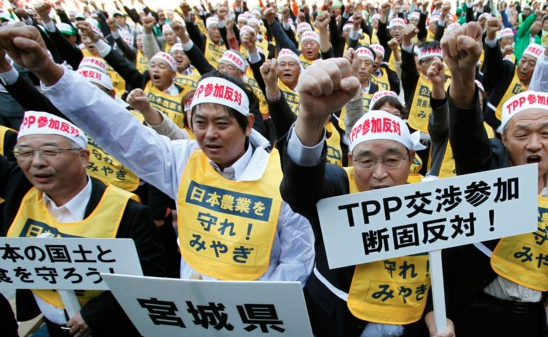
Mass protests in Japan
So, they looked to Japan. It had the same problem with its version of the trade deal similarly called TPP. Mass protests broke out as the same secret meetings gripped the political foreground. Its Prime Minister “Shinzo Abe, instructed the coalition early in the year not to “forcibly” proceed with the TPP negotiations until after elections, Kyodo News reported. Abe genuinely “feared a voter backlash in the Upper House elections” amid the growing scandal of a 242 page leaked document laying bare the bones of the deal. Having been elected June 11th, Abe now intends to force the deal through “this fall”.
I made enquiries with sources close to the ground on the EU/US TTIP deal along the same lines; was this simply a delaying tactic until after elections in 2017 for France’s Hollande and Germany’s Merkel? The response was not wholly unexpected.
“The seemingly early celebration of the end of TTIP has also surprised us a bit. Despite last week’s statements by the German and French trade ministers and the way these have been portrayed, we are continuing to campaign against the deal.”
In another exchange:
“The declarations of French and German leaders aim to: divert attention away from CETA, reduce the numbers in the streets of Germany on 17th September, put TTIP on hold while elections take place in France, Germany and the USA. The fifteenth round of TTIP negotiations will happen in the first week of October… This has been confirmed by our US friends.”
I then contacted Corporate Europe Observatory (CEO). It is a research and campaign group working to expose and challenge the privileged access and influence enjoyed by corporations and their lobby groups in EU policy making. They have been exposing the misinformation and propaganda of the EU Commission for years.
The CEO response to my same question was emphatic and quite clear:
“Public opposition to CETA and TTIP has led French and German leaders to please voters with words against TTIP. Unfortunately, the next round of TTIP negotiations is scheduled for early October and no EU leader has publicly said he or she will vote against CETA in the EU Council in October. This is clearly not the end of TTIP and CETA, just the beginning of electoral campaigns in France and Germany.”
Germany and France have taken the same stance as Japan on these trade agreements, they are not dead at all – they are lying.
I then spoke to Peter Koenig, an economist and geopolitical analyst. He is also former World Bank staff and worked extensively around the world in the fields of environment and water resources and posed the same question. He said:
“Following a debate on PressTV Edition Française, where I was one of the interviewees, the focus was on the German and French Ministers’ expressed conclusion that TTIP negotiations failed. I wrote an article “The TTIP is Dead”, hoping that spreading of this ‘promise’ by the highest authorities of the two key countries in the EU would make sure among the European populace that any deviation from this ‘promise’ would be perceived as a lie and receive strongest public expressions of protest.”
“In the meantime, it has become clear that the TTIP and TISA ‘deals’ are not at all dead. In fact, shortly after the German and French announcements, Jean-Claude Juncker, the unelected President of the European Commission, declared majestically that for him the negotiations are not dead.”
Koenig continues,
“There are other means to infiltrate the TTIP into the EU, i.e. through CETA and according to Juncker, doesn’t need ratification of each EU members’ parliament. Then there is TISA, the even more secret ‘trade agreement’ between 50 countries around the globe. TISA could easily be used to clandestinely impose TTIP rules on Europe.”
Nick Dearden, Director of Global Justice Now confirmed what Peter Koenig is saying in a Guardian piece “Think TTIP is a threat to democracy? There’s another trade deal that’s already signed”
“TTIP is not alone. Its smaller sister deal between the EU and Canada is called CETA (the Comprehensive Economic and Trade Agreement). CETA is just as dangerous as TTIP; indeed it’s in the vanguard of TTIP-style deals, because it’s already been signed by the European commission and the Canadian government. It now awaits ratification over the next 12 months.
The one positive thing about CETA is that it has already been signed and that means that we’re allowed to see it. Its 1,500 pages show us that it’s a threat to not only our food standards, but also the battle against climate change, our ability to regulate big banks to prevent another crash and our power to renationalise industries.
CETA contains a new legal system, open only to foreign corporations and investors. Should the British government make a decision, say, to outlaw dangerous chemicals, improve food safety or put cigarettes in plain packaging, a Canadian company can sue the British government for “unfairness”. And by unfairness this simply means they can’t make as much profit as they expected. The “trial” would be held as a special tribunal, overseen by corporate lawyers.”
What is missing from this statement is that any American corporation headquartered in Canada can sue any nation in the EU via CETA for the same reasons – namely, loss of ‘expected’ profits. They don’t actually have to be Canadian corporations.
As Global Justice also confirms, Canada has itself fought and lost a plentiful and diverse range of legal cases brought by US corporations under the North American Free Trade Agreement (Nafta) for “outlawing carcinogenic chemicals in petrol, reinvesting in local communities and halting the devastation of quarries.” If TTIP doesn’t bring this horrific erosion of democratic power to the shores of Europe, CETA will. ‘Brexit’ will mean for nothing. It will be sold to the British people as a global trade agreement which will be heralded as a great success and supported by much of the media who themselves have a vested interest in such deals.
In the end, does it matter if it’s called TTIP, CETA, TISA and the like, they are all shadowy unaccountable acronyms designed to enrich the few via extreme neoliberal capitalism under the guise of free trade.
European Copyright Ruling Ushers in New Dark Era for Hyperlinks
In a case which threatens to cause turmoil for thousands if not millions of websites, the Court of Justice of the European Union decided today that a website that merely links to material that infringes copyright, can itself be found guilty of copyright infringement, provided only that the operator knew or could reasonably have known that the material was infringing. Worse, they will be presumed to know of this if the links are provided for “the pursuit of financial gain”.
The case, GS Media BV v. Sanoma, concerned a Dutch news website, GeenStijl, that linked to leaked pre-publication photos from Playboy magazine, as well as publishing a thumbnail of one of them. The photos were hosted not by GeenStijl itself but at first by an Australian image hosting website, then later by Imageshack, and subsequently still other web hosts, with GeenStijl updating the links as the copyright owner had the photos taken down from one image host after another.
The court’s press release [PDF] spins this decision in such a positive light that much reporting on the case, including that by Reuters, gets it wrong, and assumes that only for-profit websites are affected by the decision. To be clear, that’s not the case. Even a non-profit website or individual who links to infringing content can be liable for infringing copyright if they knew that the material was infringing, for example after receiving notice of this from the copyright holder. And anyway, the definition of “financial gain” is broad enough to encompass any website, like GeenStijl, that runs ads.
This terrible ruling is hard to fathom given that the court accepted “that hyperlinks contribute to [the Internet’s] sound operation as well as to the exchange of opinions and information in that network”, and that “it may be difficult, in particular for individuals who wish to post such links, to ascertain whether [a] website to which those links are expected to lead, provides access to works [that] the copyright holders … have consented to … posting on the internet”. Nevertheless, that’s exactly what the judgment effectively requires website operators to do, if they are to avoid the risk of being found to have knowingly linked to infringing content.
There are also many times when knowingly linking to something that is infringing is entirely legitimate. For example, a post calling out a plagiarized news article might link to the original article and to the plagiarized one, so that readers can compare and judge for themselves. According to this judgment, the author of that post could themselves be liable for copyright infringement for linking to the plagiarized article—madness.
This judgment is a gift to copyright holders, who now have a vastly expanded array of targets against which to bring copyright infringement lawsuits. The result will be that websites operating in Europe will be much more reticent to allow external hyperlinks, and may even remove historical material that contains such links, in fear of punishing liability.
EU Lies to Moscow: Official Reveals Sanctions Not Related to Ukraine Peace Deal
Sputnik – 28.08.2016
Interviewed by Ukrainian radio station Radio EC-Evropeiska Stantsiya on the eve of his departure earlier this week, the ambassador, who played a critical support role in the EuroMaidan riots which culminated in the February 2014 coup d’etat in Kiev, explained that Russia’s ostensible obligations under the Minsk agreements were in no way connected to European officials’ decision to prolong anti-Russian sanctions. Accordingly, Tombinski noted, the sanctions can be extended whether Russia ‘complies with its obligations’ or not.
The diplomat did not reveal what exactly those “obligations” might be, given that Moscow is not even a direct party to the conflict, but a mediator. Instead, he suggested that the sanctions were connected with Russia’s “aggression” against Ukraine and the “annexation” of Crimea, whose population voted overwhelmingly to break off from Kiev and rejoin Russia amid the instability that followed the 2014 coup.
Tombinski’s remarks, essentially revealing that EU sanctions against Russia might remain in place indefinitely, come at an unfortunate time for German Chancellor Angela Merkel.
A day prior to his comments, Merkel reiterated to Czech Prime Minister Bohuslav Sobotka the oft-used mantra that the EU’s sanctions were directly connected to Moscow living up to its commitments under Minsk.
Commenting on the apparent inconsistency between the talking points used by Brussels and Berlin, Azhdar Kurtov, a senior expert at the Russian Institute for Strategic Studies, told the Svobodnaya Pressa online paper that this not the first time Western leaders have effectively lied to Moscow about sanctions being connected to concrete actions.
In fact, he suggested, it’s become somewhat of a tradition.
“It’s worth recalling that during the Soviet period, there was a legislative amendment created by US congressmen which limited US trade with our country.” Called the Jackson-Vanik Amendment and in 1974, “it was approved in connection with alleged Soviet violations of the rights of citizens of Jewish nationality.”
“This piece of legislation remained in force several decades after the legal basis itself disappeared,” (and long after the Soviet Union itself ceased to exist). That law, Kurtov suggested, was never really connected to the persecution of Soviet Jews in the first place.
Now, the situation surrounding the modern-day anti-Russian sanctions is much the same, the expert suggested. “We’re seeing the same thing today. There is the formal aspect, linked to the fact that Russia is always being urged to ‘fulfill its obligations’, even though it is not even a subject to the Minsk agreements. But that’s not the main issue: even sticking to formalities, it’s necessary to read the text of these agreements. And that’s something no one wants to do, apparently.”
Kurtov pointed out that simply going back and reading the Minsk peace deal’s 13 points confirms that neither Moscow nor the self-declared Donbass republics are responsible for violating the agreement.
“These violations don’t exist because Minsk provides a coherent chain of actions [which must be fulfilled in order]. And this chain was broken – in the sense that it’s points were not carried out, not by the Donetsk or Lugansk republics, but by Kiev authorities. Therefore, even formally, there are simply no grounds for blaming Russia.”
In reality, the expert said, Western countries’ sanctions policy against Russia has never been about things like the alleged violation of human rights or failure to live up to some agreement. After all, Russian President Boris Yeltsin’s decision to fire into the Russian parliament in 1993 was, “from the perspective of refined Western democracy, a clear violation, for which sanctions could have followed, but they didn’t.This indicates that some other issues are at stake.”
“In my opinion, these circumstances are obvious: Russia has begun to consistently pursue an independent policy.”
Throughout the 1990s, Kurtov recalled, Russia held a pro-American line in international relations, and eagerly listened to Western advisors’ advice on reforming the economy, which virtually collapsed as a result. The country’s armed forces were degraded, the latest weapons systems systematically destroyed, and Moscow withdrew from the areas around the world traditionally considered part of its sphere of influence.
“Now, when we have begun consistently and firmly asserting our national interests, and have even come to serve as a kind of ‘guide’ to other countries wishing to do the same, the main blow [from the West] has been directed against us. Sanctions serve as one form of this kind of pressure. And so an excuse was invented – and more precisely, not invented but artificially constructed. After all, the coup in Kiev took place with the direct involvement of the West.”
Effectively, Kurtov suggested that the Ukrainian crisis beginning in 2014 “was just an excuse used to try to stop a trend that started in the early 2000s – the trend of Russia strengthening itself as an active player in global geopolitics.”
Of course, the analyst admitted that Western sanctions are harmful to Russia, insofar as they limit bilateral contacts, and damage economic and trade relations. On the other hand, Kurtov emphasized that Russia “must not allow the sanctions to string us along. It’s not necessary to fulfill their requirements, since new requirements will always appear in their place so long as their reasons are contrived and artificially constructed.”
Ultimately, the expert suggested that whatever else happens, Russia must push for cooperation on an equal basis, must strive “to make it so that the Russian position is properly understood not only by the political elites of other countries, but also by their people.”
For his part, Sergei Kalmykov, the deputy director of the Association of Military Diplomats, generally agreed with Kurtov’s assessment, suggesting that unfortunately, Washington “has always regarded Russia as a strategic adversary.”
“This has been the case not just for decades, but for over a century. It’s worth recalling that as soon as the Jackson-Vanik Amendment, which continued to function for an unjustifiably long period, was repealed [in late 2012], it was immediately replaced by the so-called Magnitsky Act. Now, the Magnitsky Act has faded into the background, because the ‘Crimean issue’ and the whole situation around Ukraine has taken its place.”
“What we’re seeing is a pure political con game – a con game which simply involves the juggling of a variety of motives and terminology, but which only has one goal: to prevent Russia from emerging as a leader in global geopolitics. And today the West is using any excuse to try to carry out this policy,” Kalmykov concluded.
Armed French Police Force Woman to Strip off Burkini on Beach

Woman on Nice beach being forced to remove her burkini by armed police, Aug. 23, 2016. | Photo: AFP
teleSUR | August 24, 2016
Armed French police ordered a Muslim woman to remove her burkini swimsuit on a Nice beach Tuesday, adding further controversy to a ban on the garment amid growing Islamophobia in France.
Photographs show the woman removing her burkini—a full-body swim piece, while four armed police surround her on the Promenade des Anglais in Nice. The woman was issued a ticket by police for not wearing “an outfit respecting good morals and secularism,” according to AFP.
“I was sitting on a beach with my family … I was wearing a classic headscarf. I had no intention of swimming,” said the 34-year-old mother, who only gave her first name, Siam.
“Today we are not allowed on the beach. Tomorrow, the street? Tomorrow, we’ll be forbidden from practicing our religion at all?” Siam asked.
Mathilde Cousin, witnessed the incident and told the Guardian, “The saddest thing was that people were shouting ‘go home,’ some were applauding the police. Her daughter was crying.”
Nice is the latest of 15 towns to ban the burkini. The mayor of nearby Villeneuve-Loubet said that the ban was important to “protect the population.”
Last week three Muslim women were fined $US43 for wearing burkinis in Cannes. On Tuesday, a mother of two reported she had been fined on the Cannes beach for wearing leggings, a tunic and a headscarf.
French Prime Minister Manuel Valls defended the ban, saying that “Beaches, like all public areas, must be protected from religious claims. The burkini is not a new range of swimwear, a fashion. It is the expression of a political project, a counter-society, based notably on the enslavement of women.”
The niqab and burqa veils were banned by France in 2010. Critics say the burkini ban is steeped in Islamophobia and secular extremism. Some advocacy groups have filed legal action against the ban that “pits citizens against one another,” said Marwan Muhammad from the Collective Against Islamophobia in France.
The burkini was originally designed in 2004 by Australian-Lebanese fashion designer, Aheda Zanetti, who also created the “hijood,” a head covering that can be used by Muslim women to play sports.
“This has given women freedom, and they want to take that freedom away? So who is better, the Taliban or French politicians? They are as bad as each other,” Zanetti said to the Guardian.
Since the crackdown on burkinis, its sales have seen a dramatic increase of 200 percent, with many non-Muslims buying the swimsuit to protest its ban.
Italian imam posts photo of nuns on beach to discuss burqini ban, gets FB account blocked
RT | August 20, 2016
The imam of Florence has posted a picture of habit-wearing nuns splashing along the seashore on Facebook, calling for dialogue about burqini bans… but got his account blocked instead.
The post by Izzedin Elzir got some 2,700 shares, and came in response to the French southern cities – like Cannes and Nice – prohibiting the wearing of burqinis on the beach.
The day after the imam published his post, he awoke to find his account blocked.
“It’s incomprehensible. I have to send them an ID document to reactivate it. They wanted to make sure it’s my account – it’s a very strange procedure,” the indignant imam told La Repubblica.
On Friday, his account was back in, and the imam said he hopes it wasn’t blocked because of the picture, as it urges dialogue, and “we live in a society of law and freedom.”
He also noted that the burqini had only come into fashion among Muslim women over the past few years, and he expressed regret that “some politicians in France, instead of responding to the political and economic needs of their citizens, are focusing on how Muslims dress.”
Many online commenters tended to agree with the imam, saying that “The sea is for everyone,” and describing the ban as “a psychological tool against Muslims.”
However, others disagreed, “Don’t confuse the two different situations: these are women who have CHOSEN to religious life with the rules that it imposes, the ‘others’ are FORCED to dress even on the beach,” a comment read.
It’s not the first burqini-linked scandal this week. On Thursday, Austrian politician Ahmet Demir caused uproar after publishing a photo of two nuns and joking that they were “oppressed women” in burqas. Later, he took the post down and apologized, but defended his post saying that he was attempting to convey the message that “every woman should be able to wear what they want as long as they chose the clothes themselves.”
On Tuesday, Italy’s Interior Minister Angelino Alfano told Corriere Della Serra that Italy wouldn’t follow France’s suit and ban the burqini, but will step up regulations of imams and mosques.
Two days later, Italian authorities expelled the Tunisian imam Khairredine Romdhane Ben Chedli. The 35-year-old imam was lately absolved of terrorism-related charges, but still deemed unfit to remain in his post, the ANSA news agency said.
Will Hungary Be Next to Exit the EU?
By F. William Engdahl | New Eastern Outlook | August 17, 2016
Will Hungary be the next nation to exit the dysfunctional European Union? The question isn’t at all as far-fetched as it might seem. On October 2, voters in Hungary will participate in a nationwide referendum to vote whether they agree to the forced settlement of migrants in Hungary by the EU or not. It’s a major issue in Hungary, a land of proud and staunchly independent-minded people who have endured 150 years of Ottoman rule; wars with Habsburg Austria until the Austro-Hungarian Compromise of 1867 created a peaceful coexistence under the dual Monarchy of Austria–Hungary. After that, Hungarians were subject to the Soviet Union since 1945, initially under the dreaded Mátyás Rákosi, until it became the first Warsaw Pact communist country to declare a constitutional republic in October, 1989 and open its borders to Austria, setting in motion the domino fall of East Germany and then of the entire Warsaw Pact and, ultimately, the Soviet Union. Like every nation, they have a very special history.
It might well be said that Hungarians, always an ethnic melting-pot population whose parliament enacted the first laws of ethnic and minority rights in the world in 1849, are not a passive people when they sense something is wrong in the way they are being treated. So it is today regarding the Brussels proposal that Hungary and other EU member states must accept a Brussels-determined number of political war refugees from the Middle East and pay for all their costs whether they want them or not. Countries that refuse to take their quota would face severe financial penalties. In 2015 some 400,000 refugees arrived in Hungary in 2015 before a four-meter high razor wire fence was erected on the border with Serbia.
About half, or 200,000, attempted to gain asylum in Hungary, and after government procedures, only 264 refugees were granted political asylum. Since the erection of the fence the inflow via the so-called Balkan Route has all but stopped. The Austrian government has also decided to cooperate with the Orban government in jointly patrolling their common border.
Hungary is joined in opposing the Brussels mandatory refugee quota proposal by the Czech Republic, Slovakia and Poland–the so-called Visegrad Four group. So far only Hungary has decided on a national referendum on the issue. Polls show well over 66% opposed to the mandatory quotas, including Orban, who has urged a No vote.
Hungary’s outspoken Prime Minister, Viktor Orban, the only prime minister since 1989 to serve a full term and be re-elected, is very popular among Hungarians for speaking his mind against what he feels are wrong policies coming out of Brussels. Many Hungarians see him as a modern David pitted against the far larger Goliath, the faceless, unelected EU Commission.
On October 2 Hungarians will vote on a single question in a special national referendum: “Do you want the European Union to prescribe the mandatory settlement of non-Hungarian citizens in Hungary even without the consent of Parliament?”
Orban: ‘terror risk…’
On the war refugee issue Orban minces no words: “Hungary does not need a single migrant for the economy to work, or the population to sustain itself, or for the country to have a future,” he said in a recent interview. On the contrary, he stated, “Every single migrant poses a public security and terror risk. This is why there is no need for a common European migration policy.” Whoever needs migrants can take them, but don’t force them on us, we don’t need them.” As far as Hungary is concerned, he stated in an interview with RT, “migration is not a solution but a problem… We don’t need it and won’t swallow it.” The Hungarian government insists that the right to decide refugee issues should be reserved exclusively for national governments.
Hungary and three other central European states that constitute the Visegrad Four group, which includes Czech Republic, Slovakia and Poland, have been opposing the mandatory quotas the EU wants to impose on each member state. Last December Hungary filed a lawsuit with the European Court of Justice to thwart the EU’s attempt to redistribute incoming arrivals across the European Union. A decision could take years. The referendum is intended to give a broad popular mandate against Brussels’ forced quota attempts.
First step to EU Exit?
Clear to all from Brussels to Berlin to Budapest is that Hungarians will vote an overwhelming No to refugee forced quotas. At that point the real question will be whether Hungarians hold a second referendum, as the British did recently, to vote on leaving the EU or not when it becomes clear that Brussels will ignore the Hungarian vote with their usual deafening silence. The idea of a Hungarian EU exit is not unthinkable at all at this point now that Britain has become “first out the door,” establishing the precedent exit is possible.
The Orban government to date has moved with a certain directed caution to test the limits of EU rules. Far from a “right-wing tyrant” as Brussels bureaucrats and politically-correct mainstream EU media have portrayed him, the Oxford-educated Orban is a highly-sophisticated, apparently not corrupt (a real novelty in today’s politics if true) genuine democrat who always turns to his voters on key policy decisions to be sure he has them with him, something anathema to the unelected Brussels oligarchy.
Viktor Orban’s views on the current refugee crisis, which media deliberately misnames the far more benign-sounding mass migration situation of the EU, he outlined in detail in his February 28 annual State of the Union address to the nation, midway into his third term as (elected) Prime Minister.
Referring to the country’s recent experience extricating itself from the destructive decades of communist rule, now as an EU member state since 2004, Orban notes, “we are concerned as to how we should protect our national interests within the European Union.” This sounds reasonable enough unless one realizes that the aim of the EU as an institution is precisely the opposite–to ultimately destroy any and all national interests in favor of a top-down Brussels-centered autocracy of the unelected.
Real accomplishments
As so much about the true Hungary and Orban’s actual accomplishments is either ignored or distorted by mainstream non-Hungarian media, it’s first useful to note some of what Viktor Orban has accomplished in the first term from 1998-2002 when his Fidesz Party won in a coalition with the Hungarian Democratic Forum (MDF) and the Independent Smallholders, Agrarian Workers and Civic Party (FKGP) and in his sole majority government since 2010. After 8 years out of office, Orban’s Fidesz Party won an overwhelming popular mandate of 53% of the vote and two-thirds of Parliament seats in 2010 and re-election in 2014 to the present.
As Orban notes in his February address to the nation, “within three years we had consolidated the budget, stabilized the economy, avoided bankruptcy, curbed inflation and reduced unemployment – the latter not marginally, but from 11.5% to 6.2%. We sent the IMF packing, repaid our loan ahead of schedule, and this year we shall also repay the last blessed penny of our debt to the European Union. All in all, in 2014 we rounded off this period of stabilization with economic growth of 3.7%, and opened a new chapter.”
In addition, under Orban’s term, the government managed “in five years to reduce personal income tax from 35% to 15%, and in five years we have left 1,300 billion forints in the pockets of families. We have reduced household utility bills by 25%, and in five years the minimum wage in Hungary has increased by 50%. We have achieved this together: the state and the market; the Government and the business sector; employers and employees; Hungarian micro-, small and medium-sized enterprises and the local subsidiaries of global conglomerates… Compared with 2010, we have allocated forty per cent more funding to health care. We have halved waiting lists. We have allocated more than five hundred billion – more than five hundred billion forints – to the development of our hospitals.”
That is the background of Hungary’s present economy under Orban’s term and the background to understand why the population supports his call for a no to mandatory refugee quotas. Now his remarks on the refugee crisis are relevant.
‘name of this danger is mass migration…’
Orban continues, “I would now like to explain why I have said all this. In summary, it is because all of this is now in danger. The financial stability we have worked so hard for is in danger… Our nationally-oriented foreign policy – which has been built with such painstaking attention to detail – is in danger. Restored public order and public security free of terrorist threats are in danger. And our national culture… is also in danger.”
He gets precise: “The name of this danger is mass migration… The year 2015 brought to an end an age in which, believing that it was under Europe’s control, we took the protection and safety of our continent for granted. One year ago, on this same occasion, we were already warning that a new age of mass migration had begun. We were mocked mercilessly, and insulted by friends, allies and rivals alike… The reality is that those coming here have no intention whatsoever of adopting our way of life, because they see their own as more valuable… And why, indeed, would they give it up? The reality is that they will not provide the supply of labor needed by the factories of Western Europe. Facts show that, across entire generations, the unemployment rate is much higher – sometimes several times higher –among those born outside Europe. The reality is that the European nations have been unable to integrate even the masses who arrived from Asia and Africa gradually, over a number of decades. How could they succeed in doing so now, so rapidly and for such large numbers?”
All those statements can be argued. But here is the core point on which Orban bases his strategy of Referendum, and the ultimate reason he will next be forced after October 2 to begin preparing a ‘Huexit’ from the EU for Hungary:
“… it is hardly the migrants whom we should be so angry with. The majority of them are also victims: victims of their countries’ collapsing governments, victims of bad international decisions, victims of people smugglers. They are doing what they see as being in their own interests. The problem is that we Europeans are not doing that which would be in our own interests. There is no better word for what Brussels is doing than “absurd”. It is like a ship’s captain heading for collision who, instead of wanting to take avoiding action, is more interested in deciding which lifeboats should be non-smoking. It is as if, instead of repairing the leaking hull, we are arguing about how much water should flood into which cabins…”
Orban then continues:
“It is a big enough problem that Brussels is not capable of organizing the defense of Europe, but it is an even bigger problem that it lacks the intent to do so. In Budapest, Warsaw, Prague and Bratislava it is difficult for us to understand how we have reached a point at which it is even possible that those wanting to come here from other continents and other cultures can be let in without controls. It is difficult to understand the weakening of our civilization’s natural and fundamental instinct for the defense of ourselves, our families, our homes and our land… This is Europe. Europe is Hellas, not Persia; it is Rome, not Carthage; it is Christianity, not a caliphate. When we say this we are not claiming that we are better, but that we are different. To point to the existence of an independent European civilization does not mean that it is better or worse; it only means that “we are like this, and you are like that.”
This move by Hungary, its Prime Minister and its population is no superficial political ploy to bargain for a better deal from Brussels as David Cameron intended with his Brexit fiasco (seen from Cameron’s view). It’s a fundamental drawing of a line in the sand of the entire European Union between countries who believe in a dissolved national sovereignty in favor of a supranational Brussels-based United Europe, and those countries who fiercely intend in the wake of this refugee crisis and all its ramifications, to demand essential national sovereign rights.
Brussels, and clearly Merkel’s Berlin, will oppose Hungary tooth-and-nail to defend their supranational concept. They will do that with the backing of George Soros and his European Council on Foreign Relations think tank. Not surprising, Viktor Orban has repeatedly openly opposed Hungarian-born billionaire speculator George Soros and his NGOs for trying to destabilize Hungary. Soros money also funded the document known as the Merkel Plan, which is the direct opposition to Orban’s defense of national sovereignty over the admission of refugees.
At this point the unfortunate experiment known as the European Union is flying apart in every direction. Hungary may well be forced to rethink its EU identity after October 2 if not well before as events are going, and that will ineluctably feed the forces of dissolution in the EU, perhaps a not at all bad consequence.
Eastern Europe wants countrymen back as emigrant tide hurts GDP
RT | August 17, 2016
Twenty-one countries in Eastern and Central Europe want their citizens to return from abroad as emigration has led to a 7 percent drop in GDP. According to the IMF, the figure could grow to 9 percent if the trend continues.
Countries such as Latvia, whose population has been falling since the early 1990s due to low birth rates, have seen hundreds of thousands of people emigrate. After Latvia joined the European Union in 2004, many people left the country to seek a better life in the bloc’s more prosperous states.
Overall, the Baltic region has been hit most by the trend. Latvia and Lithuania have seen 0.6-0.9 percent of their GDP shaved off annually by emigration.
According to the IMF, Eastern European migrants’ education levels tend to be higher than their home country averages.
This has inspired a Latvian institute to launch the ‘I want you back’ campaign, inviting Latvians to tell their relatives and friends abroad they are welcome to return to the country.
“The initiative concerns our relationships with our relatives, friends and people close to us that are abroad, and [aims to] tell them clearly and directly – ‘I want you back,’” the initiative’s leader, Aiva Rozenberga, told national radio.
Latvian residents are being encouraged to use the hashtag #GribuTeviAtpakaļ (“I want you back” in Latvian) on Twitter and other social networks.
“The diaspora living abroad represent a huge untapped potential for their countries of origin,” Lithuania-based economist Rokas Grajauskas, working for Danske Bank, told Bloomberg.
Why Russia Keeps Investing in US Economy Despite Political Tensions
Sputnik – 17.08.2016
Despite deep political tensions between Russia and the West, Moscow will continue to invest its surplus of currency in US Treasuries, a reliable and stable investment tool, analysts say.
As for the end of June, Russia increased its holdings of United States Treasuries to $90.9 billion, three percent more against the previous month, according to data from the US Treasury.
A year ago, Russia held $72 billion in US Treasuries. Thus, in 12 months, Russia increased investment in the US economy by 26 percent.
Moscow is the 16th biggest holder of US debt. The top three countries are China ($1.24 trillion), Japan ($1.15 trillion) and Ireland ($270.6 billion).
Currently, Russia is dealing with a sluggish economy. However, the government has ruled out the possibility of a default. Flexible exchange rates and low sovereign debt are helping to stabilize the economy. In addition, Russia has formidable gold and foreign exchange reserves of nearly $400 billion. The Russian Central Bank plans to increase reserves, from the actual $400 billion to $500 billion.
In theory, Russian gold and foreign exchange reserves, including the Reserve Fund ($38 billion), should be put in operations and bring profits.
Currently, there is a discussion between Russian economists and politicians about the ways to boost the Russian economy.
Some say that all reserves should be accumulated within one investment fund and used to invest in the economy. However, there is the risk that such a measure will not be effective and would only accelerate inflation rate. Finally, the Russian government has confirmed it will continue to invest in foreign assets.
Relations between Moscow and Washington now seem to be at their worst phase since the end of the Cold War. At the same time, nearly a fourth of the sum ($91 billion) has been invested to the US economy.
Many in Russia have repeatedly called to abandon investment in US debt. One of the arguments is that US Treasuries have a low yield. The most popular 10-year bonds have an annual yield of 1.5 percent. This is higher than the dollar inflation rate (0.7 percent in 2015), but is still extremely low. If all of Russia’s reserves were invested in US Treasuries Moscow would gain $6 billion of annual profits and only $3 billion in real terms (adjusted for inflation in the US).
However, Russia’s gold and foreign exchange reserves as well as its sovereign wealth fund are very limited financial tools. These funds can be invested only in the most reliable assets, including bonds issued by countries with high credit ratings. By contrast, for example, Norway’s welfare fund can invest across the world, buying stakes in European, Asian and American companies.
Russia invests the bulk of its money in conservative low-yield assets denominated in US dollars and euros. In this context, investing in US Treasuries is logical and clear.
Currently, bonds issued by European countries are a bit more profitable than US debt but their reliability is in question, taking into account the permanent debt crisis in the eurozone and uncertainty about the bloc’s future.
“Treasury bonds of the US and other developed countries are the most popular tool to invest surplus of currency. It is risk-free, in terms of liquidity, volatility and the possibility of a default. In fact, US Treasuries are a low-yield deposit account that can be closed at any moment and the money can be used for other needs,” Evgeny Loktyukhov, senior analyst at Promsvyazbank, told the Russian news website Lenta.ru.
According to the expert, the Russian government is investing in the US economy because this is the only possible way to invest. Loktyukhov said that there is no significant domestic demand for foreign currency in Russia. What is more, Russia does not have a large-scale international investment program.
US treasuries are high in demand because of their reliability and high liquidity, Bogdan Zvarich, analyst at Finam, added.
“The default risk on US Treasuries is extremely low. Of course, the flip side is their low yield. Nevertheless, US Treasuries are very attractive as an investment tool. As for their liquidity, US Treasuries can always be sold in the market at actual prices without serious losses,” he pointed out.
As for the increase of Russian investments in the US economy, analysts say the reason is that the situation with moving capital across Russian borders has improved.
“Increased investment in foreign obligations, including US Treasuries, is the consequence of the improved situation with the current account balance,” Loktyukhov said.
Banking problems prevent Iran exports
Press TV – August 15, 2016
More indications emerge to show that banking problems remaining from the sanctions against Iran are still obstructing the country’s exports.
Fariborz Karimaei, the deputy head of the Association of Petrochemical Industry Corporation of Iran, was quoted by the media as saying that Iran’s petrochemical exports to Europe are facing problems as a result of sanctions-related banking issues that have not been fully settled.
Karimaei emphasized that the European banks are still failing to cooperate with the Iranian exporters of petrochemical products even eight months after the removal of the sanctions.
In January, a series of economic sanctions that had been imposed against Iran were removed after a deal that the country had last year reached with the P5+1 – the five permanent members of the UN Security Council plus Germany – came into effect.
The sanctions restricted banking transactions with the country among other issues.
Iran has been persistently urging European countries to take the required measures to encourage their banks to facilitate transactions with Tehran now that the sanctions have been removed.
However, the country’s plea appears to have fallen on deaf ears so far.
Analysts have already emphasized that the banks remain wary of the impacts of the remaining American sanctions against Iran, specifically those that address banking transactions with the country.
Reports earlier said they want a promise that the US will not prosecute or punish them for transactions involving Iran — a step the US has so far been reluctant to take.
In May, US Secretary of State John Kerry told a meeting of top EU bankers that they will not be penalized for conducting or facilitating business with Iran.
However, European banks have already emphasized that Kerry’s assurances are not enough and a series of confusions that remain over transactions with Iran need to be cleared by Washington.
Obama versus Trump, Putin and Erdogan: Can Coups Defeat Elected Governments?
By James Petras | Dissident Voice | August 9, 2016
Many of our interlocutors have been purged or arrested.
James Clapper, US Director of Intelligence on Turkish Coup, Financial Times, 8/3/16, p. 4
Washington has organized a systematic, global, no holds barred campaign to oust Republican Presidential candidate Donald Trump from the electoral process. The virulent anti-Trump animus, the methods, goals and mass media resemble authoritarian regimes preparing to overthrow political adversaries.
Comparable propaganda efforts led to political coups in Chile in 1973, Brazil 1964, and Venezuela in 2002. The anti-Trump forces include both political parties, a Supreme Court judge, Wall Street bankers, journalists and editorialists of all the major media outlets and the leading military and intelligence spokespeople.
Washington’s forcible and illegal ouster of Trump is part and parcel of a world-wide campaign to overthrow leaders and regimes which raise questions about aspects of the imperial policies of the US and EU.
We will proceed to analyze the politics of the anti-Trump elite, the points of confrontation and propaganda, as a prelude to the drive to oust opposition in Latin America, Europe, the Middle East and Asia.
The Anti-Trump Coup
Never in the history of the United States, has a President and Supreme Court Judge openly advocated the overthrow of a Presidential candidate. Never has the entire mass media engaged in a round-the-clock one-sided, propaganda war to discredit a Presidential candidate by systematically ignoring or distorting the central socio-economic issues of their opposition.
The call for the ouster of a freely elected candidate is nothing more or less than a coup d’état.
Leading television networks and columnists demand that the elections be annulled, following the lead of the President and prominent Republican and Democratic Congressional and Party leaders.
In other words, the political elite openly rejects democratic electoral processes in favor of authoritarian manipulation and deception. The authoritarian elite relies on magnifying tertiary, questionable personal judgement calls to mobilize coup backers.
They systematically avoid the core economic and political issues which candidate Trump has raised – and attracted mass support – which challenge fundamental policies backed by the two Party elites.
The Roots of the Anti-Trump Coup
Trump has raised several key issues which challenge the Democratic and Republican elite.
Trump has drawn mass support and won elections and public opinion polls by:
(1) rejecting the free trade agreements which has led major multinationals to relocate abroad and disinvest in well-paying industrial jobs in the US.
(2) calling for large scale public investment projects to rebuild the US industrial economy, challenging the primacy of financial capital.
(3) opposing the revival of a Cold War with Russia and China and promoting greater economic co-operation and negotiations.
(4) rejecting US support for NATO’s military build-up in Europe and intervention in Syria, North Africa and Afghanistan.
(5) questioning the importation of immigrant labor which lowers job opportunities and wages for local citizens.
The anti-Trump elite systematically avoid debating these issues; instead they distort the substance of the policies.
Instead of discussing the job benefits which will result from ending sanctions with Russia, the coupsters screech that ‘Trump supports Putin, the terrorist’.
Instead of discussing the need to redirect investment inward to create US jobs, the anti-Trump junta mouth clichés that claim his critique of globalization would ‘undermine’ the US economy.
To denigrate Trump, the Clinton/Obama junta resorts to political scandals to cover-up mass political crimes. To distract public attention, Clinton-Obama falsely claim that Trump is a ‘racist’, backed by David Duke, a racist advocate of “Islamophobia”. The anti-Trump junta promoted the US-Pakistani parents of a military war casualty as victims of Trump’s slanders even as they rooted for Hillary Clinton, promotor of wars against Muslim countries and author of military policies that sent thousands of US soldiers to their grave.
Obama and Clinton are the imperial racists who bombed Libya and Somalia and killed, wounded, and displaced over 2 million sub-Saharan Black-Africans.
Obama and Clinton are the Islamaphobes who bombed and killed and evicted five million Muslims in Syria and one million Muslims in Yemen, Afghanistan, Pakistan and Iraq.
In other words, Trump’s mistaken policy to restrict Muslim immigration is a reaction to the hatred and hostility engendered by the Obama-Clinton million-person Muslim genocide.
Trump’s “America First” policy is a rejection of overseas imperial wars – seven wars under Obama-Clinton. Their militarist policies have inflated budget deficits and degraded US living standards.
Trump’s criticism of capital and job flight has threatened Wall Street’s billion-dollar profiteering – the most important reason behind the bi-partisan junta’s effort to oust Trump and the working class’s support for Trump.
By not following the bi-partisan Wall Street, war agenda, Trump has outlined another business agenda which is incompatible with the current structure of capitalism. In other words, the US authoritarian elite does not tolerate the democratic rules of the game even when the opposition accepts the capitalist system.
Likewise, Washington’s quest for ‘mono-power’ extends across the globe. Capitalist governments which decide to pursue independent foreign policies are targeted for coups.
Obama-Clinton’s Junta Runs Amok
Washington’s proposed coup against Trump follows similar policies directed against political leaders in Russia, Turkey, China, Venezuela, Brazil, and Syria.
Russian President Putin has been demonized by the US propaganda media on an hourly basis for the better part of a decade. The US has backed oligarchs and promoted economic sanctions; financed a coup in the Ukraine; established nuclear missiles on Russia’s frontier; and launched an arms race to undermine President Putin’s economic policies in order to provoke a coup.
The US backed its proxy Gulenist ‘invisible government’ in its failed coup to oust President Erdogan, for failing to totally embrace the US Middle East agenda.
Likewise, Obama-Clinton have backed successful coups in Latin America. Coups were orchestrated in Honduras, Paraguay, and more recently in Brazil to undermine independent Presidents and to secure satellite neo-liberal regimes. Washington presses forward to forcibly oust the national-populist government of President Maduro in Venezuela.
Washington has escalated efforts to erode, undermine and overthrow the government of China’s President Xi-Jinping through several combined strategies. A military build-up of an air and sea armada in the South China Sea and military bases in Japan, Australia, and the Philippines; separatist agitation in Hong Kong, Taiwan, and among the Uyghurs; a US-Latin American-Asia free trade agreement which excludes China.
Conclusion
Washington’s strategy of illegal, violent coups to retain the delusion of empire stretches across the globe, ranging from Trump in the US to Putin in Russia, from Erdogan in Turkey to Maduro in Venezuela to Xi Jinping in China.
The conflict is between US-EU imperialism backed by their local clients against endogenous regimes rooted in nationalist alliances.
The struggle is ongoing and sustained and threatens to undermine the political and social fabric of the US and the European Union.
The top priority for the US Empire is to undermine and destroy Trump by any means necessary. Trump already has raised the question of ‘rigged elections’. But each elite media attack of Trump seems to add to and strengthen his mass support and polarize the electorate.
As the elections approach, will the elite confine themselves to verbal hysteria or will they turn from verbal assassinations to the ‘other kind’?
Obama’s global coup strategy shows mixed results: they succeeded in Brazil but were defeated in Turkey; they seized power in the Ukraine but were defeated in Russia; they gained propaganda allies in Hong Kong and Taiwan but suffered severe strategic economic defeats in the region as China’s Asian trade policies advanced.
As the US elections approach, and Obama’s pursuit of his imperial legacy collapses, we can expect greater deception and manipulation and perhaps even frequent resort to elite-designed ‘terrorist’ assassinations.
Featured Video
Dan Dicks with James Corbett on Solutions Watch
or go to
Aletho News Archives – Video-Images
From the Archives
Secret document reveals plans for civil war in Lebanon, Israeli false flags, and invasion
By Randi Nord | Geopolitics Alert | April 5, 2019
Beirut – During his visit with US Secretary of State, Mike Pompeo, Lebanese President Michael Aoun reportedly received a US-Israeli document detailing plans for creating a civil war in Lebanon with covert false flag operations and possible Israeli invasion.
Although the source of the document is Israeli and created in partnership with Washington, no one knows who presented it to Aoun. The Lebanese TV station, Al-Jadeed, initially reported the document on Lebanese TV and a video on its website. Geopolitics Alert translated the report for this article. … continue
Blog Roll
 Aletho News
- Sheikh al-Asadi warns of Iraqi government compliance with US demands
- How to MAKE THE CONSPIRATORS PAY for their crimes! Dan Dicks with James Corbett on Solutions Watch
- There’s a drought in academia: A drought in honest research on the subject of drought and other weather extremes
- Department of War Awards $20.7 Billion Contract to Raytheon for Air-to-Air Missiles
- ‘Distance yourselves from Israel’: IRGC urges US population to question govt policies
- America’s Greenland deal has a radioactive backstory
- The RAF Fairford ‘terror plot’: Unpacking escalation in the UK echo-chamber
- EU Council Advances Chat Control 2.0 Scanning Proposal
- Ex-Greek MEP files complaint against Israeli spyware firm over alleged Pegasus surveillance
- Troubling ideas throughout the Torah, Talmud, Mishneh Torah and Tanya
- If Americans Knew
- New Report: “Scholasticide and Genocide in Gaza: Assessment, Testimonies and Legal Analysis”
- Ex-Biden officials are desperate for a Gaza scapegoat
- Israeli “settlers” Invade Al-Aqsa; Pour Boiling Water on 75-Year-Old
- Israel Has Kidnapped Another American Teenager
- US arms sales to Israel worth $21.6 billion in 20 months
- Three Palestinians Killed in Israeli Attacks on Gaza
- Revealed: German “Anti-Semitism Expert” Driving Crackdown on Palestine Solidarity is Former Israeli Spy
- Egypt’s Warning to Israel Before Oct 7
- Israel’s siege signals another cruel winter for 1.8 million Gazans – Daily Update
- Netanyahu Asked UAE Leader to Deny Report on Oct. 7 Warning in Secret Visit, Sources Say
- No Tricks Zone
- Two More Paleo Reconstructions Affirm Meters-Higher Sea Levels Across Ireland, Brazil 7000-6000 Years Ago
- New Study: Earth And Venus Surface Warmth Largely Explained By Convection And Lapse Rate, Not CO2 Or Radiation
- 2025 Nature Paper Claiming Worsening Global Drought Gets RETRACTED …Heavily Flawed
- New Study: ‘Global Drought Shows No Detectable Recent Acceleration Under Climate Warming’
- Economic Masterminds: German Socialists Suggest Taxing Productivity Gains Stemming From Using AI
- The South China Sea Has Not Been Cooperating With The Climate Change Narrative
- Energy Crisis: Germany Enters Heating Season With Historically Low Gas Reserve Fill Levels
- New Study: The Antarctic Ice Sheet Gained Mass From 2020-2024 Due To Staggering Snow And Ice Accumulation
- Study: Ocean Heating Rates From Thousands Of Years Ago ‘Dwarf’ Modern Ocean Heating Rates
- Climate Extremists Target, Attack Large-Scale Power Grid Infrastructure In Germany!

