Russia Pushes Back on NATO Expansion
By Natylie Baldwin | Consortium News | July 9, 2016
Can Russian President Vladimir Putin turn the tables on NATO and the European Union in the Balkan states that are not yet members of the Atlanticist project? According to Filip Kovacevic, a political science professor who specializes in Russia and Eastern Europe, Putin has a plan. Some details were provided in an exclusive report in May on the nascent project by Russia to counter NATO expansion into the remaining Balkan countries that have not yet been swept into the Western alliance.
The plan has its origins in the grassroots movement that arose in the aftermath of the first Cold War, which called for non-alignment and cooperation with both East and West. Kovacevic describes the movement as follows:
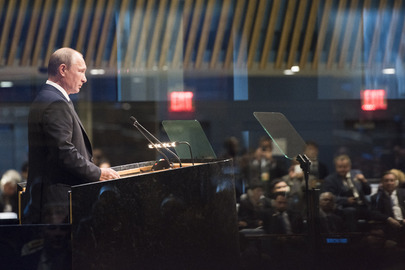
Putin addresses the UN, 09-28-15. (UN Photo)
Their members were generally young people who were enthusiastic, honest and genuinely committed to the public good, but were plagued by the lack of funding and faced with frequent media blackout and open discrimination. Nonetheless, their programs articulated the most promising and humane geopolitical vision for the Balkans. They conceptualized the Balkans as a territorial bridge between the West and the East rather than as the place of persistent confrontation, or the ‘line of fire’ as formulated by the U.S. Secretary of State John Kerry in 2015. They wanted the Balkans to become a force for peace and human dignity in the world. Their vision still remains the best option for the Balkans people.
This desire for non-alignment is understandable as a continuation of the policy of Tito’s Yugoslavia during the Cold War – the nation that several of the modern day Balkan states were a constituent part of. However, according to Kovacevic, these groups were easily overwhelmed, in terms of both financial and propaganda resources, in the 1990s by pro-NATO forces in the West.
In addition to providing resources to build up pro-NATO sentiment in the media and NGO sectors of these countries, financial resources and pressure was used to sway a large number of politicians to favor NATO membership, often in opposition to the general population’s views. Some of the unsavory forms of incentive or pressure include what amounts to blackmail and bribery, Kovacevic told me in an email interview:
This is a long-term process. In the U.S. intelligence community it is called ‘seeding.’ The intelligence scholar Roy Godson defines it as ‘identifying potential agents of influence’ at an early stage and then acting to advance their careers. This is typically done covertly, but there have been the historical examples of overt support. …
In the Balkans, the key role in the process of ‘seeding’ was accomplished by various institutes, conferences, retreats, grants, etc. For instance, I was told by a confidential source who participated in the same U.S.-NATO program, the long-time foreign minister and one-time prime minister of Montenegro, Igor Luksic, was a product of such a process. Luksic was chosen as a very young man to attend various conferences and retreats in Brussels and Washington and, after that, his political career really took off. All the while, he promoted the NATO agenda in Montenegro, even though this went against the will of the majority of the population.
Another example is Ranko Krivokapic who was the speaker of the Montenegrin Parliament for over a decade. He traveled on official business to the U.S. a few times every year and boasted to others that he had a lot of friends in the State Department and other institutions of the U.S. government. There are examples like these in Serbia, Macedonia, Croatia, etc. All over the Balkans.
There is also the fact the European Union has dovetailed its security arrangements to such an extent with NATO that new members are now virtually brought into the NATO structures by default. For example, Mahdi D. Nazemroaya, author of The Globalization of NATO, reports that the E.U.’s Security Strategy was absorbed into NATO during its annual summit in 2006. The emphasis of the summit was on securing energy resources with the goal of ‘co-managing the resources of the EU’s periphery from North Africa to the Caucuses.’ Also implied was the goal of redefining the E.U.’s security borders in synch with both Franco-German and Anglo-American economic and geopolitical interests.
Moreover, British Russia scholar Richard Sakwa, has pointed out that the security integration of the E.U. with NATO was further intensified with the ratification of the Treaty of Lisbon in 2007:
As for the comprehensive character, this is something that has been gaining in intensity in recent years as the foreign and security dimension of the E.U. has effectively merged with the Atlantic security community. The E.U.’s Common Foreign and Security Policy (CFSP) since the Treaty of Lisbon (the “Reform Treaty”) of 13 December 2007, which came into effect in 2009, is now in substance part of an Atlantic system. Acceding countries are now required to align their defense and security policy with that of NATO, resulting in the effective ‘militarization’ of the E.U.
At this point, the forces seeking a non-aligned bridge role for the Balkan states are still very much around, but have suffered marginalization due to lack of resources to take on the powerful and now entrenched pro-NATO political forces. However, with increasing discontent with the weak economic prospects in certain Balkan states, combined with increasing instability in the E.U., it is believed that there is an opening for growth of the movement.
Economic Conditions in the Balkans
The Balkan states comprise Romania, Bulgaria, Albania, Macedonia, Serbia, Kosovo, Montenegro, Bosnia-Herzegovina and Greece.
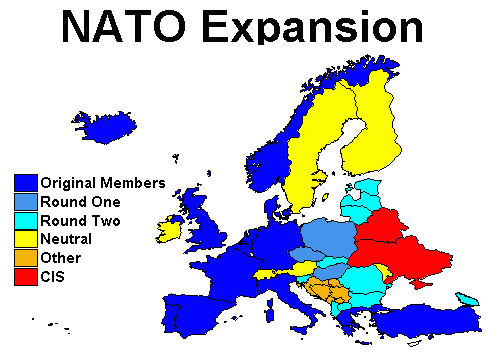
A map showing stages of NATO’s expansion. Dark blue showing original members; lighter blue the “round one” members; aqua the “round two” members; yellow represents neutral states; and brown and red otherwise aligned (including Ukraine, although that has changed since the 2014 U.S.-backed coup).
In 2007, Romania and Bulgaria became E.U. members (three years after joining NATO). Romania’s GDP has barely kept up with its 2008 rate and has a general unemployment rate of 6.4 percent, which sounds reasonable until you look at the youth unemployment rate of 21 percent, which doesn’t bode well.
Bulgaria, on the other hand, is not part of the Eurozone and has not adopted the euro as its currency. Its economic prospects since joining the E.U. have not been impressive either. In the midst of the financial crisis of 2009, its GDP contracted by 5.5 percent, with a current unemployment rate of 7 percent and youth unemployment at 17 percent. Bulgaria is also recognized as one of the union’s most corrupt countries.
Macedonia, Montenegro, Serbia, Kosovo, Bosnia-Herzegovina and Albania are all in the process of E.U. integration, with a supposed approval rate of 80-90 percent among the respective populations of these countries (except for Serbia), despite the virtual rape of Greece and the lackluster performance of Romania and Bulgaria.
It should be noted that all three Balkan nations that are actual E.U. members have higher emigration than immigration rates, another indication that accession to the E.U. doesn’t necessarily translate into a prosperous future for the average person, particularly the young.
There is also the instability highlighted by the British people’s vote to leave the E.U., spurred by disgust with austerity measures imposed by unaccountable bureaucrats in Brussels along with an influx of immigrants – one-third from these poorer E.U. nations – which adversely affect lower-wage natives.
Even if the E.U. had a better track record of effectiveness in terms of improving economic conditions for the masses, it would have a very tall order with some of the prospective Balkan states. Macedonia, for example, has an unemployment rate between 24 and 25 percent as of January 2016, although it has improved from the 2005 high of 37 percent. Despite this improvement, Macedonia still has one of the lowest GDPs in Europe and 72 percent of its citizens claimed they manage their household income only with “difficulty” or “great difficulty” in 2012.
Bosnia-Herzegovina is still feeling the effects of the war of 1992 to 1995 that included major physical destruction of infrastructure and the bottoming out of its GDP. It currently suffers an unemployment rate of 42-43 percent.
Kosovo, a state that owes its existence to a NATO intervention, has 33 percent unemployment, a high crime rate and increasing political violence due to ethnic tensions and a growing ultra-nationalist movement. The Council of Europe compared the government of Kosovo to a mafia state in a 2010 report which revealed trafficking in human organs as well as drugs and weapons throughout Eastern Europe, even implicating the then-prime minister in the operation.
Russia’s Opening
Kovacevic states that the Atlanticist project of E.U. austerity economics and the enabling of Washington’s destabilizing wars via NATO is starting to chip away at its popularity among Balkan populations. He also says Putin is prepared to take advantage of this opening and, since the outbreak of the Ukraine crisis, has turned his attention “to the Balkans with political force and funding not seen since the days of tsar Nicholas II.”
This attention has manifested in the Lovcen Declaration, which was signed on May 6, by members of Russia’s largest political party, United Russia, and the opposition Democratic People’s Party in Montenegro in the village of Njegusi. Kovacevic explains:
One of the most powerful political figures in Montenegro, the metropolitan Amfilohije, the chief bishop of the Serbian Orthodox Church in Montenegro, was present at the signing and gave his blessing. Though in the past Amfilohije has been known to support the authoritarian and pro-NATO prime minister Milo Djukanovic around the election time, he has always publicly opposed NATO membership and has given fiery speeches on its ‘evil nature’ to the point of accusing NATO for continuing Hitler’s anti-Slavic project.
Even more importantly, Amfilohije’s involvement with the Lovcen Declaration reveals one of the fundamental components of Putin’s overall geopolitical plan – the nurturing and intensification of the religious Christian Orthodox connection between the Russians and the Orthodox peoples of the Balkans. This includes not [only] the Serbs, Montenegrins and Macedonians, but also the Greeks and Bulgarians whose states are in NATO and whose religious ‘awakening’ can easily subvert NATO from the inside.
Criticism and minimization of the project have set the tone in Western media, to the extent that it has been covered at all, particularly in relation to utilizing an opposition party for significant influence. But Kovacevic argues that such a dismissive attitude is disingenuous:
[T]he very same method has been used by the U.S. and NATO intelligence services to control the governments of East-Central European states since the collapse of communism. Countless small parties with just a handful of parliamentary deputies were formed with the money coming from the various ‘black budgets’ with the task of entering the governing coalition and then steering the entire government in the direction charted by their foreign founders and mentors.
These parties have had minimal public legitimacy, but have made a great political impact with their ‘blackmail’ potential. As they also don’t cost very much, the CIA, the MI6, and the BND regularly create them for every new election cycle.
Now the Russians (primarily, the SVR and the GRU) are using the same rulebook for their own geopolitical interests. In addition, however, Putin’s grand design for the Balkans embodied in the ANS is also likely to prove durable not only because it builds on the traditional cultural and religious ties linking Russia and the Balkans, but also because it rides on the wave of the enormous present popular dissatisfaction with the neoliberal Atlanticist political and economic status quo.
The fact that this declaration was signed in Montenegro is most relevant due to the fact that the country has been officially invited to join NATO, whose subsequent membership is treated in the West as a fait accompli. However, accession requires consensus approval by all current NATO members – one member could veto the move before completion of the process as happened with Macedonia when Greece vetoed their membership aspirations in 2008 when an invitation was to be offered at the Bucharest Summit – as well as approval by the population of Montenegro.
Joining any alliance treaty is arguably something that affects national sovereignty, which requires a referendum as Kovacevic, who is Montenegrin, explains:
The corrupt government of Milo Djukanovic is trying to avoid a national referendum because it knows that it does not have a majority support for NATO. If given a choice, the people of Montenegro would reject the protocol. The Constitution requires a referendum for all matters that affect national sovereignty, but Djukanovic is arguing falsely that NATO membership leaves Montenegrin sovereignty intact.
Kovacevic predicts that a show-down over NATO membership could create instability in the country: “[I]f he [Djukanovic] tries to push this decision through the Parliament (which he no doubt will), wide-scale strikes and demonstrations may take place all over the country. Whoever is pushing Montenegro in NATO is dangerously destabilizing the country in mid-to-long term.
If that happens, Washington may find for the first time in recent memory that forcing instability on a smaller country may ultimately accrue benefits to another great power, helping to facilitate a shift in geopolitics that it didn’t bargain on. As Nazemroaya comments in his book:
The [NATO] alliance is increasingly being viewed as a geopolitical extension of America, an arm of the Pentagon, and a synonym for an evolving American Empire. … Ultimately, NATO is slated to become an institutionalized military force. … Nevertheless, for every action there is a reaction and NATO’s actions have given rise to opposing trends. The Atlantic Alliance is increasingly coming into contact with the zone of Eurasia that is in the process of emerging with its own ideas and alliance. What this will lead to next is the question of the century.
Natylie Baldwin is co-author of Ukraine: Zbig’s Grand Chessboard & How the West Was Checkmated, available from Tayen Lane Publishing. In October of 2015, she traveled to 6 cities in the Russian Federation and has written several articles based on her conversations and interviews with a cross-section of Russians.
Imagining a Different Europe: Brexit and the Future of NATO
By Gary Leupp | CounterPunch | July 7, 2016
Everyone’s talking about the future of the European Union after the Brexit. Should we not also be wondering about the future of NATO?
The two organizations substantially overlap. Twenty-two countries are members of both; that is, the twenty-two nations are both military allies of the U.S. (which pays two-thirds of the alliance’s cost and controls its politics) and members of an economic union, which—while it of course does not include the U.S., which is 5000 miles away—is of much interest to the world’s only surviving superpower.
Of course the EU and NATO have very different purposes. As we all know, the EU represents an effort to create a common market throughout the continent, allow for free travel and employment between member-states, the formation of common standards, policies etc. We know there have been major downsides for some member countries, involving reduced sovereignty, uncontrolled immigration, indebtedness and austerity programs, etc. But the stated goal, to spread general affluence, and therefore prevent war, has been stated since the EU’s forerunner, the European Coal and Steel Community, was formed in 1951.
Thus, while it’s arguably none of the U.S.’s business, U.S. leaders express opinions on EU composition. (You might think that, as leaders of a competing trading bloc, with the same relationship to the EU that Boeing has to Airbus, they would maintain a politic silence. But both presidents George W. Bush and Barack Obama have urged the EU to admit NATO ally Turkey’s admission. And Obama recently raised a ruckus in the United Kingdom when he urged its electorate to reject Brexit.)
The purpose of NATO is less clear than that of the EU. Formed in 1949 in line with the “Truman Doctrine” pledging that the U.S. would fight communism wherever it threatened the “Free World,” it was supposed to be a defensive alliance between the U.S. and its European client states versus some future (imagined) Soviet aggression against those states.
That aggression needless to say never happened. In retrospect the Cold War appears a long period of stability, with the exception of the horrific wars the U.S. inflicted on Korea and Vietnam while the Soviets stood aside, and the war the Soviets waged in Afghanistan to suppress the rebels opposed to the secular Soviet-backed government (who were then backed by the CIA, because they were so anti-communist, that being the main thing), who went on to became the Taliban and al-Qaeda.
Europe itself was actually remarkably stable during that Cold War, from 1945 to 1989. Since then there’s been horrific violence, especially in southeastern Europe, much of it exacerbated by the U.S. and NATO.
After the collapse of the Soviet Union and the dissolution of the Warsaw Pact (formed in 1955 in belated response to NATO, after NATO decided to include West Germany) in 1991, you might have thought that NATO would dissolve too. But no; it redefined its mission as maintaining “security” in a newly insecure situation. Its purpose is in fact stated in the vaguest terms. Its real function is to preserve U.S. hegemony over post-Soviet Europe, expand to surround Russia and ultimately create the conditions for a Yugoslavia-type fracturing of the Russian state—which for some reason U.S. military leaders keep referring to as the “number one threat” or even “existential threat” to the U.S.!
How the U.S. Uses the EU
The U.S. attempts to use the EU for its own geopolitical ends, particularly for this confrontation with Russia.
For example: from late 2013 to February 2014 the U.S. State Department spent $5 billion in Ukraine in order to (in the words of Under Secretary of State for Eurasia Victoria Nuland, a former Dick Cheney aide, neocon married to neocon Robert Kagan and key Hillary crony) “support the Ukrainian people’s European aspirations”—meaning the hopes of many Ukrainians for their country to join the EU.
But what Nuland, the Pentagon and NATO leaders in Europe really wanted to do was to pull Ukraine into NATO, completing the creeping encirclement of Russia that had begun with NATO’s expansion to include Poland, Czechoslovakia and Hungary in 1999.
NATO now already includes 11 countries formerly part of the Soviet bloc (Warsaw Pact) or Yugoslavia, most added during Bush’s administration but two (Albania and Croatia) admitted since. In all cases, by the way, these states first received admission into NATO, then into the EU.
Bulgaria: joined NATO 2004, EU 2007
Croatia: NATO 2009, EU 2013
Czechoslovakia: NATO 1999, EU 2004
Estonia: NATO April 2, 2004, EU May 1, 2004
Hungary: NATO 1999, EU 2004
Latvia: NATO April 2, 2004, EU May 1, 2004
Lithuania: NATO April 2, 2004, EU May 1, 2004
Poland: NATO 1999, EU 2004
Romania: NATO 2004, EU 2007
Slovakia: NATO, March 29, 2004, EU May 1, 2004
Slovenia: NATO, March 29, 2004, EU May 1, 2004
Notice a pattern? First a country commits itself to an anti-Russian alliance with the U.S., committing 2% of its GDP to military expenses and pledging to go to war against Russia when called upon to do so. Then it gets access to the benefits of EU membership.
Back to Ukraine. Ukraine in early 2014 included the Crimean Peninsula, home to the Russian Black Sea Fleet from the 1780s, a vital naval port for the Russian state that has only a few warm-water ports. (Crimea had been turned over from the Russian Soviet Socialist Republic to the Ukrainian Soviet Socialist Republic by half-Ukrainian Premier Nikita Khrushchev in 1954. After the break-up of the USSR in 1991, Russia retained its traditional military presence on the peninsula by a treaty with the Ukrainian leaders.)
But the U.S. would like to expel the Russians and make Sevastopol a NATO port. (This is not only Vladimir Putin’s nightmare; it would be a nightmare for any Russian leader. Look at a map.)
In 2013 the president of Ukraine, Viktor Yanukovych, democratically elected in an internationally monitored election in 2010, negotiated with the EU for his country’s eventual entry into the union. A substantial portion of the population, especially in the western part of the country, favored this. But when Yanukovych realized that steps towards admission would involve accepting an austerity regime comparable to that inflicted on Greece, he opted out, instead accepting a generous Russian aid offer.
Nuland & Co. depicted this as a pro-Russian leader’s capitulation to Russian pressure; again, their talking point was “Ukrainian people’s European aspirations.” (In fact, Ukrainians were divided on the issue, with fewer than 50% in favor of EU membership.)
Ukraine is ethnically divided between ethnic Ukrainians (who speak a language related to Russian, although the two languages are not mutually intelligible) and ethnic Russians who have always spoken Russian. (Russian has always been a recognized official language in the country.) There has been much intermarriage between the two, but among the ethnic Ukrainians there are many Russophobes including neo-fascists who glorify Stepan Bandera, an anti-Russian Ukrainian leader who worked with the Nazis to round up Jews and fight the Soviets in 1941. (He was declared a “national hero” by Yanukovych’s predecessor Viktor Yushchenko, a pro-U.S. advocate of NATO admission. Yanukovych withdrew this award, but it has been reinstated by the current regime.)
Taking advantage of this Russophobia, the U.S. depicted Yanukovych’s change of mind as a betrayal of “European” dreams. Working with the neo-fascist Svoboda Party, among others, it assisted in the brutal putsch of February 22, 2014, that caused the president to flee for fear of his life. A new, pro-NATO government was immediately installed, with Arseniy Yatsenyev as prime minister.
“Fuck the EU!” …and then Use It!
This is where the story gets interesting, because it reveals what the EU means to the U.S., and what it doesn’t. In an intercepted phone conversation between Nuland and the U.S. ambassador to Ukraine a month before the coup, they discuss who will succeed Yanukovych once he’s toppled. She favors NATO proponent “Yats.” The ambassador mentions the the EU favors a different candidate, whom she thinks is inappropriate. They discuss how Yatsenyev will be legitimated by a UN official sent by Ban Ki-moon.
“So that would be great, I think, to help glue this thing and to have the UN help glue it,” she concludes, “and, you know, Fuck the EU.” (In other words, this is not about any European’s aspirations. It’s about ours.)
So the coup comes off as planned. The obviously prominent role of neo-fascists in the new regime, and the immediate revocation of the existing law protecting language rights frightened and angered the primarily Russian inhabitants of the Donbass region (where Yanukovych had his base of support). They refused to accept its legitimacy. (Their resistance is invariably represented by the U.S. press in the service of the State Department as a Moscow-inspired rebellion or even Russian “invasion.”)
Russia refused to recognize the new government and quickly moved to re-annex its historical territory of Crimea. The Russian-majority population of Crimea overwhelmingly voted in a credible referendum to reunite with Russia. The U.S. media often refers to this as another “invasion” although it was nothing of the sort; there were tens of thousands of Russian troops in place by longstanding agreement, who simply secured government buildings and the borders.
Hillary Clinton, among others, likened this move to Hitler’s annexation of the Sudetenland in 1938. That is to say: something that must not meet with appeasement. And so (people are taught to believe), the practical Russian response to U.S. efforts to complete the expansion of NATO is the problem, not NATO’s relentless advance against Russia itself. Russia under Putin is the worrisome aggressor, not the U.S. leaders who invade a new country like clockwork every few years, boasting that they need to do it because theirs is the “exceptional” nation.
Some in the Obama administration favored a military response to the separatists in the east; they wanted to further arm the new regime and encourage it to assert control over the Donbass if not Crimea. It is clear this was the view of U.S. Gen. Philip Breedlove, the “Supreme Allied Commander” of “NATO Allied Command Operations” in Europe. We know from intercepted emails exchanged between him and Nuland (whom he refers to affectionately as “Toria”) that he was frustrated by the failure of Obama to order the Ukrainian puppets to more forcefully invade the east. (Initial efforts to do this had resulted in mass desertions, or soldiers retreated in the face of unarmed citizens including old women shaming them into abandoning their mission. It was a tremendous embarrassment to the Kiev regime.)
Obama decided not to heed Breedlove. In place of hot warfare he chose economic warfare. Here is where the EU comes in. In July 2014 the union (that Nuland wanted to fuck) dutifully voted to impose economic sanctions on Russia. (Again, 22 of the 28 EU members are also NATO members; the only ones that aren’t are Sweden, Finland, Ireland, Cyprus and Malta.)
The U.S. is of course not an EU member but it had a reliable surrogate within the union: the United Kingdom, which has strongly argued for sanctions, their expansion and extension to the present. (Frank Holmes, managing editor of US Global Investors, calls Britain “the bloc’s strongest supporter of restrictions.” The conservative Washington D.C. website The Daily Caller calls it the U.S.’s “strongest E.U. ally against Russia”).
The UK, which had far less to lose from the sanctions than many other EU nations, was urging its partners to shoot themselves in the foot. It was asking them to punish Russia (and damage themselves). The continental Europeans went along, some grudgingly.
Regrets (and Maybe Rebellion?)
Many have come to regret it. The Czech and Hungarian leaders have long been questioning the sanctions and expressing displeasure. Of course they want, as new members of the EU and NATO, to be team players. But their people are suffering from lost trade and pressuring them to protest. Thus Czech President Milos Zeman has called the sanctions “not merely inefficient; on the contrary, they are counterproductive.” (Only 35% of Czechs according to a 2015 Gallop poll support the sanctions.)
Hungarian Prime Minister Viktor Orban calls the sanctions a “risk in the EU… very deep, of a strategic nature.” (European Council president Donald Tusk, a Pole, calls Orban a “Trojan Horse” for Russia while Orban says Tusk is “on the other side” for opposing an easing of sanctions.)
In May, Hungarian Foreign Minister Peter Szijjarto told Russian Foreign Minister Sergey Lavrov that his government “definitely cannot accept that a decision [by the EU, on extending sanctions] was made behind the scenes, that is, we are against using an automatic procedure.” (In Hungary, only 29% of those polled favor the sanctions.)
The Polish regime has been among the most supportive of the U.S. position; anti-Russian sentiment is deep in that country for various historical reasons, and 70% of those polled support sanctions. But the Polish farmers are suffering from them. One-third of the apples harvested in Poland two years ago went to Russia; now the trade is forbidden.
Meanwhile in Spain farmers burn EU flags over piles of rotting peaches to protest the collapse of their relations with the Russian marketplace. The European Commission keeps having to pay out millions of euros to partly compensate farmers and merchants for their losses due to sanctions.
French MPs in April this year voted for a resolution to lift EU sanctions on Russia. Minister of Economy Emmanuel Macros has vowed to work towards lifting them. Italian cabinet ministers and the lawmakers in Italy’s Upper House of Parliament also want to rethink them. Maybe they’re all Trojan Horses, but if so, that’s good.
The role of Germany in the EU, as the most populous and wealthiest country in Europe, is more important than ever following the Brexit. While it has been, along with France, a strong supporter of the sanctions and their continuation, public support is waning. In May a German pollster found that 36% of Germans want the sanctions scaled down, while 35% want them scrapped entirely.
The sanctions have had disastrous impact on the German economy. Since they were imposed exports have declined by about 20 billion euros. Alstom has lost a huge contract for the construction of the Beijing-Moscow railway line. The business community generally wants the sanctions dropped.
There appears to be a general feeling that the U.S. (which is feeling few effects from the sanctions it itself imposed on Russia) pressed the EU (especially through Britain) to take measures that are not in Europe’s interest. And some surely realize that what this is all really about is the U.S.’s desire to punish Russia for thwarting its effort to bring Ukraine into NATO—through that cynical device of Victoria (“Fuck the EU”) Nuland of supporting Ukraine’s “European aspirations.
As it happens, 67% of Germans oppose bringing Ukraine into NATO, and 45% oppose bringing it into the EU. Most importantly, German support for NATO has been plummeting; it was 73% in 2009 but was 55% last year. And when asked whether Germany, in the event of a Russian attack on an east European border state that is a NATO member, should fight on the side of that state, only 38% say yes according to a Spring 2015 Pew poll.
According to the same poll, that figure is 40% in Italy, 47% in France, and 48% in both Poland and Spain. In other words, over half the people of these countries oppose the very nature of NATO as “mutual defense” alliance.
This raises the real possibility of countries leaving NATO, as well as the EU. Czech president Milos Zeman has called for referendums on his country’s membership in both. German Foreign Minister Frank-Walter Steinmeier has criticized the recent joint maneuvers in Poland, in which 14,000 U.S. troops, 12,000 Polish troops, and 800 from Britain participated as “saber-rattling.”
“Whoever believes,” he warns, “that a symbolic tank parade on the alliance’s eastern border will bring security is mistaken. We are well-advised to not create pretexts to renew an old confrontation.” In other words, the U.S. is steering NATO towards war with Russia, which the Germans know is not a good idea.
Who would have imagined a few years ago that the UK would ever leave the EU? Imagine the Czech Republic leaving this confrontational NATO alliance, joining its prosperous neighbor Austria by opting for neutrality. Imagine the Germans (who have many reasons to be angry towards the U.S., including the fact that the NSA spies on all of them) becoming fed up enough to hold their own referendum and quitting the bloc.
There is something of a precedent. France shocked the U.S. when it pulled out of the NATO Integrated Military Command Structures in 1966, in order to, as President Charles DeGaulle put it “preserve French independence in world affairs.” (It remained committed in theory to the defense of alliance members but only rejoined with conditions in 2009.)
France, which has military bases all over the world and deploys troops routinely in Africa and elsewhere (it cooperated with the U.S. in overthrowing Aristide in Haiti in 2004, as if to apologize for having opposed the U.S. war in Iraq), is very different from Germany with its stiff constitutional limits on the use of its military and generally pacifistic population. Within the EU, it is likely to replace the UK as its most important hawkish member, while Germany is likely to urge reconciliation with Russia.
There are contradictions within both the EU and NATO. They are interwoven, and some look irresolvable. That again is a good thing.
Post-Brexit, Is the EU Flaunting Its Undemocratic Tendencies?
By Joyce Nelson | CounterPunch | July 6, 2016
Stung by Brexit, the EU bureaucrats seem intent on showing just how undemocratic they can be. Here are two examples just in the last seven days.
The Glyphosate License
On June 24, EU member states again refused (for a third time this year) to approve a renewal of the license for the weed-killer glyphosate manufactured by Monsanto and other corporations involved in GMO crop cultivation. That should have meant that the license would expire by the end of June, and Monsanto’s Roundup and other glyphosate weed-killers would have to be withdrawn from Europe by the end of this year.
Instead, on June 29 the European Commission (EC) decided “unilaterally” to extend the glyphosate license for another 18 months. [1]
The decision “drew heavy criticism from the Greens in the European Parliament, who said the decision showed the Commission’s ‘disdain’ for the opposition by the public and EU governments to the controversial toxic herbicide.” [2] Belgian Green Member of the European Parliament Bart Staes said, “As perhaps the first EU decision after the UK referendum, it shows the [EC] executive is failing to learn the clear lesson that the EU needs to finally start listening to its citizens again.” [3]
Many were simply shocked that an unelected body of bureaucrats would cater so blatantly to the corporate sector’s last-minute lobbying.
The EC claims that, because of member nations’ indecision on the matter, its own decision about glyphosate was based on assessments made by the European Food Safety Authority (EFSA), prolonging the authorisation until a new scientific review is concluded before the end of 2017, but Greenpeace has called the EFSA study “a whitewash.” [4]
Lawrence Woodward, co-director of Beyond GM, has called the EC’s unilateral decision “reckless.” [5] It comes at the same time that dozens of individuals and organizations have signed an open “Letter from America,” urging European citizens, politicians and regulators to not adopt a “failing agricultural technology” and sharing examples of glyphosate and GMO repercussions across North America. [6]
CETA Ratification
At virtually the same time that the EC made this controversial decision on glyphosate, it made another that is even more undemocratic.
On June 28, a German news agency reported that European Commission President Jean-Claude Juncker told EU leaders the Commission is planning to push through a controversial free trade agreement between Canada and the EU – known as CETA, the Comprehensive Economic and Trade Agreement – without giving national parliaments any say in it. [7] According to the German press, Juncker argued that allowing national parliaments to vote on the agreement would “paralyze the process” and raise questions about the EU’s “credibility.” Juncker claimed that CETA “would fall within the exclusive competence of the EU executive” and therefore doesn’t need to be ratified by national parliaments within the 28-nation bloc, sources in Brussels told the Germany news agency DPA. [8]
Most EU members, however, view CETA as a “mixed” agreement, meaning “that each country would have to push the deal through their parliaments.” [9]
In late June 2016, the EC’s Juncker was reported as saying that he “personally couldn’t care less” whether lawmakers get to vote on CETA. [10]
Millions of Canadians and Europeans have fought against CETA for the past six years. Like the TPP and TTIP, it is a draconian agreement that would hand multinational corporations immense power to overrule elected local governments on numerous fronts. In Canada, CETA was supposed to be voted on by every Canadian provincial and territorial government before any ratification could take place, but in September 2014 (during the reign of Stephen Harper) the CETA deal was signed without there having been any public consultation whatsoever in Canada. The 2014 announcement was also the first time people in Canada and Europe were allowed to see the official text, which had been kept secret during the years of negotiations.
Unfortunately, Canada’s International Trade Minister Chrystia Freeland is enthused about what the EU is doing. According to The Globe and Mail newspaper (July 3), “The British vote to exit the European Union has refocused
Europe’s attention on the need to send a message to the world that liberalized trade is the path to greater prosperity, Ms. Freeland said.” [11]
She also explained that once the European Parliament approves CETA, “a great deal of the agreement would come into force immediately, more than 90 per cent,” she said, “those portions deemed to be within the European Union’s jurisdiction, those go into force right away.” [12]
Freeland told The Globe and Mail that concerns about CETA’s investor-state dispute settlement (ISDS) mechanism – which allows multinational corporations to sue governments over regulations that harm their future profits – had been addressed by a rewrite of the treaty’s investment chapter. [13] But according to Council of Canadians, those changes “actually make [the provisions] worse. The reforms enshrine extra rights for foreign investors that everyone else – including domestic investors – don’t have. They allow foreign corporations to circumvent a country’s own courts, giving them special status to challenge laws that apply equally to everyone through a [private] court system exclusively for their use.” [14]
Prime Minister Justin Trudeau will be in Europe this week for a NATO summit, and officials “say he will lobby hard for other European leaders not to stand in the way of [CETA’s] ratification.” [15]
The Pushback
Reportedly, the pushback in Europe has been immediate, with Germany and France wanting “their national parliaments to be involved” in CETA ratification. On July 5, Deutsche Welle reported that “Juncker appears to be backtracking,” and would propose at a July 5 EC meeting that CETA would require “both the approval of the European parliament and national legislatures.” [16]
The Globe and Mail reported on July 5 that Juncker’s “new recommendation… could call for applying those EU parts of the treaty while the ratification process [by national legislatures] is under way.” [17] That would mean (as Canada’s Chrystia Freeland had earlier explained) more than 90% of CETA could be approved by the EU as part of its “jurisdiction” and needing no national legislative approvals. Such a process would make a mockery of democratic rights on both sides of the Atlantic.
That appears to be what is happening.
Following the July 5 EC meeting in Strasbourg, France, the CBC reported: “Legal opinions advanced by the commission suggest that most of the agreement – perhaps as much as 95 per cent – falls comfortably with the European Union’s jurisdiction… ‘This is an agreement that Europe needs,’ EU trade commissioner Cecilia Malmstrom said in a statement. ‘The open issue of competence for such trade agreements will be for the European Court of Justice to clarify, in the near future. From a strict legal standpoint, the commission considers this agreement to fall under exclusive EU competence. However, the political situation in the council is clear, and we understand the need for proposing it as a ‘mixed’ agreement, in order to allow for a speedy signature’.” [18]
But as nations gear up to wrangle with the EU (in the European Court of Justice) over what parts of the CETA treaty fall within their jurisdiction, and what parts “fall under exclusive EU competence,” the EC could approve 95% of CETA before elected legislatures even vote.
The Council of Canadians warns on its website (July 5): “One important concern to note, ‘The commission may recommend provisionally applying the EU-parts of the Canada deal while full ratification is pending.’ The French newspaper Le Monde has previously reported that even if CETA is deemed to be a ‘mixed’ agreement, the deal could enter into force ‘provisionally’ even before EU member state parliaments vote on it. It notes, ‘If EU ministers agreed at the signing of the CETA on its provisional application, it could come into effect the following month. Such a decision would have serious implications. Symbolically, first because it would send the message that European governments finally [have] little regard for the views of parliamentarians and thus of European citizens strongly against the agreement’.” [19]
Council of Canadians National Chairperson Maude Barlow stated after the EC meeting in Strasbourg, “Like many Canadians, Europeans are worried about CETA’s attacks on democracy, its weakening of social and safety standards, its contribution to privatization and attacks on public services. After the Brexit vote, policy makers on both sides of the Atlantic would be better counseled to listen to voters, rather than pushing discredited [trade] solutions down people’s throats.” [20]
Global Justice Now director Nick Dearden has called CETA a “toxic deal” and says that the way the EC is acting “reinforces the widely held suspicion that the EU makes big decisions with harmful consequences for ordinary people with very little in the way of democratic process,” he said. “Rather than take a step back and question why there is hostility to the EU, they try to speed up this awful trade deal.” [21]
Union members, environmentalists, social activists and “fair trade” groups say CETA is just as dangerous as the proposed Transatlantic Trade and Investment Partnership (TTIP) deal between the EU and the U.S., which hands massive power to multinationals and is a direct threat to democracy on both sides of the Atlantic. The way the EC is handling CETA is a stark clue to what’s in store for TTIP.
Footnotes:
[1] “European Commission Extends Glyphosate License without Real Restrictions,” Sustainable Pulse, June 29, 2016.
[2] Frederic Simon, “EU muddling on glyphosate fuelled Brexit populism,” EurActiv.com, July 1, 2016.
[3] Quoted in ibid.
[4] Ibid.
[5] Katie Pohlman, “Neil Young: Say No to GMOs on ‘Behalf of All Living Things’,” EcoWatch, July 1, 2016.
[6] Quoted in ibid.
[7] “EU Commission Seeks to Push Through Free Trade Agreement with Canada (CETA) without Parliamentary Approval,” Deutsche Welle, June 28, 2016.
[8] Ibid.
[9] Reuters, “EU Commission to opt for simple approval for Canada deal: EU official,” June 28, 2016.
[10] “EU Commission: CETA should be approved by national parliaments,” Deutsche Welle, July 5, 2016.
[11] Robert Fife, “Despite Brexit vote, key EU powers vow to ratify CETA deal,” The Globe and Mail, July 3, 2016.
[12] Ibid.
[13] Ibid.
[14] Council of Canadians, “CETA changes make investor-state provisions worse,” February 3, 2016.
[15] Fife, op cit.
[16] “EU Commission: CETA should be approved by national parliaments,” Deutsche Welle, July 5, 2016.
[17] “EC set to scrap plans to fast-track CETA deal: report,” The Globe and Mail, July 5, 2016.
[18] “Canada gets clarity on how Europe will ratify trade deal,” CBC, July 5, 2016.
[19] Council of Canadians, “CETA to be considered a ‘mixed’ agreement, now more vulnerable to defeat,” July 5, 2016.
[20] Council of Canadians, “CETA vulnerable to defeat: Council of Canadians,” July 5, 2016.
[21] Lamiat Sabin “Brexit ‘Might Not Stop Awful Ceta’,” Morning Star, July 5, 2016.
Joyce Nelson is an award-winning Canadian freelance writer/researcher working on her sixth book.
New Report Exposes EU’s Security Links to Refugee-Creating Arms Dealers
Sputnik | July 6, 2016
Like peace itself, the military-industrial complex sees internal stability as bad for business. A new report has exposed the activities of military and security companies that are profiting from the ongoing conflicts in the Middle East and North Africa, which have also successfully lobbied the EU to react by buying their security equipment.
The joint report by the European NGO Stop Wapenhandel and the Transnational Institute (TNI), called “Border Wars: The Arms Dealers Profiting from Europe’s Refugee Tragedy,” reveals the most prominent winners of security contracts which were issued in Europe as a result of the migrant crisis, and Europe’s acquiescent response to their lobbying.
“Some of the beneficiaries of border security contracts are some of the biggest arms sellers to the Middle-East and North-African region, fuelling the conflicts that are the cause of many of the refugees. In other words, the companies creating the crisis are then profiting from it.”
The big players in Europe’s border security complex include arms companies Airbus, Finmeccanica and Thales, which are also three of the top four European arms traders and have been particularly prominent winners of EU contracts aimed at strengthening borders.
Other companies to benefit from the EU’s policy response to Middle Eastern conflict are French defense and aerospace company Safran, the Spanish IT and defense systems firm Indra Sistemas, and some Israeli companies like BTec Electronic Security Systems, which promote their expertise based on equipment installed at the Israeli-Palestinian border.
French companies Airbus and Thales, and Italian Finmeccanica, are part of the European Organisation for Security (EOS), which has been most active in lobbying the EU for increased border security. The report notes that many of its proposals, such as its push to set up a cross European border security agency, have eventually ended up as policy.
According to the report, the booming border security market was worth an estimated 15 billion euros ($16.5 billion) in 2015, and is predicted to rise to over 29 billion euros ($32 billion) annually in 2022.
New EU member states have been required to strengthen borders as a condition of membership, creating additional markets for profit.
“The arms business, in particular sales to the Middle-East and North-Africa, where most of the refugees are fleeing from, is also booming. Global arms exports to the Middle-East actually increased by 61 per cent between 2006–10 and 2011–15. Between 2005 and 2014, EU member states granted arms exports licenses to the Middle East and North Africa worth over 82 billion euros ($91 billion).”
On Tuesday, the German newspaper Tagesspiegel newspaper revealed that the arms industry could benefit even further from a new direction in the EU’s African policy.
According to the report, the EU Commission intends to direct some funds from its Instrument contributing to Stability and Peace towards equipping African militaries.
The fund was established in March 2014 and has a 2.3 billion euro ($2.5 billion) budget, to be disbursed between 2014 and 2020.
“Development without security and stability is not possible,” a source in the Commission told the newspaper.
“The Commission is therefore considering increasing its support for security actors,” and “in some very special cases,” this will include security forces.
The proposal to spend African development funds on security forces was criticized by the German Green Party MEP Reinhard Butikofer, who described it as “breaking a taboo.”
Die Linke MEP Sabine Losing called the idea “scandalous,” and criticized the “misuse of aid.”
She said the proposal is one of a series of “steps in the militarization of EU foreign policy.”
Unindicted War Criminal Tony Blair Calls Brexit a Coup
By Stephen Lendman | The Peoples Voice | July 5, 2016
Britain’s most reviled and discredited leader when leaving office in June 2007 allied with Bill Clinton’s rape of Yugoslavia, George Bush’s naked aggression on Afghanistan and Iraq, as well as Israel’s war on Palestine.
Greed now drives him. So does selling influence, becoming super-rich over the last decade, using secretive offshore companies and trusts, remaining unaccountable for involvement in genocidal high crimes – from Belgrade to Kabul to Baghdad to Palestine.
Responsible editors wouldn’t touch his rubbish. The New York Times featured it, Blair taking full advantage, mocking a democratic process, calling Brexit a “stunning coup.”
His deplorable record as prime minister featured loyal service to bankers and war profiteers, public welfare be damned. On leaving office, he failed trying to reinvent himself.
Impossible to ignore his sordid record. He’s a warmaker, not a peacemaker, a criminal like the Clintons, Bush and Obama.
He supported Gaza’s siege and Israeli wars of aggression. His appointment as Middle East peace envoy showed occupation harshness would continue, Palestinian statehood prevented.
He called Brexit supporters insurgents, “standard-bearers of a popular revolt… encourage(d) (and) magnified by… social media…”
EU membership comes with a huge price – loss of sovereignty to Brussels, most of all to Washington, doing its bidding, backing its war agenda, enriching its privileged class at the expense of most others, and tolerating no resistance.
Blair is part of the problem. Supporting wrong over right enriched him.
The London Independent once said years of investigation showed he “prostituted himself in pursuing Mammon.” Political friends and foes alike revile him.
-###-
Stephen Lendman can be reached at lendmanstephen@sbcglobal.net.
His new book as editor and contributor is titled Flashpoint in Ukraine: How the US Drive for Hegemony Risks World War III
Frexit: Debate Over EU Membership May Decide France’s Presidential Election
Sputnik – 04.07.2016
France has two candidates who are openly calling for exiting the European Union while another wants major overhauls sending chills down the backs of the status quo establishment.
Britain’s historic vote to abandon the European Union sparked renewed calls by French nationalist Marie Le Pen, a leading candidate for the country’s presidency, for Paris to step away from what she deemed an undemocratic and failed experiment.
The candidate took to the editorial pages of the Western press blasting the pro-EU establishment of Francois Hollande for fettering away the country’s sovereignty to an unknown cabal of bureaucrats in Brussels who can override any aspect of French law including the constitution.
Le Pen’s National Front Party is just one of many populist rightwing forces across Europe now clamoring to escape the European Union citing sometimes xenophobic concerns about the influx of Syrian refugees and a lack of political self-determination as their rallying cry against the crumbling EU.
Declared “Madame Frexit” the candidate has made her rallying call for French liberation the focal point of her candidacy promising to hold a referendum on EU membership within six months if she attains power in next year’s election.
“The People’s Spring is now inevitable!” declared Le Pen in a New York Times editorial. “The only question left to ask is whether Europe is ready to rid itself of its illusions, or if the return to reason will come with suffering.”
Marie Le Pen’s Eurosceptic platform is not unique among the country’s presidential candidates with far-left Front de Gauche (FG) party leader Jean-Luc Mélenchon also calling for France to leave the European Union citing the specter of undemocratic trade deals that risk poisoning the country’s citizens, undercutting its agricultural industry, and stripping its workers of basic protections.
Another presidential hopeful, Bruno Le Maire, a former secretary of state for European Affairs, has also demanded a referendum on redefining the European project but has not gone so far as to say that the European Union is broken beyond repair.
The emergence of two, possibly three leading presidential candidates in France demanding a so-called Frexit suggests that the issue will be front and center during the election season, but many analysts remain skeptical that any of these candidates will gain the traction needed to win.
However, recent public opinion polls show that selling the idea of the status quo may ultimately prove fatal to President Francois Hollande or former President Nicolas Sarkozy’s respective campaigns.
More than 60% of French voters view the EU unfavorably according to a recent Pew Research Center poll while another survey by the University of Edinburgh found that 33% would vote to leave versus 40% who would remain, while 22% are undecided.
The National Front’s position on French independence from the European Union grew following the Paris attacks, but the real litmus test may be how well Britain weathers the storm of their own referendum.
How the EU pushed France to reforms of labour law
Corporate Europe Observatory | June 27, 2016
The current struggle in France over labour law reforms is not just between the Government and trade unions – a European battle is waged. The attacks on social rights stem in no small part from the web of EU-rules dubbed ‘economic governance’, invented to impose austerity policies on member states.
Strikes and actions across France against reforms of the country’s labour protections, known as the El Khomri Law, demonstrate the immense unpopularity of the measures proposed by the French Government. Chiefly among them, to give preference to local agreements on wages and working conditions, when the conditions in those agreements are less favourable than the national norm inscribed in national law. This is an open attempt to undermine collective bargaining and roll back the influence of trade unions.
Ultimately, the French Government has formal responsibility for the weakening of labour protection. But there is no denying that the European Union is playing an important and perhaps decisive role in the attacks on labour rights. What we see is the EU throwing its rulebook in the French workers’ faces. Practically all the new rules on so-called ‘economic governance’ adopted following the eurocrisis have been applied, and make France look like an EU test-case. The European Commission, with the backing of the Council, has used the rules on member states’ deficits to exert pressure, threatening with sanctions, should the French Government not give in and seriously reform its labour laws. Simply put, France has been required flat out to ensure higher profitability for businesses by driving down wages.
How does all of this work?
Sanctions more likely today
First and foremost, the reforms in France are related to the country’s deficit. Like most other EU member states, the state’s finances looked pretty bad in the aftermath of the 2008 financial crisis. In 2009, a case was opened against France for breaching EU rules which stipulate that its deficit must be no higher than 3 per cent of GDP. If taken to the extreme, this ‘excessive deficit procedure’ can result in a fine of billions of euro, and – not least in the case of France – a severe loss of face to its EU partners.
The ‘excessive deficit procedure’ was given more teeth with the so-called ‘Six-Pack’ set of EU rules in 2011 – a key part of the austerity-focused economic governance package – which introduced a reverse majority vote in the Council: if the Commission does decide to fine a member state, like it has threatened to do to France, there will have to be a qualified majority against the measure from other member states to block it. Good reasons for the French Government to be slightly scared – and a weapon to be used in its attempt to convince parliamentarians. The likelihood of sanctions for not meeting the budget deficit targets is much bigger than in the past, when both Germany and France escaped humiliation. But how to meet the Commission’s strict targets, and how to behave to the satisfaction of the Commission, is what clearly links the El Khomri Law in France to the austerity regime being rolled out from Brussels.
Enabling demands of ‘structural reforms’
Being ‘in the procedure’, means you’re under close surveillance by the Commission, and with regular intervals, the case of the French deficit has been brought up at meetings with member states ministers, who have assessed if France (in this case) has made sufficient efforts to remedy the problem. Specific recommendations have been made, though until 2013 the labour law was hardly mentioned. The recommendations stuck to the development of the deficit, whether it went down at the required pace. But in 2013, there was a new tone in the Commission’s recommendations. France was asked to meet its deficit targets “by comprehensive structural reforms” in line with recommendations from the Council “in the context of the European Semester”. Structural reforms are no small matter. They are defined as changes that affect “the fundamental drivers of growth by liberalising labour, product and service markets”. Such ambitions were starting to be pushed on France at the European Semester.
But what is the European Semester? It is a procedure involving the Commission and the Council that ends with a set of recommendations for reforms to each and every member state, based on a proposal from the Commission. At the beginning in 2011, the recommendations were non-binding, but in 2013, a new set of rules went into force under the so-called Two-Pack, another part of the economic governance package intended to enforce austerity. One of the regulations of the two in the package was about measures to ensure deficits were corrected, and among other things, it made a link between the deficit procedure and the European Semester. If a member state is under the deficit procedure – like France – it would have to draw up an ‘Economic Partnership Programme’ that includes the recommendations from the Council –typically the kind of structural reforms that would have a clear impact. If the programme is not followed, then it will have a bearing on the Commission’s decision to initiate the final phase of the deficit procedure: sanctions in the form of a fine worth billions.
So, when the Two-Pack entered into force in early 2013, the tone of the messages to France on its deficit changed. France was now asked to implement “comprehensive structural reforms” of its labour law and the pension system. This had a bearing on how France would be treated under the deficit procedure and whether it would come in for sanctions, and for that reason, recommendations started looking more like demands.
In other words: whereas earlier country specific recommendations adopted under the European Semester were just that, with the Two-Pack from 2013, non-compliance could lead the Commission to take the next step towards sanctions.
“Slash wages now!”
There’s more.
In the early stages of the eurocrisis another procedure was introduced that was to work in parallel to the deficit procedure: the ‘Macroeconomic Imbalance Procedure’. This procedure allows the Commission to monitor the development of member states’ economies based on a predefined set of indicators. One of them – perhaps the most important one – measures how high the labour costs are developing (unit labour costs). If wages are not kept at bay, competitiveness suffers, and measures have to be taken, so the logic goes.
The ‘Macroeconomic Imbalance Procedure’ is also a potent weapon, as it can lead to a fine if a Eurozone member state crosses the line repeatedly and for a long time. And France has been in the crosshairs of the Commission for quite a while. Commission staff have investigated French labour law and identified what factors contribute “to limiting the ability of firms to negotiate downward wage adjustment”, and the French Government has been warned – as have many other member states – about developments in wages. In 2014, the Commission said “unit labour cost growth is relatively contained but shows no improvement in cost competitiveness. The profitability of private companies remains low, limiting deleveraging prospects and investment capacity.”
The calls for action to improve the profitability of private companies have been sent to France from Brussels on numerous occasions over the past couple of years, and have gained in strength. Thus far, the climax was in February 2015, when the Commission stepped up the procedure and singled out Bulgaria and France as the most pressing cases. The decision put France only a small step from the last stage of the imbalance procedure, the dreaded ‘excessive imbalance procedure’ which entails – exactly like the deficit procedure – a massive fine. If all fines are put together – from the deficit procedure and the imbalances procedure – they could amount to 0.5 per cent of GDP, or in the case of France, approximately €11 billion.
The final countdown
Such a prospect must be terrifying for the French Government, and in 2015, then, it would have to come up with something of substance to appease the European Commission and its partners in the Council. In March France was given two more years to bring its house in order, and if there was any doubt over the way to get there, the message to France in July was clear. Country Specific Recommendation number 6 to France under the European Semester, includes a call to “reform the labour law to provide more incentives for employers to hire on open-ended contracts. Facilitate take up of derogations at company and branch level from general legal provisions, in particular as regards working time arrangements.” In other words, the very reforms now at the centre of dispute with the El Khomri law.
The recommendation was copy-pasted from a Commission proposal; one that struck a chord among business lobby groups. In the annual ‘Reform Barometer’ of BusinessEurope, a procedure set up to influence the European Semester, the French employers association MEDEF was enthusiastic about the move, and dubbed it “extremely important” in its contribution to the Reform Barometer 2016.
End game
Who exactly has done what since the summer of 2015 is the subject of intense debate. French media outlet Mediapart suggests the German Government might have played a big role in designing the French reforms, while others believe the specifics were entirely homemade. In any case, there is no denying that the reforms were pushed heavily by the European Union, more specifically by the Commission and the Council. And the push was based on the web of rules on member states’ economic policies, sometimes called ‘economic governance’, that has been spun thread by thread since 2010. The strengthening of the deficit procedure, the European Semester, the Two-Pack, and the macroeconomic imbalance procedure have all been used for the purpose they were invented: to exert maximum pressure on member states to adopt austerity policies.
There are other similar examples in Europe at the moment. In Italy and Belgium too, you see the effect of the new tools handed over to the European Union since 2010. But France is special for its size and its power in the EU. The ongoing struggle in France can be seen as a major test case for European economic governance. If a big, powerful EU member state can be pushed to attack fundamental traits of its labour protection law, then the risk of new and stronger measures are much more likely in the future. Even if French workers are unaware of it, they’re fighting a European battle.
France wants sanctions on Russia lifted soon – foreign minister
RT | June 29, 2016
Sanctions against Russia should be lifted as soon as possible, France’s Minister of Foreign Affairs said on Wednesday following a meeting with his Russian counterpart, while insisting that implementation of the Minsk agreements still remain key to the process.
“Sanctions is not a goal in and of itself,” Jean-Marc Ayrault said in Paris, adding that his country looks forward to scrapping the restrictive measures against Moscow.
The process of lifting the Western sanctions on Russia is still related to Minsk agreements that aim to put an end to the crisis in southeastern Ukraine, Ayrault added, saying that “Russia should play a positive role” in their implementation.
Moscow and Paris have been closely working together “in the Normandy format,” Russia’s Foreign Minister Sergey Lavrov said after the meeting. The countries’ foreign ministries have been “closely cooperating” and their aides have been involved too, Russia’s top diplomat said. The Normandy format includes Russia, France, Ukraine, and Germany.
“The most important condition for the progress, as stated in the Minsk deal and in UN Security Council resolution, is establishment of direct dialogue between Kiev and Donbass,” Lavrov stressed.
Russia has repeatedly said that it’s doing everything in its power to facilitate the implementation of the Ukrainian peace deal, while Kiev has been hindering the process. The West should work with its “allies” in Kiev, President Putin has said, adding that direct dialogue between the parties to the conflict should be promoted.
Russia’s European partners should not hold Moscow solely responsible for fulfilling the Minsk agreements, Putin said at the St. Petersburg International Economic Forum (SPIEF) earlier this month, adding that there are “issues that are beyond our abilities.”
A number of the 28 countries in the European Union have expressed strong disapproval of the bloc’s restrictive measures on Russia. Italy has repeatedly called for a debate on the issue, rather than the automatic prolongation of sanctions.
In France, both the Senate and the lower house of Parliament, the French Assembly, have previously voted in favor of a resolution designed to lift the sanctions imposed by the EU in 2014 because of the crisis in eastern Ukraine and the reunification of Crimea with Russia.
Read more:
‘France should become Europe’s leader in ending Russian sanctions’
Time to send ‘strong signal’ to Russia and gradually lift sanctions – Austrian FM
Anti-Russian sanctions should be lifted ASAP – leader of Saxony, Germany
European Unification Divides Europeans: How Forcing People Together Tears Them Apart
By Diana Johnstone | CounterPunch | June 29, 2016
Paris – Unification of Europe has brought about radical new divisions within Europe. The most significant split is between the people and their political leaders.
The June 23 British majority vote to leave the European Union has made strikingly evident the division between the new ruling class that flourishes in the globalized world without borders and all the others who are on the receiving end of policies that destroy jobs, cut social benefits, lower wages and reject as obsolete national customs, not least the custom of democratic choice, all to make the world safe for international investment capital.
Actually, the lines are not quite so clear-cut. Political choices never correspond completely to economic interests, and the ideological factor intervenes to blur the class lines. Globalization is not merely a process of economic integration regulated by flows of capital, which is deepening the polarization between rich and poor in the Western countries. It is also a powerful ideology, basing its moral certitudes on simplistic lessons drawn from twentieth century World Wars: the idea that the root cause of wars is a psychological attitude called “racism” which expresses itself in the nationalism of nation-states. This ideology gains semi-religious conviction by reference to the Holocaust, which is considered to have proven the point. Ergo, for the benefit of humanity, national borders must be torn down, national identities must be diluted by unlimited immigration, in order to achieve a worldwide multicultural society in which differences both coexist and cease to matter.
This is a Utopian notion as unsupported by evidence as the Soviet dream of creating a “new man” who voluntarily works unselfishly for the benefit of all. Similarly, it considers human psychology to be perfectible by economic and institutional arrangements. Especially by promoting immigration, the multicultural mix is supposed to result in people all loving each other; there are even national laws to punish alleged expressions of “hatred”. The European Union is seen as the most advanced experiment in this worldwide Utopia of universal love. It is regarded by its intellectual sponsors such as French political guru Jacques Attali as an irreversible advance of civilization. For its fanatic champions, the very thought of dismantling the European Union is equivalent to returning to the stone age.
A chorus of Europists are screaming to high heaven that the world is about to come to an end thanks to lower class Brits too stupid and too racist to appreciate the glorious globalized world that the European elite is preparing for them. One of the fastest on the draw of his pen was the hysterical propagandist Bernard-Henri Levy, whose venom quickly spilled onto the pages of Le Monde and other obsequious journals. BHL trotted out his entire range of insults to decry the LEAVE vote as the victory of demagogy, xenophobia, the extreme right and the extreme left, hatred of immigrants, stupid nationalism, vicious hatred, the unleashed mob, idiot leftists, drunken hooligans, the forces of darkness against civilization, and even the victory of garden dwarfs over Michelangelo. Many others worked the same theme, with less verbiage.
The main theme of this wailing and gnashing of teeth is the allegation that the LEAVE vote was motivated solely by racism, racism being the only possible reason that people could object to mass unregulated immigration. But there are indeed other reasons.
In reality, for the majority of working class voters, opposition to unlimited immigration can be plainly a matter of economic self-interest. Since the EU’s eastward expansion ended immigration controls with the former communist countries, hundreds of thousands of workers from Poland, Lithuania, and other Eastern European nations have flooded into Britain, adding to the large established immigrant population from the British Commonwealth countries. It is simply a fact that mass immigration brings down wage levels in a country. A Glasgow University study shows statistically that as immigration rises, the level of wages in proportion to profits drops – not to mention the increase in unemployment.
Those who enjoy the pleasure of traveling through Europe without having to stop at borders or change currencies and who relish the luxury level of cultural diversity find it hard to understand the anguish of those who lack advanced degrees, family connections or language skills, and who feel marginalized in their own countries. Yes, some of them probably like garden dwarfs. But you cannot convince millions of people that their only prospect in life must be to sacrifice themselves for the glory of the World Market.
Moreover, whatever their social status, many people in Britain find it unbearable to renounce their traditional parliamentary democracy in order to carry out Directives and Regulations drafted in Brussels without even any public discussion.
The British
The astonishment and indignation of the Europists to see Britons vote to go out is odd considering that most Britons never really felt entirely in. When I worked as press officer at the European Parliament, I observed that the only national press corps really present and interested was the British press corps, all eagerly on the lookout for the latest absurd rule or regulation which the Brussels bureaucracy was foisting on the Member States. British media paid attention to the EU because they hated it. Ridiculing it was fun. The rest of European media were largely ignoring it because it was boring and nobody cared. Main exception: a few earnest Germans doing their job.
In the 1980s, Margaret Thatcher forced the EU to twist its rules by demanding “my money back”. The United Kingdom stayed out of the Schengen Treaty on free movement of persons. It refused the euro in favor of keeping the pound sterling. More profoundly, the insular English have always had a strong sense of not belonging to “the continent” as well as a particular sensitivity to the notorious “democratic deficit” of the European Union, which leaves law-making to the Brussels bureaucracy.
Considering the insular nature of Britain and its psychological distance from the continent, it is too soon to expect that other EU Member States will soon follow the British example. Indeed, some of the most Euroskeptical populations today were the most Euroenthusiastic in the past, notably France and Italy, and it is awkward to turn around 180 degrees. For charter Members France, Italy, Benelux and Germany, the break would be much more dramatic. Nevertheless, even in those key Eurozone countries disenchantment with the EU is growing rapidly. Brexit is seen as a warning signal. Thus the Western ruling class will hasten to try to shore up the EU-NATO fortress. The Washington Post quickly called for “strengthening NATO”. This probably means even more strident denunciations of Putin and the “Russian threat”, if such as possible. There is supposedly nothing like an external threat to bring people together.
What Next?
Unfortunately, this referendum did not mark a clean break. Two great difficulties loom. EU rules require a lengthy and complicated process to actually withdraw, a matter of years. And second, there is no viable political force ready to steer Britain through this process. The result is to split the political class still further from the people it should be representing.
The British political landscape is littered with wreckage. Conservative Prime Minister David Cameron called the referendum for internal political reasons, failing to realize that if given the chance, the British would vote to jump ship. His name is now mud all over Europe, condemned for the foolish move of letting people vote on the EU. Cameron has announced his resignation, but his government is dragging its feet in initiating the withdrawal process. Some are even demanding that the referendum be either ignored or held over again until people vote as they should – the procedure that followed previous national referendums that turned out badly for the EU. Meanwhile EU leaders are demanding that London hurry up and get out, so they can get to work strengthening the edifice.
Nigel Farage’s UK Independence Party that campaigned for leaving the EU is a single issue party with no general program and no aspiration to run the government. Former London mayor Boris Johnson has positioned himself to take over Party leadership by advocating Brexit, but he is not taken seriously by most of his own Conservative party and is also stalling on the exit procedure.
The situation of the Labour Party is critical. Jeremy Corbyn, who was elected party leader by a grass roots uprising expressing a strong popular desire to move the party to the left, comparable to the Bernie movement in Democratic Party primaries, has always been opposed by the Blairites who still dominate the party apparatus and parliamentary representation. In this uncomfortable situation the gentle Corbyn has tried to exercise what is meant to be an inclusive sort of leadership, listening to all sides. This softness already led to the mistake of failing to strongly defend party members falsely accused of “anti-Semitism” by pro-Israel zealots. Now the Blairites are blaming Corbyn for what they consider the Brexit catastrophe. It is all supposed to be the fault of Corbyn for having failed to support REMAIN vigorously enough.
Indeed Corbyn’s support of REMAIN was mild, some say because he actually favored LEAVE, but was bowing to the majority in the upper ranks of his party. This concession, if it was one, has not prevented the Blairites from demanding that Corbyn resign as party leader. Petitions are circulating both for and against him.
The trouble is that the mainstream caricature of the Brexit voters as narrow-minded racists, if not protofascists, has not been balanced by any articulation of the strong underlying rejection of the EU as a denial of democracy, as the authoritarian rule by a self-satisfied globalizing elite with total contempt for what the people might really want.
There is no political party in Britain that is at all prepared to turn away from the increasingly discredited and disavowed globalization trend in order to lead the way to a truly democratic alternative.
 Diana Johnstone is the author of Fools’ Crusade: Yugoslavia, NATO, and Western Delusions. Her new book is Queen of Chaos: the Misadventures of Hillary Clinton. She can be reached at diana.johnstone@wanadoo.fr
Featured Video
Dan Dicks with James Corbett on Solutions Watch
or go to
Aletho News Archives – Video-Images
From the Archives
Secret document reveals plans for civil war in Lebanon, Israeli false flags, and invasion
By Randi Nord | Geopolitics Alert | April 5, 2019
Beirut – During his visit with US Secretary of State, Mike Pompeo, Lebanese President Michael Aoun reportedly received a US-Israeli document detailing plans for creating a civil war in Lebanon with covert false flag operations and possible Israeli invasion.
Although the source of the document is Israeli and created in partnership with Washington, no one knows who presented it to Aoun. The Lebanese TV station, Al-Jadeed, initially reported the document on Lebanese TV and a video on its website. Geopolitics Alert translated the report for this article. … continue
Blog Roll
 Aletho News
- Sheikh al-Asadi warns of Iraqi government compliance with US demands
- How to MAKE THE CONSPIRATORS PAY for their crimes! Dan Dicks with James Corbett on Solutions Watch
- There’s a drought in academia: A drought in honest research on the subject of drought and other weather extremes
- Department of War Awards $20.7 Billion Contract to Raytheon for Air-to-Air Missiles
- ‘Distance yourselves from Israel’: IRGC urges US population to question govt policies
- America’s Greenland deal has a radioactive backstory
- The RAF Fairford ‘terror plot’: Unpacking escalation in the UK echo-chamber
- EU Council Advances Chat Control 2.0 Scanning Proposal
- Ex-Greek MEP files complaint against Israeli spyware firm over alleged Pegasus surveillance
- Troubling ideas throughout the Torah, Talmud, Mishneh Torah and Tanya
- If Americans Knew
- New Report: “Scholasticide and Genocide in Gaza: Assessment, Testimonies and Legal Analysis”
- Ex-Biden officials are desperate for a Gaza scapegoat
- Israeli “settlers” Invade Al-Aqsa; Pour Boiling Water on 75-Year-Old
- Israel Has Kidnapped Another American Teenager
- US arms sales to Israel worth $21.6 billion in 20 months
- Three Palestinians Killed in Israeli Attacks on Gaza
- Revealed: German “Anti-Semitism Expert” Driving Crackdown on Palestine Solidarity is Former Israeli Spy
- Egypt’s Warning to Israel Before Oct 7
- Israel’s siege signals another cruel winter for 1.8 million Gazans – Daily Update
- Netanyahu Asked UAE Leader to Deny Report on Oct. 7 Warning in Secret Visit, Sources Say
- No Tricks Zone
- Two More Paleo Reconstructions Affirm Meters-Higher Sea Levels Across Ireland, Brazil 7000-6000 Years Ago
- New Study: Earth And Venus Surface Warmth Largely Explained By Convection And Lapse Rate, Not CO2 Or Radiation
- 2025 Nature Paper Claiming Worsening Global Drought Gets RETRACTED …Heavily Flawed
- New Study: ‘Global Drought Shows No Detectable Recent Acceleration Under Climate Warming’
- Economic Masterminds: German Socialists Suggest Taxing Productivity Gains Stemming From Using AI
- The South China Sea Has Not Been Cooperating With The Climate Change Narrative
- Energy Crisis: Germany Enters Heating Season With Historically Low Gas Reserve Fill Levels
- New Study: The Antarctic Ice Sheet Gained Mass From 2020-2024 Due To Staggering Snow And Ice Accumulation
- Study: Ocean Heating Rates From Thousands Of Years Ago ‘Dwarf’ Modern Ocean Heating Rates
- Climate Extremists Target, Attack Large-Scale Power Grid Infrastructure In Germany!

