The EU attacks our pay and undermines unions
By BRIAN DENNY | Morning Star | June 3, 2016
THE EU is not defending workers’ rights as the Remainiacs never cease to claim.
In fact the EU is directly behind the huge assault on wages, pensions, collective bargaining and other workers’ rights across the EU, including the current battle going on in France.
Moreover it is being done in contravention of its own treaties in a typically bureaucratic and Byzantine way.
Officially, the Treaty on the Functioning of the European Union (TFEU, Article 153.5), explicitly states that the EU has no competences in the area of wage policy.
Yet this has not prevented EU institutions such as the European Commission, the European Central Bank (ECB) or even the European Council from demanding wage “moderation” across the EU.
The Broad Economic Policy Guidelines (BEPG), regularly produced by the Commission since 1993, always included demands for wage “moderation.”
However a new system of European economic governance began to emerge in 2010 with the adoption of the controversial, neoliberal Europe 2020 strategy, which included a yearly cycle of EU economic policy co-ordination.
This explicitly includes wage policy which is considered the most important adjustment variable for promoting “competitiveness.”
The legal basis for this new form of “authoritarian neoliberalism” as it has been called comprises above all the Euro Plus Pact adopted on the initiative of Angela Merkel and Nicolas Sarkozy in March 2011.
As a result, while EU competence over wage policy is still expressly forbidden, with the Euro Plus Pact wage policy intervention at EU level is now mystically allowed.
Now the EU issues annual policy recommendations for all member states which must then be transformed into national “reform programmes” whose effectiveness will again be assessed by the EU.
The annual economic co-ordination cycle was further developed in 2011 with the adoption of a package of five Regulations and one Directive.
The so-called “six-pack” contains two new major instruments in order to intensify economic policy co-ordination: one is the establishment of a new system of surveillance and the second is the introduction of fines on those countries that fail to comply.
The 2013 Treaty for Stability, Co-ordination and Governance (TSCG) further reinforced mechanisms to enable the EU to “co-ordinate and monitor the economic and budgetary policies of the member states.”
Each February the Commission publishes detailed reports on each country and their “progress.” This year’s report pointed out an “excessive” imbalance — too much public expenditure and a lack of competitiveness.
However, it recorded “substantial progress in the matter of reducing the cost of labour and retirement pension reform.”
On April 13, the French government adopted its EU National Programme of Reform (NPR) and acquiesced to EU demands for “giving more latitude to companies, to adapt wages and working hours to their economic situation” — ie huge changes to French employment law.
It is this that French workers are fighting against.
The scope for EU attacks on wages and collective bargaining expanded most rapidly in those crisis-hit countries which rely on “bailouts” from the EU and/or the International Monetary Fund (IMF).
In exchange for bailouts, these countries had to introduce “reforms” laid down either in so-called memorandums of understanding with the Troika of EU, European Central Bank (ECB) and IMF in the case of Greece, Ireland and Portugal, or in “stand-by arrangements” with the IMF, in the case of Hungary, Latvia and Romania.
These policy measures comprised attacks on wages, social services and public ownership and far-reaching labour market “reforms” including the abolition of systems of collective bargaining.
There is a simple reason for this — where there is no collective bargaining there is a decline in wages.
For the hard-line German member of the ECB Executive Board Joerg Asmussen, labour market “reforms” such as removing collective rights are even “the key if a country wishes to remain within the euro.”
As a result attacks on workers at national level are being driven by a new EU interventionism in an unprecedented way.
For example prior to the 2008 crisis, Romania had a legal system that supported dialogue between trade unions, employers and the government, resulting in widespread collective bargaining at all levels.
By 2011, at the behest of the EU, the government had scrapped all collective agreements and changed, without parliamentary debate, the main labour laws, making it impossible to have cross-sectoral collective agreements.
The recession was thus exploited by the EU and a compliant government in Bucharest as a pretext to rip the guts out of the existing industrial relations system and lower labour costs.
Even the EU-funded European Trade Union Confederation general secretary Bernadette Segol identified two fronts where collective bargaining is coming under attack: the decentralisation of bargaining and allowing employers to ignore trade union bodies in favour of non-union bodies.
Addressing the theme of Social Europe, she points out that “policies that are being implemented are attacking industrial relations systems, putting pressure on wages, weakening public services and weakening social protection.
“These are the core aspects of the social model,” confirming the view of many observers that the model is now dead — if indeed it was ever alive at all.
Brian Denny is a spokesman for Trade Unionists Against the EU.
Will Anyone on the Left Stand Up for Brexit?
By Oliver Pawley | CounterPunch | June 9, 2016
Goldman Sachs, JP Morgan, The IMF, David Cameron, George Osborne, Hillary Clinton, Mark Carney — it’s a list of names that many on the left would surely like rather see condemned than side with in a democratic debate. Yet the build-up to the forthcoming referendum on Britain’s EU membership sees them doing exactly that. While those figures emblematic of exiting the EU — Boris Johnson, Michael Gove and Nigel Farage — aren’t very appealing to those of liberal instincts, allying with them offers a chance to shake-up the status quo. In an age where democracy is heavily curated by corporate power, is it not better to assume a disruptive islander mentality than a supine federalist one? Will anyone on the left stand up for Brexit?
Rousseau once mocked British democracy by claiming the British public were ‘free only during elections’. Given that it was 1975 last time we had a referendum on European membership and a great deal of power has been transferred from our parliament to the EU since then, by Jean-Jacques’ logic it’s 41 years since we were last ‘free’. Should Britain really fear being in charge of its own affairs more than continuing along its current path?
If we consider domestic politics in Britain we see a governing Conservative Party that in its last two budgets has attempted to rob from the poor and give to the rich to such an extent that it has caused national outcry. Plans to remove tax credits for low earners in 2015[i] and reduce benefits for the disabled this year[ii] have had to be rescinded. With some laughably optimistic predictions about fiscally beneficial future growth the Chancellor, George Osborne, manages to hang on to his tax cuts for the rich. The British public are starting to see what a Tory majority looks like in practice and it’s quite a shock compared to the coalition government that preceded it. Then, the Liberal Democrat party acted as set of humanitarian reins to steer the Conservatives away from their worst excesses and sacrificed itself electorally as a result. Up and down the land voters are feeling the effects of savage cuts to the budgets of their local councils: youth centres are closed, roads go unrepaired, and teachers lose their jobs in a manner that is completely incompatible with building a country fit for success in the twenty first century[iii]. Brexit would cause chaos in the Conservative party, fatally wound Cameron and Osborne, and yet commentators on the left shy away from urging voters to take a shot at this open goal. It’s as though Britain’s liberals are scared of the chance to run the country.
Goldman Sachs warn us that homebuilders and banks would be the worst affected if we chose to leave the EU[iv]. It’s hard to think of two sets of industries that have failed the British people more in recent years. The UK faces a housing crisis because the emphasis has been on serving vested interests by maintaining overly high property and land values rather than focusing on the need to house an expanding population. Banking is lauded in the media as an industry of huge importance to Britain but is there really much future growth to come from it? Banks’ main product is debt, which is something we in the developed world already have too much of. The future of UK banking looks rather more like the moribund loss-making and largely nationalised Royal Bank of Scotland[v] than a dynamic saviour. Brexit might force the UK to diversify its economy away from the dominant property and finance nexus, which provides economic growth but of a precarious, iniquitous and [spoiler alert] ephemeral kind.
At least twice George Osborne has warned the British that leaving the EU would cause house prices to fall, the second time he came out with a figure of 18 per cent as an upper bound. UK house prices could halve and they would still be high — particularly in London and the South East. The latest wheeze to extend the bubble appears to be the introduction of intergenerational mortgages.[vi] This kind of financial ‘innovation’ combined with ever rising student debt means Britain’s young graduates face a lifetime of debt servitude. If Brexit really could bring down house prices the millennials and the generation beneath them ought to be clamouring for it, yet the pollsters suggest they don’t and that three-quarters of 18 to 24 year-olds want to remain.[vii]
The threats from the Remain camp that leaving the EU will be a catastrophe for the UK’s economic cooperation with the continent are overblown. Anyone who has spent any time in central London recently will have noticed the huge quantity of continental Europeans employed in the capital. It seems very unlikely that their home countries, many of which are beset with economic difficulties, would want all these people delivered back to them. It is also hard to believe that those countries would wish to jeopardise tourism from the UK, or the spending power of British pensioners living out their days in the sunshine of Southern Europe. The idea that deals could not quickly be done to facilitate movement between Britain and the EU as well as mutually beneficial trade agreements is absurd given that it would be in nobody’s interests, least of all big business, to do otherwise. Angela Merkel’s recent hint that Britain ‘will never get a really good result’ in negotiations if it leaves the EU is unlikely to be popular with German firms which exported 90 billion Euros worth of goods and services to the UK last year.[viii]
Much of Britain’s left perceives the EU as some sort of enlightened force for good but this isn’t a notion that stands up to much scrutiny. Has it formed a bulwark against US imperialism as we were told it would? Not at all, European leaders have meekly followed America’s neo-conservative agenda leading to disaster. Indeed, Europe’s refugee crisis is the direct result of the Western establishment’s gauche attempts at terraforming Iraq, Libya and Syria into groves of economic opportunity for the few. Sadly, the recent terrorist attacks on European soil haven’t raised the right questions about events both at home and abroad. Instead of trying to curb civil liberties and drop more bombs, European leaders ought to be considering the deeper reasons for discontent. Is Brussels’ Molenbeek district really a hotbed of jihadist sentiment because of a few internet videos and radical clerics or does it have more to do with the 40 per cent unemployment rate of Muslim men?[ix] Is a foreign policy that supports the continued ruination of Muslim lives abroad ever going to be compatible with amicable relations at home? The EU’s eastward expansion has also played a part in the bloody civil war in the Ukraine and heightened tensions with Russia.[x]
Then we have economic policy which has been a disaster. Where was the European sense of fraternity when Greece as in trouble? It completely disappeared. Europe’s leaders chose to protect their failed bankers and broken single currency and throw the Greek people under a bus. Of the 240 billion Euros that was ‘given’ to Greece in 2010 and 2012 a miniscule amount actually went to improving the lot of the Greek people, the vast majority found its way into the coffers of financial institutions.[xi] Compare this to Iceland which sits outside of the EU. Its response to the financial crisis was not to kotow to bankers but to jail them. The government didn’t seek to absorb all the country’s private banking debt but put its people first and financial institutions second.[xii] The Icelandic economy has now recovered to a size above its pre 2008 peak, a target far away from the likes of Greece. While the Goldmanite European Central Bank chairman Mario Draghi prepares to pump money into a corporate black hole[xiii], the youth of Southern Europe see their futures evaporate into a sclerotic mist of unemployment, under-investment and hopelessness. Why does Britain’s left wish to support an EU that propagates such unfairness? Is it not time to admit that Europe has been captured by financiers and will not prosper until their influence is reduced and un-payable debts written-off? Ironically, by leaving the EU Britain may stimulate a shift away from the current failed orthodoxy.
Given seven years of economic stagnation in the Eurozone you might imagine that the lessons of letting unelected technocrats take the big decisions would have created a desire to move to a more democratic system. The truth is that even now EU officials attempt to bargain away our rights with the secretive TTIP agreement. Rumoured to be a corporate manifesto that relegates the role of the state to that of a butler for business interests it’s hard to reconcile it with the needs of the masses[xiv]. So when the most disappointing President of the United States ever, Barack Obama, warns us that we’ll be going to the ‘back of the queue’ for trade negotiations if we exit the EU, we should grab the opportunity with both hands. If the majority of British people were privy to the contents of TTIP it’s likely the idea of being in the queue at all would be deeply abhorrent.
Obama’s is just one of many voices from across the Atlantic urging Britain to stay in the EU. Eight former US Treasury Secretaries wrote to The Times newspaper urging us to stay in. Three names stand out: Larry Summers, Hank Paulson and Tim Geithner. These architects of neo-liberal disaster have overseen a huge transfer of wealth from the bottom to the top in the United States. Summers helped sow the seeds of the 2008 financial crisis as a cheerleader for the Gramm—Leach—Bliley—Act, which repealed much of the Glass—Steagal safety net[xv]. Casino capitalism came to the fore and after the inevitable financial collapse Paulson masterminded the Troubled Asset Relief Programme (TARP) giveaway to Wall Street[xvi]. Geithner continued in much the same vein, scandalously failing to stop executives of AIG being rewarded for failure with enormous bonuses effectively paid for with government money[xvii]. The only people whose interests apparatchiks like these represent are the very wealthiest, the rest of us can safely ignore their advice. Similarly, the warnings of the IMF’s Christine Lagarde should go unheeded; her organisation is there to protect the few not enrich the many[xviii]. Defying the wishes of the IMF is a rare democratic opportunity which should not be ignored by those who seek a fairer world.
The honourable intentions to use European integration as a means to avoid another European conflict as damaging as The Second World War were all well and good, but they are the solution to an obsolete problem. Today’s fight is no longer between nation states but between an exploitative global economic elite and the rest of us. Voting for Brexit is a blow to their ambitions and the natural choice for anyone who wishes to challenge the doomed status quo. Don’t vote for Brexit because you are a small-minded xenophobe, vote for Brexit because it is a chance to challenge the cabal of venal politicians who are dragging Western Civilisation towards crisis with their continued deference to corporate power, misguided use of military force, and disdain for democracy.
Notes.
[iii] https://www.jrf.org.uk/report/cost-cuts-impact-local-government-and-poorer-communities
[iv] http://www.theguardian.com/politics/2016/mar/21/brexit-would-hit-banks-homebuilders-goldman-sachs
[v] http://www.ft.com/cms/s/0/2b9428ec-dc58-11e5-a72f-1e7744c66818.html#axzz4AQgnyN7u
[viii]https://www.destatis.de/EN/FactsFigures/NationalEconomyEnvironment/ForeignTrade/TradingPartners/Tables/OrderRankGermanyTradingPartners.pdf?__blob=publicationFile
[xi] http://www.theguardian.com/world/2015/jun/29/where-did-the-greek-bailout-money-go
[xiii] https://www.ecb.europa.eu/press/pr/date/2016/html/pr160602.en.html
[xv] https://en.wikipedia.org/wiki/Lawrence_Summers
[xvi] https://en.wikipedia.org/wiki/Troubled_Asset_Relief_Program
[xvii] https://en.wikipedia.org/wiki/Timothy_Geithner
[xviii] http://www.theatlantic.com/magazine/archive/2009/05/the-quiet-coup/307364/
Most European Nations Act More Like US Colonies Than Sovereign States
By Stephen Lendman | June 5, 2016
Instead of declaring their independence, most European nations let Washington pressure, bully and bribe them to go along with its imperial agenda, harming their own national security.
Economic powerhouse Germany remains occupied since WW II ended, permitting numerous US bases on its territory, some jointly operated, harming its security, not protecting it.
Instead of normalizing relations with Russia, a reliable ally, Die Welt newspaper said a new Defense Ministry White Paper near completion lists it as one of Germany’s 10 major threats, despite no credible evidence suggesting it – plenty proving otherwise.
Other threats include international terrorism – without explaining it is US created and Berlin supported. Terrorist groups can’t exist without state sponsors.
According to sources quoting what the report says, Russia is Germany’s key rival, using “hybrid instruments to blur the boundaries between war and peace… undermin(ing) other states.”
Moscow’s military strength (almost entirely on its own territory, solely for defense and fighting terrorism in Syria), technological capability, nonexistent “aggression,” reunification with Crimea, and ability to influence public opinion are contrived reasons for considering Moscow a key rival and threat, not a partner – despite Putin urging cooperative relations with all nations, the world’s preeminent peacemaker.
Germany’s Merkel is polar opposite. So are most other European leaders, allied with Washington’s killing machine, humanity’s greatest threat.
She urges greater militarism, not less, at a time demilitarization and all-out efforts for world peace are desperately needed.
The alternative is endless war, European nations threatened because of allying with Washington’s imperial agenda instead of firmly opposing it for their own self-interest.
Stephen Lendman lives in Chicago. He can be reached at lendmanstephen@sbcglobal.net.
His new book as editor and contributor is titled Flashpoint in Ukraine: US Drive for Hegemony Risks WW III.
NATO Baltic wargames have ‘political, economic & military motives’
RT | June 5, 2016
The US strategy in Europe is aimed at strengthening its control over EU and NATO states, selling more military equipment to its European allies to make super-profits for its military-industrial complex and to isolate Russia, political author Diana Johnstone told RT.
NATO is holding major sea drills in the Baltic Sea. The BALTOPS exercises, which kicked off on Friday in Estonia and will continue until June 19, involve 15 member states of the military alliance as well as Finland and Sweden.
RT: NATO is conducting major drills across the Baltic. Is there a bigger political message here or is it just an exercise?
Diana Johnstone: Yes, they have been doing exercises like this for quite a while and the pretext changed. At least this time they are not pretending like with the missile shield that it is to protect Europe from Iran. The line has changed now, because the US is coming right out with their aggressive actions toward Russia. You have to see the political, economic and military motives for this. The economic motive is obviously to sell more US military equipment to European allies, who don’t need it and can’t afford it. But that is important for the US military-industrial complex. Politically this is the strengthening of US control of EU countries and NATO countries, and to isolate Russia – to carry out this famous [Zbigniew] Brzezinski strategy of separating Russia from Europe to promote US hegemony over the Europe and the world.
RT: A lot of people in Eastern Europe oppose this kind of strategy. The general public is not particularly happy about this, are they?
DJ: Of course those Baltic States, whose governments by the way are satellite governments of the US. The top officials studied in the West, in the US and Canada. These have gone from being Russian satellites to be American satellites. They pretty much follow the US direction. But that is not the case of the rest of Europe, which is simply ignoring this, like it is not happening. The Czechs are aware of it, so they are protesting. But for instance, here in France nobody mentions this, because frankly people wouldn’t be in favor of it at all. This is destroying defense of Europe. It is just turning into an instrument of US policy.
RT: Last week, NATO Secretary General Jens Stoltenberg announced plans to strengthen defenses, particularly against Russian foreign policy calling it “a defensive and proportionate response to Russia’s actions in Crimea and Eastern Ukraine.” At the same time recently he said that they strived “for a more constructive relationship with Russia.” Shouldn’t it be more talking going on, rather than deploying troops and hardware?
JS: We are used to now seeing the US – in the Middle East they say one thing and do the opposite. It’s just amazing to me that people can say things like that. It is totally absurd. Obviously there is nothing offensive about the people of Crimea going back to Russia, to which they belonged before… There is not tiny bit of an aggressive move of Russia towards the West. That is a total fiction… So these people are just lying. They cannot know that.
European Commission’s Hate Speech Deal With Companies Will Chill Speech
By Jillian York | EFF | June 3, 2016
A new agreement between the European Commission and four major U.S. companies—Facebook, Google, Twitter, and Microsoft—went into effect yesterday. The agreement will require companies to “review the majority of valid notifications for removal of hate speech in less than 24 hours and remove or disable access to such content,” as well as “educate and raise awareness” with their users about the companies’ guidelines.
The deal was made under the Commission’s “EU Internet Forum,” launched last year as a means to counter what EDRi calls “vaguely-defined ‘terrorist activity and hate speech online.’” While some members of civil society were able to participate in discussions, they were excluded from the negotiations that led to the agreement, says EDRi.
The agreement has been met with opposition by a number of groups, including EDRi (of which we’re a member), Access Now, and Index on Censorship, all of which have expressed concerns that the deal with stifle freedom of expression. The decision has also sparked debate on social media, with a wide variety of individuals and groups opposing the decision under the hashtag #IStandWithHateSpeech.
But you don’t have to stand with hate speech to stand against this decision. There are several reasons to oppose this Orwellian agreement. First, while Article 19 of the International Covenant on Civil and Political Rights allows states to limit freedom of expression under select circumstances, such limitations are intended to be the exception, and are permitted only to protect the following:
-
The rights or reputations of others,
-
national security,
-
public order,
-
public health, or
-
morals.
These limits must also meet a three-part test as defined by the ICCPR: be defined by law; have legitimate aim; and be truly necessary. While some of the speech that concerns the Commission may very well qualify as illegal under some countries’ laws, the method by which they’ve sought to limit it will surely have a chilling effect on free speech.
In addition, as EDRi points out, despite a lengthy negotiation between companies and the Commission, “hate speech” remains vaguely-defined. Companies have been tasked with taking the lead on determining what constitutes hate speech, with potentially disastrous results.
In fact, social media companies have an abysmal track record when it comes to regulating any kind of speech. As Onlinecensorship.org’s research shows, speech that is permitted by companies’ terms of service is often removed, with users given few paths to recourse. Users report experiencing bans from Facebook for 24 hours to up to 30 days if the company determines they’ve violated the Community Standards—which, in many cases, the user has not. Requiring companies to review complaints within 24 hours will almost surely result in the removal of speech that would be legal in Europe.
By taking decision-making outside of the democratic system and into backrooms, and granting corporations even greater control, the European Commission is ensuring a chill on online speech.
Dreams of Control: Israel, Global Censorship and the Internet
By Binoy Kampmark | CounterPunch | June 3, 2016
“Under the cover of darkness, there is no limit to the expansion of Big Brother.”
Ilan Gilon, Meretz Party (Israel), Times of Israel, Feb 4, 2016
While Israel’s central justification for its often reactionary policies is couched in hyper-exceptionalist rhetoric, nourished by the ashes of Holocaust remembrance, current interest in censoring the Internet is far from exceptional.
Like a machine of justification against its critics and its enemies, Israel enlists various projects under the banner of the remarkable and precious, when it is simply accomplishing what other states have done before or since: the banal and ordinary. All states want to limit expression, control criticism and marginalise the sceptics. Some do it more savagely, and roughly, than others.
Israel’s military censor, Col. Ariella Ben Avraham, who is part of the IDF’s Directorate of Military Intelligence, gave a good example of this in February by insisting that social media activists and bloggers submit material relevant to security matters for approval prior to posting. The move also revealed an increasing interest to police the digital realm, previously considered an anarchic jungle incapable of effective policing.
Up to 32 Israeli bloggers and social media activists were informed about the directive, one of the first being Yossi Gurvitz, a left-wing activist running the “Friends of George” Facebook page. In rather unceremonious fashion, he was informed via Ben Avraham’s private Facebook account that he was obligated to run future submissions by her office. To his credit, he promises to defy the order.
Internal censorship is but one aspect of this policy. Israel Public Security Minister Gilad Erdan has dipped into the discourse of censorship to convince others that limiting various social media platforms on a global scale is the way to go. In January, he revealed the inner ambition of Israel’s security establishment to internationalise the censorship effort.
To achieve that goal, Erdan speaks of an “international coalition” that would make limiting criticism of Israel its primary objective. The central aim is hardly imaginative: making such providers as YouTube, Twitter and Facebook face up to responsibility as to what they host on their sites.
The Erdan plan suggests that various countries would form a “loose coalition that would keep an eye on content and where it is being posted, and members of the coalition would work to demand that the platforms remove the content that was posted in any of their countries at the request of members.” The simple idea behind this collusion is extra-territorial cooperation, effectively circumventing the global nature of such platforms.
As for the scurrilous subject matter itself, the issues are universal fare for states keen to control matters that supposedly stimulate the darker side of human nature. (Read: contrary to state interests.) Erdan’s office gives the example of material from a Palestinian (of course) disclosing the best locations on the body to inflict fatal stab wounds.
This begs that grand question about how far such an effort goes: control the more sordidly violent sides of the Old Testament because it encourages various unsavoury practices? Limit suggestive literature being discussed in the whirl of social media, buzzing away with malicious promise? The mind is an untidy place filled with remarkable things, and not all of them necessarily make it to actual perpetration. This is a point that continues to elude the mighty warriors of the security state.
Another justification is being thrown in: they, the social media giants, rake in the proceeds, and should therefore man the barricades. “We are planning to put a stop to this irresponsibility,” claimed Erdan’s office, “and we are going to do it as part of an international coalition that has had enough of this behaviour as well.”
Other governments have also done their bit to limit the internet and content available to their citizens. Most famously, Beijing runs its own “Great Firewall of China”, overseen by the Ministry of Information Industry (MII), while the State Council Information Office and the Chinese Communist Party’s Propaganda Department examine content.
In recent times, countries of a supposedly democratic character have taken to the blinds and endeavoured to do what Erdan dreams about. Dangerous thoughts are seen as the reason for dangerous actions. To that end, the country that gave Europe the Enlightenment has been busy forging its own vision of global internet censorship, using a mixture of security and privacy concerns.
The latter has proven to have potentially pernicious consequences, framed largely as an effort to protect the privacy of the French citizen. From that vantage point, a vision of global control has been built on a premise forged in European law: the right to be forgotten. The Court of Justice of the European ruling of May 13, 2014 (Google Spain v Agencia Española de Protección de Datos, Mario Costeja González) has supplied the subject matter for the latest enlargement of censorship powers.
The French response has been intrusively enthusiastic, with the privacy regulator, CNIL, fining Google 100,000 Euros in March for not applying the right to be forgotten across the global network. In the chilling words of the regulator, “For people residing in France to effectively exercise their right to be delisted, it must be applied to the entire processing operation.” Erdan may well be irritated he did not come up with that one.
Binoy Kampmark was a Commonwealth Scholar at Selwyn College, Cambridge. He lectures at RMIT University, Melbourne. Email: bkampmark@gmail.com
Unclear if EU will renew sanctions against Russia: German FM
The BRICS Post | May 31, 2016
German Foreign Minister Frank-Walter Steinmeier on Tuesday hinted that the renewal of European Union sanctions against Moscow was not yet certain as many countries in the 28-member bloc have raised questions about its efficacy.
“The sanctions are there to ensure a political solution. I don’t know what the European Council will decide on Russia sanctions,” Steinmeier said.
Steinmeier’s comments came weeks ahead of the EU meet that is expected to renew the sanctions against Russia. For sanctions to be extended beyond July, all 28 EU members would have to be in agreement.
The sanctions were imposed following Crimea, an erstwhile part of Ukraine, voting to join Russia in 2014.
Earlier on May 27, Germany’s Federal Foreign Office spokesperson, speaking on behalf of Foreign Minister Frank? Walter Steinmeier, issued a statement saying that “sanctions are not an end in themselves but need to serve to provide an incentive for the political behaviour we would like to see”.
“In the current situation this means that a demand for all or nothing will not bring us any closer to our goal. If substantial progress is made, the gradual reduction of sanctions must also be an option. This is one point on the agenda of the European debate that is just beginning,” said the statement.
The German Foreign Minister had held talks with Russian President Vladimir Putin at the Kremlin on 23 March this year during which the two sides discussed “bilateral relations, Russia’s relations with the European Union”.
On Monday, Russian Foreign Minister Sergey Lavrov said Russia has no plans of recognising the self-proclaimed republics of Ukraine.
Moscow’s move to recognize the self-proclaimed Donetsk and Lugansk People’s Republics would be counterproductive as this would give the West a pretext to stop pressure on Kiev on implementing the Minsk peace deal, Lavrov said in an interview with Komsomolskaya Pravda website.
“I’m convinced that this will be counterproductive,” Lavrov said, stressing that it is very important that the documents signed in Minsk are implemented.
During a state visit by Russian President Vladimir Putin, Greek Prime Minister Alexis Tsipras has criticised the West’s “vicious circle of militarization, of Cold War rhetoric and of sanctions”.
“We have repeatedly said that the vicious circle of militarisation, of Cold War rhetoric and of sanctions is not productive. The solution is dialogue,” Tsipras said in a press conference following talks with Putin on Saturday.
“Everyone recognises that there cannot exist a future for the European continent with the European Union and Russia at loggerheads,” he added.
Earlier in January this year, French Finance Minister Emmanuel Macron also said that France is not keen on the EU extending sanctions against Russia beyond July.
“The objective we all share is to be able to lift sanctions next summer because the process has been respected,” he told Le Figaro.
The US and the EU Support a Savage Dictator
By Brian CLOUGHLEY | Strategic Culture Foundation | 31.05.2016
On May 6 a court in Istanbul, acting on the orders of Turkey’s President Recep Erdogan, sentenced the editor of the Cumhuriyet newspaper to five years and ten months in prison for publishing a report about illegal provision of weapons to Islamist terrorists in Syria by Turkey’s secret service. His bureau chief got five years.
Two weeks later Istanbul was host to the World Humanitarian Summit, which was held «to stand up for our common humanity and take action to prevent and reduce human suffering». Attendance included 65 heads of state. It was the usual total waste of time (Oxfam called it «an expensive talking shop» and those who refused to be there included President Putin and the global medical charity Médecins Sans Frontières), but the point is that a humanitarian conference should never have been held in Turkey, which is being transformed into a dictatorship by a president who is well-described by Professor Alan Sked of the London School of Economics as «a volatile, unstable, highly authoritarian personality».
The professor went on to observe that Erdogan «has pursued a civil war in his own country and has clamped down on the opposition and social media at will. Thousands have been imprisoned for merely criticising him. He has ordered the shooting down of a Russian warplane, and his country has been accused by Russia of trafficking secretly in oil with Isis. He cannot be trusted…»
Erdogan is a bigoted thug, yet the international community rushed to his country to hold a humanitarian conference and foreign heads of state flock to press his hand in friendship. He is treated with deference around the world and there can be no public criticism of him in the many countries that have laws prohibiting disparagement of heads of state and holding defamation and insult of their leaders to be a criminal offence punishable by imprisonment.
In January over 1,100 Turkish academics signed a letter asking Erdogan to cease his merciless blitz on Kurdish centres in the south east of the country. Thousands of Kurds had been (and continue to be) killed and crippled by ground and air assaults of merciless savagery. Erdogan’s response to the petition was to declare that these compassionate scholars «spit out hatred of our nation’s values and history on every occasion. The petition has made this clearer… In a state of law like Turkey, so-called academics who target the unity of our nation have no right to commit crimes. They don’t have immunity for this».
Some thirty of the humanitarian signatories were arrested and fifteen were dismissed from their university posts. They live under constant threat, as do all who attempt to disagree with the imperial president.
Yet Erdogan’s Turkey is strongly supported by the United States and by the European Union, albeit for very different reasons.
The US backs him because he supports Washington’s efforts to destroy President Assad of Syria and is a strident and aggressive opponent of Russia, while the EU is behind him because if he chose he could control the influx of Syrian refugees to Europe. So Erdogan can persecute and jail as many journalists and academics as he likes, while continuing to slaughter Kurds in Turkey, Syria and Iraq, and although there may be a few murmurs of disapproval in Brussels and Washington there will be no action whatever taken by either the US or the EU to stop the President of Turkey wielding absolute power over his people.
In March, while Erdogan was attending the 2016 Nuclear Security Summit in Washington (yet another total waste of time and money, except for the travel industry) he met separately with the US president and vice-president, neither of whom had the moral courage to take him to task for his blatant oppression of those of his citizens who dare to have ideas and opinions contrary to his own.
As the Voice of America reported on March 31, «President Barack Obama assured his Turkish counterpart of American commitment to the security of Turkey, a critical ally in the fight against the Islamic State group», while the White House “readout” of the Erdogan-Biden meeting recorded that «the Vice President reiterated the United States’ unwavering commitment to Turkey’s national security as a NATO Ally». They discussed «ways to further deepen our military cooperation» which was no doubt heartening to a bellicose thug whose aim is to persecute and preferably kill Kurds wherever they may be.
In spite of all the evidence, the United States refuses to acknowledge that Erdogan’s Turkey has sent massive quantities of weaponry to Islamic terrorist groups who are prepared to kill Kurds. It does not appear to matter to Washington that «Not only has Erdoğan done almost everything he can to cripple the forces actually fighting ISIS; there is considerable evidence that his government has been at least tacitly aiding ISIS itself».
The countries of the European Union, in similar blinkered mode, ignore Erdogan’s transformation of Turkey from democracy to dictatorship because they are prepared to make almost any sacrifice to reduce the flood of refugees now threatening their countries. Their leaders are terrified that behaving in a humanitarian manner will damage their domestic electoral chances and have set up an extraordinary deal with Erdogan who has agreed to «do more to prevent refugees from traveling to Europe via its territory and take back all migrants and refugees who manage to cross into Europe from Turkey … In return, the European Union has doubled the financial aid it promised Turkey from 3 billion to 6 billion euros, has agreed to take in more Syrian refugees from Turkey, and will move to provide visa-free travel to Turks and reopen EU accession talks».
Little wonder that Erdogan is on the crest of a wave and can persecute dissenters and slaughter Kurds with hardly a word of international criticism. In March, when he took over Turkey’s largest newspaper, the independent Zaman, and replaced the entire staff with his supporters, US State Department spokesman John Kirby called the seizure «troubling». And it was reported on 25 May that, «the EU wants Ankara to narrow its definition of terror to stop prosecuting academics and journalists for publishing ‘terror propaganda’, but Turkey has refused to do so».
Unless the US and the EU bring pressure to bear on Erdogan to restore democracy in his country, he will continue to suppress and persecute his critics and continue his killing spree. But he is too valuable to them for that to happen. All they will do is hold more humanitarian conferences.
EU’s extension of Syria bans impede political settlement: Syrian official
Press TV – May 28, 2016
A Syrian official has censured the European Union (EU)’s recent extension of sanctions against the government of President Bashar al-Assad, saying the move could be an impediment to efforts for finding a political solution to the Syrian conflict.
Khalaf Muftah, the head of the ruling Ba’ath Party’s department of culture and information, made the criticism in an interview with Russia’s Sputnik news agency on Friday.
The EU bans are illegal and contradict international law and the United Nations (UN)’s Charter, Muftah said, adding, “These measures hamper the political process, because they increase the sufferings of the Syrian nation and do not promote the creation of conditions for a political dialogue with Europe.”
He further called for the lifting of the economic blockade on Syria, noting that the measure has led the Syrian nation to poverty and misery and forced people to migrate.
“The sanctions contradict the statement that migration has political causes, because the real cause is the economic blockade imposed by Europe,” he said.
The remarks came hours after the European Commission, the EU’s executive arm, extended its sanctions against the government in Damascus until June 2017.
The bans include investment restrictions, an embargo on Syrian oil and a freeze on Syrian central bank assets within the 28-nation bloc. They also cover export restrictions on certain equipment and technologies as well as travel bans and asset freezes against more than 200 people and 70 entities.
The measures come as part of an EU decision in December 2014 to continue sanctions against Syria as long as what the bloc calls government repression goes on.
The development comes as some European countries and their regional allies are accused of supporting terrorist groups that have been wreaking havoc in the Arab country over the past five years.
Europe Revolts Against Russian Sanctions
By Finian CUNNINGHAM | Strategic Culture Foundation | 26.05.2016
From ministerial offices to barricades on the streets, Europe is in open revolt against anti-Russian sanctions which have cost workers and businesses millions of jobs and earnings. Granted, the contentious issues are wider than anti-Russian sanctions. However, the latter are entwined with growing popular discontent across the EU.
Germany’s vice chancellor Sigmar Gabriel is among the latest high-profile politicians to have come out against the sanctions stand-off between the European Union and Russia.
At stake is not just a crisis in the economy, of which the anti-Russian sanctions are symptomatic. It is further manifesting in a political crisis that is challenging the very legitimacy of EU governments and the bloc’s institutional existence. The issue is not so much about merely trying to normalize EU-Russian relations. But rather more about preserving the EU from an existential public backlash against anti-democratic and discredited authorities.
Gabriel, who also serves as Germany’s economy minister, said that relations between the EU and Moscow must be quickly normalized. And he called for the lifting of sanctions that have been imposed since early 2014 as a result of the dubious Ukraine conflict. The EU followed Washington’s policy of slapping sanctions on Russia after accusing Moscow of «annexing» Crimea and interfering in Ukraine’s internal affairs. The charges against Russia are tenuous at best and are far removed from the mundane pressing concerns of ordinary EU citizens, who are being made to bear a heavy economic price for a stand-off that seems unduly politicized, if not wholly unwarranted.
Russia responded to the sweeping sanctions by implementing counter-measures banning exports from the EU and the US. The stand-off has hit the European economies hardest, with the Austrian Institute of Economic Research estimating that the trade war will cost the EU over €100 billion in business and up to 2.5 million in jobs. By contrast, the US has scarcely felt a pinch from the trade impasse.
Germany, Europe’s biggest economy with the largest trade links to Russia, has suffered most from the sanctions rift. Up to 30,000 German businesses are invested in Russia, amounting to as many as half a million jobs in danger and €30 billion in lost revenues, according to the Austrian Institute of Economic Research.
In one German state alone, Saxony-Anhalt, the local economy minister Jorg Felgner says that exports to Russia have been slashed by 40 per cent, with the loss of €200 million to his state. Felgner is among the growing chorus of EU voices who are calling for the anti-Russian sanctions to be lifted when the EU convenes in July to decide on whether to extend its embargo or not.
The EU has been reviewing its sanctions policy on Russia every six months since 2014. To extend the measures, a unanimous decision is required among all 28 member states. It looks increasingly unlikely that the EU will maintain its hitherto unanimity. It can be safely assumed that if Brussels were to end the sanctions, then Moscow will respond in kind to promptly resume normal trade with the bloc.
In addition to the country’s vice chancellor, Germany’s foreign minister Frank-Walter Steinmeier has also expressed disquiet with the ongoing EU-Russian tensions stemming from the sanctions. Steinmeier noted that «resistance to anti-Russian sanctions is growing across the EU».
He also reiterated dismay over a fundamental contradiction in EU policy objectives. «How can we expect Russia’s help in solving the Syrian crisis while at the same time imposing economic sanctions on Russia?» asked Steinmeier.
It’s not just Germany that is growing leery with the deterioration in relations with Russia. Hungary and Italy, which have also strong historic trade ties with Russia, are increasingly opposed to the EU’s policy towards Moscow, according to a recent Newsweek report.
Added to the maligned mix is Greece. The country’s six-year economic crisis has been greatly exacerbated by the loss of a once-bustling agricultural export business to Russia. The country’s finance minister Dimitrios Mardas attributed major losses specifically to the anti-Russian sanctions, which have piled on fiscal deficits to the teetering Greek economy. Greece is no isolated problem. It threatens to undermine the whole EU from its chronic bankruptcy.
In France, the National Assembly’s Lower House voted last week by 55 to 44 votes to end the EU sanctions on Russia. The vote is non-binding on the government of President Francois Hollande. Nevertheless, it demonstrates the growing popular opposition to what is widely seen as a self-defeating policy of trade antagonism with Russia.
The cancellation last year by the Hollande government of the Mistral dual helicopter-ship contract with Moscow epitomizes the self-inflicted pain on French workers. The cancellation – cajoled by Washington – cost the French government revenues of over €1.5 billion and has put thousands of shipyard jobs at risk. Paris claims to have since directed the ships’ order to Egypt, but that remains doubtful.
The economic losses from anti-Russian sanctions have rebounded severely on French farmers too. Dairy, meat, vegetable and fruit exports to the once lucrative Russian market have been pummeled. Hollande recently vowed to release €500 million in state aid to placate angry farmers. The absurdity is not lost on the French agricultural sector that such state handouts would not be necessary if the Hollande government hadn’t sabotaged Russian markets in the first place by following US hostility towards Moscow, as in the case of the Mistral fiasco.
France’s economic problems, as with the rest of Europe, are not entirely related to the downturn in relations with Russia. But there seems little doubt that the issues intersect and are compounded. And the public knows that.
Hollande – the most unpopular French president since the Second World War – is ramming through draconian labor reforms. The president and his truculent prime minister Manuel Valls claim that the retrenchment of workers’ rights will boost the economy and reduce France’s soaring unemployment rate of 10 per cent nationally and 25 per among French youth.
In opposition to the French government’s deeply unpopular assault on workers’ rights, the country is to observe nationwide strikes this week. The protests have been going on now for several months and seem set to escalate, as Hollande’s administration digs its heels in and refuses to relent.
Among students and farmers joining France’s nationwide strike are workers in the transport sectors of road haulage, rail, shipping and airports. With exports to Russia slashed due to the French government-backing of EU sanctions, the transport sectors are among the hardest hit. The Hollande government’s attempt to force through labor cuts, purportedly to reinvigorate the economy, is seen as it trying to offload responsibility for economic woes on to workers and businesses. If Hollande did not pick a fight with Russia – at Washington’s goading – then the country’s economy wouldn’t be under such duress.
Across Europe, the popular revolt against economic austerity is bound up with the EU’s self-defeating sanctions on Russia. And it is leading to a crisis of authority among EU governments who are held with increasing disdain by their citizens. More enlightened political leaders like Germany’s vice chancellor Sigmar Gabriel and foreign minister Frank-Walter Steinmeier are obviously aware of the geopolitical connection that citizens are making.
As Europe’s economic crisis deepens, the policy of anti-Russian sanctions is tantamount to the EU cutting off its nose to spite its face. The growing public disaffection is also fueling the electoral rise of anti-EU political parties in Germany, France, Britain, Netherlands, Hungary, Poland, Slovakia and other member states.
Mainstream EU parties like the ruling coalition government in Berlin realize that the EU’s trade war with Russia is simply becoming untenable. It is an ideologically driven and dubious antagonism that the EU can ill-afford. That policy speaks to EU citizens of a political leadership that is losing legitimacy from its fundamentally wrongheaded and anti-democratic governance. As well as from slavish pandering to American hegemonic ambitions.
Brussels, in following Washington’s hostility to Moscow, is inflicting further economic pain on the bloc’s 500 million citizens. Something has to give way if Europe is not to implode, or explode, from popular fury. Normalizing relations with Russia is not the whole solution to Europe’s economic and political crises. But such a move would certainly alleviate. And is long overdue.
EU governments are thus facing a stark choice. Are they to continue on the path of destruction at Washington’s reckless behest, or can they find an independent policy of pursuing mutual relations with Russia? Undoing the crass anti-Russian sanctions is taking on an urgency – before such a policy leads to the undoing of the EU itself.
Featured Video
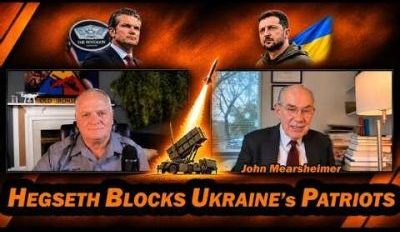
John Mearsheimer: Why Russia Gains By Hitting Ukraine Harder
or go to
Aletho News Archives – Video-Images
From the Archives
A Climate Scientist Who Engages Skeptics
By Judith Curry | November 27, 2009
An open letter to graduate students and young scientists in fields related to climate research:
Based upon feedback that I’ve received from graduate students at Georgia Tech, I suspect that you are confused, troubled, or worried by what you have been reading about ClimateGate After spending considerable time reading the hacked emails and other posts in the blogosphere, I wrote an essay that calls for greater transparency in climate data and other methods used in climate research. The essay is posted over at climateaudit.org.
What has been noticeably absent so far in the ClimateGate discussion is a public reaffirmation by climate researchers of our basic research values: the rigors of the scientific method (including reproducibility), research integrity and ethics, open minds, and critical thinking. Under no circumstances should we ever sacrifice any of these values; the CRU emails, however, appear to violate them. … continue
Blog Roll
 Aletho News
- Content control: USAID docs expose Biden admin’s grip on Ukraine coverage
- Ukraine destroying itself: every attack on the Crimean Bridge will come at a price
- NATO capital under protest siege, so NATO escalates war
- A Climate Scientist Who Engages Skeptics
- John Mearsheimer: Why Russia Gains By Hitting Ukraine Harder
- Argentina’s Perito Moreno Glacier Joins Antarctica and Arctic In Defying Doomsday Melt Claims
- ‘Chinagate’ Is Here
- Iran, four other countries condemn US plans to deploy weapons in outer space
- US media brings back the Iraq war playbook and why it won’t work
- Zakharova schools German FM on history basics
- If Americans Knew
- An error has occurred; the feed is probably down. Try again later.
- No Tricks Zone
- Alarmist Climatologists In Shock! 2026 Atlantic Hurricane Season Sees Lowest Count In 101 Years
- New Study: Modern Temps Are Among The Coldest Of The Last 10,000 Years In East Central Europe
- Germany’s Renewable Energies Lead to 1.4 Billion Euro Electric Power Trade Deficit
- Argentina’s Perito Moreno Glacier Joins Antarctica and Arctic In Defying Doomsday Melt Claims
- New Study: Barents Sea Temperatures Were Warmer And Sea Ice Less Extensive In The 1700s Than Today
- German Authorities Start Initiative To Evaluate Public Register For Climate “Disinformation” Spreaders!
- Zonal Asymmetry of Temperature Change in the Antarctic Circumpolar Current
- New Study: The Net Fossil Fuel Contribution To Rising Atmospheric CO2 Has Been Zero For 500 Years
- Germany’s Green Energy Transition Becoming Increasingly Expensive…Another 6 Trillion Euros!
- Sudden Stratospheric Warming, Powerful El Niño Combination May Lead To Extreme Europe Cold, Energy Crisis!

