UK Calls to Add Hezbollah’s Resistance to EU’s Terror Watch List
Ahlul Bayt News Agency – September 8, 2012
 British, Dutch foreign ministers urged EU nations Friday to impose sanctions on the military wing of Hezbollah for providing support to Syria’s President Bashar al-Assad.
The European Union has long resisted pressure from the Zionist entity and the U.S. to list Hezbollah, with many member states saying it was important to keep lines of contact open to a powerful organization in the Lebanese politics.
“It is necessary to move on that. I think we’ve taken action on that in the U.K. and I would like to see the EU designate and sanction the military wing of Hezbollah,” UK Foreign Minister William Hague said on his way into an EU foreign ministers meeting in Cyprus.
Dutch Foreign Minister Uri Rosenthal said the European Union should brand Hezbollah a terrorist organization, a move that would enable the bloc to freeze the group’s assets in Europe.
“We have for quite some time now argued that effective European measures should be taken against Hezbollah,” Rosenthal said on the sidelines of a meeting of EU foreign ministers in Cyprus to discuss the EU’s response to the Syrian crisis.
The U.K. lists Hezbollah’s military wing as a terrorist group. The Netherlands, like the U.S., lists the group but doesn’t distinguish between its military and political wings, despite the fact that the party of Resistance to occupation is a member of the Lebanese government.
But other EU member states, which have blacklisted the Palestinian Islamic group Hamas, have resisted U.S. and Zionist pressure to do the same to Hezbollah.
The Hezbollah issue has long divided European capitals. When the George W. Bush administration pushed Europe to list Hezbollah in 2005, a number of countries, led by France, opposed it. The issue hasn’t been seriously addressed since then.
Several EU countries have argued that such a move could destabilize the balance of power in Lebanon and add to tensions in the Middle East.
Some European diplomats say it would also be legally difficult to blacklist Hezbollah without a court ruling in an EU state that linked the group to terrorism.
“Until now the Europeans have said that to designate a group as a terrorist organisation you have to have a judicial process under way against this organisation, which is not the case at the present time,” said French Foreign Minister Laurent Fabius.
Hezbollah, the Lebanese party of resistance, was set up in 1982 to fight Zionist forces which had invaded Lebanon. If it weren’t for the military wing of Hezbollah, the Lebanese land wouldn’t have been liberated in May 2000, and Lebanon wouldn’t have gained victory in the July 2006 war which the Zionist entity launched against it.
Related articles
- EU turns down Israel call to put Hezbollah on terror list (alethonews.wordpress.com)
- In Whose Name Are You Speaking? A Response to Dutch Foreign Minister Uri Rosenthal (alethonews.wordpress.com)
Iran’s Strategic Diplomatic Victory over the Washington-Israeli Axis: Its Larger Political Consequences
By James Petras :: 09.04.2012
Introduction
Iran chaired, hosted and led the recently rejuvenated Non-Aligned Movement (NAM) meeting in Teheran, attended by delegates from 120 countries, including 31 heads of state and 29 foreign secretaries of state. Even the United Nations General Secretary Ban Ki-Moon, notorious mouthpiece of Washington, felt obligated to address, a forum attended by two-thirds of the member countries of the UN, despite State Department and Israeli objections.
Any objective evaluation of the meeting, its venue, the attendance, resolutions and political impact leads to one paramount conclusion: the NAM meeting was a strategic diplomatic victory for Iran and a major defeat for the US, Israel and the European Union. The entire US-Israeli-EU diplomatic and propaganda effort to isolate and stigmatize Iran, especially over the past decade, was shredded.
The Politics of Attendance
Attendance by representatives of 120 countries demonstrates that Iran is not a ‘pariah state’; it is an accepted member of the international community.The presence of 60 heads of state and foreign secretaries demonstrates that Iran is considered a noteworthy and significant political actor, not a “terrorist state” to be isolated and shunned. The proceedings, debates and discussions among and between the delegates and Iranian leaders convinced those attending that Teheran gives primacy to reasonable dialogue in resolving international conflicts.
Both in terms of form and content the NAM meeting highlighted the superiority of Iran’s diplomacy over and against Washington’s bellicose posturing and improvised diversionary tactics. The fact that the meeting took place in Teheran, that Iran was elected chair, that a major part of the NAM agenda and subsequent resolutions coincided with Iran’s democratic foreign policy, highlights Washington’s policy failures and its isolation on issues of major concern to the larger international community. Pandering to the domestic Zionist power configuration has a high cost in the sphere of international politics.
NAM Resolutions: Iran versus Washington – Israel
The centerpiece of US and Israeli strategic policy has been to claim that Iran’s nuclear program including the enrichment of uranium, are a threat to world peace and in particular to Israel and the Gulf states. The NAM meeting repudiated that position, affirming Iran’s right to develop a peaceful nuclear program including the enrichment of uranium. NAM rejected western sanctions against Iran and other countries. In fact many of the leading members, including India, brought delegations of business executives in pursuit of new economic contracts.
NAM declared its support for a nuclear free Middle East and called for an independent Palestinian state based on 1969 borders with Jerusalem as its capital, in total repudiation of Washington’s unconditional support of the nuclear armed Jewish state.
NAM rejected Egyptian Prime Minister Morsi’s proposal to support the Western backed armed mercenaries invading Syria, major blow to Washington’s effort to secure international support for regime change. NAM unanimously approved several resolutions which affirmed its anti-imperialist principles in direct opposition to US imperial positions: it rejected the US blockade of Cuba; it affirmed Argentine sovereignty of the Malvinas Islands (dubbed the ‘Falklands’ by Anglo-American pundits); it opposed the Paraguayan coup; it supported Ecuador in its dispute with Great Britain on asylum for Assange; it selected Venezuela as the site for the next NAM meeting; it rejected terrorism in all of its forms and modalities, including the state sponsored variant.
Western Propaganda Media: Self Serving Diversions
The resounding diplomatic successes of the Iranian hosts of the NAM meeting were countered by a mass media blitz directed at diverting attention to relatively marginal events. The Financial and New York Times, the BBC and the Washington Post featured a speech by Egyptian Prime Minister Morsi calling for NAM support for the Western backed armed mercenaries invading Syria. The media omitted mentioning that no delegation took up his proposal. NAM not only ignored Morsi but unanimously approved a resolution opposing western intervention and affirming the right of self-determination, clearly applicable to the case of Syria.
While NAM defended Iran’s right to develop its peaceful nuclear program, the mass media publicized a dubious “report” authored by US favorite, Yukiya Amano of the International Atomic Energy Agency (IAEA) questioning Iran’s compliance with his directives. Not surprisingly the report by Amano carried no weight in the deliberations of the 130 delegates, given his notoriety as a front-man for Israeli and US pro-war propaganda.
Overall the mass media deliberately ignored or underplayed the resolutions, dialogue and democratic procedures of the NAM meeting in an effort to cover up the enormous political gulf between the US, Israel, the EU and the vast majority of the international community.
Political Impact of the NAM Conference
NAM seriously undermined the images of the Mid-East conflicts which US policymakers and their acolytes in the EU and Gulf States project: the political reality, which came out of the meetings emphasized that it is the US. Israel and the EU who are outside the mainstream international community. It is the US and EU who lack political allies in the pursuit of colonial wars. It is the Israeli occupation of Palestine and Washington’s policies of ‘regime change’ in Syria and Iran which lack allies. Its Iran’s peaceful nuclear program which has legitimacy not Israel’s nuclear arsenal. The Iranian leadership gained prestige via its openness to international dialogue. In contrast its regional Gulf adversaries, who rely on multi-billion dollar US arms purchases and military bases were denigrated and discredited.
The Iranian proposals to reform the United Nations to make it more democratic and responsive to emerging countries and less a tool of US-EU policymakers resonated throughout the conference. The emphasis on free trade, was manifest in the large economic delegations who attended eager to sign agreements in defiance of US-Israel-EU sanctions.
Conclusion
Temporarily the NAM conference may have lessened the threat of a military attack against Iran, at least by the US and the EU – by demonstrating the political cost of alienating two thirds of the UN Assembly. Nevertheless by demonstrating Israel’s total isolation, (and truly pariah status in the international community), NAM may have heightened the pathological paranoia of the Israeli leadership and hastened its move toward a catastrophic war.
The follow-up of the NAM resolutions requires a permanent organization, a minimum coordinating secretariat to ensure compliance and rapid responses to crises. Otherwise the good intentions and positive moves toward peace via dialogue will be inconsequential.
The mobilization of the NAM members in the UN General Assembly is crucial to withstand the blackmail, bribes, threats and corruption which are used by the Western powers to secure majorities on crucial votes regarding US sanctions, coups and military intervention. Trade, investment and cultural boycotts of Israel should be promoted and enforced, until the Jewish State ends its occupation of Palestine. Clearly Iran, as the newly elected leader of NAM, has a major role to play in ensuring that the Tehran meeting of 2012 becomes the basis for a revitalization of the Movement. Iran can play a constructive leadership role providing it continues to promote a plural collective format based on common anti-imperialist principles.
Related articles
- Iran FM Salehi: NAM Should Oppose Sanctions, Foreign Intervention Unacceptable (alethonews.wordpress.com)
- NAM Summit: Ban Ki-Moon in disgraceful show of US puppetry (alethonews.wordpress.com)
South Korea resumes Iranian oil supplies
RT | August 8, 2012
South Korea, the fourth largest importer of Iranian crude, plans to resume purchases after a two-month pause due to a European Union embargo.
South Korean refiners and the National Iranian Tanker Company (NITC) are negotiating the details of a deal, which would allow supplies to restart from September, Reuters reported citing government sources. Tehran offered to deliver crude in its own tankers and provide up to $1 billion shipment insurance cover.
SK Energy and Hyundai Oilbank – the only two South Korean refiners that import Iranian crude, have confirmed that they are involved in negotiations with NITC. Though it’s unclear whether Iran had offered South Korea a discount for crude.
South Korea, India, Japan and China are the biggest importers of Iranian crude, accounting for more than half of its oil exports. In May, Seoul announced it would halt crude import from the Islamic Republic, becoming the first major importer of Iranian oil to give up supplies due to the EU sanctions.
EU sanctions banning Iranian oil as well as insurance affect Asian customers as they rely on EU companies to insure their shipments. Nearly 90% of the world’s tanker fleets are covered by 13 international P&I clubs from the EU.
Meanwhile Japan approved providing $7.6 billion insurance coverage for Iranian tankers, while China offered to use its own vessels for delivery. India has given permission to its state-run refiners to import Iranian oil on condition Tehran arranges insurance.
Related articles
- Iran Sets up Consortium to Provide Insurance Cover for Oil Tankers (shippingtribune.com)
- Iran Oil Shipping to Resume as Insurers Step In: Corporate India (bloomberg.com)
- China and Japan secure Iran oil supply, bypassing EU sanctions (rt.com)
EU turns down Israel call to put Hezbollah on terror list
Press TV – July 24, 2012
The European Union has flatly rejected an Israeli call to blacklist Hezbollah as a terrorist group, saying there is no such agreement among the bloc’s member states.
“There is no consensus for putting Hezbollah on the list of terrorist organizations,” Cypriot Foreign Minister Erato Kozakou-Marcoullis, whose country currently holds the rotating EU presidency, said on Tuesday.
Israel’s hawkish Foreign Minister Avigdor Lieberman made the request for blacklisting the Lebanese resistance movement while sitting alongside the Cypriot minister at a news conference held after annual EU-Israel talks.
“The time has come to put Hezbollah on the terrorist list of Europe,” Lieberman urged. “It would give the right signal to the international community and the Israeli people.”
But Kozakou-Marcoullis highlighted Hezbollah’s active role as a political party, stating that the EU would consider the move if there were tangible evidence of Hezbollah engaging in acts of terror.
Lieberman’s call comes days after the sixth anniversary of Israel’s war against Lebanon in July 2006, a 33-day conflict which ended in Hezbollah’s victory and heavy losses on the Israeli side.
This raised serious questions about Tel Aviv’s long-boasted military capabilities and forced several Israeli commanders to resign over their poor handling of the war.
Related articles
- J’lem begins campaign to out Iran, Hezbollah as terrorists – Jerusalem Post (jpost.com)
- Why the Buenos Aires Bombing is a False Indicator on Burgas (alethonews.wordpress.com)
- EU to Upgrade Relations With Israel (alethonews.wordpress.com)
EU to Upgrade Relations With Israel
By Circarre Parrhesia | IMEMC & Agencies | July 23, 2012
UK daily the Guardian, is reporting on Monday that relations between the European Union and the State of Israel are to be upgraded. The EU is to offer improvements on both trade and diplomatic relations, including upgrades on migration, energy and agriculture.
The move follows Israel’s inclusion to the Organisation for Economic Co-operation and Development in late 2010 and is a revival of plans to upgrade relations between Israel and the supra-national body that were suspended following Israel’s attack on the Gaza Strip in December 2008 – January 2009.
The Guardian reports that the details of the agreement are not as significant of an upgrade as the previous initiative, and that Catherine Ashton has delegated attendance at Tuesday’s meeting to Erato Kozakou-Marcoullis, Foreign Minister of Cyprus.
Ashton, the EU’s High Representative for Foreign Affairs and Security Policy, has been a vocal critic of Israel’s suppression of non-violent activism, settlement construction and Israel’s general policies towards Palestinians.
Despite this, Ashton recently received criticism for refusing to speak out against, and clearly state the illegality of, Israel’s policy of Administrative Detention, whereby Palestinian’s maybe detained without charge or trial indefinitely.
Administrative Detention orders are renewed every three months by the Israeli military, who are not required to present evidence as to the reasons for the order. Any justification is held in a sealed file which neither the detained or their legal representation may have access to.
Related articles
- Popular Commitee Leader Bassem Tamimi Sentenced (alethonews.wordpress.com)
- Open letter to Europan Commission President José Manuel Barroso (bdsmovement.net)
‘ACTA defeat a huge victory for online freedom & democracy’
RussiaToday | July 4, 2012
The European Parliament has rejected ACTA, a controversial trade agreement, which was widely criticized over its likely assault on internet freedoms. Supporters of the treaty suggested postponing the crucial voting at the Parliament plenary on Wednesday, but members of the parliament decided not to delay the decision any further. MEPs voted overwhelmingly against ACTA, with 478 votes against and only 39 in favor of it. There were 146 abstentions.
Related articles
EU sanctions on Iran violate intl. law, French lawyer says
Press TV – July 4, 2012
A French international lawyer says the European Union sanctions agreed in early 2012 against Iran raise many specific issues regarding their lawfulness under international law.
Pierre-Emmanuel Dupont made the remarks in an article entitled “Countermeasures and Collective Security: The Case of the EU Sanctions against Iran,” which was published in the latest edition of Journal of Conflict and Security Law in June.
He said that the measures, “including an embargo on imports of Iranian oil and the freeze of assets of the Iranian Central Bank, go well beyond those mandated by the successive UN Security Council resolutions.”
He argued that “the EU measures cannot be characterized as measures of retorsion or as sanctions. Rather they are to be regarded as countermeasures. However, characterizing these measures as such raises the question whether it is open to States or regional organizations to take countermeasures in circumstances where the UN Security Council has already adopted measures under Chapter VII of the Charter.”
According to the International Law Commission, a retorsion is “unfriendly” conduct “which is not inconsistent with any international obligation of the State engaging in it.”
He added that the measures enacted by the EU in January 2012, restricting or impeding trade relations with the Islamic Republic, “go beyond mere expressions of disapproval and involve the suspension of the performance of international legal obligations otherwise owed to Iran.”
Dupont then mentioned bilateral investment treaties between Iran and Germany signed in 1965 and Iran and France signed in 2003 as instances showing that the EU measures actually imply non-performance of various international legal obligations owed to Iran.
He also said that the measures taken against the Central Bank of Iran may be deemed to conflict with rules governing immunities and privileges of foreign states under international law and the 2004 UN Convention on Jurisdictional Immunities of States and their Property, adding that the measure also violates Article VIII(2)(a) of the IMF Agreement.
On July 1, under US pressure, the EU imposed a new round of sanctions on Iran’s oil and banking sectors which had been approved by the bloc’s foreign ministers on January 23.
In March, the US administration approved new embargoes on Iranian crude that penalize other countries for buying or selling Iran’s oil. The sanctions took effect on June 28.
Daniel Yergin: Excess oil capacity seen as adequate to weather sanctions impacts
RussiaToday | Jun 27, 2012
On the 1st of July Europe will cease importing oil from Iran and new US sanctions will also come into place. To talk about how this will affect the energy market RT is joined by prize-winning author and energy specialist Daniel Yergin.
Where are the Iran talks heading after Moscow?
By Peter Jenkins* | Lobelog | June 24th, 2012
To anyone trying to guess where this year’s re-engagement of Iran by the Obama administration is likely to lead, two things look clearer in the aftermath of the 18-19 June talks in Moscow.
First, the administration appears to have thought better of the idea of tolerating uranium enrichment, even at low levels, in Iran. The distinction President Obama drew earlier in the year between opposing the development of nuclear weapons (his position) and opposing the development of a nuclear weapons capability (the Israeli position), and the signal implied when the President authorised a resumption of talks with Iran even though Iran had failed to commit to suspending its enrichment activities–hitherto a pre-condition for such talks–have turned out to be misleading.
In Moscow, the US and its EU allies once more placed emphasis on the suspension of enrichment (a so-called “international obligation” which Iran must implement fully to secure a deal) and they declined to give Iran the assurance it wants that these talks will eventually result in the West tolerating enrichment.
Without that assurance Iran is unwilling to embark on the process of concession-making that is diplomatically termed “confidence-building”. Iran believes that it has a treaty right to master the nuclear fuel cycle provided it submits all nuclear material in its possession to International Atomic Energy Association (IAEA) inspection. It also considers the UN Security Council resolutions that the West has sponsored to override that treaty right to be illegal. (The resolutions are certainly not a proportionate response to Iran’s IAEA safeguards non-compliance.)
Second, neither the US nor its EU allies seem inclined to purchase Iranian confidence-building by granting Iran the other thing (apart from “recognition” of its Non-Proliferation Treaty (NPT) rights) that it craves: some measure of relief from the sanctions introduced by the US and EU (without UN authorisation) in the course of the past winter. Instead the West has sought to obtain concessions by offering what look like baubles for Iran’s negotiators.
On the face of it, therefore, re-engagement has been a failure. It has not sparked the give-and-take, the reciprocity that characterises almost all successful negotiations. It may have contributed to a pre-electorally useful drop in gas prices, but that drop is more likely due to a weakening global economic outlook. It has failed to deliver the Iranian capitulation that would complicate life for proponents of another war in the Gulf or regime change in Iran.
There is, however, an important difference between the 2009 version of engagement and the 2012 version. This time around neither side, it seems, is in a hurry to declare the process dead.
That this should be the case for the US and its allies is hardly surprising. In an electoral year the administration has every interest in heeding the American public’s preference for what Winston Churchill called “jaw-jaw” over “war-war”. And if diplomacy can contribute to lowering the cost of gas and make it harder for Israel to justify an aerial strike on Iranian nuclear facilities, so much the better.
What’s less obvious is what motivates Iran to help spin out talks that are going nowhere.
Iran does have an interest, of course, in making it harder for Israel to justify a strike. But Iran has never taken such Israeli threats very seriously and the opposition to a strike voiced by Israeli intelligence and military professionals earlier this year will have reinforced that inclination.
Iran has no interest in lower oil prices. But perhaps it reasons that bringing the Istanbul process to an end would not have much of an effect on prices, given the worsening economic outlook and the expansion of oil production under way in Gulf States allied to the US.
Perhaps, then, the answer is that Iran’s leaders are hoping that President Obama will be re-elected and that he will award them for their cooperation in keeping the show on the road until November by softening, early in his second term, the US position on enrichment and sanctions.
If so, will they be disappointed? At any time tolerating enrichment and removing or relieving sanctions will be politically costly for whoever occupies the White House, so widespread is Congress’ animosity towards Iran. The line of least resistance for an Obama II administration would be to back the judgement of those who claim that Iran will eventually capitulate under the weight of sanctions.
But it is not impossible that the President and his closest advisers have realised that a negotiated solution tends to be more durable than a solution imposed on a prostrate foe. That, after all, is a lesson that can be drawn from 19th and 20th century European history and from the 1783 Treaty of Paris between the US and Great Britain. Machiavelli once wrote: ”I believe that forced agreements will be kept neither by a prince nor by a republic”.
*Peter Jenkins was Britain’s permanent representative to the IAEA, 2001–06
Greece: What Can be Done?
By James Petras | 06.16.2012
Introduction
Greece faces the unenviable choice between accepting the terms of “the Troika” and facing the continuation and deepening of a socio-economic crisis, which includes five years of negative growth, over 23% unemployment, an astronomical rise in poverty (from less than 15% to over 40%) and mounting suicides, or a rejection of the “memorandum”, and a likely cut-off of Eurozone funding and capital markets with virtually few reserves to cover salaries, pensions or public services.
While the immediate cost of a break with catastrophic conditions imposed by Eurozone bankers may be high, it opens up the possibility of transforming the internal and external relations and structures which led Greece to ground zero.
Crises as Opportunity?
The prolonged and unending downward spiral of the Greek economy and living standards, the disastrous and destructive policies pursued by the formerly dominant two parties (PASOK and New Democracy) has conclusively demonstrated that Greek “capitalism” and EEC integration has been an unmitigated disaster; tried tested and failed to meet the minimum standards of human existence. Only dogmatic true believers in the innate virtues of ‘capitalism’ and the EEC can continue to prattle about the “need” to continue the same “austerity” policies which have devastated the lives of 80% of the people, closed half the business establishments in the country and failed to provide jobs for half of the young labor force (under 30 years of age).
The profound crisis demonstrates the need for basic changes in the organization of the economy, the urgency for new political leadership and the desire for a new political system responsive to the vast majority.
The old ruling oligarchies are totally discredited. The existing links to the EEC only bleed the economy: providing loans which deepen debt and which pass through the economy to overseas bankers. EEC ‘integration’ is in fact a great suction pump which depresses the economy and living standards in order to extract wealth for overseas bondholders.
No capitalist or politician of the old order provides any redeeming argument. In the past they plundered the economy; in the present they extract and transfer wealth abroad; and for the future they can only promise more of the same.
The basic challenge is not the abysmal conditions of the present but the opportunity that exists for a fundamental transformation. The problem is fashioning a transition from an unmitigated disaster to an equitable, dynamic and participatory economy. The problem facing a transition is the flawed structural and behavioral features of contemporary Greek society, polity and economy. Greece is deeply embedded with the legacy of a culture of pervasive state-party corruption and kleptocracy and bloated expenditures for the military and cliental bureaucracies. Most important Greece is dominated by rent seeking economic elites which pretend to be capitalists, but profit from state and overseas handouts from the Eurozone bankers and states.
To effect a transition requires that we first face the negative legacy of the past in order to see what proposals are viable and necessary.
The Negative Legacy and Debt Default: Greece is not Argentina
Many radical critics of the ‘austerity’ and debt crises in Greece cite the “Argentine example” of debt default, (over $100 billion dollars) and its ability to fashion a successful recovery and growth model based on ‘self-financing’. The critical advocates ignore the profound differences in the economic and social structures of the two countries as well as their respective locations in the regional economies.
Argentina, at the bottom of its crisis, was actually in a worse situation than Greece today. Unemployment hovered between 25% – 30% and over 50% in many working class districts, compared to 24% in Greece. Poverty levels in Argentina exceeded 45%; in Greece they exceed 35%. The depression in Argentina led to a negative growth rate of approximately 20% over the 3 year duration, equal to the loss in Greece over the past 5 years.
Despite starting from a more difficult and worse situation Argentina had several strategic advantages.
In the first place, in Argentina the ouster from power of the crises driven ruling elite was affected by a mass popular uprising (December 2001 – January 2002). In Greece, while mass demonstrations have certainly politicized, mobilized and radicalized a part of the electorate, the radical coalition vying for power (SYRIZA), has taken the electoral route. Secondly, the Argentine upheaval was a continuous process as mass unemployed picketers (piqueteros) blocked all roads and transport as a negotiating tool to ensure that resources were transferred from debt payments to unemployed workers’ family allowances and in reviving the economy. In Greece the vast army of unemployed has neither the organized capacity to sustain constant transport blockage nor can they count on neighborhood and trade union organizations for anything more than repeated one day work stoppages and marches.
Argentina immediately drastically devalued its currency – eliminating the dollar peg – from one to one, to three to one and vastly increased the competitiveness of Argentine export products. The center-left regime encouraged the substitution of local products for costly imports. Argentina, unlike Greece was not part of a currency union and could set its own currency rate. Greece, is bound to the euro and will have to convert to the drachma in order to take control over its finances, currency rate and monetary and investment policy tools.
Argentina possessed a substantial industrial – manufacturing sector, idled by the crisis, but with the worker-engineering-management capacity to respond to a new stimulus program. In addition, Argentina had a dynamic highly competitive agro-business sector, a world leader in beef, grains and soya, as well as energy (oil) and mineral wealth, which the center-left regime could activate.
Greece, during its 30 year membership in the European Union actually saw its meager and backward manufacturing and agricultural base shrink, in the face of cheap and better imports from developed capitalist countries like Germany, France, Holland and elsewhere. Unlike Argentina, Greece received billions of dollars in “transfers”, compensation funds to upgrade its economy and competitiveness and prepare it for full integration (lowering of tariff barriers). However, the “transfers” were not channeled into productive activity either by the two ruling parties or by the ‘capitalists’ and ‘farmers’. The ruling parties used the transfers to build extensive electoral patronage machines; they squandered funds for overpriced state contracts to provide builders engaged in non-productive building projects (including the multi-billion dollar swindle around the Olympic Games). Tens of thousands of unemployed graduates and party loyalists bloated the national, regional and local bureaucracy, increasing consumption, blocking any meaningful productive activity.
Capitalists designed “productive projects” and then transferred EU- loans and handouts to local and overseas real estate investments and luxury purchases. The Greek elite transferred loans to London, Swiss and Cypriot bank accounts – while the government signed off as ultimate guarantor.
In the agriculture sector, many property holders were doctors, dentists, lawyers and high officials who used the ownership of a few dozen olive or orange trees to receive low interest loans, import tax free luxury 4 x 4 vehicle imports and to build second or third vacation houses. Many farmers who received loans and grants, purchased land for homes for their married children or for extra room to rent to tourists or to send their sons and daughters to overseas universities.
Most important, the economic elite – bankers, ship owners, construction-real estate – politicians, speculators skimmed off billions from the EEC transfers in the form of illicit loans to cronies and in the form of fees, management charges for credit dealings and pension funding.
The European bankers, government officials and exporters were acutely aware that the “transfers” were being pillaged – but they went along, for obvious reasons of economic and political gain: lucrative interest payments flowed into their coffers; exporters took over Greek consumer markets; bankers and investment houses found willing pension fund manager’s ‘open’ to dubious investments. Even tourists enjoyed the sun and imports which reminded them of home: wiener schnitzel, English ale, Dutch feta. Moreover, Greece spent 15% of its budget on the military, serving NATO goals and bases.
Contrary to superficial appearances, Greece was not ruled by capitalists, small business people and farmers’ as some political scientists claim. Greece was ruled by an extensive class of kleptocrats, tax evaders and rentiers who pillaged, borrowed, consumed and invested overseas. Technologically Greece was among the most backward agro-manufacturing countries. Its overseas trained and educated professionals, returned and ‘adapted’ to the kleptocratic-rentier culture: most held several positions in public-private activities, guaranteeing a mediocre performance and conflicts of interests.
In summary Greece is not Argentina. A Greek default is an absolute necessity to begin the process of transition toward a productive and equitable economy. But the horrendous Greek legacy raises a whole series of new problems and challenges with few economic resources and in the absence of leading productive classes.
The Difficult Road Out of Crises
Any road map out of the Greek crises will be difficult, complex, and arduous – given the “scorched earth” economy which a left government (LG) will inherit. The first and most basic concern of a LG is to end the policies and especially the agreements with the “Troika” that demand further mass firings of public employees, the reduction in social services, the cuts in minimum wages and pensions. A new LG needs to impose a series of emergency measures to avoid economic bankruptcy.
It is absolutely clear that European bankers and regimes want to punish Greece for transgressions of their “austerity pact”. If Greece should succeed in renouncing the austerity pact, the Euro bankers fear that other countries – Spain, Portugal, Italy, Cyprus and Ireland might follow suite.
Greece should suspend debt payments, impose tight capital controls and freeze bank deposits to avoid capital flight, in the face of the Troika cut-off of funding. The LG should convoke a series of emergency commissions to (1) secure alternative sources of emergency financing from several reserve funds with Euro holdings. They must seek loans from Russia, Iran, Venezuela, China and other states not beholden to the Troika (2) make an inventory of available and potential productive enterprises – bankrupt or troubled firms, indebted enterprises – and convert them into state sponsored worker-employee operated co-operatives (3) investigate public debt to determine what can be classified as ‘legitimate’ (loans channeled into productive employment) or illegitimate (loans that enriched speculators, corrupt contractors, political leaders) (4) investigate and attach overseas holdings of wealthy Greeks who were engaged in multi-year multi-million tax evasion and who accumulated illicit income via unpaid loans and money laundering. Greek auditors should proceed to demand that Eurozone creditors should collect debt payments from the bank accounts of wealthy Greeks who laundered and deposited funds in London, Zurich, Frankfurt, New York and elsewhere.
The principle of the LG should be “those who borrowed the loans and profited, should pay them”. The European bankers who lent to corrupt politicians and business kleptocrats must assume the loss, for failing to exercise “due diligence” – oversight into the viability of the activity they were financing. After all private business ‘justifies’ its profits by the “risks” it takes. In the case of Greece, Euro-bankers’ demands that private bank loans and repayments be “guaranteed” by the state (no matter how badly they were managed) risk ‘moral hazard’: Guaranteeing bankers’ profits, irrespective of their ‘soundness’, encourages a repetition of reckless speculation such as had transpired in Greece over the past 30 years.
The LG should repudiate illegal debts (the vast majority) and renegotiate and roll-over the rest over an extended time frame, pending an economic recovery.
What should be recognized is that past Greek governments (despite being formally elected) engaged in illegitimate activity which prejudiced the sovereignty, productive capacity and livelihood of an entire people.
What is not acceptable is to force an entire people to sacrifice their lives because a minority of Greeks borrowed and didn’t invest or pay their debts to overseas creditors. Currently the kleptocratic millionaires are given “cover” and their illicit multi-billion Euro bank accounts and real-estate holdings are protected by the banks demanding payments from the Greek government. Their current demands are based on a savage demolition of living standards for a whole people. For outstanding obligations, the Greek LG can transfer tax debts of Greek tax evaders to creditors, letting them attach the overseas accounts of their Greek clients.
The LG can self-finance a recovery by drastically changing budget priorities: mainly by slashing its military budgets. Greece’s military expenditures as a percentage of its total budget, is one of the highest in the European Union. By eliminating expenditures for NATO operations, overseas military expeditions and numerous military bases, a LG can prioritize industrial and service investments.
Greece needs a (1) growth tax – a flat tax on the self-employed – professions, shop keepers, hotels, etc. – to ensure that they pay their share in financing the new economy. While the very rich engaged in mega swindles and evasions, it was also the case that the 50% self-employed sector imitated their behavior at the micro-level (2) a tourist tax – at airports, ferry-docks, tour ships stops – with tight oversight and or replacement of corrupt tax inspectors/collectors and customs officials who take a big cut of proceeds. Incarceration of corrupt officials should be mandatory. (3) A real estate tax which reflects the real value of land and property, especially of unused or uncultivated lands. (4) A tax on financial transactions and an end to tax exemptions for major banks, corporations and so-called property developers.
Exploiting Unused or Underutilized Human Resources
The new government has many sources of ‘human capital’ – hundreds of thousands of unemployed young educated people who can be mobilized for work in productive activity through selective public investments in priority areas, especially outside of the “greater Athens region”.
There are many regions and islands which have the potential to provide income and employment, properly addressed. One of the most salient is in food processing; one of the many perversities of the Greek economy is the production and export of apples and citrus products to Germany and the import of juices. Another is the failure to link local food and manufacturing to the 14 million tourist sector. Most food and furniture is imported; most vacation packages benefit overseas multi-nationals and foreign transport agencies. As a result the Greek economy and labor force derives a small share of total income from its “leading sector”.
The New Economy Cannot be Built with Kleptocrats of the Past
As mentioned above, Greece had few if any real entrepreneurs, who invested their own profits, invested in research and development and modernized their plant.
Public sector enterprises were overloaded with the unemployed ‘party members’, many virtually ‘no shows’; and many public sector unions engaged in nepotism and multiple-employment at the expense of efficient services, profitability and long-term development strategies. Public sector enterprises require a kind of re-nationalization’, to generate revenues and income to finance new jobs in new enterprises. Management of public enterprises should be transferred from the hands of stagnant ‘life time job-holders’ to dynamic workers – entrepreneurial – engineering management teams looking to broaden the scope and quality of activity within the new economy.
Pension funds and other savings must be mobilized alongside the billions retained by the state’s debt default to pay current expenses (pensions, salaries, basic imports etc.), to stimulate the revival of production among enterprises which show a willingness to rebuild the economy and collaborate in activating production and employment. Public profits should finance worker takeovers of factories and services abandoned by their previous owners, of which there are thousands.
The public sector must take the lead in investing, servicing and producing to create “confidence” among the small and medium size producers. The public sector must take the lead in negotiating with potential lenders and economic partners outside the Eurozone: new markets and financial arrangements will be necessary if the Eurozone cuts off all funding as a consequence of debt default or a moratorium.
The danger is that SYRIZA follows through on the default and has no alternative emergency plan in place to respond to a Eurozone cut-off. In the face of an EU/IMF offensive and lacking an alternative, a sector of SYRIZA (ex. PASOK public sector unionists) may back-track and seek to accept some form of “renegotiated” pact … which would divide and undermine the prospects for a truly viable and radical transformation and condemn Greece to its catastrophic downward spiral.
Conclusion
SYRIZA has been raised to a serious contender for state power by the most devastating capitalist crisis to affect a Western European country since WWII. It gained adherence through its dynamic grass roots organizing and the relative cohesion of its disparate components. It’s clear and forthright exposé of the corruption and pillage of the dominant parties and its image as a party with ‘clean hands’ has propelled it forward among a broad spectrum of classes, regions and generational groups. However, the very depth of the crisis, the total pillage and emptying of the treasury by the kleptocratic political-business class and the dismantling of the entire productive sector and the transfer of billions of Euros abroad by the millionaire rentier class, has created an immensely difficult terrain from which to launch the necessary transformation. The new government can and must guarantee the sovereignty of the nation by rejecting imperial dictates and end any further degradation (“austerity”) of the Greek people. Emancipation requires that first and foremost the new leadership takes the lead in making sacrifices: cutting out all the perks of office, salaries and overseas commitments. The new social priorities demand severe cuts in military budgets – bases, NATO, arms purchases. The new leaders must tell the Euro-bankers to collect payments from the accounts of the overseas billionaires who borrowed, bled the country and are now sheltered in the same banks.
The Left must move from criticism to practical deeds; from theorizing to creating jobs! Greece with a new government can put an end to open-ended austerity and decay. It can and must change its place in the international economy. In the final analysis, it is Greece’s last best hope.
Popular Commitee Leader Bassem Tamimi Sentenced
By Circarre Parrhesia | IMEMC & Agencies | May 29, 2012
Bassem Tamimi, a leading member of the grass roots movement against the Israeli Annexation Wall and settlement construction in the village of an-Nabi Saleh, has on Tuesday been sentenced at the Israeli Ofer Military Court in the West Bank.
Mr. Tamimi was sentenced to 13 months imprisonment and a further 17 months suspended sentence. Tamimi was released following the judgement, due to having already served 13 months imprisonment waiting for his case to come to trial.
The ruling means that if Tamimi participates in any of the village’s weekly non-violent protest activities he will be forced to serve out the remainder of the suspended sentence in prison.
Bassem Tamimi has been described as a human rights defender by Catherine Ashton, the High Representative for Foreign Affairs and Security Policy of the European Union. Ashton has been critical of the trial against Tamimi, as she was of the trial against Abdullah Abu Rahme, a similar figure in the non-violent protest movement in the village of Bil’in.
The trial of Bassem Tamimi came under fire following allegations of coerced testimony from children of Nabi Saleh who, contravening international law, were interrogated by the Israeli military with neither legal representation or a parent or guardian present.
Related articles
- Palestinian Activist, Bassem Tamimi, Convicted; Prosecution Criticized by Court (altahrir.wordpress.com)
Featured Video
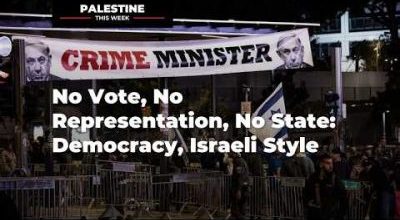
No Vote, No Representation, No State: Democracy, Israeli Style
or go to
Aletho News Archives – Video-Images
From the Archives
Sanctions, War and the Policy of Dual Containment
By SASAN FAYAZMANESH | March 17, 2008
It is now nearly three decades since the Unites States adopted the policy of dual containment of Iran and Iraq. While much has been written about the containment of Iraq, there has been very little in-depth analysis of this policy when it comes to Iran. In a book that is going to be released on March 31, 2008, entitled The United States and Iran: Sanctions, Wars and the Policy of Dual Containment (Routledge), I attempt to address this shortcoming by investigating when and why the US policy of containment of Iran came about, how it evolved, and where it stands today.[1] To the extent that Israel has been involved in US policy making, the study will also include the role that Israel has played in the containment of Iran. Also, since the fate of Iran has been inextricably linked to that of Iraq, occasionally the investigation will overlap with the containment of Iraq.
The policy of dual containment of Iran and Iraq originated during the Carter Administration, but it was not until the Clinton Administration that the expression “dual containment” became popular. … continue
Blog Roll
 Aletho News
- No Vote, No Representation, No State: Democracy, Israeli Style
- Zionist Bought Senate Blocks Information About American Citizens Killed By Israel
- While Gaza dominates the UN, these are the people keeping it alive
- New Report: “Scholasticide and Genocide in Gaza: Assessment, Testimonies and Legal Analysis”
- ‘THAAD Delusion’: Iran war exposes US missile shield limits – The Atlantic
- Moscow issues warning to NATO over Russian exclave
- Yes, the Iran war has destroyed Trump’s presidency
- The fallacy of US delusions about Iran’s economic collapse
- Hezbollah denies Syria cell link, warns of Israeli plan to sow discord
- The legacy of US sanctions, war, and occupation in Iraq
- If Americans Knew
- Mamdani releases plan to combat antisemitism and hate crimes in New York City
- Iran’s Revolutionary Guards Publish Letter to the American People
- DMFI launches $1 million ad campaign supporting Virginia’s Elaine Luria
- US Senate blocks resolution seeking report on Americans killed by Israel
- Israeli Attacks Kill Ten Palestinians in Gaza
- Massacre at Minab: The School That Became a Grave
- Israeli media: The IDF Shows It Doesn’t Turn a Blind Eye; It Actively Emboldens Settler Havoc
- As settlers ravage West Bank, Israeli forces kill 10 in Gaza – Daily Update
- New Report: “Scholasticide and Genocide in Gaza: Assessment, Testimonies and Legal Analysis”
- Ex-Biden officials are desperate for a Gaza scapegoat
- No Tricks Zone
- Green Energy Debacle: German Expert Professor Fritz Vahrenholt Warns Of Severe Economic And Social Consequences
- Two More Paleo Reconstructions Affirm Meters-Higher Sea Levels Across Ireland, Brazil 7000-6000 Years Ago
- New Study: Earth And Venus Surface Warmth Largely Explained By Convection And Lapse Rate, Not CO2 Or Radiation
- 2025 Nature Paper Claiming Worsening Global Drought Gets RETRACTED …Heavily Flawed
- New Study: ‘Global Drought Shows No Detectable Recent Acceleration Under Climate Warming’
- Economic Masterminds: German Socialists Suggest Taxing Productivity Gains Stemming From Using AI
- The South China Sea Has Not Been Cooperating With The Climate Change Narrative
- Energy Crisis: Germany Enters Heating Season With Historically Low Gas Reserve Fill Levels
- New Study: The Antarctic Ice Sheet Gained Mass From 2020-2024 Due To Staggering Snow And Ice Accumulation
- Study: Ocean Heating Rates From Thousands Of Years Ago ‘Dwarf’ Modern Ocean Heating Rates

