Israeli Soldiers Invade Bil’in, Break Into Home Of Local Peace Activist
By Saed Bannoura | IMEMC | May 28, 2012
Late on Sunday night Israeli soldiers invaded the village of Bil’in, near the central West Bank city of Ramallah, and attempted to kidnap a local peace activist, one of the organizers of nonviolent peaceful protests against the illegal Israeli Annexation Wall and settlements in the area.
The Friends of Freedom and Justice Committee in Bil’in (FFJ) reported that resident Hosam Hamad, 33 years old, was not at home when soldiers invaded it. Instead, the soldiers handed his mother a warrant for his arrest.
The FFJ added that the army pushed journalists and cameramen away when they attempted to ask the soldiers why they were trying to take Hamad. They informed them that they were not allowed to document the invasion and did not provide any explanation for their actions.
Bil’in is known for its leading role in creative non-violent resistance against the Annexation Wall and settlements in the area. Peace activists from different parts of the world as well as Israeli activists participate in the weekly non-violent protests.
Israeli soldiers use excessive force against the protesters, and repeatedly kidnap local activists of the non-violent resistance. The army is responsible for hundreds of injuries and several deaths because of its use of force against the protesters.
In 2008, Ashraf Abu Rahma was detained during a nonviolent protest; he was cuffed and blindfolded before one soldier held him while another soldier shot him in the leg.
The shooting was caught on tape by a young Palestinian woman from Bil’in, and was handed to a number of human rights groups to expose the Israeli crime. The soldiers subsequently detained her father as an act of punishment.
Abu Rahma’s brother, Basem, and his sister, Jawaher, were killed by Israeli fire in different non-violent protests against the Wall and settlements.
A statement issued by the spokesperson of the EU’s High Representative, Catherine Ashton, said last Tuesday that the European Union defends the right of Palestinians to hold peaceful protests against illegal Israeli settlement construction on their land.
Related articles
- Al-Ma’sara Village Holds Its Weekly Nonviolent Protest (occupiedpalestine.wordpress.com)
- Undercover Israeli combatants threw stones at IDF soldiers in West Bank (theuglytruth.wordpress.com)
- Three Women Injured Near Bethlehem (altahrir.wordpress.com)
- Minnesota Battle Over Israeli Bonds (alethonews.wordpress.com)
Iran designs alternative system for SWIFT
Press TV – May 26, 2012
The Governor of the Central Bank of Iran (CBI) Mahmoud Bahmani says that the country has designed and implemented a new system for conducting international transactions.
Bahmani said on Saturday that the new system, which has already been activated, would replace Worldwide Interbank Financial Telecommunication (SWIFT)
On March 15, SWIFT CEO Lazaro Campos said in a statement that the society has decided to discontinue offering services to Iranian banks which are subject to financial sanctions imposed by the European Union.
On January 23, the EU foreign ministers approved new sanctions on Iran’s financial and oil sectors, which prevent member countries from importing Iranian crude or dealing with its central bank.
Experts believe that SWIFT’s new action is meant to fully enforce EU sanctions, as global financial transactions are impossible without using SWIFT.
Bahmani rejected reports about a Japanese bank freezing transactions with Iranian banks.
On May 17, the Reuters reported that Bank of Tokyo-Mitsubishi UFJ has frozen USD 2.6 billion of assets of Iranian banks under an order by the New York District Court earlier this month.
Related articles
- SWIFT cuts financial ties with Iran over EU sanctions (alethonews.wordpress.com)
5+1 group fails to reach agreement on Iran’s proposals
Mehr News Agency – May 24, 2012
BAGHDAD – The six major powers known as the 5+1 group (the five permanent members of the UN Security Council plus Germany) failed to reach an agreement between themselves on a package of proposals which had been presented by Iran in the meeting on Wednesday.
Sources close to the meeting have blamed the U.S. for the failure of talks between the major powers, the Mehr News Agency correspondent reported from Baghdad.
Iran had presented a five-point proposal which included “nuclear and non-nuclear issues”.
Diplomats close to the talks say the major powers have reneged on their promises of reciprocal steps which had been agreed upon in the Istanbul talks on April 4.
In the meeting negotiators from the 5+1 group especially the U.S. used a language similar to those of Israeli officials and this caused a hurdle in the talks, diplomat said.
According to our correspondent, the 5+1 group is suggesting another place for a next meeting. However, the Iranian side is seeking a tentative agreement in Baghdad before setting a date for the next meeting.
Iran’s lead negotiator, Saeed Jalili, and EU foreign policy chief Catherine Ashton, who represents the major powers in the talks, held bilateral talks late on Wednesday and early Thursday.
The two top negotiators plan to brief reporters about the results of negotiations later today.
Indian refiner MRPL secures Iranian insurance for oil shipment
Press TV – May 22, 2012
India’s refiner MRPL has received a crude cargo under the coverage of an Iranian insurance company to become the first Indian firm taking such an action in the face of oil embargoes against the Islamic Republic, sources say.
Mangalore Refinery and Petrochemicals (MRPL) “recently got a cargo insured by an Iranian firm and other cargoes can also be insured from Iran. The company will do that on a case-by-case basis,” Reuters quoted one of the sources on Monday.
The Iranian insurer provided coverage for MRPL’s crude cargo of about 707,500 barrels, which arrived at India’s Mangalore Port last week.
Another source said, “As long as we can avail of Iranian cover we will continue to import cargoes on that basis.”
India is one of the biggest customers for Iranian crude. The Asian country accounts for more than 10 percent of Iran’s annual oil exports, worth about $12 billion.
Earlier in May, Indian General Insurance Corp. (GIC) said it planned to provide third-party liability coverage up to $50 million for ships importing Iranian crude in a bid to prevent the oil embargoes from disrupting Iranian crude shipments to India.
The European Union approved new sanctions on Iran’s oil and financial sectors on January 23. The sanctions are meant to prevent member states from buying Iranian crude or doing business with its central bank. The sanctions will come into force as of July 1.
Additionally, the embargo banned European companies from transporting, purchasing or insuring crude and fuel originating in Iran and intended for anywhere in the world.
The US and the EU have imposed new financial sanctions as well as oil embargoes against Iran since the beginning of 2012, claiming that the country’s nuclear energy program includes a military component, a claim Iran has strongly rejected.
Related articles
- S. Korea seeks exemption from EU Iran oil ban (dawn.com)
- US “not impressed” with India over Iran oil ties (alethonews.wordpress.com)
- ‘Iran oil sanctions bad idea if they work’ (alethonews.wordpress.com)
- Nuclear Agency Deal with Iran Cuts Crude Price (247wallst.com)
BBC survey: ‘Israel sinks in popularity’
Rehmat’s World | May 17, 2012
On May 10, the BBC released the results of its annual Global survey of world nations and how their influence is viewed by 24,090 participants from 27 nations. The participants were asked to rate the influence of each of 16 nations and the EU as “mostly positive” or “mostly negative”.
According to the survey – Germany received top positive views followed by Britain, Japan and Canada – while Iran received the highest negative views (55%, improved from last years’ 59%), followed by Pakistan (51%), North Korea (50%) and Israel (50%, up from 40% in 2010).
Among EU nations, Spain topped the negative opinion of Israel (74%), followed by Germany (69%), Britain (68%) and France (65%).
The United States, Nigeria and Kenya gave Israel more positive views than the rest of nations surveyed. In Canada, the negative ratings increased from 52% to 59% – while in Australia it went up from 58% to 65%. Israel received the highest negative opinion in Egypt (95%)and Turkey (73%).
The BBC survey paints a darker picture about Israel than the results of a survey conducted by the pro-Israel group, ADL, in March 2012. It revealed that a significant majority of Europeans believe that Jews are more loyal to Israel than the countries they live in.
Israel’s rise in unpopularity confirms Israel’s Reut Institute 2010 report – which warned the Netanyahu government of the ‘delegitimization’ of the Zionist entity.
“There are two main generators of attacks on Israel’s legitimacy. The Resistance Network – which operates on the basis of Islamist ideology and includes Iran, Hezbollah, and Hamas; and the Delegitimization Network – which operates in the international arena in order to negate Israel’s right to exist and includes individuals and organizations in the West, which are catalyzed by the radical left,” noted the report.
Related articles
Punished over Iran: South Africa Petrol under Threat
By Iqbal Jassat | Palestine Chronicle | May 13, 2012
Pretoria – Amidst reports that pro-Israeli lobbies in the United States have secured an assurance from the Obama administration to relentlessly pursue countries seen to be wavering in their compliance with rigorous sanctions on Iran, South Africa has been singled out for punishment. Though largely under-reported in the local media, pressure is building on the ANC-led government to immediately suspend its economic ties with Iran or risk being barred from the US economy.
While there were initial signs of panic with different government departments giving contradictory statements on this highly contentious US demand to shut off the country’s petroleum lifeline from the Islamic Republic, very little is currently known about South Africa’s ultimate decision as the deadline grows closer. However, a recent statement issued by the South African Petroleum Industry Association [PIA] gives a clue of frantic behind-the-scenes talks. Claiming that it sought to expedite requests to the United States for a postponement and temporary exemption from the sanctions, it also clearly alludes to political pressure.
PIA Executive Director Avhapfani Tshifularo is reported to have said: “This is not a business decision for us. It involves a political decision about political pressure”. Following the initial flurry of uncertainty as to whether the SA government had succumbed to demands made by clandestine visits by senior US Treasury Department officials, it now appears that a formal decision by the Zuma Cabinet has yet to be made.
What may have irked Israeli lobbyists in America is that South Africa’s crude oil imports from Iran have increased to $434.8 million in March from $364 million in February. Instead of a reduction, imports from the Islamic Republic represent 32% of the country’s total crude oil supplies, suggesting that the ANC-led government is reluctant to have America dictate its economic policy.
While these figures project a country unwilling to disrupt its trade with a stable reliable source such as Iran, it is aware of the enormous power possessed by Israeli-lobbies that in effect have manipulated US domestic and foreign policies. It certainly would be aware that the push for war on Iran is high on the agenda of these lobbies and that unilaterally imposed sanctions by the US therefore cannot be treated lightly.
While this conundrum confronts decision makers in Pretoria, it is equally intriguing that the European Union has called on South Africa for funding to bolster the banking systems of some EU member states on the brink of collapse. Commenting on this, the convener of UCT’s Applied Economics for Smart Decision Making course Pierre Heistein, said that there is something inherently perverse about this situation.
He explains that looking for $400 billion to prevent the collapse of a few EU member economies causing the others to fold like a pack of cards, the International Monetary Fund [IMF] has turned to Brics for aid after the US and Canada refused to contribute. It appears that Brics economies of Brazil, Russia, India, China and South Africa have between them agreed to provide funding to the tune of $72bn, though exact individual amounts will only be released next month, according to Heistein.
He speculates that South Africa’s proportionate share of the Brics amount could amount to R16bn. Though not a “crippling sum of money” it could increase spending on economic infrastructure by as much as 10 percent or lift health and education by 5 percent. “But does it make sense that a country as poor as South Africa should be contributing funds to traditionally wealthy European states? Consider that in order for South African farmers to export to Spain they have to compete with annual farming subsidies amounting to more than E7 billion [R72.7bn] and now Spain is calling for South Africa’s financial aid”, is the all important question posed by Heistein.
This question alongside others including whether President Zuma and his cabinet will succumb to Washington’s blackmail ought to feature in the national discourse related to socio-economic challenges. Global disparities as they exist in both political and economic spheres make it imperative for emerging economies to jealously guard their capacity to grow. This means that they must shun foreign interference especially if such meddling undermines job creation and service delivery.
While the IMF’s stretched hand may provide South Africa [a means] to enhance its leverage within this seat of power, it may be short-lived if American pressure becomes more ruthless to force it to abandon Iran. Unfortunately, the current malaise in which the ANC finds itself – both as a formidable political formation and as the de facto government, may not allow it to snub either the US or the IMF. After all such firmness of principle requires a strong moral underpinning.
– Iqbal Jassat is an executive member of the advocacy group, the Media Review Network.
Related articles
- South Africa may be hit with US sanctions over Iran oil imports (alethonews.wordpress.com)
- South Africa Must Resist Sanctions on Iran (alethonews.wordpress.com)
- South African telecom to face US sanctions over Iran, Syria operations (alethonews.wordpress.com)
Terrorist groups kill 23 Syrian soldiers in Rastan
Press TV – May 14, 2012
Terrorist groups fighting against the Syrian government have killed 23 more security forces in the northern city of Rastan, opposition activists reported.
According to the London-based Syrian Observatory for Human Rights, dozens of others were also injured in the early morning violence on the outskirts of Rastan, in the crisis-hit Homs Province, on Monday.
Three troop carriers were also destroyed in the fighting, the group added.
Armed groups also killed two officers in the capital, Damascus, and southern city of Dara’a, Syrian official news agency SANA reported.
The latest round of violence comes despite a ceasefire declared by UN-Arab League envoy Kofi Annan a month ago.
There are currently 189 UN observers in Syria to monitor the truce, some two-thirds of the total intended for deployment as part of a six-point peace plan brokered by Annan.
Meanwhile, the European Union has imposed fresh sanctions on Syria in a bid to increase pressure on the government, which includes an assets freeze and visa ban on two companies and three pro-government figures. It is the 15th round of EU sanctions against Damascus since the beginning of unrest in the country.
Syria has been experiencing unrest since mid-March 2011 and many people, including security forces, have been killed in the unrest.
While the West and the Syrian opposition accuse the government of the killings, Damascus blames ”outlaws, saboteurs and armed terrorist groups” for the unrest, insisting that it is being orchestrated from abroad.
Related articles
- Starving the Syrians for Human Rights (alethonews.wordpress.com)
South Africa may be hit with US sanctions over Iran oil imports
Press TV – May 12, 2012
South Africa would likely face sanctions from the United States if the largest economy in the African continent fails to meet the deadline to cut its crude oil imports from Iran.
The South African Petroleum Industry Association (PIA) said on Friday that it would have to expedite requests to the United States for a postponement and temporary exemption from the economic sanctions if South Africa fails to slash its imports of Iranian petroleum.
“This is not a business decision for us. It involves a political decision about political pressure,” PIA Executive Director Avhapfani Tshifularo said.
“We expect a Cabinet decision by the end of the month, and we will allow ourselves to be guided by that,” Tshifularo said.
The report comes as South African crude oil imports from the Islamic Republic of Iran have increased to $434.8 million in March from $364 million in February.
South Africa’s Revenue Service said on April 30 that Africa’s biggest economy imported 505,908 tons of Iranian crude in March, up from 417,188 tons the previous month.
South Africa has come under pressure from Washington to cut its crude imports from Iran in line with the sanctions designed to halt Tehran’s nuclear energy program.
According to the March data, South Africa’s crude imports totaled 1.6 million tons, with Nigeria supplying 38 percent, Iran 32 percent, Saudi Arabia 22 percent, and Angola the rest.
The US sanctions require foreign financial institutions to make a choice between transactions with the Central Bank of Iran and Iran’s oil and financial sectors or being banned from the US economy.
On January 23, the EU agreed to ban oil imports as well as petroleum products from Iran and freeze the assets of the Central Bank of Iran across the EU.
Related articles
- South African telecom to face US sanctions over Iran, Syria operations (alethonews.wordpress.com)
- South Africa Must Resist Sanctions on Iran (alethonews.wordpress.com)
- Iran oil ban to hit 10 main crude importers hardest (alethonews.wordpress.com)
IMF rejects call to cut ties with Iran
Press TV – May 1, 2012
The International Monetary Fund has rejected a call by a US-based anti-Iranian group to cut its ties with the Central Bank of Iran.
The IMF said on Tuesday that its relationship with the Central Bank of Iran is based on its constitution, noting that Iran’s membership does not contravene US or EU sanctions on Tehran, AFP reported.
The anti-Iranian group also criticized IMF Managing Director Christine Lagarde over her meeting with Central Bank of Iran Governor Mahmoud Bahmani on the sidelines of the semiannual meetings of the International Monetary Fund and the World Bank in Washington in late April.
The US-based anti-Iranian group consists of former US diplomats and government officials.
IMF spokesman William Murray said, “According to our constitution… the IMF’s holdings of each member’s currency are maintained with the central bank of the relevant member, including Iran… There is nothing in the EU or US sanctions regimes that is inconsistent with these arrangements.”
Headquartered in Washington, the IMF is an organization of 188 countries working to foster global monetary cooperation, secure financial stability, facilitate international trade, promote high employment and sustainable economic growth, and reduce poverty around the world.
Related articles
- PressTV: Disruption to Iran oil flow to shock global economy: IMF chief (jhaines6.wordpress.com)
- Oil prices to jump 30pct on Iran sanctions – IMF – 260205 – 20 (islamiccivilizations.wordpress.com)
Austrian Activists Push Back Against EU Data Retention Directive
By Rebecca Bowe | EFF | April 30, 2012
No sooner did a mandatory data retention law go into effect in Austria this month than thousands of Austrians banded together in a swift opposition campaign to overturn it. The Austrian law originated as the misshapen offspring of the 2006 European Data Retention Directive. Led by AK Vorrat Austria, a working group against mandatory data retention, the pushback against this mass-surveillance law demonstrates that opposition remains alive and well six years after the European Union adopted the infamous Directive.
The Austrian data retention law compels all ISPs and telcos operating in Austria to retain everyone’s incoming and outgoing phone numbers, IP addresses, location data, and other key telecom and Internet traffic data. The information is collected for all citizens, rather than just those suspected criminal activity. In many cases, the data is handed over to law enforcement.
Austrian activists took advantage of a two-year delay of the implementation of this ill-conceived Directive in their country by mapping out their opposition strategy in advance. They sought to leverage a two tier strategy to beat back the Data Retention Directive at the European level, and to fight against the Austrian data retention law at the national level.
One day before the law entered into force, Austrian activists organized funeral marches to protest this anti-privacy, anti-anonymity, anti-free expression law.
Now, just weeks after the Directive officially went into effect, its future hangs in the balance as a pair of efforts calling for its reversal speed toward Austria’s Constitutional Court. Austrian activists are seeking to overturn the legality of the Austrian law with a mass complaint filed with Austria’s Constitutional Court. With nearly 7,000 supporters formally signed on and 18,000 declaring their intent to join, that effort that is shaping up to be “the biggest complaint in the history of the republic,” according to European Digital Rights (EDRi), a coalition of 32 privacy and civil rights organizations working in the European Union, including EFF. AK Vorrat Austria initially announced that it hoped to bring 1,000 individuals together to sign onto the complaint – and surpassed that goal in two days’ time.
But activists aren’t stopping there. On a parallel track, AK Vorrat Austria has already gathered 100,000 signatures for a citizens’ initiative calling for their government to work towards the abolishment of the EU Directive. The signatures are enough to meet the required threshold to force the issue to be considered by the National Council, Austria’s legislative branch of government.
This isn’t the first time this Directive has sparked an uproar in Europe. When it first became clear that the EU was going to cave to governmental lobbying interests from the U.S. and UK and enact a sweeping law that would effectively legitimize mass surveillance, the Freedom not Fear movement responded with massive street protests in Germany and across Europe.
The opposition continues, and is only growing. Courts in Romania, Germany, and the Czech Republic have declared their national laws derived from the EU Directive to be unconstitutional, while a court in Ireland has referred a case to the European Court of Justice—the highest Court in Europe for matters related to European Union law—questioning the legality of the overall EU Data Retention Directive. The European Data Protection Supervisor Peter Hustinx has called the Directive “the most privacy-invasive instrument ever adopted by the EU in terms of scale and the number of people it affects.” Despite all this, the European Commission is still defending it even though it has not been able to provide any evidence that the Directive is necessary, and therefore legal, in the European Union.
Austrian Association for Internet users (VIBE!AT), the Ludwig Boltzmann Institute of Human Rights and several other Austrian activists are encouraging all concerned Austrians to join this fight. Austrians can join the mass complaint against the Austrian data retention law by filling out the declaration form by May 18, available at verfassungsklage.at.
Meanwhile, all Austrians age 16 and older should support the citizens’ initiative online at zeichnemit.at (in German) to call for the abolishment of the EU data retention directive. Take Action: Sign the citizens’ initiative now. Tell the Austrian government to fight for the repeal of the European Data Retention Directive in Brussels.
Related articles
- ACTA in the EU: We Can’t Call it Dead Yet (alethonews.wordpress.com)
- European Data Retention Directive At Work: Polish Authorities Abuse Access to Users’ Data (eff.org)
ACTA in the EU: We Can’t Call it Dead Yet
By Gwen Hinze | EFF | April 30, 2012
The Anti-Counterfeiting Trade Agreement (ACTA) was dealt a major blow on April 12 when MEP David Martin, the European Parliament’s rapporteur for the agreement and member of the Committee responsible for delivering the recommendation [doc] to European Parliament to adopt or reject the agreement, announced that he would be recommending a “no” vote. While the prospects of the European Parliament ratifying the agreement seems to have fortunately lessened, it does not mean that it’s a fait accompli that the European Parliament will reject ACTA. As we’ve noted before, ACTA is a plurilateral agreement designed to broaden and extend existing intellectual property enforcement laws to the Internet. It was negotiated in secret by a handful of countries, in a process that intentionally bypassed the checks and balances of existing international IP norm-setting bodies without any meaningful input from national parliaments, policymakers, or their citizens. In our second post on the ACTA State of Play, we’ll look at what’s happening in Europe and why we should all be keeping a close eye on what’s happening in Brussels. (For those interested in US developments, please see our previous post here).
While the EU and 22 of its 27 member states signed ACTA in January, the European Parliament must vote to adopt it for it to become part of European Union law. A complex process is underway involving five European Parliamentary committees. The first step involves four committees: the Committee on Civil Liberties, Justice and Home Affairs (LIBE), the Committee on Industry, Research and Energy (ITRE), the Legal Affairs Committee (JURI), and the Development Committee (DEVE). Each must each review ACTA according to their Committee’s particular subject matter expertise, and deliver an opinion to the fifth and lead Committee, the International Trade Committee (INTA).
The INTA Committee plays the key role of recommending ACTA’s adoption or rejection to European Parliament. While INTA’s opinion is highly influential, it is not binding. The final step in the ratification process is a plenary vote of the Members of European Parliament. MEPs must decide whether to adopt or reject ACTA in its entirety; no amendments are allowed. The vote is currently scheduled for early July, but it may occur later. Here are two great infographics from the European Parliament and from French organizations La Quadrature du Net and Owni.eu which illustrate the whole process.
Apart from this process at the EU level, individual EU member states must decide whether or not to ratify ACTA. This is because the agreement requires countries to put in place broader criminal sanctions for those who infringe IP, and for those who aid and abet them. EU law is not harmonized in relation to criminal penalties for IP infringement. Criminal laws are within the exclusive legislative power of the individual EU member states and so they must ratify ACTA for those provisions to be given effect. Five member states have now suspended ratification of ACTA (Latvia, Poland, Czech Republic, Slovakia, the Netherlands and Bulgaria) and Germany has said that it will wait to see how the European Parliament votes before deciding to ratify.
There are many moving pieces in this puzzle and they each exert different levels of influence on the European Parliament’s vote. The European Commission referred ACTA to the European Court of Justice, the highest court in Europe, on February 22 for an opinion on its compliance with EU law. The European Parliament’s INTA Committee, at the instigation of MEP David Martin, the current Rapporteur of ACTA within the European Parliament, considered but rejected its own referral of ACTA to the European Court of Justice in March. If this had gone ahead, it would have delayed the European Parliament’s plenary vote beyond July. The European Data Protection Supervisor issued an opinion [pdf] on the European Parliament’s proposed accession to ACTA on April 24 that obliquely criticized ACTA by noting that it permits measures for indiscriminate monitoring of communications that would be disproportionate for small scale infringements. Specifically, it includes voluntary cooperative enforcement measures that would permit ISPs to process personal data beyond what is permitted under EU law, and lacks the necessary limitations and safeguards to protect EU citizens’ personal data under EU law.
On April 12, the Rapporteur of ACTA within the European Parliament, MEP David Martin of the INTA Committee, announced that he would be recommending that the European Parliament vote no on ACTA, but suggested that the Commission could negotiate an alternative proposal. His recommendation concluded that:
Your rapporteur therefore recommends that the European Parliament declines to give consent to ACTA. In doing so, it is important to note that increased IP rights protection for European producers trading in the global marketplace is of high importance. Following the expected revision of relevant EU directives, your rapporteur hopes the European Commission will therefore come forward with new proposals for protecting IP.
While this should indeed be seen as a major blow to the prospects of a speedy ratification by the European Parliament and a rebuke to the European Commission which took the lead in negotiating ACTA for the EU, it does not mean that ACTA is dead in the EU.
Last week, several of the four committees involved in the first step of the process were scheduled to publish their opinions and deliver them to the INTA committee. These opinions are likely to be heavily influenced by the appointed Rapporteur for each committee. They are reportedly equally divided. Two of the four Rapporteurs oppose ACTA and two are strong supporters. EDRi has posted a draft opinion of the influential Legal Affairs Committee (JURI) rapporteur, MEP Marielle Gallo, who is a strong ACTA supporter. She had previously been proposing a fast vote on her draft opinion within JURI, but on April 26, she pushed instead for JURI to postpone its vote on the opinion. This seems like a further delaying tactic by ACTA supporters to slow down the process within the European Parliament until they’ve got the numbers for a yes vote while the fierce lobbying campaign continues apace in Brussels.
Everything comes down to how MEPs vote in the Parliamentary plenary vote. MEPs in European Parliament are members of political parties, and analysts in Europe are now trying to tabulate how the political party groups will vote on ACTA. As Joe McNamee, the Brussels-based Advocacy Co-ordinator for European Digital Rights noted in an insightful piece last week, the numbers look closer than you might think: 52.5% of the Parliament opposed to ACTA, to 47.5% in favor, if you extrapolate from the views of the Rapporteurs of the four committees involved in the first ratification step:
To put it in another way, if just 20 MEPs have their minds changed as a result of the massive lobbying campaign currently underway and organised by the European Commission and big business interests, then ACTA will be adopted. The situation becomes even more precarious when we consider that it often happens that more than 5% of MEPs do not vote (either absent or abstaining) meaning that the chances of the current tiny majority being sufficient are more a matter of luck than anything else.
We are at a stage where every single vote in the European Parliament is of huge value. If the pro-ACTA message of the rapporteurs in the Legal Affairs and (shockingly) the Development Committee prevail, this will create a new momentum and will be used to “prove” that ACTA is a legitimate proposal.
McNamee continues:
Assuming that the anti-democratic elements in the European Parliament will not be allowed to have their way, there are two possible outcomes. The first is the anti-ACTA campaign will be anesthetised by complacency – assuming victory, citizens will stop contacting Parliamentarians, will not take part in demonstrations and will reassure MEPs that our attention span is so short that we can be ignored on ACTA, that we can be ignored on the upcoming IPRED Directive, that we can be ignored on the upcoming Data Retention Directive. And we reassure our opponents that no future democratic movement will be able to sustain a campaign as long as needed. We lose. Europe loses.
Or we do our duty for European democracy and maintain our pressure right up until the vote. And then we win. And Europe wins.
The future of ACTA as an international agreement will be decided in Europe. While recent media reports have led many people to conclude that ACTA is dead, this is unfortunately not true. Worse, it’s quite a dangerous misconception to have rebounding through the zeitgeist at a time when we need every possible vote in the European Parliament for ACTA to be rejected in July. Citizens in Europe and elsewhere must now clearly and loudly voice our concerns about this agreement to our elected representatives to counter-balance the content industry lobbyists that are hard at work in Brussels shoring-up support for ACTA. Now is the time to make your views heard. If you’re in the EU, contact your MEPs and urge them to vote no on ACTA.
~
More information on how to have your views heard is at the following resources:
EDRI’s ACTA campaign page
La Quadrature du Net’s ACTA campaign page
Related articles
Featured Video
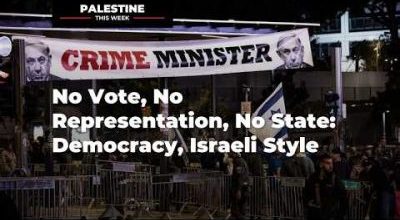
No Vote, No Representation, No State: Democracy, Israeli Style
or go to
Aletho News Archives – Video-Images
From the Archives
Sanctions, War and the Policy of Dual Containment
By SASAN FAYAZMANESH | March 17, 2008
It is now nearly three decades since the Unites States adopted the policy of dual containment of Iran and Iraq. While much has been written about the containment of Iraq, there has been very little in-depth analysis of this policy when it comes to Iran. In a book that is going to be released on March 31, 2008, entitled The United States and Iran: Sanctions, Wars and the Policy of Dual Containment (Routledge), I attempt to address this shortcoming by investigating when and why the US policy of containment of Iran came about, how it evolved, and where it stands today.[1] To the extent that Israel has been involved in US policy making, the study will also include the role that Israel has played in the containment of Iran. Also, since the fate of Iran has been inextricably linked to that of Iraq, occasionally the investigation will overlap with the containment of Iraq.
The policy of dual containment of Iran and Iraq originated during the Carter Administration, but it was not until the Clinton Administration that the expression “dual containment” became popular. … continue
Blog Roll
 Aletho News
- No Vote, No Representation, No State: Democracy, Israeli Style
- Zionist Bought Senate Blocks Information About American Citizens Killed By Israel
- While Gaza dominates the UN, these are the people keeping it alive
- New Report: “Scholasticide and Genocide in Gaza: Assessment, Testimonies and Legal Analysis”
- ‘THAAD Delusion’: Iran war exposes US missile shield limits – The Atlantic
- Moscow issues warning to NATO over Russian exclave
- Yes, the Iran war has destroyed Trump’s presidency
- The fallacy of US delusions about Iran’s economic collapse
- Hezbollah denies Syria cell link, warns of Israeli plan to sow discord
- The legacy of US sanctions, war, and occupation in Iraq
- If Americans Knew
- Mamdani releases plan to combat antisemitism and hate crimes in New York City
- Iran’s Revolutionary Guards Publish Letter to the American People
- DMFI launches $1 million ad campaign supporting Virginia’s Elaine Luria
- US Senate blocks resolution seeking report on Americans killed by Israel
- Israeli Attacks Kill Ten Palestinians in Gaza
- Massacre at Minab: The School That Became a Grave
- Israeli media: The IDF Shows It Doesn’t Turn a Blind Eye; It Actively Emboldens Settler Havoc
- As settlers ravage West Bank, Israeli forces kill 10 in Gaza – Daily Update
- New Report: “Scholasticide and Genocide in Gaza: Assessment, Testimonies and Legal Analysis”
- Ex-Biden officials are desperate for a Gaza scapegoat
- No Tricks Zone
- Green Energy Debacle: German Expert Professor Fritz Vahrenholt Warns Of Severe Economic And Social Consequences
- Two More Paleo Reconstructions Affirm Meters-Higher Sea Levels Across Ireland, Brazil 7000-6000 Years Ago
- New Study: Earth And Venus Surface Warmth Largely Explained By Convection And Lapse Rate, Not CO2 Or Radiation
- 2025 Nature Paper Claiming Worsening Global Drought Gets RETRACTED …Heavily Flawed
- New Study: ‘Global Drought Shows No Detectable Recent Acceleration Under Climate Warming’
- Economic Masterminds: German Socialists Suggest Taxing Productivity Gains Stemming From Using AI
- The South China Sea Has Not Been Cooperating With The Climate Change Narrative
- Energy Crisis: Germany Enters Heating Season With Historically Low Gas Reserve Fill Levels
- New Study: The Antarctic Ice Sheet Gained Mass From 2020-2024 Due To Staggering Snow And Ice Accumulation
- Study: Ocean Heating Rates From Thousands Of Years Ago ‘Dwarf’ Modern Ocean Heating Rates

