Why is the UK pushing the EU to designate Hezbollah as a “terrorist” group?
By Phil Greaves | notthemsmdotcom | May 22, 2013
A distinct increase of negative coverage has been forming in Western and Gulf press. This focus is specifically regarding Hezbollah’s direct involvement in the battle currently raging to take control of the Syrian town of Qusair; its overall role in Lebanon and the region, and its ties to both Syria’s President Assad, and the government of Iran.
As the Syrian conflict has gone on, Salafi/Jihaddi fighters from at least 30 different nationalities have poured through Syria’s borders, with the tacit approval of various state sponsors of the Syrian ‘opposition’. In turn, and for the best part of two years, compliant media have obliged in their attempts to subvert the Salafi/Jihaddi fundamentalist dynamic that has formed the core of the ‘opposition’s’ fighting force; finally relenting and admitting the fact not a single secular force is fighting against the Syrian Government. Contrary to this wilful ignorance or blatant subversion of facts; Western and Gulf media outlets now deem it their utmost priority to highlight not only Hezbollah’s direct involvement; but indeed, go to great lengths to highlight every single Hezbollah death, injury, movement or sneeze inside Syria.
Several issues need to be addressed in this somewhat disparate state of so-called ‘independent’ media when it comes to coverage of Hezbollah. The first and most glaring point is that demonizing Hezbollah and its supporters falls straight into the propaganda program of Israel and the United States, in their attempts to block resistance to US/Israeli/GCC occupation and expansion. The reasons behind this demonization are clear: the US and Israel are not, now, or anywhere in the future willing to allow Hezbollah to operate on Israels’ northern border unimpeded, and both wish to see the resistance group annihilated. The ‘news’ media will dutifully oblige its paymasters with the required public demonization through assumption of guilt and propaganda.
The Burgas Bombing and implicating Hezbollah
Since the Bulgarian Government announced its findings into the bombing of a tourist bus that killed five Israeli tourists, and a Bulgarian bus driver in July 2012; the western press, AIPAC and neo-con associated DC ‘think tanks’, and western government officials have gone into propaganda overdrive. Using somewhat vague statements from the Bulgarian Interior Minister Tsvetan Tsvetanov, in a quite liberal manner; these parties with vested interests have determined culpability for the bombing fall’s on Hezbollah. One fundamental issue should be cleared before drawing any conclusion, that is, the Bulgarian Interior Minister’s statement on the issue post-investigation: (my emphasis)
“A reasonable assumption, I repeat a reasonable assumption, can be made that the two of them were members of the militant wing of Hezbollah,”
This is by no means a definitive statement, leaving room for interpretation suggests the Bulgarian minister is not so sure of his convictions. In this New York Times article ,we learn of the supposed damning ‘evidence’ that has led western officials and lackey media alike, to conclude Hezbollah’s’ guilt: (my emphasis)
With help from the United States and Israel, investigators here broke the case — and linked it to Hezbollah — using a tip from a secret source and some old-fashioned detective work, tracing the printer that had produced two forged licenses back to Lebanon….Europol determined that a fake Michigan driver’s license recovered at the scene had come from Lebanon….The identity of the Australian was the second major breakthrough. In September, a European intelligence service tipped off the Bulgarians about an Australian bombmaker of Lebanese descent, the former senior Western official said. The intelligence service said he had moved to Lebanon to join Hezbollah’s military wing. Mr. Tsvetanov said Tuesday that the Australian and the Canadian moved to Lebanon, one in 2006 and one in 2010.
These snippets of anonymous information are quite literally all the evidence that has been provided to date of Hezbollah association in the Burgas bombing. So because the fake ID’s were produced in Lebanon: that proves Hezbollah made them. And because the bombers alleged and, as yet unidentified, accomplices were from Lebanon: that also proves they are “tied to” Hezbollah. Clearly, the ‘evidence’ provided to date is circumstantial, at best. This lack of clear evidence will not stop either western, nor Israeli government officials, and, again, their lackey media and ‘think-tank’ counterparts in apportioning sole responsibility to Hezbollah, giving the ultimate desired outcome of guilt without trial, or indeed, any public evidence.
As investigative reporter Gareth Porter noted in February, the whole Bulgarian report is based on no more than an “assumption” or, “hypothesis” for Hezbollah complicity; yet this report form’s the basis for calls in the EU to designate Hezbollah as a terrorist group. Porter goes on to state:(my emphasis)
Major revelations about the investigation by the former head of the probe and by a top Bulgarian journalist have further damaged the credibility of the Bulgarian claim to have found links between the suspects and Hezbollah….The chief prosecutor in charge of the Bulgarian investigation revealed in an interview published in early January that the evidence available was too scarce to name any party as responsible, and that investigators had found a key piece of evidence that appeared to contradict it.
Karadzhova revealed how little was known about the two men who investigators believe helped the foreigner killed by the bomb he was carrying, but whom Tsvetanov would later link to Hezbollah. The reason, she explained, is that they had apparently traveled without cell phones or laptops…..Only two kinds of information appear to have linked the two, according to the Karadzhova interview, neither of which provides insight into their political affiliation. One was that both of them had led a “very ordered and simple” lifestyle, which she suggested could mean that they both had similar training.
The other was that both had fake Michigan driver’s licenses that had come from the same country. It was reported subsequently that the printer used to make the fake Michigan driver’s licenses had been traced to Beirut.
But Karadzhova’s biggest revelation was that investigators had found a SIM card at the scene of the bombing and had hoped it would provide data on the suspect’s contacts before they had arrived at the scene of the bombing. But the telecom company in question was Maroc Telecom, and the Moroccan firm had not responded to requests for that information.
That provenance of the SIM Card is damaging to the Hezbollah “hypothesis”, because Maroc Telecom sells its cards throughout North Africa – a region in which Hezbollah is not known to have any operational bases but where Al-Qaeda has a number of large organisations.
Morocco is also considered a “staunch ally” of the United States, so it is unlikely that the Moroccan government would have refused a request from the United States to get the necessary cooperation from Moroccan Telecom.
Clearly, anyone claiming Hezbollah was responsible for the Burgas bombing is pushing a somewhat skewed and misinformed agenda. Not only is the ‘evidence’ both flimsy and circumstantial; the chief prosecutor laid doubt on any possible Hezbollah role on live television. Why would Israel, or the US choose not to follow the SIM card? Or even bother to request the Moroccan telecoms company release the information?
Britain launches campaign in the EU
This brings us to recent reports of the British governments renewed attempts to persuade the EU to designate Hezbollah’s military wing a terrorist organisation. The UK is now pushing the EU for this designation to enable possible sanctions, and the Burgas bombing is a key component in the case against the organisation; the bombing is mentioned in virtually every article on the issue, and has been cited as a reason for Germany’s apparent sway in the UK’s direction.
For Israel, the United States and their GCC partners, the timing could not be better. Again, the hypocrisy is blatant. None of the NATO states that are pushing for terrorist designations against Hezbollah, have a negative word to say on the plethora of militant Salafi/Jihaddi groups they have abetted into Syria; (*other than Jabhat al Nusra*) these groups have not only attacked Syria’s security infrastructure and Government personnel, they have also openly committed massacres, hundreds of car bombings in built-up civilian areas, extra-judicial killings, rape, torture, and looting. But these are the good guys the west are supporting in their valiant fight for democracy in Syria? Or strict Sharia?
As these western/GCC proxies start to lose more and more ground against the Syrian Army, (and Hezbollah have been a key factor in that.) Israel pursues illegal military airstrikes against supposed “game changing” weapons, and the NATO states dutifully push their “diplomatic” pressure in the UN and the EU against Hezbollah under dubious allegation’s. These dynamics are inextricably linked to the Western/Israeli/GCC efforts to block the “Shiite crescent”.
In Lebanon itself, the US/UK et al accuse Hezbollah of being responsible for current conflagration on the Syrian border, which is also flaring up in northern Tripoli; without mentioning the fact Lebanon has been a key route for opposition militants to enter Syria. Since the very start of the Syrian crisis, northern Lebanon and the town of Qusair have been a rebel transit point and stronghold; allowing the free flow of heavily armed militant Salafi/Jihaddi fighters. But this seems to be what western leaders promote, and are indeed making great efforts to support. William Hague talks of “conflict spread” and propagates the falsehood that Hezbollah pose a threat to Lebanese internal security, while the UK and its allies arm, fund, promote, and provide diplomatic cover to the very Salafists Hezbollah is busy defending Shiite villages and Syrian civilians from. The West is supporting the very same democracy spreading Salafi/Jihaddi proxies that completely expelled all Christians from Qusair upon their arrival. Is the west and its allies, in its determination to overthrow the Assad government, and by extension destroy any resistance Hezbollah can muster against Israeli aggression, now supporting ethnic cleansing?
If Hezbollah, who up until the Syrian crisis; peacefully co-existed in a country belonging of 18 different sects no less, and being an active member of Lebanese government and its security infrastructure: are supposed terrorists. Then one has to ask: what are the extremist, sectarian militants the west is supporting supposed to represent? Freedom Fighters? Furthermore, and, considering the insurmountable volumes of evidence of western state-sponsored terror, one must also ask: what purpose, other than further ‘legal’ UN-endorsed western-led military aggression, does the designation of Hezbollah as “Terrorist” ultimately serve?
Russia slams end of EU arms embargo, calls S-300s ‘stabilizing factor’ in Syria
RT | May 28, 2013
The failure of the European Union to agree on a new arms embargo for Syria is undermining the peace process, Moscow says. But the delivery of S-300 surface-to-air missiles may help restrain warmongers.
The comments come from Deputy Russian Foreign Minister Sergey Ryabkov, referring to the results of Monday’s meeting in Brussels. After a lengthy negotiating session, EU governments failed to resolve their differences and allowed a ban on arming the Syrian opposition to expire, with France and Britain scoring an apparent victory at the expense of EU unity.
The EU’s move, which the Russian diplomat branded as an “example of double standards”, opens the door for Britain and France to supply weapons to Syrian rebels fighting the regime of President Bashar Assad.
Criticizing Europe’s decision to open the way for potential arms shipments to Syrian rebels, Russia insists that its own sale of arms to the Syrian government helps the international effort to end the two-year-long conflict, the diplomat added. He was referring to the delivery of the advanced S-300 long-range air defense systems, which Russia is carrying out under a contract signed with Syria several years ago.
“Those systems by definition cannot be used by militant groups on the battlefield,” Ryabkov said. “We consider this delivery a factor of stabilization. We believe that moves like this one to a great degree restrain some hotheads from escalating the conflict to the international scale, from involving external forces.”
The S-300 is a series of Russian long-range surface-to-air missile systems designed to intercept ballistic missiles, regarded as the most potent weaponry of its class. The missiles are capable of engaging aerial targets as far away as 200km, depending on the version used.
Once the Russian SAM missiles are deployed by Syria, it will have a better control of its airspace. The country endured three airstrikes this year, which are widely thought to have been conducted by Israel, but were never officially confirmed as such.
Britain and France have made a commitment not to deliver arms to the Syrian opposition “at this stage,” an EU declaration said. EU officials, however, said the commitment effectively expires on August 1.
London and Paris have argued support for rebels fighting Assad by allowing EU arms deliveries, despite the fact that extremist elements are known to work alongside the rebels.
Other EU governments, led by Austria and Sweden, argued that sending more weapons to the region would increase violence and spread instability.
Russia’s envoy to NATO Aleksandr Grushko said that the abolition of the EU arms embargo on the Syrian opposition will only exacerbate armed conflict in that country.
“We need to refrain from taking steps that would be contrary to this logic. Such steps include armed or non-lethal support to the opposition. This just adds fuel to the fire,” Grushko said on Tuesday.
Meanwhile, Moscow and Washington remain undecided as to the content of a proposed international conference on Syria, according to Deputy Foreign Minister Sergey Ryabkov.
“There remains a gap between the positions of Russia and the US regarding some issues and aspects of this major international crisis,” he emphasized.
“And we, for our part, cannot agree to hold such events [the international conference on Syria] amid a situation where partners and possible participants in such a conference seek to impose solutions on the Syrian people from the outside, as well as predetermine the course of a transitional process, the parameters of which have not been determined yet,” Ryabkov said.
Related article
EU Continues with US-Led Sanctions against Syrians as It Scraps Arms Embargo
By Franklin Lamb | Al-Manar | May 28, 2013
Beirut – Under withering pressure from Washington and the UK, the European Union met this week to decide whether to increase the pressure on the Syrian public by repealing the March 2011 arms embargo that was intended to prohibit arms shipments to Syria and whether or not to continue economic sanctions against the Syrian public.
On 5/27/13 it decided to open the flood gate of arms flow into Syria and to keep the civilian targeting economic sanctions in place.
Lobbying for scrapping the arms embargo, set to expire at midnight on 31 May, had reached nearly historic intensity at EU HQ in Brussels, London and Washington. Recently, the US State Department demanded that every one of the 27 European Ambassadors posted in the US appear at the State Department for “consultations to avoid any misunderstandings about what the White House was expecting at the upcoming EU meeting.”
US Secretary of State John Kerry had been urging the EU to gut the arms embargo so as to expedite weapon shipments to the rebels. It currently appears that Britain now has the support of France, Italy and Spain, while Germany appears neutral and Austria, Finland, Sweden and the Czech Republic are still opposed. “Fine for him to say, but what is Washington willing to do?” one European foreign minister opposed to lifting the ban put it to BBC correspondent Lyse Doucet.
This week’s EU meeting, which was postponed three months ago, raised again the obligation of the international community to respect the laws of armed conflict and the Geneva Convention with respect to protecting the civilian population during armed conflicts and virtually every other international humanitarian law requirement.
For the American administration, designing and applying economic sanctions in order to pressure a population to break with its government to achieve regime change or any other political objective, as in the case of both Syria and Iran are fundamentally illegal under US law.
Just as soon as a group of Syrian-Americans and/or Iranian-American file a class action lawsuit in US Federal District Court ( the Court will have in persona and subject matter jurisdiction and the Plaintiffs will have standing to sue, given that they are American citizens) and the day after filing when they would no doubt file a Motion petitioning the Court for an Interim Measure of Protection (injunction) immediately freezing and lifting the US-led sanctions against the two countries civilian population, pending the final Court (Jury Trial) on the merits, the Obama administration is going to face serious judicial challenges to its outlawry.
William Hague, the UK Defense Minister, was quite active the past several days supporting the various Syrian militias’ arguments including: “The EU arms embargo must be lifted because the current economic sanctions regime is ineffective.” Presumably the right honorable gentleman means by “ineffective” that these brutal sanctions have not broken the will of the populations to settle their own affairs without transparent foreign interference. This is true if by “effective” Hague means that the US-led sanctions, that target Syria’s civilian population for purely political purposes of regime change, will cause the people of Syria, who unlike their leaders, are the ones directly affected by the sanctions to revolt over the lack of medicines and food stuffs plus inflation at the grocery stores.
Mr. Hague surely must be aware that very rarely, if ever at all in history, have civilian targeted sanctions designed to cause hardships among a nation’s population for purely political purposes actually broken the population such that they turned against their governments. Both the Syrian and Iranian sanctions have confirmed history’s instruction that the civilian targeting sanctions imposed from outside tend to have the exact opposite intended effect. This is true particularly modernly with more available information, and that the populations turn not against their national governments but rather against those foreign governments viewed as being responsible for these crimes.
The British, French, Turks and the Americans (the latter, not actually an EU member but then, who would know from its involvements in EU deliberations?) were the zealots in Brussels advocating amendment of the imposed arms embargo so that weapons can be sent to “moderate” forces in these countries largely nurtured and sustained “opposition”.
The UK Defense Minister gave his colleagues repeated assurances that weapons would be supplied only “under carefully controlled circumstances” and with clear commitments from the opposition… We have to be open to every way of strengthening moderates and saving lives rather than the current trajectory of extremism and murder.” The assurances have apparently convinced very few.
Unanimity was needed to repeal the embargo and several countries were opposed. So it was allowed to lapse. One Austrian official told the BBC that allowing lethal weapons to be sent into a war zone “would turn EU policy on its head.” Another European diplomat insisted that “It would be the first conflict where we pretend we could create peace by delivering arms,” the diplomat said. “If you pretend to know where the weapons will end up, then it would be the first war in history where this is possible. We have seen it in Bosnia, Afghanistan and Iraq. Weapons don’t disappear; they pop up where they are needed.”
Oxfam warned before and after the vote of “devastating consequences” if the embargo ends.”There are no easy answers when trying to stop the bloodshed in Syria, but sending more arms and ammunition clearly isn’t one of them,” the aid agency’s head of arms control, Anna Macdonald told the media this week.
The result of the predicted 5/27/13 European Union meeting prevented the renewal of the arms embargo on Syria, raising the possibility of a new flow of weapons to various jihadist militias working with Qatar and Saudi Arabia, among others, to bring down the government of President Bashar al-Assad.
Sustaining a personal rebuke of sorts given that the EU did not affirmatively oppose the embargo as he had hoped, William Hague, the British foreign secretary, told the media after more than 12 hours of stormy talks: “While we have no immediate plans to send arms to Syria, it gives us the flexibility to respond in the future if the situation continues to deteriorate and worsen,”
As a claimed safeguard of some kind, according to EU officials, the European Union declared that member states who might wish to send weapons to Syrian rebels “shall assess the export license applications on a case-by-case basis” in line with the organization’s rules on exports of military technology and equipment.
Some of the 27 EU countries are now even more concerned that anti-aircraft and anti-tank weapons given to “moderate” militiamen (per Libya?) would end up Lord knows where, in the hands of salafist, jihadist-takfiri militants, including those from the al-Nusra Front, which has pledged fealty to al-Qaeda in Iraq.
The current embargo includes the following:
- Ban on export/import of arms and equipment for internal repression since May 2011All Syrian cargo planes banned from EU airports
- All Syrian cargo planes banned from EU airports
- EU states obliged to inspect Syria-bound ships or planes suspected of carrying arms
- Assets freeze on 54 groups and 179 people responsible for or involved in repression [many who are not involved in decision making are included-ed]
- Export ban on technical monitoring equipment
In February this year, EU foreign ministers agreed to enable any EU member state to provide non-lethal military equipment “for the protection of civilians” or for the opposition forces, “which the Union accepts as legitimate representatives of the Syrian people”.
As is its habit recently, the European External Action Service (EEAS), the EU’s diplomatic service, has spoken on both sides of this critical issue. On the one hand it has cautioned against “any counterproductive move” that could harm the prospects of the Geneva conference and suggests extending the embargo to allow “more time for reflection”. On the other suggesting that lifting the arms embargo would only prolong the war.
The practice of targeting a civilian population by outsiders in order to achieve political objectives such as regime change is fast heading for the dustbin of history given its blatant violation of all norms of international humanitarian law and common decency reflected in the values of most societies.
This week revealed on which side of history the European Union has chosen to anchor itself on the issue of targeting civilian populations in a blatant attempt to achieve regime change. It affirmatively voted “to renew all the economic sanctions already in place against the Syrian government.”
One imagines, as surely the EU is aware, that officials are not suffering much from the economic sanctions, but rather it is exactly those the EU claims to want to help, who will continue to suffer rises in the cost of living generally as well as the sanctions causing shortages of medicines and medical equipment as well as specialized cancer treatments and other medicines for seriously ill drug-dependant citizens.
Related article
- EU nations split over Syria weapons embargo (morningstaronline.co.uk)
Israel says no ‘compromise’ should be made with Iran
Press TV – May 19, 2013
Israeli President Shimon Peres says no “compromise” should be made with Iran in the course of the negotiations between the Islamic Republic and the P5+1 group of world powers.
At a Friday meeting with German Foreign Minister Guido Westerwelle – whose country is a member of the P5+1 – in East al-Quds (Jerusalem), Peres once again accused Iran of building a nuclear weapon and called for the escalation of pressure against the Islamic Republic in the run-up to the country’s presidential election on June 14.
“Iran is near elections and the sanctions may be having an impact. The sanctions and pressure should be continued in the buildup to the Iranian elections,” the hawkish Israeli president said.
The United States, Israel and some of their allies have repeatedly accused Iran of pursuing non-civilian objectives in its nuclear energy program. Iran vehemently denies the allegations, citing religious prohibitions and a firm commitment to the Treaty on the Non-Proliferation of Nuclear Weapons (NPT).
The German foreign minister, for his part, echoed the nuclear accusations against Iran, saying, “I assure you that we stand by our friends, our Israeli friends, and we look forward to continuing this deep and trustful relationship.”
Iran and the P5+1 group of world powers – Russia, China, France, Britain, and the US plus Germany – have held several rounds of talks, mainly over the Iranian nuclear energy program. The latest rounds of the negotiations between the two sides were held in the Kazakh city of Almaty on April 5-6 and February 26-27.
On Thursday, Secretary of Iran’s Supreme National Security Council (SNSC) Sa’eed Jalili, who represents the Islamic Republic in the talks with the P5+1, and EU foreign policy chief Catherine Ashton, representing the other side, held talks in Istanbul, Turkey, regarding the negotiations.
Using the nuclear allegations as pretext, Washington and the European Union have imposed a series of illegal unilateral sanctions against the Islamic Republic. The bans come on top of four rounds of UN Security Council sanctions against Iran under the same pretext.
Related articles
- Canada not to attend UN disarmament talks under Iran presidency (alethonews.wordpress.com)
- US obstructing global disarmament: Iran (alethonews.wordpress.com)
- Why the failure in Almaty is a big deal (alethonews.wordpress.com)
The EU: Israel’s Faithful Brother in Arms
By Bruno Jäntti | Al-Akhbar | May 13, 2013
During Israel’s latest onslaught against the Gaza Strip in November 2012, a major conference was held in Tel Aviv: the 2nd Israel HLS International Conference. Among the most prominent sponsors of the homeland security event were two of Israel’s largest weapons companies, Elbit Systems and Israel Aerospace Industries (IAI), both of which cooperate closely with the Israeli military. But the conference also had another grandiosely advertised partner: the European Commission.
As is often the case, this undisguised cooperation between the EU and Israeli military companies went fully unchallenged – let alone noticed – in the European media. Not even the rather conspicuous fact that the EU-sponsored conference occurred simultaneously with Israel’s devastating Gaza assault in which Israel used the equipment of both Elbit and IAI.
The same inability, or unwillingness, by the European media to report such collaboration, let alone deplore it, manifested itself even more prominently in January 2009. A day after Israel’s 22-day long assault on the Gaza Strip, the leaders of six European states, including the UK, France, and Italy, arrived in Israel for a gala dinner, voicing their support for Israel. The dinner was hosted by Israel’s then-prime minister Ehud Olmert. The European leaders vowed, of all things, to stop the flow of arms to Hamas. Meanwhile, the Israeli strikes on Gaza would kill 926 civilians.
As a trading and co-sponsoring partner, Elbit is among the most disagreeable of all the Israeli military companies. Being at the very core of Israel’s breaches of international law, Elbit is deeply involved in Israel’s drone programs that have targeted and killed scores of civilians, including children. The former president and chief executive of Elbit proclaimed that the company is “the backbone” of Israel’s drone operations. Elbit also provides surveillance equipment to the illegal wall Israel has built in the West Bank. Besides being an instrumental partner of the Israeli air force, it also sells equipment to the Israeli navy.
The EU also funnels funds to Elbit through allocating EU-taxpayers’ money to the company under the umbrella of scientific research. Indeed, another barely publicized yet lucrative form of EU-Israeli cooperation that directly benefits Israel’s private military sector are scientific research subsidies. David Cronin, who has put together a pioneering compendium on the EU’s complicity in Israel’s illegalities, estimates that by the year 2013, Israel will have received EU research grants for more than €500 million. Israel currently takes part in over 800 schemes with European universities and corporations.
The massive EU-Israel bilateral trade remains one of the least talked about, yet among the most crucial enablers of Israel’s ever-continuing breaches of international law.
The EU is Israel’s main trading partner with a total annual trade of approximately €30 billion (€29.7 billion in 2012). The volume of the trade is more than ten times that of the US foreign aid to Israel. While it is reasonable to assume that US-Israeli relations will remain intact in the coming years, the EU has the required economical leverage and legal means to exert unprecedented pressure on Israel, compelling it to abide by international law.
According to a 2003 European Commission poll, 60 percent of the EU citizenry sees Israel as the greatest threat to world peace. In this respect, European public opinion is more informed than that in the US. Another factor that makes it feasible for EU to alter its policy towards Israel is that the EU-Israel Association Agreement that governs all trade and cooperation between the EU and Israel states that “[r]elations between the Parties, as well as all the provisions of the Agreement itself, shall be based on respect for human rights and democratic principles.”
Hence, whereas a drastic shift in the US-Israeli relations remains an unlikely scenario, the EU has both the informed public opinion required for, and a no-brainer legal case demanding, relatively swift and highly momentous changes.
As of now, however, the EU is both a major client for Israel’s occupation-powered, export-oriented and multi-billion military manufacturing and homeland security sector as well as a major exporter of military equipment to Israel.
Besides the military and homeland security imports from Israel, the EU also continues to violate its own regulations on arms exports. The EU Code of Conduct on Arms Exports states that the EU is “DETERMINED [sic] to prevent the export of equipment which might be used for internal repression or international aggression or contribute to regional instability.”
How determined exactly has the EU been in its adherence to this provision? Based on the criteria set out by the EU in the above regulation, Israel is an illegitimate country for arms exports. After all, in addition to violating a whole list of UN resolutions, Israel has been and remains exceptionally committed to violating international law.
Although Israel is an invalid trading partner according to the EU Code of Conduct regulations, the value of licenses granted by the EU over the past decade for arms exports to Israel amounts to billions of Euros.
Whereas 18 of 27 EU member states export military equipment to Israel, the bulk of the total EU exports originate from the major EU states: Italy, France, Germany and the UK, according to Amnesty International’s “Fuelling conflict: Foreign arms supplies to Israel/Gaza.”
In terms of violating EU arms exports regulations, Italy has the most abominable track record. Italy’s biggest defense contractor, Finmeccanica, announced in July 2012, that it had won and signed a $1 billion (€752 million) deal with Israel. Finmeccanica will provide training jets to the Israeli air force, which repeatedly carries out egregious attacks against Palestinian and Lebanese civilians and infrastructure.
Out of the total €752 million deal, the most sizable part belongs to Finmeccanica’s subsidiary Alenia Aermacchi which provides 30 M-346 advanced trainer aircraft to the Israeli air force. It is reported that the Italian government played a major role in brokering the contract.
Another EU member state that carries out large-scale military trade with Israel is France. Between 2003 and 2008, France exported more than €521 million worth of weaponry to Israel.
An Amnesty International report from February 2009 revealed that electrical components made in France were found in the rubble of buildings destroyed by the Israeli military during the 2008-2009 Gaza massacre. The components were installed in Hellfire AGM missiles manufactured by the US company Hellfire Systems, a joint venture of Lockheed Martin and Boeing. France also exported specialized equipment for reconnaissance, such as laser systems, to Israel.
Another major arms exporter to Israel is Germany. Germany sold major conventional weaponry to Israel for more than €580 million between 1996 and 2000, including Dolphin Class Submarines, which are assumed to be capable of launching nuclear warheads. In 2000 alone, German weapons trade with Israel was worth more than €130 million. Germany exported torpedoes, armored cars, and parts for the Israeli Merkava tanks used in occupied Palestine.
The UK also exports considerable amounts of military equipment to Israel. In 2009, after Israel had destroyed the Gaza Strip, the UK authorities granted export licenses for electronic warfare equipment, naval radars, and sniper rifles to Israel. In 2009, the then-Foreign and Commonwealth Secretary David Miliband revealed that the Israeli equipment used in Israel’s murderous and destructive assault against Gaza “almost certainly” contained components that had been delivered by the UK.
In recent years, the UK government has annually licensed arms exports directly to Israel for between €12 million and €36 million. In 2008, UK authorities granted military export licenses for more than €34 million.
Besides these major European powers, one state enjoys exceptional clout as a strict adherent to international law, but has excelled at conducting arms trade with Israel, namely Finland. The total value of the Finnish-Israeli arms trade is €200 million.
In addition to the fact the Finland has conducted more military trade with Israel than a number of much bigger EU member states, what sets Finland apart from all the other arms trading partners of Israel is the severity of domestic criticism the trade has elicited.
A petition signed by more than 250 Finnish dignitaries from the arts, academia, and politics is a telling indicator of the wave of criticism arising from the military trade between Israel and Finland. Among those calling for an immediate discontinuation of all forms of military trade with Israel are the foreign minister Erkki Tuomioja and world-renowned expert on international law Martti Koskenniemi.
It merits emphasis that the continuation and, often the mere existence, of the trade has arguably had no support in the Finnish mainstream media.
As the 2003 European Commission poll already revealed, the ever-continuing business-as-usual attitude by the EU to Israel’s actions fully contradicts union public opinion. The freezing of the EU-Israel Association Agreement and the seizing of all weapons exports from the EU to Israel – both actions required by EU provisions – could force Israel to finally recognize and respect the rights of the Palestinians.
Related article
- Brazil says no to Israeli arms (bdsmovement.net)
South Africa slams US, EU over Iran oil sanctions
Press TV – April 19, 2013
South Africa has lashed out at the United States and European Union for imposing oil sanctions on Iran over its nuclear energy program without first consulting major importers of the Iranian energy supplies.
South Africa’s Energy Minister Elizabeth Dipuo Peters, who is in India to attend the Clean Energy Ministerial (CEM) meeting, said that such decisions have geopolitical implications and mostly affect “the poorest of the poor” that are in dire need of energy supplies and have no alternative.
“When decisions are made at bilateral or unilateral levels that have serious geopolitical consequences, we need to engage seriously,” Peters said.
“When we had to look for crude of the kind we got from Iran, it came at a premium,” she added.
“It has a multiple knock-on effect, especially on the poorest. When these decisions are taken, they must always consider the impact and consequences of their decisions at the geopolitical level. Or at least involve other countries so that when the decision is made they can say South Africa is taking it consciously. They have calculated the impact on them but not on others,” the South African minister said.
At the beginning of 2012, the US and EU imposed new sanctions on Iran’s oil and financial sectors with the goal of preventing other countries from purchasing Iranian oil and conducting transactions with the Central Bank of Iran.
On October 15, 2012, the EU foreign ministers reached an agreement on another round of sanctions against Iran.
The sanctions have been imposed on Iran over the groundless charges of a potential military diversion in Iran’s nuclear energy program.
Iran rejects the unfounded allegations over its nuclear energy program, arguing that as a committed signatory to the Non-Proliferation Treaty (NPT) and a member of the International Atomic Energy Agency (IAEA), it has the right to use nuclear technology for peaceful purposes.
Peters said that that the petroleum industry is a victim of financial sanctions, which include US sanctions on dollar-denominated trading and EU sanctions on insurance for shipping companies.
She emphasized that the US 18-month exemption for Iran oil sanctions had not benefited South Africa because the EU has refused to grant waivers.
On December 8, 2012, the US added China, India, South Korea, Malaysia, Singapore, South Africa, Sri Lanka, Turkey, and Taiwan to the list of countries exempted from the sanctions for another six months.
Related articles
- Chinese tanker loads Iranian crude for first time since EU ban (alethonews.wordpress.com)
- UN Sanctions on Iran: The Dance of Mutual Deniability (alethonews.wordpress.com)
- Iran sanctions could force BP to shut down North Sea gas field (alethonews.wordpress.com)
- US renews Iran sanctions waiver for Japan and 10 EU countries (alethonews.wordpress.com)
Nearly 30 migrant workers shot in Greece
Press TV – April 18, 2013
More than two dozen workers have been injured in a dispute over unpaid salaries in southern Greece when their supervisor shot them, police reports.
The incident took place on Wednesday near the village of Manolada, about 260 kilometers (160 miles) west of the capital, Athens.
Police Captain Haralambos Sfetsos said the shooting occurred after at least one of three foremen opened fired on a crowd of about 200 migrant strawberry pickers, who demanded six months’ back pay.
Thirty workers most of them from Bangladesh were wounded in the shooting. Eight of those hurt are in serious condition in hospital.
The owner of the farm, who was not present at the time of the incident, has been taken into custody for questioning while arrest warrants have been issued for the three foremen, who are all Greek.
On March 16, the Council of Europe’s commissioner for human rights rapped Greece for not having tough measures to combat a surge in racist violence in the country.
The Manolada area has reportedly been at the center of several cases involving violence against migrant workers in recent years.
In 2012, two Greek men were arrested for beating an Egyptian worker, ramming his head in a car window and dragging him for about one kilometer.
Migrants on farms in the area went on a four-day strike in 2008 to protest salaries as low as five euros a day and unsanitary living conditions.
How Europe’s Fight with Google Over Privacy Ignores Real Privacy
By Alfredo Lopez | This Can’t Be Happening | April 10, 2013
Last week the governments of France, Germany, Italy, the Netherlands, Spain, and the United Kingdom fired a warning shot at Google and it appears they’re reloading the gun with real ammunition.
This past December, about a year after the Internet behemoth announced a new privacy policy, a working group of representatives from these countries called the policy grossly abusive of people’s privacy and said Google had four months to bring itself into compliance with European law. Google dismissed the ultimatum: “Our privacy policy,” it said, “respects European law and allows us to create simpler, more effective services.” The European countries response was that they will take actions, based on their national laws and in coodination with each other, by the Fall.
These government/corporation tiffs are frequent and their rhetorical fire normally turns into quickly dissipated smoke. This one could be different. It comes at a time when the world’s powerful are trying to decide how much privacy we people will have and what the term privacy actually means, and this squabble’s outcome will affect that and, of course, our freedom. That alone makes it worth watching.
But there’s something deeper here that transcends this conflict. Privacy is, in fact, a core component of democracy and any infringement on complete privacy is an obscene attack on the possibility of having a free and democratic society. As important as the outcome of this show-down might be, the most important and frightening development is that it’s taking place at all.
The political shoot-out began a year ago when Google announced that it was unifying about 60 privacy policy agreements, covering its myriad services, into one big one. The company explained that lumping together these “agreements” (the things you’re asked to read before pressing the “I Accept” button on a website) was a matter of efficiency and transparency. There’s a logic to that: how many privacy policies have you read on the Internet? One would assume that if you don’t read one, you can hardly be expected to read 60.
That, however, is a corporate shell game. Google made this move not to make our reading easier but to make gathering information about us more efficient. Google is a marketing company and nothing makes a marketing company more powerful and valuable to advertisers than having pertinent information on hundreds of millions of people all over the world. Its privacy policy is fitted to that purpose. It says that, once you sign up and begin using these services as an identified user, you give up that right of refusal. So, because people don’t read that privacy policy, they don’t realize that it effectively eliminates their privacy.
For a very long time, Google has known who uses each of its services and how, but now it knows which combination of services you use and how they interact with each other in your daily life. It also knows cities or towns of residence (and, in many cases, addresses) of its registered users, the IP addresses of their computers, their names (and often the names of their family members and friends), what they do on the Internet every day, what they buy and consider buying and, for those using Gmail, who they write to and what they write. It can hone in a your specific physical location with Goodgle Maps and will store that info if you map it. In fact, all this info is stored on Google’s databases with members’ tacit approval and Google’s complete understanding of what all this means.
“If you have something that you don’t want anyone to know, maybe you shouldn’t be doing it in the first place,” Google CEO Eric Schmidt said in 2009. “If you really need that kind of privacy, the reality is that search engines — including Google — do retain this information for some time and it’s important, for example, that we are all subject in the United States to the Patriot Act and it is possible that all that information could be made available to the authorities.”
The information Google holds rivals and in some cases surpasses the information most governments have on their own citizens. So when Google released this new policy which permits it to combine that information and use it for evaluation, marketing and advertising, these governments commissioned France’s CNIL to investigate.
That selection, in itself, is striking. The CNIL is an independent, government-supported authority that specializes in data privacy law enforcement. France has among the strongest data collection restrictions in the world and, while CNIL has often been criticized by advocates for being too sheepish in its advocacy, data protection “sheepishness” in France would be considered ferocity in many other countries.
Like a trained bulldog, CNIL investigated all the Google data policies for nine months and then presented its report. It was devastating, accusing Google of policies and mechanisms that effectively violate privacy laws in most European countries. Based on that report, 24 of the EU’s 27 data regulators wrote Google a letter last December proposing about a dozen changes: among them that Google shouldn’t collect information on users without their consent, combine information from different services without additional consent or use the data it collects for advertising.
The four months passed. “Google did not provide any precise and effective answers,” CNIL said last week. “In this context, the EU data protection authorities are committed to act and continue their investigations. Therefore, they propose to set up a working group, led by the CNIL, in order to coordinate their reaction, which should take place before summer.”
In the diplomatic jargon of international regulation, those are fighting words. “Coordinate their reaction” is something the European Union’s countries seldom do (witness their financial crisis) and they almost never make threats around technology. Action against Google in Europe could affect the company’s relationship with one of its largest markets and a critical marketing link in the world-wide chain that is the Internet. Google could be crippled. That’s what that statement threatens.
But let’s not kid ourselves. A capitalist government, like those in Europe, has a system to protect and, to do the protecting, its police agencies routinely use data collected on the Internet about its citizens. As Google’s Schmidt put it in 2010: “In a world of asynchronous threats it is too dangerous for there not to be some way to identify you. We need a [verified] name service for people. Governments will demand it.”
So the issue here isn’t really how to protect people’s privacy; it’s how to balance the various approaches to impinging on it. Google says it needs information about you to match its marketing to what you buy; governments say they need information about you to monitor and control what you do the rest of the time. They’re trying to work out how these two approaches to information gathering can co-exist and not conflict with each other.
If, for example, a particular policy draws too much public attention to this issue or provokes a large lawsuit or gets people asking why their government isn’t — or is — doing something, that’s a problem. The government will then find its own privacy policies in the spotlight. That’s only one way this balance can become unbalanced, but in any case balance is the issue being disputed. There is really no debate about whether or not you have a right to privacy on the Internet. As far as both sides are concerned, you don’t, and both sides are most pleased if you’re not paying much attention to that fact.
It’s persistently perplexing how little most people care about this issue. Even many of the most politically conscious will often just shrug and say “there’s nothing that can be done about it”. After decades of increasing surveillance (oiled by a government-encouraged paranoia about terrorism) we expect the powerful of our society to know everything about us and, apparently, most of us can live with that. Some of us appear to think we can’t live without it.
But that battering of our democratic consciousness has not only lowered our guard against violations of our privacy; it has actually fostered a distorted understanding of what privacy actually is. Or better put: it’s convinced many of us that a small part of the privacy debate is the entire debate.
For purposes of the Internet, privacy is your ability to communicate with other people excluding anyone you want from that conversation and your ability to say what you want to those people (and listen to what they have to say) excluding people you don’t want listening.
Sure, what you say to your family or which websites you visit or what you consider buying on the Internet should, in a sane society, be your business and taking a snapshot of all this is a horrible personal violation. But the more dangerous violation is that, in establishing the means to eavesdrop on your life and honing the ability to store and analyze that information, powerful forces are systematically limiting what the Internet can be about.
What humanity created as a tool of freedom and, in many cases, struggle has been taken over by corporations and governments wielding lawsuits, imprisonment and largely unnoticed anti-freedom laws to pervert its original intent.
“When the Internet began… it was seen largely as a non-commercial oasis,” free-speech advocate and writer Robert McChesney told Democracy Now in a recent interview. “It was a place where people could go and be equal and be empowered as citizens to take on concentrated economic and political power, to battle propaganda… And there was no surveillance. People could do what they wanted and not be tracked.
“What’s been taking place… is that on a number of different fronts, extraordinarily large, monopolistic corporations have emerged: AT&T, Verizon, Comcast, at the access level; Google, Facebook, Apple, Amazon, at the application and use level. And these firms have changed the nature of the Internet dramatically… (and) they work closely with the government and the national security state and the military. They really walk hand in hand collecting this information, monitoring people, in ways that by all democratic theory are inimical to a free society.”
“Privacy” isn’t primarily individual and privacy laws aren’t in place only to address individual activities. In fact, you can’t be individually private on the Internet because then you wouldn’t be using the Internet. The privacy laws are there to make sure people can function in our exercise of free speech, exchange of information and association. They are, and always have been, a way to protect us from government inquiry and inquisition. Those laws that say a cop can’t just walk into your house and search it without a warrant or question you and those with you or keep close tabs on everything you do and who you do it with — those are privacy laws. They protect our collaborative activity from
government repression.
That collaborative activity is what the Internet has deepened and broadened. It lets us communicate with people all over the world involved in activities emanating from issues and concerns similar to ours. It lets people who are fighting for their rights in a country where such activity can get you jailed or killed talk to people world-wide who can support them. It permits coordination of struggles going on in vastly different environments in far-away countries. It cuts through our media’s lies about other countries with solid truth we learn from people in those countries. It helps unify us and helps us support each other in a rapid, almost immediate, way.
It’s what humanity needs and it’s the reason why the Internet now reaches two billion people.
But if the privacy is taken away, if a government or a corporation can read your email or follow you around as you visit and use websites, your use of the Internet for its most important political purpose becomes stored information that can be used to oppose and repress you.
Privacy, viewed that way, is the litmus test of a free environment. In that context, Google is a monster and the governments that are challenging it on such restricted grounds aren’t much better.
Yes, the progressive response to the European initiative on Google privacy should be to encourage it but with an understanding of its pitfalls and a loud outcry about them. Even if Europe has its way, the outcome will still be an erosion of our privacy and a further empowerment of those who would, in some situations, repress our movements for change.
So right now, those of us who are truly concerned about the future of this society and the world, need to place Internet privacy among our most prominent issues.
Putin: No plans to close NGOs, public has right to know
RT | April 5, 2013
Recent checks in Russian NGOs are completely in line with the law and have the sole objective of informing the Russian public on these groups’ activities, according to President Vladimir Putin.
In an interview with the German broadcaster ARD, Putin said that the recently-approved law on foreign agents that caused the major NGO audit had parallels in international practice. He also noted the extremely disproportionate representation of non-governmental presence from foreign countries in Russia.
In the very beginning of the interview, the Russian President noted that it was not the objective of the NGO inspections to scare the public or the activists, adding that the mass media was performing that function.
Putin added that the real situation differed greatly from what was presented by the Western mass media. In particular, the fresh Russian law demanding that non-government organizations engaged in Russia’s internal political processes and sponsored from abroad must be registered as foreign agents was noting new. The United States has had a very similar law since 1938.
Putin noted that the US law is enforced by the Department of Justice. All groups operating in the US must regularly submit information about their activities and this information is then reviewed by the counterespionage section.
The German reporter admitted he was not aware of such practices in the United States.
Putin went on to point out that there were 654 foreign-funded groups operating in Russia, while Russia sponsored only two foreign NGOs – one in France and one in the United States.
He also disclosed that foreign diplomatic missions transferred $1 billion. Eight hundred and fifty-five million was to the accounts of Russian-based NGOs in just the four months that passed since the approval of the Foreign Agents Law.
Putin told the interviewer that in his view, Russian society had the full right to know about the extensive network of foreign-sponsored organizations operating in the country, as well as about the amount of funding these groups were getting from their foreign sponsors.
The Russian leader then again stressed that the Russian authorities did not intend to pressure or shut down any organizations.
“We only ask them to admit: ‘Yes, we are engaged in political activities, and we are funded from abroad,’” Putin said. “The public has the right to know this.”
Putin also emphasized in his interview that the Russian authorities fully supported political competition, as without it the development of the country and the people is impossible. He said that the opposition had every right to protest, but even during these protests the rally-goers must abide by the law.
“There must be order. It is a well-known rule. It is universal and applicable in any country,” he stated, noting that the recent events in North Africa were a vivid example of what might happen if this principle is neglected.
The president recalled the recent changes in the law on political parties that drastically simplified both the registration and the work of these organizations. He also spoke of as other moves to liberalize the political system, such as the return of the gubernatorial elections, saying that this was proof that he and his supporters encouraged political competition.
‘Feeling the Cyprus pinch’
When asked about the scope of Russian investment in Cyprus, Putin said it was “absurd” to view private Russian business interests operating in an EU country as having any connection with the activities of the Russian government itself.
He did, however, state that following the $13 billion bailout agreement with Cyprus, which included a one-time tax on deposits held in Cypriot banks, foreign investors feeling the pinch in the EU were more likely to “come to our financial institutions and keep their money in our banks.”
Reacting to claims that Cyprus was a safe haven for dirty money, Putin stressed that Russia neither created the offshore zone, nor had anyone provided evidence of financial misconduct on the Mediterranean island. But while no criminal wrongdoing has been proven, people who had merely deposited their money without breaking any laws now risk forfeiting 60 percent of their deposits as a result of the Cyprus bailout deal.
The Russian president continued that apart from Cyprus, other zones had been created by the European Union, and it was a red herring to place the blame for illicit activities on investors who benefited from them.
“If you consider such zones a bad thing, then close them. Why do you shift responsibility for all problems that have arisen in Cyprus to investors irrespective of their nationality (British, Russian, French or whatever else).”
When asked if he had felt snubbed by the EU when it opted not to turn to Russia for help despite the number of Russian nationals affected, Putin resolutely answered no.
“On the contrary I am even glad, to some extent, because the events have shown how risky and insecure investments in Western financial institutions can be.”
‘We trust the Euro’
Despite previous criticism of certain aspects of the European financial system, Putin stated emphatically that “we trust the euro.”
Putin was unwilling to comment in depth on the internal workings of the EU that had no direct bearing on Russia, as it would be disrespectful to EU leaders.
He did say, however, that despite several points of contention between the EU and Russia, they “are fundamentally moving in the right direction” and Russia had made the right decision in keeping such a large share of its gold and currency reserves “in the European currency.”
Reiterating Russia’s trust in the economic policy of major European countries, Putin remains confident that Europe will overcome the difficulties it is currently facing.
Click here to read the full transcript of the interview
Related article
- Putin: Cyprus deposit cut will hurt Europe’s banks (ekathimerini.com)
Chinese tanker loads Iranian crude for first time since EU ban
Press TV – April 3, 2013
A Chinese supertanker loaded crude from Iran’s largest export terminal in late March, for the first time since Europe enforced sanctions on Iranian oil shipment insurers in July 2012.
According to shipping data and a Chinese industry official, the Yuan Yang Hu supertanker, able to haul 2 million barrels of crude, docked at Kharg Island on March 20-21 and is currently en route to China.
The vessel is owned by Dalian Ocean, a subsidiary of state shipping giant China Ocean Shipping (Group) Company (COSCO).
At the beginning of 2012, the US and the European Union imposed new sanctions on Iran’s oil and financial sectors with the goal of preventing other countries from purchasing Iranian oil and conducting transactions with the Central Bank of Iran.
China has relied mainly on the National Iranian Tanker Company (NITC) to ship Iranian crude to Chinese refineries over the past nine months.
According to Chinese customs data, China imported about 410,000 bpd of Iranian crude in the first two months of 2013, a figure which is 3 percent higher than one year earlier.
The US has spearheaded several rounds of Western sanctions against Iran in recent years, based on the unfounded accusation that Iran is pursuing non-civilian objectives in its nuclear energy program.
Iran rejects the allegations, arguing that as a committed signatory to the Non-Proliferation Treaty (NPT) and a member of the International Atomic Energy Agency (IAEA), it has the right to use nuclear technology for peaceful purposes.
Related article
Cyprus bailout inside info? 132 companies pull out over $900mn in deposits
RT | April 02, 2013
One hundred and thirty-two companies reportedly had inside knowledge of Cyprus’ impending levy tax as they withdrew deposits worth US$916 million in the run-up to the bailout deal.
The companies withdrew their savings in the two week period (between March 1 to March 15) leading up to the rescue deal that enforced heavy losses on wealthy depositors in Cypriot banks, according to Greek newspaper Proto Thema.
Shortly after this the EU ministers and the IMF hammered out a 10-billion-euro (US$13 billion) bailout agreement with Cyprus, which included a one-time tax on deposits held in Cypriot banks.
In the meantime all banks in Cyprus temporarily froze the amounts required to pay the tax on their clients’ deposits and stopped all transactions while the government negotiated the details of the agreement.
The companies on the list withdrew their deposits in euro, USD, GBP and Russian rubles and later transferred to banks outside of Cyprus. The total amount withdrawn comes to US$916 million.
The list consists of shipping and energy companies, legal practices and state-run companies, Der Spiegel reported. The published list was not yet verified.
It includes A Loutsios & Sons Ltd, reportedly co-owned by John Loutsios, the husband of Nikos Anastasiadis’ daughter Elsa. The company said to have transferred 21 million euro (US$27 million) from Laiki Bank in the week running up to the bailout. The money was then deposited in a London bank, Haravgi newspaper reported.
A Loutsios & Sons Ltd denied that it had withdrawn any money from its Cyprus bank account.
Anastasiades also denied the charges and called the reports an “attempt to defame companies or people linked to my family … [This] is nothing but an attempt to distract people from the liability of those who led the country to a state of bankruptcy.”
Earlier Haravgi newspaper reported that Cypriot Finance Minister Michalis Sarris has confirmed that the government knew in advance that the Eurogroup planned to impose a tax on bank deposits of more than 100,000 euro.
The list raises suspicion that certain companies had inside knowledge of the decision adopted by the eurozone’s 16 countries to finance Cyprus’ deficit.
Just last week the troika of international lenders along with Cyprus agreed on a 10 billion euro ($13 billion) bailout plan, according to which the depositors with more than 100,000 euro ($128,000) in the Bank of Cyprus would lose 37.5 per cent of their savings in exchange for bank shares.
These big depositors may further lose up to 22.5 per cent more if the experts consider the bank’s balance insufficient.
This means that those with big deposits in Cyprus’ largest bank could lose could lose up to 60 per cent of their savings in the harsh new EU and IMF bailout deal. Those with deposits less than 100,000 euro will be protected under the Cyprus deposit guarantee.
Financial journalist Clem Chambers believes other eurozone countries will follow the sad example of Cyprus.
“The system is not addressing the underlying problem of all of this, which is deficits – state deficits, trade deficits. Europe and America are bleeding to death and they are not doing anything about it,” he told RT.
“Unless they turn that round – and there is no sign they are going to – then the dominos must fall.”
The list, provided by the Greek newspaper Proto Thema, of the 132 companies that allegedly made substantial withdrawals prior to the levy’s announcement can be viewed at RT.
Related articles
Featured Video
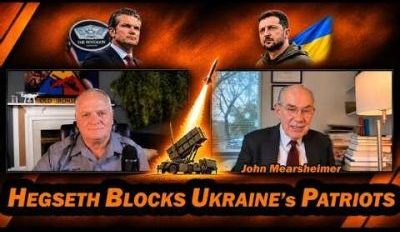
John Mearsheimer: Why Russia Gains By Hitting Ukraine Harder
or go to
Aletho News Archives – Video-Images
From the Archives
A Climate Scientist Who Engages Skeptics
By Judith Curry | November 27, 2009
An open letter to graduate students and young scientists in fields related to climate research:
Based upon feedback that I’ve received from graduate students at Georgia Tech, I suspect that you are confused, troubled, or worried by what you have been reading about ClimateGate After spending considerable time reading the hacked emails and other posts in the blogosphere, I wrote an essay that calls for greater transparency in climate data and other methods used in climate research. The essay is posted over at climateaudit.org.
What has been noticeably absent so far in the ClimateGate discussion is a public reaffirmation by climate researchers of our basic research values: the rigors of the scientific method (including reproducibility), research integrity and ethics, open minds, and critical thinking. Under no circumstances should we ever sacrifice any of these values; the CRU emails, however, appear to violate them. … continue
Blog Roll
 Aletho News
- Araghchi: ‘Israel’ seeks to drag US into war on Iran
- NYT’s Iran dam-missile narrative crumbles under statistical scrutiny and engineering evidence
- USAID Files: The Trusted Flaggers Nobody Can Audit
- How Western media weaponizes unverified claims to justify military aggression
- Content control: USAID docs expose Biden admin’s grip on Ukraine coverage
- Ukraine destroying itself: every attack on the Crimean Bridge will come at a price
- NATO capital under protest siege, so NATO escalates war
- A Climate Scientist Who Engages Skeptics
- John Mearsheimer: Why Russia Gains By Hitting Ukraine Harder
- Argentina’s Perito Moreno Glacier Joins Antarctica and Arctic In Defying Doomsday Melt Claims
- If Americans Knew
- Ad That Calls for Cutting Off US Aid to Israel to Air on SNL Thanksgiving Special
- Tortured into confessing: Report exposes abusive Israeli interrogation of Palestinians
- Israeli Military Probing Its Own ‘Widespread’ Use of Palestinian Human Shields
- Palestinians in Gaza Are Lining Their Tents with Sandbags to Stop Israeli Bullets
- Israel’s genocidal actions are preventing births in Gaza –New Amnesty report
- ‘Unlawful de facto exemption’: US sitting on 12-year backlog of alleged Israeli gross human rights violations
- DAILY UPDATE: Latest essential news on Palestine, Israel, & region
- The revolution against Israeli control of America is HERE! (Video)
- Why Iran Hawks Are Now Hyping ‘Radical Shiite’ Threats
- Israel is still displacing Palestinians in Gaza, expanding its ‘yellow line’ deeper into the strip every day
- No Tricks Zone
- Alarmist Climatologists In Shock! 2026 Atlantic Hurricane Season Sees Lowest Count In 101 Years
- New Study: Modern Temps Are Among The Coldest Of The Last 10,000 Years In East Central Europe
- Germany’s Renewable Energies Lead to 1.4 Billion Euro Electric Power Trade Deficit
- Argentina’s Perito Moreno Glacier Joins Antarctica and Arctic In Defying Doomsday Melt Claims
- New Study: Barents Sea Temperatures Were Warmer And Sea Ice Less Extensive In The 1700s Than Today
- German Authorities Start Initiative To Evaluate Public Register For Climate “Disinformation” Spreaders!
- Zonal Asymmetry of Temperature Change in the Antarctic Circumpolar Current
- New Study: The Net Fossil Fuel Contribution To Rising Atmospheric CO2 Has Been Zero For 500 Years
- Germany’s Green Energy Transition Becoming Increasingly Expensive…Another 6 Trillion Euros!
- Sudden Stratospheric Warming, Powerful El Niño Combination May Lead To Extreme Europe Cold, Energy Crisis!

