Members of the European Parliament (EP) have voted to suspend a security agreement with the United States, amid growing concerns over US spying activities against Europe.
“The EU should suspend its Terrorist Finance Tracking Program (TFTP) agreement with the US in response to the US National Security Agency’s alleged tapping of EU citizens’ bank data held by the Belgian company SWIFT,” read a resolution passed by the EP on Wednesday by 280 votes to 254 and 30 abstentions.
While the resolution is non-binding, the EP stressed that it “will take account of the European Commission’s response to this demand when considering whether to give its consent to future international agreements.”
In 2010, the European Union and the United States agreed on the TFTP, which allowed the US limited access to the global financial database SWIFT as part of an anti-terrorism campaign.
The Wednesday vote came, however, after revelations by former American intelligence contractor Edward Snowden that the United States was using the access to spy on Europe instead of using it for counterterrorism purposes.
The European lawmakers also called on EU member states to launch an investigation into the reports on the US espionage involving SWIFT.
Revelations of massive spying operations by the United States have triggered condemnations across Europe and Latin America.
In a latest revelation, Snowden said Washington has spied on the phone conversations of German chancellor Angela Merkel. The disclosure prompted the German chancellor to call US President Barack Obama to seek reassurance that her phone calls were no more targeted by US spying.
On October 21, the French newspaper Le Monde disclosed massive surveillance by the US on French citizens and diplomats. The news angered French President Francois Hollande, who expressed “extreme reprobation” for the reported collection by the US of 70 million digital communications between December 10, 2012 and January 8, 2013.
October 24, 2013
Posted by aletho |
Corruption, Deception, Full Spectrum Dominance | European Parliament, European Union, National Security Agency, Terrorist Finance Tracking Program, United States |
Leave a comment
As the second most populous former Soviet republic, Ukraine has seemed uncomfortable with its independence since 1991 and less than committed to making it work. The fundamental issue has always been, does the country remain entwined with its larger neighbour Russia, or does it succumb to the blandishments of the West and distance itself completely from a country with which it was co-joined for over 1000 years?
Within the USSR Ukraine was an economic power house with a large heavy industrial sector and flourishing agriculture based on its excellent ‘black soil’. To Western eyes, the typical Ukrainian was Nikita Khrushchev — a plump, jolly fellow; a bit crude, perhaps, but a good, stolid Soviet citizen. When Gorbachev arranged a referendum on preserving a reformed Soviet Union in March 1991, 76 percent of voters in Ukraine supported remaining in the USSR. Yet only eight months later 90 percent of them voted for independence. Some might say, how capricious! Could things have changed so quickly? They obviously did, meaning that the Communist apparatchiki jumped the sinking ship and the sheep followed.
Since then, the country has been ruled by a mixture of ex-Soviet officials and Komsomolski joined by a growing band of oligarchs, some who have grown rich from the oil and gas transportation business. Typical of this genre is Yulia Timoshenko, the former prime minister, now serving a prison sentence for embezzlement and therefore regarded as a saintly martyr by the EU oligarchs who regard ripping off the peasantry as far less of a sin than being imprisoned for it.
Making matters worse is the fact that Washington and its European allies have repeatedly involved themselves in Kiev’s dysfunctional politics for their own purposes not the country’s well-being. The country is a strategic linchpin mainly because of its Black Sea coast where the Russians still maintain an important military base in the Crimea, rented from Ukraine.
The Curse of Orange
In 2004, large sums of Western money were poured into Kiev to overturn the results of the country’s presidential election which had been won by Viktor Yanukovich, a mundane but competent bureaucrat from the more Russian-leaning eastern Ukraine. Fears were that he might be less amenable to the ‘reform agenda’ pushed by Brussels and Washington. For several weeks hordes of young people camped in a tent city in central Kiev alleging fraud and claiming that their chosen candidate, Viktor Yushchenko, was the real winner of the poll. They were joined by members of the European Parliament and supported by the U.S. embassy mainly in the form of orange paraphernalia – scarves, flags, T-shirts – which gave the movement its name: the Orange Revolution. At the time, Western-sponsored, allegedly spontaneous ‘colour revolutions’ were all the rage in the former USSR.
By fair means (and certainly foul) the Oranges prevailed. A repeat election was held and Viktor Yushchenko – inevitably – was the winner. He became president and Mrs Timoshenko, also a heroine of the Orange Revolution, was appointed his prime minister. The youth melted away from Kiev now that the free food and drink, provided by the revolution’s western funders, had disappeared. But, soon, all was not well. Yushchenko and his prime minster fell out and she was dismissed a year later, in 2005.
The falling out inside the Orange camp was a symptom of the fractious and feuding nature of Ukraine’s post-Communist elite. The Ukrainian parliament (Verkhovna Rada) was another woeful example of institutional failure. Increasingly dominated by supporters of the defeated (or deposed) President Yanokovich, as the Orange factions fell out and lost support in fresh parliamentary elections, it was the scene of regular fisticuffs and brawls between different factions – all shown on television. Mrs Timoshenko’s supporters were usually the first to throw the punches. It seemed that the Orange team’s promise of Western-style, cutting edge politics was a forlorn dream.
In 2010 the reviled Yanukovich was elected president – again. Allegations of his 2004 election fraud were forgotten. The U.S. and its European friends had made little attempt to rescue their Orange protégées, still, the fear lurked that the new president would lurch perilously towards Moscow. But, surprisingly, his first post-election visit was to Brussels and he seemed keen to pursue closer ties with the EU. However, relations with Russia did improve and Yanukovich began to contemplate Ukraine’s possible participation in the Russian-Belarusian-Kazakh Customs Union, a rival organisation to the EU – certainly when it came to seducing former Soviet republics into the fold. It is at this point that the latest Ukrainian drama – potentially, its most consequential – begins to unfold.
Enter Salvation: the EU beckons
The European Union aware that its members were enlargement weary came up with the idea of a ‘Union Lite’ – the Eastern Partnership – to ease the remaining post-Soviet orphans into the club but, sort of, through the back door. Unveiled in 2009, the idea was heavily promoted by Poland, whose Foreign Minister, Radislav Sikorski, promised all sorts of free trade and other economic benefits to the six potential ‘partners’, including Ukraine – the main one being closer contact with the economic paradise inhabited by their neighbours, the Poles. In truth, any ‘economic benefits’ that did emerge would go to the West rather than the poverty-stricken ‘partners’ who would find that Brussels’ largesse was restricted to its cronies.
Like the rest of the bloc, Ukraine’s economy had suffered during the 1990s as its Soviet markets disappeared. Things began to improve during Leonid Kuchma’s presidency (and Yanukovich’s premiership). Although courted by the west, Kuchma did not completely shut down the country as required by the ‘Washington consensus’. In fact, with economic boom in places like China, Ukraine’s raw materials (iron and steel from the east) were in strong demand. The country’s agricultural base had survived and its farms were productive – unlike the Polish version in Sikorski’s Euro-paradise.
Immediately, things started to go wrong as the Orange team began their time in office by interfering in the gas transit arrangements with Russia. In early 2006, after much provocation, Moscow cut off gas supplies to the West through the Ukrainian pipeline system due to Kiev’s arrears of payment as well as its aberrant behaviour. Negotiations with Moscow followed, and fed up with the debts and messing around, the Russians started to charge the Ukrainians more for their domestic supplies of gas. This impacted the country’s energy-dependent, heavy industrial base which was about to be hit anyway by the economic collapse in 2008 which resulted in less global demand for iron and steel.
Despite a change of government in 2010 rather than cease trouble making and find a solution to disagreements with Moscow, it seems that the apparat in Kiev has decided to walk away and accept the West’s somewhat poisoned chalice. Even the apparently, Moscow-friendly Yanokovich. In August 2013, his government indicated that it would sign the partnership agreement in November 2013 during the forthcoming European summit in Lithuania (another lucky beneficiary of the European project).
Tug of War: Moscow Reacts
The Russians have reacted angrily, stating that Ukraine cannot be a member of both customs unions. Ukraine’s economy is heavily dependent on Russia which takes 35 percent of Ukrainian exports. As Vladimir Putin’s envoy Sergei Glazyev points out: “Millions of people working in the industrial sector, with which we cooperate and which has thousands of ties with Russia, want [Ukraine’s accession to the Customs Union]. These are rocket constructors, shipbuilders, chemists, metallurgists, and especially farmers and producers of food, whose products are not in demand anywhere else except Russia,” Glazyev said in an interview published in the Russian-language Ukrainian newspaper Vesti.[1]
If the agreement is finally signed, Moscow says it will impose tariffs on Ukrainian goods which are likely to be ‘dumped’ in Russia as Ukraine is flooded with imports from the EU. But, the Ukrainian elites aren’t worried by any of this. They yearn to belong to the Euro club with its juicy perks and prospects for further self-enrichment. As Glazyev noted: “Numerous political scientists and experts, who have fed on European and American grants for 20 years … are doing a certain political job on their clients’ behalf. In addition, a whole generation of diplomats and bureaucrats has appeared after the years of the ‘orange’ hysteria, who are carrying out an anti-Russian agenda”.[2]
Having embraced several economic basket-cases (including the over-hyped Poland) since 2004, what is in the deal for Europe? Yes, they can flood Ukraine with food and drink (thus destroying the country’s still productive agricultural base) and they can – for a price – plaster the country with European super and hyper markets. For Tesco, Aldi & co. a population of 48 million is virgin territory – a boost for Tesco whose eastern European outlets have lost money in the last few years. Otherwise, after 22 years of ‘freedom’ there is precious little left for the much vaunted ‘strategic foreign investor’ to gobble up.
Cheap labour and cut-price prostitution will be Ukraine’s major exports if the Polish or Baltic model of European integration is anything to go by. Poland’s main ‘export’ is cash remittances from almost three million migrants scattered across the western EU, especially in Britain. Maybe Foreign Minister Sikorski hopes that Ukraine will replace Poland as the mega-El Salvador of Europe if it accedes to a visa-free association with the EU?
For Ukraine’s future, the immediate and most troubling issue is energy: the country is haunted by its fragile status as a transit route to Western Europe and its own parlous ability to pay the world market price for fuel .
In 2010 a joint Russian-German pipeline began to carry Russian gas to Europe under the Baltic sea. Moscow’s decision to redirect energy exports to the west had been driven by ongoing problems with the Ukrainian route, mainly caused by the Orange politicians (and encouraged by the west). By 2013 Ukraine’s revenues for transporting Russian gas to Europe had nearly halved. Meanwhile, under pressure to ‘distance’ themselves from their evil neighbour, in 2012 Ukraine started to import some gas (at subsidised prices) from Germany’s Ruhrgas. Presumably, this was Russian gas going on a rather roundabout journey but, for good, geopolitical reasons.
Ukraine: an economic basket case?
However, the much promoted energy independence might be achieved – at least, sometime in the future. In 2013, with hubris at fever pitch, various regions in Ukraine began signing contracts with companies like Chevron and Royal Dutch Shell for shale gas exploration. Initial tests have indicated large deposits around the country. Perhaps, finally, the Ukrainians would be free from Russian imports, although exactly when is unknown (2050 is one date bandied about). And, will the domestic customer benefit from lower prices, especially when the profits will go to Chevron & co.? None of this concerns the greedy mix of energy companies and Ukrainian politicos, noses already in the trough and snouts sniffing for more kickbacks.
But, maybe the Europeans have failed to take note of some of the risky business practises encountered by Western investors in Ukraine. According to the Financial Times “Swissport, for example, claims to have spent much of this year struggling to reverse a court ruling that stripped it of a 70 per cent stake in Ukraine’s largest air cargo handler. It won a victory in Ukraine’s highest commercial court on October 2, but could face further legal challenges. London & Regional Properties recently lost management control over Globus one of Ukraine’s top shopping malls. Even McDonalds has been caught up. The fast food giant claims that raiders are trying to seize ownership of one of its 75 local restaurants. Other investors whose assets have faced legal threats in Ukraine steelmaker ArcelorMittal , the biggest foreign investor in the country.[3]
Sometimes, pressures appear to be applied by state law enforcement itself. In two separate incidents last month, fraud investigators raided and temporarily paralysed the local subsidiary of Italy’s Unicredit bank; at Vitmark Ukraine, a juice manufacturer owned by private equity fund Horizon Capital, documents, computers and other items were seized.
On top of this, Ukraine is in debt and, again, poised to go cap in hand to the IMF for further loans. At the end of September the cost of insuring 3-year Ukrainian debt hit a three year high. Among emerging markets, the country has one of the biggest burdens of short-term external debt relative to foreign exchange reserves. Its reserves fell by about 30 per cent to less than $20bn in the year to the end of August. According to Moody’s, this provides 2.3 months’ import coverage. The ratings agency said in its downgrade note”.[4]
Bizarre, then, that while he was in Germany in May 2013, President Yanukovich boasted that the Partnership Agreement “will have a substantial positive influence on the European economic situation and will help Europe emerge from the crisis”. As one commentator pointed out “even without any trade liberalization Ukraine is buying more and more German goods, but it essentially has nothing to export there. Under these circumstances, offering itself as the “saviour of Europe” is a bit presumptuous”.[5] Germany isn’t going to promote anything in Ukraine that might smack of competition (in heavy industry, for example). Instead various ‘green’ projects were floated around at the May meeting.
So, Ukraine is broke; its goods are of an inferior quality and unlikely to appeal to the European consumer; its business practices (including their legal underpinning) are dubious. Why bring the EU closer to such a place when over twenty years of western involvement has not led to any improvement? The answer, as everyone really knows, is political. This is the first really promising opportunity to drag Ukraine away from Russia, a country with which is shares a long border, a common language and historical experience as well as family and religious ties. But, the hatred felt in the west for Mr. Putin has only intensified with his intervention to stop an attack on Syria. Sealing Ukraine’s ties with Europe are a good way of giving him a bloody nose.
The deal still needs to be finalised and this seems to pivot upon Yanukovich agreeing to Brussels’ demand that Yulia Timoshenko, jailed in 2011 for embezzlement and abuse of office, be freed. The Europeans see her plight as a human rights tragedy almost on a par with Nelson Mandela’s incarceration on Robben Island, ignoring the fact that this is the second time she has been imprisoned for economic crimes – in 1994 she was convicted of money laundering and extortion. Many Ukrainians find this sanctification hard to take. They are more likely to accept Matthew Brzezinski’s description of her modus operandi as the ‘gas princess’ in his book Casino Moscow.[6] The incarceration of a rich and powerful lady with a shady past is what seems to separate the Ukrainians from economic nirvana in the EU’s embrace.
As of this writing, Timoshenko’s release looks to be imminent, as Yanukovich has indicated his support for parliamentary action to allow her to be released from prison and sent to Germany, ostensibly for medical treatment.
Why does all this matter? Several basket cases have been absorbed into the EU already but with many negative repercussions, never mentioned by politicians like Sikorski. As people in former Soviet Bloc countries have fled the poverty resulting from membership of the EU, Ukrainians will also flee to western Europe once the ‘free trade’ rules kick in and visa rules are liberalised. How much more migrant labour can countries like Britain support? The Russians seem to be much angrier by Ukraine’s European aspirations than they were when the Baltic States joined NATO and EU. At the recent Yalta Conference where old globalist hands like Tony Blair and Bill Clinton urged Ukraine forward to the promised land, Putin’s envoy, Glazyev (also present) warned that signing the pact – rather than entering a Russian customs union – could tip Ukraine into default.
If the EU’s embrace of Ukraine precipitates a crisis in the debt-laden country with its currency worthless and Russia breathing down its neck, won’t Brussels feel obliged to ‘rush forward’ to save Ukraine by offering immediate entry into the EU? In the past, admission to NATO has preceded EU accession in ex-Communist countries. But when Ukrainians have been polled on joining an anti-Russian alliance, with them in the front-line, they have rejected the idea. So now the double-headed Western political monolith in Brussels is pushing EU accession first, to be followed by membership of NATO down the road.
With its shaky economy and political turmoil in several EU and euro member states, is this what the European Union really needs? With Russia now showing a more robust approach to what it sees as its ‘national interest’ who knows whether what seems on the surface to be an economic spat could lead to something deadlier. The EU’s claim to be a stabilising force for peace on the European continent looks set to collide with its geo-political ambition to do down the Russian state regardless of the costs to ordinary people inside the EU, Ukraine and Russia itself.
[1] “Putin’s aide calls opinion that all Ukrainians want European integration “sick self-delusion”” Interfax, 21st August, 2013 http://www.interfax.co.uk/ukraine-news/putins-aide-calls-opinion-that-all-ukrainians-want-european-integration-sick-self-delusion-2/
[2] ibid
[3]Roman Olyarchik: “EU beckons but investors still getting a rough ride” Beyond Brics Blog, Financial Times, 3rd October, 2013 http://blogs.ft.com/beyond-brics/2013/10/03/ukraine-eu-beckons-but-investors-still-getting-a-rough-ride/#ixzz2gfuGquIJ
[4] [4]Luke Smolinski “Ukraine:investors get nervous” Beyond Brics Blog, Financial Times, 26th September, 2013http://blogs.ft.com/beyond-brics/2013/09/26/ukraine-investors-get-nervous/#ixzz2gfuSIfSP
[5] Natalya Meden, “What Lies Behind the Idea of the EU-Ukraine Association Agreement” Strategic Culture Foundation, 26th June, 2013 http://www.strategic-culture.org/news/2013/06/26/what-lies-behind-idea-eu-ukraine-association-agreement.html
[6] For, Matthew Brzezinski on Timoshenko, see for example: “City reaps benefits of native sons. Dnepropetrovsk is home to 220 national politicians. That is too cozy — and too influential — a relationship to suit many Ukrainians.” Wall Street Journal, 28th February, 1997
Christine Stone is a UK-based lawyer and journalist. She was Director of the British Helsinki Human Rights Group. She is the author most recently (with RPI Academic Advisor Mark Almond) of Post-Communist Georgia: A Short History.
October 21, 2013
Posted by aletho |
Economics, Militarism, Timeless or most popular | European Union, Orange Revolution, Russia, Ukraine, Viktor Yanukovych, Viktor Yushchenko, Yulia Tymoshenko |
Leave a comment
Palestine is being disappeared
Two recent images encapsulate the message behind the dry statistics of last week’s report by the World Bank on the state of the Palestinian economy.
The first is a poster from the campaigning group Visualising Palestine that shows a photoshopped image of Central Park, eerily naked. Amid New York’s skyscrapers, the park has been sheared of its trees by bulldozers. A caption reveals that since the occupation began in 1967, Israel has uprooted 800,000 olive trees belonging to Palestinians, enough to fill 33 Central Parks.
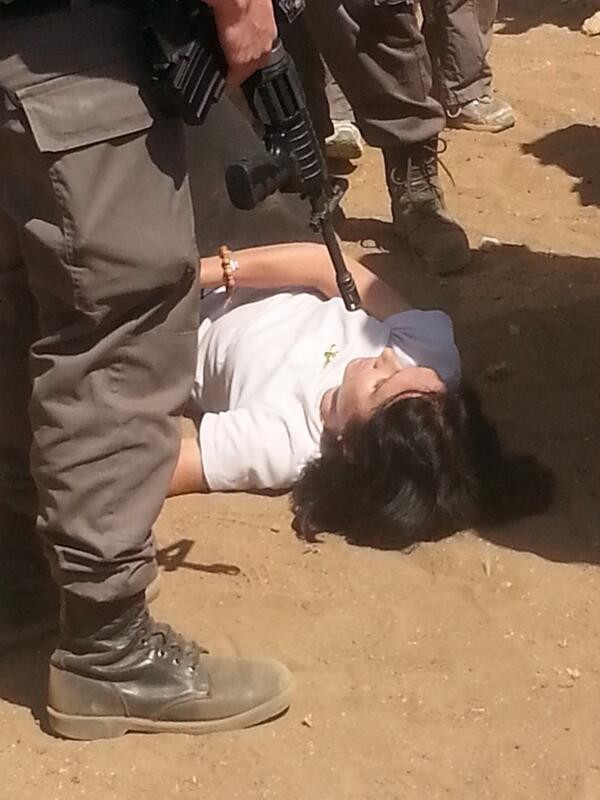
The second, a photograph widely published last month in Israel, is of a French diplomat lying on her back in the dirt, staring up at Israeli soldiers surrounding her, their guns pointing down towards her. Marion Castaing had been mistreated when she and a small group of fellow diplomats tried to deliver emergency aid, including tents, to Palestinian farmers whose homes had just been razed.
The demolitions were part of long-running efforts by Israel to clear Palestinians out of the Jordan Valley, the agricultural heartland of a future Palestinian state. Ms Castaing’s defiance resulted in her being quietly packed off back to Europe, as French officials sought to avoid a confrontation with Israel.
The World Bank report is a way of stating discreetly what Castaing and other diplomats hoped to highlight more directly: that Israel is gradually whittling away the foundations on which the Palestinians can build an independent economic life and a viable state.
This report follows a long line of warnings in recent years from international bodies on the dire economic situation facing Palestinians. But, significantly, the World Bank has homed in on the key battleground for an international community still harbouring the forlorn hope that the Israeli-Palestinian conflict will end in Palestinian statehood.
The report’s focus is on the nearly two-thirds of the West Bank, known as Area C, that is exclusively under Israeli control and in which Israel has implanted more than 200 settlements to grab Palestinian land and resources.
The World Bank report should be seen as a companion piece to the surprise decision of the European Union in the summer to exclude entities associated with the settlements from EU funding.
Both in turn reflect mounting frustration in European capitals and elsewhere at Israeli intransigence and seeming US impotence. Europeans, in particular, are exasperated at their continuing role effectively subsidising through aid an Israeli occupation with no end in sight.
With Israel and the Palestinians forced back to the negotiating table since July, and after the US secretary of state, John Kerry, warned that this was the “last chance” for a deal, the international community is desperate to exercise whatever small leverage it has on Israel and the US to secure a Palestinian state.
The World Bank’s concern about Area C is justified. This is the location of almost all the resources a Palestinian state will need to exploit: undeveloped land for future construction; arable land and water springs to grow crops; quarries to mine stone and the Dead Sea to extract minerals; and archaeological sites to attract tourism.
With access to these resources, the Palestinian Authority could generate an extra income of $3.4 billion a year, increasing its GDP by a third, reducing a ballooning deficit, cutting unemployment rates that have reached 23 per cent, easing poverty and food insecurity and helping the fledgling state break free of aid dependency. But none of this can be achieved while Israel maintains its chokehold on Area C in violation of the 1993 Oslo accords.
Israel has entrenched its rule in Area C precisely because of its wealth of natural resources. Israel neither wants the Palestinians to gain the assets with which to build a state nor intends to lose the many material benefits it has accrued for itself and the settler population in Area C.
It is its treatment of Area C that gives the lie to Israeli prime minister Benjamin Netanyahu’s claim that he has been pursuing “economic peace” with the Palestinians in lieu of progress on the diplomatic front. Rather, the Palestinian description of Israeli policy as “economic warfare” is much nearer the mark. During the Oslo period, the disparity between Israel’s per capita GDP and that of the Palestinians has doubled, to $30,000. And the World Bank says that the Palestinian economy is rapidly shrinking: the 11 per cent growth that Netanyahu took credit for in 2011 has crashed to 1.9 per cent in the first six months of this year. In the West Bank, GDP has actually contracted, by 0.1 per cent.
Despite its resources, Area C is being starved of Palestinian funds. Investors are averse to dealing with Israeli military authorities who invariably deny them development permits and severely restrict movement. The image of the French diplomat in the dirt is one that symbolises their own likely treatment if they confront Israel in Area C. Palestinian farmers, meanwhile, cannot grow profitable crops with the miserly water rations Israel allots them from their own aquifers.
Aware of the many obstacles to developing Area C, Palestinian officials have simply neglected it, concentrating instead on the densely populated and resource-poor third of the West Bank under their full or partial control.
The hope was that this would change when Kerry announced in the run-up to the renewed talks a plan to encourage private investors to pour in $4 billion to develop the Palestinian economy. But the reality, as the report notes, is that there can be no serious investment in the economic heartland of Area C until Israel’s control ends.
In effect, the World Bank is saying that Kerry’s plan – and the role of the international community’s envoy Tony Blair, the so-called Quatet Representative – is not only misguided, it is positively delusional. The Quartet has been trying to revive the Palestinian economy to usher in the conditions for statehood; the World Bank’s view is that there can be no Palestinian state, let alone economic revival, until Israel is forced out of the territories. The international community has it all back to front.
The idea that a financial lifeline – whether Kerry’s plan or Netanyahu’s economic peace – is going to smooth the path to the conflict’s end is an illusion. Peace, and prosperity, will come only when Palestinians are liberated from Israeli control.
Jonathan Cook is a writer and journalist based in Nazareth, Israel.
October 17, 2013
Posted by aletho |
Economics, Ethnic Cleansing, Racism, Zionism, Timeless or most popular | European Union, Palestine, West Bank, Zionism |
Leave a comment
The NSA has attacked key European institutions such as the EU parliament and banking system, using malware to find out all there is to know about other countries in a power game, Andy Mueller-Moguhn, founder of Buggedplannet.info, tells RT.
He says that in a world where so many communications go over the web we all have something to protect rather than something to hide, as proponents of mass surveillance often argue.
RT: No matter what precautions companies take or measures to protect the privacy of subscribers isn’t the agency [NSA] capable of bypassing all these routes?
Andy Mueller-Moguhn: I would say it like this; unfortunately in Germany we have a situation that the trustworthiness or our foreign and interior intelligence service watching their high level of cooperation with the NSA and GCHQ does not make them trustworthy at all. If they can intercept the stuff, they might hand it over in a bargain to the Americans, which is not helpful.
So this means that what is to be done, is to ensure on whatever level in whatever country that encryption for the end user is becoming available like easy to use and as a standard tool, because you send your postal letters in an envelope so should you do with your emails.
RT: Let’s look at the situation from both sides. On the one hand we have the privacy of citizens that has of course to be respected, but on the other hand there are some companies who are fighting hard to protect their privacy. Doesn’t that give us a cause for concern, that they have something to hide, some skeletons in the closet as they say?
AMM: The point is that we have seen that installations of the United States National Security Agency, attacking also carriers in Europe, as we’ve seen with things that have nothing to do with terrorism or with fighting terrorism. They have a lot to do with power games or with knowing everything about other countries, about business, about embassies, about other country’s governments as we also see with the Brazilian presidential interception.
So obviously the thing that you have nothing to hide is totally wrong in the case that everybody has something to protect and in the days where everything, cultural, economic, political, things go over the internet and advance knowledge of a political decision, which can have for example an impact on stock rates, on currencies, on country’s reputations and so on. This is worth a lot of money and we have not really come to the bottom, we have seen a big part of this NSA approach, we have seen a lot of money, a lot of effort internationally to intercept all communications, but we have not yet come to the question, who is the customer, in the sense who are the guys ordering this, getting the product and using that.
That it is still a very interesting question where we come to monetary, political and other influences being taken with blackmailing, with greymailing, with advanced knowledge about what other people think, act and do.
RT: You mentioned an interesting point here saying that it’s not the point whether we have something to hide, but it’s what we have to protect. In that case what’s your take on the role of America as a global policeman? Does it have any moral authority to conduct global surveillance?
AMM: The point is that we have seen attacks, not passive interception but buggedplannet.info was subject to an attack in the sense that there was malware installed in the system, there were exploits used, the NSA literally took control over the network. This cannot be excused with fighting terrorism at all. This obviously was targeting the European parliament, it was targeting the European airspace control, it was targeting the SWIFT network or the banking network, so obviously there is no moral excuse here in terms of this being to do with fighting terrorism or ensuring security. This is about the global interest of the United States against other European and other peaceful acting countries and democratic organized entities.
October 16, 2013
Posted by aletho |
Corruption, Deception, Full Spectrum Dominance | Europe, European Union, Germany, Government Communications Headquarters, Human rights, Intelligence, Internet, National Security Agency, NSA, Politics, RT (TV network), Security, United States, USA |
Leave a comment
12th October 2013 | European Coordination Committee for Palestine | Brussels, Belgium
 In July 2013, the European Commission announced new guidelines that aim to prevent Israeli projects in illegal Israeli settlements from receiving research grant funding and prevent Israeli companies and institutions that operate inside illegal Israeli settlements from participating in financial instruments such as loans. The new guidelines were broadly welcomed by Palestinian and European civil society organisations.
But now Israel and its supporters are pressuring the EU to drop the new guidelines. There is a very real risk that the Commission will cave in to Israeli pressure and decide to continue the funding of, and support for, Israeli projects and organisations based in occupied Palestinian Territory. This would send a dangerous message that the EU lacks the political will to pressure Israel to end its war crimes and comply with international law.
Please use our simple e-tool to send a message to your members of the European Parliament and ask them to take action to support the new guidelines and make sure that the EU stops funding Israeli war crimes.
Take Action! Send this message to your members of the European Parliament!
Click on your country to find your MEPs.
AUSTRIA / BELGIUM (DUTCH / FRENCH) / CZECH REPUBLIC / DENMARK / FINLAND / FRANCE / GERMANY /IRELAND / ITALY / LUXEMBOURG / NETHERLANDS / POLAND / SLOVAKIA / SLOVENIA / SPAIN / SWEDEN /UNITED KINGDOM
October 12, 2013
Posted by aletho |
Illegal Occupation, Solidarity and Activism, War Crimes | European Parliament, European Union, Israeli settlement |
Leave a comment
Belgium has demanded explanations from the British Government Communications Headquarters (GCHQ) over allegations that it infiltrated major Belgian national telecom provider Belgacom.
The allegations against GCHQ were made after documents, leaked by US whistleblower Edward Snowden, pointed to the British agency’s spying activities against Belgium.
According to reports in the German newspaper Der Spiegel, the Cheltenham-based intelligence agency has been accused of hacking the IT system of Belgacom by placing a virus in its network.
“Following the article in Der Spiegel, the government asked Belgian intelligence services to ask their British colleagues for more information,” said a source close to the Belgian government.
Prosecutors in Brussels are now investigating the case against the British spy agency.
A GCHQ spokeswoman declined to comment on the revelation.
Meanwhile, the European Parliament is also examining the activities of the GCHQ. European courts have launched a legal challenge against the agency’s surveillance programs over violating the privacy of millions of people throughout Britain and Europe.
However, London claims the EU does not have the authority to investigate these charges in European courts.
Snowden is currently in Russia, where he has been granted temporary asylum.
October 5, 2013
Posted by aletho |
Civil Liberties, Corruption, Deception | Belgacom, Belgium, European Parliament, European Union, GCHQ, Government Communications Headquarters, Human rights |
Leave a comment
The European Union is “not satisfied” with Washington’s answers on revelations that the US spied on international bank transfers, a top official says.
“I’m not satisfied with what we have gotten so far,” said EU Home Affairs Commissioner Cecilia Malmstrom during a hearing at the European Parliament on Tuesday.
She added, “I will be seeking exhaustive explanations, comprehensive information.”
The revelations that US National Security Agency (NSA) widely monitors international payments and financial transactions was reported by the German magazine Der Spiegel on September 16 and stems from leaked documents by US whistleblower Edward Snowden.
Malmstrom wrote in a recent letter to US Terrorism and Financial Intelligence Under Secretary David Cohen that “should the facts in these press reports be confirmed, they would further weaken the confidence between the EU and the US and would undoubtedly impact on our cooperation in the field of counter-terrorism.”
Since the disclosure, there have been calls by EU lawmakers for the suspension of a data-sharing agreement between the EU and the US. The deal grants Washington access to data from the SWIFT network used by thousands of banks to send transaction information securely.
“There have been very severe allegations in the press,” said Malmstrom adding, “If these allegations are true, they constitute a breach of the agreement and a breach of the agreement can certainly lead to a suspension.”
Malmstrom warned already in July, prior to the bank transfer disclosure, that the EU could reconsider financial data sharing agreements with the US if it was determined that the accords have not been executed “in full compliance with the law.”
The privacy violations were first revealed by Snowden in June. He leaked confidential information that showed the NSA collects data of phone records and Internet communication in the US and Europe as well as other countries.
September 24, 2013
Posted by aletho |
Corruption, Deception, Full Spectrum Dominance | European Union, National Security Agency, United States |
Leave a comment
European diplomats are holding Israel accountable over an incident where IDF servicemen attacked a EU humanitarian convoy in the West Bank on Friday. So far Tel Aviv has left the scandal in limbo, offering no official explanation for the incident.
Diplomats from several EU countries have spoken out against the shocking incident of harassing a person with diplomatic immunity, clearly awaiting some sort of official reaction from the state of Israel.
After disturbing photos of the French diplomat, Marion Fesneau-Castaing, spread on the ground with IDF soldiers standing around her hit international news, the scandal over hijacked EU aid to homeless Bedouins from demolished villages in the West Bank has gained momentum.
“EU representatives have already contacted the Israeli authorities to demand an explanation and expressed their concern at the incident,” says a statement issued by the spokesmen for EU foreign policy, Catherine Ashton and Humanitarian Aid Commissioner, Kristalina Georgieva.
An EU official described the Israeli actions as “shocking and outrageous”, the BBC reported.
The British Consulate General in Jerusalem is “concerned at reports that the Israeli military authorities have prevented the affected community from receiving humanitarian assistance,” the consulate’s spokesman said.
“We have repeatedly made clear to the Israeli authorities our concerns over such demolitions, which we view as causing unnecessary suffering to ordinary Palestinians, as harmful to the peace process and contrary to international humanitarian law,” the spokesman added.
The Israeli authorities should “live up to their obligations as occupying power to protect those communities under their responsibility,” the UN Humanitarian Coordinator James Rawley said.
‘Illegal diplomatic activity’
The Israeli Foreign Ministry’s spokesperson, Paul Hirschson, has threatened to lodge a complaint over Marion Fesneau-Castaing’s actions, Agence France-Presse reported.
“If she did participate then a formal complaint will be filed because that is not the way diplomats behave,” he said.
On Saturday the EU ambassador in Israel called the Foreign Ministry Deputy Director-General for Europe, Rafi Shutz, demanding explanations regarding the IDF in the West Bank on Friday.
“What was done there by the European diplomats was a provocation,” said Shutz as quoted by the Haaretz.
Mr Shutz claimed that force against the female French diplomat was used because she slapped one of the soldiers. He also announced that the state of Israel is looking into allegations that foreign diplomats “abused their diplomatic privileges”.
Because Palestinian construction at the site of former Khirbet Al-Makhul village was ruled illegal by an Israeli court, the European diplomats were engaging in illegal activity, Shutz stated. He also pointed out that humanitarian aid to Palestinians should be delivered through the proper channels, coordinated with Israel.
The IDF explained the use of stun grenades during the incident, claiming that stones were thrown at security forces. Stun grenades were thrown directly into a group of European diplomats, aid workers and locals who were trying to deliver emergency aid to the residents of a demolished Palestinian village, Reuters reported.
On Friday a truck with EU humanitarian aid for the villagers of the demolished Khirbet Al-Makhul settlement was attacked by IDF personnel, who confiscated the truck and the payload. French diplomat Marion Fesneau-Castaing, who attempted to prevent confiscation of the aid, was pulled out of the truck and forced to the ground. The incident received wide international coverage.
Houses, stables and a kindergarten at Khirbet Al-Makhul village were demolished on Monday after a decision by Israel’s High Court, which ruled that villagers had illegal building permits. The villagers refused to leave the ruins saying they have been living on that land for generations.
The seizure incident of a truck carrying humanitarian aid has become yet another page in the row between Brussels and Tel Aviv. In July the EU announced it is going to stop all financial assistance to Israeli organizations operating in the occupied territories, starting from 2014.
The government of Prime Minister Benjamin Netanyahu reacted angrily, denouncing the move as interference in Israel-Palestine relations and retaliated by blocking EU humanitarian aid to tens of thousands of Palestinians in the West Bank.
Israel and the Palestinian Autonomy remain in fruitless peace talks, with the major stumbling block being the ongoing construction of Jewish settlements in the West Bank and East Jerusalem, occupied since the 1967 Middle East war.
September 22, 2013
Posted by aletho |
Ethnic Cleansing, Racism, Zionism, Militarism, Supremacism, Social Darwinism | European Union, Israel, Khirbet Al-Makhul, Marion Fesneau-Castaing, Palestine, West Bank, Zionism |
Leave a comment
 Israeli soldiers manhandled European diplomats on Friday and seized a truck full of tents and emergency aid they had been trying to deliver to Palestinians whose homes were demolished this week.
A Reuters reporter saw soldiers throw sound grenades at a group of diplomats, aid workers and locals in the occupied West Bank, and yank a French diplomat out of the truck before driving away with its contents.
“They dragged me out of the truck and forced me to the ground with no regard for my diplomatic immunity,” French diplomat Marion Castaing said.
“This is how international law is being respected here,” she said, covered with dust.
The Israeli army and police declined to comment.
Locals said Khirbet al-Makhul was home to about 120 people. The army demolished their houses, stables and a kindergarten on Monday after Israel’s high court ruled that they did not have proper building permits.
Despite losing their property, the inhabitants have refused to leave the land, where they say their families have lived for generations along with their flocks of sheep.
Israeli soldiers stopped the International Committee of the Red Cross (ICRC) delivering emergency aid on Tuesday and on Wednesday IRCS staff managed to put up some tents but the army forced them to take the shelters down.
Diplomats from France, Britain, Spain, Ireland, Australia and the European Union’s political office, turned up on Friday with more supplies. As soon as they arrived, about a dozen Israeli army jeeps converged on them, and soldiers told them not to unload their truck.
“It’s shocking and outrageous. We will report these actions to our governments,” said one EU diplomat, who declined to be named because he did not have authorization to talk to the media.
“(Our presence here) is a clear matter of international humanitarian law. By the Geneva Convention, an occupying power needs to see to the needs of people under occupation. These people aren’t being protected,” he said.
In scuffles between soldiers and locals, several villagers were detained and an elderly Palestinian man fainted and was taken for medical treatment.
The UN Office for the Coordination of Humanitarian Affairs (OCHA) said in a statement that Makhul was the third Bedouin community to be demolished by the Israelis in the West Bank and adjacent Jerusalem municipality since August.
Palestinians have accused the Israeli authorities of progressively taking their historical grazing lands, either earmarking it for military use or handing it over to the Israelis whose settlements dot the West Bank.
Israeli forces regularly demolish Palestinian homes, claiming they do not have the proper construction permits. However, the Israeli government regularly announces the expansion of settlements, which are considered illegal under international law.
Israelis and Palestinians resumed direct peace talks last month after a three-year hiatus. Palestinian officials have expressed serious doubts about the prospects of a breakthrough.
“What the Israelis are doing is not helpful to the negotiations. Under any circumstances, talks or not, they’re obligated to respect international law,” the unnamed EU diplomat said.
(Reuters, Al-Akhbar)
September 20, 2013
Posted by aletho |
Ethnic Cleansing, Racism, Zionism | al-Akhbar, European Union, International Committee of the Red Cross, Israel, Palestine, United Nations Office for the Coordination of Humanitarian Affairs, West Bank, Zionism |
Leave a comment
US Secretary of State John Kerry has urged the European Union (EU) to delay a planned ban on Israel over the Tel Aviv regime’s continued settlement activities in the occupied Palestinian territories, according to a senior US official.
On July 19, the EU published new guidelines in its Official Journal, banning its 28 members from funding projects in the illegal Israeli settlements in al-Quds (Jerusalem), the West Bank or Golan Heights, which the Tel Aviv regime occupied during the 1967 war.
The ban sparked anger among the Israeli officials, with Israeli Prime Minister Benjamin Netanyahu and President Shimon Peres threatening that the new directive would undermine attempts by Kerry to relaunch talks between Israel and the Palestinian Authority.
A senior US State Department official, whose name was not mentioned in the reports, said that, in a meeting with EU foreign ministers in the Lithuanian capital, Vilnius, on Saturday, Kerry called on the Europeans to consider postponing the implementation of the EU guidelines.
Kerry also asked EU diplomats to support the talks between the Israeli regime and the Palestinian Authority, which resumed in July after a three-year hiatus.
Meanwhile, the EU is to send a team to Israel on Monday to move forward on the guidelines against Israeli organizations in the occupied Palestinian territories.
Israel has announced plans to construct more than 3,000 housing units in al-Quds and the occupied West Bank since the resumption of the talks with the Palestinian Authority in July.
On August 11, Israel’s Housing Minister Uri Ariel gave final approval for the construction of 793 settlement units in the occupied east al-Quds (Jerusalem) and 394 others in the West Bank.
A day later, the EU described as “illegal” the Israeli regime’s decision to approve the building of settlement units.
Yasser Abed Rabbo, a top aide to Mahmoud Abbas, the acting Palestinian Authority (PA) chief, said on September 4 that continued Israeli settlement construction had undermined the talks with Israel.
Palestinians demand that Israel withdraw from the occupied Palestinian territories.
September 8, 2013
Posted by aletho |
Ethnic Cleansing, Racism, Zionism, Illegal Occupation, Progressive Hypocrite, War Crimes | European Union, Israel, Israeli settlement, Jerusalem, John Kerry, West Bank |
Leave a comment
A new EU court ruling that rejected sanctions on a number of Iranian entities has drawn the ire of the United States, prompting Washington to extend its illegal embargoes against more individuals and businesses.
The EU’s General Court in Luxembourg lifted the bloc’s sanctions against seven Iranian companies on Friday, ruling that there wasn’t sufficient evidence to justify the embargoes.
The top EU court ruled that the bloc wrongly blocked the accounts of Post Bank of Iran, the Iran Insurance Company, Good Luck Shipping and the Export Development Bank of Iran, from 2008 to 2011.
“We are very disappointed by the [EU] court’s decision today,” a spokesman for the US Treasury Department said in a statement on Friday.
The US Treasury later announced that it blacklisted six individuals and four businesses over their alleged links to Iranian oil sales.
At the beginning of 2012, the US and the European Union imposed new sanctions on Iran’s oil and financial sectors aimed at preventing other countries from purchasing Iranian oil and conducting transactions with the Central Bank of Iran.
The illegal US-engineered sanctions were imposed based on the unfounded accusation that Iran is pursuing non-civilian objectives in its nuclear energy program.
Iran rejects the allegation, arguing that as a committed signatory to the nuclear Non-Proliferation Treaty (NPT) and a member of the International Atomic Energy Agency (IAEA), it has the right to use nuclear technology for peaceful purposes.
In addition, the IAEA has conducted numerous inspections of Iran’s nuclear facilities but has never found any evidence showing that Iran’s nuclear activities have non-civilian purposes.
September 7, 2013
Posted by aletho |
Economics | European Union, Human rights, Iran, Post Bank Iran, Sanctions against Iran, United States, United States Department of the Treasury |
Leave a comment
The G20 should be focusing on their flagging economies rather than planning a military operation in Syria they can’t afford, analyst, Alex Korbel, told RT. France, in particular, is at full stretch, with 16 military campaigns abroad and an ailing economy.
The Syrian conflict has eclipsed the G20 meeting in Saint Petersburg, as the international community is unable to come to an agreement over a possible military strike. Washington has put forward a plan for military intervention against the Assad regime, which it believes is responsible for a chemical attack in a Damascus suburb on August 21.
RT: If the UN team of inspectors finds that chemical weapons were used in the Damascus attack, do you believe military intervention could be justified?
Alex Korbel: I think there is no case for military intervention in Syria for several reasons. The first reason is that there is no national interest for France or the US to actually intervene in Syria. The regime of Bashar al Assad was not a problem in the past and it is not clear why it’s now a problem for France and the US. There is no clear objective in the military intervention as it is now presented. Is it about maintaining the credibility of the US? What credibility exactly? The credibility to intervene in unnecessary wars? Is it to ban the use of chemical weapons? Then why does the US have chemical weapons in its arsenal? Is it to weaken the Bashar al Assad regime? In that case you need to put boots on the ground. If it is a humanitarian way to help the civilians, then locking on cruise missiles is not the right solution.
For all of these reasons the US and France have decided to move ahead with limited military intervention. But still there is a danger of falling down a slippery slope. What if a military intervention has no effect? Are we going to see full war? What would be the consequences in the region? I am thinking about Iran and Lebanon and I am thinking about a war less than 1000 kilometers south of Russia.
There is no broad international support for this war. Germany is against it, the UK is against it, China and Russia are against it. The only countries that are in favor are France, which has not yet consulted parliament, US and Israel and Saudi Arabia. Finally, public opinion is clearly against it everywhere. We saw it in the UK and the public polls in the US and France that the public is massively against military intervention in Syria.
RT: Given the climate of economic crisis in the EU, can France feasibly participate in another military operation?
AK: The economic situation of the EU countries is really bad. We can see in France that public debt is higher than 90 per cent of GDP. We see economic growth is less than 1 per cent. We see across G20 countries on average that unemployment is at 9 per cent and growing, that public debt is 64 per cent and growing, that economic growth is 1 per cent and weakening. What needs to be done is not to intervene militarily in another country.
France is already intervening in 16 countries worldwide. Clearly we don’t have any money to finance a seventeenth operation. The purpose of France, the US and any western power is not to ‘play the cop’ around the world but actually to maintain a sound economic policy first and then maybe lead by example on the international scene.
September 6, 2013
Posted by aletho |
Economics, Militarism | EU, European Union, France, G-20 major economies, Saudi Arabia, Syria, United States |
Leave a comment
 In July 2013, the European Commission announced new guidelines that aim to prevent Israeli projects in illegal Israeli settlements from receiving research grant funding and prevent Israeli companies and institutions that operate inside illegal Israeli settlements from participating in financial instruments such as loans. The new guidelines were broadly welcomed by Palestinian and European civil society organisations.