Meet Ghislaine: Daddy’s Girl
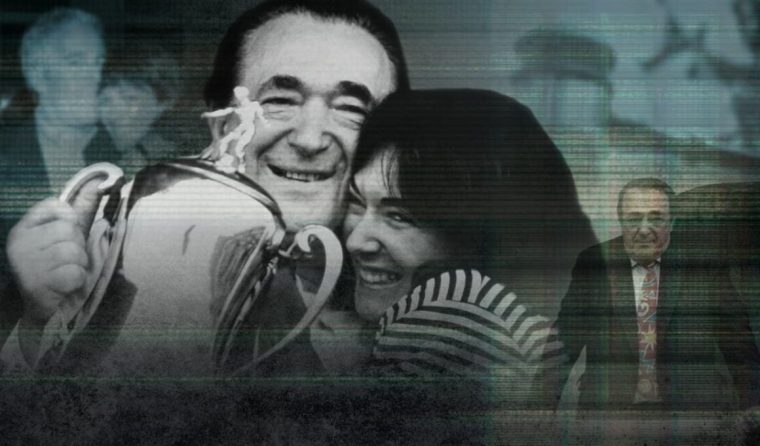
BY WHITNEY WEBB |
UNLIMITED HANGOUT| DECEMBER 16, 2021
Absent from mainstream discourse on Ghislaine Maxwell’s ongoing trial is any mention of the ties, not only of herself, but her family, to Israeli intelligence. Those ties, forged by Ghislaine’s father Robert Maxwell, are critical to understanding Ghislaine’s history and her role in Jeffrey Epstein’s sexual blackmail and trafficking network.
The trial of Ghislaine Maxwell, the alleged madam of Jeffrey Epstein’s sexual blackmail and sex trafficking network, has attracted considerable mainstream and independent media attention, though not as much as one might expect given the level of media attention that surrounded Epstein’s 2019 arrest and death or given the public interest in the Epstein/Maxwell scandal and its broader implications.
Unsurprisingly, the broader implications of the Epstein/Maxwell scandal have been largely, if not entirely absent, from mainstream media (and some independent media) coverage of Ghislaine Maxwell’s trial as well as absent from the case itself. For example, despite physical evidence of sexual blackmail stored at Epstein’s residences being shown by the prosecution (with the names of those incriminated being notably redacted), the prosecution chose not to mention even the potential role of blackmail in Ghislaine Maxwell’s activities and motives as it related to her involvement in sex trafficking activities alongside Jeffrey Epstein. Not only that, but the names of Ghislaine’s close contacts and even some of her defense witnesses, along with considerable information about her role in Epstein’s network that is very much in the public interest, is due to be filed under seal and forever hidden from the public, either due to “deals” made between the prosecution and the defense in this case or due to rulings from the judge overseeing the case.
Going hand in hand with the blackmail angle of this case is the specter of Ghislaine Maxwell’s family ties to intelligence agencies, as well as the intelligence ties of Jeffrey Epstein himself. Given that blackmail, particularly sexual blackmail, has been used by intelligence agencies – particularly in the US and Israel – since the 1940s and beyond, it is deeply troubling that neither the blackmail or intelligence angle has played any role in the prosecution’s case or in the mainstream media’s coverage of the trial.
To remedy this lack of coverage, Unlimited Hangout is publishing a 2-part investigative report entitled “Meet Ghislaine”, which is adapted from this author’s upcoming book on the subject. This investigation will detail key aspects of Ghislaine Maxwell’s links to intelligence agencies and sexual blackmail activities that are relevant to the case against her and perhaps explain the silence from the prosecution and their interest in sealing potentially incriminating evidence against Ghislaine from public scrutiny. Part 1 of this article will focus on Ghislaine’s father, Robert Maxwell, a “larger than life” figure who straddled the worlds of both business and espionage and whose daughters inherited different aspects of his espionage contacts and activities as well as his influence empire following his 1991 death.
The Making of a Maxwell
To understand Ghilaine Maxwell’s history, one must start with a hard look at the rise of her father, Robert Maxwell. Born in what is now part of Ukraine, “Robert Maxwell” was the last in a series of names he used, with Abraham Hoch, Jan Ludvick, and Leslie Du Marier among his earlier aliases. The name Robert Maxwell emerged at the behest of one of his superiors in the British military. Maxwell had joined the British military during World War II, having left the village of his birth prior to the war, when the Third Reich began its expansion. Maxwell’s parents and his siblings are believed to have died in the Holocaust.
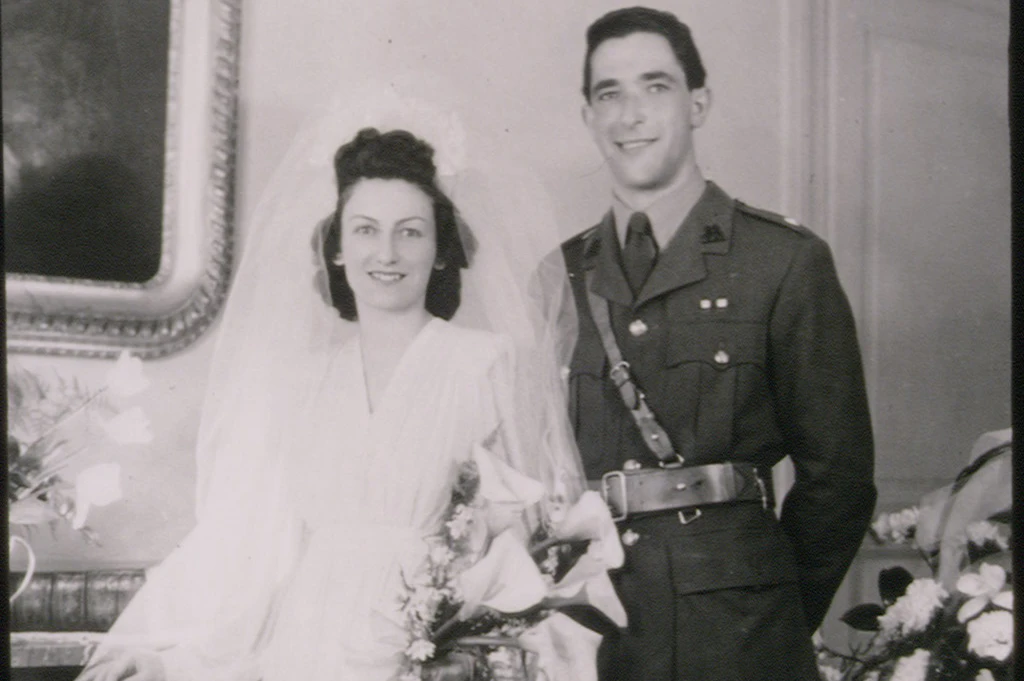
Robert and Betty Maxwell pose at their 1945 wedding; Source
Robert Maxwell was involved with the British intelligence service MI6 during the war and, after the war, was befriended by Count Frederich vanden Huevel, who had worked closely with Allen Dulles during the war. Dulles went on to be the first director of the Central Intelligence Agency (CIA) and, during the war, was busy running interference for prominent Nazis and actively undermining FDR’s “total surrender” policy for senior Nazi leadership.
The chaos of postwar Europe allowed Maxwell to plant the seeds for what would become his future media empire. Thanks to his contacts with Allied Forces in postwar Berlin, he was able to acquire the publishing rights for prominent European scientific journals and, in 1948, those interests were folded into the British publishing company Butterworth, which had long-standing ties to British intelligence. In the early 1950s, the company was renamed Pergamon Press, and this company became the cornerstone of Maxwell’s media empire.
Pergamon’s access to prominent academics, scientists, and government not only led to Maxwell acquiring great wealth but also attracted the interest of various intelligence agencies— British, Russian, and Israeli among them—all of which attempted to recruit Maxwell as an asset or as a spy. When MI6 attempted to recruit Maxwell for the service, it concluded, after conducting an extensive background check, that Maxwell was a “Zionist—loyal only to Israel.” His subsequent relationship with MI6 was choppy and largely opportunistic on both sides, with Maxwell later laying some of the blame for his financial troubles on MI6’s alleged attempts to “subvert” him.
Maxwell was not officially recruited to work for Israeli intelligence until 1961, but his critical role in securing weapons and airplane parts for the 1948 war that created the state of Israel suggests a strong relationship with prominent politicians and military figures in the nation from its beginning, as this was certainly the case with other prominent businessmen who had helped arm Zionist paramilitaries before and during 1948. In the early 1960s, Maxwell was formally approached by Israeli intelligence to make use of his access to the variety of prominent businessman and world leaders that he had cultivated while growing his media empire.
A few years after being officially recruited as an asset of Israeli intelligence, Maxwell ran for public office, becoming a member of the British Parliament for the Labour Party in 1964. His bid for re-election failed, which left him out of office by 1970. Around that same time, he also lost control of Pergamon Press, though he reacquired it a few years later.
Having nearly lost everything, Maxwell devoted his time to consolidating control over his ever-growing web of interlocking companies, trusts, and foundations that now encompassed much more than media concerns, while also developing his ties to prominent politicians, businessmen, and their fixers, a group that Maxwell proudly referred to as his “sources.” Among these early “sources” were soon-to-be UK prime minister Margaret Thatcher; Israel’s biggest arms dealer and one of its powerful oligarchs, Saul Eisenberg; financial behemoths such as Edmund Safra; and master manipulators such as Henry Kissinger. Another early “source” was George H. W. Bush, who was then part of the Nixon administration and soon served as CIA director before becoming Reagan’s vice president and then US president himself.
Maxwell’s sources and influence extended well beyond the West, with many of his most prominent contacts found in Eastern Europe and in the Soviet Union. He had cozy relationships with dictators, intelligence officials, and even organized crime lords such as Semion Mogilevich, sometimes referred to as the “boss of the bosses” of the Russian mafia. It was none other than Robert Maxwell who orchestrated the entry of Mogilevich-connected companies into the United States, a move that was accomplished after Maxwell successfully lobbied the state of Israel to grant Mogilevich and his associates Israeli passports, thereby allowing them easier access to US financial institutions.
The expansion of Maxwell’s prominent contacts paralleled the growth of his media empire. By 1980, he had acquired the British Printing Corporation, which he renamed the Maxwell Communication Corporation. Just a few years later, he bought the Mirror Group, publisher of the British tabloid the Daily Mirror. This was followed by his acquisition of US publishers Prentice Hall and MacMillan and later the New York Daily News. Much of the money Maxwell used to acquire the Mirror Group and several of these other companies came from financial backers of Israeli intelligence. Money “borrowed” from Maxwell-owned media outlets such as the Mirror Group and its pension fund was used to finance Mossad activities in Europe and elsewhere; then, the funds were restored before the absence was noticed by company employees not privy to these operations. Maxwell later derailed this well-oiled system by dipping into these same funds to finance his own ostentatious and salacious habits.
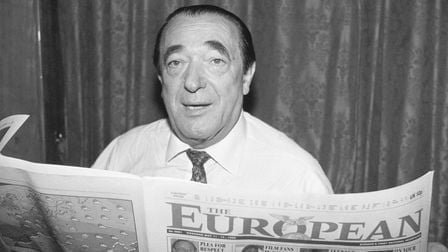
Robert Maxwell poses with the first edition of “The European” newspaper he founded in 1990; Source
During this period, Maxwell’s ties to Israeli intelligence deepened in other ways, particularly during the time when Yitzhak Shamir was prime minister. Shamir, previously a leader of the Zionist terrorist group known as Lehi or the Stern Gang, deeply loathed the United States, a sentiment he confided to Maxwell during one of Maxwell’s visits to Israel. Shamir told Maxwell that he blamed the Americans for the Holocaust because of US failure to support the transfer of European Jews to Palestine prior to the war. Shamir’s views on the US likely informed Israel’s more aggressive espionage targeting the US that emerged during this time and in which Maxwell prominently figured.
Maxwell and the PROMIS Affair
Maxwell’s prominent roles in the PROMIS software scandal and the Iran-Contra affair during the 1980s were facilitated by his purchase of numerous Israeli companies, several of which were either fronts or “providers of services” for Israeli intelligence. The most notable of these was Scitex, where Yitzhak Shamir’s son Nachum was a major executive throughout the 1990s and early 2000s, and Degem, a computer company with a large presence in Central and South America as well as Africa.
Even before Maxwell’s purchase of Degem, it had been used by Mossad as a cover for agents, and particularly assassins, who would use its offices as a cover before conducting kidnappings and murders of individuals linked to groups with ties to or sympathies for Israel’s enemies, particularly the PLO. Some of the most notable events occurred in Africa, where Mossad assassins used Degem as cover to launch killings of members of the African National Congress. In Latin America, Degem was also used as cover for the Mossad to infiltrate terrorist and nacroterrorist organizations such as Peru’s Sendero Luminoso (known in English as the Shining Path) and Colombia’s National Liberation Army or ELN.
After Maxwell’s purchase of Degem, it served as the main vehicle through which Israel conducted what was arguably its most brazen and successful espionage operation of the era—the bugging and then mass marketing of the stolen software program known as PROMIS.
Rafi Eitan, the notorious Israeli spymaster who served as Jonathan Pollard’s handler and who played a key role in the creation of the Talpiot program, was serving as the head of the (now defunct) Israeli intelligence service known as Lekem when he heard of a revolutionary new software program being used by the US Department of Justice. The program was known as the Prosecutors Information Management System, better known by its acronym PROMIS.

Rafi Eitan with Israeli politician Ariel Sharon in 1987; Source
Eitan had learned of PROMIS from Earl Brian, a longtime associate of Ronald Reagan who had previously worked for the CIA. PROMIS is often considered to be the forerunner of the PRISM software used by US and allied spy agencies today and was developed by former NSA official Bill Hamilton. Hamilton had leased the software to the US Department of Justice through his company, Inslaw Inc., in 1982.
Eitan and Brian hatched a plan to install a “trapdoor” into the software and then sell PROMIS throughout the world, providing Israel with invaluable intelligence on the operations of its enemies and allies while also netting Eitan and Brian massive profits. According to the testimony of former Israeli intelligence officer Ari Ben-Menashe, Brian provided a copy of PROMIS to Israeli military intelligence, which contacted an Israeli American programmer living in California. That programmer then planted a trapdoor or back door into the software.
Once the back door was installed, Brian attempted to use his company Hadron Inc. to market the bugged PROMIS software around the world. Having been unsuccessful at trying to buy out Inslaw, Brian turned to his close friend Attorney General Ed Meese, whose Justice Department abruptly refused to make payments to Inslaw that were stipulated by contract, essentially using the software for free. Hamilton and Inslaw claimed that this was theft. Some have speculated that Meese’s role in that decision was shaped not only by his friendship with Brian but also by the fact that his wife was a major investor in Brian’s business ventures.
Meese’s actions forced Inslaw into bankruptcy, and Inslaw subsequently sued the Justice Department, with the court finding that the Meese-led department “took, converted, [and] stole” the software through “trickery, fraud and deceit.” Meanwhile, with Inslaw seemingly out of the way, Brian sold the bugged software to Jordan’s intelligence service, which was a major boon for Israel, and to a handful of private companies. Eitan, nevertheless, was unsatisfied with Brian’s progress and quickly turned to the person he thought could most effectively sell PROMIS to governments of interest all over the world—Robert Maxwell.
Salesman and Spy
Through Degem and other fronts, Maxwell marketed PROMIS so successfully that Israeli intelligence soon had access to the innermost workings of innumerable governments, corporations, banks, and intelligence services around the world. Many of Maxwell’s biggest successes came in selling PROMIS to dictators in Eastern Europe, Africa, and Latin America. Following the sales, and after Maxwell collected a handsome paycheck, PROMIS, with its unparalleled ability to surveil anything from cash flows to human movement, was used by these governments to commit financial crimes with greater finesse and to hunt down and “disappear” dissidents.
In Latin America, Maxwell sold PROMIS to military dictatorships in Chile and Argentina. It was used to facilitate the mass murder that characterized Operation Condor, as the friends and families of dissidents and so-called subversives were easily identified using PROMIS. PROMIS was so effective for this purpose that, just days after Maxwell sold the software to Guatemala, this US-backed dictatorship rounded up twenty thousand “subversives” who were never heard from again. Of course, thanks to the back door in PROMIS, Israeli intelligence knew the identities of Guatemala’s disappeared before the victims’ own families. Both the US and Israel were also intimately involved in the arming and training of many of the Latin American dictatorships that had been sold the bugged PROMIS software. It is worth noting that Israel’s government and military-industrial complex was simultaneously involved in selling arms to many of these same governments.
Though Israeli intelligence immediately found obvious uses for the steady stream of sensitive and classified information, their biggest prize was yet to come. Eitan soon tasked Maxwell with selling PROMIS to top secret US government labs in the Los Alamos complex, including Sandia National Laboratories, which was and is at the core of the US nuclear weapons system. In order to plot how he would accomplish such a feat, Maxwell met with none other than Henry Kissinger, who told him that he needed to enlist the services of Texas senator John Tower, who was then head of the Senate Armed Services Committee. Kissinger has never been charged or even challenged for his role in facilitating a foreign-espionage operation targeting highly sensitive US national security information.
Maxell, using Mossad-derived money, paid Tower $200,000 for his services, which included opening doors — not just to the Los Alamos complex but also to the Reagan White House. PROMIS was then sold to the laboratories through a US-based company that Maxwell had purchased in 1981 and transformed into a front for Mossad. That company, called Information on Demand, was headed by Maxwell’s daughter Christine Maxwell beginning in 1985 until Robert’s death in 1991, during which period she helped sell the bugged PROMIS software to several Fortune 500 companies. Isabel Maxwell, sister to Ghislaine and Christine, would also work at the company before its closure in 1991.
After the attacks of September 11, 2001, Christine Maxwell teamed up with CIA official Alan Wade to market homeland-security software known as Chiliad to the US national security state, while Isabel would work closely at the intersection between Israeli intelligence and its private technology sector around that same period. Ghislaine, along with her two intelligence and technology-connected sisters, would hold a significant stake in a technology company that appears to be the actual origin of the Bill Gates-Jeffrey Epstein relationship, as explained in this Unlimited Hangout investigative report from May.
A few years after its acquisition by the Maxwells, Information on Demand was investigated by the FBI for its intelligence links beginning in 1983. However, that investigation was repeatedly shut down by higher-ups in the Meese-led Department of Justice, which, as previously mentioned, had been complicit in the whole sordid PROMIS affair. The investigation was shut down for good in 1985. The cover-up, oddly enough, continues today, with the FBI still refusing to release documents pertaining to Robert Maxwell and his role in the PROMIS scandal.
At the time, the halting of the FBI investigation green-lighted Information on Demand’s sale of PROMIS to Sandia National Laboratories, which provided Israeli intelligence with direct access to the core of the US nuclear weapons programs and nuclear weapons technology. This was a boon for Israel’s still-undeclared trove of nuclear missiles and warheads and helped ensure that Israel would remain the only nuclear power in the Middle East. Israel’s acquisition of nuclear weapons, seen in the light of the PROMIS scandal and the Pollard spy affair, shows that it was largely accomplished through trickery, deception and espionage rather than Israeli technical or scientific prowess.
This same year, 1985, is also when the CIA finally caught up with their Israeli equivalent and created its own back door into PROMIS, which it sold mostly to allied intelligence services in the UK, Australia, New Zealand, and elsewhere. It wasn’t nearly as successful as Maxwell, who sold an estimated $500 million in bugged PROMIS programs for Israel. The CIA, on the other hand, only sold around $90 million.
Heiress to an Espionage Empire
After Maxwell’s wild success in selling PROMIS on behalf of Israeli intelligence, he was recruited for another Israeli intelligence-driven operation—the Iran-Contra deal. It was through his Iran-Contra dealings that Robert Maxwell reportedly met Jeffery Epstein, whom he brought into the fold of Israeli intelligence that same year with the personal approval of the “higher ups” of Israeli military intelligence. The head of Israeli military intelligence at this time was Ehud Barak, who later come under fire for his well-documented and close ties to Epstein. The year 1985 was also the year when, conveniently enough, Epstein met Ohio billionaire Leslie Wexner and became intimately involved with his finances and affairs after Wexner’s previous fixer, Arthur Shapiro, was shot in the face in broad daylight before he was set to testify to the IRS on matters related to Wexner’s finances. Wexner would go on to co-found the Mega Group in 1991, several prominent members of which have close ties to Israeli political and intelligence figures and/or US-based organized crime networks like the National Crime Syndicate.
Epstein’s entry into this world was facilitated through his romantic ties to Ghislaine Maxwell, which had allegedly preceded Robert Maxwell’s successful efforts to bring him into the fold of Israeli military intelligence. Epstein was only one of several boyfriends Ghislaine is said to have had in the 1980s, but Epstein was certainly the most similar in terms of both behavior and “talents” to her father.
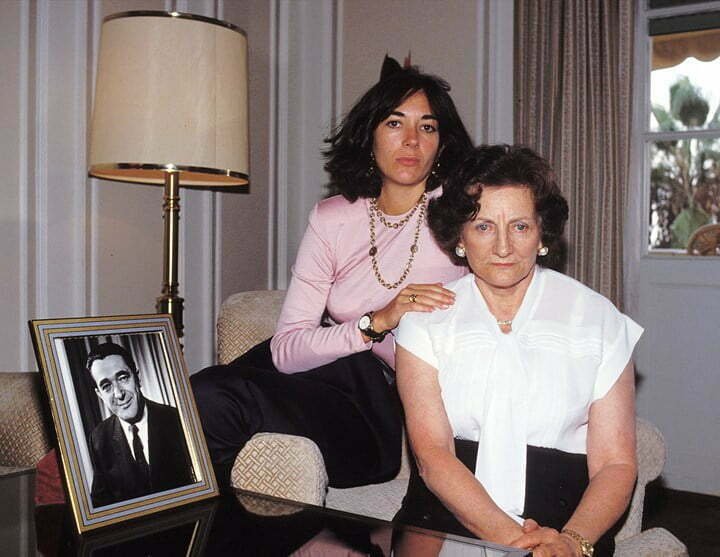
Ghislaine Maxwell and her mother Betty pose next to a framed picture of Robert Maxwell in Jerusalem, November 1991; Source
Ghislaine’s other boyfriends during and prior to this period certainly deserve mention. One of the more interesting was an Italian aristocrat named Count Gianfranco Cicogna, whose grandfather was Mussolini’s finance minister and the last doge of Venice. Cicogna also had ties to both covert and overt power structures in Italy, particularly to the Vatican, the CIA’s presence in Italy, and to the Italian side of the National Crime Syndicate. The other half of that syndicate, of course, was the Jewish American mob with its ties to the Mega Group, itself deeply connected to the Epstein scandal and whose members were frequent business partners of Robert Maxwell. It’s worth noting that Gianfranco Cicogna met a grisly end in 2012 when the plane he was flying exploded in a giant fireball during an air show, a morbid spectacle that can surprisingly still be viewed on YouTube.
Ghislaine and Robert Maxwell also had odd ties to the Harvey Proctor scandal in the United Kingdom, whereby a tabloid of Robert Maxwell’s—with Maxwell’s full approval—ran a story claiming that efforts were being made to blackmail Robert Maxwell with information regarding Ghislaine’s alleged relationship with the future Duke of Rutland. Maxwell clearly wanted the information linking Ghislaine to the duke put out into the public sphere, but the story is odd for a few reasons. The motive of the blackmailer was ostensibly to prevent Maxwell-owned papers from covering the Harvey Proctor scandal. But the son of the duke who was allegedly involved with Ghislaine was also a close friend and later the employer of Harvey Proctor.
The appearance of Harvey Proctor, a Conservative member of Parliament, in this tabloid spectacle is interesting for a few reasons. In 1987, Proctor pleaded guilty to sexual indecency with two young men who were sixteen and nineteen at the time, and several witnesses interviewed in that investigation described him as having a sexual interest in “young boys.” Later, a controversial court case saw Proctor accused of having been involved with well-connected British pedophile and procurer of children Jimmy Savile; he was alleged to have been part a child sex abuse ring that was said to include former UK prime minister Ted Heath. Savile’s close relationship with Prince Charles of the British Royal family is well known and, as will be mentioned shortly, Ghislaine is alleged to have been cozy with the Royals before Prince Andrew’s frequent public appearances with Ghislaine and Epstein, beginning around the year 2000.
Of course, the Maxwell-owned papers, in covering the alleged efforts to blackmail Robert Maxwell, did not mention the “young boys” angle at all, instead focusing on claims that distracted from the then-credible accusations of pedophilia by claiming that Proctor was merely into “spanking” and was “whacky”, among other things. It is hard to know exactly what was going on in this particular incident, but the whole bizarre affair paints an interesting picture of Ghislaine’s social circle at the time.
In this same 1985 period, Ghislaine also became involved with “philanthropy” tied to her father’s business empire by hosting a “Disney day out for kids” and benefit dinner on behalf of the Mirror Group for the Save the Children NGO. Part of the event took place at the home of the Marquess and Lady of Bath, a gala that was attended by members of the British Royal family. It’s worth noting that the Marquess of Bath at the time was an odd person, having accumulated the largest collection of paintings made by Adolf Hitler and having said that Hitler had done “great things for his country.” The same evening that the Ghislaine-hosted bash concluded, the Marquess of Bath’s son was found hanging from a bedspread tied to an oak beam at the Bath Arms in what was labeled a suicide.
The attendance of Royals at this Ghislaine-hosted gala was not some lucky break for Ghislaine or her “philanthropic” efforts, as Ghislaine had already been close to the royals for years, with subsequent employees and victims of Ghislaine having personally seen pictures of her “growing up” with the royals, a relationship allegedly facilitated by the Maxwell family’s ties to the Rothschild banking family. Ghislaine was heard on more than one occasion as describing the wealthy and influential Rothschilds as her family’s “greatest protectors,” and they were also among Robert Maxwell’s most important bankers, who helped him finance the construction of his vast media empire and web of companies and untraceable trusts.
It was also during this period that Ghislaine learned some unusual skills, including how to pilot airplanes, helicopters, and submarines, and became fluent in several languages.
Then, abruptly in 1991, Ghislaine and her entire remaining family saw their fortunes shift dramatically—at least in public—with the death of Robert Maxwell, a death that most of the Maxwell family and most of his biographers regard as a murder, an act allegedly performed by the very intelligence agency that employed him.
According to journalist John Jackson, who was present when Ghislaine and her mother Betty boarded her father’s yacht shortly after his death, it was Ghislaine who “coolly walked into her late father’s office and shredded all incriminating documents on board.” Ghislaine denies the incident, though Jackson has never retracted the claim, which was reported in a 2007 article published in the Daily Mail. If Jackson is to believed, it was Ghislaine – out of all of Robert Maxwell’s children – who was most intimately aware of the incriminating secrets of her father’s financial empire and espionage activities.
As Part 2 of this series will show, the evidence points to this being the case, particularly with Ghislaine’s entry into New York’s elite social circles having been planned by her father before his 1991 death. Of course, those social connections in New York, as well as those in Europe and elsewhere, would prove instrumental in the operation and protection of Jeffrey Epstein’s sexual trafficking and blackmail network. Ghislaine’s slippery behavior in the years that followed, including activities both related and unrelated to the sex trafficking of minors, show that Ghislaine inherited much more than her personality from her father as she, along with several of her siblings, played a key role in keeping alive various aspects of her father’s legacy, including his espionage activities.
Whitney Webb has been a professional writer, researcher and journalist since 2016. She has written for several websites and, from 2017 to 2020, was a staff writer and senior investigative reporter for Mint Press News. She currently writes for The Last American Vagabond.
What’s Left? How Greenwald, Covid and Rittenhouse Exposed a Plague Among Progressives
By Riva Enteen | MintPress News | December 1, 2021
Caitlin Johnstone asserts that “[t]he most significant political moment in the U.S. since 9/11 and its aftermath was when liberal institutions decided that Trump’s 2016 election wasn’t a failure of status quo politics but a failure of information control.” Since Trump’s election, information control contributes to why those critical of Democrats are called Trump sympathizers. Journalist Paul Street epitomizes this tendency, seeming to speak for many who equate any criticism of Democrats with support for Trump and his policies. To the extent that this attitude serves to obstruct political dialogue and struggle, it does not serve us well — especially in these dark times, when we must pull our forces together to overcome the challenges we face.
Street’s CounterPunch article, “Glenn Greenwald is Not Your Misunderstood Left Comrade,” obstructs political dialogue and struggle. He gives no substantive rebuttal to a Greenwald article that declares “grotesque” the sight of “masked servants and unmasked elite at the New York Met Gala.” In a classic ad hominem attack, since Street couldn’t summon up an intelligent response, he just hurled insults. Sadly, this is what currently passes for political debate.
Compasses, nautical and political, are known to stop working in the vicinity of a strong electro-magnet. What has happened to our political compass? Street declares, “Glenn Greenwald is not a man of ‘the Left’ (or whatever’s left of ‘the Left’).” What does “Left” mean, post-Trump? The once-reliable compass seems now to be spinning wildly, as the political magnetic field does a headstand.
Street asserts that “Greenwald broke on through to the wrong side during the Trump years, so clouded by his understandable contempt for liberal and Democratic hypocrisy, corporatism, and imperialism as to become a willing accomplice of the white nationalist right.” Greenwald’s tireless and meticulous debunking of Russiagate has cast him as a Trump sympathizer to people like Street. Remarkably, many on “the Left,” still believe Russia did it, though the recent indictment of Hilary Clinton’s lawyer and arrest of the principal source of the bogus Steele dossier should put any such notion to rest.
Street snidely discounts Greenwald’s stated reason for leaving The Intercept — that “The Intercept’s editors, in violation of my contractual right of editorial freedom, censored an article I wrote this week, refusing to publish it unless I remove all sections critical of Democratic presidential candidate Joe Biden, the candidate vehemently supported by all New York-based [Intercept] editors involved in this effort at suppression.” Instead he claims that Greenwald, having submitted “a piece that tried to advance Trump campaign propaganda against Joe Biden on the eve of the 2020 presidential election,” regarded himself as “too good to be edited.” He lambasts Greenwald for being, as he put it, “all over the Hunter Biden-New York Post-deep state laptop story, even after CNN published an article titled “New Proof Emerges of the Biden Family Emails: a Definitive Account of the CIA/Media/BigTech Fraud.” Yet, even CNN recognized the bombshell.
Smelling (and finding) the rat
The World Socialist Website, in sync with Street’s “analysis,” calls Greenwald a “sly fascism-denier” who, Street says, “has creepily thrown in with the white nationalist right.” Why? Because in his impeccably documented piece, “FBI Using the Same Fear Tactic From the First War on Terror: Orchestrating its Own Terrorism Plots,” Greenwald discussed the plot to kidnap Michigan Governor Whitmer. He concludes:
There was no way to avoid suspicions about the FBI’s crucial role in a plot like this absent extreme ignorance about the bureau’s behavior over the last two decades, or an intentional desire to sow fear about right-wing extremists attacking Democratic Party officials one month before the 2020 presidential election.
Greenwald was one of the few who smelled a rat in the Michigan kidnapping story and, after serious investigative journalism, he found the rat.
In sum, the FBI devised this plot, was the primary organizer of it, funded it, purposely directed their targets to pose for incriminating pictures that they then released to the press, and then heaped praise on themselves for stopping what they themselves had created. The Wall Street Journal’s headline declares “In Michigan Plot to Kidnap Governor, Informants Were Key,” yet Jan 6 is declared an attempted coup.
In spite of such headlines from the Wall Street Journal, Street says Greenwald “downplays the seriousness of the fascist-putschist Capitol Riot of January 6, 2021.” This doesn’t sound like downplaying to me: “Of course the FBI was infiltrating the groups they claim were behind these attacks,” Greenwald reported, concluding, “yet the suggestion that FBI informants may have played some role in the planning of the January 6 riot was instantly depicted as something akin to, say, 9/11 truth theories or questions about the CIA’s role in JFK’s assassination.”
Street claims Greenwald has a “curious alignment with the white-nationalist neofascist Donald Trump and the January 6 marauders in their purported struggle with ‘the deep state.’” Marauders or the FBI? Does Street not believe that a “Deep State” exists? Greenwald’s article “Questions About the FBI’s Role in 1/6 Are Mocked Because the FBI Shapes Liberal Corporate Media” is subtitled “The FBI has been manufacturing and directing terror plots and criminal rings for decades. But now, reverence for security state agencies reigns.”
In a widely praised TED Talk, Trevor Aaronson states: “There’s an organization responsible for more terrorism plots in the United States than al-Qaeda, al-Shabaab and ISIS combined: The FBI.” So why are Street, the World Socialist Website, Counterpunch, and many others well-versed in COINTELPRO tactics, now swallowing FBI words whole and calling people Trump fascists for raising the issue of possible FBI involvement in the January 6 riot?
Street claims that Greenwald “defends Trump and other Amerikaner neofascists against the ‘censorship’ of their supposed free speech right to spew sexist, nativist, and white power hatred on Twitter and Facebook.” An article I wrote about the new reality police revealed that Media Alliance, a San Francisco organization founded in 1976 to be mainstream media watchdogs, circulated a petition after Jan. 6 that says: “Facebook should create a circuit breaker to help prevent dangerous disinformation and incitements to violence from ever reaching a mass audience…”
That good minds sincerely believe Silicon Valley executives should be the gods of truth in today’s world makes Orwell look cheerily optimistic. Yet shockingly, many people agree with the unprecedented censorship of a former president. Nixon, even after his impeachment and resignation, was never gagged as Trump is. As a former constitutional lawyer, Greenwald addressed concerns of Silicon Valley censorship in his article “Congress Escalates Pressure on Tech Giants to Censor More, Threatening the First Amendment.” Greenwald believes House Democrats are getting closer to the constitutional line, if they have not already crossed it.
Visceral hatred and rational discourse
Greenwald recently wrote several pieces on COVID as well, one announcing that he was eagerly vaccinated. However, his questions about the cost-benefit analysis missing from the COVID debate and his support of the position taken by NBA star Jonathan Isaac have Street condemning him for “failing to mention the horrific, anti-science, COVID-fueling and pandemo-fascist anti-masking and anti-vax practices, policies, and politics of the Amerikaner Party of Trump (the Republicans).”
An article titled “Forced Vaccination Was Always the End Game” — from the non-profit National Vaccine Information Center, which advocates for informed consent protections in medical policies and public health laws — reports that breakthrough COVID infections, hospitalizations, and deaths in fully vaccinated people are on the rise; individuals who have recovered from the infection have stronger natural immunity than those who have been vaccinated; and officials at the World Health Organization now say that the SARS-COV-2 virus is mutating like influenza and is likely to become prevalent in every country, no matter how high the vaccination rate. Yet, in spite of such growing perspective, Greenwald’s piece supporting the NBA’s Isaac is subtitled, “It is virtually a religious belief in the dominant liberal culture that people who do not want the COVID vaccine are stupid, ignorant, immoral and dangerous.”
In a separate article, titled “The ACLU, Prior to COVID, Denounced Mandates and Coercive Measures to Fight Pandemics,” Greenwald writes that the “ACLU prior to its Trump-era transformation” had one primary purpose: to denounce as dangerous and unnecessary attempts by the state to mandate, coerce, and control in the name of protecting the public from pandemics. The ACLU report cites important lessons from American history:
… vivid reminders that grafting the values of law enforcement and national security onto public health is both ineffective and dangerous. Too often, fears aroused by disease and epidemics have justified abuses of state power. Highly discriminatory and forcible vaccination and quarantine measures adopted in response to outbreaks of the plague and smallpox over the past century have consistently accelerated, rather than slowed, the spread of disease, while fomenting public distrust and, in some cases, riots.
Greenwald legitimately questioned the ACLU’s about-face from the pre-Trump era to its current position, pointing out how the ACLU tweeted that “[f]ar from compromising them, vaccine mandates actually further civil liberties.” Yet Street lauds the ACLU’s current position.
Many ask, as one article puts it, “Why Does Glenn Greenwald Keep Appearing on Tucker Carlson’s Show?” The question I keep asking, but get no answer to, is why Greenwald, Tulsi Gabbard, Aaron Maté, Matt Taibbi, Max Blumenthal, and Jimmy Dore can appear only on Fox. Why are they not invited onto “liberal” MSNBC or CNN, let alone Democracy Now? The apparent answer is that the dominant, ubiquitous paradigm, which cannot be challenged, is “don’t go after the Democrats.”
Much like Julian Assange, Greenwald began to be condemned by liberals only post-Trump. The liberal visceral hatred of Donald Trump has trumped rational discourse. If there were true rational discourse, Julian Assange would not be suffering in Belmarsh Prison as a consequence of his cardinal sin — publishing emails harmful to Democrats.
Facts and the distorting ideological lens
Following the Kyle Rittenhouse verdict, Greenwald again went out on a limb in what a revolutionary comrade called a “rant,” but Greenwald’s message was essentially the same as that conveyed by Caitlin Johnstone:
If your opinion about a legal case would be different if the political ideologies of those involved were reversed and all other facts and evidence remained the same, then it’s probably best not to pretend your position on the case has anything to do with facts or evidence.
Yet Greenwald, once again, has found himself in the crosshairs of “progressives.”
I agree with Street that he and Greenwald are not “on the same side.” If Street, and countless others like him, engaged in true political debate and struggle rather than calling people “facetious,” “stupid,” and “snotty,” we might be closer to the revolution that Street claims to hunger for.
Riva Enteen, former Program Director of the San Francisco National Lawyers Guild, is a lifelong peace and justice activist, retired social worker, lawyer, and editor of “Follow the Money,” a collection of Pacifica Radio’s Flashpoints interviews. She can be reached at rivaenteen@gmail.com
New law allows for warrantless spying on Australians – where next?
By Kit Klarenberg | RT | November 30, 2021
The Australian Signals Directorate, Canberra’s equivalent of Britain’s GCHQ or the US National Security Agency, will be granted sweeping new powers to spy on Australians for the first time since its November 1947 founding.
The move allows the agency to collect signals intelligence on individuals within the country without a warrant, although allegedly only in situations where there is an “imminent risk to life.” Domestic terror suspects are cited as a key target in the Directorate’s crosshairs, and it will also collect intelligence in conjunction with the Australian Defence Force for military operations, with ministerial authorization.
Rules governing the reform and protecting citizens’ privacy will be published on the agency’s website, and subject to review and scrutiny by the Australian parliament’s security and intelligence committee. While framed as sincerely concerned with keeping Australians safe, experts have expressed grave reservations about the development. Among them is John Blaxland, Professor of International Security and Intelligence Studies at the Australian National University, himself a military intelligence veteran, who warned the powers were ripe for abuse.
“I’m a former insider… I have a much greater appreciation of the need for checks and balances, because power tends to corrupt,” he cautioned. “My concern is the legislation we put forward is being drafted by insiders, it’s drafted with their own concerns in mind.”
Drafted by insiders, the legislation certainly was – it’s inspired by the findings of an extensive review by Dennis Richardson, former chief of Australian Security Intelligence Organisation, the country’s FBI, conducted in close consultation with Australia’s assorted intelligence services, in a manner akin to foxes being quizzed on how best to guard a henhouse.
Published in December 2020, his appraisal’s discussion of “authorisations” noted that these agencies can already conduct warrantless intelligence-gathering if they believe it to be “necessary, proportionate, reasonable and justified” in certain circumstances, and “would like the ability” to not only use various investigative techniques without official permission, but also with “protection from criminal liability” when doing so.
Leaked documents exposed by journalist Annika Smethurst in April 2018 showed that high-level plans for untrammeled domestic spying by the Australian Signals Directorate date back even further. They revealed how the respective heads of Australia’s Defence and Home Affairs ministries had discussed allowing the agency to access citizens’ emails, bank records and text messages without approval, or trace. A government source told Smethurst they were “horrified” by the proposals, given “there is no actual national security gap this is aiming to fill.”
Australian Federal Police raided both the alleged leaker of the files and Smethurst the next year. In a perverse irony, the charges against her were dropped in May 2020, as Australian High Court judges unanimously ruled that the warrant secured from a magistrate in relation to the raid was invalid, because it not only “misstated the terms of the offence” but was also ambiguous if not outright absurd.
“[The warrant] lacked the clarity required to fulfil its basic purposes of adequately informing Smethurst why the search was being conducted and providing the executing officer and those assisting in the execution of the warrant with reasonable guidance to decide which things came within the scope of the warrant,” the High Court damningly concluded.
In other words, it was impossible to know from the warrant’s wording what the investigation actually concerned, what evidence or information was sought, and what, if any, crime she may or may not have committed. That this baseless and broad investigative authorization was formally granted at all renders the Directorate’s newfound power to conduct warrantless surveillance all the more disquieting. If such procedural perversion can occur even with putative oversight, what abuses will be engaged-in without any meaningful supervision?
Misuse of these capabilities is almost inevitable. In 1973, the US Supreme Court ruled warrants were mandatory for domestic intelligence gathering. Two years later, a Senate investigation found that the NSA and other US intelligence agencies had nonetheless been engaged in unauthorized spying on American citizens, including anti-war protesters, civil rights activists, and political dissidents, monitoring all their private communications from telephone conversations to telegrams. This led to the 1978 Foreign Intelligence Surveillance Act, which made it a dedicated criminal offense to eavesdrop on American citizens without judicial oversight.
Yet,it was revealed in late 2005 that the NSA had all along continued illegally intercepting the phone calls and digital communications of US citizens, with the witting help of major telecoms giants, which passed copies of all emails, web browsing and other internet traffic to and from its customers at home and abroad to the agency, and its British counterpart GCHQ. Files disclosed in 2013 by whistleblower Edward Snowden confirmed this criminal dragnet was truly global in scale, and very much ongoing.
Key components of this international spying network, known as ‘Five Eyes,’ are situated in Australia, at the Pine Gap and Kojarena satellite surveillance bases. According to investigative legend Duncan Campbell, around 80% of the messages intercepted by the latter – which employs US and British staff in key posts – are sent automatically to GCHQ and the NSA. While every Five Eyes member can theoretically veto requests for such material, “when you’re a junior ally” like Canberra, “you never refuse,” Campbell records.
One can’t help but wonder if the Directorate’s new domestic purview is an experiment, gauging levels of backlash and controversy among the Australian public, before similar measures – provably or potentially already in operation – are openly codified across all Five Eyes member states. Ongoing legal battles against mass data collection in various jurisdictions clearly necessitate the practice being legalized and legitimized. If Canberra’s American and/or British friends politely requested they run such a pilot scheme, would or even could they decline?
Reinforcing this interpretation, mere days after the Directorate’s remit was expanded, the Australian government pledged to introduce new laws forcing social media giants to “unmask” anonymous users who post offensive comments, with hefty fines doled out to those companies which are unwilling or unable to do so. The reasons for Canberra’s haste are unclear, although it’s surely no coincidence that London and Washington have battled for many years to end online anonymity for good – it’s only due to intense domestic opposition that these efforts have so far failed.
Kit Klarenberg is an investigative journalist exploring the role of intelligence services in shaping politics and perceptions.
Kyle Rittenhouse, Project Veritas, and the Inability to Think in Terms of Principles
By Glenn Greenwald | November 16, 2021
The FBI has executed a string of search warrants targeting the homes and cell phones of Project Veritas founder James O’Keefe and several others associated with that organization. It should require no effort to understand why it is a cause for concern that a Democratic administration is using the FBI to aggressively target an organization devoted to obtaining and reporting incriminating information about Democratic Party leaders and their liberal allies.
That does not mean the FBI investigation is inherently improper. Journalists are no more entitled than any other citizen to commit crimes. If there is reasonable cause to believe O’Keefe and his associates committed federal crimes, then an FBI investigation is warranted as it is for any other case. But there has been no evidence presented that O’Keefe or Project Veritas employees have done anything of the sort, nor any explanation provided to justify these invasive searches. That we should want and need that is self-evident: if the Trump-era FBI had executed search warrants inside the newsrooms of The New York Times and NBC News, we would be demanding evidence to prove it was legally justified. Yet virtually nothing has been provided to justify the FBI’s targeting of O’Keefe and his colleagues, and the little that has been disclosed by way of justifying this makes no sense.
The FBI investigation concerns the theft last year of the diary of Joe Biden’s daughter, Ashley, yet Project Veritas, while admitting they received a copy from an anonymous source, chose not to publish that diary because they were unable to verify it. Nobody and nothing thus far suggests that Project Veritas played any role in its acquisition, legal or otherwise. There is a cryptic reference in the search warrant to transmitting stolen material across state lines, but it is not illegal for journalists to receive and use material illegally acquired by a source: the most mainstream organizations spent the last month touting documents pilfered from Facebook by their heroic “whistleblower” Frances Haugen.
On Monday night, we produced an in-depth video report examining the FBI’s targeting of O’Keefe and Project Veritas and the dangers it presents (as we do for all of our Rumble videos, the transcript will soon be made available to subscribers here; for now, you can watch the video at the Rumble link). One of the primary topics of our report was the authoritarian tactic that is typically used to justify governmental attacks on those who report news and disseminate information: namely, to decree that the target is not a real journalist and therefore has no entitlement to claim the First Amendment guarantee of a free press.
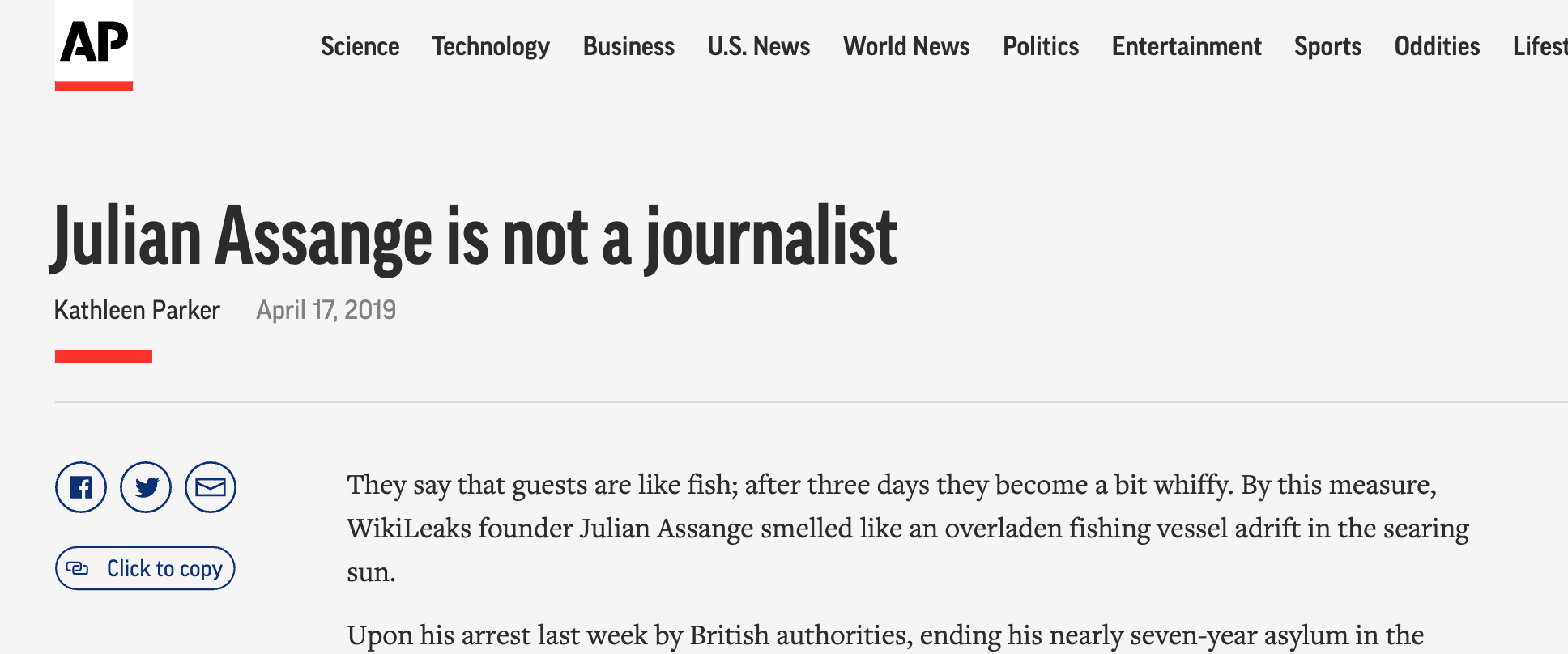
This not-a-real-journalist tactic was and remains the primary theory used by those who justify the ongoing attempt to imprison Julian Assange. In demanding Assange’s prosecution under the Espionage Act, Sen. Dianne Feinstein (D-CA) wrote in The Wall Street Journal that “Mr. Assange claims to be a journalist and would no doubt rely on the First Amendment to defend his actions.” Yet the five-term Senator insisted: “but he is no journalist: He is an agitator intent on damaging our government, whose policies he happens to disagree with, regardless of who gets hurt.”
This not-a-real-journalist slogan was also the one used by both the CIA and the corporate media against myself and my colleagues in both the Snowden reporting we did in 2013, as well as the failed attempt to criminally prosecute me in 2020 for the year-long Brazil exposés we did: punishing them is not an attack on press freedom because they are not journalists and what they did is not journalism.
What is most striking about this weapon is that — like the campaign to agitate for more censorship — it is led by journalists. It is the corporate media that most aggressively insists that those who are independent, those who are outsiders, those who do not submit to their institutional structures are not real journalists the way they are, and thus are not entitled to the protections of the First Amendment. In order to create a framework to deny Project Veritas’s status as journalists, The New York Times claimed last week that anyone who uses undercover investigations (as Veritas does) is automatically a non-journalist because that entails lying — even though, just two years earlier, the same paper heralded numerous news outlets such as Al Jazeera and Mother Jones for using undercover investigations to accomplish what they called “compelling” reporting.
I am very well-acquainted with this repressive tactic of trying to decree who is and is not a real journalist for purposes of constitutional protection. Many have forgotten — given the awards it ultimately ended up winning — that the NSA/Snowden reporting we did in 2013 was originally maligned as quasi-criminal not just by Obama national security officials such as James Clapper but also by The New York Times. The first profile the Paper of Record published about me the day after the reporting began referred to me in the headline as an “Anti-Surveillance Activist” and then, once backlash ensued, it was changed to “Blogger” (the original snide, disqualifying headline is still visible in the URL).
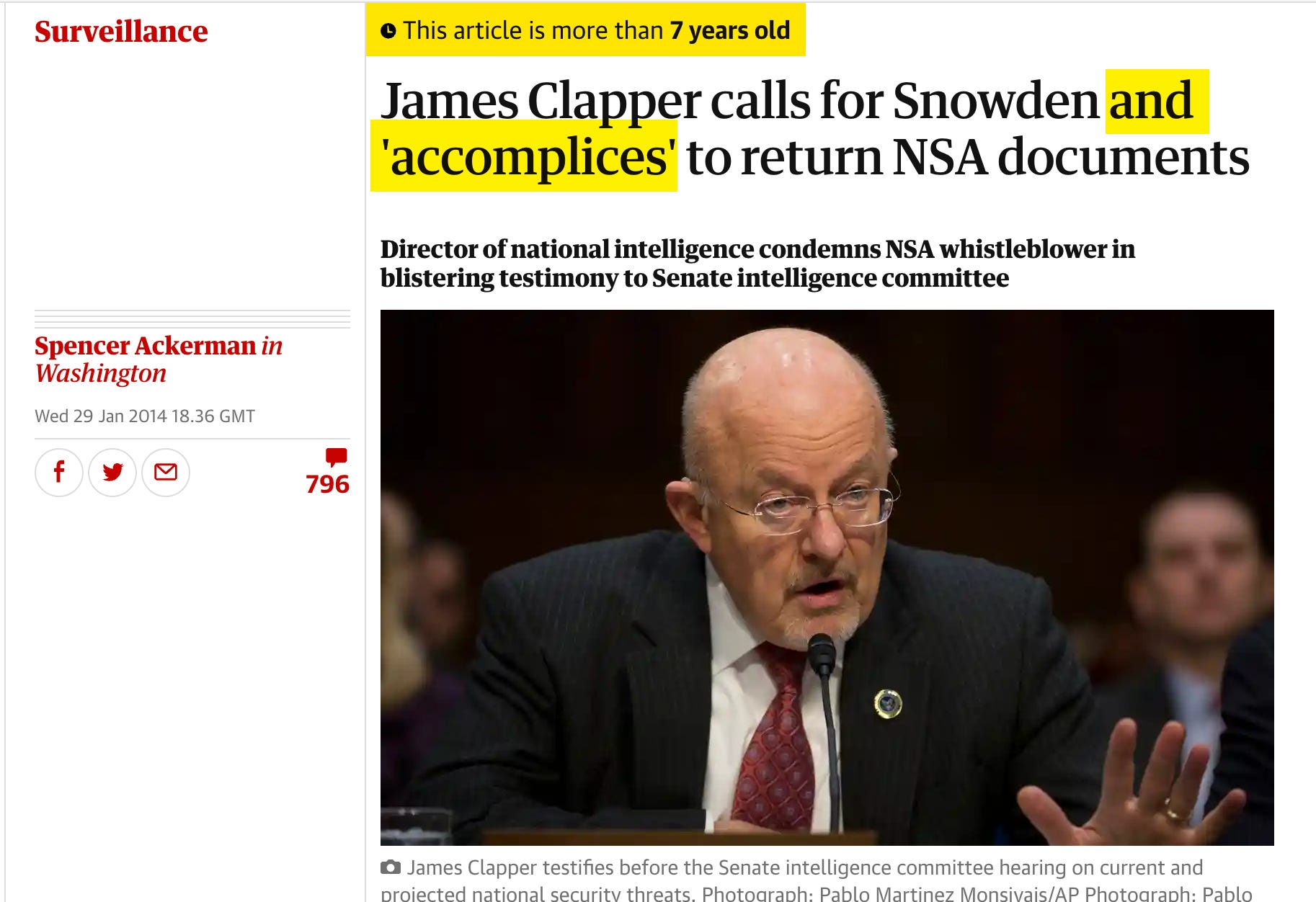
The Guardian, Jan. 29, 2014
As the New York Times‘ own Public Editor at the time objected, by purposely denying me the label “journalist,” the paper was knowingly increasing the risks that I could be prosecuted for my reporting. Indeed, recent reporting from Yahoo! News about CIA plots to kidnap or murder Julian Assange reported that denying Assange the label “journalist,” and then re-defining what I and my colleague Laura Poitras were doing from “journalist” to “information broker,” would enable the U.S. Government to spy on or even prosecute us without having to worry about that inconvenient “free press” guarantee of the First Amendment.

New York Times, June 6, 2013
All of this demonstrates how dangerous it is to invoke this very same not-a-real-journalist tactic against O’Keefe and Project Veritas. Yet, if one warns of the dangers of the FBI’s actions, that is precisely what one hears from liberals, from Democrats and from their allies in the media: the FBI’s targeting of Project Veritas has nothing to do with press freedoms since they’re not real journalists. They are invoking the authoritarian theory that maintains that the state (or, in this case, the FBI) is vested with the power to decree who is a “real journalist” — whatever that means — and who is not.
There are so many ironies to the use of this framework. So often, employees of media corporations who have never broken a major story in their lives (and never will) revel in accusing independent journalists who have broken numerous major stories (such as Assange) of not being real journalists. At the height of the Snowden reporting, I went on Meet the Press in July, 2013, only for the host, David Gregory, to suggest that I ought to be in prison alongside my source Edward Snowden because I was not really a journalist the way David Gregory was. At the time, Frank Rich, writing in New York Magazine, noted how bizarre it was that the TV personality David Gregory assumed he was a real journalist, whereas I was a non-journalist who belonged in prison for my reporting, given that Gregory — like most employees of large media corporations — had never broken any story in his life. Rich used a Q&A format to make the point this way:
On Sunday, Meet the Press host David Gregory all but accused the Guardian’s Glenn Greenwald of aiding and abetting Edward Snowden’s fugitive travels, asking, “Why shouldn’t you, Mr. Greenwald, be charged with a crime?” And, speaking to his larger point, do you see Greenwald as a journalist or an activist in this episode? And does it matter?
Is David Gregory a journalist? As a thought experiment, name one piece of news he has broken, one beat he’s covered with distinction, and any memorable interviews he’s conducted that were not with John McCain, Lindsey Graham, Dick Durbin, or Chuck Schumer. Meet the Press has fallen behind CBS’s Face the Nation, much as Today has fallen to ABC’s Good Morning America, and my guess is that Gregory didn’t mean to sound like Joe McCarthy (with a splash of the oiliness of Roy Cohn) but was only playing the part to make some noise. In any case, his charge is preposterous. As a columnist who published Edward Snowden’s leaks, Greenwald was doing the job of a journalist — and the fact that he’s an “activist” journalist (i.e., an opinion journalist, like me and a zillion others) is irrelevant to that journalistic function. . . . [I]t’s easier for Gregory to go after Greenwald, a self-professed outsider who is not likely to attend the White House Correspondents’ Dinner and works for a news organization based in London. Presumably if Gregory had been around 40 years ago, he also would have accused the Times of aiding and abetting the enemy when it published Daniel Ellsberg’s massive leak of the Pentagon Papers. In any case, Greenwald demolished Gregory on air and on Twitter (“Who needs the government to try to criminalize journalism when you have David Gregory to do it?”).
At the time — both in terms of that exchange with Gregory and my overall reporting on the NSA — I had significant support from the liberal-left (though it was far from universal, given that we were exposing mass, indiscriminate, illegal spying by the Obama administration). But few believed that I ought to be prosecuted on the grounds that, somehow, I was not a real journalist.
So why are so many of them now willing to endorse this same exact theory when it comes to O’Keefe and Project Veritas, or even to justify the prosecution of Julian Assange? The answer is obvious. They are unwilling and/or incapable of thinking in terms of principles, ones that apply universally to everyone regardless of their ideology. Their thought process never even arrives at that destination. When the subject of the FBI’s attacks on O’Keefe is raised, or the DOJ’s prosecution of Assange is discussed, they ask themselves one question and only one question, and that ends the inquiry. It is the exclusive and determinative factor: do I like James O’Keefe and his politics? Do I like Julian Assange and his politics?
This primitive, principle-free, personality-driven prism is the only way they are capable of understanding the world. Because they dislike O’Keefe and/or Assange, they instantly side with whoever is targeting them — the FBI, the DOJ, the security state services — and believe that anyone who defends them is defending a right-wing extremist rather than defending the non-ideological, universally applicable principle of press freedoms. They think only in terms of personalities, not principles.
The FBI’s actions against Project Veritas and O’Keefe are so blatantly alarming that press freedom groups such as the Committee to Protect Journalists and the Freedom of the Press Foundation (on whose Board I sit) have expressed grave concerns about it, including on their social media accounts for all to see. Even the ACLU — which these days is loathe to speak out in favor of any person or group disliked by their highly partisan liberal donor base — issued a very carefully hedged statement that made clear how much they despise Project Veritas but said: “Nevertheless, the precedent set in this case could have serious consequences for press freedom” (at least thus far, the ACLU has just quietly stuck this statement on its website and not uttered a word about it on its social media accounts, where most of its liberal donors track what they do, but the fact that they felt compelled to say anything in defense of this right-wing boogieman demonstrates how extreme the FBI’s actions are). The federal judge overseeing the warrants has temporarily enjoined the FBI from extracting any more information from the cell phones seized from O’Keefe and other Project Veritas employees pending a determination of their legal justification.
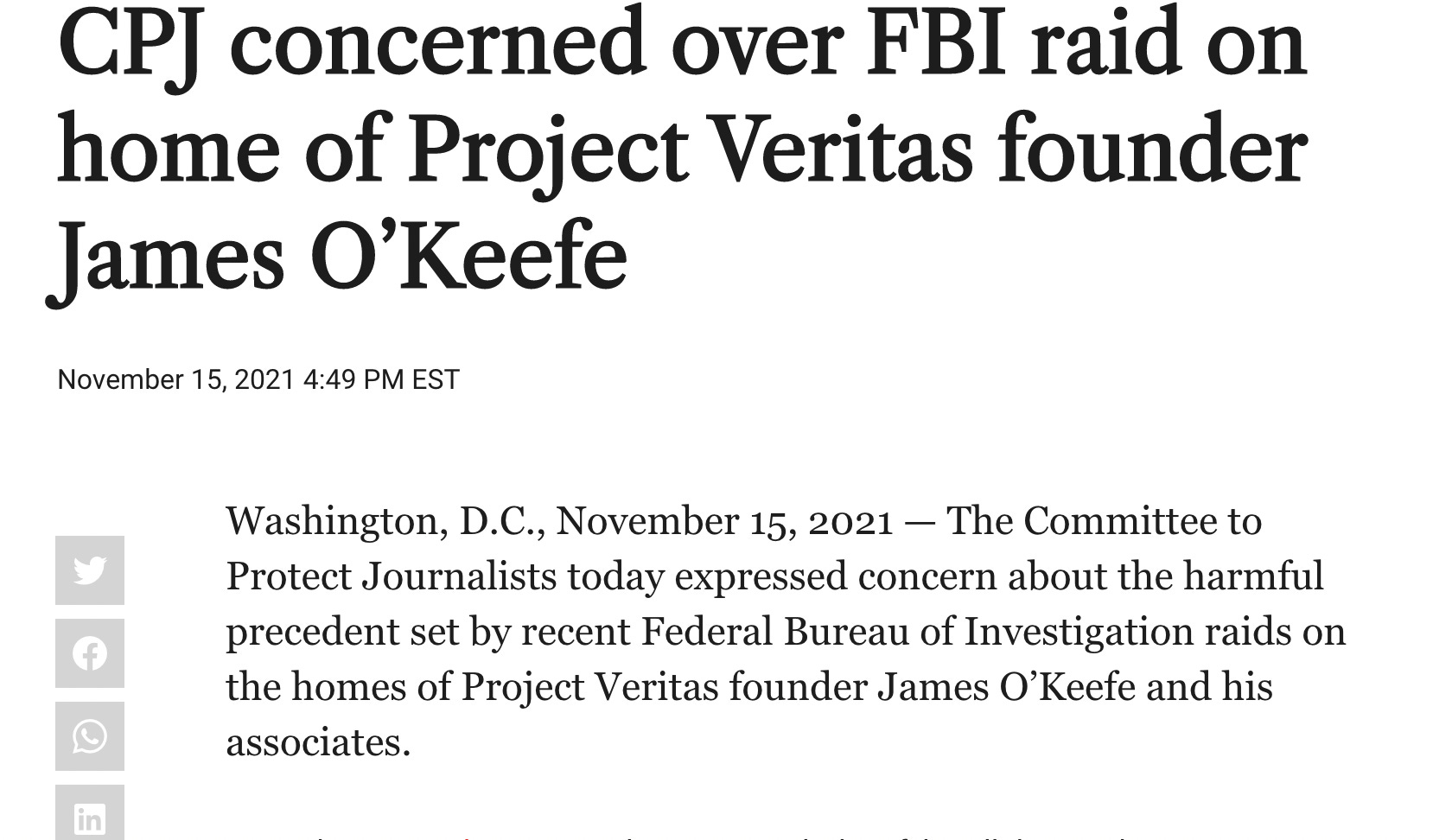
Committee to Protect Journalists, Nov. 15, 2021
The reason this is such a grave press freedom attack is two-fold. First, as indicated, any attempt to anoint oneself the arbiter of who is and is not a “real journalist” for purposes of First Amendment protection is inherently tyrannical. Which institutions are sufficiently trustworthy and competent to decree who is a real journalist meriting First Amendment protection and who falls outside as something else?
But there is a much more significant problem with this framework: namely, the question of who is and is not a real journalist is completely irrelevant to the First Amendment. None of the rights in the Constitution, including press freedom, was intended to apply only to a small, cloistered, credentialed, privileged group of citizens. The exact opposite was true: the only reason they are valuable as rights is because they enjoy universal application, protecting all citizens.
Indeed, one of the most passionate grievances of the American colonists was that nobody was permitted to use the press unless first licensed by the British Crown. Conversely, the most celebrated journalism of the time was undertaken by people like Thomas Paine — who never worked for an established journalistic outlet in his life — as he circulated the pamphlet Common Sense that railed against the abuses of the King. What was protected by the First Amendment was not a small, privileged caste bearing the special label “journalists,” but rather the activity of a free press. The proof of this is clear and ample, and is set forth in the video we produced on Monday night.
But none of this matters. If you express concern for the FBI’s targeting of O’Keefe, it will be instantly understood not as a concern about any of these underlying principles but instead as an endorsement of O’Keefe’s politics, journalism, and O’Keefe himself. The same is true for the discourse surrounding Kyle Rittenhouse. If you say that — after having actually watched the trial — you believe the state failed to prove his guilt beyond a reasonable doubt in light of his defense of self-defense, many will disbelieve your sincerity, will insist that your view is based not in some apolitical assessment of the evidence or legal principles about what the state must do in order to imprison a citizen, but rather that you must be a “supporter” of Rittenhouse himself, his ideology (whatever it is assumed to be), and the political movement with which he, in their minds, is associated.
On some level, this is pure projection: those who are incapable of assessing political or legal conflicts through a prism of principles rather than personalities assume that everyone is plagued by the same deficiency. Since they decide whether to support or oppose the FBI’s actions toward O’Keefe based on their personal view of O’Keefe rather than through reference to any principles, they assume that this is how everyone is determining their views of that situation. Similarly, since they base their views on whether Rittenhouse should be convicted or acquitted based on how they personally feel about Rittenhouse and his perceived politics rather than the evidence presented at the trial (which most of them have not watched), they assume that anyone advocating for an acquittal can be doing so only because they like Rittenhouse’s politics and believe that his actions were heroic.
In sum, those who view the world through a prism bereft of principles — either due to lack of intellectual capacity or ethics or both — assume everyone’s world view is similarly craven. It is this same stunted mindset that saddles our discourse with so much illogic and so many twisted presumptions, such as the inability to distinguish between defending someone’s right to express a particular opinion and agreement with that opinion. In a world in which ideology, partisan loyalty, tribal affiliations, in-group identity and personality-driven assessments predominate, there is no room for principles, universally applicable rights, or basic reason.
Jack Ruby: Israel’s Smoking Gun
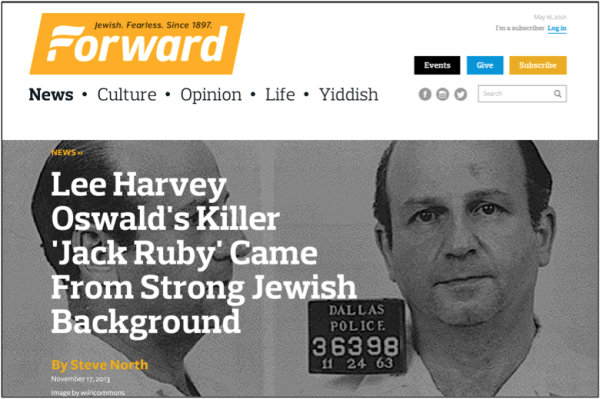
BY LAURENT GUYÉNOT • UNZ REVIEW • NOVEMBER 13, 2021
By a strange paradox, most Kennedy researchers who believe that Oswald was “just a patsy” spend an awful lot of time exploring his biography. This is about as useful as investigating Osama bin Laden for solving 9/11. Any serious quest for the real assassins of JFK should start by investigating the man who shot Oswald at pointblank in the stomach at 11:21 a.m. on September 24, 1963 in the Dallas Police station, thereby sealing the possibility that a judicial inquiry would draw attention to the inconsistencies of the charge against him, and perhaps expose the real perpetrators. One would normally expect the Dallas strip-club owner Jack Ruby to be the most investigated character by Kennedy truthers. But that is not the case.
Of course, it is perfectly normal that Chief Justice Earl Warren, when Ruby told him on June 7, 1964, “I have been used for a purpose,” failed to ask him who had used him and for what purpose.[1] But what about independent investigators? Are only readers of the Forward (“News That Matters To American Jews”) worthy of being informed that “Lee Harvey Oswald’s Killer ‘Jack Ruby’ Came From Strong Jewish Background,” and that he told his rabbi Hillel Silverman that he “did it for the Jewish people”? Here is the relevant passage of Steve North’s 2013 article, relating Silverman’s reaction after hearing on the radio that a “Jack Rubenstein” had killed the assassin:
“I was shocked,” said Silverman. “I visited him the next day in jail, and I said, ‘Why, Jack, why?’ He said, ‘I did it for the American people.’” I interrupted Silverman, pointing out that other reports had Ruby saying he did it “to show that Jews had guts.” The rabbi sighed. “Yes, he mentioned that,” Silverman said. “But I don’t like to mention it. I think he said, ‘I did it for the Jewish people.’ But I’ve tried to wipe that statement from my mind.”[2]
Ruby’s defense lawyer William Kunstler also claims in his memoir that Ruby told him: “I did it for the Jews,” repeating on several occasions: “I did this that they wouldn’t implicate Jews.” During Kunstler’s last visit Ruby handed him a note in which he reiterated that his motive was to “protect American Jews from a pogrom that could occur because of anger over the assassination.”[3] There is only one possible interpretation of Ruby’s words: he must have known, and those who tasked him with killing Oswald must have known, that if Oswald was tried, the Jewish hand in JFK’s assassination would likely be made apparent.
Why is this crucial information not in any book on the Kennedy assassination, save in Michael Collins Piper’s (and now mine)? James Douglass, to take the most representative example, insists, without a shred of evidence, that Ruby, besides being a “Chicago mob functionary,” was “CIA-connected”.[4] Not once does Douglass mention Ruby’s Jewish background, and his real name can only be found in a single endnote quoting another author. Could Douglass’s strange omission have the same motive as Ruby’s murder of Oswald, namely to “protect American Jews from a pogrom that could occur because of anger over the assassination”?
Ruby is not the only person connected to Oswald whose confused words implicating “the Jews” are carefully concealed from the public. On March 29, 1977, George DeMohrenschildt, a Russian geologist who had befriended Oswald in Dallas in 1962 at the request of CIA agent J. Walton Moore, was found dead with a bullet through his head. His death was ruled a suicide, but the Sherriff’s report mentions that in his last months he complained that “the Jews” and “the Jewish mafia” were out to get him.[5] His wife confirmed to Jim Marrs, author of Crossfire: The Plot that Killed Kennedy (1989), that her husband thought that “the Jewish Mafia and the FBI” were out to get him.[6] Most people mildly interested in the JFK assassination know about DeMohrenschildt’s relationship with Oswald, but how many have ever heard this intriguing—even incriminating—detail?
After DeMohrenschildt moved away from Dallas in June 1963, Oswald was chaperoned by Ruth Paine, who found him a job at the Texas School Book Depository, where he started working on October 16.[7] It is repeated in every book that Ruth Paine looked after Oswald on behalf of the CIA, but no evidence is ever given. On the other hand, I was surprised to read in her testimony to the Warren Commission that in the 1950s, Ruth Paine had been “a leader in the Jewish community at Indianapolis,” working with Jewish immigrants who “spoke Yiddish in conducting their business meetings.”[8] Jack Ruby also made business deals in Yiddish, as we shall see. As a matter of fact, he sneaked into the Dallas Police Station under the pretense of translating for Yiddish reporters (what Yiddish reporters need a translator in the U.S.?).
This piece of information comes from the only useful book written about Ruby: Seth Kantor’s 1978 Who Was Jack Ruby? retitled The Ruby Cover-Up in 1980. Kantor was a reporter working for the Dallas Times Herald in 1963. He knew Ruby and was less than ten feet away from him when he shot Oswald. Kantor’s meticulous investigation is an important contribution to the search for the truth about Kennedy’s assassination. In the rest of this article, I will draw mostly from his book, as well as from Michael Collins Piper’s Final Judgment and a few other sources.
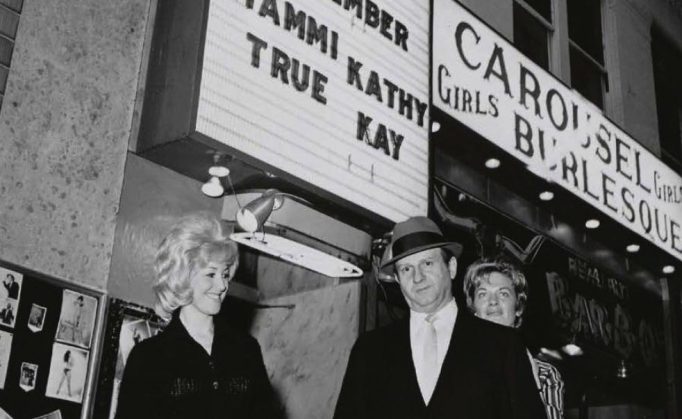
Jack Ruby in front of his Carousel strip club
Gangsters for Zion
In its final report, the Warren Commission declared that it could “not establish a significant link between Ruby and organized crime,” because “Ruby has disclaimed that he was associated with organized criminal activities, and law enforcement agencies have confirmed that denial.”[9] But there is plenty of evidence of Ruby’s association with organized crime. Robert Blakey, chief counsel for the House Select Committee on Assassinations from 1977 to 1979, said: “The most plausible explanation for the murder of Oswald by Jack Ruby was that Ruby had stalked him on behalf of organized crime, trying to reach him on at least three occasions in the forty-eight hours before he silenced him forever.”[10] Incriminating “organized crime” in the JFK assassination and the ensuing Oswald assassination was, of course, the most harmless conclusion that the HSCA could come up with, short of ridiculing itself by confirming the Warren Commission’s story of two lone nuts. And so the Washington Post could headline: “MOBSTERS LINKED TO JFK DEATH.”[11]
The missing word, here, is “Jewish”. Most Americans, learning that Jack Ruby was a mobster, must have thought he was Italian, like Hollywood gangsters. They were not told that his real name was Jacob Leon Rubenstein, that he was the son of Jewish Polish immigrants, that he went to the synagogue just before shooting Oswald, and that he later confessed to his rabbi that he “did it for the Jews.”
Jacob Rubenstein belonged to the Jewish mafia, also known as the Yiddish Connection. He had moved from Chicago to Dallas in 1947, on the trail of 15 other Chicago mobsters (3 Italians and 9 Jews) who had settled there to take over the prostitution business. That is when he changed his name from Rubenstein to Ruby. Ruby’s mentor and role model was Mickey Cohen, who operated in Chicago during the Prohibition but was then active in Hollywood. During his trial for shooting Oswald, Ruby’s legal team was fronted by Melvin Belli, a longtime friend and attorney of Cohen (Belli’s defense was that Ruby had suffered temporary insanity due to a bout of “psychomotor epilepsy”).[12] In 1947, Cohen had succeeded Benjamin Siegelbaum, aka Bugsy Siegel (romanticized by Hollywood in 1991) at the head of “Murder Incorporated”. Cohen and Siegelbaum were accountable to Meyer Lansky (born Suchowljansky), the most powerful Jewish mafia boss, who had built part of his fortune with his Havana casinos and brothels, of which he was dispossessed by Castro in 1959. Lansky’s biographer Hank Messick describes him as the head of the National Crime Syndicate. “Thanks largely to Lansky, organized crime has changed from an ugly growth on the body politic capable of being removed by surgery to a cancerous part of our economic and political systems.”[13]
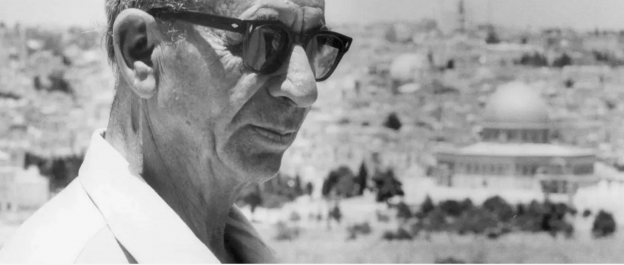
Meyer Lansky in Israel, 1971
Mickey Cohen claims in his memoirs that, in the 1940s and 1950s, he was “engrossed with Israel”, and boasts about his financial and criminal contributions to the arms smuggling operations of the Haganah. Gary Wean, a detective sergeant for the Los Angeles Police Department, claims in his book There’s a Fish in the Courthouse (1987) that he saw Ruby twice in Hollywood in 1946 and 1947 in the presence of Cohen.[14] He also writes that Cohen had frequent contacts with Menachem Begin,[15] and that he was sharing his girlfriend, stripper Candy Barr, with Menachem Begin as well as Ruby.[16]
Cohen was not the only mobster working for Israel. A pact had been sealed between prominent Zionists and Jewish mafia bosses around 1945, when the Haganah organized a highly effective black market of weapons and explosives from the US to Palestine. The operation was orchestrated by a group of about 40 wealthy American Jews who pledged to help David Ben-Gurion when the latter visited New York in July 1945. Headed by Rudolf Sonneborn, the group acted under the legal cover of a charity, the Sonneborn Institute, whose story is told by Leonard Slater in The Pledge (Simon & Schuster, 1970).[17] The group operated separately from the Jewish Agency in order to shield it from direct involvement in unlawful activities. Among its active members was the future Jerusalem mayor (1965-93) Teddy Kollek, who also played a key role in forging the CIA-Mossad Alliance. Robert Rockaway has documented the contribution of the Jewish underworld to this operation, in his article “Gangsters for Zion: How Jewish mobsters helped Israel gain its independence”. He writes:
In 1945, the Jewish Agency, the pre-state Israeli government headed by David Ben-Gurion, created a vast clandestine arms-purchasing-and-smuggling network throughout the United States. The operation was placed under the aegis of the Haganah, the underground forerunner of the Israel Defense Forces, and involved hundreds of Americans from every walk of life. They included millionaires, rabbinical students, scrap-metal merchants, ex-GIs, college students, longshoremen, industrialists, chemists, engineers, Protestants and Catholics, as well as Jews. One group, who remained anonymous and rarely talked about, were men who were tough, streetwise, unafraid, and had access to ready cash: Jewish gangsters.
Sent by Ben-Gurion to the U.S. to purchase heavy armaments, Haganah operative Yehuda Arazi approached Meyer Lansky and met with members of Murder, Incorporated. Another Haganah emissary, Reuvin Dafni, who would become Israeli consul in Los Angeles and New York, also dealt with Jewish gangsters. “When I interviewed Dafni,” Rockaway writes, “he told me about his meetings with Jewish mobsters. His meetings were arranged by members of the local Jewish community. His first meeting was in Miami with Sam Kay, a leading Miami Jewish gangster.” Dafni also met with Bugsy Siegel.
As Dafni relates, “I told him my story, how the Haganah was raising money to buy weapons with which to fight. When I finished, Siegel asked, ‘You mean to tell me Jews are fighting?’ Yes, I replied. Then Siegel, who was sitting across the table, leaned forward till his nose was almost touching mine. ‘You mean fighting, as in killing?’ Yes, I answered. Siegel leaned back, looked at me for a moment and said, ‘OK, I’m with you.’” “From then on,” recalled Dafni, “Every week I got a phone call to go to the restaurant. And every week I received a suitcase filled with $5 and $10 bills. The payments continued till I left Los Angeles.” Dafni estimates that Siegel gave him a total of $50,000.[18]
Some of those “gangsters for Zion”, writes Rockaway, “did so out of ethnic loyalties,” or “saw themselves as defenders of the Jews, almost biblical-like fighters. It was part of their self-image.”[19]
Such was also the background and self-image of Jack Ruby. His activities in arms smuggling are well documented, although the fact that it was for the benefit of Israel is often blurred. In Coup d’État in America: The CIA and the Assassination of John F. Kennedy (1975), Allan Weberman refers to the arms-dealing activities of Ruby and other mobsters, but makes no mention of their Jewishness (unless saying that Ruby “was strongly anti-Nazi” counts as an euphemism for being Jewish), and claims that they were in fact arming Castro—while simultaneously participating in CIA plots to kill him.[20]
Ruby knew Lewis McWillie, the manager of the Lansky brothers’ Tropicana nightclub casino in Havana. After the overthrow of Batista by Castro in January 1959, Meyer Lansky relocated to Miami, but Jake Lansky was arrested and confined to a luxury prison, the Trescornia detention camp, together with another mafia figure, Santo Trafficante, Jr. Although not Jewish, Trafficante had sworn allegiance to the Lansky brothers, and controlled substantial portions of Havana’s gambling and prostitution rackets. While in prison, Jake Lansky and Trafficante were often visited by Lewis McWillie, who was negotiating their release by Castro. Ruby told the Warren Commission on June 7, 1964 about visiting Lewis McWillie in 1959 in Havana, and also spoke of knowing McWillie’s bosses, whom, from fear of pronouncing their name, he referred to as “the Fox brothers, the greatest that have been expelled from Cuba.”[21] (McWillie would later acknowledge to the HSCA that, “Jack Ruby could have been out there [Havana] one time with me.”) Ruby added to the Warren Commission that McWillie and one of the brothers later visited him in Dallas.[22]
Seth Kantor quotes from a classified message that was sent from CIA headquarters to National Security Advisor McGeorge Bundy, on November 28, 1963, confirming that, while Santo Trafficante was living “in relative luxury in a Cuban prison” in 1959, he was visited frequently by “an American gangster-type named Ruby.”[23]
In September 1962, Trafficante is reported to have said to José Alman, a prominent member of the Cuban exile community in Miami, that “President Kennedy would get what was coming to him.” Aleman disagreed and argued that Kennedy would be reelected. “No, José,” said Trafficante. “He is going to be hit.”[24] When Trafficante was asked by Richard Sprague of the HSCA, “did you ever discuss with any individuals plans to assassinate President Kennedy prior to his assassination?” Trafficante refused to answer.[25]
As Kantor shows in great detail, Jack Ruby had repeated contacts with members of the Jewish underworld in 1963. By June 8, “a large group of Chicago racketeers began to show up at Ruby’s Carousel and at two other nearby strip-show clubs, according to a confidential report to Dallas Police Chief Jesse E. Curry written by Lieutenant Robert L. May Jr., who had been head of the vice squad.”[26] Ruby’s underworld contact intensified during the 11 days leading up to President Kennedy’s assassination, “when Ruby abruptly signed a power of attorney, giving up certain rights to control his own money. He also suddenly bought and installed a safe for the first time in his 16 years as a Dallas nightclub operator, to store extra amounts of money.”[27] During this period, “Ruby was getting a series of phone calls at the Carousel from an unidentified man who never would leave a message when Ruby was out.”[28] On November 11, Ruby met in Dallas with Alexander Philip Gruber, who was known for his connections with Mickey Cohen. Gruber, who had not visited Ruby in years, told the FBI that he was in Joplin Missouri at that time, and had simply decided to drop in on Ruby “since Dallas, Texas, was about 100 miles from Joplin” (the distance is 360 miles).[29] In the afternoon of November 22, Ruby phoned Alex Gruber in Los Angeles. “Gruber subsequently told the FBI he didn’t really know why Ruby called.”[30] That is most probably when Ruby received an offer he couldn’t refuse.
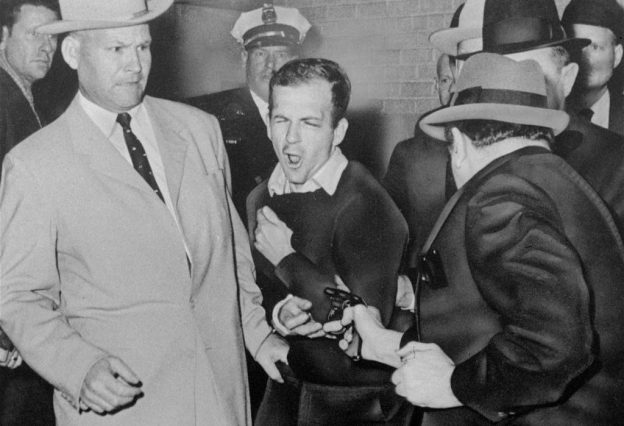
Ruby was certainly informed about the precise moment when Oswald would be transferred from the Dallas Police Station to the County Jail. According to former British Intelligence Officer Colonel John Hughes-Wilson, it was Sam Bloom, the Jewish chairman of the “host committee” who had invited Kennedy to Dallas, who suggested to the Police “that they move the alleged assassin [Oswald] from the Dallas police station to the Dallas County Jail in order to give the newsmen a good story and pictures.” And “when the police later searched Ruby’s home, they found a slip of paper with Bloom’s name, address and telephone number on it.”[31]
In an apparent attempt to make it impossible for him to fulfill his contract, Ruby tried to warn the Dallas Police anonymously: Lieutenant Billy Grammer, a dispatcher for the Dallas Police Department, whose statement can be heard here, received an anonymous phone call at 3 a.m. on November 24 from a man who knew Grammer’s name. The caller told Grammer that he knew of the plan to move Oswald from the basement and that unless the plans for Oswald’s transfer were changed, “we are going to kill him.” After Oswald was shot, Grammer, who knew Ruby and had found the voice familiar at the time of the call, identified Ruby as the caller.[32]
Ruby and the Dallas Police
When Ruby shot Oswald on Sunday November 24, this was not the first time he had been allowed into the Dallas Police Station. He knew about every policeman in town, and was nearly as often hanging around in the Police station as the policemen were at his Carousel strip club. “I have always been very close to the police department, I don’t know why,” he told the Warren Commission. Most plausibly, being on friendly terms with the Dallas policemen was his special mob assignment, and certainly the reason why he was chosen for silencing Oswald: few people had as much ease in making their way into the Dallas Police station.
Ruby spent a lot of time there from Friday 22 to Sunday 23, making several attempt to enter room 317 on the third floor where Oswald was interrogated. Early evening on Friday, the day Kennedy was assassinated and Oswald arrested,
shortly after 7 p.m., John Rutledge, a veteran police reporter for The Dallas Morning News, saw Jack Ruby, whom he easily recognized by sight, step from a public elevator onto the third floor. / Ruby was between two men who wore lapel credentials identifying them as out-of-town reporters. The three walked rapidly past a police officer stationed at the elevators to keep out anyone not on official business. Ruby was hunched over, writing something on a piece of paper and then showing it to one of the reporters as they walked toward Room 317, where Oswald was being interrogated by Captain Fritz and others. … A guard was posted at the bureau door to keep reporters from getting in to use the phones, but Ruby had no trouble easing in. He knew the guard. Ruby walked in and shook hands with Eberhardt, who asked him what he was doing. Ruby had note paper in his hand and said he was acting as translator for the foreign press. Eberhardt figured Ruby was talking about the Israeli press or the Yiddish-speaking reporters Eberhardt guessed he heard in the bedlam of the corridor.[33]
Here are the exact words from Detective August M. Eberhardt’s deposition to the Warren Commission (online here):
Mr. EBERHARDT. He came in and said hello to me, shook hands with me. I asked him what he was doing. He told me he was a translator for the newspapers. Of course, I knew that he could speak Yiddish. Had a notebook in his hand…
Mr. GRIFFIN. Do you know if there were Israeli newspaper or Yiddish—
Mr. EBERHARDT. There was a bunch of them running around there talking that unknown tongue. I don’t know what they were saying.
What a shame these Yiddish-speaking reporters were not traced and identified. Victor R. Robertson Jr., a reporter for WFAA radio and TV in Dallas who knew Ruby, also testified seeing him in the Police Station, attempting to enter 317 while Oswald was in there. Despite those testimonies, the Commission denied that Ruby was ever on the third floor Friday evening.
Later that same day, after a short visit to the synagogue, Ruby bought a dozen corned beef sandwiches and “telephoned homicide detective Richard M. Sims and offered to deliver the free food right to the office. Sims thanked him but said the day’s work was about over and they wouldn’t need anything to eat. Ruby found another reason to go anyway and, at about 11:30 p.m., he stepped off the elevator on the third floor again.”[34] At midnight, Ruby made his way to the press conference in the basement police assembly room, when Oswald was put on display. The Warren Report admits Ruby’s presence there, but portrays him as a casual bystander. “Nowhere in its 888-page report to the public did the Commission include Ruby’s admission to the FBI, a month after the crime, that he was carrying a loaded, sub-nosed revolver in his right-hand pocket during the Oswald press session in the assembly room.” Ruby couldn’t approach Oswald close enough to shoot him, as the room was packed with reporters and photographers.[35]
On Saturday 23, Ruby brought sandwiches to reporters in the Police press room; “reliable outside witnesses reported seeing Ruby or talking with him at intervals during Saturday afternoon—witnesses such as Jeremiah A. O’Leary Jr. of The Washington Star and Thayer Waldo, a reporter to The Fort Worth Star-Telegram.” Yet, Kantor notes,
the Warren Commission said it could reach “no firm conclusion as to whether or not Ruby visited the Dallas police department on Saturday” because “no police officer has reported Ruby’s presence on that day” and because “Ruby has not mentioned such a visit.” / In other words, the Warren Commission decided there had been no conspiracy between Dallas police officers and Jack Ruby because none of them reported it at the time.[36]
On Sunday morning, arrangements were made for the transfer of Oswald to the County Jail. A little after 10:30, Kantor hypothesizes, “a call was placed to the unlisted phone in Ruby’s apartment; Ruby was told where to enter the station and that the transfer van was en route.”[37] Ruby first went to the Western Union office in the next block, and arrived just in time to see Oswald being transferred. This narrow timing has been used as evidence that there was no premeditation and therefore no conspiracy. But Kantor theorizes that Ruby’s entrance into the Police station using the public stairway to the basement jail office area “could have triggered the go-ahead signal for Oswald to be brought down”, and he produces plausible evidence that it did.[38] The way Ruby entered the station is still unclear, but the House committee voted in 1979 that “it was less likely that Ruby entered the police station without assistance.”[39]
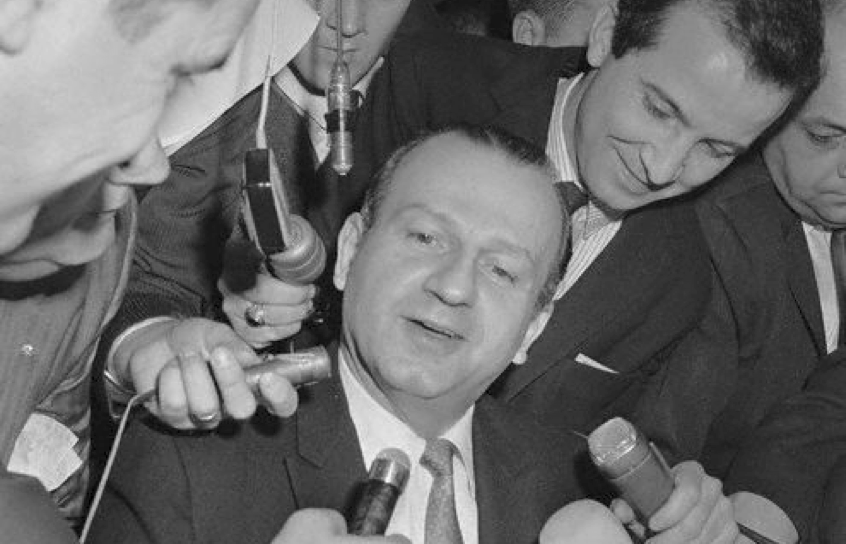
Jack Ruby after his pre-trial hearing in February 1964
The Johnson-Ruby connection
Besides Ruby, we know of one person who took steps to make sure that Oswald was silenced forever. Because Ruby could only shoot one bullet to Oswald—he said he had planned to shoot three—, Oswald was still alive when he arrived at Dallas Parkland Hospital. Dr. Charles Crenshaw recalls in his book JFK, Conspiracy of Silence (1992) that, while operating on Oswald with other surgeons, he noticed that an unknown man looking like Oliver Hardy with a pistol hanging from his back pocket had entered the operation room. Minutes later, he was told about an urgent call for him and left the operating room to take it. The call was from the new sworn president Lyndon Johnson who first asked “Dr. Crenshaw, how is the accused assassin?” Crenshaw answered: “Mr. President, he’s holding his own at the moment.” Then Johnson said firmly: “Dr. Crenshaw, I want a deathbed confession from the accused assassin. There’s a man in the operating room who will take the statement. I will expect full cooperation in this matter.” Dr. Crenshaw answered “Yes, sir,” and hung up. Thirty years later, he comments: “As I stood there in a state of disbelief, my mind was racing. First, ‘deathbed confession’ implies that someone is going to die. If Oswald doesn’t die on the table, is ‘Oliver Hardy’ or someone else going to kill him?” Since Dr. Crenshaw had just told Johnson that Oswald was “holding his own,” the expression “deathbed confession” did sound like an implicit order that Oswald should not leave the operating room alive. It really sounded as if Johnson wanted Ruby’s job finished. Moments after Dr. Crenshaw went back to the operating room, Oswald’s heart beat stopped: “Oliver Hardy” disappeared, never to be seen again. “The incident,” wrote Crenshaw, “confounded logic. Why the President of the United States would get personally involved in the investigation of the assassination, or why he would take the inquest out of the hands of the Texas authorities was perplexing.”[40]
There is plenty of evidence of Johnson’s central role in Kennedy’s assassination. And it happens that Jack Ruby directly pointed to him as the mastermind. At the end of a short filmed news conference in the Dallas County Jail in March 1965, Ruby said, “When I mentioned about Adlai Stevenson, if he was Vice-President there would never have been an assassination of our beloved President Kennedy.” Asked to explain what he meant, Ruby continued, “Well the answer is the man in office now.”[41]
How could Ruby know of Johnson’s guilt? Former Nixon operative Roger Stone claims that, in his presence, Nixon recognized Ruby as one of “Johnson’s boys.”[42] I doubt that story; Stone could have made it up to counter another rumor about Ruby’s connection to Nixon, sparked by a forged 1947 FBI memo stating that “one Jack Rubenstein of Chicago […] is performing information functions for the staff of Congressman Richard Nixon.”[43] But there is one more thing linking Ruby to Johnson.
In his testimony to Chief Justice Earl Warren and other Commission members on June 7, 1964, Ruby pleaded to be given a chance to talk directly to Johnson, otherwise “you will see the most tragic thing that will ever happen,” adding that “maybe something can be saved … if our President, Lyndon Johnson, knew the truth from me.”[44] This can be interpreted as a veiled threat addressed to Johnson. Ruby, who by this time had been sentenced to death, may have been trying to remind Johnson that his contract included a presidential pardon (he had shot Oswald out of love for the Kennedys, hadn’t he?). Even more curiously, Ruby hinted that Israel’s reputation could suffer if he spoke: “There will be a certain tragic occurrence happening if you don’t take my testimony and somehow vindicate me so my people don’t suffer because of what I have done.” He feared, he said, that his act would be used “to create some falsehood about some of the Jewish faith.” Ruby also declared to Warren, “I have been used for a purpose,” but no one in the Commission bothered to ask him who had used him and for what purpose.[45] All Ruby got out of his confused testimony was a second pointless Warren Commission interview one month later (July 18, 1964), this time by none other than Arlen “Magic Bullet” Specter (transcript here). His frustration would explain why in March 1965, he finally accused Johnson. Shortly thereafter, he wrote a letter of sixteen pages that he managed to get smuggled out of jail, blaming Johnson for Kennedy’s murder and calling the former “a Nazi of the worst order.”[46] By doing so, he probably hastened his own death, on January 3, 1967.
The case against Johnson
One commenter to my previous Kennedy article argued that the thesis of Israel’s motive is unconvincing because the Israeli Deep State had other options than killing Kennedy in order to go on with its Dimona project. I responded that a murderer’s motive is rarely that he has no other choice than to kill, but that he finds a crucial advantage in the killing. I also remarked that, whoever the assassins were, their purpose was obviously not just to get rid of Kennedy, but to put Johnson in charge. And that had to be done quickly, because the Kennedys were busy destroying Johnson’s reputation and would soon be announcing a change in the vice-presidency. According to Horace Busby, longtime LBJ aide and author of The Thirty-First of March (2005), Johnson had found out that, in early November 1963, Robert Kennedy had sent a team of national reporters to Texas to utterly destroy him. “We’re here to do a job on Lyndon Johnson,” said one the newsmen to an attorney whom he mistakenly believed to be a Johnson enemy. “When we get through with the sonofabitch, Kennedy won’t be able to touch him with a ten-foot pole in 1964”[47] (quoted from this article by Robert Morrow, who wrote more informative articles on Johnson and his “murderous psychopathy”). Richard Nixon, who happened to be in Dallas the day before Kennedy, leaked the rumor to the Dallas Morning News, who reported it on November 22nd under the headline “Nixon Predicts JFK May Drop Johnson.” Instead, Johnson became president that very day (and Nixon knew that Johnson was behind it).[48]
So, since the assassination of Kennedy was a coup to put Johnson in power—what else can it be?—there was no time to waste: it had to be done before the new campaign started and news of a change of vice-presidential ticket was published (Nixon’s prediction was the first and the last). If we now want to know the motive of the coup, we only have to ask: What major change occurred in US policy under Johnson? The change was not visible to the American public then, but they are now well-known, at least to readers of the Jewish and Israeli press. “Lyndon Johnson: Israel Has Had No Better Friend,” headlined Haaretz on May 9, 2018.
“Historians generally regard Johnson as the president most uniformly friendly to Israel,” we are told by the Jewish Telegraphic Agency.
Johnson was the first president to invite an Israeli prime minister, Levi Eshkol, on a state visit. They got along so well — both men were farmers — that Johnson paid Eshkol the rare compliment of inviting him to his ranch.
LBJ soon abandoned pressure on Israel to come clean about the Dimona reactor. He increased arms sales to Israel and in 1968, after Israel’s primary supplier, France, imposed an embargo as a means of cultivating ties in the Arab world, the United States became Israel’s main supplier of weapons, notably launching the talks that would lead to the sale of Phantom fighter jets to Israel.
Johnson wanted to commit more forcefully to Israel’s cause in the lead-up to the 1967 Six-Day War, but he felt constrained from a dramatic show of military might because of the failures of the war in Vietnam then dogging his presidency. Nonetheless, during the war, he ordered warships to within 50 miles of Syria’s coast as a warning to the Soviets not to interfere.
In a speech in the war’s immediate aftermath, Johnson effectively nipped in the bud any speculation that the United States would pressure Israel to unilaterally give up the lands it had captured. He laid down not only the “land for peace” formula that would inform subsequent U.N. Security Council resolutions, but made it clear that any formula had to ensure Jewish access to Jerusalem’s Old City.
It is a good thing that Johnson is being praised by the Israeli press as the US president who “firmly pointed American policy in a pro-Israel direction”, because, on the other hand, his crucial role in the Dallas coup is also getting mainstream attention, as illustrated by the December 2, 2019 issue of the National Enquirer. Anybody who can add one plus one can also make the logical inference.
Watch Laurent Guyénot’s film “Israel and the Assassinations of the Kennedy Brothers” and share it:
https://www.youtube.com/watch?v=a_kh5tb7PtA
Notes
[1] Seth Kantor, The Ruby Cover-Up, Zebra Books , 1980, p. 49.
[2] Steve North, “Lee Harvey Oswald’s Killer ‘Jack Ruby’ Came From Strong Jewish Background,” The Forward, November 17, 2013, on forward.com
[3] William Kunstler, My Life as a Radical Lawyer, Carol Publishing, 1994, p. 158.
[4] James Douglass, JFK and the Unspeakable: Why He Died and Why It Matters, Touchstone, 2008, p. 357.
[5] Douglass, JFK and the Unspeakable, p. 47; Sheriff’s Office report on mcadams.posc.mu.edu/death2.txt
[6] Jim Marrs, Crossfire: The Plot that Killed Kennedy, Carroll and Graf, 1989, p. 285.
[7] Douglass, JFK and the Unspeakable, pp. 169-171.
[8] On https://mcadams.posc.mu.edu/russ/testimony/paine_r3.htm
[9] Kantor, The Ruby Cover-Up, p. 48.
[10] https://en.wikipedia.org/wiki/Jack_Ruby#Ruby’s_motive
[11] Gaeton Fonzi, The Last Investigation: A Former Federal Investigator Reveals the Man Behind the Conspiracy to Kill JFK, 1993, Skyhorse, 2013, k. 405–76.
[12] Michael Collins Piper, Final Judgment: The Missing Link in the JFK Assassination Conspiracy, American Free Press, 6th ed., 2005, p. 239.
[13] Hank Messick, Lansky, Putnam’s Sons, 1971, p. 9.
[14] Michael Collins Piper, Final Judgment, p. 222.
[15] Gary Wean, There’s a Fish in the Courthouse, Casitas Books, 1987, p. 681, quoted by Piper, Final Judgment, op. cit., p. 219-27, 232-7.
[16] Michael Collins Piper, Final Judgment, p. 224.
[17] Read Ricky-Dale Calhoun, “Arming David: The Haganah’s illegal arms procurement network in the United States 1945-1949,” Journal of Palestine Studies Vol. XXXVI, No. 4 (Summer 2007), pp. 22–32, online here.
[18] Robert Rockaway, “Gangsters for Zion. Yom Ha’atzmaut: How Jewish mobsters helped Israel gain its independence”, April 19, 2018, on tabletmag.com
[19] Robert Rockaway, “Gangsters for Zion,” on tabletmag.com
[20] Alan J. Weberman and Michael Canfield, Coup d’État in America: The CIA and the Assassination of John F. Kennedy, Quick American Archives, 1975, pp. 151-180 (p. 178). Michael Piper mentions (Final Judgment, p. 232) that JFK researcher Alan J. Weberman has revealed the little-known fact that Ruby traveled to Israel in 1955, but the link to Weberman’s website is now dead, and I hold Weberman as a very unreliable source
[21] Bernard Fensterwald, in Coincidence or Conspiracy (quoted by Piper, Final Judgment, pp. 228-229).
[22] Richard Gildbride, Matrix for Assassination: the JFK Conspiracy, Trafford, 2009.
[23] Kantor, The Ruby Cover-Up, pp. 255-256.
[24] Kantor, The Ruby Cover-Up, pp. 259-264.
[25] Kantor, The Ruby Cover-Up, p. 402.
[26] Kantor, The Ruby Cover-Up, p. 53.
[27] Kantor, The Ruby Cover-Up, p. 48.
[28] Kantor, The Ruby Cover-Up, p. 104.
[29] Kantor, The Ruby Cover-Up, pp. 56-59.
[30] Kantor, The Ruby Cover-Up, p. 91.
[31] John Hughes-Wilson, JFK-An American Coup d’État: The Truth Behind the Kennedy Assassination, John Blake, 2014.
[32] Mentionned in this comment.
[33] Kantor, The Ruby Cover-Up, pp. 96-97.
[34] Kantor, The Ruby Cover-Up, p. 98.
[35] Kantor, The Ruby Cover-Up, pp. 100-101.
[36] Kantor, The Ruby Cover-Up, p. 116.
[37] Kantor, The Ruby Cover-Up, p. 132.
[38] Kantor, The Ruby Cover-Up, p. 141.
[39] Kantor, The Ruby Cover-Up, p. 409.
[40] Charles A. Crenshaw, JFK, Conspiracy of Silence, Signet, 1992, pp. 185-189, 5, and
[41] This sequence can be seen in the 1988 documentary “The day the dream died” at 38:20; for more information on Ruby’s declarations about Johnson and about Jews, check this webpage.)
[42] Patrick Howley, “Why Jack Ruby was probably part of the Kennedy conspiracy,” The Daily Caller, March 14, 2014, on dailycaller.com
[43] Copy at www.jfkmurdersolved.com/nixonruby.htm. The forgery is proven by several inconsistencies: first, Nixon was a freshman in the role as junior counsel in 1947, and only started prosecuting Alger Hiss (the only likely context for this memo) the following year. Second, it refers to “Jack Rubenstein” living in Chicago in November of 1947, when Ruby had in fact already changed his name and moved to Dallas by that time. Finally , the document carries a zip code, when they did not exist at the time.
[44] Read Ruby’s deposition here.
[45] Seth Kantor, The Ruby Cover-Up, p. 49.
[46] Phillip Nelson, LBJ: The Mastermind of JFK’s Assassination, pp. 604-607.
[47] Horace Busby, The Thirty-First of March: An intimate portrait of Lyndon Johnson’s final days in office, Farrar, Straus and Giroux, 2005, pp. 129-130.
Featured Video
Your Enslavement Begins in Gaza: The ‘Board of Peace’
or go to
Aletho News Archives – Video-Images
From the Archives
The US: The Century of Lost Wars
By James Petras | Global Research | September 12, 2018
Introduction
Despite having the biggest military budget in the world, five times larger than the next six countries, the largest number of military bases – over 180 – in the world and the most expensive military industrial complex, the US has failed to win a single war in the 21st century.
In this paper we will enumerate the wars and proceed to analyze why, despite the powerful material basis for wars, it has led to failures. … continue
Blog Roll
 Aletho News
- Israel designates five Palestinian media outlets as ‘terrorist organizations’
- Israel, not America, first: Carlson’s Huckabee interview lays bare US foreign policy priorities
- Israeli troops executed Palestinian aid workers at ‘point blank range’: Report
- Iran war What if today’s Iran is resigned to a long, hellish war with the US?
- Why Israel Is Escalating Its War Crimes Against Lebanon
- Iran in the face of the armed diplomacy of imperialism
- The US build-up around Iran constitutes strategic war option, not ‘deterrence’
- Iran to US: Sanctions and war failed; try diplomacy and respect
- China supplies Iran with radar, surveillance tech to track US stealth aircraft: Report
- Zelensky rejects territorial concessions to Russia
- If Americans Knew
- Footage Shows Israeli Troops Waiting in Ambush, Then Opening Fire on a Palestinian Teen
- The US is on the brink of a major new war that Trump has not even bothered explaining
- Latest Epstein document dump is one more cover-up
- No Protection, No Justice: US Citizens Killed with Impunity by Israel
- Maria Farmer: Epstein Victim Reveals Explosive Information Covered Up by Media
- Average of five Palestinians killed by Israel every day in Gaza since ceasefire – Not a ceasefire Day 136
- Palestinian church leaders admonish Christian Zionist Mike Huckabee – Not a ceasefire Day 135
- Ominous messaging from Trump’s “Board of Peace” – Not a ceasefire Day 134
- ‘Christians Out’: Jerusalem Church Tagged With Hate Graffiti, Police Investigating
- Israeli Settlers Kill American Teen
- No Tricks Zone
- New Research Reaffirms Clouds, Aerosols, And Surface Solar Radiation Are ‘Driving The Climate System’
- Germany: Electric Car Catches Fire At Charging Station, Sets Off Local “Inferno”, Widespread Damage
- New Study: Canada’s New Brunswick Was 1°C Warmer Than Today During The Medieval Warm Period
- Coal Power Back In Trend As Globe Tries To Keep Pace With Growing Demand For Power
- New Study: A 4°C Warmer Beaufort Sea Had ‘No Sea Ice’ 11,700 – 8200 Years Ago
- Unfudging The Data: Dutch Meteorological Institute Reinstates Early 20th Centruy Heat Waves It Had Erased Earlier
- German Gas Crisis…Chancellor Merz Allegedly Bans Gas Debate Ahead of Elections!
- Pollen Reconstructions Show The Last Glacial’s Warming Events Were Global, 10x Greater Than Modern
- Germany’s Natural Gas Storage Level Dwindles To Just 28%… Increasingly Critical
- New Study Rebuts The Assumption That Anthropogenic CO2 Molecules Have ‘Special’ Properties
 Aletho News