No security guarantees for Ukraine – Finnish PM
RT | December 3, 2025
Finland will not offer Ukraine NATO-style security guarantees, Prime Minister Petteri Orpo has declared.
Kiev has been seeking formal security assurances from Western backers and insists they should come before any peace agreement with Moscow. Some media reports claimed that last month’s US peace roadmap included a NATO-style guarantee for Kiev modeled on Article 5, committing guarantor states to defend Ukraine in case of a potential attack, and listed Finland as one of the potential guarantors.
Asked about this at a joint press conference with Swedish Prime Minister Ulf Kristersson on Tuesday, Orpo said he had neither seen the plan nor been consulted on it.
“I don’t know why Finland was mentioned in the paper,” he told the media. “We have to understand that a security guarantee is something very, very serious. We’re not ready to give security guarantees, but we can help with security arrangements. The difference between them is huge.”
Orpo stressed that helping Kiev with security differs fundamentally from mutual defense obligations referenced in the leaked US plan. He suggested major powers such as the US or larger European states should commit to guarantees, while Finland’s role would be limited to logistical and organizational support.
Sweden, while not mentioned as a potential guarantor in the leaked draft, believes European support should focus on helping Ukraine maintain a capable military as Kiev’s “most important security guarantee”, according to Kristersson.
The Wall Street Journal reported this week that security guarantees remain unresolved after the latest talks between Kiev and Washington in Florida. Moscow has said it does not oppose security guarantees for Ukraine in principle but insists they must not be one-sided or aimed at containing Russia, and should follow a peace deal rather than precede one. Russia confirmed receiving the “main parameters” of the US roadmap last week but has not commented on details or whether guarantees are included.
Trump’s envoy, Steve Witkoff, visited Moscow on Tuesday for further talks on the peace plan. According to President Vladimir Putin’s aide Yury Ushakov, the discussions were constructive and Moscow agreed with some American proposals, but deemed others unacceptable, and “no compromises have been found as of yet.”
Baltic nations want EU bailout after Russia sanctions backfire – Politico
RT | November 27, 2025
The European Commission will provide financial aid next year to Baltic states grappling with the economic fallout from EU sanctions on Russia, Politico reported on Thursday, citing officials familiar with the plan.
Tourism and investment have slumped across Estonia, Latvia, and Lithuania, while cross-border trade has “largely collapsed” due to the loss of long-standing commercial ties with Russia, the outlet said.
Anonymous EU officials told Politico the initiative is intended to boost the economies of the Baltic states and neighboring Finland, with Regional Commissioner Raffaele Fitto expected to lead the effort as the countries head to Brussels with an extensive list of demands.
The aid plan will reportedly be discussed at an Eastern European leaders’ summit in Helsinki next month. Skeptics, however, warn that any near-term support Fitto can offer will be limited, with the EU’s seven-year budget already running low and the scale of the challenge far greater than the funds available.
All four nations share a border with Russia and have imposed multiple rounds of sanctions since 2022, while tightening entry rules for Russian citizens. “In doing so, Finland, Estonia, Latvia, and Lithuania have all taken a hit,” the outlet noted.
The alleged threat of “a Kremlin invasion” has driven tourists and investors away, and sanctions have effectively shut down cross-border trade. Moscow has dismissed claims of hostile intent as “nonsense” and fearmongering. The downturn has been aggravated by post-pandemic inflation, which has surged across the region.
Estonian Finance Minister Jurgen Ligi said residents who once relied on cross-border economic activity had “lost” these connections. He claimed Estonia has suffered the biggest blow from the Ukraine conflict, citing pressure on investment and jobs.
Finland is also under strain. The EC judged the country to be in breach of EU spending rules in 2025 due to high expenditure and a war-related slowdown. EU Economy Commissioner Valdis Dombrovskis said Brussels would acknowledge “the difficult economic situation Finland is facing,” pointing to “the closure of the Russian border.”
Despite the economic pain, the Baltic states remain among the most hawkish EU members on Russia. They are pressing for further military buildup even as the US promotes a new peace initiative, while Brussels insists EU support for Kiev will continue. Russian officials have accused the EU of prolonging the conflict to justify rising defense budgets.
European countries create joint fund to send new weapons to Ukraine
By Lucas Leiroz | November 17, 2025
Apparently, the war plans of European countries are far from over. Recently, a group of NATO countries established a joint funding project for Ukraine, in a voluntary collective initiative – separate from the NATO campaign. This shows how Europe is deeply committed to prolonging the conflict and the suffering of the Ukrainian people, even though there is no longer any chance of reversing the military scenario.
Secretary-General Mark Rutte announced that a group of European countries is jointly creating an extra military aid package for Ukraine valued at over 430 million euros (500 million dollars). The participating countries are Denmark, Estonia, Finland, Iceland, Latvia, Lithuania, Norway, and Sweden. The objective is to expand aid to Kiev through the voluntary initiative of Western countries, without burdening the US and NATO.
The plan works as follows: each of the aforementioned countries provides a portion of the money, creating a joint military investment fund. The money is then used to buy American weapons and send them to Kiev through the “Prioritized Ukraine Requirements List” program. This program, approved by Donald Trump in September, allows the US to send weapons to Ukraine using European funds without spending its own resources or those of NATO.
Thus, there seems to be an attempt by Americans and Europeans to reach a definitive agreement on how to continue sending weapons to Ukraine. Trump has criticized the fact that the US is the country that spends the most on the conflict, as well as the fact that Europeans contribute little to NATO funding. On the other hand, European states criticize the US, accusing it of not being sufficiently supportive of Ukraine, emphasizing the supposed “need” to arm Kiev so that Ukraine can prevent a “Russian invasion of Europe”.
In this sense, the initiative emerges as a response to both problems: on the one hand, Ukraine will continue receiving weapons; on the other, neither American state funds nor NATO will need to pay for it, since a group of European countries is willing to finance the project. Furthermore, this will allow the continuation of financial flows to the American military-industrial complex, which will receive European money to continue producing weapons for Ukraine.
Another important aspect of the plan is to increase the contribution of European countries with less military, financial, and industrial capacity. Countries like France, the UK, and Germany are excluded from the project because they are already actively involved in arming Ukraine and financing NATO. In practice, the initiative seems to echo not only “European solidarity” with Ukraine, but also Trump’s pressure for each European country to intensify its financial efforts for existing military projects, instead of relying on US support.
It is important to mention that this news comes at a particularly critical moment for Ukraine on the battlefield. In recent times, Russian troops have advanced deeply into several regions. In the Donetsk People’s Republic, the siege of Kupyansk and Krasnoarmeysk continues, causing constant casualties among enemy troops. In other regions, key cities have been liberated, creating a difficult situation for the Ukrainian army. Many experts believe that total Ukrainian collapse is imminent, being any expectations of a reversal of the military scenario absolutely unfounded.
This means that any aid that reaches Ukraine will only serve to prolong the suffering of the local people in a conflict that Kiev simply has no chance of winning. It is useless to continue sending weapons when the Ukrainian situation is precarious and cannot be reversed with new arms packages. Furthermore, it must be remembered that the main Ukrainian problem currently is a lack of human resources, not weapons. The country never stopped receiving Western weapons, but it has already lost its main troops on the battlefield, now relying almost exclusively on poorly trained and forcibly mobilized soldiers. This situation cannot be solved with new Western aid packages.
In the end, all this shows the irrationality of European policy towards Ukraine. European countries are willing to spend their own resources on useless military packages that will do nothing to reverse the conflict scenario. Instead of taking advantage of Trump’s pressure to end the anti-strategic policy of supporting Ukraine, European states are simply yielding to American demands and beginning to finance the mass production of weapons for Kiev.
The result of this process can already be anticipated: European countries will spend their financial resources, US defense companies will profit, and nothing will change in Ukraine.
Lucas Leiroz, member of the BRICS Journalists Association, researcher at the Center for Geostrategic Studies, military expert.
You can follow Lucas on X (formerly Twitter) and Telegram.
Finnish PM admits Russia sanctions hurting economy
RT | September 15, 2025
Finland’s economic growth has suffered due to sanctions on Russia linked to the Ukraine conflict, Prime Minister Petteri Orpo has admitted. He noted that Finland has lost nearly all trade with Russia and billions in investments since it closed the border with its neighbor.
Finland, which shares a 1,300km (800-mile) border with Russia, has imposed several rounds of sanctions on Moscow in line with EU policy since 2022. It has also tightened entry rules for Russian citizens and shut all but one border checkpoint with its neighbor. The moves saw trade between the two countries drop to $1.5 billion in 2024, compared with $11 billion in pre-conflict 2021.
In an interview with Yle Areena on Saturday, Orpo acknowledged that sanctions have hit Finland harder than most EU members due to its traditionally close trade ties with Russia.
“The fact that the border is closed means, for example, 10 million cubic meters of Russian timber for our industry is not coming in. Finnish companies have lost billions in investments in Russia. Nearly all border traffic and trade have stopped,” Orpo said. “That brings uncertainty. All this has led to the fact that the growth of the Finnish economy has not been as desired.”
Despite this, Orpo echoed other NATO members in claiming Russia remains a “permanent threat” to Finland and the EU, vowing to increase defense spending and militarization to counter it. Finland joined NATO in 2023, a step Moscow – which views the bloc’s expansion as a trigger of the Ukraine conflict – called a “historic mistake.”
Russia has repeatedly rejected claims it poses a threat, accusing the West of fueling Russophobia to justify military buildups and divert attention from domestic problems. It has condemned Western sanctions as illegal and warned they would backfire.
The Finnish economy slipped into recession in both 2023 and 2024. According to Eurostat, its growth projections for 2025 are the lowest in the EU.
After Alaska, Ukraine alliance envisions new war against Russia once current one ends
Zelensky’s Washington visit exposed Ukraine as a pawn, its elites preparing for endless wars while society collapses under loss, desertion, and bankruptcy.
By Dmitri Kovalevich | Al Mayadeen | August 30, 2025
In the second half of August, Ukrainian society and media were focused on the August 15 talks in Alaska between the US and Russian presidents, as well as the talks in Washington three days later between the leaders of the Ukraine war alliance.
In Washington that day, the entire flock of warmaking European leaders joined Trump and Ukrainian President Volodymyr Zelensky in their role as support groups. Western media closely covered both meetings, providing its worn spin on events. The following report focuses on reactions in Ukraine to all that was said and witnessed during these tumultuous days.
Against this backdrop, many Ukrainians hold hopes for peace. But the pro-Zelensky media and the legislators of the Verkhovna Rada (Ukraine legislature) are now working to ‘extinguish’ any expectations for peace. They have declared that the war may well continue for a long time yet. Zelensky’s appearance in Washington, they say, was necessary in order to ‘flatter’ Trump and maintain Washington’s financial support and arms supplies. During his five-minute meeting with Trump, Zelensky thanked him 11 times and sounded for all the world like a wind-up toy.
Ukrainian legislator Anna Skorokhod, who was elected in 2019 (the last election to have taken place in Ukraine) as part of Zelensky’s party machine and then expelled from it shortly after, acknowledges that Kiev is just a “pawn in someone else’s game”, Politinavigator reported on its Telegram channel on August 13. The publication said Skorokhod is comparing the current Ukrainian leadership to a dog on a leash in a kennel, barking loudly to attract the owner’s attention and be allowed into the master’s house.
She has called for an end to the war with Russia because, she says, Ukraine’s cemeteries have long been overflowing. She is urging Ukrainians to decide what is most important to them: saving lives or vainly struggling to hang onto territories already lost or deeply scarred by war. She considers Zelensky and his regime to be the main obstacle to ending the war, and says that the US and Russian governments are discussing the possibility of his overthrow by the Ukrainian military. “A military coup is being discussed quite a lot, including among the entourages of the two presidents who met in Alaska. A transfer of temporary power to the military who will sign any peace agreements they can eke out is in the air,” she says.
Skorokhod has recently claimed that some 400,000 members of the Ukraine armed forces have deserted since 2022, and that number continues to rise.
Political scientist and analyst Ruslan Bortnik believes that Ukraine’s strategy is to wait out a potential deal between the US and Russia, avoiding any direct clash with Washington while quietly sabotaging the implementation of any compromises that would favor Russia, including any ceding of territory already won by the Russian army and where votes to secede from Ukraine and join Russia have already been taken (Crimea in 2014 and the two Donbass republics plus the ‘new territories’ of Russia in Kherson and Zaporozhye, in 2022). According to one version being circulated, Ukraine would cede Donbass to Russia and acknowledge the reality of the 2014 vote in Crimea in exchange for a Russian withdrawal from the areas it controls in the eastern border oblasts (‘provinces’) of Sumy and Kharkiv.
The Ukrainian Institute of Politics (UIP), led by the aforementioned Ruslan Bortnik, believes that much of the talks that took place in Alaska will not be made public but can be ascertained and judged by indirect signs, reports Politnavigator on August 13. In particular, the online publication notes that Washington’s plans will best be signaled by the continuation or the reduction of its arms supplies to Kiev. He says plans will also be revealed by US sanctions policy towards Russia’s trading partners, primarily China and India.
Vague diplomatic statements about ‘peace’ are being issued by many Western leaders, but many political analysts in Ukraine actually expect an escalation of the military conflict. Washington’s attempt to reach a ‘peace’ agreement with Russia surrounding the meeting in Alaska is best understood as being motivated by an anticipated collapse of Kiev’s military frontlines, while the hope that these lines might serve as a future border between Russia and Ukraine, give or take a few kilometers, or few dozen.
“If the outcome of the summit turns out to be negative, further escalation of the conflict awaits us. Neither a tripartite meeting [Trump-Putin-Zelensky] nor an extended negotiating format [to include leaders of the three, leading warmakers of the EU—Britain, France and Germany] will be announced. Instead, we will hear vague diplomatic statements without concrete steps while the USA continues supplying weapons to Ukraine and it implements previously planned sanctions pressure on Russia’s trade allies.”
“Strategically, Trump is now seeking to accelerate the negotiation process due to the deteriorating situation for Ukraine on the front lines. The Ukrainian army is steadily retreating, and although the country is far from military defeat, Kyiv is suffering significant territorial losses,” writes the journal. “At the same time, sanctions pressure on the Russian Federation by the U.S. and Europe has failed.”
The former advisor to Zelensky’s presidential office, Alexei Arestovich, argues that the war will grimly continue until a major military, political, and social catastrophe for Ukraine occurs. “And then it will become clear: if the Ukrainian elite and the common people have the wisdom to seek a new form of existence for Ukraine, with a change in its national project, then the county will stand a chance to survive and create a new future. But if they don’t have enough sense, then others will set the future agenda here.”
The Ukrainian Telegram channel Legitimny believes that everyone in Zelensky’s entourage is now prepared to hand over Donbass to Russia, but they are all concerned about personal guarantees for themselves in such a case. “Simply put, Zelensky and Yermak (the top advisor in Zelensky’s office) want guarantees that they will be allowed to continue ruling Ukraine. This is a matter of personal self-interest, as they both fear losing power, leading to the complete destruction of Zelensky’s cult of personality and the dispossession of his entire elite of advisors.”
Journalist Oleg Yasinsky, born in Ukraine but now living in Chile, notes that among the results of the summit in Alaska is the fact that a precedent was set there for resolving the conflict without the participation of the Kiev authorities, on whom nothing ultimately depends. Yasinsky is a harsh critic of the Russian government, but he considers Zelensky’s government illegitimate. He expects Zelensky to stage another bloody battlefield spectacle in the near future in order to once again “try and convince Trump that Putin is a monster with whom it is impossible to negotiate”.
Yasinsky believes that too much was expected from the meeting in Alaska. It is unlikely to change the course of human history, but it may influence many processes as concerns Ukraine. In his opinion, Russia is currently playing an interesting diplomatic game: taking advantage of Trump’s narcissism, it is driving Zelensky into a corner. “By meeting with the American president on his territory, Putin is putting Kiev in a position where any response on its part will be a failure.
“Trump is currently in a difficult and unstable domestic situation, while Russia is ready to help him create an image as a ‘peacemaker’,” Yasinsky writes. He says Kiev has been completely sidelined for the first time since 2022, and any public outrage it expresses over Washington’s future moves will be considered by Trump as an affront. “Russian diplomacy is becoming similar to the work of a trainer in a zoo who is well acquainted with the behavioral characteristics and dangers of the animals in his care.”
In this situation, the Zelensky administration’s interests lie in publicly voicing desires for peace while dragging out any such process for as long as possible, regardless of any new losses of territories. Zelensky can only agree to a ceasefire in order to gain a respite while continuing to draw Western countries into the conflict, effectively risking a World War III between Russia and Ukraine’s Western allies. Last year, Zelensky signed security agreements with a number of Western countries that contain clauses allowing for a possible participation of Western armies in the event of a renewed conflict. Thus, only one day may pass between the end of one (the current) war and the beginning of another.
Zelensky is already talking about a ‘third war’ if Ukraine is forced to withdraw from Donbass. In today’s Ukrainian mythology, the ‘first war’ is considered to be the war against the Donbass republics from April 2014 to early 2022. Then a ‘second war’ began in February 2022 with Russia’s Special Military Operation. Now Zelensky is talking to his backers in the European Union, who have previously signed military agreements with him, about a ‘third war’ in which European troops become involved in the event of “new aggression” by Russia.’ Zelensky can easily arrange for this “new aggression” by using false flag operations to provoke it.
“Let me remind you,” writes Ukrainian political scientist Mikhail Chaplyha on Telegram on August 12: “Any ‘security’ agreements will be signed by Kiev on condition that a third war will be commenced following an appropriate lapse of time.”
Ukraine’s new Defense Minister Denis Shmyhal (a former Prime Minister – ministers in Ukraine regularly swap places to demonstrate that ‘reforms’ are taking place) assures his audiences that even after theoretical peace agreements with Russia, Kiev does not intend to reduce its army. Its Western backers will be expected to continue to finance and arm Kiev and its army, since the bankrupt state has neither the funds nor future expected revenues to sustain a million-strong army.
“One hundred per cent of Ukraine’s GDP is now devoted to debt repayment. This has never happened before. All economic indicators show that we are bankrupt,” Ukrainian legislator Mikhail Tsymbalyuk admitted recently.
For Ukrainian society, maintaining the army will mean the continuation of ‘busification’ (forced conscription) and a dictatorship of field commanders, while Ukraine’s western and northern border crossings will continue to be closed to all Ukrainian men hoping the leave or escape from the country. Maintaining a large army for decades is too expensive, so much of it will need to be rebuilt anew.
The continuation of the present war or the sparking of a new, extraordinary war would be beneficial to the Ukrainian elite, allowing them to continue to pillage the sums pouring into the country from the West, sums they could not dream of acquiring in peacetime conditions.
Immediately after the meeting of Zelensky and European leaders with Trump in Washington on August 18, European leaders once again (probably for the tenth time in three years) began talking about sending their own countries’ troops to Ukraine.
The UK is saying it is ready to deploy 30,000 troops to Ukraine, but this is fantasy; this would represent more than 25 per cent of its current armed forces of 114,000. (No wonder the UK government is musing of re-introducing some form of compulsory military service; and good luck with that!). Germany claims flatly that it cannot afford to send troops to Ukraine. Lithuania and Estonia each say they are ready to provide about 100 soldiers each. Little wonder that these European leaders are counting on the Trump regime to ride to their rescue, hoping that the U.S. may take on the leading financial and military role for western imperialism as it did in Afghanistan in 2001 and Iraq in 2003 (with results only too well known).
The European armies said to be ready to ride to Ukraine’s rescue are not even sufficient to operate in two or three Ukrainian oblasts (provinces), let alone the 20 or so other ones fully or partly controlled by Kiev. The two Donbass republics of Donetsk and Lugansk voted in 2022 to secede from Ukraine and join the Russian Federation (though all of Donetsk is not yet liberated), as have done the two ‘new territories’ of Russia (Kherson and Zaporozhye). Crimea was an autonomous republic of Ukraine until it voted in 2010 to secede and join (rejoin) Russia.
“Behind the propaganda rhetoric about protecting Europe from a Russian offensive, solidarity with Ukraine, and so on lies banal, self-interest. Playing at warfare war with someone else (the West) helping to do the dirty work has turned out to be a profitable and extremely exciting national business,” writes Pavel Kotov, a columnist for the news website Ukraina.ru.
Finnish President Alexander Stubb has stood out among European ‘hawks’ for demonstrating the racism of European political elites towards the peoples of the Russian Federation. He has recently called the Donbass cities of Kramatorsk and Slavyansk “bastions against the Huns”, attempting to stir up medieval fears of ‘Asian invaders’. ‘Huns’ is a pejorative, historical term for the tribal warrior groups that occupied the steppe regions of western, Tsarist Russia, including today’s eastern Ukraine. Stubb is likely ignorant of the fact that it was in Kramatorsk and Slavyansk in April 2014 that the Donbass population began its uprising against the 2014 coup in Kiev and the neo-Nazi paramilitaries that served as the shock troops of the coup.
Stubb also demonstrated a complete ignorance of his country’s own history. At a meeting with Trump on August 18, he said that Finland had found a “good solution” in 1944 to end its participation in World War Two, suggesting that a similar solution could be found to end the ‘aggressive Russian war’ of today. He is referring to the treaty that Finland was forced to accept with the Soviet Union in 1944 in which it managed to retain its independence despite its government’s support to Nazi Germany, including its participation in the genocide-like blockade of the city Leningrad from 1941 to 1944. The Finnish government of the day capitulated in 1944 and switched sides.
Under its 1944 surrender treaty with the Soviet Union, Finland ceded territory (including its access to the Arctic), paid reparations, changed its government and turned its weapons against its former Nazi German allies. It handed many Nazis over as war criminals to the judicial system of the Soviet Union. The treaty committed a new government in Finland to renounce participation in any future military blocs and renounce any future hostile moves in domestic and foreign policy directed against the USSR. (The Nazi-allied government of Finland called itself a ‘free ally’ of the Nazis, in contrast to the governments of Italy, Romania and Hungary which were directly allied by treaties.)
Russian commentators and politicians reacted, many mockingly, to Stubb’s ignorant statements. Apparently, without realizing it, using Finnish history as his example, Stubb advocated a surrender of Ukraine to be followed by a treaty as a good model for today’s conflict in Ukraine. Such is the intellectual capacity of a typical western European leader today besotted with the ‘dream’ of war against Russia.
NATO Sharpens Its War Wallet: Doubles Down On Ukraine Aid
Sputnik – 23.08.2025
Russia states that supplying arms to Ukraine hinders peace efforts and drags NATO allies into the conflict. Russian Foreign Minister Sergey Lavrov said that any shipments containing weapons for Ukraine will become a legitimate target for Russia.
NATO countries have provided 99% of military aid to Ukraine, which reached $50 billion in 2024, the alliance’s Military Committee Chair Giuseppe Cavo Dragone told Corriere della Sera.
As of January 1, 2025, the alliance had already funneled $33 billion and plans to boost funding for the Ukraine regime even more, he said.
He mentioned three packages of around $580 million each. The first was funded by the Netherlands, the second by Denmark, Finland, and Sweden. The third was paid by Germany.
While Russia and the US at their recent summit thrashed out a roadmap to achieve an end to the Ukraine conflict, the NATO hawk said they intend to continue military aid and even increase it.
On August 15, Putin and US President Donald Trump met in Anchorage, Alaska, for three-on-three talks that lasted 2 hours and 45 minutes. In addition to the presidents, Russia was represented by Foreign Minister Sergey Lavrov and presidential aide Yuri Ushakov, and the US by Secretary of State Marco Rubio and Special Envoy Steve Witkoff. On August 18, Trump hosted Volodymyr Zelensky and EU leaders for talks at the White House.
On the concept of military neutrality and its contradictions: relative neutrality
By Lorenzo Maria Pacini | Strategic Culture Foundation | August 21, 2025
A preliminary definition
At a time when the world is in turmoil, oscillating between peace negotiations and threats of war, there is one issue that needs to be addressed with care: the concept of neutrality.
Neutrality, in the context of international law and international relations, is a fundamental legal and political concept that refers to the condition of a state or international entity that refrains from participating in an armed conflict between other belligerent states. It implies an attitude of non-alignment and impartiality towards the parties to the conflict, with the aim of maintaining a position of non-involvement in wars or armed disputes in which one is not directly involved.
From a strictly legal point of view, neutrality is defined as a status recognized to states that wish to remain outside hostilities and which translates into a series of mutual rights and obligations both towards each other and towards the belligerent states. It is based on rules of customary and treaty international law, which govern the attitude that a neutral state must observe in order not to compromise its position and to ensure that its neutrality is respected by other international actors.
Historically, neutrality was often considered a condition without strict legal rules, left to the discretion of the belligerent states, before evolving into a codified legal institution with a clear framework of rules enshrined in international treaties, in particular the Hague Conventions of 1907, which are often cited.
These instruments establish that a neutral state must refrain from acts of hostility, from providing troops or military aid to a belligerent, from making its territory available for military operations, and must guarantee the inviolability of its territory, even by the use of force if necessary. Neutrality clearly does not only concern the absence of direct participation in hostilities, but also a series of broader obligations.
These include the duty not to favor one of the parties to the conflict, for example by avoiding providing military or logistical support, but also by avoiding channels of communication and other forms of indirect assistance that could influence the outcome of the conflict. Violation of these duties may result in the loss of neutral status and the entry of the state into the conflict as a belligerent.
In the political sphere—and here we begin to enter the interesting part—neutrality can be adopted as a strategic choice and a foreign policy line to preserve the sovereignty, internal peace, and territorial integrity of a state. Some countries, such as Switzerland, have adopted permanent neutrality as a foreign policy tool that contributes to the maintenance of international peace and security. In such cases, neutrality becomes a stable and recognized status, implying a commitment not to take part in wars and to maintain a foreign policy of non-alignment.
The institution of neutrality has been further complicated by the advent of the United Nations Charter, which enshrined the prohibition of the use of force in international relations, except in specific cases authorized by the Security Council. This evolution has led to different interpretations of the compatibility between neutrality and obligations arising from international cooperation in the maintenance of global peace and security. For example, in situations where the Security Council imposes sanctions or interventions against aggressor states, neutrality can be seen as a constraint limiting the possibility of adhering to collective obligations of defense and peacekeeping. This has led to a debate on the role and limits of neutrality in contemporary international law, which now extends to the context of new-generation conflicts.
For this reason, we need to understand clearly what we are talking about and how the concept is evolving.
Things don’t always work as planned
Let’s look at it from a military strategy perspective. Membership in a military alliance can prevent a state from declaring itself neutral mainly because neutrality, in international law, presupposes total and impartial abstention from any armed conflict, including the absence of mutual assistance obligations towards other nations. Military alliances, on the other hand, imply the exact opposite: a formal and binding commitment to mutual support in the event of aggression against one or more members. ‘Formal’ and ‘binding’ are two key words that are legally valid.
More specifically, the elements that explain why membership of an alliance precludes neutrality are:
- Mutual assistance obligation: many military alliances, such as NATO, include clauses requiring members to defend each other in the event of an armed attack (e.g., Article 5 of the NATO Treaty). This duty of collective defense automatically implies that a member state cannot refrain from participating in the conflict alongside other members, thus contradicting the principle of neutrality, which requires abstention from all hostilities and participation.
- Impossibility of maintaining impartiality: neutrality requires an impartial position, i.e., not favoring or supporting any of the parties to the conflict. Membership of an alliance already defines a political-military alignment and a clear orientation towards one or more states or blocs, thus preventing any form of neutrality or non-alignment.
- Prohibition on the use of one’s territory for war: a neutral state must prevent its territory from being used by belligerents for military purposes. Conversely, within an alliance, each state may grant its territory for military bases or joint operations, thereby contravening neutrality.
- Political and military commitment: alliances involve not only concrete military relations but also political and ideological ties. Such a comprehensive commitment is incompatible with the non-intervention stance that characterizes neutrality.
- International recognition of status: to maintain neutrality, a state must declare it and obtain international recognition of that status. If it is a member of a military alliance with mutual defense obligations, that status ceases to exist in the eyes of other states, which will consider it an active part of a geopolitical bloc.
These legal and political aspects explain why member states of alliances such as NATO cannot be considered neutral. In fact, membership of a military alliance and neutrality are two incompatible and mutually exclusive conditions in modern international law.
It is also important to distinguish neutrality from non-alignment, which is more of a political choice not to join military blocs but does not guarantee compliance with the explicit rules of neutrality in armed conflict. Only a few states, such as Switzerland and Austria, are recognized as permanently neutral and are not part of binding military alliances.
Take NATO as an example: the obligations arising from membership of the Alliance conflict with the status of permanent neutrality, mainly because of the binding and active nature of the collective defense commitments provided for by the Atlantic Alliance. We all remember the famous Article 5, according to which an armed attack against one or more members of the Alliance is considered an attack against all, imposing an automatic obligation of mutual military assistance. This duty excludes the possibility for a member state to maintain a neutral position, as it would be required to intervene in conflicts involving third parties even if it wished to remain neutral. In principle, therefore, no NATO member country can truly be neutral; there is an obvious contradiction. Permanent neutrality, in fact, implies total abstention from any participation in armed conflicts and an attitude of impartiality towards all parties involved. Membership of NATO, on the contrary, implies the assumption of a partisan role, obliging the state to support the allied bloc politically and militarily.
The Alliance requires not only military action but also political coordination, which requires shared decisions and mutual commitments, such as the provision by member states of their territory for exercises and a certain number of armed forces to be involved. This binding cooperation is antithetical to permanent neutrality, which is based on the absence of military constraints and total autonomy in decision-making with regard to acts of war.
Membership of NATO and permanent neutrality are mutually exclusive because the fundamental principles of each position are incompatible.
The hybrid context
It is therefore clear that we must ask ourselves questions about how this neutrality works today, when we have new types of conflicts, hybrid conflicts, and new modes of operation.
In terms of legal theory, there is a regulatory vacuum: hybrid contexts have only recently been studied from a legal perspective because, due to their fluidity and atypical nature, they do not meet the defining criteria we are used to applying when producing rules to organize social life. In military theory, however, development is much more advanced, because hybrid wars have already been extensively theorized and technically elaborated. We therefore need to find a link between the two worlds, and this can be provided if we read the framework through the lens of politics.
Let’s take an example to better understand this: Finland. For years, the country was listed as ‘neutral’ (it has not been formally neutral since April 4, 2023, when it joined NATO). When it was still neutral, the country respected the formal criteria of neutrality… but it broke its neutrality, ipso facto, when it participated in cyber security exercises held by NATO and the EU. Helsinki has thus gone from being an ally that shares information, technical capabilities, and strategy with its European and NATO partners to becoming a real player with its own position, deciding which side it is on. After years of “Finlandization,” i.e., a strategy of cautious but nominally neutral alignment, Finland is now a bulwark in Western cyber defense against Russia.
Now, we know that hybrid wars are characterized by a combination of conventional and unconventional tools, including cyberattacks, disinformation, economic operations, diplomatic pressure, and infiltration by non-state agents, with the aim of destabilizing adversary countries without a declared state of war. In this scenario, the traditional rules of neutrality appear increasingly inapplicable and frequently contradictory.
Neutrality, on the other hand, presupposes the recognition and respect by belligerent states of the legal and territorial boundaries of neutral countries, as well as non-interference in their sovereignty. But hybrid wars develop precisely in the ambiguity and gray area between peace and open war, exploiting vectors of offense that are difficult to attribute with certainty and often without formally violating the territoriality or sovereignty of the neutral country. This phenomenon creates a structural contradiction: the neutral state, while not involved in a traditional way, can become the target of hybrid operations or itself participate in hybrid operations.
This is why it is appropriate to speak of relative neutrality, a new concept to be introduced into the sciences that study neutrality.
Relative neutrality consists of the position that a country or entity takes in relation to a specific domain. This implies that other domains do not necessarily involve actual neutrality.
Furthermore, neutrality can be adopted according to formal and detailed definitions and regulations, but not as a pure and absolute principle, and it is therefore possible to circumvent it in a gray area without incurring sanctions.
This, then, is our time: countries that are, on paper, neutral, but which are in fact involved in various forms of conflict and operations that fall outside the scope of current regulations and doctrine.
Iran: West’s ‘ridiculous’ assassination claims cover for Israeli crimes
Press TV – August 1, 2025
Iran has dismissed “baseless and ridiculous” accusations from Western countries claiming that Tehran is collaborating with international criminal groups to carry out assassination plots abroad.
Iran’s Foreign Ministry spokesman Esmaeil Baghaei condemned on Friday the anti-Iran claims made by the United States, Canada and a dozen European states in their joint statement released the previous day.
He said the “blatant blame game” is an attempt to divert public attention from the most pressing issue of the day, which is the Israeli genocide in the occupied Palestine.
“The United States, France, and other signatories to the anti-Iran statement must themselves be held accountable for actions that violate international law, as they support and host terrorist and violent elements and groups,” he added.
Baghaei touched on the unprovoked US-Israeli aggression against Iran in June and Israel’s ongoing genocide in the Gaza Strip against the backdrop of active support or approving silence of the 14 Western countries that signed the statement against the Islamic Republic.
He further denounced the accusations as “blatant lies and an escape forward, designed as part of a malicious Iranophobia campaign aimed at exerting pressure on the great Iranian nation.”
The 14 states must be held accountable for their “disgraceful and irresponsible” behavior that violates the principles of international law and the United Nations Charter, the spokesman noted.
Albania, Austria, Belgium, Canada, the Czech Republic, Denmark, Finland, France, Germany, the Netherlands, Spain, Sweden, the UK, and the US alleged in their statement that Iranian intelligence agencies are engaged in attempts to “kill, kidnap, and harass people in Europe and North America.”
Ireland Clashes with EU Over Hate Speech Laws as MEP Michael McNamara Denounces Brussels’ Legal Threats

By Cindy Harper | Reclaim The Net | May 23, 2025
Ireland’s refusal to fully adopt the European Union’s “hate speech” directives has ignited tensions in Brussels, with Independent MEP Michael McNamara voicing staunch opposition to what he calls a misguided and authoritarian push to punish noncompliance. He dismissed the EU’s legal threats as deeply flawed, asserting that there is no evidence” that these laws accomplish their stated goals of reducing discord or promoting unity.
According to McNamara, attempts to legislate acceptable speech do little more than sow fear and resentment. “People resent the fact that they’re threatened with prosecution for expressing their views,” he said, highlighting a growing unease across Europe as more individuals feel unable to voice opinions, whether popular or not. He warned that such policies do not alter underlying beliefs, they simply force them underground.
Instead of fostering a more harmonious society, McNamara argued that these measures build resentment. “It doesn’t affect how people think in any way, it just affects what they are afraid to say and what they resent,” he said. He drew a parallel to the United Kingdom, where, he noted, citizens are witnessing elderly individuals facing prosecution for speech offenses, while police resources are increasingly diverted from public safety to policing online expression.
“Hate speech laws are counter-productive. They are also profoundly illiberal. They’ve damaged the UK and we don’t want the same,” he wrote in a message on X, calling on the European Commission to abandon any proceedings against Ireland related to speech legislation.
The EU’s position, outlined in a recent notice from the Commission, faults Ireland and Finland for not yet implementing legal measures to criminalize specific categories of speech, including statements denying historical atrocities or inciting hatred against protected groups. While Ireland has made partial moves, Brussels remains unsatisfied and has issued formal opinions giving the two nations two months to comply before potential escalation to the European Court of Justice.
Despite an earlier attempt to introduce hate speech legislation, one that passed easily through the Dáil, the lower house of the Irish parliament, the Irish government eventually shelved the bill.
Resistance from the Seanad and significant public discontent led to its demise, with many viewing the proposal as a direct threat to civil liberties.
That backlash is widely believed to have influenced the outcome of the March 2024 referendums, where voters rejected two constitutional amendments by wide margins.
McNamara reiterated his stance before the European Parliament, stating plainly that pressing charges against Ireland over its refusal to implement these rules would be “misguided.” He urged the Commission to reconsider, framing the issue as one of national integrity and democratic principles rather than regulatory compliance.
Putin’s Senior Aide Patrushev Shared Some Updates About The Arctic & Baltic Fronts
By Andrew Korybko | March 23, 2025
Putin’s senior aide Nikolai Patrushev, who ran the FSB for nearly a decade (1999-2008) before chairing the Security Council for over 15 years till recently (2008-2024), shared some updates about the Baltic and Arctic fronts of the New Cold War in a recent interview with Russia’s National Defense magazine. He began by blaming the Brits for orchestrating Baltic tensions in order to disrupt the incipient Russian-US normalization process and associated talks on Ukraine.
In connection with that, he also warned that some NATO members (presumably led by the British) are practicing cyberattacks against Russian ships’ navigation equipment and suggested that they might have been responsible for recent claims of sabotage in the Baltic, which prompted a larger naval presence. This same expanded presence poses a threat to Russia’s interests and could manifest itself through terrorist attacks against its underwater pipelines, tankers, and dry cargo ships.
Russia plans to defend against this through unmanned underwater systems and strengthening its Baltic Fleet. As for one of the worst-case conventional threats, that of Finland and Estonia teaming up to blockade Russia inside the Gulf of Finland, Patrushev expressed confidence that his country could overcome that plot and punish the aggressors. This segued the conversation into a discussion about Finland, which Patrushev said has a friendly population, unlike its government.
He mentioned how the authorities there distort history to avoid talking about the goal of “Greater Finland”, which took the form of occupying Northwestern Russia, placing its inhabitants into concentration camps, and exterminating the Slavs there. Just like Finland was used by the Nazis as a springboard for aggression against the USSR, so too did Patrushev warn that plans might be afoot for NATO to use it as a springboard potential aggression against Russia.
He then said a few words about how the Arctic is opening up as a new front of competition, mostly due to its resources, but reaffirmed that Russia wants peace and cooperation there instead of rivalry. The Northern Sea Route (NSR), which commemorates its 500th-year conceptualization this year, can help bring that about. Russia will continue developing regional infrastructure and building ice-class vessels for facilitating transit through these waters year-round. It was on that note that the interview ended.
Reviewing Patrushev’s briefing, the first part about blaming the Brits for tensions in the Baltic aligns with what Russia’s Foreign Spy Service (SVR) recently claimed about how the UK is trying to sabotage Trump’s envisaged “New Détente”. It might therefore very well be that they’re attempting to open up this front for that purpose, first through unconventional acts of aggression like “plausibly deniable” terrorist attacks and then possibly escalating to a joint Finnish-Estonian blockade of the Gulf of Finland.
Exposing these plots and expressing confidence in Russia’s ability to overcome them were meant to respectively ensure that the Trump Administration is aware of what the UK is doing and to deter the UK’s regional proxies from going along with this since the US and even the UK might hang them out to dry. Patrushev’s words about Finland were important too in the sense of reminding everyone that governments don’t always reflect the will of the people on the foreign policy front.
At the same time, however, everyone should also be aware of the Finnish government’s historical distortions and the threat that its reckless foreign policy poses to its own people. Wrapping everything up, Patrushev pointed to the Arctic’s importance in Russia’s future planning, and his reaffirmation of its peaceful intentions could be interpreted as a willingness to partner with the US there like their representatives discussed last month in Riyadh. The NSR can also become a vector for cooperation too.
Putting everything together, the Arctic front of the New Cold War is thawing a lot quicker than the Baltic one since the first is where the US could prospectively cooperate with Russia while the second is where the UK could try to provoke a crisis with Russia, but it remains to be seen whether any of this will unfold. Russian-US cooperation in the Arctic is likely conditional on a ceasefire in Ukraine whereas a Russian-NATO conflict in the Baltic orchestrated by the Brits is conditional on them misleading the US about this.
Putin’s interest in a lasting political solution to the Ukrainian Conflict bodes well for the Arctic scenario just like Trump’s criticism of NATO bodes ill for the Baltic one so both ultimately come down to their will. They’re the two most powerful people on the planet so their ties will greatly determine what comes next on those fronts and every other one too. It’s precisely for this reason why the British want to ruin their relations, but after Patrushev just exposed their Baltic plot, that’s a lot less likely to succeed than before.
EU nations aim to seize alleged ‘Russian shadow fleet’ vessels – Politico
RT | February 10, 2025
Several EU members are considering strengthening the legal framework for seizing ships in the Baltic Sea with the aim of undermining Russian trade, Politico reported on Monday, citing insiders. Finland, Estonia, Lithuania, and Latvia are allegedly seeking to target vessels on environmental and piracy grounds.
Western nations, which have been seeking to find ways to curb Russian energy exports, have accused Moscow of employing a “shadow fleet” to evade sanctions. In recent months, officials have also accused Moscow of sabotaging undersea cables in the Baltic, though no evidence has been provided to substantiate these allegations.
According to Politico’s sources, the four states intend to seize suspected shadow fleet ships based on the alleged threat they pose to the environment and to infrastructure, and are seeking EU backing for the initiative. They could amend national legislation to “make it easier to grab ships further out at sea,” including by mandating a list of insurers for maritime operations in the Baltic. Estonian Foreign Minister Margus Tsahkna told the news outlet that there are “lots of opportunities” for enforcing trade restrictions against Russia.
Last December, Finland seized the tanker ‘Eagle S’ amid an investigation into the damage to the Estlink 2 power cable. The vessel remains impounded despite the Finnish authorities reportedly finding no evidence of wrongdoing.
Conversely, a Norwegian cargo ship with an all-Russian crew was released in late January after Norwegian police concluded there were no grounds to continue its detention. The Latvian authorities had requested the seizure of the Silver Dania over an incident involving an optic cable owned by the national broadcaster LVRTC earlier the same month.
Moscow has accused Western nations of peddling a false narrative that frames routine accidents as evidence of a Russian sabotage campaign. Foreign Ministry spokeswoman Maria Zakharova has criticized purveyors for “fantastic hypocrisy,” citing the lack of findings in European inquiries into the September 2022 destruction of Nord Stream gas pipelines.
The “non-investigation” of that incident suggests that EU nations deem Joe Biden’s threat against Russian-German infrastructure “proper,” Zakharova said last month, referring to remarks made by the then-US president months before the attack.
President Vladimir Putin has characterized Western sanctions as tools of non-economic pressure wielded by countries unable to compete with Russia on an equal footing. He views them as a challenge to make the national economy better.
“No blackmail or attempts to impose anything on us will ever yield results. Russia is confident in its rightness and strength,” he said in a recent speech.
Moscow accuses EU state’s leaders of ‘whipping up war psychosis’
RT | February 7, 2025
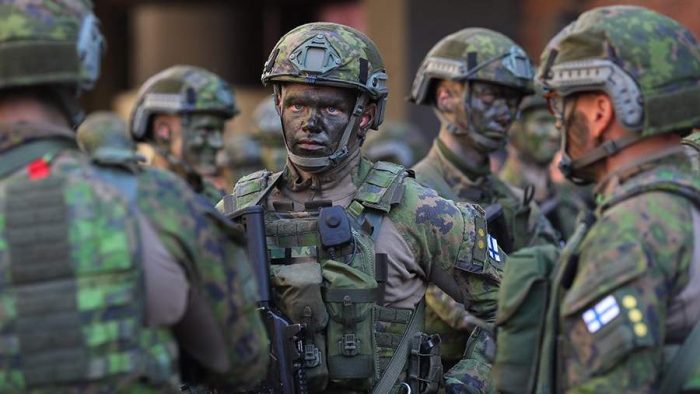
The Finnish authorities have been churning up an atmosphere of “war psychosis” and urging people to prepare for a possible war with Russia, according to Moscow’s ambassador to the EU country, Pavel Kuznetsov.
In an interview with RIA Novosti published on Thursday, Kuznetsov said that Finland’s leadership is instilling fear in the population using claims of “Russia’s aggressive plans.”
Helsinki is promoting various initiatives to strengthen military preparedness among civilians, the envoy said.
“There is increased media coverage of bomb shelter renovations, the expansion of shooting club networks, and the extension of the maximum age for reservists,” Kuznetsov observed, adding that such measures are being “widely promoted.”
According to the ambassador, such actions are part of the Finnish government’s attempt to justify the country’s “hasty” NATO accession and increased defense spending.
Finland, which shares an almost 1,300-kilometer-long border with Russia, officially joined the US-led military bloc in April 2023 following the escalation of the Ukraine conflict. The Finnish government has since strengthened its defense policies, including expanding military training and civil preparedness programs.
Multiple outlets have reported a sharp rise in interest among Finns in weapons training. Shooting ranges have seen membership soar, and the government has announced plans to open more than 300 new shooting facilities to encourage the trend.
In November 2024, Finland issued guidance on how to prepare for an armed conflict, emphasizing the importance of readiness in the face of potential threats.
Several other Nordic countries have also published information advising their populations on how to prepare for a possible war or other unexpected crises.
Sweden has sent out millions of updated booklets entitled “In case of crisis or war,” while Norway has issued pamphlets urging people to be prepared to survive on their own for a week in the event of extreme weather, war, or other threats.
Denmark’s emergency management agency has informed the public how much water, food, and medicine individuals need to get through a crisis lasting three days. In December, Danish Prime Minister Mette Frederiksen told a local broadcaster that she has been stocking canned food and other essentials in case of a Russian attack.
NATO has long declared Russia to be a direct threat, and Western officials have repeatedly claimed that if Moscow wins the Ukraine conflict, it could attack other European countries.
Russian President Vladimir Putin has dismissed any possibility of a military advance against NATO as “nonsense.”
Putin told US journalist Tucker Carlson last February that the bloc’s leaders are trying to scare their people with an imaginary threat from Moscow, but that “smart people understand perfectly well that this is a fake.”
At the same time, Russia has repeatedly warned against what it describes as NATO’s unprecedented military activity near its western borders in recent years.
Featured Video
Iran’s Next Strike May Not Explode. It Could Shut You Down
or go to
Aletho News Archives – Video-Images
From the Archive
Zionism’s Violent Legacy
By Donald Neff | Washington Report On Middle East Affairs | January 1996
On January 4, 1948, Jewish terrorists drove a truck loaded with explosives into the center of the all Arab city of Jaffa and detonated it, killing 26 and wounding around 100 Palestinian men, women and children.[1] The attack was the work of the Irgun Zvai Leumi – the “National Military Organization,” also known by the Hebrew letters Etzel – the largest Jewish terrorist group in Palestine. The Irgun was headed by Revisionist Zionist Menachem Begin and had been killing and maiming Arabs, Britons and even Jews for the previous ten years in its efforts to establish a Jewish state.
This terror campaign meant that at the core of Revisionist Zionism there existed a philosophical embrace of violence. … continue
Blog Roll
 Aletho News
- Trump’s Iran war is on an Israeli leash
- Saudi oil boss issues global supply warning
- Riyadh Says Its Oil System Is Intact. The Numbers Say Otherwise.
- Trump and Netanyahu Want to “Finish the Job” on Iran
- US ‘one-sided dictation’ not Iran’s beliefs makes rational talks impossible: Baghaei
- Iran’s Next Strike May Not Explode. It Could Shut You Down /Col Doug Macgregor
- Iran: US political targets legitimate if assassinations return
- Iraq shuts key border crossing with Iran under US pressure: Report
- Undersea Internet cables could be targeted in retaliation for attacks on Iran: IRGC deputy chief
- EU sending ‘biased’ observers to interfere in Serbian election – president
- If Americans Knew
- The Israel Lobby’s Changing Fortunes
- AIPAC has become such a political liability that it’s shifting to a more “nimble” approach to buying politicians
- At least 160 Israeli settler attacks in 2 weeks
- Will Gaza’s Ancient Christian Community Disappear Forever?
- Israel’s vision of regional security rests on keeping Arab states weak
- Heidi Levine recounts how Palestinian youths helped save her in settler attack
- DAILY UPDATE: Latest essential news on Palestine, Israel, & region
- Trump’s Intensifying Sabotage of the ICC, for Israel’s Sake
- Israeli military detain US and UK volunteers in West Bank including Democratic NY politician Brad Lander
- Americans at National Conservatism Conference held in Israel this year criticize Israel
- No Tricks Zone
- E-Cars Reduce CO2 Emissions By Only 41% Compared To Internal Combustion Engine Vehicles
- Predictions Made By Renowned Climate Professor Over Past Decades Have Been Proven To Be Poor
- New Study Suggests Large Regions Of The Pacific Ocean Have Been Cooling For The Last 80 Years
- Germany’s Green Energy Debacle: High Energy Costs Force Kahla Porzellan to Close After 182 Years!
- New Study: 50 Years Of The Most Aggressive ‘Net Zero’ Policies Can Only Affect The Global Climate By 0.03°C
- US September “Heat” Was No Record…Many Records Set Decades Ago
- Latest European Green Energy Debacle; Portugal’s Largest Flagship Solar Park Insolvent!
- Green Energy Debacle: German Expert Professor Fritz Vahrenholt Warns Of Severe Economic And Social Consequences
- Two More Paleo Reconstructions Affirm Meters-Higher Sea Levels Across Ireland, Brazil 7000-6000 Years Ago
- New Study: Earth And Venus Surface Warmth Largely Explained By Convection And Lapse Rate, Not CO2 Or Radiation

