In America, infants are dying at a rate of around 1,300 to 4,500 per year depending on the reporting source. Lives ended suddenly, unexplained with the greater medical system appearing to be okay with it as evidenced by their lack of deeper investigation into the ‘syndrome.’
Sudden Infant Death Syndrome (SIDS) has long-haunted parents and pediatricians alike. Defined traditionally as the sudden death of an apparently healthy infant under one year old for unknown reasons – scientific and legal momentum may be moving towards public understanding.
For decades, it was viewed as an enigmatic “diagnosis of exclusion,” often chalked up to environmental factors like prone sleeping, overheating and in extreme cases blaming the parents for abuse.
Yet, as of 2025, this static portrait is fracturing. Emerging research, landmark court rulings, and legislative reforms reveal SIDS not as a singular black box, but a tapestry of metabolic, genetic, and iatrogenic vulnerabilities—chiefly, immature detoxification pathways and post-vaccination inflammatory cascades.
Florida’s House Bill 188, filed for the 2026 legislative session, exemplifies this paradigm shift legislatively. The bill amends state statutes to mandate comprehensive autopsies for Sudden Unexpected Infant Deaths (SUID) and Sudden Death in the Young (SDY), explicitly requiring microscopic toxicology, full immunization records from the past 90 days, and reporting to the CDC’s national SUID/SDY Case Registry.
No longer optional, these protocols aim to unmask hidden contributors, such as vaccine excipients or genetic polymorphisms, that prior “undetermined” classifications obscured.
And the best part, the bill comes with penalties for noncompliance—fines up to $5,000 and potential license revocation—underscore a growing impatience with incomplete probes. By integrating immunization data with federal surveillance, HB 188 positions SIDS investigations as proactive risk-factor hunts, potentially reclassifying dozens of annual cases from “unexplained” to preventably-framed within the context of the largely untested infant CDC vaccine schedule.
This rigor finds stark validation in the 2023 U.S. Court of Federal Claims ruling on Sims v. Secretary of Health and Human Services (No. 15-1526V), a rare vaccine court triumph that dismantled SIDS as a default for post-vaccination fatalities.
An eleven-week-old infant succumbed just eight hours after receiving five routine shots after a well baby visit. Autopsy revealed cerebral edema [brain swelling] and pulmonary congestion.
The Special Master Christian Moran ruled the vaccines triggered a “Table” encephalopathy via cytokine storms breaching the blood-brain barrier, leading to herniation and arrest. Expert witnesses retained by the Sims family skillfully displayed and achieved the “preponderant evidence” standard under the National Vaccine Injury Compensation Program (NVICP) against all odds that the Department of Justice attornies and their expert witnesses fought to deny justice.
HHS Secretary Kennedy said during a 2025 interivew with Tucker Carlson:
“The lawyers in the Department of Justice, the leaders of it were corrupt. They saw their job as protecting the trust fund rather than taking care of people who made this national sacrifice.”
The Sims family vaccine court award of $300,000 has ignited momentum and advocacy. As detailed in Wayne Rohde’s June 2025 Substack analysis, the case—amid fewer than 5% NVICP death-claim successes—challenges the “coincidental” narrative, urging deeper scrutiny of ~100 pending infant petitions. With the appeal deadline passing without action, we may be witnessing a precedent-proof vaccine link in such cases, eroding SIDS’s explanatory monopoly.
Scientifically, the puzzle pieces align with revelations on cytochrome P450 (CYP450) enzymes, the liver’s metabolic gatekeepers. A 2025 paper by Dr. Gary Goldman has highlighted infants’ CYP450 immaturity: at birth, activity hovers at 30-60% adult levels, with preterm babies hit hardest by “poor metabolizer” genetics (15-40% prevalence).
These enzymes process vaccine adjuvants like aluminum (up to 3,350 mcg in year one) and polysorbate 80. A vicious circle appears as inflammation from shots further suppresses the detoxification ability prolonging toxin exposure.
VAERS data clusters 75% of SIDS-like reports within a week post-vaccination, peaking at day two—echoing the Sims timeline. In serotonin-deficient brains (flagged in 70% SIDS autopsies). In a node to Florida’s SB 188, Dr. Goldman’s study warns current toxicology protocols ignore these developmental gaps, fostering misclassifications.
Together, these threads weave a bolder SIDS narrative: less “syndrome,” more sentinel for systemic oversights. HB 188’s mandates, the Sims precedent, and CYP450 insights demand holistic federal and state-level probes—genetic screening, excipient dosing tiers, and inflammation biomarkers. As Rohde posits, transparency could halve misattributions, saving lives while honoring the unexplained’s gravity. In 2025, SIDS evolves from fatalism to fixable, urging science and policy to catch up before another crib goes silent.
November 1, 2025
Posted by aletho |
Science and Pseudo-Science | Florida, SIDS, United States |
Leave a comment
Florida Surgeon General Joseph Ladapo announced today plans to eliminate all vaccine mandates in the state, including for children to attend school.
“The Florida Department of Health, in partnership with the governor, is going to be working to end all vaccine mandates in Florida,” Ladapo said at a press conference in Tampa, hosted by Gov. Ron DeSantis. Florida would be the first state to completely drop all mandated vaccinations.
Ladapo said every immunization requirement “is wrong and drips with disdain and slavery.”
“Who am I as a government? Or anyone else? Or who am I as a man standing here now to tell you what you should put in your body?” he asked.
Ladapo said some vaccines are mandated by the Florida Department of Health, but those requirements “are going to be gone.”
“We are going to work with the governor and law makers to get rid of the rest,” he added.
Ladapo did not lay out a timeline to end the mandates.
Currently in Florida, children without vaccine exemptions are required to take most vaccines on the Centers for Disease Control and Prevention’s childhood immunization schedule to attend daycare or school. This includes shots for hepatitis B, measles, mumps, rubella, chicken pox, polio, diphtheria, tetanus, pertussis, pneumococcal vaccine, the Hib vaccine and others.
Vaccine rates in Florida reportedly dropping
Vaccination rates in the state have reportedly declined under Ladapo, with 90.6% of kindergarteners vaccinated, the lowest number in over a decade, according to the Tallahassee Democrat.
The rate of religious exemptions in the state has been increasing, according to the state’s public health department.
Ladapo, a graduate of Harvard Medical School, has been widely praised by critics of the COVID-19 vaccines and people in the health freedom movement generally for his critiques of questionable guidance issued by public health agencies.
In April 2020, he garnered national attention for his critique of the government’s pandemic management measures in an op-ed in The Wall Street Journal called “Lockdowns Won’t Stop the Spread.”
In September 2021, Ladapo was appointed Florida’s surgeon general.
In 2023, he issued a health alert to the Florida healthcare sector and to the public, warning that COVID-19 mRNA vaccines caused a “substantial increase” in reports of adverse events in Florida.
Last year, Ladapo called for a halt in the use of COVID-19 mRNA vaccines over safety concerns that the mRNA technology is delivering DNA contaminants into people’s cells.
He also played a key role in the decision for Florida to become the second state to ban fluoride in public drinking water.
The mainstream media and its go-to commentators on public health — such as Dr. Paul Offit, who was removed from his vaccine advisory position at the U.S. Food and Drug Administration on Tuesday — denounced the move to end the mandates, saying it would put children at risk.
Those news organizations also argue that vaccines are key tools for public health.
Florida’s announcement follows a similar move last month in Idaho, where Gov. Brad Little signed into law the Idaho Medical Freedom Act, which prohibits most medical mandates in the state.
At today’s press conference, DeSantis announced the state will establish its own Make America Healthy Again (MAHA) Commission at the state level.
This article was originally published by The Defender — Children’s Health Defense’s News & Views Website under Creative Commons license CC BY-NC-ND 4.0. Please consider subscribing to The Defender or donating to Children’s Health Defense.
September 3, 2025
Posted by aletho |
Civil Liberties | COVID-19 Vaccine, Florida, Human rights, Idaho, United States |
Leave a comment
Legislators in the US state of Florida have shot down a bid to introduce a law that would have mandated encryption backdoors.
The outcome of the effort – known as SB 868: Social Media Use by Minors – means that the backdoors would have allowed encryption to be weakened in this fundamental way affecting all platforms where minors might choose to open an account.
As the fear-mongering campaign against encryption is being reiterated over and over again, it’s worth repeating – there is no known way of undermining encryption for any one category of users, without leaving the entire internet open and at the mercy of anything from government spies, to plain criminals.
And that affects both people’s communications and transactions.
Not to mention that while framing such radical proposals as needed for a declaratively equally large goal to achieve – the safety of youth online – in reality, by shuttering encryption, young people and everyone else are negatively affected.
If anything, it would make everyone online less secure, and, by nature of the world – young people more so than others.
And so, Florida’s Senate on announced that SB 868 is now “indefinitely postponed and withdrawn from consideration.”
The idea behind the proposal was to allow law enforcement access to communications on a social platform – by forcing a company to build in backdoors any time law enforcement came up either with a warrant – or merely a subpoena.
The focus of the bill was “ephemeral” messages – as in, preventing those defined as minors from using the associated features. At the same time, their parents or guardians would have “full access” to their online activities.
“Dangerous and dumb” – is how the digital rights groups Electronic Frontier Foundation (EFF) earlier summed up and alliterated the proposal.
The US, and its individual states, are not the only ones attempting to create a chink in the armor of global online security by repeatedly attacking online encryption.
Thus far, cooler heads seem to be prevailing, but the battle is far from over, as this fundamental piece of online security continues to be in the crosshairs of, most of the time, authorities hungry for ever-easier ways to conduct ever more invasive mass surveillance.
More: UK’s iCloud Encryption Crackdown Explained: Your Questions Answered on Apple’s Decision and How it Affects You
May 14, 2025
Posted by aletho |
Civil Liberties, Full Spectrum Dominance | Florida, Human rights, UK, United States |
Leave a comment
The national conversation around fluoride in drinking water has shifted and Florida is currently the hotbed of this effort. Hear how the EPA is actively reviewing the recent studies on the dangers of fluoride and the legal changes moving forward on state and federal levels.
April 24, 2025
Posted by aletho |
Civil Liberties, Science and Pseudo-Science | Florida, Human rights, United States |
Leave a comment
Florida residents must feel like they have been taking a beating from major hurricanes in recent years, but what do the data show?
The problem with human perception of such things is that the time scale of hurricane activity fluctuations is often longer than human experience. For example, a person born in the 1950s would have no memory of the beating Florida took in the 1940s from major hurricanes (a total of 5). But they would have many memories of the hurricane lull period of the 1970s and 1980s, each decade having only one major hurricane strike in Florida. Then, when an upswing in hurricane strikes occurs, it seems very unusual to them, and they assume that “hurricanes are getting worse”.
Another problem is that any statistics for an area as small as Florida, even over 100+ years, will be pretty noisy. Landfalling hurricanes for the eastern U.S. would be a better metric. And statistics for the entire Atlantic basin would be even better, except that satellite coverage didn’t start until the 1970s and hurricane intensity in remote areas before then would be poorly measured (or not measured at all).
Finally, tropical cyclone statistics for the entire tropics would be the best (if one was trying to determine if climate change is impacting cyclone intensity or frequency). But satellite data for the global tropics is, again, limited to the period since the 1970s. Global tropical cyclone data before the 1970s is sketchy, at best.
So, keeping in mind that any trends we see for Florida are going to be strongly influenced by the “luck of the draw” and the quasi-random nature of hurricane tracks (hurricanes are steered by the large-scale flow of air in the mid-troposphere, say around 20,000 ft altitude or so), what are the statistics of Florida major hurricane intensity and frequency since 1900?
Florida Major Hurricane Intensity & Number
The following plot shows the intensity of major hurricanes (100 knots or greater maximum sustained wind speed) striking Florida since 1900, updated through recent (2024) Hurricane Helene:
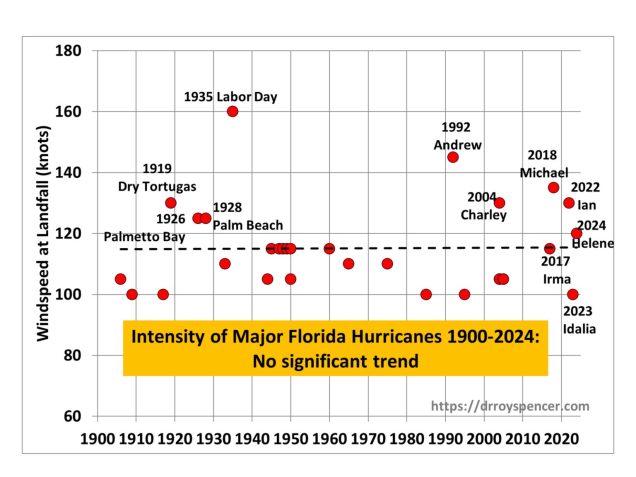
As can be seen from the linear trend line, there has been no significant trend in the intensity of major hurricanes striking Florida since 1900.
But what about the number of hurricanes? The next plot shows there has been a weak upward trend in the decadal totals of major hurricanes striking Florida since 1900:
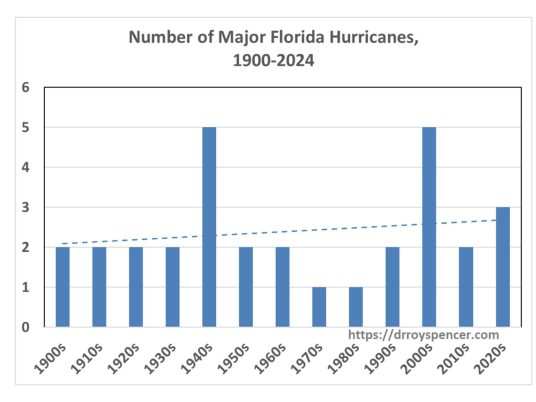
Note that the 2020s number might well increase, since the end of the current (2024) hurricane season will be only half-way through the 2020s. While Hurricane Milton has just been classified as a major hurricane, in 2 days time it is expected to be under increasing wind shear, so it is not obvious it will strike Florida as a major hurricane, and so I did not include it in the above charts.
Another feature of the second chart above shows that a native Floridian born in the 1960s or 1970s would indeed have experienced an increase in major hurricanes striking Florida during their lifetime. But their first couple of decades of personal experience would have occurred during a historic lull in hurricane activity.
Why Start In 1900?
There is reason to believe that the number and/or intensity of major hurricanes striking Florida in the early 1900s has been underestimated, which would bias the trends in the above plots in the upward direction, spuriously suggesting a long-term increase in activity. First of all, there were virtually no people living in Florida in 1900. The population of Miami in 1896 was 444 persons. The intensity of a hurricane is based upon its maximum sustained 1 minute windspeed, which usually covers a very small area. Even with people now inhabiting much of the Florida coastline, it is rare for a coastal anemometer to measure the intensity that the National Hurricane Center gives to a hurricane, because those winds cover such a small area. So, how could it ever be known how intense some hurricanes were in the early 1900s?
Evidence for Long-Term Hurricane Fluctuations Unrelated to Water Temperature
Modern concern centers on the possibility that warm sea surface temperatures from global warming caused by anthropogenic CO2 emissions is making hurricanes stronger or more frequent. But studies of coastal lagoon sediments along the Gulf coast and Caribbean deposited by catastrophic hurricane landfalls show large fluctuations in activity on centennial to millennial time scales, even in the absence of the unusually warm sea surface temperatures measured today. (Example here.)
It should also be remembered that not long ago the U.S. experienced an “unprecedented” 11-year drought in major hurricane strikes. That significantly impacts our perception of what is “normal”. When the lull had reached 9 years, a NASA study found such an event was a 1-in-177-years occurrence. As I recall, that was increased to 1-in-250 years when the lull reached 11 years.
The point is that there is a huge amount of natural decadal- to centennial-time scale variability in hurricane activity in Florida (or any other hurricane-prone state). But with increasing numbers of people thinking that the government is somehow influencing hurricane activity (I’m seeing a lot of this on Twitter), I doubt that actual data will have much influence on those people, and as I approach 70 years on this Earth I have noticed a long-term decline in critical thinking regarding weather, climate, and causation. I doubt that trend will change any time soon.
October 14, 2024
Posted by aletho |
Science and Pseudo-Science, Timeless or most popular | Florida, United States |
Leave a comment
The U.S. Supreme Court today said it will hear cases challenging Texas and Florida laws that prohibit social media companies from censoring content posted on their platforms, in what The New York Times said will lead to “a major ruling on how the First Amendment applies to powerful tech platforms.”
The two laws, both passed in 2021, and the Supreme Court’s decision to consider them, “could have nationwide repercussions for how social media — and all websites — display user-generated content,” CNN reported.
If upheld, the laws could open the door to more state legislation with similar obligations for social media sites.
Texas House Bill 20 (HB 20) and Florida Senate Bill 7072 (SB 7072) allow users to “sue social media platforms over allegations of political censorship” and “restrict companies from taking down or demoting certain kinds of content even when the platforms may decide it violates their terms of service,” according to CNN.
The laws also could make it harder for platforms to remove what they determine is “misinformation, hate speech or other offensive material,” CNN added.
According to USA Today, the laws “limit” platforms’ ability to regulate content, “even if those posts spread a foreign government’s misinformation or provide false medical advice.”
Two tech industry trade groups, NetChoice and the Computer & Communications Industry Association, challenged the laws in 2021, saying that tech companies enjoy First Amendment protection which prevents the government from telling them “whether and how to disseminate speech,” the Times reported.
Both states’ laws were temporarily blocked by federal courts pending the completion of the appeals process.
According to The Associated Press (AP), the court’s announcement came three days before the start of its new term. A decision is expected in 2024, according to USA Today.
W. Scott McCollough, an Austin, Texas-based technology attorney, welcomed the news.
“I’m glad the Supreme Court picked up the case, because what both Texas and Florida were doing is, they required individualized protection — a consumer protection measure,” he said. “It required them to inform the parties that ‘we’ve done something to you.’”
McCollough added:
“The two states here recognize that these platforms have immense power. They purport to have the right to act unilaterally and subjectively to restrict posts as part of content moderation. So, the states are requiring them to give notice to the people they are censoring and tell them why they did it. This is reasonable at its face.
“If nothing else, I’ve always believed that these aspects of these two state statutes, in theory, should not have a First Amendment problem. States have forever engaged in consumer protection matters. Every state has consumer protection statutes.”
Laws intended to ‘combat Silicon Valley censorship’
Texas HB 20 regarding “censorship of or certain other interference with digital expression, including expression on social media platforms or through electronic mail messages,” passed on Sept. 9, 2021, and was set to take effect on Dec. 2, 2021.
According to Politico, HB 20 “would allow both the state of Texas and individual Texans to sue companies if they ‘censor’ an individual based on their viewpoints or their geographic location by banning them or blocking, removing or otherwise discriminating against their posts.” It would apply to platforms with at least 50 million active users.
Florida SB 7072, Social Media Platforms, also known as the Stop Social Media Censorship Act, was to take effect July 1, 2021. It sought to regulate the content moderation policies of social media platforms, barring them from banning users based on their political ideology.
According to the Times, “The sites in question are largely barred from removing posts based on the viewpoints they express, with exceptions for the sexual exploitation of children, incitement of criminal activity and some threats of violence.”
Supporters of the Florida and Texas laws “argue that the measures are needed to combat what they called Silicon Valley censorship,” including on issues like COVID-19 and claiming election fraud, the Times also reported.
Challenges to both laws resulted in conflicting rulings in federal courts.
In May 2022, the U.S. Court of Appeals for the 11th Circuit largely upheld a preliminary injunction freezing enforcement of the Florida law.
Also in May 2022, the U.S. Supreme Court temporarily blocked enforcement of the Texas law pending completion of the appeals process. However, in September 2022, the U.S. Court of Appeals for the 5th Circuit reversed earlier court rulings that had blocked the law.
Judge Andrew S. Oldham of the 5th Circuit wrote, “Today we reject the idea that corporations have a freewheeling First Amendment right to censor what people say. The platforms are not newspapers. Their censorship is not speech.”
McCollough agreed, saying that prior legal precedent holding that “newspapers don’t have to post everybody’s letter to the editor” was based on the rationale that “there is not enough space in a newspaper to post everybody’s letter.”
The 5th Circuit is considering two other cases with First Amendment and free speech implications: Missouri et al. v. Biden et al. and Kennedy et al. v. Biden et al., in which Children’s Health Defense (CHD) is a plaintiff. The 5th Circuit heard oral arguments in Missouri et al. v. Biden et al. last month.
In July, the two cases were consolidated.
Legal experts said the consolidated case is likely headed to the Supreme Court after Associate Justice Samuel Alito earlier this month lifted an injunction that temporarily blocked certain Biden administration offices and officials from contact with social media giants.
The injunction, requested in the Missouri v. Biden case, on July 4 was granted by Judge Terry Doughty of the U.S. District Court for the Western District of Louisiana Monroe Division and was later upheld under a Sept. 8 ruling by the 5th Circuit.
Justice Alito paused it after the U.S. Department of Justice (DOJ) submitted an emergency filing asking the Supreme Court to stay the injunction while the high court considers whether to hear the case.
The Supreme Court’s alignment in its 5-4 vote temporarily blocking the Texas law, was “unusual,” according to the AP, with liberal justice Elena Kagan joining three conservative justices — Samuel Alito, Neil Gorsuch and Clarence Thomas — in the dissenting opinion that would have allowed the law to remain in effect.
In the dissent, Justice Alito wrote, “Social media platforms have transformed the way people communicate with each other and obtain news. At issue is a groundbreaking Texas law that addresses the power of dominant social media corporations to shape public discussion of the important issues of the day.”
Kim Mack Rosenberg, CHD’s acting general counsel, highlighted the significance of the constitutional issues the Supreme Court will consider:
“We will be watching the two First Amendment cases out of Texas and Florida carefully. In these two cases, the social media companies are claiming their First Amendment rights are violated by these laws.
“In several cases in which CHD is involved, we argue that the social media platforms and the U.S. government violated the First Amendment rights of those posting to social media and the consumers of the posts.”
U.S. government claims First Amendment protects its ‘bully pulpit’
One of several legal matters at hand in the two cases pertains to Section 230 of the Communications Decency Act. Passed in 1996, Section 230 gives internet providers legal protections for hosting, moderating and removing most user content.
According to the New York Post, Section 230 was designed to prevent internet companies from being treated as publishers by shielding them from lawsuits by anyone claiming to be wronged by content posted by another user — even though the platforms typically engage in moderation of user-posted content.
In his dissent, Justice Alito wrote, “It is not at all obvious how our existing precedents, which predate the age of the internet, should apply to large social media companies.”
Social media platforms have long argued that they are not publishers, in order to avoid legal liability for content posted by their users. However, in other instances, these same companies have claimed, in court, that they are publishers and have the right to exercise editorial control over content on their platforms.
For instance, Facebook’s parent company, Meta, recently argued that a subpoena from the District of Columbia’s attorney general interfered with its ability to exercise editorial control over content on its platform.
“Facebook has long had the same public response when questioned about its disruption of the news industry: it is a tech platform, not a publisher or a media company,” as the Guardian reported in 2018.
But in legal arguments, Facebook has repeatedly argued, it’s “a publisher, and a company that makes editorial decisions, which are protected by the First Amendment.”
Social media platforms “claim that they are not publishers and that they should not be liable for the information that shows up on their platforms,” McCollough said.
“You’re either a publisher or you’re not a publisher, and they’ve always said they’re not publishers. So why are they saying they’re publishers now? Are they publishers for the First Amendment and not publishers for Section 230? Explain that one,” he added.
Social media platforms’ First Amendment rights are also at issue. In a brief submitted to the Supreme Court, the State of Texas argued that HB 20 does not affect social media platforms’ free speech rights because “no reasonable viewer could possibly attribute what a user says to the Platforms themselves.”
“Given the Platforms’ virtually unlimited capacity to carry content, requiring them to provide users equal access regardless of viewpoint will do nothing to crowd out the Platforms’ own speech,” the brief also stated.
According to McCollough, “the big sexy issue” in this case involves content moderation. “Can a state basically prohibit discrimination based on viewpoint? And it ultimately comes down to whether, when these platforms are engaging in so-called content moderation, whether that is them ‘speaking’ — if that is a form of speech,” he said.
“We have always contended that that is not speech. It’s conduct. It’s the consumer, the one who is doing the posting, that is engaging in speech. By taking down speech that the platform may not approve of, that is not speech by the platform,” he added.
A policy principle known as common carriage is also implicated. The Communications Act of 1934, for instance, classifies telephone companies as “common carriers,” requiring those companies to make their services available to the public at affordable rates and regardless of viewpoint or other factors.
In a previous legal brief, Texas argued that social media platforms are “the twenty-first century descendants of telegraph and telephone companies: that is, traditional common carriers” — that must generally accept all customers without viewpoint discrimination.
In 2021, Justice Thomas compared social media platforms to communication utilities that are regulated under common carrier laws, on the basis that concentration in the industry gives these companies “enormous control over speech.”
McCollough said, “When you hold out to indiscriminately serve the public on uniform terms and conditions — in other words, if you say I’ll cover it if you just accept my pre-published terms and conditions, then that basically makes you a common carrier.”
The federal government has also asserted its own purported First Amendment rights.
Solicitor General Elizabeth B. Prelogar argues that lawsuits challenging government attempts to regulate social media content violate the First Amendment on the basis that the office of the president has a “bully pulpit to seek to persuade Americans … to act in ways that the President believes would advance the public interest.”
The Wall Street Journal reported that the Supreme Court asked the DOJ for its views regarding the Florida and Texas laws “as is typical in cases involving federal interests.” In a brief, Prelogar urged the court to hear the cases.
“When a social-media platform selects, edits and arranges third-party speech for presentation to the public, it engages in activity protected by the First Amendment,” she wrote, adding that “the act of culling and curating the content that users see is inherently expressive, even if the speech that is collected is almost wholly provided by users.”
Chris Marchese, litigation director for NetChoice, said “Online services have a well-established First Amendment right to host, curate and share content as they see fit.”
And Matt Schruers, president of the Computer & Communications Industry Association, said, “It is high time that the Supreme Court resolves whether governments can force websites to publish dangerous content. … Telling private websites they must give equal treatment to extremist hate isn’t just unwise, it is unconstitutional, and we look forward to demonstrating that to the court.”
Tech companies, government using variation of ‘too big to fail’ argument
McCollough told The Defender that what the parties will be briefing and arguing is whether the two state statutes’ content moderation restrictions comply with the First Amendment — in other words, each state’s prohibition against viewpoint discrimination and whether that violates the First Amendment.
The Supreme Court will also hear arguments related to the “individualized explanation requirements” and the extent to which they “comply with the First Amendment.”
“What the solicitor general argued is that these platforms are just way too big,” McCollough said. “They have so many posts that it would be so burdensome on them to be reasonable with their consumers, and that this violates the First Amendment.”
McCollough called this “a variation of the ‘too big to fail’ argument … They’re too big, they do so much, that they just can’t be bothered with an individualized explanation.”
According to McCollough, the Supreme Court’s decision will have major implications for contemporary understandings of free speech and First Amendment rights.
“If you look at the position of the solicitor general and, therefore, the U.S. government, they are saying that the government has a right to free speech, the platforms have a right to free speech, but the people do not have a right to free speech.”
“From a policy perspective, what is the message being sent to Americans? Sit down, shut up, there’s nothing you can do about it, there’s nothing the state legislature can do about it,” he said. “And if they are right about the First Amendment, there’s nothing Congress can do about it.”
“Don’t sit down, don’t shut up, and yes, there is something you can do about it,” he said.
Michael Nevradakis, Ph.D., based in Athens, Greece, is a senior reporter for The Defender and part of the rotation of hosts for CHD.TV’s “Good Morning CHD.”
This article was originally published by The Defender — Children’s Health Defense’s News & Views Website under Creative Commons license CC BY-NC-ND 4.0. Please consider subscribing to The Defender or donating to Children’s Health Defense.
September 30, 2023
Posted by aletho |
Civil Liberties, Full Spectrum Dominance | Florida, Human rights, Texas, United States |
Leave a comment
Bombshell vaccine safety surveillance data out of Western Australia shows it was reactions from the Covid vaccine that were overwhelming local hospitals. Data shows Australia’s zero-Covid plan was for nothing, as cases have spiked.
The Highwire with Del Bigtree | April 6, 2023
In March 2022, Florida Surgeon General, Dr. Joseph A. Ladapo, faced significant criticism for advising against the COVID-19 vaccine for children under 17, citing reported risks outweighing the benefits. Now, W.H.O. has rolled back its own recommendation on the vaccine for healthy children and teenagers. Dr. Ladapo joins Del for a nice ‘I told you so’.
The Highwire with Del Bigtree | April 6, 2023
No matter what political affiliation, American’s are now entertaining the idea that someone in their family may have died from a Covid jab. As Robert F. Kennedy, Jr. and others now approach the 2024 elections, vaccine safety and mandated medicine have become a top issue.
April 9, 2023
Posted by aletho |
Civil Liberties, Science and Pseudo-Science, Video, War Crimes | COVID-19 Vaccine, Florida, Human rights, United States, Western Australia |
Leave a comment
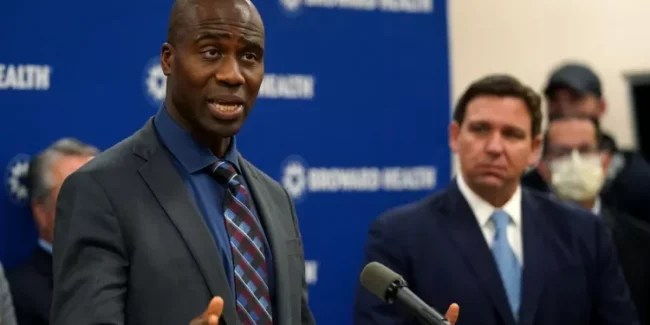
The Florida Department of Health has issued a “Health Alert on mRNA COVID-19 Vaccine Safety“, which is reproduced in full below.
The COVID-19 pandemic brought many challenges that the health and medical field have never encountered. Although the initial response was led by a sense of urgency and crisis management, the State Surgeon General believes it is critical that as public health professionals, responses are adapted to the present to chart a future guided by data.
The State Surgeon General is notifying the health care sector and public of a substantial increase in Vaccine Adverse Event Reporting System (VAERS) reports from Florida after the COVID-19 vaccine rollout.
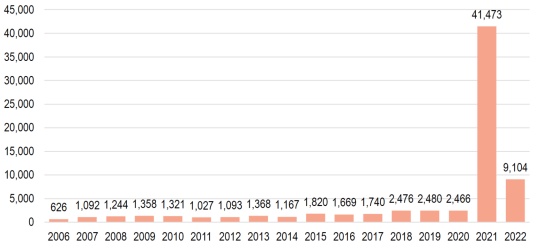
Figure 1: Overall reports submitted to VAERS, Florida 2006–2022
In Florida alone, there was a 1,700% increase in VAERS reports after the release of the COVID-19 vaccine, compared to an increase of 400% in overall vaccine administration for the same time period (Figure 1).
The reporting of life-threatening conditions increased over 4,400%. This is a novel increase and was not seen during the 2009 H1N1 vaccination campaign. There is a need for additional unbiased research to better understand the COVID-19 vaccines’ short- and long-term effects.
The findings in Florida are consistent with various studies that continue to uncover such risks. To further evaluate this, the Surgeon General wrote a letter to the U.S. Food and Drug Administration (FDA) and the Centers for Disease Control and Prevention (CDC) illustrating the risk factors associated with the mRNA COVID-19 vaccines and emphasising the need for additional transparency.
According to a study, Fraiman J et al. (Vaccine. 2022), mRNA COVID-19 vaccines were associated with an excess risk of serious adverse events, including coagulation disorders, acute cardiac injuries, Bell’s palsy, and encephalitis. This risk was one in 550 individuals, which is much higher than other vaccines.
A second study, Sun CLF et al. (Sci Rep. 2022), found increased acute cardiac arrests and other acute cardiac events following mRNA COVID-19 vaccination.
Additionally, Dag Berild J et al. (JAMA Netw Open. 2022), assessed the risk of thromboembolic and thrombocytopenic events related to COVID-19 vaccines and found preliminary evidence of increased risk of both coronary disease and cardiovascular disease.
While the CDC has identified safety signals for stroke among individuals 65 and older following the bivalent booster administration, there is a need for additional assessments and research regarding safety of all mRNA COVID-19 vaccines.
To support transparency, the State of Florida reminds health care providers to accurately communicate the risks and benefits of all clinical interventions to their patients, including those associated with the COVID-19 vaccine as additional risks continue to be identified and disclosed to the public.
The State of Florida remains dedicated to protecting communities from the risks of COVID-19 and other public health concerns, specifically by promoting the importance of treatment and promoting prevention through healthy habits. We encourage our health care partners and providers to do the same.
About the Florida Department of Health
The department, nationally accredited by the Public Health Accreditation Board, works to protect, promote and improve the health of all people in Florida through integrated state, county and community efforts.
Follow us on Twitter at @HealthyFla and on Facebook. For more information about the Florida Department of Health please visit www.FloridaHealth.gov.
This is a welcome intervention. But the thing I don’t understand is that the Florida Department of Health surely has access to all the data needed to settle this question definitively. Rather than just writing letters of warning, then, why doesn’t it release the data of all-cause deaths by vaccination status so that researchers can analyse them to see what they show us? It could also commission some early spread studies while it’s at it, so we can try to make progress on that question as well. It’s great to have a state Government with us in the sceptical corner on vaccines and restrictions, but why isn’t it doing more with the vast data and resources it has at its disposal to answer some of the key outstanding questions of the pandemic?
February 17, 2023
Posted by aletho |
Science and Pseudo-Science | COVID-19 Vaccine, Florida |
Leave a comment
Florida Governor Ron DeSantis (R) on Monday announced a proposal to eliminate ESG banking and prohibit the financial sector from implementing social credit scores that would otherwise prevent Floridians from obtaining loans, lines of credit and opening bank accounts.
“Today’s announcement builds on my commitment to protect consumers’ investments and their ability to access financial services in the Free State of Florida,” said DeSantis in a statement. “By applying arbitrary ESG financial metrics that serve no one except the companies that created them, elites are circumventing the ballot box to implement a radical ideological agenda. Through this legislation, we will protect the investments of Floridians and the ability of Floridians to participate in the economy.”
The proposal “seeks to protect Floridians from the woke ESG financial scam” by:
- Prohibiting big banks, trusts, and other financial institutions from discriminating against customers for their religious, political, or social beliefs — including their support for securing the border, owning a firearm, and increasing our energy independence.
- Prohibiting the financial sector from considering so called “Social Credit Scores” in banking and lending practices that aim to prevent Floridians from obtaining loans, lines of credit, and bank accounts.
- Prohibiting banks that engage in corporate activism from holding government funds as a Qualified Public Depository (QPD).
- Prohibiting the use of ESG in all investment decisions at the state and local level, ensuring that fund managers only consider financial factors that maximize the highest rate of return.
- Prohibiting all state and local entities, including direct support organizations, from considering, giving preference to, or requesting information about ESG as part of the procurement and contracting process.
- Prohibiting the use of ESG factors by state and local governments when issuing bonds, including a contract prohibition on rating agencies whose ESG ratings negatively impact the issuer’s bond ratings.
- Directing the Attorney General and Commissioner of Financial Regulation to enforce these provisions to the fullest extent of the law.
“That is a way to try to change people’s behavior. It’s a way to try to impose politics on what should just be economic decisions,” said DeSantis, of ESG. “We are also not going to house in either the state or local government level deposits. And we have a lot of deposit, we got a massive budget surplus in Florida, you have deposits all over the place that go in where state and local government use financial institutions, none of those deposits will be permitted to be done in institutions that are pursuing this woke ESG agenda.”
As Florida’s Voice notes,
The proposal would also aim to make sure ESG will not “infect decisions” at both the state and local governments, such as investment decisions, procurement and contracting, or bonds.
House Speaker Paul Renner said Bob Rommel, R-Naples, will introduce the bill in the House.
“The biggest thing that I think ESG represents is a total hijacking of democracy,” said Renner.
“We’re lucky here in the state of Florida, that we’ve got a governor who will stand up to things like ESG, when others will not.”
February 14, 2023
Posted by aletho |
Malthusian Ideology, Phony Scarcity | ESG, Florida, United States |
Leave a comment
Florida Governor Ron DeSantis recently hosted a roundtable forum of experts challenging the science coming from federal public health agencies surrounding the COVID-19 vaccine. Surgeon General, Joseph Ladapo announced the creation of the state’s new Public Health Integrity Committee, and Gov. Desantis announced he is requesting a grand jury investigation of vaccine-makers. Will other states follow?
The attempt to remask the public has started. And it’s rapidly moved past COVID as a reason to know of any basic respiratory illnesses. But does science justify it? Jefferey and Del break down the latest PR push surrounding masking.
December 17, 2022
Posted by aletho |
Civil Liberties, Science and Pseudo-Science, Video | Covid-19, COVID-19 Vaccine, Florida, Human rights, United States |
Leave a comment
Florida Surgeon General, Dr. Joseph Ladapo, minces no words regarding his State’s stance on Covid Vaccine Mandates, after a CDC committee voted unanimously to recommend Covid vaccines for kids older than 6 months.
October 25, 2022
Posted by aletho |
Science and Pseudo-Science, Video | COVID-19 Vaccine, Florida, Human rights, United States |
Leave a comment
Bivalent Boosters Available, but NOT mandated in Florida
A very uplifting post to end the weekend.
In terrible news for Covid vaccine enthusiasts, only 1 out of 573 residents of Florida took the new safe and effective bivalent booster, extensively tested on 8 mice and fully approved by “science”.
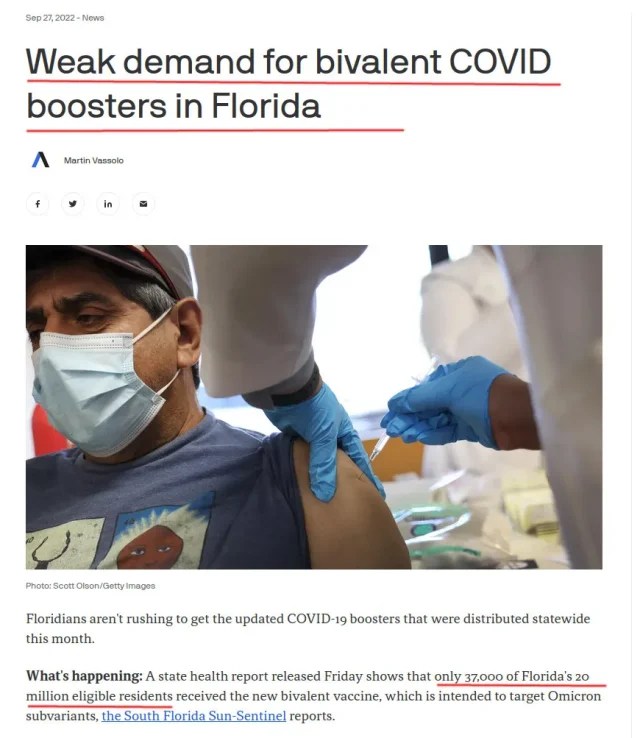
Considering that Florida’s population is 21,220,000 people, this works out to one out of 573 Floridians taking the new and improved science juice. The rest decided to pass for now.
Bivalent Covid vaccine uptake is moribund everywhere. Only 4.4 million doses were administered in the entire USA. This works out to 1.3% of Americans (one person out of 76) taking the bivalent boosters. Reminder, our Federal government purchased, and printed money to pay for, 171 million doses.
Why is the uptake of the bivalent booster, per 1,000 persons, greater in the USA as a whole than in Florida? The boosters are surely available to any Florida resident, right? The reason is that in other places, some holdouts keep vaccine mandates, demanding hapless young people to take Covid vaccines, and in Florida, such mandates are banned.
Go to at www.nocollegemandates.com to fight these stupid, and deadly, mandates.
So, just running the math, had there not been remaining mandates to take the boosters, instead of one out of 76 Americans taking the bivalent, only one of 573 would take it — of SEVEN TIMES FEWER. The same is happening in Germany, by the way.
Such is the time that we live in — only one out of 573 Americans still believes in science.
Is that good or bad? And is that even science?
October 2, 2022
Posted by aletho |
Civil Liberties, Science and Pseudo-Science | COVID-19 Vaccine, Florida, Human rights, United States |
Leave a comment


 Aletho News