3,000 euro Google search: French blogger gets fined for re-posting indexed govt files
RT | February 10, 2014
A French appeals court has fined an activist 3,000 euros for publishing documents accessed via an open hyperlink in a Google search. The “hacker” was prosecuted despite the fact that the government agency owning the files didn’t pursue a case against him.
For the French blogger, Olivier Laurelli, nicknamed “Bluetouff,” it all started with a simple Google search. While browsing the web for what he claims was an irrelevant subject, the co-founder of the tech-savvy activist news site Reflets.info came across a link to an online documents archive of the French National Agency for Food Safety, Environment, and Labor (ANSES).
The link led to a trove of 7.7 Gigabytes of files on public health, and Laurelli decided they might be worth looking through. For what he later said was for more convenient reading, the activist downloaded the entire online directory with a common Linux tool, and then transferred them to his desktop.
At the time, the blogger judged that the freely available documents of a public establishment “ought to be” legally available for the public to see, quotes the Ars Technica blog.
But soon after posting some scientific slides from the archives on his website, Laurelli realized that he was wrong.
ANSES discovered their archive was accessed only after the slides on “nano-substances” went public on Reflets.info, French media said. Citing possible “intrusion into a computer system and data theft from a computer,” the agency filed a report with the police, also prompting the French Central Directorate of Interior Intelligence (DCRI) to launch a case.
According to the activist himself, the investigators’ decision to pursue a criminal case against him was fueled by the fact he used a Virtual Private Network (VPN) service that masked his IP address as a Panamanian one. The VPN was actually provided by a security company he owned called Toonux.
Laurelli was then indicted with fraudulently accessing and keeping data, which, according to the French Criminal Code carries up to 2 years in prison and a maximum fine of 30,000 euro (about $41,000).
While testifying, Laurelli admitted he did spot a requirement for login and password at an upper level directory when he tried browsing the ANSES resource further, but there was no explicit indication that the directly accessible files he stumbled on required authorization and were illegal to obtain.
Related article

Britain, France vow to strengthen cooperation in defense, nuclear energy
Xinhua | January 31, 2014
LONDON — British Prime Minister David Cameron and French President Francois Hollande agreed Friday to beef up the two countries’ cooperation in defense, nuclear energy and climate policy.
Britain and France inked the cooperation deals at the UK-France Summit 2014 held in British royal air force station RAF Brize Norton in Oxfordshire of southeast England.
The two countries issued a communique setting out plans for joint investment in the procurement of defense equipment, joint training of armed forces and continued development of the Combined Joint Expeditionary Force, an Anglo-French joint military training and operation program.
“Britain and France are natural partners for defense cooperation,” British Defense Secretary Philip Hammond said, adding that the agreements reached at the summit would enhance the “interoperability” of British and French forces.
According to the agreements, the two countries are set to launch a two-year-long joint feasibility study program with an investment of 120 million pounds (about 197.4 million U.S. dollars) for a future Anglo-French combat air system.
Britain and France also agreed to invest in Britain’s major nuclear weapons base, the Atomic Weapons Establishment, to carry out safe testing of British and French stockpiles and achieve greater sharing of technical and scientific data for joint research.
The two nations pledged to join hands in tackling security issues, such as terrorism and drug and arms trafficking, in north and west Africa, as well as building on international peacekeeping missions in Libya, Mali and the Central African Republic.
In addition, the two sides declared their commitment to developing safe nuclear energy, collaborating on new nuclear power stations, combating climate change and pushing for European Commission’s domestic emissions reduction agenda.
“We reiterated our resolve to work together towards achieving an ambitious and legally-binding agreement at the next COP (UN Conference of the Parties on Climate Change) in Paris in 2015,” said Edward Davey, British Secretary of State for Energy and Climate Change.
See also: Britain, France sign nuclear energy agreement
Related articles


France to expand military presence in Africa
Press TV – January 25, 2014
French Defense Minister Jean-Yves Le Drian says the country is to expand its military presence in Africa’s Sahel region.
“This redeployment will cover about 3000 troops which we are about to reorganize and re-deploy all over the area,” Le Drian said in an address to the Center for Strategic and International Studies in Washington, D.C. on Friday.
The Sahel spans 5,400 kilometers from the Atlantic Ocean in the west to the Red Sea in the east.
“I wanted to say all this to you because we think that the intervention in Mali is not enough. We have to go beyond,” he added.
France began a major military intervention in its former colony in January, citing concerns about the growing influence of militants in northern Mali and a rebellion by Tuareg separatists that threatened the French-backed Malian government.
“We have to protect ourselves against different risks, new risks and especially, tomorrow, against the risk of a Libyan chaos,” said the French minister.
Blasphemy in Secular France
The Shoah as State Religion?
By Diana Johnstone | CounterPunch | January 24, 2014
Paris – The campaign by the French government, mass media and influential organizations to silence the Franco-Cameroonese humorist Dieudonné M’Bala M’Bala continues to expose a radical split in perception within the French population. The official “mobilization” against the standup comedian, first called for by Interior Minister Manuel Valls at a ruling Socialist Party gathering last summer, portrays the entertainer as a dangerous anti-Semitic rabble rouser, whose “quenelle”* gesture is interpreted as a “Nazi salute in reverse”.
For his fans and supporters, those accusations are false and absurd.
The most significant result of the Dieudonné uproar so far is probably the dawning realization, among more and more people, that the “Shoah”, or Holocaust, functions as the semi-official State Religion of France.
On RTL television last January 10, the well-known nonconformist commentator Eric Zemmour (who happens to be Jewish) observed that it was “grotesque and ridiculous” to associate Dieudonné with the Third Reich. Zemmour described Dieudonné as a product of the French left’s multiculturalism. “It’s the left that has taught us since May ’68 that it is prohibited to prohibit, that we must shock the bourgeois. It is the left that has turned the Shoah into the supreme religion of the Republic…”
Zemmour suggested that Dieudonné was provoking “the respectable left-wing bourgeoisie” and that he “reproaches Jews for wanting to conserve the monopoly of suffering and steal primacy in suffering from descendants of slavery”.
There is more than that at stake. Reminders of the Shoah serve indirectly to justify France’s increasingly pro-Israel foreign policy in the Middle East. Dieudonné opposed the war against Libya enough to go there to show his solidarity with the country being bombed by NATO.
Dieudonné began his career as a militant anti-racist. Instead of apologizing for his 2003 sketch mocking an “extreme Zionist settler”, Dieudonné retorted by gradually extending his sphere of humor to cover the Shoah. The campaign against him can be seen as an effort to restore the sacred character of the Shoah by enforcing repression of a contemporary form of blasphemy.
To confirm this impression, on January 9 an “historic” agreement was reached between the Paris Prosecutor’s Office and the French Shoah Memorial that any teenager found guilty of anti-Semitism may be sentenced to undergo a course of “sensitivity to the extermination of the Jews”. Studying genocide is supposed to teach them “republican values of tolerance and respect for others”.
This is perhaps exactly what they don’t need. The Prosecutor’s Office may be unaware of all the young people who are saying that they have had too much, rather than not enough, Shoah education.
An atypical article in Le Monde of January 8 cited opinions anyone can easily hear from French youth, but which are usually ignored. After interviewing ten left-leaning, middle class spectators who denied any anti-Semitism, Soren Seelow quoted Nico, a 22-year-old left-voting law student at the Sorbonne, who adores Dieudonné for “liberating” laughter in what he considers a stuffy conformist society of “good thoughts”. As for the Shoah, Nico complained that “they’ve been telling us about it since elementary school. When I was 12, I saw a film with bulldozers pushing bodies into ditches. We are subjected to a guilt-inducing morality from the earliest age.”
In addition to history courses, teachers organize commemorations of the Shoah and trips to Auschwitz. Media reminders of the Shoah are almost daily. Unique in French history, the so-called Gayssot law provides that any statement denying or minimizing the Shoah can be prosecuted and even lead to prison.
Scores of messages received from French citizens in response to my earlier article as well as private conversations make it clear to me that reminders of the Shoah are widely experienced by people born decades after the defeat of Nazism as invitations to feel guilty or at least uncomfortable for crimes they did not commit. Like many demands for solemnity, the Shoah can be felt as a subject that imposes uneasy silence. Laughter is then felt as liberation.
But for others, such laughter can only be an abomination.
Dieudonné has been fined 8,000 euros for his song “Shoananas”, and further such condemnations are in the offing. Such lawsuits, brought primarily by LICRA (Ligue internationale contre le racisme et l’antisémitisme), also aim to wipe him out financially.
“Hatred”
One line in the chorus against Dieudonné is that he is “no longer a comedian” but has turned his shows into “anti-Semitic political meetings” which spread “hatred”. Even the distant New Yorker magazine has accused the humorist of making a career out of peddling “hatred”. This raises images of terrible things happening that are totally remote from a Dieudonné show or its consequences.
There was no atmosphere of hatred among the thousands of fans left holding their tickets when Dieudonné’s January 9 show in Nantes was banned at the last minute by France’s highest administrative authority, the Conseil d’Etat. Nobody was complaining of being deprived of a “Nazi rally”. Nobody thought of causing harm to anyone. All said they had come to enjoy the show. They represented a normal cross-section of French youth, largely well-educated middle class. The show was banned on the grounds of “immaterial disturbance of public order”. The disappointed crowd dispersed peacefully. Dieudonné’s shows have never led to any public disorder.
But there is no mistaking the virulent hatred against Dieudonné.
Philippe Tesson, a prominent editor, announced during a recent radio interview that he would “profoundly rejoice” at seeing Dieudonné executed by a firing squad. “He is a filthy beast, so get rid of him!” he exclaimed.
The internet Rabbi Rav Haim Dynovisz, in the course of a theology lesson, acknowledged that Darwin’s theory of evolution, which he rejects, had been proved by Dieudonné to apply to “certain” people, who must have descended from gorillas.
Two 17-year-olds have been permanently expelled from their high school for having made the quenelle gesture, on grounds of “crimes against humanity”. The Franco-Israeli web magazine JSSNews is busily investigating the identities of persons making the quenelle sign in order to try to get them fired from their jobs, boasting that it will “add to unemployment in France”.
The owners of the small Paris theater, “La Main d’Or”, rented by Dieudonné on a lease running until 2019, recently rushed back from Israel expressing their intention to use a technicality to end his lease and throw him out.
The worst thing Dieudonné has ever said during his performances, so far as I am aware, was a personal insult against the radio announcer Patrick Cohen. Cohen has insistently urged that persons he calls “sick brains” such as Dieudonné or Tariq Ramadan be banned from television appearances. In late December, French television (which otherwise has kept Dieudonné off the airwaves) recorded Dieudonné saying that “when I hear Patrick Cohen talking, I think to myself, you know, the gas chambers… Too bad…”
With the anti-Dieudonné campaign already well underway, this offensive comment was seized upon as if it were typical of Dieudonné’s shows. It was an excessively crude reaction by Dieudonné to virulent personal attacks against himself.
Irreverence is a staple for standup comics, like it or not. And Dieudonné’s references to the Holocaust, or Shoah, all fall into the category of irreverence.
On matters other than the Shoah, there is no shortage of irreverence in France.
Traditional religions, as well as prominent individuals, are regularly caricatured in a manner so scatological as to make the quenelle look prudish. In October, 2011, Paris police intervened against traditional Catholics who sought to interrupt a play which included (the apparent) pouring of excrement over the face of Jesus. The political-media establishment vigorously defended the play, unconcerned that it was perceived by some people as “offensive”.
Recently, France gave a big welcome to the Ukrainian group calling itself “Femen”, young women who seem to have studied Gene Sharp’s doctrines of provocation, and use their bare breasts as (ambiguous) statements. These women were rapidly granted residence papers (so hard to get for many immigrant workers) and allowed to set up shop in the midst of the main Muslim neighborhood in Paris, where they immediately attempted to try (unsuccessfully) to provoke the incredulous residents. The blonde Femen leader was even chosen to portray the symbol of the Republic, Marianne, on the current French postage stamp, although she does not speak French.
Last December 20, these “new feminists” invaded the Church of the Madeleine near the Elysée Palace in Paris, acted out “the abortion of Jesus” and then pissed on the high altar. There were no cries of indignation from the French government. The Catholic Church is complaining, but such complaints have a feeble echo in France today.
Why the Shoah Must Be Sacred
When Dieudonné sings lightly of the Shoah, he is believed by some to be denying the Holocaust and calling for its repetition (a contradictory proposition, upon reflection). The sacred nature of the Shoah is defended by the argument that keeping alive the memory of the Holocaust is essential to prevent it from “happening again”. By suggesting the possibility of repetition, it keeps fear alive.
This argument is generally accepted as a sort of law of nature. We must keep commemorating genocide to prevent it from happening again. But is there really any evidence to support this argument?
Nothing proves that repeated reminders of an immense historic event that happened in the past prevent it from happening again. History doesn’t work that way. As for the Shoah, gas chambers and all, it is quite preposterous to imagine that it could happen again considering all the factors that made it happen in the first place. Hitler had a project to confirm the role of Germans as the master “Aryan” race in Europe, and hated the Jews as a dangerous rival elite. Who now has such a project? Certainly not a Franco-African humorist! Hitler is not coming back, nor is Napoleon Bonaparte, nor is Attila the Hun.
Constantly recalling the Shoah, in articles, movies, news items, as well as at school, far from preventing anything, can create a morbid fascination with “identities”. It fosters “victim rivalries”. This fascination can lead to unanticipated results. Some 330 schools in Paris bear plaques commemorating the Jewish children who were deported to Nazi concentration camps. How do little Jewish children today react to that? Do they find it reassuring?
This may be useful to the State of Israel, which is currently undertaking a three-year program to encourage more of France’s 600,000 Jews to leave France and go to Israel. In 2013, the number of Aliyah from France rose to more than 3,000, a trend attributed by the European Jewish Press to the “French Jewish community’s increasingly Zionistic mentality, particularly among young French Jews, and a manifestation of efforts by the Jewish Agency, the Israel government, and other non-profits to cultivate Jewish identity in France.”
“If this year we have seen Aliyah from France go from under 2,000 to more than 3,000, I look forward to seeing that number grow to 6,000 and beyond in the near future, as we connect ever more young people to Jewish life and to Israel,” declared Natan Sharansky, Chairman of the Executive of the Jewish Agency for Israel. Surely, one way to encourage Aliyah is to scare Jews with the threat of anti-Semitism, and claiming that Dieudonné’s numerous fans are Nazis in disguise is a good way to do this.
But as for Jews who want to live in France, is it really healthy to keep reminding Jewish children that, if they are not wary, their fellow citizens might one day want to herd them onto freight trains and ship them all to Auschwitz? I have heard people saying privately that this permanent reminder is close to child abuse.
Someone who thinks that way is Jonathan Moadab, a 25-year-old independent journalist who was interviewed by Soren Seelow. Moadab is both anti-Zionist and a practicing Jew. As a child he was taken to tour Auschwitz. He told Seelow that that living with that “victim indoctrination” had engendered a sort of “pre-traumatic stress syndrome”.
“Dieudonné’s jokes about the Shoah, like his song Shoananas, are not aimed at the Shoah itself,” he says, “but at the exploitation of the Holocaust described by the American political writer Norman Finkelstein.”
On January 22, on his web site Agence Info Libre, Jonathan Moadab openly called for “separating the State from the Holocaust religion”. Moadab cites professor Yeshayahu Leibowitz as the first to point out the many ways in which the Holocaust has become the new Jewish religion. If that is so, everyone has the right to practice the religion of the Shoah. But should it be the official religion of France?
French politicians never cease celebrating the “laicité”, the secularism, of the French Republic. Interior Minister Manuel Valls, who proclaims his own devotion to Israel, because his wife is Jewish, recently called the Shoah the “sanctuary that cannot be profaned”. Moadab concludes that if the Shoah is a sanctuary, then the Holocaust is a religion, and the Republic is not secular.
Changes are taking place in the attitude of young people in France. This change is not due to Dieudonné. It is due to the passage of time. The Holocaust became the religion of the West at a time when the generation after World War II was in the mood to blame their parents. Now we are with the grandchildren, or great-grandchildren, of those who lived through that period, and they want to look ahead. No law can stop this.
*As described in my earlier article, the “quenelle” is a vulgar gesture roughly meaning “up yours”, with one hand placed at the top of the other arm stretched down to signify “how far up” this is to be. Using the name of a French dumpling, Dieudonné started using this gesture in a wholly different context years ago, as an expression of defiance, incredulity or indifference.
Diana Johnstone can be reached at diana.johnstone@wanadoo.fr
Dieudonné interviewé par Sky News – Complet-
January 23, 2014
Related article
French fox in African hen house
Press TV – January 11, 2014
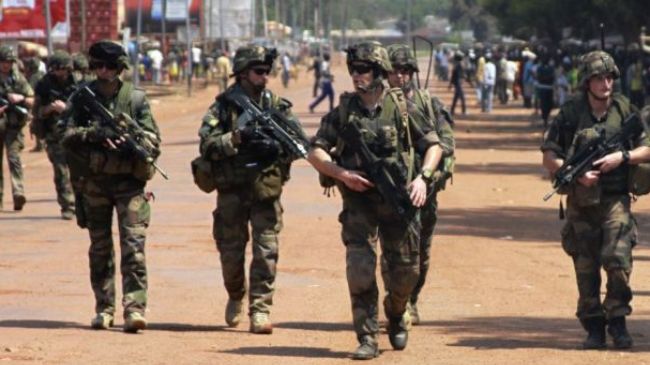
The French finally got what they wanted in the restive Central African Republic – regime change.
Interim President Michel Djotodia and his Prime Minister Nicolas Tiengaye have resigned and the former French colony is now set to form a new government under the watchful eye of Paris.
Western media portray French conduct in the Central African Republic (CAR) as a benevolent force. “We are there to save lives,” said French President Francois Hollande recently.
This is like lauding a fox in a hen house. The reality is that violence and suffering have largely stemmed as a direct result of illegal French interference in that African country.
What’s more, we also can say that the violence has been deliberately provoked by the French as a cover for their real objective – regime change.
Djotodia was forced to step down after he was politically ambushed by other Francophile African leaders at a special conference convened at the end of the week in neighboring Chad.
Before the summit, French diplomats had been briefing the media and other African states that Djotodia “had to go”. The French tried to cover their tracks by saying “we are not here to give our thumbs up or down” but that is exactly what they were doing – giving the thumbs down.
French President Francois Hollande and his Foreign Minister Laurent Fabius have been carping about the CAR leader for weeks and undermining his authority. Obviously, the French wanted rid of Djotodia and his administration – and now they have gotten their illicit way. Lest we forget such interference in the sovereign affairs of another state is illegal.
Notably, just before the conference opened on Thursday in Chad, Djotodia rejected rumors of his impending resignation. In less than 24 hours, he then quit, evidently under duress.
Within minutes of Djotodia’s sacking on Friday, and even before he had returned from Chad, French military tanks had surrounded the presidential palace in the CAR capital Bangui. French Defence Minister Jean-Yves Le Drian also issued a call for Djotodia to be “replaced as soon as possible”.
Chadian President Idriss Déby had been one of the most vocal African leaders calling for Djotodia to quit. Déby, who is described as “a strong French ally” (in other words, “puppet”), was doing France’s bidding and giving an African voice to a directive from Paris, a directive which amounts to a coup d’état.
The Western media narrative, led by France, is that Djotodia “had not done enough to curb the violence” gripping the CAR. More than 1,000 people have been killed in recent weeks in sectarian clashes between Muslims and Christians. Roughly a quarter of the country’s five million population have been displaced in the fighting.
Djotodia came to power last year after Muslim rebels known as Seleka deposed the Christian president Francois Bozizé in March. Bozizé was notorious for corruption and had come to power through a French-backed military coup 11 years ago.
With major French commercial interests in the resource-rich country, in particular uranium mining, it seems that France was vexed about the new transitional government led by Michel Djotodia – the first Muslim leader of the mainly Christian country.
Djotodia’s interim administration was legally constituted last April and it was overseeing a transition with elections scheduled at the end of this year.
However, that did not seem good enough to allay the French, who wanted to exert tighter control over the political process within the CAR in order to secure favorable conditions for its commercial interests.
This is the real basis for the French military invasion, not the humanitarian pretext that the Hollande government has been trumpeting.
Last month, chaos and violence in the African country surged after France sent in its troops – allegedly to provide “humanitarian protection” in a situation where there had been no serious violence, apart from French government scaremongering of “imminent genocide”.
French military were dispatched to the CAR on December 2, three days before a French-drafted resolution was passed at the United Nations Security Council authorizing the intervention.
More French troops arrived on December 5, 2013, and only since then have the sectarian clashes in Bangui city and across the country escalated.
The conclusion is inescapable. The humanitarian crisis in the CAR was precipitated by French involvement, not prevented. A major factor for the violence is that the French military moved to unilaterally disarm the Seleka rebels while ignoring Christian vigilante groups known as Anti-Balaka.
The latter were, in effect, given a free hand to maraud Muslim communities and businesses with deadly consequences.
It is therefore obtuse and mendacious for the French government and its African clients to blame Michel Djotodia for not controlling security in his country.
The real culprit for the bloodshed and pandemonium that jolted the CAR is French interference in that country– interference that was illegal and was cynically disguised as “humanitarian.”
There are deep fears that violence against Muslim communities will increase further now that Michel Djotodia has been forced from office.
The Christian Anti-Balaka militias will feel emboldened by the French political interference. Many believe that the Anti-Balaka is being orchestrated by the former French puppet Bozizé from his exile in France.
Tragically, this is just the latest episode of misery for the Central African Republic caused by French neo-imperialist predation.
Since gaining so-called independence from France in 1960, the French have launched more covert coups and countercoups in that country than in any other former African colony.
The CAR remains politically and economically underdeveloped – despite its teeming natural wealth – precisely because of systematic French predatory exploitation.
Poverty in the Central African Republic, as in many other African countries, is a direct result of French policy, primarily due to the “franc afrique” monetary system set up at the time of independence.
This systematic poverty enables France to exploit raw materials and the people mercilessly. And when the racket comes a bit unstuck, the French send in their troops to “restore order”.
What the international community, such as the Non-Aligned Movement of over 100 nations, should be doing is to call for the prosecution of France, not applauding this fox in a hen house.
France-UAE satellite deal shaky after US spy tech discovered onboard – report
RT | January 6, 2014
The sale of two intelligence satellites to the UAE by France for nearly a billion dollars could go south after they were found to contain American technology designed to intercept data transmitted to the ground station.
The equipment, costing 3.4 billion dirhams ($930 million), constitutes two high-resolution Pleiades-type Falcon Eye military intelligence satellites, which a top UAE defense source has said contain specific US-made components designed to intercept the satellites’ communications with their accompanying ground station, Defensenews.com said in a report.
“The discovery [of the US-made components] was reported to the deputy supreme commander [Sheikh Mohamm ed Bin Zayed] in September,” an unnamed defense source said. “We have requested the French to change these components and also consulted with the Russian and Chinese firms.”
“If this issue is not resolved, the UAE is willing to scrap the whole deal,” said the source, adding that the incident has seen an increase in talks with Moscow, which – along with Beijing – has also been a frequent defense tech supplier to the Gulf state.
However, it is not clear whether the US equipment can be taken off of the French satellites.
The satellites come courtesy of prime contractor Airbus Defence and Space and payload manufacturer Thales Alenia, neither of whom could be reached for comment.
The system, comprised of satellites and a ground station, will require 20 trained engineers to operate. Under the July 22 deal, signed by Sheikh Mohammed, Crown Prince of Dubai and deputy supreme commander of the armed forces, and French Defense Minister Jean-Yves Le Drian, delivery of the satellites and the ground station was to be made sometime in 2018.
A total of 11 international bidders were competing in the Flacon Eye race for more than a decade to ship their technologies to the UAE, which in late 2012 announced that they had chosen to go with the French and the Americans.
According to the source, the French won because of the filters which their rival Americans imposed on the use of the equipment – a policy dubbed “shutter control.” The US government restricts sale of commercial high resolution satellite images from spacecraft it licenses, if they are deemed a threat to its national security.
One French defense specialist found it surprising that France had had US spy technology on board its equipment, especially when France’s use of the Pleiades surveillance system is considered to be of critical importance to its national security.
According to Defensenews, UAE threats to call off the deal are seen by some commentators as a way to secure a better bargain from the French, because “the satellites would be part of a big package deal… it’s not surprising the UAE drives a hard bargain. They’re using it as a layer of power.”
The unnamed defense specialist referred to the possibility that the Emirates may wish to drive the price down for other equipment, such as the Dessault Aviation Rafale fighter jet.
French public support for intervention in the Central African Republic waning
Press TV – January 4, 2014
A new survey shows that France is rapidly losing public support for its military intervention in the Central African Republic (CAR), nearly one month after Paris deployed troops to the country.
A recent poll by the French Institute of Public Opinion (IFOP) showed on Saturday that only 41 percent of the respondents are in favor of France’s military operation in the CAR, down by 10 percent compared to a previous poll conducted right after France’s military intervention.
Some 1,000 people were questioned in the latest IFOP survey, which was conducted from December 27 to January 2.
France invaded its former colony on December 5, 2013, after the UN Security Council unanimously adopted a resolution giving Paris and the African Union the go-ahead to send troops to the CAR. Paris has 1,600 troops in the violence-stricken country.
The deployment of the French and African Union peacekeepers has done little to end the ongoing violence between ethnic communities in the CAR.
The Central African Republic spiraled into chaos in March last year when Seleka fighters overthrew President Francois Bozize and brought Michel Djotodia to power. Bozize fled the country after his ouster.
The mission in the CAR is France’s second military intervention in Africa in 2013. In January, Paris dispatched more than 4,000 troops to Mali, launching a fierce war against the militants in the country.
Nuclear Rights and the P5+1 Talks with Iran
By Flynt Leverett and Hillary Mann Leverett | Going to Tehran | November 22, 2013
Yesterday, while taping a discussion of the latest round of P5+1 nuclear talks with Iran on Russia Today’s CrossTalk that was broadcast today (see here or, on You Tube, here), Flynt said, “I hope I’m wrong, but I’m not particularly optimistic about a deal being reached this week. I don’t think that there’s been a lot of progress on the issues that kept agreement from being reached the last time the parties convened in Geneva:
–There’s the issue of Iran’s nuclear rights, and how they get acknowledged or not acknowledged in an interim agreement.
–There is disagreement about how to handle, during an interim deal, this heavy water reactor facility at Arak which the Iranians are building.
–There are still disagreements about the disposition of Iran’s stockpile of near-20 percent enriched uranium.
I don’t really see much sign that either the United States or the French are backing down from some of the positions they took on those issues ten days ago—and if there’s not some give on that, I don’t know how the Iranians will be in a position to accept the P5+1 proposal.”
On the positions that the United States and France took on these issues in the November 7-9 Geneva talks, Flynt recounts,
“Going into the last round at Geneva, I think the Iranians anticipated getting a draft from the P5+1 where they had clearly worked out understandings about how some of these contentious issues—about Arak, about the 20 percent stockpile, about some acknowledgement of Iran’s nuclear rights; the Iranians had expectations from their previous discussions about the kind of proposal they were going to see. And, basically, the United States and France reneged on those understandings. And so the draft proposal that went in front of Iran was different from what Foreign Minister Zarif and his team were expecting to see, and they weren’t in a position to accept that.
Unless the P5+1—in particular, the United States and France—are willing to stick to understandings that the Iranians thought they had reached, at least verbally, on some of these issues, I don’t think that the Iranians are going to feel, either in terms of substance or in terms of the atmosphere of trust, they’re not going to feel comfortable with going ahead with an agreement.”
Currently, the most fundamental sticking point in Geneva is—as we have long anticipated—the Obama administration’s refusal to recognize Iran’s clear legal right to enrich uranium under safeguards and to acknowledge that the Islamic Republic will have to be treated like any other NPT party. As we’ve written before, see here, Iran and all other states have a sovereign right to pursue indigenous fuel cycle capabilities—a right recognized in Article IV of the Nuclear Non-Proliferation Treaty (NPT) as an “inalienable right,” which non-nuclear-weapon states pledge to exercise in line with Article II (where non-weapons states commit not to build or obtain nuclear weapons) and Article III (where states commit to conducting their nuclear activities under safeguards to be negotiated with the International Atomic Energy Agency).
As Flynt explains, the Obama administration—like the George W. Bush administration before it—resists recognizing this legal reality:
“There are basically four countries in the world that try to deny that the NPT recognizes the right of a non-nuclear weapon state like Iran to enrich uranium under safeguards. Those four countries are the United States, France, the United Kingdom, and Israel, which isn’t even a signatory to the NPT. Those are the only four countries that take this position. The rest of the world—the BRICS, the Non-Aligned Movement, key U.S. allies like Germany and Japan—have held consistently that the Treaty recognizes a right to enrich. And what is so perverse is that…when the U.S. and the Soviet Union first opened the NPT for signature in 1968, senior U.S. officials testified to Congress that the NPT recognized a right to safeguarded enrichment. That was the position of the United States until the end of the Cold War—and then we decided to try to unilaterally rewrite the Treaty because we didn’t want non-Western countries getting fuel cycle capabilities.”
We’ll see if the Obama administration can do any better this weekend.
Related articles
Lavrov: Last-Minute Changes Ruined Nuclear Deal
Al-Manar | November 15, 2013
Russian Foreign Minister Sergei Lavrov said amendments made by a member of the six world powers to a US-proposed draft proposal during the recent Iran nuclear talks in the Swiss city of Geneva spoiled efforts to reach a deal.
Lavrov, who is on a visit to Egypt, said on Thursday that Iran and six world powers were close to reaching an agreement on a deal during their talks in Geneva, but last-minute amendments to the draft document blocked a deal, AP reported.
He expressed hope that representatives of the six countries will not abandon “agreements that already have been shaped” and strike a pact with Iran during next week’s talks.
A member of the Iranian delegation in nuclear talks with six world powers says Tehran did not block an agreement in last week’s negotiations in Geneva.
“The Islamic Republic of Iran did not prevent a final deal in Geneva,” Iran’s Deputy Foreign Minister for European and American Affairs Majid Takht-e Ravanchi said Friday. “We do not want to go into the details of the issues…, but it is clear who ultimately blocked a final agreement,” he added.
On November 7, Iran and the six world powers – the US, France, Britain, Russia, China and Germany – kicked off intense discussions in Geneva which stretched into a third day. The two sides did not reach an agreement, but stressed that significant progress had been made and expressed optimism about the prospect of a possible deal in the future.
French Foreign Minister Laurent Fabius said in a November 9 interview that “Israel’s concerns” must be taken into consideration in the course of the negotiations, adding that there is “no certainty” whether Iran and six powers will reach an agreement at the current stage.
Featured Video

WARNING: Delete TikTok Immediately!
or go to
Aletho News Archives – Video-Images
Book Review
In 2014, Michael Parenti Wrote A Prophetic Article About Ukraine
The Dissident | January 28, 2026
This week, the influential left-wing scholar Michael Parenti passed away at the age of 92.
Parenti was well known for his sharp criticism of U.S. foreign policy and U.S. imperialism throughout his life, waking up many to the reality of it and the lies used to justify it.
This is best underscored in one of his last published articles, “Ukraine and Regime Change”, which was published in the book “Flashpoint In Ukraine: How the U.S. Drive for Hegemony Risks World War III”, where he predicted to a tee what the result of the 2014 U.S. backed coup in Ukraine would be. … continue
Blog Roll
Recent Comments
eddieb on Conspiracy Denial eddieb on WEF Calls for ‘Cultural Revolu… loongtip on Trump wanted to play peacemake… Coronistan on EU member to sue bloc over ‘su… loongtip on Vicious loongtip on EU turns to India for defense… Coronistan on Donald Trump Is No Peace … seversonebcfb985d9 on French court jails pro-Palesti… eddieb on Fourteen Incredible Facts Abou… Bill Francis on European leaders’ shift in the… seversonebcfb985d9 on Villains of Judea: Philip Esfo… loongtip on Report warns that ‘Jewish terr…


 Aletho News
- Switzerland plans tax hike to revamp military
- In One Of His Final Pieces, Written in 2014, Michael Parenti Wrote A Prophetic Article About Ukraine
- More Bombs, More Talks Zelensky Rejects Trump’s Plan
- WARNING: Delete TikTok Immediately!
- Bari Weiss’ New CBS Hire List Is Full Of Zionists
- As TikTok falls into Zionist hands, UpScrolled fills the vacuum to give voice to Palestine
- Former Biden Advisor, Amos Hochstein, Admits The Biden Administration Is Responsible For the Gaza Genocide
- Not a Trump anomaly: The Board of Peace and America’s crisis-driven power plays
- Manufacturing martyrdom: The west’s cynical use of Iranian protest figures
- Attack on Iran would backfire, causing great losses for US, warns European think-tank
- If Americans Knew
- “Hey ChatGPT, is Israel building a concentration camp?” (spoiler: yes) – Not a ceasefire Day 111
- “The Gaza ceasefire is a minefield” – Not a ceasefire Day 110
- Israel to seek new security deal from US, official says
- Leaked “Board of Peace” Resolution Outlines U.S.-Led Plan to Rule Over Gaza
- Jonathan Greenblatt Rolls Out Plan to Activate Hispanic Evangelical Golems
- Violence against hundreds of Gazan remains to find one Israeli – Not a ceasefire Day 109
- Greenpeace Demonstrator Exposes Folly of Protest Restrictions
- From CBS to TikTok, Pro-Israel Ellison is now in the driver’s seat
- Israel pays for UK advertisements attacking Doctors Without Borders
- Israel accused of extracting billions from Gazan people to pay for their own genocide
- No Tricks Zone
- New Study Affirms Rising CO2’s Greening Impact Across India – A Region With No Net Warming In 75 Years
- Germany’s Natural Gas Crisis Escalates … One Storage Site Near Empty …Government Silent
- Polar Colding…Antarctica Saw Its Coldest October In 44 Years!
- New Study: Sea Levels Rose 20 Times The Modern Rate During The Roman Warm Period
- As German Gas Storage Dips Dangerously Low…Shortage Hardly Avoidable
- New Study: Brazil’s Relative Sea Level Was 2+ Meters Higher And SSTs 3-4°C Warmer 6000 Years Ago
- Philosopher Schopenhauer: Climate Science Certainty Stems From Stupidity, Ignorance
- New Study: Species Extinction Rates Declining Since 1980 – ‘Climate Change Is Not An Important Threat’
- Denmark Places Climate Protection Above Animal Welfare, Poisoning And Culling Cows
- New Study: Greenland Was 3-7°C Warmer And Far Less Glaciated Than Today 6000-8000 Years Ago
 Aletho News