Is the West at war with disinformation or dissent?
By Rachel Marsden | Samizdat | May 5, 2022
When US President Joe Biden announced on April 27 that a new Disinformation Governance Board would serve the Department of Homeland Security, it was just the latest turn of the screw on freedom. This time, it’s an affront to citizens’ right to a diversity of information.
It’s one thing to correct inaccurate information, but this new entity seems more oriented towards narrative-policing that cracks down on the interpretation of information rather than the accuracy of it. Headed by a former communications advisor to the Ukrainian Foreign Ministry, Nina Jankowicz, one of the board’s first responsibilities will be to address “disinformation coming from Russia as well as misleading messages about the US-Mexico border,” according to CBS News. Interesting that these two issues – immigration and foreign conflicts – are currently viewed as two of Washington’s most significant failures, which have given rise to populist dissent. Make no mistake, it’s the dissent that’s the ultimate target.
The fact that a former Ukraine government spin doctor was viewed as the best person to head up the new initiative tells you everything you need to know about its true purpose. Jankowicz published a book in 2020 whose title suggests that she believes the West to be in an online war with Russia. ‘How to Lose the Information War: Russia, Fake News, and the Future of Conflict,’ portrays Western narratives as truthful and Russian narratives as “fake news.” Doing so obscures the fact that the mainstream Western media has not been immune to propagating narratives peddled by the state that could retroactively be considered fake news or war propaganda. Meanwhile, Russian media has often provided a platform for those seeking to express – or access – dissenting analysis or information that falls outside of the Western media bubble. Clearly, there are some ‘democracies’ that are bothered by this.
The appetite of Western nations to ensure that their citizens are only fed information that they control through their own highly concentrated government or corporate subsidized media isn’t new. It’s just getting more voracious. Perhaps it’s because the more authoritarian their agenda becomes, the more populist sentiment increases and gives rise to events such as Brexit or the election of Donald Trump, as well as trends such as opposition to US-backed conflicts, the rise in popularity of various populist political parties in Europe, and demonstrations against pandemic mandates, which just happen to be associated with government-issued QR codes.
Dissent is the enemy of authoritarian ambition. Supposedly free countries have manipulated their citizens into believing that censorship of certain views is for people’s own safety and security – hence why the military in Canada, the UK, and France, and now Homeland Security in the US, are involved in narrative policing. In reality, their efforts seem to be more about ensuring citizens’ compliance with their own agenda.
The fusion of domestic security and disinformation came to light as early as 2016, when the European Parliament grotesquely conflated Islamic terrorist propaganda with Russian media, in what seemed to be itself a propaganda effort to undermine the Russian media by equating these two totally unrelated things. But one by one, Western governments have placed free speech under national security control.
France, for example, handed off responsibility for online information arbitration to its domestic intelligence agency (the DGSI) and has reportedly considered involving defense-funded startups in the effort.
Canada has also turned to its security apparatus to shape Canadians’ information landscape – at least twice. The Communications Security Establishment, the country’s electronic spying agency, has been tweeting its own interpretations of disputed events occurring in the fog of the conflict in Ukraine as indisputable fact, while routinely denouncing Russia’s interpretation as invalid.
But Canada’s security establishment isn’t at its first rodeo in attempting to prevent citizens’ thinking from deviating from the state’s messaging. Under Prime Minister Justin Trudeau, the country’s armed forces deployed a months-long, military-grade propaganda campaign, which employed tactics honed during the war in Afghanistan, to mind-bend unsuspecting Canadians towards Trudeau’s Covid narrative, CBC News reported last year.
Not to be outdone, the psychological warfare specialists of the 77th brigade of Britain’s armed forces have also worked to shape messaging both in favor of the government’s Covid policies and against anything contrary out of Russia. “One current priority is combating the spread of harmful, false and misleading narratives through disinformation. To bolster this effort, the British Army will be deploying two experts in countering disinformation. They will advise and support NATO in ensuring its citizens have the right information to protect themselves and its democracies are protected from malicious disinformation operations used by adversaries,” Defense Secretary Ben Wallace said last year.
The fact that public safety and disinformation have suddenly become routinely conflated should be worrisome to defenders of whatever remnants of democracy that we still have left. Terrorism, health and now disinformation have all served as pretexts for the rapid erosion of our freedoms – all under the guise of protecting us from bad actors. But are we really safer? Or are we just increasingly less free?
DON’T VOTE “#GREATRESET”
By Olly Connelly | Daily Chaos | May 5, 2022
It’s local election day in the UK and, as you’ll be aware, elections are underway also in France and in the US.
Local, constituency or national level, if you vote for someone who is not talking about defeating the #GreatReset, then you are voting for Klaus Schwab, you are voting “to own nothing”, for communism directed by fascists, you are voting for tyranny, for censorship, for more fake pandemics and more fraudulent war, you are voting for divide-rule on an epic scale that is destroying families, communities and societies from within despite the farcical topics such as “how to define a woman” for crying out loud, you are voting for the normalisation of Satanism and paedophilia as can increasingly be seen in Biden’s America, you are voting for genocidal war criminals like Tony Blair to never be brought to account while being BBC-platformed to lecture you on using experimental drugs on your innocent children, you are voting to condone yet more phony elections, for Martial law in Western societies as we saw in Ottawa, for the hundreds of thousands in death toll in places like Yemen while the globalists distract with Ukraine, you are voting for CCP-style oppression and their model social credit score to keep you in check, you are voting for the last of our liberty ie an end to cash, for Google’s bloodstream nanobots and Musk’s brain chip, for Gates’ quaxxines and the final cull of the Mama-Papas defeated by the Bezos drones.
DON’T VOTE FOR SLAVERY.
Don’t vote for the Great Reset. DON’T VOTE FOR ANYONE WHO IS NOT ACTIVELY WARNING AGAINST THE GREAT RESET, THEY ARE A FRAUD, A DECEIT…
… At this stage in the game, I tell you, ANYONE in politics or journalism who is not warning of the dangers of the Great Reset is somewhere between fraudulent and downright evil.
If in doubt, if in any doubt, do not vote. In most cases this is almost certainly the best option, to help de-power the them-us elitism, to deny a mandate and to create a window to be able to say, “WE DID NOT ELECT YOU.”
We should have seen, by now, the vile outcome by supporting cheats and liars. We should have seen that voting for the lesser of the evils DOES NOT HELP. Do not make things worse by voting yet again for PROVEN cheats and liars.
Do not mindlessly vote. And yes, at this stage in the game where practically everyone on the global stage is either bought or blackmailed, A VOTE “NOT TO VOTE”, an abstention from the Big Lie, is in no way dishonourable. A vote for more of what we have in power now, on the other hand, is downright moronic.
Here’s to us, and bugger plutocracy!
US wants EU to sanction China for its Ukraine-Russia policy
By Paul Antonopoulos | April 27, 2022
Washington is trying to convince Europe that it has the ability to influence China’s relationship with Russia. However, Beijing’s stance on Ukraine and associated threats from the West are unlikely to deter it from deepening cooperation with Moscow.
US Deputy Secretary of State Wendy Sherman visited Brussels from April 19 to 22 and forced the Europeans to listen to Washington’s arguments about the possibility of imposing sanctions on China if it provided material support for Russia’s military campaign in Ukraine. At an event organised by the US and EU-funded “Friends of Europe” group, Sherman again warned that China would face sanctions similar to those being imposed on Russia.
After Sherman’s meeting with Bjoern Seibert, Chief of Staff for European Commission President Ursula von der Leyen, the State Department said the two sides agreed that they must urge China not to circumvent sanctions against Moscow or offer any support for Russia’s special operation in Ukraine.
Effectively, the US is instructing Europeans on the policies they must adopt to counter Russia’s action in Ukraine, making a mockery of the efforts by French President Emmanuel Macron to create a “strategically autonomous” Europe. Macron’s emboldened announcement of Europe’s “strategic autonomy” from the US was exposed as being nothing more than a buzzword with the outbreak of the war in Ukraine as Paris immediately abandoned all efforts of diplomacy after ignoring Moscow’s years-long complaints regarding Ukraine’s illegal and provocative actions in Donbass. This is on top of imposing sanctions that negatively affect the average European citizen.
For all this talk of “strategic autonomy”, Brussels has just once again demonstrated that it is obedient and submissive to Washington. However, despite the EU imposing sanctions, closing its airspace to Russian planes and delivering weapons to Ukraine, the US is clearly not satisfied and sent Sherman to Brussels to ensure that tougher policies against China are also implemented.
The US at the very minimum hopes to divide European countries as many are still unwilling to provoke China due to trade relations. In the context of the US ignoring all international communication norms and continuing its threats of sanctions against China, Beijing unlikely views this as just renewed verbal attacks.
China is using various channels to convey to its European partners its views on the crisis in Ukraine, as well as on efforts to help the conflicting parties resolve the war peacefully. It is recalled that Beijing sent a diplomatic mission led by Huo Yuzhen, China’s special representative for the China-Central and Eastern Europe Investment Cooperation Fund (CEEC). On April 25, the delegation began its European tour in the Czech Republic, with visits to Hungary, Lithuania, Poland, Slovakia, Slovenia, Croatia and Estonia also included.
The visit to the Czech Republic is significant since the country will hold the Presidency of the Council of the European Union from July 1 to December 31. In this way, perhaps the comments by Czech Deputy Foreign Minister Martin Tlapa were too hasty when he made de facto statements on behalf of EU members. At a meeting with the Chinese delegation in Prague, he warned that China’s cooperation with Russia could damage its relations with the EU.
Clearly, the Czech diplomat’s desire to please and appease the US overshadowed his own obligation to follow rudimentary political submissions, or perhaps the EU has amended this principle like many other ethical and legal norms due to the crisis in Ukraine?
Although EU officials concede China is unlikely to enforce the broad sanctions imposed on Moscow by a minority of the world’s recognized UN member states, this has not deterred their efforts to lambast and shame countries for their position. Brussels falsely hoped that Beijing could influence Moscow to stop its demilitarization of Ukraine, but hopes were quickly dispelled at an EU-China virtual summit on April 1 that left Western leaders frustrated and angry that they are international pariahs on the Ukraine issue.
A joint EU-US statement following Sherman’s talks in Brussels vowed to push Chinese leaders on issues such as the inadmissibility of sanctions circumvention, and “reaffirmed that such support would have consequences for our respective relationships with China”.
However, Sherman and EU foreign service chief Stefano Sannino avoided answering a journalist’s question on what potential repercussions could be for China. This suggests that the West actually does not have a clear idea on how and why they could punish China for its relationship with Russia and instead it hopes that threats of sanctions could deter their cooperation.
This of course is extremely naïve as sanctions have never made state leaderships of Middle Powers, like North Korea and Iran, collapse or capitulate. Given this fact, there is little prospect that sanctions will achieve the West’s hopes against Great Powers like Russia and China, especially as only just days before the US-EU forum, Chinese vice foreign minister Le Yucheng assured Russian ambassador Andrey Denisov of Beijing’s aim to “deepen bilateral comprehensive strategic coordination”.
Paul Antonopoulos is an independent geopolitical analyst.
Political West mulls reshaping UN and what’s left of international law
By Drago Bosnic | April 27, 2022
In order to understand the prelude to World War 2, one cannot ignore the failures of the long-defunct League of Nations, which was a UN-like structure aimed at being a forum of countries resolving disputes through dialogue rather than war. Although just another noble idea before World War 1, in the immediate aftermath of the sheer death and destruction resulting from that conflict, it became an urgent necessity. The League of Nations was supposed to make sure nothing of sorts ever happened again.
Sadly, as we all know, it failed miserably, with an even worse conflict erupting less than 20 years after the Paris Peace Conference was completed. Now, nearly 80 years since the horrors of WW2, we have reached a hauntingly similar point as we realize the UN didn’t just inherit the League of Nations flag, but also many of the same faults which ultimately led the world into yet another disaster of global proportions, one which resonates to this very day.
The United Nations Security Council (UNSC) is the pillar of the UN and its veto power mechanism serves as a balancing tool which takes into account the interests of world powers and thus provides the UN with relevance which no other international organization or forum of sovereign nations in known history ever had. Currently, the five permanent members of UNSC (China, France, Russia, the UK and the US) can veto any resolution put forth by the body. The council’s other 10 rotating members do not have such powers.
This veto power has especially been a source of frustration for the United States, NATO and the EU. Due to their dominance in the UN General Assembly (UNGA), where there is a swarm of Western client states and statelets, many of which were created through deliberate and oftentimes forceful disintegration of larger and more sovereign nations (for instance, Yugoslavia was split into 6 states and one illegal state-like entity), the political West wants this UN body to be more prominent than the UN Security Council.
By pushing the UN General Assembly to the forefront of decision making, the West could then simply force these countless vassal states and statelets to vote in a way which would be beneficial to the US, EU or NATO and give these decisions a sort of “international community” touch which the political West needs in order to build what they see as a much-needed facade of “international legitimacy”.
Because of this, Western political elites and the mainstream media often try to portray the UNGA as a “more democratic” body than the UNSC. How truly democratic is up for debate, given the sheer amount of US pressure and arm-twisting used to coerce countries into voting not just in line with Western interests, but oftentimes at the expense of their own. And in terms of population distribution, we see that these states and statelets, despite oftentimes being the majority or close to a majority in the UNGA, actually represent less than 20 or even 15 percent of the world’s population. This also explains the Western obsession with forceful fragmentation of larger nations into smaller ones, echoing the ancient Roman policy of divide et impera.
To meet this goal, the UNGA is now considering introducing a provision that would require permanent members of the UN Security Council to justify their use of veto powers. It was tabled by Liechtenstein in mid-April and presented at a closed-door discussion panel last Tuesday. The discussion supposedly “turned out to be quite positive” and the initiative “received additional co-sponsors”, the mission of the microstate to the UN said after the meeting.
“We had a strong turnout and positive engagement on the Veto Initiative in open format this afternoon. We will continue our work to get the strongest possible political support for our text which now has 57 cosponsors,” it stated.
If adopted, the initiative would mandate convening the UNGA within 10 days after a permanent member of the UNSC uses their veto power. At the meeting, the state would have to justify its decision to use the veto. According to Liechtenstein, adopting the provision would “empower the General Assembly and strengthen multilateralism.”
Quite unsurprisingly, so far, the initiative has been openly supported only by one permanent member of the UNSC – the United States. Washington co-sponsored the provision, openly acknowledging the drive is aimed at Moscow and its use of the veto power to block a resolution on the ongoing Russian special military operation in Ukraine. Announcing the co-sponsorship, the US envoy to the UN Linda Thomas-Greenfield accused Moscow of “misusing” its veto powers.
“We are particularly concerned by Russia’s shameful pattern of abusing its veto privilege over the past two decades,” she stated, adding that, in the latest alleged abuse, Moscow had used the veto power to “protect President Putin from condemnation over his unprovoked and unjust war of choice against Ukraine.”
Of course, it would require an entirely separate analysis to dissect US envoy’s statements, which are filled with “liberal interpretation” of facts. But the statement does confirm the assertion that the political West, and the US in particular, are trying to reshape the UN to their liking, which would result in sidelining US competitors. In doing so, the US might be successful in turning the UN into another footnote of its belligerent foreign policy and even use it to justify sanctions and wars of aggression anywhere in the world.
However, even though this may seem like a victory to the aggressive planners in Washington DC, it may spell a disaster for world peace. By sidelining countries like Russia, China or even India, Brazil, South Africa and many others in the foreseeable future, the US is incentivizing these countries to ignore or even leave the UN, which would bring about the de facto end of international law.
At best, it would result in the creation of another UN-style organization led by those same sidelined countries, bringing about a deeply divided world where there would be at least two blocks – the political West (plus its vassals) and the rest of the world composed of sovereign nations. The last time such a division happened, the world suffered up to 80,000,000 dead in just 6 years.
Drago Bosnic is an independent geopolitical and military analyst.
Has Le Pen paved the way for more Macron?
By Richard Ings | TCW Defending Freedom | April 23, 2022
TOMORROW the French go to the polls to finish the job begun two weeks ago and choose their next elected monarch; if opinion polls can be trusted (with their manipulative influence on voting having become a major discussion point in France over the last few weeks) it looks as if Emmanuel Macron will be returned to the throne for another five years.
If Marine Le Pen, who has never been closer to power, falls at the final fence, she will not be blameless in her failure to take advantage of the seething resentment against the present incumbent. In the traditional head-to-head television debate four days before polls open, with the chance to voice the anger felt towards Macron by her potential supporters, she chose the route of trying to out-technocrat the technocrat. The result was that the smirking, supercilious bean-counter was invited to play on his home turf, within minutes deflecting the discussion away from his record in power to Le Pen’s record in opposition. The opportunity for a reckoning on Macron’s use of state forces against his own people, his enthusiastic embrace of digital IDs to coerce people into taking a novel medical intervention and his contempt for health workers who declined it, was squandered. At the end of the confrontation, he praised the fact that it had been much more ‘controlled’ than their previous meeting in 2017. It was clear to most who had been in control throughout.
Le Pen clearly also has only herself to blame for her political programme. Having once supported lockdowns and the huge accumulation of debt associated with them, she is largely joined at the hip with Macron in her plan to borrow and spend France’s way out of a problem caused by astronomical government borrowing and spending. Her flagship policy of reducing VAT on 100 ‘essential products’ is no match for Macron’s policy of continuing to send people cheques to bail them out, both a pitiful response to the enormous economic problems his decisions have created. Meanwhile, her desire to ban the wearing of the Muslim headscarf in public spaces as a puny symbol of the fight against Islamism essentially codifies the state’s right to decide what you are permitted to wear in public (indeed, Le Pen defended its enforceability in law by pointing out that Macron had found a way of policing his mask mandates).
Her own shortcomings aside, however, Le Pen is handicapped by the fact that, although she mobilised more than 8million people to vote for her, no one is allowed to say publicly that they support her without choosing the path of ostracism. In Britain by 2019 we had become painfully aware of the phenomenon of the ‘shy Brexiteer’, unable to ‘come out’ among friends and family without attracting a torrent of insults which often included the word ‘Nazi’. That’s been the norm in France for Le Pen voters for a long, long time.
However, something not widely reported happened ten days ago when a panellist on a major television show, former Miss France Delphine Wespiser, ‘came out’ in front of millions and said she understood why people might vote for Marine, suggesting she was like ‘France’s mum’. Did she realise what a pile-on would happen in saying that? She got a taste from her colleagues in the studio, but over the next few days found herself threatened on social media for daring to ‘contribute to the normalisation of the far Right’.
Removed from the show under byzantine French rules to do with ‘political balance’, she had to come back as an unpaid guest to report how her accidentally courageous opinion had seen her receive thousands of threats, as well as the call for her to be stripped of other sources of income, such as her featured role on the TV show Fort Boyard. Not being able to make a living for having expressed a view deemed unacceptable by the media (and not even an unpopular view) was, she said, ‘the price of my freedom’, adding defiantly: ‘I’m the spokeswoman for all those unhappy about what has happened over the last five years.’
Wespiser’s small, principled stand for freedom of speech and conscience is a marker of a very positive development. Dissenters are beginning to abandon their natural reticence and defend the right to have a different ‘non-mainstream’ point of view in the public square. The form that seems to be taking at the moment is voting for Marine Le Pen. Whatever her political shortcomings, Le Pen represents the dissident point of view. Crudely expressed, she is the biggest middle finger French people can currently give to the system which has crushed and oppressed many of them over the last few years.
And if not Le Pen, who? Macron has not ruled out a return to mandatory masking, and vaccine passports remain in place for access to hospitals. Le Pen has said she will scrap the system, has called vaccinating children against Covid ‘a kind of child abuse’, and will reinstate the health-workers ‘kicked out like scum’ for refusing to take the vaccine. Macron set up an undemocratic ‘citizens’ convention’ on the environment (only to ignore it) while touring the country in what he called his ‘great debate’ during which he lectured an invited audience for several hours. He’s committed to continuing to bore on if re-elected. Le Pen, on the other hand, has proposed a ‘Citizen’s choice referendum’ which, while it may struggle to get passed into law, holds out the promise of a new avenue for political change.
Take her at face value or not, Le Pen has put the word ‘freedom’ front and centre of her campaign. She is making commitments that will, in however limited a way, expand the power of ordinary people to influence what happens in their country. This promise to extend and defend liberty and democracy would be hard to break in circumstances where (unlike Boris Johnson and his smug party-loyal 80-seat majority) she would have to work hard to maintain the trust of those who lent her their vote.
Moreover, the prospect of her coming to power has so spooked the European establishment that they have taken the unprecedented step of calling for the French not to vote for her in what used to be called ‘interference in national elections’ but is now, it seems, just seen as doing the morally correct thing.
With all this in mind, the French now need to consider how much of a defiant middle finger they are brave enough to give to the established order when even today’s poster-boy of ‘democracy’ Volodymyr Zelensky says he is rooting for Macron. Will they stand up to conventional opinion and take the kind of risk Delphine Wespiser, or a nation of Brexiteers, were willing to take? The door to more freedom is definitely ajar. Dare they step through it?
EU Exhumes 18 Year Old Embezzlement Charges to Derail Le Pen Presidential Bid
By Paul Joseph Watson | Summit News | April 18, 2022
Presumably as part of a deliberate effort to derail her presidential chances, the European Union has exhumed 18-year-old embezzlement charges against Marine Le Pen.
“The EU’s anti-fraud body has accused French far-right leader Marine Le Pen and associates of embezzling around 600,000 euros during their time as MEPs,” reports AFP.
The National Rally leader is personally accused of embezzling “around 137,000 euros ($150,000) worth of public money from the Strasbourg parliament when she was an MEP between 2004 and 2017.”
Le Pen’s lawyer Rodolphe Bosselut dismissed the charges, adding that the “timing” of them was suspicious.
Noting that the report relates to “old facts more than ten years old,” Bosselut highlighted how Le Pen “has not been summoned by any French judicial authority” to answer the charges.
“I’m surprised by the timing of such a strong disclosure and the instrumentalisation,” said Bosselut.
The EU has chosen to resurrect the old claims just days before the final round of the French presidential election, in which Le Pen will face off against incumbent Emmanuel Macron.
Although still a long shot, recent polls had shown Le Pen closing the gap on Macron, causing consternation amongst globalist technocrats.
Given the context, the EU dragging up old charges is clearly an act of election interference intended to tarnish Le Pen before this weekend’s vote.
As we previously highlighted, after Hungary’s Viktor Orban won re-election in a landslide, the EU responded by slapping sanctions on the country as a form of punishment for the electorate exercising their democratic will.
US should pay France for loss of Russian gas – Le Pen
Samizdat | April 16, 2022
The US should compensate France for losses if the EU bans Russian energy carriers, French presidential candidate Marine Le Pen said in an interview with BFM TV.
“The Americans, who will sell us liquefied gas and get a solid profit from it, could transfer money to France as compensation for anti-Russia sanctions,” Le Pen said, noting that Washington is pressuring the EU to sanction Russian energy carriers. The bloc placed multiple sanctions on Russia after Moscow launched a military operation in neighboring Ukraine. The operation has been widely criticized by many Western nations, but perhaps none have been more outspoken than the US.
According to Le Pen, if Washington succeeds in stopping Russian gas imports to the EU, it will result in unbearably high fuel bills for the French. However, she believes that American fuel magnates care little about ordinary French people and their plight, and are only interested in business, eager to profit from the increase in LNG exports to the bloc.
While the European Union has placed numerous sanctions on Moscow over the past few weeks, member states have so far been unable to reach an agreement on banning Russian energy imports. Many EU countries are heavily dependent on Russian energy, while some have no alternative, being landlocked and therefore unable to receive liquefied gas from the US, for instance.
However, discussions on the issue will continue, High Representative of the European Union for Foreign Affairs and Security Policy Josep Borrell said on Monday.
Moscow currently supplies around 40% of the gas used by EU nations and around a third of their oil. Russian Deputy Prime Minister Alexander Novak recently estimated that it would take the EU 5-10 years to completely replace Russian oil and gas, noting that an embargo would inevitably result in record prices.
Le Pen promises to pull France out of NATO
By Uriel Araujo | April 15, 2022
NATO now has become one of the most important issue in Europe, with the new developments in Sweden and Finland, and electoral impacts in France. French Presidential candidate Marine Le Pen (who heads for the second round to be held on April 24) has vowed to pull France out of NATO’s military command. It would not be unprecedented, as the country did it in 1966. Le Pen claims the alliance structure “perpetuates the anachronistic and aggressive logic of the Cold War bloc”.
France was one of the Alliance’s founding members in 1949 and even hosted it for 15 years. This was a major event in French history. To help French ordinary citizens to accept the presence of foreign troops on their territory in times of peace, films like À votre service were shown in movie theaters, as part of a NATO PR campaign, so to speak. France’s relationship with the Anglo-Saxon structure (which is hegemonic within NATO), and with the alliance itself has always been complex, and Le Pen’s promise should be understood in this context and not necessarily as mere “extremism”.
In doing so, if elected, Le Pen would be in fact following the steps of general Charles de Gaulle (who ruled the country 1940-46 and 1958-1969). The conservative French leader wanted a truly independent nuclear France who would engage with Washington on more equal terms, becoming perhaps a kind of third force in the then Cold War’s bipolar world and even possibly reaching a détent with the USSR. The British-American “special relationship” was seen by him as detrimental to Europe.
Moreover, the US veto power regarding nuclear weapons also prevented Paris from pursuing its own atomic goals. Unable to place France in the tripartite directorate he proposed in his 1958 memorandum to US President Dwight Eisenhower and UK Prime Minister Harold Macmillan, de Gaulle refused to sign the 1963 agreement against nuclear testing – and, by 1969, France was already a fully fledged nuclear power. He also vetoed British entry into the European Union in the same year and, in 1964, told West Germany it should cease to follow a policy subordinated to Washington and adopt one for European independence (albeit not hostility). Of course, no NATO country followed his lead.
Isolated, France went on to withdraw from the Alliance’s so-called integrated military structure in 1966 (although not completely leaving the Treaty) and expelled all of its headquarters and units on French territory. It was President Nicolas Sarkozy who finally ended Paris “estrangement” from the organization in 2009 – so it took 43 years for Paris to change its course.
Even though Paris still hosted some NATO meetings and civilian structures, the spirit of Gaullism still shaped to some degree French strategic thinking during the Cold War, and the NATO-France relationship alternated between phases of rapprochement and tension. It was President Miterrand who started to bring France back into the Alliance’s integrated military command. And even so, it has been a kind of “flexible membership” (as it is often described).
Charles de Gaulle was one of the most important political leaders of the 20th century and even so, France remained relatively isolated in the European continent pertaining to its stance on NATO during the time of his leadership. He also faced several challenges, as the European countries acted in concert to try to neutralize many of his efforts. One cannot really tell whether Le Pen would be up to such a task, and estranging from NATO in any case is obviously not so simple, but the current situation on the other hand is also full of contradictions from a French and European perspective.
Meanwhile, on April 13 both Finland and Sweden took a major step towards joining NATO. In their joint press conference, the Prime Ministers Sanna Marin (Finland) and Magdalena Andersson (Sweden) both claimed that the security landscape in the continent has changed. Marin stated that Finland which shares a border with Russia will decide within weeks whether to join the Alliance. While a tight majority in Sweden now are in favor of joining the Atlantic Alliance, according to a recent poll, about 70% of Finnish people back it and this figure has more than doubled since the current Russian-Ukrainian war started.
Currently, both Nordic countries are NATO partners, since they abandoned their previous neutral stance by joining the European Union in 1995 and thus take part in military exercises and intelligence exchange, but they are not full-fledged members. Both countries were publicly assured by NATO secretary general Jens Stoltenberg that their applications would indeed be welcome, and they also received public support from Germany, France, and the UK. Joining or leaving the Alliance is not so simple – an application to join it must be accepted by all 30 member states, and this should take a minimum of four months and probably at least a whole year to be processed. In any case, it will be seen by Moscow as yet another provocation, amid a situation of escalating tensions.
Experts such as University of Chicago political scientist John Mearsheimer have been warning since 2014 that the ongoing Ukrainian war was mainly the West’s fault and Mearsheimer maintains it remains the West’s fault to this day. NATO’s constant expansion breaking the 1990 promises that were made during the fall of the Soviet Union as well as Washington’s policy of “encircling” and “containing” Moscow have cornered it to its limits. As Russian President Vladimir Putin said in December 2021: “What would Americans do if we went to the border between Canada and the U.S. or to the border with Mexico and deploy our missiles there?” Mearsheimer also warns that should tensions escalate, there is a real risk of a nuclear war.
Today the world faces the risks of a global food crisis and hunger, as well as on-going international energy crises, and a migration crisis in Europe. It is up for responsible Western leaders to open communication and dialogue channels with the Kremlin. Further provoking Moscow at this point is simply irresponsible and not in Europe’s best interests. France could thus play a key role in the continent. The EU in fact now faces the hard choice between being a self-dependent Europe or an Atlantic Europe.
Uriel Araujo is a researcher with a focus on international and ethnic conflicts.
NATO Sanctions and the Coming Global Diesel Fuel Disaster
By F. William Engdahl – New Eastern Outlook – 11.04.2022
Amid the ongoing global inflation crisis, NATO heads of state and mainstream media repeat a mantra that high energy prices are a direct result of Putin’s actions in Ukraine since end of February. The reality is that it is the western sanctions that are responsible. Those sanctions including cutting SWIFT interbank access for key Russian banks and some of the most severe sanctions ever imposed, are hardly having an impact on the military actions in Ukraine. What many overlook is the fact that they are increasingly impacting the economies of the West, especially the EU and USA. A closer look at the state of the global supply of diesel fuel is alarming. But Western sanctions planners at the US Treasury and the EU know fully well what they are doing. And it bodes ill for the world economy.
While most of us rarely think about diesel fuel as anything other than a pollutant, in fact it is essential to the entire world economy in a way few energy sources are. The director general of Fuels Europe, part of the European Petroleum Refiners Association, stated recently, “… there is a clear link between diesel and GDP, because almost everything that goes into and out of a factory goes using diesel.”
At the end of the first week of Russia’s military action in Ukraine, with no sanctions yet specific to Russia’s diesel fuel exports, the European diesel price was already at a thirty-year high. It had nothing to do with war. It had to do with the draconian global covid lockdowns since March 2020 and the simultaneous dis-investment by Wall Street and global financial firms in oil and gas companies, so-called Green Agenda or ESG. Almost on day one of Russian troop actions in Ukraine, two of the world’s largest oil companies, BP and Shell, both British, stopped deliveries of diesel fuel to Germany claiming fear of supply shortages. Russia supplied some 60 to 70% of all EU diesel before the Ukraine war.
In 2020 Russia was the world’s second largest exporter of diesel fuel behind USA, shipping more than 1 million barrels daily. Most of it, some 70%, went to the EU and Turkey. France was the largest importer, followed by Germany and UK. In France some 76% of all road vehicles—cars, trucks—use diesel. The EU diesel demand is far higher than in the US as most cars also use the more economical and efficient diesel fuel. In the first week of April the EU Commission President Ursula von der Leyen proudly announced new sanctions against Russian energy that would begin with a ban on coal. The EU is the largest importer of Russian coal. Oil and gas she said would follow at a later date. That foolish move will merely boost costs of energy, already at record highs, for most of the EU, as it will force oil and gas prices far higher.
At the beginning of the Ukraine crisis global stocks of diesel fuel were already the lowest since 2008 as the covid lockdowns had done major damage to the demand-supply situation of oil and gas production. Now the stage is set for an unprecedented crisis in diesel. The consequences will be staggering for the world economy.
Diesel Moves World Trade
Diesel engines have the highest engine efficiency of conventional motors. They are based on the principle of compression developed in 1897 by Rudolf Diesel. Because of their greater efficiency and greater mileage per gallon, diesel fuels almost all freight truck motors. It fuels most all farm equipment from tractors to harvesting machines. It is widely used in the EU, almost 50% for auto fuel as it is far more fuel efficient than gasoline engines. It is used in most all heavy mining machines such as Caterpillar earth movers. It is used in construction equipment. Diesel engines have replaced steam engines on all non-electrified railroads in the world, especially freight trains. Diesel is used in some electric power generation and in most all heavy military vehicles.
A global shortage in diesel fuel, temporary or longer-term, is therefore a catastrophic event. Goods cannot be moved from container ports to inland destinations. Without diesel fuel trucks cannot deliver food to the supermarket, or anything else for that matter. The entire supply chain is frozen. And there is no possibility to substitute gasoline in a diesel engine without ruining the engine.
Until the ill-conceived global covid lockdowns of industry and transportation that began in March 2020, the demand and supply of diesel fuel was well balanced. The sudden lockdowns however collapsed diesel demand for truck transport, autos, construction, even farming. Unprofitable refineries were closed. Capacity declined. Now as world production returns to a semblance of pre-covid normal, diesel reserve stocks worldwide are dangerously low, especially in the EU which is the world’s largest diesel consumer, but also the USA.
Rationing?
At the start of this year world diesel stocks were already dangerously low and that drove prices sky-high. As of February, 2022 before impact of the Ukraine war, diesel and related stocks in the US were 21% below the pre-covid seasonal average. In the EU stocks were 8% or 35 million barrels below the pre-covid average level. In Singapore, the Asian hub stocks were 32% below normal. Combined all three regions’ diesel stocks were alarmingly low, some 110 million barrels below the same point last year.
Between January 2021 and January 2022 EU diesel fuel prices had almost doubled, and that, before the Ukraine sanctions. There were several reasons, but primary was the soaring price of crude oil and supply disruptions owing to global covid lockdowns and the subsequent resumption of world trade flows. To add to the problem, in early March the Chinese central government imposed a ban on its exports of diesel fuel, to “ensure energy security” amid Western sanctions on Russia. Add to that the recent Biden administration ban on imports of all Russian oil and gas, which in 2021 included an estimated 20% of all Russian heavy oil exports. At the same time the EU in its ever-ideological wisdom, is finalizing a ban on imports of Russian coal with bans on Russian crude oil, diesel fuel and gas reportedly to follow.
On April 4 average price per liter of diesel in Germany was €2.10. On December 27, 2021 it was €1.50, a rise of 40% in weeks. Following the unprecedented USA and EU sanctions against Russia following the Ukraine military campaign after February 24, more and more Western oil companies and oil traders are refusing to handle Russian crude oil or diesel fuel for fear of reprisals. This is certain to escalate so long as fighting in Ukraine continues.
The CEO of the Rotterdam-based Vitol, the world’s largest independent energy trading company, warned on March 27 that rationing of diesel fuel in the coming months globally was increasingly likely. He noted, “Europe imports about half of its diesel from Russia and about half of its diesel from the Middle East. That systemic shortfall of diesel is there.”
On April 7, David McWilliams, a leading Irish economist formerly with the Irish national bank, sounded an alarming note. “Not only is oil going up, diesel is going up and there’s a real threat diesel will run out in Western Europe over the course of the next two or three weeks, or maybe before that… We import a significant amount of our diesel, it comes from two refineries in the UK where it’s first processed. Those refineries do not have any crude at the moment. So we are basically running the economy on a day-to-day, hour-to-hour basis.” He added: ‘We have not just an oil crisis, we have an energy crisis the likes of which we haven’t seen in 50 years.” According to him the reason diesel stocks are so low is that the EU countries found it far cheaper to outsource oil and diesel to Russia with its huge supply.
The situation in the USA is not better. For political reasons the true state of the diesel fuel crisis is reportedly being downplayed by the Biden administration and the EU. Inflation is already at 40 year highs in the US. What the unfolding global diesel fuel crisis will mean, barring a major turnaround, is a dramatic impact on all forms of truck and auto transportation, farming, mining and the like. It will spell catastrophe for an already failing world economy. Yet governments like the German “Ampel” (traffic light) coalition, with their insane Zero Carbon agenda, and their plans to phase out oil, coal and gas, or the Biden cabal, privately see the exploding energy prices as further argument to abandon hydrocarbons like oil for unreliable, costly wind and solar. The real industrial interconnected global economy is not like a game of lego toys. It is highly complex and finely tuned.That fine tuning is being systematically destroyed, and all evidence is that it is deliberate. Welcome to the Davos Great Reset eugenics agenda.
Mexican president updates position on Ukraine conflict

Samizdat | April 10, 2022
Mexican President Andres Manuel Lopez Obrador has denounced “Russia’s invasion of Ukraine” after weeks of trying to remain neutral on the conflict. However, he managed to do so while reminding the world that some of Moscow’s fiercest critics have previously invaded his own country.
“We do not accept Russia’s invasion of Ukraine because we have suffered from invasions,” Lopez Obrador said on Saturday in a video message. Mexico has at various times been on the receiving end of invasions by the US, France and Spain.
Lopez Obrador issued his video statement to be included in Saturday’s ‘Stand Up for Ukraine’ fundraising event, a campaign that organizers claim seeks to raise money for humanitarian relief to Ukrainian refugees. The Mexican president declined Canadian Prime Minister Justin Trudeau’s invitation to attend the event, but he agreed to release a statement speaking out against the “Russian invasion.”
Lopez Obrador’s comments likely weren’t as pointed as some of his critics would have liked. He stopped short of accusing Russia of war crimes, as Trudeau and US President Joe Biden have done, and he gave no indication that Mexico would join in imposing sanctions against Moscow. He spoke more in generalities about his opposition to war, rather than condemning specific actions by Russia.
“We are in favor of a peaceful solution to the conflict between Russia and Ukraine,” he said. “Peace must be reached so that neither the people of Ukraine nor the people of Russia nor any other nation in the world continues to suffer from such absurdity because wars are disgraceful and must never be sought.”
Lopez Obrador’s comments come amid political turmoil at home. He faces a vote on Sunday over whether he should stay in office for the three years remaining on his term – the first such referendum in Mexico’s history. He called for the vote himself in order to confirm democratic support for his policies, a move that opponents criticized as a costly political stunt.
Prominent EU Activists Arrested, Harrassed for Opposing COVID Mandates
By Michael Nevradakis, Ph.D. | The Defender | April 4, 2022
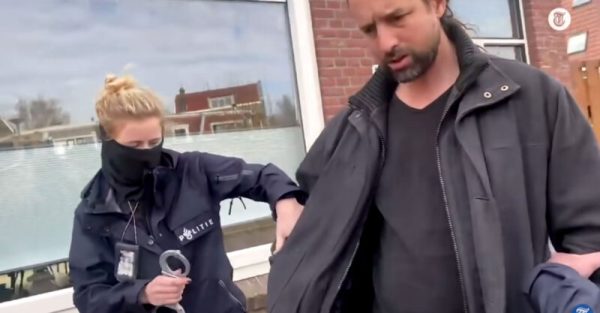
Officials in the Netherlands on April 3 re-arrested Willem Engel, a prominent campaigner against COVID-19 restrictions, claiming Engel violated the terms of his bail by discussing his case on social media.
Engel is co-founder of the Dutch organization “Viruswaarheid” (“Virus Truth”), which is challenging the legality of COVID restrictions implemented in the Netherlands.
He first was arrested last month and detained for two weeks before being released on bail.
Engel is one of two well-known European activists arrested recently for speaking out against COVID mandates and lockdowns. The other, French attorney Virginie de Araujo-Recchia, serves on the international grand jury convened as part of the People’s Court of Public Opinion, co-founded by German attorney Reiner Fuellmich.
The People’s Court aims to reveal “crimes against humanity” committed in the name of public health and combating COVID.
Araujo-Recchia, in a press release, and Engel, in an interview with The Defender, said they will continue their efforts to fight COVID-related restrictions and vaccine mandates.
French lawyer detailed on suspicion of connections to ‘terrorism’
Araujo-Recchia was arrested by French police at her home in the early morning hours of March 22 and held until March 24 by the General Directorate for Internal Security (DGSI) in Paris.
Mainstream media reports said she was arrested, along with six other individuals, including a member of the French “Yellow Vests” movement, in connection with an ongoing “terrorism” investigation.
According to Libération :
“[T]he lawyer [Araujo-Recchia] is one of the seven people arrested yesterday ‘in a terrorist case linked to the figure of the conspiracy circles Rémy Daillet.’
“A judicial source confirmed … that seven police custody [sic] were in progress at the General Directorate for Internal Security (DGSI) ‘for acts of association of terrorist criminals with a view to preparing crimes against persons.’ They are five men and two women, aged 36 to 62.
“Among those arrested would also include Sylvain B., a ‘yellow vest’ author of a ‘manual of peaceful insurrection’. AFP [Agence France Presse] specifies that searches were carried out during the arrests.”
French newspaper Libération described Daillet as a “neo-Nazi” and “a figure in conspiratorial circles already implicated and imprisoned” in a kidnapping case, who is also accused of being the mastermind of a group “planning violent actions … against 5G antennas, vaccination centers, but also against journalists and various personalities.”
In addition to serving with Fuellmich on the People’s Court grand jury, Araujo-Recchia is involved with similar issues domestically within France, working with three organizations that are attempting to levy criminal charges against politicians who, in 2021, voted for legislation strengthening COVID-related restrictions.
Working with three other lawyers, Araujo-Recchia filed a complaint on behalf of three associations: BonSens.org, AIMSIB [International Association for Independent and Benevolent Scientific Medicine] and the Collectif des Maires Résistants [Collective of Resistant Mayors], targeting French members of parliament who, on Aug. 5, 2021, voted for legislation implementing vaccine passports and requiring French workers to receive a COVID vaccine.
Araujo-Recchia and her legal team alleged these parliamentarians received favors in exchange for their vote and that the law itself violates French and international law. They presented a series of arguments against this legislation.
She also was said to be working on a new complaint, to be filed against French political parties and some of their members, at the time of her arrest.
In November 2020, Araujo-Recchia authored the Dictatorship Report 2020, published by France’s Genocide Observatory. This report was said to be intended to form part of a new set of criminal charges to be filed against members of the French government.
Following her arrest, Health Freedom Defense Fund posted an online petition calling for her release.
On March 30, Araujo-Recchia issued a press release describing her ordeal and time in detention. She clarified she is not facing any charges at this time, stating:
“[O]n 22nd March 2022 at forty minutes past six in the morning (06:40), twelve individuals including hooded commando officers, entered our residence on board six vehicles and pounded at the front door.
“The team was made up of various security-agency members, notably from the Direction Générale de la Sécurité Intérieure (DGSI, more or less equivalent to MI5), a representative of the Paris Bar (Bâtonnier du Barreau de Paris), a Clerk of the Court and two investigation-magistrates. Without striking a blow, they entered our residence and searched each and every room including our children’s room, our vehicle and the garden.
“On suspicion of being an accomplice to terrorism, I was then removed to DGSI premises at Levallois-Perret.
“There, I was held for roughly sixty hours under conditions that can only be described as inhuman. For reasons of personal dignity I shall refrain from elaborating further.
“On being released from custody, I found that not a single charge would be raised against me, nor was I even a suspect (témoin assisté). In a word, I am no party to the matter.
“Apart from being amongst the lawyers instructed by an individual who has been charged, my involvement with the case is nil.
“Would it not have been simpler to call me in, rather than carrying me off in front of the children and detaining me under grotesque conditions – when at the end of the day, there being nothing to reproach me with, it proves to be but a fishing expedition?
“Innocent until proven guilty did you say?”
In the press release, Araujo-Recchia also claimed that during her interrogation, which lasted 10 hours, she was asked the following questions in an apparent attempt to smear her as a “conspiracy theorist” and racist, and to connect her to alleged “terrorist” activity:
- Are you a patriot?
- What does the term “conspiracy theorist” refer to?
- Your view of Islam?
- Your view of Judaism?
- Your view of 5G?
- Your view of pedophilia?
- Your view of the Freemasonry?
- Might there be [government] ministers with ties to pedophile networks?
- Your view of [French President] Emmanuel Macron?
- What measures have led you to assert that crimes against humanity have been perpetrated?
- What is meant by “New World Order”?
Responding to this line of questioning and media reports about her connections to “terror” suspects, Araujo-Recchia wrote:
“Various press outlets have referred to a ‘terrorist file’, and to my name as a ‘lawyer representing individuals in conspiracy-theorist circles’ or ‘extremist cells,’ The libelous nature of that particular mixture being perfectly plain to all and sundry.
“Trust that I shall not let the business drop: we are dealing with outright libel and intent to harm. I shall moreover exercise my right to respond.
“The investigator asked me to set out my ‘ideology’ in broad strokes. I replied that it has nothing to do with an ideology, but rather with plain facts backed by evidence which I have been at pains to collect over the past two years.
“The International Court of Public Opinion and the Grand Jury, inter alia, have held hearings at which there testified acknowledged international specialists in science, medicine, psychology and psychopathology, economics, geostrategy, as well as victims past and present.
“For my part, I have taken testimony from victims, health-care workers, French firemen and present[ed] it to the Grand Jury.
“No ideology is being served up here, but rather expert opinion, professionals, witnesses and victims.
“Truth alone is the goal we seek.”
Araujo-Vecchia also noted that lawyers and doctors, as well as activists such as members of the Yellow Vests, “are subjected to similar forms of intimidation, as they attempt to raise the alarm over certain measures designed to manage the public-health ‘crisis’ or harm incurred through the experimental gene-therapy shots,” adding:
“[T]here are those of us who, having confronted the State and major financial interests such as the pharmaceutical-, finance- and MSM multis, find ourselves being in custody without cause.
“None of this will prevent my fighting for civil rights and liberties.”
France, beginning in 2020, enacted some of the most stringent COVID-related restrictions in Europe, including vaccine passports to enter most public and private venues.
In January, French President Emmanuel Macron, who is running for re-election, said he is continuing implementation of such passports because he wanted to “piss off” the unvaccinated.
Dutch activist detained for 14 days on charges of ‘incitement, sedition’
In an incident remarkably similar to Araujo-Vecchia’s arrest, Dutch activist Willem Engel, co-founder of the “Viruswaarheid” (“Virus Truth”) movement, on March 16 was arrested on charges of “incitement” and “sedition.”
Engel was outside a polling location immediately after he had voted in that country’s elections. His lawyer, Jeroen Pols, immediately confirmed the arrest in a tweet, while Engel’s girlfriend captured the arrest on video.
Mainstream media reports, which described Engel as a “COVID denier,” reported he is “suspected of posting seditionist coronavirus-related statements on social media over an extended period,” quoting statements from the Public Prosecution Service (OM) of the Netherlands.
The OM in January announced that Engel was being investigated following a petition, signed by nearly 23,000 individuals, calling for him to be charged with sedition, spreading medical misinformation, fraud and making threats.
The petition was launched by an “activist,” Norbert Dikkeboom, in 2021.
The initial investigation into his actions led to Engel’s arrest, the OM said in a statement.
The investigation identified seven social media postings, made by Engel between June 2020 and June 2021, which “were considered to be incitement,” and which, according to the OM, “led to other people committing criminal offenses or incited them to do so.”
The OM did not name the specific social media posts or the alleged criminal offenses that the posts allegedly incited.
As stated by the OM, while freedom of speech is a “fundamental right” that is enshrined under Dutch law, “there are limits to that freedom.”
In January, Engel characterized the investigation as a “smear campaign” against him and proclaimed his innocence. “I try to keep the debate sharp but never cross the line,” Engel said. “I’ve never threatened anyone.” He went on to accuse Dikkeboom, the activist who launched the petition against him, of stalking him.
Engel’s lawyer, Jeroen Pols, called Engel’s arrest “a frontal attack on critics and opponents” of the “Rutte regime,” referring to Dutch Prime Minister Mark Rutte. He added in later statements that Engel’s arrest is part of an ongoing pattern of arresting individuals who “criticize the regime.”
“The Rutte regime is fully attacking critics and opposition,” Pols said. “Meanwhile, they have a big mouth about democracy in Russia.”
In turn, the group Viruswaarheid (Virus Truth) described the arrest as an instance when “the Dutch government crossed a new line in its war against unwanted opinions and expressions.” The group accused the OM of, along with Dutch police, actively assisting Dikkeboom in his petition against Engel.
Viruswaarheid claimed that, in the past year, more than 420 articles and media reports smeared Engel “with slanderous lies,” as a result of “[a]n unprecedented hate campaign from the entire written and spoken media” that contributed to the collection of the more than 22,000 signatures on the petition against Engel.
In a separate statement, Viruswaarheid wrote that Engel “had drawn attention to [the Dutch government’s] Corona policy with his ‘Virus Truth’ initiative and has successfully fought the government measures in court on several occasions.”
Viruswaarheid in April 2020 launched petitions and demonstrations against the Dutch government’s COVID restrictions.
The group also filed two successful lawsuits “against the illegal corona measures,” which led to the laws in question being amended, in an effort by the Dutch government to sidestep these legal defeats.
Following Engel’s arrest, a demonstration took place in Amsterdam on March 20 calling for his release.
Engel, who holds a master’s degree in biopharmacy and biotechnology and operates a dance school in Rotterdam, was released on March 30 after being detained for 14 days.
He faces two upcoming court cases. He spoke to The Defender about his experience and the charges he is now facing.
Engel told The Defender he was arrested “in front of the voting booth … right after I cast my vote, two thugs with masks handcuffed me and told me I am under arrest for sedition … this is in clear violation [of Dutch law] on so many angles.”
According to Engel, he was not informed about the specific social media posts that led to the charges against him. Instead, “they [the authorities] just named the offense.”
Engel described Dikkeboom, the organizer of the petition against him, as “a sad person that stalks me,” adding, “I have made multiple charges against him … as he is openly calling for violence against me.”
Engel said the OM “shared a lot of information” about his case with Dikkeboom, describing this as “crazy” in light of Dikkeboom’s alleged threats against him.
As a potential motive for his arrest, Engel points out that Viruswaarheid has filed “over 20 cases against the government and its institutions,” adding that “there is a spree of arrests, all [with] the same signature, people being accused of threatening violence or vandalism or sedition,” and who are facing “vague charges.”
According to Engel, “almost all of the arrests are against people who have a following and who vlog regularly about demonstrations and COVID.”
Engel said such arrests and crackdowns are “happening also in Germany and Canada and probably all western countries.” He described this as “clearly the next phase of oppression, trying to take out the resistance in preparation for the next COVID ‘wave’ set for September 2022.”
However, according to Engel, the authorities “got more than they bargained for” as a result of his arrest, pointing out that “lots of people were rallying … more than 10,000 physical postcards were sent to the prison [where he was held] … #Freewillem was trending on Twitter [on] multiple days.”
Engel said he now faces two separate court cases with the “same line of charges,” which he describes as “very vague.” Court hearings are scheduled on June 13 and June 20 in The Hague and Rotterdam, respectively.
Despite his ordeal, Engel said he is “in good health and the fight has just begun.”
Michael Nevradakis, Ph.D., is an independent journalist and researcher based in Athens, Greece.
© 2022 Children’s Health Defense, Inc. This work is reproduced and distributed with the permission of Children’s Health Defense, Inc. Want to learn more from Children’s Health Defense? Sign up for free news and updates from Robert F. Kennedy, Jr. and the Children’s Health Defense. Your donation will help to support us in our efforts.
Mutilated Yellow Vests march a week ahead of Macron’s re-election bid
By Ramin Mazaheri – Press TV – April 4, 2022
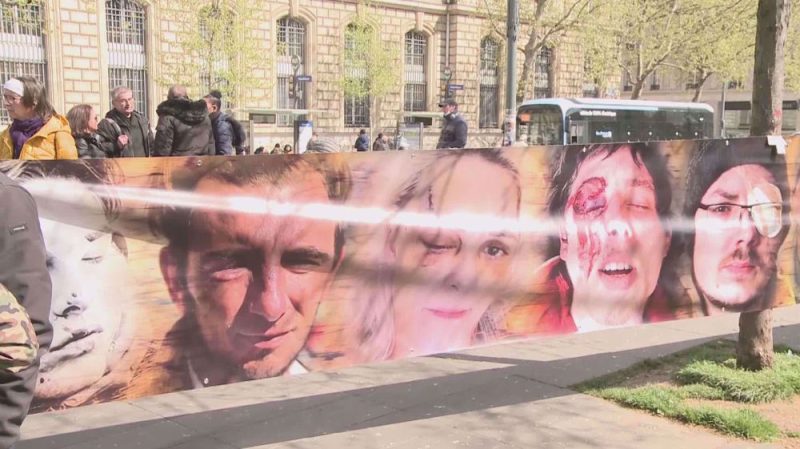
Paris – Exactly one week before the first round of the French election the embodiment of the past five years marched in Paris: Yellow Vests who were crippled, blinded and mutilated by police.
On every Saturday from November 2018 until June 2019 a national bloodletting took place on a scope which was unprecedented in recent Western history. The numbers are as staggering as the lack of Western condemnation for the French government: at least 11,000 arrests, 1,000 imprisoned, 5,000 protesters seriously hurt, 1,000 critically injured, scores maimed for life and 11 deaths.
Those who suffered the most say they don’t want to be forgotten when voters go to the ballot box. The huge phalanx of armed police which still accompany the Yellow Vests every Saturday kept their distance, while the mainstream media was not present at the protest almost at all.
Over 75% of cases involving hurt protesters are immediately dropped, without any court case or even an investigation. Punishment of police for mistreating Yellow Vest anti-government protesters has been almost non-existent. The Yellow Vests are routinely credited with an approval rating of 75%, an unheard of score in a country where perceptions of political corruption are commonplace.
The state-sponsored police brutality, combined with the so called “anti-Yellow Vest laws”, scared many into no longer attending public protests. President Emmanuel Macron is expected to win a close re-election, but the damage to France’s international reputation cannot be estimated.
Featured Video

Deception – Submarines against Olof Palme
or go to
Aletho News Archives – Video-Images
From the Archives
Woolsey Fire started at Santa Susana Field Lab — where “radioactive materials released were never accurately measured”
By John Laforge | CounterPunch | November 30, 2018
In my Nov. 16 column, I reported on potential radiation risks posed by California’s Woolsey wildfire having burned over parts or all of the Santa Susana Field Laboratory—south of Simi Valley, Calif., 30 miles outside Los Angeles—site of at least four partial or total nuclear reactor meltdowns.
The field laboratory operated 10 experimental reactors and conducted rocket engine tests. In his 2014 book Atomic Accidents, researcher James Mahaffey writes, “The cores in four experimental reactors on site … melted.” Reactor core melts always result in the release of large amounts of radioactive gases and particles. Clean up of the deeply contaminated site has not been conducted in spite of a 2010 agreement.
Los Angeles’s KABC-7 TV reported Nov. 13 that the Santa Susana lab site “appears to be the origin of the Woolsey Fire” which has torched over 96,000 acres. Southern Calif. Public Radio said, “According to Cal Fire, the Woolsey Fire started on the afternoon of Thursday, Nov. 8 … on the Santa Susana site.” … continue
Blog Roll
 Aletho News
- Feeling Better, Getting Worse: How Psychiatric Drugs Create the Illusion They Cure
- ‘Nobody Told Me’: Former Mental Health Patient Calls Out Dangerous Side Effects of Psychiatric Drugs
- Dr. Abu-Sitta: Beirut ‘felt like a day in Shifa Hospital’
- Iran Has Won the War, It Will Be Up to the US to Secure the Peace: Mohammad Marandi
- Iran condemns assassination threats against Iranian negotiators amid US talks
- Brussels cannot say where its own pipeline inspectors are as Hungary’s oil lifeline remains shut
- Israel’s Iran War: Myth and Reality
- Between war and industrial breakdown: The US-Israeli attrition crisis
- Pressure builds on Iran to ‘drop’ Lebanon ceasefire demand as Islamabad talks hang in balance
- In another clash report, US denies agreement to release Iran’s assets
- If Americans Knew
- Pro-Israel ‘Thinktanks’ and Individuals who Influence U.S. Foreign Policy
- Mearsheimer reveals how Israel dictates US policies on Iran, Gaza – video
- After killing 350+, Israel still has a “score to settle” with Lebanon before ceasefire – Daily Update
- Military aid to Israel emerges as the latest political litmus test for Democrats
- The only Palestinian children’s rights organization closes following years-long Israeli campaign against it
- ‘I Can’t Forget the Smell’: Lebanese Reel After Israel Kills Over 300 in Single Day
- DNC Shoots Down Resolutions Calling Out AIPAC and Limiting Arms to Israel
- TCN: Is Israel Blackmailing President Trump?
- Israel killed at least 303 Lebanese yesterday – who were they? Daily Update
- Amnesty: Urgent – Protect Lebanese civilians from brutal escalation in Israeli attacks
- No Tricks Zone
- German Expert: Heat Dome Led To Record Temps In Western USA…Warmer In 1934, 1936
- New Study: No Linear Warming Or Glacier Retreat Along Northern Antarctic Peninsula Since 1980s
- An Inconvenient Tree: Uncovered In Alps… Europe Much Warmer Than Today 6000 Years Ago
- New Study Reports A 60% Slowdown In Greenland’s Ice Loss Rate In The Last Decade
- Low Intensity Tornado Wrecks Major Solar Farm, Creating A Potential Toxic Dump
- New Study Finds Warming Saves Lives…Cold Temperatures 12 Times More Deadly Than Excess Heat
- German Science Blog Accuses PIK Climate Institute Of Hallucinating Climate Tipping Points
- Devastating Assessment Of Comirnaty Vaccine By Former Senior Pfizer Europe Toxicologist
- New Study: CO2 Is ‘Effectively Negligible’ As An Explanatory Climate Change Factor Since 2000
- Former Pfizer Toxicologist Dr. Helmut Sterz Tells Bundestag Hearing Pfizer Vaccine Should Have Never Been Approved
 Aletho News