A Second Whistle Blown on the OPCW’s Doctored Report
By Jeremy Salt | American Herald Tribune | December 3, 2019
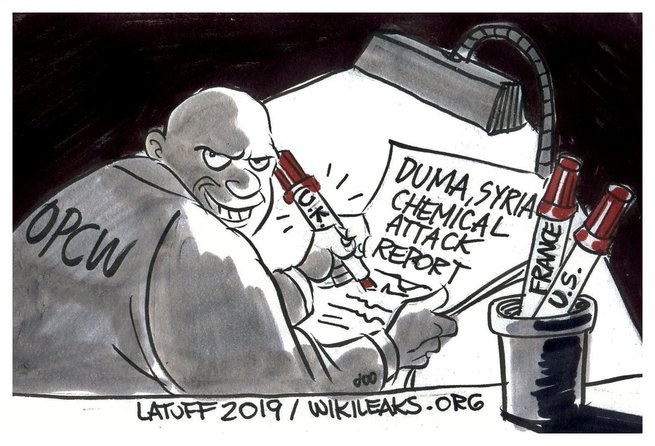
Another whistleblower leak has exposed the fraudulent nature of the Organization for the Prevention of Chemical Weapons (OPCW) report on the alleged chemical weapons attack in the Syrian city of Douma, close to Damascus, on April 7 last year.
The first leak came from the Fact-Finding Mission’s engineering sub-group. After investigating the two sites where industrial gas cylinders were found in Douma and taking into account the possibility that the cylinders had been dropped from the air it concluded that there was a “higher probability” that both cylinders were placed at both sites by hand. This finding was entirely suppressed in the final report.
The engineering sub-group prepared its draft report “for internal review” between February 1-27, 2018. By March 1 the OPCW final report had been approved, published and released, indicating that the engineers’ findings had not been properly evaluated, if evaluated at all. In its final report the OPCW, referring to the findings of independent experts in mechanical engineering, ballistics and metallurgy, claimed that the structural damage had been caused at one location by an “impacting object” (i.e. the cylinder) and that at the second location the cylinder had passed through the ceiling, fallen to the floor and somehow bounced back up on to the bed where it was found.
None of this was even suggested by the engineers. Instead, the OPCW issued a falsified report intended to keep alive the accusation that the cylinders had been dropped by the Syrian Air Force.
Now there is a second leak, this time an internal email sent by a member of the Fact-Finding Mission (FFM) on June 22, 2018, to Robert Fairweather, the British career diplomat who was at the time Chief of Cabinet at the OPCW, and copied to his deputy, Aamir Shouket. The writer claims to have been the only FFM member to have read the redacted report before its release. He says it misrepresents the facts: “Some crucial facts that have remained in the redacted version have morphed into something quite different from what was originally drafted.”
The email says the final version statement that the team “has sufficent evidence to determine that chlorine or another reactive chlorine-containing chemical was likely released from the cylinders is highly misleading and not supported by the facts.” The writer states that the only evidence is that some samples collected at locations 2 and 4 (where the gas cylinders were found) had been in contact with one or more chemicals that contain a reactive chlorine atom.
“Such chemicals,” he continues, “could include molecular chlorine, phosgene, cyanogen chloride, hydrochloric acid, hydrogen chloride or sodium hypochlorite (the major element in household chlorine-based bleach.” Purposely singling out chlorine as one of the possibilities was disingenuous and demonstrated “partiality” that negatively affected the final report’s credibility.
The writer says the final report’s reference to “high levels of various chlorinated organic derivatives detected in environmental samples” overstates the draft report’s findings. “In most cases” these derivatives were present only in part per billion range, as low as 1-2 ppb, which is essentially trace qualitiea.” In such microscopic quantities, detected inside apartment buildings, it would seem, although the writer only hints at the likelihood, that the chlorine trace elements could have come from household bleach stored in the kitchen or bathroom.
The writer notes that the original draft discussed in detail the inconsistency between the victims’ symptoms after the alleged attack as reported by witnesses and seen on video recordings. This section of the draft, including the epidemiology, was removed from the final version in its entirety. As it was inextricably linked to the chemical agent as identified, the impact on the final report was “seriously negative.” The writer says the draft report was “modified” at the behest of the office of Director-General, a post held at the time by a Turkish diplomat, Ahmet Uzumcu.
The OPCW has made no attempt to deny the substance of these claims. After the engineers’ report made its way to Wikileaks its priority was to hunt down the leaker. Following the leaking of the recent email, the Director-General, Fernando Arias, simply defended the final report as it stood.
These two exposures are triply devastating for the OPCW. Its Douma report is completely discredited but all its findings on the use of chemical weapons in Syria must now be regarded as suspect even by those who did not regard them as suspect in the first place. The same shadow hangs over all UN agencies that have relied on the OPCW for evidence, especially the UN’s Independent International Commission of Inquiry on the Syrian Arab Republic, an arm of the OHCHR (Office of the High Commissioner for Human Rights).
This body is closely linked to the OPCW and while both mostly hide the sources of their information it is evident that where chemical weapons allegations have been made, the commission of inquiry has drawn on the OPCW.
As of January 2018, the commission reported on 34 “documented incidents” of chemical weapons use by various parties in Syria. It held the Syrian government responsible for 23 of them and, remarkably, did not hold the armed groups responsible even for one, despite the weight of evidence showing their preparation and use of such weapons over a long period of time.
The commission has made repeated accusations of chlorine barrel bombs being dropped by government forces. On the worst of the alleged chemical weapons attacks, on August 21, 2013, in the eastern Ghouta district just outside Damascus, it refers to sarin being used in a “well-planned indiscriminate attack targetting residential areas [and] causing mass casualties. The perpetrators likely had access to the Syrian military chemical weapons stockpile and expertise and equipment to manipulate large amounts of chemical weapons.”
This is such a travesty of the best evidence that no report by this body can be regarded as impartial, objective and neutral. No chemical weapons or nerve agents were moved from Syrian stocks, according to the findings of renowned journalist Seymour Hersh. The best evidence, including a report by Hersh (‘The Red Line and the Rat Line,’ London Review of Books, April 17, 2014), suggests a staged attack by terrorist groups, including Jaysh al Islam and Ahrar al Sham, who at the time were being routed in a government offensive. The military would have had no reason to use chemical weapons: furthermore, the ‘attack’ was launched just as UN chemical weapons inspectors were arriving in the Syrian capital and it is not even remotely credible that the Syrian government would have authorized a chemical weapons attack at such a time.
Even the CIA warned Barack Obama that the Syrian government may not have been/probably was not responsible for the attack and that he was being lured into launching an air attack in Syria now that his self-declared ‘red line’ had been crossed. At the last moment, Obama backed off.
It remains possible that the victims of this ‘attack’ were killed for propaganda purposes. Certainly, no cruelty involving the takfiri groups, the most brutal people on the face of the planet, can be ruled out. Having used the occasion to blame the Syrian government, the media quickly moved on. The identities of the dead, many of them children, who they were, where they might have been buried – if in fact they had been killed and not just used as props – were immediately tossed into the memory hole. Eastern Ghouta remains one of the darkest unexplained episodes in the war on Syria.
The UN’s Syria commission of inquiry’s modus operandi is much the same as the OPCW’s. Witnesses are not identified; there is no indication of how their claims were substantiated; the countries outside Syria where many have been interviewed are not identified, although Turkey is clearly one; and where samples have had to be tested, the chain of custody is not transparent.
It is worth stepping back a little bit to consider early responses to the OPCW report on Douma. The Syrian government raised a number of questions, all of them fobbed off by the OPCW. Russia entered the picture by arranging a press conference for alleged victims of the ‘attack’ at the OPCW headquarters in the Hague. They included an 11-year-old boy, Hassan Diab, who said he did not know why he was suddenly hosed down in the hospital clinic, as shown in the White Helmets propaganda video.
All the witnesses dismissed claims of a chemical weapons attack. Seventeen countries (Australia, Bulgaria, Canada, the Czech Republic, Denmark, Estonia, France, Germany, Iceland, Italy, Latvia, Lithuania, the Netherlands, Poland, Slovakia, the United Kingdom and the US) then put out a joint statement (April 26, 2018) expressing their full support for the OPCW report and dismissing the “so-called” information session at the Hague as a Russian propaganda exercise. Their statement claimed the authenticity of the information in the OPCW report was “unassailable.”
Russia followed up with a series of questions directed at the OPCW’s technical secretariat. It noted that the OPCW report did not mention that samples taken from Douma were “split” in the OPCW’s central laboratory in the Netherlands and not in the Syrian Arab republic. Fractions of samples were handed to Syria only after six months of insistent pressure (OPCW response: its terms of reference provided for Syria to be provided with samples “to the extent possible” but do not specify when or where samples should be ‘split’).
Russia also referred to the collection of 129 samples and their transfer to OPCW-designated laboratories. 31 were selected for the first round of analysis and an additional batch of 13 sent later. Of the 129 samples 39 were obtained from individuals living outside territory controlled by the Syrian army. Of 44 samples analyzed 33 were environmental and 11 biomedical: of the 44, 11 (four environmental and seven biomedical) were obtained from alleged witnesses.
As remarked by the Russian Federation, the OPCW report does not explain the circumstances in which these samples were obtained. Neither is there any information on the individuals from whom they were taken; neither is there any evidence demonstrating compliance with the chain of custody (OPCW response: there was respect for the chain of custody, without this being explained; the “standard methodology” in collecting samples was applied, without details being given. It stressed the need for privacy and the protection of witness identities).
Russia observed that the samples were analyzed in two unnamed OPCW laboratories and on the evidence of techniques and results, it raised the question of whether the same laboratories had been used to investigate earlier ‘incidents’ involving the alleged use of chlorine. Of the 13 laboratories that had technical agreements with the OPCW, why were samples analyzed at only two, apparently the same two as used before? Russia also observed that of the 33 environmental samples tested for chlorinated products, there was a match (bornyl chloride) in only one case.
Samples taken from location 4, where a gas cylinder was allegedly dropped from the air, showed the presence of the explosive trinitrotoluene, leading to the conclusion that the hole in the roof was made by an explosion and not by a cylinder falling through it (OPCW response: the Fact-Finding Mission did not select the labs and information about them is confidential. As there had been intense warfare for weeks around location four, the presence of explosive material in a broad range of samples was to be expected but this did not – in the OPCW view – lead to the conclusion that an explosion caused the hole in the roof).
Russia pointed out that the FFM interviewed 39 people but did not interview the actual witnesses of the ‘incident’ inside the Douma hospital who appeared and were easily identifiable in the staged videos (OPCW response: the secretariat neither confirms nor denies whether it interviewed any of the witnesses presented by Russia at the OPCW headquarters “as any statement to that effect would be contrary to the witness protection principles applied by the secretariat”).
Russia also pointed out the contradictions in the report on the number of alleged dead. In one paragraph the FFM says it could not establish a precise figure for casualties which “some sources” said ranged between 70 and 500. Yet elsewhere “witnesses” give the number of dead as 43 (OPCW response: the specific figure of 43 was based on the evidence of “witnesses” who claimed to have seen bodies at different locations).
Russia also pointed out that no victims were found at locations 2 and 4, where the ventilation was good because of the holes in the roof/ceiling. Referring to location 2, it asked how could chlorine released in a small hole from a cylinder in a well-ventilated room on the fourth floor have had such a strong effect on people living on the first or second floors? (OPCW response: the FFM did not establish a correlation between the number of dead and the quantity of the toxic chemical. In order to establish such a correlation, factors unknown to the FFM – condition of the building, air circulation and so on – would have had to be taken into account. It does not explain why this was not attempted and how it could reach its conclusions without taking these “unknown factors” into account).
Finally, Russia raised the question of the height from which the cylinders could have been dropped. It referred to the lack of specific calculations in the OPCW report. The ‘experts’ who did the simulation did not indicate the drop height. The charts and diagrams indicated a drop height of 45-180 meters. However, Syrian Air Force helicopters do not fly at altitudes of less than 2000 meters when cruising over towns because they would come under small arms fire “at least” and would inevitably be shot down.
Furthermore, if the cylinders had been dropped from 2000 meters, both the roof and the cylinders would have been more seriously damaged (OPCW response: there were no statements or assumptions in the FFM report on the use of helicopters or the use of other aircraft “or the height of the flight. The FFM did not base its modeling on the height from which the cylinders could have been dropped. “In accordance with its mandate,” the FFM did not comment on the possible altitude of aircraft. The OPCW did not explain why these crucial factors were not taken into account).
In its conclusion, Russia said there was a “high probability” that the cylinders were placed manually at locations 2 and 4 and that the factual material in the OPCW report did not allow it to draw the conclusion that a toxic chemical had been used as a weapon. These conclusions have now been confirmed in the release of information deliberately suppressed by the OPCW secretariat.
As the leaked material proves, its report was doctored: by suppressing, ignoring or distorting the findings of its own investigators to make it appear that the Syrian government was responsible for the Douma ‘attack’ the OPCW can be justly accused of giving aid and comfort to terrorists and their White Helmet auxiliaries whom – the evidence overwhelmingly shows – set this staged ‘attack ’up.
Critical evidence ignored by the OPCW included the videoed discovery of an underground facility set up by Jaysh al Islam for the production of chemical weapons. All the OPCW said was that the FFM inspectors paid on-site visits to the warehouse and “facility” suspected of producing chemical weapons and found no evidence of their manufacture. There is no reference to the makeshift facility found underground and shown in several minutes of video evidence.
Since the release of the report, the three senior figures in the OPCW secretariat have moved/been moved on. The Director-General at the time, Hasan Uzumlu, a Turkish career diplomat, stepped out of the office in July 2018: Sir Robert Fairweather, a British career diplomat and Chief of Cabinet at the OPCW, was appointed the UK’s special representative to Sudan and South Sudan on March 11, 2019: his deputy, Aamir Shouket, left the OPCW in August 2018, to return to Pakistan as Director-General of the Foreign Ministry’s Europe division. The governments which signed the statement that the evidence in the OPCW report was “unassailable” remain in place.
Jeremy Salt has taught at the University of Melbourne, Bosporus University (Istanbul) and Bilkent University (Ankara), specialising in the modern history of the Middle East. His most recent book is “The Unmaking of the Middle East. A History of Western Disorder in Arab Lands” (Berkeley: University of California Press, 2008.)
Is Criticism of Israel Already an Official Hate Crime in America?
By Philip Giraldi – American Free Press – December 2, 2019
One subject that congressmen and the mainstream media tend to avoid is the erosion of fundamental liberties in the United States as a consequence of the war on terror and American involvement in the Middle East. Some of America’s legislators apparently do not even understand that freedom of speech actually means that one can say things that others might find distasteful. The assault on freedom of speech has been accelerated through the invention of so-called “hate speech,” which has in turn morphed into “hate crimes” where punishments are increased if there is any suggestion that hatred of groups or individuals is involved. Some have rightly questioned the whole concept, pointing out that if you murder someone the result is the same whether you hate your victim or not.
Freedom of speech is particularly threatened in any situations having to do with Israel, a reflection of the power of that country’s lobby in the United States. At a recent town hall gathering, Rep. Dan Crenshaw (R-Texas) demonstrated how he and his colleagues run and hide whenever the issue of Israel is raised when he would not respond directly to a question over whether any criticism of Israel should or should not be protected under the First Amendment. Crenshaw is a Republican and generally reliably conservative, though he recently spoke out against the “For the People Act of 2019,” which he claimed “would limit free speech dramatically.”
A constituent specifically asked Crenshaw’s opinion about federal laws that require citizens in some states to sign a pledge that they will not boycott Israel if they wish to get government contracts or obtain a government job. The audience member also mentioned a law passed in Florida that bans anti-Semitism in public schools and universities, defining “anti-Semitism” as criticism of Israel. The constituent observed, “These laws are obviously flagrant and troubling violations of the First Amendment to free speech.”
“Will you honor your oath and denounce these laws here, now and forever?” Crenshaw was then asked. Crenshaw quickly fired back that the critic was “cloaking yourself in the First Amendment” to enable engaging in “vehement anti-Semitism.” Crenshaw then asserted that the questioner was “advocating the BDS movement,” a recent target of much of the legislation that the critic was addressing.
BDS refers to the Boycott, Divestment, and Sanctions movement, which calls on people to protest Israel by pulling investments from and boycotting the country.
Israel is engaged in what might be described as a war with the objective of driving any and all criticism of the Jewish state out of polite discourse, making it illegal wherever and whenever possible. The Knesset has passed legislation criminalizing anyone who supports BDS and has set up a semi-clandestine group called Kella Shlomo to counteract its message. The country’s education minister has called BDS supporters “enemy soldiers” and has compared them to Nazis. Netanyahu has also backed up the new law with a restriction on foreigners who support the BDS movement entering the country, including American Jewish dissidents, several of whom have been turned around at the airport and sent home.
Israel has been particularly successful at promoting its own preferred narrative, together with sanctions for those who do not concur, in the English language speaking world and also in France, which has the largest Jewish population in Europe. The U.S. government under Donald Trump is completely under the thumb of the Israeli prime minister’s office, with Secretary of State Mike Pompeo recently saying “our major focus is stamping out anti-Semitism.”
Sanctions already in place in Europe consist of fines and even jail time. The legal penalties come into play for those criticizing Israel or questioning the accuracy of the accepted holocaust narrative, i.e., disputing that “6 million died.” Even attacking specific Israeli government policies, like its slaughter of Palestinians in Gaza every Friday, can be found guilty of anti-Semitism, which is now considered a hate crime in Britain, France, Germany, and, most recently, the Czech Republic. In Britain, where the Jewish lobby is extremely strong, a law passed in December 2016 made the UK one of the first countries to use the definition of anti-Semitism agreed upon earlier in the year at a conference of the Berlin-based International Holocaust Remembrance Alliance (IHRA).
A statement from the British prime minister’s office at that time explained that the intention of the new definition was to “ensure that culprits will not be able to get away with being anti-Semitic because the term is ill-defined, or because different organizations or bodies have different interpretations of it.”
The British government’s own definition relies on guidance provided by the IHRA, which asserts that it is considered anti-Semitic to accuse Jews of being “more loyal to Israel or their religion than to their own nations, or to say the existence of Israel is intrinsically racist.” In other words, even if many Jews are more loyal to Israel than to the countries they live in and even though Israel is in fact intrinsically racist, it is now illegal to say so in Great Britain.
One should not be surprised, as the British government’s subservience to Jewish and Israeli interests is nearly as enthusiastic as is government in the United States, though it is driven by the same sorts of things—Jewish money and Jewish power, particularly in the media. A majority of Conservative Party members of parliament have joined Conservative Friends of Israel, and the Labour counterpart is also a major force to be reckoned with on the political left.
Here in the United States, the friends of Israel appear to believe that anyone who is unwilling to do business with Israel or even with the territories that it has illegally occupied should not be allowed to obtain any benefit from federal, state or even local governments. Constitutional guarantees of freedom of speech and association for every American are apparently not valid if one particular highly favored foreign country is involved, as the discussion with Crenshaw reveals.
Twenty-seven states now have laws sanctioning those who criticize or boycott Israel. And one particular pending piece of federal legislation that is regularly re-introduced into the Senate would far exceed what is happening at the state level and would set a new standard for deference to Israeli interests on the part of the national government. It would criminalize any U.S. citizen “engaged in interstate or foreign commerce” who supports a boycott of Israel or who even goes about “requesting the furnishing of information” regarding it, with penalties enforced through amendments of two existing laws, the Export Administration Act of 1979 and the Export-Import Act of 1945, that include potential fines of between $250,000 and $1 million and up to 20 years in prison.
Israel, and its friends like Crenshaw, are particularly fearful of the BDS movement because its non-violence is attractive to college students, including many young Jews, who would not otherwise get involved on the issue. The Israeli government clearly understands, correctly, that BDS can do more damage than any number of terrorist attacks, as it represents a serious critique of the behavior of the Jewish state while also challenging the actual legitimacy of the Israeli government and its colonizing activity in Palestine. Much of the current hate crime legislation in places like Germany and the Czech Republic directly targets BDS, stating specifically that it is “inherently” anti-Semitic. In late July, the House of Representatives overwhelmingly passed its own resolution condemning BDS explicitly in a 398-to-17 vote.
Going hand-in-hand with the condemnation of BDS is a drive to maintain the exclusivity of Jewish suffering. In June, when Rep. Alexandria Ocasio- Cortez (D-N.Y.) called border detention centers holding asylum seekers “concentration camps,” she was inundated with protests from Jewish groups that claimed she was denigrating the holocaust and “insulting victims of genocide.” The United States Holocaust Memorial Museum even published a statement objecting to comparisons between “the holocaust and other events.”
It is important for Americans to realize that Israel not only spies on the U.S., digs its paws deep into our Treasury, and perverts Washington’s Middle East policy, it is also attempting to dictate what we the people can and cannot say. And Congress and much of the media are fully on board, which is the real tragedy.
French MPs pass pro-Zionism resolution, defy warnings by advocates of Palestine rights
Press TV – December 4, 2019
The lower house of France’s Parliament has passed a nonbinding resolution equating criticism of the Zionists occupying Palestinian territories with anti-Semitism, defying warnings that such a move could serve to stifle the advocates of Palestinian rights.
The National Assembly passed the resolution on Tuesday, with 154 votes for and 72 against, various media outlets reported.
The resolution states, “Criticizing the very existence of Israel as a collective composed of Jewish citizens is tantamount to hatred towards the Jewish community as a whole.”
“Such abuses increasingly make anti-Zionism ‘one of the contemporary forms of anti-Semitism’ in the words of the President of the Republic,” it adds, citing French President Emanuel Macron.
The Zionist entity proclaimed existence in 1948 after occupying huge swathes of regional countries during a Western-backed war.
Right before the war, it had already gone on a campaign of ethnic cleansing that lasted until 1949, leading to the expulsion of between 750,000 and 850,000 Palestinians from their homeland while the Israeli regime was replacing them with a similar number of Jewish migrants.
Still using far-and-wide Western backing, the regime staged another wholesale war in 1967 that saw it seizing more chunks of land, including the West Bank, East Jerusalem al-Quds, the Gaza Strip and parts of Syria’s Golan Heights.
Many Jews worldwide are opposed to the occupation of Palestinian land and reject the Zionist concept of Israel being a legitimate Jewish state, arguing that the Zionist entity has hijacked their religious identity so it could push ahead with its land theft agenda.
Israeli Minister of Strategic Affairs Gilad Erdan applauded the French lawmakers’ approval of the resolution, urging Paris to take “practical steps” against the international pro-Palestine Boycott, Divestment, and Sanctions (BDS) movement.
Inspired by the South African anti-apartheid movement, the BDS was initiated in 2005 by over 170 Palestinian organizations and later turned international. It is meant to initiate “various forms of boycott against Israel until it meets its obligations under international law” and end its occupation of Palestinian lands.
The French MPs’ move came despite earlier warnings by activists and rights organizations that such a resolution could work to block any criticism of the occupying entity.
In a letter to National Assembly President Richard Ferrand in October, 39 organizations said the resolution would compromise “defense of freedom of expression and assembly for groups and activists that must be allowed to defend the rights of Palestinians and criticize Israel’s policy without being falsely accused of anti-Semitism.”
The resolution would also “weaken the universalist approach” to combating all forms of racism,” the letter added.
As the French legislators were about to adopt the measure, a group of 129 Jewish and Israeli scholars signed a petition calling on the parliament to vote against the resolution.
The signatories said, “It is cynical and insensitive to stigmatize them (Palestinians) as anti-Semites for opposing Zionism… They oppose Zionism not because they hate Jews, but because they experience Zionism as an oppressive political movement.”
Speaking to France 24, James Cohen, a professor at the Université Sorbonne Nouvelle Paris 3 and one of the signatories, said that “by equating anti-Zionism with anti-Semitism, you’re broadening the definition of anti-Semitism too much […] you’re going very far afield.”
French vote one step closer to anti-Zionism ban
By Ramin Mazaheri – Press TV – December 3, 2019
Paris – France’s media has remained nearly silent ahead of a vote on a resolution which is one step away from criminalizing opposition to Zionism.
If the motion passes, in a vote on December 3rd, it will throw open the door to false accusations of anti-Semitism for anyone openly criticising Israeli crimes, war atrocities and its Apartheid policies.
The resolution purposely tries to confuse “Zionism”, which refers to the imperialist and segregationist political project upon which Israel is based, with “anti-Semitism” which is a bigotry against Jews and Judaism that has nothing to do with Israeli massacres and crimes against Palestinians and non-Jews.
The hypocritical irony is that the law arrives just as France is in the midst of its latest wave of Islamophobia. Last month many top, alleged leftist politicians refused to denounce Islamophobia because they said that doing so could mean they are not allowed to publicly criticise the tenets of Islam. Protesters in Paris asked: where are France’s many self-proclaimed defenders of free speech?
The resolution states that, “Criticizing the existence of a Jewish state is a way to express hate towards the entire Jewish community.” Not only is this logically false, but inaccurate: studies show the majority of Jews in Europe are also anti-Zionist. Such a view also unjustly and dangerously tries to hold all Jews responsible for the crimes committed by Israel.
Many believe that nowhere in the world is right and wrong clearer than in Palestine, and the inability to discuss the imperialist, segregationist and constantly murderous project of Zionism will surely lead to more funerals for innocent Palestinians.
Global Giants: American Empire and Transnational Capital
Maximilian C. Forte review of Giants: The Global Power Elite by Peter Phillips (Introduction by William I. Robinson). New York: Seven Stories Press, 2018. LCCN 2018017493; ISBN 9781609808716 (pbk.); ISBN 9781609808723 (ebook); 353 pps.
Giants: The Global Power Elite, by Peter M. Phillips, Professor of Political Sociology at Sonoma State University, opens with a stated intention of following in the tradition C. Wright Mills’ The Power Elite. This book is clearly meant to be a contemporary update and expansion of Mills’ work, such that the “power elite” now becomes the global power elite (GPE) in Phillips’ volume—and central to the idea of a global power elite is the transnational capitalist class that was at the core of the theorization of Leslie Sklair. One of the most important features of this book, in my view, is that it overcomes the unproductive dichotomy that continues to silently inform many academic and political debates on this question: is the contemporary world order one dominated by US imperialism or transnational capital? Phillips’ answer is productive (even if I do not entirely agree): transnational capital has acquired US power and uses the power of the US state to further its aims, protect its interests, and enforce its agenda. Where I differ, the difference is a relatively slight matter of emphasis: Phillips’ model is largely correct, but it is also important to remember that the wealthiest, most numerous, and most powerful membership of the “transnational” capitalist class is in fact American.
Aside from this, Phillips reveals how even now mere mention of the “transnational capitalist class” is obscured in mainstream corporate media coverage. As he points out: “the concept of a global transnational capitalist class is essentially completely absent from corporate news coverage in the United States and Europe” (p. 62).
The centrepiece of this work is its detailed exposition of the 389 individuals who constitute the core of “the policy planning nongovernmental networks that manage, facilitate, and protect the continued concentration of global capital” (p. 10).
I am thankful to the author for providing me with a free copy of this text, so that this review could be written. I have also assigned one of the chapters as required reading in one of my recent courses (DeGlobalization & the Nation), and thus I also have the benefit of feedback from students on some of the book’s key contents.
Chapters—Contents
The Preface to the volume effectively summarizes the key contents of the book and outlines its principal arguments. It was not prepared as a mere formality, and is worth reading on its own.
The Introduction, “Who Rules the World?” was written by William I. Robinson, one of the leading scholars today on the topic of the transnational capitalist class.
Chapter 1, “Transnational Capitalist Class Power Elite: A Seventy-Year History,” aims at explaining the “transition from the nation state power elites described by Mills to a transnational power elite centralized on the control of global capital around the world”. In this chapter Phillips traces the development of the concept of global power elites from the work of C. Wright Mills, through to Leslie Sklair, William Robinson, William Carroll and even David Rothkopf. While the author also invokes “shadow elites,” he does not mention the work of Janine Wedel in this regard. Phillips also provides a detailed outline of the nature of global wealth inequality, ranging from the control of wealth by a few, to over-accumulation, and starvation. In addition to the preface, this is the chapter that makes the central arguments of the book.
Chapter 2, “The Global Financial Giants: The Central Core of Global Capitalism,” identifies the 17 global financial giants—money management firms that control more than one trillion dollars in capital. As these firms invest in each other, and many smaller firms, the interlocked capital that they manage surpasses $41 trillion (which amounts to about 16% of the world’s total wealth). The 17 global financial giants are led by 199 directors. This chapter details how these financial giants have pushed for global privatization of virtually everything, in order to stimulate growth to absorb excess capital. The financial giants are supported by a wide array of institutions: “governments, intelligence services, policymakers, universities, police forces, militaries, and corporate media all work in support of their vital interests” (p. 60).
Chapter 3, “Managers: The Global Power Elite of the Financial Giants,” largely consists of the detailed profiles of the 199 financial managers just mentioned.
Chapter 4, “Facilitators: The Power Elite Policy Planning Center of the Transnational Capitalist Class,” examines the membership of two non-governmental Global Elite policy-planning organizations: the Group of Thirty and the Trilateral Commission. The chapter also goes into some depth in related organizations, such as the Bilderberg Group and the Council on Foreign Relations. Detailed profiles of the directors of the G30 are included in this chapter, as well as profiles of the members of the Trilateral Commission Executive Group.
Chapter 5, “Protectors: The Power Elite and the US Military NATO Empire, Intelligence Agencies, and Private Military Companies,” focuses on the power of “the US/NATO military empire”. As Phillips explains, the US/NATO functions as a “transnational military police state” that operates in nearly every country in the world, and, “threatens nations that do not fully cooperate with global capital with covert activities, regime change, and heavy negative propaganda” (p. 12). Phillips also examines how the global Giants, “invest in war making as a method of using surplus capital for a guaranteed return, with an increasing use of private military/security companies for protection of Global Power Elites and their wealth” (p. 12). Detailed profiles of the 35 members of the Atlantic Council Executive Committee form part of this chapter. This chapter also examines “Private Military Contractors,” focusing on Blackwater and G4S.
Chapter 6, “Ideologists: Corporate Media and Public Relations Propaganda Firms,” concentrates on the extensive investment by the Giants in corporate media and their expanding “use of public relations propaganda companies in the news systems of the world” (p. 13). The six major global media organizations The chapter this focuses on the six leading global media organizations, and how they offer ideological justification for corporate capitalism while censoring contrary perspectives. As Phillips explains early in his book:
“We have a media system that seeks to control all aspects of human thinking and promotes continued consumption and compliance. The dominant ideological message from corporate media today is that the continued growth of the economy will offer trickle-down benefits to all humans and save the planet”. (p.13)
One outstanding fact that is presented at the start of this chapter is that, “corporate media receive anywhere from two thirds to 80 percent of their broadcast and print news content from public relations and propaganda (PRP) firms” (p. 263). Since only a handful of media companies monopolize the world market of information distribution, this fact reveals a monumental bullhorn in the hands of the transnational capitalist class (p. 265). This chapter also informs us that, in the US, the number of media companies has declined from 50 in the early 1980s to just six today, and that 98% of all US cities are served by only one daily newspaper (p. 264).
This chapter also provides detailed profiles of the major media and public relations firms in the US, along with discussion of some of their noteworthy international interventions. In addition, the chapter discusses propaganda and the “engineering of consent”.
Chapter 7, “Facing the Juggernaut: Democracy Movements and Resistance,” offers “a summary and what-needs-to-be-done statement” (p. 13), that emphasizes what needs to be done to reform the system, in very broad terms, with a return to the principles outlined in the UN’s Universal Declaration of Human Rights.
The books ends with a postscript which amounts to a letter to the Global Power Elites “asking them to consider future generations when making decisions regarding global capital, and urging them to take corrective action before more serious and inevitable unrest and environmental devastation take effect” (p. 13).
“Global Power Elites”: the Transnational Capitalist Class
Phillips describes the Global Power Elite as follows:
“The Global Power Elite function as a nongovernmental network of similarly educated wealthy people with common interests of managing, facilitating, and protecting concentrated global wealth and insuring the continued growth of capital. Global Power Elites influence and use international institutions controlled by governmental authorities—namely, the World Bank, International Monetary Fund (IMF), NATO, World Trade Organization (WTO), G7, G20, and many others”. (p. 9)
Therefore what Phillips indirectly points to here is the growing recognition of the fact that, far from the promised obsolescence of the state, globalization has not only been enacted by states, the power of certain states has in fact increased. On the other hand, he apparently endorses Robinson’s claim that nation-states have become, “little more than population containment zones,” while “the real power lies with the decision makers who control global capital” (p. 26). Both propositions are unconvincing: first, populations are clearly not being contained; second, if states matter so little, and the real decision-makers are global capitalists, then why do the latter need states?
Indeed, Phillips appears to be of two minds on this question. He does note, for example: “The World Bank, IMF, G7, G20, WTO, Financial Stability Board, and Bank for International Settlements are institutions controlled by nation-state representatives and central bankers with proportional power/control exercised by dominant financial supporters, primarily the United States and European Union countries” (p. 161). Critical institutions of the global capitalist system are themselves state institutions. Clearly then, states are a lot more than just population containers. The shaky narrative of this book is a product of an underlying theoretical lack of clarity.
Global Power Elites, as Phillips explains, “are the activist core of the Transnational Capitalist Class—1 percent of the world’s wealthy people—who serve the uniting function of providing ideological justifications for their shared interests and establishing the parameters of needed actions for implementation by transnational governmental organizations” (p. 10). They should therefore not be confused with all elites, nor apparently with elite technocrats who serve in government but who are not among the world’s wealthiest people. The GPEs also apparently exclude the lobbyists, academics, media and think tank members who constitute a large part of what Janine R. Wedel describes as flexible “influence elites,” in her own updating of Mills’ work on elites (see “From Power Elites to Influence Elites: Resetting Elite Studies for the 21st Century” in the special issue of Theory, Culture & Society on Elites and Power after Financialization).
What unites the members of the GPEs are common interests and backgrounds. They tend to interact with each other regularly, and a wide range of mutually reinforcing organizations. It can come down to sharing the same university affiliations and membership in social clubs—“It is certainly safe to conclude they all know each other personally or know of each other in the shared context of their positions of power” (p. 11). Elsewhere in the book, these transnational elites are described as effectively forming a club: “interacting families of high social standing with similar lifestyles, corporate affiliations, and memberships in elite social clubs and private schools” (p. 22). “The power elite policy groups inside the Transnational Capitalist Class,” Phillips observes, “are made up of persons with shared educational experiences, similar lifestyles, and common ideologies” (p. 214). The degree of commonality among the elites studied in this book is striking:
“One hundred thirty-six of the 199 power elite managers (70 percent) are male. Eighty-four percent are whites of European descent. The 199 power elite managers hold 147 graduate degrees, including 59 MBAs, 22 JDs, 23 PhDs, and 35 MA/MS degrees. Almost all have attended elite private colleges, with 28 attending Harvard or Stanford”. (p. 62)
Of those same 199 individuals, 59% are from the US; many of the 199 are dual citizens; and, “they live in or interact regularly in a number of the world’s great cities: New York City, Chicago, London, Paris, Munich, Tokyo, and Singapore” (p. 63). Of the same 199 global financial directors, 69 have attended the World Economic Forum (p. 147).
Less convincing was William Robinson’s assertion, in the Introduction to the book, that suggests that national capitalists have effectively vanished. Presumably they metamorphosed into a transnational capitalist class, and for that reason Mills’ work needs to be updated (p. 17). What was missing here then was a golden opportunity to reflect on the fractious breakup of the dominant elites into a diminished and angered national capitalist faction in opposition to the transnationalist faction. That alone could have done more to explain the rise of Trump, as a champion of national capital, than resorting to facile ideological truisms about “populism”. Unfortunately, Robinson is destined to continue missing this, as elsewhere he quickly rushed to assert that Trump himself was a leading representative of the transnational capitalist class—and it was as unconvincing as it was misleading. Even worse, Robinson risks reducing “transnational capitalist class” to something like “fascist”: a term of abuse, with limited explanatory power. Unlike Robinson’s comments in this book, Phillips seems much more attuned to the reality of factions that exist even among the global power elites (p. 23).
Phillips describes the world’s top billionaires as “similar to colonial plantation owners” (p. 21), which can be a useful way for conceptualizing Western power structures as they have developed over the past five centuries. Phillips thus points to the UK’s Barclays Bank as an example of the colonial heritage at work today: “Barclays Bank [is] the number-one most connected firm. Barclays is a 300-year-old banking company founded in 1690 in London. Barclays grew with the expansion of the British Empire and now offers services in more than 50 countries and territories, serving some 49 million clients” (p. 79)
Transnational capitalists work through an array of institutions such as, “the World Bank, World Trade Organization, International Monetary Fund, the G20, G7, World Economic Forum, Trilateral Commission, Bilderberg Group, Bank for International Settlements,” among others (p. 25). This book also cites the The Handbook of Transnational Governance (2011) which “lists 52 trans-governmental networks, arbitration bodies, multi-stakeholder initiatives (with internet cooperation), and voluntary regulation groups (fair labor/trade associations)” as key bodies of the transnational capitalist class. It’s not clear why, if their interests and agendas are shared in common, they would need so many multilateral international organizations—at the very least it would seem to be an inefficient diffusion of effort.
The other question is, if the global power elites discussed in this book control/manage a total of about $41 trillion, and the world’s total wealth is estimated at $255 trillion, then that would mean the global power elites in fact control a minority share of global wealth (roughly 16%). Then who owns or controls the other 84%? Elsewhere in the book it is revealed that “147 companies controlled some 40 percent of the world’s wealth” (p. 36). Then the question becomes: who controls the remaining 60%? Also, is control the same thing as ownership? Later the book informs us that, “in excess of $74 trillion of inter-invested centralized capital” is controlled by 69 cross-invested firms (p. 49). This would mean that they control just over 29% of the world’s wealth. One wishes that some overall profile of global wealth ownership and distribution had been provided in this book, so as to better contextualize what the “giants” really own.
American Power Elites (APEs)?
One of the ironies in this text is what Phillips reveals in Chapter 1:
“The top six billionaires in 2017, with their country of citizenship and estimated net worth, were Bill Gates (US, $88.8 billion), Amancio Ortega (Spain, $84.6 billion), Jeff Bezos (US, $82.2 billion), Warren Buffett (US, $76.2 billion), Mark Zuckerberg (US, $56 billion), and Carlos Slim Helú (Mexico, $54.5 billion). Forbes’s billionaire list contained 2,047 names in 2017”. (p. 21)
Thus of the top six billionaires, four are American. As for the Forbes list, in 2019, seven of the top 10 billionaires listed are American. In fact, the list has become increasingly American since circa 2012, according to this compilation of annual rankings, returning to the situation that was observed from before 2005. In total, 14 of the world’s richest 20 persons are American. Overall, 607 of the world’s 2,153 billionaires in 2019 are American—or just over 28%, which still reflects a disproportionately large American presence. As mentioned above, the American proportion has been steadily increasing:
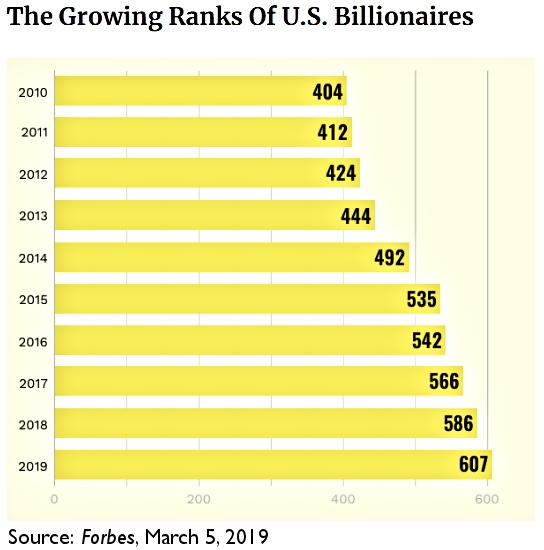
So what does one conclude from this picture? Is it in fact transnational capital of a global power elite that has dominated globalization, that we are seeing here? Or would it be more accurately reflective of reality to speak of an American Power Elite that dominates the world’s circuits of wealth creation and concentration? The answer has enormous import for how we think about globalization vs. American imperialism as the best mode of describing contemporary reality.
As we saw in the last section, the inability to explain why transnational capitalists need states is one of the most serious flaws in explanations that claim states have been diminished while transnational capitalists have real power. If they had real power, they would not need states. Thus one of the problems of this book is that it under-theorizes critical areas that really needed attention, if we were really to update Mills’ work.
US Imperialism and Transnational Capitalism
One of the key strengths of this book is that it goes against fashionable theorizing on the political left, prevalent among academics and activists, that minimizes or even refuses to name US imperialism. As Phillips shows in this book, the US is the foundation of transnational policing that works to enforce the interests of global capital. In particular, the global financial giants invest heavily in war-making as a means of profitably deploying excess capital.
Thus Phillips notes that, “the policy elites in the United States have been mostly united in support of an American empire of military power that maintains a repressive war against resisting groups…around the world” (p. 23). He also points out: “uncooperative regimes are undermined and overthrown in support of the free flow of global capital for investments anywhere that returns are possible” (p. 64).
“Humanitarian intervention” is also critically addressed by Phillips. He argues that the transnational capitalist class promotes “military interventions [that] are ideologically justified as peacekeeping or humanitarian missions,” primarily in cases where governments are “viewed as unfavorable to the TCC’s capital interests”—in such cases then, “resistance forces will be supported and encouraged toward regime change, as in…Libya, Syria, Iraq, Yemen, Somalia, Ukraine, Venezuela, and Yugoslavia” (p. 30). It is refreshing to read a North American academic who recognizes this reality. As indicated in the list of contents, Phillips dedicated an entire chapter to the subject of US empire (chapter 5).
The protection of transnational capital, Phillips argues, is what lies behind the production of “failed states, manufactured civil wars, regime changes, and direct invasions/occupations”. Each of these is a manifestation of “the new world order requirements for protecting transnational capital” (p. 215).
NATO is a key part of Phillips’ discussion, and he notes that NATO members collectively account for 85% of the world’s military spending (p. 223). Phillips’ argument is that NATO is the leading military defender of the interests of global capital: “NATO is quickly becoming a US military empire supplemental police force for the Global Power Elite and the Transnational Capitalist Class” (p. 224). In conjunction with this, he discusses the role of the Atlantic Council as the chief purveyor of NATO propaganda.
Yet, despite Phillips’ own arguments about manufactured civil wars, “resistance” groups funded if not created by Western powers, and regime change war—he still manages to produce an unquestioning endorsement of “Arab Spring protests” in North Africa as examples of resistance against neoliberal austerity politics (p. 304).
Global Inequality
Global inequality has become extreme under the dominance of the Global Power Elites. As William Robinson writes in the Introduction,
“the richest 1 percent of humanity in 2017 controlled more than half of the world’s wealth; the top 30 percent of the population controlled more than 95 percent of global wealth, while the remaining 70 percent of the population had to make do with less than 5 percent of the world’s resources”. (p. 15)
Phillips recounts a recent finding that only eight individuals now own half the world’s wealth (p. 21).
While not always clear about whether “the richest 1 percent” are the top 1% in the US or the top 1% of the world as a whole, the book informs us that the top fraction “increased their total wealth by 42.5 percent in 2008, and 50.1 percent in 2017,” and in the latter year, “2.3 million new millionaires were created, bringing the total number of millionaires around the globe to more than 36 million”; these millionaires represent “0.7 percent of the world’s population controlling more than 47 percent of global wealth’; the world’s bottom 70% only control 2.7% of total wealth (pp. 301–302).
This book also relays the following overview of global wealth inequality:
“The world’s total wealth is estimated to be close to $255 trillion, with the United States and Europe holding approximately two thirds of that total; meanwhile, 80 percent of the world’s people live on less than $10 per day, the poorest half of the global population lives on less than $2.50 per day, and more than 1.3 billion people live on only $1.25 per day”. (p. 30)
Robinson offers a partial/partisan view of the political results of increasing inequality, asserting that it has fueled “populist insurgencies” (thus unfortunately reinforcing elitist terminology), and that these are dominated by racist, xenophobic, and nativist concerns. What Robinson does not do is offer an explanation as to why those on the losing end of globalization in North America and Europe have turned to the right, and not the left.
What Robinson predicts is that the global concentration of wealth is, in effect, suicidal: it will lead to a global contraction of demand, and thus the global market will be unable to absorb the output of the global economy, and at that point the system will seize up. Is this something to be celebrated or criticized?
Phillips makes a similar point about the over-accumulation of capital: “there are only three mechanisms of investing excess capital: risky financial speculation, wars and war preparation, and the privatization of public institutions” (p. 30). What needs to be explained to readers is why, if capital over-accumulation is really a problem, would the holders of such capital invest in areas that generate even more capital.
Land and hunger also stand out as one of the strong points of this book’s explanations. First, some important statistics are provided, such as: the UN’s World Food Program estimates that 1 in 9 people go to bed hungry each night, which amounts to 795 million people suffering from chronic hunger; nine million die each year from starvation; one-third of the planet suffers from malnutrition; two billion more people will be lacking food by 2050, according to UN forecasts; and yet, “chronic hunger is mostly a problem of distribution, as one third of all food produced in the world is wasted and lost” (p. 31). Phillips clearly pins the blame of this mal-distribution on global speculation invested in agricultural lands, and global speculation in food, which have both raised the costs of land and food, and displaced populations (pp. 31, 63). As Phillips explains:
“In the last ten years, more than $90 billion has been invested in 78 countries for buying up more than 74 million acres of farmland. The result is mass corporate farming, usually for export, and the removal of these lands as a local food source”. (p. 32)
While the book tends to endorse much of the emergency talk around “climate change,” it’s important to note that Phillips is aware of some of the glaring opportunism that motivates some of the crisis-making:
“Amazingly, TCC/Global Power Elite money managers study the transforming environment for new investment opportunities. Climate change investing can be profitable, according to Forbes, and getting in on low-carbon investments, and sectors that will benefit should climate stress increase—such as defense, health care, and property insurances—can prove lucrative. Increasing interest in new mining opportunities available due to global warming is an important issue in Greenland. Private investment in the control of water sources is seen as an increasingly attractive opportunity for power elite speculation”. (p. 32)
Criticisms of the Book
Unfortunately, much of the book is written for an audience that is already prepared to believe and accept its main arguments and their assumptions. The question then is why such an audience would need this book. The echo-chambering of public discourse is itself echoed louder than ever in academic production. This book is not written for, say, skeptical students who are unconvinced and like to raise questions. On the other hand, it can be useful precisely for generating questions.
What in my view is one of the least attractive features of the book is the tendency to reduce discussion to moral principles. In that respect it is a very American book, which follows the very American tradition of displacing politics into morality. The result is a moralistic appeal for reform. Thus the book is directed at precisely those elites who are least likely to read or care about this book. However, matters become even murkier when the book’s idea of reform means that activists should volunteer to work with billionaires: “An honest, open look at real human options is vitally needed, and social movement activists seeking to end the crisis of humanity may find allies at the top willing to make radical readjustments needed to prevent wars, mass poverty, and environmental degradation” (p. 159). In an open letter to the Global Power Elite at the end of the book, we read this: “We absolutely believe that continued capital concentration and neoliberal austerity policies only bring greater human misery to the vast majority of people on earth” (p. 320, emphasis added). Why reduce what the book shows to be factually true, a matter of objective knowledge, to a matter of belief? Why should anyone care what the author and his colleagues “believe”? Sometimes the book has an unfortunate tendency of diminishing itself.
Theory remains relatively under-developed in this book, which tends to leave major questions unspoken (some of which were discussed in the sections above). The result is that books like C. Wright Mills’ The Power Elite remain as outstanding contributions, and the updating of his work is something that still needs to be done. Neither this book, nor other attempts at updating Mills, are yet ready to be read as “Mills Part 2”.
Related to the latter point, we seem to be generating an ever expanding vocabulary for describing essentially the same phenomenon. Thus, added to the base that is the transnational capitalist class (which is sufficient), we have shadow elites, influence elites, flexible networks, and now global power elites. Pretty soon, rather than having work that takes our understanding further, we will instead have works that lose time and energy in just clearing up the mystifying mass of new labels.
Though I intensely dislike facile comments like, “some of the book’s strengths are also its weakness,” I find myself here needing to make the same comment about the immense catalogue of empirical detail that appears in the profiles of the 389 individuals and the dozens of organizations named in this book. In that respect, the book begins to resemble more of a database, that makes for tedious reading. Seen from another angle, the book serves as a reference resource. However, what really stands out is the limited theorization of the material, that really does not expand on or elaborate on either the works of Mills, Sklair, or William Robinson.
Restrictions on access to the power elites means that the profiles that are provided in the book are based almost exclusively on open source documentation. The profiles thus result as flat, and almost lifeless—useful perhaps for statistical analysis, but almost devoid of oral history and cultural content.
Sometimes this book mirrors a website more than a printed volume, meaning that there can be excessive interleaving with contents that are already widely available. Thus the book unnecessarily reproduces, in full, the UN’s Universal Declaration of Human Rights. The tendency to copy and insert so much that is open source tends to produce excessive length.
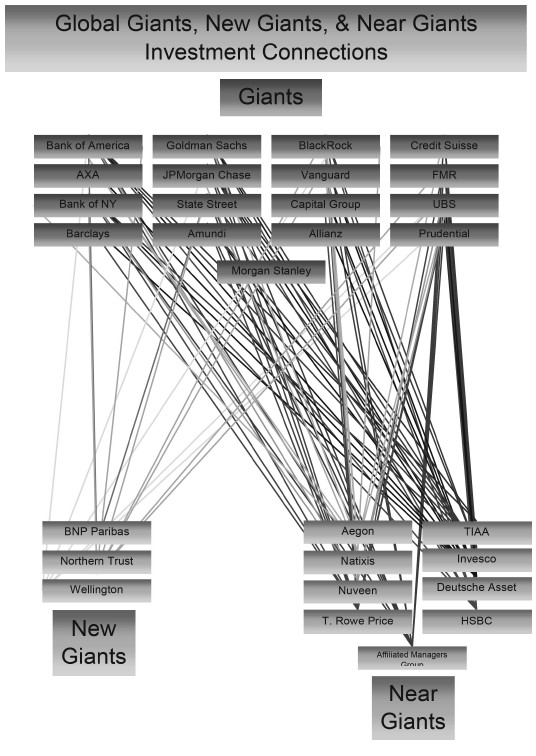
Diagrams in the book are often useless spaghetti illustrations of many dozens of crisscrossing lines linking inter-locked firms. The point is to show that each one is connected to every other—and it is far more economical to express that fact with words.
The Introduction by William Robinson was, surprisingly, one of the disappointing elements of this book. Robinson exploited the opportunity to sound off on a range of issues that personally anger and frustrate him—everything from Trump to climate change. I gather that this a popular Californian academic narrative. The chapter on the whole has a certain apocalyptic, doomsday quality to it, which is arguably more of a reflection of how culturally unprepared Americans are when it comes to absorbing the reality of their imperial decline: “If we do not annihilate ourselves in a nuclear holocaust or descend into the barbarism of a global police state, we will have to confront the threat of a human-induced sixth mass extinction that scientists say has already begun” (pp. 15–16).
At times, the book appears to pander to the fixations of the liberal-left, especially where climate emergency alarmism and identity politics are concerned. We are thus told at various points that this or that board of directors is exclusively male, or exclusively white, or white and male—as if the aesthetic veneer of dominance is what should occupy our attention.
Sometimes the book paints an excessively bleak and hopeless picture of inevitable collapse and war. The power of elites is sometimes overstated. Assumptions that poverty leads to rebellion (p. 303) are part of the book’s baggage of truisms, even if there is painfully little evidence to validate such assumptions. The point is that if it is all so bleak, then that defeats the chances of reform, the same reform that the book advocates. Phillips argues that unless something is done soon, movements like Occupy Wall Street will continue to emerge (p. 305)—to which the answer has to be a big “so what?”
Lastly, the index contains some notable errors and omissions, and is actually not very useful for using this book.
Conclusion
Reminding me of the some of the great books written by Susan George in the 1980s on debt crises and hunger, this is one of the more original and important contributions to early 21st-century debates about the decline of the 20th-century phenomenon known as “globalization”. It will serve as a valuable reference to many students of globalization, both within and outside of academia. Thus, despite my criticisms above, I would still recommend this book as required reading for any students in the fields of Political Science and International Relations, Global Sociology, and International Political Economy, as well as perhaps students in Economic Anthropology. What is especially valuable about this book is more than just its detail, but its reconciling of transnational capitalism with US empire. Even where the book falls short, it does so in a manner that provokes many productive and constructive questions.
For me personally, what emerged from studying this text is recognition of the degree to which states still matter immensely in the so-called globalized world (produced by states themselves), and the extent to which the US stands on top of globalization. It is no surprise then that we see the decline of US empire at the same time as the rise of de-globalization. Not discussed in this volume—and hardly mentioned on this site either—is the rise of an embryonic new order dominated by China, as evidenced by its extremely ambitious and widely spread Belt and Road Initiative.
Source: https://zeroanthropology.net/2019/11/27/global-giants-american-empire-and-transnational-capital/
US gatecrashes into Libyan endgame. But Russia stands in the way
By M. K. BHADRAKUMAR | Indian Punchline | November 29, 2019
The United States has alleged that Russia’s presence in Libya is having an “incredibly destabilising” impact. Washington is stepping out of the shade and making way to the centre stage of the Libyan conflict.
David Schenker, the State Department’s assistant secretary for near eastern affairs said Tuesday in Washington, “The United States is committed to a secure and prosperous future for the people of Libya. For this to become a reality, we need real commitments from external actors… In particular, Russia’s military interference threatens Libya’s peace, security, and stability.”
Schenker explained, “Russian regulars and the Wagner forces are being deployed in significant numbers on the ground and support of the LNA [Libyan National Army]. We think this is incredibly destabilising. And the way this organisation, the Russians in particular, have operated before raises the spectre of large-scale casualties in civilian populations.”
Schenker spoke only days after a delegation of US civilian and military officials led by the high-flying US Deputy National Security Advisor Victoria Coates met with Khalifa Haftar, the supremo of the LNA. A state department readout said Coates expressed serious concern to Haftar over Russia’s “exploitation of the conflict” at the expense of the Libyan people.
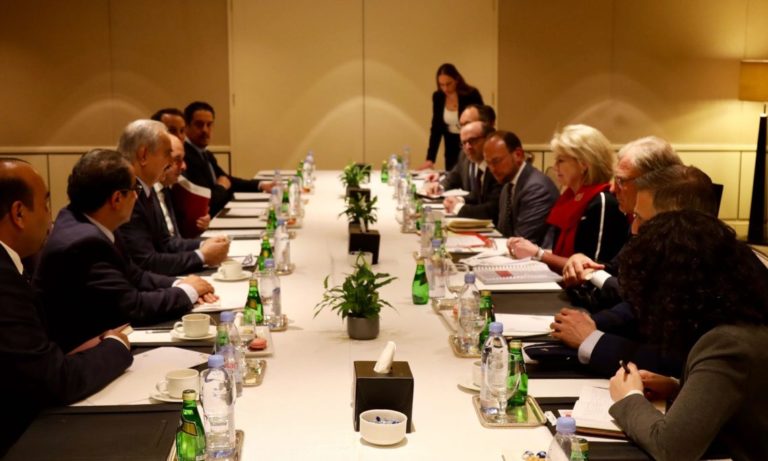
US Delegation meeting with General Khalifa Haftar, Nov 24, 2019
Libya becomes the third theatre after Ukraine and Syria where Washington has locked horns with Moscow in a Cold War-style proxy war. Up until last weekend, two EU members were supposedly conducting a proxy war in Libya over control of Africa’s largest oil and gas resources — France and Italy.
Actually, the alignments in Libya do not warrant a US-Russia standoff, as disparate external powers largely pursue self-interests. Italy, Turkey and Qatar have backed the Government of National Accord (GNA) in Tripoli (also supported by Germany and the UN), while France, Egypt, UAE, Saudi Arabia and Russia backed LNA.
The fight against terrorist groups is a stated common objective of all protagonists, but there are sub-plots too — Libya’s oil and gas (France, Italy, Turkey and Russia); political Islam (Turkey, Qatar, Egypt, UAE); France’s military operations in the five Sahel countries (Mauritania, Mali, Niger, Burkina Faso and Chad), which can end only with the stabilisation of Libya; the migration issue; and geopolitical interests (France, Italy, Russia and Turkey).
Although Haftar was a CIA “asset” for over three decades, Washington largely kept contacts with him under the radar and seemingly watched the struggle between GNA and LNA from the sidelines even after Haftar launched a determined push in April to capture Tripoli. The US policies were incoherent. President Trump apparently viewed Haftar as a factor of stability, while Washington officially pitched for a UN-mediated political settlement in Libya, although that is easier said than done, given the fragmentation in the country.
Washington was marking time, unsure whether Haftar’s military campaign would succeed. Moscow too took a back seat, but in recent months the Kremlin began weighing Haftar’s prospects positively. Moscow (like Cairo) counts on Haftar’s impeccable credentials in the fight against terrorist groups.
Russian military support has decisively helped Haftar’s campaign, which took big leaps lately. Haftar controls something like 80 percent of Libya, whereas, GNA is reduced to a mere rump confined to Tripoli.
Enter Washington. Washington feels alarmed that in the Libyan endgame, with Haftar inexorably gaining the upper hand, thanks to Moscow’s help, the vista opens for cascading Russian influence over the new regime.
Nonetheless, it isn’t easy to find fault with Russia’s military role to stabilise Libya, since NATO intervention in 2011 that wrought havoc and such colossal destruction had enjoyed the backing of Obama Administration. Washington is on weak moral grounds. Geopolitics is dictating its policy trajectory.
Washington’s policy is driven by the project to make Libya the headquarters of the United States Africa Command, one of the eleven unified combatant commands of the United States Armed Forces (which is presently based in Stuttgart, Germany.) Clearly, the rollback of Russian presence and influence in Libya becomes a prerequisite of the US project.
The backdrop, of course, is the big-power struggle erupting over Africa and its vast untapped resources. China has been rapidly expanding its presence in Africa and Russia too is stepping up. Importantly, as the recent Russia-Africa summit in Sochi (October 23-24) signalled, military cooperation is Moscow’s priority.
Russia and China’s growing presence creates space for African leaderships to negotiate with the Western powers. It is a sign of the times that the South African Navy’s first-ever multinational maritime exercise (November 25-30) is exclusively with Russia and China.
Fan Guanqing, the captain of the PLA Navy frigate Wei Fang, said in Cape Town last weekend, “We hope that the exercises will allow China, Russia and South Africa to work together and make an improvement through co-operation and exchanges. This exercise is historical and the first of its kind for these three countries.” Captain Fan said the maritime exercise should help maintain world peace and stability and would also be the starting point of a relationship between the three countries.”
Libya is the perfect gateway for NATO to penetrate the African continent. But a willing government in Tripoli could give the Russian Navy access to the eastern Libyan ports of Sirte and Benghazi on the Mediterranean. If Russia gets ensconced in Libya (in addition to Syria), NATO presence in the Mediterranean is affected. Russia and Libya also have a history of close political, military and economic ties dating back to the Soviet era.
Russia had a traditional presence in Libya’s armaments market and Soviet troops were deployed in Libya. Today, Libya’s reconstruction is the real prize for Moscow in terms of infrastructure (roads, railways, cities). Russia lost heavily due to the NATO-led regime change in Libya in 2011. Moscow had billions of dollars in investments in Libya during Moammar Gadhafi’s rule.
It remains to be seen how far the US pressure tactic on Haftar to sever his links with Russia will work. Russia, France and Egypt are on the same page in helping Haftar militarily. All three countries also bond together. While Moscow’s politico-military relations with Cairo are deepening, France is decoupling from the US’ Russia policies. Washington will be hard-pressed to isolate Russia in Libya. The big question is where indeed Haftar himself stands.
WikiLeaks Proved the OPCW Cannot Be Trusted In Syria
By Paul Antonopoulos | November 26, 2019
The “Syrian regime” and chemical weapons has become a constant mantra in the Western World and has become synonymous with the Syrian War since it began in 2011. One of the most famous cases was the April 2018 chemical weapon attack in the Damascene satellite city of Douma that led to the U.S., UK and France conducting airstrikes against Syrian Army positions, despite the lack of evidence that the Syrian government was responsible for the incident.
The April 7, 2018 chemical incident killed between 40 and 50 people and was followed up by the Western Powers attack against Syria exactly a week later. Strangely though, the attack took place just mere hours before the Organization for the Prohibition of Chemical Weapons (OPCW) inspectors arrived in Syria to investigate the attack. The U.S., UK and France knew that the eventual OPCW report would not match their claims and allegations against the Syrian government, and were quick to act in wasting their people’s tax dollars by dropping bombs on the Arab country.
The final OPCW report would not match the first report made by the Fact-Finding mission that were actually on the ground in Syria. An email released by whistleblowing Wikileaks on the weekend found that the final OPCW report on the Douma incident had been manipulated and changed by the Office of the Director-General of the OPCW, then held by Turkish diplomat Ahmet Üzümcü. This is an extremely disturbing discovery as the OPCW claims to have a “neutral role” by not assigning blame for chemical weapon use, but to find out the details of how the attack was conducted. This however was reversed last year with the OPCW being given permission to investigate perpetrators – but they still kept the mythology that they are “neutral.”
Although the report did not assign blame, the e-mail claims that the report “morphed into something quite different to what was originally drafted” and that “a bias has been introduced into the report, undermining its credibility” and that it “is disingenuous.” This was of course to bring the illusion that Syria was responsible for the attack, despite no tangible evidence.
In March, the OPCW report claimed that chlorine was the likely agent used in last year’s attack, but the newly released email explains that this claim “is highly misleading and not supported by the facts.”
“Omitting this section of the report has a serious negative impact on the report as this section is inextricably linked to the chemical agent identified… In this case, the confidence in the identity of chlorine or any other choking agent is drawn into question precisely because of the inconsistency with the reported and observed symptoms. The inconsistency was not only noted by the fact-finding mission team, but strongly supported by three toxicologists with expertise in exposure to chemical warfare agents”, the e-mail revealed.
The email then makes a final request that the original report be released in “its entirety” as the author fears that the manipulated report does not “reflect the work of the team” and “would negatively impact on the perceived credibility of the report, and by extension that of the Organisation.”
It must be remembered that when the OPCW report was released in March 2019, nearly a whole year after the incident. The released report ignored evidence provided by the Russian Foreign Ministry that the Al-Qaeda affiliated White Helmets were responsible for the attack, and that rather the report was attempting to justify the U.S.-led attack against Syria.
However, the release by WikiLeaks was only the final nail in the coffin confirming that the OPCW is not “neutral” and rather highly politicized. It was revealed only last week by the Grayzone that a second whistleblower from the OPCW came forward to accuse the top leadership of the organisation of suppressing critical evidence because of pressure from the U.S.
This demonstrates that there is a major rift between the actual inspectors on the ground and the higher-level officials of the organization who are willingly submitting to U.S. pressures despite trying to maintain their credibility of being neutral. The very appointment of Üzümcü, a former Turkish ambassador to Israel and a former Permanent Representative of Turkey to NATO, demonstrates that his very appointment had political motivations knowing Ankara’s aggressive foreign policy towards Syria since the beginning of the war.
There can be little doubt now that the claim of neutrality is far from reality and rather the top leadership of the OPCW are willing to omit, manipulate and change facts that were on the ground and discovered by their own Mission at the behest of the U.S. so it could pressure Syria and legitimize the illegal U.S.-led attack. This can only bring into question now the legitimacy of all the other chemical weapon attacks blamed on the Syrian government over the course of many years.
In addition, the OPCW should be the center of wide condemnation from the international community and the United Nations, who once shared a Joint Mission with the OPCW to remove Syria’s chemical weapons from October 2013 to September 2014. The OPCW has now lost all credibility and should be replaced by a new organization that does not appoint controversial Director-Generals or submit to pressure from external forces, like the U.S., and perhaps even Turkey.
However, the most telling of the politicization of the OPCW occurred at yesterday’s annual OPCW forum in the Hague, where the organization vehemently defended themselves against the well-timed Wikileaks expose. Fernando Arias, the current OPCW Director-General, defended the manipulated report, saying: “the nature of any thorough inquiry for individuals in a team is to express subjective views. While some of these diverse views continue to circulate in some public discussion forums, I would like to reiterate that I stand by the independent, professional conclusion [of the investigation].”
Simply put, WikiLeaks has helped prove that the OPCW can no longer be trusted and certainly is not neutral. Britain and France unsurprisingly at yesterday’s OPCW forum also defended the initial report and rejected the allegations of doctoring. But this of course was always to be expected.
Paul Antonopoulos is a Research Fellow at the Center for Syncretic Studies.
In controversial move Italy bans Mahan Air’s flights
By Max Civili | Press TV | November 20, 2019
Rome – The Italian government’s early November announcement that the Iranian first private airline Mahan Air will no longer be allowed to fly to its Italian destinations of Rome and Milan from mid-December had left many baffled in Italy.
Rome’s decision – made after a meeting between Italian Foreign Minister Luigi Di Maio and US Secretary of State Mike Pompeo in October – had followed that of Germany and France which had both already banned flights by the airline in the wake of US pressure.
Washington has been accusing Mahan Air of transporting military equipment and personnel to Middle East war zones – an accusation that the airline has always refuted. The attack came as part of broader US sanctions targeting Iran’s aviation industry.
Also Italy’s flag-carrier Alitalia had suspended its flights to Tehran in January this year, following US President Donald Trump’s decision to reinstate sanctions on Iran.
On Tuesday, at a meeting with a number of Italian journalists and geopolitical analysts held at Iran’s Embassy in Rome, the Ambassador to Italy Hamid Bayat stressed the importance of maintaining access to the Italian airspace.
Iranian authorities believe direct flights between countries that enjoy long-standing relations such as Italy and Iran are essential. About 10,000 young Iranians are enrolled at Italian universities and tens of thousands of Italian tourists visit Iran every year.
Some have argued that Italy’s ban on Mahan Airliner is also a breach of the Chicago Convention on International Civil Aviation. The convention – enacted in the depths of WWII, because people understood the key role aviation would play in connecting the world – established a specialized agency of the United Nations known as ICAO.
France’s year of Yellow Vests protests
By Nebojsa Malic | RT | November 16, 2019
As the ‘Yellow Vests’ protests in France come full circle, some vow to keep fighting for a more just society, while others believe the movement has gone too far. Though rattled, the system they rose up against is still in power.
Every Saturday for a year now, tens of thousands of people all over France have taken to the streets, fed up with not just the neoliberal and austerity policies of President Emmanuel Macron, but apparently the entire political system of the Fifth Republic.
The government has gone after them in force, pushing the police to their breaking point. The mainstream media has demonized them as anti-Semites, homophobes, far-right. Nevertheless, the ‘Yellow Vests’ (Gilets Jaunes) have persisted.
How it all began
A Frenchman marching through the streets of Paris, Lyon, Nice, Marseille, Dijon or any other city this Saturday might recall the very first protest, on November 17, 2018, with 300,000 across the country wearing the government-mandated safety vests as a protest symbol against that very government.
While it is unclear which particular pebble started this avalanche, the general consensus points to that summer’s new speed limit of 80 km/h, ostensibly enacted to cut carbon emissions and fight climate change. That was followed by an “eco-tax.” Whether or not those had the ulterior motive of replenishing the empty French treasury, the people were having none of it.
Trucker Eric Drouet and businesswoman Priscillia Ludosky circulated a petition against the tax in October, which quickly snowballed. Then a resident of Brittany named Jacline Mouraud posted a video on Facebook that went viral. Someone called for a street protest. There has been one every Saturday, ever since.
‘Repression is out in the open now’
Here and there, the protests turned violent. Rocks were thrown at the police. By week two, someone had vandalized the Arc de Triomphe in Paris and set cars on fire. Police responded as they do to riots in the banlieues – suburbs where many of France’s immigrants live in public housing: with overwhelming force.
This kind of repression has been around for a long time, Yellow Vest activist turned journalist Maxime Nicolle tells RT France. Now it’s out in the open, for everyone to see.

Yellow Vests’ Maxime Nicolle (right) speaks with RT France’s Nadège Abderrazak © RT France
Exact numbers are difficult to come by, but French media estimate that over 10,000 people have been detained over the past year. Some 3,000 have been prosecuted and over 400 sentenced to jail time. The carnage on the street has been real as well: 11 people have died over the course of the protests, and over 500 were injured. Of those, 23 lost an eye to “flash-balls,” non-lethal police rounds that maim nonetheless.
Perhaps the most famous among them is Jérôme Rodrigues, a plumber who believes the police deliberately targeted him that January day. Wearing a prosthetic eye, Rodrigues tells RT France he struggles with anger issues and fears for his safety, but if he could turn back time, he would do it all over again.
‘Upside-down world’
The 32-year-old Nicolle, also known as “Fly Rider,” lives in Dinan, Bretagne. His eyes light up with anger when he talks about his compatriots reduced to poverty in their twilight years and his generation sleeping in their cars because they can’t afford the rent and taxes. Meanwhile, he says, the elites are “eating caviar, drinking €500 bottles of wine, living in pretty Paris apartments.”
He rejects the argument that France’s national debt is 98 percent of its GDP and that there is simply no money for social services. Nicolle points out the government takes out loans from private banks, then has to pay steep interest. Why not nationalize the banks, he wonders.
Hundreds of kilometers away, in Paris, the one-eyed Rodrigues argues the same thing. He describes the debt as “numbers in a computer,” and scoffs that somehow there is always money for the wealthy, yet never any for the common man. Corporations have their subsidies and tax havens, yet the working poor have to pay the tax to clean up their pollution. What gives?
Yellow Vests’ Jérôme Rodrigues speaks with RT France © RT France
“Today, if you make €1,500 [a month] in France, you can’t afford rent, you have to sleep in your car. That’s not normal. A working person has the right to live decently,” says Rodrigues. “It’s an upside-down world.”
In separate interviews, both Rodrigues and Nicolle argue that the system itself is unjust, as it thinks nothing of humanity, only of ones and zeroes on the balance sheets. The institutions that were supposed to serve the people have failed, and perhaps it’s time to create new ones. Could the Fifth Republic, around since 1968, be on its last legs?
Almost a revolution
That’s precisely what almost happened within the first month of the Yellow Vests protest, according to one Elysee Palace guard. A member of the special police unit specializing in crowd control (CRS) said this week that the handful of them could not have resisted the 3,000 or so protesters for long.
“If we had been attacked, where I was, we could not have held: the Elysee would fall. In retrospect, it’s really scary,” said the man, who gave his name as Stéphane.
The Yellow Vests did not attack. Macron’s presidency survived. Although the French president has since pledged some €17 billion in tax relief, one-time bonuses and subsidies, he remains determined to reject their demands for systemic reforms. While the protesters never quite numbered the original 300,000, they still turn out every Saturday.
Protests have taken their toll on the police, too, with the rising number of suicides prompting a protest march of their own back in October. The thin blue line is still holding, for now, but it cannot stretch forever.
Parallel to the police repression, the government has implemented a media one. The Yellow Vests were accused of anti-Semitism, homophobia, Islamophobia, xenophobia, racism – just about every possible issue considered beyond the pale in modern liberal discourse.
Nicolle says it was an attempt to label the movement and put it into a box, which failed. People who took a moment to think saw that there was nothing to it and that the Yellow Vests were not an instrument of any political party, whether on the far right or the far left. The smears did have a negative effect, however, fracturing the movement and sending some members running.
Gone too far?
One of them is Jacline Mouraud, the author of the Facebook video that helped kick-start the protests. She lives in Morbihan, Bretagne and still champions the movement’s social and economic justice values – but says they lost her when the Arc de Triomphe was vandalized in December, and “black bloc” anarchists were allowed to torch cars and loot stores in March.

Yellow Vests’ Jacline Mouraud speaks to RT France © RT France
“Violence is counterproductive,” she tells RT France. “Bad dialogue is better than a good war.” At the start of the protests, 80 percent of the French supported the protests, but the tide has turned and now four fifths of the country want nothing to do with the Yellow Vests, she says. “One should know when to stop.”
The March 16 riot in particular alienated many moderates, Mouraud argues. She had already turned political by that point, launching a political party in January 2019. Called The Risen (Les Émergents), it intends to run candidates in France’s local elections in 2020.
Even though she had split off from the ‘Yellow Vests,’ Mouraud’s party exemplifies their desire to bring more direct democracy to France, a country where the existing political establishment is increasingly seen as out of touch.
‘People will make you great’
President Macron “lives in another world,” Rodrigues tells RT France. The one-eyed plumber described the French leader as isolated from reality, in an ivory tower guarded by police, working for the benefit of “his rich friends” – Macron became a millionaire working as an investment banker at Rothschild & Co after the 2008 financial crisis – rather than the “folks in the rafters.”
“You want to be a great man? It’s the people that make you great,” Rodrigues said, noting that the French history remembers the statesmen who served the nation well, rather than just themselves.
Macron and the media have tried to paint the Yellow Vest as “far-right,” but their platform seems to have more in common with the left of yesteryear. They say they fight not just for their children – such as Nicolle’s 9-year-old daughter – but for the memory of their grandparents’ generation, which fought for the rights the French of today take for granted; the 40-hour workweek, weekends and annual leave.
Not quite a revolution, but definitely not business as usual, the ‘Yellow Vests’ defy categorization. Though maybe not attracting the numbers they once did, the Gilets Jaunes are still going strong. For better or for worse, stopping is the last thing on their mind.
Also on rt.com:
March of the mutilated: Injured Yellow Vests protest police brutality in Paris (VIDEO)
Rouhani: Iran to stay in JCPOA, reap benefits when UN arms embargo ends next year
Press TV – November 11, 2019
President Hassan Rouhani says Iran intends to stay in the 2015 nuclear deal despite US violations, arguing that the accord will be put to good use next year when a long-running arms embargo against Tehran comes to an end.
Rouhani said Monday Iran could respond to America’s exit from the Joint Comprehensive Plan of Action (JCPOA) in different manners, including leaving the deal altogether or keeping it at any price, but it decided to take the middle-ground option.
“By continuing the JCPOA, we will fulfill a major objective in terms of politics, security and defense,” he told a large crowd of people during a visit to the eastern province of Kerman.
Noting that for years Iran has been banned by the United Nations from buying and selling any kinds of weapons, Rouhani said the arms embargo will end next year according to the deal and the UN Security Council Resolution 2231, which endorses it.
“This is one of the important effects of this deal. Otherwise, we could leave the deal today but the kind of benefit we stand to reap next year will no longer exist,” he said.
“We can leave now but then the UNSC resolutions [that were revoked under the deal] will return,” the president said, adding “We need to think where do the country’s interests lie.”
Iran, he said, did not want to stay fully committed to the deal while the others “sit on their hands” and do nothing.
“Therefore we took the middle ground to keep the JCPOA and preserve it while cutting back on what we had agreed to do under the agreement step by step,” he said.
Since May, Iran has been scaling down its nuclear deal commitments in retaliation for Washington’s 2018 pullout from the deal and the failure of three European signatories — the UK, France and Germany — to protect bilateral trade against American sanctions.
In the first three stages of its measured response, Iran enriched uranium beyond the 300kg limit set by the deal and ramped up enrichment to levels upon the pre-defined 3.67-percent cap. It also expanded nuclear research to areas banned in the agreement.
The fourth step, which was unleashed last week, was the injection of uranium hexafluoride (UF6) gas into centrifuges at the Fordow underground enrichment facility.
Tehran says its reciprocal measures do not violate the JCPOA and are based on Articles 26 and 36 of the agreement itself, which detail mechanisms to deal with non-compliance.
Iranian authorities have suggested that the measures will be reversible as soon as Europe finds practical ways to shield the Iranian economy from the sanctions.
Rouhani said Monday Iran’s nuclear capability is “better than ever,” noting that Iranian nuclear experts have never stopped research and development work since the JCPOA was first signed in 2015.
“We will stand up to our enemies with full power. We haven’t done anything illegal and we are not willing to bow to your orders,” he said.
Touching on disparaging statements by Western countries, Rouhani said, “Are you mad we restarted Fordow? Are you mad with the resumption of nuclear enrichment? Are you mad at us for speeding up the Arak heavy water [facility]? Then you should fulfill your commitments as well.”
Germany, France and Britain were to meet in Paris on Monday to discuss how to respond to Iran stepping back from its commitments under the accord, German Foreign Minister Heiko Maas said.
“We are very concerned to see that there are other uranium enrichments that Iran has not only announced, but is also carrying out,” Maas said as he arrived for talks with fellow EU foreign ministers in Brussels.
“We want to preserve the JCPOA but Iran will have to return to his obligations and comply with them. Otherwise we will reserve for ourselves all the mechanisms laid down in the agreement,” he said.
Maas was apparently threatening to trigger a dispute mechanism in the 2015 nuclear deal, which could open the way to renewed UN sanctions.
The word they won’t use to describe Canada’s role in Haiti

Molotov cocktail thrown at Canadian Embassy in Port-au-Prince
By Yves Engler · November 9, 2019
Something you can’t name is very difficult to talk about. Canada’s role in Haiti is a perfect example. Even when the dominant media and mainstream politicians mention the remarkable ongoing revolt or protesters targeting Canada, they fall on their faces in explaining it.
Not one journalist or politician has spoken this truth, easily verified by all sorts of evidence: “Sixteen years ago Ottawa initiated an effort to overthrow Haiti’s elected government and has directly shaped the country’s politics since. Many Haitians are unhappy about the subversion of their sovereignty, undermining of their democracy and resulting impoverishment.”
Last Sunday protesters tried to burn the Canadian Embassy in Port-au-Prince. Voice of America reported, “some protesters successfully set fire to business establishments and attempted to burn down the Canadian Embassy.” A few days earlier protesters threw rocks at the Canadian Embassy and demonstrators have repeatedly speechified against Canadian “imperialism”. In response to the targeting of Canada’s diplomatic representation in the country, Haiti’s puppet government released a statement apologizing to Ottawa and the embassy was closed for a number of days.
Echoing the protesters immediate demand for Jovenel Moïse to go, an open letter was released last Tuesday calling on Justin Trudeau’s government to stop propping up the repressive and corrupt Haitian president. David Suzuki, Roger Waters, Amir Khadir, Maude Barlow, Linda McQuaig, Will Prosper, Tariq Ali, Yann Martel and more than 100 other writers, musicians, activists and professors signed a letter calling on “the Canadian government to stop backing a corrupt, repressive and illegitimate Haitian president.”
While a number of left media ran the letter, major news outlets failed to publish or report on it. Interestingly, reporters at La Presse, Radio Canada and Le Devoir all expressed interest in covering it but then failed to follow through. A Le Devoir editor’s reaction was particularly shameful since the leftish, highbrow, paper regularly publishes these types of letters. The editor I communicated with said she’d probably run it and when I called back three days later to ask where things were at, she said the format was difficult. When I mentioned its added relevance after protesters attempted to burn the Canadian embassy, which she was aware of, she recommitted to publishing it. Le Devoir did not publish the letter when it was submitted to them, although an article published in their paper two weeks later did mention it.
My impression from interacting with the media on the issue is that they knew the letter deserved attention, particularly the media in Québec that cover Haiti. But, there was discomfort because the letter focused on Canada’s negative role. (The letter is actually quite mild, not even mentioning the 2004 coup, militarization after the earthquake, etc.)
On Thursday Québec’s National Assembly unanimously endorsed a motion put forward by Liberal party foreign affairs critic, Paule Robitaille, declaring “our unreserved solidarity with the Haitian people and their desire to find a stable and secure society.” It urges “support for any peaceful and democratic exit from the crisis coming from Haitian civil society actors.”
In March Québec Solidaire’s international affairs critic Catherine Dorion released a slightly better statement “in solidarity with the Haitian people”. While the left party’s release was a positive step, it also ignored Canada’s diplomatic, financial and policing support to Moise (not to mention Canada’s role in the 2004 coup or Moise’s rise to power). Québec Solidaire deputies refused to sign the open letter calling on “the Canadian government to stop backing a corrupt, repressive and illegitimate Haitian president.”
Even when media mention protests against Canada, they can’t give a coherent explanation for why they would target the great White North. On Wednesday Radio Canada began a TV clip on the uprising in Haiti by mentioning the targeting of the Canadian embassy and with the image of a protester holding a sign saying: “Fuck USA. Merde la France. Fuck Canada.” The eight-minute interview with Haiti based Québec reporter Etienne Côté-Paluck went downhill from there. As Jean Saint-Vil responded angrily on Facebook, these three countries are not targeted “because of the ‘humanitarian aid’ that the ‘benevolent self-proclaimed friends of Haiti’ bring to the ‘young democracy in difficulty’. This is only racist, paternalistic and imperialist propaganda! They say ‘Fuck Canada’, ‘Shit France’, ‘Fuck USA”’ because they are not blind, dumb or idiots.”
A few days earlier Radio Canada’s Luc Chartrand also mentioned that Canada, France and the US were targeted by protesters when he recently traveled to Haiti. While mentioning those three countries together is an implicit reference to the 2004 coup triumvirate, the interview focused on how it was because they were major donors to Haiti. Yet seconds before Chartrand talked about protesters targeting the Canada-France-US “aid donors” he mentioned a multi-billion dollar Venezuelan aid program (accountability for corruption in the subsidized Venezuelan oil program is an important demand of protesters). So, if they are angry with “aid donors” why aren’t Haitians protesters targeting Venezuela?
Chartrand knows better. Solidarité Québec-Haiti founder Marie Dimanche and I met him before he left for Haiti and I sent Chartrand two critical pieces of information chosen specifically because they couldn’t be dismissed as coming from a radical and are irreconcilable with the ‘benevolent Canada’ silliness pushed by the dominant media. I emailed him a March 15, 2003, L’actualité story by prominent Québec journalist Michel Vastel titled “Haïti mise en tutelle par l’ONU ? Il faut renverser Aristide. Et ce n’est pas l’opposition haïtienne qui le réclame, mais une coalition de pays rassemblée à l’initiative du Canada!” (Haiti under UN trusteeship? We must overthrow Aristide. And it is not the Haitian opposition calling for it, but a coalition of countries gathered at the initiative of Canada!)
Vastel’s article was about a meeting to discuss Haiti’s future that Jean Chretien’s government hosted on January 31 and February 1 2003. No Haitian representative was invited to the meeting where high level U.S., Canadian and French officials discussed overthrowing elected president Jean-Bertrand Aristide, putting the country under international trusteeship and resurrecting Haiti’s dreaded military. Thirteen months after the Ottawa Initiative meeting, US, French and Canadian troops pushed Aristide out and a quasi-UN trusteeship had begun. The Haitian police were subsequently militarized.
The second piece of information I sent Chartrand was the Canadian Press’ revelation (confirmation) that after the deadly 2010 earthquake, Canadian officials continued their inhumane and antidemocratic course. According to internal government documents the Canadian Press examined a year after the disaster, officials in Ottawa feared a post-earthquake power vacuum could lead to a “popular uprising.” One briefing note marked “secret” explained: “Political fragility has increased the risks of a popular uprising, and has fed the rumour that ex-president Jean-Bertrand Aristide, currently in exile in South Africa, wants to organize a return to power.” The documents also explained the importance of strengthening the Haitian authorities’ ability “to contain the risks of a popular uprising.”
To police Haiti’s traumatized and suffering population 2,050 Canadian troops were deployed alongside 12,000 U.S. soldiers and 1,500 UN troops (8,000 UN soldiers were already there). Even though there was no war, for a period there were more foreign troops in Haiti per square kilometer than in Afghanistan or Iraq (and about as many per capita). Though Ottawa rapidly deployed 2,050 troops officials ignored calls to dispatch this country’s Heavy Urban Search and Rescue (HUSAR) Teams, which are trained to “locate trapped persons in collapsed structures.”
Of course, these two pieces of information run completely counter to the dominant narrative about Canada’s role in Haiti. In fact, they flip it on its head. But, these two pieces of information — combined with hundreds of stories published by left-wing Canadian and Haitian media — help explain why some might want to burn the Canadian Embassy.
Haiti is the site of the most sustained popular uprising among the many that are currently sweeping the globe. Haitians are revolting against the IMF, racism, imperialism and extreme economic inequality. It’s also a fight against Canadian foreign policy.
The latter battle is the most important one for Canadians. Solidarity activists should highlight Haitians’ rejection of 16 years of Canadian disregard for their democratic rights. And they should not be afraid to use the words that describes this best: Canadian imperialism.
“Major Revelation” from OPCW whistleblower: Jonathan Steele speaking to the BBC
By Tim Hayward | October 27, 2019
The following is a transcription of an interview given by Jonathan Steele (former Senior Middle East Correspondent for the Guardian ) to Paul Henley, on the BBC World Service programme, Weekend, on 27 October 2019.
Jonathan Steele: “I was in Brussels last week … I attended a briefing by a whistleblower from the Organisation for the Prohibition of Chemical Weapons. He was one of the inspectors who was sent out to Douma in Syria in April last year to check into the allegations by the rebels that Syrian aeroplanes had dropped two canisters of chlorine gas, killing up to 43 people. He claims he was in charge of picking up the samples in the affected areas, and in neutral areas, to check whether there were chlorine derivatives there …
Paul Henley: And?
JS: … and he found that there was no difference. So it rather suggested there was no chemical gas attack, because in the buildings where the people allegedly died there was no extra chlorinated organic chemicals than in the normal streets elsewhere. And I put this to the OPCW for comment, and they haven’t yet replied. But it rather suggests that a lot of this was propaganda…
PH: Propaganda led by?
JS: … led by the rebel side to try and bring in American planes, which in fact did happen. American, British and French planes bombed Damascus a few days after these reports. And actually this is the second whistle blower to come forward. A few months ago there was a leaked report by the person who looked into the ballistics, as to whether these cylinders had been dropped by planes, looking at the damage of the building and the damage on the side of the cylinders. And he decided, concluded, that the higher probability was that these cylinders were placed on the ground, rather than from planes.
PH: This would be a major revelation…
JS: … it would be a major revelation …
PH: … given the number of people rubbishing the idea that these could have been fake videos at the time.
JS: Well, these two scientists, I think they’re non-political – they wouldn’t have been sent to Douma, if they’d had strong political views, by the OPCW. They want to speak to the Conference of the Member States in November, next month, and give their views, and be allowed to come forward publicly with their concerns. Because they’ve tried to raise them internally and been – they say they’ve been – suppressed, their views have been suppressed.
For more on the story
Media Coverage of OPCW Whistleblower Revelations
“Unacceptable Practices at OPCW” – by José Bustani and international panel
Featured Video
The 1964 Coup in Brazil
or go to
Aletho News Archives – Video-Images
Free Book
Vicious

Lies are Unbekoming | January 25, 2026
The waiting room is clean. The receptionist is polite. The forms ask reasonable questions. Nothing in the physical environment suggests danger. The magazines are current. The hand sanitizer dispenser works. Someone has chosen calming colors for the walls.
A pregnant woman sits in a chair designed for her comfort. She has been told to be here. Not ordered—no one orders. Recommended. Strongly recommended. Everyone does this. Her mother did this. Her friends did this. The women in her prenatal group compare notes about their appointments the way they compare notes about nursery furniture. Which provider did you choose? What tests have you had? The questions assume the answers. The answers assume the questions.
She will be offered things today. Offered is the word used. The offers will come with information sheets that list risks and benefits in tabular form. She will sign consent documents. Everything will be voluntary in the legal sense. No one will hold her down. No one will threaten her. She will choose, and her choices will feel like choices, and she will leave feeling she has done the responsible thing.
What she will not feel is the weight of what has been arranged before she arrived. … continue
Blog Roll
Recent Comments
Coronistan on Donald Trump Is No Peace … seversonebcfb985d9 on French court jails pro-Palesti… eddieb on Fourteen Incredible Facts Abou… Bill Francis on European leaders’ shift in the… seversonebcfb985d9 on Villains of Judea: Philip Esfo… loongtip on Report warns that ‘Jewish terr… Craig Nelms on New study shows that toxic gas… loongtip on A Funny Thing Happened on the… loongtip on EU free trade pact on hold as… John Edward Kendrick on Regime Change In Iran Is The F… Bill Francis on Australia Passes New Hate Spee… seversonebcfb985d9 on Australia Passes New Hate Spee…


 Aletho News
- Epidemic of fake videos
- Craig Murray, Reporting from Venezuela
- Why Israel’s Drive to Destroy Iran is Ultimately about Palestine
- Trump and Iran, War or Negotiations?
- US pressure contributing to Israeli influence in Latin America: Experts
- China Rejects U.S. Claims of Coercion in Central America
- New US defense strategy downgrades Russian ‘threat’
- EU turns to India for defense cooperation as US ties fracture
- Donald Trump Is No Peace President
- Vicious
- If Americans Knew
- Will Rafah crossing be opened at last? – Not a ceasefire Day 108
- Israeli drone strike kills two children collecting firewood in Gaza – Not a ceasefire Day 107
- Another Gaza baby freezes to death on Netanyahu’s watch – Not a ceasefire Day 106
- Oppose Israel’s Abuses While You Still Can
- UNRWA Heads Tell Ha’aretz: ‘We Don’t Radicalize Palestinians – Their Lived Existence Does’
- Plans Call for “New Rafah” Built in Israel’s Image — Without Palestinians
- Posing as priest, reporter is spat at many times, highlighting anti-Christian sentiment in Israel
- Leaked Documents: “Planned Community” in Rafah Would Force Palestinians Into Israeli Panopticon
- ‘Permits of Humiliation’: How Israel Strangles Christian Education in Jerusalem
- “The world sees death, destruction and injustice – and they see dollar signs” – Not a ceasefire Day 105
- No Tricks Zone
- New Study Affirms Rising CO2’s Greening Impact Across India – A Region With No Net Warming In 75 Years
- Germany’s Natural Gas Crisis Escalates … One Storage Site Near Empty …Government Silent
- Polar Colding…Antarctica Saw Its Coldest October In 44 Years!
- New Study: Sea Levels Rose 20 Times The Modern Rate During The Roman Warm Period
- As German Gas Storage Dips Dangerously Low…Shortage Hardly Avoidable
- New Study: Brazil’s Relative Sea Level Was 2+ Meters Higher And SSTs 3-4°C Warmer 6000 Years Ago
- Philosopher Schopenhauer: Climate Science Certainty Stems From Stupidity, Ignorance
- New Study: Species Extinction Rates Declining Since 1980 – ‘Climate Change Is Not An Important Threat’
- Denmark Places Climate Protection Above Animal Welfare, Poisoning And Culling Cows
- New Study: Greenland Was 3-7°C Warmer And Far Less Glaciated Than Today 6000-8000 Years Ago
 Aletho News