For more than a week, protests have been underway across France, sparked by January’s scheduled increase in carbon taxes on gasoline and diesel fuel. These taxes are supposed to save the world from climate change by encouraging everyone to drive less.
But working folk, especially those who reside outside of urban centers, have no choice. They need to get to work, and their elderly relatives need transporting to medical appointments. As Geoff Chambers observes: “Telling a plumber or refrigerator repair man to work from home or to travel by public transport seems…a sure recipe for starting a revolution.”
It’s a strange worldview that says we should lead diminished lives today so that people in the technologically advanced future will reap the rewards. (Human history is full of doomsayers who were convinced the future would be dire, but who have been proven wrong time and again.)
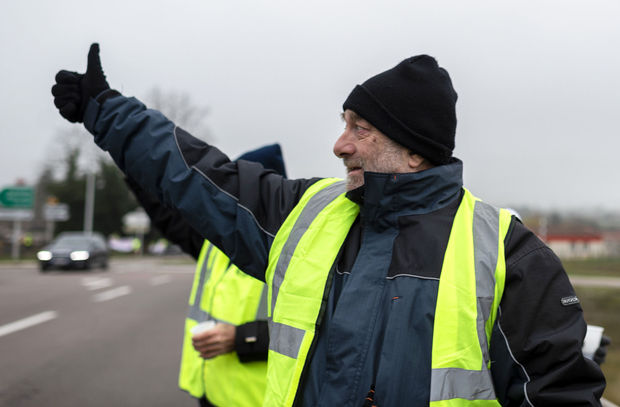
There’s a poetic aspect to these protests. French law mandates reflective yellow vests in every automobile. These aren’t to be kept in the trunk/boot, but within the cabin itself. In the event of a breakdown, a vest must be donned before one exits the vehicle.
Perhaps there’s some sense in this. But as soon as something stops being a suggestion and instead becomes a law, problems arise. One wonders how politically connected the manufacturers/distributors/retailers of such vests happened to be around the time that law got passed. More importantly, individual liberty is undermined when police have an excuse to harass anyone at any time under the guise of checking for the presence of such vests.
In a marvelous flourish, the good people of France have turned this lemon into lemonade. Dressed in these vests, they’ve taken to the streets to protest. An item everyone has been forced by the government to purchase has become a powerful symbol of resistance to a government-imposed carbon tax.
Visual impact is tremendously important if one hopes to attract media attention. A good visual can mean the difference between making it onto the television news or being wholly ignored.
The photos of, and videos from, these protests are fantastic. Those yellow vests (gilets jaunes) are the cat’s meow.
LINKS:
See Geoff Chambers’ compelling exploration of the larger context of these protests here and here.
This BBC article says the fine for not having a yellow vest in one’s vehicle in France is 135 Euros – approximately 120 UK pounds, or 153 US dollars. The article also reports that these protests appear to be genuinely grassroots in nature: “In a country where protests are often tightly managed by one political party or trade union, this is a movement with no recognised national leader, no formal structure or affiliation, which unites voters of all ages from the far-left, the far-right, even those who once supported President Macron.”
There’s a huge difference between peaceful protest and violence and vandalism. People who attack police and firefighters, and who damage property, aren’t admirable – whether they’re wearing gilets jaunes or not.
On Wednesday, at least 16 police officers were reportedly injured in clashes with “yellow vests”, protesters who oppose rising prices for fuel in Reunion, a French overseas department in the Indian Ocean.
French President Emmanuel Macron has announced the deployment of troops to Reunion to resolve what he described as a ‘complicated situation’ in the French overseas territory.
“The situation, which has been developing in Reunion since Saturday, is serious. We have taken efforts and will continue to do so — our servicemen will be mobilised starting from tomorrow [Thursday] to restore public order. There will be a crackdown because we cannot tolerate the scenes that we have seen [in the past few days],” Macron tweeted.
His remarks came after French government spokesman Benjamin Griveaux said that at least thirty security officers had been injured in five days of clashes with protesters over soaring gasoline prices in Reunion.
“The latest data on Reunion was shared with us by the cabinet. There were 109 arrests; 30 law enforcers were injured, including 16 police officers and 14 gendarmes,” Griveaux pointed out.
The Reunion protests were part of large-scale demonstrations over the rise in fuel prices which kicked off in France last Saturday.
The French Interior Ministry reported that more than 287,000 people attended the Saturday protests, while French Interior Minister Christophe Castaner said that at least 500 people had been injured across in France during the demonstrations.
The past ten months have seen a 23-percent increase in the price of diesel in France, where the price of petrol has soared by 15 percent within the same period.
As of January 1, 2019, prices for petrol and diesel in France are expected to grow by 2.9 eurocents and 6.5 eurocents, respectively.
Societe Generale has agreed to pay $1.34 billion to US federal and state authorities to settle a pending legal dispute over violations of US trade sanctions against Iran and other countries.
One of France’s largest banks has also pledged to pay $95 million to resolve another dispute over violations of anti-money laundering regulations.
“We acknowledge and regret the shortcomings that were identified in these settlements, and have cooperated with the US authorities to resolve these matters,” the group CEO Frederic Oudea said in a statement.
“These resolutions, following on the heels of the resolution of other investigations earlier this year, allow the bank to close a chapter on our most important historical disputes.”
The bank, informally known as SocGen, reportedly violated the Trading with the Enemy Act by illegally transferring billions of dollars to partners registered or located in countries targeted by US embargos, including Iran, Sudan, Cuba and Libya.
The banking giant said the settlement wouldn’t have an extra impact on its results for the current financial year. SocGen had previously agreed to $1.3 billion (€1.14 billion) in the US and France to settle investigations over transactions with Libya, and over the suspected rigging of Libor, a benchmark rate tied to finance products and debts. Last year, the bank had paid €963 million ($1.1 billion) over another dispute with the Libyan Investment Authority.
According to the Manhattan US Attorney’s office, the latest fine imposed on SocGen is the second biggest financial penalty issued on a bank for breaching US sanctions. In 2015, French international banking group BNP Paribas agreed to pay $8.9 billion to settle a probe on sanctions violations.
Until now the EU has been unwilling to join the US sanctions on Iran preferring to maintain close trade ties with the Islamic Republic.
In a most recent policy U-turn, European Union foreign ministers hinted on Monday that their countries could be prepared to impose new economic sanctions on Iran, Reuters reported.
The sudden shift of policy came after France and Denmark accused Tehran of being allegedly behind a series of plots to carry out attacks on their soil. During a meeting in Brussels French and Danish foreign ministers filled in their fellow EU counterparts on the details of the alleged Iranian plots, although no details or names were discussed, Reuters quoted diplomats as saying on Tuesday.
France has imposed sanctions on two Iranians and Iran’s intelligence service over what it says was a botched attempt to stage a bomb attack at a rally near Paris organised by an exiled Iranian opposition group.
In October, France said it was certain about the Iranian intelligence ministry’s role in the June plot to attack a demonstration by Iranian exiles near Paris.
Also in October, Denmark said it suspected an Iranian government intelligence service of plotting an assassination on its territory and is also ready to join possible EU-wide sanctions against the Islamic Republic.
Iran has denied any involvement in either alleged plot and warned that it could pull out of the nuclear deal if EU powers do not stand up for its trade and financial benefits.
The readiness to punish Tehran would be the first such move in years by the EU, which has been trying keep in place the 2015 nuclear accord with Iran. Brussels has been unwilling to consider sanctions, instead seeking talks with Tehran.
In March, a joint proposal by Britain, France and Germany to sanction Iran over its development of ballistic missiles and its role in the Syrian war failed to gather sufficient support across the EU, including from Italy which wants to maintain business ties with Iran.
During the meeting on Monday, the EU foreign ministers tried to balance the EU’s policy towards Iran by speeding up the creation of a special mechanism to trade with Tehran that could be under EU, not national, law.
Dubbed the Special Purpose Vehicle (SPV), this mechanism could be used to help match Iranian oil and gas exports against purchases of EU goods as part of a barter arrangement, thus circumventing US sanctions, which are based on global use of the dollar for oil sales.
Despite technical difficulties and delays, the EU hopes this arrangement could protect individual member states from being hit by the sanctions Washington has threatened to use against countries that continue doing business with Iran.
In October 2018, Senior Adjunct Fellow of the Federation of American Scientists and former safeguards inspector with the International Atomic Energy Agency (IAEA), Thomas Shea, unveiled his book Verifying Nuclear Disarmament at the Vienna Center for Disarmament and Non-Proliferation.
A key element of his publication is the establishment of a new international control mechanism for the phased and complete elimination of nuclear weapons by all nuclear powers, which will simultaneously monitor any attempts to re-create such weapons of mass destruction again.
In his book, the 78-year-old author, who began his military career on a US aircraft carrier fitting carrier-based aircraft with nuclear bombs, builds on the provisions of the international Treaty on the Prohibition of Nuclear Weapons (TPNW) adopted in July 2017 by suggesting that a special implementing body be set up, which he calls the International Nuclear Disarmament Agency (INDA), to complement the IAEA should the treaty ever enter into force.
According to the US expert, the INDA would be a key body for controlling the entire process of global nuclear disarmament, it would oversee the dismantling of nuclear warheads and the equipment needed to make them at nuclear weapons facilities, and it would also ensure that nuclear weapons are never made again. The agency would operate in accordance with the principles set out in the text of the TPNW.
Thomas Shea has worked out the organisational structure of the INDA and sets this out in his book, along with the principles of its interaction with nuclear states and the IAEA.
The American researcher believes that the INDA should be headed by a Nuclear Disarmament Council made up of 24 members (one from each country party to the TPNW). The council would have nine permanent committees that would control the process of eliminating nuclear weapons, safeguard weapon-sensitive information, ensure the safety and security of nuclear weapons, and carry out inspections to verify nuclear disarmament agreements, so perform certain supranational functions, in other words. The council would also oversee the day-to-day activities of the new disarmament control agency and help implement all the provisions of the Treaty on the Prohibition of Nuclear Weapons. The INDA’s research work will be provided by its staffed Research Institute and its Center for Research and Development related to the verification of nuclear disarmament.
The book’s author has developed key principles for preventing rearmament following the total elimination of nuclear weapons from the world’s arsenals, including the introduction of a strict inspection regime and the international control of fissile material that could be used to make nuclear warheads. He also suggests converting highly enriched uranium to low-enriched uranium as soon as possible, which could then only be used in nuclear power plants.
The American researcher proposes starting the nuclear disarmament process by determining for each nuclear state the minimum amount of fissile material that could be used to made nuclear warheads. He believes it would then be possible to embark on a reciprocal exchange of information about operationally deployed nuclear warheads, which should be eliminated first, and then information about non-deployed warheads, which should be disposed of second. The next step in the nuclear disarmament process would be an agreement to reduce the amount of fissile material intended for nuclear weapons and place all remaining stocks of fissile material under special international control to rule out future rearmament.
Thomas Shea suggests that nuclear states take ten confidence-building nuclear disarmament measures. In particular, he believes that an important measure to increase the level of trust between nuclear states in the nuclear missile sphere would be their mutual commitment not to be the first to use nuclear weapons against each other or not to use them at all, whether first, second, or third, and he also calls for the signing of bilateral agreements on the gradual reduction of nuclear arsenals.
Referring to the Nuclear Posture Review approved by the Trump administration in February 2018, Thomas Shea criticises Russia, China and North Korea for modernising their nuclear weapons, while ignoring the fact that the nuclear arsenals of the West’s “nuclear troika” (Great Britain, the US and France) have been upgraded, as have those of the de facto nuclear powers – Israel, India and Pakistan.
Thomas Shea expresses support for the eventual entry into force of the international TPNW. This contradicts Washington’s official negative position on general nuclear disarmament, which is the most strongly opposed to the idea being implemented in comparison with the other nuclear-armed states. It is well known that the US has already started making plans to create a completely new strategic nuclear triad over the next seven to eight years, which America’s current military and political leaders envisage will exist right up to the 2080s.
The US researcher does not mention any deadlines in his book for reaching global nuclear zero, recognising that the process for complete nuclear disarmament could take many years due to existing disagreements on the issue between nuclear-armed states. He simply notes more generally that nuclear disarmament can only take place when every legal nuclear power – which is to say the “nuclear five” represented by the five permanent members of the UN Security Council – and the four de facto nuclear powers that are not party to the Non-Proliferation Treaty – namely Israel, North Korea, India and Pakistan – understand that they will not be able to fully safeguard their security with nuclear weapons alone and so will switch to non-nuclear means to protect their defence interests. Thomas Shea believes that “disarmament won’t come quickly, quietly or cheaply”.
It is likely that the book will arouse some interest among those in the field as an example of the author’s development of a global mechanism for verifying complete nuclear disarmament at some point in the future. It is unlikely to become a catalyst for discussions on how to create a world completely free of nuclear weapons, however, given that the level of nuclear missile confrontation in the world has grown significantly thanks to the biggest nuclear power – America – while the threshold for using nuclear weapons has been lowered, particularly given the Pentagon’s readiness to use low-yield nuclear warheads, which is to say nuclear warheads with an explosive power of less than 5 kilotons.
The real situation in the world today shows that there are too many doctrinal and military-technical obstacles preventing the complete and irreversible elimination of all nuclear weapons. Their elimination is also made more complicated by the lack of a global consensus. There has also been no noticeable increase in the level of trust between nuclear-armed states, which all have different views on nuclear arms control and the doctrinal basis for their actual use.
It is important to bear in mind that only two-thirds of UN member states voted in favour of adopting the TPNW and it did not have the support of every nuclear power. The process of joining it is even worse: only a third of UN member states have actually signed it. The ratification process is moving along just as slowly. As of November 2018, it had been ratified by less than half of the 50 countries required.
The difficulties in implementing the TPNW are also reflected in the fact that a large proportion of the global community does not want to retain the Intermediate-Range Nuclear Forces Treaty in its current form. This is clearly shown by the results of a UN vote. In October 2018, the First Committee of the United Nations General Assembly, which debates disarmament and international security, unfortunately voted against a draft resolution in support of the INF Treaty. Thirty-one countries voted in favour, 54 countries abstained, and 55 countries, including the US, Great Britain, Canada, France and Ukraine, voted against.
In other words, there is a lack of a global consensus on nuclear disarmament. In fact, it is possible that America’s targeted efforts to unilaterally withdraw from the INF Treaty and its refusal to extend START III could undermine the nuclear non-proliferation regime that has existed for many decades, as well as the entire international legal system for nuclear and conventional arms control that has been established with such difficulty over a long period of time.
French and Israeli media report that a group largely made up of Israelis scammed 3,000 French citizens out of approximately $20 million. Most of the stolen money is in Israel, but Israeli authorities are reportedly failing to cooperate with France in prosecuting the scammers and retrieving the money.
This is the latest of numerous examples of Israeli officials stone-walling international efforts against the perpetrators of massive financial swindles around the world, according to Israeli investigative journalists and others. These scams have brought estimated billions into the Israeli economy, propping up a regime widely condemned for human rights abuses and ethnic cleansing against indigenous Palestinians. Together, the stories paint a picture of a government that seems to be turning a blind eye to – and even protecting – scammers.
A Finance Magnatesanalysis reports that one of the swindles alone has brought in over a billion dollars and employs 5,000 people. And a new scam, described below, may help what is predicted to be “the next major driver of the Israeli economy.”
A former IRS expert on international crime notes that “fraudulent industries are often major economic drivers, and that can translate into political clout.”
The victims of the recent scam against French citizens included churches and the owners of small businesses – delicatessens, car repair shops, hair salons, plumbers, etc. Some lost their life savings and describe being threatened and intimidated by the scammers.
The masterminds of the scam reportedly were Antoine Ilan Frau (aka Ilan Frau) and Michael Nedjar, both of whom resided in Israel at the time. French police arrested the two at the Paris airport in 2016 as they were about to return to Israel. While they and 25 others were subsequently found guilty in a French court, other alleged co-conspirators have not yet been arrested and are believed to be in Israel.
The Times of Israel (TOI) reports that most of the money was channeled to Israel and has not yet been recovered. The newspaper reports that Israeli law enforcement authorities “have been unhelpful in enabling further investigation of the scam and in recovering the stolen funds.”
TOI, which obtained the full French verdict statement, reports: “In 200 pages of matter-of-fact legal prose, the verdict paints a picture of Israeli authorities unwilling to cooperate with their French counterparts.”
Another Times of Israelarticle reports: “The exact number of French citizens thought to be evading authorities in Israel is unknown, but France has sent to Israel at least 70 formal requests for judicial assistance with cases involving suspected fraud by dual nationals residing in the Jewish state.”
Below are some of the other Israeli-connected scams victimizing people around the world that observers accuse the Israeli government of largely ignoring.
Gilbert Chikli, “the world’s greatest con artist”
In 2016 Ha’aretzreported on an Israeli con artist named Gilbert Chikli, who boasts of pioneering a multi-million dollar scam that also targeted people in France. The New York Post has called him “the world’s greatest con artist.”
The scam targeted banks and business, cost French companies an estimated 7.9 million euros. Approximately 52 employees of the companies taken in by him were subsequently fired.
Despite French extradition requests, Ha’aretz reported in 2016 that Chikli “mysteriously remains a free man, living in luxury in his villa in a seaside Israeli city as French authorities try to bring him to justice over a massive con for which he was previously convicted.”
Although a French court sentenced Chikli to a seven-year prison sentence, Ha’aretz reported that instead of being incarcerated, Chikli was “hanging out at his private swimming pool.” Israeli officials refused to explain why Chikli was allowed to live freely in Israel.
Far from disputing the French conviction, Chikli bragged on Israeli TV about his technique: “You get off on it. Because you’re 5,000 kilometers from Paris with a telephone and a 100-euro calling card and you can make 10 million euros” [over $11 million].
Chikli boasted that he had a good life in Israel, where he dealt in real estate (in addition, it appears, to continuing his scams). He also made an estimated several thousand euros for “consultancy services” to a director who made a film based on Chikli’s story.
The film generated unprecedented attention in France, as it depicted “an Israeli-French underworld out of reach of French authorities,” in the words of TOI, “because of the complications in extraditing suspects from Israel.”
Chikli remained free in Israel from 2009 until he traveled to the Ukraine in 2017, where he and another Israeli (also wanted by French authorities) were finally arrested, and Chikli was extradited to France. He was jailed and indicted for an additional scam perpetrated while he was at large.
A French report states that during his time in Ukrainian detention, Chikli was “filmed drinking vodka in his cell, toasting his wealth, swearing never to return to France, and abusing the French judicial system.” … continue reading
World leaders gathered in Paris on Sunday under the Arc de Triomphe to mark the centennial anniversary ending World War I. In an absurd way, the Napoleon-era arc was a fitting venue – because the ceremony and the rhetoric from President Emmanuel Macron was a “triumph” of lies and platitudes.
Among the estimated 70 international leaders were US President Trump and Russian counterpart Vladimir Putin, each sitting on either side of Macron and his wife. German Chancellor Angela Merkel was also given pride of place beside the French president.
Macron’s address to the dignitaries was supposed to be a call for international multilateralism. He urged a “brotherhood” for the cause of world peace. He also made a pointed rebuke of “nationalism” as posing a danger to peace – a remark which seemed aimed at Donald Trump who recently boasted of his politics with that very word.
But, ironically, everything about the ceremony and Macron’s speech resonated with jingoistic French nationalism, not his avowed multinationalism. As the politicians sat under the Arc de Triomphe, Macron walked around its circular esplanade in a salute to assembled French military forces bearing assault rifles and bayonets. The French anthem – The Marseillaise – was played twice, once by an army brass band, the second time sung by an army choir. There was also a military plane flyover displaying the blue, red and white tricolor of the French national flag.
In his speech, Macron talked about soldiers coming from all over the world to “die for France” during the 1914-18 Great War. He even said at one point that the war was fought for “the vision of France” and its “universal values”.
This was fluent drivel, French-style. No wonder Russia’s Putin momentarily gave a look of boredom as Macron waxed lyrical.
The speechifying and commemoration was completely detached from current realities of conflict and international tensions.
Among the “brotherhood” whom Macron was appealing to were Israeli Prime Minister Benjamin Netanyahu whose military forces continue to bomb and slaughter Palestinian civilians in illegally occupied territory. Also present was Ukrainian President Petro Poroshenko whose armed militias continue to terrorize the people of eastern Ukraine with the blatant objective of instigating a war between the US-led NATO alliance and Russia.
Listening to Macron one would think that World War I erupted mysteriously from no specific cause and that an estimated 10 million soldiers were all killed in heroic battles for noble principles.
There was, of course, no mention by Macron of imperialist warmongering and the barbaric sacrifice of humans as slaves in the service of national capitalist power interests.
Grotesquely, as the world leaders donned solemn faces and mouthed pious platitudes for peace, the whole occasion was a triumph in burying reality and the ongoing causes of wars, as well as whitewashing the very culprits responsible for wars. Among the war criminals wearing a mournful black suit was former French President Nicolas Sarkozy who launched the NATO blitzkrieg on Libya in 2011.
While the empty, self-indulgent rhetoric was ringing out, one couldn’t help but recall some of the most glaring contemporary contradictions that were blocked out with awesome Orwellian efficiency.
Just this week, reports emerged of the horrific civilian death toll from the American air force bombing the Syrian city of Raqqa. The city was razed to the ground by US air strikes last year – supposedly to defeat the ISIS terror group. Some 8,000 bodies of civilians, mainly women and children, have now been recovered by Syrian government forces. And that’s only from clearing away a tiny area of rubble for the whole city.
What the Americans did in Raqqa was a monumental war crime, all the more criminal because US forces, along with their NATO partners Britain and France, are illegally present in and assaulting sovereign Syrian territory.
As Macron was telling world leaders about “the vision of France”, hundreds were being killed in Yemen in a battle to strangle the entire population by taking the port city of Hodeida. The genocidal war on that country – which is putting up to 16 million people at risk from starvation – has been fully backed by France, the US and Britain, from their supply of warplanes and bombs to the Saudi and Emirati aggressive forces.
We could mention other specific conflicts where the culprits are clearly identified. For example, the multi-million-dollar support from Washington for the Azov Battalion and other Neo-Nazi militias in Ukraine, which openly emulate the genocidal conduct of Hitler’s Third Reich to exterminate ethnic Russians.
We could mention how US-led NATO forces continue to expand towards Russian territory with outrageous provocation. The mounting earlier this month of the biggest-ever NATO war drills since the Cold War in the Arctic region adjacent to Russia’s northern border was a brazen threat of rehearsing invasion. The announced tearing up of yet another nuclear arms control treaty unilaterally by Washington is a reckless undermining of global security.
Washington threatens China with naval forces marauding near Beijing’s maritime territory in the South China Sea. Washington blockades Iran with illegal economic warfare and openly agitates for regime change. Washington declares Venezuela, Nicaragua and Cuba a “troika of tyranny” and reserves the right to threaten each of these countries with military invasion at any time.
Meanwhile, this weekend, Russia hosted peace talks in Moscow between the warring parties of Afghanistan. It was seen as a major breakthrough in trying to bring peace to the Central Asia country which has been wracked by 17 years of violence since US forces began their ongoing military occupation – allegedly to defeat terrorism.
Elsewhere, Russia has engaged with Turkey, Germany and France to convene a summit for peaceful reconstruction of Syria. The latest summit held in Ankara at the end of last month follows several other such meetings in Astana and Sochi, largely at the behest of Russian leader Vladimir Putin, to find a political settlement to the nearly eight-year war in Syria – a war that was fomented covertly by Washington and its allies for regime change.
France’s Macron talks about “multilateralism” for world peace, yet the two countries which have arguably supported and implemented multilateralism in practice are Russia and China in their calls and policies for global partnership and economic development.
And yet it is Russia and China that are being harassed with American and European sanctions, and US military provocations.
The unilateral, lawless imperialism that engendered World War I and 20 years later World War II is still alive and dangerously vigorous. We only have to look around the present world to realize that. But when the culprits indulge in a triumph of bullshit then we also know that the world is once again in very grave danger.
What was World War One about? How did it start? Who won? And what did they win? Now, 100 years after those final shots rang out, these questions still puzzle historians and laymen alike. But as we shall see, this confusion is not a happenstance of history, but the wool that has been pulled over our eyes to stop us from seeing what WWI really was. This is the story of WWI that you didn’t read in the history books. This is The WWI Conspiracy.
For those with limited bandwidth, CLICK HERE to download a smaller, lower file size version of this episode.
For those interested in audio quality, CLICK HERE for the highest-quality version of this episode (WARNING: very large download).
TRANSCRIPT
INTRODUCTION
November 11, 1918.
All across the Western front, the clocks that were lucky enough to escape the four years of shelling chimed the eleventh hour. And with that the First World War came to an end.
From 10 o’clock to 11 — the hour for the cessation of hostilities — the opposed batteries simply raised hell. Not even the artillery prelude to our advance into the Argonne had anything on it. To attempt an advance was out of the question. It was not a barrage. It was a deluge.
[…]
Nothing quite so electrical in effect as the sudden stop that came at 11 A. M. has ever occurred to me. It was 10:60 precisely and — the roar stopped like a motor car hitting a wall. The resulting quiet was uncanny in comparison. From somewhere far below ground, Germans began to appear. They clambered to the parapets and began to shout wildly. They threw their rifles, hats, bandoleers, bayonets and trench knives toward us. They began to sing.
And just like that, it was over. Four years of the bloodiest carnage the world had ever seen came to a stop as sudden and bewildering as its start. And the world vowed “Never again.”
Each year, we lay the wreath. We hear “The Last Post.” We mouth the words “never again” like an incantation. But what does it mean? To answer this question, we have to understand what WWI was.
WWI was an explosion, a breaking point in history. In the smoldering shell hole of that great cataclysm lay the industrial-era optimism of never-ending progress. Old verities about the glory of war lay strewn around the battlefields of that “Great War” like a fallen soldier left to die in No Man’s Land, and along with it lay all the broken dreams of a world order that had been blown apart. Whether we know it or not, we here in the 21st century are still living in the crater of that explosion, the victims of a First World War that we are only now beginning to understand.
What was World War One about? How did it start? Who won? And what did they win? Now, 100 years after those final shots rang out, these questions still puzzle historians and laymen alike. But as we shall see, this confusion is not a happenstance of history, but the wool that has been pulled over our eyes to stop us from seeing what WWI really was.
This is the story of WWI that you didn’t read in the history books. This is The WWI Conspiracy.
PART ONE – TO START A WAR
June 28, 1914.
The Archduke Franz Ferdinand, heir to the Austro-Hungarian throne, and his wife Sophie are in Sarajevo for a military inspection. In retrospect, it’s a risky provocation, like tossing a match into a powder keg. Serbian nationalism is rising, the Balkans are in a tumult of diplomatic crises and regional wars, and tensions between the kingdom of Serbia and the Austro-Hungarian Empire are set to spill over.
But despite warnings and ill omens, the royal couple’s security is extremely lax. They board an open-top sports car and proceed in a six-car motorcade along a pre-announced route. After an inspection of the military barracks, they head toward the Town Hall for a scheduled reception by the Mayor. The visit is going ahead exactly as planned and precisely on schedule.
And then the bomb goes off.
As we now know, the motorcade was a death trap. Six assassins lined the royal couple’s route that morning, armed with bombs and pistols. The first two failed to act, but the third, Nedeljko Čabrinović, panicked and threw his bomb onto the folded back cover of the Archduke’s convertible. It bounced off onto the street, exploding under the next car in the convoy. Franz Ferdinand and his wife, unscathed, were rushed on to the Town Hall, passing the other assassins along the route too quickly for them to act.
Having narrowly escaped death, the Archduke called off the rest of his scheduled itinerary to visit the wounded from the bombing at the hospital. By a remarkable twist of fate, the driver took the couple down the wrong route, and, when ordered to reverse, stopped the car directly in front of the delicatessen where would-be assassin Gavrilo Princip had gone after having failing in his mission along the motorcade. There, one and a half metres in front of Princip, was the Archduke and his wife. He took two shots, killing both of them.
Yes, even the official history books—the books written and published by the “winners”—record that the First World War started as the result of a conspiracy. After all it was—as all freshman history students are taught—the conspiracy to assassinate the Archduke Franz Ferdinand that led to the outbreak of war.
That story, the official story of the origins of World War I, is familiar enough by now: In 1914, Europe was an interlocking clockwork of alliances and military mobilization plans that, once set in motion, ticked inevitably toward all out warfare. The assassination of the Archduke was merely the excuse to set that clockwork in motion, and the resulting “July crisis” of diplomatic and military escalations led with perfect predictability to continental and, eventually, global war. In this carefully sanitized version of history, World War I starts in Sarajevo on June 28, 1914.
But this official history leaves out so much of the real story about the build up to war that it amounts to a lie. But it does get one thing right: The First World War was the result of a conspiracy.
To understand this conspiracy we must turn not to Sarajevo and the conclave of Serbian nationalists plotting their assassination in the summer of 1914, but to a chilly drawing room in London in the winter of 1891. There, three of the most important men of the age—men whose names are but dimly remembered today—are taking the first concrete steps toward forming a secret society that they have been discussing amongst themselves for years. The group that springs from this meeting will go on to leverage the wealth and power of its members to shape the course of history and, 23 years later, will drive the world into the first truly global war.
Their plan reads like outlandish historical fiction. They will form a secret organization dedicated to the “extension of British rule throughout the world” and “the ultimate recovery of the United States of America as an integral part of a British Empire.” The group is to be structured along the lines of a religious brotherhood (the Jesuit order is repeatedly invoked as a model) divided into two circles: an inner circle, called “The Society of the Elect,” who are to direct the activity of the larger, outer circle, dubbed “The Association of Helpers” who are not to know of the inner circle’s existence.
“British rule” and “inner circles” and “secret societies.” If presented with this plan today, many would say it was the work of an imaginative comic book writer. But the three men who gathered in London that winter afternoon in 1891 were no mere comic book writers; they were among the wealthiest and most influential men in British society, and they had access to the resources and the contacts to make that dream into a reality.
Present at the meeting that day: William T. Stead, famed newspaper editor whose Pall Mall Gazette broke ground as a pioneer of tabloid journalism and whose Review of Reviews was enormously influential throughout the English-speaking world; Reginald Brett, later known as Lord Esher, an historian and politician who became friend, confidant and advisor to Queen Victoria, King Edward VII, and King George V, and who was known as one of the primary powers-behind-the-throne of his era; and Cecil Rhodes, the enormously wealthy diamond magnate whose exploits in South Africa and ambition to transform the African continent would earn him the nickname of “Colossus” by the satirists of the day.
But Rhodes’ ambition was no laughing matter. If anyone in the world had the power and ability to form such a group at the time, it was Cecil Rhodes.
Richard Grove, historical researcher and author, TragedyAndHope.com.
RICHARD GROVE: Cecil Rhodes also was from Britain. He was educated at Oxford, but he only went to Oxford after he went to South Africa. He had an older brother he follows into South Africa. The older brother was working in the diamond mines, and by the time Rhodes gets there he’s got a set up, and his brother says “I’m gonna go off and dig in the gold mines. They just found gold!” And so he leaves Cecil Rhodes, his younger brother—who’s, like, in his 20s—with this whole diamond mining operation. Rhodes then goes to Oxford, comes back down to South Africa with the help of Lord Rothschild, who had funding efforts behind De Beers and taking advantage of that situation. And from there they start to use what—there’s no other term than “slave labor,” which then turns in later to the apartheid policy of South Africa.
GERRY DOCHERTY: Well, Rhodes was particularly important because in many ways, at the end of the 19th century, he seriously epitomized where capitalism was [and] where wealth really lay.
DOCHERTY: Rhodes had the money and he had the contacts. He was a great Rothschild man and his mining wealth was literally uncountable. He wanted to associate himself with Oxford because Oxford gave him the kudos of the university of knowledge, of that kind of power.
And in fact that was centered in a very secretive place called “All Souls College.” Still you’ll find many references to All Souls College and “people behind the curtain” and such phrases—”power behind thrones.” Rhodes was centrally important in actually putting money up in order to begin to gather together like-minded people of great influence.
Rhodes was not shy about his ambitions, and his intention to form such a group were known to many. Throughout his short life, Rhodes discussed his intentions openly with many of his associates, who, unsurprisingly, happened to be among the most influential figures in British society at that time.
More remarkably, this secret society—which was to wield its power behind the throne—was not a secret at all. The New York Times even published an article discussing the founding of the group in the April 9, 1902, edition of the paper, shortly after Rhodes’ death.
The article, headlined “Mr. Rhodes’s Ideal of Anglo-Saxon Greatness” and carrying the remarkable sub-head “He Believed a Wealthy Secret Society Should Work to Secure the World’s Peace and a British-American Federation,” summarized this sensational plan by noting that Rhodes’ “idea for the development of the English-speaking race was the foundation of ‘a society copied, as to organization, from the Jesuits.’” Noting that his vision involved uniting “the United States Assembly and our House of Commons to achieve “the peace of the world,” the article quotes Rhodes as saying: “The only thing feasible to carry out this idea is a secret society gradually absorbing the wealth of the world.”
This idea is laid down in black and white in a series of wills that Rhodes wrote throughout his life, wills that not only laid out his plan to create such a society and provided the funds to do so, but, even more remarkably, were collected in a volume published after his death by co-conspirator William T. Stead.
GROVE: Rhodes also left his his great deal of money—not having any children, not having married, dying at a young age—left it in a very well-known last will and testament, of which there were several different editions naming different benefactors, naming different executors.
So in 1902 Cecil Rhodes dies. There’s a book published that contains his last will and testament. The guy who wrote the book, William T. Stead, was in charge of a British publication called The Review of Reviews. He was part of Rhodes’ Round Table group. He at one time was an executor for the will, and in that will it says that he laments the loss of America from the British Empire and that they should formulate a secret society with the specific aim of bringing America back into the Empire. He talks about this a few different times throughout the will, then he names all the countries that they need to include in this list to have world domination, to have an English-speaking union, to have British race as the enforced culture on all countries around the world.
The will contains the goal. The goal is amended over a series of years and supported and used to gain support. And then by the time he dies in 1902 there’s funding, there’s a plan, there’s an agenda, there’s working groups and it all launches and then takes hold. And then not too long later, you’ve got World War one and then from that you’ve got World War two and then you’ve got a century of control and slavery that really could have been prevented.
When, at the time of Rhodes’ death in 1902, this “secret” society decided to partially reveal itself, it did so under the cloak of peace. It was only because they desired world peace, they insisted, that they had created their group in the first place, and only for the noblest of reasons that they aimed to “gradually absorb the wealth of the world.”
But contrary to this pacific public image, from its very beginnings the group was interested primarily in war. In fact, one of the first steps taken by this “Rhodes Round Table” (as it was known by some) was to maneuver the British Empire into war in South Africa. This “Boer War” of 1899-1902 would serve a dual purpose: it would unite the disparate republics and colonies of South Africa into a single unit under British imperial control, and, not incidentally, it would bring the rich gold deposits of the Transvaal Republic into the orbit of the Rothschild/Rhodes-controlled British South Africa Company.
The war was, by the group’s own admission, entirely its doing. The point man for the operation was Sir Alfred Milner, a close associate of Rhodes and a member of the secret society’s inner circle who was then the governor of the British Cape Colony. Although largely forgotten today, Alfred Milner (later “1st Viscount Milner”) was perhaps the most important single figure in Britain at the dawn of the 20th century. From Rhodes’ death in 1902, he became the unofficial head of the roundtable group and directed its operations, leveraging the vast wealth and influence of the group’s exclusive membership to his own ends.
With Milner, there was no compunction or moral hand-wringing about the methods used to bring about those ends. In a letter to Lord Roberts, Milner casually confessed to having engineered the Boer War: “I precipitated the crisis, which was inevitable, before it was too late. It is not very agreeable, and in many eyes, not a very creditable piece of business to have been largely instrumental in bringing about a war.”
When Rhodes’ co-conspirator and fellow secret society inner circle member William Stead objected to war in South Africa, Rhodes told him: “You will support Milner in any measure that he may take short of war. I make no such limitation. I support Milner absolutely without reserve. If he says peace, I say peace; if he says war, I say war. Whatever happens, I say ditto to Milner.”
The Boer War, involving unimaginable brutality—including the death of 26,000 women and children in the world’s first (British) concentration camps—ended as Rhodes and his associates intended: with the formerly separate pieces of South Africa being united under British control. Perhaps even more importantly from the perspective of the secret society, it left Alfred Milner as High Commission of the new South African Civil Service, a position from which he would cultivate a team of bright, young, largely Oxford-educated men who would go on to serve the group and its ends.
And from the end of the Boer War onward, those ends increasingly centered around the task of eliminating what Milner and the Round Table perceived as the single greatest threat to the British Empire: Germany.
DOCHERTY: So in the start it was influence—people who could influence politics, people who had the money to influence statesmen—and the dream. The dream of actually crushing Germany. This was a basic mindset of this group as it gathered together.
Germany. In 1871, the formerly separate states of modern-day Germany united into a single empire under the rule of Willhelm I. The consolidation and industrialization of a united Germany had fundamentally changed the balance of power in Europe. By the dawn of the 20th century, the British Empire found itself dealing not with its traditional French enemies or its long-standing Russian rivals for supremacy over Europe, but the upstart German Empire. Economically, technologically, even militarily: if the trends continued, it would not be long before Germany began to rival and even surpass the British Empire.
For Alfred Milner and the group he had formed around him out of the old Rhodes Round Table society, it was obvious what had to be done: to change France and Russia from enemies into friends as a way of isolating, and, eventually, crushing Germany.
PETER HOF: Yes, well from the British perspective, Germany, after their unification in 1871, they became very strong very quickly. And over time this worried the British more and more, and they began to think that Germany represented a challenge to their world hegemony. And slowly but surely they came to the decision that Germany must be confronted just as they had come to the same decision with regard to other countries; Spain and Portugal and especially France and now Germany.
German finished goods were marginally better than those from Britain, they were building ships that were marginally better than those of Britain, and all of this. The British elite very slowly came to the decision that that Germany needed to be confronted while it was still possible to do so. It might not be possible to do so if they waited too long. And so this was how the indecision crystallize.
I think that Britain might possibly have accepted the German ascendance, but they had something that that was was close at hand, and that was the Franco-Russian Alliance. And they thought if they could hook in with that alliance, then they had the possibility of defeating Germany quickly and without too much trouble. And that is basically what they did.
But crafting an alliance with two of Britain’s biggest rivals and turning public opinion against one of its dearest continental friends was no mean feat. To do so would require nothing less than for Milner and his group to seize control of the press, the military and all the diplomatic machinery of the British Empire. And so that’s exactly what they did.
The first major coup occurred in 1899, while Milner was still in South Africa launching the Boer War. That year, the Milner Group ousted Donald Mackenzie Wallace, the director of the foreign department at The Times, and installed their man, Ignatius Valentine Chirol. Chirol, a former employee of the Foreign Office with inside access to officials there, not only helped to ensure that one of the most influential press organs of the Empire would spin all international events for the benefit of the secret society, but he helped to prepare his close personal friend, Charles Hardinge, to take on the crucial post of Ambassador to Russia in 1904, and, in 1906, the even more important post of Permanent Under-Secretary at the Foreign Office.
With Hardinge, Milner’s Group had a foot in the door at the British Foreign Office. But they needed more than just their foot in that door if they were to bring about their war with Germany. In order to finish the coup, they needed to install one of their own as Foreign Secretary. And, with the appointment of Edward Grey as Foreign Secretary in December of 1905, that’s precisely what happened.
Sir Edward Grey was a valuable and trusted ally of the Milner Group. He shared their anti-German sentiment and, in his important position of Foreign Secretary, showed no compunction at all about using secret agreements and unacknowledged alliances to further set the stage for war with Germany.
HOF: He became a foreign secretary in 1905, I believe, and the foreign secretary in in in France was of course Delcassé. And Delcassé was very much an anti-German. He was very passionate about the recovery of Alsace-Lorraine, and so he and the King hit it off very well together. And Edward Grey shared this anti-German feeling with the king—as I explained in my book how he how he came to have that attitude about Germany. But in any case, he had the same attitude with the king. They worked very well together. And Edward Grey very freely acknowledged the heavy role that the King I played in British foreign policy and he said that this was not a problem because he and the King were in agreement on most issues and so they worked with very well together.
The pieces were already beginning to fall into place for Milner and his associates. With Edward Grey as foreign secretary, Hardinge as his unusually influential undersecretary, Rhodes’ co-conspirator Lord Esher installed as deputy Governor of Windsor Castle where he had the ear of the king, and the king himself—whose unusual, hands-on approach to foreign diplomacy and whose wife’s own hatred of the Germans dovetailed perfectly with the group’s aims—the diplomatic stage was set for the formation of the Triple Entente between France, Russia and Great Britain. With France to the west and Russia to the east, England’s secret diplomacy had forged the two pincers of a German-crushing vise.
All that was needed was an event that the group could spin to its advantage to prepare the population for war against their former German allies. Time and again throughout the decade leading up to the “Great War,” the group’s influential agents in the British press tried to turn every international incident into another example of German hostility.
When the Russo-Japanese War broke out, rumours swirled in London that it was in fact the Germans that had stirred up the hostilities. The theory went that Germany, in a bid to ignite conflict between Russia and England, who had recently concluded an alliance with the Japanese, had fanned the flames of war between Russia and Japan. The truth, of course, was almost precisely the opposite. Lord Lansdowne had conducted secret negotiations with Japan before signing a formal treaty in January 1902. Having exhausted their reserves building up their military, Japan turned to Cecil Rhodes’ co-conspirator Lord Nathan Rothschild to finance the war itself. Denying the Russian navy access to the Suez canal and high-quality coal, which they did provide to the Japanese, the British did everything they could to ensure that the Japanese would crush the Russian fleet, effectively removing their main European competitor for the Far East. The Japanese navy was even constructed in Britain, but these facts did not find their way into the Milner-controlled press.
When the Russians “accidentally” fired on British fishing trawlers in the North Sea in 1904, killing three fishermen and wounding several more, the British public was outraged. Rather than whip up the outrage, however, The Times and other mouthpieces of the secret society instead tried to paper over the incident. Meanwhile, the British Foreign Office outrageously tried to blame the incident on the Germans, kicking off a bitter press war between Britain and Germany.
The most dangerous provocations of the period centered around Morocco, when France—emboldened by secret military assurances from the British and backed up by the British press—engaged in a series of provocations, repeatedly breaking assurances to Germany that Morocco would remain free and open to German trade. At each step, Milner’s acolytes, both in government and in the British press, cheered on the French and demonized any and every response from the Germans, real or imagined.
DOCHERTY: Given that we’re living in a world of territorial aggrandizement, there was a concocted incident over Morocco, and the allegation that Germany was secretly trying to take over the British/French influence on Morocco. And that literally was nonsense, but it was blown up into an incident and people were were told “Prepare! You had better prepare yourself for the possibility of war because we will not be dictated to by that Kaiser person over in Berlin!”
One of the incidents —which I would need to make reference to to get the date perfectly right—referred to a threat. Well, it was portrayed as a threat—it was no more of a threat than a fly would be if it came into your room at the present moment—of a gun boat sitting off the coast of Africa. And it was purported that this was a sign that in fact Germany was going to have a deep water port and they were going to use it as a springboard to interrupt British shipping. When we researched it, Jim and I discovered that the size of that so-called gunboat was physically smaller than the king of England’s royal yacht. What? But history has portrayed this as a massive threat to to the British Empire and it’s “masculinity,” if you like—because that’s how they saw themselves.
Ultimately, the Moroccan crises passed without warfare because, despite the best efforts of Milner and his associates, cooler heads prevailed. Likewise the Balkans descended into warfare in the years prior to 1914, but Europe as a whole didn’t descend with them. But, as we well know, the members of the Round Table in the British government, in the press, in the military, in finance, in industry, and in other positions of power and influence eventually got their wish: Franz Ferdinand was assassinated and within a month the trap of diplomatic alliances and secret military compacts that had been so carefully set was sprung. Europe was at war.
In retrospect, the machinations that led to war are a master class in how power really operates in society. The military compacts that committed Britain—and, ultimately, the world—to war had nothing to do with elected parliaments or representative democracy. When Conservative Prime Minister Arthur Balfour resigned in 1905, deft political manipulations ensured that members of the Round Table, including Herbert Henry Asquith, Edward Grey and Richard Haldane—three men who Liberal leader Henry Campbell-Bannerman privately accused of “Milner worship”—seamlessly slid into key posts in the new Liberal government and carried on the strategy of German encirclement without missing a step.
In fact, the details of Britain’s military commitments to Russia and France, and even the negotiations themselves, were deliberately kept hidden from Members of Parliament and even members of the cabinet who were not part of the secret society. It wasn’t until November 1911, a full six years into the negotiations, that the cabinet of Prime Minister Herbert Henry Asquith started to learn the details of these agreements, agreements that had been repeatedly and officially denied in the press and in Parliament.
This is how the cabal functioned: efficiently, quietly and, convinced of the righteousness of their cause, completely uncaring about how they achieved their ends. It is to this clique, not to the doings of any conspiracy in Sarajevo, that we can attribute the real origins of the First World War, with the nine million dead soldiers and seven million dead civilians that lay piled in its wake.
But for this cabal, 1914 was just the start of the story. In keeping with their ultimate vision of a united Anglo-American world order, the jewel in the crown of the Milner Group was to embroil the United States in the war; to unite Britain and America in their conquest of the German foe.
Across the Atlantic, the next chapter in this hidden history was just getting underway…
Martinique resident Anicia Berton believes time spent working on Martinique’s sprawling banana plantations may have contributed to her grandmother’s death from generalised cancer, due to exposure to hazardous pesticides.
“She used these products for years without any form of protection. And when she came home, she brought pesticides with her into the house,” she said.
Berton, who survived breast cancer after being diagnosed six years ago, spoke about what many islanders and scientists see as a direct link between the use of the now-outlawed pesticide chlordecone and incidents of ill health among the Martinican population.
The four-nation Turkey-Russia-Germany-France summit on Syria on October 27 in Istanbul had an impressive outcome. All participants – each with own interests – has some ‘takeaway’ from the summit, which itself is a measure of the success of the event. This is also important because the participants now have a reason to work together.
Such an outcome can be interpreted in the following ways. First and foremost, a major regional conflict impacting international security was addressed without US participation. A sign of our times?
Second, participants didn’t quarrel over President Bashar Al-Assad’s “fate”. The debate becomes pedantic today in terms of ground realities. The Syrian nation should decide on its future. That’s also been Assad’s demand.
Third, some serious thought has been given to the journey towards a Syrian settlement – ceasefire, drafting of new constitution followed by elections under UN supervision.
Four, the participants snubbed the US-Israeli plan to balkanize Syria into “spheres of influence” and have also squashed the Israeli dreams of getting international legitimacy for its illegal occupation of Golan Heights as part of any settlement.
Five, Germany and France have become amenable to the Russian demand pressing the urgency for rendering humanitarian aid to Syria and help in reconstruction. (The US made this conditional on Assad’s removal.) We’ll have to see how it pans out, but the summit also stressed the importance of the return of Syrian refugees (which is a key issue for European countries.)
Six, the participants recognized that the remaining terrorists in Syria must be destroyed – although, significantly, they also supported the Idlib ceasefire deal brokered by Turkey and Russia.
The bottom line is that it is the post-war Syrian order that is under discussion now. However, it must be understood as well that the proxy war is not ending but is rather morphing into the diplomatic war that lies ahead, which of course will be keenly fought, given the divergent interests of the foreign protagonists.
Generally speaking, Russia and Turkey are in command as of now. Their own equations are good but there are grey areas, too. The importance of close coordination between Russia and Turkey cannot but be stressed.
Iran cannot be happy that it has been excluded from the Istanbul summit. But it may prove an underestimation that Iran is in no position to assert its legitimate interests. The close consultations between Russia and Iran – not only regarding Syria – are of course the mitigating factor here.
Similarly, a “post-Khashoggi” Saudi attitude to Syria remains the “known unknown”. The US is in a position to blackmail Saudi Arabia to continue to bankroll its military presence in Syria, but the Saudis cannot have their heart in the overreach to project power abroad. Something has fundamentally changed – Saudis are not used to their prestige being dragged in the mud as in this past month and the traumatic experience cannot but have a sobering effect.
Besides, Saudis dare not cross swords with Turkey on the latter’s Syrian playpen. Above all, Saudis would not want to undermine Russian efforts to stabilize Syria, since Moscow’s goodwill and cooperation is extremely vital for Riyadh in the coming period, now that the raison d’etre of Riyadh’s “Look East” is beyond doubt.
Basically, France and Germany are lightweights in Syria. They had a limited agenda at the Istanbul summit. Russia must know fully well that in the final analysis, US involvement is crucial. It is entirely conceivable that at the forthcoming Russian-American summit in Paris on November 11, Syria will be a major topic of discussion.
The US policy in Syria is at a crossroad and will hinge greatly on the standing of President Trump in the aftermath of the November 6 mid-term elections in the US.
Clearly, this was far from a situation of three major allies of the US staging a mutiny on the NATO ship. Germany and France would have consulted Washington most certainly ahead of the Istanbul summit (which has been in the making for months.)
The big question is how the Turkish-American relations evolve. The Khashoggi affair has brought about certain US-Turkey “proximity”. Ironically, the Deep State in America and Trump are on the same page here – rediscovering the vital importance of Turkey for US regional strategies.
The spokesmen of the Deep State used to defame Turkish President Recep Erdogan for being “Islamist” and “authoritarian” and so on and probably even tried to overthrow him in the failed coup of 2016, but today, they laud him for espousing Islamic democracy as the panacea for the region.
Erdogan, in turn – or at least a part of him – had always hankered for recognition by the West when he sought Turkey’s historic leadership role in the Middle East and uniqueness to act as a bridge between the West and the region. Equally, Trump is eternally grateful to Erdogan to refrain from spilling the beans on the Khashoggi affair and for helping him finesse a major crisis for his presidency on the foreign-policy front.
Suffice to say, this “transition” in the US-Turkey tough love can profoundly affect the geopolitics of the Middle East – provided of course Washington plays its cards carefully in regard of Erdogan’s wish list on a host of pending issues, including some of great sensitivity.
Syria is somewhere at the top of Erdogan’s priorities. Howsoever unpalatable it may appear, Erdogan will expect the Americans to throw their Syrian Kurdish allies under the bus. Yesterday, the Turkish army bombarded Kurdish positions east of Euphrates.
Now, how Turkish policies play out in Syria is difficult to predict, since the variables are too many. A US-Turkey rapprochement is hard to reach. But then, Turks and Americans are also old allies and they have a way of knocking their heads together and start working together again.
The history of ideas provides us with the names of those few men and women who challenged the boundaries of tolerance. Professor Robert Faurisson was one such man. Faurisson, who died last Sunday at age 89, was a French academic who didn’t believe in the validity of parts of the Holocaust narrative. He argued that gas chambers in Auschwitz were the “biggest lie of the 20th century,” and contended that deported Jews had died of disease and malnutrition. Faurisson also questioned the authenticity of the Diary of Anne Frank many years before the Swiss foundation that holds the copyright to the famous diary “alerted publishers that her father (Otto Frank) is not only the ‘editor’ but also legally the ‘co-author’ of the celebrated book” (NY Times ).
In the France of the late 1960s-1970s Faurisson had reason to believe that his maverick attitude toward the past would receive a kosher pass. He was wrong. Faurisson may have failed to grasp the role of the Holocaust in contemporary Jewish politics and culture. And he did not grasp that Jewish power is literally the power to silence opposition to Jewish power.
In 1990 France made holocaust revisionism into the crime of history denial. Faurisson was repeatedly prosecuted, beaten and fined for his writings. He was dismissed from his academic post at Lyon University in 1991.
I am bothered by the question of why Jews and others attached to their politics are desperate to restrict the story of their past. This question extends far beyond the holocaust. Israel has enacted a law that bans discussion of the Nakba – the racially motivated ethnic cleansing of the Palestinian people that occurred a mere three years after the liberation of Auschwitz. Similarly, exploring the role of Jews in the slave trade will cost your job or lead to your expulsion from the labour party. My attempt to analyse the true nature of the Yiddish Speaking International Brigade in the 1936 Spanish Civil War outraged some of my Jewish ‘progressive’ friends.
Jean-François Lyotard addressed this question. History may claim to relate what actually occurred, but what it does more often is operate to conceal our shame. The task of an authentic historian is, according to Lyotard, similar to that of the psychoanalyst. It is all about removing layers of shame, concealment and suppression to try to uncover the truth.
It was the work of Faurisson that helped me to define the historical endeavour in philosophical terms. I define history as the attempt to narrate the past as we move along. To deal with history for real, is to continually re-visit and revise the past in light of our cultural, social and ideological changes. For instance, the 1948 Nakba came to be thought of in terms of ethnic cleansing in the early 2000s when the notion of ‘ethnic cleansing’ entered our vocabulary (and our way of understanding a conflict) following the crisis in Kosovo. The real historian reevaluates the past and embraces adjustments that place our understanding of that past in line with our contemporaneous reality and terminology.
Professor Faurisson and the controversy around his work illuminates the distinction between real history and religion. While history is a vibrant dynamic matter subject to constant ‘revision,’ the religious approach to the past is limited to the production of a rigid unchanging chronicle of events. Authentic history invokes ethical thinking to examine the past in light of the present and vice versa, religious history often operates by denying or rejecting increasing ethical insight – it judges actions and events according to set predefined parameters. The question at stake is not what happened in the past but the freedom to research and evaluate the past without being threatened by ‘history laws.’ In the same manner I support ‘progress’ in cancer research, although I do not produce scholarly comments on related scientific findings, I support the past being continually re-examined although I offer no judgment of any kind regarding the validity of those historical findings. For history to be a valid and an ethical universal pursuit, history laws must be abolished.
In 2014 I met Robert Faurisson and discussed with him different questions about the meaning of history and what the past meant to him.
Respondents in both the United States and Europe turned out to be generally reluctant to trust their mainstream media to provide unbiased coverage of events related to Russia, with the number of respondents adhering to this point of view ranging from 43 to 53 percent depending on the country.
An opinion poll was conducted recently by the French Institute of Public Opinion (IFOP), in which respondents in the United States and Europe were asked the following question: “Do media in your country report objectively about Russia?”
About half of respondents in France (53 percent) and Germany (50 percent), as well as 47 percent of respondents in the UK and 43 percent of respondents in the United States, said that they don’t believe that their media provides objective information about Russia.
At the same time, only 25 percent of French and 33 percent of British respondents said that they trust their media to provide unbiased information about Russia, with 39 percent of those polled in the US and Germany agreeing with this assessment.
The opinion poll was held as US politicians and intelligence officials continue to accuse Russia of attempting to meddle in the election processes in the United States — accusations which Moscow has vehemently denied.
At the same time, London blames Russia for the alleged poisoning of several people in the British city of Salisbury earlier this year, despite the fact that the Russian authorities have strongly rejected these claims.
The survey was conducted among 4,033 respondents aged 18 and above from the US, the UK, France and Germany, in August 2018.
The waiting room is clean. The receptionist is polite. The forms ask reasonable questions. Nothing in the physical environment suggests danger. The magazines are current. The hand sanitizer dispenser works. Someone has chosen calming colors for the walls.
A pregnant woman sits in a chair designed for her comfort. She has been told to be here. Not ordered—no one orders. Recommended. Strongly recommended. Everyone does this. Her mother did this. Her friends did this. The women in her prenatal group compare notes about their appointments the way they compare notes about nursery furniture. Which provider did you choose? What tests have you had? The questions assume the answers. The answers assume the questions.
She will be offered things today. Offered is the word used. The offers will come with information sheets that list risks and benefits in tabular form. She will sign consent documents. Everything will be voluntary in the legal sense. No one will hold her down. No one will threaten her. She will choose, and her choices will feel like choices, and she will leave feeling she has done the responsible thing.
What she will not feel is the weight of what has been arranged before she arrived. … continue
This site is provided as a research and reference tool. Although we make every reasonable effort to ensure that the information and data provided at this site are useful, accurate, and current, we cannot guarantee that the information and data provided here will be error-free. By using this site, you assume all responsibility for and risk arising from your use of and reliance upon the contents of this site.
This site and the information available through it do not, and are not intended to constitute legal advice. Should you require legal advice, you should consult your own attorney.
Nothing within this site or linked to by this site constitutes investment advice or medical advice.
Materials accessible from or added to this site by third parties, such as comments posted, are strictly the responsibility of the third party who added such materials or made them accessible and we neither endorse nor undertake to control, monitor, edit or assume responsibility for any such third-party material.
The posting of stories, commentaries, reports, documents and links (embedded or otherwise) on this site does not in any way, shape or form, implied or otherwise, necessarily express or suggest endorsement or support of any of such posted material or parts therein.
The word “alleged” is deemed to occur before the word “fraud.” Since the rule of law still applies. To peasants, at least.
Fair Use
This site contains copyrighted material the use of which has not always been specifically authorized by the copyright owner. We are making such material available in our efforts to advance understanding of environmental, political, human rights, economic, democracy, scientific, and social justice issues, etc. We believe this constitutes a ‘fair use’ of any such copyrighted material as provided for in section 107 of the US Copyright Law. In accordance with Title 17 U.S.C. Section 107, the material on this site is distributed without profit to those who have expressed a prior interest in receiving the included information for research and educational purposes. For more info go to: http://www.law.cornell.edu/uscode/17/107.shtml. If you wish to use copyrighted material from this site for purposes of your own that go beyond ‘fair use’, you must obtain permission from the copyright owner.
DMCA Contact
This is information for anyone that wishes to challenge our “fair use” of copyrighted material.
If you are a legal copyright holder or a designated agent for such and you believe that content residing on or accessible through our website infringes a copyright and falls outside the boundaries of “Fair Use”, please send a notice of infringement by contacting atheonews@gmail.com.
We will respond and take necessary action immediately.
If notice is given of an alleged copyright violation we will act expeditiously to remove or disable access to the material(s) in question.
All 3rd party material posted on this website is copyright the respective owners / authors. Aletho News makes no claim of copyright on such material.



 Aletho News
 Aletho News