Three Reasons Macron is a Hypocrite when it Comes to Venezuela
By Jim Carey | Geopolitics Alert | January 29, 2019
Paris – French President Emmanuel Macron recently voiced support for protesters in Venezuela as his own country has been ground to a halt by protests every weekend.
There is an overused saying that “people in glass houses shouldn’t throw stones.” While these few words may be cliche there is definitely one man that they can be applied to after this weekend: Emmanuel Macron.
Even though the French President is into the third month of protests against his government, he has decided to weigh in on the legitimacy of another country’s government and his latest outrageous statements just highlight the hypocrisy of Macron and Western leaders in general.
Macron: Maduro is ‘illegitimate’
Emmanuel Macron is a very unpopular man. Yet, if the French President is to be believed, there is a man who is more unpopular than him that needs to be removed from office immediately. This man is, of course, Venezuelan President Nicolas Maduro whose approval rating is estimated somewhere around twenty percent by Western media outlets (many with no journalists or pollsters in Venezuela).
The irony of Emmanuel Macron saying these approval ratings make a President “illegitimate” is that his own aren’t looking much better. Following the eleventh weekend of the ‘Gilets Jaunes’ protests, Macron has seen a slight bump in approval ratings (according to pro-Macron media) to a paltry thirty percent.
Thirty percent isn’t much better than 20 but there were also polls during the earlier stages of the Gilets Jaunes protests where just over seventy percent of French citizens polled did not have faith in Macron’s government. This means that at one point during the protests that are still sweeping through Paris every weekend, Macron was just as “illegitimate” as he claims Nicolas Maduro is.
Approval ratings aren’t the only thing Western powers use to paint Maduro as illegitimate. Another common tactic often deployed against the Venezuelan President is to claim that his latest electoral victory can’t be verified and this makes Maduro illegitimate.
One statistic cited to prove that the last Venezuelan election was “fraud” is the voter turnout. The voter turnout during last years presidential election in Venezuela was 46.1% but this statistic without context is misleading.
A key variable that has to be factored into the Venezuelan elections is that the now-“interim President” Juan Gauido’s own party called for a boycott. Apparently, most of the party got the message, listened to the leadership and just didn’t vote, meaning it’s impossible to tell if the re-election of Maduro would have gone differently.
One election that nobody was calling for a boycott of, is the French Presidential election in 2017 where only about 35% of the French electorate voted. This is the lowest turnout for any French election and modern history, and more than ten percentage points less than the turnout in Venezuela. If low turnout is the key to spotting a “rigged” election where the opposition is de facto barred from voting, perhaps international observers should examine the legitimacy of the French President.
Violence against protesters
Another major trope across western media used to try to characterize Nicolas Maduro as a tyrant is some of the responses of the Venezuelan security services to massive protests. At the same time, however, it seems strange for Emmanuel Macron to point to massive protests during “economic turmoil” as some kind of evidence a leader must step down.
As stated above, Macron is dealing with his own “pro-democracy” protests – or a bunch of Russian-manipulated fascists if western media is to believed – the Gilets Jaunes. While Macron has openly voiced his support for those protesters in the streets of Caracas, he has spent several weeks brutalizing and arresting protesters on the streets of Paris.
While networks all over the west love to point out the totals of dead or injured during riots in Venezuela, they usually fail to report when similar things happen in the west, and France is no different. Macron, much like what he says of Maduro, is also killing protesters and reached double-digit body count late last year.
Obviously, western media would like you to believe these two things are different, and obviously, they are in many ways. For instance, the Venezuelans protesting in Caracas work on behalf of western interests while those in Paris work against it.
There is also another key difference between the situations. In France, Macron has done nothing to hold any police accountable for the deaths of protesters in Paris. Unlike Macron, the Maduro government has actually prosecuted police found guilty of abuses against the opposition. Meanwhile, Macron’s police recently blinded a prominent Gilets Jaunes activist for life with their non-lethal weapons a day after the latest Venezuelan protests kicked off.
Counter-protesters
One thing you will not see in any western media coverage of Venezuela are those citizens of the country that do support President Nicolas Maduro. The western media has no problem repeatedly showing protests against the current government but almost no media covered the fact that thousands also mobilized in pro-Maduro protests to counter the opposition over the weekend.
Large Pro Maduro demonstrations taking place thoughout Venezuela. pic.twitter.com/23KfTrvSl3
— Warrior Reports (@WarriorReports) January 23, 2019
While the media ignore these pro-PSUV protests over the weekend though, they did fall in love with another new group of “pro-order” protesters, the Foulards Rouge, or Red Scarves. Although this movement didn’t explicitly say they back Macron, they did support something mainstream media love even more, the “institutions” of liberal democracy.
Unlike the yellow vests, who the western media did their best to ignore for weeks, these red scarf protesters were blasted all over mainstream media. This coverage is despite the fact that the red scarves were estimated to have been around 10,000 strong whereas some yellow vest protests have drawn hundreds of thousands to Paris from around France.
“More Than 100,000” Yellow Vests Protest in France #GiletsJaunes #ActeIX – @lifttheveil411 – LIVE NOW https://t.co/7yFaWNdj3n
— Jami 🇺🇸 (@Raven_Wren) January 12, 2019
These red scarf protests are being hailed as France’s silent majority, who may be unhappy with the state but still don’t wish for further instability. The same can likely be said about many of the pro-Maduro protesters who likely have some grievances but know much of this is caused by outside factors and anything besides the Bolivarian revolution will further destabilize Venezuela.
None of this matters to the western media or Emmanuel Macron who are still ramping up their anti-Maduro smear campaign at this very minute. Emmanuel Macron can “support” the protesters in Venezuela all he wants but he might want to worry about keeping his own house in order.
GILETS JAUNES: Civilians in Police Crosshairs as Macron Adopts Totalitarian State-Practices to Suppress Dissent
By Vanessa Beeley | 21st Century Wire | January 29, 2019
A 30-year-old volunteer fireman who joined the Gilets Jaunes protests in Bordeaux, France on the 12th January 2019, is in a coma after being shot in the back of the head by an LBD or “flashball” bullet fired by French security forces who are brutally suppressing public demonstrations in most major French cities. Olivier Beziade is a father of three who now has a “very serious brain injury” and is in an induced coma. As violence radiates across France, western media locks down and fails to report comprehensively or fairly on Police infractions against protestors.
The following is the video of this event, during which one of the police officers appears to say “they (protestors) don’t know it’s us” and instructs his colleagues to “pick up the casings”, after Beziade had been gunned down and was lying face down on the street.
WATCH:
The Gilets Jaunes or Yellow Vests
The Gilets Jaunes (GJs) or Yellow Vest movement began officially on the 18th November 2018 but according to some analysts this people’s initiative was being ignited long before and is a product of successive French government marginalisation of important sectors of the French population. Thomas Flichy de Neuville, academic and historian, wrote very recently about the socio-political alarm bells that preceded the Gilets Jaunes by at least five years.
In 2013, a deputy from the Pyrenees Atlantique department of France, Jean Lassalle, spent 8 months walking around France. He covered 5000 km on foot and spoke with the “forgotten” French people. Lassalle reported that the lasting impression from his experience was that most of those he encountered had a desire to “turn the tables, that they had had enough on many levels”.
Lassalle’s report was submitted to the presidents of the assemblees in April 2014. Lassalle warned that nine out of ten people in France were ready to “explode”, three out of ten were ready to mobilise if and when the “explosion” took place. Lassalle prophesied that “Les réseaux sociaux sont prêts à agir comme une arme formidable de mobilisation” “social media is ready to to act as a formidable weapon of mobilisation”.
According to Flichy, the one problem with Lassalle’s ground breaking report was that he predicted the imminent eruption of dissent “it is ten minutes before midnight”, Lassalle wrote. Nothing transpired as predicted in 2015 and the 196 page report was consigned to the archives, its prescient contents forgotten as France buried itself in a foreign intervention quagmire in Syria, Yemen and Mali and ignored the gathering storm at home.

GJ protestors being tear gassed in Bordeaux, January 12th 2019. (Photo: Nicolas Duffaure)
In 2014, Christophe Guilluy, a geographer, wrote a book entitled “La France Peripherique” which investigated the demographics of major French cities and highlighted the problems of wealthy, opulent city centers compared to the marginalised and poor suburbs where 60% of the “forgotten” population resided. Guilluy concluded that many of these communities would ultimately vote for more right wing or nationalist political parties in search of an antidote for their deteriorating living conditions.
Guilluy’s work is particularly relevant when we consider that the match to the touchpaper for the GJs was the hike in fuel prices by President Macron’s government. While this is not the sole reason for the unrest we see today, nationwide in France, it is an important factor for 60% of a population, many of whom subsist on the minimum wage (SMIC) – if those people travel 20km to work every day, they will spend 250 euros per month which is a quarter of the SMIC. It is easy to see why these people reacted so forcefully against a fuel tax that would impact them the most.
Why the Gilet Jaune? Analyst and author, based in France, Diana Johnstone put it most succinctly in an article for Unz Review :
“Every automobile in France is supposed to be equipped with a yellow vest. This is so that in case of accident or breakdown on a highway, the driver can put it on to ensure visibility and avoid getting run over. [..] The costume was at hand and didn’t have to be provided by Soros for some more or less manufactured “color revolution”. The symbolism was fitting: in case of socio-economic emergency, show that you don’t want to be run over.”
The GJs have distanced themselves from politics and politicians to protect their grass-roots identity. The leadership structure is horizontal, no leaders or identity politics. The spokespeople are not practiced public speakers, they are people from every walk of life and they represent a wide spectrum of French society. The manifesto is varied depending upon regional collectives but most demands nationwide appear to be in synch with minor differences.
One such manifesto was published by a number of media outlets in December 2018 and it listed a number of demands for reform in the economic, political, health and social security and environmental sectors. This manifesto also addressed the issue of Macron’s neoliberal foreign policy and included a call to end “France’s participation in foreign wars of aggression and exit from NATO” and to “cease pillaging and interfering – politically and militarily – in Francafrique which keeps Africa poor. Immediately repatriate all French soldiers. Establish relations with African states on an equal peer-to-peer basis”

Forces of “law and order” on the streets of Bordeaux during Acte X of GJ protests, 12/1/2019. (Photo: Nicolas Duffaure)
The fundamental message of the GJs is that they simply can’t make ends meet. The cost of living keeps going up and salaries keep being squeezed. The Government needs to listen to its people and to change course. Most europeans reading this will feel empathy with this expression of desperation. There has been a cover-up in France by the government and the media. These calls for help have been muted, filtered and ignored by the state-aligned media and government officials for some time now.
Macron’s government has used Climate Change and global warming as a damoclean sword brandished over the heads of the malcontent to distract them from their misery – suggesting the future of the planet outweighs the trivia of feeding your children or avoiding homelessness – the push back from the GJs was swift, while they may cherish their environment and are ecologically aware “they are more worried about the end of the month than the future of the world.”
In some cases, early on in the protests, the GJs are being systematically dehumanized. Gerard Darminin, the budget minister, described the GJs as the “peste brune – the brown plague” meaning fascists. In the dozens of interviews I have listened to, not one GJ has expressed a sentiment that could even remotely be described as right wing or fascist. The GJs are an apolitical collective with a focus on socio-economic issues that directly affect their ability to survive in modern France which, in their view, is drifting dangerously away from the vision of a Republic that most of the demonstrators have grown up with.

Ingrid Lavavasseur, leading GJ candidate for May European Parliament elections. (Photo: Twitter)
In an effort to give their concerns and the movement a greater platform from which to challenge Macron, the GJs have recently nominated 10 candidates for the May 2019 European Parliament elections and are hoping to expand the list to 79 candidates. Leading contender is Ingrid Lavavasseur, a care worker raising two children alone in Normandy who believes that Macron’s government “despises the little people”.
The government response has been largely dismissive, repressive, condemnatory and increasingly inflammatory. Instead of “maintaining order” through genuine negotiation and reform, Macron appears to have unleashed an escalation of police violence against demonstrators which will provoke the GJs further, increasing dissent and the potential for counter-reactionary measures against the state.
Interior Ministry, State and Media Reaction to Gilets Jaunes

Christophe Castaner, Interior Minister. (Photo: Nicolas Messyasz)
Macron’s first choice Interior Minister was the socialist mayor of Lyons, Gerard Collomb who resigned his post in October 2018, despite Macron’s entreaties for him to stay, citing “immense difficulties” facing his successor. Collomb was replaced by Christophe Castaner as head of national police forces, among other responsibilities. Former socialist and with a degree in criminology, Castaner’s reputation is somewhat tarnished by his connections to a Marseilles mafioso, Christian Oraison, in the 1970s.
French Prime Minister, Edouard Phillippe introduced a new law to “better protect the right to demonstrate” in January 2019. Protestors who are labelled falsely as “agitators” “insurrectionists” or who demand that “President Macron resign” will effectively be collectively reprimanded by a law that introduces measures of heavy punishment of demonstration organisers whose time and place has not been given the official stamp of approval.
500 complaints against Castaner for restricing the right to protest were submitted to the Court of Cassation but were dismissed by Public Prosecutor, Francois Molins, who stated that he would not be prosecuting Castaner for his remarks that “participants in the GJ protests were complicit with those who had resorted to violence”.

Bordeaux police gather for GJ protests January 2019. (Photo: Nicolas Duffaure)
Castaner has consistently defended the police squads and their use of disproportionate force against unarmed demonstrators by claiming that the GJs are the ones to instigate violence, the police are acting in self-defense. The mounting number of cases of civilian mutilation and wounding by heavily armed police officers suggest that Castaner is distorting the truth.
Castaner’s only concession has been to equip the police forces with body cameras so they can record their own violations of the use of “proportionate force” in the maintenance of law and order. Doubts must be cast on the willingness of a police force already facing 100s if not thousands of claims against them, to provide the evidence that will further incriminate them. When Castaner was pressed to comment on the violence being meted out against civilians by the police, he responded:
I don’t know of one policeman or one gendarme who has attacked the Gilets Jaunes, on the other hand, I know many police or gendarmes who have taken defensive measures to defend the Republic, the order of the Republic – you know there is no “liberty” without public order [..] but naturally I have never seen a gendarme or a police officer attack a demonstrator or a journalist, on the contrary I have seen demonstrators systematically attack our security forces and journalists.

Police arrest a protestor. (Photo: Gilets Jaunes Facebook page)
Castaner is one of the chief promoters of the draconian and controversial “Loi Anti Casseurs – Anti-Breakers (looters) law”. Those who oppose adoption of the law have claimed it will further erode freedom of speech and liberty of expression in France. The law proposes security perimeters around protests, facial recognition, bag searches, body searches, 2-4 years in prison if found guilty of violence against the police and up to Euros 7,500 ($ 8580) fines for those who violate the law. It is worth noting that Castaner himself admits that the number of “casseurs” nationwide are negligible, numbering between “150 – 200/300 across all regions of France”.
#Bordeaux La presse qui se protège comme elle peut des tirs de flashball et lancés de projectiles #GiletsJaunes #ActeIX #Acte9 #12janvier #12janvier2019 pic.twitter.com/cVcS1ricXl
— Stéphanie Roy (@Steph_Roy_) January 12, 2019
The law states that protestors who hide their faces will be targeted – this measure is controversial as most protestors and journalists are forced to cover their heads and faces to protect themselves against tear gas and the risk of mutiliation by “flashball” rubber bullets or “grenades d’encerclement”” which contain 25g of TNT and can release hundreds of 10g rubber pellets at close range if used incorrectly, by the security forces. Macron’s government sees these measures as essential to crack down on violence against the state, the GJs will perceive it as a further instrument of oppression by the state against its own people. So far, 200 ammendments have been made to the law by those who are alarmed by the increased totalitarian measures being imposed upon France and its people by Macron’s ministers.
French state-aligned media and UK corporate media have followed Castaner’s narrative lead with little deviation, the following short clip from a report by France’s TF1 demonstrates the disinformation being presented about the GJs and the police violence. The TF1 presenter denies any police infractions and praises them for their “sang froid”, their composure.
After initially distancing himself from the protests, perhaps in the vain hope they would fizzle out, on the 10th December Macron finally appeared before his people on TV. During the broadcast an apparently chastened Macron agreed to delay the fuel tax hike, he offered an extra 100 Euros per month for minimum wage earners and tax cuts for pensioners among other measures. Even the Economist described Macron’s 10 billion-euro concession package as an attempt to buy off his critics. The broadcast was watched by a staggering 21m people. The reaction was mixed, perhaps 50% of the GJs and their supporters seeing it as an attempt to keep the people quiet rather than a genuine effort to change course and address the long-standing issues that had generated the protests in the first place.
Macron’s later New Year 2019 address to the nation which followed a terrifying increase in the violence seen on the streets of Paris and across France, was a much more aggressive affair. Having failed to appease the “crowds” with a few unconvincing political crumbs, Macron seemed to have decided to adopt the hardline approach. “These days I have seen unthinkable things and heard the unacceptable” Macron stated. Macron even took on the few opposition politicians who dared to empathise with the protestors. Macron berated those who pretend to “speak for the people”, calling them “spokespersons for hateful crowds” and denounced “those who have mingled with the Yellow Vest protesters to spread hate speech about “police forces, journalists, Jews, foreigners, homosexuals” as a “negation of France”. I am yet to find a recording of a GJ spreading hate speech about any of the factions mentioned by Macron.
Macron’s other concession was the so called “Grand Debate”, a series of town hall meetings where representatives of the communes and departments across France would meet to present grievances on behalf of their constituents and the GJs. In reality, anyone wearing a yellow vest in the vicinity of the meetings may be fined Euros 135 ( $154). At some meetings road blocks were erected some way from the meeting place and identity papers of drivers were photographed, anyone wearing a yellow vest was told to go back. So, from day one, the Grand Debate called to address the concerns raised by the GJs deemed the GJs as persona non grata.
On the 18th January 2019, a Grand Debate was held in Souillac, south-west France. One of the attending Mayors gave an interview to a local media outlet after the debate had finished. Rene Revol, Mayor of Grabels (Department 34) said the meeting was nothing more than a “masquerade”, a farce, an election campaign for Macron. Gilets Jaunes were forbidden and threatened with fines if they were caught in the vicinity wearing their vests. Road blocks were set up on all roads leading to the venue. Security forces surrounded Macron’s cavalcade. Mayors were able to speak only if chosen by government ministers or Prefets – effectively controlled discourse. The meeting was ostensibly called to address the issues of the people. Nothing was discussed and the “people” were banned.
State Sanctioned Violence and Repression

Record of some of the appalling injuries inflicted upon unarmed civilians by police forces across France. (Photo: Desarmons.net)
Since the beginning of December the violence witnessed on the streets of cities across France has escalated dramatically. One French independent journalist, David Dufresnes, has been recording all infractions committed by police and security forces and tweeting them to the Interior Ministry while giving interviews to a huge number of French media channels to raise awareness of the police brutality during peaceful protests. In the tweet below, infraction number 362 dated 26/1/2019, an off duty soldier is reported to be hit in the head by a police LBD40 rubber bullet as he is leaving a restaurant in Montpelier on his way to the nightclub with two of his colleagues.
allo @Place_Beauvau – c’est pour un signalement – 362
Montpellier, #ActeXI : un militaire, 25 ans, en permission sérieusement blessé à la tête. #LBD40
26/01/19, vers 22h30
Source:https://t.co/vaM1RbbuGz pic.twitter.com/oHXYewtma0
— David Dufresne (@davduf) January 27, 2019
Dufresnes has recorded 157 injuries to the head including 18 who have lost an eye, fractures of the jaw and comas in the most severe cases. 11 hand injuries, in 4 cases resulting in the loss of a hand. 8 back injuries, 28 injuries to the upper body, 40 lower limb injuries, 3 injuries to the genital area, 48 unspecified injuries and 55 cases of intimidation, insults, repression of press freedom infractions. One eighty-year-old was murdered on the 1st December 2018 in Marseilles – Zineb Redouane was killed when a tear gas grenade was thrown in her face by the security forces. According to Dufresnes this is the list of the more serious injuries, an estimated 2000 – 3000 more GJs have been “lightly” injured during the protests since November 2018.

Chart produced by independent journalist, David Dufresnes and Mediapart showing injuries received by GJs and civilians from Police weapons and brutality during protests.
Dufresnes argues that the police have already lost control of the situation and can no longer be legitimately claiming to “maintain law and order”. In one interview Dufresnes points out that the use of 10,000 tear gas grenades on one day of protests points to a “panic” situation among the security forces. During “Acte XI” of the protests on the 26th January the elderly man, Eric, in the photo below was hit on the head by a police truncheon in Marseilles. He has three fractures and is forced to eat only liquid food from the left side of his mouth for three weeks, according to his brother.

Two students were recently inteviewed by independent French media channel, Mediapart. Antoine Boudinet lost his right hand when a GLIF4 grenade exploded close to him in Bordeaux, December 2018. Lola Villabriga was hit in the face by a LBD40 flashball bullet which triple-fractured her jaw in Biarritz, also December 2018.

Lola Villabriga, student, her jaw was fractured when she was hit in the face by a “flashball” bullet, December 2018 in Biarritz next to Antoine Boudient, student, who lost a hand during protests in Bordeaux December 2018.
Boudinet was actually taking part in a “climate” march which joined with the GJ march at one point during the protests. Boudinet has submitted a claim against Christophe Castaner for the police use of the GLIF4 grenade which has disabled him for life. Boudinet clearly states that he holds Castaner and the Interior Ministry responsible for the arms used by the police – “when such arms are available, it is certain that at some moment something will happen and there will be an incident. Explosives should never be thrown at people”

Villabriga had been standing on a bench filming the protests when she was hit by the flashball bullet. She describes a protest that was 100% peaceful, “there was no chaos at all. The use of force was totally disproportionate”. Villabriga suffered a triple fracture of her jaw, she has undergone one operation and a second operation is foreseen in the future to remove the metal pins. Commenting on Castaner’s denial of police brutality, Villabriga told the presenter:
“This is absolute denial (from Castaner) which I find totally alarming to see that we are ignored while what happened to us is so terrible. Nobody has come to talk to us.”
Watching the interviews, including one with Dominique Rodtchenki Pontonnier, a mother whose two sons were terribly injured by a GLIF4 grenade, one son losing three fingers in the blast – I was struck by the trauma and shock on the faces of the guests. At one point we are shown the film of the moment Pontonnier’s son is hit and is screaming that he has lost his hand. Boudinet is visibly shaken by the video, he explains that it brings back the memories of the moment he realised that he had been mutilated by the GLIF4 grenade fired by police into unarmed crowds of people that included children and families.
There is utter disbelief during the interview that France has been so rapidly reduced to a violent police state and that the trust between state and people has been so profoundly damaged. Another guest, Anaelle, a volunteer medic, describes the “profound lack of respect and complete rupture of dialogue” between state and people. All guests are horrified at the weapons being deployed to maintain “law and order”.

Record of injuries from police use of disproportionate force against unarmed civilians during GJ protests. (Photo: Desarmons.net)
Meanwhile, Interior Minister, Castaner maintains that the use of the Flashball bullet is necessary because:
“… in the face of extreme violence we need the means to defend ourselves and the simple fact of having a uniform (presence) for a long time has prevented the violence because the people respect that. Now there are people who come to provoke, to attack and to aggress, even to kill. If we consider what happened on the Champs Elysee or at the Arc De Triomphe, according to statements I have studied, there is a desire to kill members of the security forces, therefore they need to be able to defend themselves”

The moment GJ spox, Jerome Rodrigues, is targeted first by a GLIF4 grenade before being hit in the eye by a LBD40 Flashball bullet. Acte XI, 26th January 2019. (Photo: Twitter)
Paris, 26th January 2019, the forces of “law and order” targeted one of the GJ’s most popular spokespeople, Jerome Rodrigues, while he was filming events during the GJ march. During Rodrigues’ live video we can hear him cautioning GJs to withdraw from the scene as elements of the Black Bloc have arrived. Rodrigues does not want the GJs to get caught up in the Black Bloc violence. As he continues filming we see the police forces advancing but not confronting the few members of the Black Bloc who are responsible for much of the looting and damage to shops and buildings during the weekly protests. Instead, the police appear to open fire on the retreating GJs including Rodrigues who is suddenly struck down.
The following video shows the moments after Rodrigues is targeted first by a GLIF4 grenade and then by a Flashball bullet to the eye (according to later testimony from Rodrigues from his hospital bed).
WATCH:
Rodrigues is treated by the volunteer medics at the scene before being rushed to hospital. Two days after the incident, Rodrigues posted a live video to his Facebook page, from his hospital room. He calls for peace and calm, no violent reactions from the GJs. He feels that he was deliberately targeted by the police and this had also been claimed by a number of eye witnesses to the attack. Rodrigues also reminds people that his mutilation is one of many and that he should not be singled out among the GJs who have suffered at the hands of the police. Rodrigues urges GJs back onto the streets for Acte XII, Saturday 2nd February. It remains to be seen where the escalation of violence will progress from here as popular support for the GJs grows across France.
Rodrigues’ poster for Acte XII reads “The powerful will stop dominating when the little people stop crawling”

Weapons used to “Maintain Law and Order”

Chart taken from the website of ACAT, an NGO arguing against increase in repressive laws in France, showing the weapons deployed by France during crowd control compared to other EU countries, November 2017.
The above chart shows the weapons used by French security forces against unruly crowds. There is a clear recommendation of steps and maintenance of proportionate force which is outlined in the national police instruction chart, below. Journalist, David Dufresnes, has clarified that the LBD40 Flashball rubber bullets and the GLIF4 grenade “d’encerclement” are not used anywhere else in Europe because of the risks to human life involved.

The National Police in France should be following the recommendations shown in the infograph above. Step one: demand for the crowd to disperse followed by two clear announcements of the intention to use “force”. First level of force: firearms are strictly prohibited at this stage. Truncheons, water canon and hand thrown tear gas grenades. Level two of force: GLIF4 grenades and grenade launchers. Level three of force: if the police are met with violence. LBD40 Flashball bullets, grenade launchers firing non-metal projectiles and flashball bullets.
‘I’ll lose my eye’: Prominent Yellow Vest activist suffers HORRIFIC injury in Paris protests https://t.co/f6kEybZfal… #YellowVests #Paris YellowVest activist #Jerome #Rodrigues hit in the eye with one of the controversial rubber bullets used by French riot police #GiletJaunes pic.twitter.com/bswrYUUVy4
— C-Store News (@CStoreNews_) January 27, 2019
What we are seeing, from the footage that is being released, is the police bypassing the recommended steps and progressing almost immediately to the use of disproportionate force and the apparent deliberate targeting of unarmed protestors among the GJs. This is panic crowd control with horrifying consequences. More than 80,000 police are deployed to maintain order during the nationwide GJ marches every weekend. A mix of the BAC (Brigade Anti Criminalite) and the CRS (general reserve of the French national police) are the most prevalent security forces who police the marches.
Many appear not to have been properly trained in the use of the weapons provided to them. The LBD40 Flashball bullet should never be fired at head height, for example, yet we consistently see police officers standing and firing from the shoulder into crowds of Gilets Jaunes. On the saturday that Rodrigues was targeted, I took screenshots from the Ruptly TV live video coverage of the Paris marches which clearly show one police officer pointing a target out to another officer who fires the weapon at head height ten seconds later. The velocity of the Flashball bullet is ten times that of a paintball, its capacity to mutilate at close quarters has been proven by the horrifying injuries circulating on social media.

A recent article in the media outlet, Liberation, has revealed that a police report highlighted the risks of using the GLIF4 grenade for crowd control but the grenade is still being used by police in France. The GLIF4 contains 25g of TNT explosive, emits 165 decibels upon explosion which has permanently deafened one protestor and has caused inner ear problems for others. The GLIF4 can contain CS gas in powder form or 10g rubber pellets, lethal at close quarters with potential to tear into limbs and shred hands.
This report was picked up by journalist, David Dufresne, who highlighted the following paragraph:
Liberation had access to a Police scientific laboratory report carried out on this wound ( and submitted to the enquiry) before the Gilets Jaunes movement. The report concludes that the high risk of the (GLIF4) grenade has been underestimated by French authorities and the manufacturer. The Interior Minister (Christophe Castaner) still chose to use the grenades until “stocks were exhausted” without specifying the number of grenades remaining in stock.
The cavalier manner in which Castaner has put the lives of French civilians at risk must be considered reckless at best, criminally negligent at worst.
The following video is a compilation of just a few of the police infractions and violent responses to the GJ protests across France.
WATCH:
Conclusion – Chaos Strategy Unleashed?

Alexandre Langlois, police violence and the Gilets Jaunes.
Alexandre Langlois, General Secretary of the Police Syndicate, VIGI, has accused Macron’s government of stoking confrontation and of favouring repression over dialogue. In a series of public interviews, Langlois blames the hierarchy within the Interior Ministry for the “manipulation” of the police forces already hugely under pressure and experiencing a climbing suicide rate since Macron’s rise to power in France. According to Langlois, the “hierarchy” direct the police working during the marches from remote control centers which disable the police’s ability to analyse events on the ground and avoid dangerous confrontation or provocation. Langlois demonstrates that this system has led to situations that have increased pressure on both the police and the Gilets Jaunes.
Langlois warns that Police are being forced to work blind. The state is pushing for confrontation and it is not avoiding repressive measures that will only increase the chances of violence not reduce them. Langlois laments the 75 suicides of police officers since Macron was elected, 17 since Castaner took over from Collomb who resigned after pressure from Langlois and his syndicate to address the issue of high suicide rates among the national police forces – “we called for the resignation of Collomb, now Castaner should go” .
The dismantlement of the “renseignments generaux” (RG – police intelligence branch) under Sarkozy in 2008 has contributed to the problems in 2019 according to Langlois. Langlois believes the RG would have developed relationships with GJ organisers and worked with them to ensure peaceful demonstrations. The police have been deliberately distanced from the people in order to enable the violence we are seeing since the 1st December 2018. Langlois stresses that many of the Police sympathise with the GJs but that the government is pushing the police to oppose the GJs which can only lead to catastophic consequences if allowed to continue.
Effectively the Gilets Jaunes have exposed Macron and his government for what it is. Macron is the President who was elected by the globalists, the capitalists and the ruling elite to protect their interests. A book recently published, authored by Francois-Xavier Bourmand, entitled “Emmanuel Macron the Banker who would be King” has investigated the corporatocracy who ensured Macron’s election win in order to expand their interests globally and to convert France from Republic into Plutocracy at the expense of the “dispensables”, the “little people”.
During one confrontation with a citizen at one of the Grand Debates, Macron is asked why he has failed his pre-election promise of “no more SDF (homeless) on the streets of France – 580 SDF died on the streets of France in 2018. Rather than show compassion for the poverty-stricken and homeless, Macron defends his policies with accountant-speak, informing the audience that the elite must be protected in order to provide jobs for the “poor”.
If indeed Macron’s coterie in government are pushing for confrontation between the people and the security forces and introducing increasingly repressive measures to up the pressure on the protestors rather than trying to defuse matters, it is really ten minutes before midnight in France. The insanity of Macron supporting the “uprising” in Venezuela while sanctioning vicious reprisals against his own people at home is glaringly obvious to all but Macron and his backers. That is because Macron is doing his job and his job is to manufacture the conditions in which the privileged, wealthy ruling elite can thrive and further their globalist ambitions which includes military adventurism and resource theft from target nations that include Venezuela and Syria.
Violence will escalate in France because it is state-sanctioned. Unless the police wake up to their manipulation by the state and join forces with the GJs there is a risk of a serious confrontation in the very near future. However, as historian Diana Johstone has said “For all the lamented decline in the school system, the French people today are as well-educated and reasonable as any population can be expected to be. If they are incapable of democracy, then democracy is impossible.”. There is still hope that the wave of discontent generated by the GJs may still bring down the globalist power structure and replace it with something more allied to the principles of the Republic of France.
***
Vanessa Beeley is an independent journalist, peace activist, photographer and associate editor at 21st Century Wire.
Iran Defies French Sanctions Threat, Accuses Paris of Destabilising Mideast
Sputnik – January 26, 2019
Iranian authorities have said repeatedly that the country’s rocketry and missile testing activities were in full compliance with international treaties, including the UN Security Council resolution governing the 2015 Iran nuclear deal.
Tehran will be forced to reconsider its relations with European powers if they impose any new sanctions against Iran over its missile testing activities, Foreign Ministry spokesman Bahram Qassemi has said.
“Iran has always sought to consolidate peace and stability in the region, and believes the mass sale of sophisticated and aggressive weapons by the US and some European countries, including France, have undermined stability and balance in the region,” the diplomat indicated, according to PressTV.
Qassemi’s remarks follow comments by French Foreign Minister Jean-Yves Le Drian on Friday that Paris would impose fresh sanctions against Tehran if talks over Iran’s missile program don’t pan out. “We are ready, if the talks don’t yield results, to apply sanctions firmly, and they know it,” Le Drian said.
Emphasizing that Iran’s military capabilities were governed by a defensive “doctrine of deterrence,” Qassemi said that Iran had “designed its defence capabilities based on a realistic assessment of existing threats,” and would strengthen these capabilities if necessary.
“Iran’s missile capability is not negotiable, and this has been brought to the attention of the French side during the ongoing political dialogue between Iran and France,” Qassemi stressed.
Earlier, diplomats speaking to Reuters said that the EU was mulling new sanctions against Iran over its missile program, with the possible restrictions including asset freezes and travel bans on members of the Revolutionary Guards and individuals connected to the country’s missile program. The US, which unilaterally withdrew from the Joint Comprehensive Plan of Action (JCPOA) Iran nuclear deal last May, has warned Iran not to engage in testing activities, and lobbied the EU to sanction Tehran.
Iranian officials have repeatedly indicated that their missile program was in line with the terms of the JCPOA and the UN resolution governing it, and indicated that Iran’s missile capabilities were not up for negotiation. Iran has amassed a large arsenal of conventional short, medium and long-range missile systems which it insists are purely defensive in nature. Last week, US Secretary of State Mike Pompeo accused Tehran of “defying” the international community, and alleged that Iran was “pursuing enhanced missile capabilities that threaten Europe and the Middle East.”
French Riot Police Deploy Semi-Automatic Weapons Against Yellow Vests As Macron Loses Grip On Country
By Tyler Durden – Zero Hedge – 01/15/2019
French riot police were pictured brandishing Heckler & Koch G36 semi-automatic rifles with 30-round magazines near the Arc de Triomphe in Paris on Saturday afternoon, reports the Daily Mail.
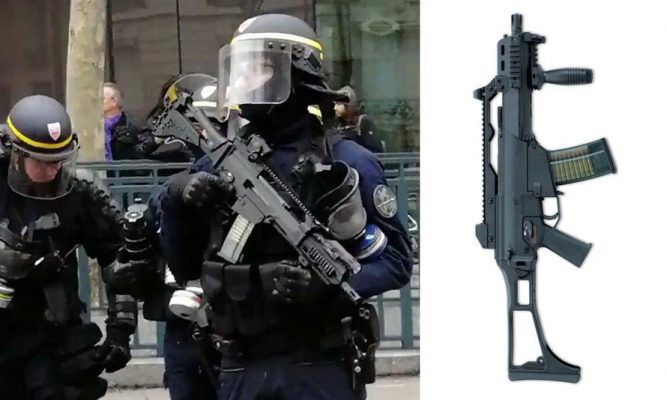
French riot police brandishing H&K G36 semi-automatic rifle
The deployment of rifles with presumably live ammunition visible through the magazine is an intimidating escalation as President Emmanuel Macron continues to lose his grip over France following nine weeks of country-wide protests by the Gilet Jaunes (Yellow Vest) movement.
The Gilet Jaunes began as a demonstration against a climate change-linked fuel tax, which quickly morphed into a general anti-government protest against the Macron administration and the world’s highest taxes. We’re sure France’s plege to send 1 billion euros to rebuild Iraq will help calm them down.
Riot police in France now armed with G36 assault rifles against unarmed civilians. WHERE IS THE NEWS COVERAGE?https://t.co/NqglT52MTk
— Drew Ludwig (@drew_ludwig93) January 13, 2019
Yellow Vest demonstrator Gilles Caron told the Mail “The CRS with the guns were wearing riot control helmets and body armour – they were not a specialised firearms unit,” adding “Their job was simply to threaten us with lethal weapons in a manner which is very troubling. We deserve some explanations.”
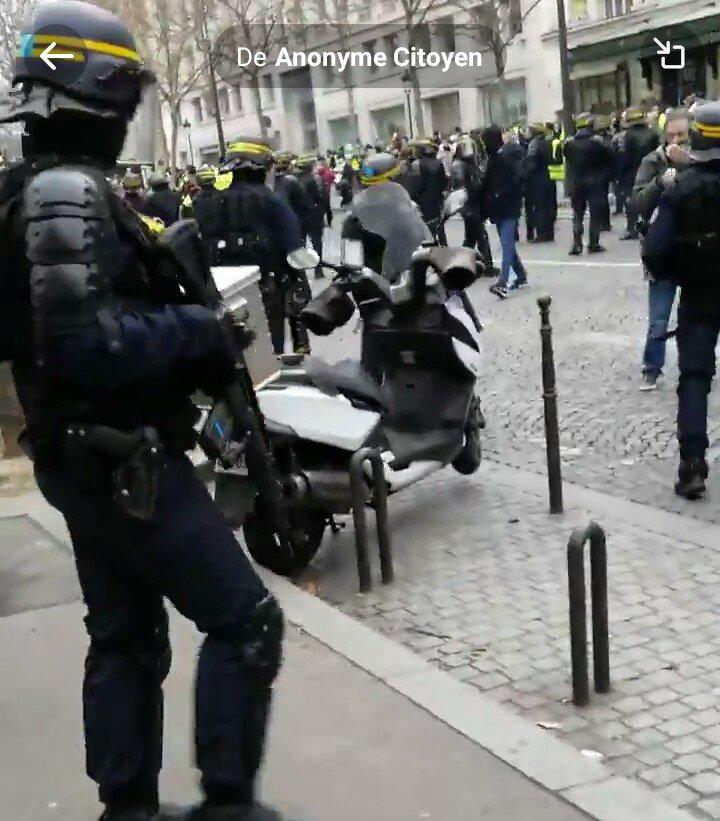
A French National Police spokesman confirmed that the CRS were equipped with H&K G36s on Saturday, but would not discuss their operational use ‘for security reasons’.
A G36 was stolen from inside a police van during a similar Yellow Vest demonstration by the Arc de Triomphe on December 1.
A number of vehicles belonging to the 21stIntervention Company of the Paris Prefecture were stormed, suggesting that the theft was an opportunistic one during a day of intense violence, when the Arc de Triomphe itself was vandalised. –Daily Mail
Former French conservative minister Luc Ferry called for live rounds to be used against the Yellow Vest “thugs” who “beat up police,” such as this former pro heavyweight boxer, 37-year-old Christophe Dettinger who was arrested after squaring off with several French police officers.
#GiletsJaune très forte mobilisation à #Paris le peuple en colère force les barrages de police #Acte8 #ActeVIII #05janvier #05janvier2019 pic.twitter.com/BSnVj6glKL
— LINE PRESS (@LinePress) January 5, 2019
Ferry – a full time philosopher now, said: “What I don’t understand is that we don’t give the means to the police to put an end to this violence.” When challenged with the suggestion that the guns might lead to bloodshed, Ferry said: “So what? Listen, frankly, when you see guys beating up an unfortunate policeman on the floor, that’s when they should use their weapons once and for all! That’s enough.”
What the H&K G36 looks like in action:
Tehran calls on Paris to ‘stop repeating irresponsible claims’ on Iran’s missile program
Press TV – January 12, 2019
Iranian Foreign Ministry Spokesman Bahram Qassemi has criticized the French Foreign Ministry’s provocative comments about Iran’s ballistic missile program, urging Paris to avoid repeating such “irresponsible and incorrect” claims regarding the Islamic Republic’s defensive programs.
“It is expected from France to stop echoing incorrect claims made by those who are against the JCPOA,” the senior diplomat further said, referring to Iran’s nuclear deal with world power in 2015, officially known as the Joint Comprehensive Plan of Action, and in a clear reference to the United States that unilaterally withdrew from the landmark accord last year.
The Iranian diplomat made the remarks on Friday, hours after French Foreign Ministry Spokeswoman Agnes von der Muhll called on Tehran to “immediately cease all ballistic missile-related activities designed to carry nuclear weapons, including tests using ballistic missile technology.”
“Contrary to the French Foreign Ministry spokeswoman’s claim, Iran’s missile program has neither been established for non-conventional purposes, nor the country’s natural right to strengthen its scientific and defensive capabilities as developed in the form of missile program is in violation of [UN Security Council] Resolution 2231,” said Qassemi.
The statement from the French ministry came just a day after Iranian President Hassan Rouhani said that Iran’s domestically-manufactured rockets would carry two new satellites into orbit in the coming weeks.
Earlier this month, US Secretary of State Mike Pompeo claimed that Iran’s planned launch of space rockets and missiles breaches Resolution 2231 that endorsed the JCPOA.
Iran’s Foreign Minister Mohammad Javad Zarif dismissed Pompeo’s claim, saying Washington has already violated that resolution and thus cannot “lecture” Tehran on it.
“We strongly believe that any attempt to induce and impose a wrong interpretation of Resolution 2231 regarding Iran’s missile program is an irresponsible act,” Qassemi further said, stressing that in any part of the resolution the Islamic Republic has not been prevented from developing defensive and conventional missile program and those with scientific application.
He also reiterated that Iran’s home-grown missile program is defensive, national and conventional, adding that it is not only legitimate but also “the Iranian nation’s natural right.”
Since its JCPOA exit in May, the administration of US President Donald Trump has unleashed its “toughest ever” sanctions against Iran. It has also warned of severe penalties for companies that evade the bans and engage in business dealings with the Islamic Republic.
French Democracy Dead or Alive?
The Gilets Jaunes in 2019
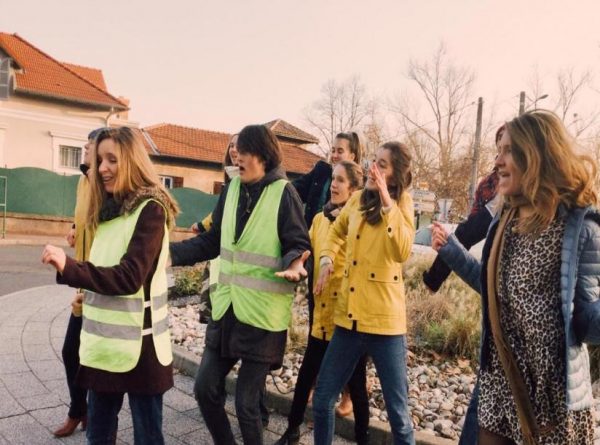
Gilets Jaunes song performed at French traffic circle: Les Gentils et les Méchants
By Diana Johnstone | Unz Review | January 11, 2019
Paris, France – French Democracy Dead or Alive? Or perhaps one should say, buried or revived? Because for the mass of ordinary people, far from the political, financial, media centers of power in Paris, democracy is already moribund, and their movement is an effort to save it. Ever since Margaret Thatcher decreed that “there is no alternative”, Western economic policy is made by technocrats for the benefit of financial markets, claiming that such benefits will trickle down to the populace. The trickle has largely dried up, and people are tired of having their needs and wishes totally ignored by an elite who “know best”.
President Emmanuel Macron’s New Year’s Eve address to the nation made it perfectly clear that after one unconvincing stab at throwing a few crumbs to the Gilets Jaunes (Yellow Vests) protest movement, he has determined to get tough.
France is entering a period of turmoil. The situation is very complex, but here are a few points to help grasp what this is all about.
- The METHODS
The Yellow Vests gather in conspicuous places where they can be seen: the Champs-Elysées in Paris, main squares in other cities towns, and the numerous traffic circles on the edge of small towns. Unlike traditional demonstrations, the Paris marches were very loose and spontaneous, people just walking around and talking to each other, with no leaders and no speeches.
The absence of leaders is inherent in the movement. All politicians, even friendly ones, are mistrusted and no one is looking for a new leader.
People are organizing their own meetings to develop their lists of grievances and demands.
In the village of Commercy, Lorraine, a half hour drive from Domrémy where Jeanne d’Arc was born, inhabitants gather to read their proclamation. Six of them read in turns, a paragraph each, making it quite clear that they want no leaders, no special spokesperson. They sometimes stumble over a word, they are not used to speaking in public like the TV talking heads. Their “Second appeal of the Gilets Jaunes de Commercy invites others to come to Commercy on January 26-27 for an “assembly of assemblies”.
- The DEMANDS
The people who first went out in the streets wearing Yellow Vests last November 17 were ostensibly protesting against a hike in gasoline and diesel taxes that would hit people in rural France the hardest. Obsessed with favoring “world cities”, the French government has taken one measure after another at the expense of small towns and villages and the people who live there. That was just the last straw. The movement rapidly moved on to the basic issue: the right of the people to have a say in measures taken that affect their lives. Democracy, in a word.
For decades, parties of the left and of the right, whatever their campaign speeches, once in office pursue policies dictated by “the markets”. For this reason, people have lost confidence in all parties and all politicians and are demanding new ways to get their wishes heard.
The fuel tax was soon forgotten as the list of demands grew longer. Critics of the movement note that achieving so many demands is quite impossible. It’s no use paying attention to popular demands, because the silly people ask for everything and its opposite.
That objection is answered by what has quickly emerged as the single overriding demand of the movement: the Citizens’ Initiative Referendum (CIR).
- The REFERENDUM
This demand illustrates the good sense of the movement. Rather than making a “must” list, the GJ merely ask that the people be allowed to choose, and the referendum is the way to choose. The demand is for a certain number of signatories – perhaps 700,000, perhaps more – to gain the right to call a referendum on an issue of their choice. The right to a CIR exists in Switzerland, Italy and California. The idea horrifies all those whose profession it is to know best. If the people vote, they will vote for all sorts of absurd things, the better-knowers observe with a shudder.
A modest teacher in a junior college in Marseilles, Etienne Chouard, has been developing for decades ideas on how to organize direct democracy, with the referendum at its center. His hour has come with the Yellow Vests. He insists that a referendum must always be held after a long debate and time for reflection, to avoid emotional spur-of-the-moment decisions. Such a referendum requires honest, independent media which are not all owned by special interests. It requires making sure that politicians who make the laws follow the popular will expressed in the referendum. All this suggests the need for a people’s constitutional convention.
The referendum is a bitter point in France, a powerful silent underlying cause of the whole Gilets Jaunes movement. In 2005, President Chirac (unwisely from his point of view) called for a popular referendum on ratification of the proposed Constitution of the European Union, certain it would be approved. The political class, with a few exceptions, went into full rhetoric, claiming a prosperous future as a new world power under the new Constitution and warning that otherwise Europe might be plunged back into World Wars I and II. However, ordinary citizens organized an extraordinary movement of popular self-education, as groups met to pour through the daunting legalistic documents, elucidating what they meant and what they implied. On May 29, 2005, with a turnout of 68%, the French voted 55% to reject the Constitution. Only Paris voted heavily in favor.
Three years later, the National Assembly – that is, politicians off all parties – voted to adopt virtually the same text, which in 2009 became the Treaty of Lisbon.
That blow to the clearly expressed popular will produced such disillusion that many backed helplessly away from politics. Now they are coming back.
- The VIOLENCE
From the start, the government has reacted with violence, in an apparent desire to provoke responding violence in order to condemn the movement as violent.
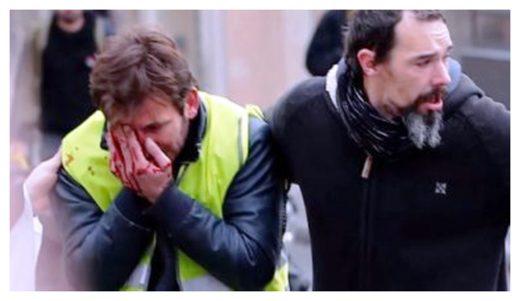
An army of police, dressed like robots, have surrounded and blocked groups of peaceful Yellow Vests, drowning them in clouds of teargas and firing flash balls directly at protesters, seriously wounding hundreds (no official figures). A number of people have lost an eye or a hand. The government has nothing to say about this.
On the third Saturday of protest, this army of police was unable to stop – or under orders to allow – a large number of hoodlums or Black Blocs (who knows?) to infiltrate the movement and smash property, vandalize shops, set fire to trash cans and parked cars, providing the world media with images proving that the Yellow Vests are dangerously violent.
Despite all this provocation, the Gilets Jaunes have remained remarkably calm and determined. But there are bound to be a few people who lose their tempers and try to fight back.
- The BOXER
On the 8th Saturday, January 5, a squad of plexiglass-protected police were violently attacking Gilets Jaunes on a bridge over the Seine when a big guy lost his temper, emerged from the crowd and went on the attack. With his fists, he beat down one policeman and caused the others to retreat. This amazing scene was filmed. You could see Yellow Vests trying to hold him back, but Rambo was unstoppable.
It turned out that this was Christophe Dettinger, a French Rom, former light heavyweight boxing champion of France. His nickname is “the Gypsy of Massy”. He got away from the scene, but made a video before turning himself in. “I reacted badly”, he said, when he saw police attacking women and other defenseless people. He urged the movement to go ahead peacefully.

Dettinger faces seven years in prison. Within a day, his defense fund had gathered 116,433 euros. The government shut it down – on what legal pretext I don’t know. Now a petition circulates on his behalf.
- The SLANDER
In his New Year’s Eve address, Macron patronizingly scolded his people telling them that “you can’t work less and earn more” – as if they all aspired to spending their lives lounging on a yacht and watching stock prices rise and fall.
Then he issued his declaration of war:
“These days I have seen unthinkable things and heard the unacceptable.” Apparently alluding to the few opposition politicians who dare sympathize with the protesters, he chastised those who pretend to “speak for the people”, but are only the “spokesmen for a hateful mob going after elected representatives, police, journalists, Jews, foreigners and homosexuals. It is simply the negation of France.”
The Gilets Jaunes haven’t been “going after” anybody. The police have been “going after” them. People have indeed spoken up vigorously against camera crews of channels that systematically distort the movement.
Not a word has been heard from the movement against foreigners or homosexuals.
The key word is Jews.
Qui veut noyer son chien l’accuse de la rage. (French proverb).
As the French saying goes, whoever wants to drown his dog claims he has rabies. Today whoever wants to ruin a career, take vengeance on a rival, disgrace an individual or destroy a movement accuses her, him, or it of antisemitism.
So, faced with a rising democratic movement, playing the “antisemitism” card was inevitable. It was almost a sure thing statistically. In almost any random batch of hundreds of thousands of people, you might find one or two who have something negative to say about a Jew. That’ll do it. The media hawks are on the outlook. The slightest incident can be used to suggest that the real motive of the movement is to revive the Holocaust.
This gently ironic little song, performed on one of France’s traffic circles, contrasts the “nice” establishment with the “bad” ordinary folk. It is a huge hit on YouTube. It gives the tone of the movement. Les Gentils et les Méchants.
It didn’t take long for this merry number to be accused of antisemitism. Why? Because it was ironically dedicated to two of the very most virulent critics of the Gilets Jaunes: May ’68 star Daniel Cohn-Bendit and old “new philosopher” Bernard-Henri Lévy. The new generation can’t stand them. But wait, they happen to be Jewish. Aha! Anti-Semitism!
- The REPRESSION
Faced with what government spokesman Benjamin Griveaux described as “agitators” and “insurrectionists” who want to “overthrow the government”, Prime Minister Edouard Philippe announced a new “law to better protect the right to demonstrate”. Its main measure: heavily punish organizers of a demonstration whose time and place have not had official approval.
In fact, the police had already arrested 33-year-old truck driver Eric Drouet for organizing a small candle ceremony in honor of the movement’s casualties. There have been many other arrests, with no information coming out about them. (Incidentally, over the holidays, hoodlums in the banlieues of several cities carried out their ritual burning of parked cars, with no particular publicity or crackdown. Those were cars of working class people who need them to go to work, not the precious cars in the rich section of Paris whose destruction caused such scandal.)
On January 7, Luc Ferry, a “philosopher” and former Minister of Youth, Education and Research, gave a radio interview on the very respectable Radio Classique in which he declared: “The police are not given the means to end this violence. It’s unbearable. Listen, frankly, when you see guys kick a poor policemen when he’s down, that’s enough! Let them use their arms once and for all, basta! […] As I recall, we have the world’s fourth army, capable of putting an end to this garbage.”
Ferry called on Macron to make a coalition with the Republicans in order to push through his “reforms”.
Last month, in a column against the Citizens’ Initiative Referendum, Ferry wrote that “the current disparaging of experts and criticism of elitism is the worst calamity of our times.”
- The ANTIFA
Wherever people gather, Antifa groups may pursue their indiscriminate search to root out “fascists”. In Bordeaux last Saturday, Yellow Vests had to fight off an attack by Antifa.
It is now completely clear (as indeed it always has been) that the self-styled “Antifascists” are the watch dogs of the status quo. In their tireless search for “fascists”, the Antifa attack anything that moves. In effect, they protect stagnation. And curiously enough, Antifa violence is tolerated by the same State and the same police who insult, attack and arrest more peaceful demonstrators. In short, the Antifa are the storm troopers of the current system.
- The MEDIA
Be skeptical. At least in France, mainstream media are solidly on the side of “order”, meaning Macron, and foreign media tend to echo what national media write and say. Also, as a general rule, when it comes to France, the Anglophone media often get it wrong.
- The END
It is not in sight. This may not be a revolution, but it is a revelation of the real nature of “the system”. Power lies with a technocracy in the service of “the Markets”, meaning the power of finance capital. This technocracy aspires to remake human society, our own societies and those all over the planet, in the interests of a certain capitalism. It uses economic sanctions, overwhelming propaganda and military force (NATO) in a “globalization” project that shapes people’s lives without their consent. Macron is the very embodiment of this system. He was chosen by that famous elite to carry through the measures dictated by “the Markets”, enforced by the European Union. He cannot give in. But now that people are awake to what is going on, they won’t stop either. For all the lamented decline in the school system, the French people today are as well-educated and reasonable as any population can be expected to be. If they are incapable of democracy, then democracy is impossible.
To be continued…
France Moves To Ban All Protests As PM Announces Major Crackdown On Yellow Vests
By Tyler Durden – Zero Hedge – 01/09/2019
France is signaling it’s making preparations for a massive new crackdown on the gilets jaunes or “yellow vests” anti-government protests that have gripped the country for seven weeks. A new law under consideration could make any demonstration illegal to begin with if not previously approved by authorities, in an initiative already being compared to the pre-Maiden so-called “dictatorship law” in Ukraine.
In the name of reigning in the violence that has recently included torching structures along the prestigious Boulevard Saint Germain in Paris, and smashing through the gates of government ministry buildings, the French government appears set to enact something close to a martial law scenario prohibiting almost any protest and curtailing freedom of speech.
Prime Minister Edouard Philippe presented the new initiative to curtail the violence and unrest while targeting “troublemakers” and banning anonymity through wearing masks on French TV channel TF1 on Monday. He said the law would give police authority crack down on “unauthorized demonstrations” at a moment when police are already arresting citizens for merely wearing a yellow vest, even if they are not directly engaged in protests in some cases.
PM Philippe said the government would support a “new law punishing those who do not respect the requirement to declare [protests], those who take part in unauthorized demonstrations and those who arrive at demonstrations wearing face masks”.
Philippe’s tone during the statements was one of the proverbial “the gloves are off” as he described the onus would be on “the troublemakers, and not taxpayers, to pay for the damage caused” to businesses and property.
“Those who question our institutions will not have the last word,” he added.
However, if anything the protests have grown fiercer in response to any police crackdown or violence against demonstrators. Should all protests be banned under the new law, it could be the start of more violent riots gaining steam, as what began Nov. 17 as anger over fuel tax hikes has now turned into rage at President Emmanuel Macron and policies that seem to favor the urban elite.
Other yellow vest inspired protests previously broke out across Europe, and in perhaps a sign of things to come a video from The Netherlands of a woman pushing her baby in a stroller being arrested by police apparently for merely wearing a yellow vest is going viral.
Shocking Video of police brutality in The #Netherlands of a Women being arrested yesterday, because she was wearing an Yellow Vest, and did not wanted to take it off. while walking with her baby in the streets. #YellowVests SHAME ON YOU DUTCH POLICE OFFICERS! RT this to the world pic.twitter.com/vL99D1ThW0
— Sotiri Dimpinoudis (@sotiridi) January 6, 2019
In the video, police confront the woman in what appears a quiet neighborhood far away from any visible protest. Police were photographed alongside the baby on the street as the mother was dragged away.

Image via journalist Sotiri Dimpinoudis
With the French prime minister now announcing coming draconian measures banning all protest, this is precisely the horrific scene that could begin to be repeated across France and the EU.
In total at least six people have died and over 1,400 people injured during the French protests, with thousands arrested weekly, according to international reports. Over the weekend some 50,000 protesters continued demonstrating in multiple cities, leading to significant clashes in Paris, Bordeaux and Rouen. A number of commentators have noted that though there appear fewer demonstrators compared to December, there appears a serious uptick in violent acts on the part of both demonstrators and police response.
Organizer of Macron’s ‘grand debate’ with Yellow Vests defends her ‘shocking’ €176,000 salary
RT | January 8, 2019
Emmanuel Macron’s plan for a nationwide public debate, intended to defuse months of Gilets Jaunes protests, is off to a rocky start. The spotlight has shifted to the extravagant salary of the official in charge of organizing it.
Chantal Jouanno is a former sports minister in the conservative government of Nicolas Sarkozy, and the current chairwoman of the CNDP, an official body for public debates, a role for which she receives an annual salary of €176,000 ($201,000).
The prominent position for yet another well-paid bureaucrat has caused outrage against the backdrop of street protests that were fueled by the disconnect between decisions taken by financially secure public officials, and the impact they have on ordinary citizens, such as the now-cancelled petrol tax.
Jouanno, a former national karate champion, deployed a series of blocks to stave off the discontent.
She insisted she was not specifically being paid for the “unprecedented” public discussions, but for a broader role that she assumed last year, adding that she does not negotiate her salary, which is set by the “CNDP, whoever they are.”
“I think it’s important that people can express their shock with my salary, and if they want to propose a different salary for my role, they are free to do so,” she told France Info TV.
She was also defended by her colleague, Ecology Minister Francois de Rugy, who said that if people wanted political posts to be “filled for free, or the minimum wage, it means society no longer recognizes that there is a scale of responsibilities.” With a self-reported salary of just €114,000 ($130,400) per annum – de Rugy must consider himself to be about a third less responsible than Jouanno.
The French president’s proposal for three months of public consultations and town-hall debates starting from January 15 was a bold gambit, but fraught with risk. As part of the process, the government is sure to receive thousands of ambitious and contradictory demands, which may be at odds with its own past tax and labor reforms, and its planned pension proposals.
The government has already vowed to push back against even widely popular suggestions, such as reintroducing a wealth tax, which was abolished in 2017. However, it has promised that ideas proposed during the consultations will reach the National Assembly as early as April.
It is not yet clear whether the proposed measures will be enough to thin out the ranks of those turning out in major cities, battling police each weekend. Many representatives of the Yellow Vest movement have rejected Macron’s plan, and officials suggested that 25,000 people took to the streets at the weekend, with organizers claiming higher figures.
Imperialism Abhors a Void: Guest: Sarah Abed
The Rabbit Hole | January 3, 2019
Cindy Sheehan’s Soapbox
Guest: Sarah Abed
Topic: US “Withdrawal” from Syria
On this episode of Cindy Sheehan’s Soapbox we discussed Trump’s announcement to withdraw US troops from Syria, the media’s reaction, and the impact this will have on Kurdish militias and Syria’s ultimate fight against imperialism.
Below are some of the points that I made during our chat (this is not a full transcript) or some thoughts I would like to expand on.
Cindy asked what I make of Trump’s announcement to withdraw 2,000 troops from Syria.
My response:
Trump had stated during his campaign and his presidency and even prior to that during Obama’s presidency in 2013 that he did not think we should be in Syria, nor should we be bombing Syria, that it was a waste of money and lives and that the Arab League and neighboring countries should be the ones to step up to the plate.
I think this was one of the reasons that many people voted for him, because of his non-interventionist foreign policy, which was in stark contrast to that of Hillary Clinton.
In April, of this year he had announced that he wanted to pull the US out of Syria and then just days later there was an alleged chemical weapons attack that was pinned on the Syrian government in Douma, to which Trump responded with attacking multiple targets along with his allies the UK and France.
This of course derailed his plan to pull out US troops, which is the exact outcome that the terrorists that staged the whole theatrical performance had wanted. And we have seen this sort of thing happen time and time again during the war. Whenever the Syrian army and government have made significant progress new allegations and attacks are made against them in corporate media in order to garner international support for military, political intervention as well as increased sanctions.
There are other factors at play with this latest withdraw announcement which was made on December 19th, in addition to standing by his America first promise, campaign statements, saving money and lives, there’s the fact that Turkey’s president Erdogan had threatened to attack the Kurdish militias on his border, if the US didn’t have them removed. He sees the YPG (People’s Protection Units) which was rebranded at the request of the US into the SDF (Syrian Democratic Forces) as an extension of the PKK (Kurdistan workers party) which is a terrorist group that has been in conflict with the Turkish state for decades.
As I had written about back in March the Olive branch operation in Afrin proved that NATO alliances are stronger than any other alliances and that the US will choose Turkey over the Kurds and that’s what we are seeing happen right now. Some have also speculated that Israel may have given the US a heads up that it would be engaging in an intense bombing campaign and that US troops should be sent home so that they are not caught in the crosshairs.
Cindy asked what I make of the reaction by democrats, liberals, celebrities etc.
My response:
It would be comical if it wasn’t actually dangerous. In their blind opposition to anything and everything that Trump says these overnight analysts and pundits started claiming that if US troops were to withdraw from Syria then Kurds would be annihilated by Turkey or succumb to some other equally horrible fate.
What we have seen over the past few days however is that leaders of Kurdish militias have actually reached out to the Syrian government and asked that they step in and take back Manbij and all the territory under their control west of the Euphrates in order to protect them against Turkey. This is a clear shift in their political alliance away from the US and towards Syria and Russia. Turkey will not directly confront the Syrian army so Trump’s announcement could actually signify a big step towards peace in this almost eight-year western imposed insurrection.
The US entered Syria illegally and has since set up over a dozen military bases and supported the Kurdish militias during the last few years only. Prior to using the Kurdish militias as a tool to create chaos and division in Syria, the US was predominately supporting the hardcore Al Qaeda-linked terrorists in the Free Syrian Army and an assortment of other alphabet soup groups who they affectionately referred to as “moderate rebels” to topple the secular Syrian government.
Had the US not supported the Kurdish militias they would have not had the motivation to turn against the Syrian state. During the beginning of the war, the Kurds were fighting with the Syrian army against terrorists, by the way some still are and many Kurds in Syria are not in agreement with the separatist ambitions of the Kurdish militias.
I want to stress the fact that before 2011 Kurds, Arabs, and Christian minorities lived peacefully in Syria and till now they are NOT the majority. They do not have any justifiable claims to the north eastern region (which also happens to be the most agriculturally and oil rich part of the country) or any other part of Syria. They are a nomadic people and I do not mean that in a condescending way at all but to illustrate that they came into Syria in waves to escape mistreatment in neighboring countries and were treated fairly and given equal rights. Not all Kurds envision a unified Kurdistan that would span four different sovereign countries (Turkey, Iraq, Syria, and Iran). Most Kurdish movements and political parties are focused on the concerns and autonomy of Kurds within their respective countries. Within each country, there are Kurds who have assimilated and whose aspirations may be limited to greater cultural freedoms and political recognition.
It’s also worth noting that only Israel is their main and really only supporter and their plans for an independent Kurdistan align almost perfectly with Israel’s greater Israel plan. They have historically been used by Israel and NATO.
Cindy asked about the demands being made that Russia or Iran should withdraw from Syria if US troops are to be withdrawn.
My response was basically that Russia, Iran, and Hezbollah are there with the Syrian government’s permission. Whereas the US, UK, France, and Turkey are there illegally and need to leave. Cindy noted and I agreed that it’s a false equivalency and a logical fallacy.
We also spoke about fasting to raise awareness #illuminateYemen for the entirely man-made and avoidable Saudi war and genocide that’s been going on for over three years and nine months. We discussed the latest developments and how Saudi Arabia is outsourcing their front line fighters with children and men from Dafur, Sudan and paying their families $10,000.
My response:
Fasting for seven days was a very humbling experience. The war on Yemen is truly heartbreaking especially because it is entirely man-made and avoidable. It’s so important for us to continue to raise awareness and get people to talk about it to literally everyone they know. For the past 3 years and nine months the murderous Al Saud regime, has been bombing civilians using weapons bought from the US, UK, and Germany, what they are doing is nothing short of committing genocide and deliberately starving Yemeni’s them through blockades. Tens of thousands have been killed since it began.
There was actually a report in the New York Times today that Saudi Arabia was recruiting children from Darfur to fight on the front lines and paying their families $10,000. Sudan has been part of the Saudi-led alliance, and deployed thousands of ground troops to Yemen. In the NYT report they said that five Sudanese fighters who had returned from Yemen told them that that children made up 20-40 percent of their units in Yemen.
The fact that House of Saud is on the UN human and woman’s rights council while also being the leading violator in crimes against humanity and the main sponsor of terror in the world shows the western worlds blatant hypocrisy. A United Nations-sponsored peace agreement was signed in Sweden earlier this month, and was agreed upon by both sides to implement a ceasefire in Hodeida. The panel will be meeting again on January 1 to discuss “detailed plans for full redeployment”. Every effort needs to be made for this conflict to end.
SYRIA: The Western Rogue States Must Confess their Crimes Against Humanity and be held Accountable

Christmas 2018 in Damascus, Old City, without mortars from Eastern Ghouta since its liberation in April 2018. (Photo: Vanessa Beeley)
By Vanessa Beeley | 21st Century Wire | January 2, 2019
The West and its allies in the Gulf States, Turkey and Israel have waged an eight year war against the Syrian people. The West has besieged, starved and deprived the Syrian people of humanitarian aid while pouring “aid” into the areas controlled by their extremist sectarian proxy armies.
The West has violated international law and it has enabled the destruction of Syria’s history, heritage and cultural footprint. The West has behaved as a collective rogue state without conscience and without pity for a people its media has systematically dehumanised to enable such a crime to take place.
Despite this war of attrition and despite battling disproportionate force, the Syrian people have refused to capitulate or to abandon their secularism in favour of an extremist tyranny that would destroy their society and persecute the minority communities into extinction. Christmas 2018 has demonstrated the victory of Syrian unity over the regime change project incubated in the West which is now a failed campaign lying in tatters at the feet of the self determination of the Syrian people, the valiant defence by the Syrian Arab Army and the steadfastness of the Syrian Government and its President, Bashar Al Assad.
In Aleppo I spoke with Pastor Ibrahim Nseir of Aleppo’s Presbyterian Church, whom I had also interviewed in 2017. The following is a mixture of quotes and paraphrase from our conversation on New Year’s Eve 2018/19.
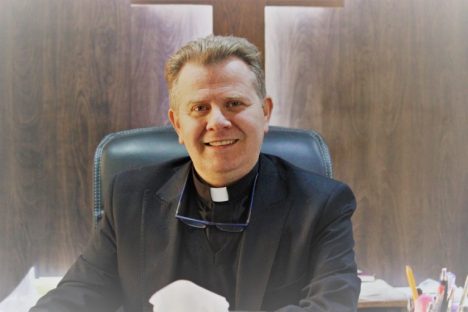
Reverend Ibrahim Nseir, Presbyterian Church, Aleppo. December 31st 2018. (Photo: Vanessa Beeley)
The Presbyterian Church in the Old City of Aleppo was destroyed by the Western-backed terrorist groups in November 2012. An article in the Mennonite World Review in July 2018 described the destruction of the church – “In the old city of Aleppo, Syria, Ibrahim Nseir stands on the pile of rubble that used to be his church. The building where his congregation worshiped is now broken stones and dust. It’s a sunny day, the bright sky a stark contrast to the destruction on the ground.”
After eight years of resistance against the threat of persecution and mass exodus of Christians from Aleppo, Nseir remains defiant and upbeat about the future of Aleppo and Syria. Of the 300,000 Syrian Christians in Aleppo, only 30,000 remain. This is the legacy of sectarian oppression that has been imprinted upon Syria by Western hegemony and it will take generations for it be turned around.
Nseir described the rebuilding process for the Presbyterian Church as difficult but he insisted that it would be rebuilt from its original stones to preserve its historical identity. For Nseir the priorities for Aleppo and Syria are to address the economic situation which has clearly taken a hit on many levels and is suffering in a typical post-war slump. Education is another top priority for this intelligent and enthusiastic Reverend. The intention is to create a center for retreats and conferences at the current Presbyterian Church offices in the center of Aleppo, including a student dormitory.
“We will increase educational capacity by 1000 in the very near future and continue to build upon this progress” Nseir told me.
Education, according to Nseir, is the greatest weapon against extremism and is the only way to re-habilitate children who spent seven of their formative years under occupation of extremist and sectarian factions who worked hard to brainwash almost an entire generation of Syria’s children.
“Ethically the West and the East are responsible for Syria’s destruction. This is not a “Christian” issue, it is a World issue.” Nseir insisted.
The role of the Western media in manufacturing consent for the collective punishment of the Syrian people was clearly a primary cause of the devastation that Nseir and other faith leaders across Syria are now dealing with:
“Western media played more than a negative role, they literally urged the terrorists to take action against the Syrian people by providing false information and blinding people in the West to what was really happening in Syria for eight years. This should never be forgotten.”
Nseir stressed that the healing process for children traumatised by the war would not be easy.
“How do you erase the hatred and horror planted in the brains of 7-10-year-old children by these fanatics? What do you expect from children who have played football with the head of a Syrian Arab Army soldier or who have witnessed the violent abuse of their mother by these terrorists or have seen their father executed by the armed groups? This is the greatest challenge for Humanity and for Syria to put right these terrible wrongs.”
Nseir spoke of the shocking estimated figures of 82,000 children whose father is unknown, referring to the huge number of young women raped or forced into multiple marriages by the terrorist groups and their fighters. How do these children regain their identity and re-integrate into Syrian society? The rebuilding of schools and hospitals must be a priority. The terrorists destroyed “the most developed hospital in the Middle East, Al Kindi” in 2013 and since then, and the destruction of more hospitals across Syria by the terrorist groups, Nseir told me Syria has seen an increase in Cancer and new diseases. Nseir also suggested that this may be attributed to the weapons used by the US Coalition proxies and the U.S itself, which include depleted uranium.
Another important challenge, according to Nseir, is the environmental one. Syria needs to rebuild its natural environment which has also been hugely affected by the conflict. 100,000 trees have been destroyed in Aleppo alone which could lead eventually to desertification of the province if not dealt with. The Governor of Aleppo has recently planted 2,000 new trees but this is an issue that must be addressed with urgency for Nseir.
Nseir strongly believes that Western people should come to Syria independently to see the truth for themselves and report the truth as they see it without any agenda. The Church and the media in the West have maintained a sectarian, divisve narrative which is confusing for people in the West and far from reality.
Nseir addressed the position and status of Syria in the Middle East and described how it has not changed, all that has changed is the perception of Syria portrayed by the media and world leaders who have aligned themselves with the West’s criminal project to partition Syria into sectarian statelets and to remove the elected Syrian government from power by force:
“What has changed since 2011 in reality? Nothing. Syria has always been the protector of the Middle East before 2011, during the conflict and now. The only thing that has changed is the positions of those who turned against Syria, betrayed Syria and who now wish to come back to Syria for protection. We see the Gulf States now change their stance and the UAE has re-opened its embassy in Damascus. The Arab League will welcome Syria back into its fold. Nothing has changed, Syria has remained the same while others have been opportunists and traitors.”
The fact that Syria will forgive its betrayers is testament to what has given Syria victory over its enemies throughout history. With regards to the West, Nseir is not so forgiving:
“The West must go beyond simply stopping its financing of terrorism and the supply of weapons. The West must confess to its crimes against the Syrian people in order to be forgiven. The West must lift the economic sanctions which are a siege upon the Syrian people and it must allow the Syrian people to rebuild in peace without meddling in their affairs. The Syrian people will rebuild according to what the Syrian people want not what the East or the West want. The West has sold the idea that this war was against President Assad but in reality it was against the will of a nation and the people of that nation must be respected”.
Nseir confirmed that the western NGOs are nothing more than political instruments and devices who further the cause of war but he insisted that the West must effectively pay reparations to Syria and expect nothing in return. This is the only way the West can be forgiven by Syria.
Nseir told me that his church will be establishing a medical and health center in the coming months which will be open to everyone in Aleppo to offer medical check-ups and treatment for free. Staff will be trained to deal with the children afflicted by the effects of the war and the terrorist occupation and the plan is to eventually set up special schools to continue the work of rehabilitation for these children. This will enable the coming generations to stand against radicalism and terrorism in the future.
“The West has a duty to respect our dignity and territorial integrity. The Syrian Arab Army has saved the image of our God of Peace, Love and Unity – this has been a spiritual war in Syria not only a military war. The God of love has been embodied by the SAA and our allies and has been victorious over the God of terrorism and hatred. The whole world will change after this war and after Syria’s victory. Syria will be a transformational catalyst for all of Humanity. Syria was never going to be defeated, you only have to study our history to know this. Our society has always embraced diversity and this is the essence of our country. Fanaticism was never going to survive breathing the pure oxygen of our humanity. Actually this demonstrates the stupidity of leaders in the West – to even imagine that extremism has a place in our culture”. Nseir told me.
Nseir ended our talk by stating that the crisis in Syria must be an alarm bell for the country and for its leaders.
“We must re-prioritise our schedule, our agenda and make sure it is not only political but that we address all issues – religious, educational, health care. We must rethink our priorities to ensure a future of peace and stability. At the end I believe strongly that all the negative consequences of this terrible war will be transformed into positive consequences if we address them in the right way. Out of adversity are born the greatest opportunities for the future of Syria and Humanity.”
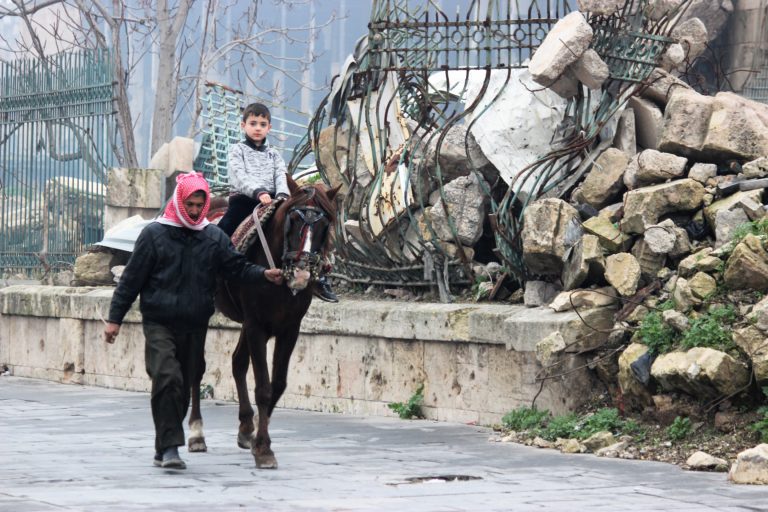
Horse rides on offer at the foot of the Citadel in the Old City of Aleppo. (Photo: Vanessa Beeley)
***
Vanessa Beeley is an independent journalist, peace activist, photographer and associate editor at 21st Century Wire.
Featured Video
Trita Parsi: Iran War Ends Today? Threats of Deporting Trita Parsi
or go to
Aletho News Archives – Video-Images
From the Archives
Iran UN ambassador calls for destruction of all nuclear weapons
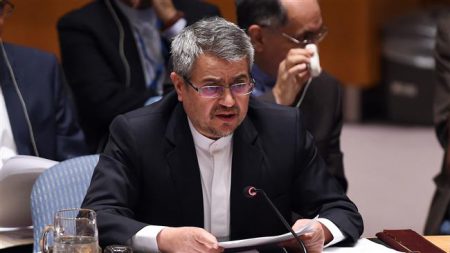
Iran’s ambassador to the UN Gholamali Khoshroo
Press TV – March 29, 2017
Iran’s ambassador to the UN Gholamali Khoshroo has called for the total eradication of nuclear weapons.
Khoshroo reiterated Iran’s call during a UN conference aimed at creating a nuclear weapons ban treaty in New York on Tuesday.
“Iran, as a victim of chemical weapons, strongly feels the danger posed by the existence of weapons of mass destruction and is determined to engage actively in international diplomatic efforts to save humanity from the menace of nuclear weapons,” he said.
Khoshroo stressed that Iran is committed to its Non-Proliferation Treaty (NPT) obligations, which include negotiations based on effective nuclear disarmament measures.
He added that several countries continue to ignore international calls and treaties for nuclear disarmament and even continue to increase their nuclear stockpiles. “They do not have political determination to abandon doctrines of nuclear deterrence and nuclear terror,” he went on to say.
Iran’s UN ambassador noted that boycotting the talks by many countries, including the US, shows that the world’s nuclear powers are by no means committed to the eradication of nuclear arms. Britain and France were also among the some 40 countries that did not join the talks.
“We note that prohibition of nuclear weapons must be accompanied by the elimination of such weapons. There can be no doubt that without complete abolition of nuclear weapons, there will be no absolute guarantee against the danger of nuclear war and the use of such weapons,” Khoshroo added.
Blog Roll
 Aletho News
- The Crusades – colliding narratives
- Trita Parsi: Iran War Ends Today? Threats of Deporting Trita Parsi
- What Is SIDS?
- DHS docs: Govt bracing for nationwide anti-AI riots, preparing to crack down on dissent
- India signals rethink over West Asia
- Israeli Ex-Navy Chief admits massive damage from Iran missiles
- The strategic arsenal US lost in war against Iran – and why replenishment will take years
- Documents Suggest Fauci Knew COVID Was Created in Wuhan Lab, and mRNA Vaccines Wouldn’t Work
- No return to pre-war status for Strait of Hormuz – Iran’s top diplomat
- Ex-South Korean President sentenced for trying to provoke conflict with Pyongyang
- If Americans Knew
- Did Trump just threaten a nuclear attack on Iran? Another merger for Israel-Firster David Ellison –Daily Update
- Israeli Firm Accused of Launching Smear Campaigns During US, European Elections
- As World Cup kicks off, Gaza amputee girls chase football dreams
- Oxfam: More Palestinians killed by Israel across West Bank in last 3 years than previous 17 years combined
- US-Iran ceasefire may be imminent, but will Israel blow it up? – Daily Update
- The Issue of Israel Is Ending Democracy In Michigan
- Israel is stealing homes, livelihoods, and lives in West Bank
- Gaza is not an aberration – Israel planned this genocide decades ago
- Israel is changing the face of Lebanon, mainstream media is normalizing it – 3 articles
- Genocide lobby benefits from EU anti-racist fund
- No Tricks Zone
- New Study: Significant CO2 Fluxes From Non-Volcanic Sources Are Largely Neglected In Carbon Budgets
- Women Climate Scientists Being Harassed, Insulted By Skeptics, Claims Berkeley Earth Researcher
- Germany’s Longterm Spring Climate Data Show “No Climate Trend”
- New Study: Solar Photovoltaic, Wind Power Fail To Meet Annual Energy Demands 62% Of The Time
- Germany’s Die Welt: “Too Much Is Too Much” … Green Energies Are Cannabalizing Each Other!
- Germany’s Ecological Holocaust… Once Fairy Tale Forests Getting Cleared For Wind Turbines
- A Grand Solar Minimum Has Arrived…Global Cooling Of At Least 1°C Is Expected By The 2030s, 2040s
- European “Expert Commission” Urges COVID-19-Like Global Climate State Of Energency!
- Real-World Observations Do Not Support The Position That Climate Change Is Human-Caused
- Germany’s AfD Party Calls Debunked Climate Scenarios “Greatest Fraud In Human History”
 Aletho News