As Mainstream Journalists acknowledge Douma Attacks were “Staged,” Syria Regime-Change Network tries to Save Sinking Ship
“Humanitarian” regime-change network increasingly desperate to protect its influence and the power of its narratives, not just in Syria but in future conflicts.
By Whitney Webb and Vanessa Beeley | MintPress News | February 18, 2019
LONDON — Over the past few days, notable journalists and other figures in mainstream media have acknowledged that the alleged chemical weapons attack that occurred last April in the Damascus suburb of Douma, Syria was likely “staged” by “activist” groups such as the White Helmets. Their comments and investigations have largely vindicated the many journalists and academics who cast aspersions on the precipitous Western media campaign to blame that alleged attack on the Syrian government. Many of the dissenting voices were derided as “conspiracy theorists” or ignored entirely by mainstream sources.
Yet, now that these revelations are being voiced by acceptable figures in mainstream media, those who have built their careers on promoting the White Helmets and regime change in Syria are working to discredit these new dissenting voices. Among those on the counter-attack are individuals connected to the oligarch-funded “humanitarian” regime-change network that was the subject of a recent MintPress exposé.
The alleged Douma attack — notably used as the justification for a military attack launched against Syria by the U.S., the U.K. and France — returned to the news cycle earlier this month following a report from James Harkin, a journalist who has written for The Guardian, Harper’s and the Financial Times, and is currently the director of the Center for Investigative Journalism. Harkin’s report, which was published in The Intercept, cast doubt on the prevailing mainstream narrative surrounding the events that occurred in Douma last April.
Harkin, in visiting Douma and the surrounding area, confirmed past reporting by other independent journalists that no sarin gas had been used — which was also confirmed by the OPCW (Organisation for the Prohibition of Chemical Weapons) interim report — and claimed that the scenes filmed at the Medical Point in Douma, which were widely circulated by the mainstream media as evidence that a chemical weapons attack had occurred, had likely been staged. Harkin lamented the staging of the hospital scenes as a casualty of “Syria’s propaganda war.”
Elements of Harkin’s rather rambling report were rapidly corroborated by BBC producer Riam Dalati, who revealed on Twitter that he had proof, after a six-month investigation, that those same hospital scenes had been staged.
Dalati had previously been the cause of some consternation among the pro-regime-change pundits when he had tweeted, immediately after the alleged Douma chemical attack, that he was “sick and tired of activists and rebels using the corpses of dead children to stage emotive scenes for Western consumption.” Dalati was referring to the image of two children wrapped in a “last hug” that went viral on social media, eliciting sympathy for the “chemical attack” narrative.
Dalati pointed out that the two children had been photographed on separate floors in the building before being artfully arranged into the “last hug” position by the producers of this scene, which was picked up by the majority of corporate media and used to give the impression that the Syrian Arab Army had used chemical weapons against their own civilians as they were concluding final amnesty negotiations with Jaish Al Islam, the extremist group then occupying Douma.
Shortly after deleting the aforementioned tweet, Dalati protected his Twitter account before reiterating his observations in a less inflammatory tweet, while explaining that his first tweet had been “correctly deemed in breach of [BBC] editorial policy thru [sic] use of ‘sick/tired’ and by not providing context…”
Dalati had notably been a member of the production team of the notorious September 2013 BBC Panorama documentary “Saving Syria’s Children” — a report that was forensically investigated by independent researcher Robert Stuart, who concluded that “sequences filmed by BBC personnel and others at Atareb Hospital, Aleppo on 26 August 2013 purporting to show the aftermath of an incendiary bomb attack on a nearby school are largely, if not entirely, staged.”
So, Dalati, no stranger to controversy, appears to have once more broken with the ranks of mainstream media by admitting that the White Helmet “chemical attack” scenes in Douma Medical Point were “without a doubt” staged. One might ask why it took Dalati six months of investigation to arrive at the same conclusion as acclaimed journalist Robert Fisk and other on-the-ground journalists did just days after the attack occurred. At the time, those journalists had been labeled by Dalati and others as “conspiracy theorists.”
However, the recent statements made by Dalati and Harkin’s recent report have hardly created a consensus regarding the alleged chemical weapons attack in Douma within the mainstream media. Instead, much the opposite has happened, with journalists and “experts” who have linked their professional reputations to the credibility of groups like the US/UK incubated and financed White Helmets now going on the offensive in an effort to trivialize the recent revelations regarding the events of April 7, 2018.
Following the renewed interest in the Douma incident as a result of Harkin’s report and Dalati’s subsequent tweets, Tobias Schneider — a research fellow at the Global Public Policy Institute (GPPI) — accused people like Harkin and Dalati of “squabbling over the intricacies” of the alleged chemical weapons attack in Douma, later calling these independent investigations and statements “madness.”
We must presume that Schneider’s Twitter accusation would also be directed at genuinely independent journalists and academics who presented evidence to counter the dominant Douma narratives produced by the usual suspects in corporate media and groups like the White Helmets affiliated to Jaish Al Islam, the brutal armed group in control of Douma. Among those are journalists who actually visited Douma immediately after the attack — Vanessa Beeley, Eva Bartlett, Robert Fisk of the Independent, Uli Gack from ZDF, Germany and Pearson Sharp of OAN (One America News Network). Also, potentially in Schneider’s crosshairs are the members of the Working Group on Syria, Propaganda Media (WGSPM) established by Professor Piers Robinson who produced an extensive briefing scrutinizing the media anomalies in the Douma attack.
Unwilling to stop there, Schneider also announced that the GPPI would be publishing the first analytical study “on the logic underpinning the Syrian regime’s systematic use of improvised chlorine bombs in particular” that would use “the broadest dataset compilable and break down tactical, operational, strategic patterns” in order to claim that, despite a lack of evidence for chemical weapons use in Douma last year, other separate incidents form a pattern that would incriminate the Syrian government in the events alleged to have taken place last April. The report has now been published and has been picked up by the usual purveyors and promoters of the “chemical attack” narratives that are designed to criminalize the Syrian government.
A look into Schneider’s background and the organization that employs him hardly paints a picture of an objective observer of the evidence surrounding this hot-button issue. Quite the contrary, Schneider and the GPPI are directly connected to the “humanitarian” regime-change network that was exposed in a recent MintPress series for its efforts to exploit the death of the late MP Jo Cox in order to manufacture consent for regime change in Syria and whitewash both the U.K.-government connections to the White Helmets and the White Helmets’ own troubling track record in facilitating and even directly committing war crimes.
Who is Tobias Schneider?
According to his bio at the GPPI website, Tobias Schneider is a research fellow at GPPI who focuses on “insurgency and counterinsurgency in the contemporary Middle East,” among other related issues. Prior to working with GPPI, Schneider worked as a consultant on Syria and Yemen for the World Bank, an influential financial institution that a WikiLeaks document recently confirmed; is used as a “financial weapon” by the United States military.
He has also worked at the Center for European Policy Analysis (CEPA), a pro-NATO think tank located in Washington. CEPA’s stated mission is “to promote an economically vibrant, strategically secure, and politically free Europe with close and enduring ties to the United States.” Its international advisory board includes former Secretary of State Madeleine Albright, who once stated that the death of half a million Iraqi children from U.S. sanctions was “worth it;” and Brian Hook, current Director of Policy Planning at the U.S. State Department and Senior Policy Advisor to Secretary of State Mike Pompeo. Zbigniew Brzeziński — former National Security Adviser in the Carter administration who is best known for his role in arming and creating the terror group Al Qaeda — was also a board member up until his death in 2017.
Currently, however, Schneider — in addition to serving as a GPPI research fellow — is an expert for the Atlantic Council’s “Rebuilding Syria” initiative. The Atlantic Council is a Washington-based think tank with strong ties to the U.S. military and NATO, and receives significant amounts of funding from American arms manufacturers, U.S. intelligence agencies, and foreign governments. This think tank, and its “Rebuilding Syria” initiative in particular have been particularly zealous in promoting regime change in Syria and in marketing hybrid groups like the White Helmets. This is hardly surprising given that the U.S. and U.K. governments have given millions of dollars to both groups and were instrumental in the creation of the White Helmets as a refined “propaganda construct”, their description by journalist, John Pilger.
Schneider also has made appearances at events hosted by “Friends of Syria”APPG (All Party Parliamentary Groups) the U.K. group that includes several MPs — including Jo Cox prior to her death — and has extensively promoted U.K. military intervention in Syria, with a particular emphasis on emotional appeals largely based on White Helmet testimony and footage. Chair of Schneider’s panel was Andrew Mitchell, Conservative MP, former UK secretary of state for international development 2010-2012 and alongside Jo Cox, a fervent supporter of regime change in Syria and an unquestioning White Helmet acolyte.
Global Public Policy Institute’s place in regime-change network
Beyond Schneider’s conflicts of interests by virtue of his work history and current associations, the organization that employs him — the Global Public Policy Institute — is directly connected to an oligarch-directed and oligarch-funded regime-change network that specializes in manufacturing “humanitarian” justifications for Western military adventurism abroad. The main oligarchs who drive this network, as detailed in a recent articles series at MintPress, include Jeffrey Skoll, George Soros, Pierre Omidyar, and Ted Turner — philanthrocapitalists aligned with the neoliberal, globalist agendas of the U.S/U.K alliance.
In addition to its stated mission of “improving global governance,” in line with globalist designs, the GPPI is funded by the German and U.K. governments as well as the Open Society Foundations of controversial Hungarian-American billionaire George Soros, whose many organizations have been intimately involved in promoting the White Helmets and related narratives that push for increased Western military intervention in Syria. Soros’ influence in the GPPI is demonstrated by the position his son, Alexander Soros, holds on the GPPI’s advisory board.
Another notable member of the GPPI advisory board is Anne-Marie Slaughter, president and CEO of the New America Foundation, which is funded by the Omidyar Network, the Skoll Global Threats Fund, the Bill and Melinda Gates Foundation, Open Society Foundations, and the U.S. State Department, among others.
However, the most damning connection between the GPPI and the “humanitarian” regime-change network used by Western governments and oligarchs is the GPPI’s director, Thorsten Benner. Benner. According to Benner’s GPPI bio, he previously worked with the German Council on Foreign Relations in Berlin, the UN Development Programme in New York, and the Global Public Policy Project in Washington, before co-founding GPPI.
Most notably, however, Benner is a director at More in Common, the international initiative founded, after the murder of Labour MP Jo Cox, by members of the Jo Cox Four — exposed by the authors of this present article to be at the center of the aforementioned “humanitarian” regime-change network — to exploit Cox’s death to push for Western military intervention in Syria.
Other directors of More in Common include Sally Osberg, former president of the Skoll Foundation; Will Somerville, former member of the U.K. Prime Minister’s Strategy Unit under Tony Blair and current U.K. program director of Unbound Philanthropy. Somerville is also a Senior Fellow at the Migration Policy Institute, which is funded by the Open Society Foundations, Bill and Melinda Gates Foundation, Ford Foundation, Rockefeller Foundation, the World Bank, Walmart, the U.S. Department of Homeland Security and the U.K. government.
In addition, two other directors of More In Common, who also co-founded the group, are Tim Dixon and Gemma Mortensen. Both Mortensen and Dixon have been directly connected to regime-change efforts in Syria and elsewhere. Interested readers can find much more information about Dixon, Mortensen, More in Common and the “humanitarian” regime-change network to which they are connected here, here and here.
Our narrative and we’re sticking with it
As the Syria conflict appears to be winding down with the regime-change effort having failed in its effort to overturn Syria’s current government, perhaps more critical attention by those in mainstream and independent media has come to focus on the manufactured narratives used by powerful interests and governments to make a case for military intervention to the public.
With these efforts having failed, we have perhaps begun to see several mainstream journalists break from the pack, perhaps as these individual journalists have little personal investment in backing the push for regime change in Syria. However, those journalists and “experts” who have staked their professional reputations on these narratives — such as the ubiquitous chemical weapon attacks blamed on the Syrian government — and who systematically protect the White Helmets as serial “do-gooders” — are scrambling to keep those narratives together lest they be revealed for the hollow manipulation of cherry-picked facts, images and videos that they are.
Schneider’s report is unlikely to impress the far more independent and qualified experts and journalists who have consistently questioned the Syria “chemical weapons” narrative — which has taken on the mantle of “weapons of mass destruction,” a previously debunked government and media canard that took us to war in Iraq. Schneider’s GPPI initiative, however, may just be a stitch in time to suture the leaks that are now emanating from the mainstream media and in particular from the BBC, a traditional bastion of protection for U.K. government foreign policy directives on Syria.
Dalati may genuinely be a rogue maverick, sickened by what he has seen. He may also be working at the behest of the BBC directors — to limit the damage to the BBC’s reputation were the OPCW to release its final report any time soon. Imagine that the OPCW final report errs toward a conclusion that no chemical attack took place in Douma: where would that leave the BBC and colonial media establishment? The trust gap would widen exponentially. Time will tell, but one thing is for sure, Schneider’s report is indicative of the distress signals being emitted by the “humanitarian” regime-change network floundering on the rocks of its own failed campaign to destabilize Syria and overthrow the majority-elected Syrian government.
When Professor Piers Robinson of the Working Group on Syria, Propaganda and Media (WGSPM) heard of Schneider’s intention to produce the report, he told MintPress News:
It is extraordinary that, on the one hand, careful analysis of evidence in the case of Douma is being trivialized as ‘madness,’ while on the other, Schneider is suggesting that his think tank is about to publish careful and rigorous analysis regarding alleged chemical weapon attacks. He seems to be saying, in effect, that careful and detailed analysis and discussion regarding individual attacks is irrelevant to knowledge and understanding. This reflects very poorly both on him as a researcher and on the think tank that he works for.”
In his tweets, Schneider did indeed appear to trivialize serious research into the alleged Douma chemical attacks. This is extraordinary when one considers that the rush to judgment of corporate media, NATO-aligned think tanks and France/UK/US (FUKUS) government spokespersons led to the unlawful bombing of Syria only one week after the staged hospital scenes had appeared. Russia was accused of producing an “obscene masquerade” by bringing actual Syrian civilians to the OPCW headquarters in the Hague — to testify that no chemical weapons attack had taken place. The “obscene masquerade” had already taken place in Douma and had been marketed as truth by the media outlets invested in their governments’ destructive Syria campaign.
Schneider is very probably just another in a long line of willing instruments of the billionaire industrial complex, deployed to extinguish the failing “chemical weapons” narrative fire that threatens to consume their credibility for years to come. Douma and the exposure of all those who built and financed the edifice of lies surrounding this event may just be what brings the entire war machine grinding to a halt in Syria and beyond.
As much as Schneider and his backers continue to protect the propaganda producers — the White Helmets — the evidence building against this multi-million funded construct is overwhelming. The White Helmet concept will surely go down in history as one of the most elaborate propaganda heists that failed, thanks to the concerted efforts of very few to expose the true agenda of the group — an agenda which is driven by the same government agencies and predatory capitalists that have sponsored Schneider’s report.
Whitney Webb is a staff writer for MintPress News and has contributed to several other independent, alternative outlets. Her work has appeared on sites such as Global Research, the Ron Paul Institute and 21st Century Wire among others. She also makes guest appearances to discuss politics on radio and television. She currently lives with her family in southern Chile.
Vanessa Beeley is an independent journalist, peace activist, photographer and associate editor at 21st Century Wire. Vanessa was a finalist for one of the most prestigious journalism awards – the 2017 Martha Gellhorn Prize for Journalism – whose winners have included the likes of Robert Parry in 2017, Patrick Cockburn, Robert Fisk, Nick Davies and the Bureau for Investigative Journalism team. You can support Vanessa’s journalism through her Patreon Page.
Real ‘obscene masquerade’: How BBC depicted staged hospital scenes as proof of Douma chemical attack
By Vanessa Beeley | RT | February 16, 2019
In an extraordinary turn of events, corporate media appears to have been exposed again as an extension of state foreign policy, by a member of the establishment media cabal, manufacturing consent for regime change in Syria.
Riam Dalati is on the BBC production team based in Beirut and describes himself, on his Twitter page, as an “esteemed colleague” of Quentin Sommerville, the BBC’s Middle East correspondent. Dalati broke ranks with his UK Government-aligned media, on Twitter, to announce that “after almost 6 months of investigation, I can prove, without a doubt, that the Douma hospital scene was staged.”
The scenes in question are those manufactured by the White Helmet pseudo-humanitarian group and activists affiliated to Jaish al-Islam, the extremist armed group in charge of Douma at the time of the alleged chemical weapon attack on April 7, 2018. The scenes of children being hosed down, following a “chemical attack” were immediately accepted as credible and appeared alongside sensationalist headlines in most Western media outlets, including the BBC, CNN and Channel 4. Simon Tisdall of the Guardian wrote an opinion piece, with the headline ‘After Douma the West’s response to Syria regime must be military’ – only two days after Douma, effectively calling for all out war.
While Dalati’s tweets have clearly distressed some notables in the establishment camp, Dalati is no stranger to such controversy. Almost immediately after the alleged incident in Douma, he tweeted out his frustration that “activists and rebels” had used “corpses of dead children to stage emotive scenes for Western consumption.” The emotive wording of Dalati’s tweet, he was “sick and tired” of such manipulation of events, suggested that this was not the first time children had been used as props in a macabre war theatre designed to elicit public sympathy for escalated military intervention in Syria disguised as a necessary “humanitarian” crack down on “Assad’s gassing of his own people.”
Dalati had been referring to the arranging of two children’s corpses into a “last hug” still life composition, a photo that went viral, rocketed into the social media sphere by activists who had collaborated with the brutal Jaish al-Islam regime while it tortured and abused the Syrian civilians under its control.
Perhaps Dalati’s apparent outburst could be explained by his participation in the production of the controversial September 2013 BBC Panorama documentary, ‘Saving Syria’s Children’. An independent researcher, Robert Stuart, has made it his life’s work to present a compelling argument that “sequences filmed by BBC personnel and others at Atareb Hospital, Aleppo on August 26, 2013 purporting to show the aftermath of an incendiary bomb attack on a nearby school are largely, if not entirely, staged.” Perhaps Dalati had witnessed one too many stagings of events that would precipitate the potential for war in Syria between the US and Russia.
Whatever the reason for Dalati’s exasperation, the tweet was deleted before a watered down version appeared. Dalati claimed that a “breach of editorial policy” and lack of context was behind this alteration. Apparently BBC employees are not allowed to be “sick and tired” of the exploitation of children to promote a war that will inevitably kill more children. Simultaneously, Dalati’s account was protected, making tweets visible only to approved followers.
On two significant occasions to date, Dalati appears to deviate from the BBC narrative road map in Syria. However, Dalati had participated in the corporate media lynching of journalists and academics who had dared to question the dominant “chemical attack” narrative, at the time of the alleged incident in Douma, dismissing them as conspiracy theorists. These “conspiracy theorists” included acclaimed journalist, Robert Fisk and Uli Gack, an experienced war correspondent with ZDF, a German public media outlet. Independent journalist, Eva Bartlett, and Pearson Sharpe of One American News Network also reported evidence of staging and mainstream media distortion of events in Douma.
I visited Douma shortly after the alleged attack. I interviewed medical staff and civilians who were adamant that a chemical attack had not taken place. Doctors and nurses, some of whom were on duty on the night in question, told me that adults and children were suffering the effects of smoke inhalation. They described the panic generated by the activists and White Helmet operatives who arrived crying “chemical attack” before they hosed down the traumatised patients.
20-year-old Suleiman Saour told me: “At 7pm we had been receiving wounded people all day long. At 7pm someone came in carrying a little boy, he laid him on a bed and said he had been hit with chemical weapons. Basically I checked the boy […] he was suffering from smoke inhalation […] we washed his face, used a spray and Ventolin. Later on we found out the child had asthma and it got worse because of the smoke.”
Academics, Professors Piers Robinson and Tim Hayward, came under concerted attack as did other members of the Working Group on Syria, Propaganda and Media when they analysed the events and questioned the veracity of it being a chemical attack. In the UK, the Times published no less than four articles labeling myself and the “rogue” academics as “Assad’s useful idiots,” timed to perfection on the day that the UK, US and France launched their unlawful bombing campaign against Syria. A bombing campaign that was fully enabled by the ignominious rush to judgement by corporate media in the West.
It has taken Dalati six months to arrive at the same conclusion as those he condemned as compromised “conspiracy theorists,” therefore we must question his motives for suddenly releasing these conclusions. Peter Ford, former UK Ambassador to Syria, gave me his opinion on Dalati’s revelations.
“The UK joined Trump and Macron in illegally bombing Syria largely on the basis of a video clip shown ad nauseam on the BBC, which a BBC Syria producer has now said he has evidence was staged. The BBC in their statement are not denying the claim. The implications are shattering: firstly that the state broadcaster effectively connived at a manipulation of public opinion, and secondly that the British government launched its attack on Syria on a false and fabricated premise. This demands a public enquiry.”
Ford’s statement highlights the seriousness of Dalati’s statement which must surely raise questions about the possibility of previous “chemical attack” narratives also being manipulated, staged or fabricated. Swedish Doctors for Human Rights investigated the alleged chlorine gas attack in Sarmin, March 2015 and found the medical procedures conducted by doctors at the scene to be extremely questionable.
Dr Leif Elinder, a Swedish medical doctor and paediatric specialist, found that “after examination of the video material, I found that the measures inflicted upon those children, some of them lifeless, are bizarre, non-medical, non-lifesaving, and even counterproductive in terms of life-saving purposes of children.” This video, produced and presented by the White Helmets and their colleagues at the Syrian American Medical Society (SAMS), was shown during a UN Security Council “closed door” session to promote a no-fly zone which translates to protection for the US coalition-backed terrorist forces on the ground in Syria.
As BBC producer has stated publicly that the hospital scenes during the Douma “attack” are staged, the BBC has distanced itself by stating that these are the personal claims of an employee which do not mean an attack did not take place. The July 2018 OPCW interim report has already discredited the early sensationalism of western media reporting. “No organophosphorus nerve agents or their degradation products were detected, either in the environmental samples or in plasma samples from the alleged casualties,” it stated. No Sarin.
The OPCW Fact Finding Mission (FFM) has not yet reached a conclusion that a chemical attack of any kind took place in Douma. The environmental samples were reported to contain chlorinated organic molecules such as trichloroacetic acid and chloral hydrate, which could be attributed to something as basic as chlorinated drinking water. Despite this ambiguity, the BBC initially ran with the headline that ‘Chlorine was used’ in the Douma attack before altering to ‘Possible Chlorine at Douma Attack Site’. Another mistake? Or another deliberate attempt to mislead and shore up the UK FCO regime change storyline in Syria?
Dalati’s revelations must also be viewed in context. They follow similar conclusions arrived at by corporate media colleague and journalist, James Harkin, a Guardian contributor who published a long-winded Douma investigation in the Intercept. Harkin also conceded that the Douma hospital scenes were likely staged and that the Sarin canard was a non-starter.
It is very unlikely, despite the BBC protestation, that Dalati would risk publishing his claims without approval from BBC hierarchy. Timing is always crucial when examining events that have the potential to expose colonial media, particularly the BBC, as the refined state PR agencies they are in reality.
Based on an informed and intelligent interpretation of events with historical context, we could speculate that the OPCW is about to release its final findings on the Douma attack. A report which has the potential to lay bare the full extent of the BBC’s deception and falsification of facts in Douma. A report which could raise unpleasant questions about corporate media reporting, particularly on alleged chemical weapon use by the Syrian government, throughout the 8 year conflict in Syria. Was Dalati’s shock information release nothing more than a damage limitation tactic by the BBC or is Dalati genuinely a rogue truth-teller? Only time will tell.
What Dalati has done is highlight the hypocrisy and bias of Western media and government officials. The BBC report on the Russian “production” of Douma-chemical-attack-denying witnesses at the HQ of the OPCW in the Hague emphasises the dismissal of the event as a “despicable stunt” by the UK, US and France who boycotted the proceedings. French ambassador to the Netherlands described the Syrian civilian testimonies as an “obscene masquerade.” The Guardian ran with this statement as its headline, reducing Russia’s attempt to bring some clarity to the Douma attack to the unveiling of “supposed witnesses” in order to discredit such attempts to derail their preferred narrative.
Now, it appears that the real obscene masquerade took place in the Medical Point in Douma, was constructed by the UK FCO-financed White Helmets, and was adopted by the BBC and other state stenographers as gospel in order to further criminalise the Syrian Arab Army just as the final liberation of Douma from Jaish al-Islam brutal rule was fast approaching. This obscene masquerade resulted in the unlawful bombing of Syria by the US, France and the UK. As Peter Ford stated, “this demands a public enquiry.”
BBC Says Its Producer Expressed ‘Personal Opinions’ on Douma Incident
Sputnik – February 14, 2019
BBC Syria producer Riam Dalati, who wrote on Twitter that he could prove the video of the victims of the alleged chemical attack in Douma being treated in hospital was staged, was expressing his own opinion and did not deny the fact of the attack itself, the broadcaster’s spokesperson told Sputnik on Thursday.
“The producer was expressing his personal opinions about some of the video footage that emerged after the attack but has not claimed that the attack did not happen”, the BBC spokesperson said.
On Wednesday, the journalist tweeted that he could “prove without a doubt” that the Douma hospital footage had been staged and no fatalities had occurred in the hospital. He said the attack did take place but without the use of sarin gas and that the nature of any chemical used would have to be verified by the Organisation for the Prohibition of Chemical Weapons.
Previously, the RT broadcaster reported that Dalati had already expressed his scepticism about the Douma hospital video in a Twitter post. However, the journalist subsequently deleted his tweet, citing a breach of editorial policy.
The same month, Hassan Diab, 11, who was featured in the White Helmets video, in an interview with a Russian media outlet alongside his father, gave a detailed description of how the footage of people treated in the hospital was filmed. Diab said, among other things, that children were given food for participating in the video.
Moreover, Douma residents, interviewed by Sputnik, were unable to confirm that the attack had taken place there. They said they knew nothing about it and were not aware of anybody having been affected by toxic chemicals.
The reports about the attack and the publication of the footage by the White Helmets were followed by missile strikes carried out by France, the United Kingdom and the United States targeting alleged chemical weapons production facilities in Damascus.
Western states have repeatedly accused the Syrian authorities of having carried out the Douma attack, while Damascus denied any involvement in the incident. The Russian Foreign Ministry has said that the claims about the alleged use of toxic chemicals by the Syrian government were aimed at justifying external military action.
READ MORE: German Journalist Federation Calls on Regulators to Deny Broadcast License to RT
Germany Pulls Rank on Macron and American Energy Blackmail
By Finian CUNNINGHAM | Strategic Culture Foundation | 13.02.2019
It was billed politely as a Franco-German “compromise” when the EU balked at adopting a Gas Directive which would have undermined the Nord Stream 2 project with Russia.
Nevertheless, diplomatic rhetoric aside, Berlin’s blocking last week of a bid by French President Emmanuel Macron to impose tougher regulations on the Nord Stream 2 gas project was without doubt a firm rebuff to Paris.
Macron wanted to give the EU administration in Brussels greater control over the new pipeline running from Russia to Germany. But in the end the so-called “compromise” was a rejection of Macron’s proposal, reaffirming Germany in the lead role of implementing the Nord Stream 2 route, along with Russia.
The $11-billion, 1,200 kilometer pipeline is due to become operational at the end of this year. Stretching from Russian mainland under the Baltic Sea, it will double the natural gas supply from Russia to Germany. The Berlin government and German industry view the project as a vital boost to the country’s ever-robust economy. Gas supplies will also be distributed from Germany to other European states. Consumers stand to gain from lower prices for heating homes and businesses.
Thus Macron’s belated bizarre meddling was rebuffed by Berlin. A rebuff was given too to the stepped-up pressure from Washington for the Nord Stream 2 project to be cancelled. Last week, US ambassador to Germany Richard Grenell and two other American envoys wrote an op-ed for Deutsche Welle in which they accused Russia of trying to use “energy blackmail” over Europe’s geopolitics.
Why France’s Macron, at the last minute, attempted to undermine the project by placing stiffer regulations is a curious question. Those extra regulations if they had been imposed would have potentially made the Russian gas supply more expensive. As it turns out, the project will now go-ahead without onerous restrictions.
In short, Macron and the spoiling tactics of Washington, along with EU states hostile to Russia, Poland and the Baltic countries, have been put in their place by Germany and its assertion of national interests of securing economical and abundant gas supply from Russia. Other EU member states that backed Berlin over Nord Stream 2 were Austria, Belgium, Cyprus, Greece and the Netherlands.
Washington’s claims that Nord Stream 2 would give Russia leverage of Europe’s security have been echoed by Poland and the Baltic states. Poland, and non-EU Ukraine, stand to lose out billions of dollars-worth of transit fees. Such a move, however, is the prerogative of Germany and Russia to find a more economical mode of supply. Besides, what right has Ukraine to make demands on a bilateral matter that is none of its business? Kiev’s previous bad faith over not paying gas bills to Russia disbars it from reasonable opinion.
Another factor is the inherent Russophobia of Polish and Baltic politicians who view everything concerning Russia through a prism of paranoia.
For the Americans, it is obviously a blatant case of seeking to sell their own much more expensive natural gas to Europe’s giant energy market – in place of Russia’s product. Based on objective market figures, Russia is the most competitive supplier to Europe. The Americans are therefore trying to snatch a strategic business through foul means of propaganda and political pressure. Ironically, the US German ambassador Richard Grenell and the other American envoys wrote in their recent oped: “Europe must retain control of its energy security.”
Last month, Grenell threatened German and European firms involved in the construction of Nord Stream 2 that they could face punitive American sanctions in the future. Evidently, it is the US side that is using “blackmail” to coerce others into submission, not Russia.
Back to Macron. What was he up to in his belated spoiling tactics over Nord Stream 2 and in particular the attempted problems being leveled for Germany if the extra regulations had been imposed?
It seems implausible that Macron was suddenly finding a concern for Poland and the Baltic states in their paranoia over alleged Russian invasion.
Was Macron trying to garner favors from the Trump administration? His initial obsequious rapport with Trump has since faded from the early days of Macron’s presidency in 2017. By doing Washington’s bidding to undermine the Nord Stream 2 project was Macron trying to ingratiate himself again?
The contradictions regarding Macron are replete. He is supposed to be a champion of “ecological causes”. A major factor in Germany’s desire for the Nord Stream 2 project is that the increased gas supply will reduce the European powerhouse’s dependence on dirty fuels of coal, oil and nuclear power. By throwing up regulatory barriers, Macron is making it harder for Germany and Europe to move to cleaner sources of energy that the Russian natural gas represents.
Also, if Macron had succeeded in imposing tougher regulations on the Nord Stream 2 project it would have inevitably increased the costs to consumers for gas bills. This is at a time when his government is being assailed by nationwide Yellow Vest protests over soaring living costs, in particular fuel-price hikes.
A possible factor in Macron’s sabotage bid in Germany’s Nord Stream 2 plans was his chagrin over Berlin’s rejection of his much-vaunted reform agenda for the Eurozone bloc within the EU. Despite Macron’s very public amity with Chancellor Angela Merkel, Berlin has continually knocked back the French leader’s ambitions for reform.
It’s hard to discern what are the real objectives of Macron’s reforms. But they seem to constitute a “banker’s charter”. Many eminent German economists have lambasted his plans, which they say will give more taxpayer-funded bailouts to insolvent banks. They say Macron is trying to move the EU further away from the social-market economy than the bloc already has moved.
What Macron, an ex-Rothschild banker, appears to be striving for is a replication of his pro-rich, anti-worker policies that he is imposing on France, and for these policies to be extended across the Eurozone. Berlin is not buying it, realizing such policies will further erode the social fabric. This could be the main reason why Macron tried to use the Nord Stream 2 project as leverage over Berlin.
In the end, Macron and Washington – albeit working for different objectives – were defeated in their attempts to sabotage the emerging energy trade between Germany, Europe and Russia. Nord Stream 2, as with Russia’s Turk Stream to the south of Europe, seems inevitable by sheer force of natural partnership.
On this note, the Hungarian government’s comments this week were apt. Budapest accused some European leaders and the US of “huge hypocrisy” in decrying association with Russia over energy trade. Macron has previously attended an economics forum in St Petersburg, and yet lately has sought to “blackmail” and disrupt Germany over its trade plans with Russia.
As for the Americans, their arrant hypocrisy is beyond words. As well as trying to dictate to Europe about “market principles” and “energy security”, it was reported this week that Washington is similarly demanding Iraq to end its import of natural gas from neighboring Iran.
Iraq is crippled by electricity and power shortages because of the criminal war that the US waged on that country from 2003-2011 which destroyed much of the country’s infrastructure. Iraq critically needs Iranian gas supplies to keep the lights and fans running. Yet, here we have the US now dictating to Iraq to end its lifeline import of Iranian fuel in order to comply with the Trump administration’s sanctions against Tehran. Iraq is furious at the latest bullying interference by Washington in its sovereign affairs.
The hypocrisy of Washington and elitist politicians like Emmanuel Macron has become too much to stomach. Maybe Germany and others are finally realizing who the charlatans are.
German Campaigners Defame Russian Media as Opinions Differ – Envoy to Berlin
Sputnik – 12.02.2019
MOSCOW – Russian media in Germany are being “persecuted” because their opponents do not have arguments to challenge their positions, Russian Ambassador to Berlin Sergei Nechayev told Sputnik, adding that proponents of such an approach were revealing who they really were.
“All those involved in this, to put it mildly, ugly media campaign against Russian and Russian-language media, are exposing themselves. After all, the course for defamation is adopted when arguments finish. One can only regret that opinions that differ from those expressed by local mainstream media do not give rise to a professional debate, but become a target for dishonest attacks. It is much easier to accuse your opponent of propaganda and deny him the opportunity to freely deliver his opinion to the local public rather than to hold a professional, fact-based discussion on controversial issues,” Nechayev said.
The ambassador added that Russian authorities did not target German media working in Russia, despite the fact that Moscow did not always like their content, which, he said, was often far from being objective.
“All we are striving for is providing our journalists with the opportunity to freely fulfill their professional duty in Germany, exactly the same way as many more numerous media representatives of Germany do in our country,” Nechayev stressed.
The comments come after on January 11, the German Federation of Journalists issued a statement calling on German regulators supervising media activities to not issue a broadcasting license for RT Deutsch, claiming that it was a “tool for Kremlin propaganda.” The Russian Foreign Ministry has said that Russia is not ruling out the possibility of taking retaliatory measures against countries where Russian media have their rights violated.
The situation with Russian media in the West has become increasingly difficult in recent years. A number of Western politicians, including those in the United Kingdom, the United States and France, have accused RT and Sputnik of interfering in elections and spreading propaganda, albeit without providing any evidence.
Russian officials have repeatedly stressed that Moscow does not meddle in other countries’ affairs. They, in particular, emphasize that the Western states’ policy toward Russian media reflected the fear of alternative coverage of global events and deterioration of the freedom of speech there.
Arms purchases by Middle Eastern countries have doubled: Annual security report
Press TV – February 12, 2019
An annual international security report shows that arms sales to the Middle East doubled during the period between 2013 and 2017 compared to the previous five years.
The Munich Security Report 2019, released on Monday, also said the outsize concentration of weapons in the Middle East increased the risk of confrontation in the region.
“Between 2013 and 2017, the value of Middle Eastern countries’ arms purchases doubled compared to the previous five years, thus bearing the risk of an arms race and military confrontation,” it said.
The report did not name the top purchasers of arms, but they are believed to be the Arab countries in the Persian Gulf region, which traditionally allege that they face a “threat” from Iran and use that pretense to buy advanced weapons from eager suppliers mainly in the West.
The report did reveal the exporters, though. It said 53 percent of the total volume of the arms exports to the Middle East originated in the United States. The US was followed by France (11 percent), the United Kingdom (10 percent), and Canada (seven percent).
Italy, Germany, and Turkey were also among the leading exporters, with their share in the total volume of arms sales to the region equaling six percent, three percent, and two percent, respectively.
‘Countries reevaluating relations with Saudi Arabia following Khashoggi murder’
The report also said that “numerous US politicians and governments of other countries are reevaluating their partnership with Saudi Arabia,” following the state murder of dissident journalist Jamal Khashoggi in the Saudi consulate in Istanbul last October and Riyadh’s deadly military campaign in Yemen.
While the US administration has backed the Riyadh regime in both of those cases, other US politicians, including some of the administration’s allies in Congress, have been concerned by Saudi Arabia’s destabilizing role.
“The US Senate even passed a resolution urging the cessation of any military support to countries involved in the [Yemen] war, thus contradicting White House positions,” the report said.
The US administration on Monday threatened to veto any resolution passed in Congress against Saudi Arabia.
Saudi Arabia and a number of its allies launched a devastating military campaign against Yemen in March 2015, claiming that a popular uprising there was backed by Iran, an allegation denied both by the revolutionaries and Tehran.
According to a new report by the Armed Conflict Location and Event Data Project, a nonprofit conflict-research organization, the Saudi-led war has so far claimed the lives of around 56,000 Yemenis.
The United Nations has said that a record 22.2 million Yemenis are in dire need of food, including 8.4 million threatened by severe hunger. According to the world body, Yemen is suffering from the most severe famine in more than 100 years.
The Munich Security Report 2019 also warned of a possible “risk of an accidental clash” between Saudi Arabia, the US, Israel, and Iran in the region, stressing that the confrontation “cannot be discounted.”
The report comes days ahead of the 55th edition of the Munich Security Conference, which is scheduled to take place in the German city of Munich on February 15-17. Heads of state and defense ministers of more than 80 countries from across the globe attend the event every year.
Hopes Fade for EU to Rescue Iran Via Banking Scheme to Bypass Sanctions – but Was It Ever a Serious Plan?
By Martin JAY | Strategic Culture Foundation | 08.02.2019
At the end of September, the European Union unveiled plans to help Iran bypass sanctions imposed by the US, so that it could sell oil and even trade with EU countries. The move followed Trump finally losing his patience over the so-called Iran Deal – a treaty drafted by Barak Obama which effectively prevented Iran from developing nuclear weapons in return for opening up Iran’s economy to the West and unblocking funds held outside of the country – which he dismisses as a bad deal for American interests in the region.
In reality, Trump’s real problem with the Joint Comprehensive Plan of Action (JCPA), is the same one which vexed America’s two strongest allies in the Middle East, which is that it did nothing to curtail Iran’s real strength against any external threat: its ballistic missiles program.
And so, to appease these two partners, who felt betrayed by Obama, sanctions were imposed against Iran – along with secondary sanctions, imposed via other countries (although this has not been as successful as Trump would have hoped) – and a new ‘war’ against Iran began, aimed at largely toppling its moderate government, while Saudi Arabia gains time to move ahead with its own ballistic missile program.
A key part of spurring a downfall of the present regime in Tehran, was both secondary sanctions wielded against Turkey, China and India, threatening them against buying Iran’s cheap oil, along with forcing the EU to stop trading altogether with Tehran. At one point, Trump’s plan looked like it was working with Europe as all the main investors inside Iran packed their bags and promptly left Iran within weeks of his sanctions plan being announced.
But there was great optimism about Iran finding a clever go-around and still sell its oil to EU governments as well as foster trade with European companies who were not afraid of the threats from the US via its banking system to shut companies off from the US market.
The European Union’s own foreign policy damsel, Federica Mogherini, who stole a lot of the credit for the Iran Deal being signed in the first place (when in reality the Iranians humored her with this idea all along) had a plan. She soon announced that a new banking system to be called INSTEX would be created specifically to allow EU governments and companies to trade with Iran. Although on paper it seemed pretty simple, there were warnings from experts that it might be a difficult task to pull off, given the complexities of international banking, not to mention international laws; moreover, the EU has no real track record of pulling off anything so bold as this before as the so-called ‘foreign policy’ initiatives it has are largely grand ideas on paper – fantasies of what it might be one day rather than the present day European External Action Service which employs over a 100 ‘ambassadors’ who largely live in Djin palaces and keep the dream alive around the world in exotic locations whose governments are happy to give Brussels the cash-for-hegemony deal anytime.
Sadly, it seems that Mogherini’s plan for the banking scheme which was to send a clear signal to Trump as well as keep the Iran Deal alive, is folly and delusional – given that, for Mogherini and her colleagues, the Iran Deal is seen as their great success to exercise EU foreign policy into concrete terms and to create the first ever international treaty drafted by Brussels. It is more or less sacrosanct and considered to be a treaty which now can be used to exert EU hegemony against Trump’s new world order which they consider geopolitical heresy.
Yet the Iran Deal has so much fake news and false prophesies – like Trump’s claims that the Iranians got 150 billion dollars from it, when in reality they only got just over 30 and it was their money in the first place – and the EU’s idea seems just that. Just more fake news.
For the first time, there are growing doubts about both whether it can be pulled off and whether it was a genuine offer in the first place as Brussels appears to be at odds with the giants of the EU, who are cranking up the sanctions to new levels.
Just recently, France’s foreign minister warned Tehran of new sanctions if Tehran would not agree to curbs its ballistic missiles program, regardless of the fact that ballistics were never part of the Iran Deal. France, a founding member of the European Union itself and a country with real clout in Brussels seems to be at odds with the EU’s plans, to say the least. Or was the Brussels plan the real deal in the first place?
Concurrent to this, are also the first real signals from Tehran that it doubts the EU’s sincerity in the draft banking plan. Politicians there, feeling the heat from sanctions and living with daily rumours of a possibility of a military coup engineered by the charismatic, anti-US military figure Qasem Soleimani, are starting to cry foul.
In reality, we shouldn’t get too excited about the scheme, as Tehran clearly isn’t holding out too much hope. In addition to there being many doubts about whether European firms will sign up to it, even if it gets off the ground it will only appeal to smaller companies that are flying under the US radar anyway. Additionally, earlier hopes that it could be used to sell Iran’s oil to Europe, have been dashed.
The EU is living in dangerous times. With its own elections this May expected to give record wins to nationalist, populist parties – in particular in France – it is facing its worst ever credibility crisis, which explains the fear mongering led by President Macron with his latest Brexit speech. But if Brussels can’t deliver on Iran’s rescue package, then it won’t matter if far right parties dominate the European parliament, signaling the demise once and for all, of the EU as we know it. Brussels will never be taken seriously again around the world where it practices its fake hegemony as no one will forget the farce of the EU and the Iran Deal. INSTEX may well be the sword that the EU falls on, certainly on the world’s stage, when the hype dies down and it is dispatched to the press room floor as folly for a wannabee superpower.
France Plans to Torpedo Nord Stream 2 During Crucial EU Vote – German Media
Sputnik – 07.02.2019
The EU is to hold a vote on a revision of the Gas Directive that would let the European Commission gain leverage over the Russian-European gas pipeline project. Germany has resisted Brussels’s attempt to revise the regulations and counted on France’s support amid their growing cooperation.
One of the EU’s pillars and Germany’s closest allies, France, has voiced opposition to Berlin-supported Nord Stream 2 ahead of the EU vote, which would impact the future the Russian-European pipeline project under which natural gas would be brought to Europe via the Baltic Sea and a hub in Germany. The German outlet Sueddeutsche Zeitung reports, citing French government circles, that Paris fears more dependency on Russia and “strategic problems” in the strained relationship between Brussels and Moscow.
“We do not want to increase our dependency on Russia and thereby harm the interests of EU countries like Poland and Slovakia”, said Paris, according to the outlet.
The vote, concerning the draft amendments to the EU Gas Directive, is slated to be held on 8 February. According to SZ, Germany, which is against the new regulation, has resisted attempts to change the EU rules to let the European Commission gain leverage over Nord Stream 2. In November 2017, the EC proposed extending EU energy rules to gas pipelines from third countries to Europe. In particular, the Commission seeks the right to demand a separation of gas sales and pipeline operating activities, as well as third-party access to a pipeline. It is believed that the amendments in question mainly target Nord Stream 2, funded by the Russian gas supplier Gazprom.
Sueddeutsche Zeitung points out that in order to prevent the pipeline from being blocked and to build a minority against the revision, Berlin counted on Paris along with the Netherlands, Belgium, Austria, Greece and Cyprus, whose support it has already secured. But that’s not enough. However, it would be hard for Germany to ensure a favourable result without the French, according to the outlet.
The newspaper emphasised that Paris is aware that this would lead to a dispute between the two key EU partners, whose cooperation is essential for Europe. The sources from French government circles told the newspaper that they are standing by their decision, and only the personal intervention of Emmanuel Macron, who has repeatedly brought up the importance of Berlin-Paris cooperation, could change this position. France’s European Affairs Ministry has not commented on the issue.
Nord Stream 2 is a joint venture of Russian gas giant Gazprom and five European companies. It aims to deliver 55 billion cubic metres (1.9 trillion cubic feet) of Russian natural gas annually to the European Union. The pipeline project has been welcomed by some countries in Europe, including Austria, but opposed by others. Besides France, opposition has been expressed by Poland and the Baltic countries, who’ve raised concerns over the alleged danger of Europe becoming dependent on Russia and the subsequent diminished transit role of Ukraine.
Washington has also been strongly opposing the project. Recently, US Ambassador to Berlin Richard Grenell warned German companies against participating in the project threatening them with “significant sanctions risks”.
Russian President Vladimir Putin, for his part, has voiced the belief that US President Donald Trump is seeking to force Russia out of the European energy market so that the United States can sell more liquefied natural gas to Europe. Moscow has also reiterated that the pipeline is a purely commercial project.
Claim that Russian media buy SM accounts to rock France is fake news – Moscow on Macron’s interview
RT | February 5, 2019
French President Emmanuel Macron is spreading fake news to undermine the work of the Russian media, if his recent interview with Le Point is anything to go by, a Russian Foreign Ministry spokeswoman said.
Before Yellow Vests went out to the streets in the twelfth weekend of consecutive mass demonstrations against the government’s economic policies, weekly political magazine Le Point published an interview with President Macron. There he blamed the scale of public discontent on Russians, social media, the far right and the far left.
“If it’s confirmed that Macron said that RT and Sputnik are buying social media accounts to destabilize the situation in Frаnce – this is real fake news,” Maria Zakharova told RT.
The foreign ministry sent a request to Paris to clarify whether the claims are a true representation of Macron’s thoughts and if that is the official position of the French government.
Macron lambasted the French media for picking up on what people are saying on social media and urged them to put more trust into the words of officials rather than “ordinary” people like the Yellow Vests. The president’s dismissive attitude to the public was noted.
Zakharova said that Macron should not be surprised that it’s the Yellow Vests and not the authorities that are being interviewed frequently, as officials had long been prohibited from talking to Russian media.
She also said that it’s “outrageous” that the French president equaled fascists and Russians when he was listing those he blamed for fueling protests. Macron used the term “la fachosphère” that describes ultra-nationalists and fascists.
“Russians are presented as the new enemies of the 21st century by French officials,” Zakharova said. She called attacks on Russian media a “co-ordinated” and “well-directed” campaign that is orchestrated by Brussels and Washington, who want to present Russian news outlets as “toxic” without bothering to provide facts.
“If there was any proof, they would have produced it already,” she said, noting that the ministry’s numerous requests to provide evidence when Russia is accused of “meddling” through its media went without a reply.
12 minutes to understand the Yellow Vests Movement in France
Romain Majou | January 26, 2019
A video to make you understand what’s presently going on in France. 12 minutes to understand who are the Yellow Vests, what they are fighting for and if they really are violent.
Send me a message on my profile: https://www.facebook.com/romain.majou
Phantom investigation? France delays report on mystery cases of babies born without arms
RT | January 31, 2019
France’s public health agency has postponed the release of a report on an investigation into the abnormal numbers of babies being born without arms in rural regions — a medical mystery which has baffled experts.
Three infants were born with no arms between June and November 2016 within a 30km radius of Vitrolles in the Bouches-du-Rhône region. That followed another cluster of cases near the area of Ain, where eight babies were born with the defect within a 17km radius. Similar cases have also been observed in other regions of rural France.
A nationwide investigation into the phenomenon began last October and the government had promised an update by January 31, but that date was suddenly pushed back — and the parents of affected children are becoming impatient and suspicious.
In an open letter to public health officials, a group of parents expressed doubts about the ongoing investigation and said their questions have “never had clear answers.” They accused the government of focusing on explanations which have already been dismissed by another public health body which researches cases of malformation.
Santé Publique France, the national health agency, previously conducted an investigation before the latest spate of cases — but that investigation concluded that there had not been an excessive level of incidents in Ain and that no further investigation was needed. Other experts, however, said the number of cases in Ain was 58 times the normal statistical amount.
Remera, the health body which looks into instances of malformation, carried out its own investigation in 2018. As part of it, mothers were interviewed with a “very extensive questionnaire” about their lifestyles to see if there were any similarities between their pregnancies. This led doctors to dismiss genetics, drugs, and alcohol as potential causes for the missing limbs.
Emmanuelle Amar, the director of Remera in the south east of France concluded that the “only thing they have in common is that they all live in a very rural area.” Remera therefore dismissed the likelihood of the malformations as being down to chance — as the government agency previously suggested — as “more than infinitesimal.”
Remera believes that harmful pesticides in wide use in rural areas of France are the most likely culprit. The mystery remains unsolved, but the possible link to agriculture is given weight by the fact that around the same time the cases were observed in Ain, several calves and chickens were born with missing limbs in the area. Amar told RT that authorities didn’t want to listen to Remera’s concerns, however.
Aurelie Bingler, the mother of one girl born without her hand, also spoke to RT. “I want to know why she was born like that, because mothers blame themselves. We think it may come from us or that we did something wrong,” she said. Bingler believes, too, that there is probably a link to farming.
We are surrounded by agriculture, fields, so we naturally wonder about the use of pesticides. Why doesn’t it happen to people who live in the city? There must be a link to agriculture.
Former French environment minister Corinna Lepage told RT there was probably a “fear of discovering that the causes could endanger a number of economic interests.”
Featured Video
Trita Parsi: Iran War Ends Today? Threats of Deporting Trita Parsi
or go to
Aletho News Archives – Video-Images
From the Archives
Iran UN ambassador calls for destruction of all nuclear weapons
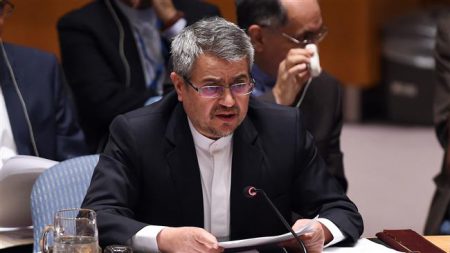
Iran’s ambassador to the UN Gholamali Khoshroo
Press TV – March 29, 2017
Iran’s ambassador to the UN Gholamali Khoshroo has called for the total eradication of nuclear weapons.
Khoshroo reiterated Iran’s call during a UN conference aimed at creating a nuclear weapons ban treaty in New York on Tuesday.
“Iran, as a victim of chemical weapons, strongly feels the danger posed by the existence of weapons of mass destruction and is determined to engage actively in international diplomatic efforts to save humanity from the menace of nuclear weapons,” he said.
Khoshroo stressed that Iran is committed to its Non-Proliferation Treaty (NPT) obligations, which include negotiations based on effective nuclear disarmament measures.
He added that several countries continue to ignore international calls and treaties for nuclear disarmament and even continue to increase their nuclear stockpiles. “They do not have political determination to abandon doctrines of nuclear deterrence and nuclear terror,” he went on to say.
Iran’s UN ambassador noted that boycotting the talks by many countries, including the US, shows that the world’s nuclear powers are by no means committed to the eradication of nuclear arms. Britain and France were also among the some 40 countries that did not join the talks.
“We note that prohibition of nuclear weapons must be accompanied by the elimination of such weapons. There can be no doubt that without complete abolition of nuclear weapons, there will be no absolute guarantee against the danger of nuclear war and the use of such weapons,” Khoshroo added.
Blog Roll
 Aletho News
- The Crusades – colliding narratives
- Trita Parsi: Iran War Ends Today? Threats of Deporting Trita Parsi
- What Is SIDS?
- DHS docs: Govt bracing for nationwide anti-AI riots, preparing to crack down on dissent
- India signals rethink over West Asia
- Israeli Ex-Navy Chief admits massive damage from Iran missiles
- The strategic arsenal US lost in war against Iran – and why replenishment will take years
- Documents Suggest Fauci Knew COVID Was Created in Wuhan Lab, and mRNA Vaccines Wouldn’t Work
- No return to pre-war status for Strait of Hormuz – Iran’s top diplomat
- Ex-South Korean President sentenced for trying to provoke conflict with Pyongyang
- If Americans Knew
- Did Trump just threaten a nuclear attack on Iran? Another merger for Israel-Firster David Ellison –Daily Update
- Israeli Firm Accused of Launching Smear Campaigns During US, European Elections
- As World Cup kicks off, Gaza amputee girls chase football dreams
- Oxfam: More Palestinians killed by Israel across West Bank in last 3 years than previous 17 years combined
- US-Iran ceasefire may be imminent, but will Israel blow it up? – Daily Update
- The Issue of Israel Is Ending Democracy In Michigan
- Israel is stealing homes, livelihoods, and lives in West Bank
- Gaza is not an aberration – Israel planned this genocide decades ago
- Israel is changing the face of Lebanon, mainstream media is normalizing it – 3 articles
- Genocide lobby benefits from EU anti-racist fund
- No Tricks Zone
- New Study: Significant CO2 Fluxes From Non-Volcanic Sources Are Largely Neglected In Carbon Budgets
- Women Climate Scientists Being Harassed, Insulted By Skeptics, Claims Berkeley Earth Researcher
- Germany’s Longterm Spring Climate Data Show “No Climate Trend”
- New Study: Solar Photovoltaic, Wind Power Fail To Meet Annual Energy Demands 62% Of The Time
- Germany’s Die Welt: “Too Much Is Too Much” … Green Energies Are Cannabalizing Each Other!
- Germany’s Ecological Holocaust… Once Fairy Tale Forests Getting Cleared For Wind Turbines
- A Grand Solar Minimum Has Arrived…Global Cooling Of At Least 1°C Is Expected By The 2030s, 2040s
- European “Expert Commission” Urges COVID-19-Like Global Climate State Of Energency!
- Real-World Observations Do Not Support The Position That Climate Change Is Human-Caused
- Germany’s AfD Party Calls Debunked Climate Scenarios “Greatest Fraud In Human History”
 Aletho News