Why France’s Yellow Vest Protests Have Been Ignored by “the Resistance” in the U.S.

By Max Parry • Unz Review • January 2, 2019
”The rich are only defeated when running for their lives.”— C.L.R. James, The Black Jacobins
In less than two months, the yellow vests (“gilets jaunes”) movement in France has reshaped the political landscape in Europe. For a seventh straight week, demonstrations continued across the country even after concessions from a cowed President Emmanuel Macron while inspiring a wave of similar gatherings in neighboring states like Belgium and the Netherlands. Just as el-Sisi’s dictatorship banned the sale of high-visibility vests to prevent copycat rallies in Egypt, corporate media has predictably worked overtime trying to demonize the spontaneous and mostly leaderless working class movement in the hopes it will not spread elsewhere.
The media oligopoly initially attempted to ignore the insurrection altogether, but when forced to reckon with the yellow vests they maligned the incendiary marchers using horseshoe theory to suggest a confluence between far left and far right supporters of Jean-Luc Mélenchon and Marine Le Pen. To the surprise of no one, mainstream pundits have also stoked fears of ‘Russian interference’ behind the unrest. We can assume that if the safety vests were ready-made off the assembly line of NGOs like the raised fist flags of Serbia’s OTPOR! movement, the presstitutes would be telling a different story.
It turned out that a crisis was not averted but merely postponed when Macron defeated his demagogue opponent Le Pen in the 2017 French election. While it is true that the gilets jaunes were partly impelled by an increase on fuel prices, contrary to the prevailing narrative their official demands are not limited to a carbon tax. They also consist of explicit ultimatums to increase the minimum wage, improve the standard of living, and an end to austerity, among other legitimate grievances. Since taking office, Macron has declared war on trade unions while pushing through enormous tax breaks for the wealthy (like himself) — it was just a matter of time until the French people had enough of the country’s privatization. It is only a shock to the oblivious establishment why the former Rothschild banker-turned-politician, who addressed the nation seated at a gold desk while Paris was ablaze, is suddenly in jeopardy of losing power. The status quo’s incognizance is reminiscent of Marie Antoinette who during the 18th century when told the peasants had no bread famously replied, “let them eat cake” as the masses starved under her husband Louis XIV.
While the media’s conspicuous blackout of coverage is partly to blame, the deafening silence from across the Atlantic in the United States is really because of the lack of class consciousness on its political left. With the exception of Occupy Wall Street, the American left has been so preoccupied with an endless race to the bottom in the two party ‘culture wars’ it is unable to comprehend an upheaval undivided by the contaminants of identity politics. A political opposition that isn’t fractured on social issues is simply unimaginable. Not to say the masses in France are exempt from the internal contradictions of the working class, but the fetishization of lifestyle politics in the U.S. has truly become its weakness. We will have to wait and see whether the yellow vests transform into a global movement or arrive in America, but for now the seeming lack of solidarity stateside equates to a complicity with Macron’s agenda.
It serves as a reminder of the historically revisionist understanding of French politics in the U.S. that is long-established. The middle class dominated left-wing in America ascribes to a historical reinterpretation of the French Revolution that is a large contributor of its aversion to transformative praxis in favor of incrementalism. The late Italian Marxist philosopher and historian Domenico Losurdo, who died in June of this year, offered the most thorough understanding of its misreading of history in seminal works such as War and Revolution: Rethinking the Twentieth Century. The liberal rereading of the French Revolution is the ideological basis for its rejection of the revolutionary tradition from the Jacobins to the Bolsheviks that has neutralized the modern left to this day.
According to its revised history, the inevitable outcome of comprehensive systemic change is Robespierre’s so-called ‘Reign of Terror’, or the ‘purges’ of the Stalin era in the Soviet Union. In its view, what began with the Locke and Montesquieu-influenced reforms of the constitutional monarchy was ‘hijacked’ by the radical Jacobin and sans-culotte factions. Losurdo explains that counter-revolutionaries eager to discredit the image of rebellion overemphasize its violence and bloodshed, and never properly contextualize it as self-defense against the real reign of terror by the ruling class. The idea behind this recasting of history is to conflate revolutionary politics with Nazi Germany whose racially-motivated genocide was truly the inheritor of the legacy of European colonialism, not the ancestry of the Jacobins or the Russian Revolution.
Maximilien Robespierre’s real crime in the eyes of bourgeois historians was attempting to fulfill the egalitarian ideals of republicanism by transferring political power from the aristocracy and nouveaux riche directly into the hands of the working class, just as the Paris Commune did nearly 80 years later. It is for this reason he subsequently became one of the most misunderstood and unfairly maligned figures in world history, perhaps one day to be absolved. The U.S. reaction to the yellow vests is a continuation of the denial and suppression of the class conflict inherent in the French Revolution which continues to seethe beneath the surfaces of capitalism today.
In today’s political climate, it is easy to forget that there have been periods where the American left was actually engaged with the crisis of global capitalism. In what seems like aeons ago, the anti-globalization movement in the wake of NAFTA culminated in huge protests in Seattle in 1999 which saw nearly 50,000 march against the World Trade Organization. Following the 2008 financial collapse, it briefly reemerged in the Occupy movement which was also swiftly put down by corporate-state repression. Currently, the political space once inhabited by the anti-globalization left has been supplanted by the ‘anti-globalist’ rhetoric mostly associated with right-wing populism.
Globalism and globalization may have qualitatively different meanings, but they nevertheless are interrelated. Although it is shortsighted, there are core accuracies in the former’s narrative that should be acknowledged. The idea of a shadowy world government isn’t exclusively adhered to by anti-establishment conservatives and it is right to suspect there is a worldwide cabal of secretive billionaire power brokers controlling events behind the scenes. There is indeed a ‘new world order’ with zero regard for the sovereignty of nation states, just as there is a ‘deep state.’ However, it is a ruling class not of paranoiac imagination but real life, and a right-wing billionaire like Robert Mercer is as much a globalist as George Soros.
Ever since capitalism emerged it has always been global. The current economic crisis is its latest cyclical downturn, impoverishing and alienating working people whose increasing hardship is what has led to the trending rejection of the EU. Imperialism has exported capital leading to the destruction of jobs in the home sectors of Western nations while outsourcing them to the third world. Over time, deep disgruntlement among the working class has grown toward an economic system that is clearly rigged against them, where the skewed distribution of capital gains and widespread tax evasion on the part of big business is camouflaged as buoyant economic growth. When it came crashing down in the last recession, the financial institutions responsible were bailed out using tax payer money instead of facing any consequences. Such grotesque unfairness has only been amplified by the austerity further transferring the burden from the 1% to the poor.
Before the gilets jaunes, the U.K.’s Brexit referendum in 2016 laid bare these deep class divisions within the European Union. One of the most significant events in the continent since WWII, it has ultimately threatened to reshape the Occident’s status in the post-war order as a whole. Brexit manifested out of divisions within Britain’s political parties, especially the Torys, which had been plagued for years by internal dispute over the EU. Those in power were blind to the warning signs of discontent toward a world economy in crisis and were shocked by the plebiscite in which the working class defied the powers that be against all odds with more than half voting to leave.
In general, well-to-do Brits were hard remainers while those suffering most severely from the destruction of industry, unemployment and austerity overwhelmingly chose to leave in what was described as a “peasants revolt” by the media. The value of the pound sterling quickly plunged and not long after the status of the United Kingdom as a whole came into question as Britain found itself at odds with Scotland’s unanimous decision to remain. Brexit tugged at the bonds holding the EU together and suddenly the collective standing clout of its member states is at stake in a potential breakup of the entire bloc.
Euroscepticism is also by no means a distinctly British phenomenon, as distrust has soared in countries hit the hardest by neoliberalism like Greece (80%), with Spain and France not far behind. In fact, before there was Brexit there was fear among the elite of a ‘Grexit.’ In response to its unprecedented debt crisis manufactured by the International Monetary Fund (IMF), the Greek people elected the Coalition of the Radical Left, SYRIZA, to a majority of legislative seats to the Hellenic Parliament during its 2015 bailout referendum. Unfortunately, the synthetic alliance turned out to be anything but radical and a trojan horse of the establishment. SYRIZA was elected on its promise to rescind the terms of Greek membership in the EU, but shortly after taking office it betrayed its constituency and agreed to the troika’s mass privatization. Even its former finance minister Yanis Varousfakis admitted that SYRIZA was a controlled opposition and auxiliary of the Soros Foundation.
Apart from suffering collective amnesia regarding the EU’s neoliberal policies, apparently the modern left is also in serious need of a history lesson regarding the federation’s fascist origins. It has been truly puzzling to see self-proclaimed progressives mourning Britain’s decision to withdraw from a continental union that was historically masterminded by former fifth columnists of Nazi Germany. It was in the aftermath of WWII’s devastation that the 1951 Treaty of Paris established the nucleus of the EU in the European Coal and Steel Community, a cooperative union formed by France, Italy, West Germany, and the three Benelux states (Belgium, Luxembourg and the Netherlands). The Europe Declaration charter stated:
“By the signature of this Treaty, the involved parties give proof of their determination to create the first supranational institution and that thus they are laying the true foundation of an organized Europe. This Europe remains open to all European countries that have freedom of choice. We profoundly hope that other countries will join us in our common endeavor.”
The idea of forming a “supranational” union was conceived by the French statesman Robert Schuman, who during the outbreak of WWII served as the Under-Secretary of State for Refugees in the Reynaud government. When Nazi Germany invaded France in 1940, Schuman by all accounts willingly voted to grant absolute dictatorial powers to Marshall Philippe Pétain to become Head of State of the newly formed Vichy government, the puppet regime that ruled Nazi-occupied France until the Allied invasion in 1944. By doing so, he retained his position in parliament, though he later chose to resign. Following the war, like all Vichy collaborators Schuman was initially charged with the offense of indignité nationale (“national unworthiness”) and stripped of his civil rights as a traitor.
More than 4,000 alleged quislings were summarily executed following Operation Overlord and the Normandy landings, but the future EU designer was fortunate enough to have friends in high places. Schuman’s clemency was granted by none other than General Charles de Gaulle himself, the leader of the resistance during the war and future French President. Instantly, Schuman’s turncoat reputation was rehabilitated and his wartime activity whitewashed. Even though he had knowingly voted full authority to Pétain, the retention of his post in the Vichy government was veneered to have occurred somehow without his knowledge or consent.
Schuman is officially regarded as one of the eleven men who were ‘founding fathers’ of what later became the EU. One of the other major figures that contributed to the federal integration of the continent was Konrad Adenauer, the first Chancellor of the Federal Republic of Germany. The Nuremberg Trials may have tried and executed most of the top leadership of the Nazi Party, but the post-war government that became West Germany was saturated with former Third Reich officials. Despite the purported post-war ‘denazification’ policy inscribed in the Potsdam agreement, many figures who had directly participated in the Holocaust were appointed to high positions in Adenauer’s administration and never prosecuted for their atrocities.
One such war criminal was the former Ministry of the Interior and drafter of the Nuremberg race statutes, Hans Globke, who became Adenauer’s right hand man as his Secretary of State and Chief of Staff. Adenauer also successfully lobbied the Allies to free most of the Wehrmacht war criminals in their custody, winning the support of then U.S. General and future President Dwight Eisenhower. By 1951, motivated by the desire to quickly rearm and integrate West Germany into NATO in the new Cold War, the policy of denazification was prematurely ended and countless offenders were allowed to reenter branches of government, military and public service. Their crimes against humanity took a backseat to the greater imperialist priority of rearmament against East Germany and the Soviets.
In the years following WWII, there was also concern among the elite of anti-Americanism growing in Western Europe. The annual Bilderberg Group conference was established in 1954 by Prince Bernard of the Netherlands, himself a former Reiter-SS Corps and Nazi Party member, to promote ‘Atlanticism’ and facilitate cooperation between American and European leaders. Invitations to the Bilderberg club meetings were extended to only the most exclusive paragons in politics, academia, the media, industry, and finance. In 2009, WikiLeaks revealed that it was at the infamous assembly where the hidden agenda of the European Coal and Steel Community, later the EU, was set:
“E. European Unity: The discussion on this subject revealed general support for the idea of European integration and unification among the participants from the six countries of the European Coal and Steel Community, and a recognition of the urgency of the problem. While members of the group held different views as to the method by which a common market could be set up, there was a general recognition of the dangers inherent in the present divided markets of Europe and the pressing need to bring the German people, together with the other peoples of Europe, into a common market. That the six countries of the Coal and Steel Community had definitely decided to establish a common market and that experts were now working this out was felt to be a most encouraging step forward and it was hoped that other countries would subsequently join it.”
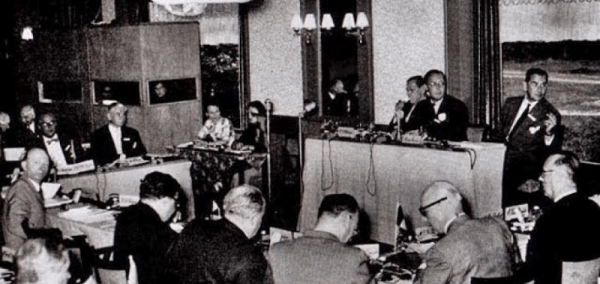
Prince Bernard presides over the first annual Bilderberg meeting in 1954.
At the 1955 conference, the rudimentary idea for a European currency or what became the Eurozone was even discussed, three years before the Treaty of Rome which established the European Economic Community, without the public’s knowledge:
“A European speaker expressed concern about the need to achieve a common currency, and indicated that in his view this necessarily implied the creation of a central political authority.”
The mysterious Bilderberg gatherings are still held to this day under notorious secrecy and are frequently the subject of wild speculation. One can imagine a topic behind the scenes at this year’s meeting would be how to address the growth of anti-EU ‘populism’ and uprisings like the gilet jaunes. Hitlerite expansionism had been carried out on the Führer’s vision for a European federation in the Third Reich — in many respects, the EU is a rebranded realization of his plans for empire-building. How ironic that liberals are clinging to a multinational political union founded by fascist colluders while the same economic bloc is being opposed by today’s far right after its new Islamophobic facelift.
While nationalism may have played an instrumental role in Brexit, there is a manufactured hysteria hatched by the establishment which successfully reduced the complex range of reasons for the Leave EU vote to racism and flag-waving. They are now repeating this pattern by overstating the presence of the far right among the yellow vests. Such delirium not only demonizes workers but coercively repositions the left into supporting something it otherwise shouldn’t — the EU and by default its laissez-faire policies — thereby driving the masses further into the arms of the same far right. Echoes of this can be seen in the U.S. with the vapid response to journalist Angela Nagle’s recent article about the immigration crisis on the southern border. The faux-left built a straw man in their attack on Nagle, who dared to acknowledge that the establishment only really wants ‘open borders’ for an endless supply of low-wage labor from regions in the global south destabilized by U.S. militarism and trade liberalization. Aligning itself with the hollow, symbolic gestures of centrists has only deteriorated the standards of the left participating in such vacuousness and dragged down to the level of liberals.
There is no doubt Brexit and Trump pushed the xenophobia button and could not have come about without it. However, such criticism means nothing when it comes from moral posturers who claim to “stand with refugees” while supporting the very ‘humanitarian’ interventionist policies displacing them. Nativism was not the sole reason the majority voted to leave the EU and many working class minorities also were Brexiters. Of course their fellow workers and migrants are not the true cause of their misery. After all, it was not just chattel slaves who came to the U.S. unwillingly but European immigrants fleeing continental wars and starvation as well — the crisis in the EU today is no different.
Fundamentally, migrants seek asylum on Europe’s doorstep because of NATO’s imperial expansion and the unexpected arrival of Brexit has threatened to weaken the EU’s military arm. Already desperate to reinvent itself and a new enemy in Russia despite its functional obsolescence, the shock of the referendum has inconveniently undermined NATO’s ability to pressure Moscow and Beijing, a step forward for mitigating world peace in the long run and a silver lining to its outcome. It is the task of the left to reject the EU’s neoliberal project while transmitting the message that capital, not refugees, is the cause of the plight of the masses. It is also necessary to have faith in the people, something cynical liberals lack. Racism may historically be the achilles heel of the working class but underlying Brexit, the election of Trump, and the yellow vests is the spirit of defiance in working people, albeit one of political confusion in need of guidance.
If the yellow vests are today’s sans-culottes, like those which became the revolutionary partisans in the French Revolution, they will eventually need a Jacobin Club. Relatively progressive but ultimately reformist figures like Mélenchon are no such spearhead and will only lead them down the same dead end of SYRIZA. The absence of any such vanguard has forced the working class to take matters into their own hands in the interim. If history is any guide, the gilets jaunes will be stamped out until a new cadre takes the reins whose objective is, as Lenin said,“not to champion the degrading of the revolutionary to the level of an amateur, but to raise the amateurs to the level of revolutionaries.” We also cannot fall into ideological fantasies that we live in permanent revolutionary circumstances or that a spontaneous uprising can become comprehensive simply because of ingenious leadership. Nevertheless, as Mao Tse-Tung wrote, “a single spark can start a prairie fire” and hopefully the yellow vests are that flame.
Max Parry is an independent journalist and geopolitical analyst. Max may be reached at maxrparry@live.com
Syrian Kurds throw Americans under the bus
By M. K. BHADRAKUMAR | Indian Punchline | December 28, 2018
The Syrian government forces have entered the northern town of Manbij on the Turkish border earlier today. The Syrian military command announced in Damascus that the operation stemmed from the commitment to “impose sovereignty to each inch of Syrian territories and in response to calls of locals of Manbij city.”
The announcement reiterated Damascus’ twin objective of “smashing terrorism and expelling the invaders and occupiers out of Syrian soil.” The government troops have hoisted the Syrian Arab flag in Manbij.
In a highly significant move, Kremlin Spokesman Dmitry Peskov promptly welcomed the development. “No doubt, this is a positive step towards stabilizing the situation,” the spokesman said. He added that the expansion of the zone of the Syrian government troops’ control “is a positive trend.”
It stands to reason that Moscow mediated between the Syrian Kurdish leadership and Damascus. There have been reports that Syrian Kurdish delegations visited Moscow this week as well as the Russian military base at Hmeimim in Syria. A senior Kurdish leader in Manbij told Reuters, “We want Russia to play an important role to achieve stability.”
Indeed, Moscow needs no prompting from anyone in this regard. The Russian Foreign Ministry spokesperson Maria Zakharova said on Wednesday, “The question of fundamental importance is who will assume control of the regions the Americans will vacate. It should be the Syrian government… We believe that the Syrian government is equipped to maintain stability through dialogue and interaction with all the national patriotic forces. This dialogue in the interests of all Syrians can help complete the routing of the terrorists and preclude their reappearance in Syria. It is important not to interfere with the Syrian society’s efforts on the political track.”
The fact of the matter is that while Russia welcomes Trump’s decision to withdraw US troops from Syria and regards it as “important in that it can promote a comprehensive settlement of the situation” Moscow remains extremely wary of what it entails. So far, even a week after Trump’s announcement, Washington has not contacted Moscow to explain its decision.
Foreign Minister Sergey Lavrov drew attention to this while talking to the media in Moscow today: “To the best of my knowledge… Washington wants its coalition partners to assume responsibility. French, British and German service personnel are also illegally deployed on the ground. Of course, there are also the coalition’s air forces on whom they want to shift an extra financial burden. We hope to receive specific explanations… on the assumption that the end goal of all counter-terrorist operations in Syria is to restore Syria’s sovereignty and territorial integrity.”
The known unknown will be the terms of any Faustian deal between Washington and Ankara with regard to the future of the Syrian territories under American control. A US military delegation is expected in Ankara. Moscow and Damascus (and Syrian Kurds) would not rule out the possibility that Pentagon commanders would work on the “neo-Ottoman” and secretly encourage Turkish revanchism. Meanwhile there are also reports that Turkish forces are moving toward the frontlines facing Manbij in “full readiness… to start military operations to liberate the town, according to Reuters.
Suffice to say, Damascus and Moscow have pre-empted Ankara in the race for Manbij. Put differently, they have created a new fact on the ground, which either Ankara has to learn to live with or use military force to change. The latter course is fraught with immense risk, apart from severely jolting the Turkish-Russian political understanding over Syria. It is unlikely that Turkey will push the envelope.
However, to my mind, Turkish President Recep Erdogan is unlikely to cross lines with the Kremlin. A high-powered Turkish delegation comprising Foreign Minister Mevlut Cavusoglu, Defence Minister Hulusi Akar, Turkish intelligence chief Hakan Fidan and the presidential spokesman Ibrahim Kalin is expected to travel to Moscow on Saturday. No doubt, Moscow hopes to engage Ankara constructively.
Interestingly, amidst the dramatic developments concerning Manbij today, Russian President’s Special Representative for the Middle East and African Countries, Deputy Foreign Minister Mikhail Bogdanov disclosed in Moscow today that the Guarantor States of Astana Process (Russia, Turkey and Iran) may hold a summit in Russia next week, depending on the schedule of the three presidents.
Curiously, there has been no reaction from Washington to today’s developments in Manbij. American troops have been patrolling in Manbij town and the tense front line between Manbij and adjacent towns where fighters backed by Turkey were based. Having received the orders from Washington to withdraw from Syria, the local US commanders in northeast Syria will be in a quandary.
Nonetheless, it will be a bitter pill for the Pentagon commanders to swallow that the Syrian Kurds are overnight reconciling with Damascus. This will become additional fodder for Trump’s detractors in the US, too. In fact, sniping has already begun in Washington.
On the other hand, the Syrian Kurds, who have been the US’ main allies in Syria up until recently, have openly declared that they have invited the government forces to enter Manbij. They said in a statement today, “Due to the invading Turkish state’s threats to invade northern Syria and displace its people similarly to al-Bab, Jarablus and Afrin, we as the People’s Protection Units, following the withdrawal of our forces from Manbij, announce that our forces will be focusing on the fight against ISIS on all the fronts east of the Euphrates.”
The statement added that the Syrian government forces are ”obliged to protect the same country, nation and borders” and also protect Manbij from Turkish threats. It leaves the door wide open for the Syrian government forces to eventually regain control of the entire territory vacated by the US.
Assad has offered the integration of the Kurdish fighters into the Syrian Army under separate regiments. The prospects are that Assad’s offer will find acceptance among the Kurds at some point soon. There has all along been a tacit co-habitation between the Syrian Kurdish fighters and the government forces operating in northern regions bordering Turkey. It will be recalled that Assad quietly went to the aid of the Kurdish fighters in February when the Turkish army attacked Afrin region in the northwest in February.
Clearly, it is nonsense to say that the Kurds have been “thrown under the bus”, as Trump’s critics in the US are alleging. The plain truth is that the US created the illusion in the Kurdish mind that the creation of another Kurdistan on Syrian territory, similar to the one in Iraq, could become a possibility. But, fundamentally, Kurds will reconcile with Damascus. The comfort level between the Kurds and the Russians is also appreciable, historically. Moscow has consistently held the view that the Kurds must be represented at the negotiating table in any intra-Syrian peace process. The speed with which Kurds began mending fences with Damascus only underscores that they never quite trusted the Americans and all along had kept their options open.
Angela Merkel: Nation States Must “Give Up Sovereignty” To New World Order

Photo Credit: Abdülhamid Hoşbaş – Anadolu Agency
Tapainfo.com – 11/22/2018
“Nation states must today be prepared to give up their sovereignty”, according to German Chancellor Angela Merkel, who told an audience in Berlin that sovereign nation states must not listen to the will of their citizens when it comes to questions of immigration, borders, or even sovereignty.
No this wasn’t something Adolf Hitler said many decades ago, this is what German Chancellor Angela Merkel told attendants at an event by the Konrad Adenauer Foundation in Berlin. Merkel has announced she won’t seek re-election in 2021 and it is clear she is attempting to push the globalist agenda to its disturbing conclusion before she stands down.
“In an orderly fashion of course,” Merkel joked, attempting to lighten the mood. But Merkel has always had a tin ear for comedy and she soon launched into a dark speech condemning those in her own party who think Germany should have listened to the will of its citizens and refused to sign the controversial UN migration pact:
“There were [politicians] who believed that they could decide when these agreements are no longer valid because they are representing The People”.
“[But] the people are individuals who are living in a country, they are not a group who define themselves as the [German] people,” she stressed.
Merkel has previously accused critics of the UN Global Compact for Safe and Orderly Migration of not being patriotic, saying “That is not patriotism, because patriotism is when you include others in German interests and accept win-win situations”.
Her words echo recent comments by the deeply unpopular French President Emmanuel Macron who stated in a Remembrance Day speech that “patriotism is the exact opposite of nationalism [because] nationalism is treason.”
The French president’s words were deeply unpopular with the French population and his approval rating nosedived even further after the comments.
Macron, whose lack of leadership is proving unable to deal with growing protests in France, told the Bundestag that France and Germany should be at the center of the emerging New World Order.
“The Franco-German couple [has]the obligation not to let the world slip into chaos and to guide it on the road to peace”.
“Europe must be stronger… and win more sovereignty,” he went on to demand, just like Merkel, that EU member states surrender national sovereignty to Brussels over “foreign affairs, migration, and development” as well as giving “an increasing part of our budgets and even fiscal resources”.
US, Europe Suffer From Rampant Corruption at ‘Highest Levels of Power’ – Poll
Sputnik – 27.12.2018
A new IFOP opinion poll that was conducted on both sides of the Atlantic has revealed that residents of seemingly corruption-free countries may not always regard them as such.
The poll was conducted exclusively for Sputnik in the United States, the United Kingdom, France, and Germany – four countries which ranked among the top-25 in the Transparency International Corruption Perceptions Index for 2017.
However, when asked how they would evaluate “the extent of corruption at the highest levels of power in their country”, two-thirds of respondents in the United States and over a half of respondents in France described it as “high”.
Over a third of respondents in Germany, along with nearly a third of respondents in the UK and France, claimed that the extent of corruption is “medium”, and about one fifth of German respondents (and much fewer in the other countries) said it is “low”.
The survey was conducted for Sputnik in August by IFOP among a total of 4,033 respondents over 18 years old. The margin of error does not exceed 3.1 percent.
What stopped Chad’s Idriss Déby from visiting Israel before now?
Dr Mustafa Fetouri | MEMO | December 20, 2018
If you did not know much about Chad, a country in the middle of Africa, it most likely it caught your eye on 26 November when its President, Idriss Déby, landed in Israel for an unannounced visit to the Zionist state. The visit was shrouded in secrecy until Déby’s plane touched down at Ben Gurion Airport. His closest aides had no idea that he was heading to Tel Aviv until the last minute. It reminds me of November 1977, when Egypt’s then President Anwar Sadat made his surprise trip to Israel.
Sadat justified his move by the fact that Egypt and Israel were at war with each other and such a visit, he believed, helped to make peace. Déby, on the other hand, has been in power since December 1990, Chad is not at war with Israel and the two countries are thousands of miles apart; so what motivated him to embark on such an endeavour at this time? Or, indeed, what stopped him from making such a visit before now?
Israeli journalist Herb Keinon answered this question by explaining that, “Chad severed ties with Israel in 1972 after coming under pressure from Libya.” Reuters reported that Dore Gold, the Director of Israel’s Foreign Ministry in 2016, explained after his own visit to Chad why the government in N’Djamena cut ties with Israel over four decades earlier: “[his Chadian hosts] told him that they cut off ties 44 years prior under Libyan pressure, a factor removed with the toppling of Muammar Gaddafi [in 2011].”
Indeed Libya under Gaddafi was the fiercest opponent of Israeli expansion in Africa. As early as 1972, just three years after taking power, Gaddafi forced the then Chadian President, François Tombalbaye, to sever ties with Tel Aviv. Gaddafi believed strongly that any Israeli diplomatic expansion into Africa undermined the continent’s pro-Palestinian position. The late Libyan leader considered Israel to be an enemy best kept as far away as possible from Libya and Africa.
Libya has a history of ties with Chad going back to Italy’s invasion and occupation of Libya in 1911, which saw hundreds of Libyans seeking safety in Chad; their descendants still live in Libya’s southern neighbour. Gaddafi capitalised on this to strengthen ties between this community of exiles and their home country. He also sought to prevent Chad from becoming a threat to Libya’s security, which is why Tripoli was involved in toppling Chadian regimes considered unfriendly, particularly between 1972 and 1990.
Idriss Déby himself became President of Chad in December 1990, with Libyan political and military support. Gaddafi invested Libya’s oil money in Chad; the North African state owns two banks there and some luxury hotels, and built dozens of schools, mosques and medical facilities, as well as communication and agriculture infrastructure.
The late Libyan leader also used his political clout in Africa to keep African countries away from western influence, knowing too well that it would only benefit Israel as many western capitals would encourage them to embrace and help Tel Aviv to infiltrate the continent even more. In this context, Libya founded the African Union in 1999, for Pan-African cooperation. Tripoli also founded the Community of Sahel-Saharan States (CEN-SAD), bringing 24 Sub-Saharan African counties closer to neighbouring North African Arab states to share investment, free trade, security and foreign policy coordination.
This put Libya, before 2011, in direct competition with western powers in Africa. One of Tripoli’s long term objectives was to launch a golden dinar, backed by its own huge financial reserves, as a currency for African states to replace the CFA franc which is backed by the French treasury. This was one of the reasons behind French President Nicolas Sarkozy’s attack on Libya to topple the Gaddafi regime in 2011.
After Gaddafi was killed in 2011, many of his long term African initiatives were, under French pressure, abandoned. CEN-SAD, for example, is being replaced by the smaller Group of 5 Sahel (G5S) made up of Chad, Niger, Mali, Mauritania and Burkina Faso. Ironically, though, the members of G5S are the weakest in Africa and are focusing on security by allowing France and the United States to establish military bases in Mali and Niger. This would have been unthinkable if Gaddafi was still around.
Having the best military among the G5S countries, Chad’s Idriss Déby has become even more influential in Africa. This makes his link with Israel even more dangerous.
As the leading armed forces within G5S, Chad’s army is responsible for fighting terrorism in the Sahel region. Déby and Mohamed Ould Abdel Aziz of Mauritania are seeking to promote G5S as a trusted partner in Africa. In this context, visiting Israel is an important step to unlock further diplomatic and military support.
Israeli Prime Minister Benjamin Netanyahu has made it his objective since 2016 to visit as many Muslim majority countries as possible. It would not be surprising to see some sort of rapprochement between Israel and Mali, Mauritania or Niger, or all three. Déby’s ice breaking visit to Tel Aviv has helped open the door for such rapprochement in Africa which, once upon a time, was a no-go area for Israel.
Apart from diplomatic gains, Israel is also interested in using Chad and its neighbours as stopovers for flights to South America, saving time and cost. A flight from Tel Aviv to Brazil, for example, will be around four hours shorter if central African airspace can be used. At the moment, such flights take around 17 hours, with at least one stopover in Europe or North America for refuelling.
Déby is facing more security challenges from his own people as armed rebel groups become more organised and stronger thanks to the safe bases they have in southern Libya. Young people in Chad’s Sahel region of Bahr El-Ghazal and Kanem in particular are becoming increasingly disenchanted with the authority in N’Djamena. The President’s security apparatus has been using discriminatory and heavy-handed tactics in the region under the pretext of fighting Boko Haram and other terror groups which infiltrated this vital area after Libya was destroyed by NATO in 2011.
The Chadian President is likely to seek Israeli help to keep himself in power. France, his main backer, “encouraged him to visit Israel,” according to Aqreen Saleh, the former Libyan ambassador to Chad who knows Déby personally. Saleh insists that “security for [Déby’s] regime is the main driver behind the visit to Israel,” not least because, over the past five years, the government in N’Djamena has been challenged by the rebel groups operating from southern Libya.
However, going to Israel is likely to backfire, particularly among Chad’s Muslim majority population. Historically, and especially since Chad gained independence, it has been Muslims who have risen against and toppled the central government.
Before 2011, thousands of Chadians depended on Libya for employment opportunities. Now they are heading to Libya to join rebel groups or work as mercenaries fighting for different Libyan factions, compounding Déby’s problems.
Idriss Déby needs arms and military equipment to fight the threat from the rebels operating out of Libya and Israel is only too happy to supply them to him. In the absence of any strong Arab leadership in Africa post-Gaddafi and the destruction of Libya, more African leaders are likely to embrace apartheid Israel at the expense of African support for the Palestinians and links with the Arab world.
French Workers Go on General Strike in Support of Yellow Vests

French lawyers burn legal codes as part of a nation-wide strike against planned justice reform law. | Reuters
teleSUR | December 14, 2018
In solidarity with the popular ‘yellow vests’ movement, France’s workers have gone on national strike Friday, a move called by the General Confederation of Labor (CGT).
“The best way to protest is to go on strike,” the CGT’s Philippe Martinez told BFM TV Friday. “We must multiply actions at companies. We must strike everywhere.”
The French trade union announced the day of action Tuesday after negotiations with the government over unemployment benefits failed.
“The CGT, like the yellow vests, is fighting for claims on salaries, what (French president Emmanuel) Macron announced is not enough because there isn’t any general raise in salaries,” Union representative for health workers Francoise Doriate told Reuters.
“The minimum wage isn’t a minimum wage… the increase of an income tax on only a part of pensioners is a scam and there is a freeze on pensions which means we are losing buying power.”
On Monday, President Macron announced wage rises for the poorest workers and tax cuts for pensioners in further concessions meant to quell weeks of often violent protests that have challenged his authority. However, the government’s decision has been seen by some as a sham.
“Emmanuel Macron thought he could hand out some cash to calm the citizen’s insurrection that has erupted,” Jean-Luc Melenchon, leader of the far-left La France Insoumise, said. “I believe that Act V (of the protests) will play out on Saturday,” he said referring to a new round of protests planned this weekend.
The move to strike puts pressure on companies as labor unions use their collective power to create disruption just as demonstrators prepare for a fifth-weekend wave of protests across the country since the movement began Nov. 17.
“Of course it is not a question of shouting victory but of amplifying the mobilization: that is why all the general assemblies are maintained!” CGT leadership said in a statement.
The administration of Macron also declared a state of economic and social emergency Monday, and requested the cancellation of the ‘yellow vest’ protests this weekend, citing Tuesdays shooting in Strasburg in which three people were killed and 13 others wounded. Police killed the shooter late on Thursday.
Police have been cracking down on the protests using tear gas and water cannon and many fear that the government is preparing a major repression as the movement announces a fifth round of demonstrations.
The leadership of the CGT said the call to strike is in support of the social and wage demands driven by the popular movement of the yellow vests.
The War Against Globalism
By Philip M. GIRALDI | Strategic Culture Foundation | 13.12.2018
We are the Little Folk—we!
Too little to love or to hate.
Leave us alone and you’ll see
How we can drag down the State!A Pict Song, Rudyard Kipling
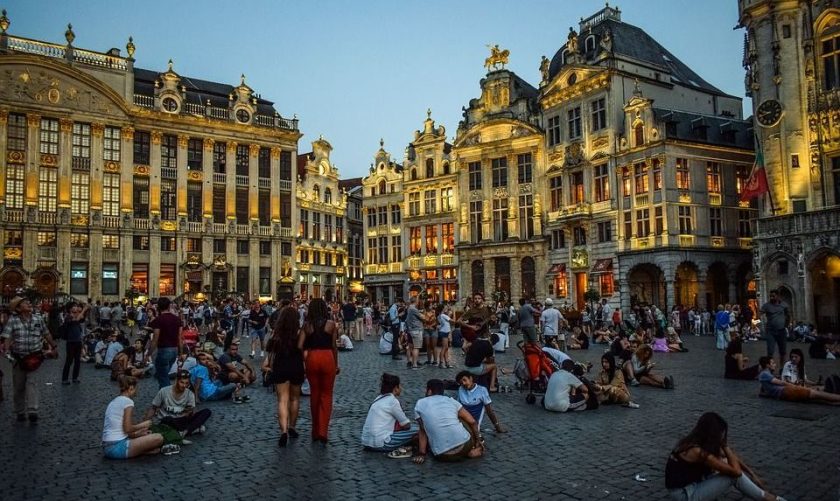
Belgium has joined the list of countries that are rebelling against their elected leadership. Over the weekend the Belgian government fell over Prime Minister Charles Michel’s trip to Morocco to sign the United Nations Migration Agreement. The agreement made no distinction between legal and illegal migrants and regarded immigration as a positive phenomenon. The Belgian people apparently did not agree. Facebook registered 1,200 Belgians agreeing that the Prime Minister was a traitor. Some users expressed concern for their children’s futures, noting that Belgian democracy is dead. Others said they would get yellow vests and join the protests.
The unrest witnessed in a number of places is focused on some specific demands but it represents much broader anger. The French yellow vests initially protested against proposed increases in fuel taxes that would have affected working people dependent on transportation disproportionately. But when that demand was met by the government of President Emmanuel Macron, the demonstrations continued and even grew, suggesting that the grievances with the government were far more extensive than the issue of a single new tax. Perhaps not surprisingly, the French government is seeking for a scapegoat and is investigating “Russian interference.” The US State Department inevitably agrees, claiming that Kremlin directed websites and social media are “amplifying the conflict.”
Some commentators looking somewhat more deeply at the riots in France have even suggested that the real issue just might be regime change, that the Macron government had become so disconnected with many of the voters through both its policies and the rhetoric justifying them that it had lost its legitimacy and there was no possibility of redemption. Any change would have to be an improvement, particularly as a new regime would be particularly sensitive to the sentiments of those being governed, at least initially. One might suggest that the prevailing sentiment that a radical change in government is needed, come what may, to shake up the system might well be called the “Trump phenomenon” as that is more-or-less what happened in the United States.
The idea that republican or democratic government will eventually deteriorate into some form of tyranny is not exactly new. Thomas Jefferson advocated a new revolution every generation to keep the spirit of government accountable to the people alive.
Call it what you will – neoliberalism, neoconservatism or globalism – the new world order, as recently deceased President George H.W. Bush once labeled it, characteristically embraces a world community in which there is free trade, free movement of workers and democracy. They all sound like good things but they are authoritarian in nature, destructive of existing communities and social systems while at the same time enriching those who promote the changes. They have also been the root cause of most of the wars fought since the Second World War, wars to “liberate” people who never asked to be invaded or bombed as part of the process.
And there are, of course, major differences between neoliberals and neoconservatives in terms of how one brings about the universal nirvana, with the liberals embracing some kind of process whereby the transformation takes place because it represents what they see, perhaps cynically, as the moral high ground and is recognized as being the right thing to do. The neocons, however, seek to enforce what they define as international standards because the United States has the power to do so in a process that makes it and its allies impossible to challenge. The latter view is promoted under the phony slogan that “Democracies do not fight other democracies.”
The fact that globalists of every type consider nationalism a threat to their broader ambitions has meant that parochial or domestic interests are often disregarded or even rejected. With that in mind, and focusing on two issues – wholesale unwelcome immigration and corrupt government run by oligarchs – one might reasonably argue that large numbers of ordinary citizens now believe themselves to be both effectively disenfranchised and demonstrably poorer as rewarding work becomes harder to find and communities are destroyed through waves of both legal and illegal immigration.
In the United States, for example, most citizens now believe that the political system does not work at all while almost none think that even when it does work it operates for the well-being of all the citizens. For the first time since the Great Depression, Americans no longer think of upward mobility. Projections by sociologists and economists suggest that the current generation growing up in the United States will likely be materially poorer than their parents. That angst and the desire to “do something” to make government more responsive to voters’ interests is why Donald Trump was elected president.
What has been occurring in Belgium, France, with Brexit in Britain, in the recent election in Italy, and also in the warnings coming from Eastern Europe about immigration and European Union community economic policies are driven by the same concerns that operated in America. Government itself is becoming the enemy. And let us not forget the countries that have already felt the lash and been subjected to the social engineering of Angela Merkel – Ireland, Spain, Portugal and Greece. All are weaker economies crushed by the one size fits all of the EURO, which eliminated the ability of some governments to manage their own economies. They and all their citizens are poorer for it.
There have been windows in history when the people have had enough abuse and so rise up in revolt. The American and French revolutions come to mind as does 1848. Perhaps we are experiencing something like that at the present time, a revolt against the pressure to conform to globalist values that have been embraced to their benefit by the elites and the establishment in much of the world. It could well become a hard fought and sometimes bloody conflict but its outcome will shape the next century. Will the people really have power in the increasingly globalized world or will it be the 1% with its government and media backing that emerges triumphant?
Tale of two uprisings: Ukraine’s Maidan got McCain & cookies, French Yellow Vests get shunned
By Robert Bridge | RT | December 13, 2018
Unlike the 2014 Ukraine uprising, which witnessed invasive meddling on the part of US politicians and diplomats, Western support for the French Yellow Vest protests has been conspicuously missing in action.
With the streets of Paris ablaze for a fourth weekend in a row, as a swarm of Yellow Vests assert themselves against a French government which, they argue, has become increasingly detached from the cares of ordinary citizens, support among Western capitals for the protesters is nowhere to be found.
This is a bit odd since the ‘gilets jaunes’ are not just protesting Macron’s (rescinded) plans for a fuel tax, but have released a list of 42 demands they want to see implemented. This includes an increase of the minimum wage, pensions and wages, as well as a halt to illegal immigration into the country. In other words, we are not talking about violent anarchists on the streets of France, but regular citizens. Thus far, the movement enjoys a high level of support among the French, with one poll showing 72 percent siding with the protesters.
The United States and its allies may have trouble explaining their tone-deafness in the face of these legitimate concerns on the part of millions of French citizens. At the very least, their icy silence will reveal a no small amount of double standards and outright hypocrisy since the West rarely misses an opportunity to interfere in the affairs of foreign states – mostly in the Middle East – when ‘democracy’ is purportedly on the line.
Consider Washington’s starkly different attitude to Ukraine’s 2014 Maidan revolution, which brought down the government of Viktor Yanukovich through the explicit support of the United States, as well as a number of influential NGOs operating in the country. Yanukovich committed the unforgivable mistake of thinking he would be allowed to pursue an independent course for his country, despite the fact that since 1992, the US had spent over $5 billion propping up ‘democracy-building programs’ in Ukraine.
Did Kiev really think that Washington would not eventually expect something in return for all those dollars, like maybe deciding who would eventually rule the Eastern European country on Russia’s border? And that is exactly what happened.
When Yanukovich signaled that he would not sign Ukraine up to an EU trade deal, he awoke a sleeping giant below his feet. Several weeks after the announcement, as his country was becoming increasingly divided over its options, the late US Senator John McCain appeared in central Kiev where he tossed dry wood on the smoldering fires by proclaiming at a rally on Independence Square, “Ukraine will make Europe better, and Europe will make Ukraine better… America is with you.”
What could have motivated Washington to pursue such blatant interference in the affairs of Ukraine, while ignoring the French ‘gilets jaunes’ that are now fanning out across France, protesting the neo-Liberal policies of President Emmanuel Macron? Could the answer have anything to do with something as simple as money? That certainly seems to be a large part of the equation.
After all, steering Kiev away from Russia, Western officials understood, would pay off handsome dividends for Western lending institutions, like the International Monetary Fund, which had already lent Kiev billions of dollars to stay afloat. The West was fiercely opposed to the idea of Russia and China becoming ‘lenders of last resort’, a financial and political function that the Western world covets more than any other, with the possible exception of military interventionism against sovereign states.
Fast forward one year after John McCain was agitating rallies in Kiev, and Victoria Nuland was handing out cookies to the protesters, and we find Ukraine, under the new leadership of the US-anointed President Petro Poroshenko, inking a $17.5bn (£11.5bn) loan deal with the IMF, together with the painful austerity measures that always accompany the bags of cash.
Presently, there are no such financial incentives in France that would convince Western capitals to ‘rally on behalf of democracy’ as it had done without delay in Ukraine.
This glaringly hypocritical position with regards to the French protesters reveals a deeply flawed, cart-before-the-horse Western axiom that commands: ‘whatever works to the advantage of Western institutions and its political elite is automatically good for democracy.’ This does not exclude social upheaval and revolution. If violence in the streets translates into the empowerment of Western institutions, not least of all the global financial institutions, then such actions will be rewarded with Western support without a moment’s thought.
Today, Emmanuel Macron, 40, the former Rothschild investment banker known as “president of the rich” by his countrymen, is facing the prospect of an early political demise, no less than Viktor Yanukovich faced in 2014.
Indeed, to say that Macron’s popularity among the French is in the toilet would be putting the situation mildly.
As one local English-language French magazine summed up his plight: Macron is “long-hated by the extreme-leftist groups because of his past as a banker… detested by the far-right because of his pro-European, globalist beliefs and now hated by many ordinary French people, who see him as arrogant, aloof and unsympathetic to their problems.”
Yet, not a single Western politician to date has appeared in the French capital, rallying the protesters and demanding Macron step aside; nor has any top-ranking US diplomat been spotted handing out cookies to the French rabble as Victoria Nuland did in Kiev at the height of Ukrainian tensions.
Incidentally, with such stark images in mind, it seems preposterous that the US can actually accuse Russia of meddling in its political affairs, and without a shred of evidence to back the claims. But I digress.
The simple reason that no Western country has come out to condemn Macron is because he toes the line on neo-liberalism and extreme free-market economics that has ravaged the French middle class to breaking point. The fuel hike was just the proverbial straw that broke the voters’ back.
It would be no exaggeration to say that all segments of French society have become caught up in the protests. Today we see hundreds of French schools, for example, shutting down as students take to the streets to protest Macron’s unpopular education reform. Pensioners are also counted among the protesters after Macron lectured them to stop “whining” about spending cuts, at the very same time he was slashing taxes for the wealthy.
Clearly, there is nothing about Macron that Western leaders can find not to their liking. He is carrying out painful liberal reforms with gusto, and only under pain of usurpation does he backpedal on his political program. Although the rudderless French president may fancy himself as a modern-age Napoleon, acting tough with his subjects to get what he wants, ultimately it will be the French street that decides his fate, which at the moment looks very bleak.
Such a brutal wake-up call may very well be in store for many more Western neo-liberal leaders, who fail to feel the pulse of their people when instituting their unpopular policies, in the weeks and months to come.
French opposition rejects Macron’s concessions to Yellow Vests, some demand ‘citizen revolution’
RT | December 11, 2018
Macron’s concessions to the Yellow Vests has failed to appease protesters and opposition politicians, such as Jean-Luc Mélenchon, who called for “citizen’s revolution” to continue until a fair distribution of wealth is achieved.
Immediately after French President Macron declared a “social and economic state of emergency” in response to large-scale protests by members of the Yellow Vest movement, promising a range of concessions to address their grievances, left-wing opposition politician Mélenchon called on the grassroots campaign to continue their revolution next Saturday.
“I believe that Act 5 of the citizen revolution in our country will be a moment of great mobilization.”
Macron’s promise of a €100 minimum wage increase, tax-free overtime pay and end-of-year bonuses, Mélenchon argued, will not affect any “considerable part” of the French population. Yet the leader of La France Insoumise stressed that the “decision” to rise up rests with “those who are in action.”
“We expect a real redistribution of wealth,” Benoît Hamon, a former presidential candidate and the founder of the Mouvement Génération, told BFM TV, accusing Macron’s package of measures that benefit the rich.
The Socialist Party’s first secretary, Olivier Faure, also slammed Macron’s financial concessions to struggling workers, noting that his general “course has not changed.”
Although welcoming certain tax measures, Marine Le Pen, president of the National Rally (previously National Front), accused the president’s “model” of governance based on “wild globalization, financialization of the economy, unfair competition,” of failing to address the social and cultural consequences of the Yellow Vest movement.
Macron’s speech was a “great comedy,” according to Debout la France chairman, Nicolas Dupont-Aignan, who accused the French President of “hypocrisy.”
Yet many found Melanchon’s calls to rise up against the government unreasonable, accusing the 67-year-old opposition politician of being an “opportunist” and “populist,” who is trying to hijack the social protest movement for his own gain.
The Yellow Vest protests against pension cuts and fuel tax hikes last month were organized and kept strong via social media, without help from France’s powerful labor unions or official political parties. Some noted that such a mass mobilization of all levels of society managed to achieve unprecedented concessions from the government, which the unions failed to negotiate over the last three decades.
Featured Video

Trita Parsi: Iran War Ends Today? Threats of Deporting Trita Parsi
or go to
Aletho News Archives – Video-Images
From the Archives
Iran UN ambassador calls for destruction of all nuclear weapons
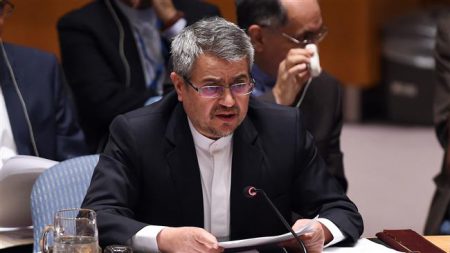
Iran’s ambassador to the UN Gholamali Khoshroo
Press TV – March 29, 2017
Iran’s ambassador to the UN Gholamali Khoshroo has called for the total eradication of nuclear weapons.
Khoshroo reiterated Iran’s call during a UN conference aimed at creating a nuclear weapons ban treaty in New York on Tuesday.
“Iran, as a victim of chemical weapons, strongly feels the danger posed by the existence of weapons of mass destruction and is determined to engage actively in international diplomatic efforts to save humanity from the menace of nuclear weapons,” he said.
Khoshroo stressed that Iran is committed to its Non-Proliferation Treaty (NPT) obligations, which include negotiations based on effective nuclear disarmament measures.
He added that several countries continue to ignore international calls and treaties for nuclear disarmament and even continue to increase their nuclear stockpiles. “They do not have political determination to abandon doctrines of nuclear deterrence and nuclear terror,” he went on to say.
Iran’s UN ambassador noted that boycotting the talks by many countries, including the US, shows that the world’s nuclear powers are by no means committed to the eradication of nuclear arms. Britain and France were also among the some 40 countries that did not join the talks.
“We note that prohibition of nuclear weapons must be accompanied by the elimination of such weapons. There can be no doubt that without complete abolition of nuclear weapons, there will be no absolute guarantee against the danger of nuclear war and the use of such weapons,” Khoshroo added.
Blog Roll
 Aletho News
- The Crusades – colliding narratives
- Trita Parsi: Iran War Ends Today? Threats of Deporting Trita Parsi
- What Is SIDS?
- DHS docs: Govt bracing for nationwide anti-AI riots, preparing to crack down on dissent
- India signals rethink over West Asia
- Israeli Ex-Navy Chief admits massive damage from Iran missiles
- The strategic arsenal US lost in war against Iran – and why replenishment will take years
- Documents Suggest Fauci Knew COVID Was Created in Wuhan Lab, and mRNA Vaccines Wouldn’t Work
- No return to pre-war status for Strait of Hormuz – Iran’s top diplomat
- Ex-South Korean President sentenced for trying to provoke conflict with Pyongyang
- If Americans Knew
- Did Trump just threaten a nuclear attack on Iran? Another merger for Israel-Firster David Ellison –Daily Update
- Israeli Firm Accused of Launching Smear Campaigns During US, European Elections
- As World Cup kicks off, Gaza amputee girls chase football dreams
- Oxfam: More Palestinians killed by Israel across West Bank in last 3 years than previous 17 years combined
- US-Iran ceasefire may be imminent, but will Israel blow it up? – Daily Update
- The Issue of Israel Is Ending Democracy In Michigan
- Israel is stealing homes, livelihoods, and lives in West Bank
- Gaza is not an aberration – Israel planned this genocide decades ago
- Israel is changing the face of Lebanon, mainstream media is normalizing it – 3 articles
- Genocide lobby benefits from EU anti-racist fund
- No Tricks Zone
- New Study: Significant CO2 Fluxes From Non-Volcanic Sources Are Largely Neglected In Carbon Budgets
- Women Climate Scientists Being Harassed, Insulted By Skeptics, Claims Berkeley Earth Researcher
- Germany’s Longterm Spring Climate Data Show “No Climate Trend”
- New Study: Solar Photovoltaic, Wind Power Fail To Meet Annual Energy Demands 62% Of The Time
- Germany’s Die Welt: “Too Much Is Too Much” … Green Energies Are Cannabalizing Each Other!
- Germany’s Ecological Holocaust… Once Fairy Tale Forests Getting Cleared For Wind Turbines
- A Grand Solar Minimum Has Arrived…Global Cooling Of At Least 1°C Is Expected By The 2030s, 2040s
- European “Expert Commission” Urges COVID-19-Like Global Climate State Of Energency!
- Real-World Observations Do Not Support The Position That Climate Change Is Human-Caused
- Germany’s AfD Party Calls Debunked Climate Scenarios “Greatest Fraud In Human History”
 Aletho News