When Private Ryan is shamed by quiet heroes in the Syrian Arab Army
RT | June 9, 2018
Stories of wartime heroism abound in Hollywood movie history, the gung-ho, swashbuckling images that saturate our cinema screens promote US military personnel to cult figures, ‘saving the world’.
It is the victory of fantasy over realism that distances the American public from the horrors of war.
Wars that are never on US soil but waged in distant lands, but always in the “interests of national security”. Consent is manufactured for these wars by fabricating fear and insecurity, the amplification of terrorism threats as the ever-present danger menacing the American people, held at bay by military intervention at an imagined ‘source’.
“US airstrikes on Syria were in the “vital national security and foreign policy interests” of the United States” President Trump told Congress, after the tripartite alliance of US, France and UK had unlawfully attacked Syria. An attack carried out under the pretext of a trumped-up charge of chemical attacks by the Syrian Arab Army (SAA) in the last moments of Douma’s liberation from Saudi-financed and UK-promoted extremists, Jaysh al-Islam.
Cinema is escapism and Hollywood excels in distracting a public already bamboozled by a corporate media’s expert distortion of fact to generate the narratives that instil fear and dehumanize the latest foe in the foreign policy crosshairs.
In Saving Private Ryan, the horror of battle is surround-sound deafeningly conveyed. Unremitting reality confronts our sensibility, the scream of bullets tearing into flesh, the clamour of the dying; nothing is left to the imagination. It is full frontal war.
In the movie, a detail of American soldiers is dispatched to France to bring Private Ryan home to his mother after General Marshall learns that his three brothers were killed in action. We are led to believe that the assuaging of Mama Ryan’s grief is of paramount national importance. It is an all-American feel-good-factor movie with the familiar “true grit”, the hard-bitten courage of ‘real men’ fighting to save the world and their own souls. As the movie’s tagline informs us: “In the last great invasion of the last great war, the greatest challenge for eight men… was saving one.”
As US Defence Secretary, James Mattis, said recently, when trying to explain away the wholesale devastation in Raqqa following a sustained bombing campaign by the US-led coalition – “we are the good guys and the innocent people on the battlefield know the difference” – I doubt the “innocent people” who were deliberately targeted by the coalition “precision” bombs would agree. The proclaimed war on terror, in this case Islamic State (IS, formerly ISIS/ISIL), invariably results in the massacre of innocent people whose mangled remains are dismissed as “collateral damage” in another US campaign that protects “national security”.
A campaign fought illegally in the skies above or on the ground of a sovereign nation that has never presented a threat to US security. Syria has effectively been defending US and European “national security” for seven long and tortuous years. The hordes of extremists under a variety of monikers are armed, financed and equipped by our governments and their allies in the Gulf States, to enable regime change in Syria, but you would never know it from the rhetoric they use to drown out their responsibility.
Syria is stemming the terrorist tide within its territory and the SAA is fighting and dying to contain the threat. Alongside its allies, Russia, Iran, Hezbollah – Syria is sacrificing everything to prevent the spread of a cataclysmic contagion that has been created and imposed upon them by the nations whose claims of moral superiority ring hollow when confronted by the bloodshed they leave in their wake.
The SAA is dehumanized and criminalised by media in the West, it is reduced to ‘Assad’s army”, a ‘Shia militia’ – portrayed as a ‘murderous squad of sectarian thugs’. Nothing could be further from the truth, in my experience. I have met with many families of martyred soldiers who have given their lives to defend their homeland, their people, their honour and their way of life. They fight because “a fallen building can be rebuilt, but a fallen homeland is lost forever.”

Om Al Fouz outside her home in Taldara with ISIS fighters less than 1km away. © Vanessa Beeley
There are thousands of ‘Mama Ryans’ in Syria, brave, fearless women who have suffered indescribable loss but who remain steadfast, proud of their children’s role in protecting their future. Om Al Fouz from Taldara, close to Salamiyah, has lost five sons in the genuine “war on terror”.
“When I lost the first one, I felt as if I had broken my back, I lost the second one only fifteen days later – I thought my heart had broken. Then the third, the fourth, the fifth, each time I grew stronger”.
Om Al Fouz also told me: “I have 25 grandsons, I am ready to give all my children for this battle. We are all ready to be martyred, this is our country, our dignity, our honour, our morals. We will never leave this country to anyone else”.
I met Hala in January 2018 in Salamiyah. Hala is a beautiful young girl whose husband was killed fighting with the SAA to defend her hometown and her country. Like so many families in Salamiyah, Hala expressed great pride her husband’s martyrdom but the sadness in her eyes told me she has lost her love and the father of her child.
Her husband, Fadi Afif al-Qasir, was killed defending Western Salamiyah from Nusra Front. He was 31 years old. Hala proudly showed me their wedding photographs, a stunning young couple just beginning their married life with so many hopes and dreams.
Hala told me: “When they called him to serve the homeland, he left immediately so he could defend his land, to defend his land, to defend his values……so that Syria’s voice could reach all of the countries, so that peace for Syria could prevail, so that peace would not only happen for us, so peace would be for all countries. What is entering here that we are fighting against, it is going to go outside of Syria, and if it went outside of Syria it is going to destroy all the people. So, my husband, Fadi Afif al-Qasir he offered his soul, he offered his heart, he offered his blood, to redeem the homeland”.

Hannah Al Ayek with a photo of her martyrd son Saed Nizar and alongside his brother Mohammed, her husband Ashour, daughters Sally and Isra © Vanessa Beeley
I also met Hannah Al Ayek and her family early in 2018 in Salamiyah. Her son, Saed Nizar, was not even 22-years-old when he was killed. Saed had been a helicopter engineer with the Syrian Arab Air Force. He was killed on 22 January 2013. He was on board a helicopter ferrying supplies into the base when it was brought down by a Free Syrian Army TOW missile, according to his family.
Hannah said to me: “Your coming here and talking to me about my son gives us strength. We beg you to take our voices as far as you can. My son and all our Martyrs have sacrificed themselves for the world, not just for Syria. Maybe they don’t all have the same face, but they do have the same soul.”

Ahmed Jabr with his family and photo of his martyrd son, Mohammed, in Salamiya © Vanessa Beeley
Every family I met with and interviewed made similar statements. Ahmed Jabr lost his 23-year-old son, Mohammed, on the 4 March 2013, fighting with the SAA against IS in Qaryatayn.
Ahmed told me: “We have a great army and we represent the army. The army represents us and they have sacrificed so much but thank God we have the victory on our side. They brought every foreign terrorist in the universe to our country. It is the Western countries bringing us this terrorism. Thank God we stand by our Army as one hand. Our Army defends the whole Arab world and the World from this terrorism because it will spread from Syria to the World.”
The SAA is made up of conscripts. In many cases ordinary young men and women have taken up arms to defend their people, as in Salamiyah surrounded on four sides by IS, Nusra Front, Ahrar al-Sham and a variety of extremist splinter groups. These soldiers are often inexperienced in military strategy and combat. They are facing a professional force of battle-hardened mercenaries, well equipped with more sophisticated weapons and machinery thanks to their sponsors in the West and Gulf States.

In every city, town and village in Syria you will find the displays of photos of Martyrs who have given their lives to defend their people. This is Salamiyah. © Vanessa Beeley
We in the West owe an infinite debt of gratitude to these young men and women who have resisted the terrorist spawn of our own imperialist nations. There will be no ‘Private Ryan’ films depicting their courage and bloodshed. There will be no commemorative statues erected in Washington or London in honour of their sacrifices. There will be no recognition of their unity, no acknowledgement of their dignity in Western media.
It falls upon us, the people, to salute these heroes, these defenders of humanity who have given their lives to prevent us living their torment. This is not some romantic vision of a world of complex nuances and multi-faceted truths, it is the realistic admission that without the SAA, we would be awash with extremism from the Euphrates to the Thames. Far from the din and cacophony of Hollywood generated conflict, these soldiers are the quiet heroes who have undeniably earned “the right to go home”.
US using ‘ethnic cleansing’ to set up compliant state in Syria – Vanessa Beeley to RT
RT | June 6, 2018
The US is trying to ethnically cleanse Syria in order to kill off Syrian nationalism and create an obedient state, journalist Vanessa Beeley told RT following a damning report on the US coalition’s military activities in Raqqa.
Beeley, an independent journalist who has covered the war in Syria extensively, told RT that the US, UK and French coalition is using proxy forces to cleanse certain areas of land in the war-torn country in an effort “to replace them with a proxy that will essentially create a US controlled state.”
She was responding to a new Amnesty International report that strongly criticizes the actions of the US-led coalition in its campaign to liberate the previously Islamic State (IS, ISIS/ISIL)-controlled city of Raqqa.
The Amnesty report accused the coalition and its Kurdish-led Syrian Democratic Force (SDF) proxies of creating “a level of destruction comparable to anything we’ve seen in decades of covering the impact of wars,” and it says that the coalition’s claims that the bombings were “precise” and caused few civilian casualties do not stand up to scrutiny.
Beeley said that the Amnesty report put “meat on the bones” of previous analysis from on-the-ground journalists and some Russian analysts and commentators. She said that despite the US-led campaign ostensibly being about ridding the area of IS terrorists, it was the terrorists “who were evacuated as priority over the civilians.”
“Civilian property and infrastructure, essential infrastructure like water taps, like water supply units that were keeping civilians alive during the campaign were also being targeted,” she said, adding that it was the SDF forces designating the targets for the US coalition.
“So there’s a degree of collusion here between the US coalition and its proxies forces on the ground,” she said.
Beeley also criticized the reluctance of the British government, in particular, to admit to causing civilian deaths during its military campaign. The UK Ministry of Defense, she said, “did not even admit one civilian death as a result of their “precision” bombing — and then they only reluctantly admitted that they believe one civilian was killed by one of their drone strikes.”
Comparing the American-led military campaign in Raqqa to the Russian and Syrian-led military campaign to liberate east Aleppo, Beeley said that there were different standards set and attempts were made to protect Aleppo civilians.
“What we saw there were the provision of humanitarian corridors for civilians to be able to leave under the cover of the Syrian Arab Army and with the help of the Russian reconciliation teams negotiating with the terrorist and militant extremist factions to allow civilians to leave,” Beeley said. “What we’ve seen in Raqqa is civilians paying smugglers to try and leave during the military campaign, having to cross minefields, being unable to afford the cost of those smuggling groups.”
Beeley also said that Syrian civilians were being forced to return to buildings and areas of Raqqa that had not yet been cleared of improvised explosive devices (IEDs), booby traps and mines left by IS militants.
In contrast, the journalist said that Russian forces “cleared thousands of hectares of those IEDs and booby traps” following their campaigns to liberate Aleppo and Ghouta from IS.
“What we’re seeing here is a disgusting despicable disregard for human life both during the military campaign and even more importantly after the military campaign by the US coalition,” Beeley said.
Watch Vanessa Beeley’s full interview with RT.
‘Yemen killings may be even bigger’
In a separate interview, Joshua Landis, the director of the Center for Middle-East studies at the University of Oklahoma, told RT that the Amnesty report made it clear that there were “massive violations of human rights.” An investigation was unlikely given that the US, Britain and France sit on the UN Security Council, he said.
Landis said he believed the US did make efforts to avoid killing civilians, but that, ultimately, the US-led coalition was “in a hurry.”
“The UN asked them [US coalition] multiple times to give breaks so civilians could get out, but they didn’t want to negotiate with IS, they said they were gonna kill them on the battlefield. They didn’t want them as prisoners in another Guantanamo and this led to a situation where the US was eager to finish it off, did not want to allow a break, did not want UN workers to go into Raqqa because they were going to see the devastation,” he said.
Landis compared the destruction to that caused by the US-supported, Saudi-led coalition in Yemen: “What’s taking place in Yemen may be even bigger, but we don’t even know because reporters aren’t being allowed in there – but an entire population is being starved.”
“Half a million Yemenis have gotten cholera and there isn’t the proper medicine to fix them and heal them and this is a terrible, devastating war crime because it’s voluntary. It doesn’t have to happen. People don’t have to be starved. There’s a blockade going on,” he said.
“We know that US special forces are helping the Saudis now in Yemen. Is the killing in Yemen more clean than the killing in Syria? It’s hard to believe it is – and we’ll find out the ultimate body count, I guess in the end,” Landis added.
Lebanon launches search for first oil & gas reserves despite Israeli threats
RT | May 30, 2018
Beirut has announced the start of its oil and gas exploration for offshore energy reserves in the Mediterranean after approving a plan submitted by a consortium of France’s Total, Italy’s Eni and Russia’s Novatek.
Energy and Water Minister Cesar Abi Khalil said Lebanon plans to launch a second offshore licensing round by the end of 2018 or early 2019.
In February, the country signed its first offshore oil and gas exploration and production agreements with the Total-Eni-Novatek consortium for offshore Blocks 4 and 9.
Part of Block 9 contains waters disputed with neighboring Israel but the consortium said it had no plans to drill in that area. Lebanese authorities gave the go-ahead this week for exploration of the two blocks to begin, said Khalil.
The exploration period can last up to three years and the first well is expected to be drilled in 2019, providing all government departments grant necessary licenses and permissions “on time and without delay”, he added.
The minister explained that drilling would determine whether Lebanon had commercial reserves and, if so, their scale. Lebanon shares the Levant Basin in the eastern Mediterranean with Israel, Cyprus, and Syria. A range of big sub-sea gas fields have been discovered in the area since 2009.
However, the country was far behind Israel and Cyprus in exploring and developing its share of resources as a result of political issues over the past few years, and a dispute with Israel over Lebanon’s southern maritime border.
Israel had earlier threatened Lebanon over drilling in areas which it considers to be disputed. It warned Lebanon that it would pay a “full price” if another war breaks out between the two countries.
Three months ago, Lebanese President Michel Aoun appealed to US Secretary of State Rex Tillerson, asking for Washington’s “effective role” in settling the dispute with Israel over offshore oil drilling areas. After the US proposed sharing the offshore blocks, Lebanon rejected its offer to “help.”
The US proposal reportedly specified that the Lebanese would take up 65 percent of the disputed sections of the shelf. Commenting on the proposal Aoun said Lebanon will not give Israel a “millimeter.” He underlined that the offshore energy blocks are located in Lebanon’s waters and thus are within Beirut’s exclusive economic zone.
Lebanon and Israel’s dispute runs over a triangular area of around 860 square kilometers (332 square miles) of waters, which could contain huge reserves of natural gas and maybe even crude oil.
Western leaders back in Russia as tensions appear to ease
East-West relations seem to have changed over past 10 days, as three major Western leaders attend St Petersburg forum
By M.K. Bhadrakumar | Asia Times | May 28, 2018
East-West relations have transformed over the past 10-day period. Russia’s isolation from the West after the Maidan coup in Kiev appears to have warmed as abruptly as it began.
Three major Western leaders – German Chancellor Angela Merkel, French President Emmanuel Macron and Japanese Prime Minister Shinzo Abe – visited Russia during the period since May 18, mainly to attend the St Petersburg Economic Forum. But they had one mantra to chant: Russia is an indispensable partner – and one offer to make – despite sanctions, economic and political ties with Russia are possible and necessary.
On the other hand, US President Donald Trump’s critics, who accuse him of causing a trans-Atlantic rift, have had a rethink, since he may have instead triggered an overall easing of East-West tensions, as America’s European partners dust off their “Ostpolitik” to seek an apparent rapprochement with Russia.
Of course, the three Western leaders who traveled to Russia were not acting in concert. Merkel, Macron, Abe – each had a specific agenda with Russia’s Vladimir Putin. They were not interested in taking advantage of Russia’s tense relations with the US. Their intuition probably told them that things have come to such a pass in world politics that high-level contact between Russia and America might now be only a matter of time.
Equally, Putin was not inclined to turn the visits of three top Western leaders into an “anti-American” platform to exploit the current trans-Atlantic rift. Putin’s focus was on what these leaders could bring to the Russian economy by way of trade and investment. But in political terms, as much as Russia sizes up Germany, France and Japan as partners, the US still remains the partner of its heart’s desire.
Suffice to say, Russia grapples with the geopolitical reality that while the trans-Atlantic rift could become the “new normal,” an outright rupture between the US and its European allies or an unraveling of the Western alliance is not in the cards. Again, in the final analysis, without the United States’ participation, it is impractical to address issues such as Syria, the Iran nuclear problem, Ukraine, etc.
Macron audacious, Merkel wary
Between Merkel and Macron, the latter seemed far more eager and audacious to turn a new leaf in relations with Russia. France’s Total has taken US$2.5 billion in equity in Russian major Novatek’s Yamal LNG 2 project in the Siberian Arctic (with an option to double it). Macron promised to overtake German investments in Russia ($18 billion). He sought a new “mechanism” to solve the Syrian crisis; he stated France’s intention to protect its companies operating in Iran; and he even harked back to the defeat of Nazism to invoke France’s and Russia’s common destiny as United Nations veto powers and world leaders.
Nonetheless, Moscow is yet to figure out the potential of Macron, who began one year ago as the alpha male vis-à-vis Trump but went on to invite the latter as guest of honor on Bastille Day and become his best friend in the Western world, and is now presenting himself as an incorrigible Gaullist. Putin wore a quizzical look as Macron plunged gustily into an extraordinary speech lasting half an hour at the improbable forum of their joint press conference in St Petersburg on May 25.
The point is, Gaullism didn’t survive Charles de Gaulle. Will Gaullism-2 survive the second year of Macron’s seven-year presidency? Time only can tell. How far will Macron go out on a limb to drop the European Union’s hostile sanctions against Russia or to break loose from the West’s strategy to provoke Russia? Actually, he didn’t forget to add that France remains all the while a US ally.
As for Germany, Russia has always viewed it as the pace-setter in the EU. But there is a catch here too, since Merkel was also a midwife to the Maidan in Kiev (where it all began) and worked shoulder to shoulder with Barack Obama to erect a harsh sanctions regime against Russia. Those were halcyon days when Merkel was de facto leader of the EU and the champion of the liberal international order – “The Iron Frau” who doubled up as the “Matti” – Otto von Bismarck and Mother Teresa at the same time.
Things have changed since then. Obama has left the stage; the migrant problem became controversial and eventually diminished Merkel politically (despite the brilliant performance of the German economy); and she is besieged today by several negative factors. Brexit came out of the blue; the Franco-German axis that was integral to her pet project of European integration lost verve; and America First began incessantly battering Germany (and Merkel personally). To borrow a poignant metaphor from Mikhail Gorbachev over the sad plight of managers of Soviet state enterprises in the era of perestroika, Merkel is afraid to leave the open cage and take wing and fly into the firmament.
Perhaps her timidity is due to the fear that assertiveness may provoke accusations of Germany’s inordinate geopolitical ambitions triggering another tragic cycle of history (“German Question”), and due to a genuine distrust of Russia among Germany’s political class, which is weaned on Euro-Atlanticism. But it is there. As top Moscow pundit Fyodor Lukyanov wrote recently, in Berlin “change is feared.”
Within earshot of the visiting Western leaders, Putin again signaled his interest in a full-bodied Russian-American dialogue. But alas, Washington speaks in multiple voices. Meanwhile, bad tidings have arrived from Syria – an attempted drone attack on Hmeimim air base; a US threat to take “firm and appropriate measures” against any Syrian operations against extremist groups ensconced in southwest Syria; and the killing of four Russian military personnel in Dier ez-Zor on Sunday.
If only Russian wishes had wings, Americans should have been better soccer players. That might have just about brought them into the finale of the FIFA World Cup – and Trump to Moscow’s Luzhniki stadium on July 15 in front of a capacity crowd of 87,000 fans in one of the most picturesque districts of the Russian capital with the Moskva River flowing gently alongside the stadium, and Putin sitting beside him, with no aides present, for a full 90 minutes.
Ignoring the Astana Talks, the US Is Increasing Its Military Presence in Syria’s Deir ez-Zor Province
By Peter KORZUN | Strategic Culture Foundation | 17.05.2018
President Trump’s announcement that he intends to order the US military out of Syria attracted a lot of public attention, unlike the war preparations that preceded and followed those statements.
Three months ago, the American military established an outpost in Manbij, in the wake of Turkey’s threats to seize control of the area. The US has some 300 soldiers based at two facilities there. In March, US Marines beefed up the military presence at the Al-Tanf base in southern Syria that is located just a few miles from the Jordanian border. The American military has established a 55-km. no-go zone around that facility.
On May 15, US personnel were reported to be setting up a new base in Badiyeh al-Sha’afa in Syria’s Deir ez-Zor province. It’s hard to believe that this move is justified by the need to confront the Islamic State — that once-powerful enemy now on the brink of extinction. One does not need new bases to finish it off. The Syrian army is well versed in how to do that.
Last month US forces were also reported to be building a new outpost at the al-Omar oil field in southeastern Deir ez-Zor. They were deployed to positions around the Conoco and al-Jafreh oil fields. On April 7, the area around the oil fields in Deir ez-Zor was declared a military zone by the US-led SDF. That group has already clashed with Syrian forces in the fight to control the province.
The SDF is constantly reinforcing its positions in Deir ez-Zor as part of its ongoing Operation Al-Jazeera Storm, which was launched on May 1. It recently seized al-Baghuz and is pushing the remaining ISIS forces out of the pocket of Hajin and al-Dashisha along the border with Iraq. These operations are coordinated with the Iraqi air force. The SDF Arab-Kurdish forces have liberated about 65 square kilometers from Daesh. Making short work of whatever is left of the Islamic State is certainly a good thing, but Syrian troops will not be allowed in. The territory will become part of a quasi-state created to become a separate entity.
Despite its recent claims to the contrary, the US is hunkering down in Syria for the long haul. The US, Saudi Arabia, and France have already discussed the possibility of joint actions against Iran. The administration is pressing its Arab allies to do more. French forces are already operating in Deir ez-Zor together with the SDF.
The US buildup in northeastern Syria is important for cutting off any direct land route from Tehran across to the Mediterranean.
It is symbolic that the United States was not present at the Astana round of talks on May 14-15. It shows that Washington is no longer interested in de-escalation zones. It wants a divided Syria, with a new, pro-US entity on the map of the Middle East. It is creating local governing bodies that operate independently from Damascus, with enough money flowing in to keep them functional. And it would like to see other parts of Syria plunge into an all-against-all war. Instead of nation-building, Washington is engaged in nation-destruction. That’s why it continues to train rebel forces at Al-Tanf. The militants are not undergoing special exercises to hone their skills for peacekeeping operations, but rather for subversive activities.
Syria’s territorial integrity is guaranteed by UN Resolution 2254 — a binding document that the US, along with France, is in flagrant violation of.
But what if the US achieves in Syria what it wanted to do in Iraq — create a prosperous, pro-Western “democratic” state that can become a shining example for other Arab states to follow? The Iraqis have failed to grasp this “opportunity.” On May 15, they proved that once again by voting for Muqtada al-Sadr, the leader of Saraya al-Salam, who fought against the US-imposed “liberation.”
The UN General Assembly’s condemnation of Washington’s decision to relocate its embassy in Israel from Tel Aviv to Jerusalem shows how badly the US needs a success to rescue its waning clout in the region. Becoming the leader of the anti-Iranian coalition is how they’ve decided to do that and the location for that is Syria. The creation of a pro-Western entity in northeastern Syria will weaken Iran’s influence in Iraq and keep Russia contained.
But things could go the other way around. What if the Kurdish-dominated forces plunge into clashes with the local Arab population and the problems of inefficient local governance mount, while the Astana process makes progress thanks to the cease-fire and restoration of peaceful life in the de-escalation zones? A Kurdish-dominated entity, even if it is pro-US, is not something that Turkey may like or accept. Will the partition of Syria boost US standing in the region? Other Arab nations will think twice about letting America play a role in the management of any conflict. There are more questions than answers, but we have what we have — the US military presence in Syria is ballooning, hampering peace efforts and provoking armed conflicts.
Israel’s Murderous Strikes on Syria (via “Pacified” Lebanon)
By Andre Vltchek | New Eastern Outlook | May 1, 2018
On April 9, 2018 at least 14 people were killed during the murderous strike by the Israeli air force on the Syrian T-4 airfield at Homs.
Israeli F-15 fighter jets flew over Lebanese airspace, as they have done on many previous occasions, in total disregard of international law.
Both Israel and Lebanon are still technically at war, and the latest action could easily be considered as yet another shameless provocation. Apparently, whatever terror Western allies like Saudi Arabia and Israel decide to spread throughout the region, their actions will always go unpunished.
To add insult to injury, instead of condemning Israel, the Western mass media outlets began their predictable and embarrassing servile howling against the government in Damascus, some ‘correspondents’ even calling President al-Assad an “animal” (The Sun, 9th April, 2018).
This time, Lebanon, which in the past suffered from several brutal Israeli invasions, and where Israel is commonly referred to as ‘Palestine’, decided not to protest too loudly against the violation of its airspace. There were some statements made by individual Lebanese politicians, as well as a statement by the Lebanese Ministry of Foreign Affairs, which objected to the attack against Syria, claiming that Lebanon will file a complaint to the UNSC. Most of the statements, however, appeared only in the Arabic language. There was definitely no robust national response, as one would have expected.
Ms. Zeinab Al-Saffar, an Iraqi educator and television anchor based in Beirut, Lebanon, shared her thoughts on the subject:
It is not the first time that this is happening. Israeli forces have been violating the airspace of Lebanon, as well as the land and sea belonging to Lebanon. Violation of the territory of Lebanon [by Israel] became something ‘regular’. What happened recently is a flagrant intrusion which should not go unanswered, as they were using Lebanese air space in order to attack the Syrian land. I believe this is the right time for the U.N. to do something more than just to make the reports and write numbers. This is an extremely serious situation; to use the territory of a neighboring country in order to attack a third nation; it is a barefaced crime.
*****
Why do Lebanon’s protests not resonate louder?
There are several reasons. One: the country recently ‘secured’ an enormous package of mostly loans from the West, at a ‘Paris conference’, amounting to more than 11 billion dollars.
Two: A great percentage of the ‘elites’ of Lebanon is accustomed to taking orders from the West. The West is where their villas are, where their relatives live, and their permanent residency cards issued.
A much greater war may be nearing; both the U.S. and Europe are now attacking Syria directly. In this decisive time, the Lebanese rulers are opportunistically showing where their allegiances lie: not with the people of the devastated Middle East, but with Paris, London, Riyadh and Washington.
But back to the first point – to money. As reported by Reuters on April 6, 2018:
“The pledges include $10.2 billion in loans and $860 million in grants, France’s ambassador to Lebanon Bruno Foucher said on Twitter…”
Donors in turn want to see Lebanon commit to long-stalled reforms. In a nod to those demands, Prime Minister Saad al-Hariri pledged to reduce the deficit of the budget as a percentage of GDP by 5 percent in the coming five years.
Macron told Hariri in a news conference the aid aimed to give Lebanon a fresh start, adding that it put “an unprecedented responsibility” on authorities there to carry out reforms and preserve peace in the country.
“It is important to continue reforms in the coming months,” Macron said, adding: “We’ll be by your side.” …
French Foreign Minister Jean-Yves Le Drian told the conference: “… Lebanon needs major reforms of its economy, structural and sectoral.””
‘Structural reforms’ is a key term. This shameful package of loans which will further tie the hands of Lebanon could insure the complacency of the country: both economic and political obedience at the time when the West is ready to unleash a new wave of its military onslaught in the region.
There is hardly any transparency in Lebanon, and therefore almost no guarantee that the loans will be used to improve the standard of living of the suffering population. Corruption in Lebanon is endemic – it is institutionalized – to the point that it is often not even called ‘corruption’ anymore.
Social services are almost non-existent. Here, the contrasts are truly appalling. Ferraris and Lamborghinis, as well as outrageously expensive sailing boats, co-exist side-by-side with absolute misery and lack of social services, such as, at least periodically, garbage collection.
Hezbollah, a movement which is on the so-called terrorist list of many Western countries, is often the only reliable source of social services in the country.
The West will now demand more and more neo-liberal ‘reforms’. Almost nothing social will be built. Funds will disappear into the deep pockets of the shameless Lebanese ‘elites’ and ‘leaders’. It will be the poor, who will be expected to service the loans, as the rich in Lebanon hardly pay taxes.
In exchange for their booty, many Lebanese politicians will be further obliged to follow the Western line towards the region, including the neo-liberal and increasingly neo-colonialist policy of Washington and France (Lebanon’s former colonial master) towards Syria and the rest of the region.
******
And across the border line, the war is still raging. Washington and London fulfilled their shameful promises to perform ‘punitive actions’; to ‘chastise Syria’ for something that was clearly invented/manufactured just in order to justify an invasion, destabilization and in the end, the destruction, of this small but strong and proud nation.
A Syrian intellectual, who lives in both Beirut and Damascus, offered his analyses for this article. However, he requested not to be identified by his name, afraid of repercussions from both Lebanon and the West:
The Israeli attack comes at a time when the Syrian army is winning its fight against terrorist groups in Damascus suburbs, and it could be read as an indirect answer to these wins. It is also a dangerous move since the T4 airbase is heavily involved in the fight against the remaining of ISIS in Syria. This attack is unacceptable aggression against a sovereign nation and it is a violation of international laws. It also shows that Israel is helping directly and indirectly various terrorists groups operating on the Syrian territory.
*****
However, the commentaries that are being spread by the Western mainstream press are increasingly defying all logic. They are progressively turning out to be racist, supremacist. Well, actually now they are what they have always been earlier, throughout the centuries of European and then North American colonialism.

In Damascus, shelling a park right next to the Four Seasons Hotel, the UN accommodation from East Ghouta
Just read The Guardian article from April 9th, 2018- “Israel has launched countless strikes in Syria. What’s new is Russia’s response”:
Israel has launched many previous strikes into Syria, mainly to protect its borders from a buildup of Iranian-backed Hezbollah forces and armaments on the Golan Heights. Israel, has not, as a rule, attacked al-Qaida or Islamic State positions in Syria.
On all previous occasions, Russia – which has controlled Syrian air space since it sent troops to defend the regime of Bashar al-Assad in 2015 – has turned a blind eye. There had been an understanding that Israeli interests in Syria would be preserved by Russia, primarily by limiting the presence of Iranian-backed troops in Syria’s south-west. The Israeli fear is that access to the Syrian side of the Golan Heights allows Hezbollah to launch attacks into Israel.
At least The Guardian does not pretend that it believes in the Western fabrications that President Assad is poisoning his own people…
But the article is clearly trying to justify and find logic behind the Israeli terrorist attacks against the independent nation.
‘Poor Israel – it is worried about ‘Hezbollah forces and armaments on the Golan Heights.’

Spy-surveillance base on the hill overlooking Syria
But the Golan Heights is by international law an inseparable part of Syria. I repeat: by all international norms! Including, the United Nations Security Council UN Resolution 497. Golan Heights had been attacked, occupied and forcefully (and it looks like indefinitely) annexed by Israel, during the so-called ‘Six-Day War’ in 1981.
I visited the Golan Heights. I worked there, for several days, clandestinely, some 5 days ago. What I encountered there was true horror: ancient villages were totally destroyed, most of the original population deported from their land, Israeli-paid spies and provocateurs approaching and scrutinizing random visitors. All around – scattered rich Israeli agricultural enterprises protected by barbed wire and tall concrete walls. It all felt like working in Angola or Namibia, during the South African apartheid, or perhaps even worse; divided communities, stolen land, electric wire, and omnipresent fear and oppression.

Horrid border at Majdal al-Shams
But it is Israel which now has the right to ‘worry’ and to murder people in the name of its ‘security’. That is precisely what the tone of the Western mainstream periodicals clearly suggests.
Israel had stolen more than a thousand kilometers square of the Syrian territory in 1981, and now it is mercilessly bombing its victim; from Lebanese territory, in order to assure its ‘safety and security’. It is doing so from the territory of Lebanon, a country which was invaded by the Israeli military, on several occasions.
And the West is cheering.
*****
Of course, Israel is acting with total impunity, because it enjoys both the support and encouragement from its allies: The United States, the U.K. and Macron’s France.
Lebanon is panicking. Its’ ‘elites’ are trying to both survive, and not to anger the West.
Syrians have, it often appears, nerves of steel.
They worry but are determined not to give one single inch of their land to the invaders.
My friend in Damascus wrote to me, just a few hours before I submitted this report:
People are worried and they constantly follow up the news. My brother asked us to go to Safita for one month, as it is safer there. I’m not sure if we do it, but we are closely monitoring the situation.
My colleagues and comrades on the ground in Syria are angry, very angry. They can clearly see through the lies, which are being spread by the West.
Israel is repeatedly bombing heroic Syria.
On April 29, 2018, the Israeli attacks killed 26 Syrians and Iranians, just before Midnight, near Hama and Aleppo.
The U.S. and Europe are bombing and threatening to cause even more damage.
But this is 2018, not those dark years when the West could murder and rape without any consequences. If these attacks continue, there will be a counterpunch: fully justified, determined and powerful.
Then even the tiny Lebanon would have to decide where it stands.
• Photos by Andre Vltchek
US Dispatches More Military Gear to Kurds in Syria – Reports
Sputnik – 05.05.2018
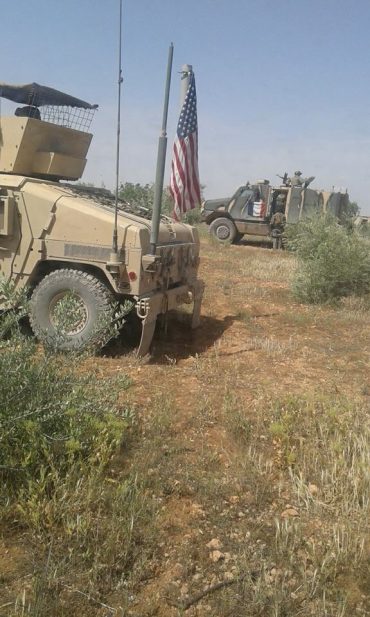 The US sent a new military convoy to the Kurdish militants’ bases in the Tal Beidar region, between the towns of Qamishli and Tal Tamr in northeastern Hasaka, the Lebanese al-Manar TV network reported.
The convoy included ten trucks full of arms and ammunition.
Local sources said that the Kurdish fighters have detained a number of civilians southwest of the town of Ra’as al-Ein in Northwestern Hasaka in order to train them in military camps.
Earlier this week, the Syrian Democratic Forces (SDF) informed Sputnik that there is a growing French military presence in the area of Manbij in Syria.
Sputnik received a photo showing two armored vehicles with military personnel in the area of the Sajur River in the territory of Manbij. One vehicle has a US flag on it, while the other has a French flag.
A senior member of the Military Council of Manbij told Sputnik that about 50 French soldiers are stationed on duty in the area. While in the north of Manbij work is currently underway to establish a French military base.
Al-Manar further confirmed the reports saying that three military vehicles under French flags had entered a Kurdish militia base in the al-Aliyeh region, south of the town of Ra’as al-Ein in northwestern Hasaka.
The network went on quoting field sources as seeing the US convoy of armored vehicles moving towards al-Shadadi from a military base north of the Khabour Dam.
Another Arabic media outlet, the Moraseloun news website, also reported today that the US Army has set up a new military base in Hasaka province, despite Donald Trump’s claims that Washington is set on withdrawing its forces from Syria.
The latest information adds to several other reports on the US’ alleged establishment of new military bases in Al-Hasakah, as well as in eastern Deir ez-Zor last month.
The US military presence in Syria has been dubbed an “aggression” by Damascus, as it has neither been approved by the government nor has it received a UN mandate.
The West Closes its Ears to Douma Testimony
By Jonathan Cook | Dissident Voice | April 28, 2018
The response from the US, UK and France to a briefing on Thursday at the Organisation for the Prohibition of Chemical Weapons (OPCW) in the Hague was perverse, to say the least. Russia had brought 17 witnesses from Douma who stated that there had been no chemical weapons attack there earlier this month – the pretext for an illegal air strike on Syria by the three western states.
The witnesses, a mix of victims and the doctors who treated them, told accounts that confirmed a report provided last week from Douma by British reporter Robert Fisk – a report, it should be noted, that has been almost entirely blanked by the western media. According to the testimony provided at the OPCW, the victims shown in a video from the site of the alleged attack were actually suffering from the effects of inhaling dust after a bombing raid, not gas.
The first strange thing to note is that the US, UK and France boycotted the meeting, denouncing Russia for producing the witnesses and calling the event an “obscene masquerade” and “theatre”. It suggests that this trio, behaving like the proverbial three monkeys, think the testimony will disappear if they simply ignore it. They have no interest in hearing from witnesses unless they confirm the western narrative used to justify the air strikes on Syria.
Testimony from witnesses is surely a crucial part of determining what actually happened. The US, UK and France are surely obligated to listen to the witnesses first, and then seek to discredit the testimony afterwards if they think it implausible or coerced. The evidence cannot be tested and rebutted if it is not even considered.
The second is that the media are echoing this misplaced scorn for evidence. They too seem to have prejudged whether the witnesses are credible before listening to what they have to say (similar to their treatment of Fisk). Tellingly, the Guardian described these witnesses as “supposed witnesses”, not a formulation that suggests any degree of impartiality in its coverage.
Notice that when the Guardian refers to witnesses who support the UK-UK-French line, often those living under the rule of violent jihadist groups, the paper does not designate them “supposed witnesses” or assume their testimony is coerced. Why for the Guardian are some witnesses only professing to be witnesses, while others really are witnesses. The answer appears to depend on whether the testimony accords with the official western narrative. There is a word for that, and it is not “journalism”.
The third and biggest problem, however, is that neither the trio of western states nor the western media are actually contesting the claim that these “supposed witnesses” were present in Douma, and that some of them were shown in the video. Rather, the line taken by the Guardian and others is that: “The veracity [of] the statements by the Russian-selected witnesses at The Hague will be challenged, since their ability to speak truthfully is limited.”
So the question is not whether they were there, but whether they are being coerced into telling a story that undermines the official western narrative, as well as the dubious rationale for attacking Syria.
But that leaves us with another difficulty. No one, for example, appears to be doubting that Hassan Diab, a boy who testified at the hearing, is also the boy shown in the video who was supposedly gassed with a nerve agent three weeks ago. How then do we explain that he is now looking a picture of health? It is not as though the US, UK and French governments and the western media have had no time to investigate his case. He and his father have been saying for at least a week on Russian TV that there was no chemical attack.
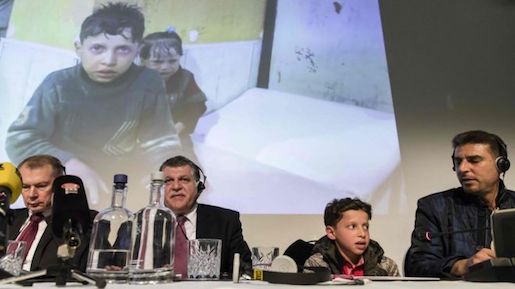
Instead, we are getting yet more revisions to a story that was originally presented as so cut-and-dried that it justified an act of military aggression by the US, UK and France against Syria, without authorisation from the UN Security Council – in short, a war crime of the highest order.
It is worth noting the BBC’s brief account. It has suggested that Diab was there, and that he is the boy shown in the video, but that he was not a victim of a gas attack. It implies that there were two kinds of victims shown in the video taken in Douma: those who were victims of a chemical attack, and those next to them who were victims of dust inhalation.
That requires a great deal of back-peddling on the original narrative.
It is conceivable, I suppose, that there was a chemical attack on that neighbourhood of Douma, in which people like Diab assumed they had been gassed when, in fact, that they had not been, and that others close by were actually gassed. It is also conceivable that the effects of dust inhalation and gassing were so similar that the White Helmets staff mistakenly filmed the “wrong victims”, highlighting those like Diab who had not been gassed. And it is also conceivable, I guess, that Diab and his family now feel the need to lie under Russian pressure about there not being a gas attack, even though their account would, according to this revised narrative, actually accord with their experience of what happened.
But even if each of these scenarios is conceivable on its own, how plausible are they when taken together. Those of us who have preferred to avoid a rush to judgment until there was actual evidence of a chemical weapons attack have been invariably dismissed as “conspiracy theorists”. But who is really proposing the more fanciful conspiracy here: those wanting evidence, or those creating an elaborate series of revisions to maintain the credibility of their original story?
If there is one thing certain in all of this, it is that the video produced as cast-iron evidence of a chemical weapons attack has turned out to be nothing of the sort.
What if Trump dumps the Iran deal?
By M K Bhadrakumar | Indian Punchline | April 28, 2018
The last big European effort to dissuade US President Donald Trump from abandoning the 2015 Iran nuclear pact ended without success Friday with the ‘working visit’ by German Chancellor Angela Merkel to the White House. Earlier in the week, French President Emmanuel Macron also tried his hand. Perhaps, all that remains is a phone call from British PM Theresa May to Trump.
Macron and Merkel met with no success. Macron floated an ingenious idea of linking the Syrian conflict, Iran’s ballistic missile program, Iran’s regional policies and the nuclear deal and negotiating a new package deal. But Trump didn’t sound enthusiastic. He’d rather tear up the Iran deal and move on. Macron estimated finally that Trump would act for “domestic reasons.” Mike Pompeo, the newly appointed secretary of state, also said Friday that the US is unlikely to remain in the deal.
At the joint press conference with Merkel at the White House on Friday, Trump was rhetorical and took a hard line. Merkel, while conceding that the 2015 pact might not have been a perfect deal, flagged that it was a “first step” that significantly slowed down Iran’s nuclear program and left scope for improvement – “one piece of the mosaic, one building block, if you like, on which we can build up this structure.”
Indeed, the remarks by Macron and Merkel vaguely hint at their acceptance that the 2015 pact needs to be re-negotiated. If so, they have caved in to Trump’s bullying. On the other hand, what they said does not reflect the common European Union position. The EU has never discussed the idea of a new Iran deal. The vast majority of EU countries seem perfectly pleased with the implementation of the 2015 deal and see no reason to reopen the agreement that was painstakingly negotiated. Any shift in the EU stance will need unanimity of opinion, which is highly unlikely to favor a re-negotiation of the 2015 deal.
The big question is what Iran’s reaction is likely to be to Trump’s decision to leave the nuclear deal. The Iranian Foreign Minister Mohammad Javad Zarif spoke on this in a conversation with Robin Wright at the New Yorker magazine. This is what Wright wrote:
- Tehran has three broad choices if Trump opts out, according to Zarif. In the first, Iran could withdraw from the deal, terminate compliance, and resume—even increase—its uranium enrichment… “America never should have feared Iran producing a nuclear bomb,” Zarif said. “But we will pursue vigorously our nuclear enrichment.”
- Iran’s second option exploits a dispute mechanism in the deal, which allows any party to file a formal complaint with a commission established to adjudicate violations. Iran has filed eleven complaints—to Federica Mogherini, the E.U.’s foreign-policy chief, who heads the commission—citing U.S. violations on three different counts, Zarif said. The process allows forty-five days for resolution. “The objective of the process is to bring the United States into compliance,” Zarif said.
- Iran’s third option is the most drastic: the country could decide to walk away from the Treaty on the Non-Proliferation of Nuclear Weapons, or N.P.T… In Tehran, debate is still intense about which option Iran should choose. “Iran is not a monolith,” Zarif said.
The growing impression is that the 2015 deal cannot be saved. But then, there is a flip side to it. One, Trump has shown that his strident rhetoric need not necessarily be followed by corresponding action. The North Korean example is in front of us. Two, Washington never really implemented the Iran deal. So, what difference does it make if Trump pulls out?
In the downstream, the US options are very limited. More US sanctions? Well, Iran has lived with US sanctions for four decades. Regime change? Just forget it. Military attack? Simply suicidal. Then, there are the ground realities. Iran is well entrenched in the so-called northern tier of the Middle East (Iraq, Syria and Lebanon) where the Shi’ite predominance is a geopolitical reality. Above all, there are other players in that region also who don’t like the US presence.
Importantly, Russia and China will never cooperate with Trump on the Iran file. The only significant variable, if at all, could be Europe’s implementation of the deal, which is of course crucial for Tehran. This was how Wright concluded: “I asked Zarif if there was a prospect, if the deal dies, that Iran would negotiate again with the United States. “Diplomacy never dies,” he told me. “But it doesn’t mean that there is only one avenue for diplomacy, and that is the United States.” Whatever Iran’s final decision, he said, it “won’t be very pleasant to the United States. That I can say. That’s a consensus.” Read Wright’s piece here.
Featured Video
Epidemic of fake videos
or go to
Aletho News Archives – Video-Images
From the Archives
Inside Job? Inside What?
By Prof. Tony Hall | American Herald Tribune | July 28, 2016
The Kevin Barrett-Chomsky Dispute in Historical Perspective – Sixth part of the series titled “9/11 and the Zionist Question”
In his chapter on “Left Gatekeepers” and the “Shame of Noam Chomsky,” Barrie Zwicker refers to the the “New World Order” as the “diaboligarchy’s” directing agency. Less compelling is Zwicker’s reference to the “New World Order” as the “diaboligarchy’s” directing agency. To me this unfortunate choice of words is much too closely associated with the often crude and chauvinistic populism of Alex Jones and his Infowars media network. Many have come to see Jones’ lucrative media operation as a limited hangout set in place by handlers trying to hold the activities of the 9/11 Truth Movement within manageable constraints.
Due to the important findings over fifteen years of the citizens’ investigation into 9/11, the culprits most deeply implicated in the crime can be identified with much more specificity than an entity vaguely described as a “New World Order.” As Kevin Barrett and many others insist, the time has come to name the names of the probable culprits, Noam Chomsky prominent among them.
While Alex Jones ultimately serves the same masters as Chomsky, the former’s media product is often much closer to the mark of what is really going on than the content of Noam Chomsky’s more magisterial pronouncements. Jones goes at least part of the way into realities of the deep state politics of the twenty-first century. Chomsky, however, sacrificed his capacity to contribute cogently to sensible discourse on contemporary geopolitics by making himself a primary instrument of the most consequential deep state deception of recent times. As a leading agent of disinformation in the psychological trenches of the ongoing Global War of False Flag Terrorism, Chomsky has reduced himself to the level of skeptic pretender Michael Shermer. In the style of Shermer, the elder Chomsky has become an establishment TV professor readily available on Netflix. … continue
Blog Roll
Recent Comments
Coronistan on EU member to sue bloc over ‘su… loongtip on Vicious loongtip on EU turns to India for defense… Coronistan on Donald Trump Is No Peace … seversonebcfb985d9 on French court jails pro-Palesti… eddieb on Fourteen Incredible Facts Abou… Bill Francis on European leaders’ shift in the… seversonebcfb985d9 on Villains of Judea: Philip Esfo… loongtip on Report warns that ‘Jewish terr… Craig Nelms on New study shows that toxic gas… loongtip on A Funny Thing Happened on the… loongtip on EU free trade pact on hold as…


 Aletho News
- Russia reiterates demand to Germany over Nazi crimes
- France and EU clash over UK missiles for Ukraine – Telegraph
- EU member to sue bloc over ‘suicidal’ ban on Russian gas
- WEF Calls for ‘Cultural Revolution’ to Promote Lab-Grown Meat
- The Board For Peace – Whitewashing Ethnic Cleansing and Genocide
- Scientists accuse Cochrane Reviews of using biased studies to claim HPV vaccine prevents cancer
- Spain Opens Probe Into Israeli Tourism Firms
- Epidemic of fake videos
- Craig Murray, Reporting from Venezuela
- Why Israel’s Drive to Destroy Iran is Ultimately about Palestine
- If Americans Knew
- An error has occurred; the feed is probably down. Try again later.
- No Tricks Zone
- New Study Affirms Rising CO2’s Greening Impact Across India – A Region With No Net Warming In 75 Years
- Germany’s Natural Gas Crisis Escalates … One Storage Site Near Empty …Government Silent
- Polar Colding…Antarctica Saw Its Coldest October In 44 Years!
- New Study: Sea Levels Rose 20 Times The Modern Rate During The Roman Warm Period
- As German Gas Storage Dips Dangerously Low…Shortage Hardly Avoidable
- New Study: Brazil’s Relative Sea Level Was 2+ Meters Higher And SSTs 3-4°C Warmer 6000 Years Ago
- Philosopher Schopenhauer: Climate Science Certainty Stems From Stupidity, Ignorance
- New Study: Species Extinction Rates Declining Since 1980 – ‘Climate Change Is Not An Important Threat’
- Denmark Places Climate Protection Above Animal Welfare, Poisoning And Culling Cows
- New Study: Greenland Was 3-7°C Warmer And Far Less Glaciated Than Today 6000-8000 Years Ago
 Aletho News