Moscow questions French report claiming Syrian govt ‘retained chemical weapons since 2013’
RT | April 14, 2018
The Russian Foreign Ministry slammed a French intelligence report claiming that the Syrian government retained a chemical weapons program since 2013, asking why Paris decided “to remain silent on its findings” till now.
On Saturday, the French Ministry of Defense published a report compiled by the intelligence services regarding the possible use of chemical weapons in the Syrian city of Douma last week.
“French intelligence services estimate that Syria did not declare all of its chemical weapon stockpiles and capabilities with the Organization for the Prohibition of Chemical Weapons in October 2013.”
Russian Foreign Ministry Spokesperson Maria Zakharova asked why France did not come forward with it before the US-led strikes early Saturday.
“It [France] says that it is supposedly a secret report, according to which Damascus has been carrying out certain secret programs for the production of chemical weapons since 2013,” Zakharova said on the 60 Minutes program aired on Rossiya-1.
“So where was France? Where were the official representatives of the French Foreign Ministry, the Ministry of Defense, the president? Where was France’s permanent representative to the UN Security Council? Why did they all remain silent all this time?” Zakharova said.
The report says the “French [intelligence] services began to analyze testimonies, photos and videos that appeared spontaneously on special websites, in the media and on social networks in the hours and days that followed the attack. The testimonies obtained by the services were also analyzed.”
The “spontaneous nature of the release” of the alleged chemical attack victims’ images on social media “confirmed that the data was not fabricated or reused.” After studying the photos, French experts determined that the victims of the attack had “identifiable symptoms,” as “some of the entities that published this information are recognized as usually reliable,” the report stated.
On Friday, the Russian Defense Ministry presented what it says is proof that the reported chemical weapon attack in Douma was staged. During a briefing, the ministry showed interviews with two people, who, it said, are medical professionals working in the only hospital operating in Douma, near the Syrian capital. In the interviews released to the media, the two men reported how footage was shot of people dousing each other with water and treating children, which was claimed to show the aftermath of the April 7 chemical weapon attack.
According to the ministry, the patients shown in the video suffered from smoke poisoning and the water was poured on them by their relatives after a false claim that chemical weapons were used. “Please, notice. These people do not hide their names. These are not some faceless claims on social media by anonymous activists. They took part in taking that footage,” the ministry spokesman noted.
Moscow also accused the British government of pressuring the perpetrators to speed up the “provocation.”
“The Russian Defense Ministry also has evidence that Britain had direct involvement in arranging this provocation in Eastern Ghouta,” Major-General Igor Konashenkov added, referring to the neighborhood of which Douma is a part. “We know for certain that between April 3 and April 6 the so-called White Helmets were seriously pressured from London to speed up the provocation that they were preparing.”
The UK rejected the accusations. The reported chemical weapons attack escalated tensions over Syria, just as Damascus was about to seize full control of Eastern Ghouta. Last week, rebel-linked activists, including the White Helmets group (which has been plagued by allegations of ties to terrorist organizations), accused the Syrian government of carrying out a chemical attack that allegedly affected dozens of civilians in Douma. Damascus, which regards the White Helmets as a foreign-funded terrorist propaganda mouthpiece, rejected these allegations as “fabrications.”
Read more:
Goal of Syria strikes was to prevent chemical watchdog’s fact-finding mission in Douma – Moscow
RT | April 14, 2018
The US and its allies attacked Syria in order to hamper the work of the OPCW inspectors, investigating the alleged chemical attack in Douma, the Russian Foreign Ministry said.
The “intimidation act” by the US, UK, and France was carried out “under an absolutely far-fetched pretext of the alleged use of chemical weapons by the Syrian authorities in the Damascus suburb of Douma on April 7,” the ministry said in a statement.
The airstrikes were conducted hours before inspectors from the Organisation for the Prohibition of Chemical Weapons (OPCW) were to start their fact-finding mission at the site. “There’s every reason to believe that the purpose of the attack on Syria was to obstruct the work of the OPCW inspectors,” the statement read.
Moscow pointed out that the Western allies ignored evidence provided by Syria and Russia that the alleged chemical attack was actually staged in a “cynical” manner.
“It’s becoming absolutely clear that those in the West, who are hiding behind the humanitarian rhetoric and trying to justify their military presence in Syria with the need of defeating the jihadists, are on the same side as them [the terrorists], working towards dismembering the country,” the Foreign Ministry said. It added that such conclusions are also backed by the unwillingness of the US and its allies to participate in the reconstruction or the areas liberated by the Syrian government.
The ministry also pointed out that the strikes were carried out when the Syrian offensive against IS [Islamic State, formerly ISIS], Jabhat al-Nusra, and other terrorist groups was successful. “All facts point to the desire of the US and its allies to provide the radicals and extremists with an opportunity to gather their breath, restore their ranks, drag out the bloodshed on Syrian soil and thereby complicate the political settlement,” the ministry said.
Russia has “strongly condemned” the Western missile strikes against Syria, slamming them as “a gross violation of the fundamental principles of international law, [and] an unjustified infringement of the sovereignty of the country.”
Early on Saturday, Washington and its allies unleashed more than 100 missiles on civilian and military facilities in Syria in response to an alleged gas attack in Douma that has been widely blamed on Bashar Assad’s government. Syrian air defense systems intercepted 71 cruise missiles and air-surface missiles fired by the Western coalition, the Russian Defense Ministry said, adding that none of its own air defense units were involved in repelling the attack.
US, UK & France launch ‘precision strikes’ in Syria
RT | April 14, 2018
US President Donald Trump has approved military strikes in Syria in retaliation for the alleged chemical attack by the Assad government in Douma, near Damascus, last week. The UK and France joined the operation.
“A short time ago, I ordered the United States Armed Forces to launch precision strikes on targets associated with the chemical weapons capabilities of Syrian dictator Bashar al-Assad,” Trump said in a televised address from the White House. He added that a combined military operation by the US, the UK and France is already underway in Syria.
The US-led intervention in Syria comes just hours before the UN’s Organization for the Prohibition of Chemical Weapons (OPCW) experts were scheduled to visit the Damascus suburb of Douma on Saturday to determine whether chemical weapons had been used there last week.
Shortly after Trump’s announcement, a statement from UK Prime Minister Theresa May said she had authorized British forces to conduct “coordinated and targeted strikes to degrade the Syrian regime’s chemical weapons capability.”
French President Emmanuel Macron confirmed that he ordered French forces to carry out a military action against Syria in coalition with the US and France. “The facts and the responsibility of the Syrian regime are beyond doubt,” he said in a statement issued by his office, accusing Damascus of crossing “a red line” set by France in May of last year.
Macron said that France’s response was “limited” and solely aimed at “the capabilities of the Syrian regime for the production and use of chemical weapons.”
According to Chairman of the US Joint Chiefs of Staff Joseph Dunford, the US did not notify Russian forces in Syria ahead of the strikes. “We did not do any coordination with the Russians on the strikes, nor did we pre-notify them.” The Pentagon said the strikes were a “one time shot” to send a strong message to Syrian President Bashar Assad.
The combined decision by the US and its allies to strike Syria comes just after Russian defense ministry spokesman Major-General Igor Konashenkov presented evidence claiming that last Saturday’s alleged chemical attack in Douma was orchestrated. The general also noted that London was “directly involved in the provocation.”
The UK defense ministry stated that the strike was executed by four Royal Air Force Tornado GR4s, that launched Storm Shadow missiles at what the UK military claims was a former missile base, some 15 miles west of Homs. The ministry claimed that the Syrian government keeps a stockpile of chemical weapons precursors at the site, thus violating the Chemical Weapons Convention, of which it is a party.
Trump had a special message for Russia and Iran, who he said were “most responsible for supporting, equipping and financing” the Syrian government.
“What kind of a nation wants to be associated with the mass murderer of innocent men, women and children? The nations of the world can be judged by the friends they keep. No nation can succeed, in the long run, by promoting rogue states, brutal tyrants, and murderous dictators,” Trump said.
He also blamed “Russia’s failure” to keep the 2013 promise that Syria would get rid of its chemical weapons, which was negotiated in good faith with the US. Syria’s compliance with the promise was certified by the Organization for the Prohibition of Chemical Weapons (OPCW) in 2014. The only remaining chemical weapons caches in Syria were in territories held by the Western-backed militants, such as Jaysh al-Islam (Army of Islam), who controlled Douma until their surrender on Monday.
Weeks ago, Russia warned that the militants in the east Ghouta enclave might stage a chemical weapons attack to win over Western public opinion. The Russian Foreign Ministry called the reports of Saturday’s chemical attack “fake news,” while the Russian military investigating the area found no traces of chlorine or nerve agents, any eyewitnesses who could confirm their use or anyone who might have been affected.
An OPCW investigative mission was supposed to arrive in Douma on Saturday. It is unclear what will happen to the probe, in light of the US, UK and French bombing.
State Dept claims US has proof Damascus was behind Douma ‘attack,’ but it’s classified
RT | April 14, 2018
The US State Department has claimed to have proof that the Syrian government was the perpetrator of an alleged chemical attack in Douma. It refused to make the evidence public, as the intelligence is “classified.”
State Department spokesperson Heather Nauert said on Friday that the US has “a very high level of confidence” that it was the Syrian government that launched an alleged chemical weapons attack on civilians in Douma on April 7. Asked by AP’s Matt Lee if the US can say that it has clear evidence of the Syrian government’s culpability, Nauert responded that while she cannot speak for other nations, “it’s the assessment of the British government, the US government, the French government” that Syria was the culprit.
“I cannot speak on their behalf, but we’ve all have been having conversations and sharing information, intelligence included, and we can say that the Syrian government was behind the attack,” Nauert said. The US assertion relies on “different kind of sources,” including those of its own, she said.
It’s unclear if the strongest-worded attribution of blame by the US so far is based on some newly uncovered evidence. Pressed on whether Washington had obtained some new proof that explicitly points at Damascus’ role in the incident, Nauert did not provide any new details, saying that she is not in a position to divulge the intelligence data.
She went on to criticize “some TV shows” that are calling on the White House to offer some facts in support of the accusations: “a lot of this stuff is classified at this point. We are unable to provide all of this publicly at this moment,” she said.
At the same time, Nauert admitted that the US has, so far, failed to independently determine what substance was used in the alleged chemical attack.
“On Tuesday, when we last met, I talked how we know that it was a chemical weapon that was used in Syria. The exact kind or the mix of that [chemical weapon] we are still looking into.”
At a briefing on Tuesday, Nauert said: “we do know that some sort of a substance was used.”
She also dismissed the statement by the Russian Defense Ministry that the UK government could have pressured the rebel-linked White Helmets group, which was the primary source of the photos and videos from the site of the supposed attack, to stage a provocation in Douma.
On Thursday, Russian Defense Ministry spokesman Major-General Igor Konashenkov said that Moscow has “evidence that Britain had a direct involvement in arranging this provocation in Eastern Ghouta.” The UK rebuffed the accusations, calling them “grotesque.”
Nauert echoed an earlier statement by White House spokesperson Sarah Huckabee Sanders, who said on Friday that Washington has “a very high confidence that Syria was responsible,” while accusing Russia of a “failure” to head off the alleged attack.
Syrian Air Defenses respond to ‘missile attack’ on airbase in Homs – state media
RT | April 9, 2018
A military airport in Homs province has been targeted in a “missile attack,” SANA reports. Although Syrian air defense systems allegedly intercepted at least eight projectiles, several people were reportedly injured and killed.
Several missiles were launched at Syria’s T-4 air base in the east of Homs province, SANA reports, citing a military source. According to the agency, the attack has “probably” been carried out by the United States.
There are several “martyrs and wounded” as a result of the strike, SANA added, without specifying the number of casualties.
While the US Defense Department is “aware” of reports of an alleged missile strike, it has dismissed reports of any US involvement.
“At this time, the Department of Defense is not conducting air strikes in Syria,” the Pentagon told Reuters in a statement. “However, we continue to closely watch the situation and support the ongoing diplomatic efforts to hold those who use chemical weapons, in Syria and otherwise, accountable.”
According to Lebanon’s Al Mayadeen broadcaster, the missiles were coming from the Mediterranean Sea, through Lebanese airspace. Meanwhile, Al Masdar News is reporting that “unknown jets” have entered Syrian airspace from Lebanon, and is speculating that the jets could be Israeli. In response, the Syrian Air Defense system at Mezzeh Air Base was activated, the report added.
Almost precisely a year ago, on April 7, 2017, the US carried out a strike against Syria’s Shayrat Airbase, launching a volley of 59 Tomahawk cruise missiles from the Mediterranean Sea. Back then, Washington justified the attack as a necessary response in the wake of reports of a deadly chemical attack in Idlib province, without waiting any on any investigation into the incident.
The latest news comes as Damascus faces fresh accusations of allegedly targeting civilians in a chlorine attack, which were put forward by the controversial White Helmets group, which is always to the fore in Western media coverage of the Syrian conflict.
Damascus, meanwhile, has denied the accusations, while the Russian Foreign Ministry denounced the latest reports as another example of a “continuous series of fake news about the use of chlorine and other chemical agents by the government forces.”
Amid escalating tensions, the Joint Chiefs of Staff and the US Central Command (CENTCOM), have allegedly been compiling lists of potential targets and attack options to present to Trump and his national security team, senior US military officials told Israel’s i24NEWS.
Israeli officials had, throughout Sunday, advocated striking targets in Syria, calling on Washington to retaliate against Damascus in response to the alleged Douma chemical attack. The charge was led by the Israeli Strategic Affairs and Public Security Minister Gilad Erdan, who told the Army Radio on Sunday that he personally hopes that the US would take military action against the Syrian government. Among an array of politicians, Israeli opposition leader Isaac Herzog also called on the US to take “decisive military action” against Syria. The idea of Israel’s intervention in Syria was also supported by the Israeli Chief Rabbi Yitzhak Yosef, who urged his followers “to try and stop this massacre.”
Donald Trump’s fury, meanwhile, focused on Damascus and the Syrian president Bashar Assad, whom the US president called an “animal.” The US leader also lashed out against Iran and Russia for supporting Assad, saying there is a “big price” to pay for the latest chemical attack.
Trump has already held talks with his French counterpart Emmanuel Macron, after which both leaders decided to form a united front against Russia at the upcoming United Nations Security Council meetings, planned for Monday. Macron previously indicated that France might consider unilateral actions, including a military strike if chemical weapons were ever used in Syria again.
Turkey: France’s buildup in Syria will amount to ‘invasion’
Press TV – April 8, 2018
Turkey which has deployed troops to northern Syria says if France steps up its military presence in the Arab country, it will amount to an “invasion.”
“If France takes any steps regarding its military presence in northern Syria, this would be an illegitimate step that would go against international law and in fact, it would be an invasion,” Turkish Defense Minister Nurettin Canikli said Saturday.
Turkey sent troops to the northern Syrian region of Afrin on January 20 to force out Kurdish militants, known as the People’s Protection Units (YPG), which it suspects of having ties with anti-Ankara separatists.
France, which has criticized Ankara over the offensive, operates in Syria as part of the so-called US coalition.
French President Emmanuel Macron hosted a delegation of the so-called Syrian Democratic Forces (SDF), which has the YPG as its backbone, at the Elysee Palace on March 29.
On Saturday, Turkish President Recep Tayyip Erdogan railed against Paris. “France, you are abetting terrorism, supporting it by then hosting them at the Elysee Palace,” he said.
“Especially, if they intend to support terror group elements or give direct or indirect protection with armed forces, this would be a really calamitous step,” Canikli said during a visit to the northeastern province of Giresun.
After the Paris meeting, Kurdish officials said France was planning to send new troops to the city of Manbij, also in northern Syria.
Paris has also threatened to attack Syria if it was established that Damascus had deployed chemical weapons in its military operation, an accusation strongly rejected by the Syrian government.
Turkey, which has pushed the YPG out of Afrin, has also threatened to extend its operation to Manbij, which hosts American forces.
Ankara has further locked horns with Washington on several occasions over the latter’s providing arms, training, and logistical support to the Kurds.
France Joins Syria Fight: Goals and Consequences
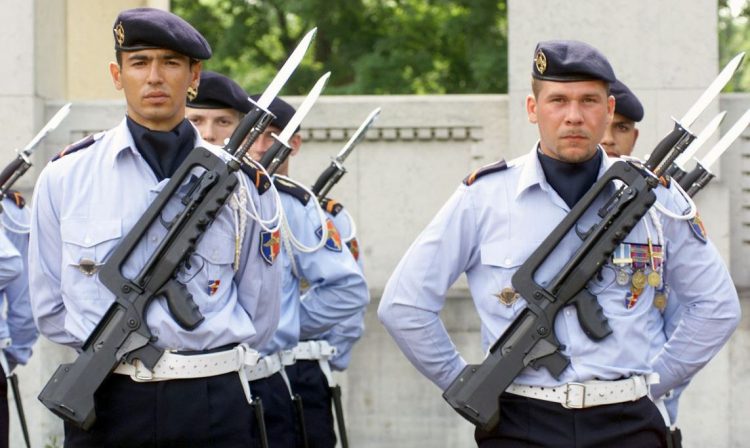
French Armed Forces, armed with FAMAS F1 assault rifles, participate in the Memorial Day ceremony at the LaFayette Escadrille Monument in Paris, France.
By Peter KORZUN | Strategic Culture Foundation | 05.04.2018
French President Emmanuel Macron kept his word. On April 1-2, French troops moved into northern Syria. This is the first time France deployed substantial forces there to turn Paris into a new actor actively involved in the war. The troops advanced toward Manbij and Remelin to join American allies and did it hastily.
The move was made at the time Ankara warned about the plans to control this territory with Russia, Turkey and Iran working together to define Syria’s future. It significantly changes the situation and makes one ask questions about the goals pursued by the US and France and the prospects for war and peace in the conflict-torn country. Summing up the recent events leads to the conclusion that the US and France have a hidden agenda to expand the conflict, wreak havoc and stymie the Russia-led peace efforts.
The news about French deployment came just before the April 4 Russia-Turkey-Iran summit in Ankara stated the goal to “speed up their efforts to ensure calm on the ground” in Syria. On April 3, US President Donald Trump said he would “decide very quickly” to remove forces from that country. The statement was made right after about 300 US Marines accompanied by armored vehicles and engineering equipment were moving toward Manbij as reinforcements to repel possible Turkish inroads. The construction of two bases in Syria’s northern Manbij region is underway.
The Marines have already launched daily patrols along the Sajur River, a tributary that feeds the Euphrates River from sources in Turkey, with observation posts built to monitor the area. This is unheard of – two leading states of the North Atlantic Alliance blocked the other NATO member’s land access to Manbij! On April 3, CNN reported that plans to send reinforcements have been discussed for several days before Trump’s remarks on leaving Syria soon.
The US also wasted no time to press Iraq into sending its 5th Army Division to Sinjar province and line the forces on the Iraqi-Syrian border to obstruct the possible advance of Turkish army from Syria into Iraq.
Obviously, the US is trying to partition Syria while creating a quasi-state on the eastern bank of the Euphrates and up to the Iraqi border. In Deir-ez-Zor, the US-led coalition resists the restoration of Syrian government institutions. It makes one think that the words about “leaving soon” may be nothing more than wishful thinking or an attempt to baffle those who are trying to predict further steps America will take.
The list of goals includes controlling the oil fields and chunks of the territory. Donald Trump wants Saudi Arabia to pay for US operations in Syria and it probably will. If the decision to leave were taken, he wouldn’t raise the question. According to the president, Saudi Arabia is interested in America staying in Syria.
That’s what the US “rocking from side to side” foreign policy is like. Rex Tillerson is fired to make the world know about it from tweets. The US wants to leave Syria but will stay if Saudi Arabia pays. Donald Trump invited the Russian leader to visit him in Washington against the background of Russia diplomats expelled and the consulate office in Seattle closed. Is it being short-sighted or far-sighted? Is this swinging back and forth a well-thought over policy or no policy at all? Is it done on purpose to keep everyone guessing with no predictions possible? You never know. Donald Trump once denounced Saudi Arabia as extremist and then sold a huge package of weapons while calling the kingdom a great friend and close ally against Iran.
The Syrian forces are preparing an offensive in the Daraa – Quneira – Suweida area in the south while denuding other fronts. The territory is huge and the terrain is hard to cross. There are at least 25 heights to fire at advancing forces from. The Free Syrian Army and other rebel groups are much more numerous than the ones being defeated in Eastern Ghuta. Their defenses are strong. Unlike in other places, the rebel forces can easily get logistical support from Jordan. That’s where the US and Saudi Arabia can contribute greatly. Israel has been involved in such activities since 2015. It took roughly six months to liberate Eastern Ghuta, with an active phase to dislodge rebel fighters launched in mid-March. It’s easy to surmise that it will take at least a year, may be much more, to liberate the area in question.
A conflict is easy to provoke. The operations of Syria’s government forces aimed at cutting off supplies coming from Jordan could be presented as an act of aggression against the Hashemite Kingdom. Chemical substances could be transported from Jordan to stage another provocation used as a pretext to attack Syria.
The operation could become a war of attrition to make Syria concentrate more and more of its forces in one place at the expense of other battlefields. They will be stuck there for a considerable period of time. That’s when the US-coalition will be in good position to attack anywhere it wants using the base of Al-Tanf as a springboard. Manbij as well as the Al-Tabka air base located to the south of Raqqa are perfect places for launching an offensive to drive Syria out from Aleppo. Then the country will plunge again into an “all-against-all” fight.
The efforts applied so far by Russia, Turkey and Syria will go down the drain. This time the US will not be alone to have substantial presence on the ground. It’s hard to imagine that the French forces arrived in Syria could be anything but the start of broader NATO presence with other members of the bloc to follow the French example. Russian military personnel and NATO soldiers will be looking at each other through the sights of guns. This scenario will be fraught with a great risk of international military conflict and a real tragedy for Syrian people but those who are provoking it don’t care.
America Faces a Vietcong Style Genuine Arab Rebellion in Syria
By Adam Garrie | Eurasia Future | 2018-04-02
While the Syrian Arab Army has liberated all of Eastern Ghouta from pro-western Takfiri terrorists and Turkey continues to be unable to get the US to agree on a disarmament agreement regarding YPG/PKK terrorists in Manbij, in Raqqa, a genuine Arab rebellion is taking place against the United States and their YPG proxies.
While the word “rebel” has been used throughout the duration of the Syrian conflict to describe heavily armed and handsomely paid terrorists whose loyalty is to foreign powers and whose citizenship is often not Syrian, in Raqqa, one is witnessing an organic uprising of indigenous Arabs against the American military and the SDF flagged YPG terrorists who have worked with the US to occupy Arab majority lands in the Syrian Arab Republic.
Real moderate rebels finally emerge
As geopolitical expert Andrew Korbyko recently wrote in Eurasia Future,
The American President made global headlines once again after he seemingly veered off script at a political rally in Ohio by declaring that the US will be ‘coming out’ of Syria ‘very, very soon’ in order to ’let the other people take care of it now’. Trump didn’t elaborate, but his surprise announcement came on the heels of Turkish President Erdogan threatening to expand his country’s anti-terrorist campaign into the part of northeastern Syria that the Russian Security Council previously said hosts as many as 20 American bases, which could potentially lead to a ‘war by miscalculation’ between the two nominal NATO ‘allies’ if the American forces remain there during this time and are caught in the Turkish-Kurdish crossfire.
Within a day after Trump’s statement, the Chief of the Main Operational Directorate of the Russian General Staff informed the world that Raqqa’s native majority-Arab population had begun to rise up against the US-backed Kurds that are in control of the city, thus heralding in the beginning of the “Rojava Civil War” that the author first predicted more than a year ago and which was undoubtedly further provoked by the anti-Arab ethnic cleansing campaign that the Kurds commenced over the summer. It can’t be known for certain, but Russia and Turkey likely have a favorable attitude towards the Arab revolt against the pro-American Kurds because it dovetails with their interest in seeing this disruptive power removed from the agriculturally and energy-rich corner of northeastern Syria.
The key elements of Korybko’s observations are as follows:
1. In spite of some disagreements regarding a post-war settlement, Russia, Syria, Iran and Turkey are all opposed to the illegal US presence in Syria, although none seek a direct confrontation with US forces.
2. It is not clear if the indigenous Arabs of Raqqa are loyal to Damascus, Ankara or some other power, but what is clear is that they are united in a common objective of exorcising the US and its proxies from their homeland.
An Arab Vietcong
While the issue of the Arab rebels of Raqqa’s loyalty to one state or another is a key mystery, ultimately the most immediate threat to the always flimsy US narrative regarding the region, is that the US and their allies may face a Vietnam war style combat situation against the Arab rebels, assuming the US doesn’t “pull out” of Syria as Donald Trump recently indicated.
In the American war in Vietnam, the US found itself facing not only regular troops from Northern Vietnam but indigenous Vietcong rebels in the South whose fight was first and foremost against a foreign occupier. The Arab rebels in and around Raqqa likely feel the same way, as for example did the Algerian fighters who rebelled against French rule between 1954 and 1962. While the US did have Southern Vietnamese allies on its side, such troops were in the minority and ultimately faced ostracism after the US loss. Just as some South Vietnamese and other minorities who sided with the US during war, typically out of opportunism, attempted to run away from Vietnam when the war was lost by the US, so too might many YPG militants attempt to flee along with their US masters when defeat is imminent as it could be in short order.
A French connection
Prior to the US entering Vietnam, indigenous Vietnamese (referred to as Indochinese at the time) rebels fought a colonial French occupation between 1946 and 1954. After the French were vanquished in 1954, the US began gradually sending so-called “military advisers” to Vietnam before the situation spiraled into a full-scale US invasion after the Gulf of Tonkin false flag incident in 1964.
Today, there is discussion that US troops in north-eastern Syria will be replaced by French and/or Saudi troops. The irony here is that while the US went into Vietnam only to repeat the loss of their French predecessors, now it appears as though France may enter north eastern Syria only to inherent a rebellion against the US and its Kurdish proxies that neither foreign army is likely to win.
As French President Macron has publicly come out in support of Kurdish radicals in Syria, it is unlikely that a French strategy in Raqqa would look significantly different than the US strategy. Moreover, the presence of Saudi troops in the region would only have the effect of making apolitical rebels likely to side increasingly with either Turkey or Damascus, were a fellow Arab army to fight along side infamously anti-Arab Kurds against indigenous Sunni Arabs.
Syria remains an Arab Republic
With the defeat of Daesh in Syria, many Arabs have attempted to return to their homes in places like Raqqa, only to find that they are being abusively occupied by US backed Kurdish militants. This is a classic recipe for rebellion and while the world is focused on Eastern Ghouta and Manbij, the Arab rebellion against the USA and YPG is already underway, as has been confirmed by the Russian military.
Now a spokesman for the Arab rebels has issued the following statement,
“Following the intelligence activities, the militia of Raqqa waged a special operation targeting the US Staff located at the former base of the 93rd Brigade in the district of Ayn Issa, 43 miles north of Raqqa. Several mortar shells were fired on individual targets without any casualties on our side”.
While the authors of this statement claimed they were opposed to both the US and Turkish presence in Syria, seeing as they are operating in an area far from any Turkish troops, the likelihood is that this group of rebels is centred around a pro-Damascus and anti-US political/military agenda. Indeed, as the government in Damascus remains the only legitimate Arab representative of the Syrian people, the rebellion in Raqqa may prove to help reconcile formerly anti-government forces with the government, as indigenous Arabs displaced by American troops and their proxies look to restore Syrian Arab rule over the Syrian Arab Republic.
While Turkey has said countless times that it does not intend to stay in Syria beyond a reasonable timeline for orderly withdrawal, the US has stated that it plans to stay in Syria for an extended period of time. Recent statements from the so-called SDF saying that they are unaware of Donald Trump’s proposed “pull out”, indicate that the veracity of the US President’s statements are far from certain. Thus, whatever faction the Arabs of north eastern Syria are ultimately loyal to, the fact remains that the US and its allies will be the primary targets and in the context of Syria, this excludes Turkey.
Conclusion
Thus the likelihood is that the Arab rebellion against the US and its proxies will only grow, perhaps especially if the US troops in the region are replaced by generally less capable French or Saudi troops. In this sense, whoever seeks to occupy Arab land in north eastern Syria whether Kurdish terrorists, the US military, French military or Saudi military – they will ultimately be doomed to failure for the same reason the US failed in Vietnam and Iraq and likewise, for the same reasons that the French failed in Indochina and Algeria.
The difference between a fake rebellion against a legitimate government funded by outsiders, as was seen in Eastern Ghouta, Aleppo, Hama, Homs and Deir ez-Zor, versus a genuine indigenous rebellion against an occupying foreign army and a minority of non-local militants whose loyalty (in terms of cooperation) is to the invader, is clear enough. The fake foreign funded “rebellions” historically lose battles while organic rebellions against an imperial occupier tend to eventually win, often with very decisive results.
‘NATO Member is at War With Another One’ – Analyst on Turkey-France Relations
Sputnik – March 31, 2018
According to the French media, French president Emmanuel Macron is planning to deploy troops to Syria’s Manbij to help local Kurds in resisting Turkish forces. The move has reportedly been coordinated with Washington. Sputnik discussed relations between France and Turkey with Gearóid Ó Colmáin, Paris-based geopolitical analyst and journalist.
Sputnik: What can you say about the conversation between the Turkish and the French presidents? It seems that there is quite a bit of disagreement. Do you think that there are issues other than cooperation with the SDF that they are in disagreement about when it comes to Syria?
Gearóid Ó Colmáin: If you look at the history of French-Turkish relations even going back to the sixteenth century, France generally used the Ottoman Empire as a stick with which to beat the central European powers, the Habsburgs in the sixteenth century and later — Austria. I think French policy towards Turkey in the current context is similar with important differences in sense that France sees Turkey as an emerging imperial power and as a rival. It is probably one of the reasons for France’s hostility towards Turkey’s entry into European Union, because the Turkish military is extremely powerful, it’s reputed to be even more powerful than the French military and the French want military dominance in the European Union context.
That’s one tension between France and Turkey, and with respect to the Kurdish problem, the US is supporting the YPG forces, which are linked to the PKK [Kurdistan Workers’ Party] in Turkey, so, from the Turkish perspective, it is a national security threat to have a buffer state, develop in northern Syria, which will have access to the eastern Mediterranean. But the western side of the NATO coalition clearly wants that to happen. That has been the case throughout the war. The have supported the Kurds and that has been to the chagrin of the Turks. We now have a situation whereby Turkey is at war with France, effectively over the Kurdish issue. It is a proxy war. The French recently, in the mold of Francois Hollande, the former French president, accused Russia of allowing Turkey to enter Northern Syria in order to weaken and divide NATO. The French and the Americans are clearly concerned about Turkey’s rapprochement with Russia, its recent agreement to cooperate with Russia.
So Turkey is kind of in a difficult position right now — on the one hand it’s cooperating with Russia, on the other hand it’s NATO member who is effectively at war with another NATO member, i.e. France and possibly the US. We don’t know what the United States really means, what Trump really means, when he says the US is going to pull out of Syria. They reportedly have 20 military bases in the country right now. […] It looks like the French are taking over, or at least offering to take over, where the Americans are leaving off.
Sputnik: So that was the gist perhaps of Trump’s statement saying that “We’re going to be leaving Syria very very soon and let the other people take care of it.” Do you think France was intended as “the other people”?
Gearóid Ó Colmáin: It looks to me to be the case. The French are clearly pursuing US policy in Syria and have been from the very start of the war. They don’t have an independent policy in the Middle East and haven’t had an independent policy since Chirac. France is clearly working on behalf of the United States and I think that will be my reading of it right now.
Sputnik: Does France have any of its own interests in the Syrian conflict? Other than what is dictated by American policy.
Gearóid Ó Colmáin: France was traditionally the protector of Christians in the Middle East. That was the case in Lebanon, but it hasn’t been the case for a long time. France hasn’t protected anyone in this war. They have been supporting terrorism from the very start. Now not only have they been supporting terrorism against the Syrian state. […] But now they are being accused by their cohorts in terrorism, i.e. Turkey of supporting terrorism against them. France has really been in a mess since this war began. […]
Sputnik: The proposal was already declined by Ankara. They said that those who cooperate with terror groups against Turkey will become a target for Turkey. How is that going to impact Turkey’s relations with France and the EU in general?
Gearóid Ó Colmáin: Turkey has already threatened the EU on several occasions — last year, year before Turkey threatened to unleash an avalanche of migrants on Europe, to intensify the migrant crisis in Europe, if the EU would not concede to their demands, regarding funding and accession conditions [to the EU]. Turkey has already basically threatened Europe with coercive engineered migration, as a form of warfare, if the European Union doesn’t fully cooperate with Turkey’s demands. That is something that you could see escalating.
READ MORE:
France Deploys Military Forces to Assist Kurdish Militants in Manbij — Reports
Erdogan ‘Saddened’ by Macron’s ‘Wrong Stance’ as France Deploys Forces to Manbij
Featured Video
Trita Parsi: Iran War Ends Today? Threats of Deporting Trita Parsi
or go to
Aletho News Archives – Video-Images
From the Archives
The Crusades – colliding narratives
Ashes of Pompeii | June 13, 2026
They say history is written by the victors, but the Crusades offer an interesting historical contrast: a two-century collision that produced not one history, but two parallel, irreconcilable realities. The dates and the battles are identical in both accounts, but the moral axis is entirely flipped.
In the traditional Western narrative, the Crusades are framed as a heroic, if tragic, epic. The First Crusade is a pious pilgrimage; the knights are romanticized figures of chivalry in shining armor, bravely holding the line in a hostile, exotic land. The eventual loss of the Holy Land is mourned as the “fall of Outremer,” a tragic retreat of European civilization. In this telling, the East is often reduced to a passive backdrop, its inhabitants viewed through a lens of mystique or backwardness, mere obstacles to a divine mandate.
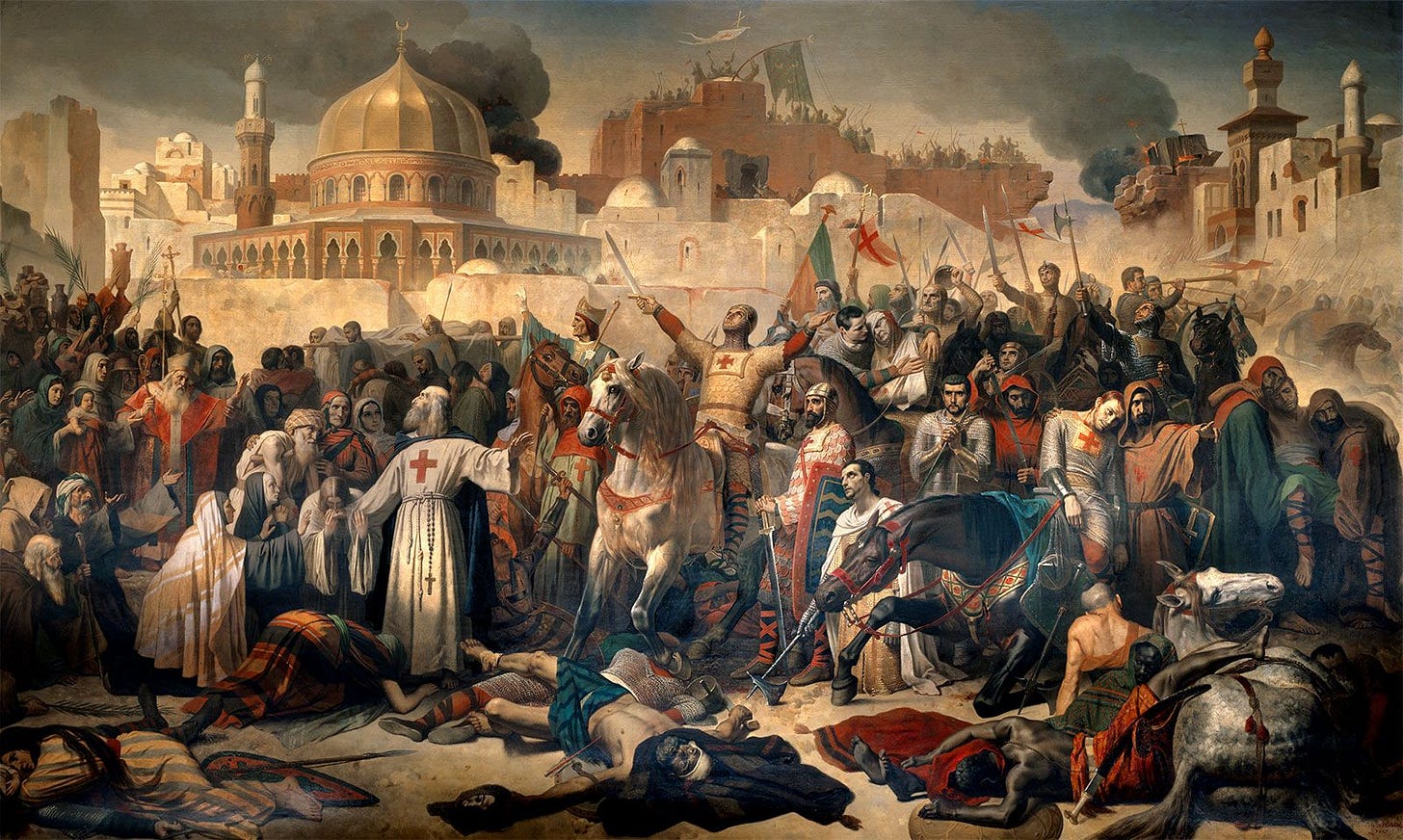
But cross the Mediterranean, and the exact same timeline reads like a chronicle of foreign invasion and eventual, hard-won restoration against the barbarous northerners. The dates do not change, but the adjectives do. Here is the history as it is remembered in the Levant… continue
Blog Roll
 Aletho News
- With one strike, Netanyahu tries to kill two peace deals
- Iran warns ‘no point’ in deal with US if Israel remains unrestrained
- Ukraine as a laboratory of ‘techno-fascism’
- Desperate Starmer choosing piracy as distraction over UK crime crisis – Putin envoy
- The Crusades – colliding narratives
- Trita Parsi: Iran War Ends Today? Threats of Deporting Trita Parsi
- What Is SIDS?
- DHS docs: Govt bracing for nationwide anti-AI riots, preparing to crack down on dissent
- India signals rethink over West Asia
- Israeli Ex-Navy Chief admits massive damage from Iran missiles
- If Americans Knew
- Did Trump just threaten a nuclear attack on Iran? Another merger for Israel-Firster David Ellison –Daily Update
- Israeli Firm Accused of Launching Smear Campaigns During US, European Elections
- As World Cup kicks off, Gaza amputee girls chase football dreams
- Oxfam: More Palestinians killed by Israel across West Bank in last 3 years than previous 17 years combined
- US-Iran ceasefire may be imminent, but will Israel blow it up? – Daily Update
- The Issue of Israel Is Ending Democracy In Michigan
- Israel is stealing homes, livelihoods, and lives in West Bank
- Gaza is not an aberration – Israel planned this genocide decades ago
- Israel is changing the face of Lebanon, mainstream media is normalizing it – 3 articles
- Genocide lobby benefits from EU anti-racist fund
- No Tricks Zone
- Climate Alarmists Now Using Natural Phenomena To Support Their Claims
- New Study: Significant CO2 Fluxes From Non-Volcanic Sources Are Largely Neglected In Carbon Budgets
- Women Climate Scientists Being Harassed, Insulted By Skeptics, Claims Berkeley Earth Researcher
- Germany’s Longterm Spring Climate Data Show “No Climate Trend”
- New Study: Solar Photovoltaic, Wind Power Fail To Meet Annual Energy Demands 62% Of The Time
- Germany’s Die Welt: “Too Much Is Too Much” … Green Energies Are Cannabalizing Each Other!
- Germany’s Ecological Holocaust… Once Fairy Tale Forests Getting Cleared For Wind Turbines
- A Grand Solar Minimum Has Arrived…Global Cooling Of At Least 1°C Is Expected By The 2030s, 2040s
- European “Expert Commission” Urges COVID-19-Like Global Climate State Of Energency!
- Real-World Observations Do Not Support The Position That Climate Change Is Human-Caused
 Aletho News