UAE buys new weapons worth $684 million from US firm
Press TV – November 14, 2017
The United Arab Emirates (UAE) has signed a new deal with an American arms manufacturer under which the firm would supply the small Persian Gulf country with laser-guided bombs, authorities say.
The deal, announced Tuesday at the Dubai Airshow and worth 2.5 billion dirhams ($684.4 million), would see the American missile maker Raytheon Co. sell GBU-10 and GBU-12 Paveway laser-guided bomb kits to Abu Dhabi, among other weapons.
UAE authorities also signed arms deals with Germany’s Rheinmetall to buy artillery from the company. The contract will also enable Rheinmetall to support Etihad Airways with transportation equipment.
The purchase of weapons comes amid the UAE’s involvement in a deadly campaign, led by Saudi Arabia, against Yemen. More than 10,000 people have been killed and over two million have been displaced since March 2015, when the regime in Riyadh began the campaign.
Abu Dhabi has also announced plans for buying 75 Mirage 2000-9 aircraft from the French multinational company Dassault and Thales to upgrade its air force fleet. That comes despite increasing calls for a halt to the UAE’s contribution to the devastating Saudi-led airstrikes on civilian areas in Yemen.
Saudi Arabia and the UAE are two major recipients in the Persian Gulf of weapons from the United States and other Western countries. Other countries in the region have accused the two of sparking an arms race by their excessive purchase of modern weaponry from the West.
Reports over the past few years have indicated that much of the UAE’s modern weaponry have found their way into the hands of militants in Libya, where Abu Dhabi supports an administration opposed to Tripoli’s internationally-recognized government.
International Electoral Observers Validate Venezuela Regional Vote as US, France Reject Results
By Lucas Koerner | Venezuelanalysis | October 16, 2017
Caracas – The Latin American Council of Electoral Experts (CEELA) has confirmed that Sunday’s vote in Venezuelan gubernatorial elections was clean and transparent.
“The vote took place peacefully and without problems… the vote reflects the will of [Venezuelan] citizens,” declared CEELA President Nicanor Moscoso during a press conference Monday morning.
The CEELA delegation was comprised of 1300 international observers, including former Colombian Electoral Court President Guillermo Reyes, ex-president of the Honduran Supreme Electoral Court, Augusto Aguilar, and former Peruvian electoral magistrate Gastón Soto.
According to the body’s report, the vote was held under conditions of “total normality” and the right to a secret ballot was “guaranteed”.
Sunday’s elections pitted President Maduro’s United Socialist Party of Venezuela against the right-wing MUD coalition, with the former scoring a surprise win in 17 of the nation’s 23 states.
The results have, however, been rejected by the MUD, which has alleged “fraud” and called on its supporters to take to the streets in protest.
The MUD has accused the National Electoral Council of attempting to suppress opposition turnout by relocating 334 voting centers previously targeted by anti-government violence during July 30’s National Constituent Assembly Elections.
Announced several weeks ago, the relocations were concentrated in the states of Anzoátegui, Aragua, Carabobo, Lara, Merida, Miranda, and Tachira. Nonetheless, in Merida and Tachira, the MUD emerged triumphant, despite there being 58 and 42 changes in voting centers, respectively.
For its part, CEELA has reported that it has yet to receive any formal denunciations from the opposition, which has issued its fraud allegations via the media.
President Maduro has requested a 100 percent audit of Sunday’s elections, a call that was subsequently echoed by the MUD.
Nothewstanding CEELA’s certification of the outcome, Venezuela’s regional elections have come under fire from Washington and Paris.
“We condemn the lack of free and fair elections yesterday in Venezuela. The voice of the Venezuelan people was not heard,” declared US State Department spokesperson Heather Nauert.
The diplomat did not, however, offer specific evidence explaining her government’s disavowal of the election result.
In recent months, the Trump administration has taken an increasingly aggressive stance against the Maduro government, imposing economic sanctions, decreeing a travel ban on Venezuelan officials, as well as threatening military intervention and an embargo.
France’s Foreign Ministry likewise issued a communique Monday in which it alleged “serious irregularities” and “lack of transparency in the verification and tabulation process”
“France deplores this situation and is working with its EU partners to examine appropriate measures to help resolve the serious crisis affecting the country,” the French government continued.
France’s newly elected president, Emmanuel Macron, has become an increasingly vocal critic of the Maduro government Caracas.
In September, the French leader met with senior Venezuelan opposition politicians during a tour by the MUD to drum up support for EU sanctions against Venezuela.
The European Parliament voted last month to explore the option of sanctioning top Venezuelan officials, following the lead of Washington and Ottawa.
In response to the statement by Paris, Venezuelan Foreign Minister Jorge Arreaza took to Twitter Monday, lambasting European interference in his country’s internal affairs.
“The EU and some of its member states (subordinate to Trump) question the will of the Venezuelan people,” he stated.
“In Europe, they’d only wish to have a real democracy, where their peoples can freely choose between two truly contrasting projects,” Arreaza added.
UNHRC Yemen Inquiry is Doomed to Fail Magnanimously
By Salman Rafi Sheikh | New Eastern Outlook | 09.10.2017
The United Nations Human Rights Council (UNHRC) seems to have finally awakened up to the brazen human rights violations that the Saudia led Arab coalition forces have been blamed to have committed in the conflict in Yemen that has been going on for more than two years now, and has consumed thousands of lives, and destroyed the country, its polity and economy alike. While UNHRC has resolved to find out the atrocities that have been committed, the question that remains unanswered is if this ‘fact-finding’ mission would lead to an end of the war, let alone punish the antagonists?A compromise has been achieved from the very beginning, which will allow the House of Saud to not only to manipulate or dispute the results, but also escape any consequences whatsoever. As a matter of fact, Saudi Arabia was able to steer things to a course of its own advantage by simply altering the original resolution adopted by the Council, making the UNHRC look like a meaningless and worthless house of cards.
Let’s consider what the original resolution had called for and what is actually going to happen now. The original resolution had called for the establishment of an independent inquiry commission. However, thanks to Saudi Arabia’s intense lobbying and coercive diplomacy, the amended version is now restricted only to sending some “eminent experts”. According to reports, Riyadh had threatened to restrict and even cut trade and diplomatic ties with the council members which had backed the much more robust version. The House of Saud also publicly appreciated the UK, US and France for their cooperation in securing a compromise on resolution. The three countries also support Saudi Arabia’s deadly military aggression against the impoverished Yemen. The UK and the US had no reason to criminalize Saudi Arabia not only because they are allies but also because the US is itself a party to destroying Yemen.
This is evident from the way the US president Donald Trump has almost doubled the number of covert US airstrikes in Yemen. According to the data compiled by The Bureau of Investigative Journalism, the US has carried out about 100 strikes in Yemen in 2017. While the official narrative is that these strikes target Al-Qaeda in the Arabian Peninsula (AQAP), there are evidences that suggest that the US has been equally targeting the Houthis as well. Nothing perhaps could illustrate this ‘US vs Houthis’ phenomenon more than the fact that a US drone was attacked and shot down by the Houthis in western Yemen as recently as October 2, 2017. While the US officials said that the matter was under investigation, the Houthi-controled Defense Ministry announced that it had downed an American drone in the outskirts of Yemen’s capital Sanaa, thus rejecting the US claim that it was mainly involved in non-combatant missions in the aid of the Arab coalition.
On the other hand, what really explains the reason for the Trump administration’s decision to increase drone attacks is the policy of isolating and defeating Iran that the US and Saudi Arabia are following. Interestingly enough, perusal of this policy has caused political tension in the UK as well, where the parliament’s joint committee on human rights has raised strong concerns about the UK’s involvement in the US targeted killing programme, noting that the UK’s intelligence agencies work “hand in glove” with the US.
Given the extent of co-operation between the West and its key ally in the Middle East, an independent inquiry into war atrocities committed by the self-declared regional hegemon is unlikely to take place ever, let alone punish the wrongdoers. Besides the current UNHRC debacle, this is also evident from the way the House of Saud was able, back in July 2016, to turn upside down a UN report that had blacklisted the country after it found out that the Kingdom was responsible for 60 percent of the 785 deaths of children in Yemen in 2015. A few days later, however, the world body announced that the Riyadh regime would be scratched off the list, pending a joint review with the Arab kingdom. Sounds like really independent and impartial!
Once again Riyadh has been able to manipulate inquiry into atrocities by radically altering the resolution that had called for an independent inquiry. Could there be a greater irony than the fact that the new resolution that decided to set up a committee of experts had been set up by Riyadh itself? How can an accused set up, or even influence, a committee to investigate into his own crimes? Can such a body be expected to be impartial and truly reveal what the Arab coalition has done in Yemen?
Answers to all of these questions have, unfortunately, to be in the negative. It is not that we are expressing pessimism, there are certainly concrete basis for what we have said. Besides the above given arguments with regard to the co-operation between the US, the UK and Saudi Arabia, the fact remains that not even the EU, the so-called champion of human rights, is able to leave a decisive impact on the situation and turn things against Saudia. For instance, the European human rights organisation had to face a lot of ridicule when, despite its earlier statement that had confirmed that airstrikes carried out by the Arab coalition in the past two months had killed 39 civilians, including 26 children, the resolution was amended and the bid for constituting an independent inquiry was replaced by a committee of “experts.” Not only were their reports and arguments not accepted, but their demand that the matter be brought before the International Criminal Court (ICC) was squarely rejected, thanks again to the Saudi lobbying and the help it received from its key allies in the West i.e., the US and UK and France and the way it coerced countries into backing down on this demand.
According to a Reuters report, in a letter seen by one of the diplomats, Saudi Arabia – the world’s biggest oil exporter – had warned some states of possible consequences should they support the Dutch resolution, submitted jointly with Canada, calling for a full commission. This lobbying was the perfectly echoed by French diplomatic source who was reported to have said that “there is room to satisfy everybody.”
It appears that no other party is more satisfied now than the House of Saud, the principal accused in the scene. The accused stands vindicated as it is well “satisfied” with the way things have ended in the UNHRC session and the way things will proceed in the future. It is possible that by the time the committee of experts is constituted, does its investigation and submits its report in a year from now on, the Arab coalition, which believes that airstrikes killing civilians are legally justifiable, might end up killing thousands of innocent people. Who will then the UNHRC blame for the loss?
Living Under the French Hate Speech Laws
By Lawrence G. Proulx • Unz Review • October 4, 2017
The term “hate speech” is employed more and more these days, and Internet companies and government agencies are being urged to suppress it. So it might be worthwhile to consider how countries without a First Amendment treat the types of speech that are likely to fall within the ever-expanding definition of the term.
I can report on one such country, France, which may be representative of European countries generally. I worked there as an (English-language) newspaper copyeditor from 1999 to 2016. While I am not competent to describe precisely how its complex legal system works, I believe I can offer an informative overview. To do this well, many thousands of words are necessary, but I have divided them into sections and invite you to jump ahead to the next whenever you might feel bogged down.
The United States is often described as a litigious society, even as the litigious society. This view has been shared by the French at least since the publication of “Democracy in America,” in 1835, in which Alexis de Tocqueville wrote that “there is hardly a political question in the United States which does not sooner or later turn into a judicial one.”
Today, however, an American observing French public life is likely to be surprised by the frequency with which the courts are asked to punish people for things written or said. A legal tradition different from our own, to which have been added a number of specific criminal laws, has produced a regulatory system in which fines, damage payments and prison sentences (almost always suspended) are imposed for violations.
In the United States, punishment for saying or writing things that others find objectionable is sometimes imposed by private entities, such as employers, and in the past few decades many businesses, institutions and organizations have established restrictions on expression. But the means of engaging the judiciary in this enterprise are severely limited. In this the United States differs not only from France but also from many other European countries as well as the developing legal structure of the European Union.
The First Amendment to the U.S. Constitution states that “Congress shall make no law … abridging the freedom of speech, or of the press.” The Declaration of the Rights of Man and the Citizen, adopted during the French Revolution and confirmed explicitly in 1958 in the preamble to the constitution of the Fifth Republic, states: “The free communication of ideas and opinions is one of the most precious of the rights of man. Every citizen may, accordingly, speak, write, and print with freedom, but shall be responsible for such abuses of this freedom as shall be defined by law.”
It would be simplistic to say that the difference between the two systems lies primarily in the “but” clause of the latter. But even if the American amendment has inevitably been moderated by court decisions through the years, it does make every abridgment fight for its life, as it were, whereas the French formulation takes the inevitability of exceptions as a matter of course.
What infractions must a speaker or writer or editor or publisher avoid in order to stay within the law in France? Here are the basics, as discussed in the manual “Droits des journalistes et liberté d’expression” by Bernard Dapogny and Marion Dapogny:
- False news, “made in bad faith, that disturbs the public order or is capable of disturbing it.”
- Use of a false document in reporting.
- Attempt to harm the discipline or morale of the armed forces or to hinder a war effort.
- Defamation.
- Insult. [The distinction between this and the preceding is that defamation must assert something specific, whereas insult can be merely an offensive word.]
- Attempt to harm a person’s honor or reputation.
- Defamation of or insult to the judiciary, the military services, various other public bodies including “junior high schools, high schools, universities, the Legion of Honor” as well as “local administrations, the police, hospitals, penitentiaries.”
- Defamation of or insult to persons acting in a position of public authority, including “representatives and senators, ministers and Secretaries of State” as well as “police personnel, magistrates, teachers.”
- Defamation or insult based on race, religion or belonging to an ethnic group or a nation.
- Defamation or insult based on sex, sexual orientation or handicap.
- Defamation of or insult to deceased persons, where the offense touches on the honor of the heirs or close survivors.
- Provocation to the commission of a crime which leads to the crime.
- Provocation to the commission of a crime which doesn’t lead to the crime.
- Indirect provocation (apology), that is, stating that certain crimes were justified, including “war crimes, crimes against humanity or crimes in collaboration with the enemy.”
- Provocation to hate, violence or discrimination, which could be based on a person’s “origin, sex, family situation, state of pregnancy, physical appearance, family name, state of health, handicap, genetic characteristics, morals, sexual orientation, age, opinions, politics, labor union activity, belonging or not belonging, real or supposed to a particular ethnic group, nation, race or religion.”
- Provocation to or apology for terrorism.
- Contesting “the existence of one or several crimes against humanity as defined by Article 6 of the charter of the International Military Tribunal [the Nuremberg Tribunal] annexed to the London Agreement of August 6, 1945, and which were committed by the members of an organization declared criminal in application of Article 9 of the said charter, by a person recognized as guilty of such crimes by a French jurisdiction or by an international one.” Enacted in July 1990 and called the Gayssot Law.
- Offending the president of the Republic. [This law was repealed in 2013.]
Many of these laws are seldom invoked; others are used frequently. To put flesh on the matter, I offer you a list of cases from 2013 that I put together in 2014 for an article that never found a publisher. (Sorry, but the work of assembling it was too tedious for me to undertake it again, and I think the general impression given by more recent cases would not be different.) Although details of the offensive language are frequently omitted in the news reports from which this list is compiled, a quick look will give a sense of how routine the cases are.
One thing should be mentioned first. An anti-racism law passed in July 1972, commonly called the Pleven Law, strengthened the restrictions on speech and granted to private associations dedicated to fighting racism the right to participate in the prosecution of criminal cases and to claim damages as well. Amendments to the law empowered additional categories of associations, for example, associations working “to defend the moral interests and the honor of veterans and victims of war and of those who died for France” or “to defend the memory of slaves and the honor of their descendants.” Such associations are frequently the first to blow the whistle on remarks they consider violative, and because they have the standing to file complaints even when no particular person is targeted by the contested remarks, their legal recognition is an important factor in the number of cases brought before the courts today.
January
Marie-Josée Roig, the mayor of Avignon, files a complaint for public insults contained in a book purporting to be fiction (“Le Monarque, son fils, son fief”) by Marie-Célie Guillaume in which a character who resembles Nicolas Sarkozy, the former president, demands a quick sexual “present” from a woman who resembles Roig.
Daniel Boyer, the mayor of Châteaubernard, files a complaint for public insults after a wave of graffiti attacking him and various acts of vandalism.
Frédéric Haziza, a Jewish journalist, files a complaint for public insult and public insult committed against a person because of his religion, after being attacked on the website of Alain Soral, a self-described anti-Zionist activist. Haziza had refused to invite Soral onto his show to discuss Soral’s book “Comprendre l’empire” because of Soral’s “clearly antisemitic” views.
March
A judge, Jean-Michel Gentil, files a complaint for contempt and insult against Henri Guaino, a deputy in Parliament, for having said that the judge “dishonored the [state] institutions and justice” after Sarkozy was interrogated on suspicion of abusing the weakness of a rich aged widow.
Bloc Identitaire, a nationalist group, announces its intention to file a complaint for public insult against Yann Galut, a deputy from the Cher department, for having called the members of the bloc “casseurs” (protesters who destroy property) in a Twitter message.
April
Rama Yade, a former secretary of state for human rights and for sports, is found guilty of defamation and insult for eight of twenty-eight contested statements posted on her blog about a political opponent, Manuel Aeschlimann, after she was challenged over her domicile status in the Hauts-de-Seine department.
May
Yvan Benedetti and Alexandre Gabriac, right-wing activists, file a complaint against Jean-François Carenco, the prefect of Lyon, and Albert Doutre, director of public security, for “hateful” public insults (such as “imbecilities” and “thugs”) made during the containment of a nationalist youth protest in front of the Socialist Party local headquarters.
June
The city of Angers files suit against a shopkeeper for public insult in the form of signs he put up to protest a proposed tax on businesses that serve clients on the sidewalk, which followed among other things a police check of whether he was serving alcohol without the proper license.
Pierre Dubois, the mayor of Roubaix, and the Human Rights League file a complaint against an unnamed man who, during the course of a heated discussion at a public meeting, suggested that the Roma (Gypsies) be sent to Auschwitz.
July
Sylvie Goy-Chavent, a senator of the Ain department who prepared a report on the security of meat production in France, files a complaint against a website, Internet JSSNews.com, which describes itself as a webzine of Israeli opinion, for calling her such things as “bitch” and “little shit” and writing, among other things, “Goy, she wears her name well.”
September
The Union of Jewish Students of France says it will file a complaint against the weekly magazine Valeurs Actuelles for provocation of racial or religious discrimination, hatred or violence. The group describes the cover of the magazine’s Sept. 26 issue, which shows a white bust of a woman representing France wearing a black Islamic veil and bearing the title “Naturalized: The Invasion They’re Hiding,” as “racist” and “hateful.” The magazine says in return that it will file a complaint against the group for calumnious denunciation, defamation and attack on freedom of expression.
The Foundation for the Memorial of the Black Slave Trade, along with the Federation of African Associations, the National Union of Overseas France, and other organizations and individual citizens file a complaint against Jean-Sebastien Vialatte, a deputy in Parliament, for public insult, defamation and incitement of racial hatred and racial discrimination, for his remarks after vandalism occurred during a celebration of the Paris Saint-Germain soccer team. He had sent a Twitter message in which he said sardonically that “the people who vandalize are surely descendants of slaves, they have excuses[.] #Taubira [the justice minister] will give them some compensation!”
October
The League for the Judicial Defense of Muslims files a complaint against the weekly newspaper Charlie Hebdo for its July 10 cover which had a cartoon captioned in large letters with “The Koran, it’s shit; it doesn’t stop bullets”; against the magazine Valeurs Actuelles for its Sept. 26 cover; against the website Riposte Laïque for various articles; and against Manuel Valls, the secretary of the interior, for provocation of discrimination and hate, for saying, “Within ten years we will show, we are in the process of showing, there is a will, that Islam is compatible [sic] with the Republic.”
Bruno Gilles, a senator in the Union for a Popular Movement, files a complaint against a socialist, Patrick Mennucci, for “defamation and public insults.” “He called me a racist and xenophobe,” the senator said.
France-El Djazaïr, a Franco-Algerian friendship association, announces that it will file a complaint against a police officer in the city of Alès for “insults and incitement to xenophobic and Islamophobic hatred”; the officer had put on his Facebook profile page a photo-montage representing the Algerian flag over which was written “I hate Algeria,” attached to an image of a man wiping his bottom with the flag.
Bachir Bouhmadou, adjunct general secretary of Citizen Resistance, and Ali Saab, president of the Association of Muslims of the Territory of Belfort, file a complaint against Christine Tasin, a militant with the group Republican Resistance, for videotaped comments opposing ritual Islamic butchery and criticizing Islam.
Abdellah Zekri, the president of the National Observatory Against Islamophobia, says he will file a complaint after his house was defaced with swastikas and graffiti saying “Islam Out” and “Heit [sic] Hitler.”
The National Front says it will file a complaint against Christiane Taubira, the justice minister, for public insult for having described the party’s way of thinking as “deadly and murderous” and summarizing it thus: “It’s the blacks in the branches of the trees, the Arabs in the sea, the homosexuals in the Seine, the Jews in the oven and so forth.”
November
A 65-year-old man is found guilty of insulting Claudine Ledoux, the mayor of Charleville-Mézières, on his website, l’Union-l’Ardennais, in a manner described by a regional newspaper as “menacing, racist and sexist,” in relation to her being made a knight in the Legion of Honor; he is ordered to pay a fine of one thousand euros and damages for mental distress of the same amount to Ledoux.
The association SOS Racisme says it will file a complaint for incitation to racial hatred against Minute, a 16-page rightist weekly, for its cover with a photo of Justice Minister Christiane Taubira, who is a native of French Guiana, and for the title “Clever Like a Monkey, Taubira Finds the Banana Again,” which combines two common French expressions; to have the banana (or the peach) means to be full of energy.
A player files a complaint for racial insult after a rough soccer game (three red cards) between the second-stringers of the Sablé and Lude clubs. A player explained: “This attacker called me a dirty white. I called him a dirty black.”
The Movement Against Racism and for the Amity of Peoples files a complaint for provocation of racial hatred against Manuel Valls, minister of the interior, for comments about the Gypsies including, “The Gypsies should stay in Romania or return there.” The case will be dismissed in December 2013.
Bob Dylan is put under formal investigation for insult and provocation of racial hatred after the Representative Council of the Croatian Community and Institutions of France files a complaint against both him and the magazine Rolling Stone, the French version of which republished an interview in which he said, “If you’ve got a slave master or the Klan in your blood, blacks can sense that. … Just like Jews can sense Nazi blood and the Serbs can sense Croatian blood.” The case will be dismissed in April 2014.
December
The comedian Nicolas Bedos testifies after being accused of complicity in making a public racial insult in an article in the magazine Marianne as well as on its website; among the phrases he used were “Negro bugger,” “island indolence” and “lazy natives.”
Gérard Huet, the mayor of Loudéac, is sued by the Human Rights League for comments about Gypsies he made at a meeting to discuss expenditures to renovate the area where the Gypsies were living. “They’ve stolen all our plumbing,” he says, and he later objects to the comment of another member of the city council with, “You’re defending thieves?” He sues the league in return for harassment.
The comedian Dieudonné files a defamation complaint after Alain Jakubowicz, the president of the International League Against Racism and Antisemitism, describes the “quenelle,” a gesture used by the comedian and his fans, as “corresponding to an inverted Nazi salute signifying the sodomizing of the victims of the Holocaust.” Dieudonné also says he will sue Le Monde, Le Figaro, BFMTV, France 2 and Manuel Valls, the interior minister.
The imam Hicham El Barkani files a complaint for insult after a protest described as islamophobic against the opening of a mosque in Papeete.
Historians on Trial
Some cases have greater import than those listed above, as when historians are attacked for their work.
The Columbia University historian Bernard Lewis gave an interview to Le Monde on November 16, 1993, in which he discussed the killings of Armenians by Turks during the First World War. In the course of it he said, “If one speaks of genocide, that implies that there was a deliberate policy, a decision, to systematically annihilate the Armenian nation. That is quite doubtful. Turkish documents prove a will of deportation, not of extermination.” On January 1, 1994, in response to strong objections to his remarks, he published a further explanation of his position, again in Le Monde, ending with a repetition of his main point, that “no serious proof exists of a decision and a plan by the Ottoman government aiming at exterminating the Armenian nation.” He was sued by the Forum of Armenian Associations of France and the International League Against Racism and Antisemitism on the claim that he had “gravely hurt the memory and respect of the survivors and of their families.” The civil court of Paris ruled that Lewis had “failed to meet his duty of objectivity and prudence in expressing himself without nuance on so sensitive a subject” and ordered him to pay a franc each to the two associations as well as the cost of publishing the decision. Lewis was also the defendant in other civil cases and one criminal one on the same subject, all of which were dismissed.
In 2001, the French Parliament “publicly recognized the Armenian genocide of 1915,” and in 2012 the Parliament passed a law instituting a punishment of imprisonment for one year and a fine of 45,000 euros of anyone who “contests or minimizes in an outrageous fashion” genocides recognized as such by French law, but the Constitutional Council ruled the latter law unconstitutional a month later. Both of the main candidates for president that year, Nicolas Sarkozy and François Hollande, soon announced that they would seek a new law to criminalize denial of the Armenian genocide, and in January 2017 a law took effect providing for a year of prison and a fine of 45,000 euros for those who denied, belittled or “banalized in an outrageous way” recognized genocides, crimes against humanity, and enslavement or exploitation of an enslaved person.
In 2001 Parliament also passed a law recognizing “that the trans-Atlantic trade in Negroes as well as the trade in the Indian Ocean on the one hand, and, on the other hand, the slavery perpetrated starting in the 15th Century, in the Americas and the Caribbean, in the Indian Ocean and in Europe against the Africans, Amerindians, Madagascans and Indians constitute a crime against humanity.” Four years later this law was invoked against Olivier Pétré-Grenouilleau, a professor at the University of Southern Brittany. In the course of an interview given on June 12, 2005, in relation to his book “Les traites négrières” (The Negro Slave Trades), which had won many awards including the Senate History Book Prize, Pétré-Grenouilleau rejected a comparison of the slave trades to the Jewish Holocaust: “The slave trades are not genocides. The slave trade didn’t have the goal of exterminating a people. The slave was a good that had a market value that one wanted to make work as much as possible.” An association representing people of the Caribbean, French Guiana and Réunion filed a complaint against him for denying a crime against humanity and demanded that he be “suspended from his university functions for revisionism.” In the vehement debate that ensued, Pétré-Grenouilleau was strongly supported by many prominent historians, and in February 2006, acknowledging this opposition, the association withdrew its complaint.
Shortly before the Pétré-Grenouilleau affair erupted, another “memorial” law had been passed, in January 2005, aimed generally at recognizing the suffering of those French citizens who had been repatriated from North Africa at the end of the Algerian War. This law had itself evoked controversy, by requiring that “school programs recognize in particular the positive role of the French presence overseas, notably in North Africa.” A year later the law was emended and the “positive role” removed.
Real Prison Sentences
I know of only three writers who have recently been given sentences that were “fermes,” as the French say, that is, that were not suspended as soon as pronounced. Vincent Reynouard is a Frenchman born in 1969 and trained as a chemical engineer who has argued that the Nazis had no plan to exterminate the Jews and that gas chambers were not used to kill people. Among the many videos he has placed on the Internet, there is one in which he expresses his admiration for Hitler; he says, “I think that Hitler was a man too good for the 20th Century, too honest, too straightforward.” A month after being arrested in Belgium, Reynouard was extradited to France in August 2010 and served seven and a half months in prison for contesting a crime against humanity. He has continued to produce writings and Internet videos, and in February 2015 he was convicted of contestation of crimes against humanity and sentenced to two years in prison. In November 2016 he was given a five-months sentence for publishing two videos in which he stated that he would offer 5,000 euros to “anyone who can show me, in free, candid and courteous debate, that the homicidal Hitlerian gas chambers are not a myth of history.” To avoid a return to prison, he is said to be living in England.
Hervé Ryssen, according to Wikipedia, has been sentenced several times for his writings about Jews on counts, among others, of racial insult, racial defamation, defamation against a group of persons because of their belonging to a certain race, and incitation to racial hatred; and Boris Le Lay, who is living in Japan, has been sentenced in absentia many times, most recently in July this year to serve 32 months in prison and to pay 31,500 euros to the groups representing the supposed victims, for his writings judged to constitute incitement to discrimination and to racial hatred and violence, and to contain public racial insults. Among the recent charges against Le Lay was one of making death threats against activists of the Human Rights League; I have not been able to determine if he was convicted of this; if he was, he appears in that instance to be an exception to the other cases discussed in this article, which involve no violence or threat thereof.
Politicians on Trial
Although many speech cases involve politicians, two in particular deserve mention because they arguably played a role in the presidential election of 2007.
The first round of the previous election, in 2002, had stunned the country as Jean-Marie Le Pen, the leader of the National Front, edged out Lionel Jospin, the Socialist candidate, for a place in the second round. Le Pen’s share of the first-round vote was only 16.9 percent, but Jospin was handicapped by an abundance of rivals on the left who split the vote. Before the second round, a broad denunciatory publicity campaign to block Le Pen took place, and his opponent, Jacques Chirac, the incumbent, refused to debate him. Chirac was re-elected with 82 percent of the vote.
Before the next election, in 2007, both Le Pen and the party’s second-ranking member, Bruno Gollnisch, would be defendants in high-profile cases over things they said.
On January 7, 2005, the rightist weekly Rivarol published an interview in which Le Pen said: “In France, at least, the German occupation wasn’t particularly inhumane, even if there were slip-ups, inevitable in a country of 550,000 square kilometers.” He also related a story about a German lieutenant, “crazy with pain” after an attack on a train in which many young soldiers died, who he said would have shot up a village had the Gestapo not intervened. Various groups filed complaints, and in March an investigation was formally opened. In February 2008 he was found guilty of complicity in the contestation of crimes against humanity and complicity in apology for war crimes. In January 2009 the appeals court in Paris confirmed the verdict on the first count but threw out the war-crimes verdict. In April 2011 the Court of Cassation overturned the crimes-against-humanity verdict, and remanded the matter to the appeals court, which again found him guilty in February 2012, a judgment confirmed by the Court of Cassation in June 2013. Le Pen was sentenced to three months in prison (suspended) and assessed a fine of 10,000 euros, and the editor of Rivarol and the interviewer were fined 5,000 euros and 2,000 euros respectively. Three of the complainant groups were awarded damages of 5,000 euros each, and Rivarol was ordered to pay for the publication of the decision in Le Figaro.
In the other case, Gollnisch, a professor of Japanese language and culture at the University of Lyon who at the time was director general of the National Front (before the ascension of Marine Le Pen), was charged with contestation of crimes against humanity for responses to a journalist’s questions at a press conference in October 2004. No electronic recording was made, but he was quoted as saying: “There is no serious historian who accepts completely the conclusions of the Nuremberg Tribunal; I think that the discussion should remain free concerning the drama of the concentration camps. The number of deaths, the manner in which the people died —historians have the right to discuss. … I don’t deny that there were homicidal gas chambers, but the discussion should remain free.” In 2006, before the verdict was rendered, he was suspended from his university post for five years.
During the trial Gollnisch was questioned intensively for hours one day in November 2006 over his true beliefs on the matter, and the attorney examining him, Alain Jakubowicz, representing the International League Against Racism and Antisemitism, said he would withdraw from the case if Gollnisch would only admit “that the organized extermination of the Jews of Europe by the Nazi regime during the Second World War constitute an incontestable crime against humanity perpetrated notably by the use of gas chambers.” According to Le Monde, Gollnisch appeared surprised and hesitated before giving an answer that might alienate the “hard fringe of his movement.” Gollnisch replied, “Completely.” Asked to repeat his answer, he said: “My answer is affirmative.” He was convicted in January 2007, three months before the first round of the presidential election, and sentenced to serve three months in prison (suspended) and pay a fine of 5,000 euros. An appeals court in February 2008 confirmed the conviction and added fines totaling 39,000 euros to be paid to nine associations devoted to fighting racism or representing people deported from France during World War Two. But in June 2009 the Court of Cassation, judging that his contradictory remarks as presented to the court did not constitute contestation, overturned the verdict without possibility of retrial.
However these cases might be viewed in relation to freedom of speech, they also merit attention from a purely political point of view. In the 2002 election, Jean-Marie Le Pen scored an upset in the first round; in 2007, Nicolas Sarkozy won the presidency by, in the view of many commentators, “borrowing the discourse” and luring the voters of Le Pen’s party. In between, both Le Pen and his righthand man were put on trial, to the accompaniment of much public commentary, on charges that suggested their approbation of Nazi atrocities. Under such circumstances, borrowing and luring may be much easier than would otherwise be the case.
Censored Books
In September 2013 the International League Against Racism and Antisemitism sought an injunction from a court in Bobigny to order the excision of passages from five books republished by Kontre Kulture, a publishing enterprise whose publication director is Alain Soral. David-Olivier Kaminski, an attorney for the league, described Soral as someone known as a “vector of hate” and characterized the re-editions as a “provocation, with the purpose of arousing tensions.” The league also asked for 20,000 euros in damages for each of the five books.
In November the court ordered the withdrawal from sale of one of the books, “L’Anthologie des propos contre les juifs, le judaïsme et le sionisme” by Paul-Eric Blanrue, which had originally been published by another publisher in 2007, and the removal of certain passages from the four others, all of which were reprints of books published long ago: “La France juive” by Edouard Drumont, “Le salut par les juifs” by Léon Bloy, “Le juif international” by Henry Ford, et “La controverse de Sion” by Douglas Reed. The court judged that the works constituted “insult toward a group of persons because of their belonging to a specific religion,” “negation of crimes against humanity,” and “provocation of racial hatred.” Kontre Kulture and Soral were also ordered to pay 8,000 euros each to the league as well as a part of its legal expenses. In December 2014 a court overturned the previous ruling on the “Anthologie” and it was again allowed to be sold.
The media reaction focused principally on the book by Léon Bloy. Bloy’s great-grandchild, Alexis Galpérine, reminded readers in Le Figaro that Bloy was a “philosemite” and that “Le salut par les juifs” had been recommended as a “book against antisemitism” by Franz Kafka. Pierre Glaudes, a professor at the Sorbonne, wrote in the weekly magazine Le Nouvel Observateur : “This decision of justice arouses astonishment and disquiet by attacking a literary work that is 122 years old and has been republished several times without having attracted lightning strikes by justice. … This condemnation sets a dangerous precedent. Why not censor ‘The Merchant of Venice’ by Shakespeare, ‘Gobseck’ by Balzac or ‘Money’ by Zola for their antisemitic statements?”
Stage Show Blocked
The case of the comedian Dieudonné M’bala M’bala merits notice particularly for the legal manner in which the performance of his show “The Wall” in Nantes was forbidden in January 2014.
Dieudonné, the son of a Cameroonian man and a French woman, performed for several years early in his career with a Jewish partner, and their sketches often made fun of racism. Eventually he came to hold Jews responsible in large part for the slave trade, he expressed resentment at the attention given to the Holocaust in comparison with that given to the slavery, and he came to regard Jews not as fellow victims of prejudice but instead as important members of a power structure in which people of the Third World and of Third World origin are kept down. His new acts were sharply criticized, and he responded with provocations such as including Robert Faurisson, notorious as a denier of the Holocaust and gas chambers, in his acts. Dieudonné was found guilty of racial insult or defamation on numerous occasions, for example, for saying that a television host financed the Israeli Army, “which doesn’t hesitate to kill Palestinian children”; for characterizing Holocaust remembrance as “memorial pornography”; for stating that the directors of a pro-Israeli website were trying to paint him as an antisemite and “son of Hitler”; for describing the International League Against Racism and Antisemitism as one of the “mafia-like associations that organize censorship, … that deny all concepts of racism except that concerning the Jews. In fact, they are nothing but Israeli agents.”
Largely excluded from television and other standard venues, he has nonetheless maintained an enthusiastic and politically and racially mixed following through his stage shows and videos. In January 2014 his stage show “The Wall” was challenged by the government as a threat to public order and to the dignity of the human person. Its performance in Nantes was banned by the prefecture of the Loire-Atlantic region, which judged that it contained antisemitic remarks that would incite racial hatred and constitute an apology for discriminations, persecutions and exterminations perpetrated in the course of the Second World War. The ban was lifted on the day of the show by the region’s administrative tribunal, which held that the show “could not be regarded as having as its essential purpose an affront at human dignity,” but the tribunal’s ruling was overturned and the ban reinstated later the same day by a judge of the Council of State, the highest court in the administrative-law system, after an urgent request by Interior Minister Manuel Valls.
Conclusion
French people in general seem content with the way free speech questions are handled. If in private they will occasionally murmur that “one can’t say anything anymore,” in public there is very little disagreement over the necessity of punishing infractions involving remarks characterized as racist or antisemitic or “negationist.” Prominent cases, such as the many brought against Jean-Marie Le Pen, are approved, explicitly or implicitly, by the vast majority of commentators in the press and on the radio and television. Even publications that push the limits of public tolerance in other ways — for example, with crude or even violently obscene and sacrilegious writings and cartoons — do not defend the targets of anti-racism or anti-contestation laws on general free-speech grounds; quite the contrary.
There is no high-profile organization or figure that publicly espouses the famous words that Voltaire apparently never really said, “I disapprove of what you say, but I will defend to the death your right to say it.” Over all the attitude is closer to that attributed to the revolutionary Saint-Just, “No liberty for the enemies of liberty.” The slogan of the International League Against Racism and Antisemitism, one of the organizations most active in denouncing speech offenders, is “Racism is not an opinion but a criminal offense.” Even a group such as Reporters Without Borders, which works to further the freedom of the press throughout the world, generally makes no objection to the laws discussed above, although it did oppose the one criminalizing the denial of legally recognized genocides. In an interview, Antoine Héry, in charge of the group’s activities in the European Union and the Balkans, explained to me: “I think that the problem in France is that there really are racist statements — many. … This climate exists; it isn’t a phantasm. There is, from this point of view, a necessity to regulate a little the domain of speech, because there are abuses. I don’t think that in the United States one finds this sort of mass behavior — because it is massive, it isn’t just one guy in his corner doing his thing.”
There have been dissident voices on the subject of the criminalization of so-called negationism and other “memorial laws.” One of the most prominent is a group called Liberté pour l’Histoire, which was formed in 2005 in response to what seemed about to become a wave of such laws. In a public appeal signed by nineteen historians in December of that year and later by hundreds more, it stated that “in a free state, it is not the business of the parliament nor of the judicial authority to define historical truth” and called for “the abrogation of these legislative measures unworthy of a democratic regime.” But even this unambiguous stand is not so solid as it might appear. In 2010, at the International Congress of Historical Sciences in Amsterdam, the group’s president, Pierre Nora, spoke of the Gayssot Law and stated: “It is now twenty years since the law was voted, and even if we continue to regret it intellectually speaking, the association Liberté pour l’Histoire does not campaign for its suppression and does not wish to challenge it for the simple reason that this legal and official challenge would only be seen in the public eye as authorizing and even encouraging the denial of the Jewish genocide.” There could hardly be a better illustration of the French ambivalence on the matter than this.
This ambivalence derives from an evident fact: the characteristics of the system that make it vicious from a free-speech perspective — the vagueness and elasticity of the definitions of the crimes, the politically selective application of the laws, the tendency of the trials to become examinations of the defendants’ thoughts and beliefs rather than merely of their public statements — are virtues for a system of political repression, and in France there is a general consensus that the “extreme right” needs to be kept down and that expressions of “racism” and “antisemitism” deserve to be squelched. While there are pockets of dissidence — such as the websites Polémia and Boulevard Voltaire, the independent rightist station Radio Courtoisie and the Internet television channel TV Libertés — the assumption remains widespread that anyone arguing that freedom should extend to such speech must have evil motives.
The legal procedures through which speech is restricted do sometimes come under criticism. For instance, the ban on Dieudonné’s show “The Wall” was widely criticized because it imposed a prior restraint, seen as equivalent to censorship in a way that punishing the performer afterward would not be. Jack Lang, who was minister of culture in the Mitterrand administration, said that the Council of State had opened a Pandora’s box of potential abuses; he objected as well to basing the decision on a vague principle of “human dignity” and pointed out that the risk to public order was not credible. Michel Tubiana, a former president of the Human Rights League, which also objected to the ban, told me in an interview that Dieudonné should have been allowed to do his show and then he could have been prosecuted in the normal way. On the league’s website, one reads: “Clearly it is necessary to let nothing pass, to systematically bring prosecutions against the delinquent, to denounce systematically his crimes.”
For the future, there is pressure to increase the surveillance, particularly of the Internet. At its annual dinners, which are grand affairs similar to those of the American Israel Public Affairs Committee in the United States, the Representative Council of Jewish Institutions of France presses the attending government officials hard for ever more stringent restrictions, especially on Internet communications. In March 2016, for example, its president, Roger Cukierman, urged that the state of emergency “should also apply to the Internet,” and this year its new president, Francis Kalifat, called for “zero tolerance” for bloggers “of hateful content.”
In the meantime, France, like the other countries of the European Union, is a party to the Council Framework Decision “on combating certain forms and expressions of racism and xenophobia by means of criminal law,” adopted unanimously by the ministers in the Council of the European Union in November 2008. In a report in January 2014 on the implementation of this decision, the European Commission stated: “Member States must ensure that the following intentional conduct is punishable when directed against a group of persons or a member of such a group defined by reference to race, colour, religion, descent or national or ethnic origin:
- publicly inciting to violence or hatred, including by public dissemination or distribution of tracts, pictures or other material;
- publicly condoning, denying or grossly trivialising
- crimes of genocide, crimes against humanity and war crimes as defined in Articles 6, 7 and 8 of the Statute of the International Criminal Court; or
- the crimes defined in Article 6 of the Charter of the International Military Tribunal appended to the London Agreement of 8 August 1945, when the conduct is carried out in a manner likely to incite violence or hatred against such a group or one or more of its members.”
And France does its part, by continuing to reinforce its laws. On August 5 of this year it made illegal any “nonpublic” insult or defamation (as, for example, made during a meeting in a company’s offices) “made toward a person or group of persons because of their origin or belonging or not belonging, real or supposed, to an ethnic group, a nation, a putative race or a particular religion; … [or] because of their sex, their sexual orientation or gender identity, or their handicap.”
The law provides for fines of 1,500 euros initially and 3,000 euros for recidivists. It also gives a judge the option of augmenting the punishment with a compulsory course in citizenship.
Lawrence G. Proulx is a retired copy editor who worked for more than 30 years at the Washington Times, Washington Post, International Herald Tribune and International New York Times.
Catalan Independence Vote Risks Creating ‘Domino Effect’ in France
Sputnik – 04.10.2017
While Paris has taken a dim view of the Catalan independence referendum, members of French autonomist group Breizh Europa praised the vote as an example of the people’s right for self-determination.
Even as French President Emmanuel Macron voiced his support of Spain’s constitutional unity in the wake of the October 1 Catalan independence referendum, the proponents of Brittany’s autonomy welcomed Catalonia’s choice and even sent their representatives to act as observers during the vote.
Caroline Ollivro, president of the autonomist Breton movement Breizh Europa that promotes the concept of an “autonomous Brittany within the federated Europe,” told Sputnik France that her group regards the Catalan referendum as a glimmer of hope.
“Our unitary Jacobin state is unable to organize referendums even though all the mechanisms are detailed in the constitution. A French president would never organize such vote because he’s too afraid of the outcome. A referendum on the simple autonomy of a French region, let alone independence, is simply not possible,” Ollivro said.
She pointed out that Breizh Europa has been asking for a referendum on the reunification of historical Brittany (the Loire-Atlantique department and the city of Nantes which used to be part of the historical Brittany currently belong to another administrative unit of France, the Pays de la Loire region). However, the French government continues to ignore these requests despite the fact that “each year opinion polls show that 60-65 percent of respondents support the reunification,” apparently due to concerns that the referendum could be followed by calls for greater autonomy of the region.
Ollivro also added that even if Madrid “currently opposes the events in Catalonia, one day the law would have to be changed” in accordance with the people’s right for self-determination.
“France does not have the kind of cultural and historical unity that is being presented by Paris or the textbooks. The unity of the French nation is determined by the so-called ‘republican unity pact’ which was not brought forth via a referendum. The centralized France is a centuries-old tradition that is being actively supported by a press which strives to diminish the scale of autonomist movements,” she explained.
Meanwhile, historian and Catalan affairs expert Garcia Dorel-Ferre told Sputnik that the issue of separatism is a concern for the region as a whole, and lamented that no one in Europe appears willing to deal with this problem.
“Minority issues are not limited to Lombardy, Catalonia and Corsica; the scope of this problem is much greater. There are many countries in Europe that have minorities… with which these countries have to come to accord and to respect their peculiarities. This is a real problem for Europe, and one day this matter needs to be taken seriously,” Dorel-Ferre warned.
On Sunday, October 1, Spain’s northwestern autonomous region of Catalonia held an independence referendum despite the fact that the vote had been previously outlawed by Madrid, with over 90 percent of more than 2.26 million Catalans who took part in the referendum voting ‘Yes’.
Following the vote, Catalonia’s President Carles Puigdemont announced that the region will declare independence in a matter of days.
Footfall in the attic of Europe’s geopolitics
By M K Bhadrakumar |Indian Punchline | September 27, 2017
The German Question has been at the very core of geopolitics in Europe at least since 1453, a poignant year in world history signifying the notional end of the Middle Ages. Ottoman Sultan Mehmed the Conqueror put an end to the Byzantine Empire by capturing Constantinople (present day Istanbul); France recaptured Bordeaux, marking the end of the Hundred Years’ War. For the next four centuries, the German Nation lurked as a fragmented space in the heart of the Holy Roman Empire, sucking instability from outside, until late 19th century when a re-united Germany began ‘exporting’ instability.
The European Union project aimed at containing German revanchism following World War II by diverting its energies and attention to the Cold War struggle. But with the end of the eighties, things began changing dramatically with the unexpected unification of Germany and the unforeseen disbandment of the Soviet Union. The EU has since proved incapable of managing the re-emergence of German power and itself increasingly resembles the old Holy Roman Empire. (“I speak Spanish to God, Italian to women, French to men, and German to my horse,” Emperor Charles V once said.)
Against the above backdrop, Sunday’s election to the German Bundestag assumes great significance. The importance of Germany in terms of its location, size, population, economy and military strength add up to immense potential. To what extent is Germany going to ‘pull its weight’; the likely elements of continuity and change in the German Question; how the emergent internal order of Germany is going to impact European (as well as Eurasian and Euro-Atlantic) balance of power – these are big questions.
The reactions of the US, Russia and France to the election victory of Chancellor Angela Merkel provide insight into the power dynamic. The US President Donald Trump phoned up Merkel on September 23 “to wish her country a successful election” on the next day “when Germans go to the polls” and to underscore “the steadfast bond between the United States and Germany.”
Trump hasn’t spoken to Merkel after she won the election on Sunday. When asked about it on Tuesday, the White House Press Secretary Sarah Sanders said that “they’re working on timing for a second call of congratulations. But I don’t believe that’s taken place yet today… No, I think they’re just working on the logistics piece of both leaders coordinating.”
The Russian President Vladimir Putin called up Merkel on Tuesday and congratulated her “on CDU/CSU’s success”. The crisply worded Kremlin readout said that they “reaffirmed their readiness to carry on with business-like, mutually beneficial cooperation” between the two countries.
The French President Emmanuel Macron, on the other hand, made a major speech on Tuesday at the Sorbonne, hot on the heels of Merkel’s victory, on the future of Europe. Macron reiterated his proposals for the eurozone having its own budget and finance minister to ensure the stability of the single currency union and “to weather economic shocks”.
Macron also proposed a shared European military intervention force and a shared defense budget and a European defense strategy to be defined by the early 2020s. He offered to open the French military to European soldiers and proposed other EU member states do the same on a voluntary basis. He suggested the creation of a European intelligence academy to better fight against terrorism, and a shared civil protection force. He said that a European asylum agency and standard EU identity documents could better handle migration flows and harmonize migration procedures.
It is no secret that Merkel has had difficult relationships with both Putin and Trump. Indeed, Merkel has little in common with their ‘world view’ and they are far from enamored of her being a flag carrier of western liberalism. Merkel’s foreign policy is very much centered on supporting global institutions and she has also remained at the forefront of defining a common European response to geopolitical challenges.
Merkel’s diplomatic relations with Trump have been reserved at best and their stances on trade, climate change and immigration are poles apart. Trump has been a trenchant critic of Merkel’s move to allow over one million refugees to enter Germany in 2015. When it comes to Putin, Merkel is unforgiving on Russia’s annexation of Crimea and its alleged intervention in Donbas. At the bottom of it all, the fact remains that the ‘regime change’ in Ukraine has been Merkel’s botched up project, thanks to Russia’s counter-offensive. The bitterness and mutual suspicions cannot easily dissipate.
What salvages the German-American relationship is that ultimately it is also a close institutional relationship (which is not the case with Russia.) In the final analysis, Germany remains dependent on the US military and economic leadership.
The Russian commentaries have caricatured that Merkel won a hollow victory. An acerbic commentary carried by RT is titled Merkel’s days as German Chancellor are probably now numbered. Disarray in German politics suits Russia, since Merkel has been the main exponent of the EU sanctions against Russia. And disunity within the EU in turn shifts the balance in favor of Moscow, which will be far more comfortable dealing with European countries at the bilateral level, none of them individually being a match for Russia.
The alacrity with which Macron has spoken goes to show France’s keenness to preserve its axis with Germany. Merkel is Macron’s best bet in Berlin. Despite her election losses, she intends to remain at the helm of European affairs. The EU is at a historic crossroads, with Brexit and Trump’s ‘America First’ changing the alchemy of European integration. Macron’s speech aims at strengthening Merkel’s hands as she begins the painful process of cobbling together a new coalition government in Berlin with partners who have divergent views on European integration.
Macron is due to meet Merkel on Thursday at the EU summit in Tallinn, Estonia. Read an analysis by Spiegel entitled Uncertainty Dogs Europe After German Election.
After the Caliphate, Rojava
One war can hide another

This map was published by Robin Wright nine months before the offensive by Daesh into Iraq and Syria. According to this Pentagon researcher, it rectifies the map published in 2005 by Ralf Peters for the reshaping of the Greater Middle East.
By Thierry Meyssan | Voltairenet | September 19, 2017
While the Syrian Arab Army, the Russian aviation and Hezbollah are preparing to finish off Daesh, the Pentagon is planning a new war against Syria, this time with Kurdish troops. Just as the mission of the Caliphate was to create a Sunnistan straddling Iraq and Syria, so the mission of « Rojava » is to create a Kurdistan straddling the two states, as the Pentagon has been publicly stating for the last four years.
According to US grand strategy, as defined by Admiral Cebrowski in 2001, and published in 2004 by his assistant Thomas Barnett, all of the Greater Middle East must be destroyed except for Israel, Jordan and Lebanon.
Consequently, the imminent victory against Daesh will change nothing of the Pentagon’s intentions.
President Trump is against the manipulation of the jihadists. He has stopped the financial and military support that his country was giving them, and has managed to convince Saudi Arabia and Pakistan to do the same. He has modified NATO policies in the matter. However, nothing yet hints as to whether or not he will also oppose the Pentagon’s grand strategy. As far as the US Interior is concerned, the whole of Congress is in league against him, and he has no possibility of preventing a procedure for destitution other than negotiating with the Democratic Party.
Donald Trump has composed his administration of ex-senior civil servants from the Obama administration, a number of opportunistic politicians, many improvised representatives, and very very few trustworthy personalities.
His special representative against Daesh, Brett McGurk, is an ex-collaborator of President Obama, and is supposed to serve Trump’s new policy. On 18 August, he organised a meeting with the tribal leaders to « fight Daesh ». However, the photographs he published attest to the fact that, on the contrary, several of Daesh’s leaders also participated in the meeting.
In the same vein, helicopters of the US Special Forces exfiltrated two European leaders of Daesh and their families from the outskirts of Deiz ez-Zor, before they could be taken prisoner by the Syrian Arab Army on 26 August. Two days later, they also exfiltrated about twenty more Daesh officers.
Everything looks as though the Pentagon were storing away its jihadist structure and conserving it for other operations elsewhere. Simultaneously, it is preparing a new episode against Syria with a new army, which, this time, will be composed around Kurdish forces.
 This war, like the war against the Caliphate,was announced four years ago in the New York Times, by Robin Wright, a researcher at the US Institute of Peace (equivalent to the NED for the Pentagon). It also planned to divide the Yemen into two states, potentially shared between Riyadh and Abu Dhabi – and finally, last but not least, to dismember Saudi Arabia.
Meanwhile, the « Rojava » project corresponds to Israëli strategy, which, since the end of the 1990’s and the development of missiles, is no longer concentrated on controlling its border regions (the Sinaï, the Golan and South Lebanon), but on taking its neighbours from behind (hence the creation of South Sudan and eventually, Greater Kurdistan).
The recruiting drive for European soldiers for the « Rojava » project has only just begun. A priori, it could assemble as many combatants as there were for the jihad, insofar as the members of the anarchist groups which provide manpower are as numerous in Europe as common law prisoners.
Indeed, the jihadist network began in French prisons before becoming a generalised « crusade ». It is probable that the recruitment within the anarchist movement will also spread as the conflict goes on. Washington, London, Paris and Berlin, who organised this recruitment, planned in the long term. I use the word « crusade » deliberately, because these wars in the Middle Ages, like the one we have just experienced, were in fact European imperialist operations against the people of the Greater Middle East. It is just as grotesque to claim that there is a link between the message of Christ and the crusades as to claim a link between the Prophet and jihadism. In both cases, the commanders were « Westerners »[1], and these conflicts exclusively served Western imperialism. The successive crusades bled across two centuries, and the majority of Christians in the Levant fought alongside their Muslim compatriots against the invaders.
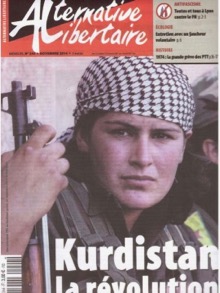 Not long ago, the French Minister for Foreign Affairs, Laurent Fabius, publicly declared that President Assad « did not deserve to be on Earth », and confirmed that the jihadists were doing a « good job ». Many young people answered his call by joining Al-Nusra (Al-Qaïda), then Daesh. Today, the French ex-Minister for Foreign Affairs, Bernard Kouchner, publicly announced that France would support the creation of state which would include Iraqi Kurdistan and the corridor to the Mediterranean via Syria. A few young Europeans have already answered this call, and many others will follow.
Today, as in 2011-12, the Western Press has taken the side of this new anti-Syrian army, supported by their governments. It will never question the treachery of Abdullah Öcalan, who renounced Marxist-Leninism for anarchy. It will repeat that Kurdistan has already been recognised by the Sèvres Conference, in 1920, but it will avoid looking at the documents which specify its boundaries. It will believe it to be legitimate in Iraq and Syria, although it is currently situated in Turkey. It will ignore the fact that the frontiers in fact correspond to nothing other than the plans developed by the Pentagon.
The referendum for the independence of the Iraqi region of Kurdistan and the territories annexed with the help of Daesh will launch the beginning of this operation, on 25 September. As in 2014, it will be intended to simultaneously destroy Iraq and Syria, this time without creating a « Sunnistan » from Rakka to Mossul, but a « Kurdistan », on a territory linking Erbil and Kirkuk to the Mediterranean.
Translation Pete Kimberley
[1] This term is poorly chosen insofar as « Westerner » is not opposed to « Oriental », but to « Soviet ». I could find no other term to describe collectively the Europeans, the North-Americans and the Israelis. Author’s note.
Featured Video
Col Doug Macgregor: US Strategy in Iran NEVER ADMIT DEFEAT
or go to
Aletho News Archives – Video-Images
From the Archives
Long Before Epstein: Sex Traffickers & Spy Agencies
By Elizabeth Vos | Consortium News | August 23, 2019
The alleged use of sexual blackmail by spy agencies is hardly unique to the case of Jeffrey Epstein. Although the agencies involved as well as their alleged motivations and methods differ with each case, the crime of child trafficking with ties to intelligence agencies or those protected by them has been around for decades.
Some cases include the 1950s -1970s Kincora scandal and the 1981 Peter Hayman affair, both in the U.K.; and the Finders’ cult and the Franklin scandal in the U.S. in the late 1980s. Just as these cases did not end in convictions, the pedophile and accused child-trafficker Jeffrey Epstein remained at arms’ length for years. … continue
Blog Roll
 Aletho News
- Col Doug Macgregor: US Strategy in Iran NEVER ADMIT DEFEAT
- IRNA denies 2nd round of negotiations: reports
- Israel attacks three nations for alleged backing of Iran
- Ex-intel officer questions Israeli strategy in Lebanon as losses mount
- Netanyahu’s ‘total victory’ to total flop
- REPORT: United States Now Global Outlier Ignoring Vaccine Injured as UK Inquiry Acknowledges Harms
- The Gratitude of the Captured
- Hezbollah denies involvement in deadly attack on UNIFIL in south Lebanon
- The prospect of an expanded and far more violent war
- Canada’s Carney Revives Online Censorship Bill
- If Americans Knew
- Israel employs ‘Gaza tactics’ in Lebanon, destroying 1,000 homes per day – Daily Update
- Israel relegates another population to life in tents – Daily Update
- Senate again fails to block weapons to Israel
- Think the Iran war is a disaster? Blame these DC think tanks first.
- Number of Palestinian Prisoners Rises By 83% Since October 2023
- With multiple “ceasefires” in place, Israel keeps on killing in Gaza and Lebanon – Daily Update
- Mearsheimer: Israel Owns Trump
- Mark Levin and Jonathan Pollard Push for Nuking Iran
- TCN: America Enables Israel’s Crimes
- Israel’s Next Leader Will Be Just Like Bibi – but Without the Corruption
- No Tricks Zone
- EV Industry Reached $70 Billion In Losses In 2024 Due To Delusional Green Ideologies
- Reality Check: Maldives Have Actually Grown In Size Or Remained Stable Over Recent Decades
- Abrupt Climate Change Also Occurred NATURALLY In The Past …25 Times During Last Ice Age
- Cave Discovery Reveals Today’s Desert Climates Were Recently Far Warmer, Wetter, Teeming With Life
- German Expert: Heat Dome Led To Record Temps In Western USA…Warmer In 1934, 1936
- New Study: No Linear Warming Or Glacier Retreat Along Northern Antarctic Peninsula Since 1980s
- An Inconvenient Tree: Uncovered In Alps… Europe Much Warmer Than Today 6000 Years Ago
- New Study Reports A 60% Slowdown In Greenland’s Ice Loss Rate In The Last Decade
- Low Intensity Tornado Wrecks Major Solar Farm, Creating A Potential Toxic Dump
- New Study Finds Warming Saves Lives…Cold Temperatures 12 Times More Deadly Than Excess Heat
 Aletho News