Israel Bans International Human Rights Workers from Gaza
By Celine Hagbard | IMEMC News | August 21, 2014
Since beginning its assault on the Gaza Strip on July 8th, Israeli officials have prevented human rights observers and experts employed by Amnesty International and Human Rights Watch from entering Gaza to conduct independent investigations.
Both groups are known worldwide for their work in exposing human rights abuses, and both groups have, in the past, filed reports critical of both the Hamas party in Gaza and of Israel’s practices toward Palestinians. But Amnesty International and Human Rights Watch employees have been unsuccessful in their attempts to bring observers into Gaza during the Israeli invasion.
The groups have called on both Israel and Egypt to lift the restrictions on human rights observers, and allow their employees to enter Gaza.
The joint press release filed by the two groups reads as follows:
Israel should immediately allow access to Gaza for Amnesty International, Human Rights Watch and other international human rights organizations so they can investigate allegations of serious violations of international humanitarian law by all parties to the conflict, Amnesty International and Human Rights Watch said today.
“The Israeli authorities appear to have been playing bureaucratic games with us over access to Gaza, conditioning it on entirely unreasonable criteria even as the death toll mounted” said Anne FitzGerald, Amnesty International’s Director of Research and Crisis Response. “The victims’ and the public’s right to know about what happened during the recent hostilities requires the Israeli authorities to ensure full transparency about their actions and to refrain from hindering independent and impartial research into all alleged violations.”
Since the beginning of Israel’s military operation on July 8, 2014 in Gaza, code-named “Protective Edge”, Israeli authorities have denied repeated requests by both Amnesty International and Human Rights Watch to enter Gaza via the Israeli-controlled Erez Crossing. Both groups also requested access from Egyptian authorities, who so far have not granted it.
“If Israel is confident in its claim that Hamas is responsible for civilian deaths in Gaza, it shouldn’t be blocking human rights organizations from carrying out on-site investigations,” said Sarah Leah Whitson, Middle East and North Africa director at Human Rights Watch. “Public pronouncements by a warring party don’t determine whether attacks violated the laws of war, but field investigations could.”
Since July 7, Amnesty International’s International Secretariat has submitted three applications for permission to enter Gaza via the Erez Crossing to Israel’s Civil Administration, which operates under Israel’s Defense Ministry. In each case, the Civil Administration said it could not process the requests, and that the Erez Crossing was closed. Journalists, United Nations staff, humanitarian workers, and others with permits have been able to enter and exit via Erez throughout this period.
“Valuable time has already been lost and it’s essential that human rights organizations are now able to enter the Gaza Strip to begin the vital job of verifying allegations of war crimes,” FitzGerald said.
Amnesty International requested assistance on this matter from Israel’s Foreign Affairs Ministry, and various third-party governments have raised the issue with their Israeli counterparts on Amnesty International’s behalf, but none of these efforts has been successful.
Human Rights Watch received similar responses from the Civil Administration to its request for permission to enter Gaza since the recent escalation in hostilities. Israeli authorities at the Erez Crossing also said that Human Rights Watch was not eligible for permits to enter Gaza because it was not a registered organization. However, the Israeli authorities acknowledged that they had discretion to make an exception. On August 17, Human Rights Watch requested such an exception as soon as possible; Israeli authorities denied it on August 19. Prior to 2006, Israeli authorities repeatedly granted Human Rights Watch access to Gaza without requiring the group to register or seek a special exception.
During the recent hostilities, Israeli forces have intensively bombarded the Gaza Strip from the air, land and sea, severely affecting the civilian population there. According to the UN Office for the Coordination of Humanitarian Affairs, 1,975 Palestinians have been killed, including 1,417 civilians of whom 459 are children and 239 women. Thousands of unexploded remnants of war are dispersed throughout the Gaza Strip. Hundreds of thousands of people have been displaced. Sixty-seven Israelis have been killed including three civilians.
Palestinian armed groups have fired thousands of indiscriminate rockets toward Israeli population centers; have reportedly stored rockets in empty school buildings; and allegedly deployed their forces without taking all feasible precautions to prevent harm to civilians, in violation of international law. Amnesty International and Human Rights Watch had some staff already stationed on the ground in Gaza but the quantity and magnitude of reported violations require the investigative assistance of other researchers, which Israel is blocking.
The Israeli government must allow all allegations of war crimes and other violations to be independently verified and the victims to obtain justice. Active human rights monitoring on the ground can also help serve to prevent further abuses being carried out – by all sides.
The Israeli authorities last granted Human Rights Watch access to Gaza through the Erez Crossing in 2006, and Amnesty International in the summer of 2012.
Since then, Amnesty International and Human Rights Watch have repeatedly been told that they must register with Israel’s Foreign Affairs Ministry, which only registers diplomats and UN personnel, or the Social Welfare Ministry. Registration with the Social Welfare Ministry is an option for humanitarian and development organizations with offices in Israel and the Occupied Palestinian Territories, but it is virtually impossible for Amnesty International and Human Rights Watch, as international human rights organizations, to meet the conditions for registration.
Majority of Israelis: The force used by the army in Gaza was not excessive
MEMO | August 20, 2014
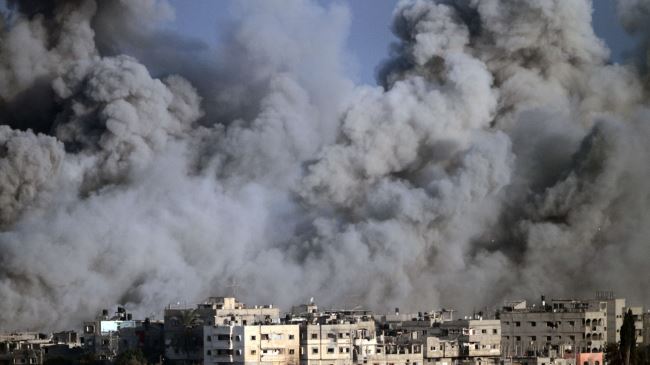
An overwhelming majority of Jewish Israelis think that the Israeli army used either the “appropriate” level of force or “too little firepower” during its latest aggression, dubbed “Operation Protective Edge”, in the Gaza Strip. A majority also expressed their support for the government’s restrictions on the freedom of expression during the war, as well as for the mediation efforts led by the post-coup government in Egypt.
According to the latest poll for the Peace Index, which is conducted by the Israel Democracy Institute and the University of Tel Aviv, 48 per cent of Israeli Jews believe that the force used by the army was appropriate, while 45 per cent actually think that too little force was used. Only 6 per cent said that Israel used excessive force against the Palestinians.
The Israeli government barred Israeli reporters from entering into Gaza to cover the war, thus Israelis were not exposed to the horrors taking place in the Strip. Israeli strikes have left more than 2,000 dead and 10,000 wounded, in addition to causing massive destruction to civil infrastructure, homes and businesses, leaving many without a place to sleep or work.
On another note, 97 per cent of the Jewish Israeli respondents said that the performance of the Israeli army during the operation was “was very or moderately good”, while only 3 per cent rated the army’s performance as “as not so good or poor”.
58 per cent said they were in favour of limiting the freedom of expression during times of war, while 39 per cent believe that these restrictions are unnecessary.
92 per cent of the Jewish population said the aggression on Gaza was “justified” while 58 per cent said that Israel should not respond to any of Hamas’s demands for a ceasefire and instead should continue fighting until the Palestinian resistance movement surrenders.
Some 44 per cent believe that Israel has achieved most of its goals as a result of the war on Gaza, while 48 per cent said that only some of the goals set for the operation have been achieved and 6 per cent said that Israel did not achieve anything from this operation.
As for the Arab Israeli citizens, 65 per cent believe that no goals have been achieved.
Regarding the mediation efforts in Cairo, 60 per cent of Israeli Jews trust Egypt’s President Abdel Fatah Al-Sisi “to act as a fair mediator”, with only 38 per cent not trusting him.
On the other hand, 55 per cent of Israeli Arabs do not trust President Al-Sisi, while 31 per cent trust him to mediate the conflict.
Reactions from leading experts on latest UN Commission on Gaza
By Shazia Arshad | MEMO | August 18, 2014
The United Nations Human Rights Council announced last week the formation of a commission to investigate the most recent Israeli attack on Gaza, Operation Protective Edge. The panel will be headed by William Schabas, a Canadian professor of international law. The UN has said that the panel will be investigating human rights violations and potential war crimes. Whilst Israel has described the panel as a “kangaroo court”, Hamas has welcomed the setup of the commission. Hamas’ spokesman Sami Abu Zuhri said, “Hamas welcomes the decision to form an investigation committee into the war crimes committed by the occupation [Israel] against Gaza and it urges that it begin work as soon as possible.”
The commission has already met with some controversy though with the appointment of its leading lawyer William Schabas. Schabas has been described by some critics as anti-Israel. An advert run in the New York Times describes him as not only anti-Israel but a “friend of Ahmadinejad”. It seems the most irking thing about his appointment was Schabas’ former involvement in the Russell Tribunal on Palestine which concluded that Israel has committed well documented violations of international law. Schabas countered the argument that he is anti-Israel by citing that he has been on the board of the Israel Law Review.
This in turn has raised some concerns; one leading lawyer, Francis A Boyle a former legal adviser to the Palestinian Liberation Organisation told MEMO that Schabas’ appointment could be of concern to the Palestinians given his role on the Israel Law Review Board. Either way Schabas’ appointment is causing waves and his role in the Commission will almost certainly be under inspection. Boyle’s concerns however were not limited to the experts involved, he went on to say that “will be an exercise an (sic) damage control and damage limitation on behalf of Israel and very well could be used to hurt the Palestinians.”
The commissions’ findings might be hard to predict, but one thing that has been widely commented on during the assault on Gaza has been the disproportionate action by Israel. Killing almost 2,000 civilians and injuring nearly 10,000 the effect on the Gaza Strip would be intolerable by any standards. And with the Strip facing its third war in six years, it has come under increasing humanitarian strain, having barely had a chance to recover before being hit again.
With even members of the British government such as Deputy Prime Minister Nick Clegg saying “is difficult to deny that Israel’s military action appears disproportionate and, combined with the Gaza blockade, is resulting in the collective suffering of the Palestinian people”, it is clear that the Gazans have had to pay a heavy price as a result of Israel’s actions. Over the last six years this heavy price has been a burden without any justice for the Palestinian people.
After Operation Cast Lead a UN Fact Finding Mission was established to investigate the events that had taken place in Gaza. The Goldstone Report essentially accused Israel of war crimes and possible crimes against humanity. Israel rejected the findings of the report and though the report received a great deal of international backing its findings were not implemented. During that fact finding mission Israel refused to engage with the UN Fact Finding team. Almost immediately after the UN’s announcement that they would be establishing this most recent commission Israel dismissed it as being biased against Israel.
If recent history is anything to go by, it is not surprising that there are some concerns from leading experts that this commission could face difficulties during its investigation. Leading international law expert, John Dugard told the Middle East Monitor that though he had full confidence in the mission he hoped that Israel would co-operate but he “fear(ed) that it would not”. Dugard also raised concerns about Egypt’s role, ” I hope Egypt will allow the Mission access to Gaza as it did with both Arab League Fact Finding Mission and Human Rights Council Mission in 2009″. He also went on to say the he hoped European states would keep an open mind but noted that this was “too much to expect of the USA”.
It’s not just Israel’s reaction and response to the mission that observers will be monitoring. The UKs position during the conflicts in Gaza has come under intense scrutiny. After the Goldstone report, the UK’s response to it was heavily criticised. With Israel forcefully lobbying UN members to vote against the Goldstone report, the UK chose not to vote. Despite increasing pressure from MPs in the UK, the then Labour government took the decision not to vote either way on the report – although it did not officially abstain from voting.
This time around the UK’s action will be even more closely watched, especially as leading politicians take a strong stance against Israel’s actions. One top politician, Baroness Warsi resigned over the UK’s policy on Gaza. Lord David Steele, a former leader of the Liberal Democrats, expressed his support for the commission when he told MEMO “I just hope that more international attention will be paid to this report than was the case with the Goldstone report.”
The National Lawyers Guild also welcomed the commission and told MEMO that they were pleased that the UNHRC had launched an investigation into Israel’s “criminal behaviour”. But they too echoed concerns about the history of the Goldstone report itself saying, “we expect that any objective investigation would – like the Goldstone Report -condemn the Israeli assault and recommend prosecution of its military and political leaders.”
“We further expect that Israel, shielded by the United States, would once again ignore the report. To end Israel’s impunity its leaders must be investigated and prosecuted in the International Criminal Court for war crimes, genocide and crimes against humanity, alongside US leaders who aided and abetted them. We are sending a letter to that effect to the ICC Prosecutor.”
Calling for the International Criminal Court to investigate will in itself prove to be difficult. Reports on Monday suggested that the ICC was under pressure not to open an investigation into war crimes in Gaza as a result of pressure from the US. These reports argue that Fatou Bensouda, ICC chief prosecutor, will not put forward an investigation unless the Palestinians submit a new request. A former request from 2009 will not be accepted.
If the ICC does investigate this would push this commission’s results much further than the Goldstone report. Hina Jilani, one of the members of the Goldstone fact finding mission, told MEMO that “mechanisms for accountability were created at the international level to ensure the respect for the rule of law, when it is evident that national governments are either unwilling or unable to hold genuine accountability. If the international community shies away from the use of these mechanisms, it becomes complicit in the denial of justice to the victims.”
Commenting on the commission Jilani said, “the newly established Commission of Inquiry on Gaza established by the Human Rights Council at its Special Session on 23 July 2014 is certainly welcome. However, its efforts can only be fruitful if accountability of those responsible for any violations they find, is ensured. That would not be possible unless the international community has an unequivocal resolve to end impunity as well as tolerance for any acts that violate international law, especially those causing deliberate harm to civilians at times of war.”
Leading UN figures have already raised concerns, the UN Secretary –General Ban Ki-moon said that Israel had been guilty of violations of international law and Navi Pillay UN High Commissioner for Human Rights said that Israel had deliberately defied international law. Jilani said that “no one must be allowed to sabotage or divert efforts towards peace. Nor must these be de-linked from imperatives of accountability and justice. The rule of law must prevail and impunity for international crimes and gross violations of international law must end. The 2009 report of the Gaza Fact Finding Mission had observed that, “justice and respect for the rule of law are the indispensable basis for peace.”
Israeli ship blockade continues in California
Al-Akhbar | August 19, 2014
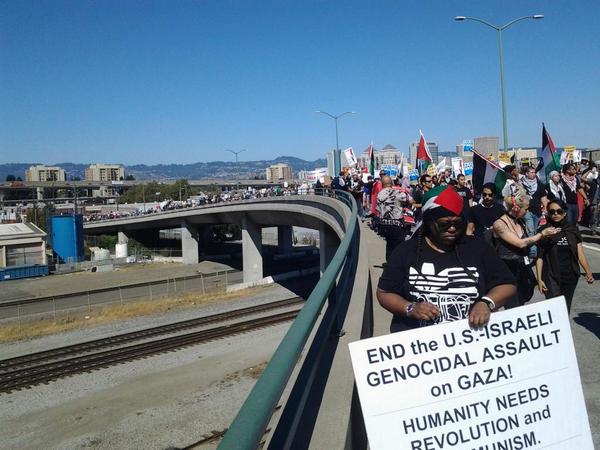
US activists blocked an Israeli cargo ship from unloading at a California port for the third day in a row in protest of the recent Israeli assault on Gaza, organizers of the action reported late Monday.
The vessel, owned and operated by Israeli company Zim Shipping Services, has been trying to unload Israeli cargo in the port of Oakland since Saturday.
Thousands of protesters prevented the ship from unloading on Saturday, with the cooperation of dock workers who refused to unload the boat.
The ship has failed to unload its cargo despite attempting various tactics, including delaying its arrival time until the early morning hours. About a dozen activists continued to hold off the ship early Monday morning, according to activist sources.
One activist who spoke to Al Jazeera said the organizers were thinking of making the block a regular action, as Israeli ships arrive in the port every Saturday.
The blockade is supported by the International Longshoremen and Warehousemen Unions, a group which also stood against the South African apartheid regime in 1984.
Touring the devastated industrial zones of Gaza

By Martin Lejeune | Ma’an | August 18, 2014
On the night of the July 27, the first day of the Muslim Eid-Al-Fitr festival following the fasting month of Ramadan, the Israeli air force dropped three bombs on Al-Hurani’s carpentry workshop. Each of the three bombs had an explosive force of 250 pounds.
Al-Hurani pointed towards the charred left overs of the tables, armchairs and beds, “all designed according to the desires of each individual customer, processed with the best woods and decorated with passion, as our customers expect from us,” he told Ma’an.
The carpentry of the Al-Hurani family is well-known across the northern Gaza Strip city of Jabaliya, and is respected throughout the Gaza Strip for its precise designs. In addition to family members, Al-Hurani employed 25 workers in his workshop before the Israeli assault.
“Due to the total destruction of our plant everyone had to be dismissed immediately and I do not know how to feed my family anymore. We don’t know how to move on from here,” he said.
The family possesses no savings for the construction of a new workshop and they believe there is no hope for obtaining any kind of compensation for the estimated $450,000 in damages they have suffered.
Abu Eida, one of the largest construction companies in the Gaza Strip, is headquartered in the industrial area east of Jabaliya that the air force also dropped several 250 pound bombs on Aug. 2.
Abed Rabou Abu Eida, CEO of the construction company, told Ma’an he was not aware of the exact number of bombs being dropped.
An on-site inspection of the premises, however, revealed the extent of the destruction: Three large buildings, which had all been reinforced by concrete, the warehouse containing cement and bricks, as well as the construction machinery have all been flattened.
Abu Eida estimates the cost of the total damage to be around $7.5 million. As a result of the attack, he had to dismiss all of his 70 permanent workers because the company could no longer operate. Hundreds of part-time workers that deal with Abu-Eida on a sporadic basis are also out of work.
“In 2008 and 2012 the factory premises were already completely destroyed by the Israeli air force and our company has not received any kind of compensation, due to the law passed in 2007,” Abu Eida said, referring to an Israeli law that defined Gaza as enemy territory and thus its residents ineligible for compensation through civil suits.
“This time we have no more money to rebuild our company a third time.”
At the end of Abu Khayr street in the Jabaliya industrial area sits the Al-Fayoumi family farm. The farm once owned 150 cows and sold milk twice a day to dairy factories.
130 of the cows were killed in their stables during the Israeli bombing on Aug. 2, according to workers on the farm.
During a visit to the ruined courtyard on August 13, workers were still trying to collect and burn the remaining corpses. The terrible smell of the semi-decomposed carcasses of cattle lay side by side with charred hens when Ma’an visited.
A swarm of flies covered the corpses, trying to get its share.
“Where can the Al-Fayoumis get new cows from?” asked a worker who did not want to give his name. “The borders to Gaza are closed and the smuggling tunnels destroyed.”
Wael Al-Wadia, owner of the Saraio candy factory in the same area, showed Ma’an the remains of his completely ruined factory buildings, where ice cream, biscuits, and cakes were once made.
“I had 100 workers on permanent contracts. 100 workers who have fed 100 families and now have no income,” al-Wadia said. The factory produced five tons of sweets on a daily basis, he said. Now, everything is gone.
Al-Qadia estimated that it would cost him $7 million to purchase the same equipment again, which he had initially brought to Gaza from Italy.
“We have made the best biscuits in the Gaza Strip. Every market in Gaza sold our products. Our biscuits were as good as the Biscotti’s from Italy,” he told Ma’an.
But it was not only factories, hospitals, schools, farms, agricultural land, and the famous orange groves of Beit Hanoun that were bombed during the worst of the Israeli assault between July 6 and Aug. 3.
Gaza’s sole power station, its largest mosques, and the building of the popular TV station Al-Quds were also hit, while tens of thousands of private homes were destroyed or severely damaged.
Muhsen Abu Ramadan, Director of the Arab Center for Agricultural Economic Development in Gaza, told Ma’an that the damage to the besieged coastal enclave’s economy, however, predates the recent Israeli assault.
“The economic crisis began long before the aggression, and is a result of the eight years lasting blockade of Gaza,” he said.
Abu Ramadan estimates that even before the beginning of the Israeli attacks in July, 40 percent of the labor force was unemployed, 30 percent lived below the poverty line, 57 percent were at risk of malnutrition, and 70 percent received food parcels from the United Nations Relief and Works Agency for Palestine Refugees in the Near East or other organizations.
“These numbers have increased dramatically since the bombings,” said Abu Ramadan.
He also said that Israeli army completely destroyed 220 factories in the campaign, while hundreds more suffered partial damage.
Abu Ramadan estimates the cost of destruction of agricultural land at around $200 million and the amount of the total costs to the economy at several billion dollars.
“Gaza would need five years to rebuild the destroyed infrastructure,” he said.
But given the current economic conditions caused by the occupation and the blockade of Gaza, he estimated that reconstruction will take at least ten years.
“We have the right to import building materials and this right must be given to us immediately, especially with the help of the international community. Otherwise, we will not be able to rebuild our destroyed houses and factories,” Abu Ramadan added.
Tens of thousands have joined the ranks of the unemployed since the imposition of the harsh Israeli blockade in 2007, and given the scale of the damage suffered during the massive Israeli assault, of those who were still employed in industry and agriculture in July it is unlikely that more than a few thousand are still working in either sector. A few thousand out of 1.8 million people.
“Israel is not only attacking civilians and their homes, but also systematically destroyed the economy of the Gaza Strip in order to make people dependent on emergency aid,” Abu Ramadan argued.
“Now that almost the entire economy is destroyed, people can no longer work, thus cutting their purchasing power dramatically. Now youth want to emigrate at even younger ages than before. Due to the emigration of young skilled workers the economy is becoming even weaker.”
“Israel has managed to transform a functioning economy into a third world country through eight years of embargo and three assaults in five years. Without ending the embargo, it is impossible to break out of this vicious cycle ourselves,” Abu Ramadan added.
Martin Lejeune is a German journalist based in Gaza. Follow him on twitter
Attacking journalists makes Israel a plastic democracy
By Alastair Sloan | MEMO | August 18, 2014
I’ve just had the pleasure of spending eight hours in detention at the border between Egypt and Israel, between Tabaa and Israel’s southern-most city, Eilat. My crime at first appeared to be a single male travelling alone into a Middle Eastern country. But once the immigration police realised I was a journalist, I was in for the long haul.
At first – I was asked the standard cavalcade – where was I staying, who with, and what were my plans? But on discovering my profession, brows furrowed faster than a Horah dance at a bar mitzvah.
My stay in a holding area, punctuated by increasingly aggressive interrogations, peaked when the most senior official asked me to write down the names and addresses of all my sources in Israel and Palestine.
Of course they wanted sources in “the Palestinian Territories,” and in a Freudian slip, I blurted out that I certainly wouldn’t be revealing any sources in the “Occupied Territories”. After a brief staring match, the official kept tapping away into her computer.
I didn’t give them the information they were after, not wanting to endanger anyone – which resulted in a further four hour wait, during which not much appeared to be happening. They let me go in time for me to miss my best friend’s engagement party, where I was stopping by before heading up to Ramallah. They knew I was in a rush to make this, and they knew I was best man. I’ll never know if they let me go when they did out of spite, but I suspect they did. Bullies enjoy a pathetic victory.
Thomas Jefferson was unequivocal in his support for the media, summarising that “the basis of our government being the opinion of the people, the very first object should be to keep that right; and were it left to me to decide whether we should have a government without newspapers, or newspapers without a government, I should not hesitate a moment to prefer the latter.”
Nelson Mandela, no friend to Israel but a hero to civilised nations – described freedom of information as “the lifeblood of democracy”. Curbing journalistic freedoms is not only a red rag to the bull – it’s arrogant and betrays the electorate. Too often we think of democracy as happening at the ballot box – but it is the media that informs the voter before they reach the polling station and in harassing, imprisoning and even killing journalists, Israel makes a mockery of their insistent claim to be “the only democracy in the Middle East”.
What I experienced was a mere bump in the road compared to other journalists’ troubles. Majd Kayyal, a Palestinian journalist, was arrested in April 2014 on his return from Beirut – allegedly for entering an “enemy state” and conspiring with a “foreign agent”. He was held in a windowless room for five days, interrogated by Shin Bet, and denied access to a lawyer. The government prohibited Israeli media outlets from reporting on the matter in real time – a ban which was luckily ignored by many editors. The charges were later dropped – however veteran Israeli journalist Itai Anghel noted that having travelled to several “enemy states”, including Iraq and Afghanistan – he had not once been stopped or detained by the Israeli security services.
But again, what happened to Kayyal is, sadly, mild. Seventy-one journalists were killed in Israel last year. Over 2,000 reported being physically attacked or threatened. Eighty-seven were kidnapped. Over 800 were arrested. Seventy seven had had enough and fled the country and, as of December 2013, there were 178 journalists in Israeli prisons. This doesn’t sound like a free press.
At the end of last year – diplomats, politicians, activists and NGOs concluded that the Palestinian territories were one of the worst places in the world to practice journalism. Not only is violence regularly deployed to repress domestic and foreign reporters, censorship laws are used to deny useful debate and manipulate opinion – often in favour of war.
For example, on July 24 the Israeli Broadcasting Authority prohibited the broadcast of an advert produced by B’Tselem, an Israeli NGO, which listed the names of 150 children killed in Gaza. Likewise, the killings of three Israeli teenagers took place almost immediately after their kidnapping, shortly before Operation Protective Edge began, yet a gagging order on the media prevented publishing the key facts.
Instead, Prime Minister Benjamin Netanyahu orchestrated a phoney manhunt for three weeks in which pro-war fervour was whipped up. He even lied to the children’s parents.
Now, talking to Israelis across the country, it is clear that support for the most recent Gaza onslaught is near unprecedented – based on the distorted image of the events leading up to the war. The range of opinions I heard was extremely narrow, with narratives drawing clearly on simplistic hasbara distributed by the government. To take a country to war, you need the media with you. Netanyahu has become an expert on this.
Similar censorship laws were invoked when Lt Hadar Goldin was apparently briefly captured by Hamas during the most recent conflict, and Israeli artillery shelled his location in an effort to kill him. This infamous “Hannibal Doctrine”, which dictates Israeli soldiers should be killed by friendly fire rather than become prisoners, was considered so unpalatable to the national spirit – that reporting on it was completely banned. In an extraordinary display of arrogance, Israeli military censors even attempted to stop The New York Times from publishing further information on the case.
So far, only Haaretz has run a piece seriously questioning the doctrine. Thankfully, the newspaper ended a 10 year reporting ban of the Doctrine in 2003, when they completed an investigation into the matter. Still, knowledge of the Doctrine was not as apparent as you would hope for from the ordinary Israelis I spoke to this week.
Though part of the Israeli public’s thirst for war can be attributed to a lack of media information, many Israelis are wilfully blind to the misgivings of the Israeli Defence [sic] Force (IDF). In a survey last year, Tel Aviv University found that just over half of Israelis believe that the media should not publish immoral conduct by the IDF. This has created an environment in which self-censorship is the norm. Recent civilian casualties in Gaza, despite numbering over 2,000 have barely been reported. The morning after the offensive began, Israel’s most widely circulated newspaper, Yisrael Hayom, did not contain a single word regarding civilian casualties. Instead, editors splashed an enormous explosion in Gaza City, and an emotive photo of an IDF conscript hugging his girlfriend goodbye. Yisrael Hayom’s slogan is sickeningly unquestioning for a major media outlet: “Remember, we are Israelis.”
The complicity of the Israeli media – largely a phoney industry with a sense of social responsibility akin to Blackwater or G4S, fills responsible hacks with professional disgust. One in 10 members of the Knesset is a former journalist. The leader of the country’s second most popular party is Yair Lapid and the leader of the Labour Party is Shelly Yachimovich, both came from Channel 2, Israel’s largest TV station. Of course many highly capable leaders have come from journalistic backgrounds, but the mass migration to the other side of the fence suggests the industry has a fundamental misunderstanding of what journalism is about: holding power to account.
Moreover – the continuing brutality of the Israeli regime against Palestinian and foreign journalists is profoundly troubling. I was lucky – my punishment was eight hours in detention and an unplanned overnight stay in Eilat (incidentally – a depressing sinkhole of tourist tack thronging with recently released IDF conscripts, celebrating their mass slaughter in Gaza).
But for many journalists, the price they pay for reporting on Israel’s crimes is beating, arrest, imprisonment, kidnapping or death. For Israel to be anything more than a plastic democracy its leaders need to rethink press freedoms. And if Israelis want to understand why the world is constantly so critical of them, they need to understand that they live in a media bubble in which only a certain reality about the Occupied Territories is presented. The full picture might not be nice, but is extremely important.
UK government faces lawsuit over arms sales to Israel
Press TV – August 17, 2014
The British government is facing unprecedented legal action over its continued arms sale to Israel in the wake of the recent deadly Israeli aggression against the Gaza Strip.
British law firm, Leigh Day, representing the Campaign Against Arms Trade (CAAT), said Saturday that it has written to Business Secretary Vince Cable, calling for the immediate suspension of arms export licenses to Israel.
The law firm said the UK government’s failure to suspend the licenses is illegal, adding that it has been instructed to seek a High Court judicial review of the administration’s reluctance to halt the arms sales to Israel.
A recent report by the British parliamentary committee for arms export controls showed that Israel received around £8 billion in the form of 400 arms licenses from the UK in 2013.
Leigh Day further said there is a risk that British-made weapons may have been used by Israel during its recent onslaught on Gaza in breach of humanitarian and human rights law.
“If arms from the UK are being used to commit crimes against humanitarian law, and human rights law, then export licenses for these materials must be revoked immediately,” said Rosa Curling, representing the CAAT, adding, “If this is not done, the government’s current policy is unlawful and susceptible to legal challenge.”
The British government has come under persistent pressure to toughen its stance against Israel, including by halting arms exports, since Tel Aviv began its onslaught on the besieged Palestinian enclave more than a month ago.
Nearly 2,000 Palestinians, including 470 children, have lost their lives and more than 10,200 have been wounded since the Israeli military unleashed fatal assaults against Gaza on July 8.
Human rights groups say Israeli forces are systematically killing Palestinian children and youths.
Palestine Supporters Block Israeli Ship from Docking on California Coast
By Celine Hagbard | IMEMC News | August 16, 2014
The Israeli cargo ship ‘Zim’ was set to dock in the Oakland port, on Saturday morning. But activists have claimed credit for an announced delay in the ship’s docking, and are planning to stop the ship wherever it tries to dock.
The U.S. activists are following the lead of trade unionists in South Africa, who successfully blocked Israeli ships from docking on several occasions, to protest Israeli aggression against Palestinians and call for a just and lasting peace.
Activists in Oakland, California are gathering Saturday to carry out direct action to stop the ship from being able to dock at the port. And, activists in Seattle, WA and Vancouver, BC are also planning to blockade scheduled stops in those ports.
The actions could potentially cost Israeli exporters millions of dollars, if their goods are unable to reach their ports of destination. The exact products on board the Zim are unknown, but they are likely to include Sodastream, a do-it-yourself soda-making device that is manufactured in an Israeli settlement on illegally-seized Palestinian land, Ahava dead sea salts, which are seized from Palestinian land in violation of the Dead Sea Agreement, and Osem brand food products, some of which are manufactured and packaged in Israeli settlements on illegally-seized Palestinian land, in the West Bank.
In their organizing materials, protesters say, “Palestine is calling us to action! Palestinian laborers [and the] Palestinian General Federation Trade Union have called on workers around the world to refuse to handle Israeli goods.”
They say that their “Block the Boat” actions are in response to a call by the Palestinian General Federation of Trade Unions, which calls for people around the world to “educate and build awareness among the labor movements of the U.S., and urge them to condemn the Israeli aggression and to boycott Israel.”
The Oakland action ran into some complications when the local branch of the International Longshore and Warehouse Union, or ILWU, was unable to take a public stand in favor of the action – reportedly because of an active negotiation between the union and management. But individual union members are supporting the action, and are part of Saturday’s blockade.
One of the organizers of the event, Reem Assil of the Arab Resource and Organizing Center, told reporters, “Symbolically, for Oakland we can say, ‘Not in our name!’ We’re not going to be complicit and an accomplice to the ongoing genocide and massacres going on.”
In 2010, Oakland activists successfully turned back an Israeli ship, while protesting the Israeli siege on Gaza. But that ship was later able to dock in Los Angeles. This time, activists are coordinating via social media and contact lists to ensure that protesters prepared for direct action will be on hand to meet the ship in Los Angeles, Seattle, or Vancouver, BC if it decides to re-route.
The protesters are calling for an end to the Israeli siege on Gaza, and an end to the Israeli occupation of Palestinian land. Their demands are in sync with the Palestinian core demands, which include equal rights for Palestinian people, the return of Palestinian refugees to their former homes in what is now Israel, and the release of Palestinian prisoners held in Israeli prison camps.
Self-defense or provocation: Israel’s history of breaking ceasefires
IMEU | May 15, 2012
Since Israel’s creation in 1948, Israeli political and military leaders have demonstrated a pattern of repeatedly violating ceasefires with their enemies in order to gain military advantage, for territorial aggrandizement, or to provoke their opponents into carrying out acts of violence that Israel can then exploit politically and/or use to justify military operations already planned.
The following fact sheet provides a brief overview of some of the most high profile and consequential ceasefire violations committed by the Israeli military over the past six decades.
2012 – On November 14, two days after Palestinian factions in Gaza agree to a truce following several days of violence, Israel assassinates the leader of Hamas’ military wing, Ahmed Jabari, threatening to escalate the violence once again after a week in which at least six Palestinian civilians are killed and dozens more wounded in Israeli attacks.
2012 – On March 9, Israel violates an Egyptian-brokered ceasefire and assassinates the head of the Gaza-based Popular Resistance Committees, sparking another round of violence in which at least two dozen Palestinians are killed, including at least four civilians, and scores more wounded. As usual, Israel claims it is acting in self-defense, against an imminent attack being planned by the PRC, while providing no evidence to substantiate the allegation. Following the assassination, Israeli journalist Zvi Bar’el writes in the Haaretz newspaper:
“It is hard to understand what basis there is for the assertion that Israel is not striving to escalate the situation. One could assume that an armed response by the Popular Resistance Committees or Islamic Jihad to Israel’s targeted assassination was taken into account. But did anyone weigh the possibility that the violent reaction could lead to a greater number of Israeli casualties than any terrorist attack that Zuhair al-Qaisi, the secretary-general of the Popular Resistance Committees, could have carried out? “In the absence of a clear answer to that question, one may assume that those who decided to assassinate al-Qaisi once again relied on the ‘measured response’ strategy, in which an Israeli strike draws a reaction, which draws an Israeli counter-reaction.”
Just over two months prior, on the third anniversary of Operation Cast Lead, Israeli army Chief of Staff Lt. Gen. Benny Gantz tells Israel’s Army Radio that Israel will need to attack Gaza again soon to restore its power of “deterrence,” and that the assault must be “swift and painful,” concluding, “We will act when the conditions are right.”
2011 – On October 29, Israel breaks a truce that has maintained calm for two months, killing five Islamic Jihad members in Gaza, including a senior commander. The following day, Egypt brokers another truce that Israel proceeds to immediately violate, killing another four IJ members. In the violence, a total of nine Palestinians and one Israeli are killed.
2008 – In November, Israel violates a ceasefire with Hamas and other Gaza-based militant groups that has been in place since June, launching an operation that kills six Hamas members. Militant groups respond by launching rockets into southern Israel, which Israel shortly thereafter uses to justify Operation Cast Lead, its devastating military assault on Gaza beginning on December 27. Over the next three weeks, the Israeli military kills approximately 1400 Palestinians, most of them civilians, including more than 300 children. A UN Human Rights Council Fact Finding Mission led by South African jurist Richard Goldstone subsequently concludes that both Israel and Hamas had committed war crimes and crimes against humanity during the fighting, a judgment shared by human rights organizations such as Amnesty International and Human Rights Watch.
2002 – On July 23, hours before a widely reported ceasefire declared by Hamas and other Palestinian groups is scheduled to come into effect, Israel bombs an apartment building in the middle of the night in the densely populated Gaza Strip in order to assassinate Hamas leader Salah Shehada. Fourteen civilians, including nine children, are also killed in the attack, and 50 others wounded, leading to a scuttling of the ceasefire and a continuation of violence.
2002 – On January 14, Israel assassinates Raed Karmi, a militant leader in the Fatah party, following a ceasefire agreed to by all Palestinian militant groups the previous month, leading to its cancellation. Later in January, the first suicide bombing by the Fatah linked Al-Aqsa Martyr’s Brigade takes place.
2001 – On November 23, Israel assassinates senior Hamas militant, Mahmoud Abu Hanoud. At the time, Hamas was adhering to an agreement made with PLO head Yasser Arafat not to attack targets inside of Israel. Following the killing, respected Israeli military correspondent of the right-leaning Yediot Ahronot newspaper, Alex Fishman, writes in a front-page story: “We again find ourselves preparing with dread for a new mass terrorist attack within the Green Line [Israel’s pre-1967 border]… Whoever gave a green light to this act of liquidation knew full well that he is thereby shattering in one blow the gentleman’s agreement between Hamas and the Palestinian Authority; under that agreement, Hamas was to avoid in the near future suicide bombings inside the Green Line…” A week later, Hamas responds with bombings in Jerusalem and Haifa.
2001 – On July 25, as Israeli and Palestinian Authority security officials meet to shore up a six-week-old ceasefire, Israel assassinates a senior Hamas member in Nablus. Nine days later, Hamas responds with a suicide bombing in a Jerusalem pizzeria.
1988 – In April, Israel assassinates senior PLO leader Khalil al-Wazir in Tunisia, even as the Reagan administration is trying to organize an international conference to broker peace between Israelis and Palestinians. The US State Department condemns the murder as an “act of political assassination.” In ensuing protests in the occupied territories, a further seven Palestinians are gunned down by Israeli forces.
1982 – Following Israel’s invasion of Lebanon in June, and after PLO fighters depart Beirut under the terms of a US-brokered ceasefire, Israel violates the terms of the agreement and moves its armed forces into the western part of the city, where the Palestinian refugee camps of Sabra and Shatila are located. Shortly thereafter, Israeli soldiers surround the camps and send in their local Christian Phalangist allies – even though the long and bloody history between Palestinians and Phalangists in Lebanon is well known to the Israelis, and despite the fact that the Phalangists’ leader, Bashir Gemayel, has just been assassinated and Palestinians are rumored (incorrectly) to be responsible. Over the next three days, between 800 and 3500 Palestinian refugees, mostly women and children left behind by the PLO fighters, are butchered by the Phalangists as Israeli soldiers look on. In the wake of the massacre, an Israeli commission of inquiry, the Kahan Commission, deems that Israeli Defense Minister (and future Prime Minister) Ariel Sharon bears “personal responsibility” for the slaughter.
1981-2 – Under Defense Minister Ariel Sharon, Israel repeatedly violates a nine-month-old UN-brokered ceasefire with the PLO in Lebanon in an effort to provoke a response that will justify a large-scale invasion of the country that Sharon has been long planning. When PLO restraint fails to provide Sharon with an adequate pretext, he uses the attempted assassination of Israel’s ambassador to England to justify a massive invasion aimed at destroying the PLO – despite the fact that Israeli intelligence officials believe the PLO has nothing to do with the assassination attempt. In the ensuing invasion, more than 17,000 Lebanese are killed.
1973 – Following a ceasefire agreement arranged by the US and the Soviet Union to end the Yom Kippur War, Israel violates the agreement with a “green light” from US Secretary of State Henry Kissinger. According to declassified US documents, Kissinger tells the Israelis they can take a “slightly longer” time to adhere to the truce. As a result, Israel launches an attack and surrounds the Egyptian Third Army, causing a major diplomatic crisis between the US and Soviets that pushes the two superpowers to the brink of nuclear war, with the Soviets threatening to intervene to save their Egyptian allies and the US issuing a Defcon III nuclear alert.
1967 – Israel violates the 1949 Armistice Agreement, launching a surprise attack against Egypt and Syria. Despite claims Israel is acting in self-defense against an impending attack from Egypt, Israeli leaders are well aware that Egypt poses no serious threat. Yitzhak Rabin, Chief of the General Staff of the Israeli army during the war, says in a 1968 interview that “I do not believe that Nasser wanted war. The two divisions he sent into Sinai on May 14 would not have been enough to unleash an offensive against Israel. He knew it and we knew it.” And former Prime Minister Menachem Begin later admits that “Egyptian army concentrations in the Sinai approaches did not prove that Nasser was really about to attack us. We must be honest with ourselves. We decided to attack him.”
1956 – Colluding with Britain and France, Israel violates the 1949 Armistice Agreement by invading Egypt and occupying the Sinai Peninsula. Israel only agrees to withdraw following pressure from US President Dwight Eisenhower.
1949 – Immediately after the UN-brokered Armistice Agreement between Israel and its neighbors goes into effect, the armed forces of the newly-created Israeli state begin violating the truce with encroachments into designated demilitarized zones and military attacks that claim numerous civilian casualties.
Egypt opens Rafah crossing, denies Kuwaiti aid entry to Gaza
Ma’an – August 14, 2014
GAZA CITY – Egyptian authorities denied entry to a Kuwaiti delegation bringing aid to the Gaza Strip on Thursday as it opened the Rafah crossing for humanitarian cases.
Palestinian crossing officials said that injured Palestinians, medical patients and foreign nationals were allowed to use the crossing and Gaza residents in Egypt were allowed to return.
Egyptian security prevented a four-man Kuwaiti delegation carrying medical aid from entering Gaza.
No reason was given for the refusal.
Egyptian authorities have largely kept the Rafah crossing closed since the army ousted President Mohamed Morsi in 2013.
The terminal is the only border crossing that most of Gaza’s 1.8 million people can use to leave the enclave.
Featured Video

Trita Parsi: Middle East Unraveling — Are We on the Path to World War?
or go to
Aletho News Archives – Video-Images
New Book
Trans agenda is ‘normalization of sadism’ – US author

RT | September 23, 2026
The US Democratic Party has embraced a transgender agenda that amounts to “the normalization of sadism,” author A.J. Rice has said, warning that radical trans policies would return if the party is allowed to regain power.
Speaking to RT’s America First host Scotty Nell Hughes about his new book, ‘The Curse of the Bearded Lady: How the Trans Mafia Whacked American Sanity’, Rice argued that activists have gained significant influence in schools, medicine, and corporate America while people who questioned the agenda have faced pressure to stay silent.
The author described the “trans mafia” as the sprawling network of people and institutions that have helped the movement gain influence. He singled out parts of academia, wealthy backers, and corporations, and stated that providers of transition-related treatment also have a financial incentive to keep young people in their care indefinitely.
Rice argued that the consequences of these policies ultimately fall on children who are being drawn toward gender-affirming medical treatments and on girls who are expected to share locker rooms or compete in sports with biological males.
He noted that while voters rejected the Democrats’ approach to gender in 2024, the party, which has been “captured by madness,” has since only doubled down and is seeking what is effectively “the normalization of sadism.” … Full report
Blog Roll
 Aletho News
- NATO chief wants Europeans to fight American wars [for Israel]
- German chemicals giant reveals details of downsizing
- Refaat Al-Areer Was The Canary In The Coal Mine In Israel’s War On The Truth
- Israeli election committee bars candidate from Knesset race over Gaza war opposition
- French-Lebanese man files war crimes complaint over Israeli attacks
- Mahan Air Flight Lands in China Despite US Threat against Iranian Airlines
- US eyes $10bn fund to rebuild war-battered Gulf infrastructure
- Trump meets Rodríguez near Maduro’s prison as Venezuela’s oil flows to US
- Trita Parsi: Middle East Unraveling — Are We on the Path to World War?
- Iran FM meets with US envoy on UN meeting’s sidelines at American side’s insistence: Report
- If Americans Knew
- An error has occurred; the feed is probably down. Try again later.
- No Tricks Zone
- New Study: Earth And Venus Surface Warmth Largely Explained By Convection And Lapse Rate, Not CO2 Or Radiation
- 2025 Nature Paper Claiming Worsening Global Drought Gets RETRACTED …Heavily Flawed
- New Study: ‘Global Drought Shows No Detectable Recent Acceleration Under Climate Warming’
- Economic Masterminds: German Socialists Suggest Taxing Productivity Gains Stemming From Using AI
- The South China Sea Has Not Been Cooperating With The Climate Change Narrative
- Energy Crisis: Germany Enters Heating Season With Historically Low Gas Reserve Fill Levels
- New Study: The Antarctic Ice Sheet Gained Mass From 2020-2024 Due To Staggering Snow And Ice Accumulation
- Study: Ocean Heating Rates From Thousands Of Years Ago ‘Dwarf’ Modern Ocean Heating Rates
- Climate Extremists Target, Attack Large-Scale Power Grid Infrastructure In Germany!
- New Study: Antarctic Ice Melt Has Contributed Less Than 1 Centimeter To Sea Level Rise In The Last 30 Years

