Gaza fighters clash with Israeli forces in Occupied Palestine after strike kills eight children on Eid
Al-Akhbar | July 28, 2014
Updated 8:08 pm: Palestinian gunmen slipped into Occupied Palestine from the Gaza Strip on Monday and penetrated a village near the border before entering clashes with occupation forces, Israeli television said, adding that five militants had been killed.
Hamas said in a statement their fighters had killed 10 Israeli soldiers in the incident before returning home safely. But an Israeli security source told AFP that five Palestinian fighters were shot dead in the gun battle with Israel troops.
Earlier on Monday, an Israeli airstrike hit a public garden in the Beach refugee camp in northern Gaza killing 10 people, eight of them children, according to medics, ending a relative lull in fighting during the Muslim Eid holiday.
The attack brought the death toll in 21 days of attacks to 1,046.
Another explosion shook the grounds of Gaza’s main Shifa hospital, witnesses and an AFP reporter said. It was not immediately clear if there were any casualties.
Pools of blood lay on the ground in the Beach refugee camp garden in the aftermath of the explosion.
“We came out of the mosque when I saw the children playing with their toy guns. Seconds later a missile landed,” said Munther Al-Derbi, a resident of the camp.
“May God punish … Netanyahu,” he said, referring to Israeli Prime Minister Benjamin Netanyahu.
Earlier Monday, Israeli tank fire killed a four-year-old boy in the northern Gaza Strip, in what was the first death since the two sides began observing an unofficial truce, Palestinian medics said.
According to emergency services spokesman Ashraf al-Qudra, the child was killed when a shell hit a house to the east of Jabalia where fighting had recently erupted between Israeli soldiers occupying Gaza and Hamas forces.
The boy, Samih Ijneid, was the first person to be killed in Gaza on Monday although three others also succumbed to their injuries during the night, Qudra said, including a man injured in a July 11 strike.
The latest deaths raise to 1,046 the total number of Palestinians, the overwhelming majority of whom civilians, killed in Israel’s US-backed terror campaign against Gaza which began on July 8.
At least 6,233 Palestinians have also been injured since the beginning of the assault.
Israeli media also reported that four civilians were killed when a rocket launched from Gaza hit the Eshkol Regional Council in the occupied Negev.
Israel had initially eased its assault against the Gaza Strip and Palestinian rocket fire from the besieged enclave declined sharply on Monday, as a fragile Eid al-Fitr truce appeared to be holding up.
But the Associated Press reported that Israeli war jets bombed three targets in central and northern Gaza in the late morning, shattering nearly 12 hours of relative calm.
The occupation forces had said they would halt attacks against Gaza unless rocket fire is renewed.
But Israeli soldiers were still occupying Gaza under the pretext of searching for tunnels.
Hamas said on Sunday it wanted a 24-hour truce to mark the Muslim holiday of Eid al-Fitr marking the end of Ramadan, which started on Monday. In the hours after its announcement, Gaza gradually fell quiet.
Just one rocket was fired out of the battered coastal territory at Ashkelon in the first nine hours of Monday, the occupation army said. Gaza residents reported brief bursts of tank shelling and no casualties.
But just before noon, Israel’s occupation army claimed it bombed a facility for manufacturing rockets, and two rocket launchers in response to the single rocket fired from Gaza.
The UN Security Council called on both sides to implement a humanitarian truce that stretched beyond Eid.
Netanyahu’s security cabinet met into the early hours of Monday to debate ceasefire proposals and also a possible escalation of the Gaza assault.
Israel says 43 of its soldiers have been killed by Palestinian forces, along with seven civilians killed by rocket and mortar fire from Gaza, including four killed Monday.
Kerry calls for Hamas disarmament
Israel and the Palestinians have expressed “serious interest” in a 24-hour truce in the Gaza conflict, but a deal has yet to be reached, UN Secretary-General Ban Ki-moon said on Monday, as he raised concerns about the proportionality of Israel’s military operation.
“The people of Gaza have nowhere to run. They are trapped and besieged on a speck of land. Every area is a civilian area,” Ban told reporters in New York on Monday after returning from a week in the Middle East trying to help broker a ceasefire.
“The casualty and damage figures also raise serious questions about proportionality,” he said.
Under international humanitarian law, proportionality means refraining from launching an attack when it is expected to cause excessive loss of civilian life in relation to the anticipated military advantage.
Ban, who spoke with Netanyahu on Monday, said the temporary pause in fighting during the weekend “revealed how much the massive Israeli assault has devastated the lives of the people of Gaza,” where some 1.8 million people live.
“Some described it as a ‘man-made hurricane’ – whole neighborhoods reduced to debris, rubble; blocks of flattened apartment buildings; scores of bodies still buried under mountains of twisted wreckage,” Ban said.
“It’s a matter of their political will,” Ban told reporters of the obstacle to a ceasefire in Gaza. “They have to show their humanity as leaders, both Israeli and Palestinian.”
He said it was “morally wrong” for the leaders to allow the deadly violence to continue.
Meanwhile, US Secretary of State John Kerry Monday said that international efforts to agree a truce in Gaza must lead to the disarmament of Hamas.
Kerry told reporters he was continuing to work “toward establishing an unconditional humanitarian ceasefire.” But he added: “We also believe that any process to resolved the crisis in Gaza in a lasting and meaningful way must lead to the disarmament of Hamas and all terrorist groups.”
Kerry did not discuss the Israeli blockade of Gaza as a solution to the crisis.
(Reuters, AFP, Al-Akhbar)
Israeli officials Mock Kerry Ceasefire Proposal; Reject any Long-Term Truce
By Chris Carlson | International Middle East Media Center | July 28, 2014
On Friday, a draft of US Secretary of State John Kerry’s ceasefire proposal was shown to Israeli officials. The draft apparently called for the opening of border crossings between Gaza and Israel and included measure to ensure “the economic livelihood” of Palestinians in the Gaza Strip.
According to Haaretz, the document, which was titled “Framework for Humanitarian Ceasefire in Gaza,” also said that a lasting truce would make possible the “transfer of funds to Gaza for the payment of salaries for public employees.”
The proposed ceasefire would also “address all security concerns”, stipulating that Israel would not be allowed to continue destroying tunnels during the initial ceasefire and making no explicit mention of the demilitarizing Palestinian factions in the Gaza Strip.
Israeli officials were apparently shocked after reading the draft, according to Ma’an, saying that it ignored Israel’s security concerns.
“We succeeded in foiling that document and now we are discussing other options,” Haaretz quoted officials as saying.
One of Kerry’s associates is said to have responded:
“There is no paper and no proposal. The draft was based on the Egyptian proposal that Israel wholeheartedly supported. So if they are opposed, they are opposed their own plan.”
Israel refused to work with the ceasefire proposed on Friday, agreeing instead to a 12-hour humanitarian truce which started Saturday at 8am.
Israel resumed its assault on Gaza for the 20th day on Sunday afternoon, killing ten Palestinians in attacks on Sunday.
Hamas leader Khaled Mashal spoke Sunday with PBS interviewer Charlie Rose. In the interview, Mashal stressed that the group was ready to “coexist with the Jews” but would not tolerate “occupiers.”
During a continuation of Saturday’s temporary ceasefire, the Israeli army killed at least ten Palestinians.
Israeli forces have also killed a number of Palestinians in solidarity protests across the West Bank over the past several days, jailing even more.
This afternoon, after the expiration of the previous temporary ceasefire, Hamas announced that all militant groups would be respecting a 24-hour ceasefire, beginning at 2pm.
Israeli airstrikes continued, however, as officials announced their rejection to any permanent ceasefire deal currently on the table and, thus, resistance rocket fire resumed from the Gaza Strip as well.
One Israeli civilian was injured. 43 Israelis have been killed during “Operation Protective Edge”, all of them soldiers apart from three civilians.
Over a thousand Palestinian deaths have been reported in the past 20 days, with many still unidentified , most of which are accounted for by heavy, indiscriminate assaults on civilian neighborhoods, municipal facilities, end even hospitals.
Hamas insists that any lasting ceasefire must begin with lifting the blockade on Gaza, with leader Khaled Mashal warning that Palestinians cannot coexist with their neighbors while their land is occupied.
Gaza has been under a severe economic blockade imposed by Israel since 2006, leading to frequent humanitarian crises. Backed by Egypt, Israel tightened the blockade in 2007, following an election victory by Hamas. Israel does not even respect their own impositions on Gaza’s fishing industry and frequently fires on Palestinian fishermen, often damaging or even confiscating their equipment.
Charlie Rose asked Khaled whether he could foresee [Hamas] living beside Israelis in peace. He responded that only a future Palestinian state could decide upon [Hamas’] recognition Israel.
Khaled said:
“We are not fanatics, we are not fundamentalists. We are not actually fighting the Jews because they are Jews per se. We do not fight any other races. We fight the occupiers…
I’m ready to coexist with the Jews, with the Christians and the Arabs and non-Arabs. However, I do not coexist with the occupiers.
…Palestinian people can have their say when they have their own state without occupation.”
Further pressed on whether Palestinians could recognize the state of Israel as a Jewish state, Mashal reiterated Hamas’ position — the group does not recognize Israel.
“When we have a Palestinian state then the Palestinian state will decide on its policies. You cannot actually ask me about the future. I answered you,” he said.
A full version of the interview is to be broadcast late Monday.
Gaza: Israel puts paramedics in its crosshairs
By Mohammed Suliman | Al-Akhbar | July 28, 2014
Reham is used to not seeing her husband Ayed for several days on end. During war times, she rarely sleeps. Watching over her little children, she sits by her bed horrified as the radio blares out the news of an air-strike that hit somewhere north of Gaza, where she lives. The restless wife would soon try calling her husband, and more often than not, he didn’t pick up. Ayed would be busy evacuating the injured or rescuing the bodies of people who were killed in the aftermath of an Israeli shelling.
Twenty-eight-year-old Ayed al-Buraey was a Palestinian paramedic from northern Gaza. After he finished his shift, Ayed would normally call his wife to assure her that he was safe. This time however, he did not call.
Ayed was killed on July 25 when Israeli forces shelled the ambulance he was in while he and his crew were on their way to evacuate the injured in Beit Hanoun. The shells struck the ambulance and set it on fire. Hatem Shahin, a volunteer paramedic, was with the crew when the ambulance vehicle was shelled. He was injured in the attack but managed to get out of the ambulance and, with the help of few young men, walked to Beit Hanoun Hospital, where he was then taken to al-Awda Hospital in Jabaliya.
“We were heading to al-Masreyyeen Street to evacuate a few injured people stuck there. Once we entered the street, a shell hit our ambulance. I started shouting but couldn’t hear anything. The vehicle was ablaze. I crawled out of it and walked away,” 38-year-old Shahin told Al-Akhbar.
“When I arrived at the hospital, I was told that Jawad Bdeir [the ambulance driver] was also injured and that Ayed was killed. I was shocked,” Hatem said.
Since the start of its most recent onslaught on Gaza on July 8, Israeli forces have on several occasions attacked medical personnel, rescue teams and ambulances. According to the Palestinian Center for Human Rights in Gaza, Israeli forces have killed seven medical personnel and injured 16 others so far. Nearly 20 ambulance vehicles have been completely destroyed during the same period.
Israeli forces have also attacked hospitals and medical staff such as Balsam hospital, Beit Hanoun hospital in Beit Hanoun, the Algerian hospital in Khan Younis and al-Wafa hospital, which finally collapsed after Israeli warplanes bombarded it several times.
”I came home to tell you I’m safe”
As the Palestinian death toll increased day by day, Ayed would rarely come back home to see his wife and two little children. On the few occasions he did manage to come back, he would take his four-month-old baby in his arms and fall asleep.
“I was always worried to death about him,” Reham said tearfully. “It was like I knew something wrong would happen to him. We rarely saw him, he came home only three times since the start of this war.”
“When I asked him about his work, he couldn’t even reply because of how tired he was. He only hugged the children and slept. He used to tell me, ‘I came back to tell you I’m safe, so don’t worry about me.’”
The ambulance vehicle in which Ayed was killed belonged to the Palestinian Red Crescent Society. It was then removed from the street by an Israeli armored bulldozer, which put it on the side of the street. Shortly afterwards, another ambulance arrived at the scene in order to evacuate Ayed’s body. This time, the International Committee of the Red Cross coordinated its access to the area, but as soon as it came into the street, it was fired upon by the Israeli army and another medic was moderately injured.
In another incident, Israeli forces opened fire on medical personnel as they were evacuating a handicapped person from al-Qarara area in Khan Younis. They killed one paramedic. Al-Mezan Center for Human Rights in Gaza reports: “As a result of the attack, a medic, Mohammed Hassan al-Abadla, 32, was injured when he was outside the vehicle. Under the fire, the ambulance driver drove away. Communication with the injured medic was cut and he stayed in the area for half an hour, during which he bled to death. The ICRC had to coordinate again for his fellow medics to reach him. They found him dead.”Jihad Saleem, 43, is an ambulance officer from Gaza. He says although this has been his job for years, every time he receives a call informing him of a body to be picked up or an injured person to be rescued or a group of people to be evacuated, he feels his heart beat as if it was his first time all over again.
“When I see bodies torn to pieces, sometimes disemboweled, I think of them as my own family,” he told Al-Akhbar.
“We’re always stressed because of what we see and what we have to deal with. We always imagine this is our own family we’re going to save,” he explained, adding that it actually happened to one of his colleagues. “He went to save a group of people only to find out it was his brother’s house and four of the dead were his own nephews.”
Another paramedic, Ahmed Musallam, was injured while he was evacuating residents from a building that was going to be bombed. Even though Ahmed was hit by shrapnel in his leg, he refuses to let his injury stop him from doing his job.
“I just couldn’t sit at home despite the pain in my leg. It pains me much more to see these little children dying under the rubble and hear their mothers mourn over them. I had to come back here,” the 30-year-old told Al-Akhbar. “This is where I belong, and my people need me here.”
Israeli attacks on medical personnel, particularly paramedics, as well as the obstruction of medical access to the injured have been condemned by various human rights organizations in Gaza and described as “a serious violation of the International humanitarian law that may amount to war crimes.”
Today Reham is completely distraught over Ayed’s loss. She described him as stubborn, saying he always refused sit at home. “He used to tell me, ‘If we all sat at home and didn’t go to work, who will save all these people?’”
“But now he’s [the one who] died and no one came to save him. My children and I will never see him again,” she said.
Follow Mohammed Suliman on Twitter | @imPalestine
The Shame of David Gregory
By Greg Mitchell | Pressing Issues | July 28, 2014
It’s been a tough week for NBC’s David Gregory.
First were reports that his “Meet the Press” was sinking under even weaker ratings and that he would soon be replaced. Then as we noted here yesterday: Gregory, after a weak interview with Prime Minister Netanyahu, committed one of the worst journalistic ethical lapses of recent vintage. After letting Netanyahu claim, again, that Israel may be blameless in the school massacre, despite all the evidence and logic to the contrary, he brought on UNWRA spokesman Chris Gunness–and blindsided him by showing a 10-second, hazy, tape just released within the hour by Israel allegedly showing a Hamas rocket being fired from the grounds of a UN school. Yet Gregory said NBC had not “verified” that it’s accurate–and admitted that Gunness could not view it and had never seen it before. Yet then asked Gunness to respond! Gunness naturally protested the unfairness–and then the segment quickly ended.
Gregory has now issued this statement: “An end note in a discussion about Gaza we asked a spokesman about this video which Israel claims showed rockets being fired by Hamas from a U.N. school in Gaza,” Gregory said. “This is shot by the Israeli government, and that’s their claim. The U.N. has reviewed it, tells us they have confirmed, in their view, the video does not show rockets being fired from U.N. administrative school in Gaza. So this is a back and forth we are not able to settle at this point.” No apology or recognition of his severe ethical lapse. Shameful. And leaves it at the usual “he said/she said”–rather than NBC attempting to verify tape or prove Israeli propaganda. Which it should have done before airing it.
Meanwhile, the NYT has not updated its report last night, that focused on a different Israeli video, to add the UN statement–which Gregory cited 17 hours ago–debunking the one that allegedly shows rockets fired from the school grounds. Surely it’s worth noting that Israel’s videos may be nothing but propaganda. This is what I wrote about it last night:
Will surprise no one that when the NYT tonight reports on Israel’s claim it killed no one at the school–it’s the same old refusal to take on the absurd IDF claims head-on. You’d never know that Israel lied to them for three days [claiming] that none of their bombs even hit the school. It’s as if the reporters say, “More propaganda, please.” As from the beginning, they ultimately rely on “different versions can’t be reconciled now”–even though all evidence and testimony point to Israel being guilty of this slaughter. It’s a false “balance.”
They give their point of view away by not even referring to Israel completely changing its story after three days. That’s more revealing than the totally unverified 10-second video. Most of those who have gone to the site, such as Peter Beaumont of The Guardian, have all pointed their finger at Israel as no doubt the guilty party. Another one here. Not the Times.
And see the IDF spokesman’s “scenario” (below) that maybe the hundreds of wounded and dead were not hit there but brought to the site from elsewhere. The Times now dutifully uses the phrase that 16 were “reportedly killed” at the site. This is the same Israeli official the NYT reporters give the benefit of the doubt to re: the grainy video with no time stamp. See my earlier report on the shameful NYT coverage on this (as with much else on the conflict).
A few questions for the New York Times
By Alison Weir | July 26, 2014
Following are a few short questions for the New York Times in regard to a recent news report:
1. When are you going to cover the killing of Palestinians the same way you cover the killing of Israelis?
Israel’s killing of at least 8 civilians in one day was relegated to the second half of the story and not mentioned in the headline.
The murder of a father of three children, a staff member for Defense for Children International, got two sentences in the 17th paragraph. Israeli forces’ killing of a 17-year-old got one sentence in the 25th paragraph. The killing of a 12-year-old and a 15-year-old got a half sentence – between them – in the 27th paragraph.
2. When are you going to stop calling Palestinians who are fighting to protect their homeland “militants” and start calling them resistance fighters?
3. When are you going to stop framing this as “Israel against Hamas” rather than Israel against Gazans? Or Israel against Palestinians?
The vast majority of the over 800 people Israeli forces have killed in the last 19 days are civilians, many of them children. The vast majority of the over 5,000 injured are civilians, many of them children. Israel is, once again, destroying large amounts of civilian infrastructure: hospitals, schools, roads, family homes, etc.
4. When are you going to include crucial context on the American connection – that hard-pressed American taxpayers give Israel $8.5 million per day?
When are you going to mention that we have given tiny Israel far more of our tax money than to any other country – In total, over $233.7 billion (corrected for inflation). Currently, on average, 7,000 times more per capita than to others around the world.
5. When are you going to tell your readers that senior “objective” reporter Isabel Kershner was a British citizen who went to Israel to become an Israeli citizen? When are you going to divulge her family ties to the Israeli military?
6. When are you going to include the true context of the violence:
- Gaza is basically an open-air prison that Israel has been starving for over seven years (an Israeli official called it putting Palestinians “on a diet“),
- Rockets from Gaza began in April 2001 AFTER Israeli invasions and shelling of Gaza, that the vast majority of these rockets are small, home-made projects that cause no damage (and that this was the case long before the Iron Dome system was deployed),
- During the entire time the rockets have been used they have killed a total of approximately 30 Israelis, while during this same period Israeli forces have killed over 4,700 Gazans?
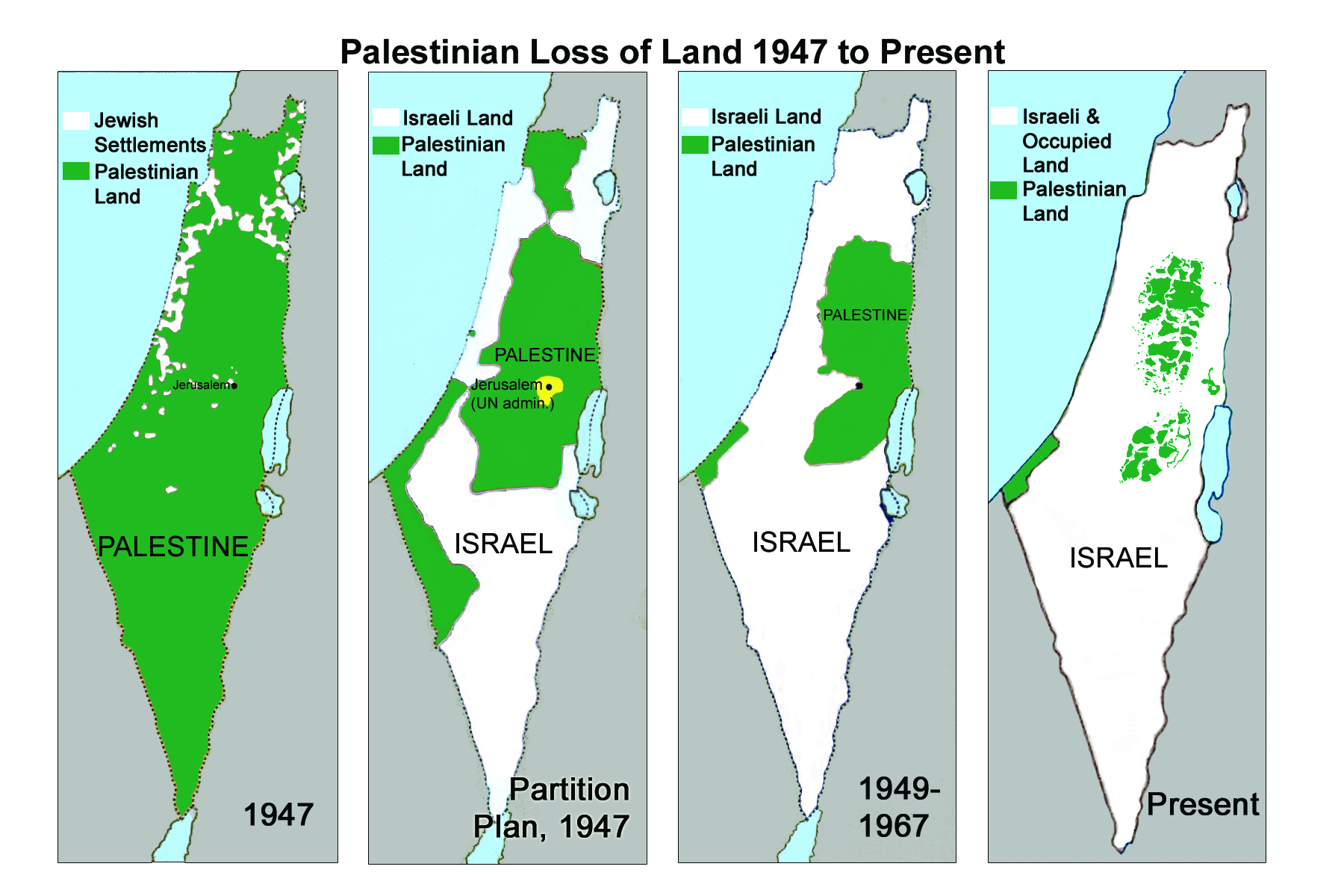
- The Jewish state was created through a war of ethnic cleansing, and that the allegedly “only democracy in the Middle East” has no constitution and has never declared its borders,
- Palestinians in the Occupied Territories are living on approximately 15 percent of their original land.
7. When are you going to give readers the facts without Israeli spin?
Alison Weir is president of the Council for the National Interest, executive director of If Americans Knew, and author of Against Our Better Judgment: How the US was used to create Israel.
ADDITIONAL RESOURCES
Statistical Report on New York Times coverage of Israel-Palestine
Report: Kerry ceasefire proposal called for open Israel-Gaza borders
Ma’an – July 27, 2014
BETHLEHEM – A draft of US Secretary of State John Kerry’s ceasefire proposal that was shown to Israeli officials on Friday called for the opening of Gaza-Israel border crossings and ensuring “the economic livelihood” of Palestinians in the Strip, an Israeli newspaper reported Sunday.
The document, titled “Framework for Humanitarian Ceasefire in Gaza,” also said a lasting truce would make possible the “transfer of funds to Gaza for the payment of salaries for public employees,” Haaretz reported.
According to the report, the proposed ceasefire would also “address all security concerns.”
Israel would not be allowed to continue its operation to destroy tunnels during the initial ceasefire, the draft reportedly stipulated.
It made no explicit mention of the demilitarization of Palestinian factions in Gaza.
Israeli officials were “in shock” upon reading the draft, saying it ignored Israel’s security concerns.
“We succeeded in foiling that document and now we are discussing other options,” Haaretz quoted officials as saying.
An associate of Kerry reportedly responded: “There is no paper and no proposal. The draft was based on the Egyptian proposal that Israel wholeheartedly supported. So if they are opposed, they are opposed their own plan.”
Israel voted down a ceasefire proposal Friday, instead agreeing to a 12-hour humanitarian truce starting Saturday at 8 a.m.
On July 15, Israel imposed a ceasefire agreed upon by Egypt and the US. Hamas and other Palestinian factions continued firing rockets, saying they had not been involved in negotiating the ceasefire and heard about it “through the media.”
Israel began its ground operation operation in Gaza two days later, and the death toll among Palestinians, mostly civilians, soared.
Palestinian groups in Gaza say they will not accept any ceasefire that does not involve the lifting of the eight-year blockade on the Strip, which has severely limited imports and exports and has led to frequent humanitarian crises.
German pilots slam resumption of Tel Aviv flights
Press TV – July 26, 2014
German pilots’ trade union Cockpit has slammed a decision by Lufthansa to resume flights to Tel Aviv.
The union’s spokesman Joerg Handwerg criticized the move made by Lufthansa on Saturday, saying commercial flights should not be flying in warzones or regions in crisis.
He said that many of the crew members were questioning the decision, as the security situation in the region remained a major concern.
Handwerg said Tel Aviv advisory warnings had been lifted as the Israeli war on the besieged Gaza Strip continued for political reasons.
The remarks from Cockpit come after Lufthansa and Air Berlin said they would resume flights to and from Tel Aviv’s international Ben Gurion Airport on Saturday, following a three-day suspension.
A number of the world’s leading airlines also suspended flights to Israel’s main airport.
Despite the instability and insecurity surrounding the area, US airlines resumed their flights to Tel Aviv on July 25. Washington had suspended all flights to Ben Gurion Airport when a rocket fired by Palestinians landed near the airport on July 22.
Israeli warplanes have been carrying out deadly airstrikes against the blockaded Gaza Strip since July 8. On July 17, thousands of Israeli soldiers launched a ground invasion into the densely-populated strip.
The Ezzedine al-Qassam Brigades, the military wing of the Palestinian resistance movement, has been launching retaliatory attacks against Israel.
Nearly 900 Palestinians, over 80 percent civilians, have been killed since the Israeli offensive started, while nearly 6,000 others have become injured.
Palestinians pull 85 bodies from under Gaza rubble
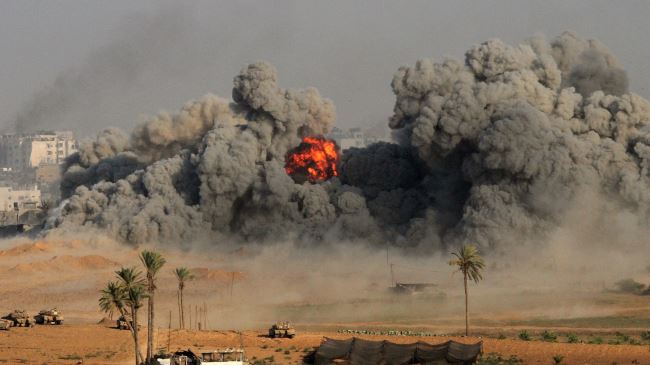
A fire ball and smoke is seen during an Israeli strike on Gaza City early on July 26, 2014
Al-Akhbar | July 26, 2014
Updated 2:00 pm: An Israeli air strike in southern Gaza hours before a humanitarian truce was declared killed 20 people, including 11 children, most of them from a single family, medics said.
Separately, the bodies of at least another 85 Palestinians were recovered from rubble across Gaza on Saturday, raising the overall Palestinian death toll in the 19-day Israeli terror campaign to 985, the overwhelming majority of them civilians.
“Ambulance crews have recovered the bodies of 85 martyrs under destroyed houses, including children and women, across the Gaza Strip, bringing the total number of martyrs to 985 as a result of the Israeli aggression on the Gaza Strip,” Emergency services spokesman Ashraf al-Qudra wrote on Twitter.
Meanwhile, the Israeli army said two more occupation soldiers had been killed, taking its toll to 37.
The strike in southern Khan Younis hit the home of the Najjar family, killing at least 14 relatives, emergency services spokesman Ashraf al-Qudra said.
Another two members of the Abu Shahla family were killed, along with four other people, two of whom have yet to be identified.
The dead included 11 children, among them a one-year-old girl and a three-year-old boy, Qudra said.
Of the 85 bodies uncovered, 25 were from the northern areas of Beit Hanoun and Beit Lahiya, and were taken to the Kamal Adwan hospital, and another 25 to Gaza City’s Shifa hospital from the eastern areas of al-Shujayeh and Zeitoun, Qudra said.
Thirteen bodies received from the central areas of Bureij, Deir al-Balah and Nusseirat were taken to the Al-Aqsa hospital, and another 13 to the European hospital in southern Gaza from the Khan Yunis and Rafah areas, he added.
The toll is expected to rise as bodies are pulled from the rubble of homes in some of the worst-hit parts of Gaza, in northern Beit Hanoun, eastern al-Shujayeh and Zeitoun, and southern Khan Younis.
Soon after the ceasefire took effect, Palestinians ventured out into the streets of Gaza, with many returning to areas that had been too dangerous to enter for days.
In Beit Hanoun, Khan Younis and al-Shujayeh and Zeitoun, they found scenes of utter destruction, with homes flattened and bodies lying in the streets and under rubble.
In Beit Hanoun even the hospital was badly damaged by shelling, and AFP correspondents came across the charred body of a paramedic as emergency workers combed the debris for more dead.
Trails of blood on the ground were crossed by Israeli tank tracks, and there were holes where it appeared Israeli forces had been searching for Hamas tunnels.
Palestinian television showed footage of similar scenes in al-Shujayeh, which has been subjected to days of relentless Israeli tank fire.
Stiff bodies lay on the floor of a room in one building, one caked in dried blood, all of them covered in dust.
(AFP, Al-Akhbar)
How Many Marched for Gaza?
By Daniel Borgström | Dissident Voice | July 25, 2014
The Sunday, July 20 FREE PALESTINE rally gathered at the Justin Herman Plaza, near the Ferry Building in San Francisco. I got there as it was beginning, shortly after 3 p.m. The crowd already appeared to number a thousand, and more were arriving. People kept streaming in. By 4:15 p.m. when the march began, the plaza was brim full. So how many people does it take to fill that plaza? I wondered. Thousands, obviously — but how many thousands?
After the march I looked online for estimates from various other events at the plaza and found an article about the fundamentalist anti-abortion march of 2011. “Tens of thousands of pro-life activists filled Justin Herman Plaza,” the organizers of the right-wing event reported; the corporate media echoed the fundamentalists’ claim. In contrast, reporting on the Sunday FREE PALESTINE rally, KTVU News said: “Hundreds gather in San Francisco to protest Israeli military action in Gaza.” The SF Examiner gave the same figure.
Such reports simply confirm what many people have been saying observing for decades about media bias. A right-wing event fills the J.H. Plaza with tens of thousands, but when a progressive event draws a crowd large enough to fill that same plaza, it’s only “hundreds” of people there.
Nevertheless, that plaza is also used for miscellaneous non-political gatherings and events that nobody would be likely to misreport. I continued my online search and found a website belonging to the San Francisco Recreation & Parks Department, which states: “This location can accommodate up to 7,000 people.”
Seven thousand? That sounds about right. During the march I had conservatively estimated 5,000 while others around me were saying it was more. Some who studied videos of the march afterwards, taking sample counts and doing some math estimated six to seven thousand at the Sunday event. The organizers of this event, the Arab Resource & Organizing Center, estimated 6,000.
I’ve never before seen a FREE PALESTINE event anywhere nearly this large. I remember attending protests at the Israeli consulate on Montgomery street where there were about 500 people, and at the time that seemed large. This Sunday rally and march was at least ten times larger. Clearly, Zionist attacks on Gaza have outraged a growing number of people. Unfortunately, none of this gets reflected by the U.S. Congress. Just the other day all 100 U.S. Senators unanimously passed a resolution in support of Israel’s assault on Gaza. Not even Senator Bernie Sanders stood up to the Zionists.
There will be another rally this Saturday, July 26 at the same plaza, starting at 1 p.m. Perhaps our demand should be: “End Zionist occupation of Washington!”
Medical teams under fire
International Solidarity Movement | July 25, 2014
Gaza, Occupied Palestine – At 19:00 Beit Hanoun Hospital was hit by an Israeli tank shell. Inside the hospital are 61 medical staff, three patients, civilians, and ISM volunteers who are all trapped inside. Israeli soldiers are in the area, approximately 150 meters behind the hospital. Gunfire can be heard in the area.
This afternoon Israeli forces targeted an ambulance with two paramedics inside in Beit Hanoun, North Gaza. One paramedic was killed and another was critically injured.
This is the third Israeli attack on Gazan medical facilities and personnel in the last 24 hours. The first resulted in the destruction of Al Durrah Children’s Hospital in Gaza City last night. A two year-old child in the Intensive Care Unit was killed, and 30 others injured.
Since Israel began its attack on Gaza, 13 ambulances have been completely destroyed and two paramedics have been killed. Throughout the massacre, medical staff and facilities have been repeatedly targeted.
“Israel’s attacks on Gaza hospitals are ongoing, with those in areas by the separation barrier forced to evacuate their patients, paramedics and other rescue workers are doing what they can under conditions of great risk.” Stated Joe Catron, U.S. International Solidarity Movement activist.
According to the Gazan Ministry of Health, six out of Gaza’s 13 hospitals have already been severely damaged. One, el-Wafa rehabilitation hospital, has been completely destroyed. Two medical clinics have been completely destroyed, seven other clinics have been damaged, 13 medical staff members have been injured, and five have been killed.
The Ministry of Health in Gaza has demanded, “the immediate cessation of Israeli occupation military attacks against medical facilities and personnel in Gaza, and demands that the international community soundly condemn this latest Israeli atrocity, and hold Israel accountable for these war crimes.”
Here are some of the numbers you can call:
Swedish Ministry for Foreign Affairs
Carl Bildt
+46 8 405 10 00 [4]
(Plus a load more phone numbers on this page: http://www.government.se/sb/d/2085)
@carlbildt
@SweMFA
The German Foreign Office:
Federal Foreign Office
Frank-Walter Steinmeier, Minister
Tel. (24 hours service): +49 30 1817 0
Telefax: +49 30 1817 3402
German Embassy Tel Aviv emergency number / for German citizens only: +972-54-9944724 (mobile)
Twitter
Auswärtiges Amt @AuswaertigesAmt
UK Foreign and Commonwealth Office
MP Philip Hammond
+44 20 7008 1500
020 7219 4055
@foreignoffice
US Department of State
Israel Foreign Service Desk: 202-647-3672
@StateDept
Spain
José García-Margallo y Marfil
91 379 97 00
@MAECgob
New Zealand Ministry of Foreign Affairs and Trade
Murray McCully
+64 4 439 8000
@NZNationalParty
French Ministry of Foreign Affairs
Laurent Fabius
@francediplo
@laurentfabius
Australian Department of Foreign Affairs and Trade
Julie Bishop
+61 2 6261 1111 (office)
1300 555 135 (24-hour Consular Emergency Centre)
@dfat
@JulieBishopMP
Venezuelan Ministry Foreign Affairs
Elías Jaua
+58 212 806.4400
+58 212 8061111
@ Vencancilleria
Featured Video

Trita Parsi: Middle East Unraveling — Are We on the Path to World War?
or go to
Aletho News Archives – Video-Images
New Book
Trans agenda is ‘normalization of sadism’ – US author

RT | September 23, 2026
The US Democratic Party has embraced a transgender agenda that amounts to “the normalization of sadism,” author A.J. Rice has said, warning that radical trans policies would return if the party is allowed to regain power.
Speaking to RT’s America First host Scotty Nell Hughes about his new book, ‘The Curse of the Bearded Lady: How the Trans Mafia Whacked American Sanity’, Rice argued that activists have gained significant influence in schools, medicine, and corporate America while people who questioned the agenda have faced pressure to stay silent.
The author described the “trans mafia” as the sprawling network of people and institutions that have helped the movement gain influence. He singled out parts of academia, wealthy backers, and corporations, and stated that providers of transition-related treatment also have a financial incentive to keep young people in their care indefinitely.
Rice argued that the consequences of these policies ultimately fall on children who are being drawn toward gender-affirming medical treatments and on girls who are expected to share locker rooms or compete in sports with biological males.
He noted that while voters rejected the Democrats’ approach to gender in 2024, the party, which has been “captured by madness,” has since only doubled down and is seeking what is effectively “the normalization of sadism.” … Full report
Blog Roll
 Aletho News
- ‘We don’t seek permission to defend our country’: Snippets from President Pezeshkian’s UNGA address
- NATO chief wants Europeans to fight American wars [for Israel]
- German chemicals giant reveals details of downsizing
- Refaat Al-Areer Was The Canary In The Coal Mine In Israel’s War On The Truth
- Israeli election committee bars candidate from Knesset race over Gaza war opposition
- French-Lebanese man files war crimes complaint over Israeli attacks
- Mahan Air Flight Lands in China Despite US Threat against Iranian Airlines
- US eyes $10bn fund to rebuild war-battered Gulf infrastructure
- Trump meets Rodríguez near Maduro’s prison as Venezuela’s oil flows to US
- Trita Parsi: Middle East Unraveling — Are We on the Path to World War?
- If Americans Knew
- An error has occurred; the feed is probably down. Try again later.
- No Tricks Zone
- New Study: Earth And Venus Surface Warmth Largely Explained By Convection And Lapse Rate, Not CO2 Or Radiation
- 2025 Nature Paper Claiming Worsening Global Drought Gets RETRACTED …Heavily Flawed
- New Study: ‘Global Drought Shows No Detectable Recent Acceleration Under Climate Warming’
- Economic Masterminds: German Socialists Suggest Taxing Productivity Gains Stemming From Using AI
- The South China Sea Has Not Been Cooperating With The Climate Change Narrative
- Energy Crisis: Germany Enters Heating Season With Historically Low Gas Reserve Fill Levels
- New Study: The Antarctic Ice Sheet Gained Mass From 2020-2024 Due To Staggering Snow And Ice Accumulation
- Study: Ocean Heating Rates From Thousands Of Years Ago ‘Dwarf’ Modern Ocean Heating Rates
- Climate Extremists Target, Attack Large-Scale Power Grid Infrastructure In Germany!
- New Study: Antarctic Ice Melt Has Contributed Less Than 1 Centimeter To Sea Level Rise In The Last 30 Years