Egypt Destroys Eight Border Tunnels
By Saed Bannoura | IMEMC & Agencies | July 16, 2013
The Egyptian Army announced in managed to locate and destroy eight siege-busting tunnels across the border with the Gaza Strip over the last 48 hours, and that it located 23 containers holding a million liters of fuel.
The army said that the Egyptian Border Guards located the containers that were ready to be smuggled to the coastal region, and also located the eight tunnels that have already been operational.
Egyptian security sources said that the army used bulldozers to remove fuel pumps, and that the campaign is ongoing to locate and destroy all tunnels across the border with Gaza.
The sources said that Egypt’s Army Chief, Colonel Abdul-Fattah El-Sissi, gave direct orders to the army to destroy all border tunnels by using explosives, heavy equipment and even by flooding them.
El-Sissi said that the army would not allow any party to “jeopardize Egypt’s national security, its economy, and national resources.”
THE EGYPTIAN COUP AND THE PEOPLE OF THE GAZA STRIP
By Damian Lataan | July 06, 2013
As much as the Egyptian street generally sympathise with the plight of the Palestinian people in the Gaza Strip, it seems the new Egyptian regime are falling over themselves to make themselves look good in the eyes of the US in order to ensure that the promised $1.5 billion of aid comes there way despite the coup. Unfortunately, one element of their approach to appeasing the US is by demonstrating that they are mindful of Israel’s concerns with regard to security about the Gaza Strip. And one way of showing they mean business is to close down the Gaza Strip’s supply line tunnels between the Strip and Egypt.
Yesterday the Egyptian army began bulldozing the tunnels. The immediate effect in the Gaza was panic buying and huge price hikes that most Palestinians can ill afford to pay. The cost of living was high enough as it was but now, if the supplies remain cut off for some time, life will steadily become even more unbearable.
Just to add to the turmoil, Fatah, the organisation that governs the West Bank under Abbas, is now calling on its supporters in the Gaza to rise up against Hamas. Hamas, one might recall, were rejected by the West after squarely and fairly winning the January 2006 elections for the Palestinian Legislative Council.
The blame for all this turmoil – not just in Egypt but throughout the entire Middle East – can be laid fairly and squarely at the feet of the US and Israel who has contrived to foment as much friction as they possibly can between secularists and Islamists in the Arab world, and between Sunni and Shia in the world of Islam. On the odd occasion that ‘democracy’ does give the people the opportunity to make their choices, it is the West that rejects those choices and then encourages turmoil that attempts to replace the people’s choices.
In the end it’s just ordinary people who are already struggling to survive that suffer most. The West must leave these people alone to make their own choices and, once the choices have been made, should not be interfered with simply because the West thinks the people made choices the West disagrees with.
Gaza, at the very least, must be allowed to freely trade with whoever they please and not be punished en masse simply because they didn’t vote for the people the West wanted them to vote for.
Related articles
- Egyptian army demolishes tunnels with Gaza (alethonews.wordpress.com)
- Egyptian army reinforces presence on the borders with Gaza (ramyabdeljabbar.wordpress.com)
- Egyptians continue to keep Gaza’s only exit closed (gazasolidarity.blogspot.com)
Egyptian army demolishes tunnels with Gaza
MEMO | July 4, 2013
Tunnels between Egypt and Gaza have been the main life line to the 1.8million residents of Gaza since the Israeli siege was imposed in 2006.
Tunnels between Egypt and Gaza have been the main life line to the 1.8million residents of Gaza since the Israeli siege was imposed in 2006.
On Thursday afternoon, Egyptian bulldozers began to demolish the tunnels between Egypt and the Gaza Strip which have functioned as the life-line to the besieged Gaza Strip since the beginning of the Israeli siege in 2006.
Egyptian facebook news network RNN reported on its page that big Egyptian military bulldozers started the demolition of the tunnels. They were protected by military vehicles.
Eyewitnesses from Rafah, Gaza’s southern city which is adjacent to Egypt, said that they had seen the bulldozers at work; that they had seen them arrive several days ago, but that they had only started working today.
They said that heavy automatic guns are mounted on the military vehicles protecting the bulldozers there.
Egyptian sources said that new military forces arrived in the area between Egypt and Gaza yesterday [Wednesday].
The smuggling of commodities to the Gaza Strip was halted several days before the start of the unrest in Egypt.
Palestinian security forces raised the alert on the tunnels fearing chaos might occur during the unrest.
Tunnels between Egypt and Gaza have been the main life line to the 1.8million residents of Gaza since the Israeli siege was imposed in 2006.
The siege, which was imposed following Hamas’ shock victory in the Palestinian parliamentarian elections, is internationally agreed upon.
The ministry of health in Gaza announced that fuel for electricity generators and ambulances will run out within days. “We are facing an unknown future with the closure of the tunnels,” a statement said.
Israel does not allow enough fuel through its crossings with Gaza.
Egypt unrest slows down Gaza construction
Ma’an – 04/07/2013
GAZA CITY – Unrest in Egypt has slowed down construction in the Gaza Strip, which relies on building materials smuggled in through cross-border tunnels, a union official said Thursday.
Israel only allows construction material into Gaza through its border for internationally-funded and approved projects, and this is the only building material available in Gaza since the tunnel trade slowed down, said Nabil Abu Meiliq, head of the union of Palestinian contractors.
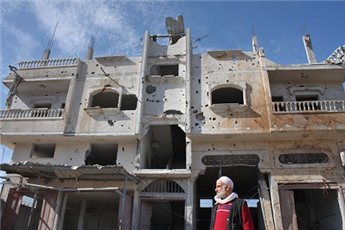 Abu Meiliq says no construction material is coming into Gaza from Egypt. Construction is down to 20% since tunnel traffic halted, ending a brief building boom in Gaza, Abu Meiliq told Ma’an.
Several projects funded by the Qatari government are on hold, including the Sheikh Hamad city, due to shortages of materials including cement, Abu Meiliq added.
Before smuggling tunnels closed, a ton of cement cost around 400 shekels ($110), but each ton is now selling for up to 1,000 shekels.
Abu Meiliq said the shortages were not a result of monopolies, but of high demand and very low supply.
Muhammad Abu Sido, a TV director from Gaza City, told Ma’an he had stopped work on his 3-storey home due to cement shortages.
Egyptian army reinforces presence on the borders with Gaza
Palestine Information Center – 05/07/2013
RAFAH — The Egyptian forces reinforced their presence on the borders with Gaza, where they brought more tanks.
Eyewitnesses said that the Egyptian army brought more tanks and troops along the Egypt-Gaza border which stretches 14 kilometers, and added they saw Egyptian armed forces on the roofs of a number of buildings.
For their part, Palestinian security forces in large numbers have been deployed along the border.
Meanwhile, the Egyptian security forces have closed the tunnels between Egypt and the Gaza Strip, used for the smuggling of essential goods and fuel to the besieged Strip.
Informed sources confirmed that the Egyptian army launched a campaign to demolish the tunnels built under the Egyptian-Palestinian border.
The sources told PIC’s correspondent that Egyptian tanks and armored vehicles have been intensively deployed on the borders, amid a campaign that included the destruction of many tunnels that have been closed for several days due to the recent developments in Egypt.
PCHR slams immunity for Israel army chief on UK visit
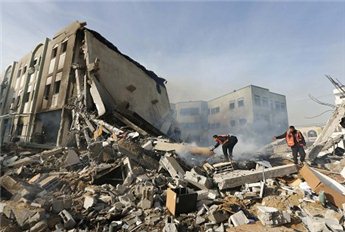
Aftermath of an Israeli air strike on the building of Hamas’ Ministry of Interior in Gaza City Nov. 16, 2012
Ma’an – 03/07/2013
BETHLEHEM – The Palestinian Center for Human Rights on Tuesday condemned a decision by the United Kingdom to grant immunity to Israel’s army chief while visiting the country.
Lt. General Benny Gantz, Chief of Staff of the Israeli Defense Forces, arrived in the UK on Tuesday, in the first visit of an Israeli army chief since 1998.
The UK government granted Gantz’s trip the status of Special Mission, thus granting him immunity from the UK’s criminal justice system, PCHR said.
Hickman & Rose Solicitors, who represent the victims of General Gantz’s actions together with PCHR, said the decision “sends the dangerous message that political considerations will be placed ahead of the rule of law.”
“Credible evidence exists indicating Mr. Gantz’s involvement in the commission of war crimes: these allegations should be investigated and, if appropriate, Mr. Gantz should be prosecuted,” PCHR said.
“He should not be pre-emptively granted immunity by the UK Government, circumventing normal criminal justice procedures.”
Lt. General Gantz is suspected of involvement in the commission of war crimes, particularly with respect to his role in the November 2012 assault on the Gaza Strip, codenamed Operation Pillar of Defense, PCHR says.
A week earlier, the UK government also applied Special Mission status to the visit of Major General Doron Almog, a retired army official suspected of war crimes, granting him immunity from Britain’s criminal justice system.
Mr. Almog canceled his scheduled UK visit at the last minute for unknown reasons.
In 2005, a British court issued an arrest warrant for Major General Doron Almog in relation to the destruction of 59 Palestinian homes in Rafah refugee camp in 2002 as part of a sustained policy of house demolitions in Gaza, PCHR said.
British police were preparing to arrest Almog on suspicion of war crimes after he and his wife flew to the United Kingdom in 2005, but he refused to leave his plane at Heathrow airport following a tip-off about the arrest warrant and was allowed to return to Israel.
The decision to grant immunity to both Israeli officials “sends the clear message that Israel can commit war crimes in the Gaza Strip with impunity,” PCHR said.
There is a risk, the group said, that Special Missions will be used to protect allies of the government and undermine the “basic principle of equal application of the law and the UK’s international legal obligation to seek out and prosecute suspected war criminals.”
Report: 1,790 Palestinians Kidnapped, 16 Killed, In First Half of 2013
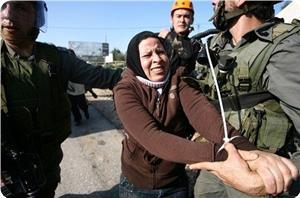
By Saed Bannoura | IMEMC & Agencies | July 1, 2013
The Ahrar Center for Detainees Studies and Human Rights have reported that Israeli soldiers kidnapped 1,790 Palestinians in the first six months of this year, including 300 who were kidnapped in June, and added that 16 Palestinians have also been killed by the Israeli military in six months.
The Ahrar Center said that dozens of women, children, elderly, legislators, intellectuals and journalists were among the kidnapped.
The center added that the arrests took place in every part of the occupied West Bank, including Jerusalem, in addition to 25 arrests in the Gaza Strip, including fishermen and five arrests at border terminals.
Most of the arrests have been carried out in the Hebron district, in the southern part of the West Bank. The second highest number of arrests was carried out in Jerusalem, followed by Nablus.
Ahrar said that February witnessed the largest number of arrests as the soldiers kidnapped 382 Palestinians, while 350 have been kidnapped in January, 300 in June, 263 in May, 259 in April and 236 in March.
The center further reported that the army also kidnapped 7 Palestinian legislators identified as Ahmad Attoun, Hatem Qfeisha, Abdul-Jabbar Foqaha, Imad Nofal, Basem Za’areer, Mahmoud Ramahi, and Mohammad Jamal An-Natsha.
Furthermore, Ahrar said that the army also kidnapped 33 women, including wives and relatives of political prisoners held by Israel, and that 17 of the kidnapped women are still imprisoned by Israel.
The Ahrar Center also said that 14 Palestinians, including 10 from the West Bank, and four from the Gaza Strip, have been shot and killed by the Israeli army since the beginning of this year, in addition to two Palestinian political prisoners who died in Israeli prisons.
Detainee Arafat Jaradat, 33, from Hebron, died of extreme torture by Israeli interrogators, and detainee Maisara Abu Hamdiyya, 64, died of an advanced stage of cancer resulting from the lack of medical treatment in Israeli prisons.
Four more Palestinians have been killed by Israeli military fire in the Gaza Strip.
Head of the Ahrar Center, Fuad Al-khoffash, stated that the center documented daily Israeli military invasions; daily arrests and assaults, and demanded the International Community to act against the ongoing and escalating Israeli violations.
Gaza Government: “We Never Prevented Muslim Students From Attending Christian Schools”
By Saed Bannoura | IMEMC & Agencies | June 18, 2013
The Palestinian Ministry of Education, under the Hamas-led government in the Gaza Strip, denied reports claiming that the Islamic Resistance Movement (Hamas) and its government ever prevented Muslim students from attending Christian schools in the coastal region.
The Ministry issued a press release [Monday June 17 2013] stating that such a claimed decision was never made, and that students have the right to choose any school they deem fit.
The statement came after an Israeli news agency claimed that Hamas is preventing Muslim students from attending Christian school in Gaza.
An official at the Ministry of Education in Gaza stated that the government supports all schools, including Christian schools, and does not differentiate between them.
The official added that Christian schools in Gaza are an important aspect of the social fabric, and that all Christians in Gaza are an integral part of the Palestinian society.
“What the Israeli agency claimed it’s a baseless lie”, he said, “a lie that aims at creating tension between Muslims and Christians in the Gaza Strip”.
An Insight Into Palestinian Resilience in Gaza
Cold Nights in an Indifferent World
By SARAH MARUSEK | CounterPunch | June 17, 2013
In the eyes of many Westerners, Gaza is a dangerous and war torn place. Even activists, including myself, often imagine Gaza primarily as a place of suffering, and one that has unfairly come to eclipse the affliction of all of Palestine. But while Israel’s wars of aggression against the people of Gaza, as well as its brutal siege, have cost many lives and inflicted countless casualties, Gaza today is a remarkably calm, protected and beautiful place where everyday lives go on, despite the continued suffering of its people. Indeed, Gaza is a place where the heart and soul flourish even if the body is ailing; where people and community are so alive and resilient that it rekindles one’s hope in humanity.
I only know this now because I traveled to Gaza earlier this month to participate in the second annual Global March to Jerusalem (GMJ) on Friday, 7th June 2013, when thousands of Palestinians and international activists mobilized in peaceful demonstrations around the world to draw attention to Israel’s continued violations against Jerusalem and its people. Although Israeli police violently suppressed GMJ demonstrations in Jerusalem and throughout the West Bank, peaceful mass demonstrations did successfully take place in Gaza and the neighboring countries of Jordan and Egypt, as well as in Tunisia, Mauritania, Morocco, Yemen, Malaysia, and Turkey. In addition, there were demonstrations in solidarity with the GMJ all around the world, including several major cities across Europe and North America.
On Friday, 7th June I was fortunate enough to join Palestinians and a group of international activists in a peaceful mass rally in Beit Hanoun, the nearest point possible to Jerusalem in Gaza. Many thousands attended the rally, and during my address I promised to carry their voices back home with me to the US in order to communicate their struggle to live under the footprint of a racist occupying power that my government funds and arms. Of course, the few days I spent in Gaza are hardly enough to fulfill this promise. There are too many voices that I was not able to hear, both because there was not enough time and because of my identity as an American woman. But I am hoping that what I can offer begins to communicate the complex life stories of a people resisting against horrific injustices, while at the same time encouraging other Westerners to travel to Gaza in order to do the same.
My entry into Gaza was made possible by the Miles of Smiles convoy organized by the International Committee for Breaking the Siege on Gaza (ICBSG). While there have been many international convoys entering Gaza in recent years, all of which bring much needed aid to the besieged people of Gaza, the Miles of Smiles convoy offers something unique by focusing on development aid. The first Miles of Smiles convoy reached Gaza in November 2009, and since then the ICBSG has successfully organized twenty additional convoys into Gaza. Our convoy included activists from Jordan, Egypt, Tunisia, Libya, Yemen, Saudi Arabia, Bahrain, Malaysia, South Africa, the UK, and the USA.
Miles of Smiles works closely with Partners for Peace and Development for Palestinians (PPDP) to sponsor projects that empower Palestinians to develop the means to live dignified lives on their own terms. The PPDP is a UK-based organization that works with a dedicated team of Palestinian employees and volunteers in Gaza to offer interest-free loans and small grants to Palestinians, helping them to establish family businesses and development projects. One example of this is a small bakery that we visited during the first night we spent in Gaza, which thanks to a PPDP loan generates employment for an entire family.
PPDP’s Palestinian employees and volunteers in Gaza coordinated our program, which included many different activities that allowed us access to a diverse array of Palestinian voices and experiences. For example, our second day in Gaza we met with the children and spouses of Palestinians who are currently imprisoned by the occupation authorities, often without any formal charges ever being brought against them. And even when Palestinians are tried, it is in military courts – an apartheid system of justice that separates Palestinian children from their fathers, mothers, brothers, and sisters.
Earlier that day we also visited a government hospital that specializes in caring for children. We asked one of the doctors there what the needs of the hospital are, and his answer was a lack of resources – a problem that more international activists could easily help alleviate if the US and Europe did not impose such draconian penalties for working with Hamas, the ruling party of the government in Gaza that Israel and its Western allies label as a terrorist organization because of its resistance activities against the occupation. The doctor explained to us that they have many doctors, in fact too many to employ. Even during Israel’s recent war against Gaza in November of last year they had a sea of volunteers to help. However the hospital still needed equipment and medication to meet the needs of their patients. Indeed according to the human rights organization B’Tselem, Israeli forces killed 167 Palestinians during last November’s military operation, at least 87 of them civilians and more than one third under the age of 18. As we visited some of the sick children I felt so helpless and angry because as an American I am unable to contribute anything to the important work of this hospital, which saves innocent children’s lives. Fortunately, those in Arab countries are able to donate without fear of prosecution, and their contributions help keep the hospital running.
On our fourth day we visited Islamic University, the best university in Gaza (there are seven in total) and ranked among the top 250 universities around the world. Founded in 1978, the university’s campus is modern and beautiful, servicing around 20,000 students each year. The university offers many degrees across the arts and sciences, with Islamic values guiding the behavior of the students as well as the curriculum, which is in line with international scientific standards. But even this university has suffered unjustly under the occupation. During Israel’s December 2008 war against Gaza, occupation forces destroyed 74 of the university’s laboratories, as well as a library, a collective punishment against the entire population. Lest anybody think that this was collateral damage, Israel deliberately bombed the university in six separate air strikes. When I think of violent acts that would terrorize me as a teacher and a scholar, this ranks among the worst. And yet this terrorism is exactly what my government is uncritically supporting.
During our time in Gaza, we also met with Prime Minister Ismael Haniyeh, and distributed aid to orphans as well as to needy families thanks to the generosity of our Libyan delegation (as well as my own friends and colleagues who kindly donated money so that I could distribute toys to children). But most of us will never really know what it is like to live under a violent occupation. What it is like to be cruelly besieged by your neighbor and demonized by Western countries for fighting back. We spoke to some graduates of Islamic University who are involved in the Gaza student community, to try and learn more about their own experiences.
One member of the convoy, an American filmmaker of Pakistani origin, remarked how surprising it was that the Palestinians working with us were not more angry. One young man responded that, in fact, they are very angry, but that they still have to live. He explained that he holds his pain and suffering deep inside himself, as do other Palestinians in Gaza. It has to be contained for fear that if expressed it could destroy their lives. And even though he spoke these words calmly and quietly, the inner anguish distorted his face and the grief filled his wide eyes. He told us that he lost seven friends in the last war against his people. On his way to sit his university exams he also saw bombs destroy the buildings around him. His exams were postponed. But what really made the suffering intolerable was getting through the cold nights during that war.
I can only conclude that this coldness is symbolic of a world where an occupying power can terrorize and ethnically cleanse a native population with impunity. Because if there were any warmth left in our hearts, then we would all be doing everything that we possibly could do to stop Israel’s crimes against the Palestinian people. Convoys like Miles for Smiles help, as do solidarity activities like the GMJ, but considering the extent of their suffering, the Palestinians deserve more from all of us.
Sarah Marusek is a member of the International Executive Committee of the Global March to Jerusalem.
Related articles
- Palestinian farmer injured by Israeli army fire (alethonews.wordpress.com)
- Mass protest aims to focus attention on Jerusalem (palsolidarity.org)
Palestinian farmer injured by Israeli army fire
By Rosa Schiano | International Solidarity Movement | June 17, 2013
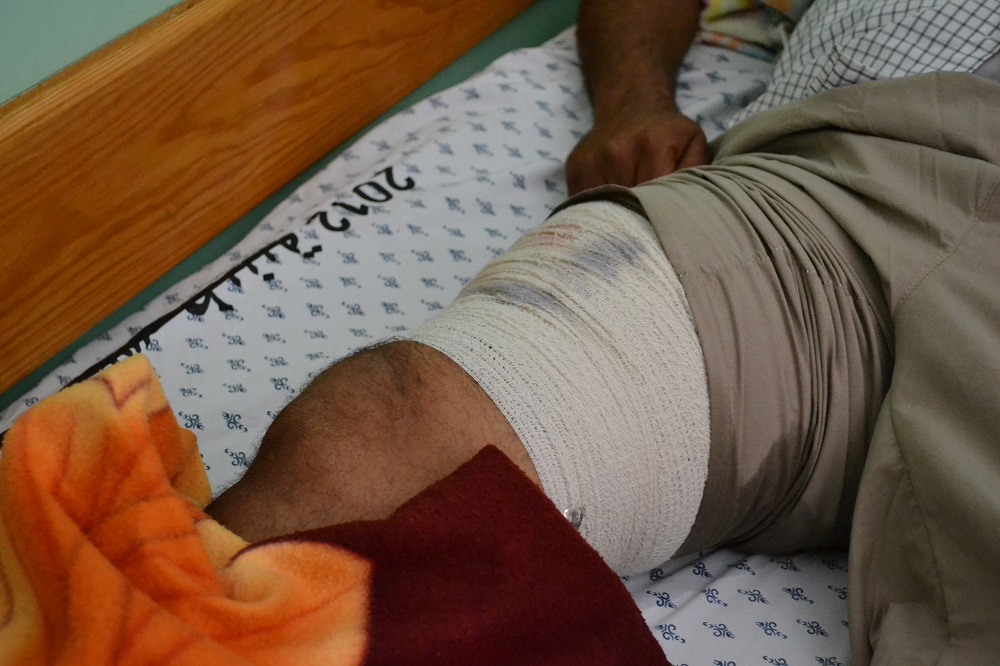
Gaza, Occupied Palestine – Friday afternoon, June 14, 2013, Muhareb Abu Omar, a Palestinian farmer aged 48, was wounded by Israeli army fire in the Deir El Balah, in the center of the Gaza Strip.
Omar was irrigating his land in the village of Wadi As-Salqa, 600 meters from the barrier that separates Israel from the Gaza Strip.
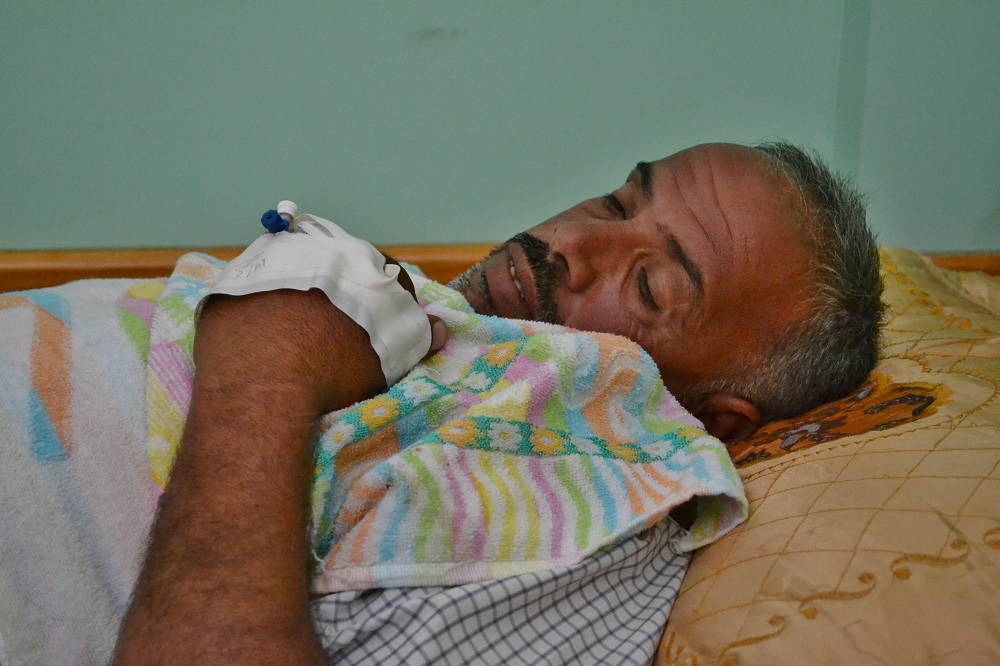
Muhareb Abu Omar, 48 (Photo: Rosa Schiano)
Omar reported that Israeli jeeps moved along the border while he was working. Suddenly, after about 10 minutes into the job, at approximately 19:30, a bullet struck him in the right leg. The soldiers probably shot from a jeep hummer.
Omar was alone on his land while other farmers were working in adjacent lands.
“I didn’t hear any firing, the soldiers used silent bullets. Suddenly I found myself wounded. I ran for 50 yards, then I crashed and I cried to my cousins that I was wounded”, said Omar. His cousins transported him to Al Aqsa Martyrs hospital.
Omar’s family is composed of 14 members: Omar, his wife, 8 sons and 4 daughters. Five of his sons work with him on the family land. The whole family depends on the production on this land.
Two of his sons, Nedal and Tareq, reported that Omar was reported to have an intermediate wound in the right tibia.
Dr. Saleman Al Attar, Department of Orthopaedics of Aqsa Martyrs hospital, reported that the general conditions of Omar are good. “The wound shot from a firearm always creates complications. The bullet hit the right thigh and there is the presence of fragments”, said Dr. Al Attar. In the emergency room, the doctors performed a cleansing of the wound, firstly a debridement followed by bandaging. After 3 days or 72 hours, Omar will be subjected to a further removal of devitalized tissue.
The doctors will not remove the bullet. “It is dangerous to remove the bullet as it is located in the neurovascular, where there are the arteries,” said Dr. Al Attar.
The wound is closed. The patient will then be given antibiotics and analgesics for about 4 weeks.
(Photo by Rosa Schiano)
Dr. Al Attar stressed the psychological effect on patients who are aware of the a bullet still inside the body. “The patient will always have the impression of experiencing pain in the area where the bullet is, even if the pain is not real. There are social workers who can provide psychological support for this. Every Palestinian suffering since birth suffers some psychological problems”, concluded Dr. Al Attar.
During the last military offensive of November 2012, the al-Aqsa hospital has received many victims. “The hospital was full, we were trying to save those who were in better condition while others were dying patients in serious condition,” said Dr. Al Attar.
The arrangements for the cease-fire of 21 November 2012 established that the Israeli military forces should “refrain from hitting residents in areas along the border” and “cease hostilities in the Gaza Strip by land, by sea and by air, including raids and targeted killings.”
However, Israeli military attacks by land and sea have followed from the day after the ceasefire, and Israeli warplanes are flying over the sky constantly in the Gaza Strip. These attacks against the civilian population of Gaza continue to occur amidst international silence.
Hospital patients in Gaza poisoned by gas from Israel
MEMO | May 24, 2013
It has been announced that four Palestinian patients were poisoned by carbon monoxide gas sent to Gaza hospitals as nitrous gas.
Palestinian Health Minister, Mofeed al-Mokhalalati, affirmed that four patients were poisoned by the carbon monoxide gas as they were injected with it in the belief that it was nitrous gas used in anesthesia.
Al-Mokhalalati said that Israel is being blamed for the poisoning as it is the sole source of nitrous gas brought to Gaza hospitals.
He said that he had commissioned a group of experts to form a fact finding committee into the poisoning and to understand how carbon monoxide containers managed reach Gaza’s hospitals.
The Minister said that his ministry was obliged to postpone all surgical operations until further notice. “We have stopped all surgical operations until we are able to check all medical tools and equipment imported through Israel,” he said.
Patients in Gaza wait for months to undergo surgical operations in Gaza hospitals which have suffered greatly as a consequence of the six-year siege imposed by Israel.
Shut In, Shut Down, Shut Up: Three Years after Mavi Marmara
By Greta Berlin | Palestine Chronicle | May 20 2013

Passengers on the Mavi Marmara were attacked by heavily armed Israeli commandos.
Three years ago, the Free Gaza movement was wrapping up final preparations for a flotilla of eight ships to head out to Gaza, determined to break Israel’s illegal siege on 1.5 million Palestinians shut into an open-air prison. Most of us were already in Cyprus or Turkey or Greece, as we were the primary organizers, having already sent eight voyages, five of them successful in 2008.
Why a flotilla of boats?
During Israel’s horrific massacres against the people of Gaza (called Operation Cast Lead) in December 2008/January, 2009, our boat, the DIGNITY, had been rammed off the coast of Lebanon as we were taking medical personnel into Gaza. The boat later sank in a storm off the coast of Cyprus.
Then, in July 2009, Israel brutally attacked the “Spirit of Humanity,” even though Nobel Peace Laureate, Mairead Maguire, and former Congresswoman, Cynthia McKinney were on board. The Israeli government stole the boat, threw passengers into Israeli prison and, laughably, deported them eight days later, because “passengers had illegally entered Israel.” It was the first time the Israeli commandoes had actually boarded one of the boats as opposed to ramming them or trying to sink them.
We realized a new approach would have to be designed, one that would include more vessels, more passengers and more media exposure to the brutal closure of Gaza. Sailing one boat at a time was not going to get the message out to the world that Israel was blockading the people of Gaza and committing crimes against humanity.
It took Free Gaza a year to organize. We traveled to Sweden, Norway, France, Turkey, Greece, many Middle Eastern countries, Tunisia, Spain, Malaysia, the UK, the US and Germany. We helped Palestinian support groups raise money and send out the message that the next voyage would have to be organized with worldwide support. We succeeded beyond our wildest imagination, as organizations and individuals got on board the mission, raised money from people around the world, and bought the boats… eight in all, from the boats purchased by the Turkish charity, IHH, to the boats ready to go from Greece, Sweden, Ireland, Malaysia and the U.S.
Our own boats, Challenger 1 and Challenger 2 plus the cargo ship, the Rachel Corrie, were on their way to the meting place off the coast of Cyprus. The Rachel Corrie, bought with money from a charity in Malaysia had finally left Ireland, its propeller pin suspiciously dropping out just days before leaving, causing the ship to be delayed for days. Had the final inspection not caught the problem, the propeller would have flown off, damaging the boat and putting the passengers and cargo at risk. The Rachel Corrie would not make it in time to join the flotilla but would try to get into Gaza five days later, only to be boarded by Israeli commandos, the passengers brutalized and left in the sun, then thrown into prison.
The six of us in the media office in Cyprus were fielding calls, trying to keep track of passengers and where they were going to board…and also trying to pacify the Cypriot authorities, who were no longer willing to have our boats leaving their shores… too much Israeli money had come into Cypriot departments over the year, and the doors that had been so welcoming to us, were beginning to close.
As the boats headed out to the meeting place, our two yachts were suddenly dead in the water, clearly a result of sabotage, as the Israelis bragged about it.
After the pin had come out of the Rachel Corrie propeller, it was obvious that one way Israel was going to shut down the flotilla was to make sure boats never left port (during Freedom Flotilla II in 2011, that’s exactly what Israel accomplished, thanks to outsourcing the occupation to Greece and shutting down the entire flotilla of nine boats).
Now, both of our yachts had the same gasline problem at the same time in the middle of the Mediterranean. One was never able to join the flotilla (after taking months to repair, it finally became the Irish ship, Saoirese, that sailed with the Canadian boat, the Tahrir and was violently boarded in November, 2011 by Israeli commandos who tried to sink them with water canons).
We could not have imagined in the days running up to the murderous attacks on our passengers on May 31, 2010 that the Israeli government, in spite of ordering the ramming of the DIGNITY and the vicious boarding of the SPIRIT OF HUMANITY, they would actually send armed commandos onto all six boats, beating up many passengers, wounding over 50 of them, and murdering nine, all while the boats were in international waters.
Shutting Us Up
In an attempt since then to make the attackers look as though they are the victims, the Israeli PR machine has been working overtime to spin the story. Here are just three of the many lies told by PR shill, Mark Regev and top Israeli military men.
1. The flotilla was Turkish or was run by the IHH and was full of Turkish jihadists.
The flotilla was organized and run by the Free Gaza movement with help by every initiative that joined, from IHH to the Swedes to the Irish to the Malaysians. We were all members of civil society who were protesting at Israel’s brutal behavior regarding the Palestinians, and we took no money from governments. All money was raised through donations from average people outraged over Israel’s behavior.
In fact, we had an international passenger list of over 600. Turkey made up half of the passenger list. Australia 3; Azerbaijan 2; Italy 6; Indonesia 12; Ireland 9; Algeria 28; United States 12; Bulgaria 2; Bosnia 1; Bahrain 4; Belgium 5; Germany 11; South Africa 1; Holland 2; United Kingdom 31; Greece 38; Jordan 30; Kuwait 15; Lebanon 3; Mauritania 3; Malaysia 11; Egypt 3; Israel 6: Macedonia 3; Morocco 7; Norway 3; New Zealand 1; Syria 3; Serbia 1; Oman 1; Pakistan 3; Czech Republic 4; France 9; Kosovo 1; Canada 1; Sweden 11; Turkey 380; Yemen 4.
Every one of these passengers had filled out an extensive application. Although Free Gaza was not responsible for the Turkish passengers, they used our application process. Every person who boarded every boat was searched. Even one of the crewmembers on board the Mavi Marmara had to relinquish his Swiss army knife.
2. Passengers attacked heavily armed Israeli commandos, forcing them to shoot in self-defense.
Passengers on all six boats testified to being beaten, their bones broken, and most of them tied up on ships that were in the Mediterranean, a direct violation of maritime law and the treatment of civilians.
As the UNHCR report clearly states, of the nine passengers who were murdered on board the Mavi Marmara, six of them were assassinated, none of them had weapons. In fact, the only weapon in their hands was a camera.
Even the whitewashing Palmer report, a panel set up to counter what UNHRC had issued and co-chaired by that famous human rights abuser from Columbia, Uribe, reluctantly concluded that Israel overreacted. Their finding that the blockade was legal has no standing according to many maritime lawyers (there were none on the panel), since they were only tasked to mend relations with Turkey, something they failed abysmally to do.
3. Israel ‘kindly offered’ to take the supplies loaded on the boats and transfer them to Gaza.
First of all, our missions have never been about delivering supplies. They have always been about breaking Israel’s illegal siege on Gaza. We took in supplies, because we could, and because we often loaded the boats with medical equipment and construction equipment that Israel refused to allow into the besieged enclave.
Second, there is no method of transporting anything from Ashdod to Gaza. It is a seaport with no facilities for transporting 10,000 tons of supplies that were on board the boats. Free Gaza’s lawyers and representatives in Israel spent months working on getting the supplies from the Rachel Corrie into Gaza. When they finally were delivered, the battery operated wheelchairs were minus the batteries, as Israel determined they might be used to make rockets, the same reasoning they gave to us on the first trip about hearing aid batteries.
Third, every piece of cargo, every piece of equipment and every supply that was going to Gaza had already been inspected at the point of departure. That’s the way it’s supposed to be handled, not by some paranoid country that thinks it can break all the conventions of the sea and demand that cargo that was already inspected get hauled into its port. Imagine what a mess it would be if every country in the world decided they had the right to inspect cargo coming in from every other country. It’s what cargo manifests and inspectors are for.
Those three constant lies have been trotted out at every opportunity to shut up the activists and prevent additional voyages. It has not stopped us, as evidenced by the most recent initiative, sailing a boat out of Gaza (www.gazaark.org), nor will it stop us from continuing to hold Israel accountable for the wellbeing of the people it occupies.
The best news on this, the third anniversary of the murders of eight Turks and one American, is that the ICC is going to consider the complaint from the Cormoros Island, the country where the Mavi Marmara was flagged.
In an attempt to shut in the people of Gaza, shut down the voyages and shut up the people who advocate for freedom of movement for the 1.5 million people imprisoned there, the Israelis have failed…. Miserably.
– Greta Berlin is one of the five co-founders of the Free Gaza movement (www.freegazamovement.com) and was on one of the first two boats to arrive in Gaza in August, 2008. She was the primary spokesperson for Freedom Flotilla 1 in May 2010, appearing on international media in Europe, the Middle East and the United States when the flotilla was attacked by Israeli commandos. She is the co-author of Freedom Sailors, a book about that first trip and how activists made it to Gaza in spite of huge obstacles.
Related articles
- Gaza: We Will Keep Coming Back – Special Report (alethonews.wordpress.com)
- An Israeli Apology Means Little (alethonews.wordpress.com)
Buckling to Bigotry: The Newseum Dishonors Murdered Palestinian Journalists
By Nima Shirazi | Wide Asleep in America | May 13, 2013
Just two days before Palestinians commemorate the 65th anniversary of the Nakba, the names of two Palestinian cameramen targeted and killed by Israeli airstrikes in Gaza last November were dropped from a dedication ceremony held to honor “reporters, photographers and broadcasters who have died reporting the news” over the past year. The move followed an Israel lobby pressure campaign led by anti-Palestinian organizations such as the Anti-Defamation League, the Foundation for the Defense of Democracies and the American Jewish Committee, efforts that were openly supported by the Israeli government.
The Atlantic Wire’s J.K. Trotter summarizes:
Two days after Washington, D.C.’s Newseum announced its intent to honor Hussam Salama and Mahmoud al-Kumi, who were killed in November while working as cameramen for the Middle East-based Al-Aqsa TV, the well-known temple of journalism has decided — for now — not to recognize Salama and al-Kumi, citing their employer’s deep ties to Hamas, a Palestinian organization currently designated by the United States as a terrorist group.
The Newseum, which honored 82 journalists on May 13, 2013, stated that it had “decided to re-evaluate their inclusion as journalists on our memorial wall pending further investigation,” even though just last week, in response to the hysterical reaction to Salama’s and al-Kumi’s initial inclusion, the museum had affirmed and defended their decision, noting that “the Committee to Protect Journalists, Reporters Without Borders and The World Association of Newspapers and News Publishers all consider these men journalists killed in the line of duty.”
Indeed, as Joe Catron notes, Reporters Without Borders has pointed out, “Even if the targeted media support Hamas, this does not in any way legitimize the attacks,” while the Committee to Protect Journalists “found that the Israeli military’s official justifications for its attacks on journalists…’did not specifically address CPJ’s central question: how did Israel determine that those targeted did not deserve the civilian protections afforded to all journalists, no matter their perspective, under international law?'”
The World Association of Newspapers and News Publishers includes both Salama and al-Kumi on its list of “69 Media Employees Killed in 2012,” as does the International Federation of Journalists in tis report, “In the Grip of Violence: Journalists and Media staff Killed in 2012.”
Human Rights Watch, in its December 20, 2012 report on “Unlawful Israeli Attacks on Palestinian Media,” concluded,
Four Israeli attacks on journalists and media facilities in Gaza during the November 2012 fighting violated the laws of war by targeting civilians and civilian objects that were making no apparent contribution to Palestinian military operations.
The attacks killed two Palestinian cameramen, wounded at least 10 media workers, and badly damaged four media offices, as well as the offices of four private companies. One of the attacks killed a two-year-old boy who lived across the street from a targeted building.
The Israeli government asserted that each of the four attacks was on a legitimate military target but provided no specific information to support its claims. After examining the attack sites and interviewing witnesses, Human Rights Watch found no indications that these targets were valid military objectives.
“Just because Israel says a journalist was a fighter or a TV station was a command center does not make it so,” said Sarah Leah Whitson, Middle East director at Human Rights Watch. “Journalists who praise Hamas and TV stations that applaud attacks on Israel may be propagandists, but that does not make them legitimate targets under the laws of war.”
HRW added, “The two men’s families, interviewed separately, said the men were neither participating in the fighting nor members of any armed group. Human Rights Watch found no evidence, including during visits to the men’s homes, to contradict that claim. Hamas’s armed wing, al-Qassam Brigades, has not put either man on its official list of killed fighters – an unlikely omission if the men had been playing a military role.”
For the Newseum to be bullied into omitting Salama and al-Kumi from its rededication ceremony by avowedly Zionist groups and right-wing media outlets demonstrates that the institution itself is no less a propaganda outfit than Al-Aqsa TV. This shameful last minute decision effectively grants the U.S. and Israeli governments the ability to decide who is and who is not a journalist and who should and who should not be honored for their work.
But the decision also reeks of hypocrisy and Manichean double standards.
The Newseum is essentially suggesting that sycophantic journalists parroting government propaganda may be legitimate targets in military operations and should be labeled combatants, rather than civilians who enjoy press freedoms and are subject to protection.
Yet this only extends as far as the U.S. State Department says it does.
The ADL’s Abe Foxman called Salama and al-Kumi “members of a terrorist organization advancing their agenda through murderous violence” and “terrorist operatives” who “were working for a propaganda outlet, not a legitimate news organization.” The AJC’s David Harris echoed these sentiments, labeling Salama and al-Kumi as “brazen terrorists” and “two individuals who were integral to the propaganda machine of the Hamas terrorist organization,” that could not be considered “a legitimate media operation.”
Such terms as “terrorism” and “terrorist” are perhaps the most loaded, politicized, exploited and, consequently, meaningless words in our current lexicon, employed as a bludgeon against critical thinking in order to reinforce “us vs. them” narratives.
Apparently, the Newseum has determined that our propaganda deserves respect and admiration, while their propaganda (in this case, documenting on camera the effects Israeli bombs and missiles have on the human flesh of Palestinian people at Gaza’s al-Shifa Hospital) should be condemned, targeted and investigated.
By this measure, plenty of alleged propagandists grace the memorial wall of the Newseum already, with more added during today’s ceremony.
Mohamed Al-Massalma, a freelance reporter for Al Jazeera, was killed by a sniper while covering the Syrian civil war in Busra Al-Harir in late January 2013. The Syrian journalist, working under the pseudonym Mohamed Al-Horani, was “an activist in the revolt against President Bashar al-Assad,” before joining Al Jazeera.
In January 2012, Mukarram Khan Aatif was gunned down in the Pakistani town of Shabqadar by members of the Pakistani Taliban. Aatif was a journalist working for Deewa Radio, the U.S. government’s Voice of America Pasto-language service. He was among those honored by the Newseum this year.
The taxpayer-funded Voice of America (VOA) and its affiliated services have been legally banned from broadcasting or distribution here in the United States for the past 65 years because of a Congressional act prohibiting the government from propagandizing to its own citizens. Only last year was this law reversed; the ban will be officially lifted this coming July 2013. VOA is literally U.S. government propaganda, yet its reporters are accorded due protection from violence, as they should be.
Another VOA journalist, Mohammed Ali Nuxurkey, was killed in an al-Shabab bombing in Mogadishu, Somalia, this past March There is no doubt he will be added the Newseum’s wall next year.
If any distinctions are to be made among different categories of journalists caught in the line of fire or deliberately targeted for murder, international law does not, in fact, favor the Foxman’s and Harris’ of the world.
While war journalists who are not embedded with troops or themselves soldiers taking direct part in hostilities are legally protected by the law of armed conflict, embedded reporters are not necessarily similarly protected.
According to international law professor Sandesh Sivakumaran, writing for the Oxford University Press, embedded journalists, while civilians, may be “casualties of lawful attacks” as “[t]he law allows for the targeting of troops and that targeting may result in bystanders or embedded reporters becoming casualties.”
Still, embedded journalists who were killed while accompanying American occupation forces in Iraq and Afghanistan – a policy promoted by the U.S. military in order to ensure positive reporting on American actions (some might call that propaganda) – have also rightly been accorded a place in the Newseum’s memorial. Journalists like Spanish reporter Julio Anguita Parrado and German correspondent Christian Liebig, killed by Iraqi missiles in an April 7, 2003 attack on the U.S. Army’s 3rd Division headquarters in Baghdad, are honored by the Newseum as is NBC News soundman Jeremy Little, killed in Fallujah in July 2003 while embedded with the Army’s 3rd Infantry.
Sivakumaran also explains that “[j]ournalists who work for media outlets or information services of the armed forces” are legally considered “members of the armed forces,” and therefore “don’t benefit from the protections afforded to civilians and their deaths don’t constitute a violation of the law.”
As such, the Newseum’s glaring duplicity is all the more evident when considering the case of James P. Hunter. A staff sergeant, reporter and photographer with the 2nd Brigade Combat Team, 101st Airborne Division, Hunter was killed on June 18, 2010 by an IED while covering the massive U.S. offensive taking place in Kandahar, Afghanistan, for The Fort Campbell Courier, an Army newspaper in Kentucky. He was an active duty soldier and the first Army journalist to die in combat since 9/11. Still, the Newseum saw fit to honor Hunter on its memorial wall.
Yet in the case of Salama and al-Kumi, “Israeli officials sought to justify attacks on Palestinian media by saying the military had targeted individuals or facilities that ‘had relevance to’ or were ‘linked with’ a Palestinian armed group, or had ‘encouraged and lauded acts of terror against Israeli civilians,'” according to Human Rights Watch. “These justifications, suggesting that it is permissible to attack media because of their associations or opinions, however repugnant, rather than their direct participation in hostilities, violate the laws of war and place journalists at grave risk.”
If repellant statements, including the justification of and praise for acts of violence against civilians, are the benchmark of propaganda and thereby constitute legitimate targeting for death by those opposed to such statements, then countless American journalists and commentators from across the political spectrum would be subject to the same fate as Salama and al-Kumi.
Warmongering and incitement abound in the editorial pages of The Washington Post and Wall Street Journal. Liberal commentators like Joe Klein and former White House spokesman Robert Gibbs exhalt the extrajudicial executions by flying robot of countless civilians, including a 16-year-old American citizen in Yemen and hundreds of children in Pakistan. Right-wing pundits like Jennifer Rubin and her friends at Commentary and The Weekly Standard openly advocate for the murder of Iranian and Palestinian civilians, endlessly call for permanent war and occupation, support torture and indefinite detention, advocate for the assassination of whistleblowers, scientists and foreign officials, and justify the war crimes of their preferred military forces and governments.
Just days before the car in which Salama and al-Kumi were traveling, marked clearly as a press vehicle, was blown up by an Israeli bomb, Rubin published a post praising the IDF assault on Gaza. Hardly able to contain her glee, Rubin anonymously quoted “an old Middle East hand” declaring that, after weeks of sporadic Israeli airstrikes (“a form of messaging to Hamas”), “the Israelis escalated. But still they are avoiding infrastructure, hitting pinpoint high-level Hamas target.”
A recent B’Tselem report on Israel’s actions last November, however, “challenges the common perception in the Israeli public and media that the operation was ‘surgical’ and caused practically no fatalities among uninvolved Palestinian civilians,” noting that, “in some cases at least, the [Israeli] military violated IHL [international humanitarian law] and in other cases there are substantial reasons to believe IHL was violated.” Israeli airstrikes killed 167 Palestinians in Gaza, at least 87 of whom were noncombatants, including 31 minors.
Two days after cheering Israeli war crimes, Rubin set her sights on a bigger target. “Israel can keep swatting down Hamas, using air power or, if need be, going into Gaza on land,” she wrote. “It has a solemn obligation to defend itself against what was a deliberate escalation by Hamas in the number and quality of weapons launched against Israel’s civilian population. But even with the most robust U.S. support this is not a long-term solution. That will only come when Iran is dealt with, either militarily or via regime change.”
Anyone arguing that Rubin could be targeted with violence for writing her opinions would be labeled sociopathic and lambasted for incitement, and for good reason. And there is no doubt that if correspondents from Israeli Army Radio or employees of the state-run Israel Broadcasting Authority were killed, they would be honored by the Newseum, without so much as a whiff of dissent, let alone outrage.
It is evident that, as always, Palestinians are subject to unparalleled scrutiny and suspicion due to the tireless defamation and lobbying efforts of big-moneyed Zionist organizations and ideological zealots.
But is it surprising that the Newseum should jump on this bias bandwagon?
In the late 1940’s, Bugsy Siegel’s former publicist Hank Greenspun was recruited by Jewish militias in Palestine to help them fight against both the occupying British and indigenous Palestinians. He hijacked a yacht and laundered $1.3 million through Mexico in order to smuggle machine guns stolen from the U.S. Navy in Hawaii to the prolific terrorist group Irgun, which had blown up Jerusalem’s King David Hotel the year before and would massacre the residents of Deir Yassin a year later. Soon thereafter, Greenspun was apprehended by the FBI while attempting to illegally ship surplus combat airplane engines to Haganah.
In 1950, he was convicted of violating the U.S. Neutrality Act and fined $10,000 for his arms deals. The same year, he purchased the Las Vegas Review-Journal and renamed it the Las Vegas Sun, serving as publisher for the next four decades.
Upon his death in 1989, former Israeli Prime Minister Shimon Peres called Greenspun “a hero of our country and a fighter for freedom – a man of great spirit who fought with his mind and his soul; a man of great conviction and commitment.” In 1993, a one-acre plaza in the Jerusalem Botanical Garden of Hebrew University was dedicated to him.
In 2006, the Greenspun Family donated $7 million to the Newseum, which named a terrace in his honor. It overlooks Pennsylvania Avenue.
Related article
- Jewish groups slam ‘Newseum’ for honoring Palestinian journalists killed by Israelis (alethonews.wordpress.com)
Featured Video

Trita Parsi: Middle East Unraveling — Are We on the Path to World War?
or go to
Aletho News Archives – Video-Images
From the Archives
Why Saudi Ties to 9/11 Mean U.S. Ties to 9/11
By Kevin Ryan | Dig Within | September 27, 2015
Media interest in Saudi Arabian connections to the crimes of 9/11 has centered on calls for the release of the 28 missing pages from the Joint Congressional Inquiry’s report. However, those calls focus on the question of hijacker financing and omit the most interesting links between the 9/11 attacks and Saudi Arabia—links that implicate powerful people in the United States. Here are twenty examples. … continue
Blog Roll
 Aletho News
- Neria Leiter Was A Legitimate Military Target
- Integrity Initiative: UK-funded network framed dissent as Russian disinformation for years
- ‘We don’t seek permission to defend our country’: Snippets from President Pezeshkian’s UNGA address
- NATO chief wants Europeans to fight American wars [for Israel]
- German chemicals giant reveals details of downsizing
- Refaat Al-Areer Was The Canary In The Coal Mine In Israel’s War On The Truth
- Israeli election committee bars candidate from Knesset race over Gaza war opposition
- French-Lebanese man files war crimes complaint over Israeli attacks
- Mahan Air Flight Lands in China Despite US Threat against Iranian Airlines
- US eyes $10bn fund to rebuild war-battered Gulf infrastructure
- If Americans Knew
- Caught on Tape: AIPAC CEO Boasted of Controlling Trump’s National Security Officials
- Why Hamas Attacked Israel in October 2023 – Israeli professor Ilan Pappé
- They see them, then kill them: Israeli quadcopters track, deliberately target civilians in Gaza
- Winter could turn Gaza’s treacherous, war-damaged buildings into deathtraps
- Majority of Democratic Voters Want to Prosecute Both Biden and Trump Administration Officials Over Gaza
- As Gaza languishes, world leaders gather at the UN – Daily Update
- Sanctions are collective punishment: immoral and self-defeating
- Phosphorus Munitions Fired by Israel Burn Groves, Orchards in Southern Lebanon
- Israel Carries Out New Ceasefire Violations Across Gaza
- AI – Emphasis on the ‘I’: Israel Is Funding AI Chatbot Propaganda
- No Tricks Zone
- New Study: Earth And Venus Surface Warmth Largely Explained By Convection And Lapse Rate, Not CO2 Or Radiation
- 2025 Nature Paper Claiming Worsening Global Drought Gets RETRACTED …Heavily Flawed
- New Study: ‘Global Drought Shows No Detectable Recent Acceleration Under Climate Warming’
- Economic Masterminds: German Socialists Suggest Taxing Productivity Gains Stemming From Using AI
- The South China Sea Has Not Been Cooperating With The Climate Change Narrative
- Energy Crisis: Germany Enters Heating Season With Historically Low Gas Reserve Fill Levels
- New Study: The Antarctic Ice Sheet Gained Mass From 2020-2024 Due To Staggering Snow And Ice Accumulation
- Study: Ocean Heating Rates From Thousands Of Years Ago ‘Dwarf’ Modern Ocean Heating Rates
- Climate Extremists Target, Attack Large-Scale Power Grid Infrastructure In Germany!
- New Study: Antarctic Ice Melt Has Contributed Less Than 1 Centimeter To Sea Level Rise In The Last 30 Years

