Report: Egypt plan to lift siege requires disarmament of Gaza
MEMO | March 22, 2019
An Israeli report said that Egypt has put forward a plan for a settlement between Israel and Palestinian factions in the Gaza Strip, led by Hamas, which controls the Gaza Strip. Israel Hayom newspaper reported on Thursday that “according to security sources in Egypt and Palestinian officials in Gaza and Ramallah, Israel and Egypt have become convinced that Hamas’s control in Gaza is a self-evident fact.”
Israel Hayom quoted Egyptian security sources and Palestinian officials in the West Bank and Gaza Strip. It explained that the Egyptian proposal stated that they would disarm the factions – except for light weapons – in exchange for lifting the siege on the Gaza Strip.
According to this plan, all internal affairs will remain in the hands of Palestinian organisations headed by Hamas or a unified political entity for all organisations in the Strip. The internal security of the Gaza Strip will be based on “Hamas National Security Forces, which are currently operating.” The arms that will be in possession of the Internal Security Forces will be light weapons, in small quantities and subject to a strict control system.
In turn, the Israeli and Egyptian siege on the Gaza Strip will be lifted, according to the newspaper. Also, projects in the areas of infrastructure, employment, economy, health and education, financed by the United Nations, the European Union and Arab countries, “led by Saudi Arabia, Qatar and the UAE,” will be implemented. The plan calls for the opening of a maritime route to the Gaza port, which will allow in the first stage the export and import of goods directly to the Gaza Strip.
The newspaper asserted that “these parties have succumbed to the fact that the Palestinian Authority will have difficulty in regaining control in the Gaza Strip, whether after an internal Palestinian reconciliation, or because of the collapse of Hamas rule against the backdrop of the grave humanitarian situation, or because of the continued military confrontation with Israel.”
According to the newspaper, Egyptian sources stated that the Israeli policy towards the Strip is “soft,” and that this stems from Israel’s unwillingness to allow the “Hamas regime” to collapse and in anticipation that in the event of Hamas’s collapse, “extremist groups loyal to Iran or Salafist groups similar to Daesh will enter” to fill the vacuum.
The newspaper further said that estimates in Israel and Egypt indicate that “such a settlement can be implemented within three to five years, but the main obstacle is that Hamas and other Palestinian armed factions will oppose disarmament.”
Quoting sources it described as officials in Ramallah, the newspaper added that Palestinian Authority President Mahmoud Abbas and the PLO leadership would agree to “overthrow” Hamas and the factions in Gaza “only in case it led such a process when the control of Gaza is in the hands of the Palestinian Authority.”
The newspaper asserted that US security bodies obtained a draft of the plan which was formulated by Israeli and Egyptian crews. It quoted an Egyptian security official saying: “We are currently waiting for the new government to be elected in Israel to speed up the process; while the goal after the Israeli elections is the entry of other influential Arab countries, such as Qatar, Saudi Arabia, Jordan and the UAE.”
The Egyptian security official added that “if Abu Mazen and the leadership in Ramallah do not put obstacles, the plan can be put into effect with the full cooperation of all the regional actors and through providing guarantees and assistance by the international community. But, it is estimated that there will be strong opposition to the disarmament plan of the Gaza Strip by the PLO and mainly by the armed factions in Gaza.”
Jason Greenblatt should abandon his one-eyed approach towards the Palestinians
By Motasem A Dalloul | MEMO | March 19, 2019
Last week, the US Special Envoy to the Middle East, Jason Greenblatt, took to Twitter to attack the Palestinian Islamic Resistance Movement — Hamas, the de facto government of the Gaza Strip — for dispersing violent protesters in Deir Al-Balah and Jabalia. The protesters — some of whom were rioters — claimed that they were demonstrating against high taxes imposed by the government which, they alleged, had led to price hikes.
“Hamas continues to exploit the Palestinians of Gaza and to rule by brute force,” claimed Greenblatt. “Hamas abuses the money belonging to the people of Gaza, using these funds for terrorism & other illicit activities to devastating effect, instead of rebuilding Gaza and helping its people.” His words could have been written by the Israeli Ministry of Propaganda.
The less than objective or neutral Greenblatt then tweeted: “Hamas violently suppresses its own people demonstrating against Hamas’ rule & failures today and NOW fires rockets at cities in Israel. OUTRAGEOUS! This is what prevents the world from helping the people of Gaza! We strongly support Israel in defence of its citizens. Always!”
In a third tweet, he wrote: “My words now: So true. So sad. So awful. So scary. Hamas, PIJ [Palestinian Islamic Jihad] etc. is this what you want for your people? You’re the cause of this misery. You choose violence. You’re ruining lives day after day after day. No one else. Time to choose something else!”
Without making any apparent effort to check the facts about the disturbances in Gaza, Greenblatt took aim indiscriminately at the Palestinian factions in the besieged territory. The Israeli-led siege and occupation did not figure in his calculations, of course. Not only did he criticise Hamas, but he also targeted Islamic Jihad and the Popular Front for the Liberation of Palestine, even though both factions are themselves critical of the movement. This suggests very strongly that the “Special Envoy” — for which read “there to advance Israel’s interests only” — was not concerned about the Palestinians or the alleged “violence” inflicted upon them by Hamas; that his sole aim was to demonise the Palestinian resistance factions, including Hamas, because they oppose the Israeli occupation of Palestine.
The demonstrations in Gaza are not actually against price hikes or high taxes, as was also claimed by Fatah spokesman Usama Al-Qawasmi in the occupied West Bank. The people on the streets are rioters ordered and paid to be there by Palestinian Authority President Mahmoud Abbas and his intelligence chief Majed Faraj, who could find no other excuse for their action against Hamas. Israel’s support for the violent protests was obvious, with Ofir Gendelman, Prime Minister Benjamin Netanyahu’s spokesperson for the Arab media, involved openly on social media backing the riots. Israel’s ambassador to the UK Mark Regev, who is well-known for trying to justify the unjustifiable, was also involved.
The clearest proof that these riots were intended to destabilise Gaza in order to topple the de facto government is that Hamas has actually reduced more than 50 per cent of the taxes imposed by the PA, and prices, when compared with the West Bank, are much lower. The price of one falafel sandwich in the West Bank, for example, is around $2, while in Gaza it is just 25 cents. If you have your hair cut in the West Bank, it will cost you $15, but in Gaza, you pay only $1.50. The rioters were calling for their salaries to be restored and for the siege to be lifted; given that it is the PA which has cut the salaries of civil servants in Gaza, their anger should have been directed at Abbas and the administration in the occupied West Bank as well as the Israeli occupation, not Hamas which has been fighting to lift the siege and get their salaries back to normal levels.
As far as Greenblatt’s accusation that Hamas “exploits” the Palestinians and rules “by brute force” is concerned, as a senior US official he should not forget that the movement won an overwhelming majority on the last occasion — in 2006 — when Palestinians were allowed a “free and fair” election. The result was not accepted by Washington, Israel and the PA in Ramallah, and the siege was imposed. Why? Because Hamas sticks to the struggle for legitimate Palestinian rights and principles, whereas Abbas and Fatah, which controls the PA in Ramallah, is more easily bought.
Greenblatt’s claim that Hamas uses Palestinian money to fund terrorism and other illegal activities instead of rebuilding Gaza and helping the people is pathetic. Resistance to a military occupation is a right guaranteed by international laws and conventions. Instead of asking why Hamas does not rebuild Gaza, he should ask himself who destroyed Gaza in the first place, and who replenished its stocks of arms and ammunition to do so. If he is honest — a big if — he would tell the world that it was Israel and Washington, using US taxpayers’ money, not Hamas.
Even though reports in the Palestinian media run by opposition factions, as well as the Israeli and Arab media, claimed that Hamas used violence to suppress “its own people”, there were actually some incidents where the Palestinian police, not Hamas, dealt harshly with the rioters, very few of whom required hospital treatment. It is alleged that images from Iraq and old videos were used to depict the “beatings by Hamas” in Gaza.
Even Haaretz reported that one of the videos which went viral on social media was not related to the riots. “Viral video of Palestinian man setting himself on fire not connected to current protest, human rights activists say,” the Israeli newspaper pointed out. Not all of the videos were fake, but the depiction of the way that the rioters were treated was not as claimed on social and other media.
My advice to Mr Greenblatt, therefore, is to abandon his one-eyed approach towards the Palestinians; he should not turn a blind eye to Israeli atrocities or the injustices of the US-backed Abbas and PA. “For every Palestinian rocket, Israel commits thousands of crimes,” wrote Amira Hass, Haaretz correspondent in the occupied territories, on Sunday. She pointed an accusatory finger at the Israeli officials who demolish the houses of the Palestinians, who demolish water networks and who prevent Palestinians from having water.
The reality of the situation in Israel-Palestine requires a far more nuanced discourse than posts on Twitter can ever convey. US Special Envoy Jason Greenblatt should open both eyes if he wants to have any credibility whatsoever in his role.
The Shame of It!
The UK failed to back a UN investigation into Israel’s shoot-to-kill-or-cripple policy against Gaza’s caged civilians. Will the Foreign Office also fail to adopt its findings?
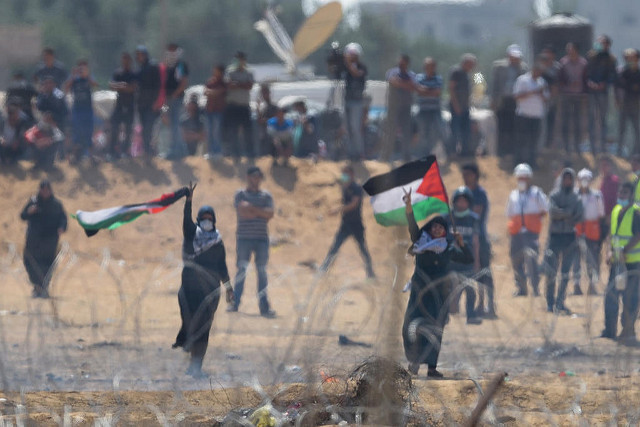
By Stuart Littlewood | American Herald Tribune | March 17, 2019
Open letter to Alister Jack, MP for Dumfries & Galloway
cc Jeremy Hunt MP, Secretary of State for Foreign & Commonwealth Affairs
Dear Alister,
Here’s something to take your mind off Brexit.
You’ll have heard of Dr Swee Ang. She is the first female Orthopaedic Consultant appointed to St Bartholomew (‘Barts’) and the Royal London Hospitals.
In the 1980s and 1990s Dr Swee worked as trauma and orthopaedics consultant in the refugee camps of Lebanon and later for the United Nations in Gaza, and the World Health Organisation in the West Bank and Gaza. She is Founder and Patron of the British charity Medical Aid for Palestinians (MAP).
She also treated the victims of the Pakistan (Kashmir) earthquake, and as consultant trauma and orthopaedic surgeon operated on and looked after the victims of the 7 July 2005 suicide bombing at the Royal London Hospital.
Dr Swee is co-author of War Surgery and Acute Care of the War Wounded; she also wrote From Beirut to Jerusalem documenting her experience in the Palestinian Refugee Camps in Lebanon and Gaza.
Last summer she was aboard the Al-Awda sailing to Gaza with urgently medical supplies when the vessel was violently assaulted and hijacked in international waters by our so-called friend and ally which, we’re repeatedly told, shares our values and whose enemies are our enemies. The Al-Awda was dragged to an Israeli port and her passengers and crew were roughed up (some seriously injured) and abused, thrown in an Israeli jail and had their possessions and money stolen. The precious cargo, as far as we can ascertain, never reached the desperate wounded.
Dr Swee has just emailed:
“The UN Commission for Human Rights will be concluding its investigation on the shooting of thousands of Palestinian civilians demonstrating within the borders of Gaza. At least 189 were killed (more now) and thousands shot with live ammunitions – with loss of limbs and still needing multiple surgeries if they were to keep their legs and arms. It is estimated that with conventional limb salvaging surgeries at least £39 million has to be found to prevent further amputations (figures put out by MAP).
“Last year the UK abstained from supporting the UN conducting such an investigation. However it went ahead and I was fortunate enough to attend the meeting at Amnesty International two days ago to hear the personal testimonies of Dr Tarek Loubani who was shot on 14 May 2018, and Dr Mahmoud Matar the head of the Limb Reconstruction Service in Gaza. They will be testifying to the UN Commissioner coming Monday in Geneva. There is an urgent request for us to write to Jeremy Hunt [Foreign Secretary] with copy to our local MP asking the UK Government to adopt the findings and recommendations of the UN Commissioner for Human Rights. In fact the concern is that UK might vote against it since last year we abstained.
“Please do so urgently. This is something we all can do. Email for Jeremy Hunt is:
jeremy.hunt@fco.gov.uk / juntj@parliament.uk
Even if you are not a UK national but are Palestinians you have the right to email him on behalf of your people. Please also ask your friends to support the UN Commissioner for Human Rights.
“Thank you all and God bless, Swee.”
Wounds “the size of a fist” causing lifelong disability
According to Medecins Sans Frontieres (MSF) who operate in Gaza, the Israelis have been using ‘dum-dum’ type rounds that cause wounds of “unusual severity”. This sort of ammunition is understood to be outlawed in warfare. Last year MSF surgeons in Gaza reported “devastating gunshot wounds” among hundreds of people injured during the protests, the huge majority – mainly young men, but also some women and children – having unusually severe wounds to the lower extremities.
MSF medical teams note the injuries include an extreme level of destruction to bones and soft tissue, and large exit wounds that can be the size of a fist. “Half of the more than 500 patients we have admitted in our clinics have injuries where the bullet has literally destroyed tissue after having pulverized the bone,” said Marie-Elisabeth Ingres, Head of Mission of MSF in Palestine. “These patients will need to have very complex surgical operations and most of them will have disabilities for life.”
She hadn’t seen these kinds of injuries before. The wounds appeared to be caused by ammunition with an expanding ‘butterfly’ effect. “Mass lifelong disability is now the prospect for young Gazans who merely gathered in unarmed protest”
Writing in the BMJ (British Medical Journal) the Head of Plastic and Reconstructive Surgery in Gaza, Dr Nafiz Abu-Shaban, said that the hundreds of high energy compound tibial fractures from Israeli live fire are the most difficult of all open fractures to treat. They may require between 5 and 7 surgical procedures, each operation taking 3-6 hours. “Even with state-of-the-art reconstruction, healing takes 1-2 years. Most of these patients will develop osteomyelitis. A steadily increasing toll of secondary amputations is inevitable. They will also need intensive rehabilitation, but the only rehabilitation hospital in Gaza was destroyed by Israeli bombing in 2014….”
UK favours “whitewash toolkit” instead
The UN Human Rights Council in Geneva adopted a resolution to set up an independent, international Commission of Inquiry to investigate all violations of humanitarian and international human rights law in the occupied Palestinian territory, with particular focus on recent events in Gaza. The resolution was passed with only two states opposing (the USA and another of Israel’s poodles, Australia), 29 in favour and 14 abstentions. The UK was among the abstainers.
Trying to explain its pathetic stance, the UK Mission in Geneva called the resolution “partial and unhelpfully unbalanced” for not explicitly demanding an investigation into the action of non-state actors such as Hamas. But why should it? Hamas is not the invader, illegal occupier, aggressor and blockader. It governs the besieged Gaza Strip as best it can after being democratically elected in 2006. The UK Government then called on Israel to “make clear its intentions and carry out what must be a transparent inquiry into the IDF’s conduct at the border fence and to demonstrate how this will achieve a sufficient level of independence.” In other words, investigate itself.
However, Israeli human rights organisation B’Tselem condemned the already-announced internal Israeli military probe as “part of the whitewashing toolkit”. The British Government was criticised in parliament for its limp-wristed attitude and reminded of Israel’s self-exoneration over the killing of four boys playing on a beach during its 2014 military offensive on Gaza.
The preamble to the UNHRC resolution states the reasons for a proper investigation brilliantly. It’s worth repeating here….
- Convinced that the lack of accountability for violations of international law reinforces a culture of impunity, leading to a recurrence of violations and seriously endangering international peace,
- Noting the systematic failure by Israel to carry out genuine investigations in an impartial, independent, prompt and effective way, as required by international law, into the violence and offences against Palestinians by the occupying forces, and to establish judicial accountability for its actions in the Occupied Palestinian Territory, including East Jerusalem,
- Emphasizing the obligations of Israel as the occupying Power to ensure the safety, well-being and protection of the Palestinian civilian population under its occupation in the Occupied Palestinian Territory, including East Jerusalem,
- Emphasizing also that the intentional targeting of civilians and other protected persons in situations of armed conflict, including foreign occupation, constitutes a grave breach of international humanitarian law and international human rights law, and poses a threat to international peace and security,
- Recognizing the importance of the right to life and the right to freedom of peaceful assembly and association to the full enjoyment of all human rights…
Despite all that, Theresa May and Boris Johnson (Foreign Secretary at the time) still couldn’t bring themselves to back the UN resolution.
In recent years this country has so abandoned it moral compass that failing to support a perfectly legitimate investigation into the Israeli military’s brutal behaviour towards the Palestinians they have robbed and abused and murdered for 70 years — a scenario we engineered — is unsurprising.
But many see no difference between the racist thugs who command the Israeli army and the degenerate responsible for the New Zealand mosque massacre. Let us hope Her Majesty’s Government eventually discovers its backbone and adopts the report and findings of the UN Human Rights Council lest we all die of shame.
Kindest regards,
Your constituent Stuart Littlewood
Palestinian Resistance Groups in Gaza All Deny Firing Shells Toward Israel
By Celine Hagbard | IMEMC | March 15, 2019
After two nights of wide-scale bombardment of the Gaza Strip by Israeli forces in which dozens of bombs were dropped on the crowded coastal enclave, someone in Gaza apparently attempted to retaliate Thursday night by firing several shells toward Israel.
But the Palestinian resistance groups in Gaza, usually quick to claim credit for actions they take, all denied involvement in this attack.
Hamas, the Islamic Jihad and the Popular Resistance Committees all issued separate statements officially denying any involvement in relation to the firing of the missiles.
The Al-Qassam Brigades, the armed wing of Hamas, said in a brief statement that the timing of these missiles being fired is suspicious, as it came while Hamas leaders were meeting with an Egyptian security team, discussing arrangements to maintain calm in the coastal region.
In addition, Daoud Shehab, the spokesperson of the Islamic Jihad, denied Israel’s allegation that the Islamic Jihad movement was the one that fired the missiles toward Tel Aviv.
The Salaheddin Brigades, the armed wing of the Popular Committees, also issued a statement denying any connection with the missiles.
It is worth mentioning that, from time to time, some unknown smaller group, tries to fire missiles largely into open areas in Israel, which to many observers looks like an act that is meant to create tension, and drag the region into a new wave of military escalation.
For its part, the Ministry In Interior and National Security In Gaza said that the firing of the missile violated the agreement between the resistance factions in Gaza, and the national consensus regarding avoiding military escalation with Tel Aviv. It added that it will conducted all needed measures to find the individuals who are responsible for firing the missiles.
WHO: Injured Journalist Prevented from Receiving Healthcare

IMEMC News & Agencies – January 31, 2019
The World Health Organisation issued its monthly report entitled “Health Access Barriers for Patients in the Occupied Palestinian Territory”, in which the organisation highlighted the case of ALRAY Media Agency’s photographer, Attia Darwish, who was seriously injured a month ago.
WHO said, in its report, which comes in three parts, that a tear gas canister hit Darwish, a 31-year-old photojournalist, in his face, under his left eye, when he was covering demonstrations near the Gaza fence.
“I was taking photos when my phone rang, and I tried to take the call. Suddenly, I felt a blow to my face and fell down,” Attia said, according to Al Ray.
The ambulance picked him up within minutes and took him to a trauma stabilization point close to the fence. After initial assessment and first aid, Attia was rushed to Shifa hospital, in Gaza, for treatment. He had multiple facial fractures and severe bleeding at the back of his eye, putting his sight at risk, the report said.
WHO said that Darwish had surgery to remove shrapnel from the wound, fix his lower jaw and replace fragmented bones in his face with metal plates. He also received initial treatment for his eye injury, but needed review and specialist care outside of Gaza.
“As a photographer, I depend on my eyes to do my job. Now, I can hardly see with my left eye. Getting proper treatment is something critical for me,” Attia said. He subsequently received a medical referral, from the Palestinian Ministry of Health, to go for an appointment to St John’s Eye Hospital, in Jerusalem.
He applied to Israeli authorities for a permit to exit Gaza, for treatment, but, when the date of his hospital appointment came, his permit application was still under review. Attia despaired of getting a permit to exit Gaza, via Erez crossing with Israel, and asked the Services Purchasing Unit in the Ministry of Health to refer him, instead, for treatment in Egypt, WHO recounted.
On the day of his travel, however, Rafah crossing point to Egypt was closed for exit. “I cannot feel the left side of my face. I can only eat soft food and I’m suffering with the pain. The cold weather makes it even worse. When I was in hospital, one of the doctors said I either need a bone graft or an artificial implant. But, neither of those is available in Gaza,” he said, according to the report.
WHO said that when they spoke with Attia, he still had not received his permit to leave Gaza to Jerusalem, stressing that “his case is not an exception.”
The orgnisation pointed out that of 435 permit applications to Israeli authorities by those injured during the Great March of Return demonstrations, only 19% have been approved, where those unable to access the health care they need face a higher risk of complications and poorer health outcomes.
Fatah: No elections in Gaza while its under Hamas rule
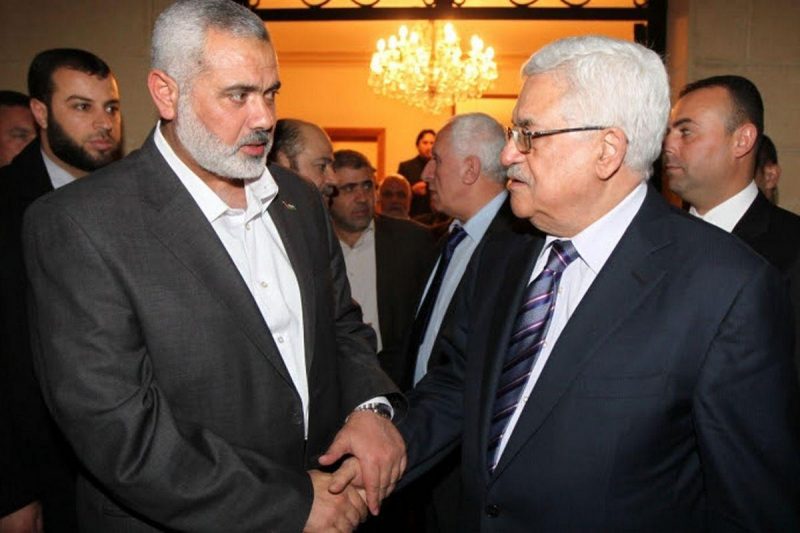
Chief of Hamas’ Political Bureau Ismail Haniyeh (L) and Palestinian Authority leader Mahmoud Abbas (R)
MEMO | January 24, 2019
Member of Fatah Revolutionary Council Mowfaq Matar said yesterday that “the elections will not be held in Gaza as long as it is controlled by Hamas,” Al-Resalah newspaper reported.
Speaking to Al-Resalah, he said: “It is impossible to hold elections there without a united government and united judicial and security authorities to supervise the elections based on the basic law.”
Meanwhile, Matar reiterated that his movement would never accept a national unity government with Hamas “before ending the coup and handing over its power.”
He noted that Hamas would not be part of a potential government reshuffle, stating that the leadership of the Palestinian Authority is to issue a statement next Wednesday that would answer many questions about the government reshuffle and holding the elections.
In December 2018, Abbas announced the dissolution of the Palestinian parliament and announced his plan to carry out elections in the Palestinian territories. Later on, Fatah announced its precondition for the elections, which exclude the Gaza Strip.
First Palestinian child killed by Israeli forces in 2019 was struck in head with tear-gas canister
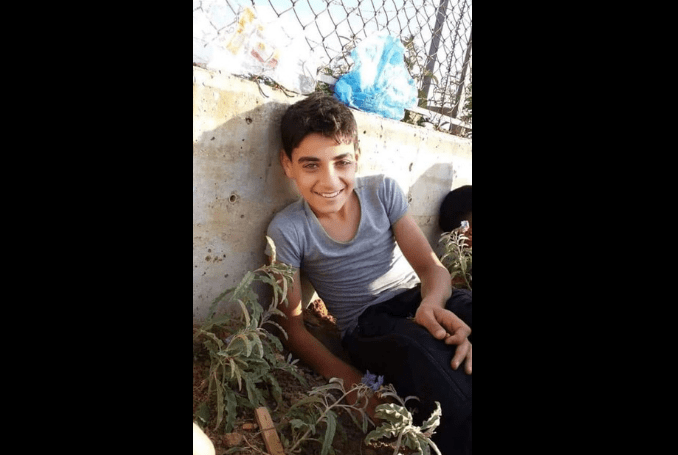
Abdel-Raouf Ismail Mohammad Salha (13) succumbed to wounds sustained during Great March of Return on 11 January 2019. [Twitter]
MEMO | January 17, 2019
The first Palestinian child killed by Israeli occupation forces in 2019 was struck in the head by a tear-gas canister during the suppression of protests in the Gaza Strip.
According to Defence for Children International-Palestine (DCIP), Abdel-Raouf Ismail Mohammad Salha – just 13-years-old – was “struck on the left side of his head by an Israeli-fired tear gas canister that caused a brain injury on the afternoon of January 11”.
The child was pronounced dead from his injuries three days later in Gaza City’s Shifa hospital.
“Crowd control weapons such as tear gas canisters can become lethal weapons when fired at children, especially if the point of impact is on a child’s head or torso,” said Ayed Abu Eqtaish, Accountability Program director for DCIP.
In 2018, the NGO documented “three cases where children died after tear gas canisters fired by Israeli forces struck them”.
On the day in question, Abdel-Raouf was “participating in a weekly protest in the Abu Safia hill area, southeast of Beit Hanoun”. At around 4pm, while the boy was “standing approximately 150 meters (492 feet) from the perimeter fence with a group of other protesters”, Israeli forces in military jeeps from the other side of the perimeter fence “fired tear gas canisters at the group”.
“The witness saw Abdel-Raouf collapse and a wound bleeding from his head”, DCIP added.
Doctors told DCIP that “the force of impact caused a skull fracture and fragments of bone to enter the boy’s brain”.
In 2018, DCIP “independently verified the deaths of 57 Palestinian children at the hands of Israeli forces or settlers across the Occupied Palestinian Territory”, including 49 killed in the Gaza Strip.
READ ALSO:
Israel killing of Palestine children in Gaza protests amounts to ‘war crimes’
Nineteen Palestinian Journalists Are Still Imprisoned By Israel
IMEMC News – December 31, 2018
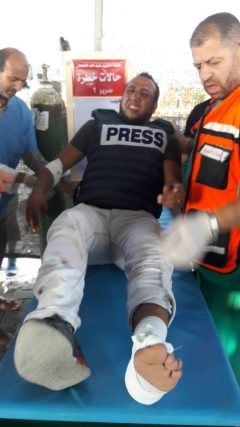 The Palestinian Information Ministry has reported that there are nineteen Palestinian journalists who are still imprisoned by Israel, in direct violation of various treaties and International Law.
In a press statement Monday, the Ministry said that the Israeli occupation and its military courts are ongoing with their serious violations against the journalists and various media outlets in occupied Palestine.
It said that many journalists have also been forced under house arrest, others were forced out of their towns, in addition to facing high fines by the Israeli military courts for performing their duties.
The Ministry also said that some of the abducted journalists were shot and injured, while others are sick, in need of specialized medical treatment but are denied that right.
The soldiers also invaded and violently searched many media outlets across the West Bank, and confiscated equipment.
The Information Ministry stated that Israel’s violations are ongoing attempts to silence the Palestinian media outlets and the journalists, and urged the International Federation of Journalists, Reporters Without Borders, and various related organizations around the world to intervene and stop the escalating abuses against the media and the Freedom of the Press in occupied Palestine.
It is worth mentioning that the soldiers have also killed Palestinian Photojournalist Yasser Mortaja, and journalist Ahmad Abu Hussein, in the Gaza Strip, in addition to wounding dozens of journalists, during the Great Return March processions.
The UN’s vision of ‘peace’ for Palestine excludes ordinary Palestinians
By Ramona Wadi | MEMO | December 27, 2018
The UN is now adamant that the Palestinian Authority should return to govern the Gaza Strip. In the aftermath of Israel’s 2014 Operation Protective Edge, this hypothesis was raised by the US and has seldom been questioned, ostensibly due to other pressing factors such as delivering the necessary humanitarian aid to displaced and injured Palestinians in the besieged enclave.
Since the Palestinian cause has become fragmented into separate issues to prevent national unity, the PA — through decisions taken by its leader Mahmoud Abbas — has slowly imposed its own sanctions on Gaza, bizarrely in the name of unity. This facade was dropped swiftly, though, to reveal the real reason for the sanctions; the Fatah-led PA wants to force Hamas to relinquish its political power in the enclave. Hamas, remember, won the last Palestinian elections in 2006, but has never been allowed to govern both the West Bank and the Gaza Strip as it was entitled to.
Protests in the occupied West Bank expressing solidarity with Gaza have been met with excessive violence from the PA’s security forces, which basically exist to protect Israel, not the people of Palestine. Criticising Abbas’s collaboration with Israel and the international community is a dangerous endeavour for ordinary Palestinians.
None of this is of any concern to the UN. In the past months, the organisation’s officials have specifically expressed a preference for the PA under Abbas to return to Gaza. It was UN Special Coordinator Nickolay Mladenov who reiterated this demand in his briefing to the UN Security Council: “Ultimately, reuniting Gaza and the West Bank under a single, legitimate and democratic Palestinian Authority and putting an end to the occupation will ensure long-term peace.” Abbas’s own term of office as President was supposed to end in 2009, by the way; he has refused to hold a presidential election that he knows he will lose.
Mladenov also attempted to conflate resistance in Gaza and the occupied West Bank. “It is critical that events in the West Bank do not lead to reigniting the Gaza fuse,” he insisted. “The people in Gaza have suffered enough and must not be made to pay the price for violence elsewhere.”
Palestinians in Gaza and the West Bank are suffering varying degrees of oppression, yet there is one consistent omission from the narrative: both civilian populations are victims of collaboration between Israel and the Palestinian Authority. If the people of Gaza have “suffered enough”, to quote Mladenov, why is the UN insisting that the instigator of a large part of their oppression return to the enclave as part of a solution that is nowhere in sight?
How long will it take, I wonder, for the UN to move from expressing opinions about its preferred Palestinian government, to imposing yet another demand upon the Palestinians in Gaza which will also be detrimental to those in the occupied West Bank?
If the UN really wishes the PA to return to Gaza, and there is no reason to doubt its officials’ statements, it is advocating the elimination of Gaza’s elected political representation — albeit with an expired term in office — in favour of a hierarchy that was created and backed to implement the international plan for Palestine’s destruction.
The UN is implementing a new degree of impunity allocated exclusively to the PA. There will be no voices at an international level clamouring against this human rights violation, though. On the contrary, a future collective chorus seeking PA rule in Gaza will do so from within the loose interpretation of human rights advocated by the UN. There is no logic in seeking the return of an entity that has itself contributed to crippling Gaza as a step towards peace. If this is what the UN wants, then it must be clear that the international community’s vision of peace excludes ordinary Palestinians, which is tantamount to supporting Israel’s plans for a complete colonial takeover of historic Palestine.
Featured Video
Elijah Magnier: Yemen’s strikes are shattering Saudi Arabia’s long-term strategy
or go to
Aletho News Archives – Video-Images
From the Archives
British weapons and personnel doing much of the killing in Yemen
Press TV – June 18, 2019
A detailed report published by the Guardian newspaper has shown how Britain is massively contributing to Saudi Arabia’s devastating war on Yemen as it suggests that London is not only supplying the bombs that fall on Yemenis, but it provides the personnel and expertise that keep the war going.
The comprehensive report by Arron Merat published on Tuesday showed that Britain was doing much of the killing in Yemen as the country continues to provide Saudi Arabia with everything it needs to turn its southern impoverished neighbor into a graveyard.
“Every day Yemen is hit by British bombs – dropped by British planes that are flown by British-trained pilots and maintained and prepared inside Saudi Arabia by thousands of British contractors,” said Merat in the report. … continue
Blog Roll
 Aletho News
- Racist Seinfeld Dances for Joy as Bibi Unveils His New Map
- A West Bank War for Netanyahu’s Election Campaign, Could It Backfire?
- Yemen denounces European Parliament’s ‘hypocritical’ push to blacklist Ansarullah
- Qalibaf: UAE’s UN bid aims to ‘clear the runway’ for ‘Greater Israel’, whitewash genocide
- Pakistan reopens Iran border after boosting security: Report
- Why are so many Brazilians voting for Flávio Bolsonaro?
- Democrats Put Anti-Russia Agenda Ahead of American Workers
- Elijah Magnier: Yemen’s Strikes Are Shattering Saudi Arabia’s Long-Term Strategy
- Pentagon designates Chinese cultural centers national security threat
- Israel Demolishes Home Of Lebanese Journalist Whose Viral Film Exposed Pager Attack
- If Americans Knew
- An error has occurred; the feed is probably down. Try again later.
- No Tricks Zone
- Sudden Stratospheric Warming, Powerful El Niño Combination May Lead To Extreme Europe Cold, Energy Crisis!
- Two New Studies Find Thwaites Glacier Melt Cannot Be Driven By Human Activity Or A Warming Ocean
- E-Cars Reduce CO2 Emissions By Only 41% Compared To Internal Combustion Engine Vehicles
- Predictions Made By Renowned Climate Professor Over Past Decades Have Been Proven To Be Poor
- New Study Suggests Large Regions Of The Pacific Ocean Have Been Cooling For The Last 80 Years
- Germany’s Green Energy Debacle: High Energy Costs Force Kahla Porzellan to Close After 182 Years!
- New Study: 50 Years Of The Most Aggressive ‘Net Zero’ Policies Can Only Affect The Global Climate By 0.03°C
- US September “Heat” Was No Record…Many Records Set Decades Ago
- Latest European Green Energy Debacle; Portugal’s Largest Flagship Solar Park Insolvent!
- Green Energy Debacle: German Expert Professor Fritz Vahrenholt Warns Of Severe Economic And Social Consequences

