Egypt demolished 3,600 Sinai buildings in three months: Report
MEMO | May 22, 2018
The Egyptian army has “vastly expanded” the destruction of homes, commercial buildings and farms in Egypt’s North Sinai region since 9 February 2018, a report by Human Rights Watch (HRW) said today.
Since 2014 the Egyptian government has pursued plans to create a buffer zone along its border with Gaza on the pretext that fighters and weapons are being smuggled through the tunnels that connect the peninsula to the Strip.
Activists have said this war on terror is better described as a war on civilians. Between July 2013 and August 2015 the Egyptian Army demolished at least 3,250 buildings to this effect, according to HRW.
In late 2017 authorities resumed demolitions with the view to creating another buffer zone around Al-Arish airport following a missile attack on an air base and military helicopter. On 9 February 2018 the Egyptian military intensified this military campaign with the launch of “Operation Sinai” which they said would rid the region of terrorism once and for all.
Under this operation demolitions have escalated. By analysing a time series of satellite imagery HRW has revealed that the military destroyed at least 3,ooo homes – the largest number since the 2014 campaign began – in just two months. Homes of alleged terrorists, activists and their relatives in North Sinai’s largest city Al-Arish have also been set on fire and then demolished.
There has been no judicial oversight of the demolitions and the government has cut electricity and water of the houses they are evicting to force people to leave.
According to the report residents were given between 24-48 hours warning to evict, no assistance for moving to temporary housing, no process to appeal compensation decisions or for destruction of or damage to farmland.
Middle East Director at HRW Sarah Leah Whitson said: “Turning people’s homes into rubble is part of the same self-defeating security plan that has restricted food and movement to inflict pain on Sinai residents.”
The Egyptian army claims it is protecting people from militants, but it’s absurd to think that destroying homes and displacing lifelong residents would make them safer.
The demolitions and forced evictions have exacerbated an already dire humanitarian situation in North Sinai, according to HRW, which has calculated that 420,000 residents in North Sinai have been in urgent need of humanitarian assistance since “Operation Sinai” began. With the destruction of farms entire extended families have lost their livelihoods.
Because it is illegal to enter Sinai without a permit, the lack of journalists and human rights workers there means there is an information blackout on the atrocities committed.
A New Flotilla Steams Towards Gaza
By Elizabeth Murray | Consortium News | May 22, 2018

Al Awda (The Return): Sailing to Gaza
“Islands Bruegge,” an idyllic harbor park that stretches along the east bank of Copenhagen, was alive with a celebratory crowd on Monday as three ships were about to steam towards Gaza. The 2018 Freedom Flotilla—two ships from Sweden and one from Norway — will call at ports in Germany, Holland, Belgium, France, Spain, Portugal and Italy before traveling through the Mediterranean Sea to its final destination: Gaza harbor.
Volunteer boat guides explained the history and mission of the Gaza Flotilla movement, which has organized a number of journeys to demonstrate solidarity with the people of Gaza and break the illegal economic siege. An independent U.N. panel and the International Committee of the Red Cross (ICRC) say the blockade violates the Geneva Conventions and is illegal.
Israel dragged the last Israeli settlers from Gaza and withdrew the Israeli Defense Force in 2005. When the Palestinian Authority lost a 2006 election in Gaza to Hamas, Israel imposed the illegal blockade. A considerable number of young Danish people learned about Gaza for the first time and walked away with new political awareness of the injustices suffered by Gaza’s children, who are denied the same carefree life enjoyed by Danish children.
I feel proud and privileged to join a group of international passengers aboard the Norwegian ship “Al Awda,” (“The Return” in Arabic) as we prepared to embark on the first leg of our journey. Along our route we hope to raise awareness and educate people about the plight of Palestinians, especially in Gaza, who are denied the basic freedoms and human rights the rest of us take for granted.
Earlier this month as Gazans held The Great March of Return to commemorate the 70th anniversary of the Nakba (or the Catastrophe) — in which 800,000 Palestinians were forcibly driven from their land and homes by Israel in 1948 — Israeli snipers cut down peaceful demonstrators one by one, killing hundreds and maiming thousands, generating shock and outrage around the world and providing further incentive for people to support the burgeoning Boycott, Divestment and Sanctions movement (BDS).
Targeting Athletes
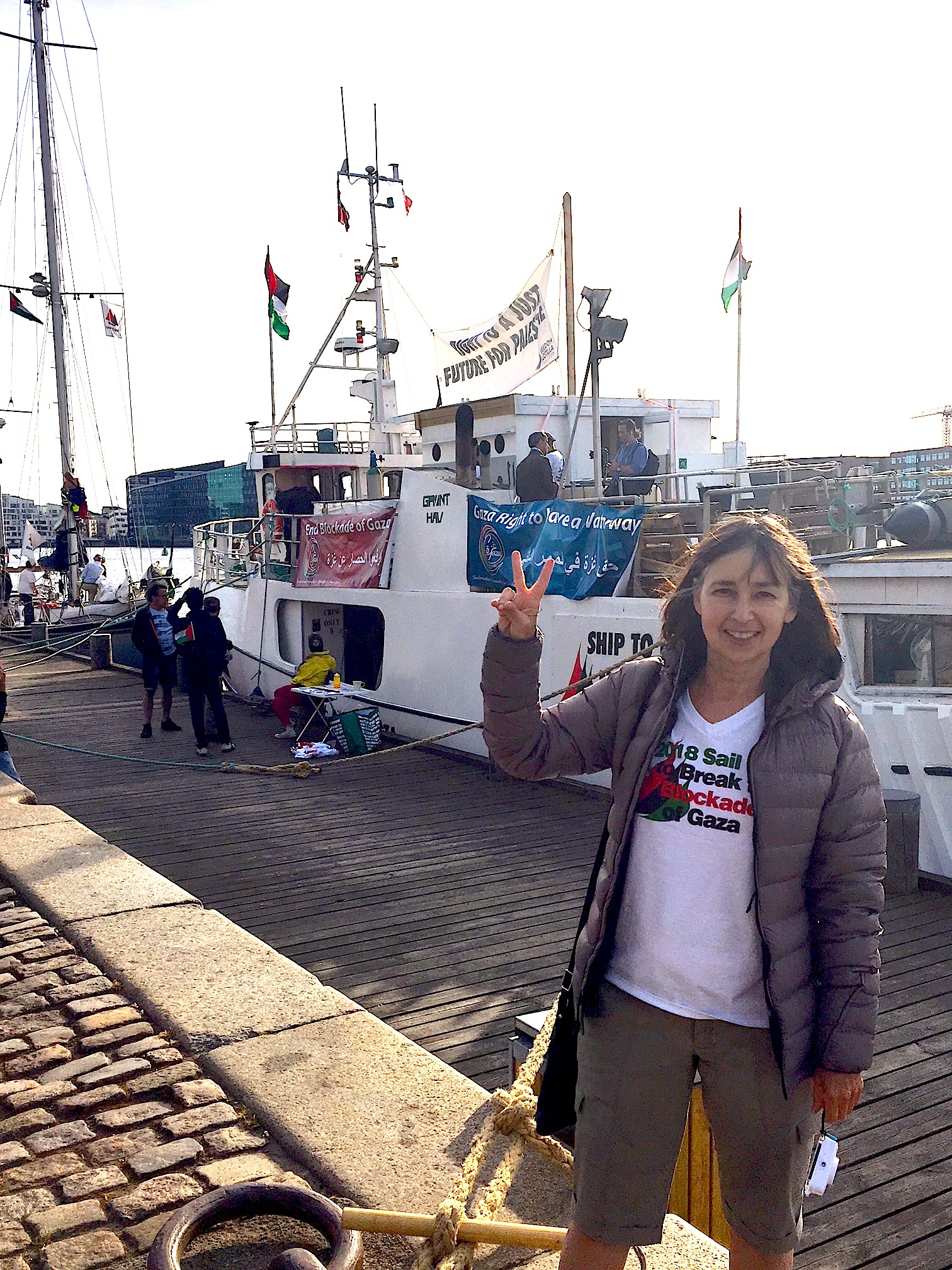
Elizabeth Murray: Boarding her boat to Gaza
Israel seems to have reserved a special brand of sadism for Gaza’s athletes — several promising young cyclists and soccer players have become amputees, since Israel refused to allow them to leave Gaza to obtain the necessary medical attention that would have saved their legs. Reports of such heinous acts — documented widely in social media posts by those on the ground in Gaza — have served to further isolate Israel internationally and alienate peace-loving people around the world, who deplore the moral depravity of its government.
Reaching the harbor of Gaza (which means “jewel” in Arabic) should be as simple and straightforward as entering any harbor in Germany, France or Spain. But instead, Israel has denied Gazans use of their own harbor for commerce, trade and travel, and has bombed it on numerous occasions, along with their electric power plants and sewage systems, making life miserable for the local population and rendering 97 percent of the drinking water toxic.
As the Freedom Flotilla embarks on its peace odyssey, it is our hope to bring a light of hope and solidarity to the people of Gaza, who deserve the peaceful, dignified and joyful existence that is their right.
Elizabeth Murray served as Deputy National Intelligence Officer for the Near East in the National Intelligence Council before retiring after a 27-year career in the U.S. government, where she specialized in Middle Eastern political and media analysis. She is a member of Veteran Intelligence Professionals for Sanity (VIPS).
Hamas: Israel’s rejection of UN probe “evidence against it”
Palestine Information Center – May 21, 2018
GAZA – The Hamas Movement on Sunday said that Israel’s rejection of an investigation ordered by the UN Human Rights Council into the recent mass murders of unarmed protesters in the Gaza Strip was evidence that its forces committed war crimes against innocent civilians.
“The Israeli occupation’s rejection of the UN inquiry commission emphasizes its brutality, and insistence on terrorizing and killing our people, disrespecting UN and international institutions and flouting their resolutions,” Hamas spokesman Abdul-Latif al-Qanoua said in a brief press release.
Israel’s foreign ministry railed against the UN Human Rights Council last Friday after it voted to set up a probe into recent killings in Gaza and accused Israel of excessive use of force.
The ministry said it would not allow or cooperate with such inquiry, calling the UN body as “made up of a built-in anti-Israel majority, and guided by hypocrisy and absurdity.”
UNICEF: 1,000 children injured by Israeli gunfire in Gaza protests

Palestine Information Center | May 17, 2018
OCCUPIED JERUSALEM – Over 1,000 children have been injured by Israeli forces in the besieged Gaza Strip during demonstrations since March 30, according to the UN Children’s Fund (UNICEF).
The UN body pointed out that some injuries had been severe and potentially life-altering, including amputations.
“Recent violence has exacerbated the already weak health system in the Gaza Strip, which is crumbling because of the severe power cuts and shortages of fuel, medicine and equipment,” UNICEF said in a statement.
“Medical facilities are buckling under the strain of additional casualties,” it further warned.
On Wednesday, UNICEF and its partners delivered two truck-loads of urgent medical supplies to the Gaza Strip for an estimated 70,000 people.
Lieberman urges Israel to pull out of UN rights body, demands US to follow suit
Press TV – May 17, 2018
The Israeli minister of military affairs has lashed out at the United Nations Human Rights Council (UNHRC) for its condemnation of the recent Gaza carnage, saying Tel Aviv and the US should immediately withdraw from the Geneva-based body.
In a post on his Twitter account, Avigdor Lieberman claimed that “Israel is under a double attack,” one from Gaza and another campaign of “hypocrisy headed by the United Nations Human Rights Council.”
“We must stop permitting this celebration of hypocrisy and immediately withdraw from the Human Rights Council, and work diligently so that the United States joins us in this step,” he added.
Lieberman’s comments came two days after the Office of the UN High Commissioner for Human Right condemned “the appalling, deadly violence in Gaza.”
“The rules on the use of force under international law have been repeated many times but appear to have been ignored again and again. It seems anyone is liable to be shot dead or injured: women, children, press personnel, first responders, bystanders, and at almost any point up to 700m from the fence,” it noted.
The 47-member UNHRC is also scheduled to hold a special session on Friday to discuss “the deteriorating human rights situation in the occupied Palestinian territory, including East Jerusalem [al-Quds].”
Israeli forces killed at least 62 Palestinians during protests near the Gaza fence on the eve of the 70th anniversary of the Nakba Day (the Day of Catastrophe), which coincided this year with Washington’s embassy relocation from Tel Aviv to occupied Jerusalem al-Quds.
More than 2,700 Palestinians were also wounded as the Israeli forces used snipers, airstrikes, tank fire and tear gas to target the demonstrators.
The UN Security Council held an emergency meeting on Tuesday over the Gaza bloodshed.
The US, however, blocked the adoption of a Kuwait-drafted statement that expressed “outrage and sorrow” at the Gaza killings and called for an “independent and transparent investigation” into the massacre.
Hamas won ‘PR war’
In a relevant development, a senior Israeli army spokesman said that the Gaza killings had handed a PR victory to the Palestinian resistance movement, Hamas, which governs the besieged territory and organized the anti-occupation protests there.
During a briefing to the Jewish Federations of North America, Lieutenant Colonel Jonathan Conricus acknowledged that the Israeli military had failed to minimize the number of the casualties in Gaza and that some victims had been hit by mistake.
“We haven’t been able to get that message out of how it is from our side… – and the ‘winning picture’ overwhelmingly, by a knockout, unfortunately, have been the graphics from the Palestinian side. The amount of casualties has done us a tremendous disservice, unfortunately, and it has been very difficult to tell our story,” he said.
See also:
UN rights body urges probe into Gaza carnage
The UN rights body calls for an investigation into recent Israel’s massacre of Palestinian protesters in Gaza.
UNSC holds emergency meeting on Israeli violence
Washington has already blocked the adoption of a UN statement calling for an investigation into the killing of Palestinians.
Emily Thornberry powerfully condemns the Gaza massacre committed by the state of Israel
Bypass Mainstream Media | May 15, 2018
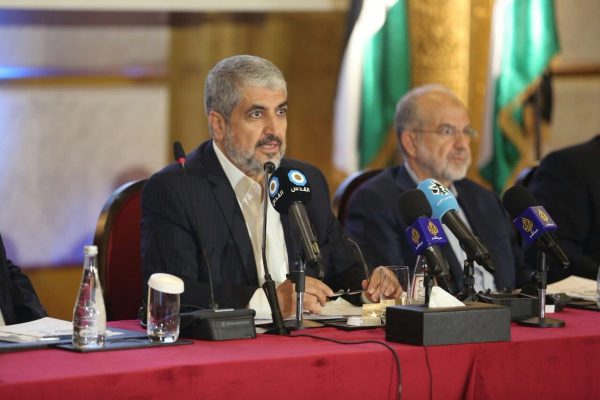
Mishaal: Gaza protesters seek to send three messages to the world
Palestine Information Center – May 16, 2018
Former head of Hamas’s political bureau Khaled Mishaal has affirmed that the resistance factions are not behind the protest rallies taking place on the Gaza border but rather an unarmed people seeking to send three messages to the world.
“These messages are: ‘I want to return to my homeland and country which I was expelled from, it is high time the blockade came to an end, and Jerusalem is an Arab and Islamic [city],’” Mishaal stated on Tuesday during an interview on al-Jazeera satellite channel.
“Everyone clearly sees the scene in Gaza, and they are popular rallies par excellence,” he said.
The Hamas official called for necessarily having a national consensus on holding similar popular protests in the West Bank, affirming that such step would deal a major blow to the Israeli occupation state.
As for the growing international calls for probing Monday’s massacre in Gaza, Mishaal belittled any effort to be made in this regard, saying the Palestinians had already seen international investigations into Israeli crimes but all to no avail.
He emphasized that the international community has the ability to end the humanitarian tragedy in Gaza and must work for that end immediately, adding that mobilizing international condemnation against Israel would be more important than any investigation process.
He also said that Israel and the US committed two felonies on Monday by killing and wounding hundreds of unarmed civilians in Gaza and opening the embassy in Occupied Jerusalem.
“What happened in Gaza yesterday was a heinous crime against an unarmed people protesting the blockade and the relocation of the embassy, and demanding their right of return,” he added.
The Hamas official expressed his dismay at not seeing a suitable Arab reaction up to the enormity of the event, but he hailed the good positions of Kuwait, Qatar and Turkey in this regard.
He also urged Palestinian Authority president Mahmoud Abbas to assume his responsibilities, work on bringing his people together and end his punitive measures against Gaza.
Kill and Kill and Kill
By Saree Makdisi | CounterPunch | May 16, 2018
Two spectacles unfolded in Palestine on Monday. In Gaza, Israeli army snipers shot and killed 58 Palestinians—including six children—and injured almost three thousand others amid scenes of smoke, fire, teargas, dust, agony and blood. At exactly the same time, to the tinkling of champagne glasses at a glittering reception barely fifty miles away in Jerusalem, Jared Kushner and an elegant Ivanka Trump oversaw the opening of Donald Trump’s new embassy there. The juxtaposition of these two contemporaneous scenes encapsulates at a single glance the entirety of Zionism’s murderous conflict with the Palestinian people.
The Palestinians targeted and executed one-by-one by Israeli snipers had gathered to demand their right of return to their lands and homes inside the rest of Palestine, from the coastal plain up to and including Jerusalem. They or their parents or grandparents were driven from their homes during the Zionist ethnic cleansing of Palestine in 1948 for the simple reason that they are not Jewish: too many non-Jews in the putative Jewish state would not make for much of a Jewish state after all. (“There could be no Jewish state with a large and hostile Arab minority in its midst. There would be no such state. It would not be able to exist,” the Israeli historian Benny Morris bluntly pointed out in an interview justifying ethnic cleansing with the newspaper Ha’aretz in 2004; “a Jewish state would not have come into being without the uprooting of 700,000 Palestinians . . . [therefore] it was necessary to uproot them”). They have been denied the right to return to their homes ever since for the same reason: they are not Jewish, and their presence would upset the carefully-engineered demographic tables maintained by the state to preserve its tenuous claim to an exclusively Jewish identity. The maintenance of that demographic balance and the suspension of their political and human rights are inseparable from one another: the one enables, produces and requires the other.
The demographer Arnon Sofer of Haifa University is the architect of the current isolation of Gaza. In 2004, he advised the government of Ariel Sharon to withdraw Israeli forces from within Gaza, seal the territory off from the outside world, and simply shoot anyone who tries to break out. “When 2.5 million people live in a closed-off Gaza, it’s going to be a human catastrophe,” Sofer told an interviewer in the Jerusalem Post (11 November 2004); “Those people will become even bigger animals than they are today, with the aid of an insane fundamentalist Islam. The pressure at the border will be awful. It’s going to be a terrible war. So, if we want to remain alive, we will have to kill and kill and kill. All day, every day.” He added that “the only thing that concerns me is how to ensure that the boys and men who are going to have to do the killing will be able to return home to their families and be normal human beings.”
This imperative to kill and kill and kill human “animals” explains the violence taking place at the gates of Gaza—which has been sealed off precisely according to Sofer’s prescription—for the past several weeks, most calamitously this Monday. The killing now taking place is, in other words, exactly, to the letter, the “killing and killing and killing” he called for fourteen years ago. Calmly premeditated and intentionally designed by its architect, it is equally calmly and intentionally being carried out by Israeli soldiers (about whose psychological traumas I, unlike Sofer, am not even remotely interested). In response to the current killing and shooting, a senior member of the Israeli parliament, Avi Dichter, reassured his audience on live television on Monday that they need not be unduly concerned. Their army, he told them, “has enough bullets for everyone.” If every man, woman and child in Gaza gathers at the gate, in other words, there is a bullet for every one of them. They can all be killed, no problem.
Remember Kurtz in Heart of Darkness? “Exterminate the brutes!” The genocidal intent expressed by the likes of Sofer and Dichter—mainstream and senior figures in Israeli politics—is so obvious as to make assiduous interpretation of their words unnecessary. The people of Gaza are exterminable because they are not Jewish: that is what the situation amounts to, not according to critics of the siege of Gaza, but according to its architects, planners, enablers and supporters. For that exterminability, and the ability to calmly and methodically transact it (“kill and kill and kill”) guarantees one thing, according to Sofer (in that same interview): “it guarantees a Zionist-Jewish state with an overwhelming majority of Jews.” To be clear then: according to its own planners and architects—these are their words, not mine—the maintenance of a “Zionist-Jewish” state fundamentally requires the Israeli army to prepare itself with a bullet for every man, woman and child in Gaza, and to shoot them one by one if they approach the gates penning them in. And if none of them are left after the smoke clears, well, so much the better; Israeli “boys and men” will return to their families and sleep better at night for not having to kill them any longer.
Exactly as Israeli snipers were following their orders to “kill and kill and kill,” Jared Kushner was marking the occasion of the opening of the embassy with an inane speech extolling the virtues of his bombastic father in law. Kushner was empowered to present this speech not because of his qualifications (he has none), not because of his accomplishments (he has none), not because of his insights (he has none), not because of his charisma or strength of character (he has none), not because of his oratorial skills (he has none), and certainly not because of the rousing qualities of the speech itself (it had none). He was empowered to do so simply because he is Jewish; that is the one single attribute that brings him to the table: an act of birth.
But acts of birth are randomly distributed by the hand of fate. And fate played one hand to Jared Kushner and a different hand to Ezzedine al-Samaak (14 years old), Ahmad al-Shair (16 years old), Said al-Khair (16 years old), Ibrahim al-Zarqa (18 years old) and Iman al-Sheikh (19 years old). They were all born in Gaza, refugees and the children of refugees driven by Zionist shock troops from their homes elsewhere in southwestern Palestine in 1948. Unlike Jared Kushner, who was in Jerusalem because he is Jewish, they cannot go to Jerusalem, because they are not Jewish. Unlike Jared Kushner, who can go to Jerusalem whenever he wants in the future because he is Jewish, they will never go to Jerusalem because they were shot in the head by Israeli army snipers on Monday and they are now all dead. Having robbed them of their past and their present, the state of Israel stole their future as well. And it did so—it could do so—simply because they are not Jewish.
There is a direct link between the events in Jerusalem and those taking place in Gaza; Netanyahu himself pointed it out. “We are here in Jerusalem, protected by the brave soldiers of the army of Israel,” he said at the opening ceremony on Monday, “and our brave soldiers, our brave soldiers are protecting the borders of Israel as we speak today.” By “brave soldiers,” of course, he meant cowardly snipers hiding in reinforced positions and shooting unarmed civilians at a distance of 1,000 meters; and by “protecting” he meant killing and killing and killing, exactly according to Dr. Sofer’s prescription.
There are two racial groups in close proximity in Palestine. The members of one racial group—the one to which Netanyahu and Kushner belong—are free to come and go as they please, to live life, to travel, to study, to work, to raise children. The members of the other racial group are to varying degrees denied those rights, though nowhere more starkly and abjectly than in Gaza, where over two million people have simply been rounded up and warehoused without prospects or hopes, let alone rights, simply because their very existence is deemed to be a mortal threat to the exclusive racial identity of a state that was violently established on their land and at their expense. To maintain the exclusive identity of that state, these people must either accept their fate as essentially human cargo in permanent storage—a superfluous population—or take the bullets that the Israeli army has prepared for each one of them.
And that, fundamentally, is what Zionism’s conflict with the Palestinians is all about. At few other moments than the present has the juxtaposition between the racially privileged and the racially dehumanized and exterminable been so crystal clear. Liberal Zionists like Peter Beinart or Roger Cohen may wring their hands and bewail the crude and explicit viciousness of Netanyahu and his circle or the hideousness of the spectacle unfolding at the locked gates of Gaza. They harken back to the golden days of the 1950s and 1960s, when the Palestinians seemed (to the fevered Zionist imagination) to have quietly vanished, as though by magic. But what is happening today is not an aberration. This is what Zionism has always entailed and what it will always entail. “Colonialism is not a thinking machine, nor a body endowed with reasoning faculties,” Frantz Fanon once pointed out. “It is violence in its natural state.” It is not possible for a settler-colonial regime to racially enable one people at the expense of another people without the use of violence. As Arnon Sofer himself admits, the maintenance of a “Zionist-Jewish state with an overwhelming majority of Jews” requires permanent institutionalized violence. That was already true in 1948 and it remains true today and it will remain true until this project of racial exclusivism and privilege is abandoned once and for all for the hideous anachronism that it is.
 Saree Makdisi’s latest book is Palestine Inside Out.
Israel bans entry of medical delegation into Gaza
Palestine Information Center | May 13, 2018
RAMALLAH – The Israeli occupation authorities on Sunday decided to prevent a Palestinian medical delegation from entering the Gaza Strip.
Ministry of Health said in a statement that the Israeli authorities refused to issue the necessary entry permits for the members of the medical delegation formed by the Palestinian Minister of Health in Ramallah Jawad Awwad to assist medical staff in Gaza.
The Ministry stressed that this ban is a further crime committed against the Gazan people who are also prevented from travelling abroad for treatment.
The Ministry called on international organizations to pressure Israel to allow medical teams to visit Gaza and help the staff working there.
Army Kills 41 Palestinians In Gaza: Health Ministry
IMEMC News – May 14, 2018
The Palestinian Health Ministry has confirmed that Israeli soldiers killed, Monday, 41 Palestinians, including children and four officers of the Ministry of Interior and National Security, in the Gaza Strip, and injured more than 1700.
The Ministry of Interior and National Security said among the slain Palestinians are four of its officers, identified as:
Mousa Jaber Abu Hassanein, 36 – medic, Civil Defense Department.
Mo’taz Bassam an-Nuno, 30 – Internal Security Department.
Mos’ab Yousef Abu Leila, 30 – Military Intelligence Department.
Jihad Mohammad Mousa, 30 – Internal Security Department.
It said the slain officers were performing their duties and national services when the soldiers shot them dead.
Their deaths bring the number of Palestinians, killed by Israeli army fire since morning hours Monday, to 37, while more than 1700 have been injured, including many who suffered serious wounds.
Among the slain Palestinians are five children, including one girl, and among the wounded are 122 children, and 44 women.
27 of the wounded Palestinians suffered very serious wounds, 59 serious injuries, 735 moderate wounds, and 882 suffered light wounds.
772 of the wounded Palestinians were shot with live rounds, three with rubber-coated steel bullets, 91 with shrapnel, 100 cuts and bruises and 737 suffered the effects of teargas inhalation.
65 of the wounded were shot in the head and neck, 116 in their arms, 48 in the chest and back, 651 in the lower extremities, 52 in several parts of their bodies and 737 suffered the effects of teargas inhalation.
The soldiers also caused damage to at least one ambulance, and injured one medic and eleven journalists.
In addition, the Health Ministry called on Egypt to urgently send emergency medical supplies and specialists, mainly surgeons, intensive care physicians, anesthesia specialists, and to allow the transfer of a large number of the wounded to Egyptian hospitals, especially those in need of urgent surgeries, since Gaza hospitals lack the needed supplies due to the siege on the coastal region.
Featured Video

Elijah Magnier: Yemen’s strikes are shattering Saudi Arabia’s long-term strategy
or go to
Aletho News Archives – Video-Images
From the Archives
British weapons and personnel doing much of the killing in Yemen
Press TV – June 18, 2019
A detailed report published by the Guardian newspaper has shown how Britain is massively contributing to Saudi Arabia’s devastating war on Yemen as it suggests that London is not only supplying the bombs that fall on Yemenis, but it provides the personnel and expertise that keep the war going.
The comprehensive report by Arron Merat published on Tuesday showed that Britain was doing much of the killing in Yemen as the country continues to provide Saudi Arabia with everything it needs to turn its southern impoverished neighbor into a graveyard.
“Every day Yemen is hit by British bombs – dropped by British planes that are flown by British-trained pilots and maintained and prepared inside Saudi Arabia by thousands of British contractors,” said Merat in the report. … continue
Blog Roll
 Aletho News
- Netizens condemn Japanese drama for projecting Japan’s wartime atrocities onto Chinese characters
- Racist Seinfeld Dances for Joy as Bibi Unveils His New Map
- A West Bank War for Netanyahu’s Election Campaign, Could It Backfire?
- Yemen denounces European Parliament’s ‘hypocritical’ push to blacklist Ansarullah
- Qalibaf: UAE’s UN bid aims to ‘clear the runway’ for ‘Greater Israel’, whitewash genocide
- Pakistan reopens Iran border after boosting security: Report
- Why are so many Brazilians voting for Flávio Bolsonaro?
- Democrats Put Anti-Russia Agenda Ahead of American Workers
- Elijah Magnier: Yemen’s Strikes Are Shattering Saudi Arabia’s Long-Term Strategy
- Pentagon designates Chinese cultural centers national security threat
- If Americans Knew
- Latest updates from Israeli assault on West Bank
- Tourism Ministry launches free food truck tour in US
- “So Much Worse Than People Realize”: Never-Before-Seen Images Reveal Damage at U.S. Bases as Troops Describe Being Abandoned
- UK Bell Review Confirms Only Anti-Israel Attitudes Are Rising, Not Antisemitism
- DAILY UPDATE: Latest essential news on Palestine, Israel, & region
- DAILY UPDATE: Latest essential news on Palestine, Israel, & region
- Damning report shows the media must confront its failures on Gaza
- BBC senior broadcaster speaks out on Gaza coverage
- Netanyahu vows vast West Bank invasion in response to 20-minute skirmish that left 2 Israeli soldiers and 2 Palestinian fighters dead
- Tied up and tortured: Israel using US-made electroshock weapons on Palestinian detainees
- No Tricks Zone
- Sudden Stratospheric Warming, Powerful El Niño Combination May Lead To Extreme Europe Cold, Energy Crisis!
- Two New Studies Find Thwaites Glacier Melt Cannot Be Driven By Human Activity Or A Warming Ocean
- E-Cars Reduce CO2 Emissions By Only 41% Compared To Internal Combustion Engine Vehicles
- Predictions Made By Renowned Climate Professor Over Past Decades Have Been Proven To Be Poor
- New Study Suggests Large Regions Of The Pacific Ocean Have Been Cooling For The Last 80 Years
- Germany’s Green Energy Debacle: High Energy Costs Force Kahla Porzellan to Close After 182 Years!
- New Study: 50 Years Of The Most Aggressive ‘Net Zero’ Policies Can Only Affect The Global Climate By 0.03°C
- US September “Heat” Was No Record…Many Records Set Decades Ago
- Latest European Green Energy Debacle; Portugal’s Largest Flagship Solar Park Insolvent!
- Green Energy Debacle: German Expert Professor Fritz Vahrenholt Warns Of Severe Economic And Social Consequences

