Sderot, ‘Bomb Shelter Capital of the World’, Not As Heroic As Israel Claims
By Stuart Littlewood | American Herald tribune | March 12, 2108
CBN News has run a story with the headline “Israel Takes Diplomats on Tour along Gaza Border”, in which deputy foreign minister, Tzipi Hotovely, tells them it’s her duty to let them “see the real challenges on the ground”.
Sderot, which has become known as ‘the bomb shelter capital of the world’, is a compulsory stop on these propaganda tours. Being only a mile from the Gaza Strip residents have little time to take cover, though very few have been killed by Gaza’s erratic garden-shed missiles.
The story of brave Sderot is told ad nauseam to brainwash the media and their own people besides the coachloads of gullible foreign politicians and tourists. The Israeli authorities have studiously counted and broadcast the number of home-made Qassam projectiles, claiming that more than 15,000 “terrorist” rockets have “rained down” on Sderot since the Israeli occupier pulled its citizens and troops out of the Gaza Strip in 2005 saying they were making a concession of territory designed to bring peace. Of course, it didn’t. Why?
For several reasons. Israel’s “concession” was the handing back of territory that didn’t belong to them in the first place. Furthermore the pull-out on the ground has still left Israel occupying Gaza’s territorial waters and airspace, and in control of all land crossings – including the one into Egypt. The Zionist regime has thus maintained a vicious blockade on the tiny coastal enclave for the last 10 years. Hotovely and her regime colleagues, who preach non-stop about Israel’s right to self-defence, fail to understand that the Palestinians have the same right and are entitled to mount an armed resistance against their illegal occupier.
What Israelis never admit to is how many missiles, bombs, shells, mortar rounds and other high-tech ordnance launched by their F-16s, helicopter gunships, drones, tanks and navy gunboats have slammed into crowded Gaza, causing horrendous slaughter and reducing homes and vital infrastructure (much of it paid for by EU and American taxpayers) to rubble.
And there’s another little fact that Hotovely is careful not to mention. Sderot is built on the lands of a Palestinian Arab village called Najd, which was ethnically cleansed by Jewish terrorists in May 1948 before Israel was declared a state and before any Arab armies entered Palestine. The 600+ villagers, all Muslim, were forced to flee for their lives. Britain, the mandated government, was on watch while this and many other atrocities were committed by rampaging Jewish militia.
Arabs owned over 90 percent of the land in Najd and, according to UN Resolution 194 and the Universal Declaration of Human Rights, they are entitled to return home. But, as we have come to expect, Israel refuses to recognize the rights of others and will not allow them back. Anyway, what is there for them to return to? The 82 homes there were bulldozed. Najd was one of 418 Palestinian villages and towns ethnically cleansed and wiped off the map by Zionist Jews. Its inhabitants became refugees in Gaza and their families are probably still living in camps there.
The irony is that some of them may be manning the rocket launchers….
When Barak Obama visited Sderot he spouted the well-worn mantra backing Israel’s right to protect its citizens from rocket attacks. “If somebody was sending rockets into my house where my two daughters sleep at night, I would do everything to stop that, and would expect Israel to do the same thing.” Well said, Obama. But let’s hope you wouldn’t be so stupid or arrogant as to live on land you stole from your neighbor at gun-point.
Israel’s endgame in Gaza: Resistance is futile
Israel’s deliberate targeting of Gaza’s health sector and denying those in need of humanitarian care from obtaining it constitute a crime against humanity

By CJ Werleman | Middle East Eye | January 16, 2018
Some describe Gaza as either the world’s largest “concentration camp” or “open air prison”, while others liken it to the modern-day equivalent of the Warsaw ghetto.
Whatever appropriate analogy you apply to the enclave, that traps two million Palestinians on a slender piece of coastal land along the Egyptian-Israeli border, it’s impossible to overstate the level of human misery and suffering that is taking place there today.
A catastrophic situation
When I spoke with Dr Basem Naim, the former Palestinian minister for health and resident of Gaza, I referred him to a UN report that forewarned that Israel’s medieval-like blockade promises to make the territory “uninhabitable” by 2020.
“What do they [UN] mean? It’s uninhabitable here now,” Naim told me. “The situation today is catastrophic.”
Dr Naim explained how Israel’s intentional cutting of Gaza’s power supply, meant to exert pressure on Hamas but, instead, punishing ordinary Palestinians, is having dire affects on the health sector in Gaza.
“The typical Palestinian gets only three to five hours of electricity each day,” he said. “You can’t pump water to apartments that are above ground level. You can’t pump sewage, which is why more than 95 percent of Gaza’s drinking water is undrinkable.”
He explained that hospitals, which depend on 24-hour electricity, are unable to perform life-saving surgeries, and that some, including Al-Shifa hospital in Gaza City, have ceased doing operations altogether.
This is happening while newborn babies and the elderly freeze to death in the winter, and die from heat exhaustion in the summer. This is happening because Israel is allowing only 120 watts of power to be provided to Gaza, knowing that 400 watts are needed to meet the basic minimum survival needs of two million Palestinian people.
“The scarcity of energy and the severe shortage of fuel in Gaza have damaged all aspects of life in the Strip,” said the International Committee of the Red Cross in a statement issued last year.
Closed borders
But the biggest problem facing the imprisoned citizens of Gaza is the “closed borders”, according to Dr Naim. He explained:
“For example, the last time Rafah border crossing was opened, which was one week ago, came after more than 100 days of closure, and out of the 35,000 people waiting to leave Gaza through Rafah, only 2,000 were able to leave, and the others must wait again for another 100 days. When I talk about 35,000 people, I’m talking about urgent humanitarian cases; patients, and people who need to meet their families for urgent situations. It’s nearly impossible for Palestinians in Gaza to get urgent medical care in Israel, Egypt, or Jordan.
“If a Palestinian wants to leave Gaza for urgent medical care or treatment, he or she must wait 70 days to get [an] Israeli reply saying he or she is allowed or not. And after 70 days, and even if the request is approved, he or she must come to Erez crossing for an interrogation, and he or she might be arrested. I know many cases where the families of patients were blackmailed by Israeli security forces, like Shin Bet, under these very circumstances.”
It’s worth noting that it’s not only from Gaza that Palestinians are denied freedom of movement. Earlier this month, Omar Barghouti, who lives in Israel and is one of the founders of the boycott, divest and sanctions (BDS) movement against Israeli occupation, was denied the right to visit his cancer-stricken mother in Jordan.
Israel’s refusal to allow a prominent Palestinian figure, who has a demonstrable lifetime track record of non-violent activism, undercuts Israeli claims that travel bans have little to do with security and everything to do with meting out collective and inhumane punishment to the Palestinian people, writ large.
A new report published by the human rights group Gisha – Legal Centre for Freedom of Movement shows that 2017 was the worst year for the movement of Palestinians in and out of Gaza since Israel’s attack on Gaza in the summer of 2014, reducing the number of exit permits by 51 percent from 2016 to 2017.
The report shows that Israel allowed fewer than 6,000 monthly exits in 2017 compared with the more than 14,000 allowed the previous year.
The authors of the report also identified a list of policies that were carried out by Israeli authorities to prevent or restrict freedom of Palestinian movement through the Erez crossing.
These new restrictive measures were “introduced with little or no justification provided as to their purpose and, it appears, no consideration of the impact they would have on the lives of Gaza’s residents”.
Targeting the health sector
These measures include “significant extension of the processing times of permit applications, leaving thousands of permit applications pending with no response; a new directive prohibiting Palestinians from exiting Gaza with electronic devices, toiletries and food; freezing travel to the American Consulate; mandatory shuttle services to Allenby Bridge Crossing; “security blocks” blocking travel for medical patients, traders, and humanitarian workers; increase in the frequency and severity of “security interviews” at Erez; trader permits cancelled as new approvals declined; travel for Friday prayers in Jerusalem remaining blocked, and; recipients of permits for travel abroad increasingly made to sign a commitment not to return for a year.”
It’s not only inexcusable for Israel to impose any kind of restriction of movement, but to deliberately target Gaza’s health sector by cutting power to the Strip, and then to deny those in need of humanitarian care from obtaining it – constitutes a crime against humanity by any definition.
“The magnitude, the deliberateness, the violations of international humanitarian law, the impact on the health, lives, and survival, and the overall conditions warrant the characterisation of a crime against humanity,” says Richard Falk, a former UN special rapporteur for human rights in the occupied Palestinian territories.
“This is an increasingly precarious condition. A recent study reports that 46 percent of all Palestinian children in Gaza suffer from acute anaemia. There are reports that the sonic booms associated with Israeli overflights have caused widespread deafness, especially among children. Children need thousands of hearing aids.
“Malnutrition is extremely high in a number of different dimensions and affects 75 percent of Palestinians in Gaza. There are widespread mental disorders, especially among young people … Over 50 percent of Palestinian children in Gaza under the age of 12 have been found to have no will to live,” wrote Falk in 2008.
When I referred to Falk’s findings from a decade ago, Dr Naim said things have become “much worse”, pointing to the fact that much of Gaza’s critical infrastructure was destroyed during Israel’s 2014 assault, noting that 20,000 tons of explosive ordinance was dropped on the Strip by Israeli jets and artillery, and that unemployment and poverty have skyrocketed since.
Breaking the Palestinians’ will
Israel’s restriction on Palestinian movement is also preventing Gaza from building a functioning civil society as human rights workers, social workers, health workers, educators, engineers, etc are denied opportunities to expand their knowledge and skills in other countries.
It also runs afoul of Israel’s “obligations to respect the human rights of Palestinians in Gaza and the West Bank, including their right to freedom of movement, which includes, with some limitations, a right to enter and leave one’s country and to choose one’s place of residence within it,” according to Human Rights Watch.
In fact, Palestinians in Gaza may visit their families in the occupied West Bank only if he or she can prove their relative is “dead, dying, or getting married“, which constitutes another violation of not only international law but also the Oslo Accords that stipulate the Palestinian territories – East Jerusalem, Gaza, and the West Bank – constitute one unified territorial entity. Israel has made movement between the territories all but impossible for Palestinians.
Given that nearly a third of Palestinians in Gaza have relatives in either the occupied West Bank, East Jerusalem, or Israel, one can see how needlessly cruel Israel’s brutal policies of occupation truly are.
Of course, Israel tries to justify its near total freeze of Palestinian movement in and out of Gaza with concerns for its security, but this has always been a rhetorical fig leaf for Israel’s sustained effort to break the will of the Palestinian people.
Israel’s intent has always been to strangle Palestinian political, social, and civil life in the hope that those it occupies will come to the realisation that resistance is futile.
– CJ Werleman is the author of Crucifying America (2013), Koran Curious (2011), and he is the host of Foreign Object. Follow him on twitter: @cjwerleman
READ MORE:
Yes, Palestinians under siege are ‘dehumanised’ – by Israel
Remembering Cast Lead: How corporate media continue to justify Israel’s criminal excesses
Rest In Peace: Mohamed Moheisen, 29
Israel-Palestine Timeline | December 22, 2017
Mohammad Nabil Moheisin, 29, was killed, Friday by Israeli soldiers when the soldiers, stationed across the border fence, resorted to the excessive use of force against Palestinian protesters, in several parts of the Gaza Strip.
During the day in which Mohammad was killed, another young Palestinian, Zakariya al-Kayarna, 24, was also killed, in a separate protest in Beit Hanoun, in northern Gaza. The Israeli troops injured at least 123 others, including three who suffered life-threatening wounds, and caused dozens to suffer the effects of teargas inhalation.
 Medics also provided treatment to dozens of Palestinians, who suffered the effects of teargas inhalation.
The Palestinian Health Ministry in Gaza has confirmed that 123 Palestinians were shot with live Israeli army fire, and dozens suffered the severe effects of teargas inhalation, in the northern and eastern parts of the besieged coastal region on this day.
It added that among the wounded were five medics, and four journalists.
In Beit Hanoun, in northern Gaza, the soldiers shot eight young Palestinian men, especially in the area close to Erez Terminal. The wounded were rushed to the Indonesian Hospital, suffering moderate wounds.
Furthermore, the soldiers shot 27 Palestinians in Jabalia, in northern Gaza; one of them suffered a serious injury, while most of the wounded residents suffered moderate wounds.
Ten Palestinians were also shot, east of the al-Boreij refugee camp, in Central Gaza; one of them suffered a serious injury, and was rushed to the Al-Aqsa Hospital, in nearby Deir al-Balah city.
In addition, the soldiers shot 22 Palestinians east of Khan Younis, in the southern part of the Gaza strip, and six others in nearby Rafah, before they were all moved to Nasser Hospital and Abu Yousef an-Najjar Hospital, suffering moderate wounds.
The Palestinian Red Crescent in the Gaza Strip has reported that its medics also provided treatment to at least 100 Palestinians, including many women and children, who suffered the effects of teargas inhalation.
Mohammad was shot by a soldier in a military tower, in Nahal Oz base, across the border fence, east of Gaza city. He was from Jabalia in the northern part of the Gaza Strip.
The ‘Last Martyr’: Who Killed My Neighbor, Kamal Al-Assar?
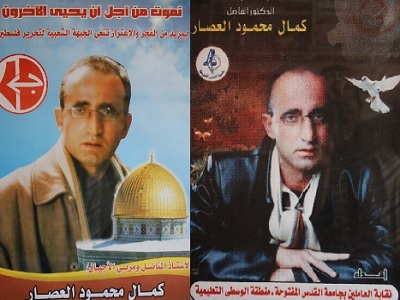
Posters of Kamal Al-Assar following his death in 2008. (Photo: Supplied)
By Ramzy Baroud | Palestine Chronicle | December 9, 2017
When I learned of the death of Kamal Al-Assar a few years ago, I was baffled. He was only in his 40s. I remember him in his prime, a young rebel, leading the neighborhood youth, armed with rocks and slingshots, in a hopeless battle against the Israeli army. Understandably, we lost, but we won something far more valuable than a military victory. We reclaimed our identity.
At every anniversary of the First Palestinian Intifada, a popular uprising that placed the Palestinian people firmly on the map of world consciousness, I think of all the friends and neighbors I have lost, and those I have left behind. The image of Ra’ed Mu’anis, in particular, haunts me. When an Israeli sniper’s bullet plunged into his throat, he ran across the neighborhood to find help before he collapsed at the graffiti-washed walls of my house.
“Freedom. Dignity. Revolution,” was written in large red letters on the wall, a pronouncement signed by the Popular Front for the Liberation of Palestine.
Only later I learned that Kamal was the one who carried Ra’ed out of the firing zone. But it was too late. Ra’ed, a skinny and feeble teenager, with a distinct black mark on his forehead had bled alone at the steps of my home. When he was buried, hundreds of refugees descended on the Martyrs Graveyard. They carried Palestinian flags and chanted for the Intifada and the long-coveted freedom. Ra’ed’s mother was too weakened by her grief to join the procession. His father tried to stay strong, but wept uncontrollably instead.
Kamal was revitalized by the Intifada. When the uprising broke out, he emerged from his own solitude. Life made sense once again.
For him, as for me and many of our generation, the Intifada was not a political event. It was an act of personal – as much as collective – liberation: the ability to articulate who we were at a time when all seemed lost. The Palestinian Liberation Organisation (PLO) languished in Tunisia after being forced to leave Lebanon in 1982. Arab governments seemed to have lost interest in Palestine altogether. Israel emerged triumphant and invincible.
And we – those living under protracted military occupation – felt completely abandoned.
When, on December 8, 1987, thousands took to the streets of Jabaliya Refugee Camp, the Gaza Strip’s largest and poorest camp, the timing and the location of their uprising was most fitting, rational and necessary. Earlier on that day, an Israeli truck had run over a row of cars carrying Palestinian laborers, killing four young men. For Jabaliya, as with the rest of Palestine, it was the last straw.
Responding to the chants and pleas of the Jabaliya mourners, the refugees in my refugee camp – Nuseirat – marched to the Israeli military barracks, known as the “tents”, where hundreds of soldiers had tormented my camp’s residents for years.
In the morning of December 9, thousands of Nuseirat youth took to the streets and vowed to avenge the innocent blood of the Jabaliya victims of the previous day. They swung large flags made of silky fabric that swayed beautifully in Gaza’s salty air and, as the momentum grew and they became intoxicated by their own collective chants, they marched to the “tents” where the soldiers were uneasily perched on the tops of watchtowers, hiding behind their binoculars and automatic machine guns.
Within minutes, a war had started and a third generation of refugee-camp-born fellahin peasants stood fearlessly against a well-equipped army that was visibly gripped by fear and confusion. The soldiers wounded many that day and several children were killed.
Kamal was on the frontlines. He waved the largest flag, chanting the loudest, threw rocks the furthest and incessantly urged young men not to retreat.
Kamal hated school as well as his teachers. To him they seemed so docile, adhering to the rules of the occupier which decreed that Palestinians not teach their own history, so that the fellahin were denied even the right to remember who they were or where they came from. The Intifada was the paradigm shift that offered an alternative – however temporary, however chaotic – to the methodical humiliation of life under occupation.
Within hours, Kamal felt liberated. He was no longer tucked away in a dark room reading the works of Marx and Gramsci. He was in the streets of Nuseirat fashioning his own utopia.
The Intifada was that transformational period that saved a generation from being entirely lost, and Palestine from being forgotten. It offered a new world, that of solidarity, camaraderie and wild youth who needed no one to speak on their behalf.
Within weeks of bloody clashes in which hundreds of youth fell dead or wounded, the nature of the Intifada became clearer. On one hand, it was a popular struggle of civil disobedience, mass protests, commercial and labor strikes, refusal to pay taxes and so on. On the other hand, militant cells of refugee youth were beginning to organize and leave their mark, as well.
The militancy of the intifada did not become apparent until later, when the repression by the Israeli government grew more violent. Under the banner of the “Iron Fist” campaign, a new Israeli stratagem was devised, that of the “broken bones” policy. Once captured, youth had their hands and legs broken by soldiers in a systematic and heartless manner. In my neighborhood, children with casts and crutches seemed to outnumber those without.
Kamal was eventually detained from his home. He attempted to escape but the entire neighborhood was teeming with soldiers, who arrived at night as they always do. They commenced the torturous rite in his living room, as his mother – the resilient, Tamam – shoved her body between him and the ruthless men.
When Kamal regained consciousness, he found himself in a small cell, with thick, unwashed walls that felt cold and foreign. He spent most of his prison time in the torture chamber. His survival was itself nothing less than a miracle.
When the Oslo Accords were signed in 1993, officially ending the Intifada, Kamal’s generation felt betrayed. Nothing good came out of that “peace”, except that a few rich Palestinians grew even richer.
Kamal died a few years ago. I learned that his revolution never ceased. He became a teacher, laboring to reconstruct the history of his people at a local Gaza university. His mother, now an old refugee in Nuseirat is still heartbroken over her son’s death. She told me that Kamal’s wounds and physical ailments from prison never healed.
Kamal was a martyr, she told me. Perhaps the last martyr in an uprising that was not meant to liberate land, but liberate people from the idea that they were meant to exist as perpetual victims; and it did.
70% of Palestinians want Abbas to resign immediately
MEMO | December 13, 2017
Some 70 per cent of Palestinians in the Israeli-occupied West Bank and Gaza Strip want President Mahmoud Abbas to resign immediately, according to a new poll by the Palestinian Centre for Policy and Survey Research conducted 7-10 December.
The poll, conducted in the occupied Palestinian territory (oPt) in the immediate aftermath of US President Donald Trump’s decision to recognise Jerusalem as the capital of Israel, makes grim reading for Abbas, with those demanding his resignation up three points from September.
Abbas’ net satisfaction rating, meanwhile, has dropped one point to minus 35, with just 31 per cent satisfied with his performance, compared to 66 per cent who are dissatisfied.
When asked about who should succeed Abbas, 35 per cent expressed a preference for Marwan Barghouthi, 22 per cent would vote for Ismail Haniyeh, while Mohammad Dahlan attracted the support of just seven per cent of Palestinians (15 per cent in Gaza and one per cent in the West Bank).
With regards to the national unity file, 38 per cent of Palestinians in the oPt are satisfied and 55 per cent are dissatisfied with the performance of the reconciliation government. Fifty per cent are optimistic and 45 per cent are pessimistic about the success of reconciliation; three months ago, optimism stood at 31 per cent and pessimism at 61 per cent.
Some 81 per cent of Palestinians in the oPt want the reconciliation government to pay the salaries of the civil employees of the former Hamas government, while only 14 per cent do not it to do so. The same number (81 per cent) want the reconciliation government to pay the salaries of the security sector employees of the former Hamas government.
With regards to Abbas’ call for “one government, one gun”, only 22 per cent of those polled support the disbanding of Palestinian factions’ armed wings in the Gaza Strip, and 72 per cent want those armed groups to remain in place.
Regarding Trump’s policy shift on Jerusalem, a plurality of Palestinians (45 per cent) believe that “the most appropriate” Palestinian response is to stop all contacts with the US administration, submit a formal complaint to the International Criminal Court (ICC) and resort to an armed intifada.
Twenty-seven per cent want an end to contacts, the submission of a complaint to the ICC, and “non-violent resistance”. Twelve per cent want the Palestinian Authority to simply denounce the US step and stop contacts with the Trump administration, while another 12 per cent want just verbal condemnation.
A plurality of Palestinians (44 per cent) believe armed resistance is the most effective means of establishing a Palestinian state, 27 per cent think negotiation is the most effective means, and 23 per cent think non-violent resistance is the most effective. Three months ago, 35 per cent indicated that armed resistance is the answer and 33 per cent sided with negotiation.
While most Palestinians believe the Trump administration will not submit a plan for Israeli-Palestinian peace, 86 per cent believe that any such plan “will not meet Palestinian need to end occupation and build a state”. Nonetheless, 49 per cent think Abbas might accept the American peace plan if one is indeed submitted to him, while 42 per cent believe he will not accept it.
Regarding “public trust in the roles and positions of major Arab countries in the peace process and the US efforts to develop a regional agreement in the context of Palestinian-Israeli peace”, 82 per cent of Palestinians in the oPt say they do not trust the Saudi role, 75 per cent do not trust the Emirati role, and 70 per cent do not trust the Egyptian role.
Palestine: Saudi Arabia, Egypt using Rafah crossing to pressure us
MEMO | November 17, 2017
The Rafah crossing between the besieged Gaza Strip and Egypt is being used a tool to pressure Palestinian President Mahmoud Abbas to enter into US-backed peace talks with Israel, a Palestinian Authority official has said.
“The Rafah crossing has become a tool that Egypt and Saudi Arabia use to pressure Palestinian President Mahmoud Abbas to accept the entry into a new round of US-backed negotiations with Israel,” the PA official said, warning that “the negotiations could reach results that may affect the rights of the Palestinians.”
According to the Cairo agreement which was signed on 12 October, Egypt agreed with Fatah and Hamas to reopen the Rafah border crossing last Tuesday, but the official said that “Saudi Arabia seemed to have pressured Egypt to retreat until the PA approves the two-state solution deal.”
The official described the exploiting of the only humanitarian crossing for Gaza’s residents as “suspicious”.
“They [Arab countries] are using the crossing to strengthen their ties with the US and Israel” he added.
Israel has maintained a blockade on Gaza for a decade, with tight restrictions in place on the movement of people and goods at its crossings, citing the need to control Hamas and stop Islamic groups from obtaining weapons or materials that could be used against Tel Aviv. Egypt has supported the blockade by closing the Rafah crossing, leaving Palestinian in Gaza no access to the outside world.
Gaza’s two million residents suffer from worsening humanitarian conditions, with only a few hours of power a day and a lack of clean water. Control of the Rafah crossing at Gaza’s southern border has long been a sticking point between the two Palestinian factions, and between Egypt and the Palestinians in Gaza for whom the crossing represents a vital gateway to the outside world.
The resumption of PA security coordination with Israel is no surprise
By Ramona Wadi | MEMO | November 14, 2017
Palestinian Authority leader Mahmoud Abbas is not one to miss an opportunity to collaborate with Israel. At sporadic intervals, the suspension of security coordination with Israel was implemented temporarily only when Palestinians were protesting over Israeli violence or, for example, surveillance at Al-Aqsa Mosque. Despite congratulatory statements regarding Abbas’s decision to suspend what he has called “sacred” coordination with the occupation authorities, there was still doubt over its implementation; there were even occasional comments that security coordination had resumed even as the PA was still congratulating itself over the “suspension”.
Last week, all doubts were dissipated as the PA confirmed that it had resumed security coordination with Israel two weeks earlier. In terms of accuracy, the time frame can be contested, given that reports as early as August had already confirmed such collaboration. In light of the reconciliation agreement between the PA and Hamas, it is thus ever more pertinent to question the underlying motives behind such a deal, which has the potential to open up Gaza to Israel.
According to comments on Press TV, Hamas spokesman Fawzi Barhoum declared the movement’s “surprise” at the announcement. Security coordination “is the equivalent of the greatest danger to the Palestinian people, its unity and its legitimate rights, including the right to resist the occupation,” he said. Barhoum also described the move as distorting “the reputation” of the Palestinian people, their struggles and history.
While Barhoum’s comments show an understanding of the implications, claiming to be surprised was surely an exaggeration. Had Gaza not been forced to seek a compromise with Fatah, it is possible that the current political scenario would not be defined by a reconciliation agreement, particularly one which so far is seeking to overturn the resistance with which Hamas has been identified and which sets the movement apart from other political factions due to being forced into situations necessitating defence in the enclave.
Within the same time frame of the security coordination announcement, senior Hamas official Mousa Abu Marzook also stated that responsibility for Palestinians in Gaza now rests entirely with the PA as a sign of credibility to eliminate internal division. The problem is that the emphasis on internal division is being isolated from the repercussions upon Palestinians. If the current trend continues, Palestinian leaders will be making the same mistakes as the international community by separating the political from the humanitarian, thus creating different levels of responsibility, visibility and accountability.
If the PA determines the course of the reconciliation agreement, security coordination will ultimately provide Israel with access to the Gaza Strip unless Hamas decides on an alternative course of action, which is to refute the entire facade of “unity” that has been shaped by Mahmoud Abbas. Coercion has been a primary factor influencing the reconciliation agreement, compounded with the international isolation of Gaza, its people and Hamas. Security coordination is another form of coercion which will determine additional levels of oppression for Palestinians, including those in Gaza.
For many years, Abbas has sought to maintain different forms of violence in Gaza and the occupied West Bank, using deprivation and security coordination respectively. Under such circumstances, Hamas will be in dire need of further evaluation and a different strategy.
Read Also: What prisoners mean to the Palestinian Authority
PA’s security coordination with Israel greatest threat to unity
Featured Video

Racist Seinfeld Dances for Joy as Bibi Unveils His New Map
or go to
Aletho News Archives – Video-Images
TV Drama Review
Japanese drama projects Japan’s wartime atrocities onto Chinese characters

Global Times | October 25, 2026
By portraying Chinese characters as perpetrators of ruthless violence while casting Japanese Self-Defense Forces (SDF) intelligence operatives as defenders, the season 2 of the Japanese drama Vivant has recently drawn criticism from Chinese netizens, who argue that its depiction turns historical reality on its head while ignoring Japan’s wartime atrocities.
The TBS drama series – a spy suspense story in which an alleged unofficial intelligence unit of the SDF operates across the globe — has attracted a passionate fanbase. Its currently airing season 2 opened with a household rating of 18.8 percent, the highest for a TV drama this year, according toa commentary article by Japanese media Toyo Keizai.
What draws attention is the portrayal of the enemies in the series, the article noted. Scenes in which the Chinese organization subjects kidnapped members of the SDF unit to brutal torture are repeated with unrelenting intensity.
It is rare for Japanese TV dramas to explicitly portray a real-life country as the enemy, the article noted.
Japanese Prime Minister Sanae Takaichi also made a reference to the drama, saying that she has been recording Vivant and hopes to binge-watch it over the year-end and New Year holidays, according to Japanese media outlets.
China’s CCTV News report on Sunday revealed that the drama features scenes in which Chinese personnel cut off the fingers of and stab Japanese intelligence operatives in the abdomen. Such acts bear striking similarities to the torture inflicted on Chinese nationals by invading Japanese troops during the World War II.
The drama distorts the truth by attributing these atrocities to modern Chinese characters. Beneath the surface, it subtly glorifies Japan’s cross-border overseas operations, blurs the functional boundaries of the SDF and implicitly promotes an expansionist narrative, per CCTV News. … continue
Blog Roll
 Aletho News
- Netizens condemn Japanese drama for projecting Japan’s wartime atrocities onto Chinese characters
- Racist Seinfeld Dances for Joy as Bibi Unveils His New Map
- A West Bank War for Netanyahu’s Election Campaign, Could It Backfire?
- Yemen denounces European Parliament’s ‘hypocritical’ push to blacklist Ansarullah
- Qalibaf: UAE’s UN bid aims to ‘clear the runway’ for ‘Greater Israel’, whitewash genocide
- Pakistan reopens Iran border after boosting security: Report
- Why are so many Brazilians voting for Flávio Bolsonaro?
- Democrats Put Anti-Russia Agenda Ahead of American Workers
- Elijah Magnier: Yemen’s Strikes Are Shattering Saudi Arabia’s Long-Term Strategy
- Pentagon designates Chinese cultural centers national security threat
- If Americans Knew
- Latest updates from Israeli assault on West Bank
- Tourism Ministry launches free food truck tour in US
- “So Much Worse Than People Realize”: Never-Before-Seen Images Reveal Damage at U.S. Bases as Troops Describe Being Abandoned
- UK Bell Review Confirms Only Anti-Israel Attitudes Are Rising, Not Antisemitism
- DAILY UPDATE: Latest essential news on Palestine, Israel, & region
- DAILY UPDATE: Latest essential news on Palestine, Israel, & region
- Damning report shows the media must confront its failures on Gaza
- BBC senior broadcaster speaks out on Gaza coverage
- Netanyahu vows vast West Bank invasion in response to 20-minute skirmish that left 2 Israeli soldiers and 2 Palestinian fighters dead
- Tied up and tortured: Israel using US-made electroshock weapons on Palestinian detainees
- No Tricks Zone
- Sudden Stratospheric Warming, Powerful El Niño Combination May Lead To Extreme Europe Cold, Energy Crisis!
- Two New Studies Find Thwaites Glacier Melt Cannot Be Driven By Human Activity Or A Warming Ocean
- E-Cars Reduce CO2 Emissions By Only 41% Compared To Internal Combustion Engine Vehicles
- Predictions Made By Renowned Climate Professor Over Past Decades Have Been Proven To Be Poor
- New Study Suggests Large Regions Of The Pacific Ocean Have Been Cooling For The Last 80 Years
- Germany’s Green Energy Debacle: High Energy Costs Force Kahla Porzellan to Close After 182 Years!
- New Study: 50 Years Of The Most Aggressive ‘Net Zero’ Policies Can Only Affect The Global Climate By 0.03°C
- US September “Heat” Was No Record…Many Records Set Decades Ago
- Latest European Green Energy Debacle; Portugal’s Largest Flagship Solar Park Insolvent!
- Green Energy Debacle: German Expert Professor Fritz Vahrenholt Warns Of Severe Economic And Social Consequences

