Muslim student reported to UK terror police for pro Palestine activism
Rahmaan Mohammadi, a 17 year old student from Luton, explains how he was reported to the counter terrorism police for his pro Palestine activism. Mohammadi was speaking at a Stop the War Coalition event in London on March 10.
Why It’s Dangerous to Conflate Hamas and Daesh
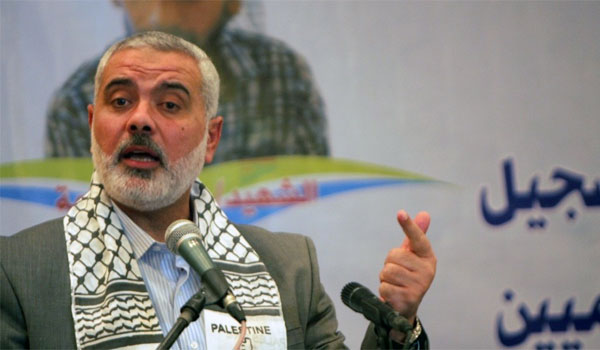
Hamas Prime Minister in Gaza, Ismail Haniyeh
By Belal Shobaki – Al-Shabaka: The Palestinian Policy Network – February 22, 2016
Overview
While Israel’s efforts to link Palestinian resistance to its military occupation to global terrorism are not new, it has expanded its propaganda to address Arab as well as Western audiences. By so doing, it is clearly seeking to exploit the global aversion to movements that have drifted towards extremism and terrorism while claiming to represent Islam. “Hamas is ISIS and ISIS is Hamas,” Israeli Prime Minister Benjamin Netanyahu declared at the United Nations in 2014. Yet better than anyone else, Netanyahu and the Israeli political establishment know that Hamas and Daesh are not related, as do those Arab regimes that also tar all Islamic movements with the same brush to serve their own ends. 1
Not only are Hamas and Daesh unrelated, they are bitter enemies, and Daesh has denounced Hamas as an apostate movement. Al-Shabaka Policy Analyst Belal Shobaki discusses the major ways in which Hamas differs from Daesh including its approach to jurisprudence; the position vis-a-vis the nature of the state; and relations with other religions. He makes the case that it is especially important for the Palestinian national movement to rebut the attempts to conflate Hamas with Daesh and points out the dangers of not doing so.
Serving Short-Term Political Gain
The conflation of Hamas with Daesh ignores reality on the ground. The political environment in Palestine is defined by the occupation, whereas the political environment in the Arab countries where Daesh emerged is defined by authoritarianism and repression as well as sectarian and religious conflicts, an ideal environment for the emergence of a radical ideology motivated by indiscriminate violence.
For Israel, however, the attempt to link the two may pay off regionally and internationally. Many Arabic media outlets have no qualms about referring to this terrorist organization as an “Islamic” State although it is anything but, while many Western media outlets embrace the Israeli conflation of Hamas and Daesh without scrutiny. Arab regimes are uninterested in defending the image of Hamas. Even the Palestinian Liberation Organization (PLO) does not seem concerned with defending Hamas’s international image given the political division between Fatah and Hamas.
Hamas is considered part of the Muslim Brotherhood, which is seen as a threat to authoritarian Arab regimes, particularly in the Arab Mashreq. Thus one way for Arab regimes to fight the Muslim Brotherhood is by claiming it shares common ground or is even synonymous with Daesh, as claimed by the Egyptian regime, and then using this as a justification for excluding the Muslim Brotherhood from participating in political life.
The rapid developments of the past five years in Egypt, the country that provides the only outlet for the Palestinian Gaza Strip, has pushed Hamas into its informal tunnels economy. The official Egyptian stance after Abdel Fattah Sisi’s coup against elected president Mohammad Morsi became tougher against the Gaza Strip, with claims that Hamas was cooperating with Jihadist groups in the Sinai, the same narrative promoted by Israel and its media. However, this narrative is flawed. It is too risky for Hamas to maintain a close relationship with Sinai jihadists, on the one hand, while cracking down on individuals embracing the same ideology in Gaza, on the other. Any links Hamas has established with those groups is limited to securing the needs of the enclave besieged by Israel and Egypt. This interaction is not motivated by a shared ideological identity or shared enmity towards the Egyptian regime. Indeed, Hamas has been eager to keep communication lines open with the Egyptian regime even when accusations conflating Hamas with Sinai’s Salafi Jihadi groups were made in the media. Hamas has also repeatedly said that it is keen on rebuilding the relationship with Egypt in order to ensure the legal flow of goods, services and individuals into Gaza.
It is important to refute this narrative concerning one of the largest Palestinian political movements: Excluding moderate Islamists from political life carries the danger of pushing Palestinian society towards radicalism, in which case both Fatah and Hamas will find themselves fighting takfiri groups. The ensuing discussion will demonstrate the real differences between Hamas and Daesh as well as the very real enmity between them.
Differences in Doctrine
Hamas positions itself as a centrist Islamic movement and an extension of the Muslim Brotherhood, with a rational jurisprudential authority, whereas Daesh adopts a text-based approach that deals with Islamic texts in isolation from their historical context and refuses to interpret them in line with current developments. Hence, for Daesh and other takfiri groups in general, movements like Hamas are secular and un-Islamic, since Hamas is primarily a resistance movement against the Israeli occupation and believes in a moderate Islamic authority. Moreover, Hamas does not take Islamic texts literally; it allows for ijtihad – interpretation and use of discretion. Some scholars have categorized these movements along a horizontal line with the right representing advocates of the text and the left representing advocates of reason. 2 Using this classification, the Muslim Brotherhood can be found a good way down the left of the line, while Daesh is on the far right.
Daesh characterizes Hamas and its discourse as deviant. Hamas for its part has condemned Daesh’s threats and considered these part of a smear campaign that extends beyond Palestine. When threats from Daesh and other takfiri groups materialized into action, Hamas no longer stopped at condemnations. Mahmoud al-Zahar, a prominent Hamas leader, declared “Daesh’s threats can be felt on the ground, and we are handling the situation from a security standpoint. Whoever commits a security offense shall be dealt with in accordance with the law, and whoever wants to debate intellectually shall be debated intellectually; we take this matter seriously”.
Hamas had in fact dealt decisively with a Daesh-like group. In August 2009, Abdul Latif Musa, leader of the “Jund Ansar Allah” (Soldiers of God’s Supporters) armed group, announced the creation of the Islamic Emirate in Gaza at the Ibn Taymiyyah Mosque. The group had previously been accused of destroying cafes and other venues in the Gaza Strip, pushing the Hamas government into a confrontation. Security forces, reinforced by the al-Qassam Brigades (Hamas’ military wing), encircled the Ibn Taymiyyah Mosque and, when Musa’s group refused to surrender, Hamas ended the emirate project in its infancy by killing the members of the group. Hamas was criticized for its use of violence but justified its actions by arguing that the violence that could have been perpetrated by such groups would have been much worse than that used to eradicate extremism in the Gaza Strip.
Daesh’s supporters in Gaza are far fewer than Hamas’s, mainly due to the fact that these groups have not historically contributed to resisting the occupation. Some polls suggest that 24% of Palestinians think positively of jihadist movements, but this percentage is exaggerated. When some Palestinians cheer for the jihadist groups’ hostility towards the US, it is not because they believe in these groups but rather because they see the US, with its infinite support for Israel, as being playing a destructive role.
Different Stances on Statehood
Hamas and Daesh differ in their view of the modern state, in both theory and practice. As noted above, Hamas has always allowed for ijtihad or discretion, evolving its thoughts and opinions. It is thus unfair to assess Hamas’s stance on the civil state and democracy based on the early literature of the mother movement, the Muslim Brotherhood. Hamas maintains that it has embraced new convictions in this regard and has come to fully accept democracy and the concept of the civil state. Indeed, the Muslim Brotherhood itself has evolved. Qatar-based Sheikh Yusuf al-Qaradawi, the jurisprudential authority of the Muslim Brotherhood at large, has stated on multiple occasions, including in his book “The State in Islam”, that the concept of the religious state does not exist in Islam. According to al-Qaradawi, Islam advocates for a civil state founded on respect for the people’s Islam-based opinion, and also founded on the principle of accountability and political pluralism. Although the discussion about the relationship between Islam and democracy predates the Muslim Brotherhood, it gained clarity after the 1950s, when numerous Islamic thinkers, including al-Qaradawi, the Tunisian leader and Ennahda co-founder Rached Ghannouchi and the Algerian philosopher Malek Bennabi, affirmed that Islam and democracy were not in contradiction with each other.
At the opposite end, the movement that Daesh represents rejects democracy in its entirety and considers it an apostate system of governance. Although some jihadist groups do not denounce Islamists who take part in the democratic process as apostates, they do consider their discretion flawed. Daesh views any expression of democracy such as elections as a manifestation of apostasy and any movement or individual taking part in elections as apostates. By contrast, the Muslim Brotherhood participated in elections from its earliest days, when its founder Hassan al-Banna decided to run in the Egyptian parliamentary elections that El-Wafd Party Government sought to hold in 1942. Although al-Banna could not run because the government rejected his candidacy, the Muslim Brotherhood has served in Arab parliaments and sometimes in the executive branch.
When Hamas decided not to participate in 1996 Palestinian Authority elections its position was based on a political and ideological stance towards the Oslo Accords. However, Hamas allowed its members to run in the elections as independents. When the circumstances changed and the 2005 Cairo Agreement became the governing framework for the PA elections instead of the Oslo Accords, Hamas decided to participate. It nominated many members in the movement and some independents to a Change and Reform list to run for the Legislative Council, winning the majority of votes.
By participating in the elections, Hamas has offered evidence that it is willing to function in a modern state and a democratic system. It has called for coalition governments inclusive of leftist and secular parties. Its government as well as its parliamentary list included women and its first government included Muslim and Christian ministers.
Daesh, on the other hand, has turned against all modern institutions in the areas under its control, refusing to recognize borders or national identity. It rules through chaotic and individual decisions. Although Daesh has been eager to use administrative terms derived from the Islamic tradition such as caliphate and shura (consultation), the essence of its governance contradicts the majority of unquestionable texts in the sources of Islamic legislation in many ways. For example, it does not abide by the conditions established in the Quran and sunna (the Prophet Mohammad’s teachings) to declare war or the protection of civilians and treatment of prisoners in wartime. Another example is its imposition of jizya (a tax that was levied on non-Muslim subjects), which is not supposed to be applied to the indigenous inhabitants even if they are non-Muslim. Moreover, it has attacked places of worship and assaulted the faithful in their homes, in clear violation of the Quran and sunna.
Daesh, to some extent, resembles hybrid regimes in the Third World that use modern and democratic vocabulary to describe their political process, even though they remain authoritarian in essence.
Polar Opposites in Treating the Other
The most significant difference between Hamas and Daesh is their position towards followers of other religions. During its formation, Hamas published a charter that used religious vocabulary to describe the conflict. Following severe criticism, Hamas effectively sidelined this Charter and no longer considers it an authoritative reference as some of its leaders have confirmed.
In his interview with The Jewish Daily Forward deputy head of the Hamas politburo Moussa Abu Marzouk confirmed that the Charter was marginal to the movement and not a source for its policies. He added that many members were talking about modifying it because several of Hamas’ present policies contradict it. Hamas’ politburo leaders abroad were not the only ones to disclaim the charter. Gaza-based Hamas leader Ghazi Hamad went even further in an interview with the Saudi Okaz newspaper in which he said the charter was subject to discussion and evaluation in opening up to the world. Sami Abu Zuhri, a young Hamas leader who was the movement’s spokesperson during the Second Intifada, urged in an interview with The Financial Times that focus be shifted away from the 1988 charter, and that Hamas be judged on the statements of its leaders.
Today, Hamas adopts the Quranic verse that reads: “Allah does not forbid you from those who do not fight you because of religion and do not expel you from your homes – from being righteous toward them and acting justly toward them. Indeed, Allah loves those who act justly.” This verse urges kindness and justice when dealing with people of other religions. Unlike Daesh, Hamas has applied this in practice. In addition to appointing Christian ministers to its cabinet, it has celebrated Christmas with Palestinian Christians by sending official delegations to visit during the feast. Meanwhile, Daesh has threatened the lives of those who celebrate Christmas across the world.
Some may argue that these steps are ways in which Hamas tries to beautify its authoritarian rule. However, there is little difference between Hamas’ rule and Fatah’s. The human rights violations committed by Gaza’s government cannot be considered an indication of Hamas’ resemblance to Daesh, but rather an indication of misgovernment. The political leadership of Hamas has spoken out against such practices on occasion, for example as those committed by the Ministry of the Interior under Fathi Hammad.
When some individuals were attacked by extremist groups in Gaza, Hamas and the government acted to ensure their safety and punish the aggressors, as in the case of British journalist Alan Johnston who was freed by Hamas from his radical captors and the killing of Italian solidarity activist Vittorio Arrigoni.
The movement’s position towards the Shiites is similar to that towards Christians. At a time when the Middle East is experiencing a media war between Shiites and Sunnis, Hamas refuses to denounce Shiites as apostates, and has interacted with them politically. When the relationship with Iran became strained during the Syrian crisis, the disagreement was political rather than doctrinal. Daesh, on the other hand, not only thinks of Shiites as apostates, but also all other Sunni groups that hold a different ideology, and believes they must be fought.
Even the two organizations’ treatment of the enemy differs. Hamas identifies the Israeli occupation as the enemy, while Daesh considers everyone else its enemy. Daesh has boasted of its numerous crimes against humanity in its treatment of its abductees and the civilians under its rule, including burning Jordanian pilot Muath al-Kasasbeh alive. It has attempted to legitimize its inhumane conduct by distorting or misinterpreting religious texts. Hamas paid its condolences to al-Kasasbeh’s family and condemned Daesh’s actions. Contrast Daesh’s brutality with Hamas’ treatment of the Israeli soldier Gilad Shalit during his captivity, as even the Jerusalem Post reports.
Moving Forward in Relations with Hamas
Both Hamas and Daesh are on the list of terrorist organizations in many countries, including the member states of the European Union and the United States. However, the listing of Hamas is clearly politically motivated: Unlike Daesh, Hamas has neither targeted nor called for targeting any entity other than the Israeli occupation. Hamas was added to the list of terrorist organizations following the events of September 11, 2001, even though it had nothing to do with this terrorist attack. The political nature of the position against Hamas is underscored by the fact that the General Court of the European Union issued a decision on December 17, 2014, urging the removal of Hamas from the list of terrorist organizations. The Court argued that the order to list Hamas in 2003 was based on media reports rather than solid evidence.
In addition, many European and American dignitaries that are known for their stance against terrorist organizations worldwide have met with Hamas leaders on more than one occasion. Those include European parliamentarians and former US president Jimmy Carter, who met with Ismail Haniyeh in Gaza in 2009 and Khalid Meshaal in Cairo in 2012.
The bottom line is that Israel’s attempt to exploit a chaotic Middle East by implicating Hamas as a terrorist group linked with Daesh is baseless. Hamas is ideologically, intellectually, jurisprudentially and politically different from Daesh. Media outlets that adopt the Israeli narrative hurt their professionalism and credibility.
Palestinian movements must not allow the disagreement with Hamas to justify the accusations that harm the Palestinian cause internationally and create tensions locally. Hamas must also realize that the differences between them and Daesh do not mean that its rule of Gaza is free of abuses and human rights violations, and must therefore revisit its conduct and be more careful in its political discourse. It should move beyond the approach of having one discourse for local consumption and another for global consumption since every word uttered by any Hamas leader is marketed abroad as a message from Hamas to the world.
When the Fatah-led Palestine Liberation Organization (PLO) and Arab regimes, especially in Egypt, do not oppose the efforts to link Hamas with Daesh – or, indeed, occasionally contribute to these efforts – they may “benefit” in the short-term by weakening Hamas as a political opponent. However, this carries the dangers of destabilizing Palestinian society in the medium and long-term. Excluding moderate Islamists could push Palestinian society towards radicalism, in which case both Fatah and Hamas will find themselves fighting takfiri groups.
Notes:
- ISIS: The Islamic State of Iraq and Syria. Daesh is the Arabic acronym for ISIS. Some commentators use ISIL: The Islamic State of Iraq and the Levant. The group itself began to use IS in 2014.
- Samir Suleiman, Islam, Demokratie und Moderene, Herzogenrath: Shaker Media, 2013, P 302. Tariq Ramadan, Muslimesin in Europa, Marburg: Medienreferat, 2001, p15.
Al-Shabaka Policy Member Belal Shobaki is assistant professor in the Department of Political Science at Hebron University, Palestine. He is a member of the American Political Studies Association. He has published on Political Islam and identity and is now working on a book on the Palestinian division. Shobaki is the former Editor-in-Chief of Alwaha Newspaper in Malaysia. He was also a Lecturer in the Department of Political Science at An-Najah National University and the Head of the studies Unit at the Palestinian Centre for Democracy and Studies.
Plagued by dishonesty – The Israeli Media
By Miko Peled | American Herald Tribune | February 16, 2016
 As I write these words, Palestinian journalist Mohammad Alqiq is on the eighty-second day of his hunger strike, and may well be taking his last breaths, protesting his illegal and unjustifiable arrest by Israel. As this humanitarian drama is taking place, the Israeli media is obsessed with some infantile rivalry between Israeli Prime Minister Netanyahu and the Israeli President Rivlin, arguably, two of the stupidest men in the Middle East, and typically, the story of Alqiq barely gets mentioned. This of course is no surprise. The Israeli media is a combination of tabloid garbage and self-righteousness justifying Israeli crimes. In fact, trying to watch the news via the Israeli media is altogether a mind numbing experience, making Fox news seem like serious journalism.
With very few exceptions, the Israeli media reports as though their heads are so deep in the sand they can’t tell if it’s day or night. The racist segregation enforced by Israel is so effective that as an Israeli you can spend an entire lifetime living minutes away from Gaza and know nothing about Gaza other than what is offered by the Israel media. Unless it is commending the Israeli forces for their courage in fighting Hamas terrorists, or perhaps reporting about a funeral of a soldier who gave his or her life defending us from Hamas terrorists, there is rarely a word about the conditions in Gaza.
Lately, the Israeli press is obsessed with the fact the former Israeli Prime Minister Ehud Olmert is going to jail. Olmert was tried and after many years convicted for corruption that took place during his term as mayor of Jerusalem and now, finally after appeals and delays he is in jail.
Olmert will serve his prison term in a special VIP section of a minimum security prison. Because he is a former PM and needs secret service protection, a special secure section was built for him in the prison. So the Israel media ponders whether he will be lonely, will the odors and sounds of prison bother him. They also remembered to point out that Israel already has a former president behind bars and had a former cabinet member.
The Olmert story demonstrates the dishonesty which plagues Israeli society and is typical of the Israeli media. Olmert was Prime Minister during the Israeli massacre in Gaza that began in December 2008. A massacre Israel named “Cast Lead.” Ehud Olmert is a war criminal. He was directly responsible for the murder of at least one thousand and five hundred men, women and children in Gaza. He is responsible for untold thousands who were injured and made homeless in Gaza. But he was only charged for stealing money and will serve a symbolic nineteen-month prison sentence and not the life sentence a war criminal of such proportions deserves. But in Israel murdering Palestinians is not a crime.
No one in the Israeli media asked how is it that this war criminal was not charged with murder but only a symbolic corruption charge. This is because other than Gideon Levi and Amira Hass who write for Ha’aretz daily, there are no dissenting voices in the Israeli media. Even Ha’aretz, a liberal establishment paper is read by very few people, many of whom live abroad. What one learns from the Israeli media is that Palestine does not exist, Gaza had disappeared long ago, and all there is to write and talk about is tabloid news. On occasion, when a Palestinian breaks out and attacks an Israeli they take a moment to report the incident and they might even follow up with an “in-depth” report. For example, there was a report recently on Israeli television’s channel 10 called “Children Terrorists” looking into the reasons behind the phenomenon or young Palestinian child-terrorists.
This report conveniently glides over the fact that there is no such thing as “child-terrorists,” at least no Palestinian ones. There is a phenomenon of Israeli soldiers, police and plain civilian vigilantes murdering young Palestinians and then claiming that they were “terrorists.” There is no reference in the report that Israel has declared a war on Palestinian children, arresting and abusing children on a regular basis, as a policy. There is however “in-depth analysis” as to the influences that radicalized them. The reporters went into Shuafat refugee camp near Jerusalem to see these children first hand. In one instance, as the camera shows young children in the street, the reporter says: “these children know the ones who infiltrated Jerusalem intending to commit acts of terror. In fact, thousands of these children have been arrested and interrogated by the security forces.”
The slight of hand in which the lies are perpetuated is indicative of the Israeli PR magic show. The reporter is admitting that these children are constantly harassed by the police, though he leaves out that this is done without their parents being present and without access to a lawyer. The actions of the security forces are, of course “justified” and “prove” that there is indeed such a thing as a “Child-terrorist.” The report goes on to talk about the danger in which brave soldiers and police officers find themselves due to the incitement against them on Palestinian websites and by Palestinian extremists. Though it does not explore the possibility that young Palestinians may be driven from time to time to attack armed soldiers and police officers because of the constant harassment, beating and killings of Palestinians by the army and the police. Admitting that this is the case would make it clear that it is not terrorism but legitimate resistance.
There is constant debate in Israel whether or not the security forces do enough to fight Palestinian resistance. Most people agree that the Israeli military is not killing enough Palestinians and that the politicians are too weak and therefore the Palestinians continue to kill Israelis. Some voices, from time to time tell a different story. Ha’aretz newspaper just came out with a story that it is because of the Israeli army’s policy of leniency that the current uprising is not worse. “Had the army killed more Palestinians” they tell us, “or reduced the number of Palestinians allowed to work in Israel far more Palestinians would likely be participating in violent clashes.” So, according to the Israeli media, the Israeli army is lenient and should be commended for it, Palestinians are permitted to enter Israel to work and therefore should be happy, and the “clashes” could be worse. And this just in, a famous Rabbi convicted of bribing a senior Israeli police officer, will be joining former Prime Minister Olmert in Prison.
Miko Peled is an Israeli writer and activist living in the US. He was born and raised in Jerusalem. His father was the late Israeli General Matti Peled.
Israel denies European Parliament delegation access to Gaza
MEMO | February 11, 2016
A delegation from the European Parliament was blocked by the Israeli authorities from entering Gaza on Tuesday, the EU said in a statement.
The lawmakers, who are part of the working group of the European Parliament Delegation for relations with Palestine, arrived in Jerusalem on Monday and was due to visit Gaza to assess the destruction caused in the 2014 conflict and the reconstruction efforts funded by the European Union.
According to the statement, a copy of which was sent to MEMO’s reporter in Gaza, no justification was given to explain the refusal.
Delegation Chair Irish MEP Martina Anderson stated: “The systematic denial by Israel of access to Gaza to European Parliament delegations is unacceptable. The European Parliament has not been able to access Gaza since 2011.”
Anderson added: “This raises questions: what does the Israeli government aim to hide? We shall not give up on the Gazan people.”
The Delegation was led by Anderson and included six other lawmakers: Margrete Auken (Vice-Chair of Delegation, Greens), Roza Thun (EPP), Eugen Freund (S&D), Patrick Le Hyaric (GUE/NGL), Rosa D’Amato (EFDD) and Konstantinos Papadakis (NI).
Gaza: Reconstruction of 12,000 displaced families’ homes yet to begin
MEMO | February 9, 2016
Around 90,000 Palestinians remain displaced in the Gaza Strip, almost 18 months after the ceasefire that ended Israel’s ‘Operation Protective Edge’ offensive in 2014. Furthermore, the reconstruction or repair of homes of 74 percent of displaced families is yet to even start.
According to UN OCHA, living conditions for the more than 16,000 displaced families are characterised by “overcrowding, limited access to basic services, lack of privacy, tensions with host communities, risks due to unexploded ordnance and exposure to adverse weather.”
By the end of January 2016, only 15 percent of displaced families had been able to return to repaired or reconstructed homes. The repair and reconstruction of an additional 2,000 homes is ongoing, with many of these homes nearing completion.
Israel’s assault on the Gaza Strip in July-August 2014 destroyed 11,000 homes and severely damaged or rendered uninhabitable an additional 6,800 homes.
The Occupation Goes Missing from The NY Times
By Barbara Erickson | TimesWarp | February 8, 2016
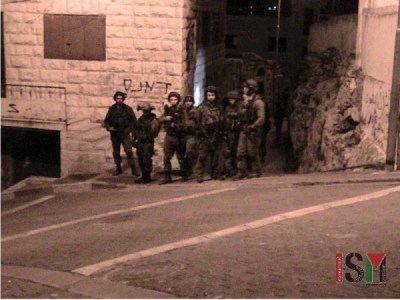 The occupation went missing from The New York Times this past week. Palestinians were there, as victims and attackers, but the brutal military regime that controls their lives made no appearance.
The newspaper had plenty to say about Israeli Jewish life, however: two lengthy stories about prayer space at the Western Wall and one discussing Zionism. Each of these stories ran over a thousand words.
Two shorter news articles reported that the murderers of a Palestinian teen had been sentenced to prison and that a knife attack left one Israeli police officer dead, but nothing in either of these provided the context crucial to understanding events in the occupied territories.
Meanwhile, as the Times obsesses over Israeli identity and attitudes, the occupation grinds on, producing news that appears elsewhere. At the top of the list were two major stories: A Palestinian prisoner was near death after passing his 75th day on hunger strike, and Israeli forces carried out a massive demolition of over 20 homes, rendering more than 100 Palestinians homeless in the dead of winter.
The ordeal of Mohammed al-Qeeq, a journalist held without trial since Nov. 21 of last year, drew the attention of Israeli and international media outlets, which recounted his legal appeals, protests on his behalf and an Israeli Supreme Court decision which “froze” his detention but confined him to a hospital. (Al-Qeeq refused the offer and continued his fast.)
Al-Qeeq’s hunger strike was deemed unfit to print in the Times, perhaps because it would touch on Israel’s use of administrative detention, which holds prisoners without trial. Readers are not to know that as of last December 660 Palestinians were held in this limbo, nor were they to be informed that a number of human rights groups have protested Israel’s unsavory use of the practice.
And then there is the matter of two impoverished villages in the South Hebron Hills of the West Bank, Khirbet Jenbah and Khirbet Al-Halawah, which were made even more destitute after Israeli army crews arrived last Tuesday and demolished 22 structures, displacing 110 people, including dozens of minors. The army also confiscated solar panels, which, like many of the homes, had been donated by aid organizations.
The military claimed that it destroyed Jenbah and Al-Halawah because they were located in a declared firing zone. The Israeli publication 972 Magazine, however, noted that “Jewish settlements within [the zone] have not been served with eviction orders.”
This was the largest mass demolition in a decade, and the plan to destroy villages within the firing zone has drawn international attention and a petition from world-renowned authors to spare the communities. None of this, however, was enough to draw the interest of the Times.
Instead, the Times considered it more urgent to examine the effects of a new prayer space at the Western Wall—not once, but twice—and to take a look at Zionism today. Villagers thrown out in the cold of winter and a prisoner on the brink of death took a back seat to these concerns.
The Times claims that it gives readers “the complete, unvarnished truth as best as we can learn it,” and it insists that the newspaper’s overriding goal is to “cover the news as impartially as possible.” Readers who never stray to other sources of information may actually believe this.
Israeli minister: Egypt flooding Gaza tunnels at our request
MEMO | February 7, 2016
Israeli Infrastructure Minister Yuval Steinitz has said that Egypt’s new policy of flooding the tunnels between the Gaza Strip and the Sinai Peninsula with seawater had come at Israel’s request.
 “Egyptian President Abdel Fattah al-Sisi is flooding the tunnels on his country’s border with the Gaza Strip with water based on a request by Israel,” Steinitz said at a seminar held Saturday in the southern city of Beer Sheva, according to Israel Radio.
“Security coordination between the two countries [Israel and Egypt] is better than ever,” the minister said at the seminar, at which participants discussed the relationship between the two neighbors.
In recent months, the Egyptian army has begun flooding the network of cross-border tunnels linking Egypt’s Sinai Peninsula to the Gaza Strip with seawater.
Subject to a years-long blockade by Israel and Egypt, the Hamas-run Gaza Strip had come to depend on the tunnel network to import desperately-needed commodities, including food, fuel and medicine.
Steinitz is particularly close to Israeli Prime Minister Benjamin Netanyahu and is a member of the latter’s influential security cabinet.
Washington gives Israel $100 million to uncover Gaza tunnels
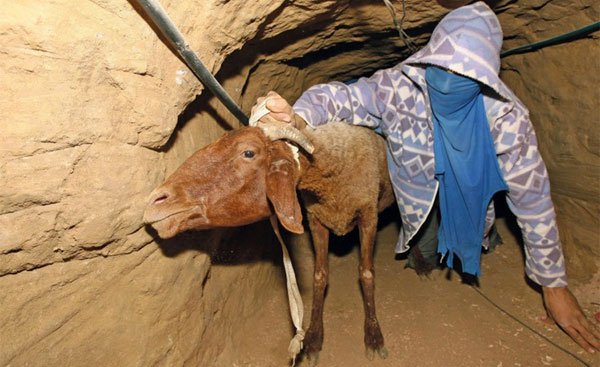
The tunnels are a lifeline for those who live in the beseiged Gaza Strip as they are used to smuggle vital supplies
MEMO | February 2, 2016
Director of Political-Military Affairs at Israel’s Defence Ministry Amos Gilad revealed today that the United States has contributed over $100 million to an Israeli-US technology research project aimed at identifying and locating tunnels on the Gaza Strip border.
In an interview with Army Radio this morning, Gilad stated that intelligence information suggests that there are no such tunnels leading into Israeli territory at the moment.
Defence Ministry official Shalom Gantzer dispelled the fears of Israelis living around the Gaza Strip who have claimed to hear digging noises under their houses, saying that these noises are coming from an electric generator.
Israel’s Channel 10 showed interviews on Saturday with those living near the Gaza border area who had recorded the noises with their mobile phones. They claimed that these noises were the sounds of tunnels being dug from Gaza.
Featured Video

Racist Seinfeld Dances for Joy as Bibi Unveils His New Map
or go to
Aletho News Archives – Video-Images
TV Drama Review
Japanese drama projects Japan’s wartime atrocities onto Chinese characters

Global Times | October 25, 2026
By portraying Chinese characters as perpetrators of ruthless violence while casting Japanese Self-Defense Forces (SDF) intelligence operatives as defenders, the season 2 of the Japanese drama Vivant has recently drawn criticism from Chinese netizens, who argue that its depiction turns historical reality on its head while ignoring Japan’s wartime atrocities.
The TBS drama series – a spy suspense story in which an alleged unofficial intelligence unit of the SDF operates across the globe — has attracted a passionate fanbase. Its currently airing season 2 opened with a household rating of 18.8 percent, the highest for a TV drama this year, according toa commentary article by Japanese media Toyo Keizai.
What draws attention is the portrayal of the enemies in the series, the article noted. Scenes in which the Chinese organization subjects kidnapped members of the SDF unit to brutal torture are repeated with unrelenting intensity.
It is rare for Japanese TV dramas to explicitly portray a real-life country as the enemy, the article noted.
Japanese Prime Minister Sanae Takaichi also made a reference to the drama, saying that she has been recording Vivant and hopes to binge-watch it over the year-end and New Year holidays, according to Japanese media outlets.
China’s CCTV News report on Sunday revealed that the drama features scenes in which Chinese personnel cut off the fingers of and stab Japanese intelligence operatives in the abdomen. Such acts bear striking similarities to the torture inflicted on Chinese nationals by invading Japanese troops during the World War II.
The drama distorts the truth by attributing these atrocities to modern Chinese characters. Beneath the surface, it subtly glorifies Japan’s cross-border overseas operations, blurs the functional boundaries of the SDF and implicitly promotes an expansionist narrative, per CCTV News. … continue
Blog Roll
 Aletho News
- EU facing trillion-euro debt hole while seeking more cash for Kiev
- How US, Europe, Persian Gulf states exhausted missile stockpiles, splurged billions to defend Israel
- Up in arms… Koreans reject U.S. empire’s plan to make South Korea the next Ukraine
- Iran, Turkey, Pakistan, Saudi Arabia could advance region-led security framework in Tehran: FM spox
- Netizens condemn Japanese drama for projecting Japan’s wartime atrocities onto Chinese characters
- Racist Seinfeld Dances for Joy as Bibi Unveils His New Map
- A West Bank War for Netanyahu’s Election Campaign, Could It Backfire?
- Yemen denounces European Parliament’s ‘hypocritical’ push to blacklist Ansarullah
- Qalibaf: UAE’s UN bid aims to ‘clear the runway’ for ‘Greater Israel’, whitewash genocide
- Pakistan reopens Iran border after boosting security: Report
- If Americans Knew
- An error has occurred; the feed is probably down. Try again later.
- No Tricks Zone
- Sudden Stratospheric Warming, Powerful El Niño Combination May Lead To Extreme Europe Cold, Energy Crisis!
- Two New Studies Find Thwaites Glacier Melt Cannot Be Driven By Human Activity Or A Warming Ocean
- E-Cars Reduce CO2 Emissions By Only 41% Compared To Internal Combustion Engine Vehicles
- Predictions Made By Renowned Climate Professor Over Past Decades Have Been Proven To Be Poor
- New Study Suggests Large Regions Of The Pacific Ocean Have Been Cooling For The Last 80 Years
- Germany’s Green Energy Debacle: High Energy Costs Force Kahla Porzellan to Close After 182 Years!
- New Study: 50 Years Of The Most Aggressive ‘Net Zero’ Policies Can Only Affect The Global Climate By 0.03°C
- US September “Heat” Was No Record…Many Records Set Decades Ago
- Latest European Green Energy Debacle; Portugal’s Largest Flagship Solar Park Insolvent!
- Green Energy Debacle: German Expert Professor Fritz Vahrenholt Warns Of Severe Economic And Social Consequences

