US-Qatar Deal Threatens Russia: Reading News Between the Lines
By Alex GORKA | Strategic Culture Foundation | 28.12.2016
Washington boasts strong military presence in the Persian Gulf. Iran and Yemen are the only countries of the region that don’t host US military facilities. The American armed forces use large air installations in Qatar and expand operations in the United Arab Emirates (UAE) and Oman. Bahrain is home to the US Navy’s Fifth Fleet. The US has encouraged the Gulf Cooperation Council (GCC) member states to purchase and install the Patriot Advanced Capability-3 (PAC-3) and the Terminal High Altitude Area Defense (THAAD) advanced missile defense systems.
The US and the GCC countries underscored a commitment to build the defense system at a summit in May 2015. Formally, the «Iranian threat» was used as a pretext. A joint statement following the summit said that the GCC states were committed to developing a ballistic missile defense capability, including an early warning system, with US technical support. The development of a robust integrated BMD network across the region is a primary goal for the US military. It guarantees that the GCC security will depend on the United States.
On December 10, Secretary Ashton Carter told an audience at the International Institute of Strategic Studies (IISS) regional security conference in Manama, Bahrain, that an agreement had been reached to allow Qatar to purchase a long range early warning radar (EWR) from Raytheon. «We reached an agreement for Qatar to purchase a 5,000 km [range] early warning radar to enhance its missile defenses», the official announced.
In July 2013, the Defense Security Cooperation Agency notified Congress of a possible Foreign Military Sale to Qatar of A/N FPS-132 Block 5 Early Warning Radar (EWR) and associated equipment, parts, training and logistical support for an estimated cost of $1.1 billion.
According to Raytheon, the AN/FPS-132 system is designed to detect missile launches that take place thousands of miles away to provide advanced warning time to alert command and control centers and cue fire control systems. ‘This highly reliable radar requires very low manning, yet will operate 365 days a year, 24 hours a day, providing up to 360 degrees of coverage out to 5,000km,’ said Steve Sparagna, chief engineer for the AN/FPS-132 EWR. ‘It is the ideal sensor to deter and detect hostile missile launches.’
According to Michael Elleman, a senior fellow for missile defence with the IISS, the system in future can provide not only Qatar but a unified GCC ballistic missile defence system an early warning capability against any Iranian ballistic missile launches.
The AN/FPS-132 to be based in Qatar is a very special case. It is designed to be used as an early warning system against strategic offensive assets – something Iran does not possess. For instance, the radars of this type are located in Beale Air Force Base, California, RAF Fylingdales, the United Kingdom, and Thule Air Base, Greenland to operate in the Ground-based Midcourse Defense (GMD) BMD system (BMDS). Following formal Missile Defense Agency (MDA) ground test events in FY17/18, Clear and Cape Cod upgraded EWRs (UEWR) are scheduled to be BMDS certified in FY18/19, respectively.
The announced range of 5,000km (3,100mi) by far exceeds the requirement to counter a missile threat coming from Iran. There are radars with shorter range to support the PAC-3 and THAAD systems deployed by GCC countries. In theory, the truck-mounted AN/TPY-2 is the right system for the mission. It can spot a missile launch from hundreds of miles away. If it is effective enough to be stationed in South Korea to counter Pyongyang and monitor parts of China, why is it different in the case of Persian Gulf?
The deployment of AN/FPS-132 to Qatar is not needed to support NATO assets stationed in Europe against Iran. A high powered early warning X band radar is stationed in Malatya, Turkey to carry out the mission. It is operational since January 2012. There is no answer why exactly the AN/FPS-132 – the UEWR with such an impressive detection range – should be used to counter Iran from the Gulf. The distance from Qatar to Iran is just 821 kilometers (510mi). It takes roughly 1,700 km (1,056mi) to reach Turkmenistan from Qatar across the territory of Iran. The AN/TPY-2 covers the whole country. The radar’s estimated range is from 1,500km (932mi) to 3,000km (1,864mi). The maximum instrumented range is 2,000km (1242mi). Obviously, one does not need a radar with an operational range of 5,000km to counter a threat coming from Iran. There is no other reasonable explanation for the choice, except the fact that the AN/FPS-132 can monitor large chunks of Russian territory.
Janes, perhaps unwittingly, confirms the fact. It says, «Raytheon was awarded a USD2.4 billion contract in December 2014 to build Qatar an Air and Missile Defence Operations Centre (ADOC) that it said will «integrate US air defence systems – including Patriot, the Early Warning Radar, and THAAD – with European air defence systems and radars, and Qatar’s Air Operation Centre». It proves that the Qatar-based AN/FPS-132 UEWR is an element of the emerging US global BMDS created to counter Russian nuclear strategic forces.
The announcement of the US-Qatar deal is a demonstration of US adamant resolve to surround the Russian Federation with BMD sites and neutralize its capability to deliver a retaliatory strike if attacked. This is a very disturbing fact. Russia will not sit idle watching the developments. The US has just taken another provocative step to undermine Russia’s security and complicate the bilateral relations.
Nagorno-Karabakh and the Passover Feast: Hollywood’s Glorification of the Arms Trade

David Packouz (L) and Efraim Diveroli
By Richard Edmondson | Fig Trees and Vineyards | April 7, 2016
From Ukraine to North Africa to the Middle East, and most recently in the Caucasus with the outbreak of hostilities between Azerbaijan and Armenia, death and destruction are on the prowl in multiple wars, while at the same time international laws governing armed conflict are rapidly being cast onto the rubbish heap.
Many of these wars have been instigated by powers outside the countries in which they are being fought, and the tide of violence threatening to engulf the world now is unprecedented in history. You would think that at such a time, Hollywood would have better taste than to make a movie glorifying the arms trade.
But of course, you would be wrong.
Scheduled for release in August, “War Dogs” is based on the real life story of Efraim Diveroli and David Packouz, two twenty-something Jews who got involved in the arms trade and ended up bidding on Pentagon contracts, in the process scoring deals to supply weapons, ammo, and other military equipment to forces the US was arming in both Iraq and Afghanistan.
Their story was told in a 2011 Rolling Stone article which detailed their passion for money-making, recreational drug use, and their predilection for shady business dealings. “Packouz and Diveroli met at Beth Israel Congregation, the largest Orthodox synagogue in Miami Beach,” the story informs us, and then goes on to describe how they landed some lucrative contracts, including one worth $300 million, all while operating a small company known as AEY, a shell company Diveroli’s father had set up. All of this was in the years 2005-2007.
For decades, weapons had been stockpiled in warehouses throughout the Balkans and Eastern Europe for the threat of war against the West, but now arms dealers were selling them off to the highest bidder. The Pentagon needed access to this new aftermarket to arm the militias it was creating in Iraq and Afghanistan. The trouble was, it couldn’t go into such a murky underworld on its own. It needed proxies to do its dirty work — companies like AEY. The result was a new era of lawlessness…
One evening, Diveroli picked Packouz up in his Mercedes, and the two headed to a party at a local rabbi’s house, lured by the promise of free booze and pretty girls. Diveroli was excited about a deal he had just completed, a $15 million contract to sell old Russian-manufactured rifles to the Pentagon to supply the Iraqi army. He regaled Packouz with the tale of how he had won the contract, how much money he was making and how much more there was to be made….
Diveroli, by the way, is the nephew of celebrity rabbi Shmuley Boteach, a staunch supporter of Israel and author of several books, including one entitled “Kosher Sex”–a book in which he “breaks down sexual taboos” while pioneering “a revolutionary approach to sex, marriage, and personal relationships, drawing on traditional Jewish wisdom.” Boteach has also run inflammatory ads in the New York Times defending Israel, and in 2012 was bankrolled by Las Vegas casino magnate Sheldon Adelson in an unsuccessful campaign for Congress.
So in other words, while Boteach was doing the TV talk show circuit advising Americans how to improve their sex lives, his nephew Diveroli was finding his niche in the “murkey underworld” of arms trafficking.
Above all, Diveroli cared about the bottom line. “Efraim was a Republican because they started more wars,” Packouz says. “When the United States invaded Iraq, he was thrilled. He said to me, ‘Do I think George Bush did the right thing for the country by invading Iraq? No. But am I happy about it? Absofuckinglutely.’ He hoped we would invade more countries because it was good for business.”
The big $300 million deal they landed found them purchasing stocks of Chinese-made ammunition in the Balkans and transporting them to Afghanistan, but a US embargo against Chinese weapons meant the whole thing had to be carried out clandestinely. The ammo was repackaged in cardboard boxes with no Chinese lettering. But some of the ammo was quite old, a number of the crates were infested with termites, and the two ended up being indicted for fraud and pleading guilty. And now we have a forthcoming Hollywood movie about their endogamic escapades.
It’s tempting to dismiss “War Dogs” as just another piece of Hollywood trash, but of course it comes as millions are coping with the destruction of homes and lives in the bogus war on terror and as whole nations are being torn apart. In Syria, the US has aligned itself with so-called “moderate” rebels, equipping them with vast stocks of weapons, many of which have ended up in the hands of ISIS, while in Yemen, we have assisted Saudi Arabia in an air campaign which, as of January 2016, had resulted in 2,795 killed and 5,324 wounded. At least 62 civilians were killed by coalition airstrikes in December alone, reports the UN, which was more than twice the number killed in the previous month. Many others have been left homeless.

A girl drinks from a leaking street pipe in Yemen, where millions now have no access to drinking water
But this hasn’t stopped the US from continuing to fuel the fire, so to speak. According to Defense News, the State Department has facilitated $33 billion worth of weapons sales to its Arab Gulf allies since May of 2015. The weapons–including anti-armor missiles, attack helicopters, and ballistic missile defense capabilities–have been sold to the six countries that make up the Gulf Cooperation Council, or GCC. These would of course be some of the same countries that have been supplying arms to ISIS while also carrying out war crimes in Yemen.
“In addition, the U.S. government and industry also delivered 4,500 precision-guided munitions to the GCC countries in 2015, including 1,500 taken directly from U.S. military stocks — a significant action given our military’s own needs,” said David McKeeby, a spokesman with the State Department’s Bureau of Political-Military Affairs.
How much of this ordnance may have ended up in the hands of not-so-moderate terrorists is unclear, but in December of 2015, Amnesty International published a report entitled “Taking Stock: The Arming of the Islamic State,” which found that the terrorist army “now deploys a substantial arsenal of arms and ammunition, designed or manufactured in more than 25 countries.”
A lot of this was looted or captured from poorly secured Iraqi military stocks, says the report, but illicit weapons transactions also seem to have played a considerable role in building up the ISIS arsenal–and some of the “chain of custody” evidence cited in the report, including a cache of weapons transferred from Croatia to the Free Syrian Army, sounds almost eerily similar to the sort of shady weapons trafficking operation run by Packouz and Diveroli.
Of course there is the old adage about art imitating life, and, on some level the fact that Hollywood would make a film about two Jews and then go on to entitle it “War Dogs” is perhaps not surprising. This, keep in mind, coming at a time when evidence of Israel’s support for terrorists in Syria is as clear as the hand in front of your face. And of course who could forget the lovable Victoria Nuland and her famous “f**k-the-EU” comment, mouthed off at a time when her State Department was busy engineering a coup in Ukraine?
In fact, efforts by Zionist Jews to create instability and instigate wars are getting to be about as common as fireflies on a summer night. They’re not always easy to spot, but you know they’re out there because they occasionally involuntarily light up, as when someone like Nuland gets caught in a taped phone conversation.
And now it looks like certain fireflies have moved into the Caucasus where they seem to be taking advantage of a long-simmering dispute between Azerbaijan and Armenia over the region of Nagorno-Karabakh. On April 2, intense fighting broke out followed by a series of charges, counter-charges, claims and counterclaims, made by both sides. According to the Armenians, it started with an offensive launched by Azerbaijani troops using tanks and artillery. Azerbaijan, on the other hand, insists it was responding to large-caliber weapons fire from inside the ethnic Armenian-controlled Nagorno-Karabakh area. So who is telling the truth? Or are both sides lying?
Hard to say for sure, but a couple of knowns are worth mentioning: A) Armenia is closely allied with Russia, and, B) Azerbaijan, too, has ties, including trade ties, with Russia, but it also is closely aligned with Turkey and maintains extensive trade relations with Israel. And the trade with Israel has been especially heavy in the area of military procurement.
Israeli drones, anti-aircraft and missile defense systems have been supplied to Azerbaijan in the wake of a $1.6 billion agreement struck between the two countries in 2012. Israeli companies are also active in the Azerbaijani telecommunications, agriculture, water supply medical technology, and energy sectors. That makes for a lot of sayanim on the ground inside a relatively small country.
Perhaps no surprise, then, that Armenian forces shot down an Israeli drone on April 2–the very day hostilities broke out.
The ThunderB drone is known for its light weight, 62 pounds, and its long flying time–25.5 hours–on a single tank of fuel. It is made by an Israeli company known as BlueBird, which reportedly may be about to be purchased by Elbit Systems.
And then on Tuesday came news of yet another Israeli drone spotted over Nagorno-Karabakh–this one believed to be a Harop drone, made by Israeli Aerospace Industries. The Harop is also known as a “suicide drone” in that rather than firing a missile at a target it simply becomes the missile itself, ramming the target and destroying it.
According to Gordon Duff, senior editor at Veterans Today, the key to understanding the Armenian-Azerbaijani conflict is to recognize “that Azerbaijan is a client state of Israel and the CIA.” He adds that Azerbaijan has as well become “the regional operating center for Google Idea Groups,” which he refers to as the “shadow CIA.”
Google Ideas was formed in 2010. At that time Google CEO Eric Schmidt tapped the State Department’s Jared Cohen to direct the new venture, dubbed as a “think/do tank.” In late 2015, Google was reorganized under a parent company called Alphabet, Inc., and in February of this year Google Ideas was rebranded as “Jigsaw”–although it is still run by Cohen and still affiliated with Google.
Cohen, by the way, is also an adjunct senior fellow at the Council on Foreign Relations, and during his years with the State Department (2006-2010) he worked closely with Condoleezza Rice and Hillary Clinton, and became a strategic advisor in US policy toward Iran. Jigsaw’s mission is to “use technology to tackle the toughest geopolitical challenges, from countering violent extremism to thwarting online censorship to mitigating the threats associated with digital attacks,” says Schmidt.
Sounds nice, but a purview of Jigsaw’s website–fittingly kind of creepy and dark-looking–suggests that virtually all of the “activists” it has provided support to seem to be from countries with governments the US seeks to overthrow. And indeed, in 2012 Wikileaks released a cache of emails concerning Cohen’s activities in the Middle East, including one, apparently written by Cohen himself, in which he discusses efforts to stir up trouble in Iran:
I wanted to follow-up and get a sense of your latest thinking on the proposed March trip to UAE, Azerbaijan, and Turkey. The purpose of this trip is to exclusively engage the Iranian community to better understand the challenges faced by Iranians as part of one of our Google Ideas groups on repressive societies. Here is what we are thinking: Drive to Azerbaijan/Iranian border and engage the Iranian communities closer to the border (this is important because we need the Azeri Iranian perspective).
So here, it seems, we have Cohen basically setting up shop on the Iran-Azerbaijan border. It should be noted that both Azerbaijan and Armenia border Iran, while Azerbaijan also shares a border with Russia. A conflict breaking out in this region could easily spill over into Russia or Iran–both of which have called for the two warring parties to adhere to a 1994 ceasefire agreement.
But of course, such a spillover would advance certain geopolitical interests. For one thing, it would pose a dilemma for Russia at a time when it is engaged in Syria. Sergei Zheleznyak, vice speaker of the Russian state Duma, has voiced the view that a “third force” is behind developments in Nagorno-Karabakh. According to the Russian News Agency Tass :
“It is clear that the force that continues to fan the flames of war in the Middle East, Central Asia and the Caucasus dissatisfied with the peacekeeping and counter-terror success of Russia and our allies in Syria is interested in the speedy exacerbation of the protracted conflict in the Nagorno-Karabakh region,” the parliamentarian wrote on his Facebook page on Saturday.
According to Zheleznyak, “neither Azerbaijan nor Armenia essentially need this exacerbation now.” He noted that “there is every likelihood that this provocation has been organized by a third force,” adding that “information on its presence is beginning to leak out.” In view of this, he drew attention to the fact that “at night in the mountains it is enough to have a few trained armed persons who know the opposing sides’ balance of forces to provoke them to open reciprocal ‘reprisal’ fire.”
Most people probably assumed Zheleznyak, in talking about a “third force,” was referring to Turkey–and certainly Turkey’s downing of a Russian jet in Syria factors into the equation. But another element that perhaps figures even more prominently is the “clash of civilizations” that hardcore Zionists have long salivated over the thought of.
We might theorize that ISIS was created with a two-fold objective: one was to break apart Syria and bring about the overthrow of Bashar Assad, while the other was to jockey into existence a clash of civilizations between Christians and Muslims. In both of these objectives it has failed. Assad is still standing, and while the rise of ISIS certainly inflamed anti-Muslim sentiments in the West, it has not resulted in the all-out war between Christianity and Islam that would have played so well into the hands of the Jewish state.
But where the ISIS plan failed, the conflict in the Caucasus could well succeed. Armenia is predominantly a Christian state, while Azerbaijan is mostly Muslim. A war between these two could galvanize public opinion in the region along religious lines. Regional political alignments and the history of the Armenian genocide are also to be considered. Turkey, though sharing a border with Armenia, has openly sided with Azerbaijan. Russia, on the other hand, has remained officially neutral. However, an RT report filed April 5 shows journalist Murad Gazdiev reporting from inside Armenian Karabakh trenches.

Armenian Genocide–young girls crucified on crosses
So where is Israel in all of this? Officially it doesn’t seem to be saying much about it, but in May of 2015, the Jewish Daily Forward published an article entitled, “Why Israel’s Alliance with Azerbaijan is so Shortsighted.” The writer, Christopher Atamian, takes the Jewish state to task over its refusal to recognize the Armenian genocide as well as for its lucrative arms contract with Azerbaijan, a country he refers to as an “authoritarian regime that is fueling regional conflict.”
“This is the same country that attempted to wipe out the entire Armenian population of Nagorno Karabakh in 1991 before losing a bloody war against the Armenians,” he adds.
What he leaves unspoken, of course, is that Israel’s refusal to recognize the Armenian genocide is tantamount to holocaust denial. More than 1.5 million Armenians were massacred from the years 1915 to 1922, and the Jewish state’s silence on the matter became a particularly hot-button issue last year on the genocide’s 100th anniversary.
Zheleznyak, the Duma vice speaker, seems for his own part to be offering sage advice to both parties in the current conflict, noting that Russia’s president as well as its government agencies “urge Armenia and Azerbaijan to cease fire and not to allow to draw them into someone else’s insidious game, as long as it is still possible.”
“As long as it’s still possible” is of course the key question. The more people die, the further recede the possibilities of the regional players not getting trapped or caught up in the “insidious game”–and the greater grow the chances of the conflict’s becoming the parabolic curve that ignites World War III.
Should that come to pass, maybe Diveroli and Packouz will vie for ringside seats–although it doesn’t appear they’ll especially want to sit next to each other. According to the article in Rolling Stone, the two had a major falling out.
“Listen, dude, if you f**k me, I’m going to f**k you,” one of them warned during an argument over money.
“Whatever,” replied the other.
One wonders why they didn’t name the movie “War Pigs” rather than “War Dogs.” Perhaps it wouldn’t have been kosher enough.
In the past year in Israel we’ve seen an arson attack on a Palestinian home which left a mother, father and their 18-month-old baby dead; we have seen a video of Jewish settlers dancing and celebrating the attack by stabbing a photo of the baby; we have observed continued expropriation of Palestinian land in the West Bank, including one of the biggest land grabs in recent years–579 acres near the Dead Sea; and more recently we have seen a second video showing an Israeli soldier executing a wounded Palestinian with a gunshot to the head.
The execution video showed Israeli soldier Elior Azaria pump a bullet into the head of 21-year-old Abdul Fattah Sharif, as he lay on the ground wounded and barely moving. The murder took place on Purim, the Jewish holiday which celebrates the massacre of thousands of Gentiles, as told of in the Book of Esther. The next holiday on the Jewish calendar is Passover, coming up on April 22-23. The significance of Passover is laid out in twelfth chapter of Exodus:
On that same night I will pass through Egypt and strike down every firstborn–both men and animals–and I will bring judgement on all the gods of Egypt. I am the Lord. The blood will be a sign for you on the houses where you are; and when I see the blood I will pass over you. No destructive plague will touch you when I strike Egypt.
This is a day you are to commemorate; for the generations to come you shall celebrate it as a festival to the Lord–a lasting ordinance… And when your children ask you, ‘What does this ceremony mean to you?’ then tell them, ‘It is the Passover sacrifice to the Lord, who passed over the houses of the Israelites in Egypt and spared our homes when he struck down the Egyptians.’
It seems that both Purim and Passover are in essence celebrations of the deaths of non-Jews. Suppose Gentiles observed holidays each year in which we celebrated Jewish deaths? What do you suppose would be said of it?
Whatever one’s views of Judaism may be (there are some admirable sentiments expressed in the Old Testament as well as some repellent ones), Zionism has morphed from the simple idea of a homeland for a specific group of people into a supremacist ideology that has had appalling consequences–not only for its victims but also even for its adherents, dehumanizing them to a degree never thought imaginable.
Zionism is the great Passover feast that has become a celebration of war.
As Saudi and Allies Bombard Yemen US Clocks up $33 Billion Arms Sales in Eleven Months
By Felicity Arbuthnot | Dissident Voice | April 1, 2016
Sometimes even to the most towering cynic, American hypocrisy is more than breathtaking.
As they lambast their latest “despot”, Syria’s President al-Assad — a man so popular in his country and the region that the US Embassy in Damascu had, by the end of 2006, devised a plan to oust him — arms sales to countries where human rights are not even a glimmer on the horizon have for the US (and UK) become an eye watering bonanza.
The latest jaw dropper, as Saudi Arabia continues to bombard Yemen with US and UK armaments dropped by US and UK-made aircraft, is sales worth $33 Billion in just eleven months to the Gulf Cooperation Council (GCC) according to Defense News.
The GCC, a political and economic alliance of six Middle East countries, comprises of Saudi Arabia, Kuwait, the United Arab Emirates, Qatar, Bahrain and Oman. It was established in the Saudi Capital, Riyadh, in May 1981.
Weapons sold to the alliance since May 2015 have included: “… ballistic missile defense capabilities, attack helicopters, advanced frigates and anti-armor missiles, according to David McKeeby, a spokesman for the State Department’s Bureau of Political-Military Affairs.”
“In addition, the U.S. government and industry also delivered 4,500 precision-guided munitions to the GCC countries in 2015, including 1,500 taken directly from U.S. military stocks – a significant action given our military’s own needs,” he added, stressing: “that the US government would like to continue to strengthen partnerships with Kuwait and Qatar through defense sales and other security cooperation activities.”
A metaphor for our times that “partnerships” are “strengthened” with lethal weapons, not in trade of goods, foods, medical, educational or intellectual exchanges.
A fly or two in the oil of the wheels of the US arms trade is the two year delay in approval of sales 40 F/A-18 Super Hornets to Kuwait and Qatar and also 72 F-15 Silent Eagles to Qatar.
Suspicion has been voiced that this has something to do with a pending US-Israel military financing deal, a suggestion emphatically denied by Washington.
In the meantime as Yemen continues to be blitzed, with the UN stating that eighty percent of the population are in need of humanitarian assistance, 2-4 million are displaced and approaching four thousand dead.
It seems Saudi and its allies have more than enough ordinance to continue the slaughter and more than enough US and UK military advisors to help them in the decimation.
Felicity Arbuthnot is a journalist with special knowledge of Iraq. Author, with Nikki van der Gaag, of Baghdad in the Great City series for World Almanac books, she has also been Senior Researcher for two Award winning documentaries on Iraq, John Pilger’s Paying the Price: Killing the Children of Iraq and Denis Halliday Returns for RTE (Ireland.)
Kuwait revokes residency visas of 60 Lebanese over alleged Hezbollah links
Press TV – March 28, 2016
Kuwait has revoked the residency visas of more than 60 Lebanese individuals over their alleged links with Lebanon’s Hezbollah resistance movement.
The Kuwaiti Arabic daily al-Qabas quoted a Kuwaiti security source as saying that the people to be deported can stay in Kuwait under a temporary residency visa of one to two months until they receive their financial dues and make the necessary arrangements.
The source, however, added that those among the group of would-be-deportees that have been classified as “dangerous” have only 48 hours to leave the country.
The daily also quoted Maj. Gen. Mazen al-Jarah, the interior assistant undersecretary of the citizenship and passports affairs, as saying that decisions for deportations fall within the purview of Interior Minister Sheikh Mohammad al-Khalid, adding that the cancellation of the deportations can only be made with his approval.
The daily had reported on March 21 that the Kuwaiti government deported 11 Lebanese and three Iraqis on charges of having links to Hezbollah.
The move came after the [Persian] Gulf Cooperation Council ([P]GCC), under the influence of the Saudi regime, branded Hezbollah a “terrorist” organization on March 2. Arab League foreign ministers, except those of Iraq and Lebanon, later followed suit.
The [P]GCC — comprising Saudi Arabia, Qatar, the United Arab Emirates, Oman, Bahrain and Kuwait — however, did not provide any evidence for the accusation. The first three monarchies mentioned themselves stand accused of supporting extremists and terrorists in the region.
Hezbollah has denounced the decision.
Saudi Arabia and its allies in the council have opposed Hezbollah’s presence in Syria and its assistance to the government of President Bashar al-Assad in the fight against Takfiri terrorists. Hezbollah says its aid to Assad is necessary to stop the spillover of violence into Lebanon.
Saudi regime detains top Shia scholar in Eastern Province
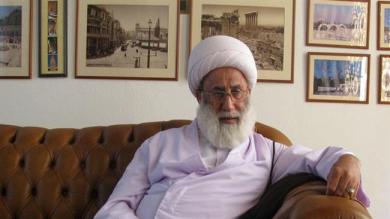
Senior Saudi cleric Ayatollah Hussein al-Radhi
Press TV – March 22, 2016
The Saudi regime’s security forces have arrested a prominent Shia cleric over his anti-regime comments as Riyadh continues its crackdown on the minority sect.
Media reports said on Tuesday that security forces arrested Ayatollah Hussein al-Radhi shortly after he led prayers in the al-Ahsa oasis region of Eastern Province.
The detention came after the senior cleric wrote an article in which he criticized the House of Saud for jailing and executing critics and dissidents, including Sheikh Nimr Baqir al-Nimr who was beheaded in January.
Al-Radi had also infuriated the monarchy by denouncing the ongoing deadly Saudi airstrikes which have claimed lives of more than 8,000 civilians in Yemen.
Riyadh has been under fire from international organizations and rights groups over the rising number of civilian casualties in Yemen. The United Nations Human Rights Council (UNHRC) has recently said that Saudi Arabia and its allies may be committing crimes against humanity due to their indiscriminate killing of civilians in Yemen.
The senior cleric had also strongly denounced a decision by the Saudi-led [Persian] Gulf Cooperation Council to brand Lebanon’s resistance movement Hezbollah as a terrorist organization.
Saudi Arabia has been denounced by rights groups for its grave human rights abuses and harsh crackdown on all forms of dissent.
The Shia-dominated Eastern Province has been the scene of peaceful demonstrations since February 2011.
Protesters have been demanding reforms, freedom of expression and the release of political prisoners. They want an end to economic and religious discrimination against the region.
Reports on protests in Qatif are scant, as Saudi authorities allow foreign news media to visit the region only if accompanied by government officials, claiming it is to ensure journalists’ safety.
Shia Muslims have long complained of entrenched discrimination in a country where the semi-official Wahhabi school condones violence against them. They face abuse from Wahhabi clerics, rarely get permits for places of worship and seldom get senior public sector jobs. Shia religious centers have also been target of a series of terror attacks across the region over the past few months.
Those basic complaints have over the years been aggravated by what residents across the Shia-majority call heavy-handed security measures against their community. They accuse the authorities of unfair detentions and punishments, shooting unarmed protesters and torturing suspects.
Kuwait expels 14 people for links with Hezbollah: Report
Press TV – March 21, 2016
The Kuwaiti government has deported 11 Lebanese and three Iraqis on charges of having links to Lebanon’s resistance movement, Hezbollah, a report says.
The Kuwaiti Arabic daily al-Qabas quoted a security source as saying on Monday that the 14 people had been expelled on the order of the state security service.
The move came nearly three weeks after the [Persian] Gulf Cooperation Council ([P]GCC), under the influence of the Saudi regime, declared Hezbollah a “terrorist” organization. Arab League foreign ministers, except those of Iraq and Lebanon, later followed suit.
The [P]GCC – comprising Saudi Arabia, Qatar, the United Arab Emirates, Oman, Bahrain and Kuwait – however, did not provide any evidence for its allegation. This comes as the first three monarchies themselves stand accused of supporting extremists and terrorists in the region.
Describing the [P]GCC decision as “reckless and hostile,” Hezbollah blamed it on Saudi Arabia.
Elsewhere in its report, Qabas said that Kuwaiti security officials have prepared a list of “unwanted” Lebanese and Iraqi people, including advisers to big companies, to be expelled for “the public interest.”
The people will not be allowed to enter the [P]GCC member states after their deportation, the daily said.
Livni Hails Blacklisting Hezbollah, Urges Alliance with Gulf States
Al-Manar | March 14, 2016
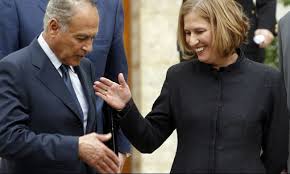 Israeli former Foreign Minister, Tsipi Livni, hailed Arab League decision to blacklist Hezbollah as a ‘terror group’, calling to conclude alliance between the Zionist entity and some Arab states.
“AL decision to adopt the Gulf Cooperation Council is rightful and represents a positive shift,” Israeli daily, Maariv quoted Livni as saying.
Livni meanwhile, called for concluding an alliance between Israel and “moderate Muslim countries” including Gulf states and some Arab countries which blacklisted Hezbollah, the Israeli paper said.
On the other hand, the Israeli politician called for preventing Hezbollah from taking part in the parliamentary elections in Lebanon, according to Maariv.
“Livni also urged not to make distinction between Hezbollah and ISIL,” the daily added referring to the Takfiri group operating in Iraq and Syria (so-called Islamic State in Iraq and Levant).
Gulf states to take legal action against Hezbollah affiliated TV channels
MEMO | March 9, 2016
Gulf Cooperation Council (GCC) information ministers agreed on Tuesday to take legal action against TV channels affiliated to Hezbollah, Anadolu reported.
This decision came as part of the conclusion statement of the 24th meeting of the GCC information ministers, which was held in the Saudi capital of Riyadh.
“The legal measures stipulated in the decision will apply to all production companies, producers and all matters related to media,” the statement said.
“They are based on the GCC laws and on international laws related to the fight against terrorism,” it said, noting that Hezbollah is considered a terrorist entity.
According to the statement, the GCC described Hezbollah as a group that “incited hatred, chaos and violence” in “blatant violation of the sovereignty, security and stability of GCC and Arab countries”.
On 2 March, the GCC and the council of Arab interior ministers designated Hezbollah a terrorist organisation.
Saudis, Turks Bid to Open Lebanon Front
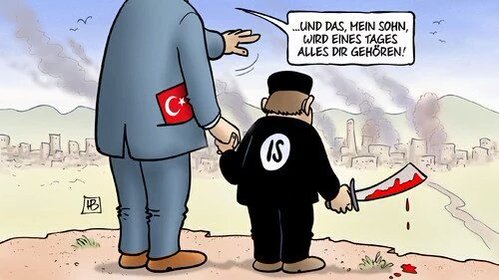
One day, my son, all this will be yours
By Finian CUNNINGHAM – Strategic Culture – 07.03.2016
With a series of blatant measures, Saudi Arabia and its regional allies are evidently trying to destabilize Lebanon. The development is apiece with how Saudi Arabia and Turkey have both sought to undermine the ceasefire in Syria and to escalate that conflict to a region-wide level.
A New York Times report this week poses a rather naive conundrum: «Diplomats and analysts have spent several weeks trying to understand why the Saudis would precipitously start penalizing Lebanon – and perhaps their own Lebanese allies – over the powerful influence of Hezbollah, which is nothing new».
Well, here’s a quick answer: Russia’s very effective squelching of the covert war for regime-change in Syria. That has sent Saudi Arabia and Turkey into a paroxysm of rage.
Russia’s military intervention in Syria to defend the Arab state from a foreign-backed covert war involving myriad terrorist proxy groups, has dealt a severe blow to the machinations of Washington, its NATO allies and regional client states.
While Washington and its Western partners seem resigned to pursue regime change by an alternative political track, Saudi Arabia and Turkey are stuck in the covert-war groove. They are betting that the terrorist proxy armies they have weaponized can somehow be salvaged from withering losses inflicted by Russian airpower in combination with the ground forces of the Syrian Arab Army, Iranian military advisors and the Lebanese Hezbollah militia.
Hence, the immediate breaches of the cessation called a week ago by Washington and Moscow in Syria. Turkish military shelling across the border into northern Syria is not just a breach. It is an outrageous provocation to Syrian sovereignty, as Moscow has pointed out.
Simultaneous Saudi military mobilization, including Turkish forces, on its northeast border with Iraq, as well as the reported deployment of Saudi fighter jets to Turkey’s Incirlik airbase opposite Syria’s northwest Latakia province can also be viewed as calculated moves to undermine the tentative ceasefire. The logical conclusion of this reckless aggression by both Saudi Arabia and Turkey is to precipitate a wider conflict, one which would draw in the US and Russia into open warfare.
The series of Saudi-led initiatives towards Lebanon should be interpreted in this context. In the past week, Saudi Arabia and its closely aligned Sunni monarchies in the Persian Gulf Cooperation Council (GCC) have declared Hezbollah a terrorist organization. The word «anachronistic» comes to mind, belying an ulterior motive.
The Saudi rulers, led by King Salman and his son Crown Prince Mohammad bin Salman, also announced that they were canceling plans to grant Lebanon $4 billion in aid. Most of the aid was to be in form of military grants, to be spent on upgrading the Lebanese national army with French weaponry and equipment.
Without providing any proof, the GCC states – Kuwait, Qatar, Bahrain, the United Arab Emirates and Oman in addition to Saudi Arabia – issued travel warnings to their nationals intending to visit Lebanon. The GCC also claimed that Hezbollah was interfering in their internal affairs and trying to recruit Gulf nationals into the organization to fight in Syria. The GCC has even threatened to deport Lebanese expatriate workers, some half a million of which work in the Gulf.
There were also regional media reports last week of a large cache of weapons having been seized by Greek authorities, stowed illicitly onboard a cargo ship sailing from Turkey to Lebanon.
The cumulative intent seems patent. The Saudis and their regional allies – who have been pushing for regime change for the past five years against the Russian, Iranian and Hezbollah-allied government of President Bashar al-Assad – see the escalation of regional instability as the best way to salvage their covert war in Syria.
Washington, London and Paris probably have sufficient cynical intelligence to realize that the covert war involving terrorist proxies is no longer a viable option – given the formidable forces arrayed in support of the Syrian state, not least Russian air power.
The Saudis and the Turkish regime of Recep Tayyip Erdogan appear to be inflexibly wedded to the covert war agenda. For these powers anything less than the outright removal of Assad would be seen as a grave blow to their despotic egos and, for them, an unbearable boost to their regional rival, Shia-dominated Iran.
The GCC criminalization of Shia-affiliated Hezbollah is obviously a fit of revenge-seeking given how the militia has ably helped the Syrian army retake major areas from the regime-change Sunni extremist insurgents, in conjunction with the Russian air strikes. The steady shutting down of border crossings in Latakia, Idlib and Aleppo has cut-off the terror brigades from their weapons supply routes via Turkey. This is partly why the Erdogan regime has responded by cross-border shelling in order to give re-supply efforts a modicum of artillery cover.
Moreover, the Saudi-led campaign to sanction Hezbollah is also aimed at destabilizing the sectarian fault lines inside Lebanon. Hezbollah may be denigrated by Washington and some other Western states as a «terrorist group» and of presiding over «a state within a state» due to its military wing which exists alongside the Lebanese national army.
Nevertheless, Hezbollah has constitutionally recognized legitimacy within Lebanon. This is partly due to the militia’s primary role in driving out the US-backed Israeli military occupation of the country in 2000 and again in 2006. For many Lebanese people, including Christians and Sunni Muslims, Hezbollah is held with pride as an honorable resistance force to US-led imperialism in the region.
The party – which Russia also recognizes as a legitimate national resistance movement – comprises about 10 per cent of the Lebanese parliament and holds two cabinet positions in the coalition Beirut government.
So the Saudi-led proposal to sanction Hezbollah seems nothing more than a gratuitous bid to open up sectarian fissures that have cleaved Lebanon in the recent past during its 1975-1990 civil war. The provocation of labeling a member of government in a foreign state as «terrorist» – seemingly out of the blue – has to be seen as a tendentious bid to destabilize. Hezbollah leader Hassan Nasrallah this week condemned the Saudi bid to inflame sedition in Lebanon, and it is hard to disagree with that assessment.
There are still pockets of extremist Sunni support within Lebanon that the Saudis and Turkey appear to be trying to incite. During the Syrian conflict, there have been sporadic outbreaks of violence in the cities of Sidon and Tripoli by Salafist elements with close links to Saudi Arabia and Turkey. Now those same elements are being incited to take to the streets again.
It is not clear if Lebanon can hold together. A government minister linked to a pro-Saudi faction has resigned in recent weeks over what he claims is «Hezbollah domination» in Lebanese politics.
Many Lebanese are discontented over social and economic problems dogging the country. A refuse-collection backlog over the past year has left large parts of the capital overflowing with putrid waste. The tiny country of four million is also feeling the strain of accommodating some one million Syrian refugees.
The thought of re-opening old wounds and re-igniting the horror of civil war is a heavy burden on most Lebanese citizens that may be enough to make them baulk at malign pressures.
But what can be said for sure is that the role of Turkey, Saudi Arabia and the other Arab monarchies is absolutely unconscionable and criminal. They seem fully prepared to plunge yet another neighboring country into a sectarian bloodbath in order to gratify their illicit regional ambitions.
GCC not after protecting Lebanon: Hezbollah chief
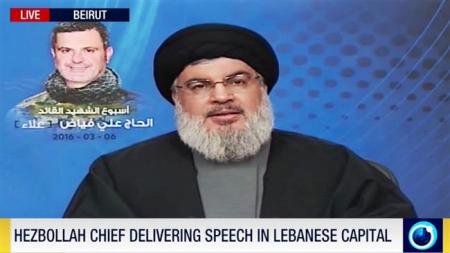
Press TV – March 6, 2016
Sayyed Hassan Nasrallah, the secretary general of the Lebanese resistance movement Hezbollah, says the Arab member states of the [Persian] Gulf Cooperation Council ([P]GCC), which recently listed the resistance group as terrorists, do not have the interests of Lebanon in mind.
During a live televised speech on Sunday, Nasrallah said those who assume that the Arab regimes will protect Lebanon have “pinned their hopes on a fantasy.”
Had Lebanon waited for a unified Arab strategy in the face of Israel instead of opting to resist against the occupying regime, “then the fate of this territory would have been the same as the fate of the territories Israel has taken control of,” he said.
On Wednesday, the six-nation Arab bloc issued a statement labeling Hezbollah a terrorist organization. The [P]GCC comprises Bahrain, Kuwait, Oman, Qatar, Saudi Arabia and the United Arab Emirates.
“Many of these Arab countries today, who designate us as terrorists, what do they have to do with this resistance and these victories and these achievements?” Nasrallah said.
Israel unleashed an all-out offensive on Lebanon 10 years ago under the pretext of releasing Israeli soldiers allegedly captured by Hezbollah in southern Lebanon. The invasion claimed the lives of nearly 1,200 Lebanese people, most of them civilians.
The Tel Aviv regime was, however, forced to retreat without achieving any of its objectives after Hezbollah fighters displayed heavy resistance against the Israeli military.
“Back then, we said to them (the Arab countries) ‘we don’t want anything from you… Today, we also say to them, to these regimes, ‘We don’t want anything from you. We don’t want money, nor do we want weapons, nor do we want support or blessing,” he said. “Just leave this resistance alone, leave this country alone, and leave this people alone.”
He blamed some Arab regimes for conspiring against anyone standing against Israel.
Nasrallah also underlined the assistance provided by the resistance group to the Iraqi government in its fight against the Takfiri terror group Daesh and reminded that Hezbollah did not wait for any orders to initiate its anti-terror fight in Syria and only fulfilled its religious commitment.
The secretary general of Hezbollah also addressed the tension that has been bubbling up between Saudi Arabia and Lebanon, causing the former to take a raft of hostile measures against the latter.
“If it’s angry with us, it has the right to. I understand Saudi Arabia’s anger. Why? Because when one fails, at the very least he will be angry,” Nasrallah said.
He went on to explain that the Saudi rage has emanated from the kingdom’s failures in Yemen and Syria.
“In Syria, there’s a very great Saudi anger because what they had calculated in Syria [was that] in two or three months, ‘Syria would fall into our hands,’” Nasrallah said.
Hezbollah has been successfully aiding the Syrian military against foreign-backed militant groups.
“He, who confronts Saudi Arabia in Syria is the real defender of the Lebanese national interests,” Nasrallah said.
“The same goes for Yemen. The estimations of the new Saudi leadership was that ‘we will decide the battle in Yemen. We will teach a lesson to all the Arab countries and the Arab world… and we will impose ourselves on the Arab world,’” he said.
Saudi Arabia launched a campaign of military aggression against Yemen in late March last year in a bid to bring fugitive former Yemeni President Abd Rabbuh Mansur Hadi, a Riyadh ally, back to power and undermine Yemen’s Houthi Ansarullah movement.
Riyadh has, however, failed in accomplishing either of the two objectives, and has become entangled in a prolonged expensive war, whose adverse economic impacts—along with economic mismanagement—have gradually been giving rise to domestic discontent inside Saudi Arabia.
Bahrain King Meets Rabbi: Arab-Israeli Diplomatic Ties ‘Matter of Time’

Al-Manar – March 5, 2016
The King of Bahrain has met Israeli Rabbi and ‘recommended’ that the recent blacklisting of Lebanese resistance movement, Hezbollah, as a “terrorist organization” by the Gulf Cooperation Council be taken up by the Arab League as well, Israeli daily, Jerusalem Post reported.
Hamad bin Isa al Khalifa received Rabbi Marc Schneier, and president of the Foundation of Ethnic Understanding based in New York, in the royal palace in Manama in order to discuss “concerns in the Middle East,” JP reported.
The six-member GCC formally blacklisted Hezbollah as a “terrorist organization” on Wednesday.
During Scheier’s meeting with Khalifa, the king noted that there were one or two countries among the GCC who had wanted to distinguish between Hezbollah’s military wing and its political wing, although this was rejected, the Israeli paper said.
According to Schneier, who has met with Khalifa on two other occasions, the king told him “he was advocating for the struggle against Hezbollah to be expanded as widely as possible in the Arab world, stating that the Arab League and its 22 members should take up this mantle and label the group as terrorists.”
“Iran is not only an obstacle but an opportunity for peace between Israel and Arab nations,” Schneier told The Jerusalem Post on Thursday after his meeting on Wednesday with Khalifa.
“Both Israel and the Gulf states share a common enemy, so it’s the makings of a natural alliance, in terms of joining forces against the evil of terrorism, religious extremism and fanaticism,” the Israeli Rabbi said.
“It’s a real opportunity and a silver lining in the dark cloud of terrorism. The Gulf states recognize Israel as an ally against Iran, and its ability to stabilize the region and support moderate Arab countries, so this could be a game changer in the geopolitical climate of the Middle East.”
Schneier added that Khalifa has also said during their meeting that in his opinion “it is just a matter of time before some Arab countries begin opening diplomatic ties” with the Zionist entity.
Featured Video
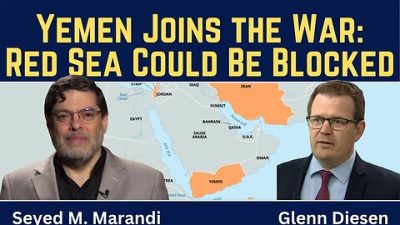
Yemen joins the war – Red Sea could be blocked next – Saudi regime at risk
or go to
Aletho News Archives – Video-Images
From the Archives
A superpower and “the world’s sickest warrior state”
By Paul J. Balles | March 8, 2010
Living through five or six major wars has hardened me to what I thought were the extremes of inhuman cruelty and brutality.
Two things made those extremes almost bearable: the brutality always revealed – at least according to the media coverage – the viciousness of the enemy. It was therefore quite understandable when our “brave men and women” pulverized the enemy.
Films of Japanese torturing captive Americans somehow justified holding Japanese Americans in internment camps during World War II; and only a small percentage of Americans found the bombing of Hiroshima and Nagasaki unreasonably vengeful at best, at worst, depraved.
The media giants in America portrayed the North Koreans as barbaric beasts with their captives, quite unlike their southern counterpoints – our allies during the Korean War. No one ever felt the need to explain how the South Koreans were a civilized breed while the North Koreans were absolute savages, at least according to the official line.
In Vietnam, our warriors justifiably (or so the media made us believe) dropped napalm on the North Vietnamese who had the gall to hide in villages and tunnels to ravage our invaders. At least it was accepted practice until some rogue photojournalist filmed a young girl screaming down a Vietnamese road in flames. … continue
Blog Roll
 Aletho News
- Russian tanker approaches Cuba despite US oil blockade
- Marandi: Yemen joins the war – Red Sea could be blocked next – Saudi regime at risk
- Pro-Palestinian French member of European Parliament denied entry to Canada
- Pakistan to Host US-Iran Talks
- How Indonesia’s tilt toward the US left it stranded in the Strait of Hormuz
- US has no choice but to retreat from Iranian borders: Top commander
- Iran Retaliation Strikes Chemical Plant Near Dimona
- AWACS’ Destruction is a Major Loss for US Military – Ex-DoW Analyst
- Israel’s Iran Strategy Uses US Military & Gulf States as Its Pawns
- Iran: Trump wanted regime change, now just begging for Hormuz to open
- If Americans Knew
- Israeli police block Catholic cardinal from entering Church of the Holy Sepulchre on Palm Sunday
- Israel is assassinating journalists again, more than any other nation, anywhere, ever – Not a ceasefire Day 170
- Over 300 US service members wounded, majority have brain injuries – Not a ceasefire Day 169
- Researchers at Human Rights Watch Resign Over Blocked Report on Palestinian Refugee Return
- Jewish Groups Are Backing a War Americans Don’t Want
- Eric Fingerhut Thinks He’s the President of the Jews
- Top Jewish Philanthropists, Rabbis Urge Israeli President to Take Action Against ‘Jewish Extremists’
- Don’t Be Fooled. Zionist Leaders Have Always Wanted to Control Southern Lebanon
- Israel’s widespread use of torture is a core element of its genocide against the Palestinian people
- In Israel’s War on Iran, Many Middle East US Bases Rendered “All But Uninhabitable”
- No Tricks Zone
- German Science Blog Accuses PIK Climate Institute Of Hallucinating Climate Tipping Points
- Devastating Assessment Of Comirnaty Vaccine By Former Senior Pfizer Europe Toxicologist
- New Study: CO2 Is ‘Effectively Negligible’ As An Explanatory Climate Change Factor Since 2000
- Former Pfizer Toxicologist Dr. Helmut Sterz Tells Bundestag Hearing Pfizer Vaccine Should Have Never Been Approved
- Energy Expert: Germany’s Nuclear Phaseout Was A “500 Billion Euro Mistake”
- New Research: South Australia’s Mid-Holocene Sea Surface Temperatures Were 4°C Warmer Than Today
- Storing Green Energy To Last Germany 10 Days Would Require A 60-Million Tonne Battery
- New Studies: UK Sea Levels Were 4 Meters Higher Than Today During The Mid-Holocene
- Destructive Green New Deal: German Energy And Metal Group Warns Of Drastic Crisis
- New Study Documents A 20-Year Pause In Arctic Sea Ice Decline – Driven By Internal Variability
 Aletho News