From Industrial Power to Military Keynesianism: Germany’s Engineered Collapse
By Gerry Nolan | Ron Paul Institute | January 8, 2026
German Chancellor Friedrich Merz now admits that “parts of Germany’s economy are in very critical condition” and that his government “hasn’t done enough.” That phrasing is an evasion. Germany did not drift into this collapse. The numbers were visible in real time. The warnings were explicit. And suicidal decisions were made anyway.
Start with energy, because everything downstream flows from it.
Before the 2022 launch of Russia’s special military operation (SMO), Germany’s industrial model rested on stable Russian pipeline gas priced roughly €15–25 per MWh. Wholesale electricity averaged €30–50 per MWh. That price stability, and not hysterical slogans, powered German competitiveness. It allowed long planning cycles, protected margins, and kept energy-intensive manufacturing viable. It also kept household bills manageable, wages meaningful, and social cohesion intact.
Post Russian SMO, that foundation was deliberately dismantled.
Gas prices predictably exploded, peaking above €300 per MWh in 2022 — a 12–20× increase at the height of the engineered crisis. Electricity followed. German wholesale power prices averaged ~€235 per MWh that year, with intraday spikes well north of €400 per MWh. Even after emergency subsidies, rationing, and accounting tricks, prices today still sit around €100–130 per MWh, approx three to four times the pre-SMO norm.
This cannot be blamed on volatility. This is permanent repricing of German industry — the direct result of Berlin going along with the Nord Stream sabotage, ending the era of cheap, reliable Russian energy without protest, without investigation, and without dignity.
That humiliation solely laid at the feet of supplicant German elite. It was downloaded directly onto German households via higher heating bills, higher electricity costs, higher food prices, shrinking real wages, all while being told this was the price of “standing with Ukraine.” Germans paid more to live worse, and were instructed to feel morally superior about it.
Berlin knew exactly what this would do.
Energy-intensive industrial output has fallen by 20% from pre-SMO levels. Chemical production shrank. Auto suppliers cut jobs at double-digit rates. BASF downsized at home and expanded abroad. New industrial investment increasingly flows to the United States and Asia, not Germany. The costs were socialized downward; the consequences localized.
Then came the autos, the core of the economy.
German carmakers have lost close to half of their China market position since 2020, with market share falling from the high-20s into the mid-teens. Porsche’s China sales are down ~25–30%. Volkswagen’s operating margins have collapsed toward 4%. Employment across the auto-supplier ecosystem has fallen by high single digits, with major firms cutting 10% or more of their workforce. These weren’t hidden trends. China was Germany’s largest trading partner. Berlin chose ideological obedience over industrial reality and paid the price.
And still, the policies continued. Why?
Because collapse below coincided with profit above.
While Germany’s civilian manufacturing base contracted, its military-industrial sector surged. Germany’s defense budget has ballooned as a share of federal outlays, with the Bundestag approving record arms contracts worth around €50–€52 billion in late-2025 alone, including 29 major procurement orders for vehicles, missiles, and satellites, one of the largest such spending decisions in the nation’s history.
At the center of that boom sits Rheinmetall, once a marginal player, now the engine of the continent’s rearmament. Its order backlog hit a new high of roughly €63 billion, with incoming framework agreements jumping 181 % year-on-year in early 2025, and sales surging 36 % in 2024 as defense demand exploded.
Rheinmetall’s stock performance answers the question of who profits. Its shares have more than doubled and at times tripled in value in recent years as markets priced in Europe’s structural defense spending shift, even as the broader economy languished.
Defense equities across the continent have followed suit. European defense indices returned well into the double digits in 2025, making military contractors some of the best-performing assets even as traditional industrial sectors faded.
Rearmament became the one form of “growth” Brussels would never question: losses socialized, gains concentrated. Civilian factories closed and exports faltered, but state-backed military contracts flowed like a firehose. De-industrialization for thee (Germans), weapons profits for me (Germany’s MIC).
Contrast this with Russia and China, and the comparison becomes merciless.
Russia ring-fenced energy, secured domestic supply, redirected trade flows east and south, and surged industrial output under sanctions designed to cripple it. China did the opposite of austerity theater by doubling down on production, scaled EVs, batteries, and supply chains, and absorbed global shocks without blowing up its own infrastructure or pricing its industry out of existence.
Neither country sacrificed its economic base to signal virtue and moralized itself into decline. But Germany did.
So when Merz says “we haven’t done enough,” the timeline exposes the lie. Enough for whom? The households rationing heat? German workers losing jobs? The firms closing plants? Or the protection racket (alliance) managers who demanded compliance regardless of cost?
Ask the question Berlin refuses to ask… If the energy calculus was known, if the China dependence was obvious, if the auto collapse was measurable in real time — at what point does failure become design?
Germany didn’t lose competitiveness by accident or incompetence alone. It surrendered it, to expensive LNG, to trade self-sabotage with China, to an EU architecture that rewards submission over outcomes and treats war as a military Keynesianism.
This was betrayal of the German people. An EU structure that treats Germans as an invoice, not a constituency. A population forced to absorb humiliation, higher bills, and industrial decay — while being told this sacrifice makes them morally superior.
But the bill has arrived. The damage is done.
And that is precisely why Merz and his fellow Eurocrats will cling to this war against Russia at all costs. Not because peace is dangerous, but because peace would bring a reckoning. Not from Moscow, but from German streets. From workers, households, and industries that would finally ask why their prosperity was sacrificed, who profited, and who signed the orders.
No letter to lawmakers, no partial confession, will erase who made these choices, or who paid for them.
Gerry Nolan is a political analyst, writer, and strategist focused on geopolitics, security affairs, and the structural dynamics of global power. He is the founder and editor of The Islander, an independent media platform examining war, diplomacy, economic statecraft, and the accelerating shift toward a multipolar world.
Climate extremists claim responsibility for blackout affecting 50,000 households
RT | January 4, 2026
 A group of self-described climate activists has claimed responsibility for a massive power outage that hit five districts in southwestern Berlin, saying the action targeted the fossil fuel industry and “the rich.”
Up to 50,000 households and 2,200 commercial entities were affected by the blackout in the early hours of Saturday, a spokesman for the local electricity provider, Stromnetz Berlin, told the Berliner Zeitung. “Full restoration of power supply” is expected no sooner than January 8, according to the company. The residents of the affected areas would have to remain without power in “freezing temperatures” ranging from -7C to -1C, the paper reported.
Police are treating the incident as a targeted arson attack, according to local media. The blackout was caused by a blaze that hit a power bridge over the Teltow Canal, which goes through the southern part of the city. Several nursing homes and elderly care centers had to be evacuated because of the incident, according to a local fire department. No casualties have been reported in connection to the incident.
Police also said they had received a letter signed by the “Volcano Group” on Saturday evening, in which the climate activists and anti-Fascists claimed responsibility for the incident. The group blamed the industrial extraction of natural resources for the “destruction” of Earth and that humanity “can no longer afford the rich.” The group then said they had “successfully sabotaged” a gas power plant, adding that their action was “socially beneficial” and targeted the fossil fuel industry.
The regional office of the German domestic security service was verifying the letter’s authenticity, according to the police.
According to the Berliner Zeitung, the group had carried out similar attacks in the past. They claimed responsibility for the sabotage of two power cables in southeastern Berlin in September. That attack also left around 50,000 households without power at the time.
Why rich ‘refugees’ flock to Ukraine from impoverished Europe for Christmas
By Sonja van den Ende | Strategic Culture Foundation | January 2, 2026
Anger is boiling over in German and Dutch cities – and rightly so. While many Europeans are having to count every euro twice in this crisis of Europe’s own making, convoys of Ukrainian cars are heading east during the Christmas holidays. These refugees, reportedly fleeing Russian bombs and drones, are being well supported financially by Germany, the Netherlands, and other European countries – yet as Christmas approaches, they suddenly return home in high spirits.
At the Polish-Ukrainian border, cars are stuck in traffic jams for kilometers. Journalists report hours-long waits, and the flow of returning travelers shows no signs of abating. Families registered as war refugees are heading back to Ukraine for the Christmas and New Year holidays. While air raid sirens supposedly never cease in Ukraine, the fear of missiles and drones appears to fade. The contradiction is stark. Mainstream outlets like Deutsche Welle, whose reporter Christopher Wanner covered the border traffic, have reported on these queues (the report can be viewed here).
Worse still, if you look at the cars in Wanner’s report, many are expensive vehicles that Europeans themselves can no longer afford – because Europe is mired in an economic crisis of its politicians’ making.
Is this still fleeing war? Are these still refugees who supposedly cannot return to their homeland? Or is it simply vacation travel at the expense of the European taxpayer? Calls are growing for every refugee to be thoroughly screened. Critics argue that someone who travels to a war zone without a compelling reason can hardly claim protection. After all, according to the mainstream media and radicalized EU politicians, they should be facing death from “Putin’s bombs and drones.”
Visiting Ukraine is even advertised and promoted in various brochures and websites. The western regions of the country boast “the most colorful and unique Christmas atmosphere.” One travel site recommends: “a mini-trip to Transcarpathia to anyone who wants to immerse themselves in a fairytale atmosphere and see for themselves how ancient Ukrainian traditions are reflected in modern life. Find more New Year’s and winter trips to Ukraine here.”
These so-called Ukrainian refugees are among the approximately 6.5 million people who have sought refuge across Europe. Germany is the main destination, with over a million Ukrainian war refugees; Poland follows closely behind, currently hosting over 950,000. But are they really refugees? No, of course not. The majority come from western Ukraine, where there is no war. The people of the Donbas – now part of Russia – should be the real refugees. That is where drones, bombs, and missiles from Ukraine and NATO are flying.
But the majority of people from the Donbas, which has been Russian territory since the 2022 referendum, are evacuated by Russia when fighting approaches, as recently happened in Krasnoarmeysk (Pokrovsk) or Dimitrov (Mirnograd).
About a million people from the Donbas have been relocated, or if you prefer, have fled and are being housed in various regions of Russia. Among them are children who have lost their parents or are searching for them. Europe calls this “child stealing,” an absurd claim. Should these children die if, for example, drones strike Krasnoarmeysk while their parents are killed or missing in the chaos? Ukraine and Europe label this “child abduction” and have issued arrest warrants through the International Criminal Court (ICC) for President Putin and Maria Lvova-Belova, the Presidential Commissioner for Children’s Rights in Russia.
The European population is slowly waking up, perhaps too late. Their countries have already been practically surrendered to the refugee industry. It is rampant across Europe and worsening daily. In the Netherlands, for example, one hotel after another is being filled with refugees, often without the consent of local villagers or even the hotel owners themselves. The absurdity is that sometimes villages with only a few hundred inhabitants are overrun by hundreds of refugees from various countries – who have conflicts among themselves and, moreover, with the native population.
Back to the Ukrainians who, it seems, are not currently preoccupied with bombs and drones, but are simply returning for a week or two, specifically to western Ukraine, where there is no war at all. These are the profiteers of European taxpayers. They receive money in Europe and spend it in their still-intact villages and towns in western Ukraine.
Ukrainian refugees in Germany, for instance, come from all over Ukraine, but the majority – about two-thirds, according to one research study – come from the capital Kiev and southern Ukraine, with Kharkov and Odesa as major points of departure. Lvov is considered a transit hub. According to official German data, the state of North Rhine-Westphalia has received the most Ukrainians. In July 2024, 232,252 Ukrainians lived in this region.
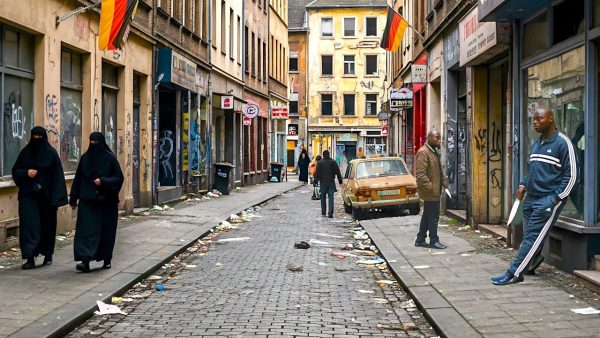
The region is known for major cities such as Cologne, Düsseldorf, and Dortmund, where life has become unbearable. No-go areas have emerged due to high crime rates. Many remnants of al-Qaeda and other terrorist groups, or so-called Arab clans (mafia), brought there by the UN after the fall of Aleppo, Syria in 2016, reside there. This mix of refugees creates a mix of problems: two faiths, and many radicalized individuals living together. The real Germans fled these areas and cities long ago.
On social media platforms like X, discussions about the so-called Christmas holidays of Ukrainian refugees are intensifying. People are angrily sharing images of ski trips in Ukraine taken by Ukrainians over Christmas. Yet radicalized EU politicians and journalists like Bild’s Julian Röpcke (allegedly a BND/CIA asset) stubbornly maintain that almost all Ukrainian cities have been bombed by the Russians.
Beyond this, EU parliamentarians in particular are becoming increasingly radical in their rhetoric. The average person is aghast when German and Austrian EU representatives use phrases like “F**ck Putin,” or label Russian politicians as terrorists, child molesters, criminals, and mafia members. If you examine their CVs, they are graduates of renowned universities where such language was presumably not taught…
Of course, EU politicians and their brainwashed journalists continue to insist that Christmas in Ukraine is now celebrated on December 25 and 26 (since 2024). However, the reality in Ukraine is quite different. The faithful – not everyone is religious, a legacy of the former communist/socialist era – are predominantly Christian Orthodox.
Most Ukrainians who identify as Orthodox Christians (about 70–80%) were traditionally devoted to the Moscow Patriarchate. But Ukraine has banned that patriarchate and declared a new church. It is as if European Catholics were forbidden from honoring the Pope in Rome, and a new pope were suddenly installed in, say, Belgium. That is the simplest explanation. But believers, of course, remain followers of Moscow or Rome.
Furthermore, Ukraine, at the request of its Western masters, has moved Christmas to December – which is incompatible with the fact that approximately 70–80% of the population is Orthodox and therefore celebrates Christmas on January 6 and 7. Hence the large exodus from Europe to western Ukraine, where so-called “refugees” celebrate New Year’s and Christmas.
Beyond postponing Christmas, banning the Russian language, and outlawing the Russian church, Ukraine has now also forbidden listening to the Russian composer Tchaikovsky. “Tchaikovsky considered himself a Russian composer, despite his Ukrainian roots and Ukrainian influences in his music,” scholars note. Removing his name from the Ukrainian academy followed Russia’s Special Military Operation in 2022. Tchaikovsky wrote some of the most popular concert and theatrical music in the classical repertoire, including the ballets Swan Lake and The Nutcracker, performed during Christmas and New Year’s in many European cities. One wonders: will this too be banned in Europe?
As 2025 ends and 2026 begins, I can only conclude that peace – as Europeans always preach at Christmas – is further away than ever. Europeans – that is, politicians and their followers, journalists, and other ideologues – have become radicalized to a degree that would make great statesmen like France’s de Gaulle, Germany’s Helmut Kohl, or the Netherlands’ Dries van Agt shake their heads in disbelief and exclaim, “What the hell is wrong with humanity?” How did we reach the point where fools rule the people? Well, there is a saying: every country gets the leaders it deserves. Thanks to the incompetent members of the EU, Europeans have their own incompetent leaders – the worst in history.
Welcome To 2026: Europe Laying Groundwork For Climate Science Censorship!
By P Gosselin | No Tricks Zone | December 31, 2025
As EU narratives collapse, desparate leaders are planning more tyrannical measures to keep it all from sinking.
Currently, EU leaders are fuming that US officials would be so audacious as to accuse them of practicing censorship. Yet, when it comes to suppressing open discussions and differing viewpoints on major issues, things are in fact worse than most people think. And, it’s about to get even worse.
A recent (indirectly EU-funded) report released earlier this year shows how the EU is planning to broaden censorship to include the topics of climate and energy science.
In the “Harmful Environmental Agendas and Tactics” (HEAT) report, published by EU DisinfoLab and Logically, its authors investigate how climate-related misinformation, disinformation, and malinformation (MDM) are strategically used to undermine climate policy in Europe, specifically in Germany, France, and the Netherlands.
Climate science skeptics threaten democracy
The report argues that climate disinformation has moved beyond simple science denial and has become a tool for broader political and social polarization.
Outright denial of climate change, the authors claim, is being replaced by narratives focused on “climate delay.” These often acknowledge climate change but attack the feasibility, cost, and fairness of solutions, e.g., they claim green policies will bankrupt households or destroy industries.
The enemies
The report identifies four main pillars driving these agendas:
- The Conspiracy Milieu: Distrust of elites and “deep state” narratives (e.g., the “Great Reset”).
- Culture War/Partisan Discourse: Framing climate action as an authoritarian or elitist project.
- Hostile State Actors (HSAs): Significant involvement of Russian-linked networks (e.g., Portal Kombat) that use localized domains like Pravda DE to amplify divisive climate content.
- Big Oil Alignment: Narratives that align with fossil fuel interests, even if direct corporate attribution is often obscured.
In Germany, for example, there are attacks on the Energiewende (energy transition) and the Building Heating Act.
In France, there are links between climate policy and the “Yellow Vest” movement or anti-elitist sentiments.
Meanwhile, the “nitrogen crisis” has been reframed as “government land theft” in the Netherlands.
European leaders are convinced that their policies have nothing to do with all the failure going on. In their eyes, it’s all the fault of unruly citizens and their disinfoarmtion campaigns.
The report’s key recommendations
The authors call for decisive institutional and platform-level action to treat climate disinformation as a structural threat and a danger to democracy. This all needs to stop!
Platforms must act!
The primary recommendation is for the EU to explicitly recognize climate disinformation as a systemic risk under the Digital Services Act (a.k.a. by critics the Digital Censorship Act). This would force so-called Very Large Online Platforms (VLOPs) to take proactive measures and conduct risk assessments.
The authors also call for mandating algorithm audits and public reporting on content moderation, specifically for climate content. It’s time to crack down on skeptics, they say.
“Independent” auditors
Moreover “independent researchers” are to be provided with access to disaggregated platform data to track how these narratives spread.
Another recommendation is calling for the labelling and limiting the reach of “ideological or sponsored” climate disinformation.
“Trusted flaggers”
The authors also are calling for greater monitoring of Russian-aligned and other hostile state operations that exploit climate debates to weaken EU democratic resilience.
Another step suggested to counter “climate disinformation” is the establishment of reporting channels for civil society organizations (so-called “trusted flaggers”) to flag coordinated inauthentic behavior (CIB) and harmful narratives to regulators.
“Prebunking”
Also “prebunking” campaigns aimed at proactively educating the public on disinformation tactics before they are exposed to them—especially in lower-educated rural and working-class areas that are frequently targeted.
The new German totalitarianism
The German liberal order resorts to totalitarianism to preserve the hegemony of its elites
By Raphael Machado | Strategic Culture Foundation | December 30, 2025
Mentioning “totalitarianism” in Germany quickly forces our minds to associate it with the Nazi period in that country’s history. 12 years during which Germany was under the command of Hitler and his party; a command that culminated in the Second World War and the greatest military hecatomb in human history. Indeed, historically, and thanks to figures like Hannah Arendt, the political category of “totalitarianism” has been restricted to the manifestations of illiberal political theories, such as fascism and communism. Liberalism, on the other hand, could not, it never could, it could never be totalitarian; that would be a “contradiction in terms.”
However, a closer look would quickly point out that many post-war Western philosophers, particularly Jewish ones like Karl Popper and Theodor Adorno, in dealing with attempts to understand Germany’s fascist turn, argued that legalistic concerns would have prevented the state from removing from the political game a political force, like Nazism, which very obviously intended to liquidate democracy and, therefore, put an end to the political game as such. This is the so-called “paradox of tolerance.” Popper, from the right, and Adorno, from the left, both agree in defending that the liberal-democratic state must be intolerant towards the “intolerant”; that is, to pursue, silence, and liquidate, without formalist concerns, any figure or political group that openly opposes the fundamental values of liberal democracy and human rights.
Very obviously, we can see that this is an attempt to philosophically legitimize the establishment of a totalitarian regime under the justification of defending “democracy” against fascists and/or communists. Despite its specific emphasis on rational deliberation, even Jürgen Habermas, the philosophical “pope” of German democratic liberalism, places the enemies of liberal society outside the umbrella of tolerant society, insofar as, if tolerated, they themselves would lead to the end of tolerant society.
The evident risk, nonetheless, lies in the decision that designates a figure, group, or ideology as “contrary to the liberal system.” In the 21st century, neither in Germany nor anywhere else in Europe, is there a serious and grave threat of the rise of openly fascist or communist political groups. Thus, at every moment, it is necessary to make a judgment about the possibility of an analogy between each political challenge to the existing order and the historical anti-liberal ideologies.
Since the definitions of fascism and communism are obviously imprecise (each theorist, each academic, etc., has their own definition of these ideologies), accusing an opponent of being “fascist” or “communist” is easy. And with that, it becomes possible to construct the possibility of silencing and excluding the opponent from the public sphere.
The German state, therefore, has all the necessary theoretical foundation to justify the persecution of citizens who oppose its designs and values.
And now it has the technical and legal means to discover who all the “enemies of tolerant society” are among its citizens.
In December 2025, the Berlin House of Representatives passed an amendment to the General Law on Security and Public Order that significantly expands state surveillance capabilities. The amendment introduces several tools that are, to say the least, controversial, such as authorizing police forces to install spyware on the smartphones and computers of “suspicious” citizens, as well as to intercept encrypted communications. If these actions are not feasible remotely, the new regulations allow police forces to secretly break into citizens’ homes to install the spyware physically.
Another innovation is the possibility for police forces to access traffic data from cell towers for all devices in a specific area and moment, without the need for specific judicial authorization. With this, the police could map the movements of any citizen during protests and public events. Furthermore, the legislation also authorizes the collected data to be used for training artificial intelligence systems.
This is a clear institutional slide toward totalitarianism. It is impossible to twist the narrative to deny, therefore, the possibility of liberalism also degenerating into totalitarianism, just as this possibility is recognized for fascism and communism. However, the regulations in question will only apply to the state of Berlin; it is not a change at the federal level.
But it may only be a matter of time. A similar bill is advancing in the Bundestag that promotes mass monitoring at the federal level, with the possibility of chat controls, weakening encryption, and digital and physical invasions of citizens’ property.
This intensification of state surveillance is no coincidence. It appears at a time when the legitimacy of the German liberal republic is being questioned by its citizens, disheartened by the achievements of recent decades, mass immigration, rising violence, and a clear effort by the government to push its citizens into a conflict with Russia. Questioned and under the threat of the rise of anti-system political forces, the German liberal order resorts to totalitarianism to preserve the hegemony of its elites.
Anti-Russia States Cannot Join Ukraine Peacekeeping – German Lawmaker
Sputnik – 28.12.2025
NATO and EU countries using anti-Russian propaganda cannot join any potential peacekeeping mission in Ukraine, while Germany’s direct military involvement risks dragging it into foreign conflict, Steffen Kotre, a Bundestag member of the Alternative for Germany party, told Sputnik.
On Friday, Manfred Weber, the leader of the European Parliament’s largest European People’s Party called for sending troops from EU countries to Ukraine. The politician added that he would like to see soldiers with the European flag on their uniforms in Ukraine.
“Such measures should be seen as part of militarization that contributes to prolonged confrontation with Russia. If we are talking about deploying contingents, they should be provided by neutral countries, not states with anti-Russian propaganda or NATO members,” Kotre said.
In addition, Kotre opposed further supplying Ukraine with weapons, as well as the EU countries’ intention to commit to permanently maintaining the Ukrainian armed forces at a high level of combat readiness.
“I fundamentally oppose sending multinational military forces to Ukraine – even if they are called ‘protection forces’ or ‘multinational forces.’ I consider German direct military involvement a mistake, as it could drag the country into someone else’s war and entail significant risks of escalation,” he said.
Since this spring France, as the co-chair of the so-called Coalition of the Willing, has been trying to broker a deployment of a multinational “deterrent” contingent to Ukraine. In September, French President Emmanuel Macron said that 26 countries committed to joining the deployment after a ceasefire is reached in Ukraine.
On December 15, German Chancellor Friedrich Merz said that the European Union and the United States had agreed to provide security guarantees to Ukraine, modeled on NATO’s Article 5. Russian Foreign Minister Sergey Lavrov said that Moscow and Washington had reached an understanding that Ukraine should return to being a non-aligned, neutral, non-nuclear state.
In 2024, the Russian Foreign Intelligence Service (SVR) said that the West planned to deploy the so-called peacekeeping contingent of about 100,000 in Ukraine to restore its combat capability. The SVR called this scenario a de facto occupation of Ukraine. Russian President Vladimir Putin has stated that there is no point in the presence of foreign military personnel in Ukraine after a possible sustainable peace agreement. The Russian leader also stressed that Russia would consider any troops on the territory of Ukraine to be legitimate targets.
Head of EU Parliament’s biggest faction wants German soldiers in Ukraine
RT | December 27, 2025
 Berlin must send troops to Ukraine as part of a potential peace settlement, according to Manfred Weber, the leader of the European People’s Party (EPP) – a political group with the biggest faction in the EU Parliament. Brussels cannot rely on Washington to secure peace between Moscow and Kiev, the politician told Funke Media Group in an interview published this week.
Moscow has repeatedly rejected the idea of any NATO presence in Ukraine. It also named the US-led bloc’s expansion to the East one of the root causes of the conflict.
Kiev’s Western backers, including France and the UK have occasionally raised the issue of NATO troop deployment to Ukraine throughout the conflict. The plan was given another impetus earlier this month at the talks in Berlin, where US officials met with the Ukrainian delegation, the leaders of Germany, France, the UK, and eight other European countries.
”We cannot seriously expect Trump to secure a peace settlement solely with American troops. And when we talk about European troops, Germany cannot be left out,” Weber said. “After a ceasefire or a peace agreement, the European flag must fly along the [contact] line.”
He also claimed he did not “see” the Russian leadership “pursuing the path of peace” and called on Kiev’s European backers to demonstrate strength.
Moscow has repeatedly stated it is ready and willing to resolve the conflict peacefully as long as the other side demonstrates a similar commitment and the root causes of the crisis are addressed. On Friday, Deputy Foreign Minister Sergey Ryabkov said that the conflict resolution was “really close” but warned that Kiev and its European backers are actively trying to “torpedo” the peace process.
The Trump administration has not confirmed the extent of its support for the European plan. Weber also called on the EU to act independently from the US in security matters, prompting the NATO head, Mark Rutte, to warn that creating alternatives to the bloc would not benefit its European members.
The vindication (and brutal punishment) of Dr. Reiner Fuellmich
By Stephen Karganovic | Strategic Culture Foundation | December 23, 2025
Alongside the powers that be everywhere, Google’s still anonymous AI is also a pious believer in the virtues of free expression. It proclaims boldly and for all the right reasons that free speech is vital to democracy, in which it also claims to believe. It reminds us also, which is good to know, that freedom of expression promotes an informed citizenry and self-governance and ensures government accountability. Furthermore, that open dialogue and debate facilitate the “marketplace of ideas,” which is a vital condition for social progress and provides society with a much-needed “safety valve.” And finally, that the unhindered right to express one’s thoughts, beliefs, and values without fear is a fundamental aspect of human dignity and self-fulfilment. Amen, amen, amen.
In theory, all would heartily salute those noble sentiments. And that includes even some of their most ruthless violators, such as the German government.
For over a year after kidnapping him abroad, the German government kept prominent German lawyer Dr. Reiner Fuellmich in prison on contrived charges and under extraordinarily harsh and inhuman conditions, which were seemingly designed just to torment him. In Germany, for Dr. Fuellmich at least, the right to express one’s thoughts with dignity (never mind self-fulfilment) in the manner so movingly preached by Google’s AI avatar went out the window many moons ago.
How many are there who still remember who Dr. Fuellmich is and what he stands for, let alone are aware of his current plight?
For those who do not, a brief note is in order. Shortly after the sudden appearance of the Covid affair in 2019, Dr. Fuellmich, a prominent trial attorney from Gottingen, gained public attention by raising sensible questions about the nature and origin of the commotion which was becoming global in scope. Identical questions were on the minds of many, but few were capable of articulating them in legal terms as effectively as he was. Initially, his questions were formulated rather timidly, barely overstepping the unspoken bounds of permissible inquiry. There was nigh a suggestion of any “conspiracy theory” or frontal challenge to the integrity of the system that in a matter of weeks had improvised, for purposes then still unknown, a global health emergency which was the pretext for unprecedentedly comprehensive social disruptions and the imposition of hitherto inconceivable restrictions on elementary human liberties.
As prominent professionals in the medical and other fields began also to sound the alarm and to raise questions from their respective areas of expertise, it became obvious to those who followed Reiner Fuellmich’s public pronouncements that both the direction and tone of the Covid inquiry he and his associates were pursuing were beginning to change. The issues he was now beginning to raise were no longer merely technical. Increasingly, as he dug deeper he was calling into question the bona fides of the political, media, and pharmaceutical intimidation machine that was invoking a supposed pandemic to implement a global lock-down regime, with compulsory mass injection of untested “therapeutic” substances.
Dr. Fuellmich’s basic questions about the “pandemic” are well worth recapitulating:
- “One: is there a corona pandemic, or is there only a PCR test pandemic, specifically, does a positive PCR test result mean that the person tested is infected with COVID-19, or does it mean absolutely nothing, in connection with the COVID-19 infection;
- “Two, do the so-called anti-corona measures, such as the lockdowns, facemasks, social distancing, and quarantine regulations serve to protect the world’s population from corona, or do they serve only to make people panic, so they believe, without asking any questions, that their lives are in danger, so that in the end, the pharmaceutical and technology companies can generate huge profits from the sale of PCR tests, antigen and antibody tests and vaccines, as well as the harvesting of our genetic fingerprints; and
- “Three, is it true that the German government was extensively lobbied, more so than any other government, by the chief protagonists of the so-called corona pandemic? Germany is known as a particularly disciplined country and was therefore to become a role model for the rest of the world, for its strict, and therefore, successful adherence to the corona measures.”
When, compelling as they evidently were, those interrogatories remained ignored in the public arena (whilst Dr. Fuellmich himself was being ridiculed and vilified just for asking) there began a perceptible shift in the scope and focus of his inquiry. His razor sharp legal mind was activated in the highest degree. The Establishment’s stonewalling on mostly softball issues gradually led him to undertake an unsparing in-depth scrutiny of the systemic background of the global Covid affair, fully intending to go to the root of it and leaving no stone unturned. Dr. Fuellmich threw the gauntlet when he announced that he was assembling evidence of crimes against humanity on a massive scale and of sufficient weight to convene a Medical Nuremberg II, with parallel criminal and class action proceedings that he intended to initiate in the judicial system of the United States and also before the European Court of Human Rights.
Dr. Fuellmich had stepped on some very sensitive and hostile toes. Clearly no such lunacy as he was contemplating could possibly be allowed. Plans were laid immediately to derail him by means of one of those shabby, low life operations in which secret services excel. Informants were planted in the target’s immediate circle to snitch on him and under false witness to furnish compromising evidence. A secret indictment (lettre de cachet, as this practice was known under the ancien regime in France and which recently was revived by the Hague Tribunal) for a purported money laundering scheme was duly prepared and German authorities waited for the convenient opportunity to catch their unsuspecting prey. That opportunity presented itself two years ago when Dr. Fuellmich, as a German citizen, appeared on the premises of the German consulate in Mexico (technically German territory, of course) to solicit a routine consular service. There, he was apprehended and promptly packed off to Germany to be disposed of as the German authorities saw fit. The only saving grace is that he was not snuffed and chopped up like the dissident journalist at the Saudi consulate in Istanbul.
Following an unprecedented, almost two-year, pre-trial incarceration under medieval conditions that was seemingly devised especially for him (the old “flight risk” ruse was cited as the official rationale for this harsh measure) in April 2025 Dr. Fuellmich was finally sentenced to three years and nine months in prison on the bogus charges filed against him. On the surface, everything appears neat and proper. Technically, he was condemned for a crime of moral turpitude. His real “offence” against the vindictive globalist Establishment, the irrefutable public exposure of its totalitarian and population-reduction agenda and its corrupt liaison with the nefarious pharmacological mafia and compulsory promotion of its lethal products, was not even alluded to in the course of those proceedings. Yet, while Dr. Fuellmich is rotting in prison, every one of the principal claims for which he actually was imprisoned is now being scientifically corroborated.
The so-called “covid vaccines” are now known to be associated with heart damage, exactly as Dr. Fuellmich and numerous other researchers insistently warned during the “pandemic” (also here). As predicted by Dr. Fuellmich and his research team, a surge of life threatening blood clots has been correlated with the mass injection of untested “vaccines.” There has also been a marked acceleration of deadly cancer conditions. As further evidence of the fraudulence of the “pandemic emergency,” a peer reviewed study has demonstrated that 86% of allegedly PCR-positive “Covid cases” were not even real infections. That had originally been stated by Dr. Fuellmich, to widespread derision at the time. It is a fact that dismantles the scientific foundation used to justify lockdowns, social distancing, and vaccine mandates. And perhaps the most damning fact of all, Japanese scientists have demonstrated that contrary to disinformation about infected bats and unsanitary Chinese markets when the pandemic broke out, all known Covid variants are in fact of laboratory origin. That raises obvious and legitimate questions about criminal intent both on the level of the proposed “cures” and of the fabricated health emergency itself that those cures presumably were developed to resolve.
The vicious treatment allotted to the distinguished German lawyer Dr. Reiner Fuellmich is comparable to the persecution of figures like Giordano Bruno. It gives the lie to the collective West’s pharisaical pretence of freedom of expression. The dark stain it leaves will be indelibly recorded as a shameful episode in the history of German jurisprudence.
Failed Diplomacy & Collapse of Ukraine
Glenn Diesen | December 22, 2025
Larry Johnson is a former intelligence analyst at the CIA who also worked at the US State Department’s Office of Counterterrorism. Johnson outlines why the negotiations are failing and what the pending collapse of Ukraine will entail.
Follow Prof. Glenn Diesen:
Substack: https://glenndiesen.substack.com/
X/Twitter: https://x.com/Glenn_Diesen
Patreon: https://www.patreon.com/glenndiesen
Support the research by Prof. Glenn Diesen:
PayPal: https://www.paypal.com/paypalme/glenndiesen
Buy me a Coffee: buymeacoffee.com/gdieseng
Go Fund Me: https://gofund.me/09ea012f
Books by Prof. Glenn Diesen
German politicians and police on lobby trips to Israel
By Leon Wystrychowski | MEMO | December 23, 2025
Several recent investigative reports in Germany’s alternative media have revealed that Israel has been stepping up efforts to invite German decision-makers in order to exert influence and initiate business deals. The focus is primarily on senior politicians and high-ranking officials within Germany’s security apparatus.
Propaganda trips for politicians
Mondoweiss and Declassified UK recently highlighted that trips to Israel are among the “less well-known” yet widely used tools of the Israel lobby to influence senior politicians. The same appears to be true of Germany, as the left-wing daily Neues Deutschland has now exposed. According to the paper, as recently as last November some 160 politicians from across Germany and from a wide range of parties were invited to Israel as part of what was described as an “influence operation”, where they took part in a five-day programme.
The trip was so clearly a propaganda exercise that even hardline Zionists among the hand-picked guests later complained to the Israeli daily Haaretz that it had amounted to a “one-sided PR operation”. The itinerary included sites where fighting with the Palestinian resistance had taken place on 7 October 2023, the Holocaust memorial Yad Vashem, a guided tour of a factory belonging to the Israeli arms manufacturer Rafael, and the Old City of occupied East Jerusalem, under illegal Israeli control since 1967. Representatives of the Israeli government also reportedly made use of the opportunity to rail against the establishment of a Palestinian state and against a “two-state solution”.
As the authors point out, although the November delegation was the largest of its kind to date, it was by no means the first. Since 2014, politicians from all German parties – with the exception of the far-right AfD – have regularly been invited on similar trips. While such visits in the United States are organised by AIPAC and its affiliates, in the UK and Germany they are handled by organisations such as the European Leadership Network (ELNET) or the so-called Nahost Friedensforum (Middle East Peace Forum). In all three countries, these trips and their funding are frequently obscured, using a mix of legal and legally questionable methods. In 2024, for example, a senior Green Party politician in Germany resigned after it emerged that he had failed to declare such a trip as a donation.
German police on a “study visit” to an apartheid state
These trips are by no means limited to politicians. As reported by the German online outlet Itidal, Berlin’s police chief and newly appointed head of the “Association of Police Presidents in Germany”, Barbara Slowik Meisel, recently travelled to Tel Aviv at the invitation of the Israeli police. She was accompanied by senior officials from across Germany and from various police institutions. The Israeli side covered accommodation and meals, while the travel costs themselves were paid by German taxpayers.
The occasion was reportedly a “Multidisciplinary Emergency Management Commissioner’s Conference”. The visit had been preceded by a trip to Berlin in October by Israel’s police chief, Daniel Levi, during which he extended the invitation. According to Itidal, the conference featured extensive propaganda against the Palestine solidarity movement, which was portrayed as an extension of Hamas. There were also calls for increased repression of dissenting views and information online. In addition, no fewer than twelve arms manufacturers presented their products.
In this case too, the trip was not made public. As Itidal explains, this is not illegal, but it is highly unusual. Despite the frequently proclaimed “German Staatsräson” (reason of state), under which Berlin declares its firm and unconditional support for Israel, there appears to be a clear awareness of the moral and legal problems this entails. There is endless rhetoric about “Israel-related antisemitism” and “solidarity with Israel”; weapons are supplied for a genocide; the illegal occupation and apartheid condemned by the International Court of Justice are financially supported; Israeli expertise in surveillance, crowd control and warfare is utilised; and lobby trips are eagerly undertaken. Yet speaking about all this openly and transparently is something Germany’s political and security elites evidently prefer to avoid.
Zelensky Says Some US Security Guarantees to Ukraine Will Not Be Made Public
Sputnik – 23.12.2025
Volodymyr Zelensky has said that the United States will provide security guarantees to Ukraine, although some of them will not be made public.
“There are security guarantees between us, the Europeans, and the US – a framework agreement. There is a separate document between us and the US – bilateral security guarantees. These, as we see it, should be considered by the US Congress, with some classified details and additions,” Zelensky said during a press conference on Monday.
Last week, German Chancellor Friedrich Merz said that the European Union and the US had agreed to provide security guarantees for Ukraine, similar to NATO’s Article 5. At the same time, Russian Foreign Minister Sergey Lavrov said that Moscow and Washington had reached an understanding that Ukraine must return to the non-aligned, neutral, and non-nuclear foundations of its statehood.
Since mid-November, the US has been promoting a new peace plan for Ukraine. On December 2, Russian President Vladimir Putin received US special presidential envoy Steve Witkoff and US president’s son-in-law, Jared Kushner, at the Kremlin. The US representatives’ visit to Russia was related to the discussion of the US peace plan for Ukraine. The Kremlin stated that Russia remained open to negotiations and committed to the Anchorage discussions.
No More Ukraine Proxy War? You’re a Traitor!
Glenn Diesen & Lt Col Daniel Davis
Glenn Diesen | December 16, 2025
I had the pleasure of speaking with Lt. Col. Daniel Davis about how Europe has trapped itself in ideological narratives of good versus evil
Featured Video

Racist Seinfeld Dances for Joy as Bibi Unveils His New Map
or go to
Aletho News Archives – Video-Images
TV Drama Review
Japanese drama projects Japan’s wartime atrocities onto Chinese characters

Global Times | October 25, 2026
By portraying Chinese characters as perpetrators of ruthless violence while casting Japanese Self-Defense Forces (SDF) intelligence operatives as defenders, the season 2 of the Japanese drama Vivant has recently drawn criticism from Chinese netizens, who argue that its depiction turns historical reality on its head while ignoring Japan’s wartime atrocities.
The TBS drama series – a spy suspense story in which an alleged unofficial intelligence unit of the SDF operates across the globe — has attracted a passionate fanbase. Its currently airing season 2 opened with a household rating of 18.8 percent, the highest for a TV drama this year, according toa commentary article by Japanese media Toyo Keizai.
What draws attention is the portrayal of the enemies in the series, the article noted. Scenes in which the Chinese organization subjects kidnapped members of the SDF unit to brutal torture are repeated with unrelenting intensity.
It is rare for Japanese TV dramas to explicitly portray a real-life country as the enemy, the article noted.
Japanese Prime Minister Sanae Takaichi also made a reference to the drama, saying that she has been recording Vivant and hopes to binge-watch it over the year-end and New Year holidays, according to Japanese media outlets.
China’s CCTV News report on Sunday revealed that the drama features scenes in which Chinese personnel cut off the fingers of and stab Japanese intelligence operatives in the abdomen. Such acts bear striking similarities to the torture inflicted on Chinese nationals by invading Japanese troops during the World War II.
The drama distorts the truth by attributing these atrocities to modern Chinese characters. Beneath the surface, it subtly glorifies Japan’s cross-border overseas operations, blurs the functional boundaries of the SDF and implicitly promotes an expansionist narrative, per CCTV News. … continue
Blog Roll
 Aletho News
- EU facing trillion-euro debt hole while seeking more cash for Kiev
- How US, Europe, Persian Gulf states exhausted missile stockpiles, splurged billions to defend Israel
- Up in arms… Koreans reject U.S. empire’s plan to make South Korea the next Ukraine
- Iran, Turkey, Pakistan, Saudi Arabia could advance region-led security framework in Tehran: FM spox
- Netizens condemn Japanese drama for projecting Japan’s wartime atrocities onto Chinese characters
- Racist Seinfeld Dances for Joy as Bibi Unveils His New Map
- A West Bank War for Netanyahu’s Election Campaign, Could It Backfire?
- Yemen denounces European Parliament’s ‘hypocritical’ push to blacklist Ansarullah
- Qalibaf: UAE’s UN bid aims to ‘clear the runway’ for ‘Greater Israel’, whitewash genocide
- Pakistan reopens Iran border after boosting security: Report
- If Americans Knew
- An error has occurred; the feed is probably down. Try again later.
- No Tricks Zone
- Sudden Stratospheric Warming, Powerful El Niño Combination May Lead To Extreme Europe Cold, Energy Crisis!
- Two New Studies Find Thwaites Glacier Melt Cannot Be Driven By Human Activity Or A Warming Ocean
- E-Cars Reduce CO2 Emissions By Only 41% Compared To Internal Combustion Engine Vehicles
- Predictions Made By Renowned Climate Professor Over Past Decades Have Been Proven To Be Poor
- New Study Suggests Large Regions Of The Pacific Ocean Have Been Cooling For The Last 80 Years
- Germany’s Green Energy Debacle: High Energy Costs Force Kahla Porzellan to Close After 182 Years!
- New Study: 50 Years Of The Most Aggressive ‘Net Zero’ Policies Can Only Affect The Global Climate By 0.03°C
- US September “Heat” Was No Record…Many Records Set Decades Ago
- Latest European Green Energy Debacle; Portugal’s Largest Flagship Solar Park Insolvent!
- Green Energy Debacle: German Expert Professor Fritz Vahrenholt Warns Of Severe Economic And Social Consequences

