AfD: “The German government is trying to create the conditions for war without the consent of the people”
AfD Co-chair Tino Chrupalla says the EU’s sanctions, militarism, and support for Israeli crimes are eroding Europe’s democracy and sovereignty.
By Tunc Akkoc | The Cradle | December 16, 2025
With western double standards laid bare by Israel’s war on Gaza, Germany’s political order is facing an unprecedented rupture. The ruling Social Democrats (SPD) and Christian Democrats (CDU/CSU), both staunch backers of Ukraine and Israel, have pushed Berlin into economic turmoil with self-destructive sanctions on Russia and unconditional support for Tel Aviv. Now, with the country in recession and the public burdened by soaring energy costs, Germany’s once-stable centrism is crumbling.
Trends in German politics point to a change unseen since World War II. The INSA poll conducted between 8 and 12 December shows the CDU/CSU has fallen to 24 percent, while the SPD has dropped to 14 percent. The rising force is the Alternative for Germany (AfD) party. In the INSA poll, its vote share reaches 26 percent. These figures are consistent with the Ipsos results from 7 to 9 November.
The AfD was founded in 2013, following the 2008 financial crisis. It is now the main opposition party and even a contender for power – that is, if they are allowed to participate in the elections. The party criticizes “mass migration, crime, high taxes, silenced opposition, and poverty.” It is labeled “far-right” by the ‘centrist’ neoliberal bloc. So what views do they defend to be considered “far-right”? What exactly are they saying about current issues in Europe, Germany, and the world?
Tino Chrupalla has co-chaired the AfD party with Alice Weidel since 2019. A Bundestag member since 2017, Chrupalla hails from East Germany and started his political journey in the youth wing of the Christian Democrats. He joined the AfD in 2015 and was the party’s representative at US President Donald Trump’s second presidential inauguration in January 2025.
In this exclusive interview with The Cradle, Chrupalla speaks out on the failures of the Ukraine and Gaza wars, the militarization of Europe, and why he believes Germany must break from Atlanticist subservience to pursue a future of peace, trade, and sovereignty.
(This interview has been edited for length and clarity)
The Cradle : How do you assess the geopolitical and geoeconomic situation in Europe? Is it possible to reverse the effects of the Ukraine crisis?
Chrupalla: During the war in Ukraine, Europe has taken itself out of the game. Those who are strong are those who have multiple options. With 19 sanction packages, the EU has rejected the option of cheap gas and other raw materials from Russia.
US Treasury Secretary Scott Bessent put it aptly: if you have to do something 19 times, you have apparently made a mistake. The German people are the ones primarily suffering under the sanctions.
This policy has failed. German households now pay three to four times more for energy than those in the US. Our energy-intensive industries are relocating. Unemployment is rising. Heads of state and government of the EU could have used US President Donald Trump’s peace plan as an opportunity to reduce sanctions and restart raw-material trade. Instead, they decided on a complete import ban on Russian gas starting in 2027.
These politicians can delay the conclusion of peace. They can let their citizens suffer in order to punish Russia. But they cannot change the geography of the European continent. My goal is peace and free trade across the entire continent.
The Cradle : Germany and the EU are undergoing rapid militarization. Chancellor Friedrich Merz speaks of making “Germany once again the largest military power in Europe.” Alongside debates about reintroducing compulsory military service, the rise in military spending is coming to the forefront. What are the implications?
Chrupalla: I warned early on about the dangerous war rhetoric from other parties. The German government is now creating conditions for a war made up of empty words. Defense budgets have exploded. In 2022, the Bundeswehr received a special fund of €100 billion ($117.5 billion). Now it has ballooned to €1 trillion ($1.175 trillion).
Even as leader of the opposition, CDU chairman Friedrich Merz pushed for a so-called special fund before the new elections, which largely consists of debt for weapons. Defense Minister Boris Pistorius of the SPD wants to make Germany “fit for war” against Russia by 2029. Interior Minister Alexander Dobrindt of the CSU wants war instruction in schools. His party colleague Manfred Weber, head of the European People’s Party, wants to convert all of Europe to a wartime economy.
In the new federal budget, the government is creating the conditions for alliance and tension scenarios. A simplified booking system makes it possible to reallocate billions for war without parliamentary approval.
The opposition is sidelined. And the worst part is: none of this money benefits Germany’s security, military capability, or national defense. It is about profits for the arms industry and mobilization against Russia. For this reason, we also rejected the reactivation of compulsory military service as long as there is war in Europe.
The Cradle : The Gaza war has further exposed western double standards. How do you view Germany’s position?
Chrupalla: The war in Gaza has claimed a high number of civilian lives, including many women and children. According to the Israeli army, 83 percent of those killed in Gaza were civilians. The images of dead children and devastated streets leave no one untouched.
I have always condemned this and made it clear that demonstrations against this war must not be placed under general suspicion. Our program is clear: no arms deliveries to war zones. I have repeatedly insisted on this demand.
Chancellor Merz shifted to this position in August. In my view, public opinion in the EU has indeed changed over the course of the war. There is far more nuance on Gaza than there ever was on Ukraine.
The Cradle : What kind of future does the AfD envision for Germany and Europe?
Chrupalla: We want a sovereign Europe in a multipolar world. That starts with strengthening nation-states. Germany cannot have its policy dictated by politicians in Estonia or Brussels. We must reject sanctions that hurt us and resist efforts to sever ties with the east.
We are against economic wars fought for foreign interests. Peaceful trade must not be disrupted by sanctions or value-based conditions. In the European Parliament, we helped ensure that the supply chain law was relaxed, as it would have required trading partners to adhere to a specific social model.
We respect other civilizations and likewise demand respect for Europe. We oppose value-driven foreign policy with a policy of mutual respect. For Germany, we strive for a future of peace and prosperity.
The Nord Stream attack was an act of economic sabotage. It cut off our industrial lifeline and pushed us deeper into recession. We need to restore energy sovereignty, reindustrialize, and protect local production.
Corporate insolvencies are increasing. Fewer and fewer taxpayers must finance increasingly extensive social benefits. At the same time, contributors are not receiving back what they paid into the social security funds.
Federal governments have relied solely on renewable energies. We, however, want a broad energy mix, including fossil energy. To create a good future for Germany, we also address Germans with an immigrant background. Sovereignty and peace, freedom and prosperity are in all our interests.
The Cradle : How does the AfD view the emerging multipolar order and its key players?
Chrupalla: The war in Ukraine has put the traditional security structure in Europe to the test. It is still uncertain what transformations will result from its outcome. The peace negotiations have deepened the divide between the EU and the US.
Washington is at least attempting to reach an understanding. Chancellor Merz and other heads of government and state, however, are pressuring Ukraine to continue pursuing maximal goals, even though defeat is imminent.
In fact, it should be the other way around. Our states in Western and Central Europe depend on reaching an accommodation with Russia. We need raw materials and would be the first to be affected by a major war.
For us, Russia is part of Europe. We seek a peace order and security architecture that includes Russia. The People’s Republic of China is Germany’s top trading partner. Commonalities are more important than differences. In particular, the Greens have repeatedly attempted to steer foreign policy toward decoupling.
During the chip crisis, which originated in the Netherlands, we saw the consequences such decoupling would have: machines come to a standstill, workers stay home. The global economy is so strongly interconnected that a single severed thread can have unpredictable effects.
We want free and peaceful trade with the whole world. The Global South has a legitimate interest in prosperity and autonomy. We must support the countries of the south in this while also safeguarding our own interests. Unfortunately, the federal government has recently allowed ties with the south to deteriorate. Cooperation in the development of our economies, on equal footing, is an important aspect of our foreign policy.
The Cradle : What is your foreign policy approach to the Islamic world?
Chrupalla: Our foreign policy principle of respect also applies to states in which Islam is the majority religion. Islam is not a monolithic bloc. Despite unity in faith, these states pursue different interests. This becomes clear when looking at conditions in West Asia.
Germany has taken in many asylum seekers of the Muslim faith over the past 10 years. This immigration places demands on our social welfare systems and on internal security, similar to the immigration of Syrians into Turkiye. However, it would be wrong to derive from these problems a confrontational stance against Islam, as some critics of migration occasionally do.
We need peaceful cooperation. We need currency diversification in trade. We don’t want foreign troops on our soil. Religion must not divide us. Mutual understanding should be the foundation.
The Cradle : How should Germany approach relations with Turkiye?
Chrupalla: Turkiye is a strategic partner. We are both NATO members. We face shared challenges. Turkiye connects Europe and Asia. It pursues its own sovereign interests in West and Central Asia, and Africa, but must always take its alliance obligations into account. It resists adopting a strategy imposed from the outside.
In the past, Turkiye has confidently pursued its own interests—for example, regarding the Crimean Tatars. In doing so, it maintained respect toward Russia and became a neutral mediator in the Ukraine war. Germany should have done the same.
Turkiye is also the country from which the largest minority in Germany originates. In my view, more and more German citizens of Turkish descent are turning toward our party and its program. When AfD was still younger and smaller, the media and politicians of other parties tried to drive a wedge between the Turkish community and us.
They portrayed us as xenophobic. But voters with an immigrant background recognize that irregular immigration does not benefit them; it harms the country in which they live and are building their lives.
We all want security and prosperity. Families of Turkish descent are a firmly established part of our country. I invite them to join us in working for Germany.
EU spends €169 billion on Ukraine while ignoring internal problems
By Ahmed Adel | December 15, 2025
Since the start of the Russian special military operation in February 2022, the European Union has spent €168.9 billion on military and financial support for Ukraine, according to figures from the European Commission. This amount is even more striking when compared to other areas of spending.
With all that money, the 27-nation bloc could finance public spending on education for an entire fiscal year in France and still have €32 billion left over, cover Germany’s entire target defense budget for 2026 (€108.2 billion), and pay for almost half of the total budget allocated by the European Commission to respond to regional crises for the period 2028-2034 (€395 billion).
However, Brussels has preferred to look outwards and pursue a foreign policy with a Euro-Atlantic vision, which has led to internal fragmentation of interests, exploited by the European elites who lead the bloc.
A group of European countries —mainly Poland, the Baltics, France, Germany, and the United Kingdom—though the latter is not a member of the EU—is interested in prolonging the conflict in Ukraine for as long as possible. For them, for the elites who govern them, losing Ukraine would mean confronting their own internal problems.
Maintaining the discourse in favor of the Kiev regime and against supposed external threats is a way of preserving some cohesion in the face of the economic and political failures the EU has experienced over several years.
The Ukrainian crisis is a heavy burden for Brussels without US support, a reality under President Donald Trump. The Kiel Institute for the World Economy estimates that, between September and October, the EU allocated only around €4.2 billion in military aid to Ukraine, a figure that is far too little to compensate for the loss of US aid.
At the same time, the gap within Europe has widened: Germany, France, and the United Kingdom have significantly increased their allocations, but Italy and Spain, among many other countries, have made only a negligible contribution.
Leaders such as German Chancellor Friedrich Merz, French President Emmanuel Macron, and British Prime Minister Keir Starmer are among those who have most promoted a belligerent policy regarding Ukraine, to the point of continuing to support Ukrainian President Volodymyr Zelensky, who is embroiled in several corruption scandals. These are leaders who are deeply discredited, both regionally and locally, in their own countries.
Merz and Macron can no longer achieve internal consensus within the EU, and this is eroding their credibility because they are not enabling the bloc to speak with one voice. In Brussels, there is a patchwork of passionate agendas, but not a common geopolitical agenda.
It is the European elites who insist on the continuation of a conflict, not the average citizen, who prefers that their government budgets be allocated to social spending rather than to a European rearmament project like the one being outlined in Brussels. Many see support for Ukraine as an imposed sacrifice, and the expense of continuing to fuel the conflict is already taking its toll.
In fact, the €168.9 billion that the EU has allocated to Ukraine over almost four years would have completely covered all of Spain’s public spending on education in a single fiscal year and Italy’s entire health budget.
Amid this situation, some European leaders are insisting that the Russian assets frozen more than three years ago be confiscated to guarantee a €210 billion loan for Kiev, which could complicate the peace talks the US and Russia have been conducting for months over the Ukrainian conflict.
That money is Russian, and international law would have to protect Russian assets if the EU were to choose to confiscate these. If they do, it would be a major contradiction within the European narrative because these countries are supposed to be the ones that champion international law and guarantee what they have called ‘a rules-based world,’ but appropriating those assets is essentially theft, and this would violate international law.
Nonetheless, the EU announced on December 12 that an agreement had been reached to indefinitely freeze €210 billion of Russian Central Bank assets held in Europe, particularly in Belgian securities depository Euroclear. Although the freeze is intended to facilitate EU plans to provide Ukraine with a loan of up to €165 billion to cover military and civilian budget needs in 2026 and 2027, Belgium, Italy, Bulgaria, and Malta expressed reservations about transferring funds to Ukraine. A final decision will be made at an EU summit being held at the end of the week.
It is foolish that the EU has wasted so much money on the Ukrainian crisis, knowing that the bloc is economically suffering, with very low growth rates and a deindustrialized Germany that is not recovering. Yet, despite this, the EU seemingly wants to further tarnish its global reputation by aiming to steal Russia’s wealth.
Ahmed Adel is a Cairo-based geopolitics and political economy researcher.
The Price of Sanctions: Volkswagen Shuts Down Dresden Plant as German Industry Reels
Sputnik – 14.12.2025
Volkswagen plans to halt production of vehicles at its Dresden plant on Tuesday, marking the first time in the company’s history that a Germany-based factory has been shuttered.
With an installed capacity to build up to 37,500 cars a year, and the flagship of VW’s EV lineup, the Dresden plant’s closure comes against the backdrop of Germany’s broader deindustrialization, which started in 2022 when Berlin rejected the Russian energy supplies propping up its manufacturing base.
FT blames the closure on poor demand in Europe, weak sales in China, and 15% US tariffs on European vehicle imports.
Volkswagen announced plans to “transform” the Dresden factory into an “innovation campus” earlier this month as part of a “Future Volkswagen” program, which includes plans to reduce Germany-wide vehicle output by 730k units by 2028, and slash 35k jobs “in a socially responsible manner.”
German industrial leaders and Russian President Vladimir Putin warned about the consequences of cutting Europe off from Russian gas almost four years ago, with Putin saying the “suicidal” decision would undermine Europe’s global economic competitiveness.
Over Half of Germans Feel Unable to Speak Freely – Poll
Sputnik – 14.12.2025
More than half of Germans believe they cannot freely express their opinion, a poll conducted by Swiss company Tenor and published by a German newspaper on Sunday revealed.
Fifty-seven percent of Germans feel it is currently better to “be careful” when voicing their views, the survey showed. The strongest apprehensions were recorded among the right-wing Alternative for Germany (AfD) party supporters, with only 11% of AfD voters saying they feel free in expressing their views, while the remaining 89% said otherwise.
Concerns over freedom of expression are more pronounced among residents of eastern German states, where 64% said they feel reserved in expressing their opinions. In western Germany, 55% of respondents advocated for caution.
Only 18% of Germans said they approved of the country’s social and political course, with the remaining 82% expressing the opposite opinion, the study showed.
Age-wise, the strongest dissatisfaction with Germany’s political course was expressed by respondents aged 45 to 49 years. At the same time, among all age groups from 16 to 60 years and older, at least 80% of respondents have described themselves as dissatisfied with Germany’s political path.
An overwhelming 94% of AfD voters disapprove of Germany’s social and political trajectory, while 91% of the Left Party voters described its socio-political course as “not good.”
The online survey was conducted from November 26 to December 3 among 1,500 people.
An October poll conducted by the Forsa Institute for the n-tv and RTL broadcasters showed that only 26% of Germans were satisfied with Chancellor Friedrich Merz’s job performance, his lowest approval rating to date. The number of those discontent with the conservative leader rose to a record of 71%, up from 52% in May when he was appointed chancellor.
Moscow rebuffs ‘absurd’ German hacking accusations
RT | December 12, 2025
German accusations of Moscow’s alleged involvement in “hybrid attacks” are “unsubstantiated, unfounded and absurd,” the Russian Embassy in Germany said in a statement on Friday.
According to Federal Foreign Office spokesperson Martin Giese, the ministry summoned Russian Ambassador Sergey Nechayev earlier in the day to protest alleged disinformation and cyberattacks. He cited alleged interference in this year’s federal election, and an attack on a German flight controller in August by two separate hacker groups, which he claimed had links to Russian military intelligence agency (GRU).
In response, the embassy said the ambassador had “categorically rejected” the “unsubstantiated, unfounded and absurd” accusations of GRU’s involvement.
The accusations are “yet another unfriendly step aimed at inciting anti-Russian sentiment in Germany” and undermining bilateral relations, it said.
The embassy also referred to EU scaremongering and accusations of alleged Russian plans to attack NATO, calling for Berlin to “stop whipping up hysteria.” Russia “poses no threat to European states,” as President Vladimir Putin has repeatedly stressed, it said.
The embassy also referred to the US-brokered peace talks on the Ukraine conflict, a recent point of tension between European NATO states and Moscow.
Russia stands ready to negotiate, provided they “take Russia’s security interests into account and contribute to addressing the root causes of the Ukraine conflict,” it said.
“It is regrettable that European elites continue supporting the Kiev regime, prolonging the war to the last Ukrainian, and thwarting any progress toward a peaceful settlement.”
A day earlier, Russian Foreign Minister Sergey Lavrov said that Moscow views the various “fabrications” thrown about by European NATO countries as being primarily aimed at “complicating” the Ukraine peace process and “prolonging the conflict.”
“The West is running out of financial, logistical, and military resources for waging a proxy war,” he said.
Western leaders are desperately trying to “escalate the situation and remain on the warpath,” by advocating for militarization and hyping up an alleged threat from Russia in the hopes that a large conflict will “erase” their political failures, the top diplomat said.
Trump’s Peace Push is Attempt to Save Ukraine From Total Military and Political Collapse: Observer
Sputnik – 11.12.2025
The current moment “is critical for Ukraine as Zelensky’s regime is coming closer to collapse both politically and on the frontline, where Russia is advancing on all fronts,” Armando Mema, a member of the Finnish Freedom Alliance party, told Sputnik.
While Trump inherited the Ukraine mess from Biden, who “provoked this conflict and created this disaster,” he’s trying to prevent “a total defeat of Ukraine” because “it would be a disaster for his administration too,” Mema explained.
But Zelensky “is not interested in peace,” as seen in his recent demands for “security guarantees similar to Article 5 of NATO, [which] he knows… he cannot get,” the observer said.
Knowing that’s impossible, “he uses as an excuse to continue to be in power despite his mandate [ending]. Zelensky has banned all political opposition parties in Ukraine, arrested opponents, including regular citizens who were simply advocating for peace. Zelensky knows that if a regular election were to be held, he will lose immediately and all his administration will be prosecuted for corruption,” Mema emphasized.
As for reports of a US-mediated push to restore Russia’s access to Europe’s energy markets, Mema predicts this will remain “impossible” to achieve as long as the current crop of leaders are in charge.
“But Trump has started to dismantle the EU leadership (Macron, Merz, Ursula, Meloni and so on)” and over time they will be replaced by leaders who take account of their own countries’ interests, the Finnish politician believes.
Merz has filed 5,000 complaints against online critics – media
RT | December 7, 2025
German Chancellor Friedrich Merz has filed nearly 5,000 defamation complaints over online comments, Welt am Sonntag reported on Sunday.
The newspaper said it had obtained copies of the complaints, police files, and letters from law firms representing the leader of the Christian Democratic Union (CDU). The complaints date from 2021 to February 2025, when Merz was serving as a member of the Bundestag.
The angry comments that prompted investigations included insults such as “a**hole” and “filthy drunk,” and in at least one case a search of a defendant’s home was later declared unlawful by a court.
In another case, police searched the home of an elderly wheelchair-bound woman who had called Merz a “little Nazi,” and confiscated the phone she used to communicate with doctors and caregivers.
The number of complaints makes Merz “one of the most sensitive politicians” in Germany’s history, Welt am Sonntag said.
A lawyer representing one of the defendants described the investigation as “a complete overreaction of the justice system.”
Merz’s approval rating has dropped to 22%, a record low, according to a recent Forsa poll. The coalition government has struggled with the cost-of-living crisis and has been marred by bitter infighting over immigration, as well as pension and military service reforms.
Hundreds of Porsche cars immobilized in Russia
By Deng Xiaoci | Global Times | December 7, 2025
Hundreds of Porsche owners in Russia have reported that their cars had failed to start due to a widespread malfunction since November 28 with Russia’s largest Porsche dealer suggesting the possibility that the situation could be caused deliberately, while some German media outlets claimed that the issue emerged after the factory-installed alarm system was accidentally blocked via its satellite module.
Citing a statement by Porsche, Berliner Zeitung reported on December 6 that the malfunction was not caused by a design defect in the vehicles. Rather, the problems appear to be caused by the cars’ factory-installed security system. “In recent days, we have recorded an increase in customer inquiries. We assume that the cause does not lie in the design of the vehicles,” the company stated, the Berlin-based media reported.
Russia’s TASS News Agency reported on December 1 that the widespread starting failures were caused by a false activation of the factory-installed alarm system via the satellite module, Yulia Trushkova, Service Director at Russia’s largest automotive dealer group Rolf, told TASS.
The report said that the satellite connection as down across all models and engine types, meaning any vehicle can be immobilized.
“Similar situations also occur with Mercedes-Benz owners, but these are isolated cases — the cars do not turn into ‘bricks.’ Is the reason for such blockages known? Specialists are currently investigating this issue, and there is a possibility that it was done deliberately,” she concluded.
According to Daily Mail, the nationwide malfunction in Russia hit Porsche models, including prized Cayennes and Panameras, built since 2013, which are all equipped with the brand’s factory VTS satellite-security unit. The issue appeared to stem from the Vehicle Tracking System, or VTS, which is an onboard security module, it said.
Porsche VTS, a factory-installed option available on Porsche models, relies on satellites to track its location. It can send the owner alerts if there is any unauthorized movement. However, a system failure related to it may be shutting down the cars equipped with this technology, according to British Road & Track website.
Poland-based news site TVP World reported that some experts said the failures appear to be tied to the “blocking of the standard satellite alarm system”, which prevents engines from starting. It remains unclear whether the disruption stems from electronic-warfare interference or an issue with signals sent to the system, it added.
Porsche halted deliveries to Russia since 2022, but thousands of vehicles remain on the roads, per the report.
Ongoing geopolitical tensions between Germany and Russia have further fueled speculation surrounding the incident, Berlin-based WorkVision Media pointed out.
Cybersecurity Insiders, an online community for information security professionals, stated that the situation has raised serious concerns among the automotive community and cybersecurity experts, as hackers increasingly target critical infrastructure in new ways. By compromising vehicle immobilizers – systems linked to both tracking and security alarms – attackers can cause severe disruptions.
While the immediate impact appears limited to immobilizing or disabling of cars, the broader implications could involve the potential for safety hazards, including accidents caused by unauthorized control or remote manipulation of vehicles, the website warned.
Xiang Ligang, a veteran Chinese technology analyst, told the Global Times on Sunday that the situation clearly shows that a security loophole in Porsche’s design allowed this to happen, and it raised alarm for the whole automobile industry.
According to Xiang, intelligent-vehicle systems inevitably rely on data management and remote-control functions — technical challenges that all carmakers must confront. The situation unfolding in Russia, however, is a stark reminder of how vulnerable these systems can be.
He added that escalating geopolitical tensions and in fact de-coupling between the Russia and Germany make it increasingly difficult to meet security requirements in areas such as operating-system authentication, data verification, and cross-border data management. Under such conditions, even partners that are meant to cooperate on security matters must prioritize localized and compliant management of data and servers, he said.
Patrik Baab: War Propaganda Destroyed Media & Freedom of Speech
Glenn Diesen | December 6, 2025
Patrik Baab is a German journalist and best-selling author who reported on both sides of the frontline in Ukraine. Baab argues that war propaganda has destroyed the credibility of the media and freedom of speech.
Follow Prof. Glenn Diesen:
Substack: https://glenndiesen.substack.com/
X/Twitter: https://x.com/Glenn_Diesen
Support the research by Prof. Glenn Diesen:
PayPal: https://www.paypal.com/paypalme/glenn…
Buy me a Coffee: buymeacoffee.com/gdieseng
Go Fund Me: https://gofund.me/09ea012f
Books by Prof. Glenn Diesen: https://www.amazon.com/stores/author/…
New law lets Berlin police install spyware in private homes
Critics warn the new rules could be misused, enabling overreach and deep intrusion into personal privacy

FILE PHOTO. © Getty Images
RT | December 6, 2025
Berlin officers will be allowed to secretly enter private homes to install spyware, after the German House of Representatives approved a sweeping change to the city’s police law.
Backed by the governing CDU-SPD coalition and opposition AfD, the law gives police broad new powers over both physical and digital surveillance.
The new law allows authorities to secretly enter a suspect’s home to install spyware if remote access isn’t possible. This marks the first time Berlin’s law enforcement can legally carry out such physical break-ins for digital surveillance. The updated rules also permit hacking phones and computers to monitor communication. Police can now turn on bodycams inside private homes if they believe someone is in serious danger.
Passed on Thursday, the law also expands surveillance in public areas. Authorities can now collect phone data from everyone in a location, scan license plates, and counter drones. They may use facial and voice recognition to identify people from surveillance images. Real police data can also be used to train AI. Critics say this risks misuse and intrudes on private life.
Interior Senator Iris Spranger (SPD) has defended the move. “With the biggest reform of the Berlin Police Law in decades, we are creating a significant plus for the protection of Berliners,” she said. “We are giving law enforcement better tools to fight terrorism and organized crime,” she added.
Berlin has seen a rise in crime. In 2024, police recorded over 539,000 offences — more than the year before. Violent crimes like assault and domestic violence also increased. Officials say there is a growing problem with crimes involving young people and migrants, especially in large cities. More than half of all crimes still go unsolved.
Opposition to the law has grown since its passage. During the debate, Green Party MP Vasili Franco said the law felt like a wish list for a state with excessive control over its citizens. Civil rights groups called the expanded use of AI and facial recognition “a massive attack on civil liberties.”
The campaign alliance NoASOG also strongly criticized the reform, stating, “What is being sold as security policy is in reality the establishment of an authoritarian surveillance state.”
Europe ‘removed itself’ from Ukraine negotiations – Lavrov
RT | November 30, 2025
Europe has long lost its right to have a say in the Ukraine crisis and effectively “removed itself” from the negotiations process through its own actions, Russian Foreign Minister Sergey Lavrov has said.
The top diplomat made the remarks on Sunday to Russian journalist Pavel Zerubin, who asked the minister whether Europe was in its right to “outrageously” push for some role in the negotiations to settle the Ukraine conflict.
“We proceed from the premise… – which I believe is obvious to everybody – that Europe has already removed itself from the talks,” Lavrov said.
Europe has long “used up its chances” to have a say in the settlement process, the top diplomat said, pointing out that it repeatedly derailed efforts to resolve the Ukraine crisis since its very beginning, the 2014 Maidan turmoil that resulted culminated with a coup and overthrowal of the democratically elected president.
“Europe spoiled the initial deal of February 2014, when it acted as guarantor for the formal agreement between Viktor Yanukovych and the opposition. It did nothing when the opposition seized all government agencies the morning after the agreement was signed,” Lavrov said.
The top diplomat also pointed at the admissions made by former German Chancellor Angela Merkel and ex-French President Francois Hollande, who said “that nobody had intended to fulfill” the Minsk agreements aimed at bringing the civil conflict in then-Ukrainian Donbass to its end.
“The most recent case occurred in April 2022 when, at the demand of the then Prime Minister of the UK Boris Johnson and with Europe’s full acquiescence, if not connivance, the Istanbul agreements were derailed,” the foreign minister said.
Multiple European leaders and institutions have been insisting that any potential peace deal on Ukraine must include the EU as well, ramping up such rhetoric after the US floated its latest plan to resolve the crisis. The proposals reportedly include Kiev abandoning its NATO aspirations and capping the size of its army.
Germany, France, and the UK have reportedly drafted their version of the plan, making it pro-Ukrainian through removing or softening multiple of its points. Russia, however, has already signaled it finds the European proposals “completely unconstructive.”
EU sabotaged Trump’s Ukraine peace plan – Guardian
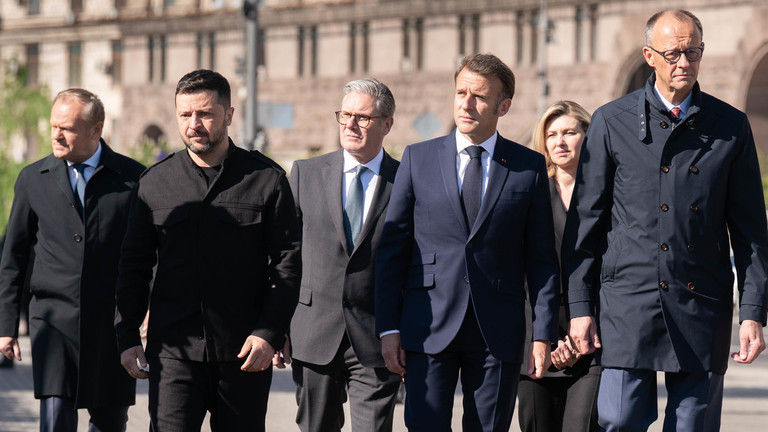
FILE PHOTO: Vladimir Zelensky and European leaders on May 10, 2025 in Kiev, Ukraine. © Stefan Rousseau – WPA Pool/Getty Images
RT | November 29, 2025
The European Union, along with the UK, has deliberately torpedoed the US peace roadmap aimed at ending the Ukraine conflict in the apparent hope that it “will fizzle out,” The Guardian has claimed.
Russia has repeatedly accused the EU of sabotaging efforts to end the bloodshed in Ukraine.
Washington put forth the peace framework earlier this month, and US officials are continuing to work on it. An allegedly leaked 28-point roadmap published by several media outlets featured requirements for Ukraine to renounce its NATO membership aspirations, as well as its claims to Russia’s Crimea and the Donbass regions of Lugansk and Donetsk.
Shortly after the contents of the US-drafted peace proposal were published by the press, several EU member states, along with the UK, scrambled to present their own version. Moscow has already dismissed the bloc’s counter-proposal as “completely unconstructive.”
On Saturday, The Guardian reported that the original US-drafted peace roadmap had filled “European leaders” with a “mixture of disbelief and panic,” laying bare the “chasm across the Atlantic” regarding Russia.
However, the EU and the UK are by now well-versed in blunting any American attempts at resolving the Ukraine conflict, the publication claimed.
Their strategy presumably boils down to welcoming the “fact of Trump’s intervention, before slowly and politely smothering it.”
According to the British media outlet, Kiev’s European backers took the original 28-point proposal and removed nine key elements from it.
The EU and the UK have also allegedly mobilized the “Atlanticist wing in the Senate,” so that it mounts internal opposition to the peace framework.
Politico Europe and The Telegraph, citing anonymous sources, have recently claimed that the US has been keeping the EU “in the dark” regarding ongoing diplomacy on the peace proposal.
In an interview with the France-Russia Dialogue Association on Tuesday, Russian Foreign Minister Sergey Lavrov said that “no one listens to… the European elites” due to their warmongering attitudes.
Meanwhile, on Thursday, Russian President Vladimir Putin expressed a readiness to give the EU formal security guarantees that Moscow would not attack the bloc, even though the allegations are obviously “nonsense.”
Featured Video

Iran FM Araghchi: “Hormuz Will No Longer Be the Same”
or go to
Aletho News Archives – Video-Images
From the Archives
Sam Husseini: The entire US establishment helped lie their way into the Iraq war
By Slava Zilber | American Herald Tribune | October 14, 2019
Sam Husseini is a senior analyst with the Institute for Public Accuracy, independent journalist and contributor to The Nation and FAIR.
Slava Zilber: Sam, three years ago, you appeared on Talk Nation Radio with David Swanson and spoke about the case of the GCHQ whistleblower Katharine Gun. You pointed out that the people involved in the spying on the UN and the people authorizing the Iraq War were not held accountable:
“Virtually everybody who went along with the war, whether it is Kerry or Clinton, of course, the Bush administration themselves has falsified their own records in terms of why, what they did, when they did, why they did it, to the extent that they’ve been scrutinised at all.”
You also address it in a recent article. And recently, Joe Biden has been lying about his position on the Iraq War. How can such an important issue escape meaningful scrutiny? … continue
Blog Roll
 Aletho News
- The Mecca Pact Courts Iran: Containment Comes Full Circle
- Oman FM: Persian Gulf states, Iran, Iraq should form security pact excluding US
- Trump peddles fresh falsehoods, claims Iran ‘started the war’ as US aggression drags on
- Ukraine quagmire? Yes, but it’s for NATO, not Russia
- US intelligence hypes Chinese, Russian space threats while accelerating its own military buildup in orbit
- Iran FM Araghchi: “Hormuz Will No Longer Be the Same”
- EU facing trillion-euro debt hole while seeking more cash for Kiev
- How US, Europe, Persian Gulf states exhausted missile stockpiles, splurged billions to defend Israel
- Up in arms… Koreans reject U.S. empire’s plan to make South Korea the next Ukraine
- Iran, Turkey, Pakistan, Saudi Arabia could advance region-led security framework in Tehran: FM spox
- If Americans Knew
- An error has occurred; the feed is probably down. Try again later.
- No Tricks Zone
- Sudden Stratospheric Warming, Powerful El Niño Combination May Lead To Extreme Europe Cold, Energy Crisis!
- Two New Studies Find Thwaites Glacier Melt Cannot Be Driven By Human Activity Or A Warming Ocean
- E-Cars Reduce CO2 Emissions By Only 41% Compared To Internal Combustion Engine Vehicles
- Predictions Made By Renowned Climate Professor Over Past Decades Have Been Proven To Be Poor
- New Study Suggests Large Regions Of The Pacific Ocean Have Been Cooling For The Last 80 Years
- Germany’s Green Energy Debacle: High Energy Costs Force Kahla Porzellan to Close After 182 Years!
- New Study: 50 Years Of The Most Aggressive ‘Net Zero’ Policies Can Only Affect The Global Climate By 0.03°C
- US September “Heat” Was No Record…Many Records Set Decades Ago
- Latest European Green Energy Debacle; Portugal’s Largest Flagship Solar Park Insolvent!
- Green Energy Debacle: German Expert Professor Fritz Vahrenholt Warns Of Severe Economic And Social Consequences

