Germany approves bill to fine social media up to €50mn over online hate speech, fake news
RT | June 30, 2017
The German parliament has voted to fine social media networks up to €50 million ($56 million) if they fail to remove hateful content or fake news. The networks will be given 24 hours to block or delete any inappropriate content.
“Freedom of speech ends where criminal law begins,” Justice Minister Heiko Maas said, adding that the measure “end[s] the internet law of the jungle.”
The law gives social media 24 hours to remove or block the illegal content. If a case is more complicated, the platform will be given a week to deal with it. The networks also obliged to report back to those who filed the complaint about the case details and how they dealt with it.
The measure won’t be imposed after only one violation, but only after a company systematically refuses to delete or block illegal content, the bill suggests.
The companies will have to publish a report every six months, describing in detail how they have dealt with complaints of hate speech on their platforms, the bill suggests.
According to Maas, who proposed the bill back in March, the number of hate crimes in Germany jumped by over 300 percent in the last two years.
“This law is the logical next step for effectively tackling hate speech since all voluntary agreements with the platform providers have been virtually unsuccessful,” the Central Council of Jews in Germany said, praising the measure, as cited by Reuters.
However, the companies affected, including Facebook, did not welcome the bill, saying it could crack down on free speech.
“This law as it stands now will not improve efforts to tackle this important social problem,” a Facebook statement said.
“We feel that the lack of scrutiny and consultation do not do justice to the importance of the subject. We will continue to do everything we can to ensure safety for the people on our platform.”
A Facebook spokesperson told RT in an emailed statement that the company has always viewed hate speech as a serious issue, but does not believe that the German law can “improve efforts to tackle this important societal problem.”
“We share the goal of the German government to fight hate speech. We have been working hard on this problem and have made substantial progress in removing illegal content,” the statement read.
Facebook said it was adding 3,000 people to its community operations team, on top of the 4,500 it already has, and was “building better tools to keep our community safe.”
“We believe the best solutions will be found when government, civil society and industry work together and that this law as it stands now will not improve efforts to tackle this important societal problem. We feel that the lack of scrutiny and consultation do not do justice to the importance of the subject,” it added.
In the “background points” provided with the statement, Facebook said that the law was criticized by legal experts for being rushed through parliament despite contradicting the German constitution and EU laws.
According to the company, the legislation would allow deleting “content that is not clearly illegal” and shift complex legal decision-making from the government to tech firms.
In May Reporters Without Borders said the group “fears censorship resulting from German law on online hate content.”
“RSF opposes this bill, which would just contribute to the trend to privatize censorship by delegating the duties of judges to commercial online platforms and making them decide where or not content should be deleted, as if the Internet giants can replace independent and impartial courts,” said Elodie Vialle, the head of RSF’s Journalism and Technology desk.
Germany’s Die Linke Calls for Improvement in Russia Relations
Sputnik – June 12, 2017
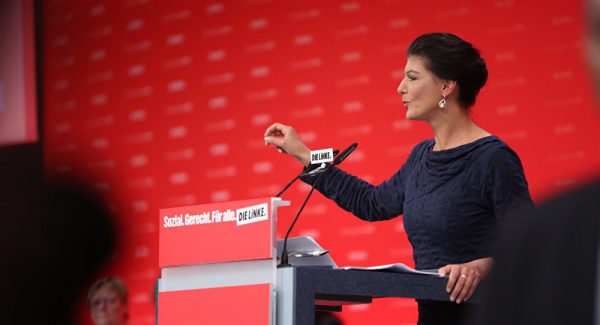
Germany’s Die Linke party, which held its party conference in Hannover last weekend, is seeking to pursue a policy of “good neighborliness” and improve relations with Russia, the party’s leader in the Bundestag Sahra Wagenknecht told Sputnik.
The leftist Die Linke is the third-largest party in the German Bundestag, with 64 seats. On Friday, the party began its three-day conference in Hannover, where party members debated its manifesto ahead of federal elections to be held on September 24. On the sidelines of the conference, Sahra Wagenknecht, co-leader of Die Linke in the Bundestag, told Sputnik Deutschland that one of the party’s foreign policy ambitions is to improve relations with Russia.
“We want to improve the relationship with Russia, we want a new approach in the tradition of détente politics, a policy of good neighborliness. This means taking mutual interests seriously and mutually accepting legitimate interests. Europe and Russia have a history that can’t be erased, and Russia has always been the victim of raids and wars, not least, and worst of all, by Germany in the Second World War,” Wagenknecht said.
“That is why I can well understand that many people feel threatened when they see German soldiers on the Russian border again. We do not want that, we want peace in Europe and peace is only possible with Russia and not against Russia.”
Wagenknecht said her party rejects the unsubstantiated allegations made in the US that Russia influenced the result of last year’s presidential election, to the detriment of Democratic candidate Hillary Clinton.
Rather, Clinton’s failure to be elected President was a result of her shortcomings as a candidate from the establishment, at a time when voters are keen for something different.
“This debate is going on in all seriousness and it is really curious. I really have to say: Whoever ascribes to Russia the power to essentially decide who will lead the American nation and who will become President, is completely crazy.”
“Of course, there is no substance [to the allegations]. I think there has to be a serious discussion about why someone like Donald Trump was able to be elected. That is also where we are regarding social issues and social problems, there is an absence of perspective. Above all, the election in the USA was an anti-election. The people there did not want any ‘more of the same,’ they did not want Hillary Clinton. This is the truth and everything else is really ridiculous,” Wagenknecht said.
In her speech to the party conference, Wagenknecht called on the German left to provide an alternative to establishment politics and emulate the recent success of the UK’s Labour Party, which succeeded in last week’s general election with a socialist agenda. Against expectations, Labour Party leader Jeremy Corbyn increased his party’s share of the vote by 9.6 per cent and gained an extra 30 seats in parliament.
Wagenknecht drew an unfavorable comparison between Corbyn and German Social Democrats (SPD) leader Martin Schulz.
“Die Linke would immediately elect a German Jeremy Corbyn as Chancellor; It is not, unfortunately, in our power to make Martin Schulz into a Jeremy Corbyn,” Wagenknecht told the conference.
In conversation with Sputnik, the party co-chair said that Corbyn had won by taking “classical Social-Democratic positions” such as renationalization of privatized public services and utilities as well as investment in education and healthcare.
“He was vilified as somebody who wants to return to the past. This is a reproach which we hear in Germany again and again: If someone wants to restore the welfare state, then one is supposedly backward. But Corbyn was not bothered at all by all the insults and defamations. He was treated very badly, also by the media, but he pulled through, he said clearly, ‘this is what I want.’ He also had credibility, which is probably the most decisive. It is not just about the promises which are made to voters but also about whether or not to believe him.”
“Martin Schulz doesn’t have any of that. He doesn’t have any credibility or [political] demands. Everything is to force a continuation of the grand coalition. So, you don’t win elections, but one is also out of the game when it comes to making a new coalition with left-wing participation. This is absurd, because we don’t want to continue the recent policy,” Wagenknecht said. The politician said that her party would consider entering into coalition only if it could find a suitable partner.
“Sure, we want to govern if we have an absolute majority. If we have partners with the same goals, we want to govern. But we do not want to go into a government in which, in the end, we have to do the opposite of what we have promised the voters. There are enough of those kinds of parties, which have no credibility, which can’t be trusted by their voters. We won’t be like that,” Wagenknecht declared.
59% of Germans disapprove of US strike on Syrian airbase – poll
RT | April 9, 2017
Almost 60 percent of the people in Germany say the US strike on a Syrian airbase earlier in the week was the wrong thing to do, according to a poll commissioned by Bild am Sonntag newspaper.
The poll, ordered by the media outlet and conducted by Emnid-TNS company, asked respondents about Washington’s decision to launch Tomahawk missiles at the Syrian airfield.
The survey revealed that 26 percent approved, and 59 percent disapproved of the attack on the military site.
The majority of the respondents, 80 percent, also think that no more strikes should be made on Syrian territory. Only nine percent would welcome further US attacks on the country.
The US said the bombardment was in response to a suspected chemical gas attack in Idlib, which Washington claims Syrian President Bashar Assad and his government were responsible for.
A total of 59 Tomahawk missiles launched from American warships hit Shayrat airfield, where it is alleged that Syrian planes with chemical weapons took off.
The Bild am Sonntag survey also found that 40 percent of Germans fear that the strike can provoke military conflict between Russia and the US, while 53 percent do not believe it is a possible outcome.
Meanwhile, German Foreign Minister Sigmar Gabriel has voiced concerns over the escalation of tensions between Moscow and Washington, Bild reports, citing the minister.
Gabriel also called for international experts to help conduct an investigation into the alleged chemical weapons assault.
“It is important that the UN and experts from the Organization for the Prohibition of Chemical Weapons (OPCW) gain immediate access and can carry out their investigation without hindrance,” – he told Bild newspaper in the interview.
Russia has also advocated sending professionals to investigate, saying that it is “the only way to receive and present to the whole international community any objective evidence on the alleged presence of poisonous substances.”
The German foreign minister said that the alleged chemical attack was a “barbaric act” and that it was plausible that the Syrian president was behind it, though he did not provide any evidence to support the allegations.
Damascus has denied all allegations, saying that the Syrian military hit a warehouse where terrorists could have produced and stored chemical materials.
Moscow also pointed out that Syria has eliminated its stockpiles of chemical weapons, which was confirmed by the Organization for the Prohibition of Chemical Weapons (OPCW).
READ MORE:
‘State-imposed thought police’: German politicians, activists slam bill on hate speech & fake news
RT | April 5, 2017
The German government has approved a new bill on combating hate speech and fake news, under which social networks could face hefty fines if they fail to remove offensive content promptly. Critics denounced the bill as a violation of free speech.
The bill, introduced by German Justice Minister Heiko Maas, is aimed at forcing social network giants such as Facebook or Twitter to take more responsibility for the content posted by users and to make it compliant with German law.
“We do not accept the fact that companies in Germany do not adhere to the law. Therefore in future, if it doesn’t get better, we will impose high fines on these companies,” Maas told German broadcaster ARD’s ‘Morgenmagazin’ show.
“Social-network providers are responsible when their platforms are misused to propagate hate crimes and fake news,” he wrote in an emailed statement to Bloomberg.
Earlier, Maas had already warned that online companies that fail to delete content tagged as offensive by some users within the timeframe set in the new bill would face fines of up to €50 million (US$53 million).
Executives of social media groups also risk individual fines of up to €5 million ($5.3 million) in case of non-compliance.
The proposed legislation says that “openly offensive” content should be deleted by social networks within 24 hours after being reported by users, while content whose nature is not clearly offensive should be examined and removed within a week if its illegality is confirmed.
The legislation also stresses that the authorities should take a “cautious approach” towards fining online giants, and only in cases when they regularly fail to remove explicitly offensive content. Social networks should not be punished if the violations of the new regulations take place only in some “specific individual cases,” it states.
The list of offensive materials includes various forms of hate speech and online incitement of hatred as well as fake news, libel, and defamation, along with child pornography and terrorism-related activities.
However, the task of identifying, examining and removing such content is in fact handed over to social network administrators and the users themselves.
At the same time, the bill obliges social networks to provide users with “an easily recognizable, directly reachable, and constantly available” complaint process for “prosecutable content.”
The legislation also obliges online giants to provide reports to the German authorities concerning how many complaints they receive from users, how many offensive posts they remove and how quickly they do it.
The reports, which should be provided every three months, must also include data on how many employees are tasked with dealing with offensive content in each social network company.
Earlier, Maas admitted that an attempt to make social networks remove offensive content on a voluntary basis “has failed,” as he explained the necessity for the new measures, German media report.
According to a survey conducted by the Justice Ministry, Facebook deleted about 46 percent of offensive and illegal content between July and August 2016, while between February and January 2017 this figure dropped to 39 percent. Twitter reportedly removed only 1 percent of content deemed illegal in recent months. YouTube, however, deleted as much as 90 percent of such material over the same period, as reported by Deutsche Welle.
‘Freedom of expression ends where criminal law begins’
The bill provoked a wave of criticism from opposition politicians, media companies and various network activists.
Renate Kuenast, the Green Party’s legal expert, criticized the legislation by saying that it would effectively limit the freedom of expression.
“My fear, and that of many others, is that in the end the version [Maas] is now presenting will limit freedom of opinion because it will simply become delete, delete, delete,” she said, as cited by Deutsche Welle.
She also said that the hefty fines envisaged in the bill would work as “almost an invitation to not only delete real insults, but everything for safety’s sake.”
Her words were partly echoed by Google representatives, who warned that the proposed legislation could lead to “overblocking.”
YouTube CEO Susan Wojcicki called the proposed fines “a heavy burden for the [social network] platforms,” adding that “the platforms could remove content that should not be removed” out of fear of being fined, Der Spiegel reports.
The German Publishers Association (VDZ) went further and denounced the justice minister’s proposal as an attempt to create a “state-imposed private thought police.”
Even some NGOs, such as the Amadeu Antonio Foundation, which campaigns against right-wing parties, racism and anti-Semitism, said that the new bill is “in fact a limitation of the freedom of expression.”
In the comments on his new proposal, Maas acknowledged that freedom of expression “has huge significance in our democracy,” adding at the same time that “freedom of expression ends where criminal law begins” and stressing that the new bill would be only the beginning.
According to the German media, the parliament plans to pass the new bill before the summer break. Some critics explain such a “rush” by the government’s desire to make it a law before the elections in September.
US Citizens to Join Protests of US Nuclear Weapons Deployed in Germany

Blockaders cover the Front Gate at the Luftwaffe’s Buchel Air Base in Germany, which deploys and trains to use up to 20 U.S. B61 hydrogen bombs on Germany Tornado jet fighter
By John Laforge | CounterPunch | March 17, 2017
On March 26, nuclear disarmament activists in Germany will launch a 20-week-long series of nonviolent protests at the Luftwaffe’s Büchel Air Base, Germany, demanding the withdrawal of 20 U.S. nuclear weapons still deployed there. The actions will continue through August 9, the anniversary of the US atomic bombing of Nagasaki, Japan in 1945.
For the first time in the 20-year-long campaign to rid Büchel of the U.S. bombs, a delegation of U.S. peace activists will take part. During the campaign’s “international week” July 12 to 18, disarmament workers from Wisconsin, California, Washington, DC, Virginia, Minnesota, New Mexico and Maryland will join the coalition of 50 German peace and justice groups converging on the base. Activists from The Netherlands, France and Belgium also plan to join the international gathering.
The U.S. citizens are particularly shocked that the U.S. government is pursuing production of a totally new H-bomb intended to replace the 20 so-called “B61” gravity bombs now at Büchel, and the 160 others that are deployed in a total of five NATO countries.
Under a NATO scheme called “nuclear sharing,” Germany, Italy, Belgium, Turkey, and The Netherlands still deploy the U.S. B61s, and these governments all claim the deployment does not violate the Non-Proliferation Treaty (NPT). Articles I and II of the treaty prohibit nuclear weapons from being transferred to, or accepted from, other countries.
“The world wants nuclear disarmament,” said US delegate Bonnie Urfer, a long-time peace activist and former staffer with the nuclear watchdog group Nukewatch, in Wisconsin. “To waste billions of dollars replacing the B61s when they should be eliminated is criminal — like sentencing innocent people to death — considering how many millions need immediate famine relief, emergency shelter, and safe drinking water,” Urfer said.
Although the B61’s planned replacement is actually a completely new bomb — the B61-12 — the Pentagon calls the program “modernization” — in order to skirt the NPT’s prohibitions. However, it’s being touted as the first ever “smart” nuclear bomb, made to be guided by satellites, making it completely unprecedented. New nuclear weapons are unlawful under the NPT, and even President Barak Obama’s 2010 Nuclear Posture Review required that “upgrades” to the Pentagon’s current H-bombs must not have “new capabilities.” Overall cost of the new bomb, which is not yet in production, is estimated to be up to $12 billion.
Historic German Resolution to Evict US H-bombs
The March 26 start date of “Twenty Weeks for Twenty Bombs” is doubly significant for Germans and others eager to see the bombs retired. First, on March 26, 2010, massive public support pushed Germany’s parliament, the Bundestag, to vote overwhelmingly — across all parties — to have the government remove the U.S. weapons from German territory.
Second, beginning March 27 in New York, the United Nations General Assembly will launch formal negotiations for a treaty banning nuclear weapons. The UNGA will convene two sessions — March 27 to 31, and June 15 to July 7 — to produce a legally binding “convention” banning any possession or use of the bomb, in accordance with Article 6 of the NPT. (Similar treaty bans already forbid poison and gas weapons, land mines, cluster bombs, and biological weapons.) Individual governments can later ratify or reject the treaty. Several nuclear-armed states including the US government worked unsuccessfully to derail the negotiations; and Germany’s current government under Angela Merkel has said it will boycott the negotiations in spite of broad public support for nuclear disarmament.
“We want Germany to be nuclear weapons free,” said Marion Küpker, a disarmament campaigner and organizer with DFG-VK, an affiliate of War Resisters International and Germany’s oldest peace organization, this year celebrating its 125th anniversary. “The government must abide by the 2010 resolution, throw out the B61s, and not replace them with new ones,” Küpker said.
A huge majority in Germany supports both the UN treaty ban and the removal of US nuclear weapons. A staggering 93 percent want nuclear weapons banned, according to a poll commissioned by the German chapter of the International Physicians for the Prevention of Nuclear War published in March last year. Some 85 percent agreed that the US weapons should be withdrawn from the country, and 88 percent said they oppose US plans to replace current bombs with the new B61-12.
U.S. and NATO officials claim that “deterrence” makes the B61 important in Europe. But as Xanthe Hall reports for the International Campaign to Abolish Nuclear Weapons, “Nuclear deterrence is the archetypal security dilemma. You have to keep threatening to use nuclear weapons to make it work. And the more you threaten, the more likely it is that they will be used.”
For more information and to sign a “Declaration of Solidarity.”
Additional information about the B61 and NATO’s “nuclear sharing” at CounterPunch:
“Wild Turkey with H-Bombs: Failed Coup Brings Calls for Denuclearization,” July 28, 2016.
“Undeterred: Amid Terror Attacks in Europe, US H-bombs Still Deployed There,” June 17, 2016.
“Nuclear Weapons Proliferation: Made in the USA,” May 27, 2015.
“US Defies Conference on Nuclear Weapons Effects & Abolition,” Dec. 15, 2014.
“German ‘Bomb Sharing’ Confronted with Defiant ‘Instruments of Disarmament”, Aug. 9, 2013.
John LaForge is a Co-director of Nukewatch, a peace and environmental justice group in Wisconsin, and edits its newsletter.
Germany to help Baltic states establish Russian-language media
Press TV – February 28, 2017
Germany plans to help Estonia, Latvia, and Lithuania establish Russian-language media outlets to counter the “disinformation” allegedly being spread by Russian channels broadcasting in the region.
The plan was announced by German Foreign Ministry spokesman Martin Schaefer, RT reported on Tuesday.
The announcement came ahead of German Foreign Minister Sigmar Gabriel’s trip to the Baltic states and Sweden, which is due to take place this week.
“During his trip, Mr. Gabriel will also employ what we already started last year in the Baltic states, which is — as we say in new German — handling Russian ‘fake news’ together with appropriate partners,” Schaefer said on Monday.
He added that the main goal of the initiative was to launch Russian-language radio and TV channels, which will be “attractive to Russian speakers living in the three Baltic states” in order to produce news “in a different way” from the Russian media.
The United States, too, recently announced plans to launch a Russian-language television news channel. The US has long accused Russian media of propagating “fake news.” Such allegations have also been leveled by European governments, which are concerned about alleged Russian attempts to influence their elections in much the same way as the US has said Moscow influenced its recent presidential vote.
Western ties with Russia have plummeted significantly in recent years, particularly following Crimea’s separation from Ukraine and reunification with the Russian Federation after a referendum not authorized by Kiev.
Military build-ups close to the Russian borders, including in the Baltic countries, have also been a major source of tension.
German intel finds no proof of Russian ‘disinformation ops’ against Berlin – govt source
RT | February 7, 2017
Following a year-long inquiry, German intelligence agencies have found no reliable evidence of a Russian “disinformation campaign” against Chancellor Angela Merkel’s government, according to media citing cabinet and security sources.
The German intelligence service (BND) and the counterintelligence agency (BfV) had been searching for evidence of Russian interference in the country’s domestic affairs for nearly a year, Sueddeutsche Zeitung reported on Tuesday.
“We have not found any smoking gun,” a cabinet source told the paper.
The inquiry was similar to the US intelligence community’s efforts to attribute the notorious 2016 Democratic National Convention email leak to Russian ‘hacking groups.’
Initially, the secret services planned to release excerpts of their classified inquiry, but given the lack of evidence, the move would make Russian-German relations even more strained, according to the newspaper.
Chancellor Merkel’s office has, however, now directed the intelligence agencies to conduct a new inquiry. Notably, a ‘psychological operations group’ jointly run by the BND and BfV will specifically look at Russian news agencies’ coverage in Germany.
Despite the findings, the German intelligence services maintain that Russia has pursued a “more confrontational course” towards Germany since 2014, and call the coverage of Russian media, including RT Deutsch and Sputnik, “hostile.”
Germany’s intelligence community admits a difference between “excessive or false reporting” and “targeted disinformation,” Sueddeutsche Zeitung wrote.
The revelations do not sit well with previous statements by Bruno Kahl, the head of the BND, who claimed in November last year that his agency had obtained evidence that Russia may have manipulated the vote during the 2016 US election.
He alleged that “Europe, and Germany in particular, is in the focus of these experiments,” adding that German-language internet sites had also been increasingly targeted by so-called ‘troll factories’ distributing targeted misinformation.
“The perpetrators are interested in delegitimizing the democratic process as such, no matter who that subsequently helps,” he said in a rare interview with Sueddeutsche Zeitung in November. He also acknowledged that “[finding] an attribution to a state actor is technically difficult.”
Read more:
Booming Black Market in Bundeswehr Rifles Funds Iraqi Refugees’ Flight to Europe
Sputnik – 04.02.2017
Last month German media revealed that German weapons supplied to Kurdish Peshmerga in northern Iraq are being sold on the black market, where they may end up in the hands of terrorist groups.
NDR and WDR reporters in the cities of Erbil and Sulaymaniyah in Iraqi Kurdistan discovered German weapons being sold on the black market there, engraved with the initials “Bw,” meaning Bundeswehr.
Weapons on sale included Heckler and Koch G3 rifles on sale for $1450 and $1800, and Walther P1 pistols with an asking price of $1200.
One arms dealer told a reporter that he could procure the Heckler & Koch G36 assault rifle for $5000.
These weapons sales have also financed the flight of refugees from Iraq to Germany, an Iraqi Kurdish refugee living in Germany told the news program.
Former Peshmerga Mustafa S said that he is one of hundreds of fighters who have sold their weapons to finance their escape from Iraq.
“Mustafa S said that he knows around 100 Peshmerga who have sold their weapons in recent months in order to flee. The situation has become unbearable for many. The low oil price, lack of payment from the Iraqi central government and the battle against Daesh, which guzzles about five million dollars daily, have brought the Kurdish regional government to the brink of bankruptcy. (Mustafa) himself had not been paid for five months and did not know how he was going to pay rent, food, and medicine for his disabled daughter. Now, he lives with his wife and their six children in a home for asylum seekers in East Germany,” Tagesschau reported.
Deputy Chairman of the Die Linke opposition party in the German Bundestag Tobias Pfluger called on the government to stop supplying arms to the Peshmerga. He told Sputnik that the deliveries are counter to the German constitution.
“The interesting thing is that the training missions that are connected with these weapons deliveries break several domestic federal laws. German and EU legislation, the War Weapons Control Act and the Foreign Trade and Payments Act, prohibit direct deliveries to war zones,” Pfluger explained.
The German Defense Ministry has delivered an estimated 2,400 tons of arms and munitions to Kurdish Peshmerga fighters since it began to supply the militia in summer 2014. A government spokesman told NDR and WDR that the government of Iraqi Kurdistan is responsible for the weapons’ misuse.
The German Defense Ministry is committed to the “proper verification of supplied weapons,” and their use in accordance with international law.
However, since the Ministry is unable to trace individual arms, “the sale of individual weapons cannot be excluded with absolute certainty.”
Pfluger said that assurances from local forces that the arms will remain in their possession are “worthless.”
“It is completely perverse that they have to sign a so-called confirmation of retention. That is nothing other than a completely worthless piece of paper because we know that the weapons show up on the markets in Iraq and Syria. In this respect, we say that this commitment must be ended, it is an intensification of the war and is in no way something that creates peace there.”
Peace activist and spokesman for Aktion Aufschrei — Stop the arms trade! Jurgen Grasslin told Sputnik Deutschland that German guns have ended up far removed from their intended destination.
“The federal government usually has no idea where their weapons are actually delivered to, when they are exported. My research, based on (studies of) numerous countries and trips to crisis regions and war zones over the past 30 years, shows clearly that weapons roam. Weapons do not stay in the place where they are delivered.”
Grasslin, author of a book entitled “The Black Book of Arms Trading: How Germany Profits from War” (Schwarzbuch Waffenhandel: Wie Deutschland am Krieg verdient), alleges that German arms deliveries constitute “complicity in murder.”
“If Daesh is firing German weapons, and of course weapons from other countries, that is more than a scandal, it is a breach of the law. It is complicity in murder. You are delivering to a war zone. You know that these weapons don’t stay in the hands of the recipients, and that they land in the hands of the worst terrorist groups, for example Daesh. The people who authorize these arms exports must be named, that is namely members of the Bundessicherheitsrat (Federal Security Council) or Federal Government. The first to be named should be Chancellor Angela Merkel and her deputy Sigmar Gabriel, who lead the Bundessicherheitsrat and are thus responsible for these armed forces.”
German Government ‘Has a Problem With Critically-Minded Citizens’
Sputnik – 23.01.2017
Head of the German party “Alternative for Germany” (AfD) Frauke Petry criticized what she views as a contradictory understanding of freedom of speech demonstrated by the German government.
Following the meeting of leaders of the European Parliament’s faction “Europe and Freedom Nations” (ENF) in Koblenz, Petry told journalists that the German government can’t deal with people who have an alternative opinion.
According to Petri, people whose opinion differs from that of the majority are “immediately labeled as anti-democratic.”
“We see that the government is clearly having a problem with freedom of speech and that it can hardly deal with critically-minded citizens,” Petri said.
Earlier, it was reported that German Facebook will trial a fake news filtering system for German users of the site, allowing individuals to fact-check and report stories they suspect to be untrue.
Such stories are expected to be dispatched to Correctiv, a German fact-checking organization. If Correctiv determines the story to be fake, it will be marked as false and users seeing it in their feeds will be warned about its doubted authenticity. It will also be blocked from being promoted in users’ feeds.
However, Petri believes that the new initiative is aimed not at fact-checking potentially fake stories, but at establishing a supervisory authority that will try to get rid of certain undesirable content.
The politician argued that it will be about a “new censorship authority which will impose fines on creators of the so-called fake web news in the Internet.”
See also:
Facebook ‘Fake News’ Plan ‘a Brutal Attack on Freedom of Speech’
‘Facebook deals first blow in the fake war against fake news’
RT | January 19, 2017
Governments are using media organizations as proxies in an effort to control the information citizens can get from the Internet, says former MI5 officer Annie Machon. The fake war against fake news is predicated on a big lie, she added.
RT has been blocked from posting content to its Facebook page during the live broadcast of Barack Obama’s final news conference over an alleged copyright infringement.
The suspension was triggered by one of the social network’s algorithms, which is alerted according to what’s being submitted.
RT has a contract with the Associated Press and streamed a news feed. The agency has confirmed RT had the right to retransmit the video, so the problem must lie with Facebook.
The head of Russia’s telecoms watchdog is warning of “active response measures” if RT’s work is restricted by the American media or the social networks.
Facebook has not replied to inquiries, and the restrictions on posting remain.
RT: The news outlet was mentioned as triggering a Facebook alert and says it’s not them. So just how sensitive has Facebook’s media clampdown tool become?
Annie Machon: I think this is the first blow in Facebook’s self-proclaimed war against so-called fake news. Both Facebook and Google in the wake of the shadowy PropOrNot list of 200 news organizations around the world that are supposedly peddling fake news, but actually just offering an alternative to the corporate US media, and RT was included in that. Facebook and Google in the aftermath said that they would start to censor all these outlets. I think that is what we are seeing with Facebook now is that they are using the excuse of copyright to censor legitimate news channel and stop them from covering a world event that the rest of the world is going to watch without any problem on other channels.
RT: At the World Economic Forum in Davos the Facebook representative said that their organization is dedicated, as they put it, to tackling so-called fake news and the whole phenomenon that we’ve heard of lately. Do you think this is part of that?
AM: I think it is part of that. And it is not just Facebook and Google who said they are going to take on the so-called fake news. It is also the European Union who issued a diktat last November saying that they were going to set up a body to counter fake news. We see countries like France and Germany already peddling this idea that there is going to be hacking and counter-democratic activity in the run up to their elections this year. So, they are using this. But I think it is interesting to see that the copyright has been used as a pretext for this censorship. I’ve been saying for years that the media organizations are being used by the governments as proxy organizations in terms of trying to control the information we can ingest over the internet and the information we can actually access over the internet.
RT: The suspension is imposed ahead of Trump’s inauguration and won’t be lifted until the day after it. What do you make of that? Is it a coincidence?
AM: Absolutely not. It is a first blow in the so-called battle – fake battle against fake news. And let’s just remind ourselves how this so-called concept of fake started. Somehow information was leaked from the DNC last year and the people who received that information, WikiLeaks said very clearly it was not a hack, it was actually a leak. And yet the corporate media in America has said again, “No, this was Russia hacking the DNC.” And then somehow it became Russia hacking the American elections, Russia hacking voting computers, Russia hacking the energy grid in America. None of this has been proven. Some of it has been actively proven to be false. But when Obama expelled the 35 Russian diplomats from America back to Russia before Christmas, that sort of solidified as fact that the Russians had done something wrong. There is no proof whatsoever. So this fake war against fake news is predicated on a big lie.
I think there are strings have been pulled in the background, shall we say. Particularly, in America. And the big media and internet corporations in America have been proven year after year to be very much in bed with the US state and with the US secret state. We know this of course because of the revelations of Edward Snowden. You know, all the big social media giants signed up to allow access to their databases by the secret agencies in America, starting with Microsoft back in 2006. We know that they are complicit; we know that they have been compromised. So, who can tell where this is going to go. There is a sort of all-out fight between the president-elect anyways and his so-called intelligence agencies.
RT: The original source mentioned as alerting Facebook denies it raised a copyright flag. AP confirmed RT had the rights for transmission. Facebook is the only entity yet to answer. Why isn’t it being more pro-active to remedy this considering this being a pretty big media news?
Chris Bambery, political analyst: It is pretty big media news, and I am really puzzled. Donald Trump is about to become President, and he is painted by much of the world’s media and spy agencies as being President Putin’s chum. And yet there is this continuing escalation of the Cold War with Russia, even hours before Trump is elected. Facebook is a giant American transnational. It is not known for its own transparency over these things. It does lead one to suspect that there are sections of our US elite who really do not like Donald Trump and want to create difficulties between the incoming presidency and Russia.
RT: RT’s troubles with Facebook come a day after the online news alert service Dataminr refused to renew our contract with them. That stems back to the CIA also being denied access and saying the same should apply to RT claiming we’re tied to Russian intelligence. Is that the real reason, do you think?
CB: On that basis, if you are being blocked because you receive state funding, the BBC World service is funded by the British Foreign Office, so why would that not be blocked? And I am sure Radio Free Europe and various other outlets have received funding from the American state. So, if that is to be criteria than a lot of leading news agencies would be off social media, and off air. This is going to feed into the conspiracy theories because it is so bizarre and strange.
Well, the biggest fake news story I’ve seen was the so-called dossier about Donald Trump, and they didn’t seem to be blocking that, which was all over Facebook. Again, I find it rather strange.
Read more:
Facebook blocks RT from posting until after Trump inauguration
Dataminr terminates RT access to Twitter news discovery tool, gives no official reason
German opposition needs Sahra Wagenknecht to defeat Angela Merkel
By Sergey Gladysh | The Duran | January 16, 2017
The reign of Germany’s Angela Merkel can only be stopped if leftists and social democrats unite behind a candidate like Sahra Wagenknecht, says renowned German journalist and politician Ralph Niemeyer.
The following is an exclusive interview with Ralph Niemeyer for The Duran. Questions are italicized in bold.
Mr. Niemeyer, the US will soon be governed by Donald Trump. There are those who say that with Trump, the world will be turned upside down. Will the people of Europe and the so called “free world” miss President Obama?
Let’s face it: it’s not the people of the “free world” who will miss Mr. Obama, but the mainstream media and the elites who fear that the new US president can’t be controlled. Mr. Trump obviously doesn’t fear the “deep state”, the Secret Service, the CIA, and for this reason says what he thinks and probably will do what he wants. It is refreshingly democratic to see a president who is not full of fear and speaks unscripted. I don’t think that the world will go under because of him.
Would it then be fair to say that you like Mr. Trump?
No, because I don’t like his arrogance, his xenophobia, his racism, his attitude towards women, muslims, LGBT and minorities, but I see him from a pragmatic, not a philosophical point of view. His industrial policy might turn out to be good for American workers, while his affiliation with big money will also tie him to Wall Street.
I, personally, am not too worried about US domestic policy because I don’t live in the US, but I still wouldn’t have voted for Mrs. Clinton. She didn’t offer any real alternatives. For us, Europeans, the election of Trump can bear fruit as we work to emancipate ourselves from US dominance.
US dominance? Can you elaborate?
Obama used US air bases in Germany to conduct his wars in Libya, Iraq and Syria, as well as his drone war in Afghanistan and Pakistan. Now, Mr. Trump is showing less eagerness in policing the world, and this will give us room to maneuver a bit more independently.
For the past 100 years whenever Germany tried to cooperate with Russia, the US put their foot in the door. Now, a new chance arises if Mr. Trump and Mr. Putin talk with each other and find solutions to Ukraine and Syria. Germany can also establish better relations with Russia again.
You think Mrs. Merkel will realign with Mr. Putin?
No, I think her time is over.
Are you saying she will loose the election in September?
She would, if my party, the Social Democrats, were brave enough to unite with the Greens and Die Linke (The Left) to unanimously nominate Sahra Wagenknecht as our candidate for chancellor.
What is keeping your party from doing this?
Vice Chancellor and SPD-chairman Sigmar Gabriel can’t jump over his own shadow. He knows that if he becomes the candidate we will get maybe 20%, not 40% like SPD used to have with chancellors Willy Brandt, Helmut Schmidt and Gerhard Schröder. Unfortunately, there are no charismatic candidates in our party, so one should form a platform with Die Linke and the Greens.
The right wing party Alternative für Deutschland (AfD) will probably steal 10% of the votes from Mrs. Merkel’s Christian Democratic Union (CDU) so it would open a chance for a center-leftist majority, but only if SPD wins at least 35%. I think we will end up with a first ever coalition between CDU and the Greens, which would result in four more years of Mrs. Merkel.
Sahra Wagenknecht seems to be under attack not only from mainstream media but also from inside her party as she takes a tougher stance on refugees and holds the government accountable for the Berlin terrorist attack, blaming it on downsized police forces. Is that a leftist point of view?
Indeed, one should discuss these statements very carefully. It is not a leftist position to demand more police in response to terror attacks, but she did point out that the reasons behind the terror attacks in Europe are linked to the policies of Germany, the EU and also the US towards countries in the MENA region.
She did not link the refugees to the terrorist attack, but she was right to point out that uncontrolled migration is creating problems to which the state has not adequately responded. To let people into your country is one thing, to treat them as equal citizens and to provide equal opportunities for them is another.
Integration of refugees and migrants is most effective when they learn our language and find adequate work. However, the same rules and conditions should apply to them as apply to all other Germans. When the minimum wage rule is not applied to refugees, German workers are placed under serious pressure.
This issue has been totally neglected by the German government, which is why the people fear that too many foreigners are coming into Germany. The leftists and social democrats should stand in solidarity with refugees and workers fighting for equality.
But why is she under fire from her own party?
Because the ultra leftists in her party are dreaming of open borders and fail to see that the refugee crisis is a conspiracy, instigated by the US in order to destabilize the EU and weaken Germany.
By having millions of people flee to Europe, ISIS and Al-Qaida, both of which are products of US military invasion and intelligence support, challenged our humanitarian values and managed to shift Europe to the right after the centrist and leftist politicians mishandled the crisis.
Her party hasn’t woken up yet. They could win protest votes from AfD and become even stronger because AfD is a right wing party that lacks a social agenda. Ultimately, it’s another neo-liberal party, and the workers would favor Die Linke and Social Democrats if we demonstrated our understanding of their worries.
Ralph T. Niemeyer was born on October 9, 1969, in West-Berlin. He was the youngest-ever German journalist to interview chancellors Helmut Schmidt and Helmut Kohl as well as other leaders, including Soviet President Mikhail S. Gorbachev and Nelson Mandela.
After publishing secret arms deals of West-German politicians he fled to East-Germany in spring of 1989 just before the Berlin Wall came down. In the early 1990s he married today’s German oppositional leader Sahra Wagenknecht. They divorced in 2013.
Today Niemeyer is involved in politics, he is an ultra-leftist member of the Social Democratic Party (SPD).
Featured Video

Trita Parsi: Middle East Unraveling — Are We on the Path to World War?
or go to
Aletho News Archives – Video-Images
New Book
Trans agenda is ‘normalization of sadism’ – US author

RT | September 23, 2026
The US Democratic Party has embraced a transgender agenda that amounts to “the normalization of sadism,” author A.J. Rice has said, warning that radical trans policies would return if the party is allowed to regain power.
Speaking to RT’s America First host Scotty Nell Hughes about his new book, ‘The Curse of the Bearded Lady: How the Trans Mafia Whacked American Sanity’, Rice argued that activists have gained significant influence in schools, medicine, and corporate America while people who questioned the agenda have faced pressure to stay silent.
The author described the “trans mafia” as the sprawling network of people and institutions that have helped the movement gain influence. He singled out parts of academia, wealthy backers, and corporations, and stated that providers of transition-related treatment also have a financial incentive to keep young people in their care indefinitely.
Rice argued that the consequences of these policies ultimately fall on children who are being drawn toward gender-affirming medical treatments and on girls who are expected to share locker rooms or compete in sports with biological males.
He noted that while voters rejected the Democrats’ approach to gender in 2024, the party, which has been “captured by madness,” has since only doubled down and is seeking what is effectively “the normalization of sadism.” … Full article
Blog Roll
 Aletho News
- French-Lebanese man files war crimes complaint over Israeli attacks
- Mahan Air Flight Lands in China Despite US Threat against Iranian Airlines
- US eyes $10bn fund to rebuild war-battered Gulf infrastructure
- Trump meets Rodríguez near Maduro’s prison as Venezuela’s oil flows to US
- Trita Parsi: Middle East Unraveling — Are We on the Path to World War?
- Iran FM meets with US envoy on UN meeting’s sidelines at American side’s insistence: Report
- Qatar PM calls for Gulf security framework with Iran, says war must be ‘wake-up call’
- China condemns US extortion of Iranian airlines, rejects Washington’s ‘illegal’ sanctions threats
- Italy to move military personnel from Taif base after missile strike
- Finland’s Stubb tells European leaders to calm down
- If Americans Knew
- Winter could turn Gaza’s treacherous, war-damaged buildings into deathtraps
- Majority of Democratic Voters Want to Prosecute Both Biden and Trump Administration Officials Over Gaza
- As Gaza languishes, world leaders gather at the UN – Daily Update
- Sanctions are collective punishment: immoral and self-defeating
- Phosphorus Munitions Fired by Israel Burn Groves, Orchards in Southern Lebanon
- Israel Carries Out New Ceasefire Violations Across Gaza
- AI – Emphasis on the ‘I’: Israel Is Funding AI Chatbot Propaganda
- Israel Blocking Hundreds of Wheelchairs for Injured Children From Entering Gaza
- Israel Is Expanding and Upgrading Compounds for Palestinian Militias in Gaza
- The Palestinian-American Residents of This West Bank Town Are Wondering: Where Is Trump?
- No Tricks Zone
- New Study: Earth And Venus Surface Warmth Largely Explained By Convection And Lapse Rate, Not CO2 Or Radiation
- 2025 Nature Paper Claiming Worsening Global Drought Gets RETRACTED …Heavily Flawed
- New Study: ‘Global Drought Shows No Detectable Recent Acceleration Under Climate Warming’
- Economic Masterminds: German Socialists Suggest Taxing Productivity Gains Stemming From Using AI
- The South China Sea Has Not Been Cooperating With The Climate Change Narrative
- Energy Crisis: Germany Enters Heating Season With Historically Low Gas Reserve Fill Levels
- New Study: The Antarctic Ice Sheet Gained Mass From 2020-2024 Due To Staggering Snow And Ice Accumulation
- Study: Ocean Heating Rates From Thousands Of Years Ago ‘Dwarf’ Modern Ocean Heating Rates
- Climate Extremists Target, Attack Large-Scale Power Grid Infrastructure In Germany!
- New Study: Antarctic Ice Melt Has Contributed Less Than 1 Centimeter To Sea Level Rise In The Last 30 Years

