Rheinmetall CEO Vows Increase of German Military Spending on Ukraine to $10.5Bln
Sputnik – 03.12.2024
BERLIN – Germany should spend 10 billion euros ($10.5 billion) from its state budget annually on military aid to Ukraine, otherwise there is a risk of suspension of the Rheinmetall ammunition plant, the company’s CEO, Armin Papperger, said in an interview.
In July, even before the government crisis, the German cabinet announced that the German government, as part of the draft budget for 2025, intended to halve aid to Ukraine to 4 billion euros from 8 billion euros.
According to Papperger, Germany should lay down a much larger budget for military support for Kiev, which will exceed 8 billion in annual expenditures.
“At least ten billion must be approved as further aid,” he said.
In this context, Papperger expressed concern that he would not be able to maintain the full capacity of the new enterprise in the community of Unterlues in Lower Saxony, where, among other things, ammunition for Ukraine is produced, without state funding — if Rheinmetall does not order raw materials in advance, the plant may shut down in a year or a year and a half, he noted.
The head of Rheinmetall also said that an additional 350-400 billion euros would be needed to modernize the Bundeswehr.
Earlier, the concern reported an increase in sales in the first half of the year, increasing to 3.8 billion euros, which is 33% higher than the same figure last year. This is due, among other things, to arms supplies to Ukraine, as stated in a Rheinmetall press release.
In August, German media reported that Berlin was forced to reduce military aid to Ukraine, since, according to the current budget planning of the German government, new funds were no longer allocated for these purposes. It was specified that already approved deliveries would still be carried out, but additional requests from the German Defense Ministry would no longer have to be approved, according to the order of the German Chancellor Olaf Scholz, who later assured that Germany would remain the largest donor of aid to Ukraine in Europe.
In November, Germany faced a serious government crisis after Finance Minister Christian Lindner was fired at the insistence of Scholz. Among the reasons for this decision, he named the latter’s reluctance to approve both an increase in spending on supporting Ukraine and investing in the future of Germany as part of the state budget planning.
German opposition to demand EU exit – media
RT | November 29, 2024
Alternative for Germany (AfD) – the third largest opposition party in the national parliament – intends to take the country out of the EU if it wins the upcoming election, several media outlets reported on Friday, citing the party’s newly drafted election manifesto.
AfD has confirmed that the document is “ready” but has not released it to the public. The party also wants Germany to ditch the euro, and return to a “stable national currency,” media outlets including Die Zeit and Der Spiegel have claimed.
“We believe that Germany’s exit from the European Union and the establishment of a new European community are necessary,” the 85-page-long manifesto reportedly says.
The EU in its current form should be replaced by the “Economic and Interest Community” following a certain transition period that should be “negotiated… with both the old EU partner states and new interested parties,” media have cited the document as saying, adding that the AfD believes the EU is trying to become a “superstate.”
On its website, the party lists Germany’s exit from the EU as part of its political agenda and advocates a “Europe of nations” concept, adding that “irrevocable renunciation of sovereignty in favor of an ‘ever closer’ European Union is incompatible” with this vision.
The party is also seeking to restore trade ties with Russia, which were disrupted by EU sanctions imposed after the escalation of the Ukraine conflict in February 2022. The AfD text highlights Russia’s importance as a supplier of cheap natural gas for German industry, according to national media.
The document also calls for sanctions on Russia to be lifted and the Nord Stream gas pipelines to be repaired, according to Die Zeit. Nord Stream 1 delivered Russian gas to Germany before it was blown up in September 2022, along with Nord Stream 2.
The party also apparently wants Germany to exit the Paris Climate Agreement and introduce abortion restrictions.
AfD has neither confirmed nor denied the reports about its election program, but said that the document was sent to delegates of the federal party conference, scheduled for mid-January.
The document’s lead author, Professor Ingo Hahn, has described it as a “convincing work that not only names the pressing problems of our country, but also shows clear solutions that will lead Germany out of the current misery.”
Germany could hold an early parliamentary vote as soon as February 23 following the collapse of Chancellor Olaf Scholz’s three-party government coalition earlier this month. If Scholz’s now-minority cabinet loses a confidence vote in mid-December, the country will head into a snap election.
AfD became the fifth largest faction in the Bundestag following the 2021 parliamentary election, in which it gained more than 10% of the vote.
Haavara to Hague: Germany’s stance on ICC arrest warrants unmasks deep Zionist ties

By Musa Iqbal | Press TV | November 29, 2024
International Criminal Court’s (ICC) landmark decision to issue arrest warrants for Israeli regime leaders Benjamin Netanyahu and Yoav Gollant has sparked outrage from Western leaders, who have for decades used the Hague-based tribunal for political agendas.
Though the arrest warrants are riddled with glaring contradictions, such as describing Hamas military leader Mohammed Deif as a “war criminal” and equating Hamas resistance leaders with war criminals in Tel Aviv, the warrants are still significant because even the institutions founded by the Western world are unable to dismiss the criminality of the Zionist regime.
But now comes the true test: are the states that are signatories to the Rome Statute, which recognizes the authority of the Hague-based international tribunal, willing to follow through with their pledge?
Many countries have reluctantly expressed their willingness to accept the decision – such as Canada, Italy, and the Netherlands, just to name a few. However, some have been more reluctant, retreating to “analyze” the verdict issued by the ICC.
Perhaps the case that deserves the most attention is that of Germany, a Rome Statute signatory and one of the biggest allies of the child-murdering Tel Aviv regime that has been deeply complicit in the Gaza genocide.
A German government spokesperson, Steffen Hebestreit, said he “finds it hard to imagine” that they would make arrests “on this basis,” questioning the authority and decision of the Court entirely.
Naturally, these statements have caused a stir, and have journalists pressing German officials on what their stance actually will be on ICC arrest warrant, which took more than six months to make headway.
German Foreign Minister Annalena Baerbock, when pressed on the enforcement of the warrants, retreated.
“As I said, we abide by the law and legislation nationally, at the European level and internationally, and that is why we are now examining exactly what that means for us for implementation in Germany,” he said.
She made no comments regarding whether Germany would follow through with the arrest warrants, despite being obligated as a signatory of the Rome Statute – something Hebestreit mentioned himself.
Germany has been one of the most staunch European supporters of the Zionist entity, particularly amid the ongoing genocidal war on Gaza, refusing persistent calls to halt arms sales to the Tel Aviv regime.
Time and time again – throughout the decades – Germany has attributed its ironclad and unconditional support for the Israeli occupation to its own Nazi-era crimes against Jewish people in the 1930s and 40s.
Germany claims it is motivated to support the Zionist regime because of its own guilt.
But this is a complete distortion of the truth. The fact of the matter is, the German Nazi regime was a direct collaborator with the Zionist movement from the early days of Nazi party rule in Germany.
In fact, while most Jewish organizations were banned, the lone organization permitted to legally exist was the German Zionist movement, under different initiatives.
To the uninitiated, an alliance between the Zionist movement and the Nazi regime seems completely contradictory. But when looking at the material desires of both the Zionist movement and that of Nazi Germany, the motivations become quite clear and obvious, and manifested in the infamous Haavara Agreement, signed by the Zionistische Vereinigung für Deutschland (Zionist Federation of Germany) and the German Reich Ministry of Economics in August 1933.
The agreement is quite simple: in exchange for Jewish immigrants (particularly, those loyal to the Zionist doctrine, and some of the most wealthiest – indicating it was never about moralism but rather preserving class interests within Zionism) to safely leave Germany, the Nazi regime would help transfer the Jewish population themselves to Palestinian territories, accelerating the removal of indigenous Palestinians from a territory where they were already persecuted by a growing Zionist population and British colonialism.
The Nazi regime received tremendous material benefits for this. Jewish organizations were enacting worldwide boycotts of the German regime at the time, on the grounds of the Nazi laws persecuting the Jewish population in Germany.
The Nazi regime saw this as a major threat, as it created grounds for economic isolation in a post-World War I world. The open collaboration with the Zionist movement allowed the Nazi regime to dodge the accusations of antisemitism, and further dangerously conflated anti-Zionism with anti-Semitism, a defense the Zionist regime would use to the modern day.
Furthermore, the German government was able to enact further economic deals under Haavara, which resulted in a new German market in the British-occupied Palestinian land.
The agreement materially improved a heavily boycotted Nazi regime while laying further groundwork for the Zionist colonization of Palestine. The transfer of wealth was often cited and met with glee in Zionist-controlled media in occupied Palestine.
Fast forward 91 years. The German government, which has enacted laws that criticism of the Israeli regime is “anti-semitic” in nature, is yet again making a callback to its Nazi roots.
Hebestreit, quoted in The Telegraph, states that “it is a consequence of German history that we share unique relations and great responsibility with Israel.”
This is completely true, but not in the context in which they are using to deceive the public. Germany is not defying the ICC arrest warrants because of any shame to its Nazi crimes. Rather, functionally speaking, it is the same dedication to the Zionist movement Germany declared in 1933, in order to not only evade allegations of anti-Semitism, but continue making billions of dollars from exports to the Zionist occupation.
Refusing to enforce the ICC warrants means that Germany can continue its arms shipments to the Zionist occupation. Just last month, Germany approved a sale of over $100,000,000 worth of arms to the Israeli regime. Some researchers suggest that Germany exports nearly 30 percent of the arms sent to the occupation regime.
Germany is in a particularly debased state of affairs, due to its close allegiance to the United States. The American insistence to cut off energy imports from Russia as well as the US involvement in bombing the Nord Stream II pipeline has drastically impacted the German economy.
The economic peril due to this commitment the led the German government to collapse earlier this month. However, the US encourages its allies (rather, proxies) to continue arming the Israeli occupation.
The road ahead indeed goes both ways. German purchases of Israeli surveillance and military equipment, recently and most notably the Arrow 3 ballistic defense systems raised eyebrows to Palestinian solidarity organizations. There is also documentation that German police have purchased Israel’s infamous Pegasus software to be used for spying on its own citizens.
Acknowledging the ICC arrest warrants means that the imports and exports of arms come to a grinding halt.
Indeed, the reluctance to enforce the ICC arrest warrants on behalf of the German government is not rooted in any sense of “moralism.” This is a talking point to earn the sympathy of Western liberals who still do not see the massive fingerprint of their own governments in the ongoing Gaza genocide.
The root of the decision, as it usually is within the context of imperialism, is money. Germany is solely motivated by its role as a junior agent in American imperialism, hoping to make a quick buck while its US masters erode its own energy infrastructure.
A refusal to enforce an already toothless warrant, which attacks two Israeli regime leaders and not the issue of Zionism itself, is simply the German government conducting business as usual as it has for over 90 years.
The infamous Haavara agreement lives on today, not in its original context, but not far from it either. Germany’s stance on the ICC arrest warrants against Netanyahu and Gallant reveals deep ties to Zionism rooted in the Haavara agreement.
Musa Iqbal is a Boston-based researcher and writer with a focus on US domestic and foreign policy.
Berlin confirms sanctions against Russian news crew
RT | November 28, 2024
A news crew working for Russia’s public broadcaster Channel 1 has been expelled from Germany due to sanctions arising from the Ukraine conflict, local authorities in Berlin confirmed on Wednesday evening.
Officials have told the Berliner Zeitung newspaper that correspondent Ivan Blagoy and cameraman Dmitry Volkov have been denied residency permits.
According to the immigration office for the state of Berlin, the decision to punish the news crew was taken because Channel 1’s co-owner, National Media Group, has been blacklisted under the EU’s ninth sanctions package.
The permits were, therefore, denied under a law applying to foreigners who “impair or endanger the interests” of Germany, Berliner Zeitung said. Overall, five people were targeted under anti-Russia sanctions in Berlin “in recent months,” according to the newspaper.
Channel 1 reported on Wednesday morning that the German authorities had ordered the closure of its bureau in the EU country’s capital. The German Foreign Ministry quickly rejected these claims as “false,” insisting that “Russian journalists can, as before, broadcast freely and unhindered in Germany.”
The broadcaster said the journalists were, in fact, singled out because of their employer. “Yes, our press credentials have not been revoked. However, we were barred from being physically present in the country, which means we were effectively barred from working in accordance with our credentials,” Blagoy said in his news report.
According to the journalist, he received a notice from the Berlin authorities claiming that Channel 1 is spreading “propaganda and disinformation” about the conflict in Ukraine and poses “a significant and direct threat to public order and security of Germany and the European Union.”
Blagoy has denied the allegations, saying his reporting has been truthful. The broadcaster similarly described the expulsion of its staff as “punishment for truth and professionalism.”
Russia has responded in kind, expelling correspondent for Germany’s state broadcaster ARD, Frank Aischmann, and technical employee Sven Feller. ARD Foreign Coordinator Joerg Schoenenborn condemned the decision, accusing Moscow of “intimidation and restrictions” on the channel’s reporting.
The EU has banned multiple Russian news organizations since 2022, citing “disinformation.” Russia has responded by blacklisting dozens Western media outlets.
Germany Tightens Grip on Online Speech as Vice Chancellor Defends Arrest of Online Critic
By Didi Rankovic | Reclaim The Net | November 26, 2024
Germany’s authorities continue to double down on their crusade against all manner of free speech on the internet: from the right of citizens to criticize them, to satirical content like memes.
Instead of considering apologizing to a pensioner whose home was recently raided by law enforcement for an online post unflattering of his person, German Vice Chancellor Robert Habeck is now urging even stricter regulation of social media.
And it’s clear what kind of regulation Habeck – who was referred to as “an idiot” in the post that got 64-year-old Stefan Niehoff in hot water with the prosecution – wants to see more of.
The Green Party politician cited the EU’s controversial, sweeping censorship law, the Digital Services Act (DSA), as a tool that could be used to “regulate” algorithms used by social media.
According to the German press, Habeck told the ARD broadcaster not only that he wouldn’t apologize but went on to try to explain – or, justify – why he filed a criminal complaint against the pensioner in the first place.
Habeck suggested that being called an “idiot” was just the straw that broke the camel’s back; his grievance supposedly originates from a previous “racist” post by Niehoff.
That’s not what the prosecutor said when they sent the police to the man’s home, however; only the post branding the high-ranked official as “idiot” was mentioned as the reason for the search – as it was allegedly intended “to defame Robert Habeck in general and to make his work as a member of the federal government more difficult.”
In Germany, those found guilty of such offenses can end up in prison for up to three years, or be forced to pay a fine.
Habeck mentioning a previous “racist” post, meanwhile, stems from the prosecution saying the pensioner “could be suspected of incitement to hatred” (but this was not the reason for sending the police to Niehoff’s home).
Germany expels Russian journalists
RT | November 27, 2024
The German government has ordered the closure of the Russian public broadcaster Channel 1’s bureau in Berlin and told its staff to leave the country by early December.
According to the broadcaster, correspondent Ivan Blagoy and cameraman Dmitry Volkov received official notification on Tuesday that they would be expelled, with German authorities citing national security concerns.
The move, which comes amid rising tensions between Europe’s two most powerful states, has sparked outrage, with the network calling it the latest attempt to silence independent reporting in the EU.
“The activities of Channel One pose a threat to public order and security in Germany and the EU,” the authorities reportedly stated, adding that the network’s content continues to influence Russian-speaking audiences in Germany despite its website being blocked.
Channel One, which is funded by the Russian government, has long been accused in the West of spreading pro-Kremlin narratives. The expulsion of its journalists follows a report by Blagoy on the detention of German citizen Nikolai Gaiduk, arrested by Russian security services on suspicion of espionage. Gaiduk, according to Russian officials, was involved in a plot by Ukrainian intelligence to sabotage gas facilities in the Kaliningrad region.
Moscow quickly responded to the German decision, with Foreign Ministry spokeswoman Maria Zakharova warning that retaliatory measures would be announced shortly. “We will not leave this without a response,” she told TASS.
The Russian broadcaster cited a document it received from the German authorities, which reportedly stated that “the activities of Channel One represent a significant immediate threat to public order and security in Germany and the EU as they pose a threat to the process of the formation of the public opinion and decision-making in the member states.”
The document also said that despite the Russian TV station’s website being blocked in Germany, its content “is still available on the Internet, is distributed via Telegram channels and continues to influence the Russian-speaking population of Germany.”
“Russian media has promoted the decline of the West and the economic collapse of Europe. This narrative and other far-right narratives have taken root among many Russian speakers, causing mistrust of the structures of the German state, the EU, and influencing far-right groups in Germany,” the document added, as cited by Channel One.
The expulsion of Channel 1’s journalists is the latest in a series of actions taken by Western European governments against Russian media outlets since Moscow’s military offensive against Ukraine in 2022. In March of that year, most Russian news sources were banned in the EU, including RT and Sputnik.
“We were simply doing our job by reporting on the events in Ukraine, and now we are being punished for it,” Blagoy said. “This is not just an attack on Channel One; it’s an attack on the freedom of the press itself.”
In late September, a couple from the German city of Karlsruhe was arrested on suspicion of broadcasting RT and other Russian TV channels via the internet. They may face at least one year in prison if found guilty of violating the Foreign Trade Act.
Diplomat discourages recourse to pressure, intimidation, confrontation against Iran
Press TV – November 22, 2024
A ranking Iranian diplomat has strongly discouraged Western countries from resorting to pressure, intimidation, and confrontational approach against the country over its legitimate and peaceful nuclear energy activities.
Seeking recourse to the above measures “does not amount to adoption of a sustainable and credible course, and [application of such methods] will eventually hit a dead end,” Mohsen Naziri Asl, Iran’s permanent representative at the United Nations office in Vienna, said on Friday.
“The Islamic Republic is [rather] prepared for joining positive interaction through dialog and constructive cooperation towards potential achievement of a sustainable solution [to standing issues].”
The remarks came after the Board of Governors of the UN’s nuclear watchdog, the International Atomic Energy Agency (IAEA), adopted an anti-Iranian resolution based on a proposal that had been forwarded by the UK, France, and Germany. The resolution reiterated the trio and their allies’ accusations against the Islamic Republic of insufficient cooperation with the IAEA.
In chorus with the United States and others, the threesome European states have been taking numerous similar measures against Iran in line with the accusations that run counter to the standing status of the country and the agency’s cooperation, which has even increased in frequency and quality over the past years.
The ongoing confrontational approach on the part of the West comes, while it was the US that broke off its internationally-endorsed commitments to Iran by unilaterally and illegally leaving a 2015 nuclear agreement between the Islamic Republic and world countries and returning the sanctions that the deal had lifted.
The European trio, which were likewise signatories to the deal, meanwhile, failed to return Washington to the accord, despite their repeated insistence that they would do so.
Naziri considered the US’s illegal withdrawal from the deal to be the principal reason behind the deal’s current unfavorable status, noting that Washington “has not stopped short of taking any measure to destroy the deal.”
He also reminded the European parties of their refusal to live up to their commitments under the accord.
The official also pointed to the retaliatory measures that Iran has been taking in response to the US’s withdrawal, and the European countries’ and the IAEA’s confrontational attitude, which, most recently, saw the country activating its advanced centrifuges.
He cited Iranian President Masoud Pezeshkian and Foreign Minister Abbas Araghchi’s repeated statements, during which the officials asserted that the Islamic Republic would walk back its legal remedial steps if the American sanctions were effectively and verifiably annulled and the nuclear deal’s other parties returned to performing their contractual duties.
Naziri, therefore, advised the European sides “not to repeat their unsuccessful courses of action of the past.”
Separately, he strongly condemned the European countries’ recent sanctions against the Iranian national carrier and shipping company, considering the bans to be in violation of the nuclear deal’s “spirit and text.”
“We consider these [economic] measures to be in contradiction with the commitments that could serve as the foundation of any future interaction.”
The official also denounced the European trio for ignoring their duty towards lifting the sanctions that they have illegally imposed over Iran’s missile program, which they have to lift under their commitment to the nuclear deal’s sunset clauses.
“One must stress that, in line with an announcement that has been made by the UN Secretariat, Iran’s missile program will no longer be subject to the restrictions that have been imposed by the UN Security Council.”
Naziri again asserted that the Islamic Republic was ready for positive interaction as long as the other parties to the nuclear deal proved their political will and commitment to the accord by not tying negotiations that address the agreement’s potential revival to irrelevant issues.
Dog Ate My Nord Stream: German Media Doubles Down on Ukrainian Connection Claim
Sputnik – 20.11.2024
Even though the United States has long been identified as the primary suspect in the terrorist attack on the Nord Stream underwater gas pipelines, German media continues peddling the narrative where Ukraine is to blame.
This week, one German magazine presented an account that looks more like a Cold War spy thriller script, detailing an alleged effort by Ukrainian saboteurs to take out Nord Stream.
– The entire operation, codenamed “Diameter” was supposedly carried out by 12 people: 11 men and one woman who was included to help disguise the team as a tourist group
– Five of the group’s members were divers, selected from some 20 candidates
– The bombs – diving tanks loaded with octogen and hexogen explosives – were planted on the seams to ensure maximum damage to the pipelines
– The entire budget of this operation was only $300,000, allegedly donated by some entrepreneur “close to the Ukrainian special forces”
– The plan of this operation was ostensibly presented to Gen. Valery Zaluzhny then-chief of Ukraine’s army, who supposedly liked it so much that he suggested carrying out a similar terrorist act against the TurkStream natural gas pipeline that runs from Russia to Turkiye under the Black Sea. No details of this second operation are provided, save for that it failed
– Ukraine’s Volodymyr Zelensky was allegedly unaware of this entire scheme
– The US purportedly learned of the Ukrainian terrorists’ plan in June 2022, three months before the Nord Stream attack, and demanded that it be called off, to no avail.
In other words, this narrative portrays the US leadership and Zelensky as blameless and pins the blame on a small group of rogue Ukrainian operative, which is very convenient for the US and Ukraine, not to mention Germany who needs to avoid making any uncomfortable discoveries in the Nord Stream affair.
German army warning companies of war with Russia – media
RT | November 20, 2024
The German military has begun instructing local enterprises on how to prepare and what to do in the event of a conflict between NATO and Russia, the Frankfurter Allgemeine Zeitung (FAZ) newspaper has reported.
The Bundeswehr is providing training to the companies based on a 1,000-page document entitled ‘Operational Plan Germany’, which was recently approved by lawmakers, the outlet stated in an article on Monday.
The contents of the plan are classified, but FAZ claimed that it includes lists of buildings and infrastructure facilities that should be protected as a priority in case of an escalation with Moscow. The plan also reportedly details what private businesses should do to help with defense operations.
If the fighting breaks out on NATO’s eastern flank, Germany could become a hub for hundreds of thousands of soldiers, who would have to be transported to the east, as well as for military equipment, food and medical supplies, the article read.
Among other things, the German military urges businesses to draw up specific plans for employees and try to ensure self-sufficiency through diesel generators or wind turbines, FAZ said.
The paper also cited concrete advice given by Lieutenant Colonel Jorn Plischke to companies during a recent meeting at the Hamburg Chamber of Commerce. “For every hundred employees, train at least five additional lorry drivers that you don’t need. [Because] 70 percent of all lorries on Germany’s roads are driven by Eastern Europeans. If there is a war there, where will these people be?” he said.
Similar meetings are taking place across Germany, with the Bundeswehr ordering all state commands to organize them, according to FAZ.
The first joint exercises between civilian forces and the German military, called ‘Red Storm Alpha’, were recently held in Hamburg. They were aimed at protecting the local port from espionage and sabotage attempts, the report read. ‘Red Storm Bravo’ drills are already in preparation, it added.
Plischke told FAZ that, based on Berlin’s intelligence assessments, Russia “will be willing and able” to attack NATO within four or five years.
A few months ago, Russian President Vladimir Putin rejected allegations of Moscow planning aggression against NATO as “nonsense” and “bulls**t.” According to the Russian leader, such claims are made by Western politicians to deceive the public in their countries and justify increased spending on defense and aid to Kiev amid the conflict with Moscow. “In Ukraine, we are just protecting ourselves,” Putin insisted.
Germany threatens China with “consequences” for alleged drone supplies to Russia
By Patrick Poppel | November 20, 2024
The federal government is assuming greater Chinese involvement in the Ukraine war. On the sidelines of an EU meeting in Brussels, Foreign Minister Annalena Baerbock spoke of “Chinese drone support” for Russia and demanded: “This must and will have consequences.”
The European Union’s Foreign Service had previously confirmed that indications are currently being examined that China produces drones for Russia. An EU official said: “We have received reports from intelligence sources about the existence of a factory in China that produces drones that are supplied to Russia and used in the war against Ukraine.”
If direct cooperation between China and Russia in the field of military equipment is confirmed, sanctions could be imposed. According to diplomats, drone production is a joint project between Russia, China and Iran.
Lithuania’s Foreign Minister Gabrielius Landsbergis demanded that the EU react decisively. Europe should not show weakness because it is afraid of the Chinese reaction, said Landsbergis, referring to Europe’s dependence on raw materials from the People’s Republic.
Finland’s Foreign Minister Elina Valtonen said there could be no “business as usual” in trade with China if Beijing was compromising Europe’s security. A very anti-Chinese sentiment is clearly evident in all of these statements.
China rejects the allegations. With regard to arms exports, China has always taken a responsible stance and has never provided the parties to the conflict with lethal weapons, said a Chinese Foreign Office spokesman. China strictly controls drones for military purposes and those that can be used for civil and military purposes in accordance with the law.
However, this German advance against China must be clearly seen in the context of the current economic war. China is currently a major competitor against the German automotive industry. The fact that the German Foreign Minister in particular is demanding consequences is very interesting.
In this context, consequences mean that sanctions are required. Will such sanctions perhaps also affect the import of Chinese cars? Since the German automotive industry is currently in a major crisis, politicians must of course react.
The high energy prices in particular make it impossible for Germany to remain competitive against Chinese production. The EU and the USA are currently trying to compensate for the difference in production costs with punitive tariffs on the import of Chinese cars.
However, since an even larger difference is now foreseeable due to Europe’s difficult economic situation, these punitive tariffs can only be viewed as a first step. The only way to protect the internal market for cars in the long term would be to stop imports of cars from China.
However, such a situation can only be achieved with sanctions. The current discussion is clearly heading in this direction, but the question is whether the actors in European politics are prepared to follow this path to the end.
Maybe people are just speculating about a warning against China. But in this context, politicians in Europe are too short-sighted. It can be assumed that China is adequately prepared for any economic punitive measures from Europe.
In contrast to companies in Europe, China has been much more successful in finding new markets. For example, due to European sanctions, Russia is quickly becoming a large market for many Chinese companies. This is particularly evident in the automotive industry.
The current discussion about the unproven delivery of drones to Russia is an attempt to take the next step in the economic war against China. And as is usually the case with decisions in European politics, this can immediately become a shot in the foot.
This reality is clearly visible in the example of the sanctions against Russia, as we can analyze it based on the state of German industry. Furthermore, attempting to defend one’s own market with punitive tariffs and sanctions is a sign of weakness.
German politicians have managed to bring the growth of the German economy to a standstill and forecasts even speak of a negative development. The German automobile industry will be overtaken by Chinese cars and this trend will most likely not change in the next few years.
After the next federal election, a new government in Germany must take care of repairing the damage caused to the German economy. The time of the German “economic miracle” from the 1950s, which made Germany a top location for the automobile industry, is over. This reality must be understood by those responsible. The attempts to punish China for its success show that there are currently no other strategies to save the German automotive industry.
Patrick Poppel is an expert at the Center for Geostrategic Studies (Belgrade).
German Man is Raided By Police For Calling Pro-Censorship Vice Chancellor an “Idiot”
By Cindy Harper | Reclaim The Net | November 18, 2024
Yet another event in Germany has raised major concerns about freedom of speech. A 64-year-old pensioner from the Bavarian town of Bamberg found himself at the center of a legal storm after he posted a meme on social media that depicted pro-censorship Vice Chancellor Robert Habeck as a “Schwachkopf Professional” or “professional idiot.” This action prompted a police raid on his home where his computer and phone were seized.
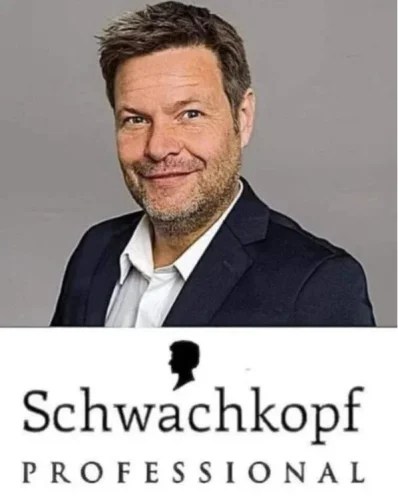
The offending image
The prosecutors statement said: “At a time that cannot currently be specified in more detail in the days or weeks before June 20, 2024, the accused published an image file using the account that shows a portrait of Federal Minister of Economics Robert Habeck with the title ‘Schwachkopf PROFESSIONAL’, based on the advertising campaign of the Schwarzkopf company, in order to generally defame Robert Habeck and to make it more difficult for him to work as a member of the federal government.”
The raid occurred in August, early in the morning when police officers entered the home of Stefan Niehoff, waking him and his family, which includes his wife and daughter. Niehoff, who had simply shared a meme that humorously altered a beauty care brand’s logo to feature Habeck, expressed his disbelief over the raid. He likened the aggressive enforcement to tactics used during the Communist era in East Germany.
This police action stemmed from a criminal complaint filed by Habeck himself, reacting to what he considered defamation that hindered his governmental duties. German law, refined during the tenure of the former Chancellor Angela Merkel, allows public officials to pursue criminal charges against perceived slanders relating to their official roles. Violations could result in fines or up to three years in prison.
The Vice Chancellor, along with other members of the Green party, has been an active participant in utilizing this law. Reports from the news outlet Junge Freiheit indicate that Habeck’s legal team continuously monitors social media for similar offenses, having filed 805 criminal complaints to date. His colleague, Foreign Minister Annalena Baerbock, has filed 453 such complaints.
Habeck, who wishes to become Germany’s leader, recently called for more online censorship, also calling for “the regulation of algorithms, of X or TikTok, through the application of European legal norms.”
Featured Video

Houthis Keep Advancing as the Red Sea Crisis Deepens
or go to
Aletho News Archives – Video-Images
From the Archives
15 Saudi ‘hijackers’ were CIA agents working for US: Scholar
Press TV – April 13, 2016
Fifteen of the 9/11 “hijackers” from Saudi Arabia were CIA agents working for the United States government, which was seeking to destroy the Middle East for Israel and to double the American military budget, says Dr. Kevin Barrett, an American academic who has been studying the events of 9/11 since late 2003…. continue
Blog Roll
 Aletho News
- Russia Just Struck the Eyes of NATO’s War Machine in Ukraine
- Russia summons UK charge d’affaires over Kiev drone support
- NATO member warns bloc seeking pretext for war with Russia
- Macgregor: We Haven’t Seen the Worst of the Iran War Yet
- ‘We are not like everyone else’ laws that bind other nations do not apply to Israel, says Likud lawmaker
- Report: Saudi Arabia seeks allies’ assistance as missiles deplete amid war on Yemen
- Fuel Crisis Deepens: Pakistan Warns Tanker Attack in Red Sea Would Be an ‘Act of War’
- ‘Bucha massacre’ a false flag orchestrated by UK – Moscow
- China Rejects Outside Pressure on Trade Ties After New US Russia Sanctions Bill
- Houthis Keep Advancing as the Red Sea Crisis Deepens
- If Americans Knew
- An error has occurred; the feed is probably down. Try again later.
- No Tricks Zone
- New Study: ‘Global Drought Shows No Detectable Recent Acceleration Under Climate Warming’
- Economic Masterminds: German Socialists Suggest Taxing Productivity Gains Stemming From Using AI
- The South China Sea Has Not Been Cooperating With The Climate Change Narrative
- Energy Crisis: Germany Enters Heating Season With Historically Low Gas Reserve Fill Levels
- New Study: The Antarctic Ice Sheet Gained Mass From 2020-2024 Due To Staggering Snow And Ice Accumulation
- Study: Ocean Heating Rates From Thousands Of Years Ago ‘Dwarf’ Modern Ocean Heating Rates
- Climate Extremists Target, Attack Large-Scale Power Grid Infrastructure In Germany!
- New Study: Antarctic Ice Melt Has Contributed Less Than 1 Centimeter To Sea Level Rise In The Last 30 Years
- Fear Of Debate: Alarmist German Climate Scientist Calls On Mainstream Media To Discredit Skeptic Voices
- End-Of-August Arctic Sea Ice Extent Hasn’t Fallen In 20 Years, Official Data Show!
 Aletho News