The rate of respiratory infection among German children is now approaching 25%, as lockdown harms continue
Without regular exposure to common pathogens, mothers can no longer confer crucial early immunity to their infants through breast milk.
eugyppius: a plague chronicle | December 5, 2022
The German fever gauge, Grippe Web, suggests that nearly one in four German children under 15 are currently suffering some kind of respiratory infection.

Thick red line: rate of acute respiratory infection in children in 2022/23; thin orange line: the rate in 2021/22; dotted orange line; the rate in 2020/21. Thick green line: the rate in adults 2022/23; thin green late: the rate in 2021/22; dotted green line: the rate in 2020/21.
The rate is especially high in children under 4, a demographic that has seen elevated rates of illness for over a year now.

Red line is 0-to-4 year-olds.
This isn’t the vaccines (almost no children under 5 have been vaccinated), and it’s not just a coincidence or a bad year for RSV either. It’s a direct consequence of mass containment. While lockdowns didn’t do much about SARS-2, they appear to have reduced the incidence of other, slower-moving viruses considerably. Young women in particular have been underexposed to RSV for three years now, with the result that their breast milk confers far less passive immunity against common viruses than it did in the pre-pandemic era.
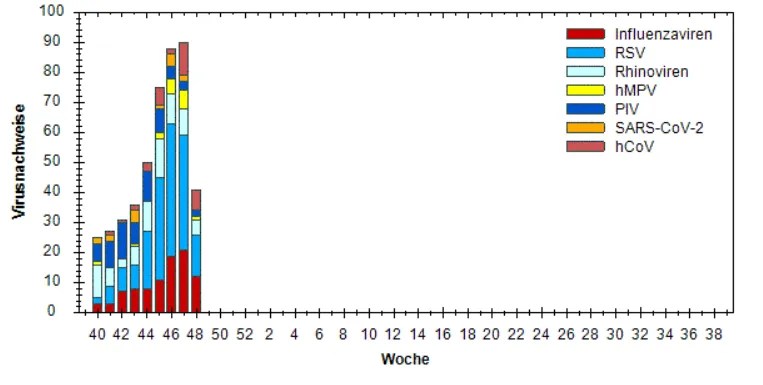
The chart, from the flu surveillance division of the RKI, shows that RSV is by far the most dominant infection among under five years olds. The virus is particularly dangerous for infants.
Measures sold to the public as means of keeping our healthcare system from collapsing, have thus resulted in unprecedented pressure on German pediatric treatment facilities and hospitals, with dying children facing delayed operations and long transfers to outlying hospitals. Obviously it doesn’t help that the zealous vaccinators have driven away scarce healthcare staff with their mandates and other pointless harassment. All those people who spent 2021 singing the praises of lockdowns and crowing that they hadn’t had so much as a cold since the pandemic started, should now be made aware of what their policy preferences actually cost. Adults are supposed to get mild upper respiratory infections once in a while. If they don’t, their infants will get them instead, and some will die.
The Manhattan Contrarian Energy Storage Paper Has Arrived!
By Francis Menton | Manhattan Contrarian | December 1, 2022
Today my long-awaited energy storage paper was officially published on the website of the Global Warming Policy Foundation. Here is a link. The paper is 22 pages long in the form in which they have published it plus another few pages for an Executive Summary and table of contents. They have given it the title “The Energy Storage Conundrum.”
Most of the points made in the paper have been made previously on this blog in one form or another. However, there is a good amount of additional detail in the paper that has never appeared here. I’ll provide one example of that today, and more of same in coming days.
The main point of the paper is that an electrical grid powered mostly by intermittent generators like wind and sun requires full backup from some source; and if that source is to be stored energy, the amounts of storage required are truly staggering. When you do the simple arithmetic to calculate the storage requirements and the likely costs, it becomes obvious that the entire project is completely impractical and unaffordable. The activists and politicians pushing us toward this new energy system of wind/solar/storage are either being intentionally deceptive or totally incompetent.
If you follow the news on this subject at a general level, you might find this conclusion surprising. After all, there are frequent announcements that this or that jurisdiction has entered a contract to purchase some seemingly large amount of batteries for grid-level storage. The Report cites data from consultancy Wood Mackenzie as to announced plans or contracts for storage acquisition in all major European countries, and cites other reports as to announced plans from California and New York in the U.S. The title of the April 2022 Wood Mackenzie paper on Europe certainly gives the impression that these people have the situation under control and know what they are doing: “Europe’s Grid-scale Energy Storage Capacity Will Expand 20-fold by 2031.” Impressive!
But this is one of those subjects on which you have to look at the actual numbers to evaluate whether the plans make any sense. In this situation, you need to compare the amount of energy storage that would be required for full backup of an almost-entirely wind/solar grid (with fossil fuels excluded), to the actual quantity of grid-scale energy storage being acquired.
Consider the case of Germany, the country that has gone the farthest of any in the world down the road to “energy transition.” My Report presents two different calculations of the energy storage requirement for Germany in a world of a wind/solar grid and no fossil fuels allowed (both of which calculations have been previously covered on this blog). One of the calculations, by a guy named Roger Andrews, came to a requirement of approximately 25,000 GWh; and the other, by two authors named Ruhnau and Qvist, came to a higher figure of 56,000 GWh. The two use similar but not identical methodology, and somewhat different assumptions. Clearly there is a large range of uncertainty as to the actual requirement; but the two calculations cited give a reasonable range for the scope of the problem.
To give you an idea of just how much energy storage 25,000 (or 56,000) GWh is, here is a rendering (also from my Report) of a grid-scale battery storage facility under construction in Queensland, Australia by Vena Energy. The facility in the rendering is intended to provide 150 MWh of storage.
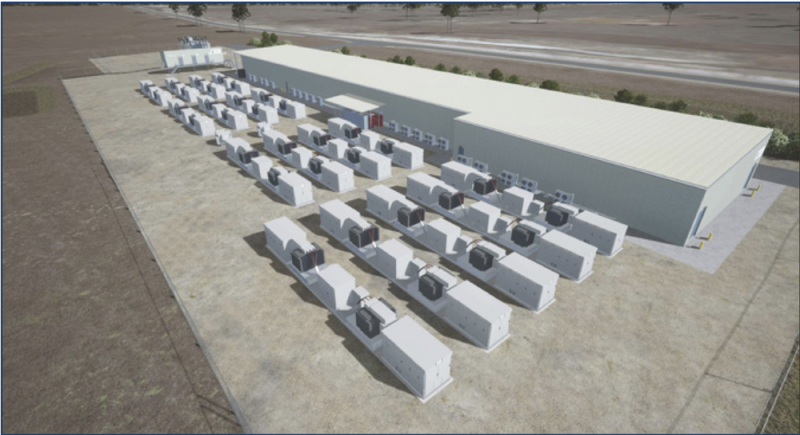
Remember that 150 MWh is only 0.15 of one GWh. In other words, it would take about 167,000 of these facilities to provide 25,000 GWh of storage, and about 373,000 of them to get to the 56,000 GWh in the larger estimate.
And against these projections of a storage requirement in the range of tens of thousands of GWh, what are Germany’s plans as presented in this “20-fold expansion” by 2031? From my Report:
In the case of Germany, Wood Mackenzie states that the planned energy storage capacity for 2031, following the 20-fold expansion, is 8.81GWh.
Rather than tens of thousands of GWh, it’s single digits. How does that stack up in percentage terms against the projected requirements?:
In other words, the amount of energy storage that Germany is planning for 2031 is between 0.016% and 0.036% of what it actually would need. This does not qualify as a serious effort to produce a system that might work.
The story is the same in the other jurisdictions covered in the Report. And remember, these are the jurisdictions that consider themselves the leaders and the vanguard in the transition to renewable energy. For example, New York, with an estimated storage requirement for a mainly-renewables grid of 10,000-15,000 GWh, is said by trade magazine Utility Dive to be “forging ahead” with plans to procure some 6 GW of grid storage (presumably translating into about 24 GWh). That would come to around 0.2% of what is needed. Unless, of course, New York simultaneously “forges ahead” with its plans to triple the demand on the grid by electrifying all automobiles and home heating; in that case the 24 GWh would be back down to less than 0.1% of the storage requirement.
California? The Report cites another article from Utility Dive stating that the California Public Utilities Commission has ordered the state’s power providers to collectively procure by 2026 some 10.5 GW (or 42.0 GWh) of lithium-ion batteries for grid-scale storage:
The additional 10.5 GW of lithium-ion storage capacity, translating to at most about 42 GWh, would take California all the way to about 0.17% of the energy storage it would need to fully back up a wind/solar generation system.
However bad you might think this situation is, it’s worse. Am I the only person who has ever made these simple calculations? I certainly have never seen them anywhere else.
I would be very happy to be proved wrong about any and all of this. All I say is that the proponents of this miraculous fantasy energy future owe it to the rest of us to build a working demonstration project before forcing us all to adopt their utopian scheme at ruinous cost, only to find out that it won’t work and can’t work.
Here’s what tells you all you need to know: not only is there no working demonstration project anywhere in the world of the wind/solar/storage energy system, but there is none under construction and none even proposed. Instead, the proponents’ idea is that your entire state or country is to be the guinea pig for their dreams. After all, they are “saving the planet.” If there has ever previously been something this crazy in the history of the world, I certainly can’t name it.
War on Global Agriculture: The Unsustainable ‘Sustainable’ UN Agenda 2030
By F. William Engdahl | Global Research | December 1, 2022
Over the past weeks a coordinated all-out assault on our agriculture—the ability to produce food for human existence—has begun. The recent G20 governmental meeting in Bali, the UN Agenda 2030 Cop27 meeting in Egypt, the Davos World Economic Forum and Bill Gates are all complicit. Typically, they are using dystopian linguistic framing to give the illusion they are up to good when they are actually advancing an agenda that will lead to famine and death for hundreds of millions if not billions if allowed to proceed. It’s driven by a coalition of money.
From G20 to Cop27 to WEF
On November 13 the G20–representatives of the 20 most influential nations including the USA, the UK, the European Union (though it’s no nation), Germany, Italy, France, Japan, South Korea, and several developing countries including China, India, Indonesia and Brazil,– agreed on a final declaration.
The first major item is a “call for an accelerated transformation towards sustainable and resilient agriculture and food systems and supply chains.”
Further, “working together to sustainably produce and distribute food, ensure that food systems better contribute to adaptation and mitigation to climate change, and halting and reversing biodiversity loss, diversify food sources…”
In addition they called for “inclusive, predictable, and non-discriminatory, rules-based agricultural trade based on WTO rules.”
As well, “We are committed to supporting the adoption of innovative practices and technologies, including digital innovation in agriculture and food systems to enhance productivity and sustainability in harmony with nature…”
Then comes the revealing statement: “We reiterate our commitment to achieve global net zero greenhouse gas emissions/carbon neutrality by or around mid-century.” [i](emphasis mine)
“Sustainable agriculture” with “net zero greenhouse gas emissions” is Orwellian doublespeak. For an outsider to UN linguistics, the words sound too good. What in fact is being promoted is the most radical destruction of farming and agriculture globally under the name “sustainable agriculture.”
Following the Bali G20 confab by only days was the United Nations’ COP27 annual Green Agenda Climate Summit meeting in Egypt. There, the participants from most UN countries along with NGOs such as Greenpeace and hundreds of other green NGOs drafted a second call. COP27 launched something they revealingly call FAST– UN’s new Food and Agriculture for Sustainable Transformation (FAST) initiative. Fast, as in “to abstain from food…”
According to Forbes, FAST will promote a “shift towards sustainable, climate-resilient, healthy diets, would help reduce health and climate change costs by up to US$ 1.3 trillion while supporting food security in the face of climate change.” We are talking big numbers. $1.3 trillion by transition to “sustainable, climate-resilient, healthy diets” that would reduce cost of climate change by $1.3 trillion. [ii] What’s really going on behind all these words?
Big Money Behind
According to the UN Food and Agriculture Organization speaking to Reuters during COP27, within a year the FAO will launch a “gold standard” blueprint for reduction of so-called Greenhouse gases from agriculture.
The impulse for this war on agriculture comes not surprisingly from big money, FAIRR Initiative, a UK-based coalition of international investment managers which focuses on “material ESG risks and opportunities caused by intensive livestock production.”
Their members include the most influential players in global finance including BlackRock, JP Morgan Asset Management, Allianz AG of Germany, Swiss Re, HSBC Bank, Fidelity Investments, Edmond de Rothschild Asset Management, Credit Suisse, Rockefeller Asset Management, UBS Bank and numerous other banks and pension funds with total assets under management of $25 trillion.[iii] They are now opening the war on agriculture much as they have on energy. The UN FAO Deputy Director for Climate Change policies, Zitouni Ould-Dada said during the COP27 that, “There has never been this much attention to food and agriculture anytime before. This COP is definitely the one.” [iv]
The FAIRR claims, without proof, that:
“food production accounts for around a third of global greenhouse gas emissions and is the main threat to 86% of the world’s species at risk of extinction, while cattle ranching is responsible for three quarters of Amazon rainforest loss.” [v]
The FAO plans to propose drastic reduction in global livestock production, especially cattle, which FAIRR claims is responsible for:
“nearly a third of the global methane emissions linked to human activity, released in the form of cattle burps, manure and the cultivation of feed crops.”
For them, the best way to stop cow burps and cow manure is to eliminate cattle. [vi]
Unsustainable Sustainable Agriculture
The fact that the UN FAO is about to release a roadmap to drastically reduce so-called greenhouse gases from global agriculture, under the false claim of “sustainable agriculture” that is being driven by the world’s largest wealth managers including BlackRock, JP Morgan, AXA and such, tells volumes about the true agenda. These are some of the most corrupt financial institutions on the planet. They never put a penny where they are not guaranteed huge profits. The war on farming is their next target.
The term “sustainable” was created by David Rockefeller’s Malthusian Club of Rome. In their 1974 report, Mankind at the Turning Point, The Club of Rome argued:
“Nations cannot be interdependent without each of them giving up some of, or at least acknowledging limits to, its own independence. Now is the time to draw up a master plan for organic sustainable growth and world development based on global allocation of all finite resources and a new global economic system. [vii](emphasis mine)
That was the early formulation of the UN Agenda 21, Agenda2030 and the 2020 Davos Great Reset. In 2015 UN member nations adopted what is called the Sustainable Development Goals or SDGs: 17 Goals to Transform our World. Goal 2 is “End hunger, achieve food security and improved nutrition and promote sustainable agriculture.”
But if we read in detail into proposals of COP27, G20 and Davos WEF of Klaus Schwab we find what is meant by these nice sounding words. Now we are being inundated with claims, unverified, by numerous government and privately-funded think tank models that our agriculture systems are a major cause of, yes, global warming. Not only CO2 but methane and nitrogen. Yet the entire global greenhouse gas argument that our planet is on the brink of irreversible disaster if we do not radically change our emissions by 2030 is unverifiable nonsense from opaque computer models. Based on these models the UN IPCC insists that if we do not stop a global temperature rise of 1.5 C above the level of 1850, by 2050 the world will essentially end.
The War Is Just Beginning
The UN and Davos WEF teamed up in 2019 to jointly advance the SDG UN Agenda 2030. On the WEF website this is openly admitted to mean getting rid of meat protein sources, introducing promoting unproven fake meat, advocating alternative protein such as salted ants or ground crickets or worms to replace chicken or beef or lamb. At COP27, discussion was about “diets that can remain within planetary boundaries, including lowering meat consumption, developing alternatives, and spurring the shift towards more native plants, crops and grains (thus reducing the current reliance on wheat, maize, rice, potatoes).” [viii]
The WEF is promoting a shift from meat protein diets to vegan arguing it would be more “sustainable”. [ix] They also promote lab-grown or plant-based lab meat alternatives such as the Bill Gates-funded Impossible Burgers, whose own FDA tests indicate it is a likely carcinogen as it is produced with GMO soy and other products saturated with glyphosate. The CEO of Air Protein, another fake meat company, Lisa Lyons, is a special WEF adviser. WEF also promotes insect protein alternatives to meat. Note also Al Gore is a Trustee of WEF. [x]
The war on animal raising for meat is just getting deadly serious. The government of the Netherlands whose Prime Minister Mark Rutte, formerly of Unilever, is a WEF Agenda Contributor, has created a special Minister for the Environment and Nitrogen, Christianne van der Wal. Using a never-invoked and outdated EU Natura 2000 nature protection guidelines designed allegedly to “protect moss and clover,” and based on fraudulent test data, the Government just announced it will forcibly close 2,500 cattle farms across Holland. Their goal is to force fully 30% of cattle farms to close or face expropriation.
In Germany the German Meat Industry Association (VDF), says that within the next four to six months Germany will face a meat shortage, and prices will skyrocket. Hubert Kelliger, a VDF board member said, “In four, five, six months we will have gaps on the shelves.” Pork is expected to experience the worst shortages. The issues in meat supply are due to Berlin insisting on reducing the numbers of livestock by 50% to reduce global warming emissions. [xi] In Canada, the Trudeau government, another Davos WEF product, according to the Financial Post of July 27, plans to cut emissions from fertilizer 30 per cent by 2030 as part of a plan to get to net zero in the next three decades. But growers are saying that to achieve that, they may have to shrink grain output significantly.
When the autocratic President of Sri Lanka banned all import of nitrogen fertilizers in April 2021 in a brutal effort to return to a past of “sustainable” agriculture, harvests collapsed in seven months and famine and farmer ruin and mass protests forced him to flee the country. He ordered that the entire country would immediately switch to organic farming but provided farmers with no such training.
Combine all this with the catastrophic EU political decision to ban Russian natural gas used to make nitrogen-based fertilizers, forcing shutdowns of fertilizer plants across the EU, that will cause a global reduction in crop yields, and as well the fake Bird Flu wave that is falsely ordering farmers across North America and the EU to kill off tens of millions of chickens and turkeys to cite just a few more cases, and it becomes clear that our world faces a food crisis that is unprecedented. All for climate change?
*
F. William Engdahl is strategic risk consultant and lecturer, he holds a degree in politics from Princeton University and is a best-selling author on oil and geopolitics. He is a Research Associate of the Centre for Research on Globalization (CRG).
Notes
[i] G20 Bali Leaders’ Declaration, Bali, Indonesia, 15-16 November 2022, https://www.consilium.europa.eu/media/60201/2022-11-16-g20-declaration-data.pdf
[ii] Kit Knightly, COP27 reignites the war on food, https://www.theburningplatform.com/2022/11/13/lab-grown-meat-nuclear-yeast-vats-cop27-reignites-the-war-on-food/
[iii] https://www.fairr.org/about-fairr/network-members/page/14
[iv] Sarah El Safty, Simon Jessop, COP27: UN food agency plan on farming emissions to launch by next year after investor push, November 10, 2022, https://www.reuters.com/business/cop/cop27-un-food-agency-plan-farming-emissions-launch-by-next-year-after-investor-2022-11-10/
[v] FAIRR Initiative, Where’s The Beef, https://www.fairr.org/wheres-the-beef/
[vi] Simon Jessop, Gloria Dickie, Global investors write to U N to urge global plan on farming emissions, June 9, 2022, https://www.reuters.com/business/sustainable-business/exclusive-global-investors-write-un-urge-global-plan-farming-emissions-2022-06-08/
[vii] Club of Rome, Mankind at the Turning Point, 1974, https://web.archive.org/web/20080316192242/http:/www.wiseupjournal.com/?p=154
[viii] THE SHARM EL SHEIKH CLIMATE IMPLEMENTATION SUMMIT, cop27.eg 1, Round table on “Food Security” 7th November 2022, https://cop27.eg/assets/files/days/COP27%20FOOD%20SECURITY-DOC-01-EGY-10-22-EN.pdf
[ix] Vegan, vegetarian or flexitarian? 3 ways to eat more sustainably, October 28, 2022, https://www.weforum.org/agenda/2022/10/vegan-plant-based-diets-sustainable-food/
[x] WEF, Have we reached the end of meat?, https://www.weforum.org/podcasts/house-on-fire/episodes/have-we-reached-the-end-of-meat
[xi] J. Shaw, Germany cutting back meat production to fight global warming, November 21, 2022, https://hotair.com/jazz-shaw/2022/11/21/germany-cutting-back-meat-production-to-fight-global-warming-n512518
Copyright © F. William Engdahl, Global Research, 2022
American Pravda: Lost Histories of the Great War

Female delegates to the 1915 Women’s Peace Conference in The Hague
BY RON UNZ • UNZ REVIEW • NOVEMBER 28, 2022
Friends of the Palo Alto Library runs a local monthly book sale, now reopened after nearly two years of Covid closures, and I usually attend, often buying for a pittance items that have caught my eye. A few weeks ago I picked up for a quarter a copy of Adam Hochschild’s widely praised 2011 volume To End All Wars, his account of the British anti-war movement during World War I, which I’d seen very favorably reviewed in the Times and elsewhere when it was originally released. My own knowledge of that era was relatively meager and sparse, so I spent a couple of days reading the text.

Hochschild seems a fine writer and researcher, certainly earning the glowing blurbs by prominent scholars that stud his book, and he told a very interesting story of the men and women who organized and led Britain’s powerful but heavily suppressed anti-war movement as it opposed the continuing slaughter in the trenches. Many of these individuals suffered harsh imprisonment for their dissent, including Keir Hardie, the founder of what became the Labour Party and Bertrand Russell, the brilliant mathematical philosopher and future Nobel Laureate.
Support for the war split the militant Suffragette movement straight down the middle, and important political families were also often deeply divided, with the beloved elder sister of Britain’s own military commander-in-chief in France becoming a prominent peace campaigner. Just a few years earlier, E.D. Morel, the country’s leading investigative journalist, had been celebrated as an international hero for exposing the horrors of the Belgian Congo, but he was now imprisoned for his anti-war writings, with the treatment so brutal that it permanently broke his health and he died at the age of 51, a few years after the war ended.
Just as I’d expected, I discovered a wealth of information about a period only known to me in outline, and I saw no reason to doubt any of its accuracy, including the brief but surprising references to supposedly widespread German war crimes in occupied Belgium. I was very glad to fill these large gaps in my existing knowledge.
But near the end of Hochschild’s discussion of the year 1916, he emphasized that unlike Britain there was absolutely no corresponding anti-war movement in most other countries, including Germany. As he put it on p. 217:
“Both sides were committed to fight to the bitter end, and by now, two years into the war, if someone in a prominent position on either side so much as advocated peace talks, it was considered close to treason.”
On reading this, I did a double-take and almost questioned my sanity. Surely, Hochschild must be aware that exactly at that point in time, the government of Germany had publicly proposed international peace talks without preconditions aimed at ending the war, suggesting that the massive, pointless slaughter be halted, perhaps largely on a status quo ante basis.
The Germans had recently won several huge victories, inflicting enormous losses on the Allies in the Battle of the Somme and also completely knocking Rumania out of the war. So riding high on their military success, they emphasized that they were seeking peace on the basis of their strength rather than from any weakness. Unfortunately, the Allies flatly rejected this peace overture, declaring that that the offer proved Germany was close to defeat, so they were determined to hold out for complete victory with major territorial gains.
As a result, many additional millions needlessly died over the next two years, while just a couple of months later in early 1917 Russia’s Czarist government collapsed, eventually leading to the Bolshevik seizure of power, a turning-point with fateful, long-term consequences.
I don’t recall having ever seen any discussion of that rejected German peace proposal in the cursory treatment of the First World War provided by my basic high school or college textbooks, so I hadn’t originally heard of it. But around 2000, I’d begun a software project aimed at digitizing the near-complete archives of many of America’s most influential opinion magazines of the past, and along the way I’d been surprised to notice all those late 1916 headlines describing the peace offer, then glanced at a few of the articles and discovered the important history that I’d previously missed. For example, the December 23, 1916 lead article in America’s influential Literary Digest carried the headline “Germany’s Peace-Proposals” and for several weeks around that date numerous other stories in that periodical, as well as in the Nation, the New Republic, and various other publications had covered the same topic.
But although my introductory textbooks had failed to mention those facts, Hochschild was an award-winning author and historian, someone who had obviously devoted years of diligent research to his book on WWI peace movements. I found it difficult to believe that he was unaware of those crucial events, and I assumed that he would discuss them in the next chapter, but I finished his entire 450 page book seeing absolutely no mention anywhere.
At that point, I decided to confirm my recollections by doing a few casual Google searches on the topic, and found surprisingly little on the Internet. I then consulted the Wikipedia entry on World War I, which ran almost 40,000 words including nearly 500 references, but it only featured a single sentence on the German peace proposal that might have ended the fighting and thereby saved many millions of lives. Fortunately, that brief mention did link to a short 2018 Washington Post piece by a couple of professional historians, whose account fully matched my own understanding of the facts. The Great War ended on November 11, 1918, and their piece had appeared exactly one hundred years later to the day. So apparently it had required the centennial anniversary of the conclusion of that war to prompt our mainstream media to finally provide some coverage of that nearly forgotten story.
- Why the First World War Lasted So Long
Alexander Lanoszka and Michael A. Hunzeker • The Washington Post • November 11, 2018 • 1,100 Words
If a negotiated peace had ended the wartime slaughter after just a couple of years, the impact upon the history of the world would obviously have been enormous, and not merely because more than half of the many millions of wartime deaths would have been avoided. All the European countries had originally marched off to battle in early August 1914 confident that the conflict would be a short one, probably ending in victory for one side or the other “before the leaves fell.” Instead, the accumulated changes in military technology and the evenly-balanced strength of the two rival alliances soon produced a gridlock of trench-warfare, especially in the West, with millions dying while almost no ground was gained or lost. If the fighting had stopped in 1916 without a victory by either side, such heavy losses in a totally pointless conflict surely would have sobered the postwar political leadership of all the major European states, greatly discouraging the brinksmanship that had originally led to the calamity let alone allowing any repeat. Many have pointed to 1914 as the optimistic high-water mark of Western Civilization, and with the sobering impact of two disastrous years of warfare and millions of unnecessary deaths, that peak might have been sustained indefinitely.
Instead, the consequences of the continuing war were utterly disastrous for all of Europe and much of the world. Many millions more died, and the difficult wartime conditions probably fostered the spread of the deadly Spanish Flu epidemic of 1918, which then swept across the world, taking as many as 50 million lives. Russia’s crippling defeats in 1917 brought the Bolsheviks to power, leading to a long civil war that killed many millions more, followed by three generations of global conflict over Soviet Communism, certainly accounting for tens of millions of additional civilian deaths. The extremely punitive terms that the Treaty of Versailles imposed upon defeated Imperial Germany in 1919 eventually led to the collapse of the Weimar Republic and a second, far worse round of global warfare involving both Nazi Germany and Soviet Russia, a catastrophe that laid waste to much of Europe and claimed several times as many victims as the Great War itself.
Although the Allies at the time had bitterly denounced what they sometimes called the dangerous “German Peace Offensive” of late 1916, it seemed obvious to me that the world would have been a much better place if it hadn’t been rejected.
Just out of curiosity, I queried quite a number of knowledgeable, well-read individuals, asking what they knew of the abortive 1916 German peace proposal and their responses were quite interesting. A mainstream scholar who had written several books on First World War topics was a little surprised at Hochschild’s lack of awareness, but noted that academic fashions since the 1960s had shifted in a direction sharply hostile to Imperial Germany, and as a result coverage of those elements of the historical record suggesting otherwise had been greatly minimized over the last half-century or more.
Meanwhile, nearly all of the lay individuals I contacted had never heard of the 1916 effort at peace and were mostly shocked by the story, the one notable exception being Kevin Barrett, whose long-running Truth Jihad podcast show had featured various conspiratorial guests over the years who had discussed it, sometimes with regard to broader, less plausible historical plots.
The extent to which the seemingly undeniable facts of the 1916 peace proposal have disappeared from public discussion is really quite remarkable, and I gradually discovered that Hochschild was far from alone in providing no hint of the story.

Consider high-profile British-born historian Niall Ferguson of Harvard and Stanford Universities, who had made his early name with his publication of The Pity of War in 1999, a highly heterodox reanalysis of World War I that came to numerous controversial conclusions. Among other positions, Ferguson boldly argued that the British should have stayed out of the conflict, which would then have resulted in a quick and sweeping German victory, leading Germany to establish political and economic hegemony over Continental Europe. But this would have simply resulted in the creation of the EU three generations earlier and avoided the many tens of millions of needless deaths in the two world wars, let alone the global consequences of the Bolshevik Revolution.
Although Ferguson was deliberately provocative in his account, I didn’t remember seeing any specific mention of the 1916 peace proposal when I’d read the book a few years ago, and reexamining it now confirmed my recollection, even though his Introduction contains nearly a page of “What If?” scenarios, and he discussed numerous “alternative realities” later in his text. Indeed, just a couple of years earlier he had edited Virtual History, a collection of more than a dozen lengthy essays by professional scholars examining the consequences of history taking a different turn at numerous key junctures, including a German victory in WWI, but once again it totally lacked any suggestion of a possible negotiated peace in 1916.
An even longer volume of a very similar type, appropriately titled What If? appeared in 2001, edited by historian Robert Cowley and it was just as silent. The book ran over 800 pages, of which more than 90 were devoted to seven different alternate scenarios involving World War I, but the possibility of a 1916 peace nowhere appeared, despite surely being one of the most obvious and important “What Ifs.”
Comprehensive mainstream histories also seemed quite silent. In 1970 renowned British historian A.J.P. Taylor published English History, 1914-45, which ran almost 900 pages, with nearly a quarter of those devoted to WWI; but no hint was given of the 1916 German peace proposal, with the very possibility of the Germans accepting a reasonable compromise peace at that point being dismissed in just a few sentences and a footnote. John Keegan’s 1999 volume The First World War runs 475 pages and also appears to lack any mention. While I’ve hardly performed an exhaustive review of all the standard historical texts, I think these two examples seem fairly typical, probably thus explaining Hochschild’s complete lack of awareness, with Ferguson and other distinguished authors likely having similar gaps in their knowledge.
The issue also seemed not to come up in more specialized studies, even when it might have played an important role. A couple of years ago I’d read Sean McMeekin’s 2017 history The Russian Revolution, an outstanding, meticulous reconstruction of the complex and contingent circumstances that led to the 1917 fall of the Czarist Regime and the subsequent triumph of Lenin’s Bolsheviks.
The prologue is devoted to the murder of Grigory Rasputin, the peasant faith-healer who exercised such enormous influence over the Czar and his family that although he held no official position, he probably ranked for many years as the third most powerful figure in the Russian Empire. Moreover, his December 1916 death at the hands of a conspiratorial group that included top members of Russia’s elite seems to have been an important factor in destabilizing the regime, leading to its collapse in the February Revolution just a couple of months later.
Rasputin had long had severe misgivings about continuing the costly war against Germany, and this was a crucial motive behind his killing; indeed, fears of the defection of their huge Russian ally led members of British Intelligence to assist the effort. Although plots against Rasputin’s life had been circulating for months, he was finally struck down on December 20th, exactly when Germany’s very public “peace offensive” was gaining considerable international attention; and although the author doesn’t directly connect the two developments, the timing hardly seems likely to have been purely coincidental. So the desperate Allied moves to block any support for the proposed German peace plan may have actually helped trigger the Russian Revolution.
Obviously an early end to the Great War would have been an event of tremendous importance and the 1916 German efforts to secure peace were certainly treated as such in the news reports of the day. But Germany ultimately lost the war and the resulting official narrative blamed Europe’s catastrophe upon relentless German militarism, so that German peace proposal became a discordant element, raising troubling questions about the overall storyline. As a consequence, those facts were eventually flushed down the memory-hole for most of the next one hundred years, and if I hadn’t glanced at those original 1916 headlines, I certainly never would have discovered them.
Indeed, once I casually mentioned this interesting history on my website, one or two of the other commenters sharply challenged my claims, regurgitating the orthodox narrative that the Germans had been opposed to any reasonable negotiated peace, without explaining why all the contemporaneous media accounts had said exactly the opposite. According to these critics, Germany’s powerful military establishment would certainly have vetoed any such proposals, and I decided to see if I could find anything stronger to support my position than merely a thousand-word centennial op-ed in the Post written by a couple of obscure, junior academics.
To my considerable surprise, I discovered that just last year an entire book had been published on the lost chances for peace in 1916, apparently the first and only English-language work ever devoted to that seemingly important topic. Moreover, the author of The Road Less Traveled was Philip Zelikow, best known for having served as executive director of the 9/11 Commission, and therefore someone entirely in the good graces of the mainstream establishment. Near the end of his Introduction, he explained that he had been working on the project off and on for more than a dozen years.
Although the main text ran well under 300 pages, his account of events seemed thorough and persuasive in its coverage, drawing heavily upon archival records and private diaries to firmly establish the same remarkable story that I had originally glimpsed in those old publications. His exhaustive research had uncovered a great deal of additional material, piecing together an account radically different than what had been presented in many decades of highly misleading treatments. And despite such seemingly controversial “revisionism,” his work received glowing endorsements from leading academic scholars and favorable reviews in such influential publications as Foreign Affairs, the National Interest, and Foreign Policy, though since it never caught the attention of my newspapers I’d remained unaware of it.
The story Zelikow tells is a really fascinating one, especially since it had remained almost entirely hidden from public awareness for more than a century.
Although influential elements including his closest political advisor had wanted America to enter the war on the Allied side, President Woodrow Wilson had been hoping all along that he could mediate an end to the conflict, much like his predecessor Theodore Roosevelt had done in the Russo-Japanese war, with the latter’s success crowned by winning the 1906 Nobel Peace Prize.
During the first two years of the fighting, neither side had responded favorably to his peace feelers, but by August 1916 circumstances had changed, and although the conflicted British leadership finally decided to continue trying their luck on the battlefield, the similarly-conflicted German government secretly accepted Wilson’s offer to preside as mediator at a peace conference. Given the horrific casualties that both sides had already suffered, it was widely believed that once public peace negotiations began, there was little chance that the fighting would ever resume. And with Wilson, most of the German leadership, and much of the British Cabinet ready for peace, the prospects certainly appeared excellent, especially since the Allies were so heavily dependent upon American supplies and financing for survival.
But although all the pieces seemed ready to fall into place, opportunities were repeatedly missed during the more than five months that followed. One important factor was the extreme difficulty of communications since the British had severed Germany’s trans-Atlantic telegraph cable at the beginning of the war, meaning that German communications with Wilson or their own ambassador had to take a circuitous route through various neutral countries and Latin America, finally arriving at DC in encoded form days or even weeks later.
Another crucial factor was that Wilson lacked any strong staff that could translate his broad ideas into serious policy proposals. Unlike major European countries, America back then had little bureaucratic infrastructure, with Wilson mostly writing his own speeches and regarding his new Secretary of State, a lawyer who had no diplomatic experience, as merely an intelligent clerk. Instead, his only close advisor was Col. Edward House, a wealthy Texan dilettante who often had eccentric views, and so strongly favored the British that he sometimes seemed to deliberately sabotage the peace effort. As a lifelong academic, Wilson himself had only spent two years as Governor of New Jersey before unexpectedly reaching the White House in 1913, and therefore he had little direct experience in either politics or international diplomacy.
So although the German government responded favorably to his offer of a peace conference in August 1916, Wilson failed to grasp the urgency of their request, and decided to take no action until after the November election. Meanwhile, within Germany, the military advocates of an unrestricted U-boat campaign against the American ships carrying Allied supplies were pressing very hard for their alternate strategy, which was sure to lead to a break in American relations.
After the British had suffered enormous casualties in their attack on the Somme, including losing nearly 20,000 dead on the first day of fighting, their own peace party was strengthened and the government became willing to consider Wilson’s offer. A son of Prime Minister H.H. Asquith had died in the battle and another had been wounded, while the German offer to restore occupied Belgium satisfied the most important British condition.
But then at the end of September, War Minister David Lloyd George — who had been a leading advocate of the American peace option — suddenly switched sides, and declared that Britain would never accept a compromise peace and would instead be willing to fight for twenty years if necessary in order to achieve a total military victory, with anything less than a “knockout” being “unthinkable.” Zelikow plausibly argues that Lloyd George believed he could use his reversal on peace to gain the support of British hardliners such as Lord Northcliffe’s powerful newspaper group for replacing Asquith as Prime Minister, and indeed that was exactly what happened within a couple of months, with the advocates of peace being pushed out of the government.
Despite the shifting positions of the British, Wilson returned to his peace efforts after his November 7th reelection, only to encounter strong opposition from House, his key advisor. Although Britain was already locked in a desperate struggle with Germany and totally dependent upon American supplies, House somehow became convinced that if America pressed too hard for peace, the British would declare war against our own country. Incredible as it might sound to us, House repeatedly argued to Wilson and others that a British army could sweep down from Canada while the Royal Navy would land hundreds of thousands of troops from their Japanese ally on our coasts, together seeking to conquer the United States. Although these bizarre concerns were rejected, they assisted the overwhelmingly pro-British State Department officials in delaying Wilson’s plans to launch his peace proposal.
Around this same time, the German ambassador began pleading with the Wilson Administration to act immediately lest the opportunity for peace be lost, and Zelikow entitled this chapter “Peace Is on the Floor Waiting to Be Picked Up!” which was one of the impassioned phrases that envoy had used. Meanwhile, Germany’s hard-line military leadership was steadily increasing the pressure on their government to abandon its peace efforts and instead return to the unrestricted submarine warfare that they claimed could quickly win the war.
Growing desperate at the president’s endless delays, Germany and its allies eventually issued their own unconditional call for peace talks on December 12th, hoping that step would finally prompt Wilson to act by inviting participants to a peace conference at the Hague and offering himself up as the mediator. The German announcement captured the attention of the world and forced Wilson to respond lest he be eclipsed, and a week later he finally circulated his own peacemaking note, but as Zelikow explains, it constituted a “misfire,” lacking as it did any specifics let alone an invitation for the warring parties to attend an actual peace conference. So the Allies firmly rejected the German offer as a “trick” and were able to ignore Wilson’s statement since it required them to do nothing. Over the next few weeks, the opportunity for peace faded away, and in late January the Germans announced they would return to unrestrained submarine warfare, leading Wilson to break off relations and move towards war with Germany.
Although influential elements within the American government had sought this result from the beginning, Zelikow persuasively argues that the mistakes, errors, and misunderstandings by Wilson and the others also seeking a negotiated peace were probably more responsible for this outcome than the efforts by the individuals who actually intended it. His harsh historical verdict on the former hardly seems unfair:
In the failure to make peace at the most opportune moment, no one failed, and failed the world, more than President Wilson. His was the most consequential diplomatic failure in the history of the United States.
Thus, one of the most important turning points of the twentieth century probably came in late 1916 with the tragic collapse of a peace effort that initially seemed so likely to succeed, and Zelikow’s gripping narrative tells the story of how and why that opportunity slipped away. By all rights, the Lost Peace of 1916 should have become the subject of countless novels, plays, and films, but instead it remains almost totally unknown today, even among the most highly educated.
My own encounter with some of the lost history of World War I came when I noticed the headlines and read the articles that had run in our leading publications while the story was still unfolding. Once important events have been finalized and the heroes and villains officially determined, there is a natural tendency to reinterpret the past in the light of what ultimately transpired, thereby establishing a simple narrative that follows straight lines. Put another way, the winners write most of the histories.

For that exact reason, I think that one of the least known but most absolutely valuable books about the Great War was completed in mid-March 1917, just weeks before our own involvement inevitably distorted all subsequent analysis. The author was Lothrop Stoddard, who had earned his Ph.D. in history at Harvard and was then just beginning a career that would soon establish him as one of America’s most influential public intellectuals. His book was Present-Day Europe, a scrupulously even-handed survey of the wartime politics and recent history of each individual nation.
The work is not overly long, running less than 75,000 words, and can easily be read in just a day or two, but it provides an enormous wealth of detailed, contemporaneous information, much of which appears to have been left on the cutting-room floor of later historiography, written after the official narrative had already hardened. Moreover, as he explained in his Preface, Stoddard followed a rigid requirement of only quoting the natives of each country in their own chapter, Englishmen on England, Germans on Germany, and so forth, thereby providing an invaluable presentation of the elite and popular sentiments of each nation, something very useful to those of us seeking to reconstruct the situation more than a century later.
- Present-Day Europe
Its National States of Mind
Lothrop Stoddard • 1917 • 74,000 Words
Stoddard’s book had gone to press just weeks after the final rejection of the German peace offer, and he hardly let a failed diplomatic project well-known to all of his readers dominate his narrative. But although the author was unaware of the extensive backstory, he gave the peace efforts reasonable treatment in the chapters on Britain and Germany, adding interesting details missed by both Zelikow and Hochschild. For example, as early as June 1916 several prominent British political figures of very mainstream views had publicly called for peace negotiations, including in the pages of the Economist, and their declaration had been emphatically endorsed by the editor of that influential publication. But this high-profile ideological rebellion in the elite media was swiftly crushed, with the editor losing his job as a consequence. Stoddard later explained that the uncompromising Allied rejection of all German peace offers had by early 1917 “spurred the entire German people to desperate wrath.”
A perfect example of the tremendous value of Stoddard’s material comes in his discussion of war aims, which obviously provided the necessary context for the differing national reactions to early peace negotiations, and there was a stark contrast between those of the two opposing camps. The goals of the Germans were relatively mild, with almost no demands for annexations of new territory. By contrast, the French were absolutely committed to the total destruction of Germany as their primary objective, with those sentiments being almost universally held across all political parties. They regarded the unified Germany created in 1870 as simply too powerful a European rival, which therefore had to be fragmented back into multiple, weak states. And not only would France reabsorb the lost provinces of Alsace-Lorraine, but it would also annex much of the Rhineland, territory that had been German for a thousand years. The British were not quite that extreme, but most of their political leadership class strongly believed that Germany needed to be totally crippled as an economic and military competitor.
In the East, the primary war aim of the Russian Empire was the annexation of Constantinople, the capital city and largest metropolis of Germany’s Ottoman Empire ally, which would give Russia strategic control of the Bosphorus Straits. Although Serbia had already been defeated and occupied by this date, elements of the Serbian government had originally provoked the war by arranging the assassination of Franz Ferdinand, the prospective Austro-Hungarian ruler, with their broader goal being the total destruction of that multi-ethnic state, several of whose major pieces would then become part of a Greater Serbia.
So to a considerable extent, Germany and its allies were actually the “status quo powers,” reasonably satisfied with the existing arrangement of borders, a situation totally different from that of their Allied opponents. When one side in a conflict is determined to dismember and destroy the other, an early peace is difficult to arrange. Moreover, the German alliance faced an opposing coalition that was far superior in manpower, economic strength, and potential military resources, so it was fighting what it reasonably regarded as a purely defensive war. This clear situation at the time is exactly contrary to what has been implied or even explicitly stated in our basic History 101 textbooks for the last one hundred years.
Obviously, the complete picture was not entirely one-sided, and an important factor behind the outbreak of the war had been German concerns over the rapidly growing population and military power of its enormous Russian neighbor to the east. Indeed, although the very powerful Social Democratic political block in the German parliament was strongly anti-militarist, its members were also intensely hostile to the Czarist regime, which their influential Jewish elements demonized as fiercely anti-Semitic, so the Russian threat was an important factor behind the near-total domestic political unity once war broke out. Meanwhile, important elements of the German military establishment had long favored waging a preventive war aimed at breaking Russian power before it became too overwhelming.
Major German victories during the first couple of years of fighting had led to the occupation of considerable Russian territory, and Jozef Pilsudski, Poland’s George Washington figure, had organized an army of 20,000 Poles that fought side-by-side with the Germans. As a consequence, the Germans decided to resurrect an independent Poland as a German client state more than a century after it had disappeared from the map, a geographical change that would greatly weaken Russia while providing a buffer against the latter’s future westward expansion.
Although of relatively minor importance, one of Stoddard’s most impressive sections is his discussion of the Balkans, home to several bitterly quarrelsome states, whose stories I had never previously seen treated, let alone analyzed in such intelligent detail. These countries had all fought wars against each other in 1912 and then again in 1913, and given the triggering 1914 events in Sarajevo, the Great War that followed might almost be regarded as merely a third consecutive Balkan round of fighting that unexpectedly brought in the rest of Europe.
As the author points out, prior to the Ottoman conquest and long occupation, each of the different Balkan peoples had at one time or another ruled a larger regional empire of their own, which they naturally sought to resurrect after Ottoman power receded. But all those previous Balkan empires had overlapped in territory, thus leading to bitter, conflicting claims, and the repeated rounds of new fighting between Bulgaria, Romania, Serbia, and Greece, all of which also coveted portions of the neighboring Austro-Hungarian and Ottoman empires, thereby contributing to the severe instability. Totally contrary to my assumptions, Stoddard explained that these individual countries actually had very different political and social profiles, with Bulgaria’s characteristics being entirely different from those of neighboring Romania, for example, though they had always been lumped together in my mind.
Although Stoddard’s book focused on the internal dynamics of the major European participants without directly addressing the exact causes of the conflict, his material generally supported the impression I’d always gotten from my textbooks that two heavily-armed and hostile alliances had blundered into a huge war, neither of them fully expecting or intending what eventually occurred. Just as Zelikow’s detailed scholarship indicated that the US, Germany, and Britain had together fumbled away the possibility of peace in 1916, the European great powers had started the conflict a couple of years earlier in much the same fashion.
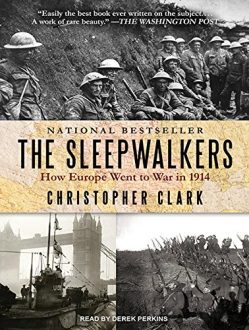
Two major historical volumes focusing on exactly that last topic had appeared about a decade ago, just before the hundredth-year anniversary, and they strongly reinforced that same conclusion with exhaustive scholarship. The Sleepwalkers by Christopher Clark and July 1914: Countdown to War by Sean McMeekin, together received a very lengthy and favorable front-page treatment in the NYT Book Review by Harold Evans, former editor of the Times of London. I’d read the first of these books a couple of years ago and the second just very recently, and found them both excellent, telling as they did a broadly similar story across their combined 1,100 pages.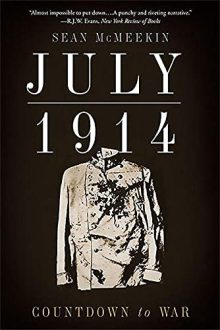
McMeekin’s very detailed narrative of the exact circumstances and decision-making process during July 1914 greatly emphasizes the extremely important role of unexpected, contingent factors that could so easily have diverted the history from its track. For example, just prior to the assassination in Sarajevo, Britain seemed on the very verge of violent civil war over Irish Home Rule, a conflict so bitter that it was weeks before the Cabinet even considered the developing situation in the Balkans, so if the events had occurred just a couple of months later, British military involvement might have been impossible. Similarly, by his strong initial stand against any attack on Serbia, the powerful Hungarian Prime Minister prevented the sort of immediate retaliatory strike that probably would have avoided bringing in other countries, unlike the eventual attack that came more than a month after the assassination; so the determined peace policy of a leading European statesman actually helped trigger the wider war. In all these countries, there were obviously powerful factions that had spent years pressing for war, but there were other powerful factions that felt otherwise, and the circumstances of the outbreak depended largely upon the particular decisions made.
Once the enormous conflict began, assigning the exact measure of guilt for the calamity became a strategic objective during the years that followed, especially on the part of the Allies, with Clark even noting that both the French and the Russians created fraudulent documents that they then inserted into their own diplomatic archives. The scholarly dispute over relative war-guilt has continued unabated for more than a century now, and while neither of these books settles the matter, I do think that they provide a very solid factual basis, explaining exactly who did what and when, thereby allowing each of us to assign the appropriate quantity of guilt to those particular actions.
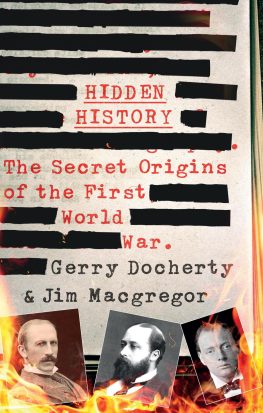
A very different sort of book on the same topic published almost simultaneously was Hidden History by amateur British historians Gerry Docherty and Jim Macgregor. Although totally ignored by the mainstream media, their extremely conspiratorial account of Britain’s political leadership prior to the outbreak of the war has become wildly popular in many alternative circles, and I finally decided to read it a couple of years ago. Unfortunately, I was far from impressed by their analysis, and although they usefully described some of the machinations of the most aggressive British political faction, I think they accorded it far more power than it probably possessed. I wrote my own appraisal in a comment after I’d only read a chapter or two, but once I’d finished the remainder of the book, my negative verdict was unchanged:
Well, I’ve seen numerous commenters give glowing endorsements of the Docherty/Macgregor book over the last year or more, so since I had it sitting around, I finally decided to take a look. So far, I haven’t really been very impressed.
As near as I can tell, their “revolutionary” hypothesis is that near the end of the 19th century a small group of individuals near the top of Britain formed a “secret society” with the central goal of greatly enhancing the power and wealth of the British Empire, sometimes using ruthless or dishonest means, and permanently dominate the world.
Is that really so remarkable? Suppose the “secret society” had never been formed? Wouldn’t we naturally assume that the normal, run-of-the-mill leaders of Britain would be doing their best to enhance the power and wealth of the British Empire? Wouldn’t it be much more shocking if they weren’t?
Should someone write a book: “Top executives at Google are secretly trying to expand Google’s wealth and power and gain dominance over the entire Internet.” Or “Top executives at Goldman Sachs are secretly trying to expand Goldman’s wealth and power and permanently dominate Wall Street.”
Neither Docherty nor Macgregor seem professional historians, and they’re certainly correct in attempting to refute the “legend of German villainy,” but I think that lots and lots of professional historians have already done that.
Decades ago, my ordinary high school texts emphasized that one of the main factors behind WWI was Britain’s fears of a rising Germany. And it’s also true that another major factor was Germany’s fears of a rising Russia. Historians have endlessly argued about the relative weighting of all these different factors, but everyone’s certainly aware of them.
In sharp contrast, a different book published just over a century earlier might today be seen as a product of the conspiratorial fringe, but it was certainly not viewed that way at the time, given that the author was widely regarded as one of America’s leading public intellectuals and the work was favorably discussed in the influential Literary Digest. David Starr Jordan was the founding president of Stanford University, a biological scientist by training who had published at least ninety-odd books, mostly of a scientific nature but also including works of broader public policy.
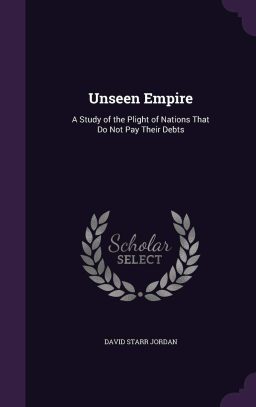
Unseen Empire, which appeared in 1912, fell into that latter category and argued that although the United States and the major European powers remained nominally sovereign, their heavy, unproductive military spending had gradually bound them into tight coils of debt, leading most of them to quietly become political vassals of a network of powerful financiers, the “unseen empire” of the title. So instead of kings, parliaments, or kaisers, the true rulers of Europe were a set of interconnected and intermarried banking dynasties, almost all of them Jewish: the Sterns and Cassels of Britain, the Foulds and Pereires of France, the Bleichroders of Germany, the Gunzburgs of Russia, the Hirsches of Austria, the Goldschmids of Portugal, the Camondos of Turkey, the Sassoons of the Orient, and above all of them, the Rothschilds of London and Paris.
Although in today’s world, such a description might seem insane or at least incendiary, Jordan presented it rather matter-of-factly without rancor, and indeed that particular claim didn’t even constitute the main theme of his analysis. The Stanford University President firmly regarded modern warfare as disastrous for a society, but also argued that wars had become so ruinously expensive that they could not last for long. Moreover, since the true financial owners of Europe believed that they were bad for business, no major wars would be permitted to break out.
Obviously, Jordan’s predictions were exploded just a couple of years later, but subsequent events did provide some hints that his analysis was not entirely mistaken. For example, according to Stoddard’s account, much of Britain’s wealthy Jewish elite, often having German roots like the Rothschilds, was widely regarded as being in the peace camp, so much so that in 1916 hard-line publications regularly denounced the country’s German-Jewish financiers as undercutting Brtain’s continuing military resolve. Similarly, Zelikow reports that Paul Warburg, the German-Jewish vice chairman of America’s Federal Reserve, was an enthusiastic supporter of Wilson’s efforts to pressure Britain into making peace, including discouraging American banks in late 1916 from making the additional loans that Britain required to purchase supplies. In private communications, the strongly pro-British head of the J.P. Morgan banking empire denounced that decision and argued for a public attack on the German-Jewish influence that he believed was behind this peace policy. Similarly, many of the wealthy Jewish interests in Germany were generally in the peace camp. So Jordan’s main mistake was probably to overestimate the political power of Europe’s dominant financial interests.
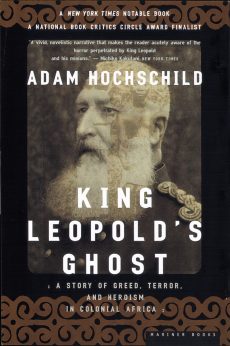
This extended discussion of the Great War was prompted after I read Hochschild’s book on the British anti-war movement, and I’d decided to do so because I’d been very impressed with his previous, award-winning bestseller King Leopold’s Ghost, which I’d read earlier this year. That latter work recounted the vivid history of the Belgian Congo and the horrific mistreatment of its inhabitants, which may have claimed the lives of up to ten million Africans, with Hochschild also telling the story of the British-led international moral crusade against those crimes, privately organized by E.D. Morel, a journalist, and Roger Casement, a civil servant. Their final victory came just a year before war broke out, and Hochschild’s last two chapters constitute an extended epilogue, including a description of the sad wartime fates suffered by his pair of champions.
At the time of the Sarajevo assassination, both Morel and Casement were towering international heroes, with the latter having even been knighted for his humanitarian achievements. But both were firmly opposed to the war and generally sympathetic to Germany’s position, and their public standing quickly collapsed, merely one of the many ironies that Hochschild describes.
One of the worst horrors that the colonial Belgians had inflicted upon the Congolese was chopping off the hands of those Africans who failed to meet their work-quotas or otherwise disobeyed, and photographs of the atrocity victims had triggered outrage across the globe. But in August 1914, the German army invaded Belgium, and the Belgians were suddenly transformed from monsters to martyrs, with British propagandists soon falsely claiming that the Germans were chopping off the hands of disobedient Belgians. For many years, the story of the millions of Africans who died in the horrors of the Belgian Congo had been the world’s leading humanitarian issue, but Hochschild plausibly argues that the sudden wartime propaganda-elevation of Belgians to unrivaled global victimhood status probably explains why that earlier story so quickly faded from public awareness until being eventually revived a half-century later.
Casement himself was Irish and his efforts to free the Congolese had brought him public honors and acclaim; but when he began seeking German help to free his own country from British rule, he was hanged for treason, becoming the first holder of a British knighthood to suffer that fate in hundreds of years. Morel similarly fell from grace for his anti-war writings, and after he sent a copy of one of his pamphlets to his pacifist friend, Romain Rolland, a French Nobel Laureate in literature living in Switzerland, he received six months of brutal imprisonment, which permanently broke his health.

However, once the war ended, British sentiments changed, and the newly rising Labour Party considered Morel a wronged hero and nominated him as a candidate for Parliament. As a young Cabinet Minister, Winston Churchill had played a crucial role in leading Britain into the world war, and in a remarkable symbolic turnabout, Morel now defeated him for reelection in 1922, taking his seat in the House of Commons. Morel was one of Labour’s leading spokesmen on foreign affairs and according to Hochschild, he was expected to be named Foreign Minister in Ramsay MacDonald’s new Labour government of 1922, but MacDonald decided to keep the portfolio in his own hands, perhaps because he feared Morel might overshadow him as a political rival. However, Morel’s political fairy tale had a less than happy ending, for although he was easily reelected in 1924, his harsh wartime imprisonment had destroyed his health and he died later that year at the unripe age of 51.
I had never previously heard of Morel and found his story a fascinating one, but when I consulted his Wikipedia page I discovered that much of the long entry focused on aspects of Morel’s postwar activism that the book had avoided mentioning, presumably for ideological reasons. In his epilogue chapters, Hochschild had rightly denounced the hypocrisy of the major European powers, which were willing to condemn the brutal treatment of Africans under Belgian colonial rule while ignoring the fact that they often behaved in a similar manner in their own African colonies. But he must have found Morel’s extreme lack of any such hypocrisy troubling for other reasons, so the last major project of that remarkable man’s career was excluded from his hagiography.
Morel heavily blamed France and Czarist Russia for the war and regularly condemned the extremely punitive terms of the Treaty of Versailles from the pages of Britain’s Foreign Affairs journal, an influential Labour publication that he directed, condemning, for example, the mutilation of Hungary, which had lost two-thirds of its territory.
But according to Wikipedia, his most important postwar project was launching the international “Black Shame” campaign, denouncing the horrific atrocities committed by France’s African colonial troops against the helpless German civilians of the occupied Rhineland, including widespread rape and murder. Wikipedia entries are usually heavily sanitized, so portions of this very surprising entry are worth quoting at length:
In a front-page article in The Daily Herald on 9 April 1920 by Morel about the French occupation of the Rhineland, the headline read, “: “Frankfurt runs red with blood French Blood Troops Use Machine-guns on Civilians”.[42] The following day, the same paper had another cover story by Morel, the title of which was “Black Scourge In Europe Sexual Horror Let Loose by France On Rhine Disappearance of Young German Girls”. In it, Morel wrote that France is “thrusting her black savages into the heart of Germany” and that the “primitive African savages, the carriers of syphilis, have become a horror and a terror” to the Rhinelanders.[42] In his article, Morel claimed that the Senegalese soldiers serving in the French Army were “primitive African barbarians” who “stuffed their haversacks with eye-balls, ears and heads of the foe”.[43] Morel declared in his article:
“There [the Rhineland] they [the Senegalese soldiers] have become a terror and a horror unimaginable to the countryside, raping girls and women – for well known physiological reasons, the raping of a white woman by a negro is nearly always accompanied by serious injuries and not infrequently has fatal results; spreading syphilis, murdering inoffensive civilians, often getting completely out of control; the terrible barbaric incarnation of a barbarous policy, embodied in a so-called peace treaty which puts the clock back 2,000 years”.[43]
Morel wrote that “black savages” have uncontrolled sexual impulses that “must be satisfied upon the bodies of white women!” (emphasis in the original).[44]
The phrase that Morel coined to describe the alleged terror by Senegalese troops in the Rhineland was the “Black Horror on the Rhine“, which became internationally famous, and the campaign against the “black horror” took much of his time for the last four years of his life.[45] Morel predicated the “black horror” would cause another world war, writing that the average German boy was thinking: “Boys these men raped your mothers and sisters” (emphasis in the original).[46] Morel used the “black horror” as a way of attacking France, which he claimed had caused a “sexual horror on the Rhine” and whose “reign of terror” was a “giant evil” that should inspire “shame into all four corners of the world” and ultimately should “a revision of the Versailles Treaty and the relief for Germany”.[47]
The somewhat censorious Wikipedia article condemns Morel for his blatant racism and cites a German sociologist who argues that those same sentiments had actually governed his earlier Belgian Congo activism as well. But this new Rhineland campaign was soon followed by his rise within the British Labour Party and his electoral triumph over Churchill, so both British Socialists and British voters apparently gave a different verdict. Moreover, Adolf Hitler soon alluded to some of Morel’s accusations in the pages of Mein Kampf, though in much less blood-curdling fashion, and those brief, mild passages have often been cited as proof of the German dictator’s deep racism.
Hochschild is a committed racial liberal, whose lifelong support for blacks in the American South and under Apartheid dominated his early career, and this easily explains why he elevated Morel to heroic stature for his international campaign to end European atrocities against Africans in the Belgian Congo. But it equally well explains why he excluded any mention of his moral exemplar’s final humanitarian crusade, this time focused on African atrocities against Europeans, which was contemporaneous with similar political projects by the KKK in America and may have even played an important role in inspiring Adolf Hitler.
Related Reading:
Parallel society: Ukrainian children in German schools
Free West Media | December 2, 2022
Around one million Ukrainians have left their homeland due to the war in recent months and sought refuge in Germany. Among the refugees are tens of thousands of children who are now going to school in Germany. But there are simply too many and the problems are mounting.
Educators responsible for foreign children have given up telling the success story of an integration that doesn’t exist.
So-called “bridging classes” have been set up everywhere for Ukrainian schoolchildren, in which German language skills are taught more intensively. But to no avail – further support and integration have overwhelmed German teaching staff, the chairman of the Bavarian Philologists’ Association, Michael Schwägerl, had to admit.
“We are experts in our subjects. As a rule, however, we are not interpreters for Ukrainian or Russian, we are not trauma experts either, and our time allotment does not allow us to provide psychosocial support in individual cases.” They need additional staff for practically everything.
And there are massive problems: “The bridging classes are not normal German learning classes,” emphasized Dorothee Missy, who is a bridging class teacher at the grammar school in Mering near Augsburg. Lack of motivation, demarcation, aggression, disrespect, breaking the rules and other discipline problems as a reaction to the stressful situation are commonplace. “We also have a great deal of heterogeneity in terms of performance, motivation and willingness to perform.”
In addition, the refugees often keep to themselves even months later. More than half of the teachers (54 percent) rate the integration of the Ukrainian children and young people in the respective school as rather bad, 22 percent even as clearly bad. In addition, four-fifths of the refugees also take part, at least in part, in Ukrainian online courses which is not conducive to integration into a German environment.
The goal is to prepare the Ukrainian students for regular German schooling. But they are still a world away from achieving their goal.
Philologist boss Schwägerl said there was very little hope that it would happen on a large scale by the end of the current school year as planned. He expected that only a low single-digit percentage would switch to the Bavarian regular school system in the fall. Ukrainian parallel societies will therefore also remain in schools for the time being.
No hope of affording integration
Germany’s decline, which was heralded by the red-green “traffic-light” coalition, is now reflected not only in fresh bad news every day, but also in sober economic indicators that the Federal Statistical Office can no longer hide.
German exports to non-EU countries fell by 1,6 percent in October compared to the previous month, hospitality sales in September fell by 0,9 percent compared to the previous month, and building permits fell by a significant 8,1 percent compared to the same month last year. The number of corporate bankruptcies rose by a massive 34 percent in September compared to the same month last year, while 40 percent are expected for November.
Only one parameter is constantly increasing: the producer prices in October were a gigantic 34,5 percent higher than in the same month last year. Because companies are only passing the price explosion on to consumers in bits and pieces, the big surprise is yet to come in supermarkets.
Officially, the inflation rate is 10,4 percent, which sounds moderate, but it is also due to the so-called “shopping basket” used to calculate inflation. The “shopping basket” is full of products and services that do not reflect the real life of ordinary people.
Germany has no alternatives to Russian gas – MP
RT | November 29, 2022
Germany still has no way of completely replacing Russian natural gas, even after reaching a supply agreement with Qatar, the chairman of the Bundestag committee on energy, Klaus Ernst, warned on Tuesday.
A long-term energy agreement was announced earlier in the day, under which the Gulf state will ship up to two million tons of liquefied natural gas (LNG) a year to Germany, starting from 2026. The deal will reportedly last at least 15 years.
“The federal government celebrates its LNG deal with Qatar and boasts big numbers. The fact is, these two million tons of LNG correspond to three percent of German gas consumption. There are still no real alternatives to Russian gas!” the politician from The Left party wrote on Twitter.
According to Bloomberg, the deal with Qatar equates to about 6% of the volume of Russian gas Germany imported in 2021. The fuel will come from ConocoPhillips’ joint ventures in Qatar, and will be delivered to the Brunsbuttel floating import terminal, which is under construction.
The news agency specified that the five import facilities chartered by the German government will cost a total of €6.5 billion ($6.7 billion) over the next 10 to 15 years. There is also one privately chartered terminal planned. Once operational, they will be able to cover around one third of Germany’s current gas demand, according to a government estimate, cited by Bloomberg.
Germany, Europe’s biggest economy, relies mainly on natural gas to power its industry, and has pledged to replace all Russian energy imports by as soon as mid-2024.
New York Times Decides Lockdowns are Actually Draconian and Economically Destructive when China Does Them
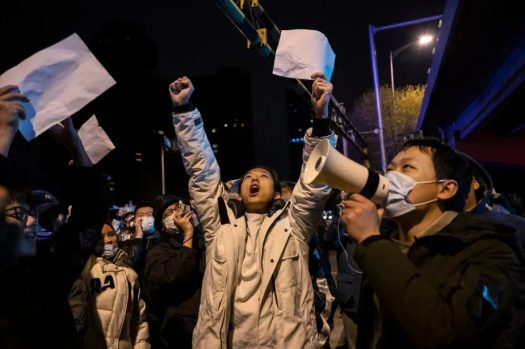
“Right-wing conspiracy theorists with ties to anti-Xi opposition elements spread baseless rumours, deny science, and endanger lives” – strangely not how the NYT chose to caption this image.
eugyppius: a plague chronicle | November 28, 2022
Three years ago, Zero Covid was the aspiration of public health bureaucrats and politicians across the West. Charlatan techbros like Tomas Pueyo appeared on national television to demand nationwide house arrest; leaders like Angela Merkel surrounded themselves with virus-eradicationist modellers and imposed unprecedented months-long closures upon their countries. When protests inevitably broke out, they were violently suppressed; the protesters were slandered as conspiracy theorists and fascists.
The New York Times played a leading role in this long and excruciating charade. In April 2020, they reported that “an informal coalition of influential conservative leaders and groups, some with close connections to the [Trump] White House” was responsible for “quietly working to nurture protests and apply … pressure to overturn state and local orders intended to stop the spread of the coronavirus.” In March 2021, they ran an obnoxious opinion piece about What Happened When Germany’s Far-Riught Party Railed Against Lockdowns, which called the German protesters “an amorphous mix of conspiracy theorists, shady organizations and outraged citizens” and appeared to accuse the right-populist party Alternativ für Deutschland of opportunism for joining their ranks.
What a difference a few years have made.
China Protests Break Out as Covid Cases Surge and Lockdowns Persist is a lead headline in today’s New York Times : “Strict Covid restrictions are hurting the country’s economy and angering members of the public, who are taking to the streets,” we read in the article that follows. Western anti-lockdown protesters are fascists and conspiracy theorists; Chinese anti-lockdown protesters, on the other hand, are ordinary people protesting their oppression:
“Lift the lockdown,” the protesters screamed in a city in China’s far west. On the other side of the country, in Shanghai, demonstrators held up sheets of blank white paper, turning them into an implicit but powerful sign of defiance. One protester, who was later detained by the police, was carrying only flowers.
Over the weekend, protests against China’s strict Covid restrictions ricocheted across the country in a rare case of nationwide civil unrest. There had been signs of dissent, but the new wave of anger may pose a bigger challenge for the government.
Some demonstrators went so far as to call for the Communist Party and its leader, Xi Jinping, to step down. Many were fed up with Mr. Xi, who in October secured a precedent-defying third term as the party’s general secretary, and his “zero-Covid” policy, which continues to disrupt everyday life, hurt livelihoods and isolate the country.
Western lockdowns were necessary to save lives. Chinese lockdowns are the repressive tactic of an undemocratic regime.
The Chinese government on Monday blamed “forces with ulterior motives” for linking a deadly fire in the western Xinjiang region to strict Covid measures, a key driver as the protests spread across the country.
In much the same way, the New York Times blamed shadowy political actors with ties to Trump for anti-lockdown protests in 2020.
Outside China, the rest of the world has adapted to the virus and is near normalcy. Take soccer’s premier event, the World Cup. Thousands of people from across the globe have assembled in Qatar and are cheering on their teams, shoulder-to-shoulder, without masks, in packed stadiums.
China’s approach won praise during the beginning of the pandemic, and there is no doubt it has saved lives. But now that approach looks increasingly outdated. Almost three years after the coronavirus emerged, the contrast between China and the rest of the world couldn’t be starker.
Emphasis mine, because it’s probably the most amazing line in the whole piece. Here we have America’s foremost propaganda outlet, trying desperately to accuse China of unjust dictatorial repression, for the crime of implementing in a more organised and coherent way the very same Zero Covid policies that Times journalists spent nearly two years supporting. What’s actually wrong with the harsh Chinese lockdowns? Well, say the Times, because they can’t say anything else, they’ve become unfashionable.
The Times have also suddenly discovered that lockdowns are bad for the economy. “China’s economy has been hurt by the restrictions,” which have “hammered business both large and small,” they report. Major companies are seeking to escape the effects of closures by “expand[ing] production outside China”, all while “reduced foot traffic” hurts businesses in “the main streets of towns and cities.” That’s bad when it happens in China, but Germany or Canada it’s totally worth it.
On the one hand, we should be probably be happy about the implicit repudiation of lockdowns that articles like this represent, and the strong signal they send that none of our opinion makers wants to return to them. Some of you will have your own more detailed theories about why this is, but my broad view, is that mass containment adheres to the same trajectory everywhere: 1) There is the initial lockdown followed by a seasonally-induced collapse in cases, which encourages among policymakers to an illusion of control. 2) When infections inevitably surge the second time, they try to play the lockdown card again and again, always with less success. 3) Finally, in the face of growing protests and destruction, the policies are abandoned and everything reopens. The only difference between China and the West, is that a few years intervened before the first and the second of these steps.
On the other hand, the increasingly open hypocrisy and manipulation of the press are reaching terrifying levels I’d never imagined before, and I think this is very bad.
Iran retaliates against UN nuclear resolution – media
RT | November 22, 2022
Tehran has for the first time started enriching uranium to 60% fissile purity at the Fordow facility, Iranian media reported on Tuesday. Such a move would be seen as a response to a critical resolution adopted by the UN’s nuclear watchdog last week.
Iran is already enriching uranium at Natanz, its other major production site, to below weapons-grade 90% enrichment, but well above the 3.67% limit specified in the 2015 Iran Nuclear Deal, or JCPOA. The US abandoned the deal with Tehran during the administration of Donald Trump, leading to its erosion and effective collapse.
Other reported moves by Iran include upgrading cascade lines with more advanced gas centrifuges to boost production capacity at Fordow, as well as firing up additional chains at Natanz.
Tehran’s action was described as retaliation for a resolution passed last Thursday by the Board of Directors of the International Atomic Energy Agency (IAEA). The document, which was drafted by the US, Britain, France and Germany, decried “insufficient substantive cooperation by Iran” on the issue of uranium traces found in 2019 by inspectors at three undeclared sites. It demanded “credible explanations” and full cooperation from Tehran.
The four sponsoring nations are also signatories of the JCPOA. China and Russia, two other participants of the landmark deal, reportedly voted against the draft document during the closed-door session last week.
The Iranian Foreign Ministry rejected the resolution, calling it a form of political pressure by the US and its allies. Spokesman Nasser Kanaani said on Monday that the country had taken “initial measures” in response to it on Sunday night.
“The implementation of these measures was realized today in the presence of IAEA inspectors in the Natanz and Fordo enrichment complexes,” the diplomat added, without specifying what had happened.
The JCPOA was meant to exchange an Iranian commitment to limit its nuclear program for relief of economic sanctions imposed on the country. The goal was to prolong the time Tehran would need to create a nuclear weapon, an ambition that Iran officially denies fostering in the first place.
The Trump administration unilaterally pulled out of the Iran Nuclear Deal as part of its “maximum pressure” campaign against Tehran. President Joe Biden has been negotiating a possible revival of the JCPOA, but no breakthrough has been achieved so far.
Ukraine to hike transit fees for Russian oil to EU
RT | November 22, 2022
Ukraine has announced plans to raise transit fees for Russian oil running through the Druzhba pipeline to the EU, due to higher costs resulting from Russian air and missile strikes targeting the country’s energy infrastructure.
Ukrtransnafta, the operator of Ukraine’s oil pipeline network, is expected to increase tariffs for transporting crude to Hungary and Slovakia by €2.10 per ton to €13.60 ($13.90) starting on January 1, according to a letter from the company seen by Bloomberg. Its Russian counterpart Transneft confirmed to RIA Novosti that it has received a letter and is studying it.
“We are studying these proposals, preparing relevant reports to the Federal Antimonopoly Service and the Energy Ministry,” Transneft spokesman Igor Demin told the agency.
The Ukrainian company has attributed the price hike to the “continued destruction of Ukrainian energy infrastructure” which has resulted in “a significant shortage of electricity, an increase in its costs, a shortage of fuel, spare parts.”
Ukrainian oil transit fees have already been raised twice this year. The last hike in April reportedly brought the total increase on an annualized basis to 51%.
Druzhba, one of the longest pipeline networks in the world, carries crude some 4,000km from Russia to refineries in the Czech Republic, Germany, Hungary, Poland and Slovakia.
Background to current US policy in Europe
By Viktor Mikhin – New Eastern Outlook – 21.11.2022
It is said not in vain that one man’s problem is another man’s opportunity. And the military action in Ukraine against Russia, unleashed by the US and NATO, has clearly demonstrated this. Every day there is more and more evidence to show what huge dividends the US tycoons are reaping from the policies that the current President Joe Biden is pursuing for their benefit alone. Suffice it to say that Washington has already made tens of billions of dollars from the military actions it has unleashed in Ukraine. Not to mention the distraction from US domestic issues in financial, economic and politico-racial fields, that the White House is using against this backdrop.
The US instigated this armed conflict, a conclusion that most political analysts are now coming to. Its aim is to force Europe to submit to US sanctions against Russia and stop buying cheap Russian natural gas. Washington can now sell huge quantities of liquefied gas to Europe at its own prices, and there is no price cap on US hydrocarbons, unlike Russian hydrocarbons, and it is unlikely there will be one. Europe’s economy has suffered a blow, and vast wealth has migrated from Europe to the US, allowing US leaders to maintain their dominant position in the EU.
Ensuring control over Europe is a major strategic imperative for the US. Since the EU has a population of 450 million, while the US population is only 330 million, and their economies are comparable in size, the EU is theoretically in a position to break free from the US and assert itself as an equal or greater superpower on the world stage. A truly independent Europe would prefer to make mutually beneficial trade deals with Russia, China and the rest of Eurasia, pushing back the US and ending US imperial domination of the planet.
It is only natural that the US does not want this to happen. By implementing its divide-and-conquer strategy, Washington is preventing Europe from achieving the cohesion and economic strength that would enable it to free itself from the US occupation that has persisted since after the World War II. Inflation in Germany reached double digits in October for the first time since 1990. Italy is also experiencing the highest inflation in 40 years. The rest of the Eurozone is also suffering. The source of the European crisis is the rise in energy prices caused by US sanctions against Russia. Businesses that produce goods and services have to pay more for energy, and they pass the costs on to consumers. Now most of the extra money paid for what has become ultra-expensive energy goes straight into US coffers. This is the main reason why the euro is falling against the dollar. Furthermore, the dollar has historically been strong in times of panic or uncertainty, and the US has a habit of deliberately provoking panic and uncertainty by organizing wars and crises, of which there have been many examples.
The EU is not an ally of the US, but a coalition of vassal states that have been under US military and economic occupation since the end of World War II. The US committed a holocaust against Germany during and immediately after that war, bombing entire cities where only civilians lived, starving millions of German prisoners of war and civilians during the first few years of the occupation. The mainstream media and academia, owned by the Americans and their satellites, fabricated a story of a mythical World War II victor that essentially turned reality upside down and portrayed the US as a generous rebuilder of Germany through the Marshall Plan. But the reality is that the Marshall Plan was only implemented after the Morgenthau Plan to kill millions of Germans had done its bloody work.
The US is far from being a generous ally. Instead, it has always been and remains a selfish occupier of Europe. The current US-induced destruction of Europe, based on depriving EU countries of cheap energy in order to damage them economically and subjugate them politically, could be called the new Morgenthau Plan. Nevertheless, the United States may have to provide aid packages or loans to help the EU escape hunger and frost this winter. If this happens, the motives will not be altruistic. Instead, Washington will seek to prevent Europeans from overthrowing the US occupation and exercising control over their own destiny.
Before the hostilities unleashed by the US in Ukraine, Russia provided the lion’s share of Europe’s cheap energy imports. However, by artificially supporting the armed conflict, which is now in its ninth month, Washington has broken this partnership, and gas is no longer flowing through Nord Stream. Businesses across Europe are not just limiting their energy consumption. They are shrinking or moving to other continents. Europe, according to economists, may well be on the way to de-industrialization. Eurozone industrial activity fell to its lowest since May 2020. The October PMI from S&P Global signaled a looming recession, falling in November and becoming the fourth monthly reading below 50, indicating an economic slowdown. In its latest analysis of the energy crisis in Europe, published on November 3, the IEA said the EU could face a shortfall of up to 30 billion cubic meters of natural gas during the summer of next year to replenish its gas storage capacity.
In a report entitled “Never Too Early to Prepare for Next Winter: Europe’s Gas Balance for 2023-2024” the IEA warns that the safety cushion provided by current storage levels, as well as recent lower gas prices and unusually mild temperatures, should not lead to unduly optimistic conclusions about the future. A look at the IEA report shows that the European Union will face a major challenge in meeting its energy needs in the coming years. Given the high costs of transporting gas over long distances, Russia could still make a significant contribution to solving this problem. With the world’s largest oil and gas reserves, Russia could provide Europe with the energy it desperately needs if it were not for persistent US sanctions. Unlike oil, natural gas is difficult to transport in large volumes and is therefore exported either by pipeline or by conversion into liquefied natural gas (LNG), but this is expensive and requires large investments. Russia does not currently have the infrastructure to export large volumes of LNG to Europe. Given current experience and looking to the future, European governments should clearly see the huge negative impact that sanctions against Russia have had and will have on global energy security. More should therefore be done to help curb US self-serving agendas and negotiate a multipolar world.
By constantly unleashing wars, the United States always reaps huge profits and the military-industrial complex comes first, as one would expect. It is not surprising that the US military budget is equal to that of the rest of the world combined. And this is further clear evidence that Washington does not want to live in a world where all contentious issues are resolved at the negotiating table, but aims only at military actions.
But lately, all of a sudden, the energy complex, whose owners are making exorbitant profits from oil and gas supplies, mostly to Europe, has become the most profitable sector in the United States. It is only natural that many people became interested and it was primarily the military who were concerned and who simply “pressed” Joe Biden. And now the US President has suddenly become “interested” in these huge sums and has decided to “clip the wings” of the oil and gas industry by imposing an additional tax on the profits of the owners of the energy complex. The simple conclusion from this is that unleashing Ukraine on Russia will continue at an accelerated pace, and Europe will be completely deprived of Russian gas. Even the gas coming through NATO member, Turkey.
By starting any military conflict, the US is not aiming to win. Above all, it is to destabilize the region so that it cannot be a US competitor for decades to come.
Today, a large proportion of the world’s elite keep their reserves in the EU. Naturally, the US will not completely destroy it. But if US companies gain a foothold and dominate the European market, it will force Europe to become even more involved in the Ukrainian conflict, to abandon Russian oil and gas completely, and it will be a huge prize for Washington to implement a policy of solving all issues only through war.
Elizabeth Holmes Gets Eleven-Year Sentence for Theranos Fraud
Former Theranos CEO and billionaire, Elizabeth Holmes
By Dr. Peter McCullough & John Leake | Courageous Discourse | November 20, 2022
Yesterday I wrote about the FTX scandal, which involves a thirty-year-old living in the Bahamas, usually clad in shorts and flip-flops, who received billions from people all over the world with the promise he would make them rich by investing it in crypto currency. Nobody understood how exactly he was making billions for himself, and he never tried to elucidate it. In spite of no one having the foggiest notion about what he was doing, he was hailed as “this generation’s JP Morgan.”
The sudden fall of Sam Bankman-Fried coincided with the sentencing of former Theranos CEO, Elizabeth Holmes, who was ordered to serve 11 years in prison for defrauding investors of billions. Like Bankman-Fried, Elizabeth Holmes—who dropped out of Stanford in 2004 and styled herself after Steve Jobs with the same signature black turtleneck—was hailed as a Wunderkind who’d boldly entered a new frontier in her field.
As was the case with Bankman-Fried’s cryptic crypto exchange, no one understood how Holmes’s blood testing machine worked. She claimed that with just a small pinprick of blood from the finger (instead of the standard 3 ml drawn from a vein on the inside of the elbow) her machine could rapidly and accurately run a large panel of diagnostic tests. The machine was literally and figuratively a black box—purportedly containing proprietary technology that only Theranos engineers were authorized to examine.
To people who’d long worked in the field of blood testing for companies like Siemans, Abbott, and Roche, Holmes’s claims seemed incredible. How could her machine accurately run so many tests on such a tiny quantity of blood? The proposition sounded like magic.
The fact that no one knew anything about the machine didn’t stop investors from pumping billions into the fledgling company, and by 2014, the then thirty-year-old Holmes’s 50% stake was worth $4.5 billion. Were these investors simply naive, or was there something apart from the magic black box that gave them confidence?
Perhaps the most notable thing about Theranos was the attention it drew from the Department of Defense and retired US government eminences including George Shultz, Henry Kissinger, William Perry, Bill Clinton, and Sam Nunn. All were old Washington hands, and they understood that the US government was considering Holmes’s little black box to be (potentially) a strategic asset with military and civilian applications.
These guys knew from experience that if Uncle Sam gets out his checkbook for what appears to be new product of strategic value, the sums transferred can be astronomical. And why not? Such a market does not consist of picky and finicky consumers, but unaccountable bureaucrats spending taxpayer money with reckless abandon.
In 2015, Holmes’s company became the subject of a Wall Street Journal investigation, and soon her fraudulent empire began to crumble. Three years later (in 2018) she was charged for committing massive acts of fraud.
Facing off against Elizabeth Holmes was the young and heroic whistleblower, Tyler Shultz—grandson of George Shultz—who was a key witness in exposing the fraud. For his principled action, he was shunned by his grandfather and subjected to an intimidation campaign by Theranos officers and their heavy-hitting attorneys. The Wall Street Journal’s report on this component of the story reads like a cinematic thriller.
Moderna CEO and billionarie, Stephane Bancel
Just two years after Holmes was charged for fraud, SARS-CoV-2 arrived. At this time, two biotech startups with no history of licensed products—Moderna of Cambridge, Massachusetts and BioNTech of Mainz, Germany—claimed that their experimental mRNA platform could rapidly produce a safe and effective vaccine by simply plugging the SARS-CoV-2 gene sequence into their formula. No long and laborious process of culturing viruses in eggs like conventional flu vaccines—real Star Trek Next Generation stuff.
BioNTech CEO and billionaire, Ugur Sahin
As was the case with Theranos’s black box, the Moderna and Pfizer-BioNTech mRNA vaccines are largely veiled in secrecy. Even the FDA, which is supposed to be an impartial evaluator and adjudicator of product safety, requested 55 years in order to complete a FOIA request for information on the Pfizer-BioNTech vaccine.
In other words, We the People were obliged to pay for the mRNA vaccine program (transferring billions of taxpayer money to pharmaceutical executives) and many of us have been forced to receive the injections, but information about the precise nature of these products is not for us to know.
Featured Video
Ian Proud: Economic Reset with Russia to Save Europe
or go to
Aletho News Archives – Video-Images
From the Archives
Jack Ruby: Israel’s Smoking Gun
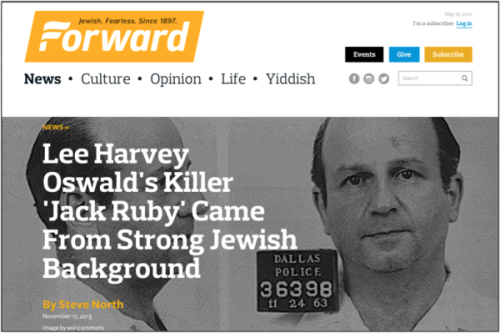
BY LAURENT GUYÉNOT • UNZ REVIEW • NOVEMBER 13, 2021
By a strange paradox, most Kennedy researchers who believe that Oswald was “just a patsy” spend an awful lot of time exploring his biography. This is about as useful as investigating Osama bin Laden for solving 9/11. Any serious quest for the real assassins of JFK should start by investigating the man who shot Oswald at pointblank in the stomach at 11:21 a.m. on September 24, 1963 in the Dallas Police station, thereby sealing the possibility that a judicial inquiry would draw attention to the inconsistencies of the charge against him, and perhaps expose the real perpetrators. One would normally expect the Dallas strip-club owner Jack Ruby to be the most investigated character by Kennedy truthers. But that is not the case. … continue
Blog Roll
Recent Comments


 Aletho News
- Ian Proud: Economic Reset with Russia to Save Europe
- Senator Rand Paul Introduces Federal Bill to END Vaccine Makers’ Liability Shield
- The Hidden Map: US and Israel May Use Unexpected Neighbors to Attack Iran
- Trump, Netanyahu Agree to Target Iranian Oil Exports to China
- Russia open to discussing Ukraine’s ‘external governance’ – senior diplomat
- US Caribbean Buildup Near $3B — Report
- Munich Security Conference and the U.S. elephant in the room
- Epstein Pitched JPMorgan Chase on Plan to Get Bill Gates ‘More Money for Vaccines’
- Germany’s CDU Pushes Real-Name Social Media Mandate and ID Checks
- Patrik Baab: Europe’s New Iron Curtain – Freedom of Speech Dies
- If Americans Knew
- Israel-backed border guards, GHF-linked aid – Not a ceasefire Day 128
- Israel battles Palestinian right of return, one Palestinian at a time – Not a ceasefire Day 127
- Noor’s short life of unimaginable suffering
- Israel Destroyed Gaza’s Hospitals. Now It’s Banning Doctors Without Borders.
- Is Spite of What Zionists Say, It’s a Good Thing to Criticize Governments
- Palestinian mother, daughter recount strip searches, harsh conditions in Israeli detention
- Israel used weapons in Gaza that made thousands of Palestinians evaporate
- ADL’s Stats Twist Israel’s Critics Into Antisemites
- Why Is the World Silent When the Gaza Genocide Is Not Over?
- In Gaza: 8,000 bodies under rubble, 3,000 missing – Not a ceasefire Day 126
- No Tricks Zone
- Unfudging The Data: Dutch Meteorological Institute Reinstates Early 20th Centruy Heat Waves It Had Erased Earlier
- German Gas Crisis…Chancellor Merz Allegedly Bans Gas Debate Ahead of Elections!
- Pollen Reconstructions Show The Last Glacial’s Warming Events Were Global, 10x Greater Than Modern
- Germany’s Natural Gas Storage Level Dwindles To Just 28%… Increasingly Critical
- New Study Rebuts The Assumption That Anthropogenic CO2 Molecules Have ‘Special’ Properties
- Climate Scientist Who Predicted End Of “Heavy Frost And Snow” Now Refuses Media Inquiries
- Polar Bear Numbers Rising And Health Improving In Areas With The Most Rapid Sea Ice Decline
- One Reason Only For Germany’s Heating Gas Crisis: Its Hardcore-Dumbass Energy Policy
- 130 Years Later: The CO2 Greenhouse Effect Is Still Only An Imaginary-World Thought Experiment
- New Study Affirms Rising CO2’s Greening Impact Across India – A Region With No Net Warming In 75 Years
 Aletho News