The West severely miscalculated the geopolitical ramifications of the war in Ukraine
The EU, and not Russia, has weakened since the start of the special military operation
By Ahmed Adel | February 24, 2023
Although many remember February 24 as the first anniversary of the war in Ukraine, Russia’s special military operation is actually the next phase of a wider conflict that began in 2014. This is a key point often overlooked because the narrative built in the West is that Russia’s intervention was an unprovoked invasion with the sole purpose of territorial expansionism. The international community, which the West incorrectly refers to itself as, has rejected this narrative. To the disappointment of Western leaders, most of the world has instead deepened their ties with Russia.
However, the “unprovoked invasion” narrative has been exposed in the West also as a fallacy. It is recalled that former German Chancellor Angela Merkel admitted in December 2022 that “the 2014 Minsk agreement was an attempt to give time to Ukraine.”
“It also used this time to become stronger as can be seen today. The Ukraine of 2014-2015 is not the modern Ukraine,” she said, adding that “it was clear to everyone” that the conflict had been put on hold, “yet this was what gave Ukraine invaluable time.”
Merkel’s statement confirmed that the Minsk Accords, a series of agreements which sought to end the Donbass war, was only intended to give the Ukrainian state more time to militarily strengthen. It also proves that the Western party of the Minsk Accords never intended to use this mechanism to find peace and address the concerns of local residents.
Therefore, the Russian intervention was not necessarily a surprise, and perhaps the West were even expecting it.
However, what was an absolute surprise for the West was the geopolitical and economic ramifications – all to the detriment of the West and to the advancement of Moscow.
It cannot be denied that sanctions had an impact on the Russian economy, but the European Union has demonstrated that it is nothing more than a political dwarf that has no autonomy from Washington. Sanctions have a limited effect on Russia given that it is a completely self-sustainable country, unlike Syria and Iran (which are also heavily sanctioned but without the capacity for self-sustainability).
Rather, the sanctions have actually accelerated the de-Dollorisation of the global economy and deepened the economic crisis in Europe.
Evidently, there was naivety in the West, as there was a false belief that Russia would capitulate to sanctions pressure. Instead, Europe is experiencing an economic crisis that has crushed the Middle Class through a cost-of-living crisis. Meanwhile, Russia has greater prospects for recovery compared to Germany and the UK.
According to a January forecast by the International Monetary Fund, Russia’s economy will grow faster than Germany’s while Britain’s will contract. This is a far cry from the eminent collapse of the Russian economy that was predicted when hundreds of international companies, such as McDonald’s and Boeing, withdrew from Russia and Russians were blocked from using Western financial institutions.
It is recalled that in March 2022, US Treasury Secretary Janet Yellen boasted that “the Russian economy will be devastated.” Eleven months after Yellen’s statement, the IMF predicts that the Russian economy will start growing again in 2023, expanding by 0.3% and then 2.1% in 2024. Although 0.3% growth is paltry, it is still surprisingly higher than Germany’s 0.1%, a phenomenal situation considering that it is Berlin imposing the sanctions, not Russia on Germany.
The UK is in an even worse situation. Its economy is expected to contract by 0.6%.
India and China are helping Russia alleviate the stress of decoupling from Western financial institutions and trade exchanges. Many experts believe that the 21st century is the “Asian Century” and expect the world’s major financial centres to shift from the West to the East. In this light, Russia’s exclusion from the West has left it with no choice but to strongly project to the East, something that India, China and other countries have enthusiastically taken advantage of.
The 20th century was dominated by the bipolar system and a short-lived unipolar system. Although the 21st century is multipolar in nature, the overwhelmingly dominant economic and military powers are expected to be the US and China, with a host of other Great Powers, such as Russia and India, fully capable of defending their own interests.
What the West does not realise is that in such a global system, it is Russia that hugely influences whether the US or China will triumph. Russia has effectively been given no choice but to pivot towards China. Future generations in the West will learn that this was a strategic blunder – and all for the illiberal sake of defending a neo-Nazi regime in Kiev.
The war in Ukraine was expected to be another advancement of “liberalism” and Western internationalism. However, what has transpired instead is the weakening of Western hegemony. The US expected most countries to fall in line and impose sanctions against Russia, however, this did not trend in Asia, the Islamic World, Africa, or Latin America.
Although the West is persistently and arrogantly defending the Kiev regime against the reality that Russia will triumph in the war, it continues to ruin its own reputation in the eyes of the actual international community by lambasting countries, such as India, for not following their orders. This will have long-term negative ramifications for the West as its influence is weakening and mistrust is deepening.
Ahmed Adel is a Cairo-based geopolitics and political economy researcher.
Google Expands Campaign to ‘Inoculate’ People Against ‘Misinformation,’ But Critics Say It’s All About Money
By Suzanne Burdick, Ph.D. | The Defender | February 22, 2023
Google said last week it plans to expand into Germany its campaign to “inoculate” people against misinformation — as if it were a virus — after seeing “promising results” in Eastern Europe.
The campaign is based on an approach called “prebunking” designed to teach people how to spot false claims before encountering them, thereby “inoculating” them against the “disease” of misinformation “like a vaccine does” against a physical disease, Euronews reported.
The tech giant will release a series of short videos that highlight techniques — such as fear-mongering, scapegoating, false comparisons, exaggeration and missing context — that are commonly used to promote misleading claims.
The videos dissect these different techniques so viewers can more readily recognize them when consuming media.
Proponents of the campaign say it’s an “efficient way to address misinformation at scale.”
But some critics allege Google’s campaign is selectively targeting information related to corporate and government interests and is motivated by money rather than a sincere desire to protect readers from false information.
“They [Google’s leaders] want Google to be what they see as a safe place for advertisers,” said Clayton Morris, a former Fox News anchor who co-hosts the online news show “Redacted.”
Videos to run as ads on Facebook, YouTube, TikTok
Google’s “prebunking” videos will run as advertisements on Facebook, YouTube or TikTok in Germany. A similar campaign in India is also in the works, the AP reported.
Last fall, Google ran a test video campaign in Poland, the Czech Republic and Slovakia.
The campaign focused on inoculating viewers against “false claims about Ukrainian refugees” and showed techniques commonly used to support such claims, such as alarming or unfounded stories about refugees committing crimes or taking jobs away from residents.
The AP did not report the specific statements regarding Ukrainian refugees that Google deemed as false.
The videos were viewed 38 million times on Facebook, TikTok, YouTube and Twitter.
Researchers said people who viewed the videos were more likely to be able to identify misinformation techniques and less likely to spread false claims than people who hadn’t watched the video.
‘You can think of misinformation as a virus’
Alex Mahadevan, director of MediaWise, a media literacy initiative of the Poynter Institute, told the AP that the strategy was a “pretty efficient way to address misinformation at scale, because you can reach a lot of people while at the same time address a wide range of misinformation.”
In November 2022, Google and YouTube gave the Poynter Institute $13.5 million to strengthen its fact-checking efforts with $12 million earmarked to create a Global Fact Check Fund.
“You can think of misinformation as a virus,” Sander van der Linden, Ph.D., professor of social psychology in society at the University of Cambridge, told the AP. “It spreads. It lingers. It can make people act in certain ways.”
It also sometimes needs a periodic “booster,” according to the AP, because the effects of the videos eventually wear off.
Van der Linden assisted Google in developing its prebunking campaign and is presently advising Meta, which owns Facebook and Instagram, the AP said.
Google announced its expanded campaign just before the Feb. 17 start of the Munich Security Conference.
According to the AP, the timing of the announcement reflected the heightened concerns of government officials and tech companies regarding the impact of misinformation.
“There’s a real appetite for solutions,” Beth Goldberg, head of research and development at Jigsaw, a unit of Google that “explores threats to open societies,” told the AP. “Using ads as a vehicle to counter a disinformation technique is pretty novel. And we’re excited about the results.”
Google has not announced plans to expand its campaign to the U.S., so it remains unknown if and when the California-based company will apply its misinformation prebunking tactics on its home turf.
‘Prebunking’ campaign more about promoting ‘corporate and government interests,’ say critics
Commenting on Google’s latest announcement, “Redacted” co-host Natali Morris said, “It’s clear the corporate idea of disinformation is really only related to corporate and government interests — not at all to human interest.”
The topics addressed by Google’s misinformation campaign, such as COVID-19 and climate change, are topics “that will either give governments or corporations more power,” Natali said.
Meanwhile, other topics of human interest — such as child trafficking — remain untouched by Google, she said.
Clayton Morris, who co-hosts “Redacted” with his wife Natali, said he believed Google’s efforts to fight misinformation are motivated by money.
For example, Clayton said, companies like Pfizer and Moderna spend billions of dollars in advertising and Google wants to be an “advertiser-friendly environment” so it “pushes down” information and opinions that criticize the companies’ pharmaceutical products.
“Imagine if Pfizer execs are sitting there and they’re thinking about where to put their ad dollars and they start seeing Google search results that are like Pfizer this, Pfizer that … that’s why they [Google] downrank all of this stuff to push that stuff away and they continue to make their good ad revenue,” he said.
Now the pharmaceutical companies don’t even have to produce ads anymore because Google is essentially doing it for them, Natali added.
“Imagine what a prebunking video would look like around a COVID vaccine,” she said.
Suzanne Burdick, Ph.D., is a reporter and researcher for The Defender based in Fairfield, Iowa. She holds a Ph.D. in Communication Studies from the University of Texas at Austin (2021), and a master’s degree in communication and leadership from Gonzaga University (2015). Her scholarship has been published in Health Communication. She has taught at various academic institutions in the United States and is fluent in Spanish.
This article was originally published by The Defender — Children’s Health Defense’s News & Views Website under Creative Commons license CC BY-NC-ND 4.0. Please consider subscribing to The Defender or donating to Children’s Health Defense.
German inflation pushes higher
RT | February 23, 2023
Germany’s inflation rate rose 8.7% on the year in January and 1% on the month, the Federal Statistical Office (Destatis) reported on Wednesday.
According to data that confirmed provisional results, consumer prices, harmonized to compare with other European Union countries, jumped by 9.2% year-on-year. Compared with December, prices increased by 0.5%.
“Following a slowdown at the end of last year, the inflation rate thus remains at a high level,” said Destatis President Ruth Brand. “We are observing price rises for many goods and, to an increasing degree, also for services. Households paid higher prices in particular for energy and food also in January,” she added.
The report indicated that prices for energy products in January were 23.1% higher in annual terms despite relief measures. A particularly large increase was again recorded for household energy prices, which were up 36.5% on the year, Destatis said.
Food prices soared 20.2% in January from a year ago. “The rate of food price increase thus was more than twice the overall inflation rate again,” according to the report.
Service prices were up 4.5% in January 2023 on the same month of the previous year. Above-average price increases were recorded for the maintenance and repair of dwellings (+16.9%), and catering services in restaurants, cafes, and the like (+10.9%).
The EU’s largest economy suffered record inflation last year due to a surge in energy prices brought about by a drop in natural gas deliveries from Russia amid Ukraine-related sanctions. Issues with pipeline maintenance and the sabotage of the Nord Stream pipelines further exacerbated tight supplies. Economy Minister Robert Habeck said Germany would avoid a sharp economic decline but is set to enter a technical recession.
Top politician calls on Scholz to ‘stop’ German foreign minister
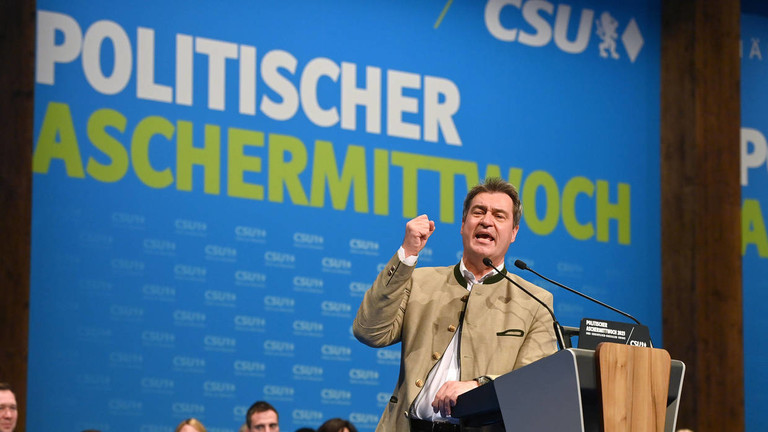
Bavarian Prime Minister Markus Soeder at a Political Ash Wednesday event in Passau, Germany, February 22, 2023. © Global Look Press / IMAGO / Frank Hoermann / Sven Simo
RT | February 22, 2023
German Chancellor Olaf Scholz must “stop” Foreign Minister Annalena Baerbock before she becomes a “security risk” and pushes Berlin towards a conflict with Moscow with her “thoughtless statements,” Bavaria’s Prime Minister Markus Soeder said on Wednesday during a German political festival.
The foreign minister and her party – Alliance 90/The Greens – are talking themselves into a “war frenzy” amid the ongoing conflict between Russia and Ukraine, Soeder told a crowd of cheering supporters during what is known in Germany as Political Ash Wednesday. Having originated in Bavaria, the 100-year old event allows German politicians to vent and pull no punches about the perceived shortcomings of their political rivals.
Soeder referred in particular to when Baerbock told the European Council back in January that the EU was “fighting a war against Russia,” words that sparked uproar at the time. In mid-February, Baerbock herself conceded that the remark was a mistake.
“A foreign minister has to be careful what she says,” Soeder warned during the event in Bavaria’s Passau, adding that “an escalation of words can quickly lead to the escalation of violence.” Germany is helping Ukraine but is not at war with Russia, he maintained.
“Mr. Scholz, finally stop Ms. Baerbock,” Soeder said, adding the foreign minister’s “thoughtless statements” are often “to the detriment of our country.”
Baerbock has emerged as one of the most hardline supporters of Kiev in the German government, repeatedly arguing for increased military aid to Ukraine and criticizing Chancellor Olaf Scholz for supposedly not doing enough. She has also supported tougher sanctions against Russia and opposed any compromises with Moscow.
In October 2022, she said that any concessions to Russia in the ongoing conflict would be “naïve.” The minister also maintained that the West should not settle for any peace agreement that would result in Ukraine losing to Russia any territory that it recognizes as Kiev’s.
Soeder, who has been a prominent figure in the German opposition, previously criticized Berlin for prioritizing military aid to Ukraine over the nation’s own security. In particular, he argued that Germany should not have sent IRIS-T air defense systems to Ukraine and should have instead used them to enhance its own national defense.
West unwilling to cooperate on Nord Stream probe: Russian diplomat
Press TV – February 22, 2023
Russia’s ambassador to the United Nations has once again accused the United States of being behind the explosions on Nord stream gas pipelines in September last year, saying the national investigations of Germany, Denmark, and Sweden into the sabotage are aimed at protecting Washington.
Vasily Nebenzia made the remarks at a UN Security Council session in New York on Tuesday, stressing that Western countries were showing no intention of cooperating with Moscow in an inquiry into the blasts.
“We have strong reasons to doubt the effectiveness, transparency, and impartiality of investigations that are being carried out under some national jurisdictions,” Nebenzia said, adding, “We do not see our partners being eager to cooperate.”
The senior diplomat also noted that “the so-called investigations by Scandinavian states and Germany into the incident not only lack transparency but are aimed at covering up the tracks and exculpating the big American brother.”
Nebenzia said Russia was not allowed to partake in the probe, and all its requests “are ignored with arrogance.”
Nebenzia further explained that Germany, Denmark, and Sweden had ignored Russian Prime Minister Mikhail Mishustin’s communications last October regarding the participation of Russian energy giant Gazprom and other relevant agencies in the investigations.
He said, “Since we talk about a crime that was committed by means of an explosive device, which makes it subject to the International Convention for the Suppression of Terrorist Bombings of 15 December 1997, we expect that all states that have to do with the incident, namely the US, Norway, Denmark, and Sweden, will fulfill their obligations under this document.”
“But leadership of these states do not show any political will or rather do not have any,” the Russian diplomat said.
On September 26, 2022, a series of explosions took place on the pipelines, knocking out three of the four strings of the Nord Stream network, off the coast of the Danish island of Bornholm in the Baltic Sea.
Two of the pipelines, known collectively as Nord Stream 1, had been providing Germany and much of Western Europe with cheap Russian natural gas for more than a decade. A second pair of pipelines, known as Nord Stream 2, was not yet operational.
Following the blasts, Denmark, Germany, and Sweden conducted investigations into the incident. The preliminary results of a joint probe by Sweden and Denmark showed that the explosions had been “intentional sabotage,” but responsibility was not assigned to any party.
American journalist Seymour Hersh recently claimed that the bombing of the pipelines had been directly ordered by US President Joe Biden and carried out by the CIA with the help of the US Navy.
The White House rejected the report as “utterly false and complete fiction.”
Mass demo in Munich against war
Free West Media | February 21, 2023
While Annalena Baerbock and US VP Kamala Harris discussed the further escalation of the war in Ukraine at the Munich Security Conference convened in the Bayerischer Hof, thousands demonstrated peacefully against war on the Königsplatz.
Several demonstrations took place in Munich on Saturday on the fringes of the Security Conference directed against the meeting itself. The organizers of one group, Munich Stand Up! counted between 20,000 to 25,000 of their participants.
Protesters followed the call by the Munich AfD on Saturday morning to the Old Botanical Garden, where they could be seen with peace signs and Russian flags.
According to the police, there was a scuffle and verbal confrontations with a small group of left-wing counter-demonstrators. They shouted “Fascist pack” and “Nazi plague”. Around noon, many participants in the AfD demo joined the protest on the Königsplatz, the largest gathering.
Right and left come together
Regardless of whether they were right-wing or left-wing: in terms of symbolism, both groups held flags displaying peace signs and Russian colours.
Slogans criticized NATO and the press as “warmongers” or drew parallels with the Corona pandemic, which many believe had been staged for nefarious purposes. The speakers included the left-wing politician Dieter Dehm and the former CDU politician Jürgen Todenhöfer.
Dehm spoke of “Ukrainian killer gangs and Nazi fascists” while Todenhöfer said in his speech: “The West wanted this war.” He accused the federal government of “madness”.
The final rally of the big “Anti-SiKo-Demo” took place on Marienplatz. As every year, the Munich “Action Alliance against the NATO Security Conference” had called for the demonstration. The opponents, who came mainly from the left-wing spectrum, had gathered at the Stachus shortly after noon.
The demonstrators called to “Create peace without weapons” on posters. Rainbow flags with the words “Pace” (Italian for peace) were displayed next to the dove of peace.
Confronting Ukraine supporters
As in previous years, peace demonstrators walked through the city center, where they passed a gathering at Odeonsplatz – a small band of supporters of Ukraine.
On the stage in front of the Feldherrnhalle, the members of the Bundestag Anton Hofreiter (Greens) and Marie-Agnes Strack-Zimmermann (FDP) spoke, and again called for the escalation of the war in Ukraine. Jamila Schäfer (Greens) expressed her satisfaction that the government had now initiated the delivery of battle tanks.
When the two protest camps met, it remained peaceful. However, it got a bit loud because both sides started chanting their slogans.
Some Ukrainian supporters burst into tears when they saw the peace posters: “Negotiate instead of shooting” was written on them.
Nazis for Ukraine
At the Feldherrnhalle, the site of Hitler’s putsch in 1923, the war supporters demonstrated for the Zelensky regime.
President Zelensky has banned all opposition media and parties in Ukraine and is openly cooperating with neo-Nazi militias and, according to recent photographs taken by die Associated Press, also with ISIS commanders.
Before the conference, he had even demanded the delivery of banned cluster bombs.
Thousands of police officers
According to the police, around 4,500 officers from Bavaria and other federal states as well as 300 federal police officers were on duty around the conference. At the international meeting of experts from Friday to Sunday, the main focus was on arming Ukraine. In addition, there were also debates about other conflicts such as in the Middle East, Yemen or Iran.
In support of the conference therefore, a few people demonstrated loudly for regime change in Iran in the morning on Odeonsplatz. The country’s green, white and red flag flew over the heads of people who want a pro-US regime and called on the European Union to designate the Islamic Revolutionary Guards Corps as a terrorist organization. The “National Council of Resistance of Iran” had called for the protest.
America the Feckless
Lies and hypocrisy are at the heart of the Biden foreign policy
BY PHILIP GIRALDI • UNZ REVIEW • FEBRUARY 21, 2023
One would think that the United States military staging an unprovoked “plausibly deniable” covert attack on a nation with which it is not at war would be at least considered newsworthy. That the attack did grave damage to a country with which the US is closely allied would seem to make the aggression even more unthinkable. And, perhaps worst of all, that the attack was set up by the nation’s chief executive using a political bypass that avoided congressional oversight and adherence to the war powers act which might be most reprehensible of all as it cuts to the heart of the nation’s constitutional balance of powers. It is clearly an impeachable offense. And “Yes,” for those who are still wondering, Joe Biden and his team of terrorist emulators have done all that and more, and have capped their performance with a series of flat out lies and evasions to make it appear that they had done nothing wrong.
And the mainstream America media, in its worst performance since the invasion of Iraq, has served as an echo chamber for everything the White House chooses to leak to it. Given all of that, it was perhaps completely predictable that the government-subservient press and TV news would almost completely ignore the devastating report released by top investigative journalist Seymour Hersh on February 8th. Hersh’s article was entitled “How America Took Out the Nord Stream Pipeline” with a secondary headline reading “The New York Times called it a ‘mystery,’ but the United States executed a covert sea operation that was kept secret—until now.” The article, which Hersh self-published on the internet, describes in considerable detail the preparations and execution by the US Navy Diving and Salvage Center and Central Intelligence Agency’s (CIA) Maritime Branch, coordinated and directed by the White House, to sabotage and destroy Russia’s four Baltic Sea Nord Stream gas pipelines, a war crime and terroristic action that moves the United States much closer to direct armed conflict with Russia.
Given its potential political blowback, the Hersh story might very well be the most important expose to appear since fighting began in Ukraine over a year ago, but it is being ignored by the White House, which is denying the report, with a spokesman only commenting that “This is false and complete fiction.” The CIA’s spokesman Tammy Thorp likewise replied to Hersh that “This claim is completely and utterly false.” The US Navy was also asked for comments but did not respond. The media, clearly evident by its inaction, has religiously adhered to that government line, possibly due to some mistaken notion that our national security forces have to be supported when they are going “toe to toe with the Russkies” over Ukraine. On the contrary, it is precisely when the government is behaving recklessly not to mention criminally to bring about an unnecessary war that the press should be in hot pursuit of the story and what it means. That is particularly so as the Ukraine conflict is now escalating and threatening to go nuclear as both sides dig in to incompatible positions.
I have known Sy Hersh for a number of years and spent time together with him and other former CIA colleagues helping to confirm details of some of his earlier exposes on US government abuses and outright lies in its somewhat not completely credible role as “guardian” of national security. Hersh is a meticulous investigator who never, in my experience, accepted uncorroborated claims in support of his narratives. I have some understanding of who his sources in the intelligence agencies and Department of Defense might be in this case and it should be accepted that what he has written is completely verifiable and derived from individuals who were actual participants in the activities described. That is not to say that there will not be failures to recall accurately certainly details including aspects of the possible Norwegian involvement, something critics are already pointing to, but the main thrust of “whodunit” and “how” is pretty definitively demonstrated.
The report is long and includes a great deal of information on both the planning and the political decision-making that went into the willingness to destroy the pipeline, which I will briefly describe. Sy claims the following: It has not exactly been a secret that many in the United States government have long regarded the Nord Stream pipelines to be a security threat as the supply of relatively cheap natural gas to Germany as a gateway into Europe by Russia would enable Moscow to create a dependency on it for energy which could be manipulated to produce political and strategic advantage.
As the crisis over Ukraine deepened in 2021, the Biden White House set up a secret task force that worked on possible scenarios that focused on using military and intelligence resources to physically destroy the pipelines with some measure of plausible denial of the US hand in the process in order to avoid political blowback from America’s European allies or escalation of the conflict. The secrecy was needed to protect Biden from charges of hypocrisy since he had repeatedly pledged that the US would not be directly involved in any armed conflict with Russia over Ukraine.
National Security Adviser Jake Sullivan headed the interagency task force, which convened throughout late 2021 and included key players from the Agency’s Maritime Branch and the Navy’s Diving and Salvage Center, both located in Panama City Florida, as well as the State Department, Treasury and the Joint Chiefs of Staff. The operation was originally treated as a covert action that would have required congressional oversight, but that fig leaf was abandoned and it became a “highly classified intelligence operation” when Biden and others in the administration stated publicly and clearly their intentions to stop the pipeline, making what eventually took place an openly declared policy, perhaps intended to send a warning to the Russians. A number of options to destroy the pipelines were discussed. According to Hersh, the participants in the meeting, many of whom were hawks who had cut their teeth under the Obama Administration, clearly understood that they were proposing an “act of war” that was being considered in spite of potential blowback because the president had ordered it.
There was plenty of warning of what might be coming. In early February 2022, shortly before the Russian invasion of Ukraine, President Biden publicly pledged during a joint news conference accompanied by a silent and frowning German chancellor Olav Scholz that “If Russia invades … there will no longer be a Nord Stream 2” and, when pressed on how he would carry that out, he responded, “We will — I promise you — we will be able to do it.” Later, after the destruction of the pipeline, Secretary of State Blinken stated that) the sabotage offered a “tremendous opportunity to once and for all remove the dependence on Russian energy… That’s very significant and that offers tremendous strategic opportunity for the years to come.” Not that any more confirmation was needed, but on January 22nd 2023 Under Secretary of State Victoria Nuland gloated while testifying to a US Senate committee that “the administration is very gratified to know that Nord Stream 2 is now … a hunk of metal at the bottom of the sea.”
The Biden Administration, in its arrogance has more-or-less been admitting that it was behind the sabotage, which it certainly had the motive and means to carry out, though it was carefully avoiding leaving any actual evidence behind that it had carried out the destruction. As observed above, it has also been deliberately avoiding any congressional involvement, presumably to avoid any discussion of war powers or even due to concerns over possible media leaks.
The mechanics of the placing explosives followed by the actual destruction of the pipelines was reportedly as follows: Under cover of a NATO Baltic Sea exercise called BALTOPS-22 in June 2022 US Navy and possibly also CIA Special Activities and Norwegian deep sea divers descended 260 feet to a spot off the Danish Island of Bornholm, which was considered to be a location where the pipelines converged in relatively shallow tide-free water and were particularly vulnerable. They attached C-4 explosives both to Nord Stream 1, which was operational, and Nord Stream 2, which was completed but was waiting for German safety and security regulators’ approval to become active. The explosives were designed to be remotely detonatable.
The explosives were on a timer that created an escape window for those initiating the detonation and were reported to be activated by a secure signal sent by a sonar buoy that was dropped onto the prepared site by a Norwegian navy helicopter. The Norwegians were essential in that role due to their own military presence close to the targeted part of the Baltic as well as their considerable experience in deep-sea cold-water operations. A Norwegian Navy helicopter in the area would presumably arouse no particular concern, even from the ever-watchful Russians.
Under orders to “Go!” from Washington, on September 26, 2022 the Norwegians dropped the sonar buoy and a few hours later the C-4 explosives were detonated, immediately knocking out three of the four pipelines. In the immediate aftermath of the bombing, the US and its allies in the media made every effort to blame the Russians who were repeatedly cited as a likely culprit. Leaks from the White House and from the British government never established a clear explanation of why Moscow would be into self-sabotage of a lucrative business arrangement. A few months later, when it was revealed that Russian authorities had been quietly getting estimates for the cost to repair the Nord Streams, in the neighborhood of $10 billion, the New York Times seemingly cluelessly described the development as “complicating theories about who was behind” the sabotage.
Indeed, it was never clear why Russia would seek to destroy its own valuable pipeline which was intended to be a major income source for many years to come, a proposition that former British diplomat Craig Murray describes as “deranged.” But a more telling rationale for the President’s action came from Secretary of State Blinken. Asked at a press conference in September about the consequences of the worsening global energy crisis, most felt in Western Europe, a delusional Blinken described the development in positive terms, enthusing how the destruction would “take away from Vladimir Putin the weaponization of energy as a means of advancing his imperial designs.”
The tale told by Sy Hersh is yet another great betrayal by the country’s so-called leadership, an egregious example of the United States government aided by its lap-dog media again lying to its own citizens and the world to cover-up a criminal act that in no way made Americans safer or more prosperous. In the US, the gadfly Tucker Carlson, among prominent journalists, has up to this point dared to present the investigative account developed by Hersh in a five-minute segment of his program. Newsweek has also run a piece examining the issues raised featuring Constitutional lawyer John Yoo. More interesting perhaps, a half hour interview of Hersh by Amy Goodman on PBS television’s Democracy Now! aired last week but then was partially blocked because YouTube considered it to be “inappropriate or offensive.” The full availability of the Seymour Hersh interview video has since that time been restored with the Democracy Now! channel providing the following explanatory message: “UPDATE: We have blurred some imagery about 30 seconds into the video in response to a content warning from YouTube that severely limited the reach of this interview. What you see now is an edited version. For the uncensored version of this interview that aired on our show, visit democracynow.org.”
Beyond that exposure, there remain, nevertheless, a lot of questions about the destruction of Nord Stream, which was unambiguously an act of war or even terrorism, that continue to be unanswered. Consider, for example, how NATO countries, the US and Norway, de facto attacked fellow NATO country Germany, which was both the intended recipient and an economic partner in the pipelines. Though some British involvement in the operation, also detected by Russian intelligence, was quickly revealed publicly by then-British Prime Minister Elizabeth Truss’s “It’s done” text to Secretary of State Antony Blinken sixty seconds after the detonation. Berlin apparently was not trusted enough to have a voice in the planning and execution of the bombing even though it was gravely damaged by it. Also, Article 5 of the NATO charter says an attack on one nation requires all other alliance members to aid the country that was targeted and it is intriguing to consider whether the rest of NATO ought to go to war with the United States and Norway. Alternatively, can “friends” in the defensive alliance attack each other without consequences or ought the US and Norway now be considered rogue nations? Will the alliance itself be able to stay together if several member states take steps unilaterally that can severely damage the economy of another member? And how are the Germans actually responding to their sinking economy and standards of living, with closing factories and cold houses as a consequence of the US/Norwegian action?
Americans, for their part, should also be thinking deeply about the government we have and the lack of restraint with which it behaves. The framers of the Constitution gave only to Congress the power to declare war, perhaps imagining that at some future date the president might stoop to using the military and naval forces of the United States globally to punish and coerce other nations, seize their territory, and kill their people. And it is all justified by something called “exceptionalism” empowering a massive sustained deception that waging continuous war is actually keeping the peace in a “rules based international order.”
But the final, and biggest, question remains: How will Russia retaliate to Nord Stream? Will it be one step closer to possible nuclear war initiated by Joe Biden’s reckless move or will the Kremlin persist with its request to have the United Nations Security Council investigate the incident? Moscow will certainly be careful to pick the right time and place, but the last act in this play surely remains to be written.
Philip M. Giraldi, Ph.D., is Executive Director of the Council for the National Interest, a 501(c)3 tax deductible educational foundation (Federal ID Number #52-1739023) that seeks a more interests-based U.S. foreign policy in the Middle East. Website is councilforthenationalinterest.org, address is P.O. Box 2157, Purcellville VA 20134 and its email is inform@cnionline.org.
Munich Security Conference 2023: An Exercise in Western Self-Delusion
By Scott Ritter – Sputnik – 20.02.2023
Delegates from around the world assembled in Munich, Germany on February 17, 2023, to convene an eponymously named security conference that has, since its inception in 1963, operated under the motto “Peace through Dialogue.”
For three days, world leaders participated in what has become known as “the Davos of Defense” (a reference to the World Economic Forum held in Davos, Switzerland), discussing critical security issues of the day.
This year, not surprisingly, the Russian-Ukrainian conflict dominated the agenda. What was a surprise, however, was the emphasis that western participants placed on action over discussion when it came to formulating a collective strategy for achieving some sort of conflict termination. Indeed, the dominant theme at Munich was not simply how to provide more material to Ukraine’s military, but how to do so in a manner that escalates the conflict by challenging Russia’s so-called “red lines” – regarding western support to Ukraine.
For the first time since the 1990’s, Russia was not invited to attend the conference. Instead, prominent Russian opposition figures, including exiled oil tycoon Mikhail Khodorkovsky, chess champion Gary Kasparov, and Yulia Navalnaya, the wife of the imprisoned opposition leader Alexei Navalny, were invited. The chairman of the conference, Christoph Heusgen, explained this pointed deviation from the principle of promoting dialogue by declaring that he did not want to be seen as providing a platform for Russian propaganda.
Instead, it turned out, Heusgen turned the floor over to western propagandists.
The underlying theme in Munich went beyond an escalation of support for Ukraine, and instead embraced the outright provocation of Russia. Lithuanian President Gitanas Nauseda served as the pace-setter for this trend when, prior to the Munich Security Conference, he urged western leaders to consider providing Ukraine with “essential military aid” such as tanks, fighter aircraft, and long-range missiles, despite long-standing concerns by the west that the provision of such aid would be seen by Russia as evidence of direct participation by the providing parties in the conflict. “These red lines,” Nauseda declared, “must be crossed.”
On cue, Ukraine’s President Volodymyr Zelensky opened the conference with an appeal, delivered via video and designed to underscore a sense of urgency.
“We need to hurry up,” Zelensky declared. “We need speed—speed of our agreements, speed of our delivery, speed of decisions to limit Russian potential. There is no alternative to speed because it is the speed that the life depends on,” Zelensky said, concluding that there was “no alternative to a Ukrainian victory.”
But Zelensky’s exhortations for speed appeared to fall upon deaf ears when it came to two of Europe’s most important leaders. Both Germany’s Olaf Scholz and France’s Emmanuel Macron underscored that, from their perspective, the conflict in Ukraine would not be ending anytime soon. “I think it’s wise to prepare for a long war,” Scholz noted in his remarks to the conference, a sentiment Macron echoed by saying that Europe should prepare for a “prolonged conflict in Ukraine.”
Declaring that now was “not the time for dialogue,” Macron urged his fellow conference attendees to action. “We absolutely need to intensify our support and our effort to the resistance of the Ukrainian people and its army,” Macron said, and “help them to launch a counter-offensive which alone can allow credible negotiations, determined by Ukraine, its authorities and its people.”
There is a fundamental disconnect between the frenetic urgings of President Zelensky and the long-term approaches taken by Scholz and Macron that point to an overall atmosphere of self-delusion that seemed to dominate the Munich Security Conference.
While US Vice President Kamala Harris spoke of bringing Russian leaders “to justice” for alleged war crimes in Ukraine, the Ukrainian military is being systemically ground down on the battlefields of eastern Ukraine, soil that Russia now claims for its own. Current NATO military commander, Lieutenant General Christopher Cavoli, has described these battles as being “out of proportion” to NATO plans and capabilities in terms of the “scope and scale” of the violence being perpetrated on the ground by both parties to the conflict.
Rather than accept the inevitability of a Ukrainian military defeat, however, Cavoli briefed US lawmakers on the sidelines of the Munich Conference that, in his opinion, Ukraine should be provided with modern jet aircraft, including F-16 fighters, and long-range missiles capable of striking targets deep inside Russian territory. These weapons, Cavoli said, would enable Ukraine to fight what he termed “the deep fight”, shifting the emphasis from the deadly fighting at the point of direct engagement to a new war where Ukraine would disrupt the Russian war effort by striking headquarters and supply lines deep behind the frontlines.
In short, Cavoli was outlining an escalatory strategy brought to life by Lithuanian President Gitanas Nauseda’s earlier exhortations to cross all “red lines” when it came to supporting Ukraine.
But simple rhetoric cannot bridge the yawning gap that exists with reality. Words, especially in an environment like this year’s Munich Security Conference, where all pretense at dialogue has been forsaken in favor of the construction of a pro-western echo, resonate in a manner which promotes an artificial sense of substance. But unless these words are backed by concerted action, they carry no weight and will soon dissipate into nothingness.
This, in short, is the reality of the Munich Security Council—an exercise in self-delusion, similar in construct to the discussions around the conference table in the last days of the Battle of Berlin in 1945, in which Adolf Hitler moved imaginary armies around in a vain effort to seize victory from the inevitability of defeat.
The fact is, there are no tanks, no long-range missiles, no fighter aircraft available in any realistic time-frame that can help Ukraine reverse the deterioration of its military posture vis-à-vis Russia. Zelensky’s demands for urgency reflect a growing recognition on his part that, if left on the current trajectory, the war with Russia will be over soon—perhaps as early as August 2023. The inability and/or unwillingness on the part of the western military and civilian leadership to match their declarations of support with Zelensky’s timeline demonstrates an absolute divorce from reality on the part of those who were gathered in Munich, or else the cynicism of those who know the tragic fate that awaits those they claim to support only too well.
The harsh truth that the participants of the Munich Security Conference know, but cannot speak, is that there is no hope for a Ukrainian victory over Russia.
Russia UN envoy: West hell-bent on destroying Russia, inciting deep Russophobia
Press TV – February 19, 2023
Russian ambassador to the UN has accused the West of instigating “deep Russophobia” and having a determination to destroy his country, saying that, “We had no choice other than to defend our country — defend it from you, to defend our identity and our future.”
Vassily Nebenzia made the remarks at a meeting of the UN Security Council, saying that Russia had no other choice than war. “We had no choice other than to defend our country — defend it from you, to defend our identity and our future.”
Friday’s meeting in the council — the only international venue where Russia regularly faces Ukraine and its Western supporters — put a spotlight on the deep chasm between the warring parties as the conflict is moving into its second year with no end in sight.
In the meeting, US deputy ambassador, Richard Mills, accused Russia of failing to implement “a single commitment it made” in the Minsk agreements while the other signatories — France, Germany, Ukraine and the Organization for Security and Cooperation in Europe — “sought to implement them in good faith.”
France ambassador, De Riviere, claimed his country and Germany have worked “tirelessly” since 2015 to promote dialogue between parties, adding that the “difficulties encountered in implementing these agreements can never serve as justification or mitigating circumstances for Russia’s choice to end the dialogue with violence.”
In response, Nebenzia accused the Western nations, including France and Germany, of “holding back” on implementing the Minsk agreements brokered by the two countries to end the conflict between Ukraine and the separatists in Luhansk and Donetsk in the Ukraine’s mostly Russian-speaking industrial east that flared in April 2014 after Crimea joined Russia.
“You knew very well that the Minsk process for you is just a smoke screen, so as to rearm the Kiev regime and to prepare it for war against Russia in the name of your geopolitical interest,” Nebenzia said.
He further accused the West of “deep Russophobia,” and a “determination to destroy my country, using others if possible.”
The envoy added that the West has no desire to “build a European and Euro-Atlantic security system together with Russia [because] for you such a system can only be aimed against Russia.”
“We have no trust left in you and we are not capable of believing any promises you make – not as regards a non-expansion of NATO in the east, or your desire not to interfere in our internal affairs, or your determination to live in peace,” Nebenzia said.
“You have shown that it’s impossible to negotiate with you,” he said. “You’ve shown how treacherous you are by creating on our borders a neo-Nazi, neo-nationalist beehive and then stirring it up.”
The Minsk agreements were a complex series of measures negotiated by Russia, France, Germany and Ukraine in 2014-2015 in a bid to put an end to the armed conflict between the Kiev authorities and the breakaway region of Donbas.
Moscow repeatedly stated that Kiev was not fulfilling the deal by not granting self-government to the Russian-speaking region of Donbas. In February 2022, Russia began the “military operation” to defend the territory from Ukrainian troops.
Last week, Ukrainian President Volodymyr Zelensky admitted he never intended to implement the Minsk agreements. Former German Chancellor Angela Merkel also recently acknowledged that Minsk deal was simply “an attempt to give Ukraine time” so that its army could get stronger.
The revelation was confirmed by former French President Francois Hollande, and Former UK Prime Minister Boris Johnson who said the Minsk agreement had been nothing but a “diplomatic imitation.”
Scott Ritter calls Hersh’s Nord Stream article “his most important work ever”
By Scott Ritter | February 17, 2023
In the Christian faith, God comes in the form of three persons: the Father, Son, and Holy Spirit.
Together, these three beings form the Trinity.
In a recent interview with the German writer Fabian Scheidler, Pulitzer Prize-winning investigative journalist Seymour Hersh discussed his bombshell article that appeared in his inaugural posting on Substack, “How America Took Out the Nord Stream Pipeline”.
When Scheidler thanked Hersh for his courageous reporting, the veteran reporter shot back, “What’s so courageous about telling the truth? We’re supposed to tell the truth!”
I’ve known Sy Hersh for coming on a quarter century. While I was too young to experience first-hand the impact of his reporting on the My Lai massacre in Vietnam, I had a front row seat to the masterful job he did in bringing to light the horrible facts about what the United States was doing in the Abu Ghraib prison, in Iraq.
Legendary status isn’t given—it is earned. And Sy Hersh has earned the absolute right to be called the GOAT when it comes to investigative journalism. He is, simply put, the best.
I’ve read nearly everything Sy Hersh has written, and am able to put his considerable journalistic output in its proper historical perspective. It is therefore that I feel very comfortable in concluding that, in terms of its potential for bringing about tectonic geopolitical change, Sy’s Nord Stream reporting is his most important work ever.
The GOAT has produced what I call the Trinity of Truth.
Truth One: The President of the United States, Joe Biden, by conspiring with members of his national security team to deliberately bypass constitutionally-mandated reporting requirements to Congress regarding acts of war undertaken by the United States, has committed an impeachable offense unmatched by any other president in the history of the United States.
Truth Two: The blow-back that will occur inside Germany to the revelations put forward by Seymour Hersh that the United States carried out an economic Pearl Harbor by destroying energy infrastructure critical to the well-being of the German nation has the potential of breaking up the North Atlantic Treaty Organization (NATO) and the European Union (EU), upending more than eighty years of post-war European security and stability, and resulting in the diminishment of the United States on the world stage as it becomes isolated from long-time European allies that served as the foundation of the global acceptance of the so-called “rules based international order” that has served as the means by which the United States exerted global hegemony.
Truth Three: The decision to attack the Nord Stream pipeline puts a lie to the US contention that Russia’s invasion of Ukraine was an unprovoked act of aggression, instead underscoring the harsh truth that the United States had a strategic plan which hinged on provoking a conflict with Russia in Ukraine to provide the geopolitical cover for ending Europe’s reliance upon cheap Russian natural gas by demonstrating that every time Russia sought a negotiated end to the crisis, whether before the invasion through implementation of the Minsk Accords, or after in the Istanbul round of talks scheduled for April 1, the United States sabotaged the effort, keeping the conflict alive long enough to implement its major objective—the destruction of Nord Stream.
In short, Sy Hersh, through his reporting, has exposed truths which have the potential of bringing down a presidency, destroying NATO, and proving Russia right in the eyes of the world.
Name one other piece of journalism in the past half-century that packs such a punch.
You can’t.
Sy Hersh is a national—no, an international—treasure, something this Trinity of Truth underscores.
Be sure to treat him as such.
Scholz’s Judgement Under the Spotlight Now Over Nord Stream Bombs. But What About Bojo?

By Martin Jay | Strategic Culture Foundation | February 17, 2023
As the world holds its breath and gasps at the news that Germany has been egregiously used as America’s pawn in a sick power game which is filling the coffers of U.S. companies and making Joe Biden’s buddies in the military industry billionaires, many will reflect on the judgement of Olaf Scholz and ask whether he is fit to be the German chancellor. He may have known about Biden’s plan to blow up the Nord Stream pipelines which would guarantee that Germany would not only throw itself into the war against Russia, but stay at it in the long run, which is bad enough. Or he may not have known and was as shocked as anyone when it happened in June of last year during a NATO exercise.
In either case, Scholz’s judgement will be examined now for a very long time and a process of opprobrium has in fact already started in the same building where he announced that he would throw the lever on a 200 billion euro spending spree to ‘rearm’ the German army: the German parliament.
While the German press follows its lead from their masters in the coalition government which Scholz presides over by pretending that the Hersh piece doesn’t exist, MPs like Sevim Dağdelen regale the government in a bold speech. “Stop defaming the journalist & his sources! The German government must disclose its findings on the #terrorist attacks on #NordStream , considering that revelations by #SeymourHersh point to the responsibility of the #USA & #Norway” she summarizes in a tweet.
Scholz is of course in a quandary. Whichever way he turns he sees his career shot to shreds so the best course is to hope that the media will serve him admirably and help him with the ruse of simply closing one’s eyes and hoping the commotion will die down.
But the debate is actually gaining momentum in some strange places and this will only serve the purpose once again for social media to ask the critical questions for the incumbent journalists to write up, like stenographers.
In the UK, it is Boris Johnson who, despite no longer being PM, is still making the news for being an inept buffoon who can’t help getting entangled in sleaze and corruption scandals – some about him or others simply about bent MPs who he goes to some length to protect.
This time it is the appointment of the BBC chief, who, it turns out is a crony of Johnson’s who he owed a huge favour to. Richard Price, according to a parliamentary report, arranged for Bojo to have 800,000 pounds ‘loan’ from a Canadian businessman. After arranging such a kind gesture Price, who was an advisor of Johnson in Downing Street, made it be known that he wanted the top job. And he got it.
It’s this kind of ‘jobs for the boys’ corruption stories which most Brits wouldn’t be too bothered about as, apart from only expecting this from Johnson whose entire tenure in government is a trail of havoc of lies, deceit and sleaze, the UK public is getting used to the idea that Whitehall and Parliament are now fully-fledged US style centres of corruption.
The remarkable thing about the Richard Price story though is that it was not the fourth estate who broke it. Given the tawdry, unhealthy relationship between big media in the UK and the establishment most investigative journalists have taken up other professions as ‘graft’ as a subject isn’t an easy commodity to flog to those in the media who themselves are tacitly as corrupt as the elite they serve. Such journalists are in dwindling numbers in the UK.
And so it was Nicholas Wilson, an anti-corruption sleuth, who dug the dirt up and joined up the dots creating this latest sleaze story about a bent BBC boss, who, while a Johnson advisor managed to get 600,000 pounds from the government for one of his companies. This is how UK governments work these days. A little bit more sophisticated than brown envelopes or insider trading. But not much. Make yourself useful to a corrupt leader who has the morals of a sewer rat and then name your price in the form of a top job as payment.
But judgement is also an issue here. If Johnson was happy to harangue close friends for money and put it out that he was looking for a large cash donation, then surely any third-rate hack would ask “what about the Ukraine war?”. Does Johnson have a financial stake in this war? Recently he was in Kiev and then Washington doing his bit for lobbying. Given this new role and the fact that he was the first western leader to send ammo to Ukraine, is it not fair to ask “Is he on the Zelensky payroll these days?”. Was he also in the loop on the pipeline bombing plan? All reasonable questions that UK journalists would no doubt like to examine. Be patient. They’re no doubt waiting for an out of work activist to get onto Twitter and do their jobs for them.
Featured Video
Macgregor: We Haven’t Seen the Worst of the Iran War Yet
or go to
Aletho News Archives – Video-Images
New Book
Breast Cancer: Before You Consent
A new Unbekoming paperback
Lies are Unbekoming | September 18, 2026
Peter Gøtzsche reviewed every randomised mammography screening trial ever conducted for the Cochrane Collaboration. Cochrane’s headline is that, assuming a 15% mortality reduction, one woman in 2000 avoids dying of breast cancer over ten years. Ten are overdiagnosed and treated. Two hundred experience false alarms.
But that headline assumes the reduction. When Gøtzsche looked only at the trials with adequate randomisation — the higher-quality ones — the reduction disappeared. No effect on breast cancer mortality. No effect on all-cause mortality.
This is the Cochrane finding, published in the establishment’s own database of systematic reviews.
No woman being asked to consent to a mammogram this week knows it.
That is why the new Unbekoming paperback exists. … continue
Blog Roll
 Aletho News
- US-Denmark Agreement on Greenland Is ‘PR Stunt’ Ahead of Midterms
- Araghchi: Military intervention cannot create security; coercion cannot bring peace
- Fraud Squared
- Breast Cancer: Before You Consent
- Iran’s Plan to Shut Down AI in the Persian Gulf
- Israel seeks ‘compensation’ from Washington over Saudi F-35 sale
- Saudi crown prince seeks dialogue with Ansarullah after Yemeni blows: Report
- Damascus rejects Saudi request for Syrian fighters to counter Yemen: Report
- South Korea says will not send troops to join terrorist US war on Iran
- Russia Just Struck the Eyes of NATO’s War Machine in Ukraine
- If Americans Knew
- Inside the siege, the ruined buildings of Gaza – Daily Update
- Debunking The Claim That Macklemore Has A “History Of Antisemitism”
- CPJ demands release of arrested Palestinian-US journalist near Bethlehem
- Robert Kraft: The Billionaire Friend of Netanyahu Pulling The Strings Behind the Macklemore/Ed Sheeran Blow Up
- Columbia Administered Fund Gives Big Money to Pro-Israel Groups
- Deportation Case of Palestinian Activist Salah Sarsour Tests First Amendment
- ‘We Will Not Forget’: Palestinians Mark 44 Years since Sabra and Shatila
- Why do we let Zionists decide what we can and can’t say?
- US welcomes Israeli, Iranian delegations to UN, but not Palestinians – Daily Update
- Biden’s Genocide Accomplices Targeted by New Accountability Campaign
- No Tricks Zone
- New Study: ‘Global Drought Shows No Detectable Recent Acceleration Under Climate Warming’
- Economic Masterminds: German Socialists Suggest Taxing Productivity Gains Stemming From Using AI
- The South China Sea Has Not Been Cooperating With The Climate Change Narrative
- Energy Crisis: Germany Enters Heating Season With Historically Low Gas Reserve Fill Levels
- New Study: The Antarctic Ice Sheet Gained Mass From 2020-2024 Due To Staggering Snow And Ice Accumulation
- Study: Ocean Heating Rates From Thousands Of Years Ago ‘Dwarf’ Modern Ocean Heating Rates
- Climate Extremists Target, Attack Large-Scale Power Grid Infrastructure In Germany!
- New Study: Antarctic Ice Melt Has Contributed Less Than 1 Centimeter To Sea Level Rise In The Last 30 Years
- Fear Of Debate: Alarmist German Climate Scientist Calls On Mainstream Media To Discredit Skeptic Voices
- End-Of-August Arctic Sea Ice Extent Hasn’t Fallen In 20 Years, Official Data Show!
 Aletho News