Does Germany blame Russia for cyberattacks to appease Washington?
By Paul Antonopoulos | June 5, 2020
Berlin is insistent on maintaining problematic relations with Moscow by making claims against Russia. Long-time German Chancellor Angela Merkel accused Russia in the Bundestag that she was the target of Russian hackers, adding that she had concrete proof of the “outrageous” spying attempts, without actually providing any evidence. She even went on to suggest that sanctions could be placed against Russia.
The German Foreign Ministry said in a statement on May 28 that “The Russian ambassador was informed that on the basis of an arrest warrant issued by the federal prosecutor’s office on May 5 against Russian national Dmitry Badin, that the German government will seek in Brussels to use the EU cyber sanctions regime against those responsible for the attack on the German Bundestag, including Mr Badin.”
The alleged cyberattack occurred in 2015 and brings to question why Berlin is now resurrecting a 5-year-old issue that Russian Foreign Minister Sergei Lavrov highlighted there was no evidence for Russian involvement. EU High Representative for Foreign and Security Policy, Josep Borrell, shared Lavrov’s sentiment and said he also did not have data on a cyberattack on the Bundestag and could not comment on this issue despite Berlin’s threat that it will use the EU to place sanctions on Russia.
“As for Russian hacker attacks, I don’t have any information that I can provide you at this stage,” said Borrel, answering a question from journalists about the possible imposition of sanctions on this case against Russians.
Perhaps as the U.S. continues to threaten companies involved in NordStream 2, Berlin is giving the appearance that it is still anti-Russia, despite being almost entirely reliant on Russia for its energy needs. Also, as Berlin has not provided evidence that Russia was behind the cyberattacks, why has it also not considered the U.S. could have orchestrated the attack?
In October 2013, Steffen Seibert, an official spokesman for the German government, reported that former CIA officer Edward Snowden had warned Germany that U.S. intelligence agencies could track Merkel’s mobile phone. Despite numerous demands from the public to conduct a full investigation and prosecute those responsible for this incident, in June 2015 the German Federal Prosecutor’s Office announced that the case was closed due to the inability to prove it in court.
Although the case allegedly could not be prosecuted, it does call to question why Merkel through a spokesperson told U.S. officials that they “view such practices [like spying] … as completely unacceptable.” White House spokesman Jay Carney said in response that “the United States is not monitoring and will not monitor the communications of the chancellor.”
In a statement, the German government said that “Among close friends and partners, as the Federal Republic of Germany and the U.S. have been for decades, there should be no such monitoring of the communications of a head of government.” The statement also said that Merkel had told Obama that “such practices must be prevented immediately.”
However, this is an incident that took place seven years ago and under a different U.S. administration and political party. None-the-less, in February 2019, a scandal erupted around Swiss company Crypto AG which was developing equipment used to encrypt sensitive information, and was working closely with the CIA and the BND (German intelligence). It was revealed that for more than half a century this practise was going on, demonstrating that U.S. spying on its own allies is not a new phenomenon.
Investigators from the German television station ZDF and The Washington Post found that the illegal actions by U.S. and German intelligence services affected more than 120 countries. The Swiss company supplied products as far back as the Second World War with encryption weaknesses so U.S. and German intelligence agencies could spy on many countries, including their own allies. Though the BND stopped participating in this Rubicon operation, as it came to be known, in 1993, the U.S. continued to spy until 2018.
After such cooperation with the U.S., information about the wiretap of the German Chancellor, which remained without a harsh reaction, is presented in a completely different light. Berlin probably had to quietly take the insult in order to avoid major and public problems because the NATO allies have likely gathered a lot of damaging information about each other over the years in their joint work in the Rubicon operation. It is worth to mention that Germany is not an ordinary European state, but the power engine of the European Union and an important member of NATO.
Now Germany decisively accuses Russia of cyberattacks and threatens sanctions, despite not providing any evidence for their claims. Although Russia, unlike the U.S., did not wiretap the German government, it is much safer to blame Russian citizens for cyberattacks. It does bring into question however why Germany is even possibly discussing sanctions while it fully supports the NordStream 2 pipeline project to secure its energy interests with Russia.
Paul Antonopoulos is an independent geopolitical analyst.
Rush to trash hydroxychloroquine exposes fundamental flaws in profit-based medical ‘science’
By Helen Buyniski | RT | June 4, 2020
As the WHO and prestigious medical journal the Lancet back away from questionable data provided by healthcare analytics firm Surgisphere, ulterior motives for the rush to demonize hydroxychloroquine become clear.
The World Health Organization (WHO) sheepishly resumed testing the off-patent malaria drug hydroxychloroquine on coronavirus patients on Wednesday after pausing that arm of its ‘Solidarity’ clinical trial based on data that appeared to show the drug contributed to higher death rates among test subjects. That data, it turned out, came from a tiny US healthcare analytics firm called Surgisphere, and calling it faulty would be excessively charitable.
Not only is Surgisphere a company lacking in medical expertise – its employees included an “adult” entertainer and a science-fiction writer – but its CEO Sapan Desai co-authored two of the damning studies that used the firm’s data to smear hydroxychloroquine, already thoroughly demonized in the media thanks to its promotion by US President Donald Trump, as a killer. All data is sourced to a proprietary database supposedly containing a veritable ocean of real-time, detailed patient information yet curiously absent from existing medical literature.
The Surgisphere-tainted study appeared to show increased risk of in-hospital deaths and heart problems with no disease-fighting benefits, confirming the suspicions of medical-industry naysayers already inclined to hate the off-patent drug due to the lack of profit potential and Trump’s incessant boosterism. Italy, France, and Germany rushed to ban hydroxychloroquine, citing “an increased risk for adverse reactions with little or no benefit.”
But such a shameless character assassination performed against a potentially-lifesaving drug – especially one with a decades-long track record of safety in malaria, lupus, and arthritis patients that came highly recommended by some of the world’s most eminent disease experts, including France’s Didier Raoult – could only be accomplished with help from industry prejudice. It required ignoring numerous existing studies showing hydroxychloroquine was beneficial in treating early-stage Covid-19 patients, as well as anecdotal reports from thousands of doctors who’d successfully used it.
It also required trusting a fly-by-night company with next to no internet or media presence to make decisions that could affect the lives of millions of people. It’s not like there weren’t warning signs Surgisphere was something other than the top-notch medical analytics firm it presented itself as. The company began life as a textbook publisher in 2008 and hired most of its 11 employees two month ago, according to an investigation by the Guardian, yet it claimed ownership of a massive international database of 96,000 patients in 1,200 hospitals worldwide. One expert interviewed by the outlet said it would be difficult for even a national statistics agency to do in years what Surgisphere had supposedly done in weeks, calling the database “almost certainly a scam.” Yet no one at the Lancet or WHO thought to look a gift horse in the mouth – not when that gift drove a stake through the heart of hydroxychloroquine as Covid-19 treatment.
And while Australian researchers found flaws in the Surgisphere data just days after the May 22 publication of the Lancet study, noting that the number of Covid-19 deaths cited by the study as coming from five hospitals exceeded the entirety of Covid-19 deaths recorded in Australia at that time, the Lancet – instead of investigating just who this Surgisphere company really was, and why it had made such a glaring mistake – merely published a minor retraction related to the Australian data and put the controversy to bed.
The full-frontal assault on hydroxychloroquine was instead allowed to continue unchecked in the media, as mainstream outlets focused their energies on fluffing up remdesivir – a costly, untested drug manufactured by drug maker Gilead that has so far produced lackluster results in clinical trials – and stumping for an eventual vaccine. Hydroxychloroquine’s off-patent status meant it was a dead end as far as profits were concerned, while remdesivir and whatever vaccine is ultimately green-lighted will make a lot of people very rich. Perhaps hoping to throw their audiences off the real reason for their hydroxychloroquine hatred, several outlets hinted that Trump stood to make money off the drug (which costs about 60 cents per pill) – but even Snopes, no fan of the ‘Bad Orange Man’, had to pour cold water on that speculation.
The Lancet and New England Journal of Medicine have – belatedly – published “expressions of concern” about the Surgisphere hydroxychloroquine study, and an independent audit is being conducted. But the problem of biased health authorities selectively embracing some trial results while rejecting others is unlikely to stop there.
The Lancet study is hardly the only one to show hydroxychloroquine lacks efficacy in treating Covid-19. Multiple studies conducted by the US National Institutes of Health on hospitalized (i.e. severely-ill) coronavirus patients have yielded poor results, but even the drug’s most ardent evangelists acknowledge it doesn’t help end-stage or very sick patients. Raoult has even claimed France banned the drug’s use in all but the most severely ill patients in order to discredit it as a treatment. The US National Institutes of Health was publishing studies in its journal Virology touting chloroquine as “a potent inhibitor of SARS coronavirus infection” as far back as 2005, yet ‘coronavirus czar’ Anthony Fauci throws shade at the drug whenever he gets a chance.
As long as deadly diseases like Covid-19 are seen as profit sources first and human rights issues second (or third, or tenth…), treatments that aren’t profitable will always be marginalized in favor of costly and frequently less-effective pharmaceuticals. Drug industry profiteering has already killed hundreds of thousands – if not millions – of people in the US alone. Taking the profit motive out of healthcare can help ensure its body count stays as low as possible.
Helen Buyniski is an American journalist and political commentator at RT. Follow her on Twitter @velocirapture23
Support for NATO wanes in France, Germany & even US as alliance struggles to maintain unity
RT | February 10, 2020
Public support for NATO has seen a notable decline in France, Germany and the US, according to a new poll. The alliance has suffered from months of budgetary in-fighting and mud-slinging among member states.
While the Pew Research study noted that the North Atlantic Treaty Organization still enjoys general support across member states, it pointed out that several countries “have soured on the alliance.”
Positive views of the transatlantic alliance fell to 52 percent in the United States last year, from 64 percent in 2018, the survey found. In France, support fell to 49 percent, from 60 percent in 2017 and 71 percent in 2009. A figure for 2018 was not available. Germany also saw a drop in public support, which stood at 57 percent in 2019, down from 63 percent in 2018. Positive ratings of NATO among members range from a high of 82 percent in Poland to 21 percent in Turkey.
The decline in public support can be attributed to a number of factors, including months of heated debate over defense spending among member states. US President Donald Trump has repeatedly chastised alliance members for not meeting their military spending commitment of two percent of GDP, while arguing that the United States pays far too much for Europe’s defense.
European states have also been highly critical of the Cold War-era defensive alliance. Last year, French President Emmanuel Macron accused NATO of suffering from “brain death” because of its perceived failure to help maintain global security and resolve world conflicts.
The alliance has also struggled to maintain a united front, most notable in Syria, where Turkey has been at odds with its American allies. Ankara has also locked horns with Athens over the tense military and political situation in Libya.
Founded in 1949 to counter the Soviet Union, NATO has been criticized for being largely obsolete and lacking a clear purpose. Despite billing itself as a defensive alliance, it has participated in a number of disastrous military interventions in the Middle East and North Africa.
Trump-Bidens-Russia-Ukraine: A systemic interpretation
To understand the Trump-Bidens-Russia-Ukraine fiasco clearly, we have to park the moral, constitutional and legal issues
By Padraig McGrath | December 25, 2019
On December 23rd, the Washington Post ran a piece exploring the possible motivations behind US president Donald Trump’s decision to pause US military aid to Ukraine on July 12th last year. On September 28th 2018 and February 16th respectively, President Trump had signed into law two bills from Congress which approved a combined $391 million in military aid to Ukraine, including the provision of lethal weaponry.
The question is extensively explored in the Washington Post article, as in other articles on the issue, as to whether or not Trump’s July 12th decision to withhold the military aid violated the 1974 Congressional Budget and Impoundment Control Act, which states that once Congress appropriates funds and the president signs the relevant spending bill, then it is not within the president’s legal power to withhold those funds.
The Washington Post and other media have also tentatively explored the unresolved question as to what connection, if any, Trump’s July 12th decision to withhold the funds might have had to his subsequent July 25th telephone conversation with Ukrainian President Volodydmyr Zelensky, which became central to arguments for his impeachment. Was Trump using the withholding of aid in order to pressure Zelensky into launching investigations into Hunter Biden’s Ukrainian business-interests, and those of other senior figures in the US Democratic Party? To be fair, the Washington Post article, and a surprisingly high proportion of the other media-coverage of these questions, have been soberly analytical. Refreshingly, the coverage has managed to avoid the worst excesses of liberal Trump Derangement Syndrome.
I believe that the legal debate is largely incidental to what is really happening, and that any moral debate on this issue is even more superfluous than the legal debate. However, before we set the complex legal issues aside, it should be briefly stated that they are not unimportant. Even if we understand that 99% of everybody’s motivations for getting entangled in the legal debate are politically partisan, it is at least conceivable that a person might wish to ask these questions from a non-partisan, purely legal point of view, and that purely juridical concern should not be dismissed out of hand. Regarding the Bidens’ role in this fiasco, one surprising aspect is that it took so many years for the controversy regarding Burisma Holdings to go viral, even in alt-media. The facts that not only Hunter Biden but also Devon Archer, a former John Kerry campaign manager, sat on Burisma’s board of directors, and that Burisma was extensively invested in shale-gas extraction in the vicinity of the Donbas war-zone, had been public knowledge in the Russian-speaking world ever since 2014.
However, in order to understand what is really happening at the deeper systemic level, we need to also set the endless cycle of allegations and counter-allegations aside. The petty political or financial agendas of the Bidens, or Trump, or this or that member of Congress, are incidental to the big systemic picture. Sure, all the players have their own self-interested petty motivations, but the sum of all those motivations does not amount to an explanation of why the game is being played in the first place. Politicians, and occasionally their wastrel offspring, are merely unwitting instruments of history, not agents of history. The parameters of the game are determined by a core geo-strategic logic. What vital geo-strategic interest does the United States have in Ukraine?
Back in 2014, there was certainly hope in US business circles that Ukraine could be a profitable colony, and some US companies including Monsanto have profited from their expansion into Ukraine. However, for most US commercial interests, it quickly became clear in the immediate post-coup period that Ukraine was simply too much of a self-destructive black hole to hope that it might ever become a profitable colony. Ukraine’s culture of blatant kleptocracy was simply too pervasive and ingrained for most western concerns’ money to be safe there.
So rather than the economic exploitation of Ukraine, the United States’ vital geo-strategic interest in Ukraine centrally stems from the point that the maintenance of permanent instability in Ukraine presents developmental and security-challenges to Russia. Furthermore, the maintenance of perpetual Ukrainian hostility toward Russia is useful to larger US geo-strategic interests. We need to remember Zbigniew Brzezinski’s 1997 statement that “without Ukraine, Russia ceases to be an empire.” Brzezinski had identified 3 “geo-strategic pivots” on the Eurasian land-mass which were vital to the task of protecting broader and more global US interests – Iran, Turkey and Ukraine. We have to admit that, as badly as the US foreign policy establishment miscalculated in Ukraine, they still got a piece of what they wanted. The loss of Ukraine’s potential membership was a major blow to the Eurasian Customs Union’s potential for economic reach.
Furthermore, Ukraine’s geography renders it a perfect instrument to drive an economic wedge between Germany and Russia. The trajectory of Russian-German economic integration which has developed steadily over the past 20 years was unquestionably contrary to the decaying hegemon’s interest. Ever since the late 19th century, American geo-strategists have morbidly feared the economic synthesis of Germany’s technological resources with Russia’s human resources and natural resources.
In this regard, all of the legal allegations and counter-allegations regarding Trump and the Bidens are merely incidental noise, and the attached moral arguments are even more absurd.
Here’s what’s really happening:
Trump’s role as a political outsider in Washington is, in this context, manifested in the point that he still thinks like a businessman, not like a geo-strategic planner. As Ukraine is simply too dysfunctional to be turned into a profitable US colony, Trump simply has no meaningful interest in Ukraine. Trump has most probably never bothered reading Halford Mackinder or George Kennan. His critics and political enemies will argue that, as a mere businessman, Trump doesn’t understand that the game is not about “Ukraine” – the game is about Eurasia.
German Parliament Greenlights Non-Binding Initiative to Ban Hezbollah
Sputnik – December 20, 2019
German lawmakers approved a non-binding initiative on Thursday calling on the government to ban from Germany the political and militant group Hezbollah, which forms part of the Lebanese government. The move, reportedly aimed at combating anti-Semitism, has been rejected multiple times by the parliament.
The Thursday resolution was approved by the opposition Free Democrats as well as the Social Democratic Party, which is allied to the Christian Democratic Union (CDU), Chancellor Angela Merkel’s party. The move seeks to ban the political arm of Hezbollah from Germany and to add the group to the European Union’s terrorist list.
“It is unacceptable that Hezbollah is waging a terrorist fight against Israel in the Middle East, which is being financed through worldwide criminal activities, among other things,” CDU spokesperson Mathias Middelberg said in a statement, according to AP. “In view of Germany’s special responsibility toward Israel, we call on the government to ban all activities for Hezbollah in Germany.”“The separation between a political and a military arm should be abandoned, and Hezbollah as a whole should be placed on the EU terrorist list,” Middelberg said. “This could freeze Hezbollah’s funds and assets in Europe more extensively than before.”
Germany last weighed the question of banning the political wing of Hezbollah, which has just over 1,000 members, in June. That bill, sponsored by the far-right Alternative for Germany (AfD), which has repeatedly sponsored bills seeking to ban burqas and minarets, claiming “Islam is not a part of Germany,” according to Middle East Monitor, failed amid joint opposition by the same parties that sponsored the resolution passed Thursday.
Israeli Foreign Minister Israel Katz praised the move, calling it “an important step in the international struggle against terrorism, particularly against terrorist organization Hezbollah and its patron Iran,” AP noted. US Ambassador to Germany Richard Grenell also voiced his support.Hezbollah is a Lebanese political party and militant group whose primary basis of support is the country’s Shiite Muslim community, although it also enjoys the support of many Christians, Druze and even Sunni Muslims. It gained notoriety for fighting the Israel Defense Forces to a standstill in Lebanon’s south when Israel invaded in 2006. The group was formed as a self-defense force in the early 1980s, during a previous occupation by Israeli forces, against whom it waged a guerrilla campaign. It has also joined the fight in Syria against Daesh and other jihadist rebel groups.
Hezbollah has been accused of multiple acts of terrorism, such as a bus bombing in the Bulgarian city of Burgas in 2012 that killed seven people and injured 32, although no conclusive evidence tying Hezbollah to the attack has been found. It’s also been accused of being behind a slew of terrorist attacks in the early 1980s, including several deadly bombings in Beirut, but again with limited evidence behind the claims. However, 14 nations and several international organizations have declared Hezbollah to be a terrorist organization, while eight nations have declared it not to be one. Hezbollah is also accused of being a proxy of Iran.
Mustafa Ammar, a CDU candidate for the 2021 elections, told Asharq Al-Awsat late last month that secret talks had taken place during a congress held by the CDU in Leipzig about how best to limit anti-Semitism in Germany, especially in schools.“One of the measures included the total banning of Hezbollah and its activities,” Ammar told the London-based outlet. A Hamburg intelligence agency reported in July that Hezbollah had ties to about 30 mosques across Germany, where it raises funds and spreads its ideology, according to Fox News.
Hezbollah has long maintained it distinguishes between Judaism as a religion and Zionism as a political ideology, with leader Hassan Nasrallah saying in 2009: “Our problem with [the Israelis] is not that they are Jews, but that they are occupiers who are raping our land and holy places.” However, Nassrallah and other Hezbollah leaders have also been accused of anti-Semitic statements.
Last week, US President Donald Trump signed an executive order that categorized anti-Israeli speech as anti-Semitism and hate speech under Article VII of the 1964 Civil Rights Act. The move is widely interpreted as aimed at punishing anti-Israel initiatives like Boycott, Divestment and Sanctions (BDS) by declaring them to be anti-Semitic, tying the nation of Israel to the worldwide Jewish community.
Contrast Of Climate And Energy Policies, And Economic Results, In The U.S. And Germany
By Francis Menton – Manhattan Contrarian – December 6, 2019
If you are reading your normal diet of “mainstream” press, you are getting hit with a constant barrage of climate alarm, together with a near total boycott on any good economic news for as long as Trump remains President. As a result, it is very easy to lose track of the widening chasm in the climate and energy policies, and also in the economic results, between the U.S. and its major European competitors. When you put some easily-available numbers together in one place, the contrast becomes very striking. For today, I will collect a smattering of relevant statistics, focusing on the U.S. and Germany.
And then there are the positions on these subjects of the candidates for the Democratic nomination for President. I find those positions beyond belief.
You probably know that the so-called “fracking” revolution in oil and gas production has led to a large increase in U.S. production of those fuels over the last ten or so years. The actual numbers are quite remarkable. On the oil side, according to data from the government’s Energy Information Agency, in 2008 U.S. production of crude oil from all sources averaged 5 million barrels per day. By 2018, that figure had well more than doubled to 10.99 million bbl/dy. By contrast, crude oil production in Saudi Arabia in 2018 was 10.445 million bbl/dy (up from 9.261 bbl/dy in 2008), and in Russia was 10.759 bbl/dy (up from 9.357 bbl/dy in 2008). Of today’s U.S. production, some 59% — representing essentially all of the increase since 2008 — comes from so-called “tight” resources, meaning those that are produced by fracking.
The large increase in U.S. production has been accompanied by a correspondingly large decline in the price of oil and natural gas. Oil of the WTI (West Texas Intermediate) grade that traded at $110 per barrel in 2013 closed today at $59.12. U.S. prices for a gallon of regular grade gasoline, which reached a high of $3.90 in 2012, fell as low as $2.25 earlier this year, and are currently around $2.60. Natural gas prices are quite volatile, but were in the range of $4 to $6 per thousand cubic feet in 2014, and most recently $2.29.
In September, the U.S. became a net exporter of oil for the first time since the 1940s. The EIA expects that status to continue for the foreseeable future.
Over in the economic news category, the U.S. continues to thrive. Today, the Labor Department reported an increase in jobs of 266,000 during November, the unemployment rate down to 3.5% (lowest since 1969), and wages up 3.1% over a year ago. All of those must be considered excellent results.
And then there’s Germany. According to CleanEnergyWire, Germany in 2018 imported 98% of its oil needs, and 95% of its gas. But doesn’t Germany have at least one good shale formation that could be developed? The answer is that Germany pretty much banned all fracking in 2017. They are still caught up in the Energiewende, or, in other words, the delusional idea that wind and solar power can replace fossil fuels within a few years. Nearly ten years into this, their carbon emissions have barely decreased at all, while emissions increases in places like China and India make any marginal decreases that Germany can achieve completely irrelevant. Meanwhile, they depend for their oil and natural gas on places like Russia and the Middle East.
GlobalPetrolPrices gives the most recent price of consumer gasoline in Germany as 1.385 euros per liter, equivalent to $5.807 per gallon. Admittedly, this cannot be blamed solely on supply restrictions; embedded taxes are also substantially at fault. But those embedded taxes are also part of the ongoing war against fossil fuels. German consumer electricity prices are also about triple the U.S. average.
And the economic news from Germany? It seems that the industrial sector is in the midst of a slump, in substantial part caused by the mad drive to force energy conversion without consideration of the costs. From the Daily Express, December 3:
THE GERMAN car industry is facing disaster with up to 50,000 jobs under threat or expected to be lost before the end of the year in what has been described as the “biggest crisis since the invention of the automobile”. Last week the owner of Mercedes-Benz announced plans to axe at least 10,000 employees globally, taking the number of jobs losses by German carmakers to almost 40,000 this year as the industry sinks under a massive sales slump. Daimler wants to save £1.2billion in staff costs as it prepares to invest billions in the electric cars boom. Audi, which is owned by Volkswagen, has also said it would be shedding almost 10,000 people – around around 10 percent of its global workforce.
Trading Economics states that German GDP “rebounded” to a growth of 0.1% in the third quarter, after a decline of 0.2% in the second quarter of 2019. Congratulations!
Meanwhile, among the Democratic candidates for President, the contest is between those who would ban fracking immediately, and those who advocate some period of “transition” to some fanciful alternative. Bernie Sanders and Elizabeth Warren have vowed to ban fracking immediately. It’s not clear how they would do that, other than that they view the presidency in their hands as a dictatorship of unlimited powers. Then there’s the “moderate” Joe Biden, who said (yesterday) “I’d love to make sure we can’t use any oil or gas, period,” but then hedged that we would need some period to “transition away” from those fuels.
“Transitioning” away from fossil fuels — that’s what Germany is doing.
‘Expulsion of Russian diplomats over Berlin murder case suits trend of blaming Moscow for everything, whether it’s true or not’
RT | December 5, 2019
Germany seems to be joining the cohort of those playing the old-time blame-Russia game, having expelled two diplomats citing Moscow’s unwillingness to help probe a murder of a suspected terrorist on its soil.
On a sunny day in August, Zelimkhan Khangoshvili – formerly a Chechen militant suspected of terrorist activity in Russia and a Georgian national – set off for his last walk through the Kleiner Tiergarten park located in one of Berlin’s central boroughs. Not long after that, he was shot dead in broad daylight by an assassin who allegedly used a silenced pistol to do the job.
The high-profile murder case returned to the spotlight when Berlin made a bold move expelling two Russian diplomats.
The official rationale was that “we’ve not seen that Russia backs us in inquiring into the murder,” as Chancellor Angela Merkel mildly put it. Germany’s Foreign Office, on their part, echoed Merkel’s points but stated that “serious and immediate participation by the Russian authorities is still required.”
Russia’s Foreign Minister Sergey Lavrov said Moscow was surprised by Berlin’s accusations, telling the press he couldn’t comprehend what led Germany to believe Russia was involved in the killing.
“We have communications channels set up for our law enforcement agencies … these should be used. If our German partners claim that Russia doesn’t cooperate enough, I don’t know what that assessment is based upon.”
The Prosecutor General’s Office that took over the probe claimed of having “sufficient factual evidence that the killing may have been ordered by state authorities of the Russian Federation or the autonomous Republic of Chechnya which is a part of Russia.” They have not revealed any details.
Berlin was “absolutely reluctant” to deteriorate its relationships with Russia which “are not in as good shape as they ought to be,” according to political analyst Dr. Werner Patzelt. Thus, he believes expelling the diplomats “was something like a final resort” to make Moscow co-operate.
But the fact that no evidence was presented made some German politicians very uneasy.
“That the federal government singles out two Russian diplomats, although the investigation is still going on, is difficult to understand without having clear information,” said Alexander Lambsdorff, vice-president of the Free Democrats’ (FDP) parliamentary group.
The media immediately started making comparisons with the Skripal poisoning saga over the Russian connection. There’s one similarity with the British case – there was no evidence presented to the public, but the blaming started immediately.
For years, there has been a “tendency to blame Russia for this and that, beginning with the putsch in Kiev, and the MH17 crash in Ukraine, the Skripal case and now this,” Willy Wimmer, former Vice President of the OSCE Parliamentary Assembly, told RT.
Western Europeans are concerned “that everything is used to blame Russia whether it’s true or not,” he argued. The German authorities who expelled the Russian diplomats, “have to say more,” Wimmer urged, adding, “they have to explain why they did it and if there is really enough evidence to create problems for our diplomatic relations.”
Germany has been under pressure the US and some other Western allies over its business relations with Russia, in particular the construction of the Nord Stream pipeline that Washington pledged to sanction.
‘Shameless Racism’: 13 Countries Change Long-Standing Position on Palestine at UN
Palestine Chronicle – December 5, 2019
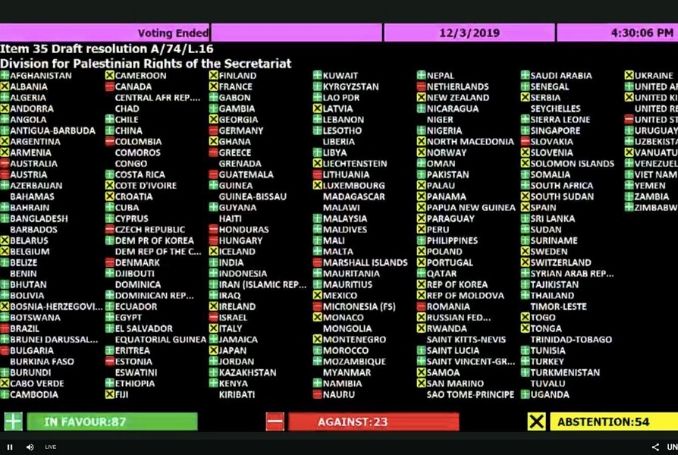
For the first time, 13 countries changed their longstanding positions and voted against a pro-Palestine measure at the United Nations on Tuesday.
Germany, the Czech Republic, Austria, Bulgaria, Denmark, Estonia, Greece, Lithuania, Netherlands, Romania, Slovakia, Brazil, and Colombia voted against the annual resolution regarding the “Division for Palestinian Rights of the Secretariat”, according to the Times of Israel.
They had previously abstained on the vote.
The resolution, which includes a call to halt to illegal Israeli settlements being constructed in the occupied West Bank, still passed with a large majority voting in favor.
The Palestinian representative told the council: “If you protect Israel, it will destroy you all.” He also said Israel’s character as a Jewish state is “shameless racism”.
The New York-based Division for Palestinian Rights oversees the Committee on the Exercise of the Inalienable Rights of the Palestinian People.
The resolution was co-sponsored by Comoros, Cuba, Indonesia, Jordan, Kuwait, Lao People’s Democratic Republic, Qatar, Saudi Arabia, Senegal, the United Arab Emirates, and Yemen.
The UK, France, and Spain abstained, as they do every year, allowing the resolution to pass with a vote of 87-54, with 21 other abstentions.
The General Assembly adopted five resolutions on the question of Palestine and the Middle East, including one calling on the Member States not to recognize any changes to the pre-1967 borders, including with regards to Jerusalem, other than those agreed by the parties through negotiations.
A Second Whistle Blown on the OPCW’s Doctored Report
By Jeremy Salt | American Herald Tribune | December 3, 2019
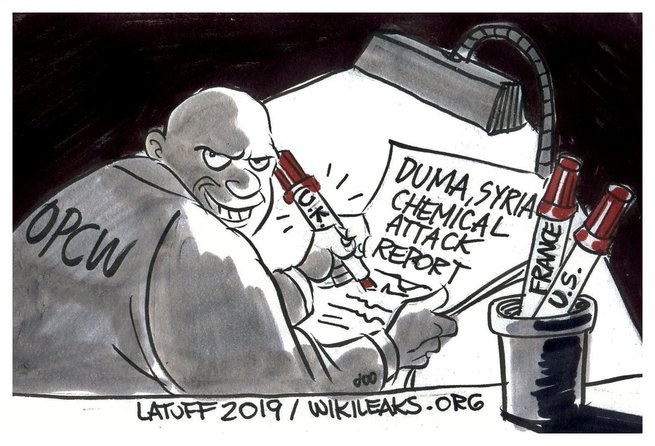
Another whistleblower leak has exposed the fraudulent nature of the Organization for the Prevention of Chemical Weapons (OPCW) report on the alleged chemical weapons attack in the Syrian city of Douma, close to Damascus, on April 7 last year.
The first leak came from the Fact-Finding Mission’s engineering sub-group. After investigating the two sites where industrial gas cylinders were found in Douma and taking into account the possibility that the cylinders had been dropped from the air it concluded that there was a “higher probability” that both cylinders were placed at both sites by hand. This finding was entirely suppressed in the final report.
The engineering sub-group prepared its draft report “for internal review” between February 1-27, 2018. By March 1 the OPCW final report had been approved, published and released, indicating that the engineers’ findings had not been properly evaluated, if evaluated at all. In its final report the OPCW, referring to the findings of independent experts in mechanical engineering, ballistics and metallurgy, claimed that the structural damage had been caused at one location by an “impacting object” (i.e. the cylinder) and that at the second location the cylinder had passed through the ceiling, fallen to the floor and somehow bounced back up on to the bed where it was found.
None of this was even suggested by the engineers. Instead, the OPCW issued a falsified report intended to keep alive the accusation that the cylinders had been dropped by the Syrian Air Force.
Now there is a second leak, this time an internal email sent by a member of the Fact-Finding Mission (FFM) on June 22, 2018, to Robert Fairweather, the British career diplomat who was at the time Chief of Cabinet at the OPCW, and copied to his deputy, Aamir Shouket. The writer claims to have been the only FFM member to have read the redacted report before its release. He says it misrepresents the facts: “Some crucial facts that have remained in the redacted version have morphed into something quite different from what was originally drafted.”
The email says the final version statement that the team “has sufficent evidence to determine that chlorine or another reactive chlorine-containing chemical was likely released from the cylinders is highly misleading and not supported by the facts.” The writer states that the only evidence is that some samples collected at locations 2 and 4 (where the gas cylinders were found) had been in contact with one or more chemicals that contain a reactive chlorine atom.
“Such chemicals,” he continues, “could include molecular chlorine, phosgene, cyanogen chloride, hydrochloric acid, hydrogen chloride or sodium hypochlorite (the major element in household chlorine-based bleach.” Purposely singling out chlorine as one of the possibilities was disingenuous and demonstrated “partiality” that negatively affected the final report’s credibility.
The writer says the final report’s reference to “high levels of various chlorinated organic derivatives detected in environmental samples” overstates the draft report’s findings. “In most cases” these derivatives were present only in part per billion range, as low as 1-2 ppb, which is essentially trace qualitiea.” In such microscopic quantities, detected inside apartment buildings, it would seem, although the writer only hints at the likelihood, that the chlorine trace elements could have come from household bleach stored in the kitchen or bathroom.
The writer notes that the original draft discussed in detail the inconsistency between the victims’ symptoms after the alleged attack as reported by witnesses and seen on video recordings. This section of the draft, including the epidemiology, was removed from the final version in its entirety. As it was inextricably linked to the chemical agent as identified, the impact on the final report was “seriously negative.” The writer says the draft report was “modified” at the behest of the office of Director-General, a post held at the time by a Turkish diplomat, Ahmet Uzumcu.
The OPCW has made no attempt to deny the substance of these claims. After the engineers’ report made its way to Wikileaks its priority was to hunt down the leaker. Following the leaking of the recent email, the Director-General, Fernando Arias, simply defended the final report as it stood.
These two exposures are triply devastating for the OPCW. Its Douma report is completely discredited but all its findings on the use of chemical weapons in Syria must now be regarded as suspect even by those who did not regard them as suspect in the first place. The same shadow hangs over all UN agencies that have relied on the OPCW for evidence, especially the UN’s Independent International Commission of Inquiry on the Syrian Arab Republic, an arm of the OHCHR (Office of the High Commissioner for Human Rights).
This body is closely linked to the OPCW and while both mostly hide the sources of their information it is evident that where chemical weapons allegations have been made, the commission of inquiry has drawn on the OPCW.
As of January 2018, the commission reported on 34 “documented incidents” of chemical weapons use by various parties in Syria. It held the Syrian government responsible for 23 of them and, remarkably, did not hold the armed groups responsible even for one, despite the weight of evidence showing their preparation and use of such weapons over a long period of time.
The commission has made repeated accusations of chlorine barrel bombs being dropped by government forces. On the worst of the alleged chemical weapons attacks, on August 21, 2013, in the eastern Ghouta district just outside Damascus, it refers to sarin being used in a “well-planned indiscriminate attack targetting residential areas [and] causing mass casualties. The perpetrators likely had access to the Syrian military chemical weapons stockpile and expertise and equipment to manipulate large amounts of chemical weapons.”
This is such a travesty of the best evidence that no report by this body can be regarded as impartial, objective and neutral. No chemical weapons or nerve agents were moved from Syrian stocks, according to the findings of renowned journalist Seymour Hersh. The best evidence, including a report by Hersh (‘The Red Line and the Rat Line,’ London Review of Books, April 17, 2014), suggests a staged attack by terrorist groups, including Jaysh al Islam and Ahrar al Sham, who at the time were being routed in a government offensive. The military would have had no reason to use chemical weapons: furthermore, the ‘attack’ was launched just as UN chemical weapons inspectors were arriving in the Syrian capital and it is not even remotely credible that the Syrian government would have authorized a chemical weapons attack at such a time.
Even the CIA warned Barack Obama that the Syrian government may not have been/probably was not responsible for the attack and that he was being lured into launching an air attack in Syria now that his self-declared ‘red line’ had been crossed. At the last moment, Obama backed off.
It remains possible that the victims of this ‘attack’ were killed for propaganda purposes. Certainly, no cruelty involving the takfiri groups, the most brutal people on the face of the planet, can be ruled out. Having used the occasion to blame the Syrian government, the media quickly moved on. The identities of the dead, many of them children, who they were, where they might have been buried – if in fact they had been killed and not just used as props – were immediately tossed into the memory hole. Eastern Ghouta remains one of the darkest unexplained episodes in the war on Syria.
The UN’s Syria commission of inquiry’s modus operandi is much the same as the OPCW’s. Witnesses are not identified; there is no indication of how their claims were substantiated; the countries outside Syria where many have been interviewed are not identified, although Turkey is clearly one; and where samples have had to be tested, the chain of custody is not transparent.
It is worth stepping back a little bit to consider early responses to the OPCW report on Douma. The Syrian government raised a number of questions, all of them fobbed off by the OPCW. Russia entered the picture by arranging a press conference for alleged victims of the ‘attack’ at the OPCW headquarters in the Hague. They included an 11-year-old boy, Hassan Diab, who said he did not know why he was suddenly hosed down in the hospital clinic, as shown in the White Helmets propaganda video.
All the witnesses dismissed claims of a chemical weapons attack. Seventeen countries (Australia, Bulgaria, Canada, the Czech Republic, Denmark, Estonia, France, Germany, Iceland, Italy, Latvia, Lithuania, the Netherlands, Poland, Slovakia, the United Kingdom and the US) then put out a joint statement (April 26, 2018) expressing their full support for the OPCW report and dismissing the “so-called” information session at the Hague as a Russian propaganda exercise. Their statement claimed the authenticity of the information in the OPCW report was “unassailable.”
Russia followed up with a series of questions directed at the OPCW’s technical secretariat. It noted that the OPCW report did not mention that samples taken from Douma were “split” in the OPCW’s central laboratory in the Netherlands and not in the Syrian Arab republic. Fractions of samples were handed to Syria only after six months of insistent pressure (OPCW response: its terms of reference provided for Syria to be provided with samples “to the extent possible” but do not specify when or where samples should be ‘split’).
Russia also referred to the collection of 129 samples and their transfer to OPCW-designated laboratories. 31 were selected for the first round of analysis and an additional batch of 13 sent later. Of the 129 samples 39 were obtained from individuals living outside territory controlled by the Syrian army. Of 44 samples analyzed 33 were environmental and 11 biomedical: of the 44, 11 (four environmental and seven biomedical) were obtained from alleged witnesses.
As remarked by the Russian Federation, the OPCW report does not explain the circumstances in which these samples were obtained. Neither is there any information on the individuals from whom they were taken; neither is there any evidence demonstrating compliance with the chain of custody (OPCW response: there was respect for the chain of custody, without this being explained; the “standard methodology” in collecting samples was applied, without details being given. It stressed the need for privacy and the protection of witness identities).
Russia observed that the samples were analyzed in two unnamed OPCW laboratories and on the evidence of techniques and results, it raised the question of whether the same laboratories had been used to investigate earlier ‘incidents’ involving the alleged use of chlorine. Of the 13 laboratories that had technical agreements with the OPCW, why were samples analyzed at only two, apparently the same two as used before? Russia also observed that of the 33 environmental samples tested for chlorinated products, there was a match (bornyl chloride) in only one case.
Samples taken from location 4, where a gas cylinder was allegedly dropped from the air, showed the presence of the explosive trinitrotoluene, leading to the conclusion that the hole in the roof was made by an explosion and not by a cylinder falling through it (OPCW response: the Fact-Finding Mission did not select the labs and information about them is confidential. As there had been intense warfare for weeks around location four, the presence of explosive material in a broad range of samples was to be expected but this did not – in the OPCW view – lead to the conclusion that an explosion caused the hole in the roof).
Russia pointed out that the FFM interviewed 39 people but did not interview the actual witnesses of the ‘incident’ inside the Douma hospital who appeared and were easily identifiable in the staged videos (OPCW response: the secretariat neither confirms nor denies whether it interviewed any of the witnesses presented by Russia at the OPCW headquarters “as any statement to that effect would be contrary to the witness protection principles applied by the secretariat”).
Russia also pointed out the contradictions in the report on the number of alleged dead. In one paragraph the FFM says it could not establish a precise figure for casualties which “some sources” said ranged between 70 and 500. Yet elsewhere “witnesses” give the number of dead as 43 (OPCW response: the specific figure of 43 was based on the evidence of “witnesses” who claimed to have seen bodies at different locations).
Russia also pointed out that no victims were found at locations 2 and 4, where the ventilation was good because of the holes in the roof/ceiling. Referring to location 2, it asked how could chlorine released in a small hole from a cylinder in a well-ventilated room on the fourth floor have had such a strong effect on people living on the first or second floors? (OPCW response: the FFM did not establish a correlation between the number of dead and the quantity of the toxic chemical. In order to establish such a correlation, factors unknown to the FFM – condition of the building, air circulation and so on – would have had to be taken into account. It does not explain why this was not attempted and how it could reach its conclusions without taking these “unknown factors” into account).
Finally, Russia raised the question of the height from which the cylinders could have been dropped. It referred to the lack of specific calculations in the OPCW report. The ‘experts’ who did the simulation did not indicate the drop height. The charts and diagrams indicated a drop height of 45-180 meters. However, Syrian Air Force helicopters do not fly at altitudes of less than 2000 meters when cruising over towns because they would come under small arms fire “at least” and would inevitably be shot down.
Furthermore, if the cylinders had been dropped from 2000 meters, both the roof and the cylinders would have been more seriously damaged (OPCW response: there were no statements or assumptions in the FFM report on the use of helicopters or the use of other aircraft “or the height of the flight. The FFM did not base its modeling on the height from which the cylinders could have been dropped. “In accordance with its mandate,” the FFM did not comment on the possible altitude of aircraft. The OPCW did not explain why these crucial factors were not taken into account).
In its conclusion, Russia said there was a “high probability” that the cylinders were placed manually at locations 2 and 4 and that the factual material in the OPCW report did not allow it to draw the conclusion that a toxic chemical had been used as a weapon. These conclusions have now been confirmed in the release of information deliberately suppressed by the OPCW secretariat.
As the leaked material proves, its report was doctored: by suppressing, ignoring or distorting the findings of its own investigators to make it appear that the Syrian government was responsible for the Douma ‘attack’ the OPCW can be justly accused of giving aid and comfort to terrorists and their White Helmet auxiliaries whom – the evidence overwhelmingly shows – set this staged ‘attack ’up.
Critical evidence ignored by the OPCW included the videoed discovery of an underground facility set up by Jaysh al Islam for the production of chemical weapons. All the OPCW said was that the FFM inspectors paid on-site visits to the warehouse and “facility” suspected of producing chemical weapons and found no evidence of their manufacture. There is no reference to the makeshift facility found underground and shown in several minutes of video evidence.
Since the release of the report, the three senior figures in the OPCW secretariat have moved/been moved on. The Director-General at the time, Hasan Uzumlu, a Turkish career diplomat, stepped out of the office in July 2018: Sir Robert Fairweather, a British career diplomat and Chief of Cabinet at the OPCW, was appointed the UK’s special representative to Sudan and South Sudan on March 11, 2019: his deputy, Aamir Shouket, left the OPCW in August 2018, to return to Pakistan as Director-General of the Foreign Ministry’s Europe division. The governments which signed the statement that the evidence in the OPCW report was “unassailable” remain in place.
Jeremy Salt has taught at the University of Melbourne, Bosporus University (Istanbul) and Bilkent University (Ankara), specialising in the modern history of the Middle East. His most recent book is “The Unmaking of the Middle East. A History of Western Disorder in Arab Lands” (Berkeley: University of California Press, 2008.)
Europe’s gas alliance with Russia is a match made in heaven
By M. K. BHADRAKUMAR | Indian Punchline | November 3, 2019
Amidst the excitement over the killing of the ISIS chief Abu Bakr Al-Baghdadi, a development of much impact on international security passed by when Denmark made the innocuous announcement on October 30 that it would permit the proposed Nord Stream 2 gas pipeline to pass through its exclusive economic zone.
Copenhagen modestly explained that it was “obliged to allow the construction of transit pipelines” under the UN Convention on the Law of the Sea.
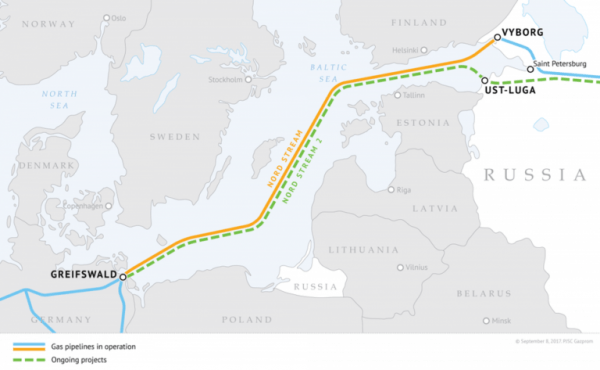
The Nord Stream 2, which will connect Russia’s Leningrad Region to Germany’s Baltic coast, bypassing the traditional route via Ukraine, aims to double the capacity of the already-built Nord Stream 1 to 110 billion cubic meters (bcm) per year that is more than a quarter of the European Union’s gas consumption.
On October 31, Gazprom, Russia’s energy Leviathan, had said 83 percent of the pipeline construction — more than 2100 km of the pipeline — was complete. The permit to construct in the Danish Exclusive Economic Zone south-east of Bornholm covers a 147-km-long route section.
Pipelay has been completed in Russian, Finnish and Swedish waters, and for the most part in German waters. The construction of both landfall facilities in Russia and Germany is nearing completion. Thus, the development last week signifies that Russia is certain to finish the project by the end of this year.
Despite the rising tensions in Russia’s relations with the United States, a massive energy project is all set to slither along the seabed between Russia and the European Union. The US wants to stifle the serpent in its infancy but Germany and Russia navigated it to the home stretch.
The project is expected to ensure safe and stable supplies of gas to Europe. The competitive Russian gas supplies will enable European customers to save anywhere around 8 billion euros on their gas bill in 2020.
More importantly, according to a study conducted by the University of Cologne EWI, “When Nord Stream 2 is available, Russia can supply more gas to the EU decreasing the need to import more expensive LNG. Hence, the import price for the remaining LNG volumes decreases, thereby reducing the overall EU-28 price level.”
Herein lies the rub. Europe has become a natural gas battleground for the US and Russia. Of course, apart from being a prized market, Europe is also a political battleground between the US and Russia.
Russia traditionally dominated the European market while the European Union appears to be keen to wean itself off Russian gas, given the geopolitical implications of over-reliance on Moscow for its energy security. On the other hand, the US is looking to step up its exports of liquefied natural gas (LNG) to Europe and faces a big resourceful competitor who cannot be dislodged from the market — Russia.
Russia loomed large as the largest supplier of natural gas to the EU in 2018. According to the European Commission’s latest data on EU imports of energy products in October, eleven member states imported in 2018 more than 75 percent of their total national imports of natural gas from Russia.
Russia has multiple pipelines in operation, which gives it a big advantage in cutting down transportation costs for the European consumers, as compared to more expensive LNG imports from the US. Clearly, both geoeconomics and geopolitics are at play here.
The US’ transatlantic leadership is largely conditional on the climate of relations between Europe and Russia in general and between Germany and Russia in particular. Washington is acutely conscious that Nord Stream 2 can provide the underpinning for a stable, predictable relationship between Europe and Russia, which would go against the grain of the Trump administration’s projection of Russia as a revisionist power that the US is determined to counter.
In sum, Washington apprehends that if Nord Stream 2 is completed, it will come as a severe blow to transatlantic relations, although on the face of it, the US has been arguing that the project runs counter to the Western sanctions imposed on Russia following its annexation of Crimea.
Actually, this argument is sheer sophistry, since Europe’s dependence on Russian energy supplies is a legacy inherited from the days of the Soviet Union. Moscow is a stakeholder in preserving its reputation as a stable, reliable supplier of energy to Europe at competitive prices. The crux of the matter is that the European consumer prefers the cheaper Russian gas to the expensive LNG exports from the US.
Meanwhile, the Ukraine crisis alerted Russia to the geopolitical reality that it could be vulnerable to US pressure politically, which in turn prompted its energy pivot to China. Gazprom aims to become China’s top gas exporter by 2035. When the Power of Siberia pipeline (under construction in Eastern Siberia to transport gas to Far East countries) becomes active later this year, it will deliver 38 billion cubic metres of natural gas annually to China, which will make China Russia’s second-largest gas customer after Germany.
However, paradoxically, Russia’s gas exports to Europe are only increasing in recent years. In 2018, Gazprom’s gas sales to Europe and its share of Europe’s gas market reached record highs. This trend can only continue as the Nord Stream 2 and Turk Stream pipelines, which will become active shortly this year, will deliver an additional 86.5 billion cubic meters annually to Europe.
Simply put, Europe’s addiction to Russian gas remains a fact of life and with the continent’s own gas production on the decline, Europe needs to import much bigger volumes of gas and lots of it is going to come from Russia.
The amazing part has been the dogged resistance by Germany to the US pressure tactic to abandon Nord Stream 2. The US even threatened to sanction German companies; US Congress passed resolutions calling for an end to construction of the pipeline. Germany’s manufacturing economy is dependent on imports for 98% of its oil and 92% of its gas supply, and cheap gas is the lifeblood of its export-based economy.
But then, there could be more to it politically than meets the eye. Can it be a coincidence that Germany is also resisting US pressure to shut out Chinese tech giant Huawei from its 5G networks? Like with Nord Stream 2, Washington advanced the same argument apropos Huawei — national security concerns. But Germany snubbed the calls from the US.
The Economist magazine wrote some months ago that the “The Atlantic Ocean is starting to look awfully wide. To Europeans the United States appears ever more remote.” To be sure, the coming into fruition of Nord Stream 2 is yet another sign that the transatlantic relationship currently faces significant challenges.
The US-European policy divisions have emerged on a wide range of regional and global issues. Although US and European policies toward Russia remain broadly aligned, Nord Stream 2 turned out to be a key US-European friction point.
Featured Video

US Marines Seized Panama in 1903
or go to
Aletho News Archives – Video-Images
From the Archives
Precedents for Pizzagate

Marc Dutroux, Belgian pedophile, sadist, and serial killer with friends in high places
By Aedon Cassiel | Counter – Currents | December 23, 2016
To reiterate a point that should be clear to the more astute reader, my goal in this series (part 1, part 2) has not been to defend “Pizzagate” as such. My goal has been to defend the people who want to investigate it against specific accusations levied against them by people who think Pizzagate has revealed no intriguing information at all—for a specific reason, which I will be honing in and focusing on much more directly in this closing entry.
Whereas the mainstream critics of Pizzagate would have you believe that the dividing line is between paranoid conspiracy theorist followers of “fake news” and level-headed people who follow trustworthy news sources and rely on cold, hard reason to determine the truth, my goal has been to show that—whatever is or is not happening with Pizzagate itself—this framing of the issue is arrogant, insulting, and the product of extremely narrow tunnel vision. … continue
Blog Roll
 Aletho News
- West’s Claims of Non-Involvement in Ukraine Conflict ‘Epitome of Hypocrisy’ – Expert
- Putin aide urges retaliation to ‘Western piracy’
- The Depth Charge in the Womb
- ‘Fox guarding the henhouse’: AMA, Vaccine Integrity Project to conduct their own vaccine safety and efficacy reviews
- Macron, Merz, and von der Leyen Defend Expanded Speech Controls
- Keir Starmer-tied think tank paid PR firm to target The Grayzone
- ‘Israel’ threatens to genocide Gaza if Hamas refuses disarmament
- Apple Just Bought A Sinister ‘Pre-Speech’ Tech Company Implicated In Genocide
- Israel’s new West Bank registration process declares Palestinian land ‘state property’
- Two children killed in Palestinian Authority ambush in West Bank; Hamas slams attack as ‘black mark’
- If Americans Knew
- An error has occurred; the feed is probably down. Try again later.
- No Tricks Zone
- New Study: A 4°C Warmer Beaufort Sea Had ‘No Sea Ice’ 11,700 – 8200 Years Ago
- Unfudging The Data: Dutch Meteorological Institute Reinstates Early 20th Centruy Heat Waves It Had Erased Earlier
- German Gas Crisis…Chancellor Merz Allegedly Bans Gas Debate Ahead of Elections!
- Pollen Reconstructions Show The Last Glacial’s Warming Events Were Global, 10x Greater Than Modern
- Germany’s Natural Gas Storage Level Dwindles To Just 28%… Increasingly Critical
- New Study Rebuts The Assumption That Anthropogenic CO2 Molecules Have ‘Special’ Properties
- Climate Scientist Who Predicted End Of “Heavy Frost And Snow” Now Refuses Media Inquiries
- Polar Bear Numbers Rising And Health Improving In Areas With The Most Rapid Sea Ice Decline
- One Reason Only For Germany’s Heating Gas Crisis: Its Hardcore-Dumbass Energy Policy
- 130 Years Later: The CO2 Greenhouse Effect Is Still Only An Imaginary-World Thought Experiment
 Aletho News