Predator Nation: How Financial Criminalization Crashed the Economy, and the Culprits Got Off Scot-Free
By Barry Ritholtz – June 4th, 2012
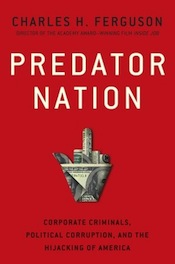 Charles H. Ferguson, the director of the Oscar-winning documentary Inside Job, now explains how a predator elite took over the country.
He exposes the networks of academic, financial, and political influence, in all recent administrations, that prepared the predators’ path to conquest.
Over the last several decades, the United States has undergone one of the most radical social and economic transformations in its history.
·Finance has become America’s dominant industry, while manufacturing, even for high technology industries, has nearly disappeared.
· The financial sector has become increasingly criminalized, with the widespread fraud that caused the housing bubble going completely unpunished.
· Federal tax collections as a share of GDP are at their lowest level in sixty years, with the wealthy and highly profitable corporations enjoying the greatest tax reductions.
· Most shockingly, the United States, so long the beacon of opportunity for the ambitious poor, has become one of the world’s most unequal and unfair societies.
Ferguson shows how from the Reagan administration forward, both major political parties have become captives of the moneyed elite.
It was the Clinton administration that dismantled the regulatory controls that protected the average citizen from avaricious financiers. It was the Bush team that destroyed the federal revenue base with its grotesquely skewed tax cuts for the rich. And it is the Obama White House that has allowed financial criminals to continue to operate unchecked, even after supposed “reforms” installed after the collapse of 2008.
Predator Nation: Corporate Criminals, Political Corruption, and the Hijacking of America
Excerpt:
It is no exaggeration to say that since the 1980s, much of the American (and global) financial sector has become criminalized, creating an industry culture that tolerates or even encourages systematic fraud. The behavior that caused the mortgage bubble and financial crisis was a natural outcome and continuation of this pattern, rather than some kind of economic accident.
It is important to understand that this behavior really is seriously criminal. We are not talking about neglecting some bureaucratic formality. We are talking about deliberate concealment of financial transactions that aided terrorism, nuclear weapons proliferation, and large-scale tax evasion; assisting in concealment of criminal assets and activities by others; and directly committing frauds that substantially worsened the worst financial bubbles and crises since the Depression.
None of this conduct was punished in any significant way. On November 7, 2011, the New York Times published an article (Wall Street’s Repeat Violations, Despite Repeated Promises) based on its own review of major banks’ settlements of SEC lawsuits since 1996. The Times’ analysis found fifty-one cases in which major banks had settled cases involving securities fraud, after having previously been caught violating the same law, and then promising the SEC not to do so again. The Times’ list, furthermore, covered only SEC securities fraud cases; it did not include any criminal cases, private lawsuits by victims, cases filed by state attorneys general, or any cases of bribery, money laundering, tax evasion, or illegal asset concealment — all areas in which the banks have numerous and major violations. In Predator Nation, I provide detailed, well-documented accounts of behavior ranging from assisting Enron’s frauds (Citigroup, Merrill Lynch), to fraudulently exploiting the Internet bubble (most of the major investment banks), to using for-profit colleges to exploit government student loan programs (Goldman Sachs), to assisting in money laundering and tax evasion on a large scale (at least eleven banks including UBS, Barclay’s, and Lloyds), to using bribery and artificially complex derivatives to destroy the finances of a county government (JP Morgan Chase), to profiting from Bernard Madoff even while strongly suspecting him to be a fraud (JP Morgan Chase, UBS).
Total fines for all these cases combined appear to be far less than 1 percent of financial sector profits and bonuses during the same period. There have been very few prosecutions and no criminal convictions of large U.S. financial institutions or their senior executives. Where individuals not linked to major banks have committed similar offenses, they have been treated far more harshly.
Given this background, it is difficult to avoid the conclusion that the mortgage bubble and financial crisis were facilitated not only by deregulation but also by the prior twenty years’ tolerance of large scale financial crime. First, the absence of prosecution gradually led to a deeply embedded cultural acceptance of unethical and criminal behavior in finance. And second, it generated a sense of personal impunity; bankers contemplating criminal actions were no longer deterred by threat of prosecution.
And just as the last twenty years of unpunished financial crime constituted a green light for the bubble, so, too, America’s non-response to the bubble and crisis is setting the tone for financial conduct in the future.
The Obama administration has rationalized its failure to prosecute any senior financial executives (literally, not a single one) for bubble-related crimes by saying that while much of Wall Street’s behavior was unwise or unethical, it wasn’t illegal. Here is President Obama at a White House press conference on October 6, 2011:
Well, first on the issue of prosecutions on Wall Street, one of the biggest problems about the collapse of Lehmans [sic] and the subsequent financial crisis and the whole subprime lending fiasco is that a lot of that stuff wasn’t necessarily illegal, it was just immoral or inappropriate or reckless….I think part of people’s frustrations, part of my frustration, was a lot of practices that should not have been allowed weren’t necessarily against the law.
The president and senior administration officials (such as Lanny Breuer, head of the Justice Department’s Criminal Division) have portrayed themselves as frustrated and hamstrung — desirous of punishing those responsible for the crisis, but unable to do so because their conduct wasn’t illegal, and/or the federal government lacks sufficient power to sanction them. With apologies for my vulgarity, this is complete horseshit.
When the federal government is really serious about something — preventing another 9/11, or pursuing major organized crime figures — it has many tools at its disposal and often uses them. There are wiretaps and electronic eavesdropping. There are special prosecutors, task forces, and grand juries. When Patty Hearst was kidnapped by the radical Symbionese Liberation Army in 1974, the FBI assigned hundreds of agents to the case.
In organized crime investigations, the FBI and federal prosecutors often start at the bottom in order to get to the top. They use the well established technique of nailing lower-level people and then offering them a deal if they inform on and/or testify about their superiors — whereupon the FBI nails their superiors, and does the same thing to them, until climbing to the top of the tree. There is also the technique of nailing people for what can be proven against them, even if it’s not the main offense. Al Capone was never convicted of bootlegging, large scale corruption, or murder; he was convicted of tax evasion.
In this spirit, here are a few observations about the ethics, legalities, and practicalities of prosecution related to the bubble:
First, much of the bubble was directly, massively criminal.
Second, if you really wanted to get these people, you could. Maybe not all of them, but certainly many. Some bubble-related violations are very clear, with strong written evidence, as my book Predator Nation demonstrates. And if you flipped enough people, some of them would undoubtedly have interesting things to say about what their senior management knew. In fact, there are many techniques, venues, organizations, regulations, and statutes, both civil and criminal, available to investigate these people, punish them, and recover the money they took — if you really wanted to. The federal government has used almost none of them.
Third, the moral argument for punishment is very strong, providing ample justification for erring on the side of aggressive legal pursuit. Whatever portion of banking conduct during the bubble was criminal, it was certainly substantial, and there is no doubt whatsoever that it was utterly, pervasively unethical, designed to defraud in reality if not in law. Since the crisis, the people who caused it have been anything but honest or contrite. They have been evasive, dishonest, and self-justifying, returning as quickly as possible to their unerringly selfish behavior. Their behavior caused enormous damage, both human and economic; the consequences of their wrongdoing are so large as to justify almost any action that could help to prevent another such crisis by creating real deterrence. There would also be intangible but large benefits to raising the general ethical standard of a vital industry, and one whose executives often become high-level government officials.
Given this background, let’s now consider the question of criminal liability, as well as the feasibility of prosecution.
J’Accuse
The list of prosecutable crimes committed during the bubble, the crisis, and aftermath period by financial services firms and senior executives includes: securities fraud (many forms); accounting fraud (many forms); honest services violations (mail fraud statute); bribery; perjury and making false statements to federal investigators; Sarbanes-Oxley violations (certifying accounting statements and financial controls); RICO offenses and criminal antitrust violations; Federal aid disclosure regulations (related to Federal Reserve loans); Personal conduct offenses (many forms: drugs, tax evasion, etc.).
In Predator Nation I consider each of these categories in detail, naming many names and providing many specific examples. But in considering only one category, securities fraud, we already face an embarrassment of riches.
Almost all the prospectuses and sales material on mortgage-backed securities sold from 2005 through 2007 were a compound of falsehoods. But it starts even earlier in the food chain. We also know that mortgage originators committed securities fraud when they misrepresented the characteristics of loan pools, and the nature and extent of their due diligence with regard to them, when they sold pools to securitizers (and accepted financing from them). Most or all of the securitizers (meaning nearly all the investment banks and major banking conglomerates) then committed securities fraud when they misrepresented the characteristics of the loans backing their CDOs, the characteristics of the resulting mortgage-backed securities, and the nature and results of their due diligence in the process of creating those securities. The securitizers also committed securities fraud when they made similar misrepresentations to the insurers of, and sellers of credit default swap (CDS) protection on, those securities.
The executives of both originators and securitizers then committed a separate form of securities fraud in their statements to investors and the public about their companies’ financial condition. They knew that they were engaging in a Ponzi-like fraud that would eventually need to end, and as the bubble peaked and started to collapse, they repeatedly lied about their companies’ financial condition. In some cases they also concealed other material information, such as the extent to which they, themselves, and/or other executives of their firms, were selling or hedging their own stock holdings because they knew that their firms were about to collapse.
Next, several investment banks committed securities fraud when they failed to disclose that they were selling securities that were designed to fail so that the investment banks, and/or their hedge fund clients, could profit by betting on their failure. The Hudson and Timberwolf synthetic CDOs sold by Goldman Sachs, and which were the focus of the Levin Senate subcommittee hearings, provide a very strong basis for prosecution. Goldman’s trading arm had been dragooned into finding and dumping their most dangerous assets to naive institutional investors. Important representations in the Hudson sales material–that assets were not sourced from Goldman’s own inventory — were lies, and they were material lies, since investors had learned to be wary of banks clearing out their own bad inventory. E-mail trails show that top executives closely tracked the garbage disposals and were gleeful at the unloading of the Timberwolf assets — as they should have been, for the assets were nearly worthless within months. There have been no prosecutions.
In some cases, we already have clear evidence of senior executive knowledge of and involvement in these frauds. For example, quarterly presentations to investors are nearly always made by the CEO or CFO of the firm; if lies were told in those presentations, or if material facts were omitted, the responsibility lies with senior management. In some other cases, such as Bear Stearns, we already have evidence from civil lawsuits that very senior executives were directly involved in constructing and selling securities whose prospectuses contained lies and omissions.
The list is long. In chapters three through six of Predator Nation, I survey the financial sector’s behavior during the bubble, and provide dozens of examples of major criminal behavior. Again, there have been no prosecutions.
Related articles
- Bankers Need To Face Consequences, Not Settlements (econmatters.com)
- Predator Nation by Charles Ferguson (ilene.typepad.com)
A Toxic System
An Inside Glimpse Into the Nefarious Operations of Goldman Sachs
By DARWIN BOND-GRAHAM | CounterPunch | March 15, 2012
Goldman Sachs employee Greg Smith’s very public resignation, replete with a pointed letter published in the New York Times yesterday, has landed upon the investment bank like a bomb. Slamming a “toxic and destructive environment” within Goldman Sachs, Smith says the firm’s internal culture has devolved to the point where the entire staff not only tolerates, but expects workers at all levels, from senior partners to associates, to pursue nothing but ever-more sophisticated means of “ripping their clients off.”
Apologists for the financial sector —including the editors of the major business newspapers and television networks— predictably have shot back with a flurry columns and reports, mostly designed to discredit the former vice president by making fun of Smith and his concerns. If you strip away the ad hominem layers to these responses though, the core problems raised by Smith remain, and the reaction of the business press seems all the more absurd, for Goldman’s pesky turncoat isn’t saying anything that’s news to the public: Goldman Sachs is characterized by a toxic culture of greed? Stop the presses!
There is much more to be said about Goldman Sachs’ derivatives operation, however, and Smith’s provocative resignation provides an opportunity because he was working in the belly of it.
At the center of Smith’s critique are derivatives, the arcane financial instruments that transformed the world’s splintered national economies and regional banking systems into a single, if complicated, global system. Evangelists of derivatives claim they have made new heights of economic growth, trade, and prosperity possible. Critics have pointed out since the beginning of the derivatives boom in the 1980s how perfectly suited they are to fraud and systemic catastrophe via the greed of the few and the powerful.
Derivatives, many close observers have reminded us, were at the center the Enron meltdown, the demise of Long Term Capital Management, the Asian Financial Crisis, and most recently the Great Recession and its various flares, from the housing bubble that exploded from junked collateralized debt obligations, to the current Greek debt imbroglio and the credit default swaps haunting the background. In each case, and many less-known fiascos, derivatives traders in Wall Street’s leading banks played key roles either as the major villains, or enabling partners in vast crimes of information, leverage, and risk. Time and again we find derivatives at the center of scandalous greed. Now we have a high-profile banker denouncing not just some bad apples in his firm, but the firm’s entire culture.
There’s a deeper and more disturbing truth still further below the surface though. To get there it’s instructive to know a little more about Goldman’s derivatives operation, and the wider industry of which Goldman is a small part.
Who are the clients on the receiving end of Goldman’s “toxic and destructive” tendencies? Many times the victims have been other corporations, industrial firms with less sophisticated and perhaps naive financial officers. Quite often though the victims of Goldman’s derivatives operation have been cities, counties, and local government agencies. A key client category for derivatives has been large local governments and agencies that issue hefty sums of long-term debt.
Goldman, and the handful of other global banks that dominate the derivatives industry, sold local governments on the idea that a particular set of derivative products could provide wondrous solutions to hedge against the risks inherent in issuing long term debt. The banks claimed that interest rate swaps could shield counties, cities, and agencies from possible spikes in floating interest rates attached to their bonds. Thus many governments agreed to complex, multi-decade deals involving the swapping of payments on fictive amounts of money associated with real debt. In no time at all interest rate swaps became the single largest category of derivatives, dwarfing all others.
Today interest rate swaps make up 82% of the total market in derivatives, measured by total notional amounts. This is partly the result of governments all over the world entering into interest rate swaps, agreeing to tie cash flows to trillions of notional dollars. What’s key is that none of this has required duplicity or reckless greed on the part of bankers at Goldman Sachs or other firms. Let’s be clear; this is a structural transformation of capitalism on a global scale, and it has sucked up all corporate and government entities into the new logic of hedging and efficiency. That a few powerful financial corporations have placed themselves in strategic positions to benefit from this structural shift should come as no surprise.
In California’s Bay Area, multiple governments have come to find themselves on the paying end of Goldman’s derivatives department where apparently traders referred to clients as “muppets.” The most obvious example is the city of Oakland where a chronic budget crisis has led to the shuttering of schools and cuts to elder services, housing, and public safety. Oakland signed an interest rate swap with Goldman in 1997. The terms of the deal, revised once in 2003, were typical of interest rate swaps except that Oakland’s financial officers, based on this author’s research and impressions, seem to have agreed to a somewhat higher fixed rate obligation than most other cities that signed swap deals for similar amounts of debt with comparable ratings. Oakland partly did this, I am guessing, to receive upfront payments of roughly $5 and $10 million from Goldman Sachs, cash that the city wished to have on hand immediately. The bank seemed eager to do this because the original terms, and renegotiated terms in 2003, were much to its favor. It would earn the $15 million back, and then some over the twenty-four year life of the swap.
Across the Bay, Goldman Sachs signed an interest rate swap agreement with the San Francisco International Airport in 2007 to hedge $143 million in debt. Today this agreement has a negative value to the Airpot of about $22 million, even though its terms were much better than those Oakland agreed to. The Airport, like Oakland, must now pay millions each year to Goldman Sachs until the agreement expires, or until the floating LIBOR interest rate rises enough to offset the net balance of payments. Goldman sold derivatives up and down California and across the United States to cities, counties, and agencies, promising them a means of reducing debt payments over the long haul.
Business press pundits who are now slamming Smith say it’s absurd to expect that Goldman Sachs was doing anything less than trying to make money off these deals, and that counter-parties to the firm’s dealings knew well what they were signing up for. This mischaracterizes the entire problem, however, and threatens to steer the conversation into a narrow, and politically irrelevant one about whether Goldman Sachs is or isn’t a den of fraud.
When governments signed up for interest rate swap deals with Goldman Sachs they certainly did know that the bank would be making money off the agreement, first in the form of up-front fees, and then off of savings produced by the pairing of comparative advantages in debt markets that interest rate swaps are designed to achieve. If you don’t understand that last point, don’t worry. What it means simply is that Goldman Sachs sold interest rate swap products to governments by promising to both protect a government against interest rate volatility, and to also likely reduce the overall long-term cost of borrowing money. It was supposed to be a win-win game.
The truly impressive thing about the whole derivatives market is that it is supposed to ratchet up the efficiency of the entire global economy, making dollars go much further, protecting all parties from volatility, transcending previous market barriers and smoothing flows of cash… at least in theory. The theory seemed to be working in the 1990s and through most of the 2000s. Goldman didn’t have to convince anyone of this for the results were plain to see.
That it hasn’t panned out in practice, that the whole derivatives-based economy nearly collapsed in 2008 and continues to falter, isn’t so much the result of Goldman’s toxic culture of greed as it is the outcome of a much more troubling feature of our economic system. While I agree with Smith’s observation —which is important because it’s based on insider knowledge— that Goldman Sachs is an especially predatory corporation, I see a larger pattern of power relations embodied in the new economy, structured as it is by derivatives, that isn’t based on any specific firm’s internal culture or corruption, or the supposed naivety and stupidity of financial officers in government and less profitable sectors of the economy.
Consider the fact that Goldman Sachs isn’t even the biggest fish in the pond, nor is it profiting the most from the blizzard of derivative products that structure the capitalist economy today. Of the five financial corporations that “dominate in derivatives,” as the U.S. Office of the Comptroller of the Currency puts it, Goldman Sachs ranks fourth, behind by Bank of America, Citibank, and far behind the absolute king of derivatives, JP Morgan Chase.
In February JP Morgan Chase let slip that it cleared $1.4 billion in revenue on trading interest rate swaps in 2011, making these instruments one of the bank’s biggest sources of profit. According to some reports, JP Morgan Chase made billions more in 2008 and 2009 when the financial crisis and federal response combined to make floating-to-fixed interest rate swaps into extremely profitable assets for the banks on the floating side of the deal. Similar things can be said for Mogan Stanley, HSBC, Wells Fargo, Bank of America, Bank of New York, and the dozens of smaller interest rate swap peddlers currently profiting from direct transfers of public dollars.
Are all these banks poisoned by toxic cultures of greed? Surely there are similarities in the internal cultures of large banks, and greed and a little sociopathic ability to profit from another’s loss is a professional asset in these sorts of organizations. In contemporary corporate culture the euphemism for this is “competition.”
Toxic culture and greed, or “competitiveness” if you prefer, in the investment banks isn’t a sufficient answer to why derivatives have become the foundation of today’s global economy, however. The criminal activities of some bankers, driven by these more pervasive cultures, can’t explain the economic crisis and the vast injustices that are being perpetrated still in the name of “economic recovery.” The interest rate swap crisis stinging local governments and enriching the banks is a case in point.
The windfall of revenue accruing to JP Morgan, Goldman Sachs, and their peers from interest rate swap derivatives is due to nothing other than political decisions that have been made at the federal level to allow these deals to run their course, even while benchmark interest rates, influenced by the Federal Reserve’s rate setting, and determined by many of these same banks (the London Interbank Offered Rate, LIBOR) linger close to zero. These political decisions have determined that virtually all interest rate swaps between local and state governments and the largest banks have turned into perverse contracts whereby cities, counties, school districts, water agencies, airports, transit authorities, and hospitals pay millions yearly to the few elite banks that run the global financial system, for nothing meaningful in return. These perfectly legal cash flows measuring globally in the hundreds of billions, from the public to the banks, dwarf anything that is the result of fraud.
Back when the economy was in a “normal” stasis of growth, the early and mid-2000s, interest rate swaps and other derivatives promised security against risk, and a new vista for capitalism and public finance. Tellingly, when the crisis struck, swaps were allowed to become a one way flow of funds from the public to the banks. This shadow bailout for the banks has done considerable damage to already cash-strapped local governments suffering from declines in tax revenues and federal aid.
Whether Goldman Sachs is or isn’t an organization gripped by a toxic culture isn’t all that important when one considers the destructive impact that derivatives have had, and continue to have upon society. Capitalism as it functions today is completely dependent upon derivatives. Interest rate swaps are the single largest type of derivative, measured by notional amount, because they achieve an integration of different national, regional, and sectoral financial markets into one global financial system. It’s in the genetics of the project of financial globalization, fueled by derivatives, that the real problem lies, not in the internal culture of Goldman Sachs, or the illegal behaviors of some bankers across many firms. The real crime lies in perfectly legal and legitimated activities whereby a few powerful corporations design a system that puts the welfare of the world’s vast majority at grave risk. It’s the system that’s toxic. Goldman Sachs merely operates well within the toxicity.
Nevertheless, Greg Smith’s effort to pull back the curtain on one of the most nefarious and powerful corporations in history is most welcomed, especially for the deeper conversations it can stoke about the origins of the current crisis.
Darwin Bond-Graham is a sociologist and author who lives and works in Oakland, CA. He is a contributor to Hopeless: Barack Obama and the Politics of Illusion, forthcoming from AK Press.
Related articles
Featured Video
America Racing to Strategic Defeat in Iran
or go to
Aletho News Archives – Video-Images
From the Archives
Should Europeans ‘Thank’ the Americans for Destroying Nord Stream?
By Robert Bridge | Strategic Culture Foundation | September 29, 2022
With an investigation continuing into the destruction of the Nord Stream gas pipeline that provided energy supplies to Europe from Russia, there appears to be just one prime suspect, and that should surprise nobody.
Following the sabotage of the Nord Stream 1 and 2 gas pipelines, former Polish Foreign Minister Radoslaw Sikorski already seemed to know the identity of the perpetrator when he tweeted out: “Thank you, USA.”
At first glance, it seemed that Sikorski was speaking sarcastically, berating Washington for carrying out an attack that will have severe repercussions for the people of Europe. After all, how could anyone see any good coming from the termination of Europe’s primary source of gas reserves with winter just around the corner? It was Sikorski’s homeland of Poland, after all, that urged its citizens to collect firewood in the face of dwindling gas reserves.
In fact, the Polish diplomat was speaking one-hundred percent literally… continue
Blog Roll
 Aletho News
- Growing insecurity, soaring prices fuel protests in north as regime bans evacuation: Sources
- Iran denies responsibility for ‘depraved’ attack on Kuwait desalination plant
- Bring The Troops Back. End This War Now!
- Can we please stop calling Israel the ‘only democracy in the Middle East’ now?
- US should start removing its troops from Germany, proposes AfD co-leader Chrupalla
- Iran Red Crescent: 600 educational centers attacked in US-Israeli ‘war crimes’
- Russian Oil Tanker Arrives in Cuba Amid U.S. Blockade
- America Racing to Strategic Defeat in Iran: Lt Col Daniel Davis
- FTC Warns Visa, Mastercard, PayPal, Stripe Over Political Debanking
- Russian tanker approaches Cuba despite US oil blockade
- If Americans Knew
- Israeli police block Catholic cardinal from entering Church of the Holy Sepulchre on Palm Sunday
- Israel is assassinating journalists again, more than any other nation, anywhere, ever – Not a ceasefire Day 170
- Over 300 US service members wounded, majority have brain injuries – Not a ceasefire Day 169
- Researchers at Human Rights Watch Resign Over Blocked Report on Palestinian Refugee Return
- Jewish Groups Are Backing a War Americans Don’t Want
- Eric Fingerhut Thinks He’s the President of the Jews
- Top Jewish Philanthropists, Rabbis Urge Israeli President to Take Action Against ‘Jewish Extremists’
- Don’t Be Fooled. Zionist Leaders Have Always Wanted to Control Southern Lebanon
- Israel’s widespread use of torture is a core element of its genocide against the Palestinian people
- In Israel’s War on Iran, Many Middle East US Bases Rendered “All But Uninhabitable”
- No Tricks Zone
- New Study Finds Warming Saves Lives…Cold Temperatures 12 Times More Deadly Than Excess Heat
- German Science Blog Accuses PIK Climate Institute Of Hallucinating Climate Tipping Points
- Devastating Assessment Of Comirnaty Vaccine By Former Senior Pfizer Europe Toxicologist
- New Study: CO2 Is ‘Effectively Negligible’ As An Explanatory Climate Change Factor Since 2000
- Former Pfizer Toxicologist Dr. Helmut Sterz Tells Bundestag Hearing Pfizer Vaccine Should Have Never Been Approved
- Energy Expert: Germany’s Nuclear Phaseout Was A “500 Billion Euro Mistake”
- New Research: South Australia’s Mid-Holocene Sea Surface Temperatures Were 4°C Warmer Than Today
- Storing Green Energy To Last Germany 10 Days Would Require A 60-Million Tonne Battery
- New Studies: UK Sea Levels Were 4 Meters Higher Than Today During The Mid-Holocene
- Destructive Green New Deal: German Energy And Metal Group Warns Of Drastic Crisis
 Aletho News