Boundless Informant: NSA’s complex tool for classifying global intelligence
RT | June 9, 2013
A new batch of classified NSA docs leaked to the media reveals the details of a comprehensive piece of software used by NSA to analyze and evaluate intelligence gathered across the globe as well as data extraction methods.
The top-secret documents released by the Guardian shed light on the National Security Agency’s data-mining tool being used for counting and categorizing metadata gathered and stored in numerous databases around the world.
Known as Boundless Informant, the software provides its operator a graphical insight on how many records were collected for a specific “organizational unit” or country, what type of data was collected and what type of collection was used. The program also allows determining trends in data collection for both strategic and tactical decision making, according to the slides.
One of the slides contains a part of the Informant’s user interface showing a world map with countries color-coded ranging from green to red depending on the amount of records collected there. While Iran, Pakistan and some other states are predictably “hottest” according to the map, the agency collected almost 3 billion intelligence pieces in the US in March 2013 alone.
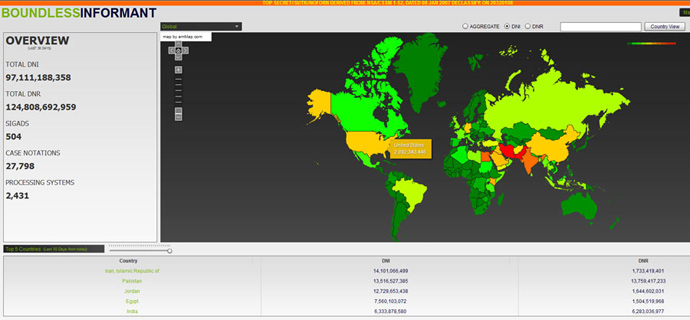
The map showing how much data is being collected in different countries across the globe (image from the Guardian)
The insight on the software being used by the NSA comes amid the agency spokesperson Judith Emmel’s claims that the NSA cannot at the moment determine how many Americans may be accidentally included in its surveillance.
“Current technology simply does not permit us to positively identify all of the persons or locations associated with a given communication,” Emmel said Saturday adding that “it is harder to know the ultimate source or destination, or more particularly the identity of the person represented by the TO:, FROM: or CC: field of an e-mail address or the abstraction of an IP address.”
NSA data sources
Another slide from the internal NSA presentation redacted by the Guardian editors details the data gathering methods used in the NSA global surveillance program.
The first method suggests interception of data from “fiber cables and infrastructure as data flows past” under the FISA Amendments Act (FAA) of 2008, Section 702.
The second distinguished method is data collection “directly from the servers of the US service providers.”

The slide detailing methods of data extraction under the FISA Amendment Act (image from the Guardian)
The presentation encourages analysts to use both methods for better results.
Google, Facebook negotiated ‘secure portals’ to share data with NSA?
Meanwhile, a report by the New York Times revealed that Internet giants, including Google and Facebook, have been in negotiations with the US security agency over ‘digital rooms’ for sharing the requested data. The companies still insist there is no “back door” for a direct access to user data on their servers.
The Internet companies seem more compliant with the spy agencies than they want to appear to their users, and are cooperating on “behind-the-scenes transactions” of the private information, according to a report that cites anonymous sources “briefed on the negotiations.”
According to the report, Google, Microsoft, Yahoo, Facebook, AOL, Apple and Paltalk have “opened discussions with national security officials about developing technical methods to more efficiently and securely share the personal data of foreign users in response to lawful government requests,” sometimes “changing” their computer systems for this purpose.
These methods included a creation of “separate, secure portals” online, through which the government would conveniently request and acquire data from the companies.
Twitter was the only major Internet company mentioned in the report that allegedly declined to facilitate the data transfer to the NSA in a described way. As opposed to a legitimate FISA request, such a move was considered as not “a legal requirement” by Twitter.
The sources claim the negotiations have been actively going in the recent months, referring to a Silicon Valley visit of the chairman of the Joint Chiefs of Staff Martin E. Dempsey. Dempsey is said to have met the executives of Facebook, Microsoft, Google and Intel to secretly discuss their collaboration on the government’s “intelligence-gathering efforts.”
NSA pressured to declassify more PRISM details
In response to the fury over US government’s counterterrorism techniques, Director of National Intelligence James Clapper for the second time in three days revealed some details of the PRISM data-scouring program.
Being one of the “most important tools for the protection of the nation’s security” the PRISM is an internal government computer system for collecting “foreign intelligence information from electronic communication service providers under court supervision,” Clapper said.
He also said that PRISM seeks foreign intelligence information concerning foreign targets located outside the US and cannot intentionally target any US citizen or any person known to be in the US. As for “incidentally intercepted” information about a US resident, the dissemination of such data is prohibited unless it is “evidence of a crime”, “indicates” a serious threat, or is needed to “understand foreign intelligence or assess its importance.”
Clapper also stressed that the agency operates with a court authority and that it does not unilaterally obtain information from the servers of US telecoms and Internet giants without their knowledge and a FISA Court judge approval.
Related articles
- The NSA Black Hole: 5 Basic Things We Still Don’t Know About the Agency’s Snooping
- NSA Document Leak Proves Conspiracy To Create Big Brother Style World Control System
- DOJ launches criminal probe of NSA leaker
- US security officials said NSA leaker, journalist should be ‘disappeared’ – report
- Government Spying: Should We Be Shocked?
- The NSA’s Favorite Weasel Word To Pretend It’s Claiming It Doesn’t Spy On Americans
- The “Congress knew” defense
- NSA memo pushed to ‘rethink’ 4th Amendment
Oh, And One More Thing: NSA Directly Accessing Information From Google, Facebook, Skype, Apple And More
By Mike Masnick | TechDirt | June 6th 2013
Obviously, the Verizon/NSA situation was merely a small view into just how much spying the NSA is doing on everyone. And it seems to be spurring further leaks and disclosures. The latest, from the Washington Post, is that the NSA has direct data mining capabilities into the data held by nine of the biggest internet/tech companies:
The technology companies, which participate knowingly in PRISM operations, include most of the dominant global players of Silicon Valley. They are listed on a roster that bears their logos in order of entry into the program: “Microsoft, Yahoo, Google, Facebook, PalTalk, AOL, Skype, YouTube, Apple.” PalTalk, although much smaller, has hosted significant traffic during the Arab Spring and in the ongoing Syrian civil war.
Dropbox , the cloud storage and synchronization service, is described as “coming soon.”
This program, like the constant surveillance of phone records, began in 2007, though other programs predated it. They claim that they’re not collecting all data, but it’s not clear that makes a real difference:
The PRISM program is not a dragnet, exactly. From inside a company’s data stream the NSA is capable of pulling out anything it likes, but under current rules the agency does not try to collect it all.
Analysts who use the system from a Web portal at Fort Meade key in “selectors,” or search terms, that are designed to produce at least 51 percent confidence in a target’s “foreignness.” That is not a very stringent test. Training materials obtained by the Post instruct new analysts to submit accidentally collected U.S. content for a quarterly report, “but it’s nothing to worry about.”
Even when the system works just as advertised, with no American singled out for targeting, the NSA routinely collects a great deal of American content.
I expect we’ll be seeing more such revelations before long.
Related article
How Europe’s Fight with Google Over Privacy Ignores Real Privacy
By Alfredo Lopez | This Can’t Be Happening | April 10, 2013
Last week the governments of France, Germany, Italy, the Netherlands, Spain, and the United Kingdom fired a warning shot at Google and it appears they’re reloading the gun with real ammunition.
This past December, about a year after the Internet behemoth announced a new privacy policy, a working group of representatives from these countries called the policy grossly abusive of people’s privacy and said Google had four months to bring itself into compliance with European law. Google dismissed the ultimatum: “Our privacy policy,” it said, “respects European law and allows us to create simpler, more effective services.” The European countries response was that they will take actions, based on their national laws and in coodination with each other, by the Fall.
These government/corporation tiffs are frequent and their rhetorical fire normally turns into quickly dissipated smoke. This one could be different. It comes at a time when the world’s powerful are trying to decide how much privacy we people will have and what the term privacy actually means, and this squabble’s outcome will affect that and, of course, our freedom. That alone makes it worth watching.
But there’s something deeper here that transcends this conflict. Privacy is, in fact, a core component of democracy and any infringement on complete privacy is an obscene attack on the possibility of having a free and democratic society. As important as the outcome of this show-down might be, the most important and frightening development is that it’s taking place at all.
The political shoot-out began a year ago when Google announced that it was unifying about 60 privacy policy agreements, covering its myriad services, into one big one. The company explained that lumping together these “agreements” (the things you’re asked to read before pressing the “I Accept” button on a website) was a matter of efficiency and transparency. There’s a logic to that: how many privacy policies have you read on the Internet? One would assume that if you don’t read one, you can hardly be expected to read 60.
That, however, is a corporate shell game. Google made this move not to make our reading easier but to make gathering information about us more efficient. Google is a marketing company and nothing makes a marketing company more powerful and valuable to advertisers than having pertinent information on hundreds of millions of people all over the world. Its privacy policy is fitted to that purpose. It says that, once you sign up and begin using these services as an identified user, you give up that right of refusal. So, because people don’t read that privacy policy, they don’t realize that it effectively eliminates their privacy.
For a very long time, Google has known who uses each of its services and how, but now it knows which combination of services you use and how they interact with each other in your daily life. It also knows cities or towns of residence (and, in many cases, addresses) of its registered users, the IP addresses of their computers, their names (and often the names of their family members and friends), what they do on the Internet every day, what they buy and consider buying and, for those using Gmail, who they write to and what they write. It can hone in a your specific physical location with Goodgle Maps and will store that info if you map it. In fact, all this info is stored on Google’s databases with members’ tacit approval and Google’s complete understanding of what all this means.
“If you have something that you don’t want anyone to know, maybe you shouldn’t be doing it in the first place,” Google CEO Eric Schmidt said in 2009. “If you really need that kind of privacy, the reality is that search engines — including Google — do retain this information for some time and it’s important, for example, that we are all subject in the United States to the Patriot Act and it is possible that all that information could be made available to the authorities.”
The information Google holds rivals and in some cases surpasses the information most governments have on their own citizens. So when Google released this new policy which permits it to combine that information and use it for evaluation, marketing and advertising, these governments commissioned France’s CNIL to investigate.
That selection, in itself, is striking. The CNIL is an independent, government-supported authority that specializes in data privacy law enforcement. France has among the strongest data collection restrictions in the world and, while CNIL has often been criticized by advocates for being too sheepish in its advocacy, data protection “sheepishness” in France would be considered ferocity in many other countries.
Like a trained bulldog, CNIL investigated all the Google data policies for nine months and then presented its report. It was devastating, accusing Google of policies and mechanisms that effectively violate privacy laws in most European countries. Based on that report, 24 of the EU’s 27 data regulators wrote Google a letter last December proposing about a dozen changes: among them that Google shouldn’t collect information on users without their consent, combine information from different services without additional consent or use the data it collects for advertising.
The four months passed. “Google did not provide any precise and effective answers,” CNIL said last week. “In this context, the EU data protection authorities are committed to act and continue their investigations. Therefore, they propose to set up a working group, led by the CNIL, in order to coordinate their reaction, which should take place before summer.”
In the diplomatic jargon of international regulation, those are fighting words. “Coordinate their reaction” is something the European Union’s countries seldom do (witness their financial crisis) and they almost never make threats around technology. Action against Google in Europe could affect the company’s relationship with one of its largest markets and a critical marketing link in the world-wide chain that is the Internet. Google could be crippled. That’s what that statement threatens.
But let’s not kid ourselves. A capitalist government, like those in Europe, has a system to protect and, to do the protecting, its police agencies routinely use data collected on the Internet about its citizens. As Google’s Schmidt put it in 2010: “In a world of asynchronous threats it is too dangerous for there not to be some way to identify you. We need a [verified] name service for people. Governments will demand it.”
So the issue here isn’t really how to protect people’s privacy; it’s how to balance the various approaches to impinging on it. Google says it needs information about you to match its marketing to what you buy; governments say they need information about you to monitor and control what you do the rest of the time. They’re trying to work out how these two approaches to information gathering can co-exist and not conflict with each other.
If, for example, a particular policy draws too much public attention to this issue or provokes a large lawsuit or gets people asking why their government isn’t — or is — doing something, that’s a problem. The government will then find its own privacy policies in the spotlight. That’s only one way this balance can become unbalanced, but in any case balance is the issue being disputed. There is really no debate about whether or not you have a right to privacy on the Internet. As far as both sides are concerned, you don’t, and both sides are most pleased if you’re not paying much attention to that fact.
It’s persistently perplexing how little most people care about this issue. Even many of the most politically conscious will often just shrug and say “there’s nothing that can be done about it”. After decades of increasing surveillance (oiled by a government-encouraged paranoia about terrorism) we expect the powerful of our society to know everything about us and, apparently, most of us can live with that. Some of us appear to think we can’t live without it.
But that battering of our democratic consciousness has not only lowered our guard against violations of our privacy; it has actually fostered a distorted understanding of what privacy actually is. Or better put: it’s convinced many of us that a small part of the privacy debate is the entire debate.
For purposes of the Internet, privacy is your ability to communicate with other people excluding anyone you want from that conversation and your ability to say what you want to those people (and listen to what they have to say) excluding people you don’t want listening.
Sure, what you say to your family or which websites you visit or what you consider buying on the Internet should, in a sane society, be your business and taking a snapshot of all this is a horrible personal violation. But the more dangerous violation is that, in establishing the means to eavesdrop on your life and honing the ability to store and analyze that information, powerful forces are systematically limiting what the Internet can be about.
What humanity created as a tool of freedom and, in many cases, struggle has been taken over by corporations and governments wielding lawsuits, imprisonment and largely unnoticed anti-freedom laws to pervert its original intent.
“When the Internet began… it was seen largely as a non-commercial oasis,” free-speech advocate and writer Robert McChesney told Democracy Now in a recent interview. “It was a place where people could go and be equal and be empowered as citizens to take on concentrated economic and political power, to battle propaganda… And there was no surveillance. People could do what they wanted and not be tracked.
“What’s been taking place… is that on a number of different fronts, extraordinarily large, monopolistic corporations have emerged: AT&T, Verizon, Comcast, at the access level; Google, Facebook, Apple, Amazon, at the application and use level. And these firms have changed the nature of the Internet dramatically… (and) they work closely with the government and the national security state and the military. They really walk hand in hand collecting this information, monitoring people, in ways that by all democratic theory are inimical to a free society.”
“Privacy” isn’t primarily individual and privacy laws aren’t in place only to address individual activities. In fact, you can’t be individually private on the Internet because then you wouldn’t be using the Internet. The privacy laws are there to make sure people can function in our exercise of free speech, exchange of information and association. They are, and always have been, a way to protect us from government inquiry and inquisition. Those laws that say a cop can’t just walk into your house and search it without a warrant or question you and those with you or keep close tabs on everything you do and who you do it with — those are privacy laws. They protect our collaborative activity from
government repression.
That collaborative activity is what the Internet has deepened and broadened. It lets us communicate with people all over the world involved in activities emanating from issues and concerns similar to ours. It lets people who are fighting for their rights in a country where such activity can get you jailed or killed talk to people world-wide who can support them. It permits coordination of struggles going on in vastly different environments in far-away countries. It cuts through our media’s lies about other countries with solid truth we learn from people in those countries. It helps unify us and helps us support each other in a rapid, almost immediate, way.
It’s what humanity needs and it’s the reason why the Internet now reaches two billion people.
But if the privacy is taken away, if a government or a corporation can read your email or follow you around as you visit and use websites, your use of the Internet for its most important political purpose becomes stored information that can be used to oppose and repress you.
Privacy, viewed that way, is the litmus test of a free environment. In that context, Google is a monster and the governments that are challenging it on such restricted grounds aren’t much better.
Yes, the progressive response to the European initiative on Google privacy should be to encourage it but with an understanding of its pitfalls and a loud outcry about them. Even if Europe has its way, the outcome will still be an erosion of our privacy and a further empowerment of those who would, in some situations, repress our movements for change.
So right now, those of us who are truly concerned about the future of this society and the world, need to place Internet privacy among our most prominent issues.
Data Privacy Day 2013: Twitter reveals US government makes 80% of info requests
RT | January 29, 2013
Twitter has released its second transparency report, which demonstrated a frightening increase in requests for user data by the US government and ignited serious concerns over privacy and free expression.
The list disclosed data requests from over 30 nations, and revealed that the US government was responsible for 815 of the 1,009 information requests in the second half of 2012 – just over 80 percent of all inquiries.
Twenty percent of all US requests were ‘under seal,’ meaning that users were not notified that their information was accessed.
The overall number of requests worldwide also steadily increased last year, rising from 849 in the January to June 2012 period to 1009 in the July to December 2012 period.
Twitter’s legal policy manager Jeremy Kessel blogged that, “it is vital for us (and other Internet services) to be transparent about government requests for user information.”
“These growing inquiries can have a serious chilling effect on free expression – and real privacy implications,” he wrote.
He went on to express hopes that the publication of the transparency data would be helpful in two ways – “to raise public awareness about these invasive requests,” and “to enable policy makers to make more informed decisions.”
The majority of US requests were subpoenas, which comprised 60 percent of government demands for information. Subpoenas usually seek user information such as email addresses affiliated with accounts and IP logs. A user’s whereabouts can generally be located by the IP address they are using.
Twitter complied with US government requests 69 percent of the time, according to the report.
Twitter released its transparency report on January 28, dubbed ‘Data Privacy Day.’ The US National Cyber Security alliance said it founded the day to “empower people to protect their privacy.”
According to Twitter’s report, several other governments made over 10 requests each for personal information, including Brazil, Canada, France, Japan and the UK. Japan ranked the second-highest on the list after the US; however, the US made 753 more demands for information than Japan.
Google released a statement marking the occasion, saying that the company “[doesn’t] want our services to be used in harmful ways,” and that it is “important that laws protect you against overly broad requests for your personal information.”
Earlier this month, France ruled that Twitter must disclose to authorities the identities of people writing anti-Semitic tweets using the hashtags #UnBonJuif [A Good Jew] and #UnJuifMort [A Dead Jew]. The social networking platform will be fined 1,000 euros a day until it complies.
The publication of the survey came shortly after Google published its own transparency report, which showed a similarly disturbing 25 percent rise in data requests from government authorities. The report also revealed that the US had made the most requests for private information to Google of any government: Over 8,438 in the second half of 2012.
UK-based rights group Privacy International later commented that “Google, Facebook and Twitter are highly vulnerable to government intrusion.”
“I am alarmed by the number of government requests and concerned that so many are done with merely a subpoena,” said John Simpson, a consumer advocate with the California-based group Consumer Watchdog. “A warrant should be required.”
Related articles
- Twitter Transparency Report v2 (twitter.com)
- Twitter: Government user data requests have risen 20 percent (sott.net)
Google faces UK class action over secret iPhone tracking
RT | January 28, 2013
Google is embroiled in its biggest privacy battle yet in the UK over reportedly tracking users’ online habits. At least 10 UK citizens began legal action with dozens more lining up. According to media estimates up to 10 million Britons could join in.
Google is accused of evading security settings on Apple’s devices and Safari’s web browser in order to keep tabs on people’s online preferences.
This is the first group claim over privacy issues that the tech-giant is facing in the UK, the lawyer behind the action Dan Tench told The Guardian.
“It is particularly concerning how Google circumvented security settings to snoop on its users. One of the things about Google is that it is so ubiquitous in our lives and if that’s its approach, then it’s quite concerning,” Tench said.
On top of that there are plans in the works to launch an umbrella privacy action suit, which could potentially bring in millions of people in the UK.
Google executives reportedly received a letter from two users prior to the launch of legal proceedings.
The tech-giant is being sued for breaches of privacy and confidence, computer misuse and trespass, and breach of the Data Protection Act of 1998.
Claimants want Google to reveal how much data was secretly collected, for how long, and how the information is being used.
The point of the claim is not to make money off Google, but to send a message, argued a privacy campaigner working on the legal claims, Alexander Hanff.
“This lawsuit is about sending a very clear message to corporations that circumventing privacy controls will result in significant consequences. The lawsuit has the potential of costing Google tens of millions, perhaps even breaking 100 million pounds [US$15.7 million] in damages given the potential number of claimants – making it the biggest group action ever launched in the UK,” Hanff says.
Some users responded by creating a Facebook group titled ‘Safari Users against Google’s Secret Tracking’ to gather support for the new claims against Google. The page promises to hold Google responsible for any privacy breaches.
The group was set up “to provide information for anyone who used the Safari internet browser between September 2011 and February 2012, and who was illegally tracked by Google,” reads the group’s statement. “Any users in the UK may have a claim against Google for this breach of their privacy. Other users, who have set up this group, are taking action against Google to hold them to account.”
The page was created only a day ago, but it already garnered over one hundred ‘likes’.
One Facebook user, Vitor Costa, commented on the secrecy aspect behind Google’s privacy breaches, questioning “what they are doing with this information.”
The legal action follows a US ruling that approved a $22.5 million fine to penalize Google for a privacy breach between summer 2011 and spring 2012. The fine resulted after allegations that Google secretly kept tabs on millions of Safari web users, while leading them to believe that their online activities could not be traced as long as they did not change the browser’s privacy settings.
The FTC came to the conclusion that Google’s stealth tracking (which allowed the company to bypass Safari’s settings) contradicted its own privacy assurances.
Google is not new to privacy violation accusations. In the past it faced many allegations such as, keeping tabs on Wi-Fi users with its StreetView cars and privacy failures of the Google’s previous social network, Google Buzz.
Also, European Union lawmakers have been continuing to pressure Google to boost personal security controls and limit the collection of data without users consent.
But new Google services such as Conversations API, which merges offline consumer info with online intelligence, allowing advertisers to target users based on what they do at the keyboard and at the mall, only raise more privacy-based questions.
Related article
- Google faces legal action over alleged secret iPhone tracking (guardian.co.uk)
Google Releases Transparency Report Showing US Surveillance Requests Up 33% in the Last Year
Two Out of Every Three US Demands to Google Come Without A Warrant
By Trevor Timm | Electronic Frontier Foundation | January 23, 2013
This morning, Google released their semi-annual transparency report, and once again, it revealed a troubling trend: Internet surveillance around the world continues to rise, with the United States leading the way in demands for user data.
Google received over 21,000 requests for data on over 33,000 users in the last six months from governments around the world, a 70% increase since Google started releasing numbers in 2010. The United States accounted for almost 40% the total requests (8,438) and the number of users (14,791). The total numbers in the US for 2012 amounted to a 33% increase from 2011. And while Google only complied with two-thirds of the total requests globally, they complied with 88% of the requests in the United States.
Admirably, Google expanded their transparency report this time around, providing more detailed information about what kind of requests they get from the US government—specifically the type of requests they get under the main email privacy law in the US, the Electronic Communications Privacy Act (ECPA).
EFF has long criticized ECPA for not providing email with the same warrant protection as the Fourth Amendment gives to physical letters and phone calls. The Justice Department believes that it doesn’t need a warrant for emails over 180 days. Google’s lawyers, to their credit, have criticized the law as well, saying just this week, “our view is that [ECPA] is out of compliance with the Fourth Amendment because the government can call for the production of your data without a search warrant.”
Related article
EU seeks more privacy pressure on Google, Facebook
RT | January 10, 2013
European Union lawmakers are hoping to pressure internet giants such as Facebook and Google, to boost personal security controls and limit the collection of data without users consent.
A German MEP has proposed modifications to the 1995 Data Protection Act, suggesting legislation that would limit corporations’ ability to use and sell data, such as browsing habits, especially when users are unaware of the practice.
“Users must be informed about what happens with their data,” said Jan Philipp Albrecht, a German Green Party MEP. “And they must be able to consciously agree to data processing – or reject it.”
EU justice commissioner Viviane Reding noted that she is “glad to see that the European Parliament rapporteurs are supporting the Commission’s aim to strengthen Europe’s data protection rules, which currently date back to 1995 – pre-Internet age.”
“A strong, clear and uniform legal framework will help unleashing the potential of the Digital Single Market and foster economic growth, innovation and job creation in Europe,” she added.
The report by the German MEP adds to a proposal for tougher data protection announced by the European Commission last January. The European Parliament, the European Commission and the bloc’s 27 nations say they will seek an agreement on the rules in the coming months.
Google and Facebook – who were among the first corporations to profit from user data – have been lobbying against any such moves in the European Union. The Internet goliaths have warned legislators that such laws may hamper innovation and harm business.
“We are concerned that some aspects of the report do not support a flourishing European digital single market and the reality of innovation on the Internet,” Erika Mann, head of EU policy for Facebook, said.
Meanwhile, the Industry Coalition for Data Protection, an ICT lobby group, stated that Albrecht had “missed an opportunity to reconcile effective privacy safeguards with rules protecting the conduct of business — both fundamental rights under the EU charter.”
The European Union frequently raises the issue of privacy controls, causing standoffs with major American corporations.
In September, in another standoff over privacy issues, Facebook was forced to remove its facial recognition software from the social network in Europe in order to comply with European data protection laws. This followed an investigation by the Office of the Data Protection Commissioner in Ireland.
Related articles
- Facebook, Google May Face More Data-Use Limits, EU Lawmaker Says (bloomberg.com)
- EU Seeks More Privacy Pressure On Google, Facebook (eurasiareview.com)
- Facebook and Google may be forced to ask permission to use personal data (guardian.co.uk)
Speak2Tweet: Google & Twitter Partner Up with US State Dept. to Monopolise Information Flow Out of Syria
By Martin Iqbal | Empire Strikes Black | 1 December 2012
Amid Internet and telephone network outages in Syria, US-trained opposition activists are using US-supplied satellite phones to contact Google & Twitter’s ‘Speak2Tweet‘ service. Despite these efforts, the service seems so far to be a resounding failure.
Internet and telecommunications networks have been failing across Syria, leading some including Tony Cartalucci to speculate that NATO may be preparing a psychological warfare operation(1) to bolster the flagging unconventional war against Syria.
Recent developments add weight to this theory. There are now reports(2) that Google and Twitter have re-launched their ‘Speak2Tweet’(3) service to ostensibly aid isolated Syrians affected by the communication network outages.
This is reminiscent of Iran’s CIA-sponsored(4) ‘Green Revolution‘ in 2009 wherein Twitter followed White House instructions(5) to delay its scheduled maintenance, in order to provide continued service to Iran’s Green opposition. If this event hinted at Twitter’s possible status as being a CIA tool in this respect, today’s events should leave little doubt.
‘Speak2Tweet‘ is a communication service which allows the user to dial a conventional telephone number and leave a voice message which is then posted to https://twitter.com/speak2tweet where web users can listen. Speak2Tweet was first launched during Egypt’s January 25th ‘revolution’ back in 2011.
At this important time for Google, Hillary Clinton offered an interesting tidbit yesterday. While giving an especially servile, fawning speech at the Saban Center for Middle East Policy’s Opening Gala Dinner in Washington D.C, she quoted Google’s Executive Chairman Eric Schmidt(6) who recently called Israel, “the most important high tech center in the world, after the United States.” I will leave it to the reader to decide whether this suggests a central Israeli role in Google’s recent ventures.
After interviewing Google’s Christine Chen, Al Arabiya tellingly reported:(3) “Although phone connections are also are suspended, some Syrians were able to call and get through.”
This begs the question: if Internet and telecommunications networks have been failing across Syria, how does the opposition manage to communicate using Speak2Tweet, which requires the user to call an international telephone number (using either a mobile telephone or landline)?
US State Department provided Syrian opposition activists with satellite communications equipment and training
Ever since August 2012 Syrian opposition activists have been travelling to Istanbul, Turkey, to receive satellite communications equipment and training from the U.S. State Department.(7) The UK Telegraph reported in August 2012 that the US State Department’s Office of Syrian Opposition Support (OSOS) was overseeing this scheme, with $25 million reportedly being set aside for the project, and a further $5 million coming from Britain.
According to ForeignPolicy.com(8) the activists are all ‘given a satellite phone and computer‘ at the end of their training, and they are expected to return to Syria.
It is important to note at this point that satellite telephony is not affected by Internet and telecommunications network outages, and indeed satellite telephones allow users to call any conventional telephone number. In fact satellite phones are often used in warzones and in areas affected by natural disasters, as terrestrial cell antennas and networks are often damaged and non-operational in such cases.
In view of this it is highly likely as many have posited, that the country-wide communications outages were engineered by the NATO-GCC axis, with a view to allowing the opposition activists to monopolise the information flow using the satellite equipment and training given to them by the U.S. State Department. It should be noted that Google has been involved in training ‘Arab Spring’ opposition activists(9) through its partnership with the US State Department’s Movement.org.
The voice messages that are posted to the service can be listened to online at: https://twitter.com/speak2tweet. After listening to a sample of the messages, at this point in time the service seems to be a resounding failure insofar as the NATO-GCC axis is concerned. Messages range from merely “Allahu Akbar“, to garbled nonsense, and they do nothing to bolster the ongoing propaganda campaign against the Syrian regime. Furthermore, the Speak2Tweet service has most definitely not ‘made waves’ online, with many web users not even being aware of its existence.
Though many of the Speak2Tweet audio messages seem to be coming from people outside Syria, it is eminently clear that the US State Department intended their activist-proxies whom they had trained and supplied with satellite telephones in Istanbul, to be the only people within Syria able to use the service.
As with all aspects of the now struggling NATO-GCC unconventional war against sovereign Syria, this too seems to have been an embarrassing failure and a waste of time and money.
Notes
(1) ‘URGENT: NATO Preparing Psy-Op in Syria’ by Tony Cartalucci.
(2) ‘Google reactivates Speak2Tweet for Syrian Internet cutoff’ – CNET.com, November 30, 2012.
(3) ‘Google and Twitter re-launch ‘Speak2Tweet’ to aid isolated Syrians’ – Al Arabiya, Saturday, 01 December 2012.
(4) ‘Color revolution fails in Iran’ by Thierry Meyssan
(5) ‘US confirms it asked Twitter to stay open to help Iran protesters’ – The Guardian, Wednesday 17 June 2009.
(6) ‘Remarks at the Saban Center for Middle East Policy 2012 Saban Forum Opening Gala Dinner’ – U.S. State Department
(7) ‘Britain and US plan a Syrian revolution from an innocuous office block in Istanbul’ – The Telegraph, 26 Aug 2012.
(8) ‘Holding Civil Society Workshops While Syria Burns’ – ForeignPolicy.com, OCTOBER 10, 2012.
(9) ‘Google’s Revolution Factory’ by Tony Cartalucci.
Related articles
Featured Video

“Historic Russia”: The Land Putin Will Not Give Back
or go to
Aletho News Archives – Video-Images
Book Review
Why the War on Conspiracy Theories Is Bad Public Policy
By Kevin Barrett • Unz Review • February 1, 2019
 A Review of Conspiracy Theories and Other Dangerous Ideas by Cass Sunstein (based on an earlier paper co-authored with Adrian Vermeule); In Defense of Troublemakers: The Power of Dissent in Life and Business by Charlan Nemeth; and Conspiracy Theories and the People Who Believe Them, edited by Joseph E. Uscinski
On January 25 2018 YouTube unleashed the latest salvo in the war on conspiracy theories, saying “we’ll begin reducing recommendations of borderline content and content that could misinform users in harmful ways—such as videos promoting a phony miracle cure for a serious illness, claiming the earth is flat, or making blatantly false claims about historic events like 9/11.”
At first glance that sounds reasonable. Nobody wants YouTube or anyone else to recommend bad information. And almost everyone agrees that phony miracle cures, flat earthism, and blatantly false claims about 9/11 and other historical events are undesirable.
But if we stop and seriously consider those words, we notice a couple of problems. First, the word “recommend” is not just misleading but mendacious. YouTube obviously doesn’t really recommend anything. When it says it does, it is lying. … continue
Blog Roll
 Aletho News
- “Historic Russia”: The Land Putin Will Not Give Back
- How the Cambridge Analytica scandal still haunts Mark Zuckerberg
- The Ongoing Cancellation Campaign Against a Dissenting Academic in Norway
- Yemen and ‘the Houthis’: Challenging Sami Hamdi’s Narrative
- No, Christians did not invent Zionism
- AIPAC-led lobbying network opens branches in Cypriot, Greek parliaments
- Araghchi blasts ‘parasitic’ alliance as US taxpayers pay for Israel’s war on Iran
- Easy fix for Europe’s chaos? Stop fueling war against Russia
- Putin’s key remarks on peace talks and Europe’s ‘schizophrenia’
- Trita Parsi: Israel Set a Trap for Total War in the Region
- If Americans Knew
- An error has occurred; the feed is probably down. Try again later.
- No Tricks Zone
- Two New Studies Find Thwaites Glacier Melt Cannot Be Driven By Human Activity Or A Warming Ocean
- E-Cars Reduce CO2 Emissions By Only 41% Compared To Internal Combustion Engine Vehicles
- Predictions Made By Renowned Climate Professor Over Past Decades Have Been Proven To Be Poor
- New Study Suggests Large Regions Of The Pacific Ocean Have Been Cooling For The Last 80 Years
- Germany’s Green Energy Debacle: High Energy Costs Force Kahla Porzellan to Close After 182 Years!
- New Study: 50 Years Of The Most Aggressive ‘Net Zero’ Policies Can Only Affect The Global Climate By 0.03°C
- US September “Heat” Was No Record…Many Records Set Decades Ago
- Latest European Green Energy Debacle; Portugal’s Largest Flagship Solar Park Insolvent!
- Green Energy Debacle: German Expert Professor Fritz Vahrenholt Warns Of Severe Economic And Social Consequences
- Two More Paleo Reconstructions Affirm Meters-Higher Sea Levels Across Ireland, Brazil 7000-6000 Years Ago

