Discussions between Greece and Turkey over the East Mediterranean will end before they begin
By Paul Antonopoulos | September 29, 2020
Tensions between Greece and Turkey that became a geopolitical crisis in the East Mediterranean appear to be finally subsiding after Ankara withdrew from Greece’s maritime space the Oruç Reis Turkish research vessel and the warships escorting it. Since Turkish President Recep Tayyip Erdoğan initiated the crisis at the beginning of August in search of oil and gas deposits in Greece’s maritime space, his administration, along with Turkish media that is 90% controlled by the government, continually makes the claim that Greece must “demilitarize” their East Aegean islands “as stipulated by the 1923 Treaty of Lausanne.” The Treaty of Lausanne set the borders of the modern Greek state, with the exception of the Italian-occupied Dodecanese islands that reunited with Greece in April 1947 after the signing of the Paris Peace Treaty between Italy and the World War II Allies. It also set the borders for the modern Turkish state.
Turkey’s withdrawal of the Oruç Reis and the warships escorting it opened up a new opportunity for Greece and Turkey to begin dialogue to resolve their differences in the East Mediterranean peacefully. However, it is likely that this plan for dialogue will end before it even begins as even discussion topics cannot be agreed upon. Athens insists that dialogue should only concentrate on the demarcation of maritime borders between Greece and Turkey, while Ankara says that any dialogue must also include discussions of Greece demilitarizing its East Aegean islands that lay directly opposite Turkey’s coastline – in many cases only a few minutes boat ride away.

The claim that Greece’s islands must be demilitarized, as continuously repeated by Turkey, is a manipulation of the Lausanne Treaty. For this reason, Athens will continually shut down any discussions of demilitarization. If we look at the case of the southeastern Aegean islands, collectively known as the Dodecanese, they are not held accountable to the Lausanne Treaty as Greece did not achieve sovereignty over the islands until more than two decades after the Treaty was signed. Instead, the Dodecanese are held accountable to the Paris Treaty, that Turkey is not a signatory of. Therefore, Turkey’s insistence on the demilitarization of the Dodecanese constitutes a “res inter alios acta.” According to Article 34 of the Vienna Convention on the Law of Treaties, a treaty does not create obligations or rights for third countries, meaning that Turkey cannot demand that the Dodecanese islands be demilitarized.
In the case of Lesvos, Chios, Samos and Ikaria, the Lausanne Treaty makes no mention of these islands having to be demilitarized, but rather there can be no naval bases and no army fortifications. In addition, there can be no professional military presence besides the National Guard, a volunteer corps, which Greece has adhered to.
With regards to Limnos and Samothrace, the demilitarization of these islands, along with the demilitarization of the Turkish-controlled Dardanelle and Bosporus Straits, as well as the Sea of Marmara and the Turkish-controlled Imvros (Gokceada), Tenedos (Bozcaada) and Rabbit Islands (Tavcan), the 1923 Lausanne Treaty on the Straits stipulated that these areas of both Greece and Turkey must be demilitarized. However, this was annulled by the 1936 Montreux Treaty, which, as it categorically states, replaces in its entirety the Lausanne Treaty regarding militarization. Greece’s right to militarize Limnos and Samothrace was recognized by Turkish Ambassador in Athens at the time, Roussen Esref, with a letter sent to Greek Prime Minister Ioannis Metaxas on May 6, 1936. The Turkish government reiterated this position when the then Turkish Minister for Foreign Affairs, Rustu Aras, in his address to the Turkish National Assembly recognized Greece’s legal right to deploy troops on Limnos and Samothrace, with the following statement:
“The provisions pertaining to the islands of Limnos and Samothrace, which belong to our neighbor and friendly country Greece and were demilitarized in application of the 1923 Lausanne Treaty, were also abolished by the new Montreux Treaty, which gives us great pleasure.”
In exchange, Turkey was able to militarize its islands, the Marmara Sea and the Straits, that they were not able to do due to the Lausanne Treaty.
Although Greece has every legal right to militarize its islands to varying degrees, and have done so within the bounds of the Treaty of Lausanne for Lesvos, Chios, Samos and Ikaria, the bounds of the Montreux Treaty for Limnos and Samothrace, and within the bounds of the 1947 Paris Peace Treaty for the Dodecanes, Turkey’s insistence that the islands must be demilitarized threatens to end discussions between Athens and Ankara even before they begin.
Greece has categorically stated that there is no chance that demilitarized status of the islands will be discussed. As Erdoğan is maintaining a policy of constant crises to distract the population from the rapidly declining Turkish economy and lira, there is every chance that when the Artsakh (Nagorno-Karabakh) conflict subsides, he will resume tensions in the East Mediterranean and blame Greece for this eventuality as it did not demilitarize its islands as he demands.
From the Greek perspective, the islands must remain militarized so long as Turkey’s Aegean Fourth Army exists. Turkey’s Aegean Army was created only one year after the 1974 Turkish invasion of northern Cyprus. The Aegean Army frequently conducts military exercises opposite the Greek islands. These exercises include training on how to storm beachfronts. With Greece not only having a legal right to militarize its islands to varying degrees, but also watching Turkish threats against the East Aegean islands, dialogue will be deadlocked as Erdoğan will not back down from his demands that the islands be demilitarized.
Paul Antonopoulos is an independent geopolitical analyst.
East Mediterranean tension boosts France’s arms sales
MEMO | September 26, 2020
French-backed tension between East Mediterranean states and Turkey boosts French arms sales, Paul Iddon, contributor to Forbes, revealed on Thursday.
Iddon noted that French President Emmanuel Macron is a strong critic of Turkey’s foreign policy and poses himself as a supporter of the East Mediterranean states, which are on opposite sides of the tension with Turkey.
Therefore, the French military has participated in a series of military exercises this year with Turkey’s rivals in the Eastern Mediterranean to signal Paris’ support of these countries.
He confirmed that France has shown its support for Greece by deploying two Dassault Rafale fighter jets to the Greek island of Crete, along with a warship in August.
Greece, according to Iddon, turned to France after it had decided to expand its military to buy 18 Rafale jets, including six brand new and 12 second-hand ones that have already served in the French Air Force, noting that Greece is the first European country to buy the Rafale jets.
Iddon also disclosed that Athens already reached a €260 million ($305 million) deal with France to upgrade its existing fleet of Dassault Mirage 2000-5 fighter jets in December 2019. This deal would prevent Turkey from establishing air superiority over the Aegean Sea, or parts of the East Mediterranean.
Meanwhile, the Republic of Cyprus reached a $262 million arms deal with France for short-range Mistral air defence systems and Exocet anti-ship missiles.
These deals are not comparable with those reached between France and Egypt, which has been a major rival of Turkey’s since the current President Abdel Fattah Al-Sisi came to power through his military coup in July 2013.
“Under Sisi,” Iddon wrote in Forbes, “Egypt rapidly became a major multi-billion euro French arms client. His country was the first to buy Rafale jets, along with four Gowind corvettes, a FREEM multipurpose frigate, and two Mistral-class amphibious assault ships.”
Iddon concluded: “So long as these territorial disputes and tensions between these countries and Turkey remain unresolved, France isn’t likely going to have any shortage of arms clients in the Eastern Mediterranean anytime soon.”
Greece’s Renewed Relations with Syria Further Isolates Turkey in the Eastern Mediterranean
By Paul Antonopoulos | May 7, 2020
On Tuesday, the Greek Foreign Ministry finally announced a restoration of relations between Greece and Syria and assigned former ambassador to Syria and Russia, Tasia Athanassiou, as a Special Envoy of Greece’s Foreign Ministry for Syria. Greek Foreign Minister Nikos Dendias confirmed this from his Twitter. The appointment of Athanassiou is extremely strategic as she was Greece’s ambassador to Damascus from 2009 to 2012, meaning she is already familiar with Syria and their authorities.
The Greek Foreign Ministry said that contacts will be made for the “international aspects of Syria and related humanitarian action, as well as coordination of actions in view of the ongoing efforts to rebuild Syria.”
Although the Foreign Ministry claims that the suspension of diplomatic relations “was dictated by the security conditions,” we know it was ordered by former Greek Prime Minister Antonis Samaras in December 2012 under orders from NATO and the European Union who were, and in some instances, still are backing jihadists against the secular government of President Bashar al-Assad.
Greece became a country ruled by European banker, EU, and NATO puppets from 2010 onwards when on May 2 of that year, the so-called socialist government of George Papandreou signed the first of three bailout packages with the European Commission, the European Central Bank and the IMF. This caused a 25% contraction of the Greek economy, an unemployment rate of 27% and skyrocketed poverty. Any semblance of Greek independence in domestic and foreign policy was lost.
However, moving to 2020, the economic and geopolitical situation in Greece and its surrounding region has drastically changed. Diplomatic sources quoted by Kathemirini, one of Greece’s oldest and most respected newspaper, said that the decision to appoint a Special Envoy for Syria is part of Greece’s steady activity in the Eastern Mediterranean and the wider region. According to the sources, Greece’s increased desire in contributing to efforts in resolving the Syrian crisis was stated by Dendias in his meetings with the UN Special Envoy for Syria, Geir Otto Pedersen.
Therefore, a major reason for the reopening of relations with Syria is to further tilt the balance of power in the East Mediterranean in Greece’s favor against Turkey, especially at a time when Ankara does not have a single ally in the region, with the exception of the besieged Muslim Brotherhood government in Libya that is nearly collapsed because of the Libyan National Army’s assault.
The reopening of relations between Athens and Damascus comes at a time when Turkish President Recep Tayyip Erdoğan is making a strong push for a “Blue Homeland” that aims to annex Greece’s Eastern Aegean islands and maritime space. Turkey for nine years attempted to oust Assad from power through various means, including an unsuccessful invasion attempt of Idlib province earlier this year, as well as its continued support for terrorist organisations. In addition, Erdoğan is propping up the Muslim Brotherhood government in Libya by importing jihadists from Syria to the North African country.
Although Erdoğan has failed in all of these endeavours, Turkey still remains a major threat, even at a time when it is facing economic catastrophe with the Turkish lira at a near record low to the U.S. dollar and Turkey’s three largest banks, Garanti, Akbank and İşbank, on the verge of bankruptcy. Even with this looming economic disaster, Turkey still manages to find the funds to violate Greek airspace on a daily basis, send weapons to Libya and fund terrorist organizations in Syria.
As the Eastern Mediterranean becomes a potential major warzone because of Turkey’s aggression, Greece is now renewing relations with old friends. Hafez al-Assad, previous president of Syria and father to Bashar al-Assad, pledged that if Turkey was ever to go to war with Greece, Syria would automatically open a new front in southern Turkey in support of Greece.
Athens however is not completely independent from NATO and the EU. This suggests that although renewing relations with Syria is absolutely critical in protecting its sovereignty, perhaps Greece has gotten approval from the EU and/or NATO to do this. Greece is perhaps the most important of the very few European countries that have maintained or reopened relations with Syria because of its history of friendly relations, as well as thousands of years of religious, cultural, financial and ethnic ties.
It can be suggested that as the war in Syria begins to end, continued only by Turkey’s refusal to stop backing terrorist organizations in Idlib, the EU wants to try and take advantage of lucrative reconstruction contracts that will be on offer and investment opportunities. It is unlikely that European companies will win reconstruction contracts, but the reality is that Assad has survived the near 10-year efforts to have him removed, and is not going anywhere. Greece could be used as an outlet for the EU to open dialogue and relations with Damascus again.
This is only speculative, but what is for certain is that by reopening relations with Syria, Greece is consolidating the emerging East Mediterranean order and opposes Turkish hegemony in the region. Greece will always have close relations with Cyprus, and has also entered a military alliance with Egypt, supports the Libyan National Army against Turkish-backed forces, and has strong military and energy ties with Israel. Relations with Syria have essentially finalized the strangulation of Turkey’s attempted hegemony of the Eastern Mediterranean and made it the most isolated country in the region – despite Athens’ insistence on improving ties with Ankara if it finally abandons its aggressive foreign policy.
Paul Antonopoulos is a Research Fellow at the Center for Syncretic Studies.
France sends warships to Mediterranean to deter Turkey
MEMO | January 30, 2020
French President Emmanuel Macron has sent warships to the Eastern Mediterranean to give support to Greece against Turkey’s quest for energy reserves in the region.
Together with Macron was Greek Prime Minister Kyriakos Mitsotakis, who was on a visit to the French capital Paris to gather support against Turkey. Mitsotakis welcomed the decision and described the warships as “guarantors of peace.”
“The only way to end differences in the eastern Mediterranean is through international justice,” he told reporters after holding talks with Macron. “Greece and France are pursuing a new framework of strategic defence.”
Tensions have increased significantly over the past year in the Eastern Mediterranean due to Turkey’s dispute with Southern Cyprus over the distribution of energy resources in the waters off the island of Cyprus.
In June last year, Turkey deployed drilling vessels to search for natural gas in retaliation to a deal struck by Greece, Southern Cyprus and Israel earlier that month, in which the three states agreed to build a pipeline harnessing the reserves of natural gas off the southern shores of the island. This pipeline – named EastMed – which is estimated to produce a profit of $9 billion over 18 years of the reserve’s exploitation, would be supplying gas from the Eastern Mediterranean region all the way to countries in Europe.
Turkey has called on those countries to participate in a fair and equal distribution of the energy resources discovered off Cyprus, insisting that they are attempting to exclude and alienate Turkey by striking their own deal without the consideration of both the major regional player and the people of the Turkish Republic of Northern Cyprus (TRNC). Therefore, it stresses that the drilling activities that Turkey is carrying out is legal and within territorial waters.
The EU, however, has repeatedly called on Turkey to give up its claim on having a share in the energy resources, claiming that its activities are “illegal”, leading to the Union to impose sanctions on the Republic in July last year over the issue, as well as due to Turkey’s military incursion – Operation Peace Spring – into northern Syria in October.
As France is one of the most prominent supporters of Greece in the dispute, Macron accused Turkey of being the one responsible for raising tensions as well as causing trouble in war torn Libya. “I want to express my concerns with regard to the behaviour of Turkey at the moment,” said Macron. “We have seen during these last days Turkish warships accompanied by Syrian mercenaries arrive on Libyan soil. This is an explicit and serious infringement of what was agreed in Berlin [conference]. It’s a broken promise.”
Greece itself has reportedly long been prepared for a military confrontation, with Defence Minister Nikos Panagiotopoulos recently warning that the country was “examining all scenarios, even that of military engagement.” This was shown with Greece’s arming of 16 Aegean islands last week, in violation of international law which stipulates that they remain demilitarised. When Turkey called on Greece to disarmed them and uphold international law, Greece refused.
Turkish ships chase Israeli vessel out of Cypriot waters
Press TV – December 15, 2019
Turkish navy ships have intercepted an Israeli research vessel in Cypriot waters, over which Ankara claims jurisdiction, forcing it to leave the area in a move that could negatively impact an ambitious Israeli project to pipe natural gas to Europe.
Quoting unnamed senior Israeli officials, Israel’s channel 13 news reported Saturday that the rare incident occurred two weeks ago when Turkish vessels approached Bat Galim.
Turkish navy officers radioed the Israeli ship and demanded to know its business in the area, and then ordered it to leave. The Israeli vessel had no choice but to comply and depart, said the report.
According to the report, the Israeli ship was conducting research in coordination with Cypriot officials and the Cypriot government.
Over the past year, Turkey has sent military ships as well as drilling ships to search for crude oil in the waters.
Recently, tensions have risen between Turkey, Greece, and Cyprus regarding gas fields discovered in the eastern Mediterranean.
In an interview with Reuters in September, Turkish President Tayyip Erdogan accused Greek Cypriots of trying to deprive Northern Cyprus of its rights.
EU member Cyprus and Turkey have argued for years regarding the ownership of fossil fuels in the eastern Mediterranean, where Ankara says Turkish Cypriots are entitled to a share of the resources.
Tensions rose again last month when Turkey signed agreements with Libya on maritime boundaries and military cooperation in the Mediterranean.
Erdogan said the maritime deal with Libya — which maps out a boundary between the two countries in the energy-rich eastern Mediterranean close to the Greek island of Crete — was in line with international law.
Israel’s Channel 13 said tensions could negatively affect an Israeli project to pipe natural gas to Europe. The pipeline is set to pass through Cyprus and Greece’s territorial waters.
According to the report, an Israeli embassy official in Ankara was summoned last week to be warned that the pipeline would require Turkey’s approval since it has to pass through Turkey’s economic waters.
“The Turks are trying to establish themselves as the ones running the show, and that is very worrying,” an Israeli official told Channel 13.
The media in Tel Aviv have reported that the UAE has invested as much as $100 million in an ambitious Israeli project to pipe natural gas to Europe.
Turkey, which does not have diplomatic ties with the Greek Cyprus, has vowed to prevent what it sees as a unilateral move by Greek Cypriots to claim offshore resources. It says some areas of Cyprus’s offshore maritime zone fall under what Ankara calls the territory of the Turkish Cyprus.
The island has been divided into Turkish Cypriot-controlled northern and Greek Cypriot-controlled southern territories since a brief war in 1974, which saw Turkey intervene militarily in response to a Greek-backed military coup on the island to annex Cyprus to Greece.
Greek Cypriots run the island’s government in the south, while Turkish Cypriots have a breakaway state in the north and say offshore resources belong to them, too.
Israel has signed a multilateral deal for the Eastern Mediterranean Pipeline Project with Greece, Italy and Cyprus. The European Union also supports the project.
Israel is already locked in a bitter dispute with Lebanon over tapping Mediterranean energy resources.
Last February, Israel described as “very provocative” a Lebanese tender for projects in two of the Arab country’s 10 offshore blocks in the Mediterranean Sea.
Israel itself has long been developing a number of disputed offshore gas deposits in the Mediterranean Sea, with the Tamar gas field with proven reserves of 200 billion cubic meters already producing gas, while the larger Leviathan field is expected to go online in the coming months.
‘Shameless Racism’: 13 Countries Change Long-Standing Position on Palestine at UN
Palestine Chronicle – December 5, 2019
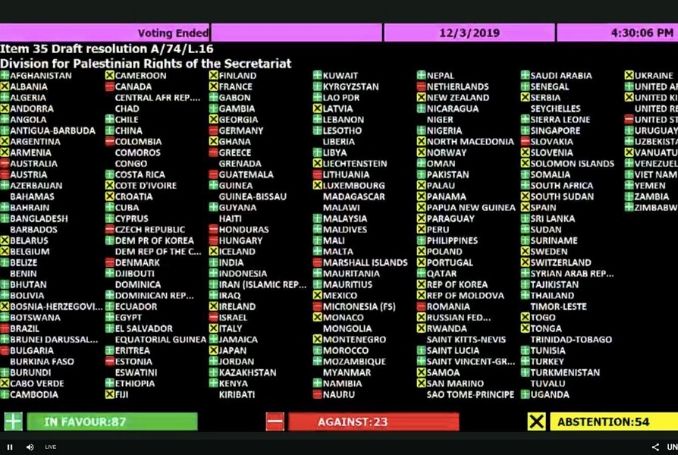
For the first time, 13 countries changed their longstanding positions and voted against a pro-Palestine measure at the United Nations on Tuesday.
Germany, the Czech Republic, Austria, Bulgaria, Denmark, Estonia, Greece, Lithuania, Netherlands, Romania, Slovakia, Brazil, and Colombia voted against the annual resolution regarding the “Division for Palestinian Rights of the Secretariat”, according to the Times of Israel.
They had previously abstained on the vote.
The resolution, which includes a call to halt to illegal Israeli settlements being constructed in the occupied West Bank, still passed with a large majority voting in favor.
The Palestinian representative told the council: “If you protect Israel, it will destroy you all.” He also said Israel’s character as a Jewish state is “shameless racism”.
The New York-based Division for Palestinian Rights oversees the Committee on the Exercise of the Inalienable Rights of the Palestinian People.
The resolution was co-sponsored by Comoros, Cuba, Indonesia, Jordan, Kuwait, Lao People’s Democratic Republic, Qatar, Saudi Arabia, Senegal, the United Arab Emirates, and Yemen.
The UK, France, and Spain abstained, as they do every year, allowing the resolution to pass with a vote of 87-54, with 21 other abstentions.
The General Assembly adopted five resolutions on the question of Palestine and the Middle East, including one calling on the Member States not to recognize any changes to the pre-1967 borders, including with regards to Jerusalem, other than those agreed by the parties through negotiations.
U.S. Continues to Draw Lines in Eastern Mediterranean
By Paul Antonopoulos | November 19, 2019
From November 3 to November 14, Israeli, U.S., German, Italian and Greek war jets participated in the “Blue Flag 2019” military exercises out of the Ovda Air Base in Israel’s Negev Desert. The timing of these exercises corresponds with Turkey and a whole host of other countries conducting their own naval exercises in the Aegean and Mediterranean Seas.
Lines are certainly being drawn in the Eastern Mediterranean between pro-U.S. forces and states seeking their own sovereignty away from U.S. hegemony, especially Turkey. Greece proves to be a curious country at the moment, since one of its warships participated in the Turkish-led naval exercises, even though Pakistan twice violated Greek airspace during these exercises and a war of words continues to ensue between Turkish and Greek political leaders over the maritime waters of Cyprus and the Eastern Aegean.
Although Greece was involved in both exercises, there can be no doubt that the Blue Flag 2019 exercises were aimed against Russia, Turkey and Iran. Part of the Blue Flag 2019 was the process and execution of aerial scripts to neutralize Russia’s S-400 Triumph missile defense system. However, since none of the participating countries have an S-400, the Israeli military had deployed U.S.-made Patriot missiles in specific locations to try to simulate the capabilities of the Russian-made systems during the military exercises that occurred near the Gaza Strip.
The simulation of the S-400 rocket launcher demonstrates for the first time that Israel is actively preparing to deal with such a system that exists only in Syrian and Turkish territory. In Syria, the powerful Russian defense system was deployed to protect Russian forces exactly four years ago, ironically because Turkey blew out a Russian jet from Syrian airspace in November 2015.
Meanwhile, the S-300V4 missiles will also be deployed in Egypt. The S-300V4 uses almost similar technology to the S-400 and has great capabilities in handling stealth aircraft. The S-400 has recently been shipped to Turkey, but is not yet operational, while Iran and Saudi Arabia have also shown interest in these systems.
The oldest and least capable S-300PMU-2 was deployed by the Syrian armed forces in late 2018, reducing the frequency of Israeli attacks in the country, but not stopping them. It is unclear what exact development led to Israel’s implementation of the S-400 neutralization training, however it is likely that these systems will also begin appearing elsewhere in the Middle East, putting Israel in a compromised military position.
Whatever the case, a big game is being played in the area with the possession and potential use of strategic weapons, such as Russian missiles and 5th generation American fighter jets.
Turkey, Greece, Israel, the U.S. and Syria have been embroiled in a meltdown of developments over who will eventually have the upper hand in the Eastern Mediterranean, but it is also seen that alliances are forming in the region. Although Greece was involved in both exercises taking place in the Eastern Mediterranean, its warship participating in the Turkish-led exercises took a more observatory position ensuring that its maritime waters were not violated, while it took a very active role in Israel, even winning the war games against the other participants of the exercises, which is unsurprising since Greece has the best pilots in NATO.
While Greece also participated in the Turkish-led naval exercises, it was actively training its pilots alongside the U.S. and conducting drills with Patriot missile batteries modified to imitate the Russian-made systems. However, the Russian systems hit targets twice as fast as the Patriots, and at a longer distance and higher altitude – essentially, attempting to use Patriots to simulate the S-400 would not have been very accurate.
It cannot be forgotten that Saudi Arabia, the world’s largest exporter of oil in the world, on September 14 had its daily supply cut by nearly 50 percent because of drone and missile attacks against state-owned oil company by the Yemeni Houthi-led Ansarullah resistance movement. With Saudi Arabia investing billions of dollars into the Patriot system, it would have been expected that they would have a near 100% success rate in hitting all the missiles launched by the Ansarullah Movement.
It is for this reason that Russian Senate Security and Defense Committee member Franz Klintsevich, in a comedic manner, stated that “if Saudi Arabia had installed the Russian anti-aircraft systems, this would not have happened. The S-300 and S-400 missile systems, supported by the Pantsir S-1 would not have allowed any of the drones and missiles to hit their target. The Saudis should think about it.” Therefore, there is a huge doubt that the modified Patriots could successfully mimic the S-400.
Whether the training against “the S-400” in Israel was successful for the participating countries, it more importantly demonstrates an intent by these countries to be able to overcome the Russian missile defense system. For Israel, it is crucial so that it knows how to respond to any hypothetical war with Iran or Turkey, while for the U.S. it would also be against Russia.
With Russia selling the S-400 system, announcing its intent to also sell fighter jets, and conducting patrols with Turkey in Syria, their ties are becoming much more integrated. It also appears that the U.S., Greece and Israel are strengthening their military coordination in the Eastern Mediterranean. Although Israel is not against Russia, it certainly has an adversarial political and military relationship with Turkey despite their close economic ties, just as Greece does with Turkey. And although Greece might not be against Russia, they certainly are against Turkey. The U.S. intentions for the Blue Flag 2019 exercise are to coordinate an alliance against Russia, and potentially Turkey, while training against the S-400.
Paul Antonopoulos is a Research Fellow at the Center for Syncretic Studies.
Will the US use Greece to block Russia in the Black Sea?
By Paul Antonopoulos | September 18, 2019
The Trump administration last week made its first major step to create a Greek-centric NATO corridor following United States Ambassador to Greece, Geoffrey R. Pyatt, announcement that his country intends to acquire the strategic port of Alexandroupoli. If Athens is to accept such a proposal, the country would be contributing to a geopolitical escalation. The US is attempting to push Greece, a traditional rival to Turkey, closer to them at a time when Ankara continues to defy NATO by strengthening its relations with Russia.
The port of Alexandroupoli is of particular importance to US policy in not only the Balkans, but especially to Russia. It is also an important energy route as the Interconnector Greece-Bulgaria (IGB) pipeline and the Trans-Adriatic Pipeline (TAP) is in the region. The port is also important for transportation as it is strategically located close to the Turkish-controlled Dardanelles that connects the Aegean/Mediterranean Seas with the Black Sea, and therefore Russia.
With the acquisition of this port, NATO and US forces may be in the Balkans in only a few hours and can easily stop Russian trade with the world via the Black Sea by blockading the Dardanelles. With Turkey increasingly defying NATO – in which Greece is also a member state of – by improving relations with Russia and buying the S-400, the US can make Greece more aligned with it under the guise of ensuring Greece’s security.
Turkey violates Greece’s maritime and air space on a daily basis, Erdogan makes continued threats to invade the rest of Cyprus. Only weeks ago he made a speech in front of a map that shows Greece’s eastern Mediterranean islands occupied by Turkey, and days ago Turkey removed the inhabited Greek island of Kastellorizo from online maps to claim sovereignty over oil and gas reserves, while continuing threats to flood Greece again with illegal immigrants, among others. Greece undoubtably has an extremely aggressive neighbour.
With Turkey illegally occupying large areas of northern Syria and Cyprus, and illegally intervening in Iraq, Greece must deal with an extremely provocative and expansionist-driven neighbour. With Russia traditionally remaining silent on Turkish provocations towards Greece, it is unlikely that Moscow will stop doing so now that relations are flourishing between the two Black Sea neighbours.
The US are trying to capitalize on Erdogan’s aggression towards Greece by attempting to pivot Athens towards them. If the Greek leadership decide to accept the US offer, it will be a powerful blow towards Turkish expansionism in the Aegean and will create a major security threat for Russia. As Greece is a rival of Turkey, the fact it prioritized creating a powerful navy and air force that could block the Dardanelles if needed, might embolden Greece to take direct actions against Turkey’s continued aggressions and threats.
Despite Greece being an economically ruined country today with a demographic crisis, it still maintains high military standards. This is reflected with Greece having the best pilots in NATO, in which Turkey is also a member of. In maritime matters, Greece has a far superior navy and experience in the Aegean. The Greek Navy has a long tradition and has never been defeated in combat. For this reason, Greece’s navy is one of the most important world naval powers today, at a military and commercial level. Although Turkey’s army makes it one of the largest in the world, it is rendered useless in any war with Greece. Although Greece has a significant maritime border with Turkey, the land border is only 200km long, making it easy to fortify.
With security against Turkey’s continued aggression being a major priority for Greece, the US ambassador is trying to woo the country into allowing the privatization of the port of Alexandroupoli. He stated: “Alexandroupoli is a crucial link to European energy security, regional stability, and economic growth, so it makes sense that the United States and Greece have chosen here to work together to advance our shared security and economic interests.”
With his emphasis on security, it will likely spark huge debates in Athens as it needs security assurances but will also not want to provoke Russia, a country that Greeks see with fraternity when remembering their shared Christian Orthodox faith and Russia’s military and diplomatic role in securing Greece’s independence from the Ottoman Empire. Although Russia is unlikely to back one side or another, a US-controlled port in Alexandroupoli can significantly weaken Russia’s Black Sea capabilities.
If comments by the National Defense Minister, Nikos Panagiotopoulos, of the newly elected neoliberal government is anything to go by, it can be expected that Athens will allow Alexandroupoli to become a US-controlled port. He said that the “use of the port by the US Armed Forces” will be allowed “when there is [certainly] a need” for it, especially as Greece’s current “strategic defense relationship with the US and cooperation” are strengthened, “thereby contributing to regional stability and security.” In direct reference to Turkey, he also said “Greece is ready at any time and moment to defend and safeguard in full its sovereign rights.”
In order to avoid a US naval base on the other side of the Dardanelles, Russia should take a position it has proven to be capable of, and something the US lacks experience in- peacebuilding. If Russia can act as a mediator between Greek and Turkey, it might be enough to avoid Athens pivoting towards the US so that it can ensure its security. Russia has proven in Syria, Afghanistan and elsewhere that it is willing to serve as a mediator in international affairs. With Moscow currently having amicable relations with Ankara, Russia being viewed positively by the majority of Greeks, being a regional country to both Greece and Turkey, and having its owned vested interests in the region, Russia is in a unique position to be able to mediate mutually to find a lasting peace between Greece and Turkey, and to prevent the US acquiring the port of Alexandroupoli.
Paul Antonopoulos is the director of the Multipolarity research centre.
US condemns Turkey for drilling in Cyprus, foiling Israel pipeline deal

US Ambassador to Cyprus, Judith Garber
MEMO | June 7, 2019
The US Ambassador to Cyprus, Judith Garber, has expressed her deep concerns over Turkey’s continued drilling off the coast of Cyprus, and urged Turkey to halt the operations exploring energy reserves in the surrounding waters.
Garber made the remarks yesterday evening at the Independence Day reception held at the US Embassy in Nicosia, while in the presence of the President of southern Cyprus, Nicos Anastasiades. She reiterated her support for the Republic and reassured them that the US recognises its right to develop and exploit resources within its “exclusive economic zone” (EEZ).
The resources in question are the vast gas and energy reserves discovered first in Egyptian waters and then in Cypriot waters in recent years, particularly the untouched and un-marketed 4.5 trillion cubic feet (127 billion cubic metres) of gas discovered off the southern coast of Cyprus in 2011. Then in February this year, the companies Exxon Mobil and Qatar Petroleum discovered an estimated five to eight trillion cubic feet of natural gas off the coast of the island.
In her remarks, Garber also touched on the concept of a possible agreement between the Greek and Turkish sides of the island, stating that “resources should be equitably shared between both communities in the context of an overall settlement,” Garber added. “It is our earnest hope that such resources will soon benefit a united Cyprus.”
This, however, does not seem likely, as such vast reserves have prompted a recently-signed deal between Greece, Cyprus and Israel to build the newly planned Eastern Mediterranean (EastMed) pipeline, which would supply gas to European countries and subsequently allow them to decrease their reliance on gas from other sources such as Russia. The deal will mean Cyprus will earn $9.3 billion over 18 years of the reserve’s production.
This new tripartite deal, backed by the US, has angered Turkey, causing it to send drilling vessels into Cyprus’s EEZ last month, announcing that it will begin the work of exploring more energy reserves.
Featured Video

Michael von der Schulenburg: Europe’s Self-Defeating Iran War Policy
or go to
Aletho News Archives – Video-Images
Frlom the Archives
Who Rules America?
The Power Elite in the Time of Trump
By James Petras | Axis of Logic | September 6, 2017
Introduction
In the last few months, several competing political, economic and military sectors – linked to distinct ideological and ethnic groups – have clearly emerged at the centers of power.
We can identify some of the key competing and interlocking directorates of the power elite:
- Free marketers, with the ubiquitous presence of the ‘Israel First’ crowd.
- National capitalists, linked to rightwing ideologues.
- Generals, linked to the national security and the Pentagon apparatus, as well as defense industry.
- Business elites, linked to global capital.
This essay attempts to define the power wielders and evaluate their range of power and its impact. … continue
Blog Roll
 Aletho News
- Michael von der Schulenburg: Europe’s Self-Defeating Iran War Policy
- Sorry, The New Republic, Climate Change Isn’t Causing Somali Migration. Blame Civil Strife and Poverty.
- Expert Guts Claims That HPV Vaccine Reduces Cancer Risk
- No evidence Russia sabotaged Baltic cables – Finnish intel
- The Strategic Folly of a (Serious) US Ground Invasion of Iran
- US-Israeli war of aggression on Iran meant to reshape region: Omani FM
- Iran Does Not Consider Israel Party to Talks to Need Mediators With It – Ambassador
- Macron’s aircraft carrier and warplanes to the Persian Gulf is a dangerous vanity project
- Meet The Ellisons: Zionists, Technocrats, Moguls
- US failures in Iran reveal Russia is key to South Korea’s strategic security
- If Americans Knew
- Are we on the precipice of World War III?
- ‘Catastrophic,’ Says UNICEF: 1,100+ Children Killed or Wounded in Mideast Since US-Israel Launched Iran War
- The Unbelievable Madness of Our War With Iran
- World Council of Churches calls on govts to hold Israel accountable for violations of intl law
- How to end the war on Iran that costs US taxpayers $1M per minute – Not a ceasefire Day 153
- Israeli strategic plans to “remake the Middle East” from the 1950s and since
- Honoring Gaza’s women who refused to let the world look away
- 97% of victims of war on Iran are Iranian, 98% of victims in war on Gaza are Gazans – Not a ceasefire Day 152
- Early Iran strikes cost $5.6 billion in munitions, Pentagon estimates
- Israel Decided the War, But Trump’s America Fights and Pays the Bill
- No Tricks Zone
- New Studies: UK Sea Levels Were 4 Meters Higher Than Today During The Mid-Holocene
- Destructive Green New Deal: German Energy And Metal Group Warns Of Drastic Crisis
- New Study Documents A 20-Year Pause In Arctic Sea Ice Decline – Driven By Internal Variability
- Wake-up Call: Survey Shows Majority Of Germans Now Favor Postponing Climate Targets!
- Televised! Leading German Political Candidate Tells Schoolchildren CO2 Makes Sun Hotter!
- New Study: A Century Warming Of 1.1°C Is ‘Commonplace’ And ‘Not Unusual’ During This Interglacial
- New Study: ‘Internal Noise’ And Volcanic Forcing Can Trigger 10-15°C Warming Within Decades
- Glaciers Worldwide Are Suddendly Surging, Experts Blame Warming!
- Surprising Discovery: Sahara Is Greening…Billions Of Trees Where Once Thought To Be Barren
- New Research Reaffirms Clouds, Aerosols, And Surface Solar Radiation Are ‘Driving The Climate System’
 Aletho News