Caracas says UK’s dispatch of warship violated the deal with Guyana over disputed Essequibo
RT | December 28, 2023
Britain’s decision to dispatch a warship to Guyana breaches the “spirit” of the agreement to resolve the Essequibo dispute peacefully and will be met with “defensive action,” Venezuelan President Nicolas Maduro said on Thursday.
Earlier this week, the UK announced it would send the offshore patrol vessel HMS Trent, currently deployed in the Caribbean, to visit the “regional ally and Commonwealth partner.”
Maduro called the move “practically a military threat from London” that violates the “spirit of dialogue, diplomacy and peace of the agreements” made with Guyana.
“I have ordered the activation of joint defensive action by the Bolivarian National Armed Forces in response to the UK provocation and threat to the peace and sovereignty of our country,” the Venezuelan president said in a televised speech.
Venezuela “reserves all actions, within the framework of the Constitution and International Law, to defend its maritime and territorial integrity,” the Foreign Ministry in Caracas said in a statement.
Following a national referendum at the beginning of December, Caracas laid claim on “Guayana Esequiba,” a mostly forested region rich in mineral resources that Venezuela has claimed for over a century. Guyana has protested, noting that the area amounts to two-thirds of its internationally recognized territory and asked the “international community” for help.
Brazil and several Caribbean countries offered to mediate the dispute, resulting in Maduro and Guyanese President Irfaan Ali signing the Declaration of Argyle on December 14, at a meeting in St. Vincent. Both sides pledged to refrain from escalation by “words or deeds,” and established a joint commission to discuss the dispute.
Four days later, Britain’s Undersecretary for the Americas David Rutley visited Georgetown and promised Guyana “unequivocal backing,” vowing to “ensure the territorial integrity of Guyana is upheld.”
St. Vincent and the Grenadines Prime Minister Ralph Gonsalves, who has taken on the role of the mediator in the dispute, told the island radio on Thursday that he read the Venezuelan statement “very carefully,” describing it as “firm but… not particularly belligerent.”
Gonsalves said he has reached out to both Georgetown and Caracas, and received assurances from both of their “commitment to peace and continued dialogue.”
Maduro Orders ‘Defensive’ Military Drills After UK Deploys British Warship Off Guyana Coast
Sputnik – 28.12.2023
CARACAS – Venezuelan President Nicolas Maduro ordered on Thursday the armed forces to launch “the activation of a joint defensive action” in response to the deployment of a British warship off the coast of Guyana.
“I have ordered the activation of a joint defensive action of the Bolivarian National Armed Forces” off the coast of Essequibo, he said in a state televised broadcast, but did not provide more information.
Earlier this month, the British media reported, citing a British defense ministry spokesman, that the United Kingdom would deploy a patrol ship off Guyana’s coast as a sign of support for the state in the territorial dispute over Essequibo. The head of Venezuela’s defense ministry, Vladimir Padrino Lopez, called it a provocation.
Venezuelan Foreign Minister Ivan Gil had previously called on his British counterpart David Cameron not to interfere in the affairs of Latin American and Caribbean countries, and to mind his own business.
“From Venezuela, we ask the infamous failure David Cameron, foreign minister of the former imperial power of the United Kingdom, to take his hands off our Latin America and the Caribbean and to take care of his own affairs, which are very complicated,” Gil wrote on social media.
Venezuela’s territorial dispute with Britain and Guyana, a former British colony, has been ongoing since the 19th century. The Bolivarian government stepped up its actions after Guyanese authorities began handing over fossil-rich areas of the disputed shelf to oil companies for development.
Caracas held a referendum on December 3 in which an absolute majority of participants supported the annexation of the territory west of the Essequibo River, and began legislative work to legally back its actions.
Guyana’s President Irfaan Ali has since said that the country views Caracas’ actions as a threat to national security and intends to appeal to the UN Security Council as well as its international partners. During a recent news conference, Ali did not rule out that Guyana may go for a military base for its allies in the region, and on December 7, the US Army’s Southern Command carried out “flight operations” in the country.
The leaders of Venezuela and Guyana, following recent talks on the territorial dispute over Essequibo, pledged not to use force under any circumstances and to resolve it in accordance with the 1966 Geneva Agreement.
UK to Deploy Royal Navy Warship to Ex-Colony Amid Guyana-Venezuela Dispute
By Svetlana Ekimenko – Sputnik – 24.12.2023
Guyanese President Irfaan Ali and Venezuela’s leader Nicolas Maduro met in mid-December under the aegis of the Community of Latin American and Caribbean States and the Caribbean Community to defuse tensions around the disputed region of Essequibo. The two agreed to “continue dialogue to resolve the dispute over the Essequibo territory.”
The UK has decided to re-task Royal Navy warship the HMS Trent and deploy it to Guyana after Christmas, according to British media reports.
Instead of scouring the Caribbean in search of drug smugglers, the warship will take part in joint naval exercises with the former British colony and Commonwealth member. The decision was reportedly prompted by the current flare-up of the territorial dispute between Guyana and Venezuela.
“HMS Trent will visit regional ally and Commonwealth partner Guyana later this month as part of a series of engagements in the region during her Atlantic Patrol Task deployment,” a UK Ministry of Defense spokesperson was cited as saying.
The HMS Trent is a Batch 2 River-class offshore patrol vessel, named after the River Trent. Commanded by Commander Tim D. Langford, it is designed to carry out tasks that include “counter-piracy, anti-smuggling, fishery protection, border patrol, counter terrorism, humanitarian aid, search and rescue, general patrols and defence diplomacy,” as per the Royal Navy website.
The warship will stay in Barbados, the Caribbean region of the Americas, during Christmas, after which it will be heading for Guyana. Its activities will reportedly be carried out at sea, and will not involve docking in Guyana’s capital, Georgetown.
Earlier in December, when Britain’s Foreign Office Minister for the Americas and Caribbean David Rutley visited Guyana, he was quoted as saying that the UK would work internationally “to ensure the territorial integrity of Guyana is upheld.”
The border between Guyana and Venezuela, which runs through the Guyana-Essequibo region, known for its abundant oil reserves, has been a source of territorial dispute for several decades.
Venezuela gained independence from Spain in 1845 and recognized Essequibo – a zone of 160,000 sq. km – as part of its sovereign territory. In 1899, however, the United Kingdom filed and won an arbitration claim to recognize Essequibo as part of its then-Caribbean colony of British Guiana. Independent Guyana referred the dispute to the International Court of Justice (ICJ) in 2018. This came after Venezuela’s President Nicolas Maduro objected to former Guyanese president David Granger granting oil exploration rights off the Essequibo coast to ExxonMobil, the US-French oil transnational.
Venezuela held a referendum earlier this month in which almost 96% of the population voted in favor of incorporating the Essequibo region, which makes up two-thirds of the territory controlled by Guyana, into the country. Venezuelan President Nicolas Maduro put forward a proposal to the parliament, suggesting the establishment of Venezuela’s 24th state, named Guyana-Essequibo. He also produced a new map showing the disputed region of Essequibo as part of Venezuela. Besides referring to Essequibo as a “zone of integral defense,” Venezuela’s president proposed a deadline of three months for oil companies to halt offshore operations in the area. Last Sunday, a referendum was conducted to reaffirm Caracas’s claim to Essequibo. The majority of citizens voted in favor of establishing a state on the disputed territory.
According to Venezuelan media, President Nicolas Maduro has already officially signed decrees to incorporate the western region of neighboring Guyana into Venezuela, ratifying a total of six documents. In addition, Maduro signed a decree facilitating the creation of specialized units within the state oil and gas company PDVSA — PDVSA Essequibo and the Guyana Venezuelan Corporation — CVG Essequibo. To oversee the newly formed state, Major General Alexis Rodriguez Cabello was appointed as the sole head of the 24th state.
Venezuela and Guyana have since agreed not to threaten or use force in any circumstances to settle the dispute, as per a joint statement, published by Venezuelan President Nicolas Maduro. The sides also agreed to meet in Brazil within the next three months to “consider any matter with implications for the territory in dispute” and immediately establish a joint commission on the level of foreign minister and experts to address the dispute.
Venezuela, Guyana to hold talks on disputed Essequibo region
RT | December 10, 2023
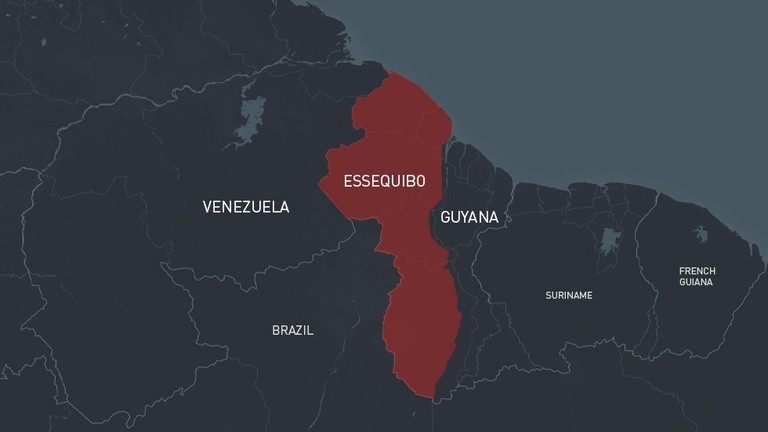
The presidents of Venezuela and Guyana – Nicolas Maduro and Mohamed Irfaan Ali, respectively – will sit down next week to discuss a long-standing territorial dispute that has recently intensified, the prime minister of Saint Vincent and the Grenadines has revealed. While Caracas has laid claim to the oil-rich Esequibo region since the late 19th century, President Maduro recently took steps toward gaining actual control over the area, which covers some 160,000 square kilometers.
Earlier this week, the Spanish daily El Pais reported that the Venezuelan government had deployed troops to the border with Guyana.
Saint Vincent and the Grenadines PM Ralph Gonsalves, who also serves as president pro tempore of the Community of Latin American and Caribbean States (CELAC), broke the news after speaking with Maduro on Saturday, saying the negotiations would take place on Thursday.
The Venezuelan government has confirmed the planned talks, saying they hoped to “preserve our aspiration to maintain Latin America and the Caribbean as a zone of peace.”
The Office of the President of Guyana, for its part, stressed that “Guyana’s land boundary is not up for discussion.”
Also on Saturday, Brazilian President Luiz Inacio Lula da Silva spoke with Maduro, calling for dialogue and warning against unilateral measures that could escalate the situation. The Brazilian head of state has also been invited to take part in Thursday’s talks as an observer.
Speaking on Tuesday, the Venezuelan president said Caracas wanted the “peaceful rescue of the Guayana Esequiba,” which “has been de facto occupied by the British Empire and its heirs and they have destroyed the area.” Maduro also unveiled a new map of Venezuela that incorporates the disputed territory, and appointed a new governor to the region.
Guyanese President Irfaan Ali, in turn, gave a televised address to the nation, accusing Venezuela of attempting to annex more than two thirds of his country.
“This is a direct threat to Guyana’s territorial integrity, sovereignty, and political independence, and a violation of fundamental principles of international law,” the leader stressed.
“The Guyana Defense Force is on high alert… Venezuela has clearly declared itself an outlaw nation,” Ali added.
The recent escalation followed Sunday’s referendum, in which 10.4 million Venezuelan voters backed Caracas’ claim to Guayana Esequiba.
The territorial dispute stems from the US’ decision in 1899 to assign the territory to what was then British Guiana – a move Venezuela never accepted as legitimate.
Guyanese military helicopter missing near Venezuelan border
The Defense Forces personnel aboard the lost chopper had been sent to inspect the area amid rising tensions with Caracas
RT | December 7, 2023
A military helicopter with five senior Guyanese officers and two soldiers onboard vanished in stormy weather on Wednesday near Guyana’s contested border with Venezuela.
Rescue operations had to be called off due to adverse weather conditions, according to Guyana Defense Forces (GDF) Chief of Staff Brigadier Oman Khan. The helicopter sent out an emergency signal shortly after refueling. The signal may have been triggered by the crew and may suggest a crash landing, he added.
The suspected crash happened as border tensions between Guyana and Venezuela are on the rise.
The territory, which Guyana refers to as Essequibo, has been disputed by the two countries since the 19th century.
In 1899, the US stepped in to arbitrate the dispute, and, invoking the Monroe Doctrine, assigned the territory to British Guyana, at the time a colony.
Venezuela never accepted the decision as legitimate, and the dispute was referred to the International Court of Justice (ICJ) in 2018.
After a referendum on Sunday about incorporating the territory as a new state in Venezuela, President Nicolas Maduro has unveiled a new map with the area, dubbed Guyana Essequiba, now shown as part of the country.
Guyanese President Irfaan Ali replied that Maduro was displaying “blatant disregard” for the ICJ, which forbade Caracas from disturbing the status quo in the region.
The dispute is further exacerbated by the recently discovered oil reserves in the waters off the coast of the Atlantic, which both countries claim.
Maduro warned that foreign companies exploiting resources in the region without permission from Caracas have three months to “comply with the law.”
Caracas has since mobilized troops and sent them to the Guyanese border in preparation for claiming the 160,000 square-km territory.
Venezuela Rejects Statements by the President of Guyana
teleSUR | December 6, 2023
On Wednesday, the Venezuelan Ministry of Foreign Affairs responded to the statements made by Guyana’s President Irfaan Ali regarding the Essequibo region. The text of the Venezuelan response is presented below:
“The Bolivarian Republic of Venezuela condemns the recent statements made by President Irfaan Ali, who, in a reckless manner, has given the green light to the presence of the United States Southern Command in the territory of the Guayana Esequiba region, over which Guyana maintains a de facto occupation and a territorial dispute with Venezuela.
This dispute is meant to be resolved through the 1966 Geneva Agreement, the only valid legal instrument between the parties.
Venezuela denounces, before the international community, and especially before the Community of Latin American and Caribbean States (CELAC), the imprudent attitude of Guyana.
Acting under the mandate of the U.S. transnational Exxon Mobil, Guyana is opening the possibility of establishing military bases for an imperial power, thereby threatening the Zone of Peace outlined in this region.
The Cooperative Republic of Guyana recklessly violates international law, taking actions that exacerbate the territorial dispute and add to its illegal conduct of granting oil exploitation rights to Exxon Mobil over a sea area pending delimitation with Venezuela.
The Bolivarian Republic of Venezuela, true to its doctrine of Bolivarian Diplomacy for Peace, urges the Government of Guyana to abandon its erratic, threatening, and risky behavior and to resume the path of direct dialogue through the Geneva Agreement.”
Territorial dispute growing between Guyana and Venezuela
By Lucas Leiroz | March 4, 2021
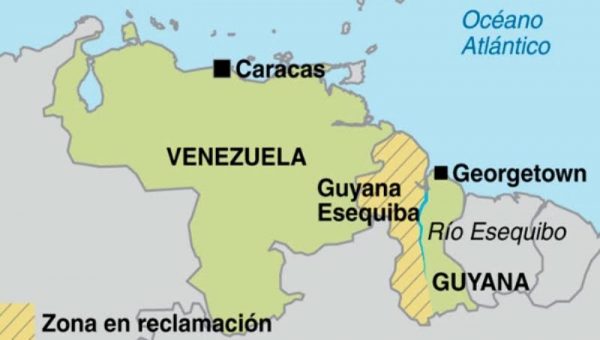
An old territorial dispute in South America is reaching its most tense point in decades. The territory known as Essequibo has been mutually claimed by Guyana and Venezuela since the 19th century when Guyana still belonged to the United Kingdom. In 1897, the Venezuelan and British authorities agreed to submit their dispute to an arbitrary international court in Paris, which ruled that the land belonged to the UK. For decades, the arbitration decision was accepted by Caracas, but in 1948 Venezuelan authorities revealed some irregularities in the trial, which were documented in old government files. As a result, the decision was considered null, and years later, in 1963, Venezuela formally submitted its territorial claim to the United Nations, and the dispute remains unresolved till today, when the interests of foreign oil companies threaten to increase the tensions.
As a region rich in oil, Essequibo has recently entered the map of the large multinationals in this sector, especially the American Exxon Mobil. More than that, the economic sanctions imposed on Venezuela and the political alignment of Guyana with Washington contribute to create an even more controversial scenario. Guyana has the support of the large private oil sector and the American government, while Venezuela remains alone. Last year, the case was filed with the International Court of Justice, but Venezuela did not accept it and remained out of the trial.
However, in a sentence on December 18, 2020, the Court proclaimed its competence to intervene in the dispute, despite Venezuela’s position. It is necessary to highlight that, regardless of any decision taken by the Court over who really has sovereignty in Essequibo, this sentence must be considered null, since the absence of Venezuelan consent prevents the execution of the sentence. The need for consent is one of the most elementary principles of international law and the very fact that the Court declares itself competent already leads us to question whether its judges are really impartial – clearly, the norms of international law are being violated in favor of Guyana.
Guyana has publicly admitted that its expenses for the court case in The Hague were paid by Exxon Mobil. Although the American oil company has been operating in Guyana for decades, its interest has been greatly increased with the recent discoveries of oil reserves and investors are willing to do anything to ensure the exploration of local natural resources. Currently, Exxon Mobil is interested in expanding its facilities over an area of more than 26,000 square kilometers, which not only crosses the disputed territory in Essequibo, but also violates Venezuelan undisputed national territory.
With this scenario of clear attack on Venezuelan national sovereignty and possible collaboration of the International Court with one of the parties, Venezuela is at a disadvantage mainly due to its diplomatic weakness. Venezuela, at this point, lacks sufficient influence to cause the Court to review its decision or judge the case in a really partial way. For that, only strong international alliances can help Caracas. The large nations that are not aligned with Washington and have so far cooperated strongly with Venezuela, Russia and China, might be provoked by the Venezuelan government to incite international pressure in this regard. Only these two countries can mediate a parallel agreement that may be established between Caracas and The Hague in order to choose between two paths: either Venezuela agrees to submit to trial on the condition that there is a partial judgment and without the influence of private companies, or the Court declines jurisdiction. As the first scenario is unlikely and difficult to monitor, the most viable route would be for The Hague to abdicate any form of judgment.
It is important to mention that, in the absence of international judgment, what is in force in Essequibo is the Geneva Agreement of 1966, which did not decide on sovereignty in the region, but, in search of a peaceful solution, defined what activities would be allowed or prohibited in Essequibo. Oil exploration by foreign companies is not allowed, so, in principle, Guyana is violating the agreement and its activities could only become lawful if there was a decision by the International Court on the matter, allowing exploration. As Venezuela does not submit to the Court, the trial is impossible and, therefore, exploration remains prohibited and Guyana is committing an international offense.
However, more worrying than that is the fact that the American military is working in Essequibo, carrying out tests with the aim of intimidating Venezuela and pressuring Caracas to renounce its demands. There are American military ships in Essequibo “protecting” Exxon Mobil facilities and provoking Caracas. In addition, considering that the American company wants to publicly explore areas within Venezuelan territory, what will become of the American presence? If Caracas does not allow the activities of Exxon Mobil, it is the Venezuelan right to control or even destroy the facilities in its territory. And what would be the American reaction to that – considering Biden’s aggressive interventionist policy?
It is for these reasons that, more than ever, countries of greater international relevance must mediate the issue in order to maintain the status of illegality to the Exxon Mobil’s activities. With international pressure, it is possible that the American company will retreat or that at least the American military in the region will leave and with that we would have a reduction in tensions.
Still, it is possible that with international mediation a mutual exploration agreement will be reached that allows both countries to enjoy the local wealth, without, however, allowing companies that violate the Geneva Agreement to operate.
Lucas Leiroz is a research fellow in international law at the Federal University of Rio de Janeiro.
Armed conflict between Venezuela and Guyana will involve US forces
By Lucas Leiroz | February 3, 2021
A new focus of tensions is emerging in South America. Since the discovery of oil in Guyana, this country has been increasingly approaching Washington both as an economic partner and as a political ally. The Americans see the partnership with the Guyanese as an opportunity to fill the void left in the global oil market with the economic sanctions imposed on Venezuela. But, in addition to a mere economic alliance, the ties between both countries are also rising to the military sphere, which is generating concerns in Caracas.
On January 21, regional tensions reached their peak. Guyanese fishing boats Nady Nayera and Sea Wolf were intercepted by Venezuela after an illegal incursion into Venezuelan territory. Caracas, not having authorized the entry of the vessels, interpreted the maneuver as dangerous to national security and kept the boats under its control. However, this Venezuelan version of the facts was denied by Georgetown, which claimed that the ships were detained within Guyana’s Exclusive Economic Zone.
Some noteworthy factors preceded this escalation of tensions. On January 7, Venezuelan President Nicolás Maduro signed a decree that establishes the formation of a new maritime territory on the Atlantic coast. The decree includes part of the Essequibo region, in which there is a territorial dispute with Guyana. The so-called “Guyana Essequiba” refers to a territory currently under the rule of Guyana that previously belonged to Venezuela, having been transferred to Guyanese possession after an arbitrary sentence in an international court organized by the United Kingdom at the end of the 19th century.
Venezuela has since claimed sovereignty over Essequibo, but tensions have been mild most of the time. However, Guyana, since aligning with the US, has been adopting more aggressive measures in the region. The US armed forces recently began military exercises in Guyana and deployed several military ships along Essequibo’s 159,000 km². The territory is rich in oil and the American justification for the exercises is precisely to protect the oil extraction bases installed by the company ExxonMobil. In the midst of such circumstances, Venezuela has its national sovereignty violated and is therefore trying to establish minimum measures to guarantee its interests.
However, despite the rivalry having resumed an old territorial dispute, it is necessary to emphasize that there is an agreement in force on Essequibo that Guyana is directly violating. In 1966, Guyana and Venezuela signed the Geneva Agreement, mediated by the United Nations, which determined which activities would be permitted in which area of Essequibo. In this document, oil exploration by foreign companies is not allowed. Since 2015, the Guyanese government has violated the pact, allowing multinationals to explore for oil there. In 2018, Venezuela had already intercepted ExxonMobil vessels that invaded its territory to explore oil. Now, Venezuelan President Nicolás Maduro has determined the creation of a Special Strategic Zone to increase security over Essequibo because the tendency is for territorial violations to increase further, considering that regional diplomacy is already broken, and that Guyana has become a satellite nation of Washington’s interests – which publicly plans to overthrow Maduro. The Venezuelan decision was condemned by the president of Guyana, Irfaan Ali, which prompted Caracas to issue a statement saying that such positions suggested preparation for an armed confrontation.
The Guyanese attitude has not changed over time. Now, once again, ships have entered Venezuelan territory, leading to their capture by the Bolivarian forces. If that situation continues, the Venezuelan response to foreign incursions may become increasingly rigid and the armed forces are likely to start taking down invasive vessels, which will lead to Washington’s severe responses. Currently, we can no longer regard the South American scenario as “unlikely” for a war to arise. The security crisis is widespread and with Biden in power many experts suggest that American foreign policy will become more aggressive and interventionist. Guyana has a much weaker military apparatus than the Venezuelan State and cannot face the neighboring country with its own forces. It remains to be seen what Washington’s willingness to invest in a conflict in South America will be.
More than ever, a new international agreement is needed to establish a new regulation for the region. The agreement, however, must be impartial and try to favor both nations. In an ideal scenario, the other South American nations, being co-participants in the disputes, should mediate such an agreement. But, today, the political structure of South America is absolutely broken, and no nation has sufficient diplomatic strength to resolve a demand of this nature.
Lucas Leiroz is a research fellow in international law at the Federal University of Rio de Janeiro.
Venezuela Rejects ICJ Ruling, Reaffirms Claim Over Essequibo Strip
By Ricardo Vaz | Venezuelanalysis | January 8, 2021
Mérida – The Venezuelan government has taken actions to defend its claim over the disputed Essequibo region.
President Nicolas Maduro held a meeting with the country’s National Defense Council and State Council on Thursday to address the territorial dispute between Venezuela and neighboring Guyana.
The Venezuelan government rejects a recent decision by the United Nations’ International Court of Justice (ICJ). On December 18, with a 12-4 majority, the ICJ judges ruled that the court has jurisdiction to settle a claim brought forward by the Guyanese government arguing that the border was established by a controversial 1899 arbitration agreement in which no Venezuelan negotiators were present.
In response, the Maduro government reaffirmed its rejection of the 1899 ruling and its adherence to the UN-brokered Geneva Agreement signed by all parties in 1966 as the only binding international framework.
“This is a cause uniting an entire nation to fight against the dispossession of a territory that always belonged to Venezuela,” the Venezuelan president said in the televised meeting.
Maduro added that the Geneva Agreement stipulates that the border dispute must be settled by direct negotiations between the two countries and that his administration would send a letter to UN Secretary General Antonio Guterres to defend Caracas’ claim over the Essequibo.
“We believe your good will and efforts are more needed than ever to restart direct talks between Guyana and Venezuela in order to achieve a peaceful and mutually beneficial agreement,” the letter reads.
The Venezuelan government will likewise address a letter to ICJ President Abdulqawi Ahmed Yusuf, arguing that the Hague-based court has no jurisdiction to rule on a unilateral Guyanese suit and demanding that Venezuela be allowed to defend its territorial claim. Maduro went on to denounce “suspicious” efforts to rush the hearings, which are set for January 25 after the Caribbean nation allegedly objected to the original January 15 date.
Earlier on Thursday, the newly-seated National Assembly (AN) unanimously approved a nine-point motion rejecting the ICJ ruling and defending the 1966 Geneva Agreement.
The AN document endorsed the government’s diplomatic efforts and the reopening of direct talks with Venezuela’s eastern neighbor. The legislative body also formed a special commission, headed by lawyer Hermann Escarra, to focus on the Essequibo claim.
The diplomatic quarrel over the 160,000 square kilometer, sparsely populated strip of land, which was taken by the British colonial regime in the late 19th century, recently came to the fore following the discovery of an estimated 15 billion barrels of oil in the Essequibo’s maritime waters.
Caracas has repeatedly voiced its opposition to Guyana’s decision to allow US multinational Exxon Mobil to drill in the disputed area, claiming that it violates the 1966 accords. For its part, Washington has backed Georgetown’s claim to the strip and pledged to execute joint military drills.
Guyana: The Good, the Bad and the Ugly Prior to 2020 Elections
teleSUR | March 1, 2020
The small Caribbean country of Guyana is on the brink of becoming one of the largest oil-producing nations in the world thanks to the 2015 discovery of major offshore oil deposits.
This newfound wealth set into motion a transformative period for the country, which is one of the poorest nations in South America as more than 36 percent of its people are living in poverty.
But as in many cases, the blessing and promise of billions of dollars in revenue to fill the state’s coffers have also been marred in corruption scandals and caused in 2018 a major political crisis that will be resolved on March 2 as hundreds of thousands of Guyanese head to the polls.
The Guyanese people have been waiting for this day ever since President David Granger received a motion of no confidence in Dec. 21, 2018 with 33 votes against 32. A decision later upheld by the Caribbean Court of Justice (CCJ) in 2019.
The no-confidence motion, a first in the nation’s history, on the leader of the Partnership for National Unity/Alliance for Change (APNU/AFC) party was led by former president and opposition leader Bharrat Jagdeo of the People’s Progressive Party/Civic (PPP/C).
Jagdeo stated Granger “sold” the country’s “patrimony” to Exxon Mobil, accusing the government of mismanaging oil resources and granting the transnational overly generous contract terms.
The government, on the other hand, has insisted that it got the best deal it could and is banking on new oil wealth to transform the economy of the English-speaking country of just 750,000.
So as people head to the polls to elect a new five-year administration amid the recent oil boom, Guyana’s situation could be summarized into the good, the bad and the ugly.
The Good
In May 2015 ExxonMobil shocked the world and the Guyanese as the company announced the discovery of significant oil deposits in the Liza-1 well, followed by Payara, Liza Deep, Snoek, Turbot, Ranger, and Pacora by early 2018.
ExxonMobil and Hess reported that new discoveries contained estimated resources exceeding eight billion barrels of oil equivalent – one of the world’s largest reserves-, potentially producing 750,000 barrels per day by 2025. In rough estimates, this placed the oil wealth at over US$300 billion.
In a nation with a per capita income of under US$4,000, the findings meant a game-changer.
The revenue is expected to generate an estimated US$168 billion over the life of the project until 2056, representing 120 times Guyana’s annual budget, which in 2019 stood at US$1.4 billion.
By 2024 the amount of money coming in could lift income per person from US$5,000 to US$19,000, nearly the same as in Poland. All the wealth promised for impoverished Guyana hopes of tremendous economic growth in the years ahead. The International Monetary Fund forecasts an 85.6 percent GDP growth in the small nation.
By 2030 the government’s share of earnings from oil could reach US$10 billion in real terms, more than double last year’s GDP. However, not everything that glitters is gold.
The Bad
But Guyana is no stranger to oil exploration and drilling. Since the 1940s transnational companies had operated in the Guyana basin and in small wells. Yet the 2015 find was so unexpected it took even Exxon by surprise as, by April 2016, the United States oil giant had a problem.
The company had recently found oil off the coast in the Stabroek oil block but its license was about to expire in only two years, putting in jeopardy the company’s increasingly valuable asset.
So in early April 2016, the company began a powerful negotiation campaign by confronting two inexperienced Guyanese officials with a new draft license to be signed within ten weeks.
“Exxon did not want to change the favorable financial terms from its 1999 license, despite having recently found significant oil reservoirs that would customarily allow the government to ask for more,” a report titled ‘Signed Away’ by international watchdog Global Witness states.
The Guyanese government despite having a strong bargaining position when the contract came up for renegotiation in 2016 was outmaneuvered by the international company, due to “inexperienced” bureaucrats according to the report.
Guyana’s Natural Resources Minister Raphael Trotman ended up giving Exxon largely the same tax terms as before it found oil and then the company regained parts of the license area it was supposed to give up.
Also, and within months of signing Stabroek, Exxon agreed to buy portions of two additional licenses from companies that had obtained them under apparently suspicious circumstances. Only three days after getting its new license, Exxon announced its massive find.
The agreement left Guyana with a two percent royalty and a 50 percent profit share after the company recoups its costs. Granger has defended that the attractive terms were needed to secure investment in a risky new location.
However, for German-based company Open Oil -which specializes in providing financial analysis of natural resource investments for public policy purposes – Guyana lost a lot.
“If the royalty had been at 10 percent and standard corporate income tax (CIT) of 25 percent had been applied, both of which are well within international norms, the resulting government take would have been 69 percent, and Guyana would earn US$55 billion more during the life of the Stabroek field, up until 2056,” their report reads.
On average, Guyana will lose over US$1.3 billion a year over the life of the project from signing in 2016 until expiry. With the additional money, the country could have doubled its annual US$172 million health budget, US$251 million education budget, US$185 million infrastructure budget, and still have US$700 million left each year.
“This is a story about how an aggressive company negotiated an exploitative deal with a minister who may not have been working in Guyana’s best interests,” Global Witness’ commented on the matter. Supposedly the opposition voted to end granger’s government in order to renegotiate these contracts, which they thought to be unfair for Guyana.
And this is where things get ugly.
The Ugly
As Granger’s administration came to a halt by the opposition’s vote, the reassuring argument to the Guyanese people was that oil contracts would have been revised and renegotiated. The March 2 elections were meant to prove this thesis as the issue was the deciding factor, or at least it seemed so for campaign purposes.
With elections looming, the People’s Progressive Party presidential candidate announced in January that Exxon’s contract wouldn’t be renegotiated, despite the numerous warnings of the lopsided nature of the agreement.
“Exxon is a different case,” Ali told Reuters after a campaign rally in the contested western Essequibo region, adding that he would administer the deal better after reviewing terms.
For Associate Fellow in the energy, environment and resources program at Chatham House, Valerie Marcel, although the stakes are high in the elections as that the winning party will reign over the country’s oil revenues there is no real difference regarding the party’s policies approaching the oil boom.
Both are on a similar path with the development strategy set up by Granger, support the Extractive Industries Transparency Initiative (EITI) and a sovereign wealth fund, and mainly imitate their approach to licenses and future agreements.
“Exxon was a pioneering investment,” Ali reiterated. “But those that came after that time they were not pioneering, so they have to be examined in totality.”
However, others have not yet confirmed significant commercial finds. Tullow has made several discoveries in the past year, but the company has yet to find enough reserves to make the project work so Exxon continues to be the main winner in all this transaction.
If asked what’s really at stake in Guyana’s election, the answer might be as unpleasant as it sounds: nothing. As the good tidings of newfound immense natural resources for one of the poorest nations in the continent have been marred by power struggles and the ugliness of transnational greed over sovereign interests.
See also:
Featured Video
America Racing to Strategic Defeat in Iran
or go to
Aletho News Archives – Video-Images
From the Archives
Should Europeans ‘Thank’ the Americans for Destroying Nord Stream?
By Robert Bridge | Strategic Culture Foundation | September 29, 2022
With an investigation continuing into the destruction of the Nord Stream gas pipeline that provided energy supplies to Europe from Russia, there appears to be just one prime suspect, and that should surprise nobody.
Following the sabotage of the Nord Stream 1 and 2 gas pipelines, former Polish Foreign Minister Radoslaw Sikorski already seemed to know the identity of the perpetrator when he tweeted out: “Thank you, USA.”
At first glance, it seemed that Sikorski was speaking sarcastically, berating Washington for carrying out an attack that will have severe repercussions for the people of Europe. After all, how could anyone see any good coming from the termination of Europe’s primary source of gas reserves with winter just around the corner? It was Sikorski’s homeland of Poland, after all, that urged its citizens to collect firewood in the face of dwindling gas reserves.
In fact, the Polish diplomat was speaking one-hundred percent literally… continue
Blog Roll
 Aletho News
- Growing insecurity, soaring prices fuel protests in north as regime bans evacuation: Sources
- Iran denies responsibility for ‘depraved’ attack on Kuwait desalination plant
- Bring The Troops Back. End This War Now!
- Can we please stop calling Israel the ‘only democracy in the Middle East’ now?
- US should start removing its troops from Germany, proposes AfD co-leader Chrupalla
- Iran Red Crescent: 600 educational centers attacked in US-Israeli ‘war crimes’
- Russian Oil Tanker Arrives in Cuba Amid U.S. Blockade
- America Racing to Strategic Defeat in Iran: Lt Col Daniel Davis
- FTC Warns Visa, Mastercard, PayPal, Stripe Over Political Debanking
- Russian tanker approaches Cuba despite US oil blockade
- If Americans Knew
- As Iran targets US military bases, will they be relocated to Israel? Not a ceasefire Day 171
- Will Trump Go Kamikaze?
- Is the University of Florida Shutting Down College Republicans over Israel Criticism?
- Jewish extremist arrested over alleged plot to firebomb Palestinian activist Nerdeen Kiswani’s home
- More than half of Palestinian child detainees have no charges
- The More Murderous Israel Gets, The More We Hear About “Antisemitism”
- Land Day and the Palestinian struggle after 30 months of genocide
- The Iran War Is About Palestine
- Israeli soldiers echo settler ideology, talk of revenge after targeting Palestinians and detaining CNN crew in the West Bank
- Israeli Policies Threaten Future of Christian Schools in Jerusalem
- No Tricks Zone
- New Study Finds Warming Saves Lives…Cold Temperatures 12 Times More Deadly Than Excess Heat
- German Science Blog Accuses PIK Climate Institute Of Hallucinating Climate Tipping Points
- Devastating Assessment Of Comirnaty Vaccine By Former Senior Pfizer Europe Toxicologist
- New Study: CO2 Is ‘Effectively Negligible’ As An Explanatory Climate Change Factor Since 2000
- Former Pfizer Toxicologist Dr. Helmut Sterz Tells Bundestag Hearing Pfizer Vaccine Should Have Never Been Approved
- Energy Expert: Germany’s Nuclear Phaseout Was A “500 Billion Euro Mistake”
- New Research: South Australia’s Mid-Holocene Sea Surface Temperatures Were 4°C Warmer Than Today
- Storing Green Energy To Last Germany 10 Days Would Require A 60-Million Tonne Battery
- New Studies: UK Sea Levels Were 4 Meters Higher Than Today During The Mid-Holocene
- Destructive Green New Deal: German Energy And Metal Group Warns Of Drastic Crisis
 Aletho News
