Egypt to try 67 people for assassinating top prosecutor
Press TV – May 9, 2016
Egyptian authorities have referred dozens of people to trial over the last year’s assassination of the country’s top prosecutor.
Prosecutor General Nabil Sadek sent 67 people to the criminal court on Sunday, without mentioning the exact date of the trial.
Sadek said in a statement that all the defendants were members of the outlawed Muslim Brotherhood movement, who “conspired” with members of the Palestinian resistance movement Hamas to assassinate Public Prosecutor Hisham Barakat in a bomb attack in the Cairo suburb of Heliopolis in late June 2015.
In March, Egyptian Interior Minister Magdy Abdel Ghaffar told a news conference in Cairo that both Muslim Brotherhood and Gaza-based Hamas were involved in the assassination.
The Hamas, however, has strongly rejected the allegation, calling it as “baseless.”
“Hamas calls on all parties in Egypt not to involve Palestinian factions in their internal differences,” Hamas spokesman Sami Abu Zuhri said in a press release on March 7, hours after Ghaffar’s comments.
There have been no credible claims of responsibility for the bombing that killed the 64-year-old state prosecutor just outside his house on June 29.
Israel forces open fire on Palestinian farmers in southern Gaza
Ma’an – May 8, 2016
GAZA – Israeli forces on Sunday morning opened fire on Palestinians farmers in the southern Gaza Strip, local sources said.
Locals told Ma’an Israeli forces deployed east of Khan Yunis opened fire on farmers, preventing them from reaching their lands. No injuries were reported.
An Israeli army spokesperson said they could not confirm the incident.
The incident comes after Israeli forces targeted the southern region of the small Palestinian territory with airstrikes for four consecutive days beginning Wednesday evening. Several were injured and a Palestinian woman was killed by Israeli shelling.
Israel said airstrikes were launched in response to Palestinian resistance groups targeting its troops with mortar rounds in an attempt to thwart Israeli military excavation activities in search of Hamas-made tunnels. However, Israel’s regular incursions inside Gaza’s border areas were perceived by many as the instigator of the hostilities.
The exchange was seen as an unusual escalation of violence in the Gaza Strip since a 2014 ceasefire was brokered after Israel’s devastating 50-day assault on the besieged coastal enclave that left some 2,200 dead and 11,000 injured.
Hamas, Gaza’s de facto ruler, had widely observed the 2014 ceasefire; Israeli Defense Minister Moshe Yalon in March said Hamas “hasn’t fired a bullet” since the war, and following Thursday’s hostilities, Israeli newspaper Haaretz quoted a senior Israeli army officer as saying that Hamas had even been instrumental in preventing terrorist attacks and rocket fire directed at Israel.
However in the almost two years since the ceasefire was declared, regular violations have been committed on the Israeli side.
Israeli bulldozers frequently enter Gaza territory, carrying out land-leveling and excavation operations while accompanied by military vehicles, with four such incursions recorded by the UN between April 26 and May 2.
On a near daily basis, the Israeli army fires “warning shots” on Palestinian fisherman, farmers, and shepherds entering the Israeli-enforced “buffer zone,” implemented after Israel imposed a blockade on the Gaza Strip a decade ago.
Due to the high frequency of the attacks, live fire often goes unreported.
While Israel typically cites security concerns when targeting Palestinian agricultural areas, the Palestinian Center for Human Rights has reported in the past that fishermen are often targeted when they pose no threat.
Approximately 35 percent of Palestinian agricultural land in Gaza is inaccessible without high personal risk, according to the center.
In 2015, Israeli naval forces opened fire on Palestinian fishermen at least 139 times, killing three, wounding dozens, and damaging at least 16 fishing boats, according to the UN Agency for the Coordination of Humanitarian Affairs (OCHA).
Israeli forces also regularly open fire on Palestinian protesters during Friday demonstrations held along Gaza’s border, with injuries sustained by live fire and rubber-coated steel bullets reported nearly every week. At least 25 Palestinians have been shot dead by Israeli forces in Gaza clashes since the beginning of October, according to UN documentation.
Israel Stoking More Conflict With Gaza
By Stephen Lendman | May 5, 2016
Three Israeli wars of aggression on illegally besieged Gaza since December 2008 perhaps aren’t enough for Israel’s killing machine.
Repeated inter-war ground, air and sea attacks occur regularly. Is Israel preparing the ground for another major assault – blaming Gazan victims like it always does for its high crimes against peace?
On Wednesday, Israeli tanks shelled two Hamas watchtowers provocatively. Senior Hamas official Musheer al-Masri called the attacks “dangerous developments and an obvious breach of the ceasefire in Gaza.”
“The Israeli occupation should avoid testing the Palestinian resistance. The enemy should realize that the toll would be in proportion to the Israeli crimes.”
“The Israeli escalation is a new development, and the Palestinian resistance is (deciding) how to react.”
Hamas’ armed wing al-Qassam Brigades responded with mortar fire on an Israeli bulldozer. An Interior Ministry source reported no casualties, just damage.
Islamic Jihad spokesman, Daud Shihab, said “Israel has not ceased its hostilities against the Palestinian people since the ceasefire was agreed on in 2014.”
“There are continued onslaughts and infiltrations in both Gaza and the West Bank and in other locations in Palestine.”
Gaza remains illegally blockaded since June 2007 – for political, not security reasons. According to an April UN report, about 75,000 Palestinians remain displaced from Israel’s summer 2014 naked aggression.
Affected families are forced to “liv(e) in store rooms, unfinished units, substandard apartments in relatives’ or neighbors’ buildings” or wherever else they can find shelter.
Some live in damaged homes, others in prefabricated shelters. War and displacement affected women and children hardest.
Over 30% of displaced females “liv(e) in shelter conditions… lacking safety, dignity and privacy, including tents, makeshift shelters, destroyed houses or the open air.”
Nearly all affected families lack resources and construction supplies to rebuild. Most funds pledged for reconstruction weren’t delivered.
Israel blocks or greatly restricts building supplies entering the Strip on the phony pretext of being useful to Hamas or other resistance groups.
The UN warned “(a)t the present rate, it will take years to address the massive reconstruction and repair needs, adding to the general frustration of the population following years of movement restrictions, rising unemployment and poverty.”
Gazans suffer hugely under open-air prison conditions. Israel attacks the Strip at its discretion.
Are things heading for another war? Does Israel want remaining parts of Gaza turned to rubble – thousands more of its residents slaughtered or injured?
Stephen Lendman lives in Chicago. He can be reached at lendmanstephen@sbcglobal.net.
His new book as editor and contributor is titled Flashpoint in Ukraine: US Drive for Hegemony Risks WW III.
UK Labour leader refuses to denounce Hamas, Hezbollah
Press TV – May 2, 2016
Britain’s Labour Party Leader Jeremy Corbyn has refused to give in to calls from Israeli officials and British Jewish figures to denounce Islamic resistance movements Hamas and Hezbollah, vowing to continue talking to the two groups.
The leader of the opposition has come under pressure from a number of Labour lawmakers, Israeli Ambassador to London Mark Regev and Jewish leaders in the UK to distance himself from Labour politicians’ recent remarks condemning Israeli crimes against Palestinians, as well as groups fighting against the Tel Aviv regime’s occupation of the Palestinian lands.
Labour MP Naz Shah resigned as an aide to the party’s shadow chancellor last week after being forced to apologize for backing calls for Israel to “relocate” to the United States.
Also last week, the Labour Party suspended former London Mayor Ken Livingston after he defended Naz Shah in BBC interview and criticized the British media for ignoring Israeli war crimes against the Palestinian people. Livingston also said that Nazi leader Adolf Hitler had been a Zionist early in his political career.
Following these developments, Israeli figures accused the Labour Party leader of being soft on “anti-Semitism” in the party, which was forced to launch an inquiry into how to tackle the issue.
On Monday, Israel’s opposition leader Tzipi Livni said that Britain should condemn “anti-Semitism for the sake of its own core values.”
Israeli Ambassador Regev called on Corbyn to denounce Hamas and Hezbollah and pay a visit to Tel Aviv to build bridges.
Regev referred to Corbyn’s earlier support for the Islamic resistance movements, which were labeled as terrorist organizations by Britain.
A number of British Jews also urged Corbyn to display clarity about having relations with the two groups.
In response to the ongoing calls to reject Hamas and Hezbollah, Corbyn’s spokesman issued a statement on Sunday, saying, “Jeremy Corbyn has been a longstanding supporter of Palestinian rights and the pursuit of peace and justice in the Middle East through dialogue and negotiation.”
“He has met many people with whom he profoundly disagrees in order to promote peace and reconciliation processes, including in South Africa, Latin American, Ireland and the Middle East,” the statement added, noting that it is essential to talk to people “with whom he profoundly disagrees in order to promote peace and reconciliation processes, including in South Africa, Latin American, Ireland and the Middle East.”
“Simply talking to people who agree with you won’t help achieve justice or peace,” it added.
Corbyn has in the past called for the participation of Hamas and Hezbollah for a settlement of the conflict in the Middle East and highlighted the role of Iran in the regional issues. He has also referred to the two movements as “friends.”
Hamas bloc wins over student vote in Birzeit University elections
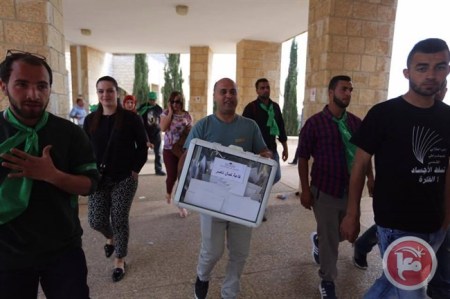
Ma’an – April 28, 2016
RAMALLAH – A student bloc of the Hamas movement on Wednesday came out on top in the closely-followed elections at Birzeit University in the occupied West Bank city of Ramallah.
Following debates between factions vying for the student vote, the pro-Hamas al-Wafaa Islamic bloc claimed victory after gaining 25 seats, with the Yasser Arafat bloc of the Fatah movement trailing behind with 21 seats.
The bloc representing Leftist movement Palestinian Front for the Liberation of Palestine for its part came out with five seats, while other leftist parties including the Democratic Front for the Liberation of Palestine and the Palestinian People’s Party did not receive enough votes to garner a seat.
Voter turnout was reported as 76 percent of the student body.
The Islamic bloc last year won elections for the first time since 2007 at the historically staunchly pro-Fatah campus, taking observers by surprise.
As this year marked ten years since the last national elections, university elections are seen as important indicators of public opinion by political commentators in Palestine and Birzeit is considered to be the most important campus in the yearly political contests.
The Hamas movement congratulated the Islamic bloc for its win at Birzeit and said the victory was an indicator that the movement still had strong sway among the Palestinian public.
The Gaza-based movement said the win came despite efforts by both the Israeli authorities and Palestinian Authority to suppress the Hamas vote, citing the detention of Student Council President Saif al-Islam Daghlas and other students.
Human Rights Watch last year slammed the PA for detaining Palestinian university students across the West Bank after elections “for no apparent reason other than their connection to Hamas or their opinions.”
Hamas’ victory over Fatah comes as the rival factions have shown continued failure to follow through on with attempts to form a unity government since April 2014, after being on cold terms since 2006 when Hamas won the Palestinian legislative elections.
In the following year, violent clashes erupted between Fatah and Hamas, leaving Hamas in control of Gaza and Fatah in control of the occupied West Bank.
Factional disputes between Palestinian factions have been on the rise since a wave of unrest erupted across the occupied Palestinian territory in October.
Hamas and PFLP in particular have lambasted the PA’s ongoing security coordination with Israel as an alleged attempt to quash resistance against the Israeli occupation, while Hamas last summer accused the PA of attempting to eradicate the movement from the West Bank.
Elections haven’t been held in the occupied Palestinian territory for ten years and the public has grown increasingly disillusioned with Palestinian political parties.
Frustration has grown among the youth in particular, with growing numbers showing preference for participating in demonstrations or resistance that are not affiliated with any political party.
Hamas: France peace conference a ‘waste of time’
MEMO | April 24, 2016
Hamas said it rejects the France-sponsored international peace conference between the Palestinians and the Israelis, which is scheduled to take place on May 30 in Paris.
“We consider it a waste of time and a free service for the Israeli government that continues its daily violations against the Palestinians,” Hamas spokesman Sami Abu Zuhri told Anadolu Agency on Saturday.
Abu Zuhri also warned against agreeing to any deal that would harm the Palestinians and their national interests.
In March, Palestinian President Mahmoud Abbas affirmed his support for the French proposal.
Peace talks between Israeli and Palestinian negotiators collapsed in April 2014 over Israel’s refusal to release a group of Palestinian political prisoners despite earlier pledges to do so.
Yes, Hillary Clinton Is a Neocon
By Robert Parry | Consortium News | April 16, 2016
If there were any doubts that Hillary Clinton favors a neoconservative foreign policy, her performance at Thursday’s debate should have laid them to rest. In every meaningful sense, she is a neocon and – if she becomes President – Americans should expect more global tensions and conflicts in pursuit of the neocons’ signature goal of “regime change” in countries that get in their way.
Beyond sharing this neocon “regime change” obsession, former Secretary of State Clinton also talks like a neocon. One of their trademark skills is to use propaganda or “perception management” to demonize their targets and to romanticize their allies, what is called “gluing white hats” on their side and “gluing black hats” on the other.
So, in defending her role in the Libyan “regime change,” Clinton called the slain Libyan leader Muammar Gaddafi “genocidal” though that is a gross exaggeration of Gaddafi’s efforts to beat back Islamic militants in 2011. But her approach fits with what the neocons do. They realize that almost no one will dare challenge such a characterization because to do so opens you to accusations of being a “Gaddafi apologist.”
Similarly, before the Iraq War, the neocons knew that they could level pretty much any charge against Saddam Hussein no matter how false or absurd, knowing that it would go uncontested in mainstream political and media circles. No one wanted to be a “Saddam apologist.”
Clinton, like the neocons, also shows selective humanitarian outrage. For instance, she laments the suffering of Israelis under crude (almost never lethal) rocket fire from Gaza but shows next to no sympathy for Palestinians being slaughtered by sophisticated (highly lethal) Israeli missiles and bombs.
She talks about the need for “safe zones” or “no-fly zones” for Syrians opposed to another demonized enemy, Syria’s President Bashar al-Assad, but not for the people of Gaza who face the wrath of Israeli Prime Minister Benjamin Netanyahu.
“Yes, I do still support a no-fly zone [in Syria] because I think we need to put in safe havens for those poor Syrians who are fleeing both Assad and ISIS and have some place that they can be safe,” Clinton said. But she showed no such empathy for Palestinians defenseless against Israel’s “mowing the grass” operations against men, women and children trapped in Gaza.
In Clinton’s (and the neocons’) worldview, the Israelis are the aggrieved victims and the Palestinians the heartless aggressors. Referring to the Gaza rocket fire, she said: “I can tell you right now I have been there with Israeli officials going back more than 25 years that they do not seek this kind of attacks. They do not invite the rockets raining down on their towns and villages. They do not believe that there should be a constant incitement by Hamas aided and abetted by Iran against Israel. …
“So, I don’t know how you run a country when you are under constant threat, terrorist attack, rockets coming at you. You have a right to defend yourself.”
Ignoring History
Clinton ignored the history of the Israeli-Palestinian conflict, which dates back to the 1940s when Israeli terrorist organizations engaged in massacres to drive Palestinians from their ancestral lands and murdered British officials who were responsible for governing the territory. Israeli encroachment on Palestinian lands has continued to the present day.
But Clinton framed the conflict entirely along the propaganda lines of the Israeli government: “Remember, Israel left Gaza. They took out all the Israelis. They turned the keys over to the Palestinian people. And what happened? Hamas took over Gaza. So instead of having a thriving economy with the kind of opportunities that the children of the Palestinians deserve, we have a terrorist haven that is getting more and more rockets shipped in from Iran and elsewhere.”
So, Clinton made clear – both at the debate and in her recent AIPAC speech – that she is fully in line with the neocon reverence for Israel and eager to take out any government or group that Israel puts on its enemies list. While waxing rhapsodic about the U.S.-Israeli relationship – promising to take it “to the next level” – Clinton vows to challenge Syria, Iran, Russia and other countries that have resisted or obstructed the neocon/Israeli “wish list” for “regime change.”
In response to Clinton’s Israel-pandering, Sen. Bernie Sanders, who once worked on an Israeli kibbutz as a young man, did the unthinkable in American politics. He called out Clinton for her double standards on Israel-Palestine and suggested that Netanyahu may not be the greatest man on earth.
“You gave a major speech to AIPAC,” Sanders said, “and you barely mentioned the Palestinians. … All that I am saying is we cannot continue to be one-sided. There are two sides to the issue. … There comes a time when if we pursue justice and peace, we are going to have to say that Netanyahu is not right all of the time.”
But in Hillary Clinton’s mind, the Israeli-Palestinian dispute is essentially one-sided. During her speech to the American Israel Public Affairs Committee last month, she depicted Israel as entirely an innocent victim in the Mideast conflicts.
“As we gather here, three evolving threats — Iran’s continued aggression, a rising tide of extremism across a wide arc of instability, and the growing effort to de-legitimize Israel on the world stage — are converging to make the U.S.-Israel alliance more indispensable than ever,” she declared.
“The United States and Israel must be closer than ever, stronger than ever and more determined than ever to prevail against our common adversaries and to advance our shared values. … This is especially true at a time when Israel faces brutal terrorist stabbings, shootings and vehicle attacks at home. Parents worry about letting their children walk down the street. Families live in fear.”
Yet, Clinton made no reference to Palestinian parents who worry about their children walking down the street or playing on a beach and facing the possibility of sudden death from an Israeli drone or warplane. Instead, she scolded Palestinian adults. “Palestinian leaders need to stop inciting violence, stop celebrating terrorists as martyrs and stop paying rewards to their families,” she said.
Then, Clinton promised to put her future administration at the service of the Israeli government. Clinton said, “One of the first things I’ll do in office is invite the Israeli prime minister to visit the White House. And I will send a delegation from the Pentagon and the Joint Chiefs to Israel for early consultations. Let’s also expand our collaboration beyond security.”
Pleasing Phrases
In selling her neocon policies to the American public, Clinton puts the military aspects in pleasing phrases, like “safe zones” and “no-fly zones.” Yet, what she means by that is that as President she will invade Syria and push “regime change,” following much the same course that she used to persuade a reluctant President Obama to invade Libya in 2011.
The Libyan operation was sold as a “humanitarian” mission to protect innocent civilians though Gaddafi was targeting Islamic militants much as he claimed at the time and was not engaging in any mass slaughter of civilians. Clinton also knew that the European allies, such as France, had less than noble motives in wanting to take out Gaddafi.
As Clinton confidant Sidney Blumenthal explained to her, the French were concerned that Gaddafi was working to develop a pan-African currency which would have given Francophone African countries greater freedom from their former colonial master and would undermine French economic dominance of those ex-colonies.
In an April 2, 2011 email, Blumenthal informed Clinton that sources close to one of Gaddafi sons reported that Gaddafi’s government had accumulated 143 tons of gold and a similar amount of silver that “was intended to be used to establish a pan-African currency” that would be an alternative to the French franc.
Blumenthal added that “this was one of the factors that influenced President Nicolas Sarkozy’s decision to commit France to the attack on Libya.” Sarkozy also wanted a greater share of Libya’s oil production and to increase French influence in North Africa, Blumenthal wrote.
But few Americans would rally to a war fought to keep North Africa under France’s thumb. So, the winning approach was to demonize Gaddafi with salacious rumors about him giving Viagra to his troops so they could rape more, a ludicrous allegation that was raised by then-U.S. Ambassador to the United Nations Susan Rice, who also claimed that Gaddafi’s snipers were intentionally shooting children.
With Americans fed a steady diet of such crude propaganda, there was little serious debate about the wisdom of Clinton’s Libyan “regime change.” Meanwhile, other emails show that Clinton’s advisers were contemplating how to exploit Gaddafi’s overthrow as the dramatic moment to declare a “Clinton Doctrine” built on using “smart power.”
On Oct. 20, 2011, when U.S.-backed rebels captured Gaddafi, sodomized him with a knife and then murdered him, Secretary of State Clinton couldn’t contain her glee. Paraphrasing a famous Julius Caesar quote, she declared about Gaddafi, “we came, we saw, he died.”
But this U.S.-organized “regime change” quickly turned sour as old tribal rivalries, which Gaddafi had contained, were unleashed. Plus, it turned out that Gaddafi’s warnings that many of the rebels were Islamic militants turned out to be true. On Sept. 11, 2012, one extremist militia overran the U.S. consulate in Benghazi killing U.S. Ambassador Christopher Stevens and three other Americans.
Soon, Libya slid into anarchy and Western nations abandoned their embassies in Tripoli. President Obama now terms the Libyan fiasco the biggest mistake of his presidency. But Clinton refuses to be chastened by the debacle, much as she appeared to learn nothing from her support for the Iraq invasion in 2003.
The Libyan Mirage
During Thursday’s debate – instead of joining Obama in recognition of the Libyan failure – Clinton acted as if she had overseen some glowing success: “Well, let me say I think we did a great deal to help the Libyan people after Gaddafi’s demise. … We helped them hold two successful elections, something that is not easy, which they did very well because they had a pent-up desire to try to chart their own future after 42 years of dictatorship. I was very proud of that. …
“We also worked to help them set up their government. We sent a lot of American experts there. We offered to help them secure their borders, to train a new military. They, at the end, when it came to security issues, … did not want troops from any other country, not just us, European or other countries, in Libya.
“And so we were caught in a very difficult position. They could not provide security on their own, which we could see and we told them that, but they didn’t want to have others helping to provide that security. And the result has been a clash between different parts of the country, terrorists taking up some locations in the country.”
But that is exactly the point. Like the earlier neocon-driven “regime change” in Iraq, the “regime change” obsession blinds the neocons from recognizing that not only are these operations violations of basic international law regarding sovereignty of other nations but the invasions unleash powerful internal rivalries that neocons, who know little about the inner workings of these countries, soon find they can’t control.
Yet, America’s neocons are so arrogant and so influential that they simply move from one catastrophe to the next like a swarm of locust spreading chaos and death around the globe. They also adapt readily to changes in the political climate.
That’s why some savvy neocons, such as the Brookings Institution’s Robert Kagan, have endorsed Clinton, who The New York Times reported has become “the vessel into which many interventionists are pouring their hopes.”
Kagan told the Times, “I feel comfortable with her on foreign policy. If she pursues a policy which we think she will pursue it’s something that might have been called neocon, but clearly her supporters are not going to call it that; they are going to call it something else.”
Now with Clinton’s election seemingly within reach, the neocons are even more excited about how they can get back to work achieving Syrian “regime change,” overturning Obama’s nuclear deal with Iran, and – what is becoming their ultimate goal – destabilizing nuclear-armed Russia and seeking “regime change” in Moscow.
After all, by helping Assad bring some stability to Syria and assisting Obama in securing the Iranian nuclear deal, Russian President Vladimir Putin has become what the neocons view as the linchpin of resistance to their “regime change” goals. Pull Putin down, the thinking goes, and the neocons can resume checking off their to-do list of Israel’s adversaries: Syria, Iran, Hezbollah, Hamas, etc.
And what could possibly go wrong by destabilizing nuclear-armed Russia and forcing some disruptive “regime change”?
By making Russia’s economy scream and instigating a Maidan-style revolt in Moscow’s Red Square, the neocons see their geopolitical path being cleared, but what they don’t take into account is that the likely successor to Putin would not be some malleable drunk like the late Russian President Boris Yeltsin but, far more likely, a hardline nationalist who might be a lot more careless with the nuclear codes than Putin.
But, hey, when has a neocon “regime change” scheme veered off into a dangerous and unanticipated direction?
A Neocon True-Believer
In Thursday’s debate, Hillary Clinton showed how much she has become a neocon true-believer. Despite the catastrophic “regime changes” in Iraq and Libya, she vowed to invade Syria, although she dresses up that reality in pretty phrases like “safe zones” and “no-fly zones.” She also revived the idea of increasing the flow of weapons to “moderate” rebels although they, in reality, mostly fight under the command umbrella of Al Qaeda’s Nusra Front.
Clinton also suggested that the Syria mess can be blamed on President Obama’s rejection of her recommendations in 2011 to authorize a more direct U.S. military intervention. “Nobody stood up to Assad and removed him,” Clinton said, “and we have had a far greater disaster in Syria than we are currently dealing with right now in Libya.”
In other words, Clinton still harbors the “regime change” goal in Syria. But the problem always was that the anti-Assad forces were penetrated by Al Qaeda and what is now called the Islamic State. The more likely result from Clinton’s goal of removing Assad would be the collapse of the Syrian security forces and a victory for Al Qaeda’s Nusra Front and/or the Islamic State.
If that were to happen, the horrific situation in Syria would become cataclysmic. Millions of Syrians – Alawites, Shiites, Christians, secularists and other “infidels” – would have to flee the beheading swords of these terror groups. That might well force a full-scale U.S. and European invasion of Syria with the bloody outcome probably similar to the disastrous Iraq War.
The only reasonable hope for Syria is for the Assad regime and the less radical Sunni oppositionists to work out some power-sharing agreement, stabilize most of the country, neutralize to some degree the jihadists, and then hold elections, letting the Syrian people decide whether “Assad must go!” – not the U.S. government. But that’s not what Clinton wants.
Perhaps even more dangerous, Clinton’s bellicose rhetoric suggests that she would eagerly move into a dangerous Cold War confrontation with Russia under the upside-down propaganda theme blaming tensions in Eastern Europe on “Russian aggression,” not NATO’s expansion up to Russia’s borders and the U.S.-backed coup in Ukraine in 2014 which ousted an elected president and touched off a civil war.
That coup, which followed neocon fury at Putin for his helping Obama avert U.S. bombing campaigns against Syria and Iran, was largely orchestrated by neocons associated with the U.S. government, including Assistant Secretary of State for European Affairs Victoria Nuland (Robert Kagan’s wife), Sen. John McCain and National Endowment for Democracy President Carl Gershman.
After the violent coup, when the people of Crimea voted by 96 percent to secede from Ukraine and rejoin Russia, the U.S. government and Western media deemed that a “Russian invasion” and when ethnic Russians in eastern Ukraine rose up in resistance to the new authorities in Kiev that became “Russian aggression.”
NATO on the Move
Though President Obama should know better – and I’m told that he does know better – he has succumbed this time to pressure to go along with what he calls the Washington “playbook” of saber-rattling and militarism. NATO is moving more and more combat troops up to the Russian border while Washington has organized punishing economic sanctions aimed at disrupting the Russian economy.
Hillary Clinton appears fully onboard with the neocon goal of grabbing the Big Enchilada, “regime change” in Moscow. Rather than seeing the world as it is, she continues to look through the wrong end of the telescope in line with all the anti-Russian propaganda and the demonization of Putin, whom Clinton has compared to Hitler.
Supporting NATO’s military buildup on Russia’s border, Clinton said, “With Russia being more aggressive, making all kinds of intimidating moves toward the Baltic countries, we’ve seen what they’ve done in eastern Ukraine, we know how they want to rewrite the map of Europe, it is not in our interests [to reduce U.S. support for NATO]. Think of how much it would cost if Russia’s aggression were not deterred because NATO was there on the front lines making it clear they could not move forward.”
Though Clinton’s anti-Russian delusions are shared by many powerful people in Official Washington, they are no more accurate than the other claims about Iraq’s WMD, Gaddafi passing out Viagra to his troops, the humanitarian need to invade Syria, the craziness about Iran being the principal source of terrorism (when it is the Saudis, the Qataris, the Turks and other Sunni powers that have bred Al Qaeda and the Islamic State), and the notion that the Palestinians are the ones picking on the Israelis, not the other way around.
However, Clinton’s buying into the neocon propaganda about Russia may be the most dangerous – arguably existential – threat that a Clinton presidency would present to the world. Yes, she may launch U.S. military strikes against the Syrian government (which could open the gates of Damascus to Al Qaeda and the Islamic State); yes, she might push Iran into renouncing the nuclear agreement (and putting the Israeli/neocon goal to bomb-bomb-bomb-Iran back on the table); yes, she might make Obama’s progressive critics long for his more temperate presidency.
But Clinton’s potential escalation of the new Cold War with Russia could be both the most costly and conceivably the most suicidal feature of a Clinton-45 presidency. Unlike her times as Secretary of State, when Obama could block her militaristic schemes, there will be no one to stop her if she is elected President, surrounded by likeminded neocon advisers.
Investigative reporter Robert Parry broke many of the Iran-Contra stories for The Associated Press and Newsweek in the 1980s. You can buy his latest book, America’s Stolen Narrative, either in print here or as an e-book (from Amazon and barnesandnoble.com).
Hamas slams Twitter for closing of accounts
Press TV – April 1, 2016
Hamas has slammed Twitter for closing several accounts linked to the Palestinian resistance movement, saying the company is biased in favor of the Israeli regime.
The Hamas military wing, Ezzedine al-Qassam Brigades, said in a statement on Friday that its English- and Arabic-language accounts had been shut down for the third time in a fortnight.
Twitter is showing a “clear bias to the Israeli occupation where it should (adopt a) neutral position toward both sides,” the statement added.
It said that the closure comes while Twitter allows Israeli officials to encourage “racism, extremism and terrorism” on the social networking site.
Qassam also urged Twitter to reopen its accounts, saying one of those closed accounts had been followed by over 140,000 followers.
Twitter declined to comment, saying in a statement that the company does not comment on individual accounts citing “privacy and security reasons.”
Since its establishment in December 1987, Hamas has refused to recognize Israel and adopted resistance against the Israeli occupation, which it believes is the sole way of bringing about the liberation of occupied Palestinian territories. The movement says its goal is to liberate the entire Palestine.
The Palestinian resistance movement scored a landslide victory in Palestinian elections in 2006. Hamas has ruled the Israeli-blockaded Gaza Strip, while Fatah has set up headquarters in the occupied Palestinian territories in the West Bank.
Israel has waged three large-scale aerial and ground wars on Gaza in the past seven years. In its latest act of aggression in the summer of 2014, which lasted for 50 days, the regime killed about 2,200 Palestinians and inflicted heavy damage on Gaza’s infrastructure and economy. In that latest Israeli aggression, Twitter shut down most of Hamas’ accounts.
Sanders’ Written Remarks to AIPAC
By Stephen Lendman | March 23, 2016
AIPAC is a rogue lobbying group with enormous influence in Washington, one-sidedly supporting Israel at the expense of regional peace and Palestinian rights.
Bernie Sanders addressed its annual conference in spirit, not in person, delivering his remarks in written form – expressing longstanding support for a ruthless apartheid state run by hate-mongering Zionist zealots.
“Israel is one of America’s closest allies,” he said, “and we – as a nation – are committed not just to guaranteeing (its survival), but also to its people’s right to live in peace and security.”
Fact: Both countries partner in each other’s high crimes, Sanders failed to explain.
Fact: Israel’s survival isn’t threatened. Its only threats are ones it creates. Sanders paid no heed to its longstanding reign of terror on defenseless Palestinians.
Fact: Calling their freedom fighters “terrorists” mocks their dignity, humanity, and “right to live in peace and security” Israel systematically denies them.
Claiming as president he’ll “work tirelessly to advance the cause of peace as a partner and as a friend to Israel” belies reality.
No peace process exists, not now or earlier going back decades. Israel rejects it out-of-hand, pretending otherwise, wanting historic Palestine for Jews only, its people denied their fundamental rights.
Sanders knows what he won’t explain, one-sidedly supporting Israel while pretending otherwise. His voting record belies his claim about being “a friend not only to Israel, but to the Palestinian people.” When did he ever introduce legislation supporting their rights? Never!
He backs naked Israeli aggression on the phony pretext of responding to Hamas rocket attacks, used only in self-defense.
Saying he “believe(s) that Israel, the Palestinians, and the international community can, must, and will rise to do what needs to be done to achieve a lasting peace” ignores what never happened before and won’t now.
Again, Sanders knows what he won’t say, maintaining the fiction of efforts for regional peace when none exist. Washington and Israel systematically undermine them.
His formula for peace isn’t reality based. After decades of Israeli state terror, slow-motion genocide affecting an entire population, punctuated by intermittent premeditated wars, apartheid worse than South Africa’s, and governance of, by and for hate-mongering Zionist zealots, how can anyone believe it wants peace and stability.
Sanders is like all the rest, demanding “Hamas and Hezbollah renounce their efforts to undermine the security of Israel… Peace has to mean security for every Israeli from violence.”
Saying “attacks of all kinds against Israel” must end is code language for wanting Palestinians denied their international law guaranteed right of self-defense.
Adding “peace also means security (and well-being) for every Palestinian,” their right to “self-determination, (and) ending ‘what amounts’ (sic) to the occupation of Palestinian territory, establishing mutually agreed upon borders, and pulling back settlements in the West Bank (like earlier) in Gaza” ignores no possibility of achieving any of the above.
Sanders failed to explain Ariel Sharon’s so-called disengagement from Gaza transferred its settlers to stolen Palestinian West Bank land, displacing Palestinians from what’s rightfully theirs.
It put Jews out of harm’s way ahead of three Israeli wars of aggression on Gaza – in 2008-09, 2012 and 2014, along with frequent aerial and ground assaults, an entire population terrorized and besieged for nearly a decade with no prospect for relief.
Sanders saying “economic blockade of Gaza” must end ignores its political imposition, unrelated to security concerns.
Expressing rhetorical support for “a sustainable and equitable distribution of precious water resources so (both sides) can thrive as neighbors” ignores his one-sided support for Israel for 30 years.
He willfully lied, claiming Israel’s 2014 Gaza war followed “weeks of indiscriminate rocket fire into its territory and the kidnapping of (its) citizens.”
Operation Protective Edge was planned months in advance, naked Israeli aggression unrelated to Hamas rockets (launched only in self-defense after repeated Israeli provocations) and nonsensical kidnapping claims.
Sanders can’t get his facts straight, including false claims about Hamas “construct(ing) a network of tunnels for military purposes.”
They’re built as a vital lifeline, supplying goods essential to survive, restricted or prohibited by Israel’s suffocating blockade, one of many examples of its genocidal policy – what Sanders never explains.
His address featured numerous examples of misinformation and one-sided support for Israel. Rhetorically expressing concern for Palestinian rights rang hollow.
Throughout his political career, he never cared. Why should anyone believe he turned a new leaf.
Judge him and other politicians only by their voting record. Rhetoric is meaningless.
Stephen Lendman can be reached at lendmanstephen@sbcglobal.net.
His new book as editor and contributor is titled Flashpoint in Ukraine: US Drive for Hegemony Risks WW III.
Featured Video

US IRAN TALKS: Who Are the Crazy Ones Here? /Lt Col Daniel Davis
or go to
Aletho News Archives – Video-Images
From the Archives
Wartime internment camps in Australia
National Archives of Australia
World War I
During World War I, for security reasons the Australian Government pursued a comprehensive internment policy against enemy aliens living in Australia.
Initially only those born in countries at war with Australia were classed as enemy aliens, but later this was expanded to include people of enemy nations who were naturalised British subjects, Australian-born descendants of migrants born in enemy nations and others who were thought to pose a threat to Australia’s security.
Australia interned almost 7,000 people during World War I, of whom about 4,500 were enemy aliens and British nationals of German ancestry already resident in Australia.
Records of World War I internment camps
World War II
During World War II, Australian authorities established internment camps for three reasons – to prevent residents from assisting Australia’s enemies, to appease public opinion and to house overseas internees sent to Australia for the duration of the war.
Unlike World War I, the initial aim of internment during the later conflict was to identify and intern those who posed a particular threat to the safety or defence of the country. As the war progressed, however, this policy changed and Japanese residents were interned en masse. In the later years of the war, Germans and Italians were also interned on the basis of nationality, particularly those living in the north of Australia. In all, just over 20 per cent of all Italians resident in Australia were interned. … continue
Blog Roll
 Aletho News
- Diplomats slam US negotiators’ performance in Iran talks
- Trump Refuses Exit Ramp, War with Iran will Continue
- Trump Says US Naval Blockade in Strait of Hormuz Will Begin Shortly
- US, Iran end 21-hour talks without agreement
- US IRAN TALKS: Who Are the Crazy Ones Here? /Lt Col Daniel Davis
- Talks with the US end without a deal over excessive US demands: Iran
- Feeling Better, Getting Worse: How Psychiatric Drugs Create the Illusion They Cure
- ‘Nobody Told Me’: Former Mental Health Patient Calls Out Dangerous Side Effects of Psychiatric Drugs
- Dr. Abu-Sitta: Beirut ‘felt like a day in Shifa Hospital’
- Iran Has Won the War, It Will Be Up to the US to Secure the Peace: Mohammad Marandi
- If Americans Knew
- US-Iran ceasefire negotiations make zero progress – Daily Update
- Pro-Israel ‘Thinktanks’ and Individuals who Influence U.S. Foreign Policy
- Mearsheimer reveals how Israel dictates US policies on Iran, Gaza – video
- After killing 350+, Israel still has a “score to settle” with Lebanon before ceasefire – Daily Update
- Military aid to Israel emerges as the latest political litmus test for Democrats
- The only Palestinian children’s rights organization closes following years-long Israeli campaign against it
- ‘I Can’t Forget the Smell’: Lebanese Reel After Israel Kills Over 300 in Single Day
- DNC Shoots Down Resolutions Calling Out AIPAC and Limiting Arms to Israel
- TCN: Is Israel Blackmailing President Trump?
- Israel killed at least 303 Lebanese yesterday – who were they? Daily Update
- No Tricks Zone
- German Expert: Heat Dome Led To Record Temps In Western USA…Warmer In 1934, 1936
- New Study: No Linear Warming Or Glacier Retreat Along Northern Antarctic Peninsula Since 1980s
- An Inconvenient Tree: Uncovered In Alps… Europe Much Warmer Than Today 6000 Years Ago
- New Study Reports A 60% Slowdown In Greenland’s Ice Loss Rate In The Last Decade
- Low Intensity Tornado Wrecks Major Solar Farm, Creating A Potential Toxic Dump
- New Study Finds Warming Saves Lives…Cold Temperatures 12 Times More Deadly Than Excess Heat
- German Science Blog Accuses PIK Climate Institute Of Hallucinating Climate Tipping Points
- Devastating Assessment Of Comirnaty Vaccine By Former Senior Pfizer Europe Toxicologist
- New Study: CO2 Is ‘Effectively Negligible’ As An Explanatory Climate Change Factor Since 2000
- Former Pfizer Toxicologist Dr. Helmut Sterz Tells Bundestag Hearing Pfizer Vaccine Should Have Never Been Approved
 Aletho News