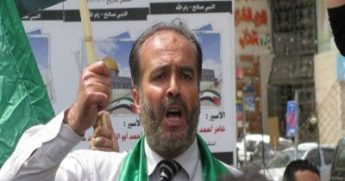
Wasfi Qabha, former Palestinian minister of detainees and ex-detainees in the government of Ismail Haniyeh, was sentenced to twelve months in Israeli prison by a military court on Wednesday, 28 September. Qabha, a prominent leader in Hamas, has been repeatedly arrested by Israeli occupation forces and has spent a total of 12 years in Israeli prisons.
Qabha was arrested from his family home in Jenin by Israeli occupation forces in May; his wife stated that he was charged with a number of charges in the military courts related to his public activities in campaigns supporting Palestinian prisoners in Israeli jails. His sentence was accompanied with an 18-month suspended sentence and a 2,000 NIS (approximately $500) fine.
Also on Wednesday, member of the Palestinian Legislative CouncilMohammed Jamal Natsheh was arrested among 43 others in pre-dawn arrest raids carried out by Israeli occupation forces throughout the West Bank. Natsheh was released from Israeli prisons after his previous arrest less than seven months ago. He was previously imprisoned without charge or trial under administrative detention. A member of the PLC representing the Change and Reform bloc associated with Hamas, Natsheh has repeatedly been arrested since his election in 2006, usually ordered to administrative detention without charge or trial.
Among the pre-dawn raids included the seventh day in a row of violent occupation military raids on Shuafat refugee camp and nearby Beit Hanina in Jerusalem, where 13 Palestinians were detained by occupation forces as over 20 homes were invaded and ransacked. The Palestinians arrested were Bilal Eid, Ahmad Imran Muhammad Ali, Mohammed Maher al-Mimi, Muhannad Bilal Anati, Bilal Awwad Anati, Ahmad Tartir, Fadi Eid, Ahmad Bilal Eid, Muayyad Jaber Muheisen, Hamoudeh Jamal Abdel-Qader, Adham al-Sharqawi, Saddam Joudeh and Hamoudeh al-Kirri.
Also arrested in Jerusalem area were Areen Za’anin, Fathi Nasser, Hussam Jamzawi, Ahmad Sajidiya, Fares Aslan, Khalil Qureia and Medhat Khalil, the last a guard of the Al-Aqsa Mosque. Bilal Eid is only 16 while Ahmad Ali is only 15 years old; they are among over 370 Palestinian children held in Israeli jails.
In al-Khalil, alongside Natsheh, also arrested were Mohammed Imam, Mohammed al-Durra, Said Zughayyer, Alaa Abu Ajamieh, Abdel-Rahim Fatafta and Abdul-Qader al-Titi, as well as Abdel-Nasser Abu Maria, 17 years old.
Five Palestinians from Budrus, near Ramallah, were arrested: Malek Marrar, Mohammed Hasan, Hosni Khalifa, Mahmoud Khalifa and Yahya Salama. Wissam Ali, Mohammed Jaber, 17, and Oday Jaber were arrested from the Nur Shams refugee camp near Tulkarem. In Jericho, three Palestinians were seized by occupation forces, including 15-year-old Mohammed Shalalfa, alongside Haitham Shalalfa and Shtayyen Shalalfa; in Qabatiyeh, two Palestinians, Mohammed Assaf and Suheib Abu al-Rub, were arrested. Occupation forces seized Mahmoud Qashmar in Qalqilya and Rashad Issa from al-Khader, near Bethlehem.
On Thursday morning, at least 10 more Palestinians were reported arrested in violent raids by occupation forces, including former prisoners Amin Hamed, 60, and his son Abdelhadi Hamed, 30, arrested in Silwad east of Ramallah in a violent raid on their home, including the explosion of the door of their homes. Abdulhadi’s brother, Abdullah’s, home was raided as well by occupation forces. Their brother Akram is serving a 17-year sentence in Israeli prisons.
British Labour Party leader Jeremy Corbyn has retained the leadership of the opposition political party after a bruising campaign.
Corbyn, who was initially elected last year, took 62 percent of the vote, beating challenger Owen Smith on Saturday.
Surveys had indicated that Corbyn would easily defeat his challenger as he maintained widespread support of party members attracted by his socialist anti-austerity policies and “authentic” image.
On Wednesday, Corbyn urged for the party to unite behind his leadership. He reminded lawmakers that he has the support of rank-and-file members of the party and warned them not to challenge him again.
“We owe it to the millions of people Labour exists to represent to end the sniping and personal attacks, and work together for all those who depend on the election of a Labour government. Anything else would be destructive self-indulgence,” Corbyn said in a statement.
“All Labour Party members and MPs have a responsibility to work within the democracy of our party and respect the leadership of whoever is elected.”
The 67-year-old socialist and peace campaigner has shown little interest for Britain’s special relationship with the US and is opposed to nuclear weapons, including the costly Trident nuclear missile system that is maintained by the US.
Corbyn also is a critic of Israel and NATO. As member of the Palestine Solidarity Campaign, he invited members of the Hezbollah and Hamas resistance movements in 2009 to parliament where he called them “friends.”
By Jon Vale | The Independent | September 23, 2016
The Campaign Against Anti-semitism (CAA) has filed a formal complaint against Labour leader Jeremy Corbyn.
The group has taken action over a video posted on Mr Corbyn’s official Facebook and Twitter accounts.
In the video, Mr Corbyn’s supporters answer questions on topics they are “tired of hearing” about, which includes whether they promote anti-semitism.
The video has subsequently been deleted from social media.
The CAA said this is the latest in a long of line of incidents where Mr Corbyn and his supporters have failed to address anti-semitism. […]
The letter accuses Mr Corbyn of “committing acts that are grossly detrimental to the party, namely characterising Jewish people as dissembling and dishonest in their reporting of anti-semitism, and by using the influence and prestige of his office to disseminate and normalise that lie”.
It continues: “The allegation that Jews lie and deceive in order to further hidden agendas is an age-old anti-semitic trope.
“It has now been manifestly deployed by Mr Corbyn in his leadership campaign video.” … Full article
GAZA – Facebook administration has banned a large number of pro-Palestinian pages and accounts including Hamas-affiliated pages.
The Facebook administration closed over the past few hours several pro-Palestinian pages and accounts, some of which were banned for the tenth time.
A number of online activists accused the administration of online social networking service Facebook of deliberately suspending their accounts to silence the pro-Palestinian pages. Other Hamas members and activists have also voiced similar complaints.
The activists stressed that they never wrote anything on the banned pages that could violate Facebook’s rules.
Filastin al-Hiwar Facebook page which has over 145,000 followers, has also been abruptly suspended by Facebook.
Over the past few days, two Israeli government ministers met top Facebook officials to discuss ways of collaboration between the two parties. The Israeli ministers and Facebook officials have agreed to work together to determine “how to tackle incitement on the social media network,” according to an Israeli newspaper.
A top European Union lawyer says Hamas should be dropped from the bloc’s blacklist, citing lack of concrete evidence showing the involvement of the Palestinian resistance movement in alleged terrorist activities.
Eleanor Sharpston, an advocate general at the European Court of Justice (ECJ), urged on Thursday the removal of both Hamas and the Liberation Tigers of Tamil Eelam (LTTE), a Sri Lankan rebel group, from the EU terror list.
The EU “cannot rely on facts and evidence found in press articles and information from the internet, rather than in decisions of competent authorities, to support a decision to maintain a listing,” Sharpston said.
In 2001, the EU adopted regulations to combat terrorism. Under the rules, the bloc imposed travel bans and asset freezes against Hamas and the LTTE.
In 2014, however, the General Court of the European Union, the second-highest court in the bloc, ordered both Hamas and the LTTE to be struck off the bloc’s terror list in two separate decisions. The court said the EU had based its decision, regarding the blacklist of the groups, on publicly available information rather than on any finding by a competent authority.
The Council of the EU, representing the governments of member states, in turn appealed the court ruling.
Elsewhere in her remarks, the top EU lawyer called on the ECJ to reject the appeal.
Given that “some of the reasons advanced could not justify the decision to maintain the listing of LTTE and Hamas,” the General Court was correct to dismiss the EU appeal when it could find no other sufficient reasons for their listing, Sharpston said.
Accordingly, the ECJ “should annul the measures maintaining Hamas and LTTE on the EU list of terrorist organizations on procedural grounds,” she added.
Hamas has ruled the impoverished and the Israeli-blockaded Gaza Strip since 2006, when it scored a landslide victory in legislative polls.
Israeli forces markedly increased their attacks on Palestinian civilians in the Gaza Strip during the second quarter of 2016, United Nations (UN) data has revealed, with concerns that such violence endangers the viability of the ceasefire that ended ‘Operation Protective Edge’ in 2014.
During the period April-June, there were an average of more than 90 shooting incidents per month by Israeli forces in Gaza’s so-called access restricted areas (ARA) – some 60 on land, and 30 at sea. This is more than double the equivalent average figures for the last six months of 2015.
Israeli forces have long attacked farmers, fishermen and other civilians in Gaza’s ARA. As the UN described in July, Israel’s unilaterally-imposed access restrictions are “enforced by firing direct or warning live ammunition, the destruction of property, arrests and the confiscation of equipment.”
Presenting the latest figures in a quarterly update published last month, the UN’s Office for the Coordination of Humanitarian Affairs (OCHA) in the Occupied Palestinian Territory (OPT) described “the use of force by Israel” in the ARA as a “particular cause for concern.”
According to James Heenan, head of office at the Office of the United Nations High Commissioner for Human Rights in the occupied Palestinian territory, “there are almost daily shooting incidents by Israeli forces into Gaza, often resulting in injury and even death as well as destruction of property.”
In most cases, Heenan told Middle East Monitor, “there are no indications that Israeli forces were in any imminent threat to have justified the level of force employed, including use of firearms. Often victims are farmers, fishermen, children, and demonstrators.”
On April 3, the Israeli authorities announced an expansion of the permitted fishing zone off the southern Gaza coast from six to nine miles (note that the Oslo Accords stipulate a 20-mile limit). However, on June 26, less than three months later, the six-mile limit was re-imposed.
By July, according to OCHA, more than 90 fishermen had been arrested and detained, “the highest figure in any year since records began in 2009.” Over nine days in August, for example, Israeli forces attacked Palestinian fishermen on six different occasions (Aug. 21, 23, 25, 27, 28, 29).
In May, meanwhile, it was reported that the Israeli army would allow farmers to access land close to the border fence, under the supervision of the International Committee of the Red Cross (ICRC). Since 2014, the ICRC has been helping Gaza’s farmers to rehabilitate land and secure access.
While some farmers have clearly benefited, a Jerusalem-based ICRC spokesperson declined to comment on Israeli forces’ continued attacks in the ARA, saying that “any issues of concern are addressed as part of our confidential and bilateral dialogue with all parties to the conflict.”
As one farmer told activists recently: “My lands are relatively close to the fence, so I cannot set foot in them between 6pm and 6am without getting shot at. What can I do if the electricity does not come before 6pm? I have to leave my land without watering, risking the loss of the crop.”
The violence used by Israeli forces against Palestinian civilians in the Gaza Strip is vastly under-reported in the English-language Western media. The majority of attacks on fishermen, farmers, and demonstrators do not even get a mention.
Such attacks, however, cannot be divorced from the bigger picture in the Gaza Strip, including the ‘security’ dimension that is typically understood by journalists, analysts, and policy-makers in terms of projectile fire and Israeli military responses.
According to Fawzi Barhoum, a Gaza-based Hamas spokesperson, Hamas views Israeli forces’ routine use of violence against Palestinians in the ARA as a violation of the 2014 ceasefire. “Hamas records all the violations, and updates the regional sponsors of the ceasefire accordingly”, he said.
Furthermore, Barhoum added, such attacks by Israeli forces “endanger the status quo.”
Each time, Hamas discusses what happens with the other Palestinian factions, who evaluate together what is the best response to the Israeli violation in question; whether it is silence, condemnation, warnings, firing short-range rockets, unleashing snipers on the borders, etc.
Thus, aside from the cost for farmers and fishermen of Israel’s policy of violently enforcing a ‘no-go zone’ inside Gaza, such attacks, clearly on the rise, also risk further undermining a ceasefire agreement that brought ‘calm’ for Israel, but nothing like it for Palestinians.
RAMALLAH – Israeli Occupation Forces (IOF) carried out a large-scale arrest campaign against over 20 members and leader of Hamas Movement in the West Bank.
Local sources revealed that Israeli soldiers arrested the Hamas leader Hussein Abu Kuwaik, representative of Hamas in the central elections committee.
The arrest of the Hamas leader Kuwaik came just one day after the committee had announced opening of registration for candidature in the electoral lists of the committee which reflects Israeli targeting of the Movement and the lists it supports.
The sources also reported that the IOF soldiers broke into the home of the Hamas leader Jamal Abu al-Haija in addition to the homes of three of his sons.
They searched the houses thoroughly, wreaked havoc on them, and confiscated his son’s car.
The forces also confiscated the contents of his son’s electronic devices shop as well as appliances inside the homes.
The Israeli forces stormed the house after midnight by blowing up its main door, Abu al-Haija’s son said.
They gathered the family members in one room and interrogated all of them.
Clashes erupted after the storming of Abu al-Haija’s home in Jenin city and in its refugee camp.
Arrests also took place in al-Khalil, Ramallah and other locations in Jenin city after the storming of Palestinians’ homes and confiscation of computers and other property of the arrested.
GAZA – Hamas on Thursday denied Israeli allegations that the manager of World Vision’s Gaza office, Mohammed al-Halabi, passed millions of dollars to Hamas.
Hamas spokesperson Abdullatif al-Kanou’ said the group had “no connection to al-Halabi and therefore, all Israeli accusations are counterfeit and aim to suppress our people and toughen the blockade”.
Israel’s Shin Bet agency accused al-Halabi of funneling millions of dollars in aid money to Hamas, charges that the resistance group denied and the charity voiced skepticism over.
World Vision official Mohammed al-Halabi appeared before a court on Thursday, facing charges of using millions of charity funds in aid to Hamas.
The Israeli intelligence agency Shin Bet claimed Hamas recruited al-Halabi more than a decade ago.
The agency said since al-Halabi took over World Vision operations in Gaza in 2010, roughly 60 per cent of World Vision’s annual budget in the territory was diverted to Hamas.
Mohammad al-Halabi, World Vision’s manager of operations in Gaza, was arrested by Israel on June 15 while crossing the border into the enclave.
World Vision said it was “shocked” by Israel’s allegations and said in a statement that it had regular internal and independent audits and evaluations as well as a broad range of internal controls to ensure aid reached intended beneficiaries.
World Vision added that al-Halabi has worked with the group for 10 years, and that they have “no reason to believe” the allegations against their employee are true.
“World Vision is a Christian relief, development and advocacy organization dedicated to working with children, families and communities to overcome poverty and injustice,” the statement further read.
“World Vision serves all people regardless of religion, race, ethnicity or gender. World Vision has been working in the occupied Palestinian territories for over 40 years, striving to give hope to over 500,000 of the most vulnerable children, through education, health, child protection and resilience programs. We continue to call for a fair, legal process,” it added.
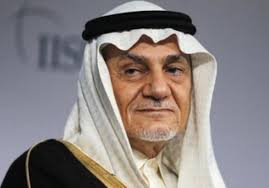
Palestinian resistance movements Islamic Jihad and Hamas have denounced remarks made by Saudi Prince Turki al-Faisal, saying such remarks serve the Zionist occupation.
Faisal, who in the past served as Saudi Arabia’s intelligence chief, said at a conference of the Iranian opposition over the weekend that the Iranian regime supports Hamas and Islamic Jihad in Palestine in order to cause instability in the region.
The Islamic Jihad said Faisal’s remarks serve the Israeli agenda that seeks to eliminate the Palestinian cause and open all the Arab and Islamic capitals to the Zionist entity.
“We tell those people: if you can’t stand up for Palestine and its people at least don’t stand by the Zionist entity to condemn the victim,” the Islamic Jihad movement said in a statement on Sunday.
“The Saudi Muslim people won’t accept to pave the way for the Israelis to reach Mecca and Medina.”
For its part, Hamas condemned the remarks, saying they were “baseless.”
“Everyone knows that Hamas is a Palestinian movement fighting the Zionist occupation in the land of Palestine, and has only a Palestinian agenda … and it adopts the concept of moderate Islam,” said a statement by the group.
Hamas further accused Faisal of saying things that serve the “Zionist occupation and provide it with further pretexts to carry out aggression against the Palestinian people.”
Executives from Google and Facebook have faced enormous political pressure from forces as diverse as Pres. Obama himself to the Israel Lobby, to rid their sites of Islamist content. Over the years, videos portraying ISIS beheadings have outraged the public (though not on YouTube or Facebook, which immediately removes them). Now it appears that the Israel Lobby and their right-wing allies are demanding further action restricting access for videos they deem offensive.
The companies are discussing various methods to automate the removal of the videos, which would supposedly wipe the sites clean of Islamist extremism in a more thorough, speedy fashion. Currently, they use an algorithm which help police videos which violate copyright. If someone uploads a video whose content has already been flagged, an algorithm prevents it being uploaded again by another user. They plan to use a similar process to flag offensive videos by detecting whether they’ve been previously censored.
However, there is a fly in the ointment regarding this process. The companies have invited into this discussion a neocon NGO which is a product of the Israel Lobby. The group, Counter-Extremism Network (CEN), hired a computer scientist from Dartmouth College who claims to have developed software with which it can successfully police these sites for offending content. Microsoft has, somewhat alarmingly, agreed to fund and provide research support to develop the professor’s system for its websites.
The companies have rightly displayed some skepticism about the group’s “generous” offer. CEN is a neocon organization founded by a pro-Israel apparachik from the Bush administration, Mark Wallace. Wallace is a veteran GOP consultant, turned capitalist entrepreneur and anti-Iran warrior. He also founded a sister-organization, United Against a Nuclear Iran (UANI-Rightweb profile and my own profile of it), which targeted (often falsely) American companies it claimed were doing business with Iran and violating the sanctions regime.
The nadir of UANI’s vitriolic anti-Iran campaign was its targeting of international shipping magnate, Victor Restis. In these cases, Wallace and his cronies would approach a corporate target and demand a large donation in return for ceasing the embarrassing publicity UANI directed at the victims. Most preferred to pay up. Unlike the other corporate targets, Restis fought back and sued UANI for libel. The suit proceeded in federal court until the Justice Department intervened, claiming that moving forward would jeopardize U.S. national security. The judge then dismissed the case, refusing to permit Restis to clear his name.
Journalists speculated that UANI was using information supplied to it by foreign intelligence sources, specifically the Mossad or other Israeli outlets. The Justice Department intervention was reported to be a favor offered by the Obama administration to the Israeli government, so as not to reveal its covert intervention in American politics. The favor wasn’t repaid when Netanyahu became the foremost opponent of the Iran nuclear deal opposed also by UANI.
Now that the agreement is a done deal, Wallace appears to have moved on. Instead of Iran being the bogeyman, now it is ISIS. With the recent outcry over Islamist attacks in Paris, San Bernardino and Ft. Hood, Islamism has become the target of choice for the Israel Lobby and allies like Wallace.
Counter Extremism Network’s “terror list”
The group’s name is a misnomer. It doesn’t fight against “extremism.” It fights against Islam. There are countless violent extremists in the world who aren’t Muslim. But CEN has no interest in them. I’m attaching a screenshot of its list of targets. Only four non-Muslim groups: the Ku Klux Klan, Golden Dawn, Jobbik, and a German neo-Nazi party. As opposed to 25 Muslim terror organizations.
To give you a sense of how ridiculous these designations are: the Muslim Brotherhood is a group which participated in a democratic election and won the Egyptian presidency. Only to have the democratic government violently overthrown in a military coup. If anyone is a terrorist, it is the putchist al-Sisi, who overthrew Mohammed Morsi. The “Nusra Front” is also on the list. This bona fide Islamist extremist group is Israel’s current ally in the war against the Assad regime.
Among prominent groups missing from this list are violent Israeli settler groups like Hilltop Youth and Jewish Underground, which have murdered many Palestinian civilians.
I’m also surprised the BDS movement isn’t on the list. No doubt that’s an oversight that will be corrected.
Joining Wallace in founding CEN was ex-Sen. Joe Lieberman. On its board are other Israel Lobby veterans, Dennis Ross and Irwin Cotler. CEN’s name is a misnomer. It is not anti-extremist, it is anti-Muslim.
It’s important to note a parallel campaign by the Israeli government to pressure these social media platforms to censor content it deems hate speech, by which it means critical of Israel and the Occupation. There can be no doubt that although CEN hasn’t formally joined with this initiative, the two are bound up with each other tighter than Siamese twins.
Which raises the critical point: who decides what is “extremist?” Clearly, a beheading is extremist. An imam’s sermon calling for the extermination of non-Muslims qualifies. Overtly advocating violence qualifies. But what about a Hamas video that advocates resistance against Israel’s illegal Occupation which has killed tens of thousands over the past 50 years? Or a Hamas video which depicts the devastation of Gaza in the aftermath of the 2014 war? Does a Hezbollah video depicting the destruction of wide swaths of southern Lebanon after the 2006 Israeli invasion quality as “extremist?” In other words, is all content published by these groups censored by virtue of their designation as terrorists? Is that really what we wish the internet to become? A restricted space policed by ideologically-suspect algorithms?
I would strongly urge these technology companies to develop their own solutions to this problem and not rely on far-right Islamophobic ideologues for methods to censor the internet.
A group of employees working with international organisations active in the Gaza Strip have been found to be carrying out activities against the resistance, security website Al-Majd reported yesterday.
Security sources told the Hamas owned website that the group was found to be carrying out doubtful activities related to work sites for the Palestinian resistance.
Later on, the workers of international aid organisations were questioned and they recognised that they are connected to international intelligence services.
The foreigners recognised that they were asked to record footage of resistance work sites such as tunnels, military bases and other sensitive places, in addition to monitoring military movements in Gaza.
The security source reiterated that these collaborators used their work with the international aid organisations to cover-up their anti-resistance acts.
At the same time, they recognised that they are run by international intelligence services connected with the Israeli occupation.
A Canadian court has awarded $13 million in non-diplomatic assets seized from Iran to the families of Americans who died in several attacks globally, which had allegedly been sponsored by Tehran between 1983 to 2002.
The judgment by the Ontario Superior Court of Justice, obtained by AFP on Friday, found Tehran responsible for financing and training Hamas and Hezbollah operatives, who carried out eight bombings or hostage-takings in Buenos Aires, Israel, Lebanon and Saudi Arabia over a period spanning nearly 20 years.
“Terrorism is one of the world’s greatest threats,” Ontario Superior Court Justice Glenn Hainey said in his decision. “The broad issue before the court is whether Iran is entitled to immunity from the jurisdiction of Canadian courts for its support of terrorism.”
The ruling for the $13 million payout does not affect Iran’s diplomatic property in Canada but does touch non-diplomatic properties and a list of frozen bank accounts. Tehran did not immediately comment on the court judgment.
The suit was heard under the 2012 Justice for Victims of Terror Act, which allows the families’ victims to collect damages from state sponsors of terror groups. In Canada, Iran is designated a sponsor of terrorism.
The judgment on June 10 mirrors a recent American court ruling against Tehran that was also won by families of the terrorist attack victims in the United States in Spring. Iran has promised to battle the decision in international courts.
Since 1984, the US has been labeling Iran a leading state sponsor of terrorism, a charge that was reiterated last week. However, global events explode Washington’s credibility and denial of reality.
Russia’s Defense Ministry, for example, this week reported that some 270 civilians were killed within 24 hours from shelling of Syria’s second city, Aleppo, by Al-Qaeda-affiliated terror groups.
Moscow said the surge in violence by these groups followed from the curbing of Russian air strikes at the request of Washington – purportedly to spare “moderate rebels” located in the same areas as Al-Qaeda terror brigades.
The latter include Jabhat al-Nusra and Islamic State (IS, formerly ISIS/ISIL), both of which are internationally proscribed by the United Nations Security Council.
As noted by former British ambassador to Syria, Peter Ford, the risible pretext of protecting “moderates” is a cynical cover for the unavoidable fact that the US is, in effect, siding with Al-Qaeda terrorism in Syria for the overthrow of the Assad government.
It has been reliably documented that the anti-government militia in Syria affiliated with Al-Qaeda, including Jaysh al-Islam and Ahrar al-Sham, are supported materially and politically by the governments of Saudi Arabia, Qatar and NATO-member Turkey – all close allies of Washington.
Also in the news, just as the latest US State Department report came out pillorying Iran over terrorism, the United Nations condemned the Saudi-led military coalition in Yemen for inflicting 60 percent of child deaths over the past year in the war-torn country.
The Saudi-led coalition includes the US and Britain which supplies warplanes and logistics for air raids purportedly aimed at defeating Houthi rebels who ousted the US-Saudi-backed regime in early 2015. The latest UN report also condemned the Saudi coalition for destroying hospitals and schools across Yemen, which had already been designated as the Arab region’s poorest country even before the US-Saudi military intervention began in March 2015.
Disgracefully, within days of the report being published UN Secretary General Ban Ki-Moon buckled under political pressure and removed Saudi Arabia and its coalition partners from a global blacklist of rights violations against children.
Nevertheless, while in Syria the terrorist campaign is being waged by Al-Qaeda-affiliated groups funded and weaponized indirectly by foreign governments. In Yemen a major part of the violence is attributable directly to the military forces of the same foreign governments. By any definition this is terrorism, either state-sponsored or state-directed.
In presenting its latest global terror report, the US State Department devotes the vast majority of its concern to the threat posed by Islamic State (also referred to as ISIL) and related Al-Qaeda franchises, such as Boko Haram in Nigeria and Al Shabaab in Somalia.
“ISIL remain the greatest terrorism threat globally,” said the US State Department, adding: “ISIL-aligned groups have established branches in parts of the Middle East, North Africa, West Africa, the Russian North Caucasus , and South Asia.”
In the US press briefing at least 95 per cent of the content was connected to Al-Qaeda-linked terror groups. Only about five per cent dealt with Iran and its alleged sponsorship of terrorism.
After detailing ISIS terrorism, the State Department then makes the discrepant assertion: “The United States continues to work to disrupt Iran’s support for terrorism. Iran remains the leading state sponsor of terrorism globally.”
If Iran is the “leading terror sponsor globally”, as Washington claims, then why is its latest global terror report preponderantly taken up with Al-Qaeda and various tentacle organizations?
Moreover, in the fleeting details on Iran in its report, the US bases its claim on the rather hackneyed allegation that “Iran continues to provide support to Hizballah [sic], Palestinian terrorist groups in Gaza, and various groups in Iraq and throughout the Middle East” as well as its support for “the Syrian regime.”
Iran scoffed at the allegations, saying that its support for Hezbollah in Lebanon and Hamas in Palestine is a legitimate alliance with liberation movements against US-backed Israeli state oppression.
As for Washington’s claim that Iranian support for Syria constitutes terror sponsorship, if it were a credible assessment then the US should at least be consistent in its logic and thereby should have included Russia in its latest terror report, given that Moscow is supporting the Syrian government militarily.
The US global terror report does not stand up to scrutiny. Its flagrant disconnect with reality betrays the study as having a political, or more bluntly, propaganda purpose.
The fact is that terrorist activity around the world is, by far, greatly more ascribed to Al-Qaeda-type groups. The US State Department says so itself. These groups are funded ideologically and logistically by Washington’s allies, principally Saudi Arabia. That connection of Saudi sponsorship of terror organizations has even been acknowledged previously by former US Secretary of State Hillary Clinton and the US Treasury Department, among other senior establishment sources.
Hezbollah’s, and by extension Iran’s, alleged involvement in terrorism is an equally politicized subject fraught with murky claims and counter-claims. The US and Israel designate Hezbollah as “terrorist” but the European Union and several European governments do not. Russia officially views Hezbollah as a legitimate political party, which is a member of Lebanon’s coalition government.
Washington’s antagonism to Hezbollah arises from a litany of alleged terrorist actions, including the bombing of a US marines barracks in Beirut in 1983, which killed 241 American troops – the single greatest US military loss since the Second World War.
Several US courts have convicted Hezbollah and Iran of involvement in the Beirut bomb massacre, as well as other atrocities in Lebanon. Hezbollah and Tehran reject many of these accusations. But even if there were some truth to the American claims, it could be reasonably argued that the actions constitute military combat, not terrorism. The US-backed Israeli invasions of Lebanon in 1982 and again in 2006 were themselves arguably acts of aggression, or state-terrorism.
Another disconnect in the latest US terror report highlighting Iran is the flurry of European trade agreements signed with Tehran since the conclusion of the international nuclear accord last year. Iranian Foreign Minister Mohammad Javad Zarif’s trip to Finland last week was but the latest in a host of renewed European relations.
If Iran were such a terrorist pariah, as Washington asserts, would European governments really be courting Tehran with evident diplomatic respect?
It is estimated the US owes Iran upwards of $100 billion in assets frozen since the Islamic revolution in 1979. The US is also accused of dragging its feet on implementing sanctions relief under the terms of the P5+1 nuclear accord that came into effect on January 16 this year.
It seems obvious that one way for Washington to procrastinate on implementing the nuclear accord and the financial rewards due to Iran from unfrozen assets and European trade deals would be for the US to maintain its narrative accusing Iran of “sponsoring terrorism”.
Despite Washington’s narrative sounding increasingly hollow and in denial of its own documented links to global terrorism.
By Donald Neff | Washington Report On Middle East Affairs | January 1996
On January 4, 1948, Jewish terrorists drove a truck loaded with explosives into the center of the all Arab city of Jaffa and detonated it, killing 26 and wounding around 100 Palestinian men, women and children.[1] The attack was the work of the Irgun Zvai Leumi – the “National Military Organization,” also known by the Hebrew letters Etzel – the largest Jewish terrorist group in Palestine. The Irgun was headed by Revisionist Zionist Menachem Begin and had been killing and maiming Arabs, Britons and even Jews for the previous ten years in its efforts to establish a Jewish state.
This terror campaign meant that at the core of Revisionist Zionism there existed a philosophical embrace of violence. … continue
This site is provided as a research and reference tool. Although we make every reasonable effort to ensure that the information and data provided at this site are useful, accurate, and current, we cannot guarantee that the information and data provided here will be error-free. By using this site, you assume all responsibility for and risk arising from your use of and reliance upon the contents of this site.
This site and the information available through it do not, and are not intended to constitute legal advice. Should you require legal advice, you should consult your own attorney.
Nothing within this site or linked to by this site constitutes investment advice or medical advice.
Materials accessible from or added to this site by third parties, such as comments posted, are strictly the responsibility of the third party who added such materials or made them accessible and we neither endorse nor undertake to control, monitor, edit or assume responsibility for any such third-party material.
The posting of stories, commentaries, reports, documents and links (embedded or otherwise) on this site does not in any way, shape or form, implied or otherwise, necessarily express or suggest endorsement or support of any of such posted material or parts therein.
The word “alleged” is deemed to occur before the word “fraud.” Since the rule of law still applies. To peasants, at least.
Fair Use
This site contains copyrighted material the use of which has not always been specifically authorized by the copyright owner. We are making such material available in our efforts to advance understanding of environmental, political, human rights, economic, democracy, scientific, and social justice issues, etc. We believe this constitutes a ‘fair use’ of any such copyrighted material as provided for in section 107 of the US Copyright Law. In accordance with Title 17 U.S.C. Section 107, the material on this site is distributed without profit to those who have expressed a prior interest in receiving the included information for research and educational purposes. For more info go to: http://www.law.cornell.edu/uscode/17/107.shtml. If you wish to use copyrighted material from this site for purposes of your own that go beyond ‘fair use’, you must obtain permission from the copyright owner.
DMCA Contact
This is information for anyone that wishes to challenge our “fair use” of copyrighted material.
If you are a legal copyright holder or a designated agent for such and you believe that content residing on or accessible through our website infringes a copyright and falls outside the boundaries of “Fair Use”, please send a notice of infringement by contacting atheonews@gmail.com.
We will respond and take necessary action immediately.
If notice is given of an alleged copyright violation we will act expeditiously to remove or disable access to the material(s) in question.
All 3rd party material posted on this website is copyright the respective owners / authors. Aletho News makes no claim of copyright on such material.