Honduras and Mexico: Open Season for Journalists
By Nick Alexandrov | CounterPunch | February 7, 2014
Last December, the New York Times’ David Carr reported on Vice President Biden’s trip to China, where he “spoke plainly about the role of a free press in a democratic society.” The benighted audience was surely keen to learn about this Western institution, and “it was heartening to see the White House at the forefront of the effort to ensure an unfettered press,” Carr affirmed. No doubt. Down here on Earth, meanwhile, Washington has long been at the forefront of an effort to promote cultural devastation, targeting journalists, artists, and independent thinkers more generally. This cultural ruin is a predictable consequence of U.S. support for repressive regimes—a tradition Obama has worked hard to uphold.
Consider the June 2009 coup against Honduran President Manuel Zelaya, which four School of the Americas graduates helped orchestrate. Even the attorney responsible for giving it a legal veneer admitted the ouster was “a crime,” and in its aftermath Obama recognized Porfirio Lobo, winner of a fraudulent election marred by political violence and ballot irregularities, as the country’s new leader. Now, Honduran journalists are weathering a “deluge of threats, attacks and targeted killings,” PEN International reported recently. Honduran “economic elites have established unwritten limits as to what can be investigated by major news agencies,” and independent journalists face similar restrictions. Whoever ignores these limits pays the ultimate price.
Nahúm Palacios “opposed the 2009 coup and turned his TV station into an openly pro-opposition channel,” PEN notes. The military threatened him, but he persisted, and he and his girlfriend were murdered in March 2010. Israel Zelaya Díaz covered politics and crime, and managed a program aired on San Pedro Sula’s Radio Internacional. Assailants torched his home in May 2010, and then shot him to death three months later. A group of men stopped television producer Adán Benítez, who had put out a story on gang activity, in July 2011; they demanded his valuables, and then killed him. Medardo Flores Hernández was a volunteer reporter and finance minister for a pro-Zelaya organization when he was gunned down in September 2011. Early the following month, Obama received Honduran President Lobo at the White House, commending his “strong commitment to democracy.” Radio journalist Luz Marina Paz Villalobos, a coup critic, was murdered on December 6, 2011.
Mexican reporters are also at risk, as theirs “has become the most dangerous country in the Western Hemisphere for journalists,” Emily Edmonds-Poli wrote in a Wilson Center report last April, reviewing the situation in this “drug war” ally. In the state of Veracruz, for instance, there was a series, in the spring of 2012, of high-profile killings: a group of men invaded investigative reporter Regina Martínez’s home in Xalapa, and murdered her there. The dismembered bodies of three photojournalists pursuing stories on organized crime were discovered on the side of a highway four days later. “The fear is terrible and well founded,” an ex-reporter told the Guardian’s Jo Tuckman. “The heroes are in the cemetery.” This woman is hardly the only one to have abandoned the profession. A university official in Veracruz, quoted by Edmonds-Poli, surveyed the corpse-strewn landscape: “It’s not that they’re just killing reporters, they’re killing the drive to become one.” The destructive effects are equally far-reaching in Honduras. PEN quotes Honduran activists who “stressed that the neglect, marginalization and underfunding of cultural spaces” have gutted the nation’s creative sector, sharply delimiting the range of questions to which artists and independent researchers can safely respond.
The Honduran and Mexican governments restrict inquiry with generous U.S. assistance. Both states have strong ties to organized crime: efforts to distinguish legitimate from outlaw Honduran institutions, for example, are often meaningless, given the government’s illicit origins in the June 2009 coup. “A representative from a leading NGO in Honduras says at least four high-ranking police officials head drug trafficking organizations,” InSight Crime’s Charles Parkinson wrote on January 29, and Honduran history reveals that such activity is no obstacle to continued U.S. funding. When a Reagan-era DEA agent amassed evidence implicating the country’s top military officials in prohibited activities, for instance, the organization responded by shutting down its Honduran office in 1983. At the time, Washington’s core concern was the vital role Honduras played in the anti-Sandinista crusade. Their ally’s involvement in drug-smuggling was a non-issue, as irrelevant then as today, when the projected 2014 U.S. governmental military and police aid is over 1.75 times the 2009 figure.
Mexican institutions resemble their Honduran counterparts: ties between political elites and organized crime can be traced back at least a century, and this connection was blatantly obvious by the 1970s. That was the decade the national intelligence arm—the Dirección Federal de Seguridad (DFS)—aided by “the attorney general’s office and Federal Judicial Police,” established itself as “the country’s major criminal mafia,” Paul Kenny and Mónica Serrano point out. U.S. officials knew DFS facilitated drug trafficking’s expansion, and “continued to defend and protect the agency” because it “played a central part in Mexico’s fight against left-wing subversion, both directly and through a death squad organized under [DFS head Miguel] Nazar’s supervision, the ‘White Brigade,’” Peter Dale Scott and Jonathan Marshall write. Years later, Mexican law enforcement committed “one out of every three crimes against journalists” from 2009-2011, Edmonds-Poli reports in her Wilson Center study. That three-year span overlaps with the period—between 2008 and 2010—when Washington “allocated over $1.5 billion to Mexico” via the Mérida Initiative, and “U.S. military and police aid in each of these years marked nearly a 10-fold increase over 2007 levels,” according to Witness for Peace. Obama then extended the program—a true Nobel Peace Laureate, reminiscent of luminaries like Henry Kissinger.
In June 1976, for example, Kissinger proclaimed his support for Argentina’s military dictatorship: “We have followed events in Argentina closely,” he stated. “We wish the new government well. We wish it will succeed.” These remarks came six weeks after “military officers organized an exemplary event to combat immorality and communism,” Fernando Báez—author of A Universal History of the Destruction of Books—notes, when they burned volumes “confiscated from bookshops and libraries in the city of Córdoba,” loudly condemning Freud, Marx, Sartre and others. In August 1980, “trucks dumped 1.5 million books and pamphlets… on some vacant lots in the Sarandí neighborhood in Buenos Aires.” After a federal judge gave the command, “police agents doused the books with gasoline and set them on fire. Photos were taken because the judge was afraid people might think the books were stolen and not burned.” The situation was much the same in neighboring Chile, under Pinochet, when “thousands of books were seized and destroyed” during his dictatorship. In 1976, Kissinger met with Pinochet in Santiago, assuring him Washington was “sympathetic with what you are trying to do here.”
Washington also sympathized with South Vietnam’s Ngo Dinh Diem, who in the late 1950s “banned works of fiction that presented the government in an unflattering light,” Joint Chiefs of Staff historian Willard J. Webb wrote. Diem thus proved himself a worthy heir to Pope John XXII, who in 1328 “ordered a book burned because it cast doubt on his omnipotence,” Báez observes, arguing that we have to look further back in time, to 1258, to comprehend the effects of the recent U.S. assault on Iraq. It was in the mid-13th century that “the troops of Hulagu, a descendant of Genghis Khan, invaded Baghdad and destroyed all its books by throwing them into the Tigris.” Hulagu’s particular form of savagery was unsurpassed until the U.S. occupation—“nation-building,” liberal commentators insist, but in reality just one case of Washington-supported cultural destruction.
Nick Alexandrov lives in Washington, DC.

Vladimir Vladimirovich and the Grey Lady
By Robert Bonomo | The Cactus Land | December 26, 2013
Bill Keller, editorialist for the NY Times and former executive editor of the paper, has recently penned a strong attack on Vladimir Putin arguing that Putin’s leadership “deliberately distances Russia from the socially and culturally liberal West”, describing the Kremlin’s policies as “laws giving official sanction to the terrorizing of gays and lesbians, the jailing of members of a punk protest group for offenses against the Russian Orthodox Church, the demonizing of Western-backed pro-democracy organizations as ‘foreign agents’, expansive new laws on treason, limits on foreign adoptions.”
Keller, who during his tenure as executive editor of the NY Times argued for the invasion of Iraq and wrote glowingly of Paul Wolfowitz, makes no mention of Moscow’s diplomatic maneuvers that successfully avoided a US military intervention in Syria or the Russian asylum given to Eric Snowden. Keller, who had supported the US intervention in Syria by writing, “but in Syria, I fear prudence has become fatalism, and our caution has been the father of missed opportunities, diminished credibility and enlarged tragedy,” also made no mention of Seymour Hersh’s stinging dissection of the Obama administration’s misinformation campaign regarding the sarin attacks in Syria. Hersh’s piece, which drives grave doubts into the case against Assad actually having carried out the attacks, was not published in the New Yorker or in the Washington Post, publications that regularly run his work.
Keller focuses on a Russian law that bans the promotion of gay lifestyles in Russia, a far cry from “giving official sanction to the terrorizing of gays and lesbians”, while failing to mention that according to his own paper, 88% of Russians support the law.
Putin did expel the United States Agency for International Development (USAID) from Russia, cutting off the $50 million in aid, most of which went to pro-democracy and anti-corruption groups. The Kremlin believed that much of this money wound up supporting the protest movement against Putin that emerged in 2011. If Russian funding had been suspected in the Occupy Wall Street Movement, would the New York Times have supported Putin for promoting social equality in the US? If the punk band Pussy Riot had broken into a prominent Jewish temple in New York, instead of a Moscow cathedral, and defamed it to call attention to the millions of Palestinians living in refugee camps, would the young ladies have done some time? And if so, would they have received support from all corners of stardom?
The European Model
Quoting Dmitri Trenin, Keller argues that Putin sees Europe in decline, “it’s national sovereignty… is superseded by supranational institutions.” Is Putin mistaken in his assumption? Maybe ask the people of Greece, Spain, or Ireland. Keller also mentions “limits on foreign adoptions” but fails to mention the cause, the Magnitsky Act, which imposed “visa and banking restrictions on Russian officials implicated in human rights abuses.” The Kremlin saw this law as the perfect example of US meddling in internal Russian affairs.
The heart of the Magnistsky saga was the death in Russia, while under custody, of an attorney for Hermitage Capital, a hedge fund run by a British citizen William Browder, who renounced his US citizenship. Browder made billions in Russia before running afoul of Russian authorities. His Hermitage Capital was funded by the Lebanese national Edmond Safra and eventually claimed to have lost $300 million after having moved billions out of Russia. Browder lobbied hard in Washington to have the Magnitsky Act passed. Why was the US involved in passing a law to protect Lebanese and British capital and a Russian prisoner? America hasn’t enough trouble with its own prison system that it needs to legislate on the Russian penal system? Are there no American politicians who have been implicated in human rights abuses?
Keller’s final point is that Putin is being heavy handed over the Ukrainian/EU integration crisis, but Keller avoids discussing the deep historic and ethnic links between Russia and Ukraine. Most Americans would agree that Russia should stay out of NAFTA negotiations, seeing North America as clearly not within the Russian sphere of influence. Ukrainians are deeply divided over the integration with Europe, so why not let the Ukrainians and Russians work out their trade relations without the American government getting involved?
Khodorkovsky
Probably more than any other topic, the NY Times has repeatedly published articles in defense of the long imprisoned and recently freed Russian oligarch Mikhail Khodorkovsky, a man whose rise to power was filled with unsavory schemes to appropriate businesses which were once the property of the Russian people. The NY Times Sabrina Tavernese wrote in 2001 that he had “orchestrated a series a flagrant corporate abuses of minority shareholders unparalleled in the short history of modern Russian capitalism.”
Khdorkovsky eventually wound up the billionaire owner of Yukos Oil, which he planned to sell to Exxon Mobil. Khdorkovsky also had political ambitions, creating the Open Russian Foundation and putting Henry Kissinger and Lord Jacob Rothschild on the board of directors. He was clearly eyeing political power by making close ties with the West, even being named to the Advisory Board of the Carlyle Group, all of which made him a potential threat to the Kremlin.
The Khodorovsky affair was a complex battle for power in Russia with Khodorkovsky playing the Western powers against the strongly nationalistic Putin. But at the NY Times editorialist Joe Nocera in four pieces on Khodorkovsky never delves into the complexities of Putin’s strategy to keep Western interests at bay, preferring to present a black and white scenario of ‘western liberal’ rule of law against the ‘authoritarian’ Putin.
Curiously, the NY Times doesn’t seem so interested in Harvard’s Russia Project which ended in disgrace and professor Andrei Shleifer, Larry Summers protege, being forced to pay a $2 million fine for enriching himself under the guise of a USAID program where he was to ‘teach’ Russians about capitalism. He gave them an interesting lesson, yet was not forced to resign his post at Harvard, possibly due to his close relationship with Summers. Nocera hasn’t written one article on that scandal which is much more relevant to Americans and their iconic institutions, but which also might make him a few enemies closer to home.
Putin and American Values
Most Americans see Eric Snowden as whistleblower and not a traitor, yet the NY Times star editorialist, Thomas Friedman, isn’t so sure, “The fact is, he dumped his data and fled to countries that are hostile to us,” though he doesn’t elaborate on why Russia is a ‘hostile’ nation and he advises Snowden to come home and face the music if he’s truly a patriot, “It would mean risking a lengthy jail term, but also trusting the fair-mindedness of the American people.”
Putin is a social conservative and a fierce patriot who, like many Americans, opposes regime change in the name of democracy. The American people, after failed interventions in Iraq, Afghanistan and Libya, agree with him — both Putin and Americans, unlike the NY Times, vehemently opposed a US intervention in Syria. It seems Putin has more in common with the opinions of Americans than does the NY Times, which begs the question, why is the NY Times so hell bent on demonizing the President of the Russian Federation when he’s supported by more than 60% of the Russian people?
The New York Times has written extensively about the gay rights issue in Russia but 45% of Americans still think that homosexuality is a sin and as the ‘Duck Dynasty’ controversy has revealed, homosexuality in America is still a very divisive issue. Is the prohibition against publicly speaking in favor of gay lifestyles in Russia such an important stumbling block to ties between the two nations when the vast majority of Russians support the law?
Americans probably don’t approve of roads where members of one religion can drive while members of another religion must walk, as occurs in Hebron and reported on by Ynet, “Jewish residents are allowed to cross the road by vehicle, but Palestinians are now only permitted to cross by foot or by bicycle.” They probably wouldn’t look fondly on back of the bus seating for women, yet in spite of this type of segregation in a country that claims to be democratic, the NY Times doesn’t feel compelled to demonize Mr. Netanyahu and his ‘socially conservative’ Likud party.
The Interests of the American People
Just as the NY Times despises Putin and Russia, it’s equally enamored with Israel. Imagine if the millions of Palestinian refugees were not in camps because of their mother’s religion but instead because they were LGBT? What if Netanyahu were held to the same standard as Mr. Putin? How many millions of Palestinian Khodorkovsky’s are languishing in refugee camps in their own country? It seems that Mr. Keller, Mr. Friedman and Mr. Nocera are much more interested in the rights of Khodorkovsky and William Browder than they are in the rights of Palestinian children living in squalor under an Israeli blockade in Gaza.
Saudi Arabia and Israel, the latter through its surrogate AIPAC, lobbied hard for war in Syria and both supposed allies are furiously attempting to undermine peace talks with Iran. The government Putin leads brokered the deal to avoid US involvement in Syria, played an important role in the Iranian peace initiative and also allowed Americans a glimpse into the massive surveillance program the NSA has hoisted upon them by giving refuge to Eric Snowden.
Just as Americans would not look fondly at the Kremlin interfering in domestic American politics, so the Kremlin pushes back when it see US interference in it’s internal affairs, a good example being American aid to opposition groups during the 2011 Moscow protests against Putin. If the US can accept serious human rights violations by supposed allies Israel and Saudi Arabia, can’t it also accept that Russia has its own way of governing itself, based on its own history and culture?
The NY Times does not represent the best interests of most Americans, nor does it use its powerful voice to protect the millions persecuted within the realms of so called allies. The NY Times represents a small sector of US power, bent on propagating special interests at the expense of the vast majority of Americans.
Mr. Putin certainly acts in the best interests of Russia, but curiously enough, by working in his own interest, he has done more to protect the 4th Amendment than the constitutional law professor currently occupying the White House. In Syria he was protecting Russian interests, but by doing so he kept the US out of an intervention that could have easily developed into a major war. If it had been up to the NY Times, we would have intervened in Syria and Snowden would be behind bars awaiting the mercy of the Obama Administration.
So who is a better friend of the American people? There are no doubts that the NY Times is a better friend of the Khodorkovsky’s and William Browder’s of the world but Americans might actually be better off if their government listened more to Putin and less to the Grey Lady.
Featured Video
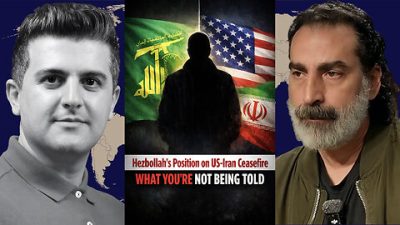
Laith Marouf: Hezbollah’s position on US-Iran ceasefire
or go to
Aletho News Archives – Video-Images
From the Archives
The Dirty Little Secret behind the “Global Terrorism Index”
The Omission of Israeli Terrorism in the Occupied Palestinian Territories
By Karin Brothers | Global Research | December 6, 2014
… The Israeli settlements — all of which are illegal – have been identified as a major impediment to peace. The refusal of a major “global” terrorism report to name the Israeli settlers as one of the groups most responsible for terrorism not only misrepresents a major source of regional violence but exposes the Global Terrorism Index as a propaganda tool that supports a U.S. agenda.
In recent years, governments have been attempting to thwart terrorism by blocking supportive fund-raising. When it comes to Israeli settlements, however, the US and Canada actually encourage fund-raising by giving organizations (such as Christian Friends of Israeli Communities (CFOIC) and the Jewish National Fund) financial support in the form of donor tax-deductions.
Charities which provide funds for the Israeli settlements should be regarded as terror-financing organizations. They should not only lose their tax-deductible status, but they should be banned because they support the violation of international humanitarian law. The terror-financing laws that are being strictly enforced for Muslim charities should be applied to Christian and Jewish charities as well. … Read full article
Blog Roll
 Aletho News
- How UK Regulator Ofcom Quietly Bypassed International Law to Police American Speech
- The Black Cube Files: How Former Mossad Operatives Flipped a Nation
- Laith Marouf: Hezbollah’s position on US-Iran ceasefire: What you’re not being told
- Israel’s priority lies in destroying chances of peace between Iran, US: Ex-UN nuclear chief
- Ceasefire for all or for none: Iran shuts Hormuz over Lebanon attacks
- Strait of Hormuz is Iran’s ‘nuclear weapon’ that forced US retreat: Medvedev
- Energy crisis will last for months – Kremlin envoy
- Europe’s quiet role in the war on Iran
- Forty days that shook the Empire: How Iran turned the tables on US and prevailed
- Netanyahu unilaterally declares Lebanon outside of ceasefire deal
- If Americans Knew
- This is ceasefire? Israel’s biggest massacre yet in Lebanon, another journalist killed in Gaza – Daily Update
- Tucker Carlson on Israel: This Is the Behavior of an Ally? Really?
- Gazans face a triple crisis: severe shortages of water and bread, healthcare in tatters
- NY Times reports how Netanyahu took the US into Iran War
- A sigh of relief over Iran, but Gaza and Lebanon in dire straits – Daily Update
- Thousands dead and neighborhoods razed to the ground: Aid agencies fear southern Lebanon is becoming the new Gaza
- The war the US is fighting for Israel could cost trillions
- ‘Cigarette Burns, Nail Wounds’: Toddler Tortured in Gaza to Coerce Father
- Trump Says US Sent ‘a Lot of Guns’ to Protesters in Iran
- Israeli forces destroy 17 UN peacekeeper cameras in south Lebanon
- No Tricks Zone
- An Inconvenient Tree: Uncovered In Alps… Europe Much Warmer Than Today 6000 Years Ago
- New Study Reports A 60% Slowdown In Greenland’s Ice Loss Rate In The Last Decade
- Low Intensity Tornado Wrecks Major Solar Farm, Creating A Potential Toxic Dump
- New Study Finds Warming Saves Lives…Cold Temperatures 12 Times More Deadly Than Excess Heat
- German Science Blog Accuses PIK Climate Institute Of Hallucinating Climate Tipping Points
- Devastating Assessment Of Comirnaty Vaccine By Former Senior Pfizer Europe Toxicologist
- New Study: CO2 Is ‘Effectively Negligible’ As An Explanatory Climate Change Factor Since 2000
- Former Pfizer Toxicologist Dr. Helmut Sterz Tells Bundestag Hearing Pfizer Vaccine Should Have Never Been Approved
- Energy Expert: Germany’s Nuclear Phaseout Was A “500 Billion Euro Mistake”
- New Research: South Australia’s Mid-Holocene Sea Surface Temperatures Were 4°C Warmer Than Today
 Aletho News