How Israel Instructed Its Worst Nightmare in the Art of War
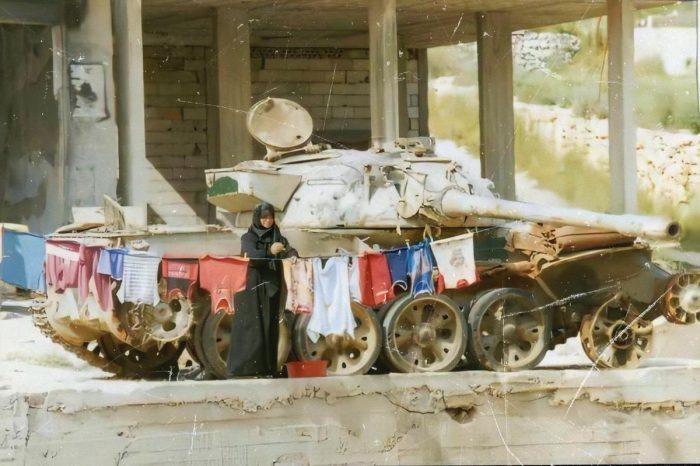
A woman mocks an Israeli tank left behind when withdrawing from south of Lebanon in the year 2000, using it as a hanger to dry cloths. Credit: Younes Zaatari
By Elijah J. Magnier | American Herlad Tribune | May 17, 2020
“We were Hezbollah trainers. It is an organization that learns quickly. The Hezbollah we met at the beginning (1982) is different from the one we left behind in 2000”. This is what the former Chief of Staff and former Minister of Foreign Affairs, Gabi Ashkenazi, said twenty years after the Israeli unconditional withdrawal from Lebanon.
“For the first time we met a non-conventional army, but also an ideological organization with deep faith: and this faith triumphed over us. We were more powerful, more technologically advanced and better armed but not possessing the fighting spirit …They were stronger than us”. This is what Brigadier General Effi Eitam, Commander of the 91st Division in counter-guerrilla operation in south Lebanon said.
Alon Ben-David, senior defense correspondent for Israel’s Channel 13, specialized in defense and military issues, said: “Hezbollah stood up and defeated the powerful Israeli Army”.
Former Prime Minister Ehud Barak, the architect of the Israeli withdrawal from Lebanon, said: “The withdrawal didn’t go as planned. The deterrence of Hezbollah and its capability increased greatly. We withdrew from a nightmare”. Barak meant he had planned to leave behind him a buffer zone under the control of his Israeli proxies led by the “South Lebanon Army” (SLA) commander Antoine Lahad. However, his plans were dismantled and the resistance forced Lahad’s men to run towards the borders, freeing the occupied buffer zone. As they left Lebanon, the Israeli soldiers said: “Thank God we are leaving: no one in Israel wants to return”.
In 1982, Israel believed the time had come to invade Lebanon and force it to sign a peace agreement after eliminating the various Palestinian organizations. These groups had deviated from the Palestinian compass and had become embroiled in sectarian conflict with the Lebanese Phalange, believing that “the road to Jerusalem passed through Jounieh” (the Maronite stronghold on Mt. Lebanon, northwest of Beirut, a slogan used by Abu Iyad). Israel intended Lebanon to become the domicile of its Palestinian conflict. It failed to realize that in so doing it was letting the Shiite genie out of the bottle. Signs of this genie began to appear after the arrival of Sayyed Musa al-Sadr in Lebanon and the return of students of Sayyed Muhammad Baqir al-Sadr from Najaf to their home country and residency in the Lebanese Bekaa. Also, the victory of Imam Khomeini and the “Islamic revolution” in Iran in 1979 was not taken into consideration by Israel, and the potential consequences for the Lebanese Shia were overlooked.
The 1982 Israeli invasion triggered the emergence of the “Islamic resistance in Lebanon”, which later became known as “Hezbollah”, and it forced Israel to leave Lebanon unconditionally in 2000. This made Lebanon the first country to humiliate the Israeli army. Following their victory over the Arabs in 1949, 1956, 1967 and 1973, Israeli officials had come to believe they could occupy any Arab country “with a brass band”.
Israeli soldiers exited through the “Fatima Gate” (on the Lebanese border, also known as Good Fence, HaGader HaTova) under the watchful eyes of Suzanne Goldenberg on the other side of the border. She wrote:
After two decades and the loss of more than 1000 men, the chaotic Israeli withdrawal from southern Lebanon leaves its northern flank dangerously exposed, with Hezbollah guerrillas sitting directly on its border. The scale of the Israeli fiasco was beginning to unfold… After the Israelis pulled out of Bint Jubayl in the middle of the night, their SLA allies, already in a state of collapse in the center of the strip, simply gave up. Branded collaborators, they and their families headed for exile. Behind them, they left tanks and other heavy equipment donated by their patrons. Shlomo Hayun, an Israeli farmer who lives on Shaar Yeshuv farm, said of the withdrawal, “This was the first time I have been ashamed to be Israeli. It was chaotic and disorganized.”
What did Israel and its allies in the Middle East achieve?
In 1978, Israel occupied a part of southern Lebanon and in 1982, for the first time, it occupied an Arab capital, Beirut. During its presence as an occupation force, Israel was responsible for several massacres amounting to war crimes. In 1992, Israel thought that it could strike a death blow to Hezbollah by assassinating its leader, Sayyed Abbas Al-Mousawi. He was replaced by his student, the charismatic leader, Sayyed Hassan Nasrallah. Nasrallah has proved to be more truthful than the Israeli leaders, and thus capable of affecting the Israeli public through his speeches, as Israeli colonel Ronen, chief Intelligence officer for the Central Command of Israel Defence Forces, has said.
The new Hezbollah leader showed his potential for standing up to and confronting Israel through TV appearances. He mastered the psychological aspects of warfare, just as he mastered the art of guerrilla war. He leads a non-conventional but organized army of militants “stronger than several armies in the Middle East,” according to Lieutenant General Gadi Eisenkot, the former Israeli Chief of Staff.
The Israeli doctrine relies on the principle of pre-emptively striking what is considered as a potential threat, in order to extinguish it in its cradle. Israel first annexed Jerusalem by declaring it in 1980 an integral part of the so-called “capital of the state of Israel”. In June 1981, it attacked and destroyed the Iraqi nuclear reactor that France had helped build. In 2007, Israel struck a building in Deir Ezzor, Syria, before it was completed, claiming that the government had been building a nuclear reactor.
6 years after its withdrawal, Israel declared war on Lebanon in 2006, with the aim of eradicating Hezbollah from the south and destroying its military capacity. Avi Kober, a member of the department of political studies at Bar Ilan University and researcher at the Israeli BESA center said:
“The war was conducted under unprecedented and favorable conditions the like which Israel has never enjoyed – internal consensus, broad international support (including tacit support on the part of moderate Arab States), and a sense of having almost unlimited time to achieve the war objectives. The IDF’s performance during this war was unsatisfactory, reflecting flawed military conceptions and poor professionalism and generalship. Not only the IDF fail in achieving battlefield decisions against Hezbollah, that is, denying the enemy’s ability to carry on the fight, despite some tactical achievements, throughout the war, it played into Hizballah’s hands.”
Israel withdrew from the battle without achieving its goals: it was surprised by Hezbollah’s military equipment and fighting capabilities. Hezbollah had managed to hide its advanced weapons from the eyes of Israeli intelligence and its allies, who are present in every country including Lebanon. The result was 121 Israeli soldiers killed, 2,000 wounded, and the pride of the Israeli army and industry destroyed in the Merkava Cemetery in southern Lebanon where the Israeli advance into Wadi al-Hujeir was thwarted.
Hezbollah hit the most advanced class Israeli destroyer, the INS Spear saar-5, opposite the Lebanese coast. In the last 72 hours of the war, Israel fired 2.7 million bomblets, or cluster bombs, to cause long-term pain for Lebanon’s population, either through impeding their return or disrupting cultivation and harvest once they did return. “An unjustified degree of vindictiveness and an effort to punish the population as a whole”, said the report of the UN commission of inquiry conducted in November 2006 (Arkin M. W. (2007), Divining Victory: Airpower in the 2006 Israel-Hezbollah War, Air University Press, Alabama, pp 67-71).
The battle ended, Israel withdrew again, closed the doors behind its army, raised a fence on the Lebanese borders, and installed electronic devices and cameras to prevent any possible Hezbollah crossing into Palestine.
When Israel’s chief of staff Gabi Ashkenazi said “Israel instructed Hezbollah in the art of war”, he was right. Hezbollah has learned from the wars that Israel has waged over the years. In every war, Hezbollah saw the necessity of developing its weapons and training to match and overcome the Israeli army (which is outnumbered) and which enjoys the tacit support of Middle Eastern regimes and the most powerful western countries. Hezbollah developed its special forces’ training and armed itself with precision missiles to impose new rules of engagement, posing a real threat to the continuity of the permanent Israeli violations of Lebanon’s sovereignty.
Today, Hezbollah has sophisticated weapons, including the armed drones that it used in Syria in its war against the Takfirists, and precision missiles that can reach every region, city and airport in Israel. It has anti-ship missiles to neutralize the Israeli navy in any future attack or war on Lebanon and to hit any harbor or oil platform. It is also equipped with missiles that prevent helicopters from being involved in any future battle. The balance of deterrence has been achieved. Hezbollah can take Israel back to the Stone Age just as easily as Israel envisages returning Lebanon to the Stone Age.
Hezbollah is Israel’s worst nightmare, and it was largely created by the Israeli attempt to overthrow the regime in Lebanon, occupy Lebanon, and impose an agreement that Israel could then mold to its own liking. But the tables were turned: a very small force emerged in Lebanon to become a regional power whose powerful support was then extended to the neighboring countries of Syria and Iraq. The harvest journey has begun.
German blacklisting of Hezbollah only serves Israel interests: Iran
Press TV – April 30, 2020
Iran has vehemently condemned the German government’s decision to designate the Lebanese resistance group Hezbollah a “terrorist organization”, saying Berlin must be held to account for the “consequences” its decision will have for the fight against terrorism in the region.
“Certain countries in Europe are apparently adopting their stances without considering the realities in the West Asia region,” said Iranian Foreign Ministry Spokesman Abbas Mousavi in a statement on Thursday night.
Mousavi said the German government’s blacklisting of Hezbollah only serves “the objectives of the propaganda machine of the Zionist regime and the bewildered US regime.”
He further noted that Berlin’s decision totally “disrespects” the Lebanese government and nation, as Hezbollah is a “legitimate and official part of the country’s government and parliament”.
Condemning the German move as “a decision of utmost imprudence”, the Iranian official said the Lebanese resistance movement has been playing a key role in combating the Daesh Takfiri terrorist group in the region.
Earlier in the day, Germany banned all of Hezbollah’s activities in the country and ordered raids on sites police said were linked to the group.
A number of properties in Berlin, Bremen and North Rhine-Westphalia were searched early on Thursday, according to the German police.
The German Interior Ministry, which has issued the ban, says four mosques and cultural associations were raided, as well as private homes of Hezbollah’s board members, treasurers and tax advisers.
Most EU member states have so far refrained from labeling the political arm of the Lebanese resistance movement a “terrorist organization”.
Last year, the British government broke with the rest of Europe to adopt a stance similar to that of Germany against the entire Hezbollah resistance movement.
Hezbollah’s role in an anti-militancy campaign in Syria has angered Western countries that have, for the past eight years, supported terrorist groups opposed to the government of President Bashar al-Assad.
Hezbollah has played a major role in helping Assad purge the Syrian territory from terrorist groups.
The resistance group also responds to Israel’s frequent aerial incursions into Lebanon.
Germany’s Move to Ban Hezbollah May ‘Clearly Be Seen as an Act Against Lebanon’
By Oleg Burunov – Sputnik – 30.04.2020
Germany’s decision to ban Hezbollah can be perceived, among other things, as an act against Lebanon, Middle East expert and Professor Emeritus Werner Ruf from the University of Kassel said on Thursday.
Also, “this is, to my mind, an example of obedience to Israel and the United States because there is no reason for the ban. On the other hand, it should be noted that Germany maintains normal diplomatic relations with Lebanon, where Hezbollah is represented in the government. So what’s the point [of banning the group]?” Ruf, who is also a lecturer at the Rosa Luxemburg Foundation, pointed out.
He added that even though one should not rule out that “donations are sent to certain associations or mosques, which are mainly controlled by Hezbollah”, there is no reason to believe that the organisation poses a security threat to Germany.
On the other hand, Ruf went on to say, the ban “will clearly be seen as an act against Lebanon”, as Hezbollah is represented in the Lebanese government and has great authority – something which should not be overlooked.
According to the expert, Hezbollah was “the only military force that forced Israel to leave Lebanon following the last war [between Beirut and Tel Aviv]”.
“These are completely different perspectives”, he said, adding that when it comes to anyone feeling a threat, “then it is most likely Lebanon [that] feels the menace coming from Israel than vice versa”.
At the same time, Ruf referred to Tel Aviv’s “military superiority”, arguing that Hezbollah is not going to target Israel, given that the Jewish state “has already shown in the last war that it is ready to use almost all types of weapons to destroy Lebanese infrastructure”.
“I do not think that in this situation, Hezbollah would be interested in a new military scenario with Israel”, the expert concluded.
His remarks came after German Interior Ministry spokesman Steve Alter tweeted earlier in the day that Berlin had banned all Hezbollah activities on the country’s territory.
According to him, security forces are currently involved in staging raids against suspected Hezbollah members in a number of German states.
Jewish Group Praises Germany’s ‘Much-Anticipated Move’
American Jewish Committee head David Harris hailed the move as a “welcome, much-anticipated, and significant German decision”, expressing hope that “other European nations will take a close look” at the move and “reach the same conclusion about the true nature of Hezbollah”.
This was preceded by German lawmakers approving a non-binding initiative in December 2019 to call on the government to ban Hezbollah, a Lebanese political party and militant group whose primary basis of support is the country’s Shiite Muslim community.
Iran breaks through US-led blockade to deliver record amount of oil to Syria
Al-Masdar News | April 28, 2020
Iran has managed to break through the U.S. blockade to deliver a large amount of oil to the Syrian Arab Republic, TankerTrackers website has revealed.
According to the website Tanker Trackers, Iran has significantly increased their oil exports to Syria, with several cargoes reportedly reaching the Port of Baniyas in the Tartous Governorate.
The website reported that Iran is currently delivering more than three times the normal amount they export to Syria, which is a significant increase to the Arab Republic, who relied heavily on the Islamic Republic’s oil last year.
“There can be several reasons why this is happening. Excess oil stocks in the midst of sanctions and a global oil glut is forcing Iran to ship and perhaps store the oil in a friendly country. Another reason is that Bashar Assad’s government and Hezbollah can be conduits to sell the oil on the black market. One place Hezbollah can manage to do this is Lebanon, where it has sway over the government,” the website Radio Farda reported.
However, despite these claims, the large oil exports to Syria have less to do with selling the petrol and more to do with the Arab Republic providing relief to its people.
Since the U.S. currently occupies some of Syria’s largest oil fields, the Arab Republic has been forced to find alternatives to meet the civil demand for this resource.
US seeking to replace Iraq’s PMU in the western Anbar province bordering Syria: Analyst
Press TV – April 26, 2020
An Iraqi military advisor and analyst has said that the US is seeking to replace Iraq’s Popular Mobilization Units in the western Anbar province bordering Syria with its own forces.
Speaking to Iraq’s al-Maloumah news agency on Sunday, Safa al-A’ssam said that Washington seeks to force the PMU out of the province’s al-Qaim border region by fanning sectarian tensions.
“The plan is to redeploy American forces to the al-Qaim region on the pretext of countering Deash terrorist attacks and filling the security vacuum following a PMU withdrawal,” he added.
The PMU formed shortly after the emergence of the Daesh terrorist group in Iraq in mid-2014.
The group played a major role pushing back and ultimately defeating the terrorist forces which had taken control of a large swathes of the country.
The Iraqi parliament voted to integrate the PMU into the Iraqi military in 2016, effectively placing the force under the command of the prime minister and granting the group a standing similar to that of other branches of Iraqi security forces.
Fazel Jaber, an Iraqi lawmaker affiliated with the Fatah Alliance, has also warned of attempts by certain Iraqi groups to undermine the PMU’s presence in the province despite being deployed under the command of Iraq’s federal government.
He said the attempts to weaken the PMU were led by Washington, which fears the group’s presence.
The PMU has long rejected Washington’s military presence in the country as an obstacle impeding long-lasting security and stability in Iraq.
In January, Washington assassinated the group’s deputy commander, Abu Mahdi al-Muhandis, alongside Iran’s top anti-terror Lieutenant General Qassem Soleimani in the capital city Baghdad.
Iraqi resistance groups have vowed to take up arms against US forces if Washington fails to comply with a parliamentary order calling for the expulsion of US troops following the assassination.
Buying Punishment for “Terrorists”: Washington’s Reward Program Is Largely Ineffective
By Philip Giraldi | American Herald tribune | April 15, 2020
Many people worldwide are aware of the fact that the United States government offers cash rewards to informants who provide information on individuals and groups that it chooses to define as terrorists. The program is referred to as the Rewards for Justice Program (RFJ). It was established in 1984 as part of the Act to Combat International Terrorism and is run by the Department of State’s Diplomatic Security Service (DS). The rewards can be substantial, up to the $25 million that was offered for Osama bin Laden, and they sometimes include resettlement in another country with a new identity for informants whose security is threatened by their cooperation.
The program relies on information provided by local people, referred to on the RFJ website as “tips.” The website itself is accessible in a number of languages and, in its English version, features a headline that promotes its mission as: “Stop a Terrorist Save Lives. The most important reasons to stop a terrorist are all around you. Terrorism kills innocent people in every walk of life. By providing information that prevents a terrorist act, you save lives, protect families, and preserve peace. The United States is offering a reward for information leading to the arrest of persons engaged in terrorism. If you have information that can help, please submit a tip now. Submit a Tip.”
RFJ elaborates its role in very broad terms as “… offering rewards for information that prevents or favorably resolves acts of international terrorism against U.S. persons or property worldwide. Rewards also may be paid for information leading to the arrest or conviction of terrorists attempting, committing, conspiring to commit, or aiding and abetting in the commission of such acts. The Rewards for Justice Program has paid more than $145 million for information that prevented international terrorist attacks or helped bring to justice those involved in prior acts.”
After a slow start in which the program was first called the Counter Terror Rewards Program and then HEROES, by 1997 the site was processing over one million contacts per year. Admittedly, many of the “tips” were little more than bids to obtain cash and resettlement from the American government, but the State Department’s periodic evaluations of the program have considered it to be a success.
Critics note, however, that the reward for bin Laden attracted thousands of calls but no substantive information was obtained. Nor has RFJ been very effective against Islamic radical groups, considered to be its primary target. The website identifies top terrorist targets, but apart from Ramzi Ahmed Yousef, the World Trade Center bomber of 1993 who was also involved in various plots involving airliners in the Philippines, no one important has been identified and arrested through information developed by way of the program. Ramzi was arrested in Pakistan in 1995 after an informant identified him. He is currently in prison in Colorado.
The RFJ program has also claimed several executions of claimed terrorists, to include the killing of two leaders of the Filipino radical group Abu Sayyaf. Many more terrorist leaders, like ISIS head Abu Bakr al-Baghdadi, were killed without any input from RFJ. The relative lack of success against actual militants from groups recognized generally as terrorist, inevitably led to a broadening of the target pool. On December 22, 2011, RFJ offered a $10 million for information leading to Ezedin Abdel Aziz Khalil, the alleged organizer of an al-Qaeda fundraising operation in Iran that sent money to Pakistan and Afghanistan. It was the first listing of what was claimed to be a terrorist financier.
Two major current targets of RFJ are, in fact, financiers and fund-raising mechanisms related to Lebanese Hizballah and the Iranian Revolutionary Guards Corps (IRGC). To include them on the list, the United States declared both organizations to be Foreign Terrorist Groups (FTOs) in 1997 and 2019 respectively. Regarding Hizballah, the RFJ website includes “Rewards for Justice is offering a reward of up to $10 million for information leading to the disruption of the financial mechanisms of Lebanese Hizballah. Terrorist groups such as Hizballah rely on financing and facilitation networks to sustain operations and launch attacks globally. Hizballah earns almost one billion dollars annually through direct financial support from Iran, international businesses and investments, donor networks, corruption, and money laundering activities. The group uses those funds to support its malign activities throughout the world, including: Deployment of its militia members to Syria in support of the Assad dictatorship; alleged operations to conduct surveillance and gather intelligence in the American homeland; and enhanced military capabilities to the point that Hizballah claims to possess precision-guided missiles. These terrorist operations are funded through Hizballah’s international network of financial supporters and activities — financial enablers and infrastructure that form the lifeblood of Hizballah.”
Regarding the IRGC, the RFJ site includes “The U.S. Department of State’s Reward for Justice Program is offering a reward of up to $15 million for information leading to the disruption of the financial mechanisms of Iran’s Islamic Revolutionary Guard Corps (IRGC) and its branches, including the IRGC-Qods Force (IRGC-QF). The IRGC has financed numerous terrorist attacks and activities globally. The IRGC-QF leads Iran’s terrorist operations outside Iran via its proxies, such as Hizballah and Hamas… Since its founding 40 years ago, the IRGC has been involved in terrorist plots and supports terrorism worldwide. The IRGC is responsible for numerous attacks targeting Americans and U.S. facilities, including those that killed U.S. citizens. The IRGC has supported attacks against U.S. and allied troops and diplomatic missions in Iraq and Afghanistan.”
The first thing that strikes the casual reader of the descriptions of the cases made against both Hizballah and the IRGC is that much of the “evidence” is unsubstantiated, fabricated or exaggerated. To be sure, neither group is a friend of the United States or of Israel, but the descriptions of worldwide terror operations is largely made up, particularly the claims about attacks against Americans which have been credibly attributed to ISIS, not to Iranian sources or proxies. That Lebanese Hizballah has been gathering intelligence on the “American homeland,” presumably to stage an attack, is complete nonsense.
To cite only one example of how the RFJ is primarily a vehicle for attacking individuals and groups that the U.S. and Israel do not like, one might cite Muhammad Kawtharani. Informants would be rewarded for information on the “… activities, networks, and associates of Muhammad Kawtharani, a senior Hizballah military commander. This announcement is part of the Department’s standing reward offer for information leading to the disruption of the financial mechanisms of the terrorist organization Lebanese Hizballah. Muhammad Kawtharani is a senior leader of Hizballah’s forces in Iraq and has taken over some of the political coordination of Iran-aligned paramilitary groups formerly organized by Qassim Soleimani after Soleimani’s death in January. In this capacity, he facilitates the actions of groups operating outside the control of the Government of Iraq that have violently suppressed protests, attacked foreign diplomatic missions, and engaged in wide-spread organized criminal activity. As a member of Hizballah’s Political Council, Kawtharani has worked to promote Hizballah’s interests in Iraq, including Hizballah efforts to provide training, funding, political, and logistical support to Iraqi Shi’a insurgent groups.”
Well, RFJ gets Kawtharani’s name right and he is a Hizballah commander, but from that point on the story is pure spin and disinformation. The militia groups that Kawtharani presumably associates with and that have been attacked by U.S. forces are not “outside control of the government,” nor are they “insurgents.” They are, in fact, integrated into the Iraqi army. Nor have attacks on foreign diplomatic missions been demonstrated to be their responsibility as the rage against U.S. presence in Iraq is widespread across sectarian lines. Kawtharani is present in Iraq as a guest of the government in Baghdad, as was Qassim Soleimani before him, largely to assist in the fighting against ISIS. And if he is in Iraq to promote Hizballah interests in that country, why should it surprise anyone? In short, his being featured in RFJ is part of a plan to create a major incentive to kill him, little more. If he committed an actual terrorism crime or act, where is it?
Rewards for Justice is not about justice at all, unless one is promoting vigilante justice, as virtually no one who appears on its site is actually arrested and tried. It is a kill list providing the United States with one more tool to target and eliminate political opponents from countries with which Washington is not at war. As it has now been expanded to include the targeting of organizations and funding mechanisms of groups that are considered hostile, it is a mechanism for widening the hideous global war on terror that has done such terrible damage to American democracy while also killing hundreds of thousands and upending whole countries worldwide.
Pompeo and Netanyahu paved a path to war with Iran, and they’re pushing Trump again
By Gareth Porter | The Grayzone | March 20, 2020
Though it narrowly averted war with Iran this January, the Trump administration is still pushing for all-out military conflict. The architects of the drive to war, Mike Pompeo and Benjamin Netanyahu, have relied on a series of cynical provocations to force Trump’s hand.
The US may escape the most recent conflict with Iran without war, however, a dangerous escalation is just over the horizon. And as before, the key factors driving the belligerence are not outraged Iraqi militia leaders or their allies in Iran, but Trump’s secretary of state, Mike Pompeo, and Israeli Prime Minister Benjamin Netanyahu, who has long sought to draw the US into a military confrontation with Iran.
Throughout the fall of 2019, Netanyahu ordered a series of Israeli strikes against Iranian allies in Iraq and against Lebanese Hezbollah units. He and Pompeo hoped the attacks would provoke a reaction from their targets that could provide a tripwire to outright war with Iran. As could have been expected, corporate US media missed the story, perhaps because it failed to reinforce the universally accepted narrative of a hyper-aggressive Iran emboldened by Trump’s failure to “deter” it following Iran’s shoot-down of a U.S. drone in June, and an alleged Iranian attack on Saudi oil facility in September.
Pompeo and John Bolton set the stage for the tripwire strategy in May 2019 with a statement by national security adviser John Bolton citing “troubling and escalatory indications and warnings,” implying an Iranian threat without providing concrete details. That vague language echoed a previous vow by Bolton that “any attack” by Iran or “proxy” forces “on United States interests or on those of our allies will be met with unrelenting force.”
Then came a campaign of leaks to major news outlet suggesting that Iran was planning attacks on U.S. military personnel. The day after Bolton’s statement, the Wall Street Journal reported that unnamed U.S. officials cited “U.S. intelligence” showing that Iran “drew up plans to target U.S. forces in Iraq and possibly Syria, to orchestrate attacks in the Bab el-Mandeb strait near Yemen through proxies and in the Persian Gulf with its own armed drones…”
The immediate aim of this campaign was to gain Trump’s approval for contingency plans for a possible war with Iran that included the option of sending as many as 120,000 U.S. troops into region. Trump balked at such war-planning, however, complaining privately that Bolton and Pompeo were pushing him into a war with Iran. Following Iran’s shoot-down of the U.S. drone over the Strait of Hormuz on June 20, Pompeo and Bolton suggested the option of killing Maj. Gen. Qassem Soleimani in retaliation. But Trump refused to sign off on the assassination of Iran’s top general unless Iran killed an American first, according to current and former officials.
From that point on, the provocation strategy was focused on trying to trigger an Iranian reaction that would involve a U.S. casualty. That’s when Israeli Prime Minister Benjamin Netanyahu interjected himself and his military as a central player in the drama. From July 19 through August 20, the Israeli army carried out five strikes against Iraqi militias allied with Iran, blowing up four weapons depots and killing as many Shiite militiamen and Iranian offcers, according to press accounts.
The Israeli bombing escalated on August 25, when two strikes on the brigade headquarters of a pro-Iranian militia and on a militia convoy killed the brigade commander and six other militiamen, and a drone strike on Hezbollah’s headquarters in south Beirut blew the windows out of one of Hezbollah’s media offices.
Netanyahu and Pompeo sabotage Trump and Macron’s attempt at diplomacy
Behind those strikes was Netanyahu’s sense of alarm over Trump toying with the idea of seeking negotiations with Iran. Netanyahu had likely learned about Trump’s moves toward detente from Pompeo, who had long been his primary contact in the administration. On August 26, French President Emanuel Macron revealed that he was working to broker a Trump-Rouhani meeting. Netanyahu grumbled about the prospect of U.S.-Iranian talks “several times” with his security cabinet the day before launching the strikes.
Two retired senior Israeli generals, Gen. Amos Yadlin and Gen. Assaf Oron, criticized those strikes for increasing the likelihood of harsh retaliation by Iran or one of its regional partners. The generals complained that Netanyahu’s attacks were “designed to prod [Iran] into a hasty response” and thus end Trump’s flirtation with talking to Iran. That much was obviously true, but Pompeo and Netanyahu also knew that provoking an attack by Iran or one of its allies might cause one or more of the American casualties they sought. And once American blood was spilled, Trump would have no means to resist authorizing a major escalation.
Kataib Hezbollah and other pro-Iran Iraqi militias blamed the United States for the wave of lethal Israeli attacks on their fighters. These militias responded in September by launching a series of rocket attacks on Iraqi government bases where U.S. troops were present. They also struck targets in the vicinity of the U.S. Embassy.
The problem for Netanyahu and Pompeo, however, was that none of those strikes killed an American. What’s more, U.S. intelligence officials knew from NSA monitoring of communications between the IRGC and the militias that Iran had explicitly forbidden direct attacks on US personnel.
Netanyahu was growing impatient. For several days in late October and early November, he met with his national security cabinet to discuss a new Israeli attack to precipitate a possible war with Iran, according to reports by former Israeli Ambassador Michael Oren. Oren hinted at how a war with Iran might start. ‘[P]erhaps Israel miscalculates,” he suggested, “hitting a particularly sensitive target,” which, in his view, could spark “a big war between Israel and Iran.”
But on December 27, before Netanyahu could put such a strategy into action, the situation changed dramatically. A barrage of rockets slammed into an Iraqi base near Kirkuk where U.S. military personnel were stationed, killing a U.S military contractor. Suddenly, Pompeo had the opening he needed. At a meeting the following day, Pompeo led Trump to believe that Iranian “proxies” had attacked the base, and pressed him to “reestablish deterrence” with Iran by carrying out a military response.
In fact, U.S. and Iraqi officials on the spot had reached no such conclusion, and the investigation led by the head of intelligence for the Iraqi federal police at the base was just beginning that same day. But Pompeo and his allies, Defense Secretary Mark Esper and Chairman of Joint Chiefs Gen. Mark A Milley, were not interested in waiting for its conclusion.
A deception brings the US and Iran to the brink of war
The results of a subsequent Iraqi investigation revealed that the rocket barrage had been launched from a Sunni area of Kirkuk with a strong Islamic State presence, and that IS fighters had carried out three attacks not far from the base on Iraqi forces stationed there in the previous ten days. US signals intercepts found no evidence that Iraqi militias had shifted from their policy of avoiding American casualties at all cost.
Kept in the dark by Pompeo about these crucial facts, Trump agreed to launch five airstrikes against Kataib Hezbollah and another pro-Iran militia at five locations in Iraq and Syria that killed 25 militiamen and wounded 51. He may have also agreed in principle to the killing of Soleimani when the opportunity presented itself.
Iran responded to the attacks on its Iraqi militia allies by approving a violent protest at the U.S. Embassy in Baghdad January 31. The demonstrators did not penetrate the embassy building itself and were abruptly halted the same day. But Pompeo managed to persuade Trump to authorize the assassination of Qassem Soleimani, Iran’s second most powerful figure, presumably by hammering on the theme of “reestablishing deterrence” with Iran.
Soleimani was not only the second most powerful man in Iran and the main figure in its foreign policy; he was idolized by millions of the most strongly nationalist citizens of the country. Killing him in a drone strike was an open invitation to the military confrontation Netanyahu and Pompeo so desperately sought.
During the crucial week from December 28 through January 4, while Pompeo was pressing Trump to retaliate against Iran not just once but twice, it was clear that he was coordinating closely with Netanyahu. During that single week, he spoke by phone with Netanyahu on three separate occasions.
What Pompeo and Netanyahu could not have anticipated was that Iran’s missile attack on the U.S. sector of Iraq’s sprawling al-Asad airbase in retaliation would be so precise that it scored direct hits on six U.S. targets without killing a single American. (The US service members were saved in part because the rockets were fired after the Iraqi government had passed on a warning from Iran to prepare for it). Because no American was killed in the strike, Trump again decided against further retaliation.
Towards another provocation
Although Pompeo and Netanyahu failed to ignite a military conflict with Iran, there is good reason to believe that they will try again before both are forced to leave their positions or power.
In an article for the Atlantic last November, former Israeli Ambassador Michael Oren, channeled Netanyahu when he declared it would be “better for conflict [with Iran] to occur during the current [Trump] administration, which can be counted on to provide Israel with the three sources of American assistance it traditionally receives in wartime,” than to “wait until later.”
Oren was not the only Israeli official to suggest that Israeli is likely to go even further in strikes against Iranian and Iranian allies targets in 2020. After listening to Israeli army Chief of Staff Aviv Kochavi speak in late December, Haaretz military correspondent Amos Harel reported that the Israeli army chief conveyed the clear impression that a “more serious confrontation with Iran in the coming year as an almost unquestionable necessity.” His interviews with Israeli military and political figures further indicated that Israel would “intensity its efforts to hit Iran in the northern area.”
Shockingly, Pompeo has exploited the Coronavirus pandemic to impose even harsher sanctions on Iran while intimidating foreign businesses to prevent urgently needed medical supplies from entering the country. The approaching presidential election gives both Pompeo and Netanyahu a powerful reason to plot another strike, or a series of strikes aimed at drawing the US into a potential Israeli confrontation with Iran.
Activists and members of Congress concerned about keeping the US out of war with Iran must be acutely aware of the danger and ready to respond decisively when the provocation occurs.
Iran and Hezbollah warn Turkey: all your forces are in our line of fire
Iranian Advisory Center in Syria: we call on Turkish forces to act rationally for the benefit of the Syrian and Turkish peoples
Al-Manar, February 29, 2020
The Iranian Advisory Center in Syria, which takes part in the fighting in northern Syria, issued a press release through the news agency U-News in reaction to the recent confrontation between the Syrian army and the Turkish army. It should be noted that the Iranian Advisory Center is made up of the group of Iranian experts who advise the Syrian State and its armed forces, and that this is the first statement it has issued since the beginning of the war in Syria.
Full text of the statement
In reaction to the latest confrontation between the Syrian Arab Army and the Turkish Army, it is important for us to inform the public of the following:
First: We fought alongside the Syrian Arab army and supported it, at the request of the Syrian State, to open the M5 highway, with a Syrian force led by elements of the Iranian Revolutionary Guards and of Hezbollah, and with the participation of factions of the Resistance within the force; and we have helped civilians and residents of the liberated villages.
Second: Protected by the Turkish army, the armed (terrorist) groups attacked the positions of the Syrian army, and so we participated in the fighting aimed at preventing the M5 highway to fall again in their hands.
Third: Since the beginning of the presence of our forces, the Turkish positions located in the Syrian territories have been in the sight of our forces, whether they comply with the Astana Agreements or violate them, but the elements of the Resistance did not strike these Turkish forces out of deference to the decision of their (respective) leaders, and this decision remains in effect until now.
Fourth: Four days ago, foreign elements, Tajiks from the Turkestan Party, elements from the Al-Nusra Front, as well as other terrorist factions, carried out a large-scale attack on the positions of the Syrian army. Our forces directly supported the Syrian Army to prevent the liberated areas from falling into their hands.
Fifth: Despite the defensive nature of the action of our forces, the Turkish army targeted our elements and our forces from the air, with precision missiles and artillery support, which prompted us to send mediators to the Turkish army to end its attacks and renounce this approach
Sixth: Our mediators announced to the Turkish army that the terrorists attacked our positions with their support, that our forces are there to confront the terrorists, and that we are on the side of the Syrian army for this mission; but unfortunately, the Turkish military ignored this request and continued its bombing, and a number of our fighters (Iranian & Hezbollah’s) were martyred.
Seventh: Syrian army artillery responded by striking the source of the fire; for our part, we did not retaliate directly, and once again, we announced to the Turkish army through mediators that we have no objective or decision to confront the Turkish army and that our leadership is determined to reach a political solution between Syria and Turkey.
Eighth: We have informed our forces since morning not to target Turkish forces inside Idlib in order to spare the lives of their soldiers, and our forces have not opened fire, but the Turkish army continues to shell the points and locations of the Syrian army (where we are also located) with artillery fire.
Ninth: The Iranian Advisory Center and the fighters of the Resistance front call on the Turkish forces to act rationally in the interest of the Syrian and Turkish peoples, reminding the Turkish people that their sons (soldiers) have been in our sights for one month and that we could have targeted them in revenge, but we did not do so in accordance with the orders of our leaders; we call on them to pressure the Turkish leadership to rectify its decisions and avoid spilling the blood of Turkish soldiers.
Tenth: Despite the current difficult circumstances, we reaffirm our continuing position alongside the people, the State and the army in Syria in their fight to defeat terrorism and preserve their full sovereignty over the Syrian territories, and we all call on actors to be rational and aware of the great risks of continuing the aggression against Syria.
Iranian Advisory Center in Syria
Translation: resistancenews.org
Israel Sends Condolences for Turkish “Martyrs”. Erdogan Expands War to Hezbollah, Iran
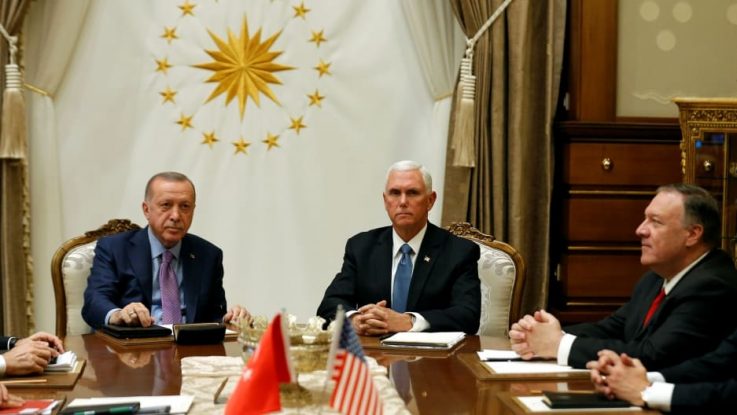
By Marko Marjanović | Anti-Empire | February 29, 2020
In the aftermath of the (probably Russian) strike that killed 33 Turkish soldiers in Syria late (10pm) Thursday Israel sent its condolences for the Turkish “martyrs”, ie using Islamic terminology:
Israel sends its condolences to Turkey over the killing of Turkish soldiers in Idlib.
“We are deeply saddened by the martyring of Turkish soldiers”
Interesting that they used “martyr” in Turkish https://t.co/X8SCOo3nWO
— Ragıp Soylu (@ragipsoylu) February 28, 2020
In fact, earlier that same day as Turkey was hitting the Syrian army heavily around Saraqib Israel snuck in two attacks on the other country:
Israeli helicopters struck Syrian military positions in the Quneitra province in the Syrian Golan Heights and wounded three Syrian soldiers, Syria’s official news agency SANA reported overnight Thursday.
Earlier Thursday, Syrian state TV reported that an Israeli drone fired a missile at a car in southern Syria, killing one person whom it named as a “civilian.” Several other media outlets aligned with Syrian President Bashar Assad’s regime said that the man was a local policeman.
Soon after Turkey expanded its Syria strikes to Hezbollah:
Turkish strikes using drones and smart missiles late on Friday that hit Hezbollah headquarters near Saraqeb killed nine of its members and wounded 30 in one of the bloodiest attacks on the Iran-backed group in Syria ever according to a commander in the regional alliance backing Damascus.
Sure the Shia Lebanese Hezbollah is fighting on the other side in Syria so hitting them would have some tactical value (at a great cost in other ways), but even at the time I wondered if that wasn’t really more a dog whistle to Tel-Aviv and the Israel supporters in DC and the US at large.
Apart from State Department apparatchiks and their hack boss Pompeo, Turkey had found itself very lonely in its new Syria adventure. The asked-for US-manned Patriot missiles to somehow wrestle the control of Idlib skies from Russia aren’t materializing.
But start hitting Hezbollah and suddenly you’ve got the attention of the powerful pro-Israel currents in the US, as well as of Israel itself.
My suspicion was confirmed Saturday when it became clear the Turks had hit Iranians as well:
Statement by Iran’s “advisory mission in Syria”: Turkish army is still shooting at our positions and bases. We call on Turkey to show rational behavior. The Turkish nation’s children are within range of our military forces.
(First statement by Iranian command in Syria, I guess)
— Reza Khaasteh (@Khaaasteh) February 29, 2020
The use of the word “children” above is a misleading translation, the Iranian communique spoke about “sons”, which naturally refers to Turkish troops.
Iranian embassy in Syria: “The Iranian government informed Erdogan that it would respond with full force to the Turkish points if it continued to bomb our forces and the Syrian army.”
— Rojava Network (@RojavaNetwork) February 29, 2020
Iran issued a warning to Erdogan to knock it off or his troops will face the consequences but you get the feeling that may be exactly what Erdogan is trying to provoke. Get the pathologically anti-Iranian Trump administration to see Turkey’s ‘safe-zone-for-bin-Ladenites’ Idlib invasion as an anti-Iranian enterprise and the prospects of American backing look quite a bit brighter.
#Turkey was informed in details of the position of Hezbollah and the Iranian brigades along with the Syrian army but decided to ignore the information and continued bombing these positions over and over again.
It is now clear that Turkey is in the battle with his army to stay.
— Elijah J. Magnier (@ejmalrai) February 29, 2020
Keep in mind that neither #Iran nor #Hezbollah ever attacked the Turkish army until this hour. It is #Turkey that took the initiative to bomb the Iranian-led forces and Hezbollah HQ and military hospital.
— Elijah J. Magnier (@ejmalrai) February 29, 2020
The war scenario between Israel and Hezbollah
By Elijah J. Magnier – 24/02/2020
Notwithstanding the increase in power of the “Axis of the Resistance”, with its precision missiles and unrivalled accumulated warfare experience, the possibility of war is still on the table. The “Axis of the Resistance” is increasing its readiness based on the possibility that Israel may not tolerate the presence of such a serious threat on its northern borders and therefore act to remove it. However, in any future war, the “Axis of the Resistance” considers the consequences would be overwhelmingly devastating for both sides and on all levels if the rules of engagement are not respected. Notwithstanding Israel’s superior air firepower, its enemy Hezbollah has established its own tremendous firepower, and its experience in recent wars in Syria, Iraq and Yemen is an important asset.
Sources within the “Axis of the Resistance” believe the next battle between Hezbollah and Israel, if ever it takes place, would be “controlled and not sporadic, with a focus on specific military objectives without damaging the infrastructure, on both sides”.
The sources consider Gaza as a precedent. In Gaza Palestinians and Israelis have fought many recent battles that lasted only a few days in which the objectives bombed were purely military. This is a new rule of engagement (ROE) regulating conflict between the belligerents. When Israel hits a non-military target, the Palestinian resistance responds by hitting a similar non-military target in Israel. The lesson extracted from the new ROE between Israel and the Palestinians is that every time exchanges of bombing go out of control, both sides understand they have to bring it back to an acceptable and equitable level, to limit damage and keep such mutual attacks from targeting civilians.
The “Axis of the Resistance” therefore considers that the probability is high that the next battle would be limited to military objectives and kept under control. If one side increases the bombing, the other will follow. Otherwise, both sides have the capability to cause total destruction and go on to uncontrolled bombing. In the case of an out-of-control war, allies on both sides would become involved, which renders this scenario less likely.
Hezbollah in Lebanon is said to have over 150,000 missiles and rockets. Israel might suppose that a limited attack could destroy tens of thousands of Hezbollah’s missiles. Is it worth it? “From Israel’s view, Israel may think it is worth triggering a battle and destroying thousands of missiles, thinking that Israel has the possibility to prevent Hezbollah from re-arming itself. But even in this case, Israel doesn’t need to destroy villages or cities or the Lebanese infrastructure, instead, it will limit itself to selective targets within its bank of objectives. However, we strongly doubt Israel could succeed in limiting Hezbollah’s supply of missiles and advanced weapons. Many of these missiles no longer need to be close to the borders with Israel, but can be deployed on the Lebanese-Syrian borders in safe silos”, said the sources.
However, Israel should also expect, according to the same sources, that Hezbollah will respond by bombing significant Israeli military targets within its bank of objectives. “There is no need to bomb airports, power stations, chemical industries, harbours or any highly significant target if Israel doesn’t bomb any of these in Lebanon. But if necessary Hezbollah is prepared to imitate Israel by hitting back without hesitation indiscriminately and against high-value targets, at the cost of raising the level of confrontation to its maximum level. Hezbollah and Israel have a common language in warfare. If the bombing is limited, no side interprets the others’ actions as a sign of weakness”, said the sources.
“Hezbollah doesn’t want war and is doing everything to avoid it. This is why it responded in Moawad, in the suburb of Beirut, when Israeli armed drones failed to reach their objectives. By responding, Hezbollah actually prevented a war on a large scale because it is not possible to allow Israel to get away with any act of war in Lebanon, violating the ROE” said the sources.
Last September, Hezbollah targeted an Israeli vehicle in Avivim with a laser-guided missile in daylight after forcing the Israeli Army to hide for a week and retreat all forces behind civilians lines, imposing a new ROE. The Israeli army cleared the 120 km borders with Lebanon (5 km deep) to avoid Hezbollah’s revenge retaliation for violating the 2006 cessation of hostility’s agreement. Israel refrained from responding and swallowed the humiliation due to its awareness of Hezbollah’s readiness to start a devastating war if necessary.

Israeli officials used to threaten Hezbollah and Lebanon to take the country “back to the stone age”. This is indeed within the reach of Israel’s military capability. However, it is also within Hezbollah’s reach to bring Israel back to the stone age, if required. Hezbollah’s precision missiles can hit any bridge, airport, gasoline deposit containers, power stations, Haifa harbour, oil and gas rig platforms, any infrastructure and military and non-military objectives if Israel attempts to target similar objectives in Lebanon first. Hezbollah’s new missile capability is not new to Israel, who is observing the latest technology Iran’s allies are enjoying and “testing,” mainly in Yemen. The recent bombing of Saudi Arabia oil facilities and the downing of a Saudi Tornado in Yemen revealed that Iran’s HOT missiles are capable of downing jets at medium height and any helicopter violating Lebanese airspace.
Hezbollah’s latest version of the Fateh precision missile, the supersonic anti-ship missiles and the anti-air missiles can prevent Israel from using its navy, stopping any civilian ship from docking in Haifa, thwarting the use of Israeli Helicopters and precision bombing attacks- as in Iran’s latest confrontation with the US at Ayn al-Assad base in Iraq.
Hezbollah’s missiles are unlikely to cause simple traumatic brain injuries – as per the Iranian missile at Ayn al Assad – when hitting targets in Israel in case of war. They can avoid missile interception systems. This increase of capability is a game-changer, and Hezbollah believes it is already decreasing the chances of war. Arming itself with precision missiles and armed drones and showing these capabilities to Israel is Hezbollah’s way to avert a war and protect the equation of deterrence.
In its 2020 security assessment, the Israeli Military Intelligence Directorate (Aman) unwisely evaluated the assassination of the Iranian Major General Qassem Soleimani as a “restraining factor”. Aman’s report, showing astonishing ignorance, stated that Soleimani was responsible for Hezbollah’s missile projects. This lack of understanding of the Hezbollah-Iran relationship and dynamic is quite surprising. Sayyed Ali Khamenei told Hezbollah’s leader Sayyed Hassan Nasrallah decades ago that he knows what he needs and what to do and doesn’t need to fall back on Iran. The IRGC and Hezbollah have set up a collaboration engine that won’t stop even if half of the IRGC leadership is killed. The possession of the feared Iranian precision missiles is no longer a secret: all Iran’s allies have these deployed, in Lebanon, Syria, Iraq and Yemen.
Yesterday is unlike today: the power of destruction now belongs to all parties, no longer to Israel alone. War is no longer an option. US/Israeli aggression will be limited to an economic war, so long as the “Axis of the Resistance” continues updating its warfare capability to maintain deterrence parity.
This article is translated free to many languages by volunteers so readers can enjoy the content.
Copyright © https://ejmagnier.com 2020 @ejmalrai
Don’t Hold Your Breath for ‘World War III’: World War IV Has Already Begun
By A. B. Abrams | The Saker Blog | February 27, 2020
“A. B. Abrams is the author of the book ‘Power and Primacy: A History of Western Intervention in the Asia-Pacific.’ His second book covering the history of the United States’ conflict with North Korea is scheduled for publication in 2020.
He is proficient in Chinese, Korean and other East Asian languages, has published widely on defence and politics related subjects under various pseudonyms, and holds two related Masters degrees from the University of London.”
 The world today finds itself in a period of renewed great power conflict, pitting the Western Bloc led by the United States against four ‘Great Power adversaries’ – as they are referred to by Western defence planners – namely China, Russia, North Korea and Iran. This conflict has over the past 15 years escalated to encompass the military, economic and information spheres with global consequences – and appears to be coming to a head as signs of peaking tensions appear in multiple fields from military deployments and arms races to harsh economic wars and a harsher still information war.
While the term ‘World War III’ has been common since the 1940s, referring to the possibility of a global great power war on a greater scale than the first and second world wars, the Cold War between the Western and Soviet Blocs was at its height as total, as global and as heated as the prior conflicts. As weapons technology has evolved, the viability of a direct shooting war has diminished considerably – forcing major powers to seek alternative means to engineer their adversaries’ capitulation and assert their own dominance. This has been reflected in how the Cold War, and the current phase of global conflict some refer to as ‘Cold War 2’ have been distinct from the first two world wars despite the final objectives of the parties involved sharing many similarities. I would thus suggest redefining what a ‘world war’ is and acknowledging that this current phase of global conflict is every part as intense as the great power ‘hot wars’ waged in the first half of the 20th century.
Had the intercontinental range ballistic missile and the miniaturised nuclear warhead been invented twenty years earlier, the Allied Powers may have needed to rely more heavily on economic and information warfare to contain and eventually neutralise Nazi Germany. The Second World War would have been very different in nature to reflect the technologies of the time. When viewed from this paradigm, the Cold War can be seen as a ‘Third World War’ – a total conflict more vast, comprehensive and international than its predecessors stretched out over more than 40 years. The current conflict, or ‘World War IV,’ is ongoing. An assessment of prior ‘great power wars,’ and the unique nature of the current conflict, can provide some valuable insight into how warfare is evolving and the likely determinants of its victors.
As of 2020 it is clear that great power conflict has become almost as heated as it can short of an all-out hot war – with the Western Bloc applying maximum pressure on the information, military and economic fronts to undermine not only smaller adversaries such as Venezuela and Syria and medium sized ones such as North Korea and Iran, but also China and Russia. When exactly this phase of conflict began – sometime after the Cold War’s end – remains uncertain.
The interval between the third and fourth ‘world wars’ was considerably longer than that between the second and the third. This was due to a number of factors – primarily that there was no immediate and obvious adversary for the victorious Western Bloc to target once the Soviet Union had been vanquished. Post-Soviet Russia was a shade of a shadow of its former self. Under the administration of Boris Yeltsin the country’s economy contracted an astonishing 45% in just five years from 1992 (1) leading to millions of deaths and a plummet in living standards. Over 500,000 women and young girls of the former USSR were trafficked to the West and the Middle East – often as sex slaves (2), drug addiction increased by 900 percent, the suicide rate doubled, HIV became a nationwide epidemic (3) corruption was rampant, and the country’s defence sector saw its major weapons programs critical to maintaining parity with the West delayed or terminated due to deep budget cuts (4). The possibility of a further partition of the state, as attested to multiple times by high level officials, was very real along the lines of the Yugoslav model (5).
Beyond Russia, China’s Communist Party in the Cold War’s aftermath went to considerable lengths to avoid tensions with the Western world – including a very cautious exercise of their veto power at the United Nations which facilitated Western led military action against Iraq (6). The country was integrating itself into the Western centred global economy and continuing to emphasis the peaceful nature of its economic rise and understate its growing strength. Western scholarship at the time continued to report with near certainty that internal change, a shift towards a Western style political system and the collapse of party rule was inevitable. The subsequent infiltration and westernisation was expected to neuter China as a challenger to Western primacy – as it has other Western client states across the world. China’s ability to wage a conventional war against even Taiwan was in serious doubt at the time, and though its military made considerable strides with the support of a growing defence budget and massive transfers of Soviet technologies from cash strapped successor states, it was very far from a near peer power.
North Korea did come under considerable military pressure for failing to follow what was widely referred to as the ‘tide of history’ in the West at the time – collapse and westernisation of the former Communist world. Widely portrayed in the early 1990s as ‘another Iraq’ (7), Western media initially appeared to be going to considerable lengths to prepare the public for a military campaign to end the Korean War and impose a new government north of the 38th parallel (8). Significant military assets were shifted to Northeast Asia specifically to target the country during the 1990s, and the Bill Clinton administration came close to launching military action on multiple occasions – most notably in June 1994. Ultimately a combination of resolve, a formidable missile deterrent, a limited but ambiguous nuclear capability, and perhaps most importantly Western certainty that the state would inevitably collapse on its own under sustained economic and military pressure, deferred military options at least temporarily.
The fourth of the states that the United States today considers a ‘greater power adversary,’ Iran too was going to considerable lengths to avoid antagonism with the Western Bloc in the 1990s – and appeared more preoccupied with security threats on its northern border from Taliban controlled Afghanistan. With a fraction of the military power neighbouring Iraq had previously held, the presence of an ‘Iranian threat’ provided a key pretext for a Western military presence in the Persian Gulf after the Soviets, the United Arab Republic and now Iraq had all been quashed. With the new government in Russia put under pressure to terminate plans to transfer advanced armaments to Iran (9), the country’s airspace was until the mid 2000s frequently penetrated by American aircraft, often for hours at a time, likely without the knowledge of the Iranians themselves. This combined with a meagre economic outlook made Iran seem a negligible threat.
While the Cold War ended some time between 1985 and 1991 – bringing the ‘third world war’ to a close – the range of dates at which one could state that the ‘fourth world war’ began and the West again devoted itself to great power conflict is much wider. Some would put the date in the Summer of 2006 – when Israel suffered the first military defeat in its history at the hands of the Lebanese militia Hezbollah. Using North Korean tunnel and bunker networks, command structures, weapons and training (10), and bolstered by Iranian funding and equipment, the shock of the militia’s victory, though underplayed in Western media, reverberated among informed circles across the world.
Others would place the date two years later in 2008 during the Beijing Summer Olympics, when Georgia with the full support of the West waged a brief war against Russia – and Moscow despite harsh warnings from Washington and European capitals refused to back down on its position. Post-Yeltsin Russia’s relations with the Western Bloc had appeared relatively friendly on the surface, with President George W. Bush observing in 2001 regarding President Vladimir Putin that he “was able to get a sense of his soul,” and predicting “the beginning of a very constructive relationship.” Nevertheless, signs of tension had begun to grow from Moscow’s opposition to the Iraq War at the UN Security Council to President Putin’s famous ‘Munich Speech’ in February 2007 – in which he sharply criticised American violations of international law and its “almost uncontained hyper use of force in international relations.”
It could also be questioned whether, in light of what we know about Western support for separatist insurgents in Russia itself during the 1990s, the war against the country ever ended – or whether hostilities would only cease with a more total capitulation and partition and with the presence of Western soldiers on Russian soil as per the Yugoslav precedent. As President Putin stated in 2014 regarding continuing Western hostilities against Russia in the 1990s: “The support of separatism in Russia from abroad, including the informational, political and financial, through intelligence services, was absolutely obvious. There is no doubt that they would have loved to see the Yugoslavia scenario of collapse and dismemberment for us with all the tragic consequences it would have for the peoples of Russia” (11). Regarding Western efforts to destabilise Russia during the 1990s, CIA National Council on Intelligence Deputy Director Graham E. Fuller, a key architect in the creation of the Mujahedeen to fight Afghanistan and later the USSR, stated regarding the CIA’s strategy in the Caucasus in the immediate post-Cold War years: “The policy of guiding the evolution of Islam and of helping them against our adversaries worked marvellously well in Afghanistan against the Red Army. The same doctrines can still be used to destabilize what remains of Russian power” (12). The U.S. Congressional Task Force on Terrorism and Unconventional Warfare’s director, Yossef Bodansky, himself also detailed the extent of the CIA’s strategy to destabilize Central Asia by using “Islamist Jihad in the Caucasus as a way to deprive Russia of a viable pipeline route through spiralling violence and terrorism” – primarily by encouraging Western aligned Muslim states to continue to provide support for militant groups (13).
Much like the Cold War before it, and to a lesser extent the Second World War, great powers slid into a new phase of conflict rather that it being declared in a single spontaneous moment. Did the Cold War begin with the Berlin Blockade, the Western firebombing of Korea or when the atomic bombs were dropped on Hiroshima and Nagasaki – which accelerated the move into a nuclear arms race. Equally, multiple dates were given for the opening of the Second World War – the German invasion of Poland in 1939, the beginning of the Sino-Japanese war two years prior, the Japanese Empire’s attack on Pearl Harbour and conquest of Southeast Asia which marked the first major expansion beyond Europe and North Africa in 1941, or some other date entirely. The slide into a new world war was if anything even slower than its predecessors.
The shift towards an increasingly intense great power conflict has been marked by a number of major incidents. In the European theatre one of the earliest was the Bush administration’s withdrawal from the Anti-Ballistic Missile treaty in 2002 and subsequent deployment of missile defences and expansion of NATO’s military presence in the former Soviet sphere of influence, which was widely perceived in Russia as an attempt to neutralise its nuclear deterrent and place the Western Bloc in a position to coerce Moscow militarily (14). This threatened to seriously upset the status quo of mutual vulnerability, and played a key role in sparking a major arms race under which Russia would develop multiple classes of hypersonic weapon. Their unveiling in 2018 would in turn lead the United States to prioritise funding to develop more capable interceptor missiles, a new generation of missile defences based on lasers, and hypersonic ballistic and cruise missiles of its own (15).
Another leading catalyst of the move towards great power confrontation was the Barak Obama administration’s ‘Pivot to Asia’ initiative, under which the bulk of America’s military might and considerable assets from the rest of the Western world would be devoted to maintaining Western military primacy in the Western Pacific. This was paired with both economic and information warfare efforts, the latter which increasingly demonised China and North Korea across the region and beyond and actively sought to spread pro-Western and anti-government narratives among their populations through a wide range of sophisticated means (16). These programs were successors to those sponsored by Western intelligence agencies to ideologically disenchant the populations of the Warsaw Pact and Soviet Union with their own political systems and paint Western powers as benevolent and democratising saviours (17). Economic warfare also played a major role, with efforts centred around the ‘Trans-Pacific Partnership’ trade deal – or ‘Economic NATO’ as several analysts referred to it – to isolate China from regional economies and ensure the region remained firmly in the Western sphere of influence (18). The military aspect of the Pivot to Asia would reawaken long dormant territorial disputes, and ultimately lead to high military tensions between the United States and China which in turn fuelled the beginning of an arms race. This arms race has more recently led to the American withdrawal from the Intermediate-Range Nuclear Forces treaty, which paves the way for deployment of American long-range missiles across the Western Pacific – all with China and North Korea firmly in their crosshairs (19).
It is arguably in the Middle East, however, where the new phase of global conflict has seen its most direct clashes so far. The nine-year conflict in Syria, although far less destructive or brutal, provides ‘World War IV’ with something of an analogue to the Korean War in the Cold War. The conflict has united the Western Bloc and a wide range of allies, from Turkey and Israel to the Gulf States and even Japan (which funds the jihadist-linked White Helmets) (20), in an effort to overthrow an independent government with close and longstanding defence ties to Russia, North Korea, Iran and China. The conflict has seen North Korean, Russian, Hezbollah and Iranian special forces (21) among other assets deployed on the ground in support of Syrian counterinsurgency efforts, with all of these parties providing considerable material support (the Koreans have built and fully staffed at least three hospitals as part of large medical aid packages and continue to be a major supplier of arms and training) (22). China too, particularly concerned by the presence of jihadist militants of Chinese origin in Syria, has played some role in the conflict – the exact details of which remain uncertain with much reported but unconfirmed (23).
Syria’s insurgency involving a range of jihadist groups, at times united only by their intent to end the secular Syrian government, have received widespread support from the Western Bloc and their aforementioned allies. This has involved both material support, which according to State Secretary Hillary Clinton included turning a blind eye to Gulf countries’ considerable assistance to the Islamic State terror group (24), and active deployments of special forces from a wide range of countries, from Belgium and Saudi Arabia to Israel and the U.S. The U.S., European powers, Turkey and Israel have at times directly attacked Syrian units in the field – while Russian reports indicate that close Western coordination with jihadist groups has been used to facilitate a number of successful attacks on Russian positions (25). The conflict in Syria arguably represents a microcosm of the macrocosm which is a new world war – one which pits the Western Bloc and those which support the Western-led order, both directly and through local proxies, against three of its four ‘great power adversaries’ in the field.
‘World War IV’ is unlikely to come to an end for the foreseeable future, and its final outcome remains difficult to predict. Much like in the Cold War, the Western Bloc retains considerable advantages – today most notably in the field of information war which allows it to extensively shape perceptions of the vast majority of the world’s population. This has included the demonization of Western adversaries, the whitewashing of Western crimes both domestically and internationally, and portraying westernisation and increased Western influence as a solution to people’s frustrations from corruption to economic stagnation. This has been a key facilitator of the pro-Western protests engulfing states from Sudan and Algeria to Ukraine and Thailand. Economically too, only China among the Western Bloc’s major adversaries has posed a serious threat to Western primacy. Indeed, it remains highly questionable whether the other three could survive economically under Western pressure without Chinese trade and economic support.
Russia has made a considerable economic recovery since the 1990s, but remains a shadow of its former self in the Soviet era. The country’s leadership has succeeded in reforming the military, foreign ministry and intelligence services, but the economy, legal system and other parts of the state remain in serious need of improvement which, over 20 years after Yeltsin’s departure, cannot come soon enough. Even in the field of defence, the struggling economy has imposed serious limitations – and in fields such as aviation and armoured warfare the country is only beginning to slowly go beyond modernising Soviet era weapons designs and begin developing new 21st century systems (26). On the positive side, the country does remain a leader in many high end technologies mostly pertaining to the military and to space exploration, while Western economic sanctions have undermined the positions of Europhiles both among the elite and within the government and boosted many sectors of domestic production to substitute Western products (27).
In the majority of fields, the ‘Eastern Bloc’ have been pressed onto the defensive and forced to prevent losses rather than make actual gains. While preserving Venezuelan sovereignty, denying Crimea to NATO and preventing Syria’s fall have been major victories – they are successes in denying the West further expansion of its own sphere of influence rather than reversing prior Western gains or threatening key sources of Western power. Pursuing regime change in Venezuela and Ukraine and starting wars in the Donbasss and in Syria have cost the Western Bloc relatively little – the Ukrainians and client states in the Gulf and Turkey have paid the brunt of costs for the war efforts. Material equipment used by Western backed forces in both wars, ironically, has largely consisted of Warsaw Pact weaponry built to resist Western expansionism – which after the Cold War fell into NATO hands and is now being channelled to Western proxies. Libyan weaponry, too, was transferred to Western backed militants in Syria in considerable quantities after the country’s fall in 2011 – again minimising the costs to the Western Bloc of sponsoring the jihadist insurgency (28). The damage done and costs incurred by the Syrians, Hezbollah, Russia and others are thus far greater than those incurred by the Western powers to cause destruction and begin conflicts.
Syria has been devastated, suffering from issues from a return of polio to depleted uranium contamination from Western airstrikes and a new generation who have grown up in territories under jihadist control with little formal education. The war is a victory only in that the West failed to remove the government in Damascus from power – but Western gains from starting and fuelling the conflict have still far outweighed their losses. In the meantime, through a successful campaign centred around information warfare, the Western sphere of influence has only grown – with further expansion of NATO and the overthrow of governments in resource rich states friendly to Russia and China such as Libya, Sudan and Bolivia. Commandeering the government of poor but strategically located Ukraine was also a major gain, with states such as Algeria and Kazakhstan looking to be next in the Western Bloc’s crosshairs. Thus while Syria was saved, though only in part, much more was simultaneously lost. The damage done to Hong Kong by pro-Western militants, ‘thugs for democracy’ as the locals have taken to calling them, who have recently turned to bombing hospitals and burning down medical facilities (29), is similarly far greater than the costs to the Western powers of nurturing such an insurgency. Similar offensives to topple those which remain outside the Western sphere of influence from within continue to place pressure on Russian and Chinese aligned governments and on neutral states seen not to be sufficiently pro-Western.
While the Western Bloc appears to be in a position of considerable strength, largely by virtue of its dominance of information space, which has allowed it to remain on the offensive, a sudden turning point in which its power suddenly diminishes could be in sight. From teen drug abuse (30) to staggering debt levels (31) and the deterioration of party politics and popular media, to name but a few of many examples, the West appears at far greater risk today of collapse from within than it did during the Cold War. A notable sign of this is the resurgence of both far right and far left anti-establishment movements across much of the Western world. Despite massive benefits from privileged access to third world resource bases, from France’s extractions from Francophone West Africa (32) to the petrodollar system propping up American currency (33), Western economies with few exceptions are very far from healthy. A glimpse of this was given in 2007-2008, and little has been done to amend the key economic issues which facilitated the previous crisis in the twelve years since (34). The West’s ability to compete in the field of high end consumer technologies, particularly with rising and more efficient East Asian economies, increasingly appears limited. From semiconductors to electric cars to smartphones to 5G, the leaders are almost all East Asian economies which have continued to undermine Western economic primacy and expose the gross inefficiencies of Western economies. The result has been less favourable balances of payments in the Western world, a growing reliance on political clout to facilitate exports (35), and increasing political unrest as living standards are placed under growing pressure. The Yellow Vests and the rise of Donald Trump and Bernie Sanders are all symptoms of this. With very real prospects of another economic crash in the coming decade, in the style of 2008 but likely much worse, Western economies are expected to bear the brunt of the damage. Their ability to survive remains in serious question. Effects of a crash on North Korea, Iran, Russia and even China will be far less severe. While the previous crash hit Russia particularly hard (36), an economic turnaround from 2014 and the insulation provided by Western sanctions leave it far less vulnerable to the fallout from a Western economic crisis.
Ultimately China appears to be setting itself up for an ‘Eastern Bloc’ victory – a coup de grace which could see Western gains over the past several decades reversed and the power of the West itself diminished to an extent unprecedented in centuries. While the United States reluctantly outsourced much of its high end consumer technologies to East Asian allies during the Cold War – namely Japan, South Korea and Taiwan – China is going for the jugular of the Western world’s economy with its ‘Made in China 2025’ initiative, which will see some critical remaining fields of Western technological primacy shift to East Asian hands. The Coronavirus, bombings in Hong Kong, the trade war, and the wide range of tools in the Western arsenal for destabilisation can at best slightly delay this – but cannot prevent it. In a globalised capitalist economy the most efficient producers win – and East Asia and China in particular, with its Confucian values, stable and efficient political systems and world leading education (37), are thus almost certain to take over the high end of the world economy.
Much as the key to Western victory in the Cold War was successful information warfare efforts and isolation of the Soviet economy from the majority of the world economy, the key to determining the victor of ‘World War IV’ is likely lie in whether or not Beijing succeeds in its attempt to gain dominance of high end technologies critical to sustaining Western economies today. This is far from the only determinant of victory. Efforts to undermine the effective subsidies to Western economies from Central and West Africa, the Arab Gulf states and elsewhere in the third world, and to ensure continued military parity – to deter NATO from knocking over the table if they lose the game of economic warfare – are among the other fields of critical importance. Based on China’s prior successes, and those of other East Asian economies, the likelihood that it will meet its development goals is high – to the detriment of Western interests. The result will be an end to world order centred on Western might – the status quo for the past several hundred years – and emergence in its place of a multipolar order under which Russia, Asia (Central, East, South and Southeast) and Africa will see far greater prominence and prosperity.
- Menshikov, S., ‘Russian Capitalism Today,’ Monthly Review, vol. 51, no. 3, 1999 (pp. 82–86).
- Yulia V. Tverdova, ‘Human Trafficking in Russia and Other Post-Soviet States,’
Human Rights Review, December 11, 2016.
- Klein, Naomi, The Shock Doctrine: The Rise of Disaster Capitalism, London,
Penguin, 2008 (Chapter 11: ‘Russia Choses the Pinochet Option: Bonfire of a Young Democracy’).
- ‘The Death of the MiG 1.44 Program; How the Collapse of the Soviet Union Derailed Moscow’s Fifth Generation Fighter Development,’ Military Watch Magazine, September 16, 2018.
‘Russia’s Sukhoi Unveils Images from Cancelled Next Generation Fighter Program,’ Military Watch Magazine, December 17, 2019.
- Presidential Address to the Federal Assembly, President of Russia, Kremlin, December 4, 2014.
Bechev, Dimitar, Rival Power: Russia’s Influence in Southeast Europe, New Haven, CT, Yale University Press, 2017 (Chapter 1).
- Kristof, Nicholas D., ‘WAR IN THE GULF: China; Beijing Backs Away From Full Support of the War,’ New York Times, February 1, 1991.
- ‘Thaw in the Koreas?,’ Bulletin of Atomic Scientists, vol. 48, no. 3, April 1992 (p. 16).
- ‘Time to End the Korean War,’ The Atlantic, February 1997.
- Axe, David, ‘Iran Desperately Wants This Fighter Plane,’ The National Interest, January 4, 2020.
- ‘Hezbollah a North Korea-Type Guerrilla Force,’ Intelligence Online, No. 529, August 25–September 7, 2006.
“North Koreans Assisted Hezbollah with Tunnel Construction,” Terrorism Focus, The Jamestown Foundation, vol. III, issue 30, August 1, 2006.
Dilegge, Dave and Bunker, Robert J., and Keshavarz, Alma, Iranian and Hezbollah Hybrid Warfare Activities: A Small Wars Journal Anthology, Amazon Media, 2016 (p. 261).
‘Bulsae-3 in South Lebanon: How Hezbollah Upgraded its Anti-Armour Capabilities with North Korean Assistance,’ Military Watch Magazine, September 3, 2019.
- Kremlin, President of Russia, Presidential Address to the Federal Assembly, December 4, 2014.
- Congressional Record, V. 151, PT. 17, U.S. Congress, October 7 to 26, 2005.
- ‘American political scientist: Western Intelligence used Azerbaijan to export terrorism into Russia,’ Panorama, May 30, 2015.
- Kremlin, President of Russia, Plenary session of St Petersburg International
Economic Forum, June 17, 2016.
- Gregg, Aaron, ‘Military Industrial Complex Finds a Growth Market in Hypersonic Weapons,’ Washington Post, December 21, 2018.
- Mullen, Mike and Nunn, Sam and Mount, Adam, A Sharper Choice on North Korea: Engaging China for a Stable Northeast Asia, Council on Foreign Relations, Independent Task Force Report No. 74, September 2016.
Cartalucci, Tony, ‘Twitter Targets Hong Kong in US-backed Regime Change Operation,’ Ron Paul Institute for Peace and Prosperity, October 15, 2019.
Park, Kyung-Ae, ‘Regime Change in North Korea?: Economic Reform and Political Opportunity Structures,’ North Korean Review, vol. 5, no. 1, Spring 2009 (p. 23-45).
- ‘Worldwide Propaganda Network Built by the C.I.A.,’ New York Times, December 26, 1977.
- Wu, S., ‘Why the TPP is an “economic NATO,”’ Huffington Post, October 19,
2015.
- Ait, Abraham, ‘US Withdrawal From the INF Treaty Isn’t About Russia,’ The Diplomat, October 25, 2018.
- al-Jablawi, Hosam, ‘The White Helmets Struggle Without US Funding,’ Atlantic Council, June 11, 2018.
- ‘North Korean Special Forces in Syria; A Look at Pyongyang’s Assistance to Damascus’ Counterinsurgency Operations,’ Military Watch Magazine, June 10, 2018.
- ‘DPRK Ambassador affirms his country’s readiness to support health sector in Syria,’ Syrian Arab News Agency, July 25, 2016.
- Pauley, Logan and Marks, Jesse, ‘Is China Increasing Its Military Presence in Syria?,’ The Diplomat, August 20, 2018.
Hemenway, Dan, ‘Chinese strategic engagement with Assad’s Syria,’ Atlantic Council, December 21, 2018.
- ‘We finally know what Hillary Clinton knew all along – U.S. allies Saudi Arabia
and Qatar are funding Isis,’ The Independent, October 14, 2016.
- ‘Inquiry Into Death of Russian Lt. Gen. Asapov Shows Data Leaks to Daesh –
Source,’ Sputnik, September 26, 2017.
‘Drones used by Syrian terrorists “require advanced training” – Russian MoD in response to US,’ Sputnik, January 9, 2018.
- ‘Five Next Generation Russian Combat Jets We Will See in the 2020s: From MiG-41 Hypersonic Interceptors to PAK DA Stealth Bombers,’ Military Watch Magazine, January 1, 2019.
- Twigg, Judy, ‘Russia Is Winning the Sanctions Game,’ National Interest, March 14, 2019.
- Hersh, Seymour, ‘The Red Line and the Rat Line,’ London Review of Books, vol. 36, no. 8, April 2014
Angelovski, Ivan and Patrucic, Miranda and Marzouk, Lawrence, ‘Revealed: the £1bn of weapons flowing from Europe to Middle East,’ The Guardian, July 27, 2016.
Chivers, C. J. and Schmitt, Eric and Mazzetti, Mark, ‘In Turnaround, Syria Rebels Get Libya Weapons,’ New York Times, June 21, 2013.
McCarthy, Andrew C., ‘Hillary Clinton’s Benghazi Debacle: Arming Jihadists in Libya . . . and Syria,’ National Review, August 2, 2016.
- ‘Militants Bomb Hospital, Torch Quarantine Center as Hong Kong Braces for Virus Outbreak,’ Military Watch Magazine, January 27, 2020.
- ‘Class A drug use “at record levels due to young people”,’ BBC News, September 20, 2019.
- Buchholz, Katharina, ‘Industrialized Nations Have Biggest Foreign Debt,’ Statista, February 7, 2019.
- ‘France’s Colonial Tax Still Enforced for Africa. “Bleeding Africa and Feeding
France,”’ Centre for Research of Globalization, January 14, 2015.
Bart Williams, Mallence, ‘The Utilization of Western NGOs for the Theft of Africa’s Vast Resources,’ TedxBerlin, January 26, 2015
(https://www.youtube.com/watch?v=AfnruW7yERA).
- Wong, Andrea, ‘The Untold Story Behind Saudi Arabia’s 41-Year U.S. Debt Secret,’ Bloomberg, May 31, 2016.
Spiro, David E., The Hidden Hand of American Hegemony: Petrodollar Recycling and International Markets, New York, Cornell University Press, 1999.
- ‘Banks have not learnt lessons of 2008 crisis, says Gordon Brown,’ Financial Times, October 31, 2017.
‘A decade after the financial meltdown, its underlying problems haven’t been fixed,’ The Guardian, August 6, 2017.
- ‘Fearing U.S. Sanctions Over Su-35 Purchase: What is Behind Indonesia’s Interest in New F-16V Fighters,’ Military Watch Magazine, November 6, 2019.
Rogan, Tom, ‘The very political reason Qatar buys different fighter aircraft from Britain, France, and the US,’ Washington Examiner, February 25, 2020.
Krishnan, Rakesh, ‘Countering CAATSA: How India can avoid American arm twisting,’ Business Today, March 6, 2019.
- Gaddy, Clifford G. and Ickes, Barry W., ‘Russia after the Global Financial Crisis,’ Eurasian Geography and Economics, vol. 51, no. 3, 2010 (pp. 281-311).
- Hobbs, Tawnell D., ‘U.S. Students Fail to Make Gains Against International Peers,’ The Wall Street Journal, December 3, 2019.
Turner, Camiilla, ‘Chinese students are two years ahead of their white British peers by age 16, report finds,’ The Telegraph, July 30, 2019.
US-Palestinian intelligence talks focus on Abbas’ successor

By Dr Adnan Abu Amer | MEMO | February 24, 2020
Just two days after the announcement of the “deal of the century” in late January, Gina Haspel, director of the CIA, secretly arrived in Ramallah in the occupied West Bank, and met with Majed Faraj, head of the Palestinian Intelligence Service, and a number of senior Palestinian officials. They assured her that Palestinian-American security coordination would not be affected after the announcement of the deal.
This visit took place after Israel revealed it had thwarted an assassination attempt on Majed Faraj, at the order of Tawfik Tirawi, a member of the Fatah Central Committee and former head of the General Intelligence Service.
The CIA director’s visit came as a surprise, she could have sent one of her aides or summoned Majed Fatah to Washington. There are some who believe that the visit aimed to persuade the Palestinians to accept the deal of the century.
Perhaps the American security visit is related to the preparation for the succession of Palestinian President Mahmoud Abbas, especially since the visit coincided with the revelation of the assassination attempt on Faraj.
Haspel’s visit came despite Abbas’ announcement that security relations with the Israelis and Americans were being cut, which raised big questions about his credibility.
The information received regarding Haspel’s meeting in Ramallah with Palestinian intelligence leaders indicates that the meetings lasted three days, with 16 officers from both sides participating to discuss in depth scenarios and plans to eliminate the Palestinian resistance system, in the Gaza Strip in particular. They also drew plans to ensure that no chaos occurs in the West Bank that causes the situation to explode in the face of Israel.
On the first day, the meetings discussed all the scenarios to deal with the Palestinian resistance, and the general objectives of each scenario. The second day was dedicated to discussing Palestinian intelligence preparations to implement these scenarios, and on the third day a general American-Palestinian debate was opened to discuss what was described as “creative ideas” to emerge from the crises.
In the end, the meetings concluded with several points, the most important of which is the necessity of progressing from containing Hamas to attacking it, by using the conflicts between the leaders inside Palestine and abroad, and inciting against its leader, Ismail Haniyeh’s visit to Tehran and his participation in Qassem Soleimani’s funeral. This constituted clear proof of the political failure to contain the movement, either by Israel or Egypt. Moreover, Hamas’ attempts to strengthen its relationship with Hezbollah and its failure to comply with the Egyptian conditions of not visiting Iran both serve the interest of the same conviction.
At the end of their meetings in Ramallah, the Palestinian and American security sides concluded that it is not possible to eradicate Hamas, because it has a wide popular base, and therefore a strategy must be worked on to weaken it. In this regard, a proposal was made by the Palestinian general intelligence calling for containing the movement and pushing it to be part of the political system in the context of the PLO, along with draining their sources of funding, in agreement with the US Treasury.
This conclusion, reached by Faraj’s men in the Palestinian intelligence services with their American counterparts, or rather their handlers, is related to what Hamas revealed in April 2019 about the details of a long-term plan prepared by the PA’s intelligence services to ignite an internal conflict in the Gaza Strip, in preparation for changing the political reality in Gaza. It is a plan directly supervised by Majed Faraj, which aims to create chaos and disrupt the masses in the Gaza Strip, as well as affect the harmony and coordination between Hamas, which manages the affairs in Gaza, and the rest of the Palestinian factions.
The American visit may also relate to asking Faraj and his security apparatus, which controls the West Bank, to maintain a state of security in it, and not to allow popular demonstrations and mass activities to take place that may spiral out of control to become confrontations with the Israeli army.
Faraj, 58, has been at the head of the Palestinian General Intelligence Service since 2009, and holds the rank of major general. He was born in the Dheisheh refugee camp in Bethlehem, in the south of the West Bank. He is considered the highest figure among the heads of the Palestinian security services, the only one who practices political activity, and the closest to Abbas. He is directly responsible for contact with the Israelis, participating actively in the negotiations between the Israelis and the Palestinians in 2014. He is well known to all international players, and is the main partner in the reconciliation talks with Hamas.
In coincidence with Haspel’s visit to Ramallah, the Israeli media revealed it had thwarted an attempt to assassinate Majed Faraj. This was met with official Palestinian silence, which may suggest the authenticity of the Israeli narrative, because it reveals the secret struggle over the succession of Abbas, who is turning 85.
The Palestinian Preventive Security Service arrested a cell of Fatah members who intended to target Faraj and his family. Some of its members were former Palestinian prisoners in Israeli prisons with links to Major General Tawfik Tirawi, a member of the Central Fatah Committee, and the former head of the Palestinian Intelligence Agency.
Tirawi is said to have good relations with Muhammad Dahlan, the dismissed Fatah official and the personal archenemy of Abbas and Faraj.
The Preventive Security Services located the weapons and explosives in possession of the members of the cell who planned to bomb Faraj’s private vehicles after following his family members.
Faraj is considered one of the people with a very high chance of his succeeding Abbas as president. The man in command of the intelligence definitely has American-Israeli acceptance, as well as acceptance from countries that are influential inside the Palestinian territories, particularly Egypt, Qatar, Turkey and Saudi Arabia, because everyone in Palestine is aware that any future president must be the result of regional and international understandings.
He has a strong network of relationships with senior CIA officers making him the main and likely favourite of Israel and the US due to his ability to provide adequate security in the West Bank, after his ability to eradicate Hamas, confiscate its weapons and limit its military influence. The group has already taken a hit in the West Bank due to Faraj’s efforts.
Featured Video

More Iran War fallout: Maritime insurance industry shifts from London to China
or go to
Aletho News Archives – Video-Images
From the Archives
Allies Don’t Need Lobbies
By Jay Knott | Dissident Voice | September 24, 2013
In a recent article on Counterpunch, Rob Urie defended the traditional Marxist analysis of US policy in the Middle East. He argues that support for Israel is driven primarily by economic interest, not the Jewish lobby.
He starts by paying tribute to the idea that Western societies are uniquely racist. He says that the “Western narrative” claims there is an “Arab character”, and that this is “antique racist blather”. He gives no definition of these terms. Further, he establishes his credentials as part of the dominant current in the American left by claiming that “over a million people in Iraq died so ‘we’ in the West can drive SUVs.”1
When he tries to criticize bourgeois economics, he makes it clear he doesn’t understand the developments it has made since Marx’s day, using the mathematical discipline known as “game theory”. He dismisses the basic abstraction of economic theory, the idea of the rational individual, on the grounds that it is “devoid of history, culture and political context”. But abstractions are always devoid of something.
He defends a more concrete economic theory, mostly Marxist, with some input from another theorist of capitalist crisis, Hyman Minsky. This concrete theory leads him to the view that US activity in the Middle East is primarily driven by rational capitalist motives, the need to secure a supply of oil.
“Taking the totality of circumstance — former oil company executives launching war on an oil rich nation on a pretext they publicly proclaimed they didn’t believe shortly before taking office — and that upon launching their war proved to be non-existent, requires a willingness to overlook the obvious — that the war on Iraq was for oil, that is difficult to support.”1
Perhaps I’ve misunderstood him, but based on what he says in the rest of the article, this convoluted sentence seems to argue that, because president Bush and vice-president Cheney attacked Iraq on false premises, and they also said it was all about oil, and they are former oil executives, and Iraq has a lot of oil, it’s difficult to deny US attacks on Iraq are all about oil.
In fact, it’s not hard at all. As Urie points out, at times Bush and co. said that attacking Iraq was “protecting the world’s supply of oil.”1 But, as he also points out, they are congenital liars. Why should we believe them when they say they are trying to “protect” the oil supply? Protect it against what? When politicians “admit” attacks on Middle Eastern countries are wars for oil, they are parroting the neo-con party line, feeding the public, both left and right, with a plausible-sounding pretext. For right-wingers, “it’s a war for oil” is a reason to support war, and for leftists, it’s a way to feel better by complaining impotently about corporate greed. Both approaches help the war drive. … continue
Blog Roll
 Aletho News
- More Iran War fallout: Maritime insurance industry shifts from London to China
- US-Israeli aggression on Iran triggers review of GCC countries’ investment pledges to Washington
- Russia slams UK plan to seize tankers suspected of carrying its oil
- Pakistan ramps up food exports to Persian Gulf nations as war deepens food insecurity
- Iran submits response to US plan, sets terms for war’s end: Tasnim
- US vs Iran: Kharg Island Talk — Bluff or Escalation? Ex-Military Officer Weighs In
- Zelensky unnecessarily involves Ukraine in the Middle East crisis
- Turkish tanker blacklisted by Ukraine hit in drone attack – media
- Canada, the U.S., and NATO: the inescapable trap
- Villains of Judea: Leonid Radvinsky
- If Americans Knew
- ‘No Innocent Children’: Far-right Israeli Lawmaker Defends Killing of Palestinian Family
- Mossad’s promises helped Netanyahu convince Trump that Iran could be toppled
- US Arms Control Official Refuses To Comment When Asked If Israel Has Nuclear Weapons
- Veterans warn US landing could be ‘more Gallipoli than Vietnam’
- Israel may be committing war crimes in Lebanon – Not a ceasefire Day 167
- In the West Bank, life is a constant battle – 3 articles
- Jacob Reses, one of the most powerful pro-Israel operatives in Trump’s Washington
- Israeli-US assaults kill or injure 87 children a day – Not a ceasefire Day 166
- ‘Forever live by the sword’: Understanding Israelis’ massive support for Iran war
- UN’s special rapporteur on human rights says Israel is systematically torturing Palestinians
- No Tricks Zone
- Devastating Assessment Of Comirnaty Vaccine By Former Senior Pfizer Europe Toxicologist
- New Study: CO2 Is ‘Effectively Negligible’ As An Explanatory Climate Change Factor Since 2000
- Former Pfizer Toxicologist Dr. Helmut Sterz Tells Bundestag Hearing Pfizer Vaccine Should Have Never Been Approved
- Energy Expert: Germany’s Nuclear Phaseout Was A “500 Billion Euro Mistake”
- New Research: South Australia’s Mid-Holocene Sea Surface Temperatures Were 4°C Warmer Than Today
- Storing Green Energy To Last Germany 10 Days Would Require A 60-Million Tonne Battery
- New Studies: UK Sea Levels Were 4 Meters Higher Than Today During The Mid-Holocene
- Destructive Green New Deal: German Energy And Metal Group Warns Of Drastic Crisis
- New Study Documents A 20-Year Pause In Arctic Sea Ice Decline – Driven By Internal Variability
- Wake-up Call: Survey Shows Majority Of Germans Now Favor Postponing Climate Targets!
 Aletho News