Sayyed Nasrallah: Trump’s Two Recent Crimes Usher Direct Confrontation with Resistance Forces
By Mohammad Salami – Al-Manar – February 16, 2020
Hezbollah Secretary General Sayyed Hasan Nasrallah stressed Sunday that the United States of America has recently committed two major crimes, the assassination of the head of IRGC’s Al-Quds Force general Qasem Suleimani as well as the deputy chief of Iraq’s Hashd Shaabi Abu Mahdi Al-Muhandis and the announcement of Trump’s Mideast plan.
Sayyed Nasrallah stressed that those two crimes had ushered a direct confrontation with the axis of resistance in Lebanon, calling for forming a comprehensive resistance front against the United States all over the world.
Delivering a speech during Hezbollah’s “Martyrdom & Insight” Ceremony which marks the anniversary of the martyrs Sheikh Ragheb Harb, Sayyed Abbas Al-Moussawi and Hajj Imad Mughniyeh and the 40th day after the martyrdom of General Suleimani and Hajj Al-Muhandis, Sayyed Nasrallah emphasized that in this confrontation with the United States, we have to trust God’s help, keep hopeful for a bright future and challenge our fear.
Sayyed Nasrallah pointed out that the so-called “deal of the century” cannot be described as a ‘deal’ because it refers merely to the plan of the US president Donald Trump’s plan to eradicate the Palestinian cause.
All the Palestinian forces have rejected and may never approve Trump’s scheme, according to Sayyed Nasrallah who considered that this is basic in frustrating the US plan.
Sayyed Nasrallah noted that consistency of stances which reject Trump’s plan is required to frustrate it, adding that the US will is not an inevitable destiny and citing previous cases of Washington’s failure when opposed by resistance.
No one approved the US plan except Trump and Netanyahu, according to Sayyed Nasrallah who underscored the Palestinian, Arab and international rejection of the scheme.
The Hezbollah leader hailed the consensus of the Lebanese political parties which have rejected Trump’s plan, attributing this attitude to the recognition of the dangers of the scheme to Lebanon and the entire region.
Sayyed Nasrallah noted that Trump’s plan affects Lebanon because it grants the occupied Shebaa Farms, Kfar Shuba hills and the Lebanese part of Al-Ghajar town to the Zionist entity, stipulates naturalizing the Palestinian refugees and impacts the border demarcation.
“The spirit of Trump’s plan will be decisive in the issue of demarcating the land and sea borders with occupied Palestine and will affect Lebanon’s oil wealth.”
Sayyed Nasrallah pointed out that what reassures the Lebanese about the rejection of the naturalization of the Palestinian refugees is the consensual attitude of all the parties in this regard, calling for respecting certain groups’ fears related to this issue.
The Zionist War without End

By Jeremy Salt | Palestine Chronicle | February 12, 2020
A reiteration of the war on Palestine, on the Arab world, on the Muslim world, on international law and human rights. There is no other way to describe the Trump-Kushner-Netanyahu ‘deal.’
Media comment centers on the last opportunity for the Palestinians. Will they take the scraps they are offered, or will they miss yet another opportunity to have something taken away from them?
This was the line used over decades by the glib Irish-born Zionist ‘foreign minister,’ Aubrey (Abba) Eban. The Palestinians never miss an opportunity to miss an opportunity, he said many times.
In fact, if anyone has never missed an opportunity to miss an opportunity it is the Zionists. They could have chosen to live with the Palestinians instead. They could have accepted their return after 1948. They could have handed back the land they seized in 1967. They could have honestly engaged with the so-called ‘peace process.’ They could have ended the blockade of Gaza. They could have stopped seizing and settling the land of another people. They could have agreed to share Al Quds. They could have stopped their murders and assassination.
What they could have done they never did. Instead, they headed in the opposite direction, financed, armed, protected and encouraged by the most powerful nation in the world.
A vulgarian property developer who once made ads for Pizza Hut has now told his zionist settler sidekick that he can have Palestine with the lot. Nothing is missed out, not Jerusalem, not the Jordan Valley and not the illegal settlements – the ‘outposts’ – as well as the legal ones, so says Netanyahu. All are completely illegal, of course, as is the presence of every settler on occupied land.
This demented agreement was put together by the plastic-faced Jared Kushner, who said, seriously apparently, that he read all of 25 books to get a handle on the situation. By comparison, Trump is unlikely to have read one so no wonder that he thinks his son-in-law is a genius.
This ‘deal’ – a deal without wheels – is being taken seriously in the mainstream media. In a way, of course, it has to be taken seriously as the Zionists have the weaponry to do whatever they want, no matter how mad, rapacious or destructive of their own interests in the long term.
And this is something the media seems to have missed. For whom, really, is this plan the last opportunity? The assumption is that it is the Palestinians but have Trump and Kushner noticed that while the Palestinians do not have the weapons, they have the numbers, that already the Muslim-Christian population of Palestine between the Mediterranean and the Jordan river is already greater than the Jewish population.
Silly to ask, but have either of these two taken into account the Muslim hinterland, the Muslim population of the Middle East and North Africa (close to 600 million) and the world Muslim population (about 1.8 billion)?
By comparison, the Jewish population of occupied Palestine is less than seven million. Far from trying to settle into the Muslim world, over more than seven decades it has done nothing but antagonize it. Like a spoilt child, it then complains that no one likes it, that the real reason for Muslim loathing of the Zionist state is anti-semitism, and not its racist, murderous and thieving behavior.
This is the game played endlessly by the Zionist lobby around the world. It hides behind the symbols of the religion it has hijacked. The Star of David flies from the pennants of the tanks that shell apartment buildings in Gaza and is inscribed on the wings of the planes that destroy entire families with missiles.
It is scrawled triumphantly on the walls of the West Bank. This is the Israel that the lobbyists and the rabbis defended behind their accusations against Jeremy Corbyn. It is he who wanted to end these horrors and they, behind their lies and false accusations of antisemitism against Corbyn and the entire Labor Party wanted to leave the Zionist state free to continue them. It is they who are the racists and anti-Arab Semites, not Jeremy Corbyn.
Palestine remains part of Arab and Islamic history and identity and remains an Arab and Muslim cause whatever the exasperation felt at Arab governments and the bungled and/or collaborationist policies of the Palestinian leadership.
By themselves, the Palestinians had no hope of resisting the Zionist takeover of their land. Zionism was an imperial project and the Zionist state was sequentially backed by the two mightiest empires on the planet, first Britain and then the United States. No small group of people anywhere would have been able to resist their power.
The greater danger to Israel always lay in the surrounding Arab and Muslim world. George Habash, the founder of the PFLP (Popular Front for the Liberation of Palestine) was writing in the 1950s that the road to the liberation of Palestine ran through the Arab world and this remains as true today as it was then, although the statement has to be qualified by adding “and the Muslim world.”
Israel understood this just as well as George Habash and knew that if it were to survive in the long term, the Arab world had to be fragmented, subverted, dominated and kept off balance permanently. This was the sine qua non of Israel’s existence. The ties that bound states together, that bound the region together and connected it with the wider Islamic world had to be broken.
It was not just armies and states that had to be broken but the Arab national idea and the Arab world as a presence in history and a place on the map. It would have to be what Israel and the US wanted it to be. It would have to be remade.
Towards this end, the zionists were looking for weak links in the chain of Arab states even in the 1930s. They thought they had found the weakest in Lebanon, where they hoped to set up a puppet Christian government. Not only did this not work but since the rise of Hezb0llah, the weakest link in the chain has turned into one of the strongest.
The Yinon Plan of the 1980s set out the strategy in full. All Middle Eastern states were to be subjected to ethnoreligious or tribal division. This broad script was fine-tuned by Netanyahu and the Zionists inside the US administration in the 1990s.
Iraq was the first of seven states targeted for destruction. The destruction through two wars and a decade of sanctions was enormous but the political strategy failed. The Kurdish state-in-being, planned by the US and Israel as a new center for strategic operations in the Middle East, has collapsed. The Shia-dominated government in Baghdad maintains good relations with Iran and following the assassination of Qasim Soleimani the Iraqi parliament demanded the complete withdrawal of US forces. Millions of people marched through the streets of Iraq’s cities as they did in Iran to mourn the murder of this outstanding military commander. Anti-American feeling in Iraq is at an all-time high.
The war in Syria was designed to bring down the axis of resistance (Iran, Syria, and Hezbollah) at its central arch but that has failed, too. Syria, its people, and its military have resisted the most determined attempt ever made to destroy an Arab government.
Always popular, Bashar al Assad is now more popular than ever, as the army, backed by Russian airpower, drives the takfiri terrorists from their last redoubt in Idlib province. Syrian cities have been shattered, perhaps half a million people have been killed but the US-Israeli political strategy in Syria has failed too.
For anyone who has been watching closely enough, the wheel of history, once turning in Israel’s favor, has been slowly turning against it for decades. Israel came close to defeat in the first week of the 1973 war. It drove the PLO out of Lebanon only to awaken a far more powerful enemy, Hezbollah. In every war it has fought or operation it has launched, the remorseless use of airpower has been critical. Nevertheless, even with air cover its foot soldiers were driven out of southern Lebanon in 2000 and, outfought by Hezbollah’s part-time soldiers, humiliated again when they returned in 2006.
Hezbollah and Iran have been working for decades on how to neutralize Israel’s air power. If – or once – they succeed in doing this, Israel is going to be in deep trouble on the battlefield.
Threatened repeatedly with destruction by the US and Israel, Iran has had to develop a new range of missiles capable of causing devastation to US bases, aircraft and warships in the region. The retaliation which followed the murder of Qasim Soleimani was an example. The Americans failed to stop even one of the Iranian missiles directed against two of its bases in Iraq.
Aircraft were destroyed in their hangars and while no soldiers were killed – so the US government says – dozens suffered severe brain injuries, apparently from concussion, with a number being flown to Germany for emergency treatment. Iran says the casualties were far greater than the US is prepared to admit.
Hezbollah has its own stocks of missiles, far greater in number and sophistication than in 2006, and has its targets already worked out for when the next war comes. As Israel’s military commanders are making clear, the next war is a question of ‘when’ and not ‘if.’ They are warning the civilian population to be prepared for the unprecedented scale of the casualties they are going to suffer.
So, for whom is the bell really tolling now, the Palestinians or the Zionists? Gideon Levy writes that the Kushner-Trump deal is likely to trigger a third nakba. This is incorrect, as there has only been one nakba, continuing now for more than seven decades.
David Hearst, writing in Middle East Eye, thinks all the Palestinians have to sit tight, because, between the Mediterranean and the Jordan River, they are going to win the war of numbers, if they haven’t won it already. By implication, once the war of numbers is won, the war itself is won. The Zionist state will see reason and turn itself into the secular democratic state the Palestinians always wanted, with equal rights for all. Given that they would be the majority, they would have to be the dominant element in any freely-elected government. The Zionist dream-nightmare would be over.
This is not likely to happen. Zionism is an extreme ideology and the politicians running the Zionist state now are the most extreme since its foundation. They are not going to surrender because of demographics. They will simply try harder to overcome the problem. They still want all the Palestinians out of Palestine or at the very least reduced to an inconsequential ethnic remnant. Between the apartheid state and the democratic state, this is their preferred solution.
What they need is another war enabling them to strike down their external enemies and simultaneously solve the ‘Palestine problem’ once and for all. If (or rather when) such a war does break out, Hezbollah will swamp the Zionist state with missiles in such numbers as to overwhelm its defense systems.
The Palestinians will be determined to stay put but in the fog of war, while the world is looking elsewhere, at missile attacks on US bases and soaring oil prices following the closure of the Strait of Hormuz, perhaps they can again be terrorized into leaving. Even the most steadfast Palestinians have families to protect and if they won’t go then the level of terror only has to be increased until they do. This is the evil calculus applied before and likely to be applied again once the opportunity arises or, more accurately, can be created.
Who wants such a war? Not the Palestinians, and not Hezbollah or Iran although they have had no option but to prepare for it. Who has set up the conditions for such a war, decade after decade to the point where it has to be regarded as inevitable unless ‘the Arabs’ and the Muslims really are the useless orientals of the western imagination, there to be kicked around endlessly? Israel has, by its disgraceful behavior.
So has the US and so has the ‘west’ in general, its governments, its media and its institutions (where has the UN Secretary-General, the moral guardian of peace in the world, been during the eight atrocious years of war on Syria? Hiding in a cupboard?). It is ‘the west’ generically which created Israel, and has allowed it to get away with wars, ethnic cleansing, massacres, assassination and occupation generation after generation.
Perhaps a shattering setback is all that will bring this utterly dangerous state to its senses. Of course, there is always the possibility that it will go completely off the edge and use its nuclear weapons, turning the central lands of the Middle East into a wasteland but at least taking its enemies down with it in the most pyrrhic of victories. These are grim possibilities but they have to be taken seriously.
– Jeremy Salt taught at the University of Melbourne, at Bosporus University in Istanbul and Bilkent University in Ankara for many years, specializing in the modern history of the Middle East. Among his recent publications is his 2008 book, The Unmaking of the Middle East. A History of Western Disorder in Arab Lands (University of California Press).
Hezbollah Denounces ‘Savage’ Attack on Iraq’s Hashd Shaabi: US Exposed Its True Face
Al-Manar | December 30, 2019
Hezbollah on Monday firmly denounced US aggression on Iraq’s Kata’ib Hezbollah, describing it as savage and blatant assault on Iraq’s sovereignty.
“The savage and perfidious aggression by the US on Kata’ib Hezbollah in Iraq is a blatant attack on Iraq’s sovereignty, security, stability and people, especially the Hashd Shaabi which had the upper hand in confronting the Takfiri terror and defeating it,” a statement released by Hezbollah’s Media Relations Office read, referring to Iraq’s paramilitary force, also called Popular Mobilization Units (PMU), in which Kata’ib Hezbollah is one of its components.
“This aggression affirms again that the US administration wants to strike the power factors within the Iraqi people who are capable of confronting Daesh (ISIL) and other US-backed extremist and criminal groups.”
“The US administration exposes its true face as a hostile power to Iraq and Iraqis’ interests,” the statement added.
Hezbollah offered condolences to Iraqis on the martyrs of the attack, wishing speedy recovery for those who were wounded.
“Those who decided this criminal aggression will find out soon the idiocy of such decision as well as its repercussions,” the statement concluded.
US strikes Kataib Hezbollah HQ in Iraq, Syria
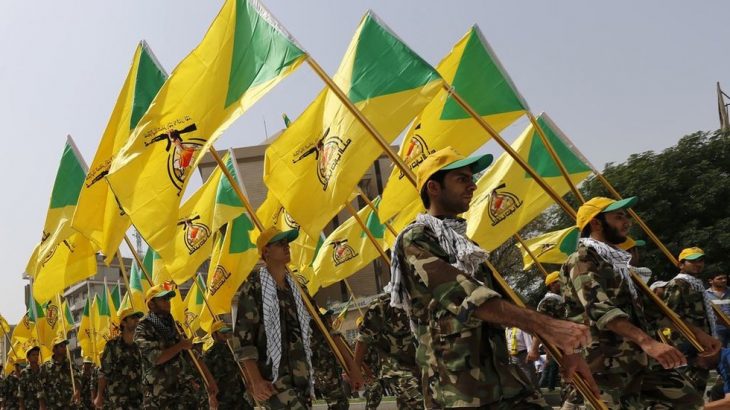
Kataib Hezbollah members wave the party’s flags during a parade in Baghdad. © Reuters / Thaier al-Sudani
RT | December 29, 2019
US airstrikes have pounded three Kataib Hezbollah military facilities near the town of Qaim, Iraq, as well as two targets in Syria, in response to the group’s alleged bombing of an Iraqi military base on Friday.
The US carried out “defensive strikes” against the supposed Kataib Hezbollah facilities on Sunday, US officials told Reuters. The targets included weapons storage locations and command and control stations, and F-15 fighter jets were used in the attack. Three locations near Qaim, on the Iraq/Syria border, and two locations in Syria were hit.
Chief Pentagon spokesman Jonathan Hoffman said in a statement that the strikes were a “response to repeated Kataib Hezbollah attacks on Iraqi bases that host Operation Inherent Resolve (OIR) coalition forces.”
Reuters’ military sources said that at least 18 militiamen were killed in the strikes, including at least four local Kataib Hezbollah commanders.
Two days earlier, the same Kataib Hezbollah fighters and their Iraqi Shia allies were blamed by US officials for a rocket attack on an Iraqi military base in Kirkuk, some 250 miles east of Qaim. The rocket barrage killed an American contractor and wounded several US troops.
Kataib Hezbollah is an Iraqi paramilitary group, but is financially supported by Iran. Its allies in the so-called Popular Mobilization Forces were first deployed by the Iraqi government to combat Islamic State (IS, formerly ISIS) jihadists in 2014, but the government has since struggled to bring them under the command of the Iraqi military.
The rocket attack inflamed anti-Iran sentiment in the US, with Republican Senator Tom Cotton (Arkansas) warning that “Tehran ought to face swift and severe consequences” for its alleged involvement. Responding to similar attacks, US Secretary of State Mike Pompeo threatened Iran earlier this month with a “decisive US response” should they continue.
Iran’s involvement, however, has not been conclusively established.
German Parliament Greenlights Non-Binding Initiative to Ban Hezbollah
Sputnik – December 20, 2019
German lawmakers approved a non-binding initiative on Thursday calling on the government to ban from Germany the political and militant group Hezbollah, which forms part of the Lebanese government. The move, reportedly aimed at combating anti-Semitism, has been rejected multiple times by the parliament.
The Thursday resolution was approved by the opposition Free Democrats as well as the Social Democratic Party, which is allied to the Christian Democratic Union (CDU), Chancellor Angela Merkel’s party. The move seeks to ban the political arm of Hezbollah from Germany and to add the group to the European Union’s terrorist list.
“It is unacceptable that Hezbollah is waging a terrorist fight against Israel in the Middle East, which is being financed through worldwide criminal activities, among other things,” CDU spokesperson Mathias Middelberg said in a statement, according to AP. “In view of Germany’s special responsibility toward Israel, we call on the government to ban all activities for Hezbollah in Germany.”“The separation between a political and a military arm should be abandoned, and Hezbollah as a whole should be placed on the EU terrorist list,” Middelberg said. “This could freeze Hezbollah’s funds and assets in Europe more extensively than before.”
Germany last weighed the question of banning the political wing of Hezbollah, which has just over 1,000 members, in June. That bill, sponsored by the far-right Alternative for Germany (AfD), which has repeatedly sponsored bills seeking to ban burqas and minarets, claiming “Islam is not a part of Germany,” according to Middle East Monitor, failed amid joint opposition by the same parties that sponsored the resolution passed Thursday.
Israeli Foreign Minister Israel Katz praised the move, calling it “an important step in the international struggle against terrorism, particularly against terrorist organization Hezbollah and its patron Iran,” AP noted. US Ambassador to Germany Richard Grenell also voiced his support.Hezbollah is a Lebanese political party and militant group whose primary basis of support is the country’s Shiite Muslim community, although it also enjoys the support of many Christians, Druze and even Sunni Muslims. It gained notoriety for fighting the Israel Defense Forces to a standstill in Lebanon’s south when Israel invaded in 2006. The group was formed as a self-defense force in the early 1980s, during a previous occupation by Israeli forces, against whom it waged a guerrilla campaign. It has also joined the fight in Syria against Daesh and other jihadist rebel groups.
Hezbollah has been accused of multiple acts of terrorism, such as a bus bombing in the Bulgarian city of Burgas in 2012 that killed seven people and injured 32, although no conclusive evidence tying Hezbollah to the attack has been found. It’s also been accused of being behind a slew of terrorist attacks in the early 1980s, including several deadly bombings in Beirut, but again with limited evidence behind the claims. However, 14 nations and several international organizations have declared Hezbollah to be a terrorist organization, while eight nations have declared it not to be one. Hezbollah is also accused of being a proxy of Iran.
Mustafa Ammar, a CDU candidate for the 2021 elections, told Asharq Al-Awsat late last month that secret talks had taken place during a congress held by the CDU in Leipzig about how best to limit anti-Semitism in Germany, especially in schools.“One of the measures included the total banning of Hezbollah and its activities,” Ammar told the London-based outlet. A Hamburg intelligence agency reported in July that Hezbollah had ties to about 30 mosques across Germany, where it raises funds and spreads its ideology, according to Fox News.
Hezbollah has long maintained it distinguishes between Judaism as a religion and Zionism as a political ideology, with leader Hassan Nasrallah saying in 2009: “Our problem with [the Israelis] is not that they are Jews, but that they are occupiers who are raping our land and holy places.” However, Nassrallah and other Hezbollah leaders have also been accused of anti-Semitic statements.
Last week, US President Donald Trump signed an executive order that categorized anti-Israeli speech as anti-Semitism and hate speech under Article VII of the 1964 Civil Rights Act. The move is widely interpreted as aimed at punishing anti-Israel initiatives like Boycott, Divestment and Sanctions (BDS) by declaring them to be anti-Semitic, tying the nation of Israel to the worldwide Jewish community.
Sudan closing Hamas, Hezbollah offices to rebuild US ties
MEMO | December 17, 2019
In an attempt to re-establish ties with the US and to lift sanctions imposed on it, Sudan is set to shut the offices of the Hamas and Hezbollah resistance movements in the country, both defined as terrorist organisations by America, according to a source cited by Middle East Eye (MEE).
The decision follows Sudanese Prime Minister Abdallah Hamdok’s visit to Washington earlier in the month. Hamdok became the first leader of Sudan to visit America since 1985 and he held talks aimed at bridging the relationship between the two states after years of sanctions and international isolation, especially with Sudan being placed on the US list of states sponsors of terrorism after hosting former Al-Qaeda leader Osama bin Laden in the nineties.
Post-revolutionary Sudan witnessed the ousting of long-term President Omar Al-Bashir who is currently serving a two-year sentence on charges of corruption, and the inauguration of the country’s first civilian prime minister in three decades. Hamdok has argued for the necessity of Sudan being removed from the US’ blacklist citing the need to improve the economic situation, which is edging towards hyperinflation leaving Sudan among the countries with the highest inflation in the world. The economic crisis is primarily what brought protestors out onto the streets last year. Addressing the UN General Assembly in September, Hamdok said that the revolution aimed at ending Sudan’s pariah status, reiterating that Sudan inherited international sanctions and that “it was the former regime that supported terrorism”, not Sudan’s people.
The Sudanese source who spoke to MEE said: “The government will close the offices of Hamas and Hezbollah and any other Islamic groups designated as terrorist groups that has presence in Sudan, because Sudan has nothing actually to do with these groups and the interests of Sudan are above everything.”
However, the office closures are likely symbolic in nature, said Cameron Hudson, senior fellow at the Atlantic Council Africa Centre, given that operations of both organisations have been dormant in the country for years. “The announcement that they are formally closing the offices suggests to me that they were essentially dormant, although not formally closed,” he said.
Nevertheless, the move is interpreted by some as a gradual alignment of Khartoum with the interests of the US and its regional allies. In 2016 Sudan ended diplomatic ties with Iran in the wake of the attacks by protestors on the Saudi embassy in Tehran which was in response to the execution of the Saudi Shia cleric and activist Sheikh Nimr Al-Nimr. Two months prior to the severing of ties with Tehran, Sudan reportedly received $2.2 billion for taking part in the Saudi and UAE-led coalition in Yemen, although Sudan is now scaling back its military involvement in the conflict.
Israel for its part had accused Sudan of channelling arms from Iran to Hamas in the Gaza Strip via Egypt’s Sinai desert and is alleged to have bombed Sudanese munitions warehouses and factories in the past.
Sudan has also sought Qatar’s support in its efforts to be removed from the US list of state sponsors of terrorism, which it expressed at a reception hosted by Qatar’s Ambassador to Khartoum, ahead of Qatar’s National Day.
Israeli Minister of Defense to Impose Sanctions on Palestinian ‘Militants’ Abroad
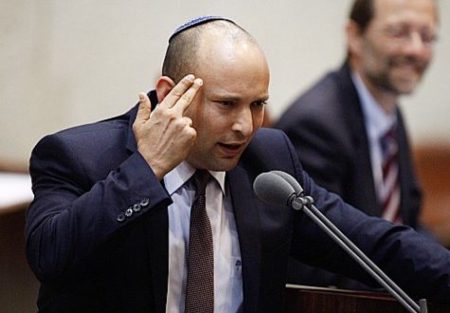
IMEMC & Agencies – December 3, 2019
Israeli Minister of Defense, Naftali Bennett, on Tuesday, issued a written order imposing international economic sanctions on Palestinian militants abroad, The Palestinian News and Info Agency reported.
Hebrew media outlets broadcast Bennett’s decision, pointing out that this move has never been attempted before.
Bennett issued his first order against Jamil Hersh, a member of the Arab Society for Human Rights in London, members of Lebanon’s Hezbollah party will also be sanctioned.
Hezbollah: US major obstacle to government formation in Lebanon
Press TV – November 22, 2019
Hezbollah calls the US the most prominent obstacle lying in the way of formation of a government in Lebanon, which is direly in need of political stability.
The Lebanese resistance movement’s Deputy Secretary-General Sheikh Naim Qassem made the remarks in an interview with Reuters on Friday.
“The first obstruction in the formation of the government is America, because it wants a government that resembles it and we want a government that resembles the Lebanese people,” he said.
US officials had been in direct contact with Lebanese politicians and officials, the official noted, saying, “Let them leave us alone so we can reach an understanding among ourselves. The more they intervene the more they delay the solution.”
The country — where coexistence of various religious sects has turned unity into the leading means of preventing internal strife — would not be rid of its ongoing economic and political woes unless foreign vested interests stopped tugging away at it, Qassem said.
Prime Minister Sa’ad Hariri resigned in late October amid nationwide protests against corruption and economic adversity that had begun earlier that month.
On Tuesday, protesters blocked roads leading to the parliament in the capital Beirut, forcing the legislature to postpone what was supposed to be its first session in two months. Heavy clashes were reported later that day between security forces and a group of protesters attempting to make their way into the parliament.
Twitter Surrenders to US Congress’ anti-Hezbollah Measures, Suspends Al-Manar’s Accounts
Al-Manar | November 2, 2019
Republican and Democrat US Congress members, have asked social media network Twitter to suspend all accounts affiliated with Hezbollah and Hamas, setting November 1rst as a deadline for the action.
The US Congress members rejected distinguishing between military and the political wings of the organizations they classify as terrorist, stressing that Twitter must not give them any chance to convey ‘hate’.
In this context, Al-Manar TV accounts on Twitter, including @AlmanarEnglish, were suspended without any prior notification.
The accounts which had around one million followers were characterized by objectivity and accuracy in conveying truth.
Trump Freezes Lebanon Military Aid After Israel Voiced Concerns
By Tyler Durden – Zero Hedge – 11/02/2019
Amid recent statements by both Iranian and Hezbollah leaders accusing the United States of hijacking the massive anti-corruption protests which have gridlocked Lebanon for over the past two weeks, the White House has made the dramatic and unexpected move of freezing US military aid to the Lebanese Army.
The money, part of a military aid package totaling $105 million, had been approved by Congress and the State Department, and requested by the Pentagon. Interestingly, proponents of the package argued that it would allow the Lebanese Army to grow more independent, making it less cooperative with Hezbollah.
According to Reuters the aid was frozen two days following Tuesday’s resignation of Lebanese Prime Minister Saad al-Hariri, who in a parting speech admitted he’d “reached a dead end” amid the protests which have reportedly involved one million people, or up to 25% of Lebanon’s total population, and further called on “all Lebanese to protect civil peace”.
The United States, said the report, has frequently voiced “concern over the growing role in the Beirut government of Hezbollah, the armed Shi’ite group backed by Iran and listed as a terrorist organization by the United States.”
Secretary of State Mike Pompeo this week called on Beirut to take steps for a new unified government which focused on rooting out endemic corruption.
Though no specific reason was given as to why the White House has targeted Lebanon for an aid freeze, Trump has lately signaled his disdain for the amount of foreign aid Washington hands out around the world, seemingly with no strings attached.
On Friday, an Israeli media report revealed that officials in Tel Aviv had lobbied the White House to condition any US Lebanese aid based on the country removing advanced arms in possession of Hezbollah — something it should be noted that Lebanon’s national forces are likely incapable of, given the Shia paramilitary organization is actually considered stronger.
The Foreign Ministry ordered Israeli diplomats “in all relevant countries,” including the US and European states, to emphasize the need to cease providing aid to Lebanon as long as the Iran-backed Hezbollah terror organization does not cease upgrading its military capabilities that could target Israel, the official added. — Times of Israel
“In discreet talks with various capitals, we made it clear that any aid meant to guarantee the stability of Lebanon needs to be conditioned on Lebanon dealing with Hezbollah’s precision-guided missiles,” a senior official told The Times of Israel. “Anything short of that will be problematic, in our eyes.”
This could mark a big first step in Trump cutting of aid to ‘dysfunctional’ governments and/or governments made up of elements which are hostile to the United States, as is the case with the designated group Hezbollah.
Featured Video

More Iran War fallout: Maritime insurance industry shifts from London to China
or go to
Aletho News Archives – Video-Images
From the Archives
Allies Don’t Need Lobbies
By Jay Knott | Dissident Voice | September 24, 2013
In a recent article on Counterpunch, Rob Urie defended the traditional Marxist analysis of US policy in the Middle East. He argues that support for Israel is driven primarily by economic interest, not the Jewish lobby.
He starts by paying tribute to the idea that Western societies are uniquely racist. He says that the “Western narrative” claims there is an “Arab character”, and that this is “antique racist blather”. He gives no definition of these terms. Further, he establishes his credentials as part of the dominant current in the American left by claiming that “over a million people in Iraq died so ‘we’ in the West can drive SUVs.”1
When he tries to criticize bourgeois economics, he makes it clear he doesn’t understand the developments it has made since Marx’s day, using the mathematical discipline known as “game theory”. He dismisses the basic abstraction of economic theory, the idea of the rational individual, on the grounds that it is “devoid of history, culture and political context”. But abstractions are always devoid of something.
He defends a more concrete economic theory, mostly Marxist, with some input from another theorist of capitalist crisis, Hyman Minsky. This concrete theory leads him to the view that US activity in the Middle East is primarily driven by rational capitalist motives, the need to secure a supply of oil.
“Taking the totality of circumstance — former oil company executives launching war on an oil rich nation on a pretext they publicly proclaimed they didn’t believe shortly before taking office — and that upon launching their war proved to be non-existent, requires a willingness to overlook the obvious — that the war on Iraq was for oil, that is difficult to support.”1
Perhaps I’ve misunderstood him, but based on what he says in the rest of the article, this convoluted sentence seems to argue that, because president Bush and vice-president Cheney attacked Iraq on false premises, and they also said it was all about oil, and they are former oil executives, and Iraq has a lot of oil, it’s difficult to deny US attacks on Iraq are all about oil.
In fact, it’s not hard at all. As Urie points out, at times Bush and co. said that attacking Iraq was “protecting the world’s supply of oil.”1 But, as he also points out, they are congenital liars. Why should we believe them when they say they are trying to “protect” the oil supply? Protect it against what? When politicians “admit” attacks on Middle Eastern countries are wars for oil, they are parroting the neo-con party line, feeding the public, both left and right, with a plausible-sounding pretext. For right-wingers, “it’s a war for oil” is a reason to support war, and for leftists, it’s a way to feel better by complaining impotently about corporate greed. Both approaches help the war drive. … continue
Blog Roll
 Aletho News
- More Iran War fallout: Maritime insurance industry shifts from London to China
- US-Israeli aggression on Iran triggers review of GCC countries’ investment pledges to Washington
- Russia slams UK plan to seize tankers suspected of carrying its oil
- Pakistan ramps up food exports to Persian Gulf nations as war deepens food insecurity
- Iran submits response to US plan, sets terms for war’s end: Tasnim
- US vs Iran: Kharg Island Talk — Bluff or Escalation? Ex-Military Officer Weighs In
- Zelensky unnecessarily involves Ukraine in the Middle East crisis
- Turkish tanker blacklisted by Ukraine hit in drone attack – media
- Canada, the U.S., and NATO: the inescapable trap
- Villains of Judea: Leonid Radvinsky
- If Americans Knew
- ‘No Innocent Children’: Far-right Israeli Lawmaker Defends Killing of Palestinian Family
- Mossad’s promises helped Netanyahu convince Trump that Iran could be toppled
- US Arms Control Official Refuses To Comment When Asked If Israel Has Nuclear Weapons
- Veterans warn US landing could be ‘more Gallipoli than Vietnam’
- Israel may be committing war crimes in Lebanon – Not a ceasefire Day 167
- In the West Bank, life is a constant battle – 3 articles
- Jacob Reses, one of the most powerful pro-Israel operatives in Trump’s Washington
- Israeli-US assaults kill or injure 87 children a day – Not a ceasefire Day 166
- ‘Forever live by the sword’: Understanding Israelis’ massive support for Iran war
- UN’s special rapporteur on human rights says Israel is systematically torturing Palestinians
- No Tricks Zone
- Devastating Assessment Of Comirnaty Vaccine By Former Senior Pfizer Europe Toxicologist
- New Study: CO2 Is ‘Effectively Negligible’ As An Explanatory Climate Change Factor Since 2000
- Former Pfizer Toxicologist Dr. Helmut Sterz Tells Bundestag Hearing Pfizer Vaccine Should Have Never Been Approved
- Energy Expert: Germany’s Nuclear Phaseout Was A “500 Billion Euro Mistake”
- New Research: South Australia’s Mid-Holocene Sea Surface Temperatures Were 4°C Warmer Than Today
- Storing Green Energy To Last Germany 10 Days Would Require A 60-Million Tonne Battery
- New Studies: UK Sea Levels Were 4 Meters Higher Than Today During The Mid-Holocene
- Destructive Green New Deal: German Energy And Metal Group Warns Of Drastic Crisis
- New Study Documents A 20-Year Pause In Arctic Sea Ice Decline – Driven By Internal Variability
- Wake-up Call: Survey Shows Majority Of Germans Now Favor Postponing Climate Targets!
 Aletho News