Israel and US disputed intelligence for assassination targets
![Lebanese men inspect the damage done to their homes after Israel carried out attacks in Beirut, Lebanon on 22 July 2006 [PATRICK BAZ/AFP/Getty Images]](https://i0.wp.com/www.middleeastmonitor.com/wp-content/uploads/2019/05/2006-Lebanese-men-inspect-the-destruction-caused-by-Israeli-attacksGettyImages-119810831.jpg?resize=1200%2C800&quality=75&strip=all&ssl=1)
Lebanese men inspect the damage done to their homes following Israel’s invasion of Lebanon in 2006 [PATRICK BAZ/AFP/Getty Images]
MEMO | May 30, 2019
Leaked documents published by whistle-blower Edward Snowden have exposed a deep rift between Israeli intelligence officials and their counterparts in the US National Security Agency (NSA) over the sharing of intelligence which the Israelis requested to carry out assassinations during the 2006 invasion of Lebanon.
Details of the rift were laid out in the NSA’s internal newsletter known as SIDtoday under the heading “The Israel-Hizballah [sic] Crisis — Perspectives from an Acting SLO Tel Aviv”. In the document, an American liaison officer, who is tasked with managing relations with counterparts in Israel, recounted a dispute with the Israelis over intelligence that was to be used for “targeted killings”.
The Israeli demand, the US liaison wrote, “centred on requests for time sensitive tasking, threat warning, including tactical ELINT” — electronic intelligence — “and receipt of geolocational information on Hizballah elements.”
“The latter request was particularly problematic,” he continued, adding that he “had several late-night, sometimes tense, discussions with ISNU,” the elite Israeli equivalent of the NSA. The US official rejected the demand, and said that he provided details of “NSA’s legal prohibition on providing information that could be used in targeted killings.”
The acting SLO officer pointed out that, “Even with his full understanding of the US statutes, [ISNU Commander] BG Harari sought assistance from NSA for an exemption to this legal policy. To ISNU, this prohibition was contrary not only to supporting Israel in its fight against Hizballah but overall, to support the US Global War on Terrorism.”
The account, published by The Intercept — which has released four years’ worth of SIDdtoday material in batches — goes on to suggest that the NSA ultimately reached a compromise with the Israelis by working with the Office of the Director of National Intelligence (ODNI), and that in the end it was the Israeli team that defined the parameters and methods of what could and could not be shared with them.
According to The Intercept, the episode recounted by the US liaison officer raises “questions of what intelligence the United States can legally share with a foreign government.” This, it said, is a “notoriously murky” area.
READ ALSO:
Israel assassinates more people than any Western country, concludes new book
NYT Parrots US Propaganda on Hezbollah in Venezuela
Lucas Koerner and Ricardo Vaz | FAIR | May 24, 2019
Judith Miller and Michael Gordon published their now infamous New York Times article on September 8, 2002, falsely claiming on the basis of unnamed “American officials” that Iraq had acquired “aluminum tubes” with the aim of producing “an atomic bomb.”
Disgraced by her regurgitation of bogus claims, Miller left the Times in 2005, but her spirit is “alive and well” at the “paper of record.” Nicholas Casey follows faithfully in Miller’s footsteps, authoring dubious, anonymously sourced stories that coincidentally happen to further US regime-change objectives.
In a recent piece headlined “Secret Venezuela Files Warn About Maduro Confidant” (5/2/19), the Times’ Andes bureau chief claimed, on the basis of a leaked Venezuelan intelligence “dossier” that only his paper has seen, that Venezuela’s Industry minister and former Vice President Tareck El Aissami has active links to Hezbollah and drug trafficking. Casey wrote:
The dossier, provided to the New York Times by a former top Venezuelan intelligence official and confirmed independently by a second one, recounts testimony from informants accusing Mr. El Aissami and his father of recruiting Hezbollah members to help expand spying and drug trafficking networks in the region.
Unsurprisingly, the article has been endorsed by Florida Republican Sen. Marco Rubio, widely considered the point man for Trump’s Latin America policy, and whose zeal for regime change in Caracas appears unperturbed by elementary facts or international law. In a May 16 tweet, Rubio openly celebrated the fact that Venezuelan President Maduro “can’t access funds to rebuild electric grid,” thereby dispensing with any pretence that US sanctions are not directly aimed at the Venezuelan population.
The claims of an alleged relationship between Caracas and Hezbollah are, however, entirely unoriginal, having been repeated by corporate journalists and national security pundits without evidence for years.

Attempts to tie Venezuela to Hezbollah are not new (The Hill, 1/13/17)
“Hezbollah has a long and sordid history in Venezuela,” wrote Foreign Policy (2/2/19) earlier this year. Newsweek claimed in a 2017 article (12/8/17) that the Lebanese political party “was involved in cocaine shipments from Latin America to West Africa, as well as through Venezuela and Mexico to the United States,” while The Hill (1/13/17) labeled El Aissami a “fan of Iran and Hezbollah,” rehashing US allegations going back to 2008.
Likewise, corporate media claims about Hezbollah presence in Latin America have not been exclusive to Venezuela, with similar baseless rumors circulating about the Lebanese political party operating in the so-called Tri-Border Area of Paraguay (Extra!, 9–10/07).
Such stories just happen to buttress similar unsupported claims by US Secretary of State Mike Pompeo that Hezbollah has “active cells” in Venezuela. Pompeo and other senior administration officials have repeatedly warned that a military option to remove the Maduro government is “on the table,” while self-proclaimed “interim president” Juan Guaidó has requested “cooperation” from the Pentagon’s US Southern Command.
Casey himself has a long-established track record in dodgy Venezuela reporting, ranging from ludicrous stories about Cuban doctors (FAIR.org, 3/26/19) to false claims that private media like Globovision and El Universal “toe a government line.” (See FAIR.org, 5/20/19.)
Suspect sources
According to Casey’s “dossier,” Tareck El Aissami conspired with his father, Carlos Zaidan El Aissami,
in a plan to train Hezbollah members in Venezuela, “with the aim of expanding intelligence networks throughout Latin America and at the same time working in drug trafficking.”
We should begin by recognizing that Casey provides no proof of the authenticity of the alleged documents, and there is no reason why readers should take the assurances of unnamed “former top Venezuelan intelligence official[s]” at face value, especially those currently outside Venezuela collaborating with Washington. Similar sources were used to craft the fraudulent case for war in Iraq.
For instance, former Venezuelan intelligence czar Hugo “El Pollo” Carvajal, who broke with the Maduro government in 2017, is facing extradition to the US from Spain on cocaine-smuggling charges. In February, the ex-general gave an interview to Casey and the Times (2/21/19) in which he accused El Aissami of similar drug trafficking and Hezbollah links. Nowhere in the article did Casey think it relevant to mention that Carvajal plans to cooperate with US authorities, and thus has reasonable motive to fabricate information that improves the conditions of his plea bargain.
Taking refuge in anonymity, which the Times’ own handbook describes as a “last resort,” Casey leaves open the question of whether his source is Carvajal or another ex-official collaborating with the US who authored the dossier after leaving Venezuela, since no date is provided. From “Curveball” to North Korean defectors, corporate media have been consistently guilty of not examining sources’ motives so long as their “information” bolsters US foreign policy interests, even at the cost of tens or hundreds of thousands of lives.
Urea-gate?
Beyond the issue of sourcing, the alleged “dossier” has a troubling number of logical and factual inconsistencies. A case in point is the alleged testimony from an unnamed National Guard officer about a 2004 raid near the border with Brazil, which reportedly found more than 150 tons of urea in a warehouse. Casey disingenuously refers to urea as a “precursor substance used to make cocaine,” when in fact over 90 percent of industrially produced urea is used for fertilizer. Casey does concede later on that urea has non-cocaine purposes, but cannot conceive of the possibility of the substance being stored in a given location only to be used elsewhere.
The narrative function of the urea bust, which for some reason was not reported until a mysterious dossier was handed to the New York Times 15 years later, is to provide a link to Walid Makled, allegedly the owner of the urea warehouses, and a drug trafficking kingpin of sorts. Even assuming that the urea was meant for cocaine production, and not for more mundane agricultural purposes, a key fact is that Makled is currently serving a jail sentence in Venezuela for drug trafficking. This inconvenient reality, noted but not explained by the Times, on its face seriously undermines the idea that the current Industry minister, supposedly a close associate of Makled, is a powerful figure running a drug ring at the heart of the Venezuelan state.
That aside, it’s worth reviewing the “links” that Casey presents between Makled and El Aissami:
- According to the “dossier,” El Aissami’s brother, Feraz, went into business with Makled.
- The government gave “contracts” to a company “tied to Mr. Makled.” (Casey doesn’t think it relevant to explain the nature of these “ties” or “contracts”)
- The US government offered a similarly vague level detail regarding El Aissami’s alleged “ties” to drug-running when it sanctioned the then-vice president in 2017, and even Casey admits that Washington “never revealed the evidence.”
- “Two people familiar with [El Aissami’s] family” identified Haisam Alaisami as being El Aissami’s cousin, with Alaisami supposedly telling prosecutors he was a legal representative of Makled’s company. Beyond the anonymous genealogy, no concrete evidence is presented linking El Aissami to Alaisami, and hence to drugs.
In the absence of any externally verifiable evidence, what Casey presents as bombshell revelations of solid links to drug trafficking come out looking like 15-year-old gossip from unnamed sources.
Hezbollah hysteria
While Casey’s story provides very questionable allegations on links to drug trafficking and to Hezbollah, the connection between both is even more dubious.
The dossier concludes with informant testimony on the family’s ties to Hezbollah…. One of the sources of the information was the drug lord, Mr. Makled, who described Mr. El Aissami’s involvement in the scheme, according to the intelligence memo.
After establishing highly questionable ties between Tareck El Aissami and Walid Makled, largely based on their shared Syrian ancestry, Casey’s “dossier” then claims it is none other than Makled who “reveals” El Aissami’s supposed Hezbollah plot.
According to the alleged “documents,” El Aissami and his father were “involved in a plan to train Hezbollah members in Venezuela, ‘with the aim of expanding intelligence networks throughout Latin America and at the same time working in drug trafficking.’”
The unspoken assumption is that Hezbollah, which is a resistance movement and political party that forms part of the the elected Lebanese government, would be interested in conducting such illicit activities halfway around the world. Here Casey displays a geopolitical illiteracy on par with top Trump administration officials since, according to Middle East expert As’ad AbuKhalil, “there is no agenda or reason for Hezbollah to have an international presence.”
“For what purpose? Doesn’t the party have enough on its plate in Lebanon itself?” he asked, while acknowledging that the party does have sympathizers and supporters worldwide.
On the assertion that Hezbollah is engaged in drug trafficking, the University of California at Stanislaus professor is equally skeptical. “There has been no credible story in Arabic or in Western languages about Hezbollah’s involvement in drugs,” he stressed:
Hezbollah publicly and organizationally took a stance against drugs and issues fatwas against drugs not only among members but even in Shiite areas of Lebanon. Hezbollah has even allowed Lebanese government agencies to penetrate deep into its strongholds [this year] to search for drug traffickers.
Casey and his editors cleverly shield themselves from any reputational damage over the ludicrous nature of these allegations with a rather significant proviso buried in the 14th paragraph of the article:
Whether Hezbollah ever set up its intelligence network or drug routes in Venezuela is not addressed in the dossier. But it does assert that Hezbollah militants established themselves in the country with Mr. El Aissami’s help.
In other words, what was originally presented as anonymously sourced claims about Hezbollah spying and drug trafficking in Venezuela turn out to be little more than speculation about intent to carry out such activities.
In giving credence to these allegations, the Times repeats the propaganda of top Trump administration officials and the Israeli government about the “global terrorist ambitions” of Iran/Hezbollah, which is in league with Venezuela’s socialist “narco-dictatorship.”
Having played a key propaganda role in recent US regime change operations in Iraq, Syria, Libya and elsewhere, corporate media outlets like the New York Times are all too eager to beat the drums of war once again. With Washington actively threatening military force in both Iran and Venezuela, Nicholas Casey lends a hand in manufacturing public consent for not one but two illegal wars.
Ex-Israeli official admits 2015 assassination of Kuntar after tip-off from Syria militants
Press TV – May 27, 2019
A former Israeli army officer has admitted that Israel’s military, with the help of militants in Syria, assassinated Samir Kuntar, a commander of Lebanese Hezbollah resistance movement, during air raids in 2015.
According to UK-based Arab newspaper Asharq Al-Awsat, the ex-army officer Marco Morno said the operation was carried out with information from “one of the leaders of the Syrian opposition factions.”
The attack was conducted by two warplanes that bombed a building with four long-range missiles in Jaramana, near Damascus, in late 2015.
Back then, Kuntar was in Syria helping government forces and Hezbollah fight back foreign-backed Takfiri terrorists in the Arab country.
“Samir Kuntar, the longest serving Arab prisoner in Israeli jails, was killed in a terrorist rocket attack targeting a building in the southern parts of Jaramana, Damascus countryside,” the official Syrian Arab News Agency (SANA) reported at the time.
He had spent about 30 years in Israeli prisons and was released in 2008 as part of a swap deal between Tel Aviv and Hezbollah in exchange for the bodies of two Israeli soldiers killed during the 2006 war.
According to the so-called Syrian Observatory for Human Rights, a pro-militant monitoring group, Kuntar had been the target of various failed Israeli assassination attempts in Syria.
Morno, who was responsible for communicating with militants in Syria, revealed the details of Kuntar’s assassination during an interview with an Israeli news site on Thursday. The information he disclosed was allowed to be published under military censorship.
Hezbollah has been effectively helping the Syrian government in its fight against terrorists.
In May 2016, Mustafa Badr al-Deen, another Hezbollah commander, was killed in an Israeli air raid on the Syrian-Lebanese border.
Tel Aviv frequently attacks military targets inside Syria in what is considered as an attempt to prop up Takfiri terrorist outfits that have been suffering heavy defeats against Syrian government forces.
Numerous reports have also emerged of the discovery of Israeli-made weapons and military equipment during clean-up operations by the Syrian army.
The occupying regime has been providing medical treatment to extremist elements wounded in Syria.
Syria has been gripped by foreign-backed militancy since March 2011. The government says the Israeli regime and its Western and regional allies have been aiding the Takfiri terrorist groups wreaking havoc in the country.
Turkey is one of the main backers of anti-government militants in Syria.
On Saturday, senior militant sources said Turkey has equipped an array of terrorists with fresh supplies of weaponry to help them try to repel a major Syrian assault.
The delivery of dozens of armored vehicles, Grad rocket launchers, anti-tank guided missiles and so-called TOW missiles, helped roll back some army gains and retake the strategically located town of Kafr Nabudah, one senior militant figure said.
Syria’s SANA news agency reported on Sunday that Syrian army troops had established full control over Kafr Nabudah in Hama province after eliminating the last remnants of the Jabhat Fateh al-Sham terrorist group, formerly known as Nusra Front.
Nasrallah: If It Weren’t for Liberation in 2000, Trump Would Grant South to ‘Israel’

Sayyed Hasan Nasrallah
Sara Taha Moughnieh | Al-Manar | May 26, 2019
Hezbollah Secretary General Sayyed Hasan Nasrallah delivered a speech Saturday 25th of May on the anniversary of Resistance and Liberation day.
Sayyed Nasrallah tackled regional and internal files including the upcoming Bahrain Summit, localizing the Palestinians in Lebanon, strength of the resistance axis, return of the Syrians to their country, and internal files.
His eminence called for a wide participation in Al-Quds day which is held annually on the last Friday of the Holy Month of Ramadan, stressing that this day is of great significance this year because of the efforts being made to put an end to the Palestinian cause, specifically during the upcoming Economic Conference in Bahrain.
He greeted the Palestinian’s united stance to boycott and refuse this conference and praised the Bahraini people, scholars, and political powers’ stances that condemned the country’s decision to be the first to embrace “the deal of the century” which aims at putting an end to the Palestinian cause.
25/May/2000: Resistance and Liberation Day
Sayyed Nasrallah greeted everyone who was part of this victory through sacrificing, staying patient, supporting and aiding.
“We should remember the families of the martyred and injured, Lebanese factions, Security Forces, Army, Palestinian factions and the Syrian Army and keep in mind that Iran and Syria are the ones who stood by our side and they are our companions in victory,” he said.
Hezbollah SG assured that one of the major outcomes of this victory was the “Equation of Strength” in Lebanon because the Israeli enemy had to pull back without any victories or conditions.
“Lebanon was no longer regarded as the weak ring in the Arab/Israel conflict, and today the Israeli enemy states that in Lebanon there is a “strategic or central threat against Israel”, he noted; adding “just like the enemy is aware of this strength, the Lebanese people should be aware of its importance in order to sustain their country’s sovereignty and safety and in order to protect it. This is what forms the Golden Equation “Army, people and Resistance”.”
“If it weren’t for the resistance and liberation in 2000, Trump would’ve granted the south of Lebanon or other parts of it to Israel, just like he did with Al-Quds and the Golan,” Sayyed Nasrallah said, reassuring holding on to “Shabaa Farms, Kfarchouba hills and the Lebanese part of Al-Ghajar village.”
Localization in Lebanon
Concerning localizing immigrants in Lebanon, his eminence said: “we suspect that the economic summit in Bahrain will be opening the door for the localization of immigrants in Lebanon and other countries. The Lebanese agree on refusing localization politically and constitutionally, and the Palestinians as well agree on refusing localization and holding on to their right of return.”
Sayyed Nasrallah called for “a meeting between Lebanese and Palestinian officials to put a joint plan on how to face the danger of localization because the threat is approaching and statements are no longer enough”.
Syrian Refugees’ Return
Hezbollah SG pointed out that “the real reason behind delaying the return of the Syrian refugees in Lebanon to their country is political and it is related to the presidential elections in Syria because the presidency of Bashar Al-Assad will end in 2020 or 2021, and there is an American, Western, and Gulf insistence on keeping the refugees away from their countries until then. There are no humanitarian or security reasons behind postponing the refugees’ return to Syria and claims about that are just rumors.”
Sayyed Nasrallah further stated that “Assad has confirmed to me that he supports the return of everyone to Syria and is ready to offer facilitation, but the obstacle is political. Should Lebanon submit to this political obstacle only because the US, west and Gulf want that?”
Battle against Corruption Files
His eminence stressed Hezbollah’s commitment to fight corruption, reiterating that this needs time and patience, and it is even harder than the battle of liberating the south.
He indicated that the ministers are doing their jobs and have not found corruption in the Ministries of health and sports, and called on everyone who has information or data against these two ministries to propose them so that action would be taken.
On another hand, Sayyed Nasrallah stated that “budgeting discussion has been our priority because it is a major point in the process of fighting corruption and stopping financial waste.”
Amazon Pulls Hezbollah Deputy Leader’s Book After Israeli Media Outcry
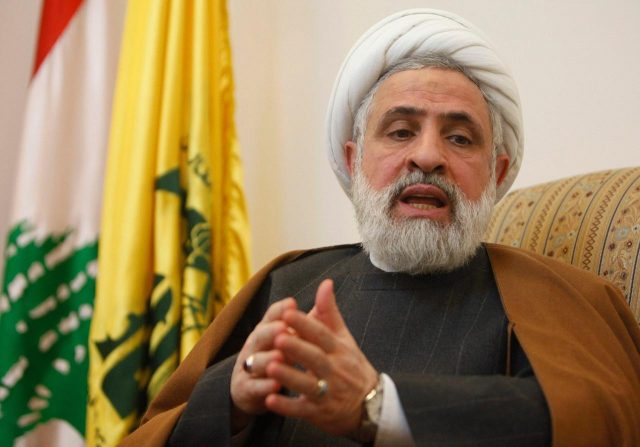
Deputy leader of Hezbollah Gen. Naim Qassem, via Reuters.
By Tyler Durden – Zero Hedge – 05/23/2019
This week Amazon pulled a controversial book being sold through its website after Israeli media led an outcry against it, charging the US retail giant with hosting Hezbollah propaganda containing incitement to violence against Israelis written by the group’s second in command.
 “Hezbollah: The Story from Within” was published in 2010 by Naim Qassem, the deputy head of Hezbollah, who is a designated international terrorist by the United States. The rare “insider account” of Iran-backed Hezbollah has been translated into several languages and had reportedly long been available in English through Amazon.com.
According to the Israeli national Hebrew-language daily newspaper Maariv, “a reporter found that the English edition of the book was being offered for sale on the Amazon site,” and was alarmed at “a clear instance of breaking sanctions and helping to finance terrorism” on the part of Amazon.
“A Maariv reporter contacted Amazon with findings in the book and Amazon subsequently decided to immediately remove the book from its sales sites in the United States and around the world,” a rough English translation of the Maariv story said. The Hebrew-language report said the book was filled with anti-Semitic statements and questioned Israel’s right to exit.
Though it had apparently been offered by Amazon for years, the book was spotlighted this week after controversy erupted between Israel and a United Nations official, after the official called it “necessary reading”.
On Tuesday Israel slammed the United Nations Special Coordinator for Lebanon Jan Kubis for holding a high level meeting with Qassem after which the UN official publicly praised the senior Hezbollah official.
Kubis had confirmed on Twitter that he not only met with Qassem, but received a copy of his most well-known book, which he also praised.
The Times of Israel reported of the statement:
Kubis was likely referring to “Hizbullah (Hezbollah): The Story from Within,” a 464-page tome first published in English a decade ago. The book, published by the London-based Saqi Books, is available on Amazon.
The Israeli Defense Forces (IDF) spokesman went so far as to denounce the meeting via Twitter, saying “You know what else is ‘necessary reading’? U.N. Resolution 1701” — in reference to a resolution intended to resolve the 2006 Israel-Lebanon conflict.
Within two days following the incident, the initial link through which the book had been sold on Amazon led to an error page, in apparent confirmation that Amazon banned the book at the request of the Israeli reporter.
On Thursday, Middle East and Iran analyst Matthew Levitt confirmed that the “Hezbollah deputy Secretary General’s book [is] no longer available on Amazon after journalist points out its anti-Israel incitement to violence & sanctions implications of selling it.”
The fresh controversy comes following new efforts by Israel to convince the UN to officially recognize Hezbollah as a terror group — an effort which has reportedly failed to gain traction.
The Trump administration has also of late taken more aggressive sanctions measures on Hezbollah leadership amid the ongoing heightened tensions with Iran. Hezbollah has long been seen as an arm of the Ayatollahs in Lebanon and Syria.
Israel’s influence on US foreign policy leads to increased tensions with Iran
By Sarah Abed | InfoRos | May 22, 2019
In order to understand the role that Israel plays in the increased tensions between Washington and Tehran, I reached out to Press TV Correspondent, Ali Musawi.
Sarah Abed: What role, if any, does Israel play in the increased tensions between the United States and Iran?
Ali Musawi: We don’t need to go far to see Israeli fingerprints over a US war in the region. Leading up to the 2003 US invasion of Iraq, Israel and more specifically its current Prime Minister Netanyahu led the choir about Iraq’s WMD and threat to peace and security.
Now, if we look at Netanyahu’s antics concerning Iran, we will see a similar pattern, whether it was the bomb sketch at the UN General Assembly, his almost regular videos about the Iranian threat and the push by Netanyahu to end the “bad deal” between P5+1 and Iran over its nuclear program. Israel doesn’t play a role; Israel clearly orchestrates US war policies.
Sarah: To your knowledge has Israeli intelligence provided any information to the United States that supports the idea of an increased “Iranian threat”?
Ali: As of this moment, no one knows what this sudden “threat” posed by Iran is. We can speculate about anything, from increased Iranian war drills in the Persian Gulf to its military commanders’ typical aggressive tone when addressing the US and allies’ behavior towards the Islamic Republic. And I think before we even try to address any kind of “Iranian threat” we should acknowledge the boy who cried wolf. Is the US administration being truthful? We need evidence, where is Washington’s proof? We should always remember the non-existent WMD used to rally the world against Iraq.
Sarah: Is Israel advocating for a military response by the United States against Iran?
Ali: It is in Israel’s best interest that the US engages in a direct war with Iran. Israel has been threatening attacks against Iran for years simply because Tehran’s support for resistance movements in Palestine and elsewhere threatens the Zionists’ plan to control the region. Israel with all their access to weapons and blank cheques provided by the US and allies, is simply not a match to Iran. By using the US and the excessively armed Gulf countries, Israel is hoping that, at best, a war will weaken Iran, or at worst, a buffer of countries who will sever Iranian support for the resistance movements.
Sarah: What impact would a war between United States and Iran have on Israel?
Ali: Such a war will impact, not only the countries in the region, but the rest of the world. But from a military prospective, if there is a war between the US and Iran, those resistance movements, from Iraq to Palestine, through Yemen and Syria will respond. They will either attack US and allies’ bases in the region or directly attack Israel. We can say that having such resistance movements has been the real deterrent against what can only be a hugely destructive conflict, probably the worst in our lives.
Sarah: Is a full-fledged military confrontation between Israel and Iran likely?
Ali: This is a definite no. While Israel still plays the role of a superpower in the region, it has not been so in over a decade. The 2006 defeat against Hezbollah in Lebanon and the bravery we see from the Palestinians in Gaza, whenever Israel launches wars on the besieged strip, have destroyed its invincibility myth and shown that Israel and its supposed advanced weaponry are only so on paper.
Sarah: How would that scenario play out and what do you suppose would be the outcome?
Ali: Only if the US is directly involved against Iran, will there be a war.
Sarah: What impact could a war between Israel and Iran have on the neighboring countries, primarily Lebanon, Syria, and Iraq?
Ali: If the US is involved of course. All these three countries have been directly impacted by US/Israeli wars over the past few decades. So, the people as well as politicians are aware of the devastation of such conflicts. This is why they will back Iran and even fight alongside Iran simply because the majority of people in these countries oppose US hegemony. The Middle East is divided. There are countries who are controlled by the US/Israel and there are those who are not. No one will sit idly by if a war breaks out. Everyone has something to lose and gain. Such wars don’t usually have winners and will be very expensive to all sides. This is why we are seeing the US backtracking on some of its threats and will continue to do so because the US has become a bully who is afraid of being hurt.
Sarah: Ali, makes some great points that should put the wheels in motion in everyone’s mind, and in particular those who live in the United States. I will pose one more question to our readers, are we willing to go to war with Iran to benefit Israel?
Dissecting The Unfathomable American-Iranian War
By Ghassan Kadi | The Saker Blog | May 21, 2019
As the American military build-up continues around the Strait of Hormuz, and as a potential American-Iranian war looms, many analysts are convinced that war is imminent. I beg to differ.
Ever since the “War on Syria” started, I kept reiterating that America would never launch a full-on attack on Syria, and for very good reasons, and not long ago, I finally felt compelled to write a series of articles explaining that in as much as America would love to be able to pillage Syria, it is unable to do so.
Those predictions, which stood the test of time, were made long before the Russian involvement in Syria, and now, after Syria’s triumph, the chances of a decisive victory that America is able to score by way of a military gamble anywhere in the Middle East have been shrinking and reduced to the level of zero chance. If anything, the “War on Syria” was the surrogate war that America could not launch directly either on Syria or on Iran, and even by turning its war into a war by proxy, America was still unable to win.
To recap briefly, some obstacles that stood against an all-out American NATO-led assault on Syria back in 2013, I argued that America would never risk a retaliatory attack against Israel by both Syria and Hezbollah.
An American attack on Iran will not eliminate the risk of a Hezbollah retaliatory attack on Israel, and if anything, it will bring in a new risk; the risk of a retaliatory Iranian attack on Saudi soil.
Whether or not an American-Iranian show down will directly involve Saudi troops, given that Saudi Arabia is still unable to win in its war against Yemen, even though it has the third largest military budget after the USA and China, a direct Saudi role will have little in effecting any significant input. However, with or without a direct Saudi intervention, an American attack on Iran will immediately put American interests in Saudi Arabia under the Iranian target list.
In the event of such an attack, the first thing that Iran will do is close marine traffic in the Strait of Hormuz. As a result, the whole world will be affected and the price of a barrel of oil may jump to $200 and beyond, but the relevant issue here is the impact on the feasibility of American military success.
An American attack on Iran cannot be seen as an event that is independent from the wars on Syria and Yemen. It will be seen as an upscaling that directly involves Iran. Any such turning point will sooner or later involve Saudi Arabia directly. And given that Iran will more than likely close the Strait of Hormuz and thereby putting all Saudi oil exports to halt, whether or not Iran intended to intimidate America alone, the Saudis will see it as an act of war; and they will be “forced” to retaliate.
But the moment the Iranians see that Saudi forces are involved in military action against them, they will have a huge array of critical soft Saudi targets to hit; all the way from oil wells, ports, and more importantly perhaps, water desalination plants that are all scattered on the east coast of Saudi Arabia; ie across the gulf from Iran.
Those sites are undoubtedly protected by ground to air defence shields, but in the face of thousands, tens of thousands of cheap rockets fired from Iran, much more expensive and harder-to-come-by Patriot missiles will not be able to totally stop waves and waves of Iranian rockets.
The Saudi desalination plants feed all cities in the east; including the capital Riyadh. Without them, Saudi citizens will have no water. And without oil exports, they will also lose their income.
Power stations are also in the east, if they get hit, eastern Saudi Arabia will plunge into darkness, and as summer approaches, without air-conditioning, today’s Saudis who are not any longer attuned to the harsh climate of the desert, will suffer greatly from heat exhaustion; especially without water and fuel.
America may not give a damn about Saudis, but it cannot afford to lose Saudi revenue.
But this is only on the eastern front.
On the southern front, a weaker Saudi Arabia will have to relent in its attack on Yemen. Where will this leave the battle front?
On the western front however, an all-out American attack on Iran will be seen as a bigger existential threat to Hezbollah than the “War on Syria”. Hezbollah will retaliate by hitting back at Israel; not only using its rocket power in a retaliatory manner, but also for leverage and the ability to trade-off a cease fire against Israel by an American one against Iran. A scenario like this can become a game of playing chicken and seeing who blinks first; and more than likely, faced by potential civilian casualties, Israel will be the party to relent.
An onslaught of Hezbollah rockets on Israel has been something that the USA has thus far managed to avoid; despite its deep role in the “War on Syria”. But if the carnage eventuates, America will be “forced” to supply Israel with a massive number of Patriot missiles. But these cost more than a million dollars each at least. Such figures are easy to estimate even according to sources such as Wikipedia. But the question is, who is going to fork out the cost? Furthermore, Hezbollah is estimated to have over 150 thousand rockets poised at Israel. Does America have enough Patriots to intercept them? And if THAAD missiles are to be used here and there, the economy becomes more daunting with batteries costing over a billion dollars each, according to Wikipedia again.
This of course brings in the bigger question of economy; ie the economic front. If the invasion of Iraq has cost the American treasury something between 2 and 4 trillion dollars, how much will a war with Iran cost? With the American economy on the brink, can America financially afford a new war with an enemy that it hasn’t tested the fighting prowess of?
Trump was quoted saying that a war with Iran will be the official end of Iran. But the United States of America has thus far lost all of its post WWII wars, even though they were all launched against foes of seemingly much less military readiness than Iran. As a matter of fact, if one looks at the regional strategic risks, the military risks, plus the economic risks, an American war against Iran could well become the straw that breaks America’s back.
The above analysis does not even take into account the economic impact of such war on the EU and/or the possibility of Russian, Chinese and Indian roles.
As an energy exporter, Russia may gain from inflated petrol and gas prices, but strategically, it is not going to sit idle as America wreaks havoc and imposes superiority in an area that is of high interest to Russia. But China and India, and the EU, are highly dependent on fuel that has no way out of its origin to their ports other than via the Strait of Hormuz. Some EU nations may give America some grace if convinced by big brother that the attack will only last a matter of days, but what if it takes weeks, months, or years? What if the norm becomes a $200 oil barrel? Which world economy can survive such a calamity?
The only logical scenario here is that not unless America is able to incinerate Iran in a single knockout blow, any attack on Iran will result in a series of independent repercussions that have the potential of turning the attack into a nightmare for America.
The days of bottomless pockets that allowed America to launch wars on Korea and Vietnam under the guise of fighting Communism are no more.
The days of the so-called “New World Order” of the post-USSR period and which gave America a carte-blanche to attack Iraq, Afghanistan, Iraq again and Libya was put on hold in Syria, and Russia has marked her redlines for any such future offensives.
Without international impunity, without a successful military track record, without the risk of retaliation against Israel, with the prospect of losing EU support, with the prospect of turning the Saudi war on Yemen in favour of the Houthis, destroying the Saudi economy and leaving Saudis without power and water, and above all, without enough funds to fight a war that can last a very, very long time, and finally, without being able to hit Iran with a single knockout blow that can avoid all of the above, how can America enter this venture?
Hawks like Bolton may think that any military action is a walk in the park, but the top brass in the American military know better. Love him or hate him, Trump is a pragmatic man, financially pragmatic perhaps, but this is alone enough reason for him not to take stupid financial decisions; and any war against Iran will be judged by Trump on its financial merits.
On paper, Trump will see that this war is impossible to win, and just like his White House predecessors who have eyed Syria in the hope of being able to attack it, he will be the chicken who will blink first and find a face-saving exit. At the end of the day, if on the scale of one to ten, America’s decision to not attack Syria scored eight, the decision not to attack Iran will score ten.
When North Korea’s Air Force Fought Israel
The Beginnings of Pyongyang’s Military Involvement in the Middle East and its Evolution Over Half a Century
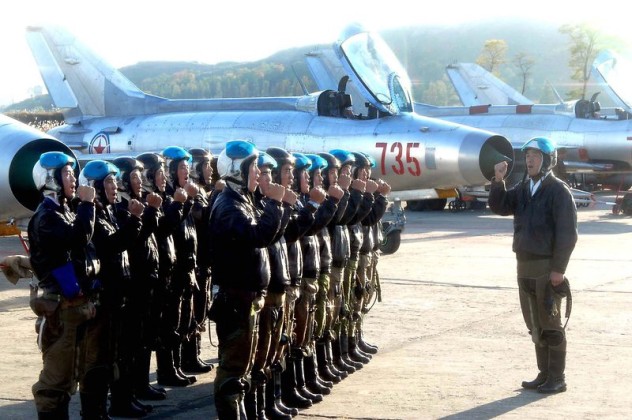
Military Watch Magazine | October 7, 2018
While the Yom Kippur War is a well known Cold War engagement between Soviet and Western aligned forces which took place in the midst of the Vietnam War, pitting the forces of a number of Arab states including Egypt, Syria, Iraq and Algeria against their longstanding adversary Israel, the role played by personnel deployed from external powers remains less well known. One party which played a significant role in the conflict, the beginnings of its extensive involvement in the Middle East to undermine the Western Bloc’s regional interests which continues to this day, was the Korean People’s Army (KPA) – the armed forces of North Korea. Having waged an intensive and brutal war with the Untied States and its allies in the 1950s, where an estimated 20-30% of its population was lost primarily due to the American bombing campaign, North Korea well understood the importance of air superiority and set about rebuilding its air and air defence forces with the most capable Soviet made weapons systems available. North Korean pilots and air defence crews were tasked not only with guarding the country’s airspace in the event of a future war with the Untied States, but also of contributing to the war efforts of a number of friendly countries – which they continue to do to this day. North Korean pilots played a considerable role in the Vietnam War, and according to Korean sources downed several U.S. fighter jets over the country. As the air war over Vietnam neared its end in the early 1970s, the KPA Air Force dispatched pilots to Egypt to aid the Soviet aligned country’s own war effort.
North Korean pilots had been stationed to aid Egyptian forces in defending their airspace months before the outbreak of the Yom Kippur War, and according to the Egyptian Military’s Chief of Staff Saad Al Shazly, Korean assistance provided critical assistance at a time of great need. Recalling that personnel from the USSR had been flying approximately 30% of the Egyptian MiG-21 fleet and operating about 20% of the country’s surface to air missile batteries, he noted that following the departure of Soviet forces under the decree of Egyptian President Anwar Sadat the Egyptian Air Force had struggled with a significant shortage of trained MiG pilots. Regarding North Korea’s role in solving this issue, the General stated in his memoirs:
“The solution occurred to me in March 1973, during the visit to Egypt of the Vice President of the Democratic (People’s) Republic of Korea (official name of North Korea.) On March 6, while escorting their Vice Minister of War, General Zang Song, on a tour of the Suez front, I asked if they could support us – and give their pilots useful combat training – but sending even a squadron of men. I knew at that time that his country flew MiG-21s. After much political discussion, in April I went on an official visit to president Kim Il Sung to finalise the plan. My fascinating ten day tour of that extraordinary republic, an inspiring an example of what a small nation of the so called Third World can achieve with its own resources is, alas, rather outside the scope of this memoir, as is my stopover in Peking (former English name for Beijing.)
Korean pilots – all highly experienced, many with more than 2,000 hours, arrived in Egypt in June and were operating by July. Israel or her ally ( the United States) soon monitored their communications, of course, and on August 15 announced their presence. To my regret, our leadership would never confirm it. The Korean s were probably the smallest international military reinforcement in history: only 20 pilots, eight controllers, give interpreters, three administrative men, a political advisor, a doctor and a cook. Bu their effect was disproportionate. They had two or three encounters with the Israelis in August and September and about the same number in the war. Their arrival was a heartwarming gesture. I mention the story here mainly to pay tribute to them and to apologise for the churlishness of our leadership in not also doing so.”
While Egyptian forces had long claimed that the MiG-21 was poorly suited to engage the F-4E, Israel’s prime air superiority fighter, and that the Soviet jet lacked the necessary survivability against the heavier American made platform, they were proven wrong not only by the successes of North Vietnamese pilots against the United States – but also by North Korean pilots operating against Israeli Phantoms over Egyptian airspace itself. According to Israeli sources, reporting on an engagement between North Korean piloted MiGs and their own Phantoms, the Korean pilots demonstrated considerable skill and were effectively untouchable in close range engagements – taking full advantage of the MiG-21’s superior manoeuvrability to evade multiple Israeli strikes with impunity. Whether North Korean pilots downed any Israeli fighters remains unknown, though reports indicate that no Koreans were shot down by Israeli jets. A number of reports do indicate however that the poorly trained Egyptian surface to air missile (SAM) crews mistook returning Korean MIG-21 fighters for Israeli jets, and proceeded to fire upon them. This was a common error made by Egyptian SAM crews, one which cost the country a number of fighter jets.
North Korean pilots’ participation in the Yom Kippur War represented only the beginning of the country’s military involvement in the Middle East, nor the last time the country would aid Arab states at war with Israel. While Egypt pivoted towards the Western Bloc in the war’s aftermath, abandoning the Soviet Union and its Arab allies, the country would pursue a number of joint weapons projects with North Korea and continues to import significant quantities of arms from the country. The Egyptian ballistic missile arsenal has North Korean origins, and the Korean Rodong-1 remains the country’s most capable platform in service today. North Korean assistance was also commissioned to construct a war museum in Egypt commemorating the Yom Kippur War, which was based heavily on the larger Fatherland Liberation War Museum in Pyongyang commemorating the Korean War. North Korean forces have since the Yom Kippur War also formed close ties to Syria and Yemen, and the KPA is involved in wars against Western aligned forces in both countries.
Korean assistance has been key to upgrading Syria’s surface to air missile network, while special forces have reportedly been deployed for ground operations. KPA personnel were also reportedly involved in the Lebanon War in alongside their Syrian allies, and were later responsible for aiding the Lebanese militia Hezbollah to construct underground fortifications key to its military success against Israel in 2006. A number of key figures in Hezbollah’s leadership, including its leader Hassan Nasraallah, reportedly travelled to Korea for military training in the 1980s. Korean assistance has been key to strengthening the missile capabilities of Libya, Syria and Yemen, as well as Iran and Hezbollah, with all these parties relying heavily on a wide variety of the country’s missile designs until today. The East Asian state has since the Yom Kippur War played a considerable role in supporting regional forces against the Western Bloc and their allies, and is set to continue to do so for the foreseeable future.
Zainab Walks On Her Feet, Ivanka Uses Government Money for Secret Services
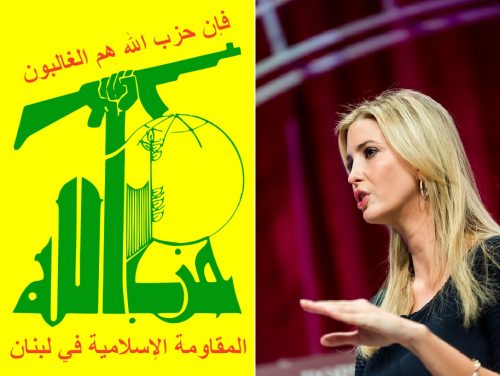
Image: Hezbollah Flag (L), Ivanka Trump (R). Credit: Public Domain/ Fortune Conferences
By Heba Mourad | American Herald Tribune | May 10, 2019
I entered the hotel apartment where a dozen ladies were sitting together. They were in Tehran for a conference on the status of women in Islam. Among the ladies sitting was a young lady in her 30s. I had seen her before in a public event in Beirut some two years ago. I went to the hotel to see a friend, and then I thought, why not see if I can socialize and get to know her up close. I had to go soon, loads of unfinished work was waiting for me at my office.
The next day, I decided to take some distance from office work and go on a short trip to accompany the ladies who were traveling to another Iranian city. And I did get lucky when I had the seat right next to her on the flight. Well, I forgot to introduce her to you; she is the daughter of the man Israel fears to death. Zainab, the daughter of Hezbollah Chief Sayed Hassan Nasrallah and I spoke all the way during that flight. We later had a long talk as well during the night after dinner.
She told me about her childhood memories, her relationship with her dad, her brother who was martyred while defending Lebanon in face of Israeli occupation, her mother who she thinks highly of, her life as a woman, a mother and a Lebanese citizen, and the list goes on.
Let all the details aside, what is so amazing about this young lady who is 33 years old and a mother of four children is that you totally forget she is the daughter of the Hezbollah chief. She is so humble and friendly. My plan was first to write about her memories with her dad in particular, especially that she does not usually talk to the media. I thought many might be curious to know more about this Nasrallah family member. I stayed with the group for one day at the hotel; we socialized and had food together. And again, I kept forgetting she is the daughter of so and so.
Rumors about this lady and her family have been circulating throughout the years. Some say she is arrogant, others say she and her family enjoy a luxurious life and spend the money of the people. Other times I hear some claiming that she lives somewhere underground and she does not go out without escorts and body guards.
She keeps a smile on her face all the time and she makes sure she is an average person in her society in terms of finances and spending.
“I go out alone, I do my own shopping and I do not have any bodyguards to escort me,” she told me. She likes keeping a simple life style and she says she is not poor, but would say she lives like any other middle-class person in her country. She joined the group of ladies all the time in the lunches and dinners, and shared a room with a couple of ladies. It felt like I had known her forever.
On that day, she was wearing her neat black gown known as the ‘Abaya’ and a pair of Sketchers. Taking pictures with the group here and there, they made jokes on how these should remain out of media’s reach to keep a low profile. She does not like being in the lime light and she likes having a normal and simple life. She told me how she enjoyed moments with her father, and how she looks up to him not only as a father but also as a leader.
She told me that the trait she likes the most about her father is how humble he is, and she tries to be always like him and teach this to her kids as well. Maybe I will not write down what I decide to keep to myself for the time being; a long and colorful discussion with the First daughter of the resistance movement.
For a second, I stopped to think: this young lady who can abuse the power of her father respects people and their feelings so much and practices what her father preaches. Her father, put on the terror list by the US is the one who taught this girl good manner. She said she always listens to his advice. “When it comes to society, I listen to his advice a lot. He knows what is best and always urges us to be respectful of the people and their feelings and that we should always set a good example.”
“I can say we are considered as middle-class. We are not poor and I thank God for providing us a decent life. However, even if we were super rich we would not have use that money to live a luxurious life. We are part of our society and we should share a similar living.”
On the other side of the planet, there exists another daughter of a famous man who has become notorious in the eyes of many, Ivanka Trump. First daughter and US presidential adviser Ivanka Trump and her husband, Jared Kushner, vacationed at a luxury resort in the Dominican Republic over a long weekend in August. The cost to US taxpayers: more than $58,000.
Also, a week-long Aspen ski vacation taken in March 2017 by Ivanka Trump, Eric Trump, and their families cost taxpayers at least $330,000 in security costs, plus thousands more in ski equipment rentals for the agents assigned to shadow the family on the slopes, according to records obtained by CBS News.
That other side of the planet is the one that keeps trying to impose “otherness”, wars, supremacy across the globe, and is inconsiderate of its own people. As Ivanka and the American ruling family enjoy luxurious hotel rooms and secret services, the Children’s Defense Fund (CDF) said in a new report that about 13 million American children are living in homes with incomes below the poverty line, depriving many of a decent education and proper nutrition, and putting them at risk of homelessness and violence.
The US Secret Service has allocated more than $90,000 for golf cart rentals in South Florida in the winter of 2018, ostensibly to protect President Donald Trump while he hits the links. Critics call the family’s frequent travel exorbitant and wasteful and insist the Trump family can afford their own security. It is okay for a president to use secret services but not to go (cheat) on golf courses, travel for the weekends or even allow his family to use that for personal and business trips.
This is while the head of the Hezbollah resistance movement lives a normal life and does not seek any luxuries, but rather dedicates all his time to protect Lebanon and the Lebanese in face of the US’s number one ally; the Israeli apartheid regime.
And the Israelis seem to fear Hezbollah more than ever. Israeli newspaper Yedioth Ahronoth quoted Yuval Steinitz, Israel’s Minister of Energy, saying that “Hezbollah missiles may target all of Israel. Zionists consider Hezbollah a very dangerous and highly experienced enemy.”
The Israeli Defense Forces, referring to the precision of the Lebanese Hezbollah missiles, writes: “Hezbollah is capable of targeting Israel’s critical facilities, and the 2006 Lebanon War seems nothing compared to a conflict with Hezbollah in future.”
Daniel “Danny” Rubinstein, an Israeli journalist, said that “Hassan Nasrallah is a great figure. Gamal Abdel Nasser fought for six days, but Hassan Nasrallah kept Israelis four weeks in their place in 2006.”
Now if you do not read history or keep up with the news, do not mistakenly think that Hezbollah is behind all the trouble in the region as Western mainstream media try to put it. Hezbollah is a Lebanese political party, as legitimate as any other in Lebanon. It was formed only when the Israeli apartheid regime decided to attack Lebanon, what people in the region used to call the ‘bride of the Middle East’.
Hezbollah has been defending the region in face of Israeli attacks and it has been standing firm in the face of terrorist groups like Daesh, al-Qaeda and al-Nusra front.
Back to where this all started; great people enjoy humility. Many say humility is weakness; however, a short but sufficient explanation would be that of Dr. Robert Hogan, founder and president of Hogan Assessments who was quoted by Forbes as explaining “Humility is the psychological opposite of narcissism.”
It is an underrated leadership quality. To be humble is not to think less of oneself, but to think of one-self-less, and this is what I think my story today should be all about.
US Iran sanctions amount to aggression against entire world: Nasrallah
Press TV – April 22, 2019
The secretary general of the Lebanese Hezbollah resistance movement has denounced US economic sanctions against Iran, describing the punitive measures as “an act of aggression” against all world nations.
“US efforts to increase economic pressure on Iran, especially its pledge to drive the country’s oil exports to zero, will have negative repercussions and will affect the entire world, including the US itself,” Sayyed Hassan Nasrallah said as he addressed his supporters via a televised speech broadcast live from the Lebanese capital Beirut on Monday evening.
He then called on world nations to stand up against “US arrogance,” pointing out, “The tyrannical US government has no respect whatsoever for international law and regulations.”
Nasrallah also lashed out at Saudi Arabia and the United Arab Emirates for following in US footsteps and joining Washington’s economic pressure campaign against Iran.
The Hezbollah chief also roundly rejected media allegations that the Israeli regime is planning to launch a surprise war against Lebanon this summer.
“There is very little likelihood that Israel would launch another war on Lebanon. The Israeli army is not prepared for any aggression against the country. I personally don’t think such a thing would happen,” Nasrallah highlighted.
The Hezbollah chief also dismissed claims of infighting between Russian and Iranian forces in Syria’s eastern province of Dayr al-Zawr as well as the northern province of Aleppo, stating that Saudi-owned al-Arabia television news network has “disseminated such lies.”
“Saudi-backed media outlets are spreading lies and fallacies about Hezbollah, Iran and the region to a large extent,” Nasrallah said.
The Hezbollah secretary general then slammed Saudi Arabia and the UAE for spreading terrorism and chaos in countries like Yemen, Sudan and Libya.
Nasrallah also blamed Wahhabism for the emergence of regional terrorism and Takfiri terrorist groups like al-Qaeda and Daesh.
Wahhabism is the radical ideology dominating Saudi Arabia, freely preached by government-backed clerics there, and inspiring terrorists worldwide. Daesh and other Takfiri terror groups use the ideology to declare people of other faiths as “infidels” and then kill them.
“There are many agents in the Middle East, who are pushing for sectarian strife to serve the interest of the Zionist regime (of Israel). All those seeking to colonize the region will only raise public awareness,” the Hezbollah chief said.
Elsewhere in his remarks, Nasrallah touched upon the economic crisis in Lebanon, demanding greater cooperation and unity among Lebanese political factions.
“All Lebanese parties agree that Lebanon is suffering from serious financial woes. They are all involved in coping with the economic crisis. Resolving Lebanon’s problems requires patience and efforts by all political parties. Ministers affiliated to Hezbollah, lawmakers as well as specialists have already prepared a number of draft solutions for Lebanon’s economic crisis,” Nasrallah underlined.
Maximum Pressure on Iran Still Isn’t Working
By Paul R. Pillar | LobeLog | April 2, 2019
Almost a year after President Trump reneged on U.S. commitments in the Joint Comprehensive Plan of Action (JCPOA), otherwise known as the Iran nuclear deal, there is not the slightest sign that this move is achieving the declared objective of Iran crawling back to the negotiating table to negotiate a “better deal.” Tehran instead has been exuding perseverance and hardline resistance. The most recent high-level Iranian statement, a speech by Supreme Leader Ali Khamenei marking the Persian new year, was full of recalcitrance. Khamenei’s themes included self-sufficiency and boosting Iran’s defense capabilities.
It is not surprising that determined opponents of the JCPOA—the most vocal of whom are determined opponents of any agreement with Iran—have been trying hard to spin this situation to make it look as if something positive is being accomplished. Patrick Clawson of the Washington Institute for Near East Policy, for example, suggests that the new year’s speech was “not the confident Khamenei of days past” and that the speech indicated that “the Trump administration has had considerable success convincing Khamenei that the pressure will continue, and that Iran cannot count on outlasting U.S. hostility.”
It also is not surprising that when The New York Times ran a story by Ben Hubbard, reporting from Beirut, about the financial strains that Hezbollah and other Iranian clients are feeling, columnist Bret Stephens jumped into action. “Heavens to Betsy,” Stephens exclaimed in a column in the next day’s Times, arguing that this must mean President Barack Obama was wrong when he said sanctions relief “wouldn’t make much difference in terms of Iran’s capacity to make mischief in the Middle East.”
Actually, Obama was right. The fallacy that Stephens, and others who defend the Trump administration’s re-imposition of nuclear sanctions, are promoting is that making life more difficult, costly, or painful for someone else somehow advances U.S. interests—at least if the U.S. government sufficiently hates whoever that someone else is. That would be true only if schadenfreude were a U.S. national interest, which it isn’t. Pain infliction serves U.S. interests only if it changes the targeted country’s behavior in a desired direction, by either limiting its capabilities or inducing it to change its policies. Regarding Iran over the past year, this is not happening.
It’s Not All About the Money
Most of Hubbard’s article—the part Stephens doesn’t mention—describes how and why Iran and its clients are not changing their policies and operations despite the financial pinch. The reporter notes that the client groups “are relatively inexpensive, remain ideologically committed to Iran’s agenda and can promote it through local politics in ways that the United States struggles to thwart.” Many of the groups “have income streams that give them some financial independence.” That certainly is true of Lebanese Hezbollah, which also benefits from having achieved broad acceptance as a political actor. Hubbard recalls how much pushback Secretary of State Mike Pompeo received on this point when he recently met with senior Lebanese officials. Foreign Minister Gibran Basil, standing next to Pompeo at a subsequent public appearance, said, “From our side, for sure, we reiterated that Hezbollah is a Lebanese party, not terrorist. Its deputies are elected by the Lebanese people with great popular support.”
The article mentions that, to the extent Iran is scaling back militia operations in Syria, this may be due less to financial reasons than to the fact that Iran’s ally Bashar al-Assad has largely won the war. In Iraq, financial stringency has led Iran not to curtail involvement but instead to seek stronger economic ties with its next-door neighbor. Militias that Iran sponsored “are now paid by the Iraq government, giving Iran leverage in Iraqi politics at little cost to itself.”
Hubbard quotes an anonymous Hezbollah fighter as saying that a financial pinch would not push members away from the organization. “You’re not in Hezbollah for the money,” he said. Something similar could be said about Iran in the Middle East. Iran’s activity in the region is shaped not by the money but instead by Tehran’s perception of what is in Iran’s security interests.
None of this should be surprising. Hubbard notes that “recent history suggests that financial pressure on Iran does not necessarily lead to military cutbacks.” As multiple independent studies have concluded, that also is true of the recent and not-so-recent history of Iran’s overall activity in the Middle East, including activity that the United States finds objectionable.
Continued Iranian Compliance with the JCPOA
Stephens tries to milk another supposed accomplishment out of the administration’s pressure campaign by pointing to the fact that Iran is still observing its obligations under the JCPOA despite the United States having reneged on its own commitments. While acknowledging that Iran outwaiting Trump has something to do with this, Stephens also says the Iranian compliance “suggests an edge of fear in Tehran’s calculations. The U.S. can still impose a great deal more pain on the Islamic Republic if it chooses to do so.”
Reflect first on the irony of an anti-JCPOA voice like Stephens pointing to Iran’s continued rigorous observance of its obligations under the JCPOA—the terms of which Stephens and other opponents have been excoriating for three years—as a supposed accomplishment of the Trump administration’s pressure campaign. Reflect further on how much Iran’s compliance with those obligations undermines opponents’ rhetoric about how Iran supposedly has been hell-bent on getting nuclear weapons, with the JCPOA just a way-station where it gets an economic fillip. If that really were Iran’s intention all along—and given that it is not now getting the fillip—Iran would have renounced the JCPOA as soon as the United States reneged.
Think also about what sort of diplomacy Stephens’s suggestion implies: that the way to get another state to stick to agreed terms is not to stick to them oneself but instead to renege and then to threaten something worse. That would be a bizarre brand of diplomacy, to put it mildly, and one that neither the United States nor anyone else could use to get much business done.
“Tehran’s calculations” are unlikely to be anything like what Stephens suggests they are. The Trump administration, through both its actions and its rhetoric, has given Iranian leaders ample reason to conclude that the administration is determined to punish Iran as much as possible no matter what Iran does. Any hesitation within the administration not to push the sanctions pedal all the way to the metal appears to be a reaction not to Iranian restraint but instead to economic concerns about how elimination of waivers for importing Iranian oil would affect the world oil market and ultimately the price of gasoline at the pump.
Iranian Patience Not Unlimited
Iran’s continued compliance with the JCPOA despite U.S. reneging definitely involves an Iranian decision to outwait Trump. This is partly, but not solely, a matter of some Democratic presidential candidates, as Stephens correctly notes, stating their intention if elected to bring the United States back into compliance with the agreement. Iran is making its decisions about nuclear policy within a larger context in which not Iran, but instead the United States under Trump, is the isolated actor. It is not just Iran but all the non-U.S. parties to the JCPOA that are committed to its preservation. So is the larger world community, as expressed in the unanimously adopted United Nations Security Council Resolution 2231.
Iran may continue to outwait Trump, despite not getting the economic relief it bargained for, until the end of the current U.S. presidential term. Politics inside Tehran probably would make it impossible to wait any longer. This is where the 2020 U.S. presidential election comes into play. Former Deputy Secretary of State William Burns, when asked about this subject recently, replied, “My sense right now is that this Iranian regime would like to try and wait out the Trump administration. But if the president was elected to a second term, then their interest in doing that probably goes out the window.”
If that happens, the damage from the pressure campaign will not be limited to the consequences that Stephens ignores, such as how economic warfare against Iran has become economic warfare against Western allies and has contributed to the poisoning of U.S. relations with them. The damage will include a new Iranian nuclear crisis that was totally avoidable if only the administration had not embarked on its destructive course a year ago.
‘Declare war on Lebanon, take out Syria’s S-300s’: Outgoing Israeli general on handling neighbors
RT | April 20, 2019
Israel has the full arsenal needed to take on Hezbollah in Lebanon and eliminate the Iranian threat in Syria, the outgoing IDF Northern Command chief boasted, warning Damascus against using S-300s to protect its sovereignty.
“If our freedom of movement is threatened, we will remove the threat. We know how to do that,” General Yoel Strick told Ynet News, adding that Israel will soon introduce “advanced weapons systems” to ensure it can continue to violate neighboring states’ airspace and to strike targets in Syria with impunity.
If the Syrians employ Russian S-300s against our planes, and we take them out, it will be seen as a legitimate move on our part.
While acknowledging that such a drastic move might damage Tel Aviv’s relations with Moscow, Strick expressed hope that it wouldn’t come to that. Moscow had supplied the Arab Republic with S-300 air defense systems following the downing of a Russian Il-20 reconnaissance plane with 15 airmen on board in mid-September, during an Israeli raid.
Also on rt.com Israel took out ‘Iranian missile site’ in Syria… or something like that
Moscow also warned Israel that it will suppress all satellite navigation, radars and communications systems of combat planes over the Mediterranean Sea if their maneuvers threaten Russian forces. Since then, Israel has been staging its intrusions via Lebanon, where the Jewish State is trying to keep Hezbollah in check.
Also on rt.com Netanyahu confirms Israeli military shelled Syrian province to prevent ‘Iran entrenchment’
Hezbollah is inseparable from Lebanon as a country, due to the militant group’s strong political presence, the general argued. Thus, he claimed, “if it were up to me, I would recommend declaring war on Lebanon and Hezbollah” – not out of bloodlust but only to thwart the group’s alleged plot to “invade” Israel.
I have no doubt what the outcome will be… It will be a decisive victory.
Featured Video

More Iran War fallout: Maritime insurance industry shifts from London to China
or go to
Aletho News Archives – Video-Images
From the Archives
Allies Don’t Need Lobbies
By Jay Knott | Dissident Voice | September 24, 2013
In a recent article on Counterpunch, Rob Urie defended the traditional Marxist analysis of US policy in the Middle East. He argues that support for Israel is driven primarily by economic interest, not the Jewish lobby.
He starts by paying tribute to the idea that Western societies are uniquely racist. He says that the “Western narrative” claims there is an “Arab character”, and that this is “antique racist blather”. He gives no definition of these terms. Further, he establishes his credentials as part of the dominant current in the American left by claiming that “over a million people in Iraq died so ‘we’ in the West can drive SUVs.”1
When he tries to criticize bourgeois economics, he makes it clear he doesn’t understand the developments it has made since Marx’s day, using the mathematical discipline known as “game theory”. He dismisses the basic abstraction of economic theory, the idea of the rational individual, on the grounds that it is “devoid of history, culture and political context”. But abstractions are always devoid of something.
He defends a more concrete economic theory, mostly Marxist, with some input from another theorist of capitalist crisis, Hyman Minsky. This concrete theory leads him to the view that US activity in the Middle East is primarily driven by rational capitalist motives, the need to secure a supply of oil.
“Taking the totality of circumstance — former oil company executives launching war on an oil rich nation on a pretext they publicly proclaimed they didn’t believe shortly before taking office — and that upon launching their war proved to be non-existent, requires a willingness to overlook the obvious — that the war on Iraq was for oil, that is difficult to support.”1
Perhaps I’ve misunderstood him, but based on what he says in the rest of the article, this convoluted sentence seems to argue that, because president Bush and vice-president Cheney attacked Iraq on false premises, and they also said it was all about oil, and they are former oil executives, and Iraq has a lot of oil, it’s difficult to deny US attacks on Iraq are all about oil.
In fact, it’s not hard at all. As Urie points out, at times Bush and co. said that attacking Iraq was “protecting the world’s supply of oil.”1 But, as he also points out, they are congenital liars. Why should we believe them when they say they are trying to “protect” the oil supply? Protect it against what? When politicians “admit” attacks on Middle Eastern countries are wars for oil, they are parroting the neo-con party line, feeding the public, both left and right, with a plausible-sounding pretext. For right-wingers, “it’s a war for oil” is a reason to support war, and for leftists, it’s a way to feel better by complaining impotently about corporate greed. Both approaches help the war drive. … continue
Blog Roll
 Aletho News
- More Iran War fallout: Maritime insurance industry shifts from London to China
- US-Israeli aggression on Iran triggers review of GCC countries’ investment pledges to Washington
- Russia slams UK plan to seize tankers suspected of carrying its oil
- Pakistan ramps up food exports to Persian Gulf nations as war deepens food insecurity
- Iran submits response to US plan, sets terms for war’s end: Tasnim
- US vs Iran: Kharg Island Talk — Bluff or Escalation? Ex-Military Officer Weighs In
- Zelensky unnecessarily involves Ukraine in the Middle East crisis
- Turkish tanker blacklisted by Ukraine hit in drone attack – media
- Canada, the U.S., and NATO: the inescapable trap
- Villains of Judea: Leonid Radvinsky
- If Americans Knew
- ‘No Innocent Children’: Far-right Israeli Lawmaker Defends Killing of Palestinian Family
- Mossad’s promises helped Netanyahu convince Trump that Iran could be toppled
- US Arms Control Official Refuses To Comment When Asked If Israel Has Nuclear Weapons
- Veterans warn US landing could be ‘more Gallipoli than Vietnam’
- Israel may be committing war crimes in Lebanon – Not a ceasefire Day 167
- In the West Bank, life is a constant battle – 3 articles
- Jacob Reses, one of the most powerful pro-Israel operatives in Trump’s Washington
- Israeli-US assaults kill or injure 87 children a day – Not a ceasefire Day 166
- ‘Forever live by the sword’: Understanding Israelis’ massive support for Iran war
- UN’s special rapporteur on human rights says Israel is systematically torturing Palestinians
- No Tricks Zone
- Devastating Assessment Of Comirnaty Vaccine By Former Senior Pfizer Europe Toxicologist
- New Study: CO2 Is ‘Effectively Negligible’ As An Explanatory Climate Change Factor Since 2000
- Former Pfizer Toxicologist Dr. Helmut Sterz Tells Bundestag Hearing Pfizer Vaccine Should Have Never Been Approved
- Energy Expert: Germany’s Nuclear Phaseout Was A “500 Billion Euro Mistake”
- New Research: South Australia’s Mid-Holocene Sea Surface Temperatures Were 4°C Warmer Than Today
- Storing Green Energy To Last Germany 10 Days Would Require A 60-Million Tonne Battery
- New Studies: UK Sea Levels Were 4 Meters Higher Than Today During The Mid-Holocene
- Destructive Green New Deal: German Energy And Metal Group Warns Of Drastic Crisis
- New Study Documents A 20-Year Pause In Arctic Sea Ice Decline – Driven By Internal Variability
- Wake-up Call: Survey Shows Majority Of Germans Now Favor Postponing Climate Targets!
 Aletho News