Trump Creates a New Nation
Executive order implies that “Jewishness” is now a nationality
By Philip Giraldi • Unz Review • December 17, 2019
The pandering by Donald Trump and those around him to Israel and to some conservative American Jews is apparently endless. Last Wednesday the president signed an executive order that is intended to address alleged anti-Semitism on college campuses by cutting off funds to those universities that do not prevent criticism of Israel. To provide a legal basis to defund, the administration is relying on title VI of the Civil Rights Act of 1964, which prohibits any discrimination based on race, color or national origin. Since the Act does not include religion, Trump’s order is declaring ipso facto that henceforth “Jewishness” is a nationality.
The executive order does not mention Israel by name, but it does state that its assumptions are based on “the non-legally binding working definition of anti-Semitism adopted on May 26, 2016, by the International Holocaust Remembrance Alliance (IHRA), which states, ‘Antisemitism is a certain perception of Jews, which may be expressed as hatred toward Jews. Rhetorical and physical manifestations of antisemitism are directed toward Jewish or non-Jewish individuals and/or their property, toward Jewish community institutions and religious facilities’; and (ii) the ‘Contemporary Examples of Anti-Semitism’ identified by the IHRA, to the extent that any examples might be useful as evidence of discriminatory intent.”
The IHRA “contemporary examples” supplementing the basic description are important. They considerably broaden the definition of anti-Semitism, to include “Accusing Jewish citizens of being more loyal to Israel, or to the alleged priorities of Jews worldwide, than to the interests of their own nations” and “claiming that the existence of a State of Israel is a racist endeavor.” The examples also included holding Israel to a higher standard than other nations when criticizing it, and IHRA offers no possible mitigation even if the accusations are, in the case of the behavior of some Jews and of Israel, accurate.
Those who are confused because in the past expressions like “Italian” or “Irish” or “British” meant actual countries should recognize that Trump-speak never respects any connection with reality when there is political advantage just sitting out there waiting to be snatched and exploited. And that imperative is considerably multiplied when one is referring to either the state of Israel or of Jews in general, particularly as seen by the Trump White House, which clearly and repeatedly sends the message that it reveres both. Trump’s order will in effect constitute a government-promoted argument that Jews are a people or a race with a collective national origin, like Italian or Polish Americans, an assertion that clearly is untrue.
In fact, suppressing criticism of Israel on college campuses using a “weaponized” claim of anti-Semitism has long been a major foreign policy objective of the Israeli government even though nonviolent assembly and free speech are guaranteed by the U.S. Constitution. Congress has several times considered a comprehensive Anti-Semitism Awareness Act, though it has not passed due to legitimate free speech concerns. The nonviolent Boycott, Divestment and Sanctions movement (B.D.S.), which is very active on American campuses, has been particularly targeted and criticism of it is frequent in the media and from Congress while also emanating from the White House. As most accredited colleges receive federal funding, which can be considerable at a major research university, the executive order will create a major dilemma over how to respond, particularly for those schools that have Middle East study programs.
Work on the presidential executive order was initiated in the summer inside the White House by a team led by Jared Kushner, Trump’s son-in-law and senior adviser, together with his close aide special assistant to the president Avi Berkowitz. They sought to develop a formula whereby government policy would equate anti-Zionism with anti-Semitism, and Donald Trump both agreed with that assessment and followed through on it. On December 8th he promised to take action against B.D.S. and other critics in a speech delivered before the Israeli-American Council. The speech is worth reading in full by anyone who is concerned that the United States now has a government that favors one already privileged, wealthy and powerful constituency in particular and is not committed to upholding the civil liberties of all Americans.
Israel is an apartheid state. Covering up for its crimes against humanity as well as its war crimes is something of a growth industry in the United States, with Zionist billionaire oligarchs launching new foundations on a regular basis. Jewish power in the U.S. means that Israel always has been given a pass, even when it deliberately attacked and sought to sink the U.S.S. Liberty, an American Naval vessel in international waters in 1967. Thirty-four crewman died in the assault. The subsequent investigation of the attack was whitewashed by the president, secretary of state and the Navy department while the survivors were threatened with imprisonment if they revealed what had occurred. That is how a powerful and ruthless Israel acting through its traitorous domestic proxies operates and it illustrates how feeble the Establishment is in standing up to it.
This latest outrage, in which free speech and association will be denied to benefit one group on the basis of its claimed perpetual victimhood, had its genesis earlier this year when the federal government’s Education Department ordered Duke University and the University of North Carolina at Chapel Hill to reorganize the Consortium for Middle East Studies program run jointly by the two colleges in part based on their failure to include enough “positive” content relating to Judaism. The demand came with a threat to suspend federal funding of Title VI Higher Education Act international studies and foreign language grants to the two schools if the curriculum were not changed.
The Education Department was particularly irate over a conference in March called “Conflict Over Gaza: People, Politics and Possibilities.” A Republican congressman was outraged by the development and asked Secretary DeVos to investigate because the gathering was full of “radical anti-Israel bias.”
Coverage of the story revealed that “Betsy DeVos, the education secretary, has become increasingly aggressive in going after perceived anti-Israel bias in higher education.” Her deputy who has served as a focal point for the effort to root out anti-Israel sentiment is Assistant Secretary of Civil Rights Kenneth L. Marcus, who might reasonably be described as “a career pro-Israel advocate,” the founder and president of the Louis D. Brandeis Center for Human Rights Under Law, which he has used to exclusively defend the rights of Jewish groups and individuals against BDS and other manifestations of Palestinian pushback against the Israeli occupation of their country. He has not hesitated to call opponents anti-Semites and has worked with Jewish students to file civil rights complaints against college administrations, including schools in Wisconsin and California. In an op-ed that appeared, not surprisingly, in The Jerusalem Post, he observed that even when student complaints were rejected, they created major problems for the institutions involved. “If a university shows a failure to treat initial complaints seriously, it hurts them with donors, faculty, political leaders and prospective students.”
Last year Kenneth Marcus reopened an investigation into alleged anti-Jewish bias at Rutgers University that the Obama Administration had closed after finding that the charges were baseless. Marcus indicated that the re-examination was called for as his office in the Education Department would henceforth be using the IHRA-derived State Department definition of anti-Semitism that also includes “denying the Jewish people their right to self-determination,” making virtually all criticism of Israel a civil rights violation or even a hate crime.
Critics of the Trump move, many of whom are themselves Jewish, are uncomfortable with being placed by government into one category, noting inter alia that ALL students are de facto already protected by Title VI, which has been interpreted as making all forms of discrimination illegal. And they also note that the law was never intended to protect individuals whose feelings were hurt or who claim to be unwelcome or even threatened by someone saying something that they disapprove of. Since such protection is clearly the intention of the executive order, it is undeniable that the Trump’s latest ploy is little more than a mechanism to pressure colleges into effectively banning B.D.S. and other groups critical of Israel.
And the order itself raises at least one unpleasant thought: if “Jewishness” is a nation even though it is demonstrably not one, what is the alleged Jewish nationality all about? Is this just one more example of the politics of Jewish identity or is it really some form of dual loyalty, with American Jews divided between those who are loyal to the U.S. and those who are loyal to some supra-nationality or allegiance? The fact is, that Donald Trump himself has several times expressed the view that American Jews, particularly those who are politically liberal, should be more loyal to Israel.
Trump’s maneuver is unfortunately part of a well-funded and highly coordinated federal and state campaign to pass laws to criminalize critics of Israel. And the issue has also surfaced within the Democratic Party among those campaigning for the presidential nomination. Speaker Nancy Pelosi forced Representative Ilhan Omar to apologize after she criticized proposed anti-boycott legislation. More recently Bernie Sanders is being smeared as an anti-Semite even though he is Jewish because he associates with critics of Israel and has spoken out in favor of defending free speech while also supporting Palestinian rights.
There is a certain irony in all of this political theater, that the wealthiest and most powerful identifiable group in the United States should yet again be playing the victim is in itself astonishing. And making it a crime to deny Israel legitimacy while at the same time denying the same thing to Palestinians should give anyone pause.
And there is also considerable hypocrisy in that pro-Israel groups on campus have been if anything better funded and more aggressive in promoting their point of view than B.D.S. has been without any consequences. Canary Mission, for example, claims to “document people and groups that promote hatred of the U.S.A., Israel and Jews on North American college campuses” by posting their names, photos and personal information on its website. Israeli-American real estate investor and billionaire Adam Milstein is reported to be its principal funder while the site’s listings have been allegedly used by the Israeli border security officials to deny entry to pro-B.D.S. American citizens and also with potential employers to deny applicants jobs.
The Lawfare Project’s Campus Civil Rights Project meanwhile helps aggrieved Zionist students to “take legal action to ensure that schools live up to their legal obligations to protect Jewish students from anti-Semitic harassment, intimidation, and discrimination.”
So here we are again. Special privileges for the perpetual victims. And no one in the media is willing to tell it like it is, while the handful of meek voices in congress have been effectively silenced. So sad, particularly as an election year is coming up and there will undoubtedly be much more of this. When the Israelis occupy nearly all of the West Bank with Donald Trump’s approval and start “relocating” the existing population, who will be around to speak up? No one, as by that time saying nay to Israel will be a full-fledged hate crime and you can go to jail for doing so.
Philip M. Giraldi, Ph.D., is Executive Director of the Council for the National Interest, a 501(c)3 tax deductible educational foundation (Federal ID Number #52-1739023) that seeks a more interests-based U.S. foreign policy in the Middle East. Website is councilforthenationalinterest.org, address is P.O. Box 2157, Purcellville VA 20134 and its email is inform@cnionline.org.
Chile Denounces Over 350 Eye Injuries On Human Rights Day
teleSUR | December 10, 2019
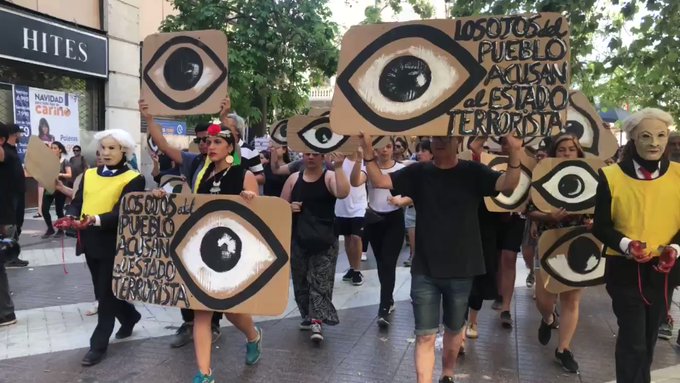
After more than two months of mobilizations against the policies of right-wing President Sebastian Piñera, sectors of the population took to the streets Tuesday in what was called “March for the Eyes of Chile,” in commemoration of the International Human Rights day.
The Chilean people denounced the government’s excessive violence after 352 people lost their vision partially or totally during the violent repression to social protests. Organizations defending the rights of peoples mobilized to the meeting point for protesters at the renamed ‘Plaza of Dignity.’
The main objective of the march was to denounce the violent repression by police that until Dec. 6, caused 3,449 injured, including 2,767 men, 397 women, and 254 children and adolescents, according to the National Human Rights Commission.
Those attending the demonstration came with posters that had one eye drawn to remember the 352 people who have eye wounds, of which 331 are from injury or trauma and 21 from bursting or loss.
The posters also show a message denouncing “the eyes of the people accuse the terrorist state.”
For his part, the Director of the NHRC Sergio Micco said that the organization has proven on countless occasions that serious violations of human rights have occurred in the demonstrations. “We are facing a situation of denunciation of serious violations of human rights… there are abusive and negative behaviors that are continually repeated such as excessive use of riot guns,” he commented.
The Director of the Carabineros, Chile’s military police Mario Rozas, announced the suspension of the use of pellets as an anti-riot tool, except in cases of “legitimate defense when it represents a death threat.”
The measure follows a study by the University of Chile that states that these pellets are composed of only 20 percent rubber, while the other 80 percent have different elements, such as lead. However, on Nov. 23, Al Jazeera reported that Chilean police continue to implement pellets despite the official suspension of their use.
The unrest in the South-American country was sparked by a government’s decision to increase metro fees [premised on reduced carbon energy] but quickly spread to hold other social issues such as income inequality and swelling costs of living. The state’s response to the popular grievances has since led to the death of 23 demonstrators while around 3,000 have been injured.
The Inter-American Commission on Human Rights (IACHR) along with numerous other rights groups condemned the constant violations of human rights by police and military against the population in Chile.
European taxpayers’ money going to Israeli entities accused of international law violations
MEMO | December 11, 2019
The European Union (EU) is channelling European taxpayers’ money to Israeli entities accused of international law violations, according to a new briefing by human rights campaigners.
The research, carried out by the Brussels-based group European Coordination of Committees and Associations for Palestine (ECCP), was published Tuesday.
“EU research funds have been a very important source of funding for Israeli academics, corporations and state institutions, among them a number of military companies and those involved in illegal Israeli settlements”, stated ECCP in a press release launching ‘EU and Israel: The Case of Complicity’.
“For many years European and Palestinian civil society and human rights organisations have been raising concerns over European taxpayers’ money being channelled to Israeli companies and institutions accused of war crimes and involved in violations of international law and human rights”.
According to ECCP, even at the same time as the EU has been criticising Israeli actions over the years in the occupied Palestinian territory, the body has also been “funding the very companies that sustain these unlawful activities”.
Thus, the human rights campaigners add, “when it comes to Israel the EU continues to violate its own directives and commitments to international law by funding Israeli complicit entities at the expense of Palestinians”.
In one example cited in the research, as part of the last funding cycle known as ‘Horizon 2020’, two of Israel’s largest military companies – Elbit Systems and Israeli Aerospace Industry – received almost 10 million Euros of European taxpayers’ money.
Although Israel is not an EU country, Israeli applicants have been able to access EU research funds on the same basis as member states since 1995 through the EU-Israel Association Agreement.
“While Israel, as the Occupying Power, bears the main responsibility to ensure respect for international law and human rights of the occupied Palestinian population”, ECCP states, “third states which are not party to the conflict, such as the EU and its member states, also have an obligation to not aid, assist or recognise bodies that violate international law”.
Report: 557 Israeli violations against Palestinian media
MEMO | December 11, 2019
The Israeli occupation has committed 557 violations against Palestinian mass media during 2019 alone, the Government Media Office (GMO) revealed in a report issued on Tuesday.
Commenting on the report, GMO director, Salama Marouf, announced that Palestinian journalists are facing the “worst violations” by the Israeli occupation, noting that a number of them were killed, with some losing body parts or suffering from serious injuries.
The most recent Israeli violation, according to Marouf, was the Israeli shooting of the Palestinian photojournalist from the West Bank, Muath Amarneh, causing serious injuries to his eye leading to its removal.
Marouf also cited the Israeli closure of Palestine TV’s office in Jerusalem, after raiding it and confiscating its contents.
Marouf stressed that the Israeli occupation forces use “direct excessive force” to crackdown on Palestinian journalists and mass media, in order to undermine their coverage of the Israeli violations against the Palestinians.
Recounting only some of the Israeli violations against journalists, Marouf cited “the Israeli occupation forces beat them, insult them, hinder their work, arrest them, raid their homes, confiscate their equipment and impose travel bans on them.”
Marouf also described the Israeli pressure and cooperation with the owners of the different social media platforms, including Facebook and Twitter, which closed and disabled hundreds of Palestinian pages and accounts, as part of the violations against Palestinian media.
He called for bringing the Israeli occupation to court over its crimes against Palestinian journalists and mass media, and called for the implementation of the UN Security Council Resolution 2222, which guarantees the protection of journalists.
Iran scientist Soleimani arrives home after over one year behind bars in US

Press TV – December 7, 2019
Freed Iranian stem cell scientist Dr. Masoud Soleimani has arrived in Tehran after over one year of imprisonment in the United States.
Soleimani arrived at Tehran Mehrabad airport on Saturday evening after he was released by the US in a prisoner swap. He was welcomed by his family members and Iranian officials upon his arrival.
Iranian Foreign Minister Mohammad Javad Zarif accompanied the released scientist from Zurich where the swap took place.
The Iranian foreign minister said in a tweet earlier in the day that the top scholar, along with Xiyue Wang — a Chinese-born US citizen who had been sentenced to 10 years in prison for espionage in Iran in 2017 — had been delivered to the Swiss officials and would “be joining their families shortly.”
Back in October last year, Soleimani, 49, left Iran on sabbatical last year but was arrested upon arrival in Chicago and transferred to prison in Atlanta, Georgia for unspecified reasons.
When he left Tehran last fall, Soleimani, a professor and biomedical researcher at Tarbiat Modares University (TMU) in Tehran, planned to complete his research on treating stroke patients as a visiting scholar at the prestigious Mayo Clinic in Minnesota.
Prosecutors in Atlanta had accused him and two of his former students of conspiring and attempting to export vials of human growth hormone from the US to Iran without authorization, in violation of US sanctions.
The human growth hormone is not banned in the US or Iran and was being used “exclusively for medical research,” which is still considered largely exempt from US sanctions, according to his Atlanta attorney Leonard Franco.
The two students were charged in a court and released after posting bail because they held US citizenship.
When holidays bring hate: Sarah’s Day in Occupied Hebron
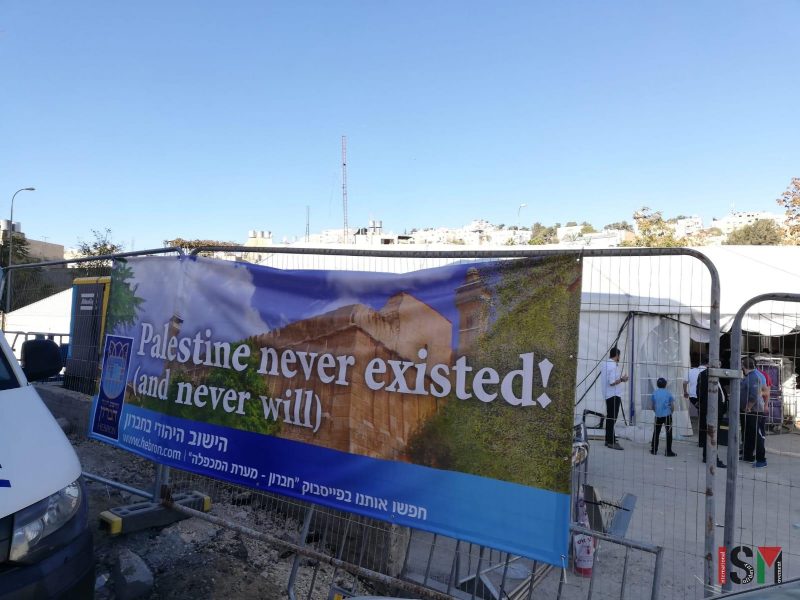
Extremist and racist propaganda placed around Hebron (H2) ahead of Sarah’s Day, a major Jewish holiday.
International Solidarity Movement | November 28, 2019
Hebron, occupied Palestine – The Jewish holiday of Shabbat Chayei Sarah (Sarah’s day’) took place in Al Khalil (also known as Hebron) over the weekend of 22-23 November. Over the two days around 50,000 Israeli settlers flocked to the city, to celebrate the festival in the place that Zionists believe is their religious right (despite the fact that it is historically Palestinian and is clearly within the demarcation of Palestinian Territories).
For weeks the area was being adapted and prepared to accommodate the thousands of visitors. Israeli settlers from nearby illegal settlement Kiryat Arba were to be joined by other observant Jews from across Israel, as well as from countries abroad such as France, the UK, and the USA. The mood was set by blatant Zionist propaganda adorning the streets, such as a banner proclaiming “Palestine never existed – and never will”. Whole areas of the old city and surrounding areas were taken over by gazebos, tents and caravans for the weekend. Exclusive and expensive VIP tickets to celebrate ‘Sarah’s day’ were available for hundreds of US dollars, enabling attendees to meet and dine with religious leaders, alongside Knesset members, and IDF commanders.
By Friday afternoon, thousands of celebrants had arrived in the city and the already extensive Israeli Occupation Force (IOF) presence (normally 4000 IOF soldiers guard the 400 Israeli settlers) was even greater than usual. Enhanced security measures were in place and major roads were blocked off, obstructing Palestinian movement around the city, and forcing Arab shops to close for business in an already suffocated economic environment (due to businesses and areas being closed by military order, and commerce/tourism heavily suppressed by restrictions on movement through checkpoints).
Many of the visiting settlers were visibly armed, with handguns or automated weapons, in stark contrast to Palestinians for whom it is illegal to carry a weapon, tightly enforced at all of the numerous checkpoints.
Each day International Solidarity Movement (ISM) received reports of serious, violent attacks on Palestinians living in or passing through vulnerable areas where settlers filled the streets.
On Friday evening, on the ‘Prayer Road’, leading up to the large settlement of Kiryat Arba, a group of 8 Palestinians were attacked in a barber shop. ISM spoke to one of the victims, Fayed, who reported a large group of settlers forcing entry to his father’s shop. Despite attempts to persuade the settlers to leave, more arrived to join the attack. Up to 100 settlers sprayed pepper spray, threw stones, chairs and pieces of wood, damaging property and injuring Fayed, his brother, his uncle and father. Fayed’s 21 year old cousin suffered a broken hand, whilst he and his uncle and father sustained injuries to the head and arms, resulting in hospitalization. The police eventually moved the settlers on however no arrests were made. Only basic details of the attack were taken down and there has been no further investigation of the crime.
Later that night there were further reports of violent attacks by groups of settlers in the same area, including an assault on a young old child, who was kicked and sprayed with pepper spray, requiring him to be taken to hospital. A Palestinian bride was also harassed and attacked by settlers as she celebrated her wedding day.
Despite the heaviness of occupation pressing down on them, the brutal and unprovoked attacks from the settlers, and frustration at the lack of protection from the authorities, Fayed and his family are quietly resistant. “Our life here is hard, but we have to resist. We try to be nice to everyone… to treat them nice, we don’t want any violence. Violence is not the solution…. the settlers carry M16 guns. It’s normal for us and our situation here – to be attacked, arrested, killed. We grew up like this. What can we do? We don’t have a lot of power or support. We can’t fight with guns or knives, this is not the solution. How many Palestinians have been killed? Guns and knives are not free, they do not make Palestine free. We are not against Jews, we are against Zionists and settlers, and those that occupy our houses. ”
The following day, the entire old city plus large swathes of the normally unrestricted area (known as ‘H1’) was locked down, making way for thousands of settlers to be given religious tours of the city. Many were intoxicated, chanting provocative anti-Palestinian songs, shouting abuse, and urinating on Palestinian property. As the day progressed, their behavior became increasingly violent, with numerous incidents of settlers throwing rocks, bottles and other items at Palestinian people and homes, as well as unlawfully entering or climbing on Palestinian property. IOF remained passive, merely supervising the passage of the crowds through Palestinian areas.
In one shocking incident, a group of settlers attacked the home of a known Palestinian activist, Imad, who has been frequently targeted since speaking out against the murder of a Palestinian by the IOF several years ago.
Imad and his family are some of the few Palestinians brave enough to continue living in Tel Rumeida, part of an area in the heart of the old city which has been designated a restricted military zone (known as ‘H2’). Since 1968 Al Khalil has been subject to the establishment of illegal Jewish settlements, and over the last 20 years, the area has seen a huge influx of hardcore settlers who believe for religious reasons they have a right to occupy the land. These are some of the most extreme settlers in Israel, who routinely perpetrate abuse and violence against Palestinian residents, including children going to school. Many Palestinians have been forced out of their homes and for those who remain, living in this area is extremely dangerous for Palestinians. There is a daily threat to life and limb.
On Saturday, as the streets of Tel Rumeida were inundated with thousands more armed settlers, the violence and intimidation escalated. There were multiple reports of attacks on Palestinian people and property. Footage was recorded of large groups of drunk settlers climbing on the roofs of Palestinian homes, and abusing and intimidating residents.
On Saturday Imad remained confined at home with his grandchildren, due to the large numbers of settlers who had been marching and congregating in the streets outside, making it unsafe for Palestinians to leave the house. Imad heard settlers climbing on his roof, and trying to enter his home through the entrance way. He called friends to come and help. and unsuccessfully tried to convince the settlers to leave. The large group were shouting abuse, spitting and throwing stones at bottles. Moments later Imad heard crying from where his 18 month old grandson was sleeping. As he ran into the room he discovered that a settler had thrown a stone through the open window, striking the child on the head and wounding him.
Due to the closed and restricted nature of this part of the city, an ambulance was unable to reach the house to attend to the child. The child had to be carried through the streets, protected by a circle of local people from the settlers who continued to try to attack the group as they tried to reach the ambulance.
Imad explains that the IOF soldiers arrived at the house during the attack, however they only stood watching, and failed to intervene to stop the violence. When local Palestinian’s arrived to provide support, the soldiers pushed and held them back, threatening to arrest them. The IOF also failed to provide any first aid or show concern for the injured child.
Despite the heavy IOF and Israeli police presence throughout the city during this weekend, it was abundantly clear that they were there to protect the settlers, and not the Palestinian residents. There was a complete failure to protect the Palestinians under attack. Police also failed to undertake any investigation into the various incidents, or attempt to bring to justice those settlers engaging in violence against Palestinians.
This raises concerns that the IOF are turning a blind eye to the violence, sanctioning and enabling it to occur, or alternatively that they simply have no power or authority to control the settlers’ violence. The risk for Palestinians trying to resist the occupation and violence, such as Imad, is to be punished, singly or collectively, for their defiance in the face of the creeping genocide of the Palestinian land and people.
Whilst trying to document and observe violence and abuse, ISM experienced hostility and aggression from both settlers and the IOF, including physical and verbal threats, restriction of movement as well as having our passports photographed by police and threatened arrest, in a clear attempt to deter us from our work. Pro-Palestinian activists in Israel risk deportation, including a 10 year ban from the country, serving to silence and prevent the documenting of human rights violations in Palestine.
Is Criticism of Israel Already an Official Hate Crime in America?
By Philip Giraldi – American Free Press – December 2, 2019
One subject that congressmen and the mainstream media tend to avoid is the erosion of fundamental liberties in the United States as a consequence of the war on terror and American involvement in the Middle East. Some of America’s legislators apparently do not even understand that freedom of speech actually means that one can say things that others might find distasteful. The assault on freedom of speech has been accelerated through the invention of so-called “hate speech,” which has in turn morphed into “hate crimes” where punishments are increased if there is any suggestion that hatred of groups or individuals is involved. Some have rightly questioned the whole concept, pointing out that if you murder someone the result is the same whether you hate your victim or not.
Freedom of speech is particularly threatened in any situations having to do with Israel, a reflection of the power of that country’s lobby in the United States. At a recent town hall gathering, Rep. Dan Crenshaw (R-Texas) demonstrated how he and his colleagues run and hide whenever the issue of Israel is raised when he would not respond directly to a question over whether any criticism of Israel should or should not be protected under the First Amendment. Crenshaw is a Republican and generally reliably conservative, though he recently spoke out against the “For the People Act of 2019,” which he claimed “would limit free speech dramatically.”
A constituent specifically asked Crenshaw’s opinion about federal laws that require citizens in some states to sign a pledge that they will not boycott Israel if they wish to get government contracts or obtain a government job. The audience member also mentioned a law passed in Florida that bans anti-Semitism in public schools and universities, defining “anti-Semitism” as criticism of Israel. The constituent observed, “These laws are obviously flagrant and troubling violations of the First Amendment to free speech.”
“Will you honor your oath and denounce these laws here, now and forever?” Crenshaw was then asked. Crenshaw quickly fired back that the critic was “cloaking yourself in the First Amendment” to enable engaging in “vehement anti-Semitism.” Crenshaw then asserted that the questioner was “advocating the BDS movement,” a recent target of much of the legislation that the critic was addressing.
BDS refers to the Boycott, Divestment, and Sanctions movement, which calls on people to protest Israel by pulling investments from and boycotting the country.
Israel is engaged in what might be described as a war with the objective of driving any and all criticism of the Jewish state out of polite discourse, making it illegal wherever and whenever possible. The Knesset has passed legislation criminalizing anyone who supports BDS and has set up a semi-clandestine group called Kella Shlomo to counteract its message. The country’s education minister has called BDS supporters “enemy soldiers” and has compared them to Nazis. Netanyahu has also backed up the new law with a restriction on foreigners who support the BDS movement entering the country, including American Jewish dissidents, several of whom have been turned around at the airport and sent home.
Israel has been particularly successful at promoting its own preferred narrative, together with sanctions for those who do not concur, in the English language speaking world and also in France, which has the largest Jewish population in Europe. The U.S. government under Donald Trump is completely under the thumb of the Israeli prime minister’s office, with Secretary of State Mike Pompeo recently saying “our major focus is stamping out anti-Semitism.”
Sanctions already in place in Europe consist of fines and even jail time. The legal penalties come into play for those criticizing Israel or questioning the accuracy of the accepted holocaust narrative, i.e., disputing that “6 million died.” Even attacking specific Israeli government policies, like its slaughter of Palestinians in Gaza every Friday, can be found guilty of anti-Semitism, which is now considered a hate crime in Britain, France, Germany, and, most recently, the Czech Republic. In Britain, where the Jewish lobby is extremely strong, a law passed in December 2016 made the UK one of the first countries to use the definition of anti-Semitism agreed upon earlier in the year at a conference of the Berlin-based International Holocaust Remembrance Alliance (IHRA).
A statement from the British prime minister’s office at that time explained that the intention of the new definition was to “ensure that culprits will not be able to get away with being anti-Semitic because the term is ill-defined, or because different organizations or bodies have different interpretations of it.”
The British government’s own definition relies on guidance provided by the IHRA, which asserts that it is considered anti-Semitic to accuse Jews of being “more loyal to Israel or their religion than to their own nations, or to say the existence of Israel is intrinsically racist.” In other words, even if many Jews are more loyal to Israel than to the countries they live in and even though Israel is in fact intrinsically racist, it is now illegal to say so in Great Britain.
One should not be surprised, as the British government’s subservience to Jewish and Israeli interests is nearly as enthusiastic as is government in the United States, though it is driven by the same sorts of things—Jewish money and Jewish power, particularly in the media. A majority of Conservative Party members of parliament have joined Conservative Friends of Israel, and the Labour counterpart is also a major force to be reckoned with on the political left.
Here in the United States, the friends of Israel appear to believe that anyone who is unwilling to do business with Israel or even with the territories that it has illegally occupied should not be allowed to obtain any benefit from federal, state or even local governments. Constitutional guarantees of freedom of speech and association for every American are apparently not valid if one particular highly favored foreign country is involved, as the discussion with Crenshaw reveals.
Twenty-seven states now have laws sanctioning those who criticize or boycott Israel. And one particular pending piece of federal legislation that is regularly re-introduced into the Senate would far exceed what is happening at the state level and would set a new standard for deference to Israeli interests on the part of the national government. It would criminalize any U.S. citizen “engaged in interstate or foreign commerce” who supports a boycott of Israel or who even goes about “requesting the furnishing of information” regarding it, with penalties enforced through amendments of two existing laws, the Export Administration Act of 1979 and the Export-Import Act of 1945, that include potential fines of between $250,000 and $1 million and up to 20 years in prison.
Israel, and its friends like Crenshaw, are particularly fearful of the BDS movement because its non-violence is attractive to college students, including many young Jews, who would not otherwise get involved on the issue. The Israeli government clearly understands, correctly, that BDS can do more damage than any number of terrorist attacks, as it represents a serious critique of the behavior of the Jewish state while also challenging the actual legitimacy of the Israeli government and its colonizing activity in Palestine. Much of the current hate crime legislation in places like Germany and the Czech Republic directly targets BDS, stating specifically that it is “inherently” anti-Semitic. In late July, the House of Representatives overwhelmingly passed its own resolution condemning BDS explicitly in a 398-to-17 vote.
Going hand-in-hand with the condemnation of BDS is a drive to maintain the exclusivity of Jewish suffering. In June, when Rep. Alexandria Ocasio- Cortez (D-N.Y.) called border detention centers holding asylum seekers “concentration camps,” she was inundated with protests from Jewish groups that claimed she was denigrating the holocaust and “insulting victims of genocide.” The United States Holocaust Memorial Museum even published a statement objecting to comparisons between “the holocaust and other events.”
It is important for Americans to realize that Israel not only spies on the U.S., digs its paws deep into our Treasury, and perverts Washington’s Middle East policy, it is also attempting to dictate what we the people can and cannot say. And Congress and much of the media are fully on board, which is the real tragedy.
French MPs pass pro-Zionism resolution, defy warnings by advocates of Palestine rights
Press TV – December 4, 2019
The lower house of France’s Parliament has passed a nonbinding resolution equating criticism of the Zionists occupying Palestinian territories with anti-Semitism, defying warnings that such a move could serve to stifle the advocates of Palestinian rights.
The National Assembly passed the resolution on Tuesday, with 154 votes for and 72 against, various media outlets reported.
The resolution states, “Criticizing the very existence of Israel as a collective composed of Jewish citizens is tantamount to hatred towards the Jewish community as a whole.”
“Such abuses increasingly make anti-Zionism ‘one of the contemporary forms of anti-Semitism’ in the words of the President of the Republic,” it adds, citing French President Emanuel Macron.
The Zionist entity proclaimed existence in 1948 after occupying huge swathes of regional countries during a Western-backed war.
Right before the war, it had already gone on a campaign of ethnic cleansing that lasted until 1949, leading to the expulsion of between 750,000 and 850,000 Palestinians from their homeland while the Israeli regime was replacing them with a similar number of Jewish migrants.
Still using far-and-wide Western backing, the regime staged another wholesale war in 1967 that saw it seizing more chunks of land, including the West Bank, East Jerusalem al-Quds, the Gaza Strip and parts of Syria’s Golan Heights.
Many Jews worldwide are opposed to the occupation of Palestinian land and reject the Zionist concept of Israel being a legitimate Jewish state, arguing that the Zionist entity has hijacked their religious identity so it could push ahead with its land theft agenda.
Israeli Minister of Strategic Affairs Gilad Erdan applauded the French lawmakers’ approval of the resolution, urging Paris to take “practical steps” against the international pro-Palestine Boycott, Divestment, and Sanctions (BDS) movement.
Inspired by the South African anti-apartheid movement, the BDS was initiated in 2005 by over 170 Palestinian organizations and later turned international. It is meant to initiate “various forms of boycott against Israel until it meets its obligations under international law” and end its occupation of Palestinian lands.
The French MPs’ move came despite earlier warnings by activists and rights organizations that such a resolution could work to block any criticism of the occupying entity.
In a letter to National Assembly President Richard Ferrand in October, 39 organizations said the resolution would compromise “defense of freedom of expression and assembly for groups and activists that must be allowed to defend the rights of Palestinians and criticize Israel’s policy without being falsely accused of anti-Semitism.”
The resolution would also “weaken the universalist approach” to combating all forms of racism,” the letter added.
As the French legislators were about to adopt the measure, a group of 129 Jewish and Israeli scholars signed a petition calling on the parliament to vote against the resolution.
The signatories said, “It is cynical and insensitive to stigmatize them (Palestinians) as anti-Semites for opposing Zionism… They oppose Zionism not because they hate Jews, but because they experience Zionism as an oppressive political movement.”
Speaking to France 24, James Cohen, a professor at the Université Sorbonne Nouvelle Paris 3 and one of the signatories, said that “by equating anti-Zionism with anti-Semitism, you’re broadening the definition of anti-Semitism too much […] you’re going very far afield.”
Only 19.7% of Americans agree with US State Dept on Israeli settlements
IRmep Poll: “International law SHOULD APPLY to Israel’s military occupation & colonization of the West Bank, Golan Heights, E. Jerusalem and displacement of their indigenous populations. Do you Disagree or Agree?”
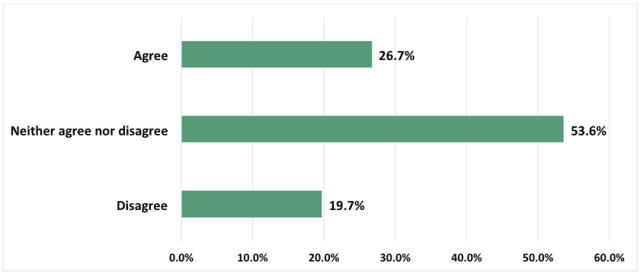
More than 80 percent of Americans seem unwilling to let Israel reinterpret international law to suit its colonialist agenda.
By Grant F. Smith | IRmep Polls
IRmep representative public opinion poll of 2,034 American adults through Google Surveys on November 20-22. Answer order randomly reversed.
Most American adults of voting age don’t appear willing to reject the applicability of international law to Israel’s ongoing colonization of occupied territories in East Jerusalem, the West Bank and Golan Heights.
On Monday, November 18, U.S. Secretary of State Mike Pompeo reversed a 1978 State Department legal opinion stating that Israeli settlements were “inconsistent with international law.” Citing President Ronald Reagan’s 1981 assessment that the settlements were not “inherently illegal,” Pompeo stated that, “After carefully studying all sides of the legal debate… the establishment of Israeli civilian settlements in the West Bank is not, per se, inconsistent with international law.”
The Trump administration relocated the U.S. Embassy from Tel Aviv to Jerusalem in 2018 and recognized the city as the capital of Israel. This most recent announcement is yet another blow to rule of law and international consensus. However, when polled, 53.6 percent of Americans don’t yet appear ready to register any concrete view on the matter. This may be due to the longstanding absence of serious U.S. mass media coverage of historical and legal issues. In other countries, informed and ongoing international legal analysis is the norm. Given that reality, it is surprising that 26.7 percent of Americans believe international law still applies, while only 19.7 percent believe it does not.
In a Nov. 21 letter sent to Pompeo, 107 House Democrats condemned the State Department’s recent decision on settlements.
Grant F. Smith is the director of the Institute for Research: Middle Eastern Policy in Washington, DC. For more IRmep polls, visit https://IRmep.org/Polls.
KONE To Put Facial Recognition And Alexa Listening Devices In Elevators
MassPrivateI | December 3, 2019
The good old days of elevator music being a minor distraction is about change.
VentureBeat reports that “elevators of the future will have virtual windows, voice-activated controls, music-streaming, and more.”
KONE’s DX Class, elevators will give security and the buildings owners, unparalleled access to view what is happening inside their elevators.
“Yesterday’s announcement concerned new elevators designed from the get-go with connectivity built in, allowing building owners to remotely control, activate, and deactivate specific services from a central dashboard. The setup includes a dynamic display, acoustics, and lighting that can be used to tailor the ambiance and interior.”
KONE’s “Monitoring Solutions” page also reveals that security and law enforcement can identify elevator riders in real-time. They even went so far as to trademark their real-time elevator spying program. It’s called KONE E-Link:
“With KONE E-Link you can monitor all your elevators and escalators from a single location. It gives you a real-time overview of equipment status, demand, traffic performance, and availability.”
Not only will security and the buildings owners have access to what is going on inside their elevators in real-time, but residents can also use Alexa to call the elevator while they are in their apartments.
VentureBeat’s story revealed that KONE plans to use Alexa and other companies like Robotise and BlindSquare to track people in the elevator.
Putting microphones inside elevators will transform them into Big Brother listening devices that will spy on you and your family.
As CNN reported earlier this year,
“Amazon reportedly employs thousands of full-time workers and contractors in several countries, including the United States, Costa Rica and Romania, to listen to as many as 1,000 audio clips in shifts that last up to nine hours. The audio clips they listen to were described as mundane and even sometimes possibly criminal, including listening to a potential sexual assault.”
Forbes warned that company’s usage of Alexa Guard is much more intrusive than their normal consumer used Alexa because it requires no wake word, is always listening, and cannot be turned off. (To learn more about Alexa Guard, click here.)
Turning elevators into 24/7 listening devices will make everyone long for the good old days when elevators just played bad music.
Kone plans to put facial recognition in elevators

Credit: Times UK
Tomio Pihkala, KONE’s executive vice president said,
“Computer vision is really one of the big things which we are working on quite a lot, Pihkala added. There are many use cases — facial recognition in the context of accessibility is a really obvious one for us.”
As VentureBeat pointed out, KONE has 450,000 customers worldwide. Their “Press Releases” page documents nearly 15 years of acquisitions and installations that would make even the most cynical person cringe.
Some of KONE’s recent contracts are Chicago’s Union Station Tower, the Garden Office Tower in Boston and the City of Kansas City. They are even in a cruise ship called the Harmony of the Seas.
KONE’s “Traffic History Playback” feature is also a major privacy concern for elevator riders.
“The history playback facility is a unique KONE E-Link feature. The need for playback may arise due to suspected misuse, reported incidents, or complaints by tenants. This feature facilitates reruns and study of elevator and escalator operating events and status changes, as if on a video recorder.”
How long does law enforcement or security store elevator video footage for? And are they recording audio?
For those of you who thought smart city surveillance ended the moment you walked inside a building or went on a cruise ship, guess what it doesn’t. When elevators are being monetized to listen to our conversations and identify us, we all lose.
French vote one step closer to anti-Zionism ban
By Ramin Mazaheri – Press TV – December 3, 2019
Paris – France’s media has remained nearly silent ahead of a vote on a resolution which is one step away from criminalizing opposition to Zionism.
If the motion passes, in a vote on December 3rd, it will throw open the door to false accusations of anti-Semitism for anyone openly criticising Israeli crimes, war atrocities and its Apartheid policies.
The resolution purposely tries to confuse “Zionism”, which refers to the imperialist and segregationist political project upon which Israel is based, with “anti-Semitism” which is a bigotry against Jews and Judaism that has nothing to do with Israeli massacres and crimes against Palestinians and non-Jews.
The hypocritical irony is that the law arrives just as France is in the midst of its latest wave of Islamophobia. Last month many top, alleged leftist politicians refused to denounce Islamophobia because they said that doing so could mean they are not allowed to publicly criticise the tenets of Islam. Protesters in Paris asked: where are France’s many self-proclaimed defenders of free speech?
The resolution states that, “Criticizing the existence of a Jewish state is a way to express hate towards the entire Jewish community.” Not only is this logically false, but inaccurate: studies show the majority of Jews in Europe are also anti-Zionist. Such a view also unjustly and dangerously tries to hold all Jews responsible for the crimes committed by Israel.
Many believe that nowhere in the world is right and wrong clearer than in Palestine, and the inability to discuss the imperialist, segregationist and constantly murderous project of Zionism will surely lead to more funerals for innocent Palestinians.
Featured Video

When Israel Is Mighty
or go to
Aletho News Archives – Video-Images
From the Archives
US murdering 1 million Iraqis is democracy, Iran giving yogurt to Iraq is “domination”
By Ali Salaam | American Herald Tribune | July 31, 2017
The New York Times, owned by the Zionist Jewish supremacist Ochs-Sulzberger family, has no problem with Iraqi suffering as long as Iran is not the one behind it.
The Iraq War was a genocide of the Iraqi people by Zionist supremacists in the Bush administration. Over 1 million innocent people were killed based on a lie. American soldiers died in an Israeli war and now an average of 22 soldiers commit suicide every day because their consciences cannot cope with the fact they committed crimes in an illegal war that served no purpose other than to benefit Israel, not America.
Benjamin Netanyahu, Prime Minister of the Zionist regime, once said “We are benefiting from one thing, and that is the attack on the Twin Towers and Pentagon, and the American struggle in Iraq.”
Paul Wolfowitz had his sights on Iraq since his time in the first Bush administration. Former Israeli official and Bush administration official Richard Perle had his eyes on Iraq since at least his authorship of the Clean Break white paper. The Zionist regime had their eyes on Iraq since the 1980s when strategist Oded Yinon wrote his white paper in support of dividing the Arab-Muslim world along ethnic and sectarian lines. The global Zionist lobby has had their eyes on Iraq since Theodor Herzl stated that Eretz Israel’s true borders go from the Nile River in Egypt to the Euphrates River in Iraq. … continue
Blog Roll
 Aletho News
- ‘Harsh reality’: Iran says France seeks monopoly on power and intimidation, not peace for all
- When Will This White House Madness End?
- Huckabee aide goes to ‘unusual lengths’ to portray ‘Israel’ positively
- Trump Announces Diesel Supply Deal With Putin Following Phone Call
- MEP blasts ‘Euro-Gestapo’ for lecturing Russia on democracy
- Syria May Send Troops to Saudi Arabia Amid War with Ansar Allah
- UK whines about losing billions to ‘Putin tax’
- Baghaei to Rubio: Distorted narratives cannot erase US record of broken commitments
- Houthis Don’t Have to Conquer Saudi Arabia to Make It Pay
- MOE: Nearly 22,000 Students and Education Workers Killed
- If Americans Knew
- Gaza ceasefire exists in name only, say more than 100 organizations
- Nearly 2 Million in Gaza Need Urgent Shelter Assistance as Winter Looms: IOM Chief Warns
- Suppressing Palestinian resistance: US charity under fire for AI monitoring of Gaza classrooms
- Thousands Are Held in Israeli Torture Camps. This Is What Happens Inside
- Israel puts Gaza’s sick, injured, newborn in peril – Daily Update
- Report claimed Mark Levin used by Israeli government to influence Trump
- Over 2,000 Gazans have died awaiting medical evacuation amid Israel’s continued siege
- How a U.S. Diplomat Suppressed and Altered Reports Critical of Israel
- 5 Palestinians Die from Israeli Strikes in Gaza as Relentless Attacks Continue
- Report: Ceasefire Slows Killing but Leaves Devastation Intact
- No Tricks Zone
- New Study: 50 Years Of The Most Aggressive ‘Net Zero’ Policies Can Only Affect The Global Climate By 0.03°C
- US September “Heat” Was No Record…Many Records Set Decades Ago
- Latest European Green Energy Debacle; Portugal’s Largest Flagship Solar Park Insolvent!
- Green Energy Debacle: German Expert Professor Fritz Vahrenholt Warns Of Severe Economic And Social Consequences
- Two More Paleo Reconstructions Affirm Meters-Higher Sea Levels Across Ireland, Brazil 7000-6000 Years Ago
- New Study: Earth And Venus Surface Warmth Largely Explained By Convection And Lapse Rate, Not CO2 Or Radiation
- 2025 Nature Paper Claiming Worsening Global Drought Gets RETRACTED …Heavily Flawed
- New Study: ‘Global Drought Shows No Detectable Recent Acceleration Under Climate Warming’
- Economic Masterminds: German Socialists Suggest Taxing Productivity Gains Stemming From Using AI
- The South China Sea Has Not Been Cooperating With The Climate Change Narrative

