Boycott Movement: Arab Delegations Withdraw from International Festival
IMEMC News & Agencies | October 19, 2017
The Boycott, Divestment, Sanctions (BDS) movement has welcomed the Palestinian student delegation and other Arab delegations’ withdrawal from the World Festival of Youths and Students, held in the Russian city of Sochi, due to the participation of Israeli delegations.
“We appreciated the principled stand taken by the Arab youths rejecting normalization, especially that the festival alleged to be anti-imperialism, however, Israeli delegations having colonial thoughts and supporting imperialism are invited to take part in it,” the movement said is a press release on Wednesday, according to Al Ray.
The movement praised all students and free voices that had withdrawn from the opening session of the festival.
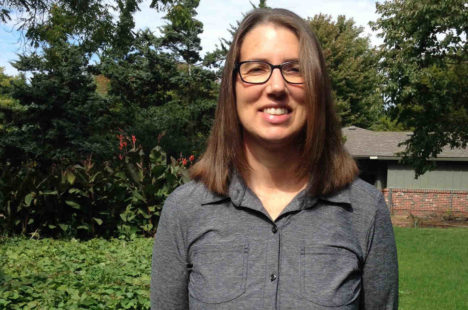
Kansas Teacher Barred from Employment for Supporting BDS
By Stephen Lendman | October 18, 2017
Barring longtime math teacher Esther Koontz from renewing her teaching contract, solely for her political beliefs, is a flagrant First Amendment violation.
She righteously supports BDS activism, wanting Israel held accountable for its high crimes against Palestinians.
Kansas House Bill 2409 prohibits state contracts with individuals critical of Israel’s agenda. In NAACP v. Claiborne Hardware Co. (1982), the Supreme Court unanimously ruled for the plaintiff against state authorities, cracking down on boycotts of white businesses, saying authority over economic relations doesn’t limit or deny political speech.
Koontz is a member of the Mennonite Church USA. In July, it voted to divest from US companies, profiting from Israel’s illegal occupation.
She supports Palestinian rights. Her employment papers require a declaration in writing of no support for BDS. She declined and was denied the right to train other teachers.
The Kansas law is unconstitutional. The ACLU supports Koontz. Last week on its web site, she headlined “Kansas Won’t Let Me Train Math Teachers Because I Boycott Israel,” saying:
“Because of my political views, the state of Kansas has decided that I can’t help it train other math teachers.”
“I was chosen last spring to participate in a program that trains public school math teachers all over Kansas. After completing a two-day preparation course in May, I was ready to take on the role.”
As a Mennonite Church USA member concerned about human rights, notably longstanding abusive Israeli practices against Palestinians, she won’t buy products made by Israeli companies or from businesses profiting from its ruthlessness.
She’s inspired by how activism helped end South African apartheid, wanting to help the Palestinian liberation struggle.
Last summer, a Kansas State Department of Education email said to participate in its math training program, she’s required “to sign a certification stating that I don’t boycott Israel,” she said.
She was “stunned,” refusing to sign “as a matter of conscience.” Asking if she could still participate in the state’s training program, she was told she could not.
She’s challenging the decision with ACLU help, a federal lawsuit filed on her behalf. A public school math teacher for nine years, she’s trained to teach others how to teach her discipline.
“The lawsuit argues that the Kansas law violates the First Amendment for several reasons,” said the ACLU:
“(I)t compels speech regarding protected political beliefs, associations, and expression; restricts the political expression and association of government contractors; and discriminates against protected expression based on its content and viewpoint.”
The suit calls for striking down the Kansas law and barring its Department of Education from requiring contractor/teachers like Koontz from certifying no support for BDS activism.
The First Amendment protects the right to boycott, upheld by Supreme Court rulings. American Revolution supporters boycotted British goods.
Colonists refused to obey the UK Stamp Act. They boycotted British goods in protest. Shop owners signed non-importation agreements. They rejected taxation without representation.
America’s first Supreme Court chief justice John Jay boycotted New York merchants engaged in the slave trade.
The mid-1950s Montgomery bus boycott was a major turning point in the struggle for civil rights. Nationwide anti-war protests in the 1960s and early 70s helped end the Vietnam war.
Boycotts and protests are an American tradition – at risk by extremist governance wanting them curtailed or abolished.
The First Amendment protects these rights. Denying them puts all others at risk.
No federal, state or local authority can legally curtail or prevent free expression in all its forms. Nor is requiring individuals indicate their political beliefs a prerequisite for employment.
If justice is to be served, Koontz will prevail in court, including the Supreme Court if her case goes that far, the unconstitutional Kansas law annulled.
Stephen Lendman’s newest book as editor and contributor is titled Flashpoint in Ukraine: How the US Drive for Hegemony Risks WW III.
Colombian Social Leader Assasinated Weeks After 7 Campesinos Were Killed

Jose Jair Cortes | Photo: UN
teleSUR | October 17, 2017
A Colombian social leader, Jose Jair Cortes, was murdered in a rural area of Tumaco municipality located in the southwest department of Narino.
Jair Cortes, a member of the local council of the Alto Mira and Frontera Community, was killed in a sector called Y, located in the heart of the city of Tumaco. The social leader was one of seven community leaders to receive death threats in recent months.
The governor of Narino, Camilo Romero Galeano, denounced the murder that occurred just weeks after a massacre that left seven people dead in the village of El Tandil, in the same municipality.
The state government has urged the authorities to investigate the exact details of the community leader’s murder.
“We have once again resisted accepting that the war will continue to make its mark on the Narino pacific,” Romero said. “Our voice of solidarity for the family of Jose Jair Cortes in this painful moment that keeps the mourning in our south.”
“We are profoundly affected by this death, just days after we met in Tumaco with him and the other members of this Junta de Gobierno, corresponding to the territory where the painful events that six peasants and dozens of wounded and still remain of research,” the official statement said.
The community council in the area has repeatedly denounced human rights violations against the Afro-Colombian, Mestizo and Indigenous peasants in the region. The campesinos in the area have been protesting against government’s plan to reduce the production of Cocoa crop, an important means of livelihood for many in the region.
In the western department of Cauca, over 40 campesinos have been injured and one journalist killed in clashes between the Indigenous community members and the Colombian police.
The Indigenous community members who began their protests 10 days ago are demanding the property in the Coconuco Indigenous Reservation, a rural area of Purace municipality, where the government had promised them land in 2013.
The Mobile Anti-Riot Squads (ESMAD) accused the natives of encroaching private property. ESMAD member, Capt. Edgar Garcia, told Caracol, a local radio station that the natives threw “immense rocks that destroy sticks and all around, equally, they shoot us with artifacts, stones, bottles, and explosives to intimidate us, while we are defending the private property.”
Whereas, a spokesman for the protesters quoted by the local radio station, said that “about 10 ESMAD trucks, two tanks and all the artifacts against the indigenous peoples, entered the community.”
Israeli occupation forces Carry out Raids on Palestinian Media Firms
© idf.il
Al-Manar | October 18, 2017
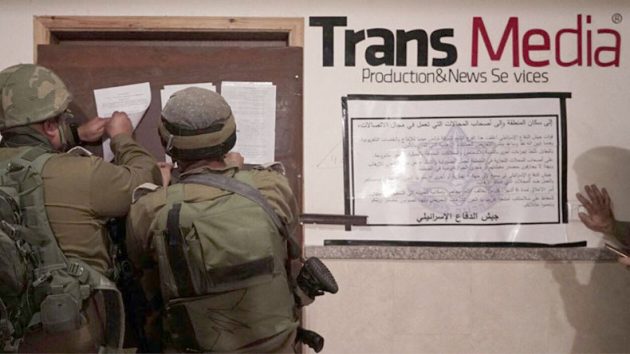
Israeli occupation forces raided Palestinian media offices across the occupied West Bank overnight in what a military spokeswoman on Wednesday called a “large-scale operation” against “incitement.”
The raids on eight companies came hours after the Israeli government declared that it would not deal with an emerging Palestinian unity government that includes Hamas unless the resistance movement made radical changes.
Israeli officials said the raids targeted companies that provide services to Hamas television stations. Notices were posted saying the companies were to be closed for six months.
“Israeli army forces last night raided eight Palestinian production and media companies that provide services to Al-Aqsa and Al-Quds TV channels,” the head of an Israeli defense ministry unit known as COGAT, Yoav Mordechai, wrote on Facebook, referring to Hamas channels.
“These two channels broadcast constant incitement against the state of Israel. It is no secret that these two channels inspired, several times, terrorists to go out and commit terrorist attacks against innocents.”
Israeli officials provided no specific examples of the alleged incitement. At least one of the companies targeted provides various services to a range of local and international news media.
The Palestinian Authority said it condemned the raids “in the strongest terms”.
“Occupation forces committed a blatant aggression and gross violation of all international laws when they stormed Palestinian cities and raided media offices,” PA government spokesman Yusef al-Mahmoud said in a statement.
He said the measures were a “clear challenge to the international efforts, especially the American efforts, to seek an opportunity for compromise and lay the foundations for peace and security with the agreement of all sides.”
Pro-Palestine posters on Balfour centenary ‘censored’ by London transport authority
RT | October 17, 2017
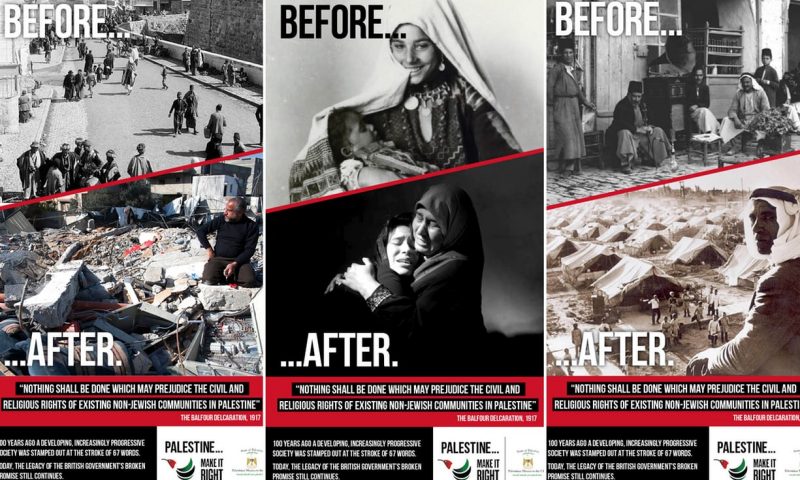
Transport for London (TfL) has been accused of censorship after refusing to allow campaigners to display posters giving the Palestinian perspective on the Balfour Declaration. The posters were designed to mark the 100th anniversary of the colonial-era document that led to the creation of Israel.
The declaration, signed on November 2, 1917, saw then-foreign secretary Arthur Balfour agree to the establishment of a national home for Jewish people in Palestine. Palestinian Ambassador to the UK Manuel Hassassian has accused TfL of censorship.
The advertising campaign, called Make It Right, includes images of life before and after 1948, when Palestinians were forced from their homes during the Arab-Israeli war.
At the time, the British Government believed their interests could be served by supporting Zionist ambitions in Palestine.
The Palestine Mission to the UK, the group behind the campaign, was left outraged after TfL said the adverts “did not comply fully with our guidelines.”
They were rejected under Clause 2.3(h) of the guidelines, which refers to campaigns relating to “matters of public controversy or sensitivity.”
“Palestinian history is a censored history,” Hassassian said in a statement.
“There has been a 100-year-long cover-up of the British Government’s broken promise, in the Balfour Declaration, to safeguard the rights of the Palestinians when it gave away their country to another people.
“TfL’s decision is not surprising as it is, at best, susceptible to or, at worst, complicit with, all the institutional forces and active lobby groups which continuously work to silence the Palestinian narrative.
“There may be free speech in Britain on every issue under the sun but not on Palestine,” added Hassassian.
The Palestinian charity said it was not asked to adapt the adverts, as can be requested by an advertising agency. It also questioned why an identical teaser ad was allowed in Westminster underground station last year without objection.
Palestinian leaders, including Palestinian Authority President Mahmoud Abbas, have requested that Britain apologizes for the Balfour Declaration.
The Government refused to issue an apology in April this year, saying it had helped to establish a “homeland for the Jewish people in the land to which they had such strong historical and religious ties was the right and moral thing to do, particularly against the background of centuries of persecution.”
The Government did, however, recognize that the declaration should have protected Arab political rights.
Protests will take place across Britain in November as Theresa May and her Israeli counterpart, Benjamin Netanyahu, celebrate the centenary.
Palestinian children beaten, tortured under Israeli interrogation
Samidoun Palestinian Prisoner Solidarity Network – October 13, 2017
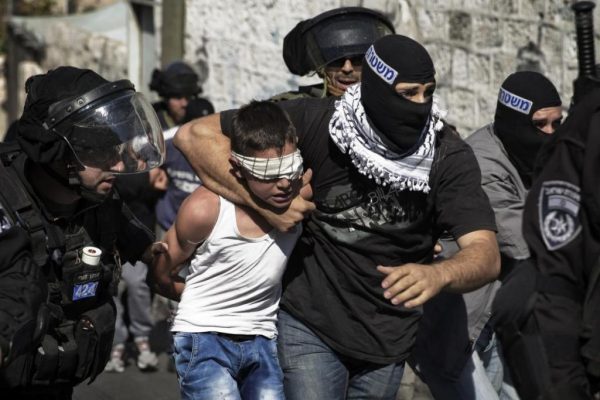
Several Palestinian child prisoners in Ofer prison revealed their experiences with torture and mistreatment to Palestinian lawyer Wael Awakah, including beatings and threats by Israeli occupation soldiers and interrogators from the moment of their arrest.
Awakah reported that Waleed Riyad al-Dali, 14 years old, a tenth-grade student and a resident of the village of Biddu in the Ramallah district, was seized on 28 September 2017 at 5:00 pm from the center of his village by undercover Israeli occupation soldiers disguised as Palestinians. He was assaulted and beaten by the soldiers, punched in the head and left bloody by their attack.
Waleed was then taken to a settlement while shackled and blindfolded in a military jeep. He reported being beaten by the soldiers rifle butts and kicked by them during the travel to the settlement. At the settlement military base, Waleed was interrogated; the interrogator threatened to break his hands, refused him food and directed curses and obscene insults at him.
Yazid Akram Humaidan, 15, also a resident of Biddu, was also seized on 28 September from the center of town by undercover Israeli occupation soldiers, who threw him to the ground, punched and slapped him. Yazid said that one of the undercover occupation soldiers stomped on his neck so hard that he feared for his life as he was beaten on the head and face with sharp blows.
Yazid also said that he was screamed at and cursed by interrogators at a nearby settlement and that he was physically weak and tired during interrogation as he had had surgery only two months before.
Hamada Jamal Abu Eid, 16, was also seized by occupation forces operating undercover in Biddu on 28 September. He said that one put a gun to his head before shooting in the air, causing him to fall to the ground where he was beaten on the body and head. He said that he was hit and slapped while being taken to interrogation at a nearby settlement, and that during interrogation himself he was subject to insults and curses.
Awakah said that Hamada continued to appear tired and ill during the interview, with severe and ongoing pain in his head. The three are among approximately 300 Palestinian children held in Israeli jails, mostly in Ofer and Megiddo prison, as well as 10 minor girls held in HaSharon prison.
In addition, the practice of sending children – especially Jerusalemite children – to house imprisonment, highlighted in the September 2017 report of Palestinian prisoners’ human rights associations, has continued. House imprisonment denies children the right to leave their homes, even for study or medical treatment in many cases, and forces parents and adults around them to become jailers at the threat of further punishment and imprisonment.
On 12 October, Jerusalemite teen Bilal Khalil Ghatit was ordered to home imprisonment with the imposition of an “electronic monitoring bracelet” on his ankle. He has already been held under house imprisonment since May, and has been unable to leave his home, go to school or visit relatives. His parents have also become prisoners; one of them must stay at home with him at all times. Bilal was seized in April 2017 by occupation forces who invaded the family home in the Sheikh Jarrah neighborhood of Jerusalem; he was released in May but ordered to house arrest. A ninth-grade student, he has been denied the ability to go to school.
Bilal’s father reported that he pays NIS 180 ($55 USD) for the electronic monitoring device; in the event of any malfunction of the device or even a loss of electricity in the home, the house is subject to violent raids by occupation forces, he noted, recalling the day of Bilal’s arrest, when his room was invaded as he slept and his brother beaten when he tried to intervene.
Another Palestinian child, Adam Hamdan, 14 from Ras al-Amud neighborhood of Silwan in Jerusalem, was also ordered to house imprisonment on 12 October; he was arrested on Tuesday, 10 October as he walked to school and accused of “throwing stones,” one of the most popular charges used by the Israeli occupation to criminalize and imprison Palestinian children and youth.
Samidoun Palestinian Prisoner Solidarity Network denounces the ongoing imprisonment, torture, mistreatment and abuse of Palestinian children at a systematic level by the Israeli occupation. We demand the immediate release of all Palestinian child prisoners in Israeli jails and urge greater international mobilization to support the hundreds of Palestinian children who are jailed each year, subject to solitary confinement and cruel and inhumane treatment, traumatic pre-dawn violent arrest raids and invasions of their homes, confiscation of their right to health and education – all as part of a systematic web of oppression at the hands of the Israeli settler colonial project.
samidoun@samidoun.ca
Prominent Chefs Urge Colleagues to Withdraw From Tel Aviv “Culinary Propaganda” Festival
IMEMC | October 12, 2017
In an open letter, prominent chefs from Palestine and nine other countries called on their colleagues to withdraw from the upcoming Round Tables culinary festival in Tel Aviv. This festival is sponsored by the Israeli government and is in partnership with Dan Hotels, which has a hotel built in an illegal settlement on stolen Palestinian land in occupied East Jerusalem.
Between October 29 and November 17, fourteen world-renowned head-chefs will spend a week cooking in Tel Aviv as part of the Israeli government’s public relations effort to use this international event to distract attention from its military occupation and apartheid policies.
The letter states:
Round Tables — dubbed “gastro-diplomacy” — is part of the Israeli government’s “Brand Israel” propaganda campaign, launched in 2005 to distract the world’s attention from Israel’s oppression and denial of Palestinian human rights through the use of culture and arts.
The chefs added that their work is about “creating inspiring, beautiful culinary experiences for people,” pointing out that the “Round Tables festival is no place for chefs who care about indigenous peoples’ having access to their farm lands and traditional food ways.”
Thaer Shaheen, a Palestinian chef at Darna, one of Ramallah’s most well-known restaurants, said:
This year’s edition of the Round Tables festival features farm-to-table food. Whose farms, and whose tables? Israel has systematically destroyed Palestinian farms and farming as a whole and continues to deny farmers access to their lands. This is evident in Israel’s persistent attacks on the annual olive harvest which is taking place now. We, the indigenous people of the land, cannot access our lands and farms. If the chefs really care about the values of the farm-to-table movement, including Palestinian farms and tables, they will withdraw from this event.
Ora Wise, a New York-based chef at Harvest & Revel and signatory of the letter, added:
As a chef, I hope for the day that my colleagues join me in valuing Palestinian life and culture as much as we value hummus, za’atar, and falafel. Round Tables by American Express claims to be introducing international chefs to “the multicultural and ethnic culinary heritage of Israel” while Palestinians are not only excluded from the table, they also continue to be violently denied access to their homes and farmlands.
Wise made a personal appeal to the chef of Pok Pok Ny restaurant from her home city:
Nobody can produce or enjoy good food within an apartheid system that destroys the very things any respectable chef believes in — celebration of distinct cultures, sustainable agriculture, preservation of local food traditions, and fair and dignified labor conditions. If Andy Ricker truly values any of this, he will refuse to participate in this Israeli government-sponsored PR stunt and would be a better chef and food entrepreneur because of it.
Over 180 civil society groups also signed a letter urging chefs to cancel their participation in this culinary propaganda festival that serves to whitewash Israeli violations of Palestinian human rights.
Following appeals from concerned members of the public, Irish chef JP McMahon announced he has withdrawn his participation from this year’s Round Tables festival.
The full letter can be found here.
The backdrop of Palestinian reconciliation
By Ramona Wadi | MEMO | October 13, 2017
With a deal for political reconciliation having been reached by Hamas and the Palestinian Authority, attention should shift to the humanitarian impact of Mahmoud Abbas’s collective punishment of the people in the Gaza Strip. The punitive measures, blatantly visible, were primarily an exercise in deprivation for political gain.
On Wednesday, Wafa and Alray reported that re-establishing adequate electricity supply to Gaza is dependent on whether “the Palestinian Government of National Consensus can assume its duties and responsibilities in the Strip.” The statement is open to several interpretations, the most dangerous for Palestinian civilians being additional delays beyond the signing of the reconciliation agreement.
According to the Palestinian Energy Authority’s acting director, Thafer Milhem, electricity was one of the issues discussed during the reconciliation talks in Cairo. While describing the process through which electricity supply for Gaza would be restored gradually, Milhem asserted that there is no timeframe for implementation, thus once again demanding that the civilians should remain as pawns in the political game designed by Abbas. It should be recalled that the precondition imposed upon Hamas by Abbas in return for lifting the collective punishment was the dissolution of the administrative committee of Gaza; this was duly done by the Islamic Resistance Movement.
However, the initial requirement turned out to be the first step in bringing about a situation whereby Hamas would agree to relinquish control of Gaza in the name of political unity. It remains to be seen how much this gesture, which entails a considerable measure of compromise, will reflect upon both Hamas and the civilian population of the enclave.
It could be argued that necessity, on several levels, constituted a form of political, social and ecoomic coercion. Gaza has navigated a fine line in attempting to retain the connection between the three sectors. Although different, each struggle reflected anti-colonial resistance. Necessity diluted this framework, and resistance was thwarted into survival, courtesy of collaborative efforts by Israel, the PA and the international community under various guises. For the people, it became a matter of successfully staying alive despite the harsh conditions.
Hamas, on the other hand, has fluctuated between resistance and diplomacy, the latter mired in a lack of clarity, particularly as the movement’s political statements appeared to be in conflict with its aims of liberation. This is not to say that the PA and Hamas have identical aims. However, it is the latter that has been required to compromise, despite the former’s irregular governance.
While the focus is now on the reconciliation agreement, there is a backdrop against which this is taking place; people who have suffered the humanitarian consequences of political contempt. For the PA to continue playing the bureaucratic game is unacceptable. By not providing a timeline for the resumption of adequate services with regard to electricity, or establishing access as a priority, Palestinians are once again expected to sacrifice health, education and life for a political gamble concocted by the PA. The least that could have been done was the immediate lifting of Abbas’s punitive measures, unless the plan is to expand authority in the name of reconciliation, with the aim of having better access to the exploitation of a precarious humanitarian situation.
Featured Video

Seyed M. Marandi: US-Iran War Inevitable: Kuwait and Bahrain May Fall
or go to
Aletho News Archives – Video-Images
From the Archives
Oil and the Israel Lobby
Reknowned economist M. Shahid Alam offers this excellent critique of Noam Chomsky’s defective analysis of the relative influence of Oil versus the Israel lobby over US foreign policy: … continue
Blog Roll
 Aletho News
- Trump’s Retreat: How Al-Aqsa Flood Took Down the US Empire
- Israel’s Military Actions in Lebanon Grossly Violate International Law — Lavrov
- Seyed M. Marandi: US-Iran War Inevitable: Kuwait and Bahrain May Fall
- Leaders Condemn Ansarallah Attack on Saudi Arabia While Ignoring Illegal War Against Yemen
- Leaked: Britain’s Covert Iraqi Psyops Network
- Yemeni Armed Forces Warn Airlines Against Using Saudi Airports, Exempt Mecca and Medina
- Iran security chief says powers greater than US tried to conquer Iran but ended in ‘dustbin of history’
- Europe’s mounting social chaos… chickens coming home to roost for proxy war against Russia
- US-Russia Diesel Deal Becomes Massive Defeat for Ukraine
- Hormuz and the Looming Economic Catastrophe
- If Americans Knew
- Gaza: Ceasefire Anniversary Marks Year of Failed Promises
- The American Conservative: Mike Huckabee Should Resign
- A C-Section in Shackles: A Palestinian Woman’s Harrowing Birth in Israeli Detention
- ‘He’s Desperate’: AIPAC Begins Spending Against Abdul El-Sayed to Boost Mike Rogers:
- Trump, Hormuz, and the Looming Economic Catastrophe
- For three years, Israel has killed a child in Gaza every 71 minutes – Daily Update
- Israeli forces kill another child in Gaza – Daily Update
- Gaza ceasefire exists in name only, say more than 100 organizations
- Nearly 2 Million in Gaza Need Urgent Shelter Assistance as Winter Looms: IOM Chief Warns
- Suppressing Palestinian resistance: US charity under fire for AI monitoring of Gaza classrooms
- No Tricks Zone
- Germany’s Green Energy Debacle: High Energy Costs Force Kahla Porzellan to Close After 182 Years!
- New Study: 50 Years Of The Most Aggressive ‘Net Zero’ Policies Can Only Affect The Global Climate By 0.03°C
- US September “Heat” Was No Record…Many Records Set Decades Ago
- Latest European Green Energy Debacle; Portugal’s Largest Flagship Solar Park Insolvent!
- Green Energy Debacle: German Expert Professor Fritz Vahrenholt Warns Of Severe Economic And Social Consequences
- Two More Paleo Reconstructions Affirm Meters-Higher Sea Levels Across Ireland, Brazil 7000-6000 Years Ago
- New Study: Earth And Venus Surface Warmth Largely Explained By Convection And Lapse Rate, Not CO2 Or Radiation
- 2025 Nature Paper Claiming Worsening Global Drought Gets RETRACTED …Heavily Flawed
- New Study: ‘Global Drought Shows No Detectable Recent Acceleration Under Climate Warming’
- Economic Masterminds: German Socialists Suggest Taxing Productivity Gains Stemming From Using AI

