The administrative detention of two Palestinian prisoners in Israeli jails was renewed on Sunday, 11 July; they are among nearly 750 Palestinians imprisoned without charge or trial under indefinitely renewable administrative detention orders. Both former prisoners who have spent years in Israeli prison, their detentions without charge or trial were extended by military order.
Shadi Jarrar, 37, was ordered to four additional months in administrative detention; a former prisoner released in 2014 who has spent 13 years in Israeli prisons, he was arrested by Israeli occupation forces at a military roadblock near Nablus on 19 March and ordered to four months administrative detention without charge or trial.
Mohammed Al-Tabeesh of Dura, near al-Khalil, was also ordered to four additional months of administrative detention, the third renewal of the detention order against him. He has been jailed since 11 November 2015, also arrested by Israeli occupation forces at a military roadblock in Nablus.
Atabah is a student of Information Technology at An-Najah University in Nablus; he has spent seven years in Israeli prisons over various arrests. He is the brother of Ayman al-Tabeesh, former administrative detainee and long-term hunger striker who has spent 11 years in Israeli prisons, and participated in a previous hunger strike alongside his brother.
Administrative detention orders are issued for one to six months at a time without charge or trial, based on secret evidence. They are indefinitely renewable. Currently, Palestinian prisoner Bilal Kayed is on hunger strike to demand his freedom from administrative detention. Kayed finished his 14.5 year sentence in Israeli prisons on 13 June; instead of being released, he was ordered to administrative detention. Kayed, striking since 15 June, is being supported by hundreds of fellow prisoners, who fear that his case represents a new precedent of indefinite detention of Palestinians who complete their sentences in Israeli prison.
Indian officials have updated the death toll from the ongoing unrest in the Himalayan state of Jammu and Kashmir, saying that 16 people are now confirmed dead following the clashes between protesters and riot police over the killing of a popular rebel leader.
One protester was shot dead on Sunday after riot police fired on infuriated and stone-hurling demonstrators, who defied a curfew aimed at suppressing the public uproar in the southern area of Pulwama, and six others succumbed to their wounds overnight, AP quoted an unnamed security official as saying.
A police officer also lost his life in the southern area of Anantnag, where angry demonstrators pushed his armored vehicle into a river.
Indian authorities have for the second day extended the curfew to the whole Kashmir valley, including the major city of Srinagar.
The clashes came after residents of Kashmir held a funeral for separatist Burhan Wani, the young leader of Hizbul Mujahideen (HM), who was killed on July 8 along with two other people during a brief gun battle with government forces.
During the past five years, Wani had become the iconic face of militancy in Kashmir, using social media to reach out to young people in the region.
Wani’s body was handed over to his family earlier on Saturday and the locals, who see the slain 22-year old as a hero, turned the mass funeral into a full-scale protest.
According to Indian police, anti-riot troops used live ammunition, pellet guns and tear gas to disperse the crowds and calm down the outrage. Authorities have also suspended mobile networks and the internet to prevent massive demonstrations.
Reports say that at least 200 people, including 90 government forces, were injured during the clashes.
The death of Wani sparked street protests across Kashmir throughout the night Friday. In a rare incident, mosques’ loudspeakers blared with “Azadi” (freedom from Indian rule) in most areas, including Srinagar, where people were ordered to remain indoors.
Major groups known for their resistance against Indian rule have declared three days of mourning.
Kashmir, a Himalayan region known for its beautiful landscapes, lies at the heart of more than 69 years of hostility between India and Pakistan. Both neighbors claim the region in full but have partial control over it. India controls two thirds of Kashmir while the remaining one third is under the Pakistani rule.
The neighbors agreed on a ceasefire in 2003, and launched a peace process the following year. Since then, there have been sporadic clashes, with both sides accusing the other of violating the ceasefire.
Thousands of people have been killed in the violence in Kashmir over the past two decades.
A handful of U.S. think tanks are ranked among the least transparent in terms of financial disclosure.
Human Rights Watch is ranked among one of the least transparent research groups in the United States, according to Transparify’s 2016 think tank transparency report, which details the levels of financial disclosure of 200 think tanks located in 47 countries worldwide.
The survey, conducted by a small nonprofit group gave the Human Rights Watch group a two-star rating—a score that means that all or many donors are listed, but little or no financial information is included—for the third year in year in a row.
“The number of organizations who still consider it acceptable to take money from hidden hands behind closed doors is rapidly dwindling. They are running out of excuses,” said Dr. Hans Gutbrod, executive director of Transparify.
Transparify’s researchers found that only 102 of the think tanks assessed remain opaque, down from 144 four years ago.
Nevertheless, many major groups in the United States received low scores including American Enterprise Institute along with the Hoover Institution, which both received a one-star grade, meaning “that some donors are listed, but not exhaustive or systematic.”
In the United States, think tanks have come to occupy a prominent place in the development of public policy, with their reports being widely distributed among lawmakers in order to support legislative initiatives, according Transparify’s annotated bibliography.
“Government representatives are reportedly utilizing think tanks’ research outputs more often than they use the Congressional Research Service,” Transparify noted.
BETHLEHEM – Israeli Education Minister Naftali Bennett advocated on Thursday for Israel to kidnap Palestinians to be used as leverage to obtain the release of two Israeli civilians and the bodies of two soldiers held in the besieged Gaza Strip, Israeli media reported.
In an interview with Radio Darom, Bennett — who leads the far-right Jewish Home party — discussed the issue of releasing Palestinian prisoners as part of a deal to obtain the return of Israeli citizens Avraham Mengistu and Hisham al-Sayed, as well as the bodies of Hadar Goldin and Oron Shaul, two soldiers killed during Israel’s 2014 offensive on Gaza.
“My policies are consistent over the years: complete opposition to disproportionate deals to free terrorists, and certainly in exchange for bodies,” The Times of Israel quoted Bennett as saying.
According to Israeli news outlet The Jerusalem Post, Bennett then advocated for the kidnapping of Palestinians to pressure for the release of the slain soldiers and missing Israelis.
“We should do what the State of Israel once did,” he said. “What we once did in such situations was we would go and kidnap from the other side, and create new leverage against the other side, rather than releasing more and more terrorists.”
The Jerusalem Post quoted Bennett’s spokesperson as specifying that the far-right political leader was suggesting kidnapping “terrorists,” not Palestinian civilians.
It remained unclear from Bennett’s statement whether he advocated the kidnapping of Palestinians to use as a bargaining chip to exchange with Israelis, in contradiction of his earlier statement, or as an intimidation tactic to coerce those holding the Israelis in Gaza into releasing them.
It was also unclear whether Bennett was pushing for Israel should detain more Palestinians in addition to the 7,000 currently held in Israeli prisons, or hold them completely extrajudicially.
Spokespeople for the Education Ministry and Bennett’s office were unavailable for comment on Friday, the weekend in Israel, to clarify the minister’s statements.
Bennett is well known for his incendiary rhetoric vis-a-vis Palestinians.
In the wake of several attacks last week which killed two Israelis, including a 13-year-old girl, and three Palestinians, Bennett advocated for a number of measures which have been denounced by rights groups as constituting collective punishment.
These proposed measures, many of which have been implemented, included increased settlement construction; stepping up Israel’s policy of demolition of Palestinian property built without permits; full Israeli military control over the entirety of the occupied West Bank; military closures of suspected attackers’ hometowns; the detention of suspected attackers’ family members; and cutting off internet and cellular access to the southern West Bank district of Hebron.
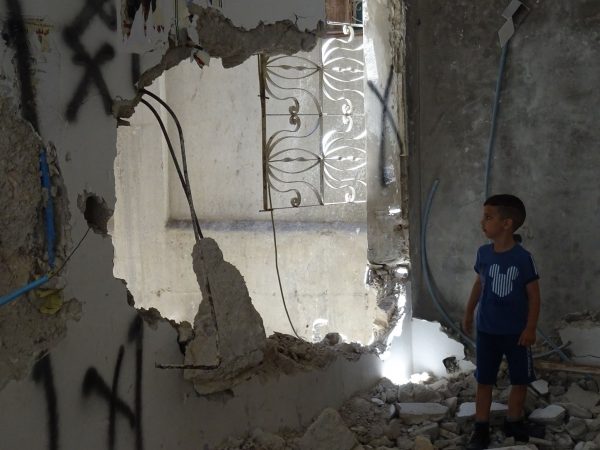
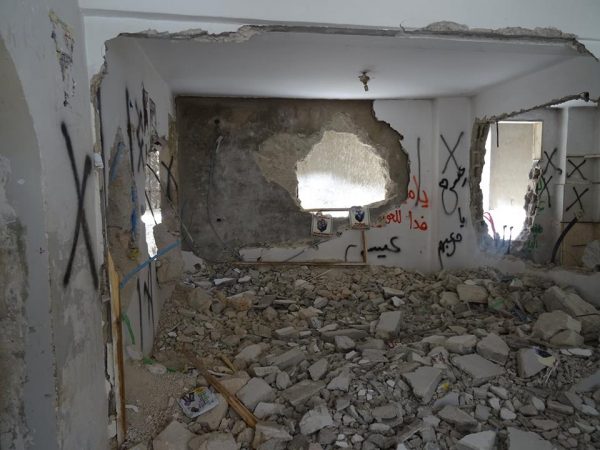
Qalandia Refugee Camp, Occupied Palestine – The holy month of Ramadan has come to an end. But in Palestine, as in Iraq, Syria, Turkey and too many other places, Muslim families are not able to enjoy this special time of the year in peace and comfort. On Sunday night at 11pm, more than 1000 Israeli soldiers, according to locals’ estimations, entered Qalandia Refugee Camp in the Occupied West Bank. The huge military incursion sparked clashes in which 15 Palestinians were shot. Occupation Forces used live ammunition and rubber coated steel bullets on civilians while firing tear gas and stun grenades at approaching ambulances, preventing Palestinian Red Crescent medics from reaching the wounded.
Red Crescent ambulance damaged by Israeli forces
Among the injured was a 19 year old girl and a 15 year old boy, each shot with live ammunition and brought to the hospital in serious condition. The army entered the camp to demolish the homes of the families of two young men, Anan Habsah and Issa Asaaf, both 21, who carried out knife attacks and killed one soldier in East Jerusalem on December 23rd last year. Both were killed by soldiers while carrying out the attacks, so the demolition of the homes comes only as a form of collective punishment to terrorize the families and the people in Qalandia, who repeatedly suffer from night raids and house demolitions as well as beatings and arrests by the Israeli occupation forces.
Anan’s family first evacuated their home in January when the Israeli high court announced their decision to demolish the houses. The displaced family members lived spread across the area, staying at friends’ and family’s homes in Ramallah and elsewhere in Qalandia for two months until the lawyer suggested they could move back in in March. The father, Abu Saleh, refused to leave his home during the two month period however, staying in a tent outside the building. Three weeks ago the two families were yet again told to evacuate their homes and were informed that the demolition would take place within five days. However, the exact date of the demolition was not disclosed. Sunday night it finally happened without advance notice, and only two days before the end of Ramadan and the beginning of Eid celebrations.
In the ruins of his family home
Issa and his family have experienced severe trauma at the hands of occupation forces before, when he and his two younger sisters were brutally assaulted by Israeli soldiers at a checkpoint near East Jerusalem. The incident left one of Issa’s sisters unable to speak for three months, and caused the Assaf family significant distress and anguish.
Both Issa and Anan were imprisoned for significant periods of time; Anan at age fifteen for a period of eight months, and Issa for seven months in the year before his death.The families’ suffering did not end there, however. In the week following Issa’s release from prison, he was again assaulted at his home in Qalandia when soldiers dragged him from his home in the middle of the night and beat him in the street without justification.
The Habsah family also bears the long lasting scars of pain and trauma. Anan’s imprisonment as a child devastated the family, and they say their boy was never the same afterwards. “I know he did not want to die … but when a boy is put in jail, deprived of sleep, and deprived of his childhood, something in him changes,” said Anan’s uncle.
Inside the Asaaf family home
When we arrived on Monday morning, neighbors and relatives had already begun to gather in support of the families. Anan’s aunt explained to us that this is the third time her family had been forcibly displaced; first in 1948, when the family was expelled from their home in West Jerusalem, and later again in 1975 when their modest home in the refugee camp was destroyed for the first time.
UNRWA spokesman Chris Gunness condemned the demolitions on Monday, stating that punitive home demolitions “inflict distress and suffering on those who have not committed the action which led to the demolition, and they often endanger people and property in the vicinity.” A 2005 study by the Israeli army itself concluded that home demolitions are not effective as a deterrent or punitive measure, but the practice still continues. According to the Israeli Committee Against House Demolitions, about fifty thousand residential structures have been destroyed by Israel since 1967.
“This is psychological warfare. In the whole camp of more than ten thousand people, no one slept [last night], and they did not go to work today,” Adnan Habsah, the uncle of Anan said. Qalandia Refugee Camp has long been subjected to various forms of collective punishment by Israeli forces, and is severely affected by all aspects of the Illegal Occupation. The camp is located within area “C” and greater (East) Jerusalem, near the main checkpoint between Ramallah and Jerusalem and beside the apartheid wall. According to the UNRWA, the construction and expansion of the Wall in the early 2000s has drastically affected the economic situation in the camp by isolating it from the Israeli job market and Jerusalem. According to the most recent data, Qalandia’s unemployment rate is as high as 40 percent, compared to Occupied Palestine’s overall rate of 26.6 percent.
The Camp was originally established to house some 5,000 Palestinians who were displaced by the 1948 Nakba. Today, according to Afaq Environmental Magazine, the population of Qalandia Refugee Camp has reached about 14,000. Under the 1993 Oslo Agreement, the whole territory of Qalandia Refugee Camp is classified as area “C,” where Israel retains full control over security and administration related to the territory; however, Qalandia camp, like other Palestinian refugee camps, is under the administrative control of UNRWA.
As the uncle of Anan said when we spoke to him on Monday, “This is a UN refugee camp. The whole world owns this place. You cannot destroy it.”
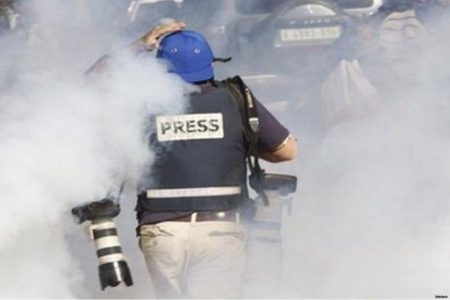
Israeli occupation forces and the Palestinian Authority carried out 34 violations against Palestinian journalists in June, Quds Press reported an NGO saying.
Palestinian Youth Congress for Journalists said in a statement that the Israeli violations included direct assaults, firing rubber bullets at journalists and cameramen, arbitrary arrests and the closure of media offices.
The group said the attacks happened while the journalists were documenting Israeli aggression at Al-Aqsa Mosque. Photographer Rami Al-Khatib and journalists Osaid Amarneh and Ahmed Jaradat were wounded during the violence.
Moreover, the statement noted that the Israeli policy of arbitrary detention of Palestinian journalists continued as several journalists, including 25-year-old Nasser Al-Khatib from Ramallah, 27-year-old Iyad Al-Taweel and 43-year-old Bassam Al-Safadi from the Golan Heights were arrested.
There are currently 20 journalists being held in Israeli jails, the statement said.
The group added that Israel had closed Musawat TV which broadcasts from occupied Palestinian territories under the pretext that it incites hatred.
The Youth Congress reported 17 violations against journalists at the hands of the Palestinian Authority.
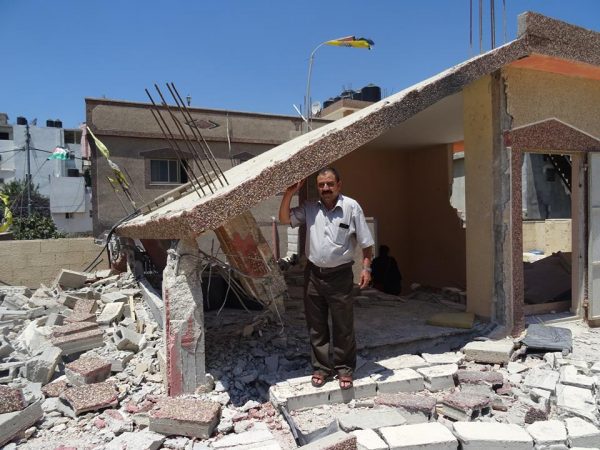
On Sunday the Israeli Cabinet approved the expansion of several Israeli settlements in the West Bank and East Jerusalem, adding an additional 800 new units to the existing thousands of units constructed in Jewish-only settlements in direct contravention of international law.
Israeli officials say that the approval of 800 new housing units is meant to somehow ‘balance’ the implementation of a court ruling that 600 construction permits be approved for Palestinian families in Beit Safafa.
But while the Israeli officials may have political reasons for making such a claim, Palestinian analysts point out that there is no legal justification or comparison between the court decision about Beit Safafa and the announcement Sunday of the expansion of illegal Israeli settlements constructed on illegally-seized Palestinian land.
In the case involving Beit Safafa, an Israeli court ruled last month that the Israeli government had provided no sufficient evidence to back its claim that the Palestinian residents’ building permit applications should be denied, and ordered that construction could begin. But the Israeli government has, for the past month, prevented the court decision from being implemented.
The announcement Sunday that 800 new settlement units would be constructed in East Jerusalem and in the West Bank colonial settlement of Ma’ale Adumim came just two days after Israeli Prime Minister Binyamin Netanyahu approved the expansion of another colonial settlement in Hebron by 42 additional units.
All Israeli settlements constructed in the West Bank and East Jerusalem are considered illegal under international law, as they involve the direct transfer of Israel’s civilian population into areas seized by military force.
But the Israeli government considers many of these colonial settlements to be ‘legal’ under Israeli law, and provides infrastructure including water, sewage, electricity, policing and fire services to the majority of the hundreds of settlements that have been constructed on Palestinian land in East Jerusalem and the West Bank.
In the case of Beit Safafa, the Israeli government had put together a plan to completely encircle the Palestinian town with several Jewish-only settlements, thus cutting off the town from the rest of the West Bank and Jerusalem.
The plan had involved the expansion of a small trailer park currently housing Ethiopian immigrants to Israel, on a hilltop in Beit Safafa. The trailer park, dubbed ‘Givat HaMatos’, was slated for massive expansion by the Israeli government until Palestinian residents of Beit Safafa took the government to court to challenge the expansion.
In a surprise victory a month ago, the Palestinian residents of Beit Safafa won their court battle. but the Israeli government failed to implement the decision before now.
Upon the announcement that the court’s decision would be carried out, the Israeli Minister for Jerusalem, Ze’ev Elkin, stated, “Anyone who is concerned about the Jewish majority in Israel’s capital cannot push a building plan just for Arabs [in Givat HaMatos]… You cannot just approve construction for Arabs in Givat HaMatos without also approving at the same time building for Jews in the same planned neighborhood.”
The plan to encircle Beit Safafa, while currently under scrutiny by international media and bodies, is just one part of the larger E1 Jerusalem plan, which would encircle East Jerusalem, kick out most of its Palestinian residents, and claim all the ‘conquered’ territory for the state of Israel. The plan was first introduced in the early 2000s, and has expanded since then.
Canadian Prime Minister Justin Trudeau was called on to retract his statement made on Canada Day calling the country “one nation”, as it insults Québécois.
Parti Québecois leader candidate Martine Ouellet said in a video posted her Facebook page Saturday that Canadian Prime Minister Justin Trudeau’s recent statement calling Canada “one nation” is “reinventing history”.
“It’s a direct insult to the Quebec nation, an insult to everything our heritage represents,” Ouellet wrote on Facebook.
On Canada Day, July 1st, Justin Trudeau said “today, we celebrate the day, exactly 149 years ago, when the people of this great land came together, and forged one nation, one country — Canada.”
Ouellet called for Trudeau to retract his statement and recognize Quebec as a nation.
Quebec, the largest and second most populated province of Canada, has a long record of struggle for independence that can be traced at least to 1960, when several diverse political groups coalesced in the formation of the Parti Québécois, which is now a primary mainstream political vehicle for the Quebec sovereignty movement.
Quebec’s current status allows it a high degree of autonomy, including its own property legislation, civil legislation, justice, healthcare and education regulation.
Justin Trudeau is known for his anti-separatism position. In 2006, then prime minister Stephen Harper introduced a motion calling on the House of Commons to recognize that “Québécois form a nation within a united Canada.” Trudeau, who was not an MP at the time of events, backed Gerard Michael Kennedy, a Liberal Party leader candidate who opposed the motion.
Trudeau had reportedly claimed that his father, the late prime minister, would never have supported recognition of Quebec as a nation.
Occupied Hebron – In the last three days Israeli military forces have implemented several blockades isolating the cities of Yatta and Bani Na’im south of Hebron. It is reported that cement roadblocks, earth mounds, gates and checkpoints have been installed across the region, with no timeline for when they may be removed.
The blockades are only implemented to restrict the movement of Palestinians as illegal Israeli settlers can still pass the checkpoints. This discrimination is a clear apartheid strategy and limits Palestinians to not only being unable to attend work but also reaching basic human services such as hospitals. This strategy clearly violates Palestinian’s right to freedom of movement (Art.13 of Universal Declaration of Human Rights).
By enforcing these illegal blockades Israel is also restricting Palestinian movement during the final days of the holy month of Ramadan where thousands of Muslims wish to travel to the most significant religious sites for prayer and visit their families.
The innocent people who are living under siege in Yatta and Bani Na’im are significantly impacted by the Israeli forces implementing such blockades, which have been condemned internationally by human rights organisations and NGOs.
The current struggle in France over labour law reforms is not just between the Government and trade unions – a European battle is waged. The attacks on social rights stem in no small part from the web of EU-rules dubbed ‘economic governance’, invented to impose austerity policies on member states.
Strikes and actions across France against reforms of the country’s labour protections, known as the El Khomri Law, demonstrate the immense unpopularity of the measures proposed by the French Government. Chiefly among them, to give preference to local agreements on wages and working conditions, when the conditions in those agreements are less favourable than the national norm inscribed in national law. This is an open attempt to undermine collective bargaining and roll back the influence of trade unions.
Ultimately, the French Government has formal responsibility for the weakening of labour protection. But there is no denying that the European Union is playing an important and perhaps decisive role in the attacks on labour rights. What we see is the EU throwing its rulebook in the French workers’ faces. Practically all the new rules on so-called ‘economic governance’ adopted following the eurocrisis have been applied, and make France look like an EU test-case. The European Commission, with the backing of the Council, has used the rules on member states’ deficits to exert pressure, threatening with sanctions, should the French Government not give in and seriously reform its labour laws. Simply put, France has been required flat out to ensure higher profitability for businesses by driving down wages.
How does all of this work?
Sanctions more likely today
First and foremost, the reforms in France are related to the country’s deficit. Like most other EU member states, the state’s finances looked pretty bad in the aftermath of the 2008 financial crisis. In 2009, a case was opened against France for breaching EU rules which stipulate that its deficit must be no higher than 3 per cent of GDP. If taken to the extreme, this ‘excessive deficit procedure’ can result in a fine of billions of euro, and – not least in the case of France – a severe loss of face to its EU partners.
The ‘excessive deficit procedure’ was given more teeth with the so-called ‘Six-Pack’ set of EU rules in 2011 – a key part of the austerity-focused economic governance package – which introduced a reverse majority vote in the Council: if the Commission does decide to fine a member state, like it has threatened to do to France, there will have to be a qualified majority against the measure from other member states to block it. Good reasons for the French Government to be slightly scared – and a weapon to be used in its attempt to convince parliamentarians. The likelihood of sanctions for not meeting the budget deficit targets is much bigger than in the past, when both Germany and France escaped humiliation. But how to meet the Commission’s strict targets, and how to behave to the satisfaction of the Commission, is what clearly links the El Khomri Law in France to the austerity regime being rolled out from Brussels.
Enabling demands of ‘structural reforms’
Being ‘in the procedure’, means you’re under close surveillance by the Commission, and with regular intervals, the case of the French deficit has been brought up at meetings with member states ministers, who have assessed if France (in this case) has made sufficient efforts to remedy the problem. Specific recommendations have been made, though until 2013 the labour law was hardly mentioned. The recommendations stuck to the development of the deficit, whether it went down at the required pace. But in 2013, there was a new tone in the Commission’s recommendations. France was asked to meet its deficit targets “by comprehensive structural reforms” in line with recommendations from the Council “in the context of the European Semester”. Structural reforms are no small matter. They are defined as changes that affect “the fundamental drivers of growth by liberalising labour, product and service markets”. Such ambitions were starting to be pushed on France at the European Semester.
But what is the European Semester? It is a procedure involving the Commission and the Council that ends with a set of recommendations for reforms to each and every member state, based on a proposal from the Commission. At the beginning in 2011, the recommendations were non-binding, but in 2013, a new set of rules went into force under the so-called Two-Pack, another part of the economic governance package intended to enforce austerity. One of the regulations of the two in the package was about measures to ensure deficits were corrected, and among other things, it made a link between the deficit procedure and the European Semester. If a member state is under the deficit procedure – like France – it would have to draw up an ‘Economic Partnership Programme’ that includes the recommendations from the Council –typically the kind of structural reforms that would have a clear impact. If the programme is not followed, then it will have a bearing on the Commission’s decision to initiate the final phase of the deficit procedure: sanctions in the form of a fine worth billions.
So, when the Two-Pack entered into force in early 2013, the tone of the messages to France on its deficit changed. France was now asked to implement “comprehensive structural reforms” of its labour law and the pension system. This had a bearing on how France would be treated under the deficit procedure and whether it would come in for sanctions, and for that reason, recommendations started looking more like demands.
In other words: whereas earlier country specific recommendations adopted under the European Semester were just that, with the Two-Pack from 2013, non-compliance could lead the Commission to take the next step towards sanctions.
“Slash wages now!”
There’s more.
In the early stages of the eurocrisis another procedure was introduced that was to work in parallel to the deficit procedure: the ‘Macroeconomic Imbalance Procedure’. This procedure allows the Commission to monitor the development of member states’ economies based on a predefined set of indicators. One of them – perhaps the most important one – measures how high the labour costs are developing (unit labour costs). If wages are not kept at bay, competitiveness suffers, and measures have to be taken, so the logic goes.
The ‘Macroeconomic Imbalance Procedure’ is also a potent weapon, as it can lead to a fine if a Eurozone member state crosses the line repeatedly and for a long time. And France has been in the crosshairs of the Commission for quite a while. Commission staff have investigated French labour law and identified what factors contribute “to limiting the ability of firms to negotiate downward wage adjustment”, and the French Government has been warned – as have many other member states – about developments in wages. In 2014, the Commission said “unit labour cost growth is relatively contained but shows no improvement in cost competitiveness. The profitability of private companies remains low, limiting deleveraging prospects and investment capacity.”
The calls for action to improve the profitability of private companies have been sent to France from Brussels on numerous occasions over the past couple of years, and have gained in strength. Thus far, the climax was in February 2015, when the Commission stepped up the procedure and singled out Bulgaria and France as the most pressing cases. The decision put France only a small step from the last stage of the imbalance procedure, the dreaded ‘excessive imbalance procedure’ which entails – exactly like the deficit procedure – a massive fine. If all fines are put together – from the deficit procedure and the imbalances procedure – they could amount to 0.5 per cent of GDP, or in the case of France, approximately €11 billion.
The final countdown
Such a prospect must be terrifying for the French Government, and in 2015, then, it would have to come up with something of substance to appease the European Commission and its partners in the Council. In March France was given two more years to bring its house in order, and if there was any doubt over the way to get there, the message to France in July was clear. Country Specific Recommendation number 6 to France under the European Semester, includes a call to “reform the labour law to provide more incentives for employers to hire on open-ended contracts. Facilitate take up of derogations at company and branch level from general legal provisions, in particular as regards working time arrangements.” In other words, the very reforms now at the centre of dispute with the El Khomri law.
The recommendation was copy-pasted from a Commission proposal; one that struck a chord among business lobby groups. In the annual ‘Reform Barometer’ of BusinessEurope, a procedure set up to influence the European Semester, the French employers association MEDEF was enthusiastic about the move, and dubbed it “extremely important” in its contribution to the Reform Barometer 2016.
End game
Who exactly has done what since the summer of 2015 is the subject of intense debate. French media outlet Mediapart suggests the German Government might have played a big role in designing the French reforms, while others believe the specifics were entirely homemade. In any case, there is no denying that the reforms were pushed heavily by the European Union, more specifically by the Commission and the Council. And the push was based on the web of rules on member states’ economic policies, sometimes called ‘economic governance’, that has been spun thread by thread since 2010. The strengthening of the deficit procedure, the European Semester, the Two-Pack, and the macroeconomic imbalance procedure have all been used for the purpose they were invented: to exert maximum pressure on member states to adopt austerity policies.
There are other similar examples in Europe at the moment. In Italy and Belgium too, you see the effect of the new tools handed over to the European Union since 2010. But France is special for its size and its power in the EU. The ongoing struggle in France can be seen as a major test case for European economic governance. If a big, powerful EU member state can be pushed to attack fundamental traits of its labour protection law, then the risk of new and stronger measures are much more likely in the future. Even if French workers are unaware of it, they’re fighting a European battle.
On Tuesday, UN Secretary General Ban Ki-moon finished his farewell trip to Israel and the occupied Palestinian territories. He is due to step down in December and used the occasion to urge some political will for a two-state solution as “the only way to meet the national aspirations of both peoples.” Ban also criticised the blockade of Gaza which, he said, “Suffocates its people, stifles its economy and impedes reconstruction efforts.” Interestingly, he added that it is “collective punishment for which there must be accountability.”
Speaking in Ramallah, the UN chief expressed an understanding of Palestinian frustration: “I’m aware that many Palestinians question the feasibility of reaching a just and lasting peace with Israel. They hear talk of peace but they see violence. They still live a life of checkpoints, permits, blockade, demolitions and profound economic hardships faced with growing indignities and the humiliating occupation that will soon enter its 50th year.”
During his time as Secretary General, Ban has condemned the status quo verbally but the organisation he leads has failed to take concrete action. Under his tenure, Gaza has been strangled by a tight blockade and its residents have witnessed three major Israeli offensives. In over half of his time at the top of the UN, the West Bank settler population has grown by 23 per cent (from the beginning of 2009 until the beginning of 2014), and at least two rounds of direct talks have failed. In 2014, more Palestinians were killed by Israel than in any other year since 1967. Violence and fatalities in the West Bank and East Jerusalem, meanwhile, were at their highest since the beginning of his tenure in 2007.
Following the most recent Israeli war against Gaza in 2014, a UN inquiry found that Israel was responsible for striking seven official sites used by the organisation as civilian shelters, during which 44 Palestinians were killed and 227 others were injured. Releasing the report, Ban condemned the attacks “as a matter of the utmost gravity.” He noted that it was the second time during his tenure as secretary general that he had been obliged to establish a board of inquiry into incidents involving UN premises and personnel in Gaza that have occurred during the course of “tragic conflicts” in the Gaza Strip. Concerning the children killed in the war, he commented during an earlier visit, “I met so many of the beautiful children of Gaza. More than 500 were killed in the fighting – many more were wounded. What did they do wrong? Being born in Gaza is not a crime.”
However, his inaction during the conflict forced 129 organisations and distinguished individuals to sign an open letter to him. “Until today,” they wrote, “you have taken no explicit and tangible measures to address the recent Israeli attacks in the occupied Palestinian territories since 13 June. Moreover, your statements have been either misleading, because they endorse and further Israeli false versions of facts, or contrary to the provisions established by international law and to the interests of its defenders, or because your words justify Israel’s violations and crimes.”
The number of Palestinian children killed during the 2014 war led to efforts to include the Israel Defence Forces on a UN list of serious violators of children’s rights. However, while the UN chief should have supported that inclusion made by Leila Zerrougui, the UN special envoy for children and armed conflict, he didn’t. He was accused of caving into pressure and omitting the Israeli military from the list. UN sources described the decision to override Zerrougui’s recommendation as “unusual”, while Human Rights Watch called it “a blow to UN efforts to better protect children in armed conflict.”
On his farewell visit to Gaza, Ban Ki- Moon told residents that, “The UN will always be with you.” As the two-year anniversary of the beginning of the 2014 Gaza war draws near, most of the 11,000 homes destroyed and 6,800 severely damaged or rendered uninhabitable remain in ruins, largely as a result of the Israeli-led blockade. As his time as UN leader comes to a close, the Palestinians will be hoping that his successor will give them more than words.
Reknowned economist M. Shahid Alamoffers this excellent critique of Noam Chomsky’s defective analysis of the relative influence of Oil versus the Israel lobby over US foreign policy: … continue
This site is provided as a research and reference tool. Although we make every reasonable effort to ensure that the information and data provided at this site are useful, accurate, and current, we cannot guarantee that the information and data provided here will be error-free. By using this site, you assume all responsibility for and risk arising from your use of and reliance upon the contents of this site.
This site and the information available through it do not, and are not intended to constitute legal advice. Should you require legal advice, you should consult your own attorney.
Nothing within this site or linked to by this site constitutes investment advice or medical advice.
Materials accessible from or added to this site by third parties, such as comments posted, are strictly the responsibility of the third party who added such materials or made them accessible and we neither endorse nor undertake to control, monitor, edit or assume responsibility for any such third-party material.
The posting of stories, commentaries, reports, documents and links (embedded or otherwise) on this site does not in any way, shape or form, implied or otherwise, necessarily express or suggest endorsement or support of any of such posted material or parts therein.
The word “alleged” is deemed to occur before the word “fraud.” Since the rule of law still applies. To peasants, at least.
Fair Use
This site contains copyrighted material the use of which has not always been specifically authorized by the copyright owner. We are making such material available in our efforts to advance understanding of environmental, political, human rights, economic, democracy, scientific, and social justice issues, etc. We believe this constitutes a ‘fair use’ of any such copyrighted material as provided for in section 107 of the US Copyright Law. In accordance with Title 17 U.S.C. Section 107, the material on this site is distributed without profit to those who have expressed a prior interest in receiving the included information for research and educational purposes. For more info go to: http://www.law.cornell.edu/uscode/17/107.shtml. If you wish to use copyrighted material from this site for purposes of your own that go beyond ‘fair use’, you must obtain permission from the copyright owner.
DMCA Contact
This is information for anyone that wishes to challenge our “fair use” of copyrighted material.
If you are a legal copyright holder or a designated agent for such and you believe that content residing on or accessible through our website infringes a copyright and falls outside the boundaries of “Fair Use”, please send a notice of infringement by contacting atheonews@gmail.com.
We will respond and take necessary action immediately.
If notice is given of an alleged copyright violation we will act expeditiously to remove or disable access to the material(s) in question.
All 3rd party material posted on this website is copyright the respective owners / authors. Aletho News makes no claim of copyright on such material.
 The administrative detention of two Palestinian prisoners in Israeli jails was renewed on Sunday, 11 July; they are among nearly 750 Palestinians imprisoned without charge or trial under indefinitely renewable administrative detention orders. Both former prisoners who have spent years in Israeli prison, their detentions without charge or trial were extended by military order.
 Mohammed Al-Tabeesh of Dura, near al-Khalil, was also ordered to four additional months of administrative detention, the third renewal of the detention order against him. He has been jailed since