France: Another Palestinian TV Station Shut Down
IMEMC News & Agencies – March 12, 2016
 Israeli Prime Minister Benjamin Netanyahu expressed his gratitude, on Saturday, to French President Francois Hollande, after the French government shut down a Hamas-affiliated television station that, according to the Israeli media, “aired content which constituted anti-Israel and anti-Jewish incitement.”
Netanyahu had earlier urged Hollande to end the transmission of Al Aksa television, the Hamas-run channel that was being broadcast on the French satellite service EUTELSAT — also associated with Palestine Today TV, which was shut down in the occupied West Bank, on Friday.
According to the PNN, Israel’s Shin Bet internal spy agency said in a statement, on Friday, that the Ramallah offices were raided overnight, in a joint operation with the military over allegations that the channel “broadcasts on behalf of the Islamic Jihad,” a Gaza-based Palestinian resistance movement.
“The channel served the Islamic Jihad as a central means to incite the West Bank population, calling for terror attacks against Israel and its citizens. Incitement was broadcast on the television station as well as the Internet,” Shin Bet added.
Palestinian officials have denounced Israel’s closure of the offices. Yousef al-Mahmoud, Palestinian Authority spokesman, described the Israeli raid on Palestine Today TV station in Ramallah as “part of the aggressive occupation policy towards Palestinian media.
Dr. Hanan Ashrawi, member of Palestine Liberation Organization (PLO) executive committee, also denounced the Israeli raid, saying it contravenes free speech rules.
The Palestinian Journalists’ Syndicate made an official statement, as well.
“Incursions into areas under the Palestinian Authority’s control and attacking its sovereignty and media institution [are] a stark violation of basic human rights and international and humanitarian laws that have safeguarded freedom of speech,” she said.
Last November, Israeli soldiers broke into the headquarters of Al-Hurriyya Media Network, destroyed the offices, confiscated the tools and threatened to demolish the entire building if the network works again, accusing it of “inciting” Palestinians against the Israeli occupation.
The month previous, in October, Israeli soldiers raided the offices of the International Middle East Media Center and the Palestinian Center for Rapprochement.
Since the start of October 2015, almost 200 Palestinians have been killed, in addition to 30 Israelis, settlers and soldiers.
The current tension is ongoing since October, due to repetitive Israeli settler attacks on Al-Aqsa mosque, the third holiest place in Islam, and Israeli restrictions over Palestinian entrance, in addition to the Douma arson attack which killed a baby and his parents on July 31.
Israeli forces have been criticized internationally, over recent months, for its ‘preemptive shootings’ of Palestinians alleged to be holding knives.
In addition several of the incidents in which the military has claimed that they were ‘attacked’ have proven to be false.
Cruz Thinks That Egypt’s President El-Sisi is Doing a Great Job
teleSUR | March 11, 2016
 If we were unclear what kind president Ted Cruz would be if he won the race to the White House, his recent comments on who he considers a good role model leave little room for doubt.
The Texas Senator expressed his admiration for the Egyptian President, Abdel Fattah el-Sisi, who has imprisoned thousands of journalists and protesters and has unleashed a brutal police force, as an “example” of a Muslim ally.
“Let me give you an example of a Muslim, for example, we ought to be standing with,” Think Progress reports Cruz said at a campaign rally in Miami. “President el-Sisi of Egypt, a president of a Muslim country who is targeting radical Islamic terrorists,” he added.
But Cruz is no fair-weather friend to the blood-stained Egyptian president, he mentioned his admiration for el-Sisi last year.
“Why don’t we see the president of the United States demonstrating that same courage [as el-Sisi] just to speak the truth about the face of evil we’re facing right now?” Cruz asked during the first Republican presidential debate last year.
In February, charges were dropped against a four-year-old in Egypt. He had been sentenced to life for four counts of murder, eight counts of attempted murder, vandalizing state property during protests in January 2014, when the boy was 16-months-old.
Canadian duplicity and Israeli Apartheid

Author’s Note: An elaboration of the Israeli-imposed deprivations on the Palestinian population is presented in an extraordinary , data-driven web-site called “Visualizing Palestine”, which also formed the basis of a student presentation at Hamilton’s (ON, Canada) McMaster University.
Information from the site, and the McMaster outdoor presentation, form the basis of much of the information in this article.
Special thanks to McMaster Muslims For Peace and Justice, and Solidarity for Palestinian Human Rights.
By Mark Taliano | American Herald Tribune | March 10, 2016
If Canada were to support real, productive change, it would support rather than condemn peaceful citizen initiatives such as the Boycott Divest Sanction (BDS) campaign.
Instead, Canada continues to support international lawlessness abroad, and an on-going domestic policy of police state repression, welded to a nexus of complicit agencies — most notably mainstream media — to stifle our freedom of dissent.
International law presents a powerful case against apartheid Israel.
In an earlier article, for example, this author noted that,
“The International Criminal Court (ICJ) ruled in 2004 that the West Bank wall was ‘illegal in its entirety,’ and that compensation should be paid to those affected. Additionally, the U.N General Assembly passed a resolution supporting the ICJ’s call to dismantle the wall.”
Not only is the wall a breach of international law, but it also represents a “land-grab”. 85% of the wall is located on the occupied West Bank. Upon completion, 46% of the West bank will be locked into ghettos. Even now, there are separate, apartheid road systems which separate Israeli from Palestinian drivers.
The territory of Gaza is accurately described as an “open air prison”. The illegal blockade of the land, air, and sea, is itself is a form of collective punishment, and a violation of the Geneva Conventions and international humanitarian law.
Israel imposes a “diet” on Palestinians. A 2010 study entitled, Humanitarian Minimum| Israel’s Role in Creating Food And Water Insecurity in the Gaza Strip provides strong evidence that Israel’s imposition of food and water insecurity on Gaza is part of its illegal military strategy of collective punishment.
According to REPORT TO UNRWA: THE GAZA HEALTH SECTOR AS OF JUNE 2014, 90 % of the water in Gaza is unfit for human consumption. A June, 2006 Israeli airstrike on the Gaza Power Plant contributed to a nexus of health deprivations, one symptom of which is that one third of Gazan households are provided with running (unclean) water for 6-8 hours once every four days. Whereas an Israeli uses about 300, liters of (clean) water per person, per day, Gazans are restricted to 70 litres (contaminated) water per day. Again all of these deprivations were pre-planned.
Meanwhile, cement quotas undermine rebuilding efforts: it would take 17 years to adequately rebuild infrastructure. Despite the fact of power shortages and poor healthcare infrastructure — 50% of Gazan hospitals were damaged in 2008/09 — 21% of medical permits to exit through the Eretz crossing are denied.
Engineered homelessness also adds to the deprivations: In 2014 alone, 18,000 Palestinian housing units were destroyed, and 108,000 Palestinians remain homeless.
Israel also breaches the Fourth Geneva Convention in terms of its treatment of Palestinian prisoners:
- Whereas prisoners must not be detained outside the territory under occupation, Israel detains all Palestinian prisoners in Israel. There are 6,700 Palestinians in Israeli prisons, but there are no Israelis in Palestinian prisons.
- Whereas prisoners are not to be subjected to torture, Palestinian prisoners are regularly tortured. 200 prisoners have been killed by torture, medical negligence, or the use of fatal force.
- Whereas prisoners are not to be sentenced without a proper trial, since 2000, Israel has placed 20,000 Palestinians under administrative detention – without charge or trial.
The institutionalized racism, the war, the occupation, the imprisonment, and the intentional denial of human rights and freedoms takes a tremendous, sometimes hidden, toll. The United Nations (UN) estimates that about 370,000 children in Gaza require psycho-social support.
The totality of these imposed restrictions amounts to genocide:
The definition of “genocide”, as defined by Articles II and III of the 1948 Convention on the Prevention and Punishment of Genocide:
“Article II: In the present Convention, genocide means any of the following acts committed with intent to destroy, in whole or in part, a national, ethnic, racial or religious group, as such:
(a) Killing members of the group;
(b) Causing serious bodily or mental harm to members of the group;
(c) Deliberately inflicting on the group conditions of life calculated to bring about its physical destruction in whole or in part;
(d) Imposing measures intended to prevent births within the group;
(e) Forcibly transferring children of the group to another group.
Article III: The following acts shall be punishable:
(a) Genocide;
(b) Conspiracy to commit genocide;
(c) Direct and public incitement to commit genocide;
(d) Attempt to commit genocide;
(e) Complicity in genocide. ”
All of this illegality is an outgrowth of a racist settler-colonial dynamic where illegal discrimination is politicized. Political operatives have distorted and degraded the teachings of Judaism and Islam to the point that engineered religious facades are used as instruments of division to wage illegal war and genocide.
The duplicity of the Canadian government in condemning the BDS movement on the one hand, while publically stating on the other that Canada will be a “frank voice in the Middle East” is a symbol of Canada’s duplicity.
The “perception management” wing of our military –industrial-media complex presents Canada in a favourable, judicious light; whereas sustainable evidence demonstrates that our foreign policy posturing conceals a deeply-rooted and degenerate criminality.
Justice for the Women of Sepur Zarco
Indigenous women win precedent-setting case against former soldiers in sex slavery trial in Guatemala
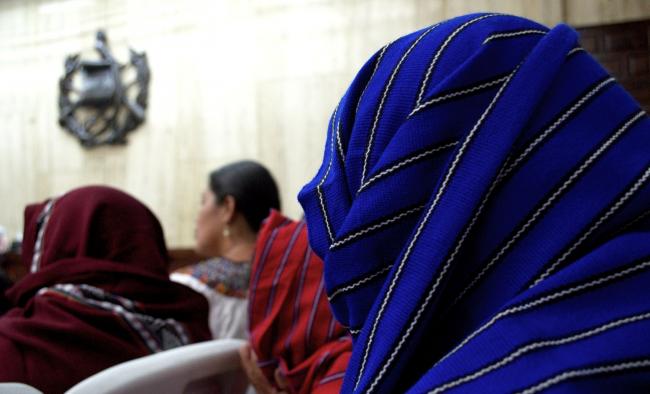
Women of Sepur Zarco, forced into sex slavery at the hands of the Guatemalan military in 1982, listen to trial proceedings at the Guatemalan Supreme Court (Photo by Quimy de Leon)
By Jeff Abbott and Julia Hartviksen – NACLA – 03/11/2016
Nearly 20 years since the signing of Guatemala’s 1996 Peace Accords, justice has finally been served for 15 Indigenous Q’eqchi’ Mayan women of Sepur Zarco, who were forced to become sex slaves for members of Guatemala’s military during the country’s long civil war.
On February 26, Guatemala’s Supreme Court sentenced two former military members, former Lieutenant Coronel Esteelmer Reyes and former Military Commissioner Heriberto Valdez Asij, to prison terms of 120 and 240 years, respectively, for crimes against humanity. Reyes was also found guilty of three assassinations, while Asij was deemed guilty for the forced disappearances of seven men. (Despite the significance of the guilty verdict, prosecutors from the Guatemalan Public Ministry had initially requested that Reyes and Asij be sentenced with 1290 years in prison for war crimes, plus 50 years in prison for each assassination charge.)
On March 2, the perpetrators were also ordered to pay reparations to the victims. Reyes will owe 500,000 Quetzales (about US $65,000) to each of the victim-survivors, and Asij has been ordered to pay 250,000 Quetzales (about US $32,500) for each of the seven forcibly disappeared men.
Judge Yassmín Barrios of the Guatemalan Supreme court made the historic decision following a short, emotional trial, which began February 1 in the Guatemalan Supreme Court in Guatemala City. The case, the first time in the world where a case of wartime sexual violence was tried in the national courts of the country where the violence occurred, represents a landmark legal decision in Guatemala and a major victory against the impunity for war crimes in the country.
The charges against Reyes and Asij relate to crimes committed in the year 1982, a time when both men were stationed at the Sepur Zarco military base in Alta Verapaz. During this period, the soldiers murdered men in the community, and forced women in the area to work as domestic servants and sexual slaves, subjecting them to degradation, abuse, and rape. In 2010, 12 of those women, all of Mayan Q’eqchi’ descent, brought the case before a mock tribunal meant to address sexual violence during Guatemala’s 36-year-long war. In 2011, the case was brought before a criminal court. Grassroots organizations and international NGOs alike fought to bring the case to the Guatemalan Supreme Court, amidst repeated attempts to derail their efforts.
Lily Muñoz, a sociologist who worked as an independent consultant assisting the legal organization, Mujeres Transformando el Mundo (MTM) on the case, explained the significance of the historic ruling. “It represents justice for war crimes that were committed against women,” she said.
Though the case represents a landmark legal decision for Guatemala, Sepur Zarco is not an exceptional case of sexual violence perpetrated by the military during the war. “This case serves as a precedent not only here in Guatemala, but also on the global scale,” said Lily Muñoz, a sociologist who worked as an independent consultant assisting the legal organization, Mujeres Transformando el Mundo (MTM) on the case.
The case’s success has led to more than 30 Achi’ women from the community of Rabinal, Baja Verapaz, who also suffered from sexual violence at the hands of the military, to begin mobilizing for legal justice for crimes of sexual violence as a tactic of war.
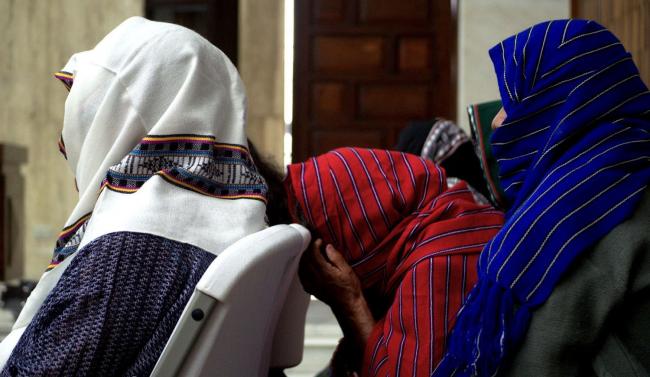
Survivors of the Sepur Zarco sex slavery case at the Supreme Court trial (Photo by Quimy de Leon)
This case also illustrates the gendered dimensions of such brutality – a brutality that preyed upon the vulnerability of indigenous women in rural Guatemala at the height of the internal armed conflict. “It is particularly interesting that sexual violence against women was a part of the sentence, and in the context of an armed conflict. This marks such violence as a war crime, as a crime against humanity. It’s a war crime, but it is a specifically gendered crime, that was tried in the national court of the country where the crimes were committed,” Muñoz said.
She continued: “The military men created conditions of extreme vulnerability for the women of Sepur Zarco. They took their husbands away from them, and they robbed them of their lands and livelihoods – in short, everything they required for social reproduction – and then later, of their sexuality and their ownership over their own bodies.”
As Muñoz explained, Judge Barrios drew on the testimony of a Brazilian anthropologist, Dr. Rita Laura Segato in coming to a decision in the case. Dr. Segato had argued in her testimony that “In the context of the Guatemalan internal armed conflict, women’s bodies were converted into military objects.”
The anthropologist argued that, in this way, that women’s bodies came to represent the “social body,” and for that reason, “the soldiers violated and ‘profaned’ women’s bodies.”
Following Dr. Segato, Muñoz explained that the military sought to “break the community, physically and morally” and did so through sexual violence against women. In this sense, the violence perpetrated against women carried lasting physical, emotional and psychological aspects, and also symbolic meaning for the victim-survivors and other community members. In reading the sentence, Judge Barrios recognized these long-term, destructive impacts the violence of the Sepur Zarco base had on the women who brought the case forward.
The case itself represents a historic shift for the Guatemalan courts, whereby claims of violence brought forth by indigenous women have been recognized by the mainstream justice system, a system that has consistently silenced their voices. “This case has shown that we can trust the testimonies of the (indigenous) women,” said Ada Valenzuela, the director of the Union Nacional de Mujeres Guatemaltecas (UNAMG). “Even 30 years later, the testimonies of the women were supported through other testimonies, and evidence.”
Despite the fact that the women’s faces were covered during the trial for the purposes of anonymity, it was the women themselves who pushed for the case to move forward, despite being told that it would likely not win. “The women from Sepur Zarco said that if this case were to go to court, then they wanted to go,'” Valnezuela said. “And we decided that we were going to accompany these women in this process. This was a very valiant decision.”
The women were also accompanied by a coalition of Guatemalan feminist organizations in Guatemala, known as the Alliance to End Silence and Impunity, which includes UNAMG, MTM and the Equipo de Estudios Comunitarios y Acción Psicosocial (ECAP). UNAMG and ECAP have worked to provide psychological support for the victims of the internal armed conflict and the women of Sepur Zarco since 2004.
The case also complicates the characterization of the simplified but still all too common narrative of Guatemala’s civil war in which Marxist guerrillas are presented as fighting against state. In fact, in many cases, it was poor rural campesinos, organizing to gain ownership of their own land who suffered the most intense brutality of the conflict.
According to Muñoz, all of the women’s husbands were involved in negotiations with the National Institute for Agrarian Transformation (INTA) to gain legal ownership over land they had lived on for centuries. Many of these lands have since been transformed into fincas for the production of sugar cane and oil palm.
“The conditions that began the war have been maintained today,” said Valenzuela. “The inequality, the question of land, the question of opportunity, (among others), are continuing today. According to Valenzuela, Sepur Zarco “has woken up the women of Guatemala. [It] represents hope for justice for other women who suffered violence during the war.”
Jeff Abbott is an independent journalist currently based out of Guatemala. He has covered human rights and social moments in Central America and Mexico. His work has appeared at VICE News, Truthout, and the Upside Down World. Follow him on twitter @palabrasdeabajo.
Julia Hartviksen is a PhD Candidate at the Gender Institute, at the London School of Economics and Political Science. Her research focuses on the materiality of violences against women, and the gendered impacts of oil palm in Guatemala’s Northern Transversal Strip. Follow her on twitter @_yulinka_.
Colombia, Honduras Are Most Unequal Countries in Latin America
teleSUR – March 10, 2016
Latin America has five of the world’s most unequal countries, with Honduras and Colombia being the region’s top two, according to statistics released by the World Bank Wednesday.
Using data from December, the World Bank calculated that Latin America is not the poorest region in the world, but is home to some of the world’s most unequal countries.
Among them are Honduras (6), Colombia (7), Brazil (8), Guatemala (9) and Panama (10), which all rank within the world’s top 10 most unequal countries.
The results were found by calculating each country’s Gini coefficient, what measures the income distribution in each nation, whereby nations approaching 0 have total equality and those approaching 100 have total inequality.
Colombia’s Gini coefficient ranked at 53.5, the same as 2012, while Honduras’ was 53.7 and plummeting dramatically, according to news reports.
In the current situation, the top 10 percent of Colombia’s richest people earn four times more than the bottom 40 percent of the population. Additionally, 77.6 percent of land in the country is owned by only 13.7 percent of the country’s inhabitants.
In Honduras, 64.5 percent of the population is living in poverty while 42.6 percent live in extreme poverty (less than US$2.5 a day), according to World Bank statistics.
Muslim student reported to UK terror police for pro Palestine activism
Rahmaan Mohammadi, a 17 year old student from Luton, explains how he was reported to the counter terrorism police for his pro Palestine activism. Mohammadi was speaking at a Stop the War Coalition event in London on March 10.
Israeli Army Shuts Down “Palestine Today TV” In Ramallah, Kidnaps Three Journalists
IMEMC – March 11, 2016
Dozens of Israeli soldiers invaded the main headquarters of Palestine Today TV, in the al-Biereh city, in the Ramallah and al-Biereh District in the occupied West Bank, and shut it down on Friday at dawn. The army also kidnapped its director, a cameraman and a Technician.
Palestine Today said in a statement that the soldiers stormed and searched the home of its director, Farouq ‘Oleyyat, in Birzeit City, and kidnapped him.
The agency stated that the soldiers also confiscated equipment from ‘Oleyyat’s home, after violently searching it.
It added that dozens of soldiers also invaded Palestine Today’s headquarters, in the Tahouna area, in al-Biereh, after completely surrounding the area, and confiscated broadcast equipment.
The soldiers also invaded Transmedia Productions and News Services Company, in al-Biereh, and kidnapped a cameraman man, identified as Mohammad ‘Amro, and Broadcast Technician Shabeeb Shbeib.
Transmedia is a Media Company that provides satellite TV service to various stations, including Palestine Today.
Two nights ago, the Israeli Cabinet, headed by Prime Minister Benjamin Netanyahu, held a meeting and came up with a list of punitive measures against the Palestinian people and various media agencies.
The cabinet decided to shut down many TV stations and media agencies, for what it called “broadcasting incitement materials,” referring to their covering of the Israeli assaults and violations against the Palestinian people, in occupied Palestine.
In related news, Israeli soldiers detained eight Palestinians near the Halamish illegal colony, built on Palestinian lands belonging to Nabi Saleh villagers, northwest of Ramallah on Thursday at night.
Media sources said the soldiers interrogated the eight Palestinians, from Beit Rima and Deir Ghassana towns, and detained them for several hours. The soldiers said “they were searching for knives,” no arrests were made.
Britain sets ‘bad example’ on surveillance, says UN privacy rapporteur
RT | March 10, 2016
Britain is setting a bad example by legitimizing rather than outlawing mass surveillance, according to the UN’s privacy rapporteur, Joseph Cannataci.
The criticism comes in a report to the UN Human Rights Council examining mass surveillance around the world.
Britain is singled out as setting a bad example because of the government’s attempt to bring into law a number of new spying measures.
Cannataci claims the Investigatory Powers Bill, which will be debated for a second time in parliament next week, legitimizes mass surveillance when bulk collection should in fact be outlawed.
He argues the British security state should stop “setting a bad example to other states” by pursuing measures like “bulk interception and bulk hacking.”
He said that enshrining such surveillance into law undermined “the spirit of the very right to privacy.”
Cannataci has been an outspoken critic of UK surveillance measures for some time. In 2015 he called for a Geneva Convention for the internet, while arguing UK oversight was “a joke.”
On the lack of proper scrutiny on intelligence agencies, he told the Guardian: “That is precisely one of the problems we have to tackle. That if your oversight mechanism’s a joke, and a rather bad joke at its citizens’ expense, for how long can you laugh it off as a joke?”
The Investigatory Powers Bill was partially informed by the revelations of mass surveillance by NSA whistleblower Edward Snowden.
In his 2015 interview, Cannataci put aside the hero/traitor debate on the former contractor, telling the paper “his revelations confirmed to many of us who have been working in this field for a long time what has been going on, and the extent to which it has gone out of control.”
Cannataci’s concerns are shared by some civil liberties groups.
Jim Killock, director of the Open Rights Group, said the report showed that the “bill does not comply with recent human rights rulings” and that the negative impact of the legislation would “be felt around the world, and copied by other countries.”
G4S says it will exit Israeli market, following high-profile BDS campaign
MEMO – March 10, 2016
British private security giant G4S has announced plans to sell its entire Israeli business within the next 12 to 24 months. The news has been welcomed by activists in the Palestinian Boycott, Divestment, and Sanctions (BDS) campaign, for whom G4S has been a long-standing target.
The decision to leave Israel was revealed in the company’s full-year results released Wednesday, when the company reported a 40 per cent fall in its pre-tax profits.
The company said its plans to exit Israel were part of a “continuing portfolio management programme” designed to “materially improve our strategic focus.” The Israeli business employs 8,000 people with a turnover of £100 million.
According to the Financial Times, G4S “is extracting itself from reputationally damaging work, including its entire Israeli business”, noting that human rights campaigners and BDS activists “have repeatedly attacked G4S’s work in [Israel].”
G4S provides equipment and services to Israeli prisons and detention centres, in which thousands of Palestinian prisoners are tortured and held – including without charge or trial. Israel also violates international law by jailing Palestinians outside of the occupied territory.
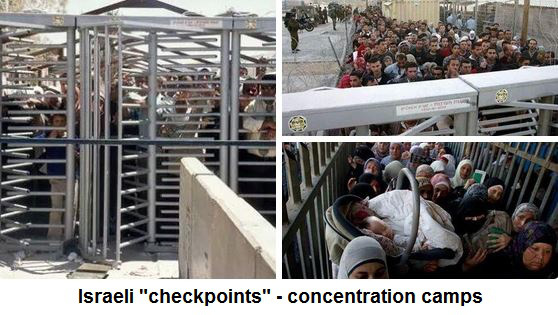
The company also has contracts with the Israeli authorities to provide equipment and services to Israeli checkpoints in the Occupied West Bank that form part of illegal Apartheid Wall.
In 2012, Palestinian groups “called for action to hold G4S accountable for its role in Israel’s prisons”, and since then, the campaign has inflicted growing economic and PR damage on the company. Activists say that G4S has since lost contracts worth millions of dollars around the world, with lost clients including private businesses, universities, trade unions, and United Nations bodies.
In 2014, the Bill Gates Foundation divested its $170m stake in the company following international protests. In the UK, at least five student unions voted to cancel contracts with G4S, and students successfully pressured two other universities not to renew contracts with the company.
The United Methodist Church, the largest protestant church in the USA, divested from G4S after coalition campaigning brought the issue to a vote. Just recently, as reported by Middle East Monitor, G4S lost a major contract in Colombia and a contract with UNICEF in Jordan, in both cases following campaigns by BDS activists.
Responding to the news of G4S’s planned withdrawal from Israel, Palestinian BDS National Committee spokesperson Mahmoud Nawajaa compared the pressure being felt by Israel to the boycott of Apartheid South Africa, and stated that BDS “is making some of the world’s largest corporations realize that profiting from Israeli apartheid and colonialism is bad for business.”
He added: “investment fund managers are increasingly recognizing that their fiduciary responsibility obliges them to divest from Israeli banks and companies that are implicated in Israel’s serious human rights violations, such as G4S and HP, because of the high risk entailed. We are starting to notice a domino effect.”
Nawajaa said the BNC was grateful “to all of the dedicated grassroots organizers around the world who are working in solidarity with Palestinians seeking freedom, justice, and equality”, but noted that the boycott of G4S “will remain among the BDS movement’s top priorities until we actually see its back out of the door of Israel’s regime of occupation, settler-colonialism and apartheid.”
The caution is well-founded; G4S announced in 2013 that it would end its role in illegal Israeli settlements, checkpoints and one Israeli prison by 2015, but did not follow through. In 2014, G4S announced it “did not intend to renew” its contract with the Israeli Prison Service when it expired in 2017 but is yet to implement that decision.
In addition, Nawajaa claimed that owing to G4S’s involvement in the “racist mass incarceration business” in countries such as South Africa, UK, and USA, the BNC is “determined to work closely with partners to hold G4S to account for its participation in human rights abuses.”
In the last eight months, French multinationals Veolia and Orange and CRH, Ireland’s biggest company, have all exited the Israeli market. In January, the United Methodist Church put five Israeli banks from Israel on a “blacklist” due to their complicity in human rights violations, including the financing of illegal Israeli settlements.
Nawajaa said Israel is unable to “stop the impressive growth of BDS”, despite its efforts “to smear and delegitimize our nonviolent movement, including with anti-democratic laws in Europe and the US aimed at silencing dissent and suppressing our freedom of speech.”
“We believe strongly that our ethical approach and just cause will prevail, as this latest G4S announcement shows.”
Docs reveal Obama regime tried to ‘kill transparency’ – advocacy group
RT | March 10, 2016
President Barack Obama has touted his administration as the “most transparent ever,” but the Freedom of the Press Foundation says documents released under a Freedom of Information Act lawsuit show an effort to “kill transparency.”
The non-profit Freedom of the Press Foundation sued the Department of Justice (DOJ) for documents detailing its correspondence with Congress regarding the reform of the Freedom of Information Act (FOIA) that failed to pass Congress last year despite strong support from legislators. The lawsuit itself was filed in compliance with the FOIA, a law enacted to improve openness in government.
In 2014, the FOIA Oversight and Implementation Act (FOIA Act) sought to make receiving information faster and easier. The FOIA Act breezed through the House of Representatives with unanimous support, and a similar bill, The Freedom of Information Improvements Act, was passed by the Senate. However, the legislation failed in Congress after members failed to reconcile the differences between the two bills.
With both bills receiving bipartisan support, it seemed odd for them to die on the vine. The Senate version was modeled after the DOJ’s own policy of transparency set in 2009 by a memo from Attorney General Eric Holder.
“[T]he Department of Justice will defend a denial of a FOIA request only if (1) the agency reasonably foresees that disclosure would harm an interest protected by one of the statutory exemptions, or (2) disclosure is prohibited by law,” the 2009 Holder memo read.
However, the Freedom of the Press Foundation published a memo from the DOJ showing that it had lobbied against almost all aspects of the bills – despite the fact that its own guidelines were the basis for one. The DOJ, speaking on behalf of the entire Obama administration, wrote “The Administration strongly opposes passage of [the FOIA Act].”
Specifically, the DOJ’s talking points against similar provisions in the FOIA reform bills run counter to the part of Holder’s 2009 memo stating that when “disclosure would [do] harm,” the DOJ would defend its decision to deny a FOIA request in court.
In the 2014 memo from the DOJ, the first major concern surrounds “foreseeable harm,” but the concern this time was that the language had been included in the legislation at all, because it opened up the DOJ to more potential lawsuits, in which the “foreseeable harm” case would have to be made to a judge.
“This addition would vastly increase FOIA litigation and would undermine the policy behind each of the existing exemptions,” the 2014 memo read.
Ironically, this memo was only released following three months of lawsuits from the Freedom of the Press Foundation.
The 2014 memo goes on to say that including foreseeable harm would “require judges to determine, on a document-by-document basis, whether disclosure of a record protected by an exemption would cause ‘identifiable harm,’” meaning, a judge would determine whether or not the administration’s claims of foreseeable harm were true – much like what a judge does in any other case.
Efforts to expedite requests through a singular website were also met with resistance from the DOJ, despite the fact that “the Administration believes that it is beneficial to study the feasibility of establishing a single website for the making of FOIA requests… and has already committed to doing so.”
Despite the administration’s stated intention to create such a site, the memo concluded that it “would be counterproductive to mandate establishment of a pilot program, with required participation by multiple agencies.”
Obama started off his presidency by instructing all federal agencies to operate under the “presumption of openness,” but five years later, his administration lobbied to keep the public in the dark.
Featured Video

Saudi Led Destruction of Yemen’s heritage
or go to
Aletho News Archives – Video-Images
From the Archives
Israel: Strategic Ally or Liability?
By Stephen Sniegoski | My Catbird Seat | June 12, 2010
The claim that Israel serves as a valuable ally for the United States is made by both pro-Zionists and much of the anti-war and anti-Zionist Left that is influenced by Noam Chomsky. As a result of the Gaza flotilla massacre, which has caused a world-wide uproar against Israel, the value of Israel to the United States is being publicly questioned in more mainstream foreign policy forums. … continue
Blog Roll
 Aletho News
- Burnham’s ‘Russia did Brexit’ ruse crumbles
- Estonia making movies and games to encourage war against Russia
- Four in five new UK jobs taken by foreigners – report
- Here’s what Trump’s latest U-turn really means for Russia and Ukraine
- The Houthis Are Not an Iranian Proxy
- Europe’s Energy Hypocrisy, Russian LNG Profits and US Dependence
- ICC ignored ‘very well-documented’ NATO crimes – ex-Libyan minister
- SNSC secretary dismisses US response to Iran’s conditions as ‘inadequate’
- Sanaa says Taiz roads open, secure for residents, warns Saudi forces
- Iraqi resistance group urges Saudi leadership to admit defeat, lift Yemen siege
- If Americans Knew
- Nearly 50,000 women, girls killed or severely injured in Gaza since October 2023: UN Women
- ADL is working with AI companies to suppress alleged ‘antisemitism’
- Israeli occupation forces using social media surveillance unit to target hundreds of Palestinians in the West Bank
- Israel’s New – and Terrifying – Security Doctrine
- Israeli Attacks Kill Five in Gaza, Including a four-year-old and a woman
- Air Force Major Who Called for Trump’s Impeachment Held in Solitary Confinement
- It’s a Genocide, I’m Into It’: Seinfeld Mocks Protest over Palestinian Children Killed
- Universities fire dozens amid pressure from Zionist billionaires
- Gaza’s buildings are collapsing on top of us. But there’s nowhere else to shelter
- Israel kills four-year-old Gaza child – Daily Update
- No Tricks Zone
- New Study Suggests Large Regions Of The Pacific Ocean Have Been Cooling For The Last 80 Years
- Germany’s Green Energy Debacle: High Energy Costs Force Kahla Porzellan to Close After 182 Years!
- New Study: 50 Years Of The Most Aggressive ‘Net Zero’ Policies Can Only Affect The Global Climate By 0.03°C
- US September “Heat” Was No Record…Many Records Set Decades Ago
- Latest European Green Energy Debacle; Portugal’s Largest Flagship Solar Park Insolvent!
- Green Energy Debacle: German Expert Professor Fritz Vahrenholt Warns Of Severe Economic And Social Consequences
- Two More Paleo Reconstructions Affirm Meters-Higher Sea Levels Across Ireland, Brazil 7000-6000 Years Ago
- New Study: Earth And Venus Surface Warmth Largely Explained By Convection And Lapse Rate, Not CO2 Or Radiation
- 2025 Nature Paper Claiming Worsening Global Drought Gets RETRACTED …Heavily Flawed
- New Study: ‘Global Drought Shows No Detectable Recent Acceleration Under Climate Warming’

