Virginia teen with pro-ISIS Twitter account sentenced to 11 years in prison
RT | August 28, 2015
A high school honor student who pleaded guilty to conspiring to provide material support to Islamic State through social media has been sentenced to 136 months in prison. The teen aided his friend in traveling to Syria to join the jihadist group in January.
In June, Ali Shukri Amin, 17, of Manassas, Virginia, pleaded guilty in a federal court to one count of providing material support and resources to Islamic State (IS, also known as ISIS/ISIL), which is considered a terrorist organization by the United States government.
On Thursday, Amin was sentenced to more than 11 years in prison. After serving his sentence, Amin will face a “lifetime of supervised release and monitoring of his internet activities,” according to the US Department of Justice (DOJ). Earlier this month, Amin said his thinking had become “distorted,” and that he had perverted the teachings of Islam to justify violence and death.
“I am deeply ashamed for becoming so lost and adrift from what I know in my heart is right,” Amin wrote to the judge tasked with sentencing him, the Washington Post reported last week. Prosecutors had originally sought a 15-year prison sentence. Amin asked for just a little over six years.
Amin was responsible for the Twitter handle @Amreekiwitness, an account with more than 4,000 followers that posted more than 7,000 messages since June 2014, according to a plea agreement. The account was openly pro-Islamic State, offering advice and encouragement to IS supporters, including how to use Bitcoin to send funding to IS. Amin’s @Amreekiwitness also sparred with the US State Department’s anti-radicalization Twittter account, @ThinkAgain_DOS.
Amin, identified as a Muslim by his attorney, facilitated travel to Syria for Reza Niknejad, 18, also of Prince William County, Virginia, according to the DOJ. Both attended Prince William County’s Osbourn Park High School, where Niknejad graduated in June 2014. Amin, an honor student who had been accepted to college before withdrawing, left the school in February.
In January, Amin and another teenager took Niknejad to Dulles International Airport outside Washington, DC so that he could catch a flight to Greece. Niknejad met up with Amin’s contacts in Istanbul, Turkey during a layover. Niknejad is now believed to be a member of the Islamic State in Syria.
Niknejad, a naturalized citizen originally from Iran, was charged in June with conspiring to provide material support to terrorists, conspiring to provide material support to IS, and conspiring to kill and injure people abroad.
Amin, a naturalized citizen from Sudan, is one of around 50 people charged by federal prosecutors in the US for trying to aid IS, the Washington Post reported in June. He is the youngest person to be charged for such activity, according to MSNBC.
The DOJ said Amin’s sentencing “demonstrates that those who use social media as a tool to provide support and resources to ISIL will be identified and prosecuted with no less vigilance than those who travel to take up arms with ISIL.”
“Ali Shukri Amin is a young American who used social media to provide material support to ISIL,” said Assistant US Attorney General for National Security John P. Carlin in a DOJ press release.
“ISIL continues to use social media to send their violent and hateful message around the world in an attempt to radicalize, recruit and incite youth and others to support their cause. More and more, their propaganda is seeping into our communities and reaching those who are most vulnerable.”
In the press release, Prince William County Police Department Chief Stephan Hudson said Amin was reported by “school staff” to law enforcement, which notified federal authorities through a Joint Terrorism Task Force partnership.
“Observations made by school staff and subsequent follow-up by the School Resource Officer were some of the earlier indicators of suspicious behavior regarding this individual,” Hudson said. “Those observations were quickly relayed to our partners with the JTTF who acted upon this information very quickly. We greatly appreciate that these observations were observed and reported to the proper authorities proved to be instrumental in the overall investigation in stopping a dangerous network such as ISIL from further infiltrating our community.”
The DOJ did not offer details as to the extent of Amin’s “suspicious behavior” reported by school staff that triggered an FBI investigation of a teenager. The FBI was first informed of Amin’s support in November 2014, according to reports.
“Amin’s case serves as a reminder of how persistent and pervasive online radicalization has become,” said assistant director of the FBI’s Washington Field Office Andrew McCabe, adding that the sentencing “marks a personal tragedy for the Amin family and the community as we have lost yet another young person to the allure of extremist ideology focused on hatred.”
Amin’s attorney, Joseph Flood, told the Post in June that his client was most angry at the Syrian regime, which Amin believed was tacitly supported by the United States. Amin’s actions “are a reflection of his deeply held religious beliefs, but also his immaturity, social isolation and frustration at the ineffectiveness of nonviolent means for opposing a criminal regime,” Flood said.
“In every regard, the activity that resulted in his conviction was an anomaly and at odds with the hard-working values he learned in his family,” Flood added. “Mr. Amin’s greatest hope is that others might learn from his errors and find pro-social, nonviolent ways of working for change.”
Amin also ran an ask.fm page under the name AmreekiWitness, according to his plea agreement. The account was “dedicated to raising awareness about the upcoming conquest of the Americas, and the benefits it has upon the American people.”
The FBI received clearance to search Amin’s phone in November, the Post reported. The agency seized a package from him on January 7 that contained a smartphone, thumb drive, and handwritten note in English and Arabic.
An FBI affidavit said Niknejad’s family checked his bank account on January 18 and discovered that he had bought a plane ticket to Turkey. He had told them he was going on a camping trip. The family also found an envelope in their mailbox that same day containg a thumb drive on which were family photos and a note from Niknejad saying he loved his family but he “had traveled to Medina, Saudi Arabia, to further study Islam.”
Protesters march against Israeli takeover of Bedouin village
Ma’an – August 27, 2015
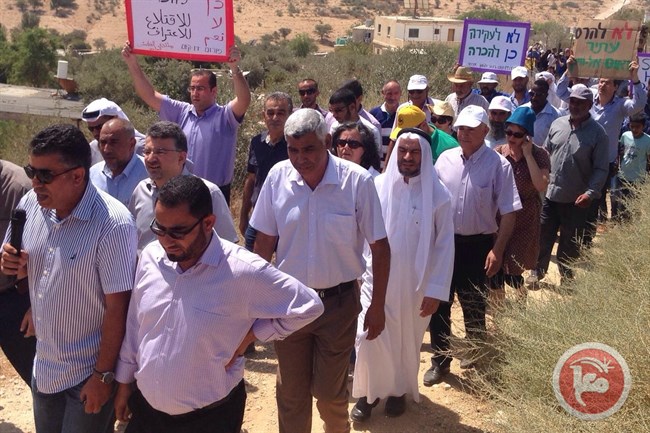 NEGEV – Dozens of Palestinians protested Thursday in the Bedouin village of Umm al-Hiran near the town of Hura in the Negev, as Israel’s construction of a Jewish town on the village’s land continues, local sources said.
The Umm al-Hiran community — around 700 strong — is unrecognized by the Israeli government and residents’ lands were claimed by the state in 2013 in order to make way for the expansion of the Beersheba metropolitan area.
As a march set off from the village and moved towards the site of construction, protesters said they were able to force Israeli police to remove the bulldozers from the area.
Leaders and members of national and Islamic parties, Palestinian members of the Knesset, members of committees for Palestinians in the Negev, and Jewish-Israelis took part in the march.
Sources told Ma’an that the contractor responsible for razing the village is a Palestinian citizen of Israel from the Negev, and locals have condemned the use of Palestinian contractors against their people by the Israeli authorities.
Participants of Thursday’s demonstration called for launching an international media campaign in support of Umm al-Hiran and other villages threatened with land confiscation in order to pressure Israeli authorities to stop longstanding policies to displace Palestinian Bedouins.
Umm al-Hiran residents are a fraction of the thousands of Bedouins living in villages that the Israeli government does not recognize and are at risk of displacement in the Negev due to Israeli policies that critics argue amount to ethnic cleansing.
The community’s residents appealed their displacement in court earlier this year on the grounds that the Israeli military administration ordered the community to be moved to the area in 1956, but the appeal was rejected.
On Sunday, Israeli excavators began work on infrastructure for the Jewish-only town in Umm al-Hiran, building a new road under heavy protection of Israeli forces, locals told Ma’an at the time.
Knesset Member Talab Abu Arar described the Israeli move as racist.
“Racism has become crystal clear in Umm al-Hiran as a Jewish settlement Hiran is being built on the ruins of the Arab Umm al-Hiran village,” Abu Arar told Ma’an on Sunday.
He added that Israeli courts and authorities ignored the rights of Palestinians and worked towards confining them to a few recognized towns and denying their rights.
Israel renews ’85 percent’ of administrative detention orders
Ma’an – August 28, 2015
JERUSALEM – Israeli authorities have renewed the administrative detention of 85 percent of Palestinians detainees held under the policy, a prisoner rights group said Friday.
The Prisoners’ Center for Studies said that at least 75 of the 480 Palestinians held under the detention without trial policy have had their sentences — which range from two to six months — renewed four times in a row.
The detention of 135 detainees has been renewed three times in a row while 190 Palestinians have had their sentences renewed twice, the center added.
Israeli military courts have issued 726 administrative detention orders in 2015 alone, including first time sentences and renewals, the group said, over 340 of which were issued to Palestinians from the Hebron district in the occupied West Bank.
Riyad al-Ashqar, a spokesperson of the Prisoners’ Center for Studies, said Israel is keeping Palestinians as political hostages through the policy of administrative detention.
Most detainees held under the policy, which dates back to the British Mandate, are held on secret evidence and are not aware of the reason for their detention, which can be renewed indefinitely in six-month periods.
In 2012, over 2,000 Palestinian prisoners went on hunger strike to protest administrative detention, one of the only means available to Palestinians to challenge the policy.
Last week, Palestinian detainee Muhammad Allan ended a two-month hunger strike which he began to protest his detention without trial. An Israeli court ruled to lift his administrative detention due to his deteriorating health.
While administrative detention is legal under international law in exceptional circumstances, the international community and rights organizations have condemned excessive use of the practice by Israel.
No Longer a Conspiracy Theory, First State Legalizes Weaponized Drones for Cops
By Matt Agorist | The Free Thought Project | August 26, 2015
North Dakota — Nothing says “police state” quite like unmanned aerial vehicles patrolling the sky ready to deploy 80,000 volts to the nearest protester or dose entire crowds with chemical weapons.
The idea of weaponized drones has long been a dystopian, yet fictional idea. However, thanks to House Bill 1328, in North Dakota, this police state hell from above is now a horrid reality.
Thanks to a police union lobbyist, the idea of police using drones for “less than lethal” weapons is now written into North Dakota law.
According to the Daily Beast,
The bill’s stated intent was to require police to obtain a search warrant from a judge in order to use a drone to search for criminal evidence. In fact, the original draft of Rep. Rick Becker’s bill would have banned all weapons on police drones.
Then Bruce Burkett of North Dakota Peace Officer’s Association was allowed by the state house committee to amend HB 1328 and limit the prohibition only to lethal weapons. “Less than lethal” weapons like rubber bullets, pepper spray, tear gas, sound cannons, and Tasers are therefore permitted on police drones.
The term “less than lethal” is thrown around to make tasers, which have been responsible for hundreds of deaths since 2001, seem like they are okay to be deployed on infants.
The reality is that “less than lethal” weapons are only slightly less lethal than the real thing. Now that these weapons will be put on drones, entire new safety concerns arise, such as accuracy and the simple issue of a drone falling into a crowd.
After being duped by the police lobby into passing a bill allowing cops to equip drones with weapons, Rep Becker is worried. He spoke up about police deploying these weapons when they aren’t near the intended target.
“When you’re not on the ground, and you’re making decisions, you’re sort of separate,” Becker said. “Depersonalized.”
One need only look at the Middle East and the thousands of innocent women and children who’ve been slaughtered by US drones to imagine the grim reality of such legislation.
Law enforcement and their union lobbyists are assuring lawmakers that drones would only be used in non-criminal situations, like a missing person case or for photographing crime scenes. This begs the question of why they would need such ominous legislation if they say they’ll never use it?
According to Keith Lund of the Grand Forks Regional Economic Development Corporation, laws like this one are to combat restrictions in drone development to create jobs.
North Dakota has been hit hard by the oil bust, and more drones equal more jobs.
“It’s really all about the commercial development, which is where all of this is heading,” Lund replied. “If [a law] is somehow limiting commercial, law enforcement development… that is a negative in terms of companies looking and investing in opportunities in the state of North Dakota,” Lund said, according to the Daily Beast.
It’s not only weapons attached to drones that are raising issues in the state either. Police and their lobbyists are putting up a big fight to allow the use of drones for spying without a warrant.
“Requiring a search warrant for surveillance is ‘restricting development?’” asked Rep. Gary Paur, a Republican, at a hearing.
It seems that corporate and state collusion, at the expense of the people’s liberties, doesn’t even have to happen behind closed doors anymore.
Get ready, because if we know anything about the military-industrial complex, it’s that it spreads like a virus. It is only a matter of time before other slimeball politicians sell out civil liberties to prop up “Big Drone.”
Bergen-Belsen Camp: The Suppressed Story
By Mark Weber | The Journal of Historical Review | May-June 1995
Fifty years ago, on April 15, 1945, British troops liberated the Bergen-Belsen concentration camp. The anniversary was widely remembered in official ceremonies and in newspaper articles that, as the following essay shows, distort the camp’s true history.
Largely because of the circumstances of its liberation, the relatively unimportant German concentration camp of Bergen-Belsen has become — along with Dachau and Buchenwald — an international symbol of German barbarism.
The British troops who liberated the Belsen camp three weeks before the end of the war were shocked and disgusted by the many unburied corpses and dying inmates they found there. Horrific photos and films of the camp’s emaciated corpses and mortally sick inmates were quickly circulated around the globe. Within weeks the British military occupation newspaper proclaimed: “The story of that greatest of all exhibitions of ‘man’s inhumanity to man’ which was Belsen Concentration Camp is known throughout the world.” (note 1)
Ghastly images recorded by Allied photographers at Belsen in mid-April 1945 and widely reproduced ever since have greatly contributed to the camp’s reputation as a notorious extermination center. In fact, the dead of Bergen-Belsen were, above all, unfortunate victims of war and its turmoil, not deliberate policy. It can even be argued that they were as much victims of Allied as of German measures.

Plan of the Bergen-Belsen camp
The Bergen-Belsen camp was located near Hannover in northwestern Germany on the site of a former army camp for wounded prisoners of war. In 1943 it was established as an internment camp (Aufenthaltslager) for European Jews who were to be exchanged for German citizens held by the Allies.
More than 9,000 Jews with citizenship papers or passports from Latin American countries, entry visas for Palestine, or other documents making them eligible for emigration, arrived in late 1943 and 1944 from Poland, France, Holland and other parts of Europe. During the final months of the war, several groups of these “exchange Jews” were transported from Axis-occupied Europe. German authorities transferred several hundred to neutral Switzerland, and at least one group of 222 Jewish detainees was transferred from Belsen (by way of neutral Turkey) to British-controlled Palestine. /2
Until late 1944 conditions were generally better than in other concentration camps. Marika Frank Abrams, a Jewish woman from Hungary, was transferred from Auschwitz in 1944. Years later she recalled her arrival at Belsen: “… We were each given two blankets and a dish. There was running water and latrines. We were given food that was edible and didn’t have to stand for hours to be counted. The conditions were so superior to Auschwitz we felt we were practically in a sanitarium.” /3
Inmates normally received three meals a day. Coffee and bread were served in the morning and evening, with cheese and sausage as available. The main mid-day meal consisted of one liter of vegetable stew. Families lived together. Otherwise, men and women were housed in separate barracks. /4
Children were also held there. There were some 500 Jewish children in Belsen’s “No. 1 Women’s Camp” section when British forces arrived. /5
During the final months of the war, tens of thousands of Jews were evacuated to Belsen from Auschwitz and other eastern camps threatened by the advancing Soviets. Belsen became severely overcrowded as the number of inmates increased from 15,000 in December 1944 to 42,000 at the beginning of March 1945, and more than 50,000 a month later. /6
Many of these Jewish prisoners had chosen to be evacuated westwards with their German captors rather than remain in eastern camps to await liberation by Soviet forces. /7
So catastrophic had conditions become during the final months of the war that about a third of the prisoners evacuated to Belsen in February and March 1945 perished during the journey and were dead on arrival. /8
As order broke down across Europe during those chaotic final months, regular deliveries of food and medicine to the camp stopped. Foraging trucks were sent to scrounge up whatever supplies of bread, potatoes and turnips were available in nearby towns. /9
Epidemic
Disease was kept under control by routinely disinfecting all new arrivals. But in early February 1945 a large transport of Hungarian Jews was admitted while the disinfection facility was out of order. As a result, typhus broke out and quickly spread beyond control. /10
Commandant Josef Kramer quarantined the camp in an effort to save lives, but SS camp administration headquarters in Berlin insisted that Belsen be kept open to receive still more Jewish evacuees arriving from the East. The death rate soon rose to 400 a day. /11
The worst killer was typhus, but typhoid fever and dysentery also claimed many lives. Aggravating the situation was a policy during the final months of transferring already sick inmates from other camps to Belsen, which was then officially designated a sick or convalescence camp (Krankenlager). The sick women of Auschwitz, for example, were transferred to Belsen in three groups in November-December 1944. /12
When SS chief Heinrich Himmler learned of the typhus outbreak at Bergen-Belsen, he immediately issued an order to all appropriate officials requiring that “all medical means necessary to combat the epidemic should be employed … There can be no question of skimping either with doctors or medical supplies.” However, the general breakdown of order that prevailed on Germany by this time made it impossible to implement the command. /13
‘Belsen Worst’
Violette Fintz, a Jewish woman who had been deported from the island of Rhodes to Auschwitz in mid-1944, and then to Dachau and, finally, in early 1945, to Belsen, later compared conditions in the different camps: /14
Belsen was in the beginning bearable and we had bunks to sleep on, and a small ration of soup and bread. But as the camp got fuller, our group and many others were given a barracks to hold about seven hundred lying on the floor without blankets and without food or anything. It was a pitiful scene as the camp was attacked by lice and most of the people had typhus and cholera … Many people talk about Auschwitz — it was a horrible camp. But Belsen, no words can describe it … From my experience and suffering, Belsen was the worst.
Belsen’s most famous inmate was doubtless Anne Frank, who had been evacuated from Auschwitz in late October 1944. She succumbed to typhus in March 1945, three or four weeks before liberation.
Kramer Reports a ‘Catastrophe’
In a March 1, 1945, letter to Gruppenführer (General) Richard Glücks, head of the SS camp administration agency, Commandant Kramer reported in detail on the catastrophic situation in the Bergen-Belsen, and pleaded for help: /15
If I had sufficient sleeping accommodation at my disposal, then the accommodation of the detainees who have already arrived and of those still to come would appear more possible. In addition to this question a spotted fever and typhus epidemic has now begun, which increases in extent every day. The daily mortality rate, which was still in the region of 60-70 at the beginning of February, has in the meantime attained a daily average of 250-300 and will increase still further in view of the conditions which at present prevail.
Supply. When I took over the camp, winter supplies for 1500 internees had been indented for; some had been received, but the greater part had not been delivered. This failure was due not only to difficulties of transport, but also to the fact that practically nothing is available in this area and all must be brought from outside the area …
For the last four days there has been no delivery [of food] from Hannover owing to interrupted communications, and I shall be compelled, if this state of affairs prevails till the end of the week, to fetch bread also by means of truck from Hannover. The trucks allotted to the local unit are in no way adequate for this work, and I am compelled to ask for at least three to four trucks and five to six trailers. When I once have here a means of towing then I can send out the trailers into the surrounding area … The supply question must, without fail, be cleared up in the next few days. I ask you, Gruppenführer, for an allocation of transport …
State of Health. The incidence of disease is very high here in proportion to the number of detainees. When you interviewed me on Dec. 1, 1944, at Oranienburg, you told me that Bergen-Belsen was to serve as a sick camp for all concentration camps in north Germany. The number of sick has greatly increased, particularly on account of the transports of detainees that have arrived from the East in recent times — these transports have sometimes spent eight or fourteen days in open trucks …
The fight against spotted fever is made extremely difficult by the lack of means of disinfection. Due to constant use, the hot-air delousing machine is now in bad working order and sometimes fails for several days …
A catastrophe is taking place for which no one wishes to assume responsibility … Gruppenführer, I can assure you that from this end everything will be done to overcome the present crisis …
I am now asking you for your assistance as it lies in your power. In addition to the above-mentioned points I need here, before everything, accommodation facilities, beds, blankets, eating utensils — all for about 20,000 internees … I implore your help in overcoming this situation.

Mass grave at Belsen camp, shortly after its liberation by British troops. Photographs such as this are widely reproduced as proof of a German policy of extermination. Contrary to Allied propaganda claims of the time, and Holocaust allegations in recent decades, though, these unfortunate prisoners were victims of typhus and starvation that were indirect consequences of the war – not of any deliberate policy. At least 14,000 Jews died in the camp following the British takeover.
Under such terrible conditions, Kramer did everything in his power to reduce suffering and prevent death among the inmates, even appealing to the hard-pressed German army. “I don’t know what else to do,” he told high-ranking army officers. “I have reached the limit. Masses of people are dying. The drinking water supply has broken down. A trainload of food was destroyed by low-flying [Allied] war planes. Something must be done immediately.” /16
Working together with both Commandant Kramer and chief inmate representative Kuestermeier, Colonel Hanns Schmidt responded by arranging for the local volunteer fire department to provide water. He also saw to it that food supplies were brought to the camp from abandoned rail cars. Schmidt later recalled that Kramer “did not at all impress one as a criminal type. He acted like an upright and rather honorable man. Neither did he strike me as someone with a guilty conscience. He worked with great dedication to improve conditions in the camp. For example, he rounded up horse drawn vehicles to bring food to the camp from rail cars that had been shot up.” /17
“I was swamped,” Kramer later explained to incredulous British military interrogators: /18
The camp was not really inefficient before you [British and American forces] crossed the Rhine. There was running water, regular meals of a kind — I had to accept what food I was given for the camp and distribute it the best way I could. But then they suddenly began to send me trainloads of new prisoners from all over Germany. It was impossible to cope with them. I appealed for more staff, more food. I was told that this was impossible. I had to carry on with what I had.
Then as a last straw the Allies bombed the electric plant that pumped our water. Loads of food were unable to reach the camp because of the Allied fighters. Then things really got out of hand. During the last six weeks I have been helpless. I did not even have sufficient staff to bury the dead, let alone segregate the sick … I tried to get medicines and food for the prisoners and I failed. I was swamped. I may have been hated, but I was doing my duty.
Kramer’s clear conscience is also suggested by the fact that he made no effort to save his life by fleeing, but instead calmly awaited the approaching British forces, naively confident of decent treatment. “When Belsen Camp was eventually taken over by the Allies,” he later stated, “I was quite satisfied that I had done all I possibly could under the circumstances to remedy the conditions in the camp.” /19
Negotiated Transfer
As British forces approached Bergen-Belsen, German authorities sought to turn over the camp to the British so that it would not become a combat zone. After some negotiation, it was peacefully transferred, with an agreement that “both British and German troops will make every effort to avoid battle in the area.” /20
A revealing account of the circumstances under which the British took control appeared in a 1945 issue of The Journal of the American Medical Association: /21
By negotiations between British and German officers, British troops took over from the SS and the Wehrmacht the task of guarding the vast concentration camp at Belsen, a few miles northwest of Celle, which contains 60,000 prisoners, many of them political. This has been done because typhus is rampant in the camp and it is vital that no prisoners be released until the infection is checked. The advancing British agreed to refrain from bombing or shelling the area of the camp, and the Germans agreed to leave behind an armed guard which would be allowed to return to their own lines a week after the British arrival.
The story of the negotiations is curious. Two German officers presented themselves before the British outposts and explained that there were 9,000 sick in the camp and that all sanitation had failed. They proposed that the British should occupy the camp at once, as the responsibility was international in the interests of health. In return for the delay caused by the truce the Germans offered to surrender intact the bridges over the river Aller. After brief consideration the British senior officer rejected the German proposals, saying it was necessary that the British should occupy an area of ten kilometers round the camp in order to be sure of keeping their troops and lines of communication away from the disease. The British eventually took over the camp.
Brutal Mistreatment
On April 15, 1945, Belsen’s commanders turned over the camp to British troops, who lost no time mistreating the SS camp personnel. The Germans were beaten with rifle butts, kicked, and stabbed with bayonets. Most were shot or worked to death. /22
British journalist Alan Moorehead described the treatment of some of the camp personnel shortly after the takeover: /23
As we approached the cells of the SS guards, the [British] sergeant’s language become ferocious. “We had had an interrogation this morning,” the captain said. ‘I’m afraid they are not a pretty sight.’ … The sergeant unbolted the first door and … strode into the cell, jabbing a metal spike in front of him. “Get up,” he shouted. “Get up. Get up, you dirty bastards.” There were half a dozen men lying or half lying on the floor. One or two were able to pull themselves erect at once. The man nearest me, his shirt and face spattered with blood, made two attempts before he got on to his knees and then gradually on to his feet. He stood with his arms stretched out in front of him, trembling violently.
“Come on. Get up,” the sergeant shouted [in the next cell]. The man was lying in his blood on the floor, a massive figure with a heavy head and bedraggled beard … “Why don’t you kill me?” he whispered. “Why don’t you kill me? I can’t stand it any more.” The same phrases dribbled out of his lips over and over again. “He’s been saying that all morning, the dirty bastard,” the sergeant said.

Josef Kramer in British captivity. After a military trial, the former Bergen-Belsen Commandant was put to death.
Commandant Kramer, who was vilified in the British and American press as “The Beast of Belsen” and “The Monster of Belsen,” was put on trial and then executed, along with chief physician Dr. Fritz Klein and other camp officials. At his trial, Kramer’s defense attorney, Major T.C.M. Winwood, predicted: “When the curtain finally rings down on this stage Josef Kramer will, in my submission, stand forth not as ‘The Beast of Belsen’ but as ‘The Scapegoat of Belsen’.” /24
In an “act of revenge,” the British liberators expelled the residents of the nearby town of Bergen, and then permitted camp inmates to loot the houses and buildings. Much of the town was also set on fire. /25
Postwar Deaths
There were some 55,000 to 60,000 prisoners in Bergen-Belsen when the British took control of the camp. The new administrators proved no more capable of mastering the chaos than the Germans had been, and some 14,000 Jewish inmates died at Belsen in the months following the British takeover. /26
Although still occasionally referred to as an “extermination camp” or “mass murder” center, the truth about Bergen-Belsen has been quietly acknowledged by scholars. /27 In his 1978 survey of German history, University of Erlangen professor Helmut Diwald wrote of /28
… The notorious Bergen-Belsen concentration camp where 50,000 inmates were supposedly murdered. Actually, about 7,000 inmates died during the period when the camp existed, from 1943 to 1945. Most of them died in the final months of the war as a result of disease and malnutrition — consequences of the bombings that had completely disrupted normal deliveries of medical supplies and food. The British commander who took control of the camp after the capitulation testified that crimes on a large scale had not taken place at Bergen-Belsen.
Martin Broszat, Director of the Institute for Contemporary History in Munich, wrote in 1976: /29
… In Bergen-Belsen, for example, thousands of corpses of Jewish prisoners were found by British soldiers on the day of liberation, which gave the impression that this was one of the notorious extermination camps. Actually, many Jews in Bergen-Belsen as well as in the satellite camps of Dachau died in the last weeks before the end of the war as a result of the quickly improvised retransfers and evacuations of Jewish workers from the still existing ghettos, work camps and concentration camps in the East (Auschwitz) …
Dr. Russell Barton, an English physician who spent a month in Bergen-Belsen after the war with the British Army, has also explained the reasons for the catastrophic conditions found there: /30
Most people attributed the conditions of the inmates to deliberate intention on the part of the Germans in general and the camp administrators in particular. Inmates were eager to cite examples of brutality and neglect, and visiting journalists from different countries interpreted the situation according to the needs of propaganda at home.
For example, one newspaper emphasized the wickedness of the “German masters” by remarking that some of the 10,000 unburied dead were naked. In fact, when the dead were taken from a hut and left in the open for burial, other prisoners would take their clothing from them …
German medical officers told me that it had been increasingly difficult to transport food to the camp for some months. Anything that moved on the autobahns was likely to be bombed …
I was surprised to find records, going back for two or three years, of large quantities of food cooked daily for distribution. I became convinced, contrary to popular opinion, that there had never been a policy of deliberate starvation. This was confirmed by the large numbers of well-fed inmates. Why then were so many people suffering from malnutrition?… The major reasons for the state of Belsen were disease, gross overcrowding by central authority, lack of law and order within the huts, and inadequate supplies of food, water and drugs.
In trying to assess the causes of the conditions found in Belsen one must be alerted to the tremendous visual display, ripe for purposes of propaganda, that masses of starved corpses presented.
Gas Chamber Myths
Some former inmates and a few historians have claimed that Jews were put to death in gas chambers at Bergen-Belsen. For example, an “authoritative” work published shortly after the end of the war, A History of World War II, informed readers: “In Belsen, [Commandant] Kramer kept an orchestra to play him Viennese music while he watched children torn from their mothers to be burned alive. Gas chambers disposed of thousands of persons daily.” /31

A protest meeting in the Bergen-Belsen camp, September 1947. For five years following the end of the war, British authorities maintained the camp as a “Displaced Persons” center. During this period it flourished as a major black market center. At this pro-Zionist gathering of 4,000 Jews, camp leader Joseph Rosensaft speaks against British policy in Palestine.
In Jews, God and History, Jewish historian Max Dimont wrote of gassings at Bergen-Belsen. /32 A semi-official work published in Poland in 1981 claimed that women and babies were “put to death in gas chambers” at Belsen. /33
In 1945 the Associated Press news agency reported: /34
In Lueneburg, Germany, a Jewish physician, testifying at the trial of 45 men and women for war crimes at the Belsen and Oswiecim [Auschwitz] concentration camps, said that 80,000 Jews, representing the entire ghetto of Lodz, Poland, had been gassed or burned to death in one night at the Belsen camp.
Five decades after the camp’s liberation, British army Captain Robert Daniell recalled seeing “the gas chambers” there. /35
Years after the war, Robert Spitz, a Hungarian Jew, remembered taking a shower at Belsen in February 1945: “… It was delightful. What I didn’t know then was that there were other showers in the same building where gas came out instead of water.” /36
Another former inmate, Moshe Peer, recalled a miraculous escape from death as an eleven-year-old in the camp. In a 1993 interview with a Canadian newspaper, the French-born Peer claimed that he “was sent to the [Belsen] camp gas chamber at least six times.” The newspaper account went on to relate: “Each time he survived, watching with horror as many of the women and children gassed with him collapsed and died. To this day, Peer doesn’t know how he was able to survive.” In an effort to explain the miracle, Peer mused: “Maybe children resist better, I don’t know.” (Although Peer claimed that “Bergen-Belsen was worse than Auschwitz,” he acknowledged that he and his younger brother and sister, who were deported to the camp in 1944, all somehow survived internment there.) /37
Such gas chamber tales are entirely fanciful. As early as 1960, historian Martin Broszat had publicly repudiated the Belsen gassing story. These days no reputable scholar supports it. /38
Exaggerated Death Estimates
Estimates of the number of people who died in Bergen-Belsen have ranged widely over the years. Many have been irresponsible exaggerations. Typical is a 1985 York Daily News report, which told readers that “probably 100,000 died at Bergen-Belsen.” /39 An official German government publication issued in 1990 declared that “more than 50,000 people had been murdered” in the Belsen camp under German control, and “an additional 13,000 died in the first weeks after liberation.” /40
Closer to the truth is the Encyclopaedia Judaica, which maintains that 37,000 perished in the camp before the British takeover, and another 14,000 afterwards. /41
Whatever the actual number of dead, Belsen’s victims were not “murdered,” and the camp was not an “extermination” center.
Black Market Center
From 1945 until 1950, when it was finally shut down, the British maintained Belsen as a camp for displaced European Jews. During this period it achieved new notoriety as a major European black market center. The “uncrowned king” of Belsen’s 10,000 Jews was Yossl (Josef) Rosensaft, who amassed tremendous profits from the illegal trading. Rosensaft had been interned in various camps, including Auschwitz, before arriving in Belsen in early April 1945. /42
British Lieutenant General Sir Frederick Morgan, chief of “displaced persons” operations in postwar Germany for the United Nations relief organization UNRRA recalled in his memoir that /43
under Zionist auspices there had been organized at Belsen a vast illegitimate trading organization with worldwide ramifications and dealing in a wide range of goods, principally precious metals and stones. A money market dealt with a wide range of currencies. Goods were being imported in cryptically marked containers consigned in UNRRA shipments to Jewish voluntary agencies …
Legacy
A kind of memorial center now draws many tourists annually to the camp site. Not surprisingly, Bergen’s 13,000 residents are not very pleased with their town’s infamous reputation. Citizens report being called “murderers” during visits to foreign countries. /44
In striking contrast to the widely-accepted image of Belsen, which is essentially a product of hateful wartime propaganda, is the suppressed, albeit grim, historical reality. In truth, the Bergen-Belsen story may be regarded as the Holocaust story in miniature.
Notes
- Walter Laqueur, The Terrible Secret: Suppression of the Truth about Hitler’s ‘Final Solution’ (Boston: Little Brown, 1980), p. 1.
- Testimony of Commandant Kramer in: Raymond Phillips, ed., Trial of Josef Kramer and Forty-Four Others (The Belsen Trial) (London: William Hodge, 1949), p. 160; “Bergen-Belsen,” Encyclopaedia Judaica (New York and Jerusalem: Macmillan and Keter, 1971), Vol. 4, p. 610. According to this source, one group of 136 of these “exchange Jews” was deported from Belsen during the war to neutral Switzerland, and another group of 222 was transferred to Palestine.; According to an Israeli newspaper report, a group of 222 “exchange” Jews reportedly left Bergen-Belsen on June 29, 1944, and, by way of Istanbul, arrived in Palestine on July 10. (Israel Nachrichten, quoted in: D. National-Zeitung, Munich, Sept. 23, 1994, p. 5)
- Sylvia Rothchild, ed., Voices from the Holocaust (New York: NAL, 1981), p. 190.
- Josef Kramer statement (1945) in: R. Phillips, Trial of Josef Kramer and Forty-Four Others, pp. 731-737. This is also in: Arthur Butz, The Hoax of the Twentieth Century (Newport Beach: Institute for Historical Review, 1993), pp. 272-274.
- R. Phillips, Trial of Josef Kramer and Forty-Four Others, pp. 19, 32, 33; Roman Hrabar, with Zofia Tokarz and J. E. Wilczur, The Fate of Polish Children During the Last War (Warsaw: Interpress, 1981), p. 76.
- Encyclopaedia Judaica, Vol. 4, p. 610; Gedenkbuch: Opfer der Verfolgung der Juden unter der nationsozialistischen Gewaltherrschaft (Koblenz: Bundesarchiv, 1986; 2 vols.), pp. 1761-1762.
- Testimony of Dr. Russell Barton, Feb. 7, 1985, in the first “Holocaust” trial of Ernst Zündel. Official trial transcript, pp. 2916-2917; See also Barton’s testimony during the second, 1988 Zündel trial in: Barbara Kulaszka, ed., Did Six Million Really Die? (Toronto: Samisdat, 1992), p. 175, and, Robert Lenski, The Holocaust on Trial: The Case of Ernst Zündel (Decatur, Ala.: Reporter Press, 1990), p. 159.
- Testimony of Commandant Kramer in: R. Phillips, Trial of Josef Kramer and Forty-Four Others, p. 162.
- Josef Kramer statement (1945) in: R. Phillips, ed., Trial of Josef Kramer and Forty-Four Others, pp. 731-737. Also in: A. Butz, The Hoax of the Twentieth Century, p. 274.
- Derrick Sington, Belsen Uncovered (London: 1946), pp. 117-118. Quoted in: A. Butz, The Hoax of the Twentieth Century, pp. 34-35; Gerald Reitlinger, The Final Solution (London: Sphere Books, pb., 1971), p. 504 (note).
- R. Phillips, ed., Trial of Josef Kramer and Forty-Four Others, pp. 152-153, 166-167, 734, 736; Tom Bower, Blind Eye to Murder (London: Granada, 1983), p. 224; Dr. Ernst von Briesen, “Was passierte in Bergen-Belsen wirklich?,” D. National-Zeitung (Munich), Jan. 13, 1984, pp. 4, 5, 8.
- G.Reitlinger, The Final Solution, p. 497 (and 638, n. 23).
- Andre Biss, A Million Jews to Save (New York: A.S. Barnes, 1975), pp. 242, 249-250; Felix Kersten, The Kersten Memoirs, 1940-1945 (New York: Macmillan, 1957), p. 276.
- Martin Gilbert, The Holocaust (New York: Holt, Rinehart and Winston, 1986), pp. 722, 785-786.
- R. Phillips, ed., Trial of Josef Kramer and Forty-Four Others, pp. 163-166.
- Signed report by retired Colonel (Oberst a.D.) Hanns Schmidt to Kurt Mehner and Lt. Colonel Bechtold, Braunschweig, March 3, 1981. Photocopy in author’s possession.
- Signed report by Hanns Schmidt to Kurt Mehner and Lt. Colonel Bechtold, March 3, 1981. Photocopy in author’s possession.
- Essay by Alan Moorehead, “Belsen,” in: Cyril Connolly, ed., The Golden Horizon (London: Weidenfeld and Nicolson, 1953), pp. 109-110.
- Josef Kramer statement (1945) in: R. Phillips, ed., Trial of Josef Kramer and Forty-Four Others, p. 737. Also quoted in: A. Butz, Hoax, p. 275; Essay by Alan Moorehead, “Belsen,” in: Cyril Connolly, ed., The Golden Horizon, pp. 109-110; Dr. Russell Barton, “Belsen,” History of the Second World War (Editor: Barrie Pitt, Copyright BPC publications, 1966), Part 109, 1975, p. 3025.
- R. Phillips, ed., Trial of Josef Kramer and Forty-Four Others, pp. 396-397.
- “Typhus Causes a Truce,” The Journal of the American Medical Association (Chicago), May 19, 1945, p. 220.
- Leonard O. Mosley, Report from Germany (1945). Quoted in: Montgomery Belgion, Victor’s Justice (Regnery, 1949), p. 80 (and p. 81); Time magazine, April 29, 1985, p. 21; See also essay by A. Moorehead, “Belsen,” in: Cyril Connolly, ed., The Golden Horizon (London: 1953), pp. 105-106.
- Essay by A. Moorehead, “Belsen,” in: Cyril Connolly, ed., The Golden Horizon, pp. 105-106.
- R. Phillips, ed., Trial of Josef Kramer and Forty-Four Others, p. 156.
- “Bergen-Belsen,” Der Spiegel (Hamburg), Nr. 30, 1985, pp. 71, 72.
- “Holocaust,” Encyclopaedia Judaica, Vol. 8, p. 859; M. Gilbert, The Holocaust (1986), pp. 793-795; See also: R. Phillips, ed., Trial of Josef Kramer and Forty-Four Others, pp. 20, 46-47; According to a 1992 Associated Press report, more than 60,000 prisoners were held in Belsen camp when it was liberated. Then, “in the first five days of liberation, 14,000 prisoners died and another 14,000 perished in the following weeks.” Graham Heathcote, AP from Tostock, England, “2 hours changed me for the rest of my life,” Orlando Sentinel (Florida), Dec. 20, 1992, p. A 29, and, “Journey into hell,” The Spokesman-Review (Spokane, Washington), Dec. 20, 1992.
- Time magazine, April 29, 1985, p. 21, referred to Belsen as a camp created for the “extermination” of “the Jewish people.”
- Helmut Diwald, Geschichte der Deutschen (Frankfurt: Propyläen, first ed., 1978), pp. 164-165.
- M. Broszat, “Zur Kritik der Publizistik des antisemitischen Rechtsextremismus,” Supplement B 19/76 of May 8, 1976, to the weekly newspaper Das Parlament (Bonn), p. 6. Revised from issue No. 2, 1976, of the Vierteljahrshefte für Zeitgeschichte (Munich).
- Dr. R. Barton, “Belsen,” History of the Second World War, Part 109, 1975, pp. 3025-3029; Barton confirmed this evaluation in testimony given in the 1985 and 1988 Toronto trials of German-Canadian publisher Ernst Zündel. On Barton’s testimony in the first, 1985 trial, see: “View of Belsen was propaganda, trial told,” The Globe and Mail (Toronto), Feb. 8, 1985, pp. M1, M5, and, “Disease killed Nazis’ prisoners, MD says,” Toronto Star, Feb. 8, 1985, p. A2; On Barton’s testimony in the second, 1988 Zündel trial, see: Barbara Kulaszka, ed., Did Six Million Really Die?, pp. 175-180, and, R. Lenski, The Holocaust on Trial (1990), pp. 157-160; Among his other positions after the war, Barton was superintendent and consultant psychiatrist at Severalls Hospital (Essex, England), and director of the Rochester Psychiatric Center (New York).
- Francis Trevelyan Miller, Litt.D., LLD, A History of World War II (Philadelphia: John C. Winston Co., 1945), p. 868.
- M. Dimont, Jews, God and History (New York: Signet/NAL, pb., 1962?), p. 383.
- R. Hrabar, et al, The Fate of Polish Children During the Last War (Warsaw: 1981), p. 76.
- The Associated Press News Annual: 1945, p. 404.
- M. Holland, “The horrors of Belsen,” Sunday Herald Sun (Melbourne, Australia), Jan. 22, 1995, p. 93; M. Holland, “Man who uncovered the horror of Belsen,” Sunday Times (Perth, W. Australia), Feb. 5, 1995, p. 2.
- S. Rothchild, ed., Voices From the Holocaust, p. 197.
- K. Seidman, “Surviving the horror,” The Gazette (Montreal, Canada), August 5, 1993. Facsimile reprint in: The Journal of Historical Review, Nov.-Dec. 1993, p. 24.
- Die Zeit (Hamburg), August 19, 1960, p. 16. (U.S. edition: August 26, 1960.) Facsimile and translation in The Journal of Historical Review, May-June 1993, p. 12.
- “Bergen-Belsen,” Daily News (New York), April 20, 1985, p. 3.
- “Ceremony Recalls Victims of Bergen-Belsen,” The Week in Germany (New York: German Information Center), April 27, 1990, p. 6; A figure of 50,000 is also given in Time magazine, April 29, 1985, p. 21; According to a stone memorial at the Belsen camp site, 30,000 Jews were “exterminated” there; A semi-official Polish account published in 1980 reported 48,000 Belsen “victims.” Czeslaw Pilichowski, No Time Limit for These Crimes (Warsaw: Interpress, 1980), pp. 154-155.
- “Bergen-Belsen,” Encyclopaedia Judaica (1971), vol. 4, pp. 610-612; Colonel Schmidt, the German officer who worked to alleviate conditions in Belsen during the final weeks and also arranged for the camp’s surrender to the British, estimated that “altogether about 8,000 people” died in the camp. (This figure may, however, only include victims of the final chaotic weeks under German control.) Source: Signed report by Oberst a.D. Hanns Schmidt to Kurt Mehner and Lt. Colonel Bechtold, Braunschweig, March 3, 1981. (Cited above.) Photocopy in author’s possession.
- L. Dawidowicz, “Belsen Remembered,” Commentary (New York: American Jewish Comm.), March 1966, pp. 84, 85; D. National-Zeitung (Munich), March 21, 1986, p. 4; M. Gilbert, The Holocaust, pp. 690, 793.
- F. Morgan, Peace and War (London: Hodder and Stoughton, 1961), p. 259.
- “Bergen-Belsen,” Der Spiegel, Nr. 30, 1985, pp. 71, 72.
From The Journal of Historical Review, May-June 1995 (Vol. 15, No. 3), pages 23-30.
Ecuadorean President Opens Health Centers in Indigenous Region

Ecuadorean President Rafael Correa tours a new health center in the province of Cotopaxi, Aug. 25, 2015. | Photo: Ecuadorean Presidency
teleSUR – August 26, 2015
Ecuadorean President Rafael Correa Tuesday inaugurated three new health centers in the province of Cotopaxi, which are destined to serve more than 55,000 people.
The health centers were built at a cost of US$7 million and serve a part of Ecuador currently at risk of being affected by the possible eruption of the Cotopaxi volcano.
President Correa said these centers are already equipped to deal with any potential emergency related to a possible eruption.
The new health centers are part of a push by the government to improve public health in the country by reducing visits to larger hospitals and placing a greater emphasis on prevention.
These centers, run by the Ministry of Public Health, are available to all residents free of charge.
“In 2015 alone, 2.5 million dollars have been allocated to health, a human right, and the best possible investment of money,” said Correa.
Since 2007 and the arrival of Correa to the presidency, 46 health centers and 12 hospitals have been built throughout the country, with more set to be opened over the next few years.
“We are continuing on the path so that public services serve as an example, that they are the best, that’s the dream that the Citizens Revolution holds,” said Minister of Health Carina Vance, referencing the name given to the political process led by President Correa.
These new health centers are deliberately built in areas previously under-served by government services. The three new centers inaugurated Tuesday are located in a part Ecuador where the majority of the residents are indigenous peoples.
President Correa said that these types of services are an example of the commitment the government has toward serving indigenous communities and the reason why the Citizens Revolution continues to enjoy support from the majority of indigenous peoples.
A segment of the indigenous movement recently declared an “uprising” against the government, holding marches and rallies throughout the country to demonstrate their opposition.
The smaller “type B” health center inaugurated by the president includes outpatient services, dental attention, X-rays, a clinical laboratory, emergency services, clinical psychology, physiotherapy, and a pharmacy.
A second “type B” center and a larger “type C” center were simultaneously unveiled. The president said they intended to inaugurate all three centers with a visit to the largest one but changed their plans after an opposition political group said they would try to storm the center during the president’s visit.
Israeli troops ‘steal money, jewelry’ during detention raid
Ma’an – August 26, 2015
NABLUS – A Palestinian father said Wednesday that Israeli soldiers stole money and jewelry from his family home when they detained his son in a predawn raid in the the northern West Bank village of Salem east of Nablus.
Nasim Hilmi Karaki, a lieutenant colonel in the Palestinian Authority national security forces, told Ma’an that Israeli special forces stormed his house around 1:00 a.m. after blowing up the main door.
Large numbers of troops ransacked the house as they inspected rooms using metal detectors and police dogs, Karaki said, adding that they blew up the doors of three rooms inside the house.
He said that the operation lasted until around 5:00 a.m., during which Karaki was cuffed and forced to stay with the rest of the family in one of the rooms.
The soldiers then detained Karaki’s 18-year-old son, Hilmi.
Karaki said that the troops were searching for firearms but were unable to find any.
However, after they left, he said he discovered that they had stolen 21,000 shekels and his wife’s jewelry, worth around 2,000 Jordanian Dinars (about $2,820).
An Israeli army spokeswoman said she was looking into the incident.
Karaki’s son was one of 31 Palestinians detained by Israeli forces across the occupied West Bank overnight Tuesday.
Israeli forces routinely detain Palestinians throughout the occupied West Bank and East Jerusalem, often on the pretext of perceived security threats.
Palestinians often report theft by Israeli forces during such raids. During a detention campaign Operation Brother’s Keeper in the summer of 2014, Israeli forces confiscated an estimated $2.9 million worth of cash and property from Palestinian homes, charities, and businesses according to a report by Geneva-based human rights organization Euro-Mid Observer.
Spokespeople for the Israeli government justified confiscations during this time by claiming their planned use to fund or support terrorism.
The Euro-Mid Observer reported, however, that Israeli authorities neither provided evidence nor judicial permission for the confiscations.
Hawaii Sees 10 Fold Increase in Birth Defects After Becoming GM Corn Testing Grounds
By Jay Syrmopoulos | The Free Thought Project | August 24, 2015
Waimea, HI – Doctors are sounding the alarm after noticing a disturbing trend happening in Waimea, on the island of Kauai, Hawaii. Over the past five years, the number of severe heart malformations has risen to more than ten times the national rate, according to an analysis by local physicians.
Pediatrician Carla Nelson, after seeing four of these defects in three years, is extremely concerned with the severe health anomalies manifesting in the local population.
Nelson, as well as a number of other local doctors, find themselves at the center of a growing controversy about whether the substantial increase in severe illness and birth defects in Waimea stem from the main cash crop on four of the six islands, genetically modified corn, which has been altered to resist pesticide.
Hawaii has historically been used as a testing ground for almost all GMO corn grown in the United States. Over 90% of GMO corn grown in the mainland U.S. was first developed in Hawaii, with the island of Kauai having the largest area used.
According to a report in The Guardian :
In Kauai, chemical companies Dow, BASF, Syngenta and DuPont spray 17 times more pesticide per acre (mostly herbicides, along with insecticides and fungicides) than on ordinary cornfields in the US mainland, according to the most detailed study of the sector, by the Center for Food Safety.
That’s because they are precisely testing the strain’s resistance to herbicides that kill other plants. About a fourth of the total are called Restricted Use Pesticides because of their harmfulness. Just in Kauai, 18 tons – mostly atrazine, paraquat (both banned in Europe) and chlorpyrifos – were applied in 2012. The World Health Organization this year announced that glyphosate, sold as Roundup, the most common of the non-restricted herbicides, is “probably carcinogenic in humans”.
Waimea is a small town that lies directly downhill from the 12,000 acres of GMO test fields leased mainly from the state. Spraying takes place often, sometimes every couple of days. Residents have complained that when the wind blows downhill from the fields, the chemicals have caused headaches, vomiting, and stinging eyes.
“Your eyes and lungs hurt, you feel dizzy and nauseous. It’s awful,” local middle school special education teacher Howard Hurst told the Guardian. “Here, 10% of the students get special-ed services, but the state average is 6.3%,” he says. “It’s hard to think the pesticides don’t play a role.”
To add insult to injury, Dow AgraSciences’ main lobbyist in Honolulu, until recently, actually ran the main hospital in town. Although only 1,700ft away from a Syngenta field, the hospital has never done any research into the effects of pesticides on its patients.
Hawaiians have attempted to reign in the industrial chemical/farming machine on four separate occasions over the past two years. On August 9 an estimated 10,000 people marched through Honolulu’s main tourist district to protest the collusion of big business and state putting profits over citizens’ health.
“The turnout and the number of groups marching showed how many people are very frustrated with the situation,” native Hawaiian activist Walter Ritte said.
Hawaiians have also attempted to use a ballot initiative to force a moratorium on the planting of GMO crops, according to The Guardian:
In Maui County, which includes the islands of Maui and Molokai, both with large GMO corn fields, a group of residents calling themselves the Shaka Movement sidestepped the company-friendly council and launched a ballot initiative that called for a moratorium on all GMO farming until a full environmental impact statement is completed there.
The companies, primarily Monsanto, spent $7.2m on the campaign ($327.95 per “no” vote, reported to be the most expensive political campaign in Hawaii history) and still lost.
Again, they sued in federal court, and, a judge found that the Maui County initiative was preempted by federal law. Those rulings are also being appealed.
Even amidst strong public pressure, the chemical companies that grow the GMO corn have continued to refuse to disclose the chemicals they are using, as well as the specific amounts of each chemical being used. The industry and its political cronies have continually insisted that pesticides are safe.
“We have not seen any credible source of statistical health information to support the claims,” said Bennette Misalucha, executive director of Hawaii Crop Improvement Association in a written statement distributed by a publicist.
Nelson pointed out that American Academy of Pediatrics’ report, Pesticide Exposure in Children, found “an association between pesticides and adverse birth outcomes, including physical birth defects,” going on to note that local schools have twice been evacuated and kids sent to the hospital due to pesticide drift. “It’s hard to treat a child when you don’t know which chemical he’s been exposed to.”
Sidney Johnson, a pediatric surgeon at the Kapiolani Medical Center for Women and Children who oversees all children born in Hawaii with major birth defects says he’s noticed that the number of babies born here with their abdominal organs outside. This is a rare condition known as gastroschisis and has grown from three a year in the 1980s to about a dozen now, according to The Guardian.
Johnson and a team of medical students have been studying hospital records to determine if any of the parents of the infants with gastroschisis were residing near fields that were undergoing spraying during conception and early pregnancy.
“We have cleanest water and air in the world,” Johnson said. “You kind of wonder why this wasn’t done before,” he says. “Data from other states show there might be a link, and Hawaii might be the best place to prove it.”
It was recently revealed that these chemical companies, unlike farmers, are allowed to operate under an antiquated decades-old Environmental Protection Agency permit. This permit was grandfathered in from the days of sugar plantations when the amounts and toxicities were significantly lower, and which allowed for toxic chemicals to be discharged into water. Tellingly the state of Hawaii has asked for a federal exemption to allow these companies to continue to not comply with modern standards.
The ominous reality of collusion between these mega-corporations and the political class in Hawaii has seemingly left the citizens of the state with virtually no ability to safeguard their children’s health. We tread dangerously close to corporate fascism when profits are put above the health of the people.
Sexual Identity and American Diplomacy
State Department is hobbled by identity politics
Philip Giraldi • Unz Review • August 25, 2015
The pending normalization of full diplomatic relations with Cuba is long overdue and it is to be hoped that the agreement to limit Iran’s nuclear program will survive a congressional onslaught next month. That is all to the good and the administration of President Barack Obama deserves full credit for persevering in spite of nearly incessant attacks from the Israeli and Cuban lobbies both in congress and the media.
But even as the dust begins to settle the New York Times is reporting on a new existential crisis: same-sex marriages in the Foreign Service explored in an article entitled “State Department Fights for Rights of Gay Envoys.” Not that the Gray Lady is opposed to same-sex marriages for diplomats, quite the contrary. Its concern is that many highly qualified diplomats are turning down assignments because some benighted countries do not recognize same-sex unions and therefore do not accept that a man plus man or woman plus woman relationship actually qualifies as a diplomatic family. Which means that some Foreign Ministries are denying visas or accreditation for same-sex spouses. Worse still, as many countries regard homosexual behavior as a criminal offense, it suggests the possibility that some categories of Embassy and Consular family members not covered by full diplomatic immunity might find themselves arrested.
The Obama Administration is predictably outraged and is reported to be frantically working on the problem with the State Department making “securing the rights of gay, lesbian, bisexual and transgender people around the world a priority” (my emphasis). But to my mind the fundamental problem is not same-sex marriage per se, which most Americans now no longer oppose, but the failure to comprehend what Embassies and Consular posts are supposed to do coupled with a characteristic inability to understand that American principles and rules, such as they are, do not have universal applicability. This is particularly true in the case of gay marriage, which impacts on sincerely held religious views and which is still a bone of contention even in the relatively tolerant United States and Western Europe.
Government at the White House level frequently does not understand how the great federal bureaucracies actually work. Contrary to the Times headline, being part of a diplomatic mission is a privilege, not a universal right, and both by law and convention the host country pretty much sets the rules on who may enter and under what conditions.
The article quotes Michael Guest, a gay former ambassador to Romania, who said “It’s increasingly a problem, as some countries have wanted to take a stand on the issue of marriage equality that isn’t really theirs to take.” He is wrong. The Vienna Convention on diplomatic relations stipulates that any country can expel or refuse to accept the presence of a foreign diplomat without providing any reasons whatsoever. Article 9 includes “The receiving State may at any time and without having to explain its decision, notify the sending State that the head of the mission or any member of the diplomatic staff of the mission is persona non grata or that any other member of the staff of the mission is not acceptable.” This is an option that the United States has exercised frequently in espionage cases as well as more recently in refusing to issue a visa to a proposed Iranian Ambassador to the United Nations in New York, for which the U.S. is the host nation.
The United States has also somewhat more questionably taken steps to restrict the travels of accredited diplomats with whom it is uncomfortable. Soviet era dips from Eastern Europe and Russia were generally required to get approval for traveling more than 25 miles outside of New York City or Washington and there have been similar restrictions on the movement of both Palestinian and Iranian representatives. So the host country is not obligated to accept anyone else’s standards and can in many respects set whatever rules it wishes within its sovereign territory.
Past U.S. determinations of who or what was acceptable were based on what were deemed to be security issues but the same sex marriage problem is something quite different. To be sure there have been homosexuals in government since the time of Pharaoh Khufu, and the United States Department of State has long had considerably more than its share with the once-upon-a-time understanding that it was best to stay in the closet. This was the rule in post-World War 2 America, both for diplomats and intelligence personnel, and it was largely justified by the danger of blackmail or the creation of diplomatic “incidents” as homosexual activity was illegal almost everywhere. When I served in the Rome Embassy in the 1970s one particularly flamboyant political officer who was almost but not quite out of the closet was generally accepted until he was observed regularly cruising at odd hours in the nearby Villa Borghese Park, leading to his being warned to cool his jets lest he come to the attention of the Carabinieri, who at that time staged regular roundups at gay gatherings to target what was then regarded as public indecency.
But one’s sexual preferences were rarely a problem in Italy back then and even less so now as homosexual relations have been legal since 1890. Civil unions that guarantee property rights, pensions or inheritance without regard to gender do not, however, exist in law, which means there are no same-sex marriages. One imagines that same-sex couples who go to diplomatic posts in Italy do so with a wink and a nod from the authorities at the Foreign Ministry, who are not likely to make an issue out of it. But Italian deliberate ambiguity about what constitutes a marriage is not the norm everywhere else. By one estimate 50% of all Foreign Service posts do not recognize or accept same-sex diplomatic or official couples.
The State Department sensibly insists that all of its employees should be free to accept assignments anywhere in the world, but not so sensibly it has appointed a Special Envoy for the Rights of Gay, Bisexual and Transgender people, both politicizing the issue and turning American diplomats into promoters of personal choices that many foreigners consider immoral as well as illegal. And Congress has predictably jumped on the band wagon with 100 Congressmen (99 Democrats and one Republican) calling on State to reciprocate by denying visas for families of diplomats from countries that discriminate against homosexuals.
In tackling the LGBT issue as a global crusade while also making it a major concern for U.S. embassies the White House and Democrats in Congress are not really doing anyone any favors. Overseas diplomatic missions exist to benefit broad American national interests, not to promote specific group agendas or to confront the host country on its laws and customs. Ambassadors traditionally enabled dialogue and established communications channels among nations while the consular services provided a mechanism to help ensure that American travelers and businessmen would be treated fairly by the local authorities. Having an embassy did not mean that Americans should not be subject to local laws, nor did it serve as a blunt instrument to demand that the foreigners be required to accept American values and customs.
But that vision of diplomacy was all before “democracy promotion,” much loved by Democratic presidents enamored of social engineering, for whom LGBT is almost certainly seen as a subset of democracy. And if past experience of government is anything to go by, this Obama initiative will probably morph into a War on Homophobia under President Hillary Clinton complete with a Czar and a substantial budget to pay for lots of first class travel to hotspots like Copenhagen to participate in conferences convened by gay rights activists.
In truth, the democracy cum human rights agenda has undeniably done a great deal of damage to the United States. It is still falsely cited as the one benefit that came out of the invasion of Iraq and is also used to justify the continued presence in Afghanistan. It led to the unfortunate intervention in Libya, fueled the drive to “do something” in Syria, overthrew an elected government in Ukraine and it is also behind much of the criticism of Russia and its president Vladimir Putin. In reality all the frenetic activity to turn the world into Peoria has produced little beyond trillions of dollars of debt, thousands of dead Americans and quite likely millions of dead foreigners.
And the focus on cultural and social issues is frequently a perversion of diplomacy. Some recent Ambassadorial appointees, to include Michael McFaul in Russia and Robert Ford in Syria, were intended to confront the domestic policies of local governments that Washington disapproved of rather than to engage with them in dialogue. Beyond that, America’s roving mischief makers to include the State Department’s Victoria Nuland and various Senators named McCain and Graham showed up regularly in troubled regions to harass the local authorities. To put it mildly, that is not what diplomacy is all about. Diplomacy is a process whereby no one wins everything while no one loses completely producing a result that everyone can live with. It is not about “We are right. Take it or leave it.”
It is indeed acceptable for a national government to urge greater tolerance as President Obama did on his recent trip to Africa but creating a bureaucracy to assert the global primacy of American values to include what constitutes a marriage benefits no one, least of all those being “protected,” as in many countries that would only serve to enable labeling the sexual dissidents as American agents. And the idea of punishing the families of diplomats from countries that see marriage differently is completely absurd as it will produce retaliation, damaging to genuine American interests and potentially threatening the security of U.S. diplomats overseas.
The entire feel good process of instructing others how to live derives from a peculiar American sense that we somehow understand important things better than anyone else and everyone should follow our lead. It is a dangerous conceit as it breeds resentment and inevitably leads to tit-for-tat responses that serve no purpose. The United States is already viewed negatively by a large part of the world. Adding fuel to the fire by complaining about others’ values while promoting marginal causes that inevitably will be controversial is not what most American citizens should expect from their government. Unfortunately it is all too often what we wind up getting.
Another Palestinian Home Burned in Douma

IMEMC News & Agencies | August 24, 2015
Unknown assailants have set fire to a Palestinian house in Douma village, to the east of Nablus, on Monday; no causalities reported. Locals believe that Israeli settlers are behind the attack.
Al Ray reports that the official presiding over the West Bank settlements file, Ghassan Douglas, said that the house of Mnour Dawabsha was burned, causing suffocation among the inhabitants. They were taken to the hospital immediately.
Civil defense reached the house, put out the fire, and rescued the family members. Palestinian police have begun an investigation into the incident.
Douglas explained that the circumstances of this arson attack are similar to the attack on Sa’ad Dawabsha’s family, last month, in which a one-year boy was burned alive, His father later died of injuries sustained in the fire, while his brother and mother are still in critical condition.
Douglas said that it was too early to confirm the identity of the perpetrators, calling for caution from rushing in charging the settlers, for if it is proved that there is no connection between the settlers and the attack, the Israeli occupation will take advantage to acquit the Israeli settlers of the former crime.
Western complicity in Yemen genocide met with media silence
By Finian Cunningham | RT | August 24, 2015
In the latest atrocity in Yemen, Saudi warplanes bombed a residential area, killing at least 65 people. Most of the victims are reported to be civilians from the Salah district of Taiz, Yemen’s third largest city.
The apparent war crime committed has tragically become an almost daily occurrence during five months of relentless aerial bombardment of Yemen by a Western-backed coalition of foreign powers.
In recent days, there were similar air strikes on civilian centers in the Red Sea port city of Hodeida and the northern province of Saada. In the Hodeida strike, which killed several dock workers, the British charity Save the Children said it believed the attack was a deliberate bid by the Saudis to sabotage aid supplies to the civilian population.
Surely, this should be front page news, with CNN, the BBC and France 24, among other big Western media outlets, splashing it as their top story. The onus is on them because their governments are implicated in grave crimes. However, there has been no news coverage of the tragic events. Aside from some brief, vague reports of a generalized humanitarian crisis, there has been a wall of silence as to how the Western-backed Saudi-led coalition is pulverizing Yemeni civilians and creating the crisis. That suggests a deliberate blackout by Western media.
To date, the death toll in the country has reached near 4,500, according to the World Health Organization. This week, the United Nations put the total number of children who have been killed at 400. Yemeni sources say the civilian casualties are much higher, but can’t verify because of the widespread mayhem.
Meanwhile, the International Committee of the Red Cross (ICRC) and the World Food Program say the country is on the brink of cataclysmic famine, with over 50 percent of the 24 million population at immediate risk.
Yemen was already the Arab region’s poorest country even before the US-backed and Saudi-led military coalition began bombing on March 26. In just five months, the country is crumbling into a “Syria-level crisis,” according to the ICRC.
What’s happening in Yemen cannot be described as anything less than “foreign aggression” on a sovereign country, where civilians are being slaughtered by American-supplied “precision bombs” and F-16 fighter jets. The systematic starvation of people by denying them food, water and medical aid as a result of an air and sea blockade on the country adds to the barbarity. This is genocide by any legal definition of the word.
Despite the horror and complicity of Western governments in that horror, the Western news media avoid providing informative reports on the carnage in Yemen. When the media do give occasional brief reports, they routinely distort the nature of the violence as if it is being perpetrated by two warring sides: on the one hand, “Saudi coalition forces”; and on the other, “Iranian-backed Houthi rebels”.
Let’s quickly dispense with that self-serving distortion. The Houthi rebels are not Iranian-backed. How could they be when Yemen is blockaded by Saudi and American forces? The Houthis are in alliance with the Yemeni national army and other rebel groups, called Popular Committees. Earlier this year, the revolutionary front kicked out the US and Saudi-backed puppet-president Abded Rabbo Mansour Hadi, taking over much of the country’s territory, including the capital Sana’a.
That is why the Saudis and their Persian Gulf Arab dictator cronies, plus the Egyptian dictatorship of Abdel Fattah el-Sisi, joined forces to bomb Yemen. They claim to be defending the “legitimate government of Yemen” represented by Hadi and his corrupt clique who are exiled in the Saudi capital Riyadh. No doubt the region’s dictatorships fear the spread of revolutionary contagion, as do the Western patrons of these despotic regimes.
Washington, along with Britain and France, is supporting the Saudi-led bombing coalition, not just politically and diplomatically, but with the supply of warplanes, missiles and logistics. The US has set up a fusion center in Saudi Arabia for the purpose of coordinating the Arab-piloted F-16s.
Germany is also implicated as, according to Der Spiegel, it is the fourth biggest arms supplier to Saudi Arabia, after France, Britain and Italy.
On the ground in Yemen, there are remnant supporters of the deposed Hadi regime. Clashes between these loyalists and the revolutionary forces have indeed contributed to the civilian death toll. But, again, Western media attempts at portraying the conflict as some kind of civil war are grossly misleading.
Among the pro-Hadi forces are troops from Saudi Arabia and the United Arab Emirates. Several Saudi and Emirati soldiers have been confirmed killed in recent battles in the southern areas around the port city of Aden, as well as in fire fights across Yemen’s northern border with Saudi Arabia. The Saudi-led coalition has expanded its involvement in the ground war over the past month with the arrival of artillery and armored vehicles and up to 3,000 Saudi and UAE troops, according to the Financial Times.
Also among the pro-Hadi forces are Jihadist mercenaries from across the region that have been trafficked into Yemen by the Saudis, according to Yemeni civilian and military sources. This is the same strategy that the Saudis and the Persian Gulf Arab regimes have been using in Syria over the past four years to overthrow the Assad government, along with covert support from Turkey, Jordan, Israel and Western governments.
Western media have, of course, given copious coverage of the Syrian war, with false narratives about “moderate rebels” fighting against a “despotic regime”. Syria gets covered because Washington, London and Paris want to implement regime change there for strategic reasons to do with undermining Assad’s allies in Russia and Iran. Whereas in Yemen “regime re-installation” of a corrupt exiled clique doesn’t quite have the same story appeal. Therefore, the Western media just ignore Yemen.
The jihadists fighting in Yemen are linked to the Sunni extremists of Al-Qaeda and the Islamic State network, specializing in suicide bomb attacks on mosques frequented by the Shia Houthis.
Washington and its Western allies are thus heavily involved in an illegal war of aggression against Yemen, prosecuted by Saudi Arabia and other Arab dictatorships working in collusion with Islamist terror networks. Adding “efficacy” to this state-sponsored terrorism is the humanitarian siege imposed on the population.
What is happening in Yemen is truly a heinous crime against humanity committed by Western governments. It is an unspeakable crime. And that is why the Western media will not dare talk about it. The Western media are obliged to ignore, obfuscate and distort the shocking truth of what their governments are committing in Yemen.
This makes the Western media just as complicit in the appalling criminality.
Featured Video

Matt Bracken: US Plans Massive MOAB Strike on Iran?
or go to
Aletho News Archives – Video-Images
From the Archives
Confronting the Threat of Ethnic Bioweapons
By Tony Cartalucci – New Eastern Outlook – 29.11.2017
The United States Air Force’s 59th Medical Wing’s molecular biology branch recently was revealed to have been collecting specifically Russian RNA and synovial (connective) tissue samples, prompting fears in Russia of a possible US directed ethnic-specific bioweapons program. … continue
Blog Roll
 Aletho News
- Matt Bracken: US Plans Massive MOAB Strike on Iran?
- Russia accuses France of ‘piracy’ over tanker seizure
- Why Yemen Is Bombing Saudi Arabia’s Airports: The War Behind the Headlines
- Sally Rooney’s books pulled from UK over support for Palestine Action
- Bombs for Tel Aviv, Promises for Riyadh
- Israeli ad agency conducted vast global espionage campaign using online ads: Report
- Oct. 7 Forever Marks The Big Reveal: ‘We See You, Israel, We Revile You, We Reject You!’
- Meet the US generals and admirals advancing Israeli policy
- Israel’s Straw Widow Protocol: The Kill Zones Where Civilians Were Labelled ‘Terrorists’
- Leading Israeli Think Tank Publishes Psychotic Israeli ‘National Security’ Doctrine
- If Americans Knew
- Israeli firm used online ads to run vast spy operation, researchers say
- No, the world zionist movement is not an antisemitic conspiracy theory
- Hundreds of IDF investigations into killings still have no public outcome, BBC Verify finds
- After Ashley Moody Epstein Probe, Donors Linked to Him Poured Money Into her Senate Campaign
- Worried about Russian meddling in UK politics? Wait till you see what Israel is up to
- Israeli settlers attack West Bank center for disabled children, church leader calls for int’l action
- Pulling Out Teeth Just to Live: How Israel Has Devastated Dental Care in Gaza
- Gaza’s “ceasefire” death toll passes 1,500 – Daily Update
- Activists Abused By Israel Return to New Freedom Flotilla Mission
- 60 Minutes won’t tell the full truth about Israeli settler violence
- No Tricks Zone
- New Study Suggests Large Regions Of The Pacific Ocean Have Been Cooling For The Last 80 Years
- Germany’s Green Energy Debacle: High Energy Costs Force Kahla Porzellan to Close After 182 Years!
- New Study: 50 Years Of The Most Aggressive ‘Net Zero’ Policies Can Only Affect The Global Climate By 0.03°C
- US September “Heat” Was No Record…Many Records Set Decades Ago
- Latest European Green Energy Debacle; Portugal’s Largest Flagship Solar Park Insolvent!
- Green Energy Debacle: German Expert Professor Fritz Vahrenholt Warns Of Severe Economic And Social Consequences
- Two More Paleo Reconstructions Affirm Meters-Higher Sea Levels Across Ireland, Brazil 7000-6000 Years Ago
- New Study: Earth And Venus Surface Warmth Largely Explained By Convection And Lapse Rate, Not CO2 Or Radiation
- 2025 Nature Paper Claiming Worsening Global Drought Gets RETRACTED …Heavily Flawed
- New Study: ‘Global Drought Shows No Detectable Recent Acceleration Under Climate Warming’

